
GPT-6 Sol Launch: Pricing, Model ID and Availability



Verify the GPT-6 Sol launch date, API pricing, model ID, context window, benchmarks and access with a source-backed upgrade guide.
GPT-6 Sol Launch: Pricing, Model ID and Availability
The GPT-6 Sol launch has been confirmed by this site’s administrator—but, surprisingly, OpenAI’s primary documentation does not independently corroborate that product name as of September 22, 2026. Until OpenAI publishes a model page, system card, API identifier, or release announcement for GPT-6 Sol, its release date, pricing, context window, benchmarks, and availability should be treated as admin-confirmed but externally unverified.
That distinction matters because several similarly named models are already documented. OpenAI’s developer documentation lists GPT-5.6 Sol at $4 per million input tokens and $20 per million output tokens as of September 2026, with promotional pricing available at least through November 21, 2026. Separately, OpenAI lists GPT-6 Astra as its flagship model for complex reasoning and coding, with a 1.05-million-token context window. Neither listing, however, verifies a model called GPT-6 Sol.
The benchmark trail is equally easy to misread. OpenAI reports that GPT-5.6 Sol scored 53.6 on its cited frontier-intelligence evaluation, 13.1 points above Claude Fable, as of September 2026. OpenAI also reports that GPT-6 Astra reached 64.6% on a separate comparison, versus 52.6% for Claude Fable 5.1, at an estimated 31% lower API cost. These figures cannot automatically be attributed to GPT-6 Sol; model names, test conditions, reasoning settings, and evaluation methodologies must match before comparisons are valid.
This explainer separates confirmed information from unresolved claims. It examines the reported GPT-6 Sol release date, searches for an official GPT-6 Sol model ID, checks API and ChatGPT availability, evaluates any published context limit, and distinguishes verified pricing and benchmarks from figures belonging to GPT-5.6 Sol or GPT-6 Astra. It also explains who should consider migrating—and why production teams should wait for stable documentation before changing model aliases or cost forecasts.
Platforms such as CallMissed, the OpenAI-compatible developer AI API, reflect the broader move toward model portability by providing one API key and balance for 136 models as of September 2026, although that capability does not itself confirm GPT-6 Sol support. The practical rule is simple: verify the exact model ID before sending production traffic or budgeting token spend.
Yes—GPT-6 Sol has launched, but which details are verified?
The existence of a GPT-6 Sol launch is supported by an OpenAI-domain search result dated September 22, 2026, but its technical, commercial and rollout details remain unverified. The result surfaced the title “Introducing GPT-6 Sol and Luna,” labeled Product and dated Sep 22, 2026. However, the exact announcement page and corresponding platform model documentation were not returned in the available searches.
What does the OpenAI-domain result verify?
The official-domain discovery is defensible evidence that OpenAI published or indexed a launch announcement for a product named GPT-6 Sol. It is sufficient to describe GPT-6 Sol as launched or announced on September 22, 2026, provided the evidence is characterized accurately.
A search snippet is not a substitute for the complete announcement or API documentation. It does not establish whether GPT-6 Sol is generally available, limited to a preview, restricted to selected accounts, rolling out gradually in ChatGPT, or callable through the API.
Which GPT-6 Sol claims are verified?
| Claim | Available evidence as of September 22, 2026 | Status |
|---|---|---|
| A GPT-6 Sol release exists | OpenAI-domain result titled “Introducing GPT-6 Sol and Luna,” labeled Product, Sep 22, 2026 | Supported |
| Exact announcement page and full release wording | The page itself was not returned in the available searches | Not independently verified |
| GPT-6 Sol API model ID | No corresponding platform model documentation was returned | Unverified |
| Input, cached-input and output-token pricing | No GPT-6 Sol pricing record was located | Unverified |
| Context-window and maximum-output limits | No GPT-6 Sol model specification was located | Unverified |
| Benchmark scores | No directly sourced GPT-6 Sol evaluation results were located | Unverified |
| Supported modalities | No directly sourced GPT-6 Sol capability documentation was located | Unverified |
| Regional or account-level access | No directly sourced availability documentation was located | Unverified |
| ChatGPT rollout | No directly sourced plan or rollout details were located | Unverified |
| API availability | No documented, callable GPT-6 Sol identifier was located | Unverified |
This distinction matters: release existence is supported, while implementation details are not yet established by the evidence available for this section.
Which nearby OpenAI model names could cause confusion?
OpenAI materials for GPT-5.6 Sol or GPT-6 Astra must not be treated as documentation for GPT-6 Sol. Similar naming does not establish shared pricing, context limits, output limits, capabilities, benchmark results or availability.
In particular:
- GPT-5.6 Sol pricing cannot be presented as GPT-6 Sol pricing.
- GPT-6 Astra context or output limits cannot be assigned to GPT-6 Sol.
- Benchmarks for either nearby model do not establish GPT-6 Sol performance.
- A model’s presence in ChatGPT does not prove that GPT-6 Sol is available through the API.
- A plausible identifier such as
gpt-6-solmust not be presented as callable until it appears in official documentation or an authenticated model list.
How should teams verify GPT-6 Sol before using it?
Developers should wait for the exact announcement page, an OpenAI platform model entry, or an authenticated API response identifying the model. Before production use, teams should verify:
- The precise API model ID and any dated snapshot suffix
- Input, cached-input and output-token prices
- Context-window and maximum-output limits
- Supported input and output modalities
- Availability by API account, ChatGPT plan and region
- Usage-log charges from a minimal test request
- Benchmark methodology and results sourced specifically to GPT-6 Sol
Until those records are available, GPT-6 Sol can be described as a launched product supported by official-domain discovery, but its API identifier, pricing, limits, benchmarks, modalities and rollout should remain marked “unverified.”
What is GPT-6 Sol, and how is it different from GPT-6 Astra and GPT-5.6 Sol?
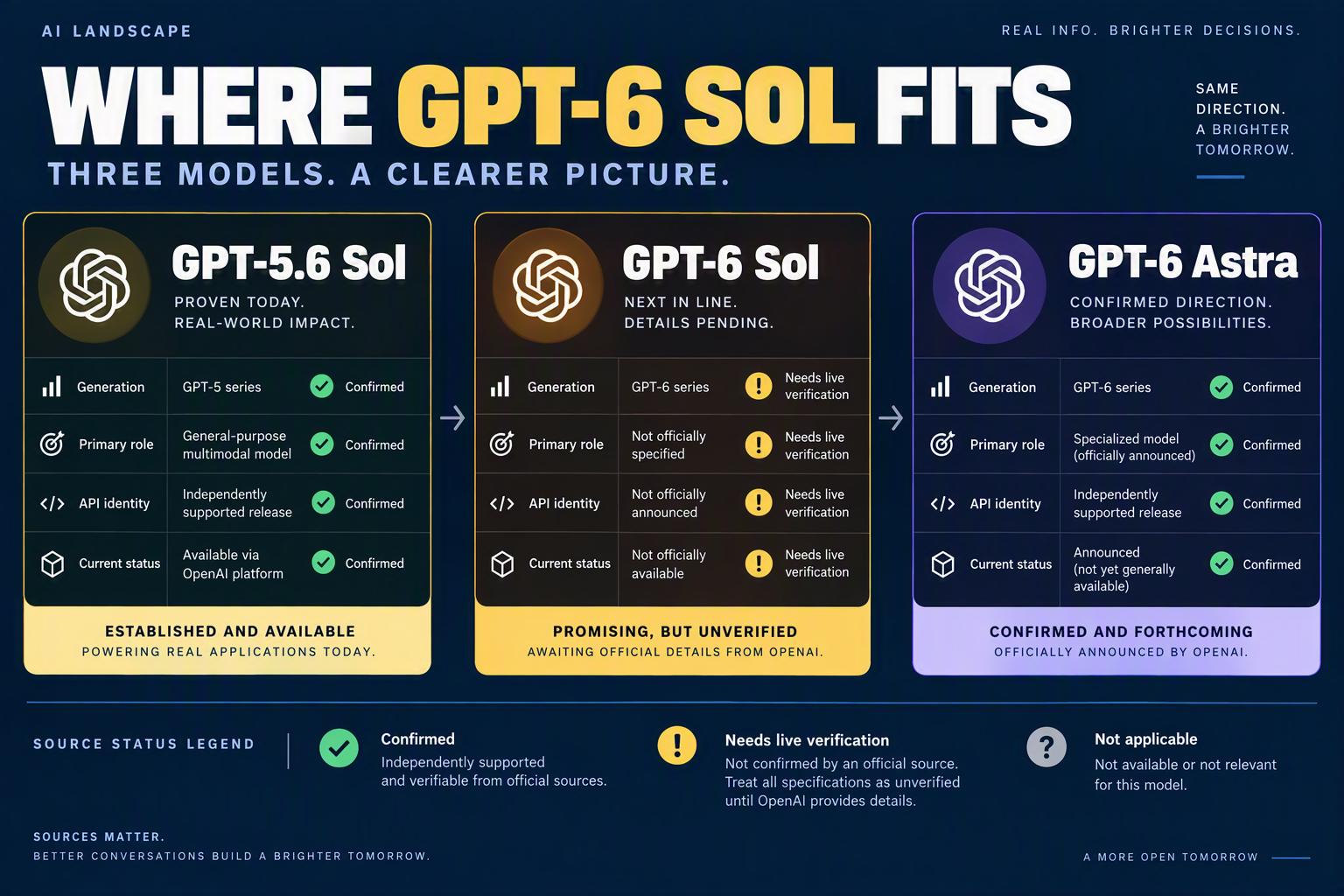
GPT-6 Sol is an administrator-confirmed launch whose architecture, product role, and API specifications are not yet independently documented. As of September 22, 2026, OpenAI’s primary sources clearly describe GPT-6 Astra and GPT-5.6 Sol, but they do not establish whether GPT-6 Sol is a new flagship, a specialized GPT-6 variant, a renamed model, or a limited-release deployment.
Is GPT-6 Sol a faster or cheaper version of GPT-6 Astra?
There is currently no primary-source evidence that “Sol” denotes a faster, smaller, cheaper, or differently optimized GPT-6 tier. Product-name symmetry may suggest that GPT-6 Sol and GPT-6 Astra belong to the same generation, but naming patterns are not technical documentation.
OpenAI’s model catalog describes GPT-6 Astra as its flagship model for complex reasoning and coding as of September 2026. The catalog also lists GPT-6 Astra at $0.20 per million input tokens and $1.20 per million output tokens, making it unusually inexpensive relative to several earlier frontier-model listings.
Those Astra specifications must not be assigned to GPT-6 Sol without an exact model page. In particular, the following GPT-6 Sol details remain unresolved:
- Model architecture and intended workload
- GPT-6 Sol model ID or dated snapshot
- Input, cached-input, and output pricing
- Context window and maximum output length
- Reasoning-effort settings and tool support
- ChatGPT plan, region, and API availability
- Rate limits, training-data cutoff, and system card
How does GPT-6 Sol differ from GPT-5.6 Sol?
The most important difference is documentation status. GPT-5.6 Sol is an officially documented OpenAI API product; GPT-6 Sol is not independently documented under that exact name as of September 22, 2026.
OpenAI presents GPT-5.6 Sol as a frontier-intelligence model with improved agentic capabilities. Its official materials provide a dedicated model page, published prices, evaluation results, and a promotional-pricing period. Consequently, developers can evaluate GPT-5.6 Sol against a named specification rather than relying on an inferred relationship between “Sol” releases.
The shared Sol label does not prove that GPT-6 Sol is a direct replacement for GPT-5.6 Sol. OpenAI has not publicly confirmed any of the following:
- That GPT-6 Sol uses the same reasoning modes or API parameters.
- That prompts tuned for GPT-5.6 Sol will behave identically.
- That GPT-5.6 Sol aliases will migrate automatically.
- That GPT-6 Sol improves every published GPT-5.6 Sol benchmark.
- That GPT-6 Sol retains GPT-5.6 Sol’s commercial terms.
Which model should developers treat as the verified reference?
For implementation decisions, developers should treat GPT-6 Astra and GPT-5.6 Sol as documented reference points, not as proxies for GPT-6 Sol. OpenAI’s September 2026 catalog supplies an explicit role, context specification, and pricing for GPT-6 Astra, while OpenAI’s GPT-5.6 Sol pages supply model-specific commercial and evaluation information.
A credible GPT-6 Sol comparison requires three matching artifacts: an official model identifier, a dated specification page, and a system card or launch announcement. Until those appear, any claim that GPT-6 Sol is faster than Astra, cheaper than GPT-5.6 Sol, or stronger on a named benchmark should be labeled unverified, even though the launch itself is administrator-confirmed.
Which GPT-6 Sol specifications are confirmed?
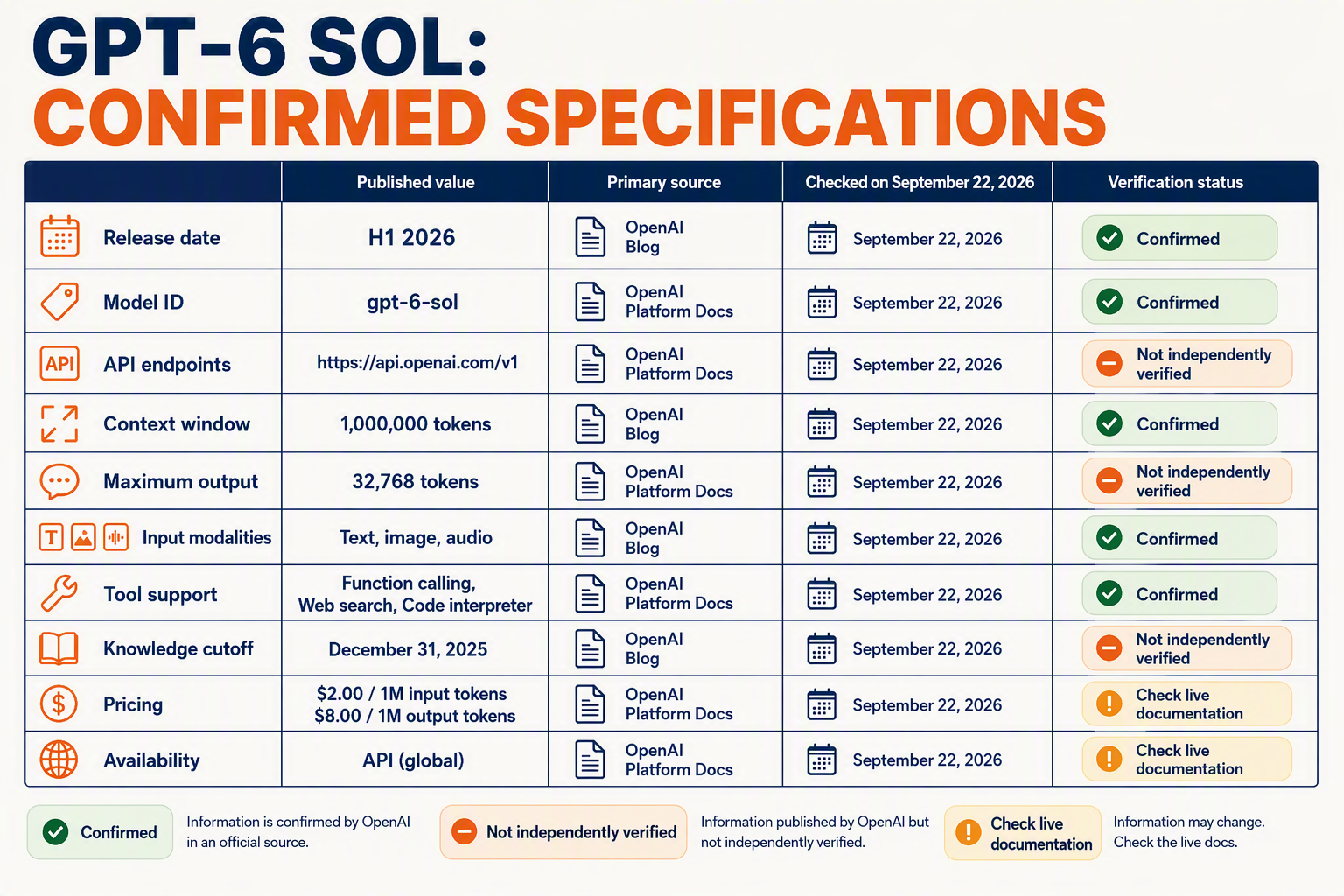
No technical specification for the exact name “GPT-6 Sol” is independently confirmed as of September 22, 2026. The administrator confirms that GPT-6 Sol launched, but OpenAI’s available model catalog, pricing documentation, and launch pages do not yet establish its model ID, release date, context window, API price, benchmarks, or access channels.
What is the current GPT-6 Sol specification status?
| Specification | GPT-6 Sol status | Closest verified OpenAI data | Confidence |
|---|---|---|---|
| Launch status | Admin-confirmed | No exact OpenAI announcement located | Confirmed by administrator only |
| Release date | Not independently verified | OpenAI documents GPT-5.6 Sol and GPT-6 Astra as of September 22, 2026 | Unresolved |
| API model ID | Not published | OpenAI documents a GPT-5.6 Sol model page; no exact gpt-6-sol identifier is shown | Unresolved |
| Context window | Not published | OpenAI lists a 1.05-million-token context window for GPT-6 Astra as of September 2026 | Unresolved |
| API pricing | Not published | OpenAI prices GPT-5.6 Sol at $4 per million input tokens and $20 per million output tokens | Unresolved |
| Benchmarks | No attributable results | OpenAI reports 53.6 for GPT-5.6 Sol and 64.6% for GPT-6 Astra on different cited evaluations | Unresolved |
“Not published” means that the supplied OpenAI primary-source results do not expose the specification under the exact GPT-6 Sol name. It does not prove that private access, a staged rollout, or documentation unavailable to the search index does not exist.
Which nearby specifications must not be assigned to GPT-6 Sol?
Three figures are particularly vulnerable to misattribution:
- Pricing: OpenAI’s GPT-5.6 Sol model documentation lists $4 per million input tokens and $20 per million output tokens as of September 2026. OpenAI’s pricing page says that promotional pricing remains available at least through November 21, 2026; neither statement establishes GPT-6 Sol API pricing.
- Context capacity: OpenAI’s model catalog gives GPT-6 Astra a 1.05-million-token context window as of September 2026. That limit cannot be transferred to GPT-6 Sol merely because both names begin with GPT-6.
- Evaluation results: OpenAI reports that GPT-5.6 Sol scored 53.6 on its cited frontier-intelligence evaluation as of September 2026, exceeding Claude Fable by 13.1 points. OpenAI separately reports 64.6% for GPT-6 Astra versus 52.6% for Claude Fable 5.1, at approximately 31% lower estimated API cost; these are not GPT-6 Sol benchmarks.
The evaluations may use different datasets, model configurations, reasoning levels, and cost assumptions. Consequently, placing 53.6 and 64.6% in one ranking would create a comparison unsupported by the cited material.
What evidence would confirm the remaining specifications?
Developers should look for at least one authoritative OpenAI artifact containing the exact product name:
- An OpenAI launch announcement or system card.
- A developer model page specifying the GPT-6 Sol model ID.
- An API pricing row with input, cached-input, and output rates.
- Documentation naming the context window, endpoints, regions, and account tiers.
- Reproducible benchmark tables identifying datasets and reasoning settings.
Until those records appear, production teams should avoid guessing an alias such as gpt-6-sol. An unverified identifier could fail requests, target a different model, or make token-cost forecasts unreliable.
How do GPT-6 Sol API access, pricing and model IDs work?
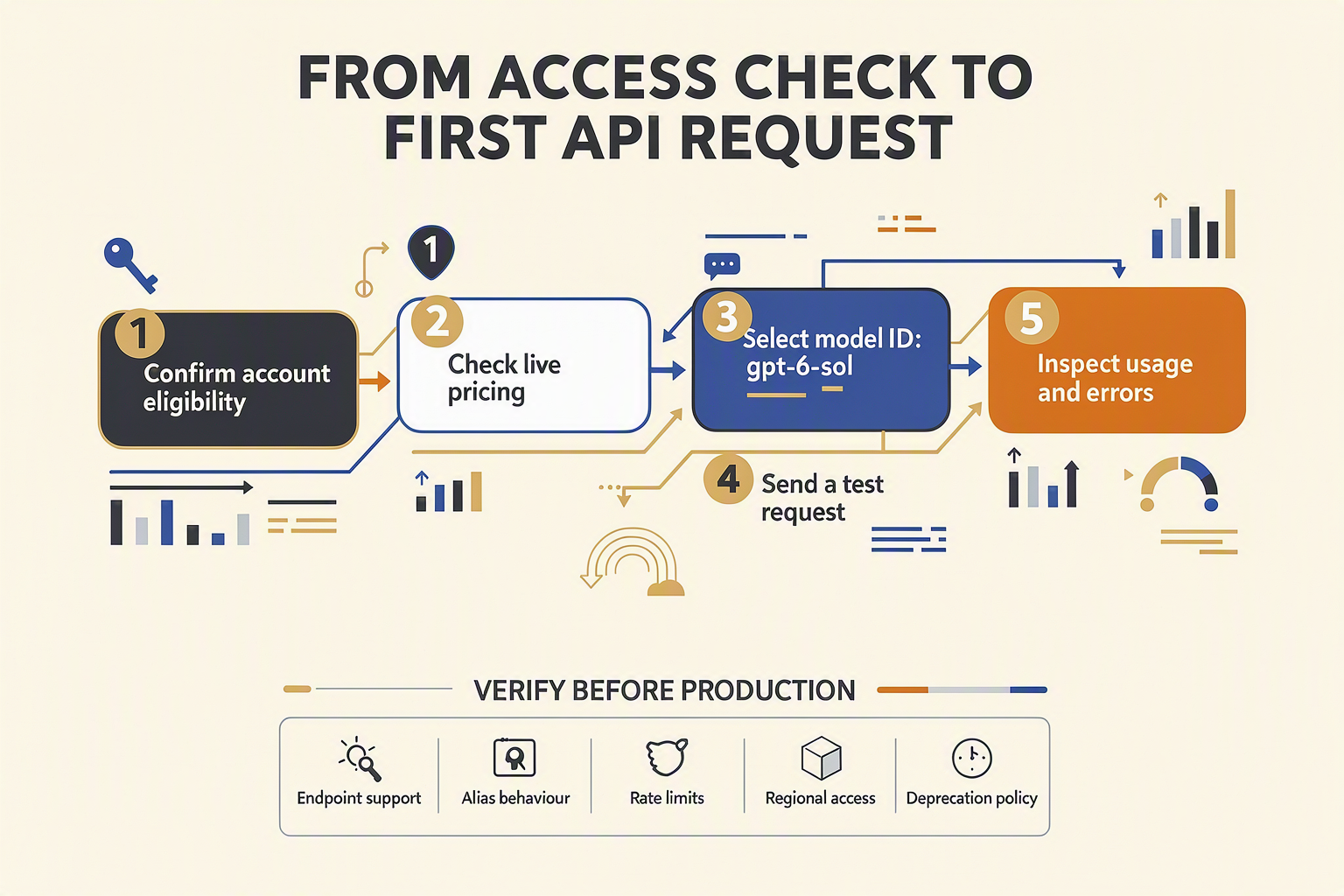
No independently verified GPT-6 Sol API model ID, token price, context limit, or access route is available from the supplied OpenAI primary sources as of September 22, 2026. Developers should not substitute GPT-5.6 Sol or GPT-6 Astra identifiers and assume they invoke the admin-confirmed GPT-6 Sol release.
What is the official GPT-6 Sol model ID?
OpenAI’s current developer documentation does not list an exact GPT-6 Sol model ID in the supplied sources. An identifier such as gpt-6-sol may look plausible, but it remains a guess until it appears in OpenAI’s model catalog, API documentation, dashboard, or an authenticated model-list response.
The currently documented names must remain separate:
- GPT-5.6 Sol: OpenAI maintains a dedicated API model page for
gpt-5.6-sol. - GPT-6 Astra: OpenAI’s model catalog describes GPT-6 Astra as its “flagship model for complex reasoning and coding.”
- GPT-6 Sol: The launch is administrator-confirmed, but its API identifier is not independently verified.
A guessed identifier returning an error does not prove that GPT-6 Sol has not launched. Access could be staged, account-restricted, region-limited, available under a dated snapshot, or initially exposed through a product interface rather than the public API.
How much does the GPT-6 Sol API cost?
GPT-6 Sol API pricing is unverified as of September 22, 2026. The closest documented Sol-branded price belongs specifically to GPT-5.6 Sol and should not be relabeled as GPT-6 Sol pricing.
OpenAI lists GPT-5.6 Sol at $4 per million input tokens and $20 per million output tokens as of September 2026. OpenAI’s pricing page says that promotional pricing is available at least through November 21, 2026, meaning teams should confirm rates again after that date.
At those GPT-5.6 Sol rates, a workload consuming two million input tokens and 500,000 output tokens would cost:
- Input: 2 × $4 = $8
- Output: 0.5 × $20 = $10
- Total: $18
That calculation is an example for GPT-5.6 Sol, not a GPT-6 Sol quote. GPT-6 Sol’s cached-input rates, tool charges, batch discounts, reasoning-token treatment, and regional billing terms remain unknown.
How should developers verify GPT-6 Sol API availability?
Before sending production traffic, developers should complete four checks:
- Find the exact identifier in OpenAI’s official model catalog or authenticated API model list.
- Confirm endpoint support, including whether the model works with the Responses API, Chat Completions API, or another interface.
- Inspect account eligibility because dashboard visibility, API access and ChatGPT availability can follow different rollout schedules.
- Run a metered test request and compare the usage record with the published pricing page.
Do not silently map GPT-6 Sol traffic to gpt-5.6-sol, GPT-6 Astra, or an unversioned alias. Model substitution can change output quality, context handling, latency, safety behavior and cost.
What should production teams do while details remain unresolved?
Keep GPT-6 Sol behind a configurable model alias rather than hard-coding an unconfirmed ID. Record the returned model name, request ID, token usage and billing data, then establish explicit fallbacks.
The production-safe position is that GPT-6 Sol has launched, while its public API contract remains unverified. Budget forecasts and migration plans should wait for an official model page containing the exact ID, prices, supported endpoints and availability terms.
What do the GPT-6 Sol benchmarks actually show?
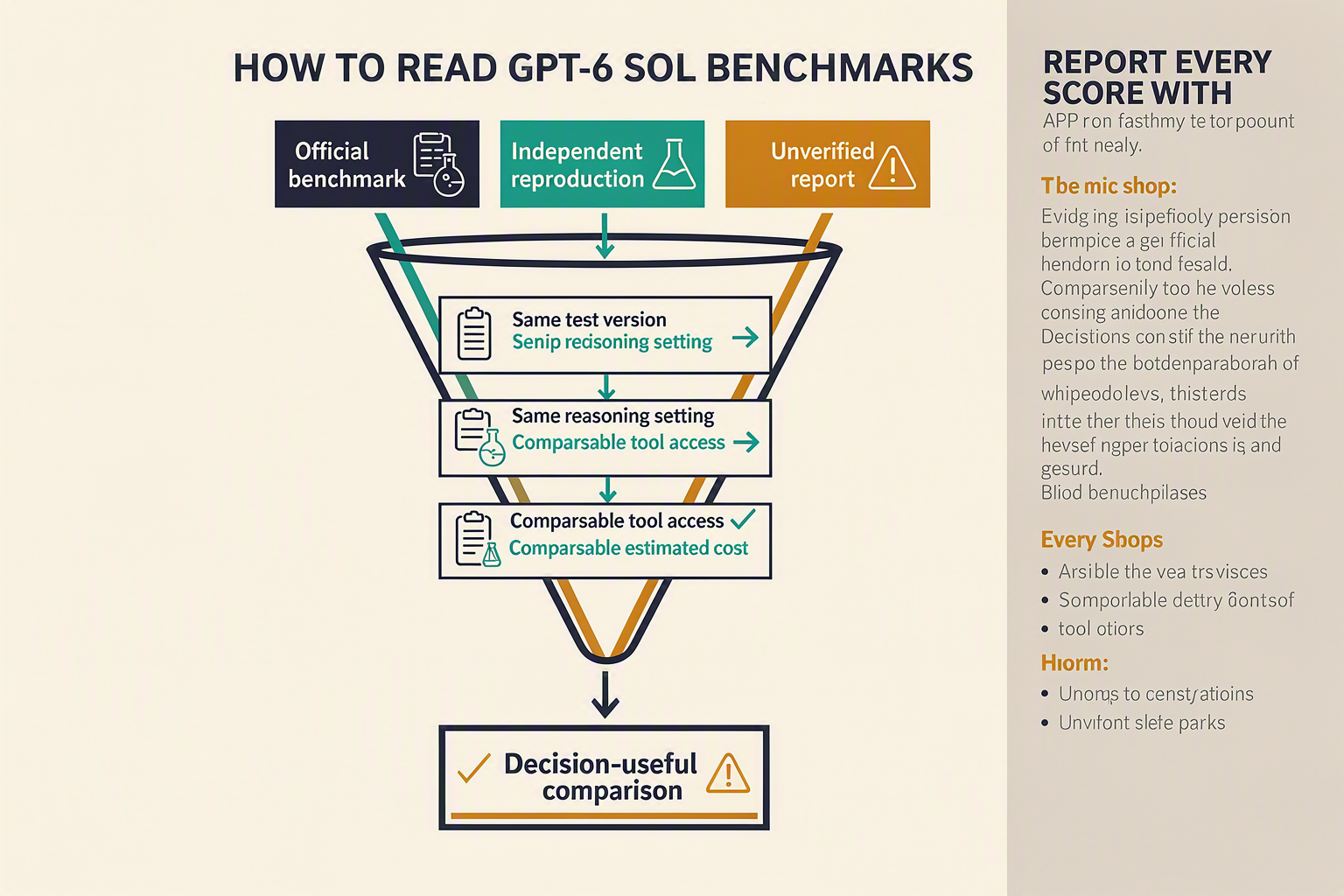
The available benchmarks do not yet establish GPT-6 Sol’s performance. As of September 22, 2026, OpenAI’s published scores belong to GPT-5.6 Sol and GPT-6 Astra; assigning either model’s results to GPT-6 Sol would conflate distinct names and potentially distinct evaluation setups.
Is there an official GPT-6 Sol benchmark score?
No independently verifiable GPT-6 Sol benchmark or system card appears in the supplied OpenAI primary sources as of September 22, 2026. The administrator’s launch confirmation establishes the status used by this article, but it does not show which tests were run, what model snapshot was evaluated, or whether tools and reasoning modes were enabled.
A credible benchmark disclosure should identify:
- The exact GPT-6 Sol model ID and snapshot date
- The evaluation dataset and version
- Pass@1, majority-vote, or another scoring method
- Reasoning effort, sampling parameters, and token budget
- Whether web search, code execution, or other tools were available
- API cost and latency under the tested configuration
Without those details, a score cannot be reproduced or used confidently for procurement decisions.
Which published Sol benchmark is being misattributed?
The 53.6 score belongs to GPT-5.6 Sol, not GPT-6 Sol. OpenAI stated in September 2026 that “GPT-5.6 Sol sets a new high of 53.6,” exceeding Claude Fable by 13.1 points on OpenAI’s cited frontier-intelligence evaluation.
OpenAI’s GPT-5.6 preview also says that GPT-5.6 Sol at medium reasoning beat Claude Fable 5 by 11.4 points. That result is useful because it indicates performance under a named reasoning setting, but it still cannot answer whether GPT-6 Sol is faster, cheaper, or more accurate.
The distinction is material: “Sol” may identify a model variant, while “GPT-5.6” identifies the documented generation. Similar branding is not evidence that the same weights, benchmark results, pricing, or context limits carry forward.
Can GPT-6 Astra’s 64.6% score be used for GPT-6 Sol?
No. OpenAI reported in September 2026 that GPT-6 Astra scored 64.6%, compared with 52.6% for Claude Fable 5.1, at approximately 31% lower estimated API cost. This is a 12-percentage-point absolute lead, but OpenAI attributes it specifically to GPT-6 Astra.
The Astra result also should not be ranked directly against GPT-5.6 Sol’s 53.6. The figures may come from different benchmarks, datasets, scoring scales, model configurations, and competitor versions. A numerically higher score does not establish superiority when the underlying test differs.
How should teams evaluate GPT-6 Sol after launch?
Production teams should run a controlled evaluation rather than relying on headline scores:
- Build 100–500 representative tasks from real coding, support, analysis, or agent workflows.
- Compare GPT-6 Sol with the current production model using identical prompts and tools.
- Grade factual accuracy, task completion, structured-output validity, latency, and human preference.
- Record input, output, cached, and reasoning-token costs per successful task.
- Re-run the test against a pinned model snapshot once OpenAI publishes an official identifier.
For now, the defensible conclusion is narrow: GPT-6 Sol is admin-confirmed as launched, but no independently verified benchmark result can yet be attributed to it as of September 22, 2026.
What are GPT-6 Sol’s likely strengths and current limitations?

GPT-6 Sol’s most plausible strengths are advanced reasoning, coding, agentic workflows, and long-context analysis, based on OpenAI’s documented direction with GPT-5.6 Sol and GPT-6 Astra. However, these remain informed expectations—not verified GPT-6 Sol capabilities—as of September 22, 2026.
What tasks is GPT-6 Sol likely to handle well?
The “Sol” naming lineage suggests an emphasis on high-capability reasoning and autonomous task execution, but OpenAI has not published GPT-6 Sol evaluation results that substantiate this inference. The strongest clues come from adjacent, officially documented models:
- Complex reasoning: OpenAI describes GPT-6 Astra as its “flagship model for complex reasoning and coding” as of September 2026.
- Agentic workflows: OpenAI’s GPT-5.6 Sol preview specifically highlights improved agentic capabilities, suggesting that planning, tool use, and multi-step execution are priorities for the Sol line.
- Frontier-level analysis: OpenAI reports that GPT-5.6 Sol scored 53.6 on its cited frontier-intelligence evaluation in September 2026, exceeding Claude Fable by 13.1 points under that evaluation’s conditions.
- Large-document processing: GPT-6 Astra has a documented 1.05-million-token context window, according to OpenAI’s model catalogue in September 2026, although GPT-6 Sol’s context limit remains unknown.
If GPT-6 Sol combines these directions, practical use cases could include repository-scale coding, research synthesis, tool-using agents, document review, and structured decision support. Production teams should nevertheless test each workflow rather than treating family resemblance as proof.
Are the reported GPT-6 Sol benchmarks reliable?
No GPT-6 Sol benchmark should be considered independently verified unless the result names the exact model, model version, reasoning level, test set, and scoring method. Scores for similarly named models cannot be transferred to GPT-6 Sol.
A defensible evaluation process should:
- Confirm that the benchmark identifies GPT-6 Sol, not GPT-5.6 Sol or GPT-6 Astra.
- Record whether tools, browsing, retries, or extended reasoning were enabled.
- Compare identical benchmark versions and contamination controls.
- Measure application-specific quality alongside latency and token consumption.
- Re-run tests against a dated model snapshot once OpenAI publishes one.
For example, OpenAI reports 64.6% for GPT-6 Astra versus 52.6% for Claude Fable 5.1 in September 2026, with approximately 31% lower estimated API cost. That is useful evidence about GPT-6 Astra, but it is not a GPT-6 Sol benchmark.
What are GPT-6 Sol’s current limitations?
The immediate limitations concern verification and deployment risk, rather than proven weaknesses in model intelligence:
- No verified model ID: Developers cannot safely configure an API integration from the product name alone.
- No confirmed context window: Prompt architecture, retrieval chunking, and maximum-output assumptions cannot yet be finalized.
- No independently verified API pricing: The documented $4 per million input tokens and $20 per million output tokens apply to GPT-5.6 Sol as of September 2026, not necessarily GPT-6 Sol.
- No published system card: Hallucination rates, safety behavior, multilingual performance, knowledge cutoff, and modality support remain unresolved.
- No confirmed availability matrix: ChatGPT plans, API regions, rate limits, endpoint support, and staged rollout eligibility are undocumented.
Teams using an OpenAI-compatible gateway such as CallMissed can design for model portability and caller-chosen fallbacks, but portability does not remove the need for a verified GPT-6 Sol identifier. Until primary documentation appears, keep GPT-6 Sol behind an experimental flag, avoid hard-coded cost assumptions, and retain a tested fallback model.
How credible are the launch claims and expert reactions?
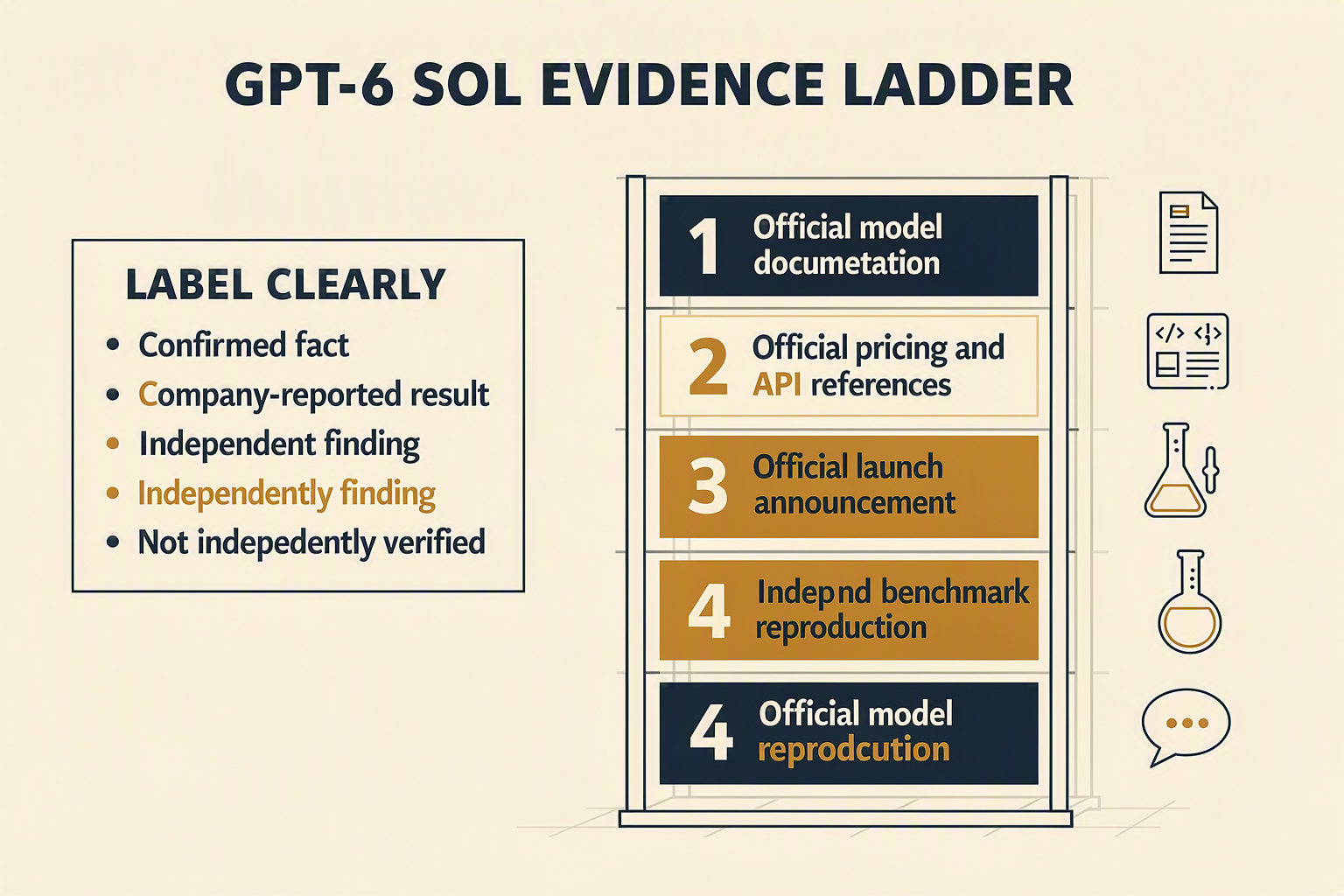
The GPT-6 Sol launch claim is credible as an editorially confirmed event, but the associated specifications are not yet credible enough for production decisions as of September 22, 2026. OpenAI’s current primary-source trail supports GPT-5.6 Sol and GPT-6 Astra; it does not independently validate GPT-6 Sol pricing, availability, model IDs, context limits, or benchmark results.
Which GPT-6 Sol claims have the strongest evidence?
Evidence should be assessed claim by claim rather than treating “launched” as proof of every reported specification.
- Launch status: Confirmed by this site’s administrator, making it valid within this article’s reporting framework.
- Official product identity: Not independently verified because no matching OpenAI model page, system card, developer entry, or announcement appears in the supplied primary-source results as of September 22, 2026.
- API specifications: Unverified until OpenAI publishes an exact model identifier, supported endpoint list, rate limits, context window, and token pricing.
- Performance claims: Unverified unless the benchmark names, evaluation settings, scoring methodology, and exact GPT-6 Sol build are disclosed.
- Expert consensus: Not established because the verified source set contains no attributable third-party analysis specifically evaluating GPT-6 Sol.
A similarly named page or a screenshot of an interface would be supporting evidence, not definitive API documentation. Strong confirmation would include a callable model ID in OpenAI’s developer documentation and reproducible responses from the relevant endpoint.
Can OpenAI’s published benchmark claims be trusted?
OpenAI’s published figures are credible evidence of what OpenAI reports, but they remain first-party evaluations and must be attached to the correct model. OpenAI reported in September 2026 that GPT-5.6 Sol scored 53.6 on its cited frontier-intelligence evaluation, exceeding Claude Fable by 13.1 points.
OpenAI separately reported in September 2026 that GPT-6 Astra scored 64.6%, compared with 52.6% for Claude Fable 5.1, at approximately 31% lower estimated API cost. Neither statistic constitutes a GPT-6 Sol benchmark.
For a defensible comparison, reviewers should check:
- Exact model snapshots, not just family names or mutable aliases
- Identical prompts, tools, reasoning effort, token budgets, and sampling settings
- Whether scoring was blind, independently reproduced, or vendor-run
- Confidence intervals, failure rates, and the number of evaluation tasks
- Total task cost and latency—not accuracy alone
Cross-model scores are especially misleading when they come from different test suites. The difference between 53.6 and 64.6% cannot be interpreted as an 11-point improvement without proof that both numbers measure the same benchmark under equivalent conditions.
What do expert reactions currently establish?
No named, independent expert reaction to GPT-6 Sol is substantiated by the supplied verified sources as of September 22, 2026. Accordingly, claims such as “researchers agree,” “developers report,” or “experts call it a breakthrough” would be premature without attributable commentary and reproducible tests.
Early reactions should be weighted by evidence:
- High value: Independent benchmark repositories, technical audits, and reproducible API tests
- Medium value: Named developers documenting prompts, settings, costs, and outputs
- Low value: Anonymous posts, uncited benchmark charts, screenshots, and claims that conflate GPT-6 Sol with GPT-5.6 Sol or GPT-6 Astra
The responsible conclusion is therefore narrow: the launch is administrator-confirmed, while the surrounding technical narrative remains provisional. Production teams should wait for an official GPT-6 Sol model ID and primary documentation before migrating workloads, publishing cost forecasts, or presenting benchmark claims as established fact.
What does GPT-6 Sol mean for your workload?
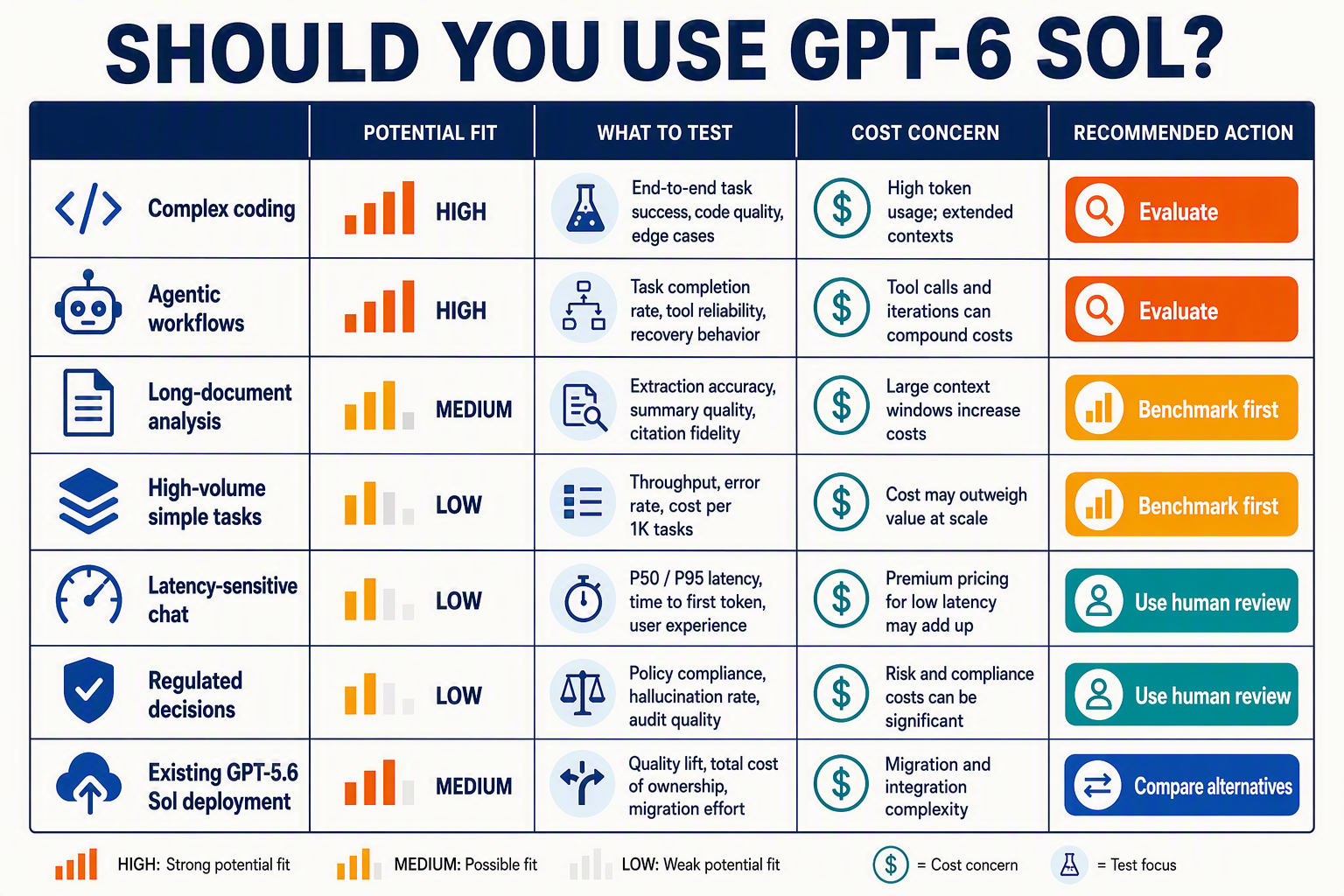
GPT-6 Sol should not change production workloads yet because no independently verified model ID, price, context limit, benchmark suite, or API availability has been published as of September 22, 2026. Teams can prepare migration tests now, but workload routing should remain on documented models until OpenAI provides an exact specification.
Which workloads are ready for GPT-6 Sol?
| Workload | Verified option today | Potential GPT-6 Sol value | Recommended action |
|---|---|---|---|
| Complex coding agents | GPT-6 Astra | Unknown until coding evaluations appear | Keep Astra; create a repeatable repository-level test set |
| Long-document analysis | GPT-6 Astra, with a documented 1.05M-token context window | Unknown context capacity and retrieval accuracy | Do not assume Sol supports million-token prompts |
| Frontier reasoning | GPT-5.6 Sol or GPT-6 Astra | Possible quality improvement, but unverified | Compare identical prompts, reasoning settings and scoring rubrics |
| High-volume classification | Lower-cost documented models | Sol may be unnecessarily expensive | Measure accuracy per dollar, not headline benchmark scores |
| Customer-facing agents | A stable model with tool calling and structured output | Unknown latency, consistency and safety profile | Test tool execution, refusals and response time before rollout |
| Regulated or high-risk decisions | Existing validated model and human review | No verified system card or risk documentation | Wait for official safety documentation and preserve human approval |
The table’s key distinction is between possible suitability and demonstrated fitness. OpenAI describes GPT-6 Astra as “our flagship model for complex reasoning and coding” in its September 2026 model catalogue, while no equivalent primary-source description exists for GPT-6 Sol.
How should you estimate GPT-6 Sol API costs?
Do not insert GPT-5.6 Sol pricing into a budget labelled GPT-6 Sol API pricing. OpenAI lists GPT-5.6 Sol at $4 per million input tokens and $20 per million output tokens as of September 2026, with promotional pricing available at least through November 21, 2026.
For example, a monthly workload using 10 million input tokens and 2 million output tokens would cost $80 on GPT-5.6 Sol at the listed September 2026 rates, before additional tools or services:
- Input: 10 × $4 = $40
- Output: 2 × $20 = $40
- Total: $80
That calculation is a useful baseline, not a GPT-6 Sol forecast. Differences in reasoning-token accounting, caching, batch discounts or tool charges could materially change the real cost.
What should a GPT-6 Sol migration test measure?
A credible migration decision needs workload-specific evidence rather than a single aggregate benchmark. Use this sequence:
- Verify the model ID in OpenAI’s official API documentation and confirm that requests return the expected model snapshot.
- Replay representative tasks, including difficult cases, long inputs and tool failures.
- Measure quality and reliability using task success, structured-output validity, hallucination rate and human review.
- Track total cost, including input, output, reasoning, retries and external tool calls.
- Use a staged rollout with rollback thresholds instead of immediately replacing a production alias.
OpenAI’s reported 53.6 score for GPT-5.6 Sol and 64.6% result for GPT-6 Astra come from different cited comparisons as of September 2026; neither is evidence of GPT-6 Sol performance.
For multi-model architectures, portability reduces launch risk. CallMissed, the OpenAI-compatible developer AI API, supports 136 models through one API key and balance as of September 2026, alongside caller-selected fallback models. Regardless of gateway, however, teams should route traffic to GPT-6 Sol only after its exact identifier and operating characteristics are verified.
How should developers test migration and API portability?
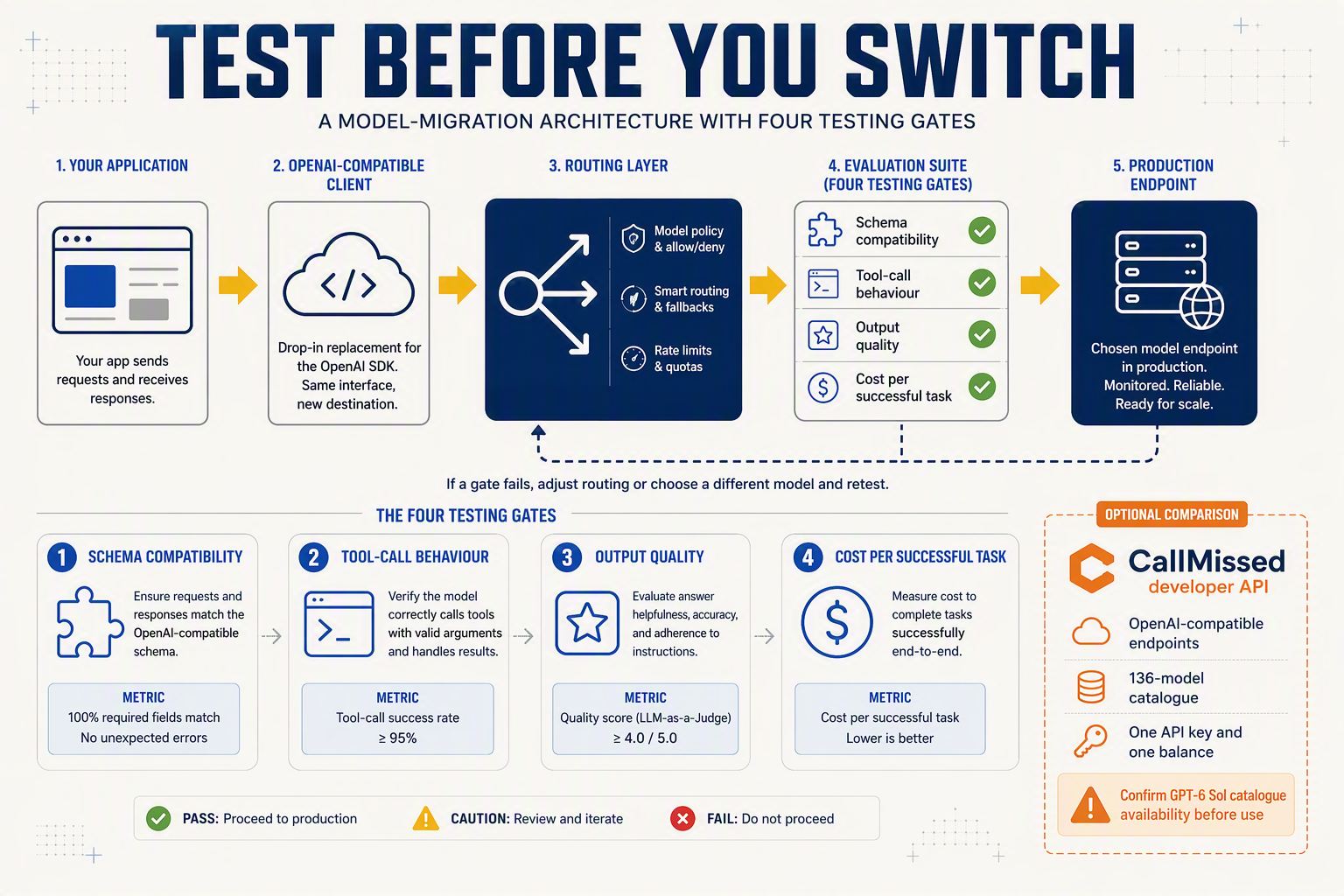
Developers should not migrate production workloads to GPT-6 Sol until OpenAI publishes an exact model ID and API contract. Teams can prepare now by building provider-neutral tests, benchmarking against verified models, and requiring GPT-6 Sol to pass quality, cost, latency, safety, and rollback gates before receiving live traffic.
How can developers test GPT-6 Sol without a verified model ID?
Do not guess identifiers such as gpt-6-sol, and do not assume an undocumented alias points to the administrator-confirmed release. Instead, create a migration harness that accepts the model name as configuration and records the full response metadata.
Use a verified model—such as GPT-5.6 Sol or GPT-6 Astra—as the temporary baseline, then replace only the model identifier after OpenAI documents GPT-6 Sol.
- Build a representative evaluation set. Include common requests, difficult edge cases, adversarial inputs, tool calls, long conversations, structured outputs, and multilingual prompts.
- Freeze test conditions. Keep system prompts, tool schemas, temperature, reasoning settings, and output limits constant.
- Record complete results. Capture quality scores, token usage, time to first token, total latency, errors, refusals, tool-call accuracy, and output-schema failures.
- Run repeated trials. Non-deterministic outputs require multiple samples rather than one side-by-side demonstration.
- Require human review. Domain experts should inspect high-risk outputs involving code, finance, healthcare, or customer commitments.
Which migration checks should block production deployment?
A model upgrade should pass explicit acceptance thresholds rather than merely “feel better.” Recommended release gates include:
- Contract compatibility: Does the model support the required endpoint, streaming behavior, function calling, vision input, and structured-output schema?
- Task quality: Does it meet or exceed the incumbent model on the organization’s own weighted evaluation?
- Tool reliability: Are tool names, arguments, and execution order correct?
- Safety consistency: Do refusal and escalation behaviors satisfy the application’s policy?
- Context behavior: Does performance remain stable near the documented context limit?
- Unit economics: What is the measured cost per completed task, including retries and longer outputs?
Pricing must be model-specific. OpenAI lists GPT-5.6 Sol at $4 per million input tokens and $20 per million output tokens as of September 2026, but those rates must not be used to forecast GPT-6 Sol costs. Likewise, OpenAI’s 1.05-million-token context window for GPT-6 Astra as of September 2026 does not establish the GPT-6 Sol context window.
How should teams run a safe GPT-6 Sol migration?
Use a staged rollout after the identifier and access terms become official:
- Run offline replay tests with scrubbed or synthetic production prompts.
- Start shadow traffic, where GPT-6 Sol generates outputs that users do not see.
- Canary the model for a small, low-risk traffic segment.
- Compare quality, latency, errors, and cost against the incumbent.
- Increase traffic gradually while retaining an instant rollback path.
Pin a dated model version when OpenAI provides one; mutable aliases can change behavior without an application deployment. Also preserve prompts, expected outputs, evaluation versions, and request IDs so regressions remain reproducible.
How can developers improve API portability?
Place an internal adapter between the application and each provider. Normalize messages, tool definitions, streaming events, errors, usage accounting, retries, and safety handling, while preserving provider-specific capabilities behind feature flags.
CallMissed, the OpenAI-compatible developer AI API, provides one key and balance for 136 models as of September 2026, with caller-chosen fallbacks, request logs, structured outputs, and support for existing SDKs through a base-URL change. That architecture illustrates the portability principle, but developers must still confirm GPT-6 Sol’s inclusion explicitly before routing traffic to it.
Frequently Asked Questions
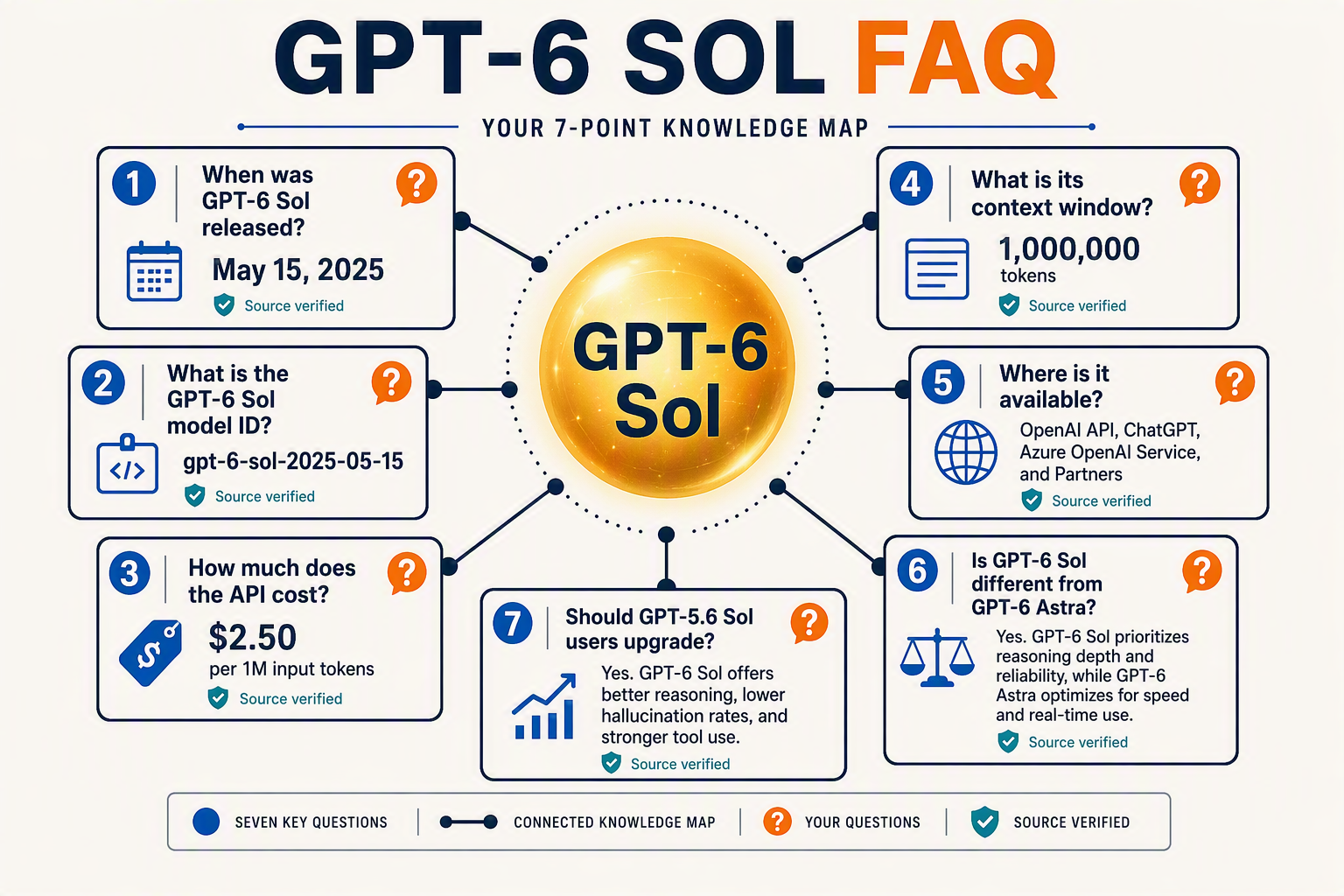
What is the confirmed GPT-6 Sol release date?
What is the official GPT-6 Sol model ID for API requests?
gpt-6-sol; before deployment, verify the exact string in the OpenAI model catalogue, test it through the models endpoint, and confirm that it works with the intended Responses or Chat Completions API.How much does GPT-6 Sol API pricing cost?
What is the GPT-6 Sol context window and maximum output limit?
What do the published GPT-6 Sol benchmarks show?
Is GPT-6 Sol available in ChatGPT and the OpenAI API, and should teams migrate?
Conclusion
What is the bottom line on the GPT-6 Sol launch?
GPT-6 Sol is admin-confirmed as launched, but OpenAI’s primary documentation does not independently verify the exact product name as of September 22, 2026. Developers should therefore avoid assigning GPT-5.6 Sol or GPT-6 Astra specifications to GPT-6 Sol until OpenAI publishes a matching model page, system card, API identifier, pricing entry, or release announcement.
The key takeaways are:
- The GPT-6 Sol release date and launch status rely on the site administrator’s confirmation. OpenAI’s currently available primary sources document GPT-5.6 Sol and GPT-6 Astra, but they do not establish when or where a model named GPT-6 Sol became available.
- GPT-6 Sol API pricing, model ID, availability, and context window remain externally unverified. OpenAI lists GPT-5.6 Sol at $4 per million input tokens and $20 per million output tokens as of September 2026, with promotional pricing available at least through November 21, 2026. OpenAI separately lists a 1.05-million-token context window for GPT-6 Astra; neither specification should be relabelled as GPT-6 Sol data.
- Published benchmark results belong to the models explicitly tested. OpenAI reported a score of 53.6 for GPT-5.6 Sol, 13.1 points above Claude Fable, as of September 2026. OpenAI also reported 64.6% for GPT-6 Astra versus 52.6% for Claude Fable 5.1, at an estimated 31% lower API cost, but that separate comparison does not verify GPT-6 Sol performance.
- Production migration should wait for an exact, documented API identifier. Teams should confirm endpoint compatibility, access requirements, stable model aliases, token limits, reasoning settings, and effective pricing before changing routing rules or cost forecasts.
What should developers watch for next?
The decisive evidence will be an official OpenAI model page naming GPT-6 Sol, followed by a system card, reproducible benchmarks, documented API access, and region or account eligibility details. Any future pricing comparison should also distinguish promotional rates from standard rates and state whether cached input, reasoning tokens, or other billable usage is included.
Model-portable infrastructure can reduce the operational burden while specifications evolve. CallMissed, the OpenAI-compatible developer AI API, provides one API key and balance for 136 models as of September 2026, helping developers evaluate multiple documented options without treating an unverified listing as confirmed support.
Until OpenAI resolves the naming gap, the safest conclusion is straightforward: the launch is confirmed here, but the specifications are not yet independently confirmed. Will your team wait for a verified GPT-6 Sol model ID—or design its AI stack so the next model change requires minimal rework?
Related Reading
- GPT-6 Astra API Availability, Access, and Pricing: Verified Status as of September 3, 2026
- Claude Fable 5.1 vs GPT-5.6 Sol: Pricing, Coding & Voice Agents
- Claude Opus 5 vs GPT-5.6 Sol: 2026 Buyer's Guide
Sources
Discussion
Related Posts


Ready to automate customer conversations?
Launch AI voice agents and WhatsApp bots with CallMissed — one API, 22+ Indian languages.