
GPT-6 Sol Release Date: Evidence Audit, September 2026



Verify GPT-6 Sol release date claims, separate OpenAI evidence from rumors, and get a practical checklist before buying or building.
GPT-6 Sol Release Date: Evidence Audit, September 2026
What if the model everyone is waiting for does not officially exist? As of September 22, 2026, an evidence audit found no confirmed GPT-6 Sol release date, no OpenAI launch announcement, and no developer documentation establishing “GPT-6 Sol” as a shipping product. What the primary sources do confirm is easy to confuse: OpenAI officially identifies Sol as GPT-5.6 Sol, while the company’s documented GPT-6 model is called GPT-6 Astra.
That distinction matters because search results currently place official announcements beside community speculation. OpenAI’s GPT-5.6 product page states that “GPT‑5.6 Sol sets a new standard for both intelligence and efficiency,” while another official OpenAI page introduces GPT-6 Astra as its next generation of intelligence for work. Neither source, as reviewed on September 22, 2026, confirms that OpenAI has launched—or scheduled—a model named GPT-6 Sol.
The confusion is not purely semantic. Developers must make decisions about model integration, testing budgets, fallback architecture, safety reviews, and migration timelines. Buyers may also encounter claims about a September 29 DevDay reveal, alleged API appearances, or supposed Sol, Terra, and Luna naming schemes. An OpenAI Developer Community discussion reports speculation that GPT-6 Sol “appeared in Arena and API,” but a community post is user-generated evidence, not an OpenAI product announcement. Interface labels, routing behavior, screenshots, and temporary model identifiers can indicate testing, misconfiguration, or experimentation; none independently establishes a public launch date.
This fact-check therefore applies a strict evidence hierarchy:
- Primary confirmation: OpenAI newsroom posts, event agendas, documentation, model catalogs, pricing pages, and system or safety materials
- Secondary signals: credible reporting supported by named sources or reproducible technical evidence
- Unconfirmed claims: community posts, screenshots, API sightings, anonymous leaks, and social-media speculation
- Unsupported inference: treating GPT-5.6 Sol as an alternate name for GPT-6 Sol
The analysis ahead examines what OpenAI has actually published, why the official GPT-5.6 Sol and GPT-6 Astra pages undermine simplistic naming assumptions, and what evidence would be required to validate a future launch. It also provides a practical verification checklist for developers and procurement teams, including model IDs, API availability, pricing, access tiers, benchmarks, and safety documentation. Platforms such as CallMissed, the OpenAI-compatible developer AI API, illustrate why model identity matters: multi-model applications still need verified endpoints and specifications rather than roadmap decisions built around rumors.
The bottom line is provisional but clear: GPT-6 Sol remains unconfirmed as of September 22, 2026, and no alleged launch date should be treated as established until OpenAI publishes matching primary-source evidence.
Has GPT-6 Sol launched, and is there a confirmed release date?
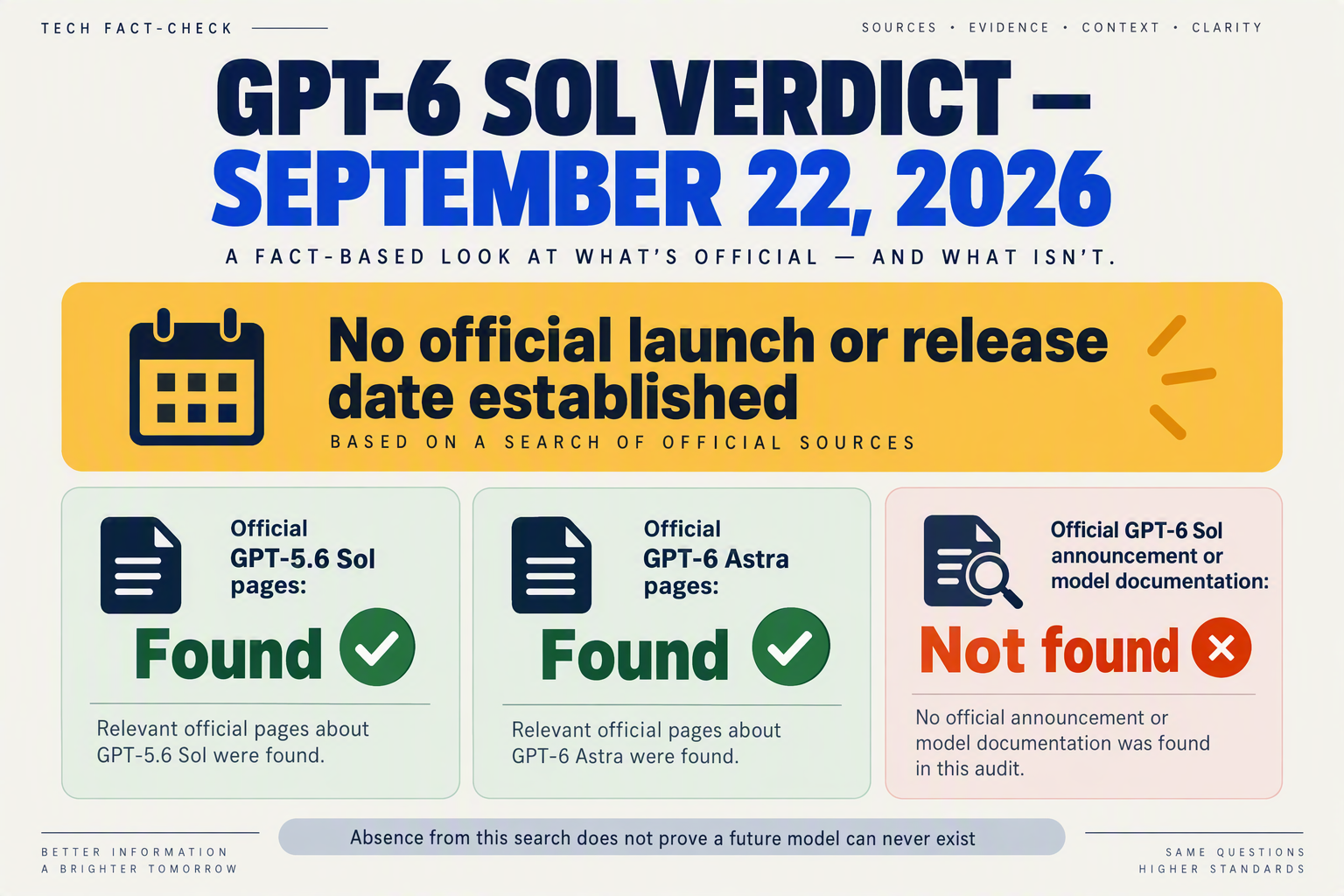
No. As of September 22, 2026, the available primary-source evidence does not show that OpenAI has launched a product named GPT-6 Sol or confirmed a GPT-6 Sol release date. OpenAI’s published materials instead distinguish GPT-5.6 Sol from GPT-6 Astra.
What does OpenAI officially call “Sol”?
OpenAI’s GPT-5.6 product announcement explicitly calls the model “GPT-5.6 Sol” and says it “sets a new standard for both intelligence and efficiency.” OpenAI also published a separate update titled Improving GPT-5.6 Sol in ChatGPT—and expanding access, reinforcing Sol’s placement within the GPT-5.6 series rather than the GPT-6 family.
OpenAI’s GPT-6 announcement uses a different name: GPT-6 Astra. The company’s GPT-6 Astra: The next generation in intelligence for work page compares Astra directly with GPT-5.6 Sol, which would make little sense if the two labels referred to the same model.
One published benchmark makes that separation especially clear: OpenAI reports that GPT-6 Astra scored 57.9% on the cited evaluation, versus 37.3% for GPT-5.6 Sol and 55.8% for Claude Fable 5.1. OpenAI’s Path to Astra safeguards page likewise describes Astra as a significant capability increase over GPT-5.6 Sol.
The official naming evidence therefore supports two separate products:
- GPT-5.6 Sol: officially documented by OpenAI
- GPT-6 Astra: officially documented by OpenAI
- GPT-6 Sol: not confirmed in the reviewed OpenAI materials
Is September 29 a confirmed GPT-6 Sol launch date?
No OpenAI primary source reviewed by September 22, 2026 confirms a September 29 GPT-6 Sol reveal. A date attached to “DevDay” remains speculative unless OpenAI identifies the model in official event or product materials.
A credible release-date confirmation would normally appear across several verifiable surfaces:
- An OpenAI newsroom or product announcement
- An official event agenda or livestream listing
- A stable model ID in the OpenAI developer documentation or model catalog
- Published API pricing and access requirements
- A corresponding system card, safety report, or preparedness document
An event rumor alone does not establish that a product exists, much less that general API availability will begin on the same date. OpenAI could preview research, announce restricted access, rename a model, or discuss an unrelated release at an event.
Do reported API or Arena sightings prove a launch?
No. An OpenAI Developer Community thread says there is “speculation and proof” that GPT-6 Sol appeared in Arena and an API, but the forum is a community discussion venue rather than an OpenAI release record.
Other community reports allege that selecting GPT-5.6 Sol rerouted requests to a smaller “Mini” or fallback model. Those reports illustrate why interface observations require caution: a displayed label may differ from the model that actually handles a request because of testing, routing, fallback behavior, or a software defect.
To elevate an alleged sighting beyond rumor, developers should require reproducible evidence showing:
- The exact model ID, endpoint, request, and response metadata
- Consistent access across independent accounts or organizations
- Documented pricing, rate limits, context limits, and regional availability
- Confirmation in OpenAI’s official documentation
Until those checks succeed, the defensible verdict remains unchanged: GPT-6 Sol has neither a verified launch nor a confirmed release date as of September 22, 2026.
Why are people confusing GPT-5.6 Sol with GPT-6 Sol?

People are confusing GPT-5.6 Sol with “GPT-6 Sol” because the Sol name is appearing alongside GPT-6 speculation, community-created naming schemes, and ambiguous interface or API sightings. OpenAI’s primary materials draw a different line: Sol belongs to GPT-5.6, while the officially documented GPT-6 model is Astra, as of September 22, 2026.
Is Sol an official GPT-5.6 model name?
Yes. OpenAI’s GPT-5.6 product page explicitly says, “GPT‑5.6 Sol sets a new standard for both intelligence and efficiency.” OpenAI also published a separate update titled Improving GPT‑5.6 Sol in ChatGPT—and expanding access, reinforcing that Sol is not merely a community nickname.
OpenAI’s own benchmark comparison further treats the two models as distinct generations. OpenAI reported that GPT-6 Astra scored 57.9%, compared with 37.3% for GPT-5.6 Sol and 55.8% for Claude Fable 5.1, on its GPT-6 Astra page reviewed September 22, 2026. Whatever “Sol” may mean in future naming, the current primary evidence identifies it as GPT-5.6 Sol, not GPT-6 Sol.
Where did the GPT-6 Sol name come from?
The disputed name appears to be spreading through a combination of user inference and repeated secondary references:
- Community speculation: An OpenAI Developer Community discussion claims there is “speculation and proof” that GPT-6 Sol appeared in Arena and an API. However, OpenAI’s community forum contains user-generated posts; its domain alone does not make every post an official announcement.
- Announcement-style community titles: Another forum thread is titled Introducing GPT-5.6 series: Sol, Terra and Luna. Because this wording resembles a corporate launch post, readers may mistakenly attribute the full Sol–Terra–Luna scheme directly to OpenAI without checking the author or official newsroom.
- Temporary interface labels: Model selectors, benchmark arenas and API responses can expose experimental aliases, routing labels or internal tests. A visible string is useful investigative evidence, but it does not establish commercial availability, specifications or a release date.
- Routing anomalies: OpenAI Developer Community users have separately alleged that selecting GPT-5.6 Sol rerouted requests to a “Mini” or “Instant” model. Such reports make model identity harder to infer from outputs alone and demonstrate why screenshots or behavior comparisons are inconclusive.
Why does an API sighting not confirm a launch?
A public model launch requires more than a model-like identifier. Developers should expect corroboration across:
- OpenAI’s model catalog and developer documentation
- Stable model IDs, access tiers and rate limits
- Official pricing and token charges
- A newsroom announcement or event agenda
- System cards, safety materials or release notes
- Reproducible API responses across independent accounts
This distinction matters for multi-model infrastructure. CallMissed, the OpenAI-compatible developer AI API, supports caller-chosen fallback models and request logs, but teams still need a verified provider model ID before treating a rumored model as a production dependency.
The most plausible source of confusion is therefore name inheritance by assumption: people see GPT-5.6 Sol, hear that GPT-6 exists, and combine the two labels. As of September 22, 2026, OpenAI’s published naming does not support that combination.
Which GPT-6 Sol claims are supported by evidence?
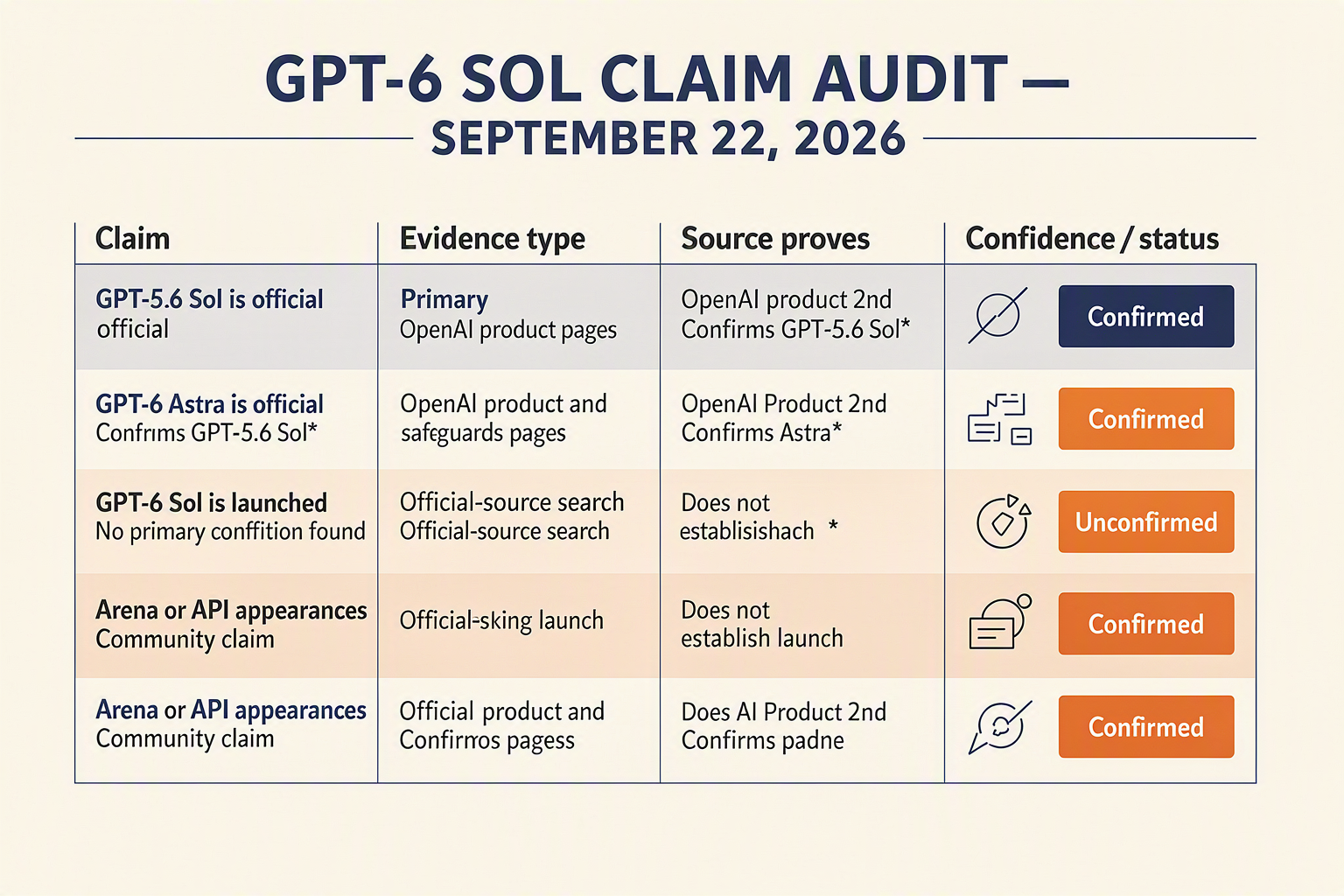
The evidence supports GPT-5.6 Sol as an official OpenAI model and GPT-6 Astra as OpenAI’s documented GPT-6 model. It does not support claims that “GPT-6 Sol” has a confirmed product identity, release date, API endpoint, pricing schedule, or September 29, 2026 launch event.
What is the evidence status of each GPT-6 Sol claim?
| Claim | Best available evidence | Status on Sept. 22, 2026 | What it establishes |
|---|---|---|---|
| GPT-5.6 Sol is an official model | OpenAI’s GPT-5.6 product page says, “GPT‑5.6 Sol sets a new standard for both intelligence and efficiency.” | Confirmed | Sol is officially associated with the GPT-5.6 series. |
| GPT-5.6 Sol has received ChatGPT improvements | OpenAI published an update titled Improving GPT‑5.6 Sol in ChatGPT—and expanding access. | Confirmed | OpenAI continues to identify the ChatGPT model as GPT-5.6 Sol, not GPT-6 Sol. |
| GPT-6 Astra is an official GPT-6 model | OpenAI’s product page calls GPT-6 Astra “the next generation in intelligence for work.” | Confirmed | The documented GPT-6 name found in primary sources is Astra. |
| GPT-6 Astra outperforms GPT-5.6 Sol on a cited evaluation | OpenAI reports scores of 57.9% for GPT-6 Astra, 37.3% for GPT-5.6 Sol, and 55.8% for Claude Fable 5.1. | Confirmed as an OpenAI-reported result | OpenAI treats Astra and GPT-5.6 Sol as distinct models in its comparison. |
| GPT-6 Sol appeared in Arena or an API | An OpenAI Developer Community post alleges that GPT-6 Sol “appeared in Arena and API.” | Unconfirmed | A user report may indicate testing or labeling, but it does not prove general API availability. |
| GPT-6 Sol will launch at DevDay on September 29 | No corroborating OpenAI agenda, newsroom announcement, model documentation, pricing page, or safety material was identified. | Unsupported rumor | September 29 should not be used as a procurement or deployment date. |
Why do API sightings not confirm a GPT-6 Sol launch?
An interface label or returned model string is technical evidence of an observation, not proof of product status. Model routers can expose aliases, experimental identifiers, fallback paths, internal tests, or display bugs without making those models commercially available.
That distinction is especially relevant because OpenAI Developer Community users have also reported GPT-5.6 Sol requests allegedly rerouting to a “Mini” or “Instant” model during August and September 2026. Those reports demonstrate why screenshots and observed routing behavior require reproduction and primary-source confirmation.
A credible API launch would ordinarily provide several independently verifiable artifacts:
- A stable model ID in official OpenAI developer documentation
- Published access tiers, rate limits, and API pricing
- Supported parameters, context limits, modalities, and deprecation rules
- A system card, safety analysis, or corresponding safeguards publication
- Consistent availability through documented endpoints rather than isolated sightings
What conclusion can buyers safely draw?
The defensible conclusion is narrow: Sol is officially documented within GPT-5.6, while Astra is officially documented within GPT-6. The available evidence does not justify combining those names into “GPT-6 Sol.”
Developers should therefore label GPT-6 Sol roadmap entries as unverified, avoid budgeting around rumored specifications, and require an official model catalog entry before beginning migration or production testing. If OpenAI later publishes matching documentation, pricing, safety materials, and endpoint access, the verdict can be updated without relying on retrospective interpretations of community posts.
What can alleged API or arena sightings actually prove?
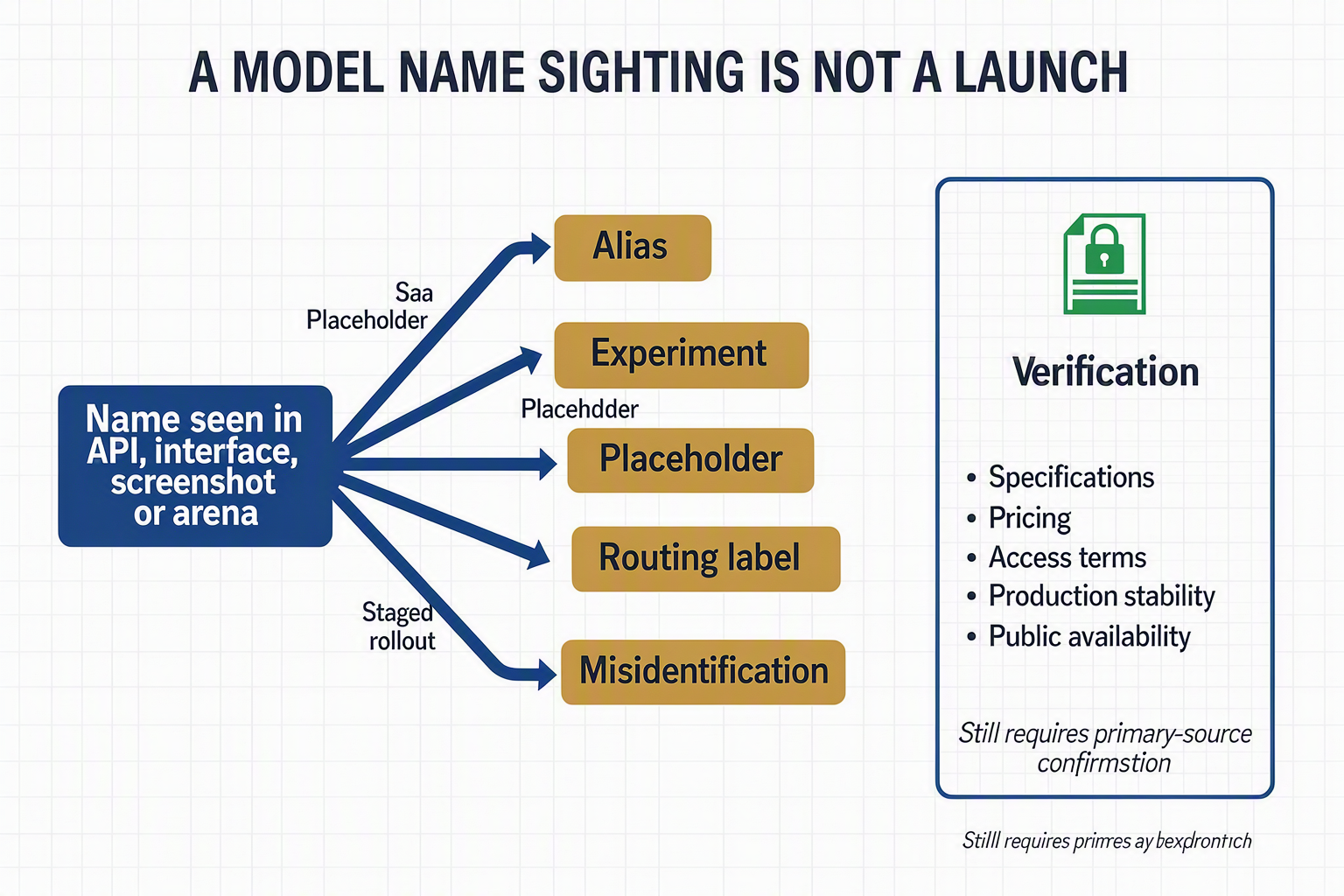
Alleged API or model-arena sightings can show that a label was visible to a particular user at a particular time. They cannot, by themselves, prove that GPT-6 Sol is a distinct OpenAI model, publicly launched, commercially available, or ready for production use.
What does an API model-name sighting prove?
At most, a reproducible API response can establish that a service accepted or returned a particular identifier. A name such as gpt-6-sol could represent:
- An internal alias pointing to an existing model
- A temporary experiment or evaluation cohort
- A placeholder added before—or without—a release
- A routing label that selects different back-end models
- A staged rollout available only to certain accounts
- A logging, interface, or metadata bug
- A third-party proxy’s own model name rather than OpenAI’s identifier
Routing makes screenshots especially difficult to interpret. OpenAI Developer Community bug reports in September 2026 alleged that requests selecting GPT-5.6 Sol were sometimes rerouted to a “Mini” or “Instant” model. Those user reports do not independently prove the underlying route, but they illustrate why a displayed name and the model actually serving a request may differ.
Developer infrastructure can add another routing layer. For example, as of September 2026, CallMissed’s OpenAI-compatible AI gateway supports caller-selected fallback models and request logs across its model catalogue. In any gateway or proxy setup, investigators must distinguish the requested model, gateway alias, fallback route, and provider-reported model.
What can an arena appearance establish?
An arena listing may indicate that an evaluator tested outputs under a label. However, blind-testing platforms commonly use temporary codenames, aliases, snapshots, experimental checkpoints, or provider-supplied labels.
A September 2026 OpenAI Developer Community thread described “speculation and proof” based on alleged GPT-6 Sol appearances in an arena and API. A community post is user-generated evidence, not an OpenAI launch announcement. Without confirmation from the arena operator and OpenAI, observers cannot reliably determine the model’s owner, architecture, version, or relationship to an existing product.
Neither an API nor arena sighting establishes:
- A GPT-6 Sol release date or general-availability date
- Pricing, rate limits, context window, or benchmark performance
- Eligible accounts, regions, tiers, or access terms
- Safety evaluations, system specifications, or data policies
- Production stability, service-level commitments, or long-term availability
How should a claimed GPT-6 Sol sighting be verified?
Use this reproducibility and primary-source checklist:
- Capture the complete request and response, including timestamp, endpoint, model field, headers, account tier, region, SDK version, and request ID.
- Repeat the test across separate accounts, API keys, regions, and direct OpenAI endpoints—not only aggregators or gateways.
- Disable or document fallback routing, aliases, previews, experiments, and automatic model selection.
- Ask the platform operator to confirm the label’s provenance and whether it represents a unique model.
- Check OpenAI’s primary sources: newsroom, developer documentation, model catalogue, pricing page, release notes, event agenda, system card, and safety materials.
- Require independent reproduction by multiple researchers while protecting credentials and sensitive logs.
OpenAI’s official materials identified GPT-5.6 Sol and GPT-6 Astra as of September 22, 2026. The available evidence did not establish an official model called GPT-6 Sol, so its alleged launch and release date remain unconfirmed.
Is GPT-6 Sol expected at DevDay on September 29?
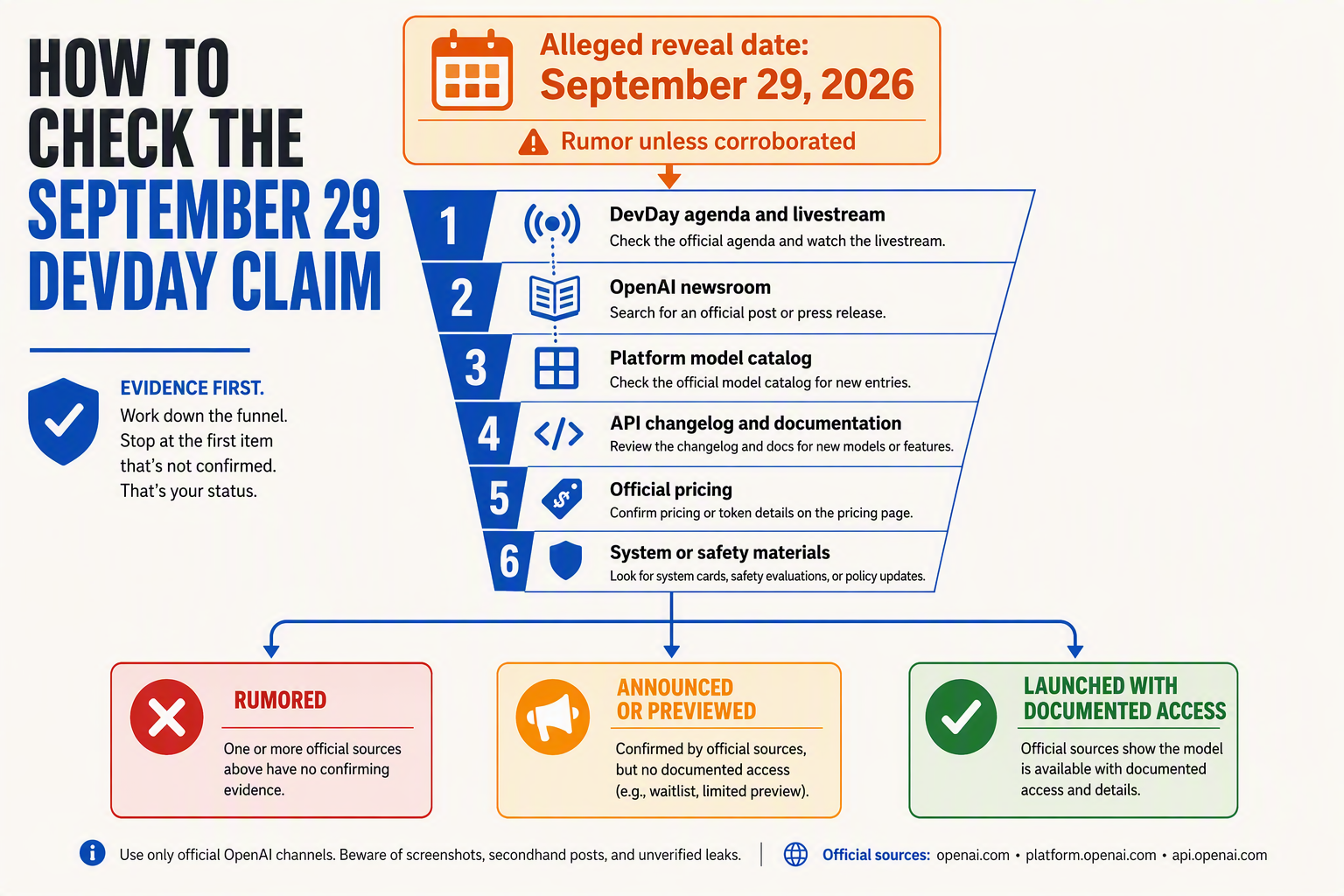
No. As of September 22, 2026, there is no verified evidence that OpenAI will reveal GPT-6 Sol at DevDay on September 29, 2026. The September 29 claim should be treated as an unsupported rumor, not a release date, launch date, or confirmed event announcement.
What does OpenAI officially say about GPT-6 Sol?
The official materials reviewed do not confirm that a product named GPT-6 Sol exists or is scheduled for announcement. Specifically, no confirmation appears in any reviewed:
- OpenAI event agenda or speaker schedule
- OpenAI newsroom or product announcement
- Official livestream or premiere listing
- Developer documentation or API model catalog
- API pricing page
- Model safety report, system card, or preparedness material
That absence does not prove OpenAI could never use the name. It means there is no primary-source basis for telling readers, buyers, or developers that GPT-6 Sol will appear on September 29.
OpenAI’s published naming also points in a different direction. The official OpenAI product page identifies Sol as GPT-5.6 Sol, while another official OpenAI announcement identifies Astra as GPT-6 Astra. Those are separate documented products; GPT-5.6 Sol should not be relabeled or interpreted as GPT-6 Sol.
Where did the September 29 DevDay rumor come from?
The available research includes an OpenAI Developer Community discussion titled “GPT-6 Sol, Terra, and Luna?” Its author describes “speculation” and alleged appearances in Arena and an API. However, the OpenAI Developer Community contains user-generated posts, so a thread title or participant claim is not equivalent to an OpenAI announcement.
Alleged model-name sightings can also have several explanations:
- A third-party interface may apply its own label.
- A transient API string may be a test, placeholder, alias, or routing artifact.
- Screenshots can omit account, endpoint, date, and response-header context.
- “Sol” references may concern the officially documented GPT-5.6 Sol, not an unreleased GPT-6 model.
None of these possibilities establishes a September 29 launch.
What evidence would confirm a September 29 reveal?
A credible confirmation should come directly from OpenAI and be independently reproducible. Strong corroboration would include several of the following appearing consistently:
- An official DevDay agenda naming GPT-6 Sol and specifying a presentation time.
- An OpenAI newsroom post stating the model’s availability date and intended users.
- A verified livestream listing with the relevant session title or description.
- Developer documentation providing an exact model identifier, endpoint support, context limits, and migration guidance.
- An API catalog and pricing page listing access tiers, token prices, and regional availability.
- Safety or system documentation describing evaluations, limitations, and deployment safeguards.
A single forum post, screenshot, benchmark submission, or unexplained API label would remain weaker evidence than this primary-source package.
How should developers plan for DevDay?
Developers should not reserve migration windows, promise GPT-6 Sol capabilities, or budget against rumored pricing before OpenAI publishes verifiable documentation. Teams can monitor the September 29 event, but plans should continue to use models that OpenAI officially documents and prices.
The evidence-based verdict remains straightforward: September 29, 2026, is not a confirmed GPT-6 Sol reveal date as of September 22, 2026, and no GPT-6 Sol launch should be implied.
What must buyers and developers verify before planning around GPT-6 Sol?
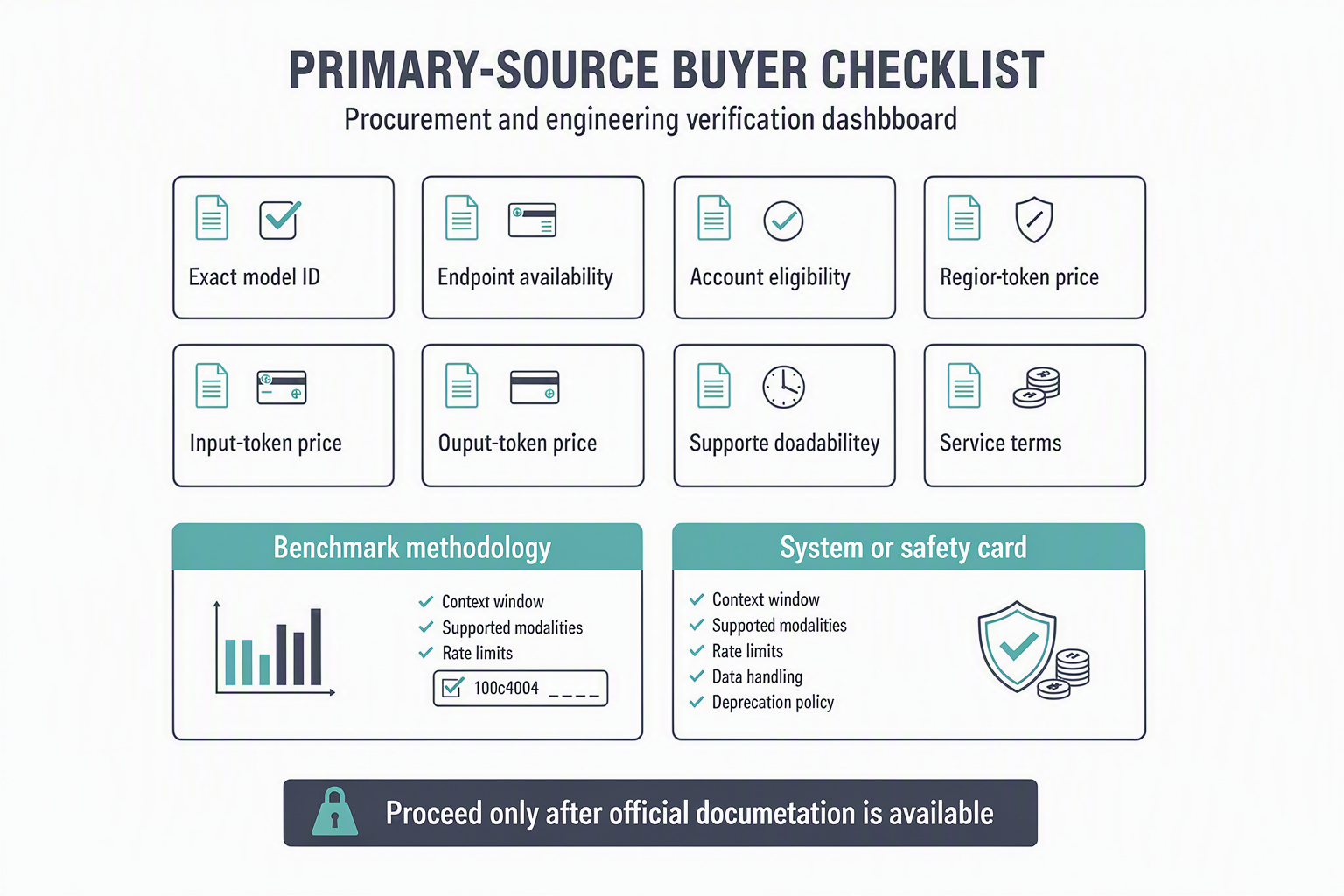
A buyer should not budget, design an architecture, or promise a production date for GPT-6 Sol until OpenAI publishes a matching model ID, API documentation, pricing, safety materials, and service terms. As of September 22, 2026, OpenAI’s primary sources document GPT-5.6 Sol and GPT-6 Astra, but the available research found no official OpenAI launch announcement or developer documentation for a model named GPT-6 Sol.
How can developers confirm that GPT-6 Sol is a real API model?
Require evidence from OpenAI’s newsroom, developer documentation, API model catalog, pricing page, system card, and account console. An OpenAI Developer Community post, an arena label, a screenshot, or an alleged API response can justify further testing, but it cannot establish general availability.
Verify these identifiers before writing integration code:
- Exact model ID: Record the case-sensitive API identifier, not merely the marketing name “GPT-6 Sol.” Determine whether it is a stable model, dated snapshot, preview, or moving alias.
- Supported endpoint: Confirm whether the model works with the Responses API, Chat Completions API, Realtime API, Batch API, or another documented endpoint.
- Returned model identity: Log the model identifier and response metadata during testing to detect aliases, routing changes, or fallbacks.
- Availability date: Require an explicit OpenAI release date rather than inferring one from rumors, including any unconfirmed claim of a September 29 DevDay reveal.
OpenAI’s official naming matters here: its website identifies Sol as GPT-5.6 Sol, while its documented GPT-6 product is GPT-6 Astra. Those names must not be treated as interchangeable.
What commercial and access details must procurement verify?
Procurement teams should obtain written, primary-source answers for:
- Account and regional eligibility: Which API tiers, organizations, countries, and cloud environments can access the model?
- Input and output pricing: Check separate rates for input tokens, cached input, output tokens, reasoning tokens, images, audio, tools, and any priority-processing option.
- Rate limits: Confirm requests per minute, tokens per minute, concurrent sessions, quota-increase procedures, and whether preview access has stricter limits.
- Service terms: Review usage policies, warranties, indemnity provisions, service-level commitments, support coverage, and restrictions on regulated workloads.
Every quoted price and limit should be dated because preview terms can change before general availability.
What technical and safety specifications must architects confirm?
OpenAI’s official documentation should establish the context window, maximum output, supported modalities, structured-output behavior, function calling, streaming, reasoning controls, and tool compatibility. Teams should also verify whether fine-tuning, embeddings, image input, audio, or realtime speech are actually supported rather than assumed from another GPT model.
For governance, require the official system card or safety report, data-retention rules, training-use policy, regional processing details, abuse-monitoring terms, and enterprise privacy controls. The deprecation policy should specify notice periods, replacement models, snapshot longevity, and migration expectations.
Benchmark claims also need scrutiny. Record the benchmark version, prompt setup, tool access, sampling settings, pass criteria, number of runs, and comparison model snapshots; a leaderboard score without methodology is not a procurement-grade result.
How can teams avoid locking architecture to an unconfirmed model?
Build against an abstraction layer, test fallback behavior, and keep prompts and evaluations portable. As of September 2026, CallMissed’s OpenAI-compatible developer API provides one key and balance across 136 models, with caller-chosen fallbacks and bring-your-own provider keys—an example of how multi-model routing can reduce dependence on any rumored release.
Until OpenAI supplies the complete primary-source package, label GPT-6 Sol unconfirmed, keep it out of contractual commitments, and plan production capacity around models that are already documented and accessible.
What does GPT-6 Sol uncertainty mean for your team?
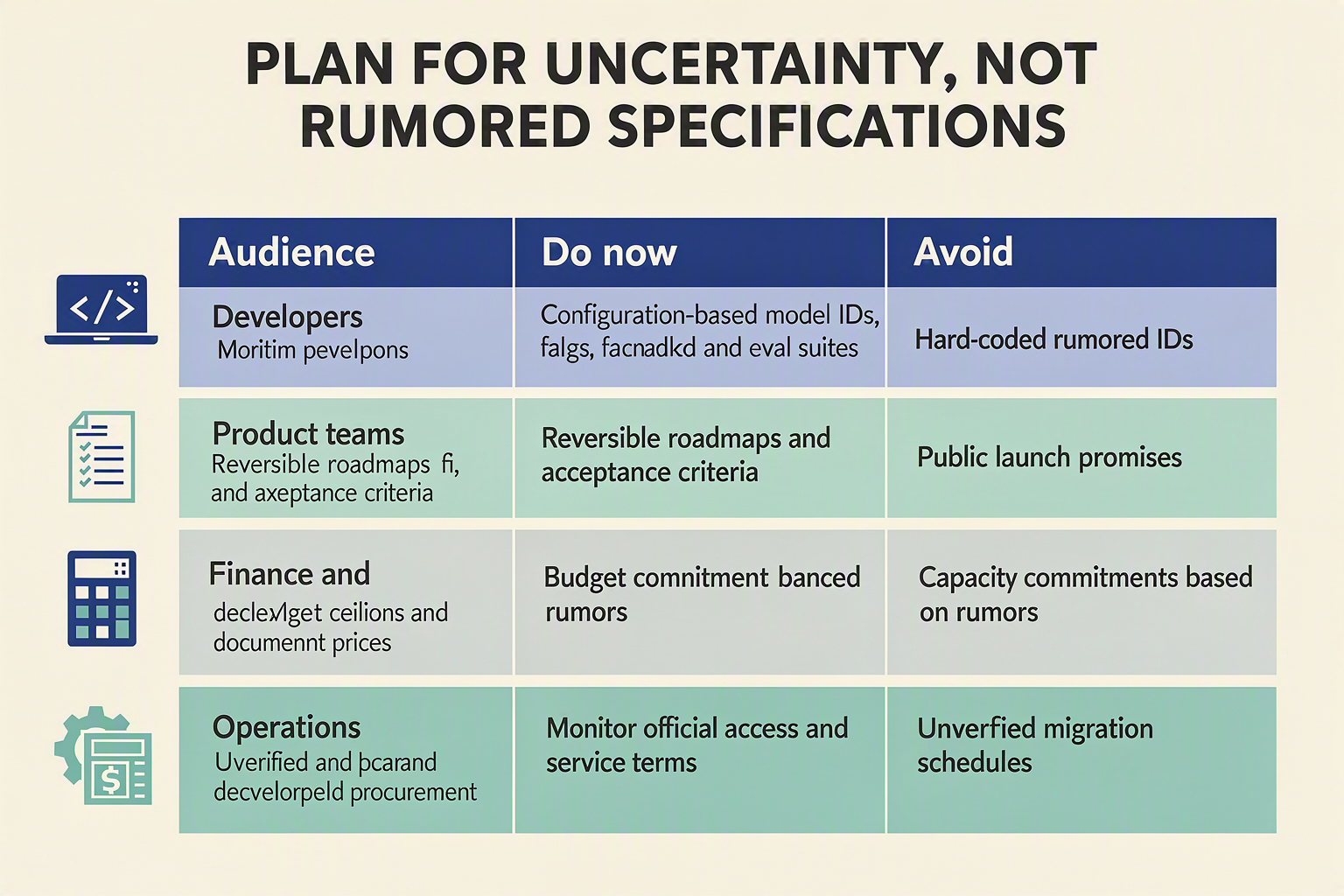
Treat GPT-6 Sol as unavailable for operational planning until OpenAI publishes a product announcement, exact API model ID, pricing, access terms, rate limits, documentation, and safety materials. As of September 22, 2026, the evidence reviewed confirms GPT-5.6 Sol and GPT-6 Astra, but not an official GPT-6 Sol launch or release date.
How should teams plan around an unconfirmed GPT-6 Sol release?
OpenAI’s official website identifies Sol as GPT-5.6 Sol, while OpenAI separately documents GPT-6 Astra as a GPT-6 model. OpenAI Developer Community discussions about GPT-6 Sol may help identify claims worth investigating, but forum sightings and user reports are not substitutes for a model catalog entry or production documentation.
The safest approach is to make adoption reversible:
| Uncertainty or risk | Operational impact | Recommended action | Evidence required to proceed |
|---|---|---|---|
| Unconfirmed model name | A hard-coded gpt-6-sol identifier may fail or point to the wrong product | Store model IDs in configuration or environment variables | Official API documentation and a successful authenticated API request |
| Unknown capabilities | Product features may be designed around nonexistent context limits, modalities, or tool support | Hide model-specific functionality behind feature flags | Published specifications plus task-level testing |
| Unknown reliability or capacity | Teams could make unsupported throughput or service commitments | Avoid customer capacity promises; retain current production capacity | Documented rate limits, access tier and load-test results |
| Unknown quality | A newer model may regress on particular languages, formats or workflows | Run versioned eval suites, regression tests and human review | Passing scores on organization-specific acceptance thresholds |
| Unknown pricing | Token costs could invalidate unit economics | Set per-request and monthly budget ceilings with alerts | Official pricing and measured workload costs |
| Sudden errors or access changes | A rollout could interrupt production traffic | Configure tested fallback models, timeouts and circuit breakers | Successful failover drills and monitored request logs |
| Rumored launch timing | Public roadmaps and migrations may slip | Do not publish launch promises or fixed migration schedules based on rumors | OpenAI newsroom, event agenda, documentation and availability notice |
| Provider-specific coupling | Switching models could require widespread code changes | Use an abstraction layer with normalized request and response handling | Compatibility tests for streaming, tools, structured output and errors |
What should teams verify before migrating?
A launch announcement alone is not enough for production adoption. Before changing a default model, teams should verify:
- Identity: the precise model ID, aliases, version pinning and deprecation policy.
- Availability: eligible accounts, regions, quotas, rate limits and any waitlist.
- Behavior: tool calling, structured outputs, streaming, vision, reasoning controls and safety refusals.
- Economics: input, output, cached-token and tool-related charges under realistic traffic.
- Quality: accuracy, latency distribution, schema compliance and failure rates on private eval sets.
- Governance: data handling, retention settings and documentation required by the organization.
An API abstraction can reduce the cost of waiting. As of September 2026, CallMissed, the OpenAI-compatible developer AI API, provides one API key and balance for 136 models, along with caller-selected fallback models, request logs, structured outputs and response caching. Whether teams use CallMissed or another gateway, the architectural principle is the same: keep model selection configurable so an unverified product name never becomes a production dependency.
Until primary evidence appears, budget and schedule against models that can actually be tested—not against a rumored GPT-6 Sol launch date.
How should experts weigh official sources, observations and speculation?

The evidence hierarchy is clear: OpenAI’s authenticated product pages and developer documentation can confirm a launch; reproducible technical observations can show testing or configuration; credible reporting can corroborate developments; and community posts can establish only that someone made a claim. As of September 22, 2026, the available primary sources confirm GPT-5.6 Sol and GPT-6 Astra, not a product officially named GPT-6 Sol.
Which OpenAI sources count as product confirmation?
OpenAI primary sources deserve the greatest weight when they identify a model consistently across multiple release surfaces. Experts should look for:
- An announcement on OpenAI’s newsroom or product website
- A model entry in official API documentation and the model catalog
- Published API pricing, access requirements and availability dates
- A system card, safety report or preparedness assessment
- Release notes or a verified DevDay agenda and livestream
OpenAI’s official website calls the existing Sol model GPT-5.6 Sol. Separately, OpenAI’s GPT-6 Astra announcement identifies Astra as a GPT-6 model and reports a score of 57.9%, versus 37.3% for GPT-5.6 Sol, on the benchmark cited in that announcement. Those pages establish OpenAI’s naming and OpenAI’s reported results; they do not establish that every rumored name represents another planned product.
Even an official performance claim should be attributed precisely. A vendor benchmark can document what OpenAI reported, while independent reproduction is needed to establish how reliably the result generalizes.
How much weight should credible secondary reporting receive?
Credible secondary reporting is strongest when it names sources, reproduces documents or technical tests, and obtains an on-record response from OpenAI. A report citing “people familiar with the matter” may provide useful advance information, but it cannot replace the final model documentation because names, dates and specifications can change before release.
Experts should ask whether the report provides:
- A named OpenAI representative or attributable document
- Reproducible API requests, identifiers or interface evidence
- Independent corroboration from another established publication
- A clear distinction between preview, testing and general availability
A claimed September 29 DevDay reveal, for example, remains speculation unless OpenAI corroborates it through its agenda, newsroom, livestream, documentation or related launch materials.
Do API or interface sightings prove GPT-6 Sol has launched?
No. An API response, model selector, routing label or arena appearance can indicate an internal test, staged deployment, placeholder, alias or configuration error. It does not by itself prove public availability, final branding, pricing or a release date.
Reproducible evidence is more informative than a screenshot: researchers should record the endpoint, exact model identifier, timestamp, account tier, response headers and whether other users can repeat the result. Even then, the defensible conclusion is usually “the identifier was observed,” not “the product launched.”
Why are OpenAI Developer Community posts not official confirmation?
The OpenAI Developer Community is hosted under OpenAI branding, but its user-generated posts are claims rather than OpenAI product announcements. Posts discussing “GPT-6 Sol, Terra, and Luna” or alleging that GPT-5.6 Sol rerouted to another model document user observations and speculation, not verified release policy.
Community evidence can reveal bugs, emerging terminology or tests worth investigating. Unless an authorized OpenAI employee confirms the claim and official product surfaces support it, experts should label the information unverified and avoid using it for procurement, integration deadlines or capacity planning.
How will this GPT-6 Sol audit track corrections and future changes?
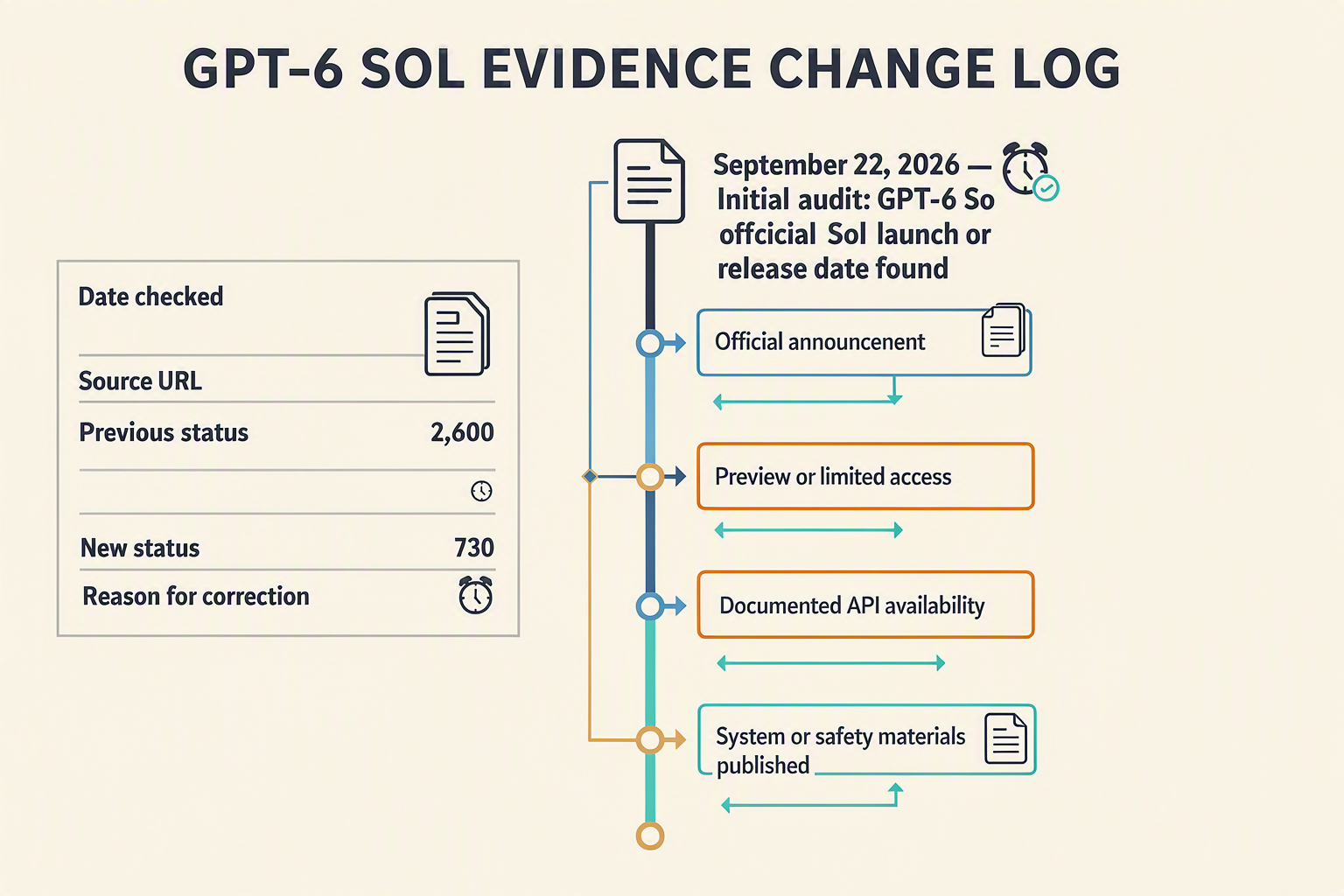
As of September 22, 2026, this audit found no official OpenAI launch announcement, release date, or developer documentation for a model named GPT-6 Sol. OpenAI’s published materials identify Sol as GPT-5.6 Sol and identify Astra as the documented GPT-6 model, so community reports or apparent API sightings do not change the current verdict.
What does the correction log say today?
Correction-log entry — September 22, 2026
- Current verdict: No confirmed GPT-6 Sol release or launch date was found.
- Confirmed naming: OpenAI’s product announcement calls the model GPT-5.6 Sol, not GPT-6 Sol.
- Confirmed GPT-6 model: OpenAI separately describes GPT-6 Astra as its next-generation model for work.
- Unverified claims: Posts in the OpenAI Developer Community discussing “GPT-6 Sol, Terra, and Luna” are user-generated claims, not official product documentation.
- Release-date rumors: Any proposed September 29 DevDay announcement remains unconfirmed unless OpenAI publishes corroborating primary evidence.
The distinction matters because a forum screenshot, interface label, routing anomaly, or temporary API response can have several explanations. OpenAI Developer Community users, for example, have separately reported GPT-5.6 Sol requests apparently being rerouted to a Mini model; such reports show why observed behavior should not automatically be interpreted as a new product launch.
What evidence would change the GPT-6 Sol verdict?
The verdict should change only when primary evidence explicitly names GPT-6 Sol. Strong confirmation would include one or more of the following:
- An official OpenAI announcement stating the model name, launch status, and release date.
- OpenAI developer documentation or a model catalog entry defining a GPT-6 Sol model identifier and supported capabilities.
- A reproducible production endpoint that returns the documented model identity—not merely an interface label, alias, routing trace, or isolated screenshot.
- Official pricing and access terms covering API rates, ChatGPT availability, regional access, rate limits, or eligibility.
- Safety, system, or preparedness documentation that explicitly evaluates GPT-6 Sol and identifies its deployment status.
These items answer different questions. An announcement can confirm that a model exists without proving general availability; an endpoint can establish limited API access without confirming ChatGPT access; and pricing documentation can distinguish a preview from a broadly purchasable service.
Developer gateways also should not be treated as substitutes for primary confirmation. For example, CallMissed’s OpenAI-compatible AI gateway listed 136 models as of September 2026, but the appearance of any model name in an aggregator or third-party catalog would establish availability through that provider—not, by itself, OpenAI’s official launch status or branding.
How should future changes be recorded?
Any later revision should use a dated entry and separate two categories:
- Correction: The earlier article misstated, omitted, or misinterpreted evidence that was already available on September 22, 2026. The original wording and corrected wording should both be identified.
- New evidence: OpenAI published additional material after the audit date. The update should preserve the original time-bounded verdict while explaining how the new announcement, documentation, endpoint, pricing, access terms, or safety material changes it.
A future update should also label the resulting status precisely as announced, previewed, available to selected users, API-accessible, or generally available. This page is a dated evidence audit, not a claim of continuous monitoring; readers should recheck OpenAI’s newsroom, developer documentation, model catalog, pricing pages, and safety publications before making procurement or engineering decisions.
Frequently Asked Questions
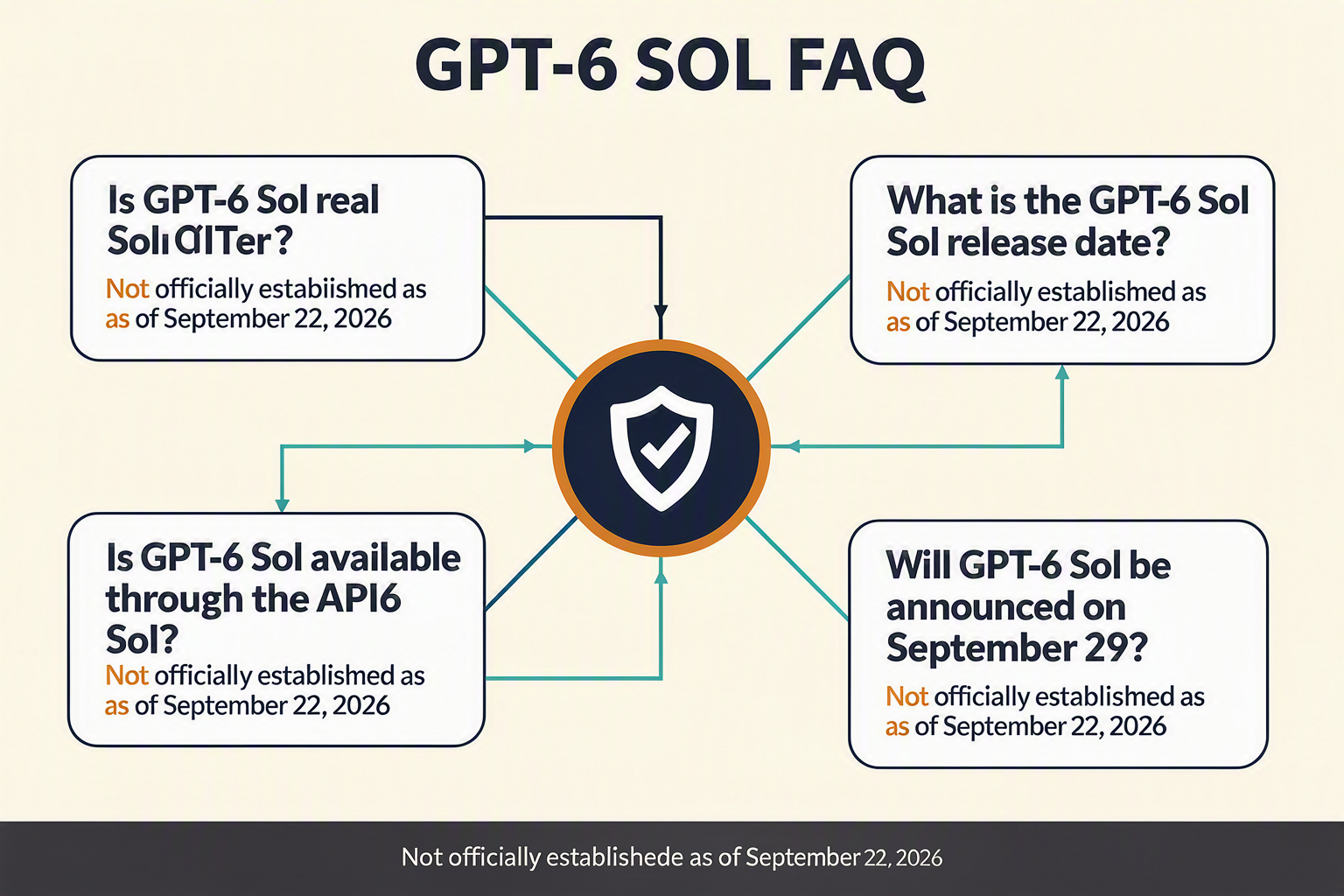
Does GPT-6 Sol officially exist?
What is the confirmed GPT-6 Sol release date?
Is a GPT-6 Sol announcement at DevDay on September 29, 2026, confirmed?
Do GPT-6 Sol sightings in Chatbot Arena or an API prove that the model is available?
Which Sol and GPT-6 models has OpenAI officially documented?
Is GPT-6 Sol API access, pricing or a model identifier officially available?
How should developers prepare without relying on GPT-6 Sol rumors?
Conclusion
The verdict as of September 22, 2026, remains clear: OpenAI primary sources confirm GPT-5.6 Sol and GPT-6 Astra—not GPT-6 Sol—and no confirmed GPT-6 Sol launch or release date was found. Community reports, Arena labels, API sightings, and September 29 speculation do not override official product documentation.
- “Sol” officially refers to GPT-5.6 Sol, while OpenAI identifies its documented GPT-6 model as GPT-6 Astra.
- No OpenAI newsroom post, model catalog entry, pricing page, system card, or developer documentation confirms GPT-6 Sol.
- Interface labels are not proof of model identity. Testing, fallback routing, or display errors can create discrepancies between the selected model and the model serving a request.
- Developers and buyers should avoid planning around rumored names, dates, benchmarks, context limits, or prices.
What should change this verdict? Watch for a consistent primary-source trail: an OpenAI announcement, official model ID, API access details, pricing, and safety documentation. Until then, teams should architect integrations with configurable model IDs, explicit fallback policies, request logging, and repeatable evaluations.
To explore flexible AI infrastructure, CallMissed offers an OpenAI-compatible API spanning 136 models, with caller-chosen fallbacks and request logs as of September 2026. Before committing budget or launch plans, ask: Can every model claim be traced to current, first-party documentation?
Related Reading
- GPT-6 Astra Release Date: September 2026 Fact Check
- OpenAI Astra Launch Status: GPT-6 Release and API Facts for September 2026
- GPT-6 Sol vs GPT-6 Astra: Is Sol Actually Real in 2026?
Sources
Discussion
Related Posts


Ready to automate customer conversations?
Launch AI voice agents and WhatsApp bots with CallMissed — one API, 22+ Indian languages.