Claude Fable 5.1 Enterprise Deployment: AWS, Azure, GCP and Anthropic


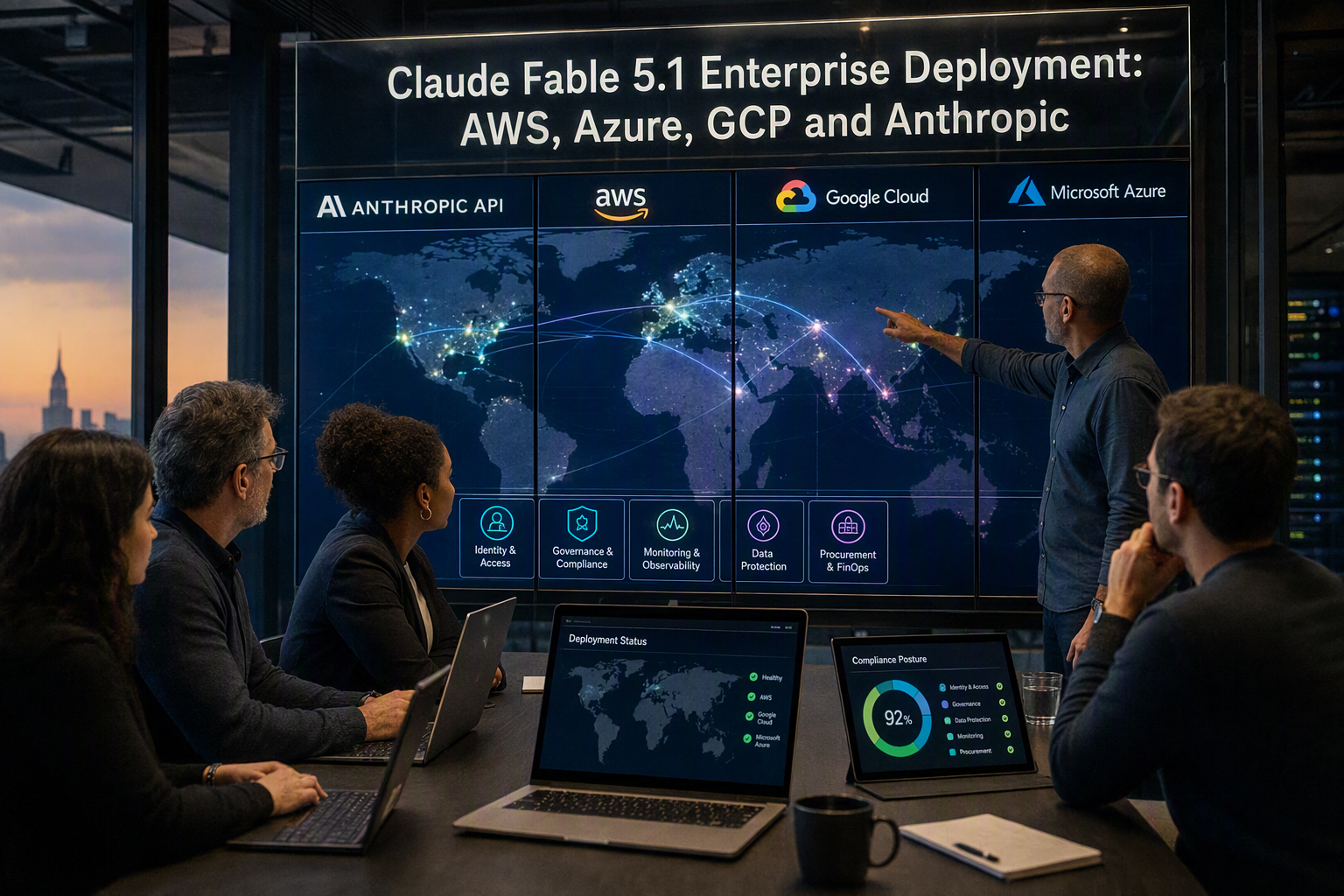
Plan Claude Fable 5.1 enterprise deployment using verified availability, IAM, procurement, governance, observability, portability and cost guidance.
Claude Fable 5.1 Enterprise Deployment: AWS, Azure, GCP and Anthropic
What if your enterprise deployment target was released only two days ago, yet stakeholders already expected a production-ready architecture across four different AI platforms? Claude Fable 5.1 enterprise deployment matters now because Anthropic launched the model on September 1, 2026, positioning it for demanding reasoning, long-running agentic coding and complex knowledge work.
Anthropic’s September 1, 2026 release notes confirm that Claude Fable 5.1 is generally available through the Anthropic API under the model ID claude-fable-5-1. Anthropic’s model documentation describes Fable 5.1 as appropriate when evaluations on Claude Opus 5 at higher effort still fall short, while the company’s launch announcement says the model leads its incident-investigation evaluations based on real production incidents. Anthropic also states that Claude Fable 5.1 uses the same underlying model as Claude Mythos 5.1, with stronger safeguards for specified cybersecurity and biology tasks.
For enterprise teams, however, model quality is only the beginning. Choosing among the Anthropic API, Amazon Web Services, Google Cloud and Microsoft Azure affects much more than endpoint syntax:
- Procurement: direct Anthropic contracts versus existing cloud marketplace agreements, committed spend and consolidated invoicing.
- Identity and access management: Anthropic workspace keys versus cloud-native roles, service accounts, managed identities and policy controls.
- Data governance: retention settings, audit evidence, encryption boundaries and approved processing regions.
- Operations: request tracing, token-usage monitoring, quota management, fallback design and incident response.
- Portability: how tightly applications become coupled to provider-specific SDKs, model identifiers and managed AI services.
What this deployment guide will establish
This guide separates confirmed availability from assumption. The supplied first-party documentation confirms Claude Fable 5.1 on the Anthropic API as of September 3, 2026; availability on Amazon Bedrock, Google Cloud Vertex AI or Microsoft Azure must be validated against each provider’s current model catalog, supported regions and account-level access controls before procurement. An announcement mentioning a cloud ecosystem is not equivalent to a deployable endpoint in every region.
You will learn how to compare platforms, structure enterprise access, evaluate regional and governance constraints, implement observability, and preserve application portability. Pricing differences will be included only where official providers publish comparable figures—without treating list prices as the full cost of security, networking and operations.
This multi-provider pattern also explains the appeal of gateways such as CallMissed’s OpenAI-compatible AI gateway, which gives developers a consistent integration layer across many models and providers. The goal is not merely to call Claude Fable 5.1, but to deploy it through a procurement, security and operating model that your enterprise can defend.
Where can enterprises deploy Claude Fable 5.1 as of September 5, 2026?
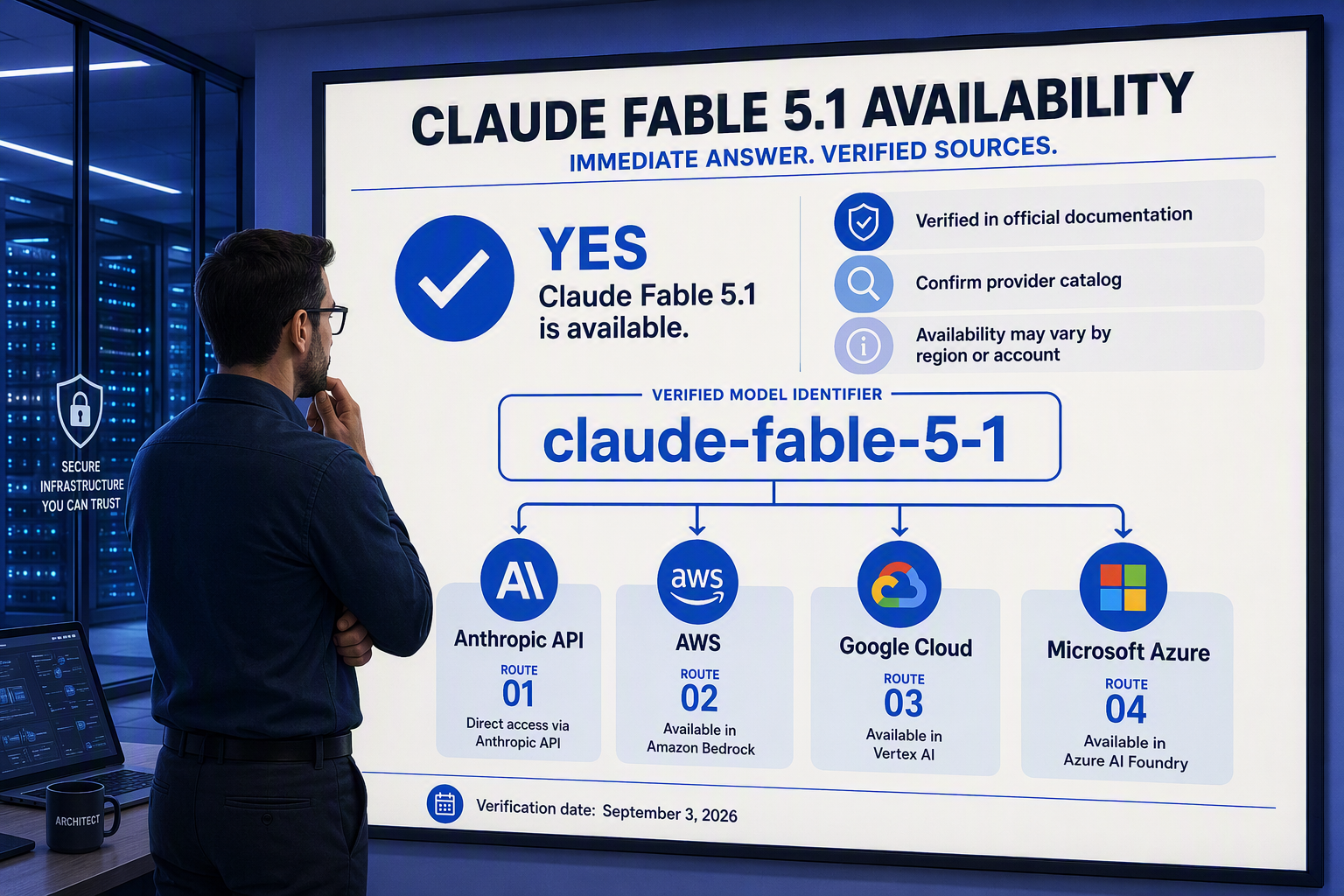
As of September 5, 2026, Anthropic says Claude Fable 5.1 is available through the Anthropic API and across Amazon Web Services, Google Cloud and Microsoft Azure. This confirms broad platform availability, but it does not guarantee that every region, account or subscription can immediately deploy the model. Each Claude Fable 5.1 enterprise deployment still requires platform-specific validation.
Available deployment routes
Enterprises can evaluate four primary routes:
- Anthropic API: Use Anthropic’s first-party API with the model ID
claude-fable-5-1, subject to the organization’s access, rate limits and contractual terms. - Amazon Web Services: Deploy through Amazon Bedrock, provided the required Claude Fable 5.1 SKU is offered in the intended AWS Region and enabled for the production account.
- Google Cloud: Access the model through Vertex AI, subject to the relevant publisher-model listing, supported region, project eligibility and quota.
- Microsoft Azure: Deploy through the applicable Microsoft Foundry catalog offering, subject to subscription eligibility, regional capacity, marketplace terms and model access requirements.
Anthropic’s statement establishes general model availability across these providers. Actual enablement can differ by geography, cloud region, account type, capacity, quota and contract. A catalog page or launch announcement should not be treated as proof that the intended production environment can invoke the model.
Verify the production environment
Before approving a Claude Fable 5.1 enterprise deployment, teams should confirm:
- The current cloud SKU, model identifier and API version
- Availability in the required production and disaster-recovery regions
- Account, project or subscription eligibility
- Model-access approvals and marketplace acceptance
- Input, output and concurrency quotas
- Provisioned-throughput or capacity requirements
- A successful credentialed test invocation
- Current contract pricing, discounts and billing treatment
Record the catalog URL, verification timestamp, deployment region and test-request ID in the architecture review. Recheck them before production because cloud catalogs, quotas and regional capacity can change after initial approval.
Procurement, IAM and data governance
The deployment route affects more than endpoint selection. Direct Anthropic usage may require a separate vendor agreement and Anthropic-managed organization controls, while cloud deployment may fit an existing hyperscaler contract and billing arrangement. Enterprises should compare actual contract pricing rather than assuming that rates and discounts are equivalent across providers.
IAM and data-governance controls also differ. Keep credentials in an approved secrets manager, apply least-privilege roles or service identities, and verify logging, retention, data-location and processing terms for the selected route. Anthropic’s model safeguards—including restrictions affecting certain high-risk cybersecurity and biology requests—should also be tested against legitimate enterprise workflows before approval.
The practical conclusion as of September 5 is that Claude Fable 5.1 enterprise deployment is available through Anthropic, AWS, Google Cloud and Microsoft Azure. Production readiness, however, remains specific to the selected cloud SKU, region, account, quotas and commercial agreement.
What is Claude Fable 5.1, and which enterprise workloads is it designed to handle?

Claude Fable 5.1 is Anthropic’s high-end model for demanding reasoning, long-horizon agentic execution and complex knowledge work. Enterprises should reserve it for workflows where task completion, root-cause analysis and sustained autonomy matter more than achieving the lowest possible latency or per-request cost.
A model for long-running, high-complexity work
Anthropic describes Claude Fable 5.1 as a “Mythos-level model” built for ambitious, long-running projects. Rather than selecting an easy-looking workaround, the model is intended to investigate underlying causes, maintain context across extended workflows and complete multi-stage tasks.
Anthropic’s Claude Platform documentation recommends Fable 5.1 when evaluations using Claude Opus 5 at higher effort still fall short. That positioning makes Fable 5.1 an escalation tier—not necessarily the default model for every chatbot interaction, summary or classification request.
The strongest enterprise workload categories include:
- Agentic software engineering: navigating large repositories, planning coordinated changes, implementing features, running tests and repairing failures across multiple iterations.
- Production incident investigation: correlating logs, traces, configuration changes and source code to develop and validate root-cause hypotheses.
- Complex knowledge work: synthesising technical, legal, financial or operational material into structured analysis, subject to domain-expert review.
- Research and planning: decomposing an ambiguous objective into subtasks, using tools or internal data sources and revising conclusions as evidence changes.
- Long-horizon automation: executing workflows that require persistent state, checkpoints, permissions and recovery from failed tool calls.
Anthropic reported on September 1, 2026 that Claude Fable 5.1 was a leading model on its incident-investigation evaluations, which use real production incidents and the company’s Bits agent. That claim is particularly relevant to platform engineering and site-reliability teams, although enterprises should reproduce the evaluation against their own repositories, telemetry and incident taxonomy.
Safety boundaries affect workload selection
Claude Fable 5.1 is available for general use, but its intended workload envelope is not unrestricted. Anthropic’s September 2026 Claude Fable 5.1 and Claude Mythos 5.1 System Card states that Fable includes additional safeguards that prevent certain high-risk cybersecurity and biology tasks.
Consequently, security teams should test whether legitimate activities—such as vulnerability validation, malware analysis or advanced biological research—encounter model refusals before committing to a production architecture. These controls are a model-level consideration; changing the hosting platform does not necessarily change the underlying safety behaviour.
Use enterprise evaluations, not model prestige
A defensible selection process should compare Fable 5.1 with lower-cost or faster models using representative tasks. Measure:
- End-to-end completion rate, including successful tool use.
- Accuracy and evidence quality, not merely fluent output.
- Recovery from errors during long-running workflows.
- Latency, token consumption and retry frequency.
- Human-review time required before an output can be used.
Fable 5.1 is most appropriate when improved task success offsets higher operational cost or latency. Routine extraction, FAQ responses, sentiment classification and simple summarisation should remain candidates for smaller models, with Fable 5.1 used through risk-based routing or escalation.
Which Claude Fable 5.1 developments should enterprise buyers know?
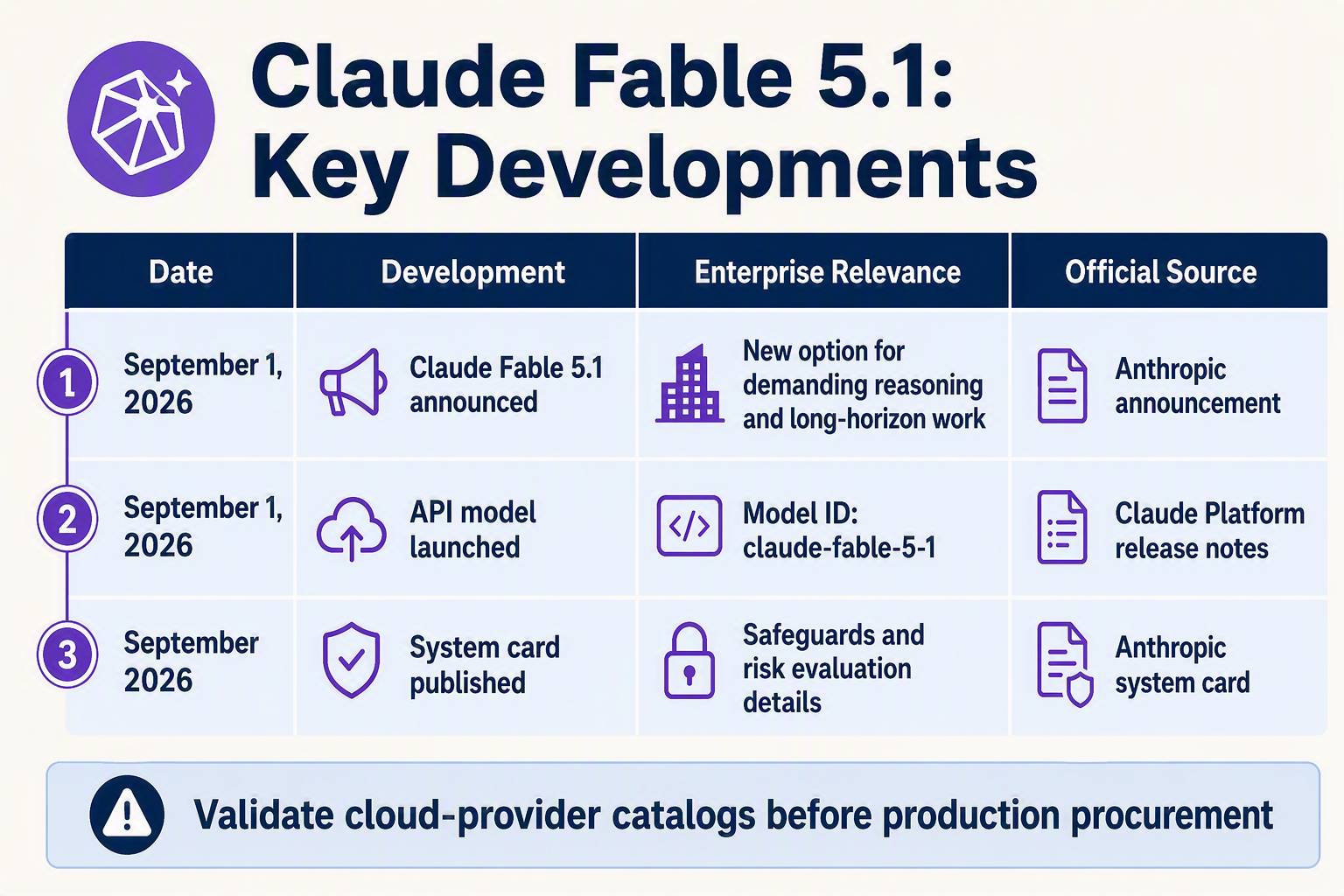
The developments that matter most are Fable 5.1’s rapid general release, its specialized safety profile, and its positioning above Opus 5 for selected workloads. Enterprise buyers should treat these as evaluation and governance signals—not as proof that the model is already purchasable through every cloud marketplace or available in every region.
Buyer-impact summary
| Development | Verified evidence | Enterprise implication | Required buyer action |
|---|---|---|---|
| New production model | Anthropic’s release notes dated September 1, 2026 list claude-fable-5-1 for general use | Existing model inventories, risk assessments and allowlists may not include it | Register the exact model ID and run internal acceptance testing |
| Successor to Fable 5 | Anthropic identifies Fable 5.1 as the successor to Claude Fable 5 | Applications should not assume identical behavior across versions | Pin model versions and repeat quality, latency and safety evaluations |
| Higher-end workload positioning | Anthropic’s model overview recommends Fable 5.1 when Claude Opus 5 at higher effort still fails enterprise evaluations | Fable 5.1 is intended for difficult workloads rather than automatic estate-wide replacement | Route only qualified tasks after comparative evaluation |
| Long-horizon focus | Anthropic positions Fable 5.1 for demanding reasoning, agentic coding and complex knowledge work | Longer autonomous runs increase token usage, tool permissions and operational risk | Add spend limits, execution timeouts and human approval checkpoints |
| Incident-investigation strength | Anthropic’s September 1, 2026 announcement says Fable 5.1 leads its incident-investigation evaluations using real production incidents | The model may suit debugging, root-cause analysis and operational knowledge workflows | Validate against anonymized incidents from the buyer’s own environment |
| Specialized safeguards | Anthropic states that Fable 5.1 shares its underlying model with Claude Mythos 5.1 but adds stronger safeguards for specified cybersecurity and biology tasks | Some legitimate requests may be restricted or handled differently from other Claude models | Test expected security and life-sciences workflows before committing |
What these developments do—and do not—prove
Anthropic’s September 2026 system card says Claude Fable 5.1 is available for general use and includes additional protections against certain high-risk tasks. That statement supports model-level security review, but it does not answer cloud-specific questions such as where prompts are processed, which audit logs are available or whether private networking is supported.
The launch evidence also does not establish performance leadership for every enterprise workload. Anthropic’s incident-investigation result is a vendor-reported evaluation, so procurement teams should request methodology details and reproduce the comparison with representative tickets, repositories and tool chains. Useful acceptance criteria include:
- successful task completion and human correction rates;
- end-to-end latency for multi-step agent runs;
- token consumption and tool-call volume;
- refusal rates for legitimate cybersecurity or biology requests;
- recovery from failed tools, incomplete context and conflicting instructions.
The immediate procurement consequence
As of September 3, 2026, the Anthropic API documentation provides a confirmed model identifier, while the supplied evidence does not independently confirm deployable listings for Amazon Bedrock, Google Cloud Vertex AI or Microsoft Azure. Buyers should therefore separate four milestones: vendor announcement, catalog listing, regional activation and account entitlement.
Before signing an order or consuming committed cloud spend, require the provider to show the model in the target account and region. Record its exact identifier, access process, identity controls, pricing unit and data-handling terms. This evidence-based approach prevents a newly announced model from being designed into an architecture before the chosen procurement channel can actually serve it.
How do Anthropic API, AWS, Google Cloud, and Microsoft Azure compare?
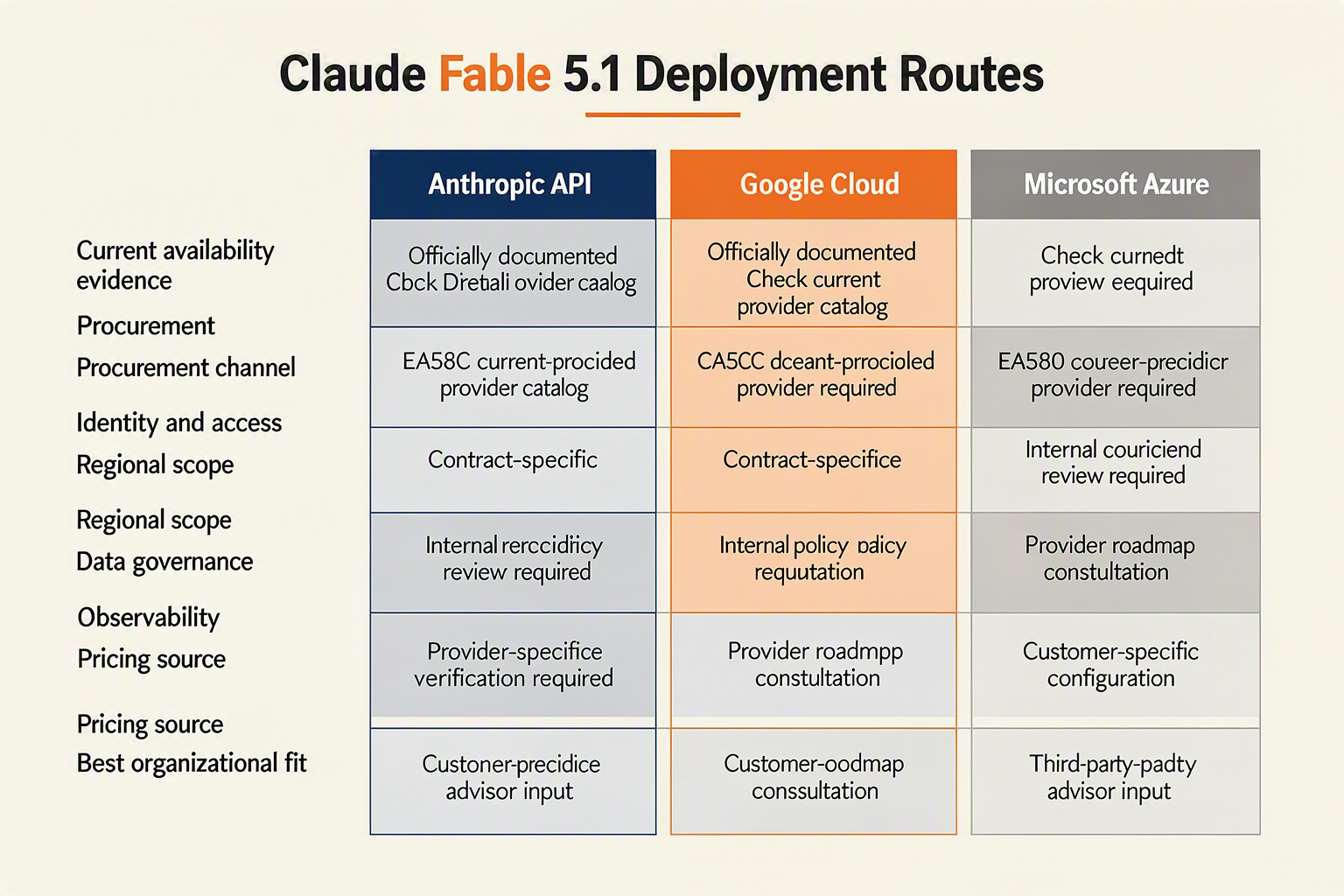
The Anthropic API is the only deployment route confirmed by the supplied first-party evidence as of September 3, 2026. Enterprises should treat Claude Fable 5.1 availability on Amazon Web Services, Google Cloud and Microsoft Azure as unverified until the model appears in the relevant account, region and provider catalog.
| Comparison area | Anthropic API | AWS | Google Cloud | Microsoft Azure |
|---|---|---|---|---|
| Fable 5.1 availability | Confirmed as claude-fable-5-1 | Verify Amazon Bedrock catalog and account access | Verify Vertex AI Model Garden and regional endpoint access | Verify Azure model catalog, subscription and region |
| Procurement | Direct Anthropic agreement, credits or invoicing | AWS Marketplace or enterprise cloud agreement, if listed | Google Cloud Marketplace or cloud agreement, if listed | Azure Marketplace or Microsoft agreement, if listed |
| Identity and access | Anthropic organization, workspace and API-key controls | AWS IAM roles, policies and temporary credentials | Google Cloud IAM roles and service accounts | Microsoft Entra ID, Azure RBAC and managed identities |
| Governance boundary | Anthropic’s documented processing and retention controls | Bedrock account, network, logging and regional controls | Vertex AI project, VPC and regional controls | Azure subscription, virtual-network and policy controls |
| Observability | API usage, application telemetry and request identifiers | Amazon CloudWatch and AWS CloudTrail integration patterns | Cloud Logging, Cloud Monitoring and Cloud Audit Logs | Azure Monitor, Application Insights and Azure activity logs |
| Portability and cost | Native Claude semantics; use official direct pricing | Provider-specific IDs, quotas and published cloud pricing | Vertex-specific endpoints, quotas and published pricing | Azure-specific deployment names, quotas and published pricing |
Availability is a gate, not a footnote
Anthropic’s Claude Platform release notes dated September 1, 2026 identify claude-fable-5-1 as the API model ID and describe it as the successor to Claude Fable 5. That confirmation does not establish availability through a cloud provider.
Before approving any cloud deployment, capture evidence for:
- The exact provider model identifier and version.
- The approved regions and whether inference remains within them.
- Account-level enablement, quotas and capacity restrictions.
- Preview versus generally available status.
- Published pricing and contractual data-processing terms.
A model visible in public documentation may still be unavailable in a particular tenant, project, subscription or region.
Choose according to the enterprise control plane
The direct Anthropic API offers the shortest path to newly released Claude capabilities and avoids an additional cloud-service abstraction. It is a strong fit when the enterprise can onboard Anthropic as a vendor and manage API credentials through a secrets manager.
A cloud route may fit better when security and finance teams already standardize on AWS IAM, Google Cloud IAM or Microsoft Entra ID. Cloud procurement can also align model consumption with existing billing, marketplace and committed-spend arrangements—but only after the provider confirms that Claude Fable 5.1 is eligible under those arrangements.
Do not equate cloud-native identity with model availability. An administrator can prepare IAM roles, service accounts or managed identities before the model is listed, but production approval should remain blocked until an authenticated test request succeeds in the intended region.
Compare total operating cost, not an assumed token price
No comparable cross-provider Claude Fable 5.1 price figures appear in the supplied evidence, so a defensible comparison should avoid invented token rates. Calculate total cost of deployment from each provider’s current price sheet and include:
- Input, output and any cache-related token charges.
- Network egress, private connectivity and centralized logging.
- Support plans, security tooling and marketplace fees.
- Engineering costs created by provider-specific authentication, SDKs and model IDs.
For portability, keep business logic separate from provider adapters and record model-version metadata with every evaluation. This allows procurement flexibility without pretending that authentication, safety behavior, quotas or observability are identical across platforms.
How do procurement and identity access management differ by deployment route?
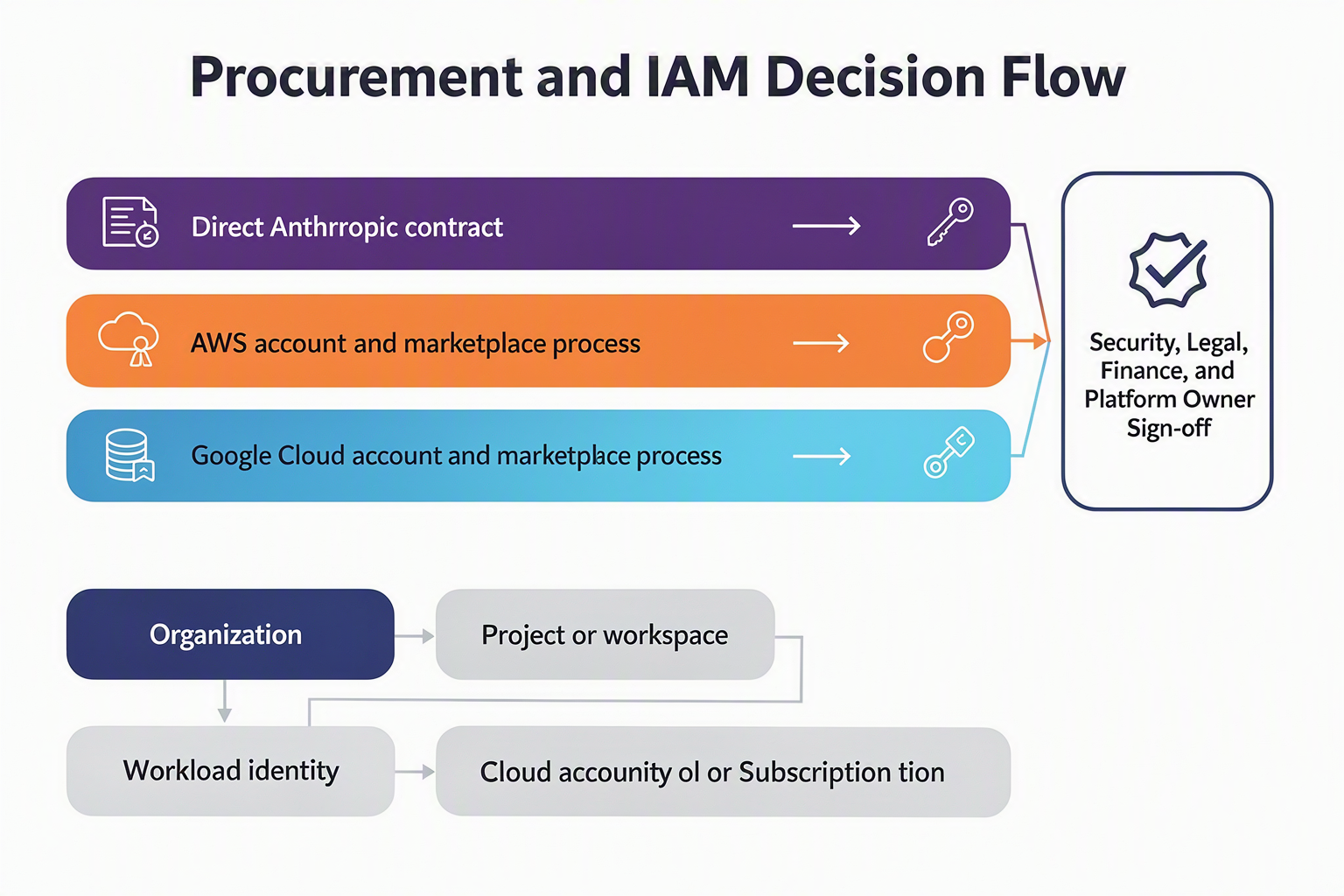
Procurement determines who contracts, bills and supports the model, while the deployment route determines whether applications authenticate with Anthropic credentials or cloud-native identities. For Claude Fable 5.1, enterprises should approve each cloud route only after confirming that the model appears in the provider’s current catalog, target region and tenant—not merely in an announcement.
Direct procurement through Anthropic
The Claude Fable 5.1 Anthropic API route creates a direct commercial and operational relationship with Anthropic. Procurement teams should review enterprise terms, invoicing, support, data-processing commitments, usage limits and any negotiated capacity arrangements.
Anthropic’s September 1, 2026 system card states that Claude Fable 5.1 is available for general use, but its additional cybersecurity and biology safeguards should still be documented during model-risk review. Authentication is typically centered on Anthropic organization or workspace credentials:
- Provision separate workspaces or projects for development, staging and production.
- Generate dedicated API keys for workloads rather than sharing human-owned keys.
- Store keys in a secrets manager, rotate them regularly and revoke them during offboarding.
- Restrict who can create credentials, change spending limits or view sensitive usage data.
Direct API keys are portable across infrastructure, but they do not automatically inherit Amazon Web Services IAM, Google Cloud IAM or Microsoft Entra ID controls.
Procurement through AWS, Google Cloud or Azure
A cloud deployment can simplify purchasing when an enterprise already has an approved provider agreement, consolidated billing and established vendor-risk controls. However, existing committed cloud spend should not be assumed to cover model consumption; procurement must confirm marketplace treatment, private pricing eligibility, taxes, support ownership and whether AI charges qualify toward contractual commitments.
The approval path normally differs by provider:
- Amazon Web Services: Confirm Claude Fable 5.1 in the Amazon Bedrock model catalog, request model access where required, and verify supported AWS Regions.
- Google Cloud: Confirm the model in Vertex AI Model Garden or the applicable managed model catalog, then validate project, location and billing-account eligibility.
- Microsoft Azure: Confirm tenant-level catalog availability, deployment-region support and the commercial terms attached to the relevant Azure AI service.
As of September 3, 2026, the supplied first-party evidence confirms the Anthropic API model, claude-fable-5-1; it does not independently establish deployable AWS, Google Cloud or Azure endpoints. A purchase order should therefore reference a verified service listing and region.
Cloud-native identity and least privilege
Cloud routes replace broadly distributed provider keys with identities governed through the enterprise cloud control plane:
- AWS: Use IAM roles for workloads, narrowly scoped Bedrock invocation permissions, service control policies and permission boundaries. Prefer temporary credentials over long-lived access keys.
- Google Cloud: Use dedicated service accounts, least-privilege Vertex AI permissions and Workload Identity Federation for workloads outside Google Cloud.
- Microsoft Azure: Use Microsoft Entra ID, managed identities and Azure role-based access control wherever the selected endpoint supports token-based authentication.
- All routes: Separate model invocation from catalog administration, quota changes, billing access and audit-log access.
The final design should preserve a clear accountability chain: procurement approves the seller and terms; platform engineering provisions the endpoint; security controls identities; application teams receive invocation-only access. This separation reduces credential sprawl and prevents model users from changing commercial or governance settings.
How should teams manage data retention, regional requirements, and observability?
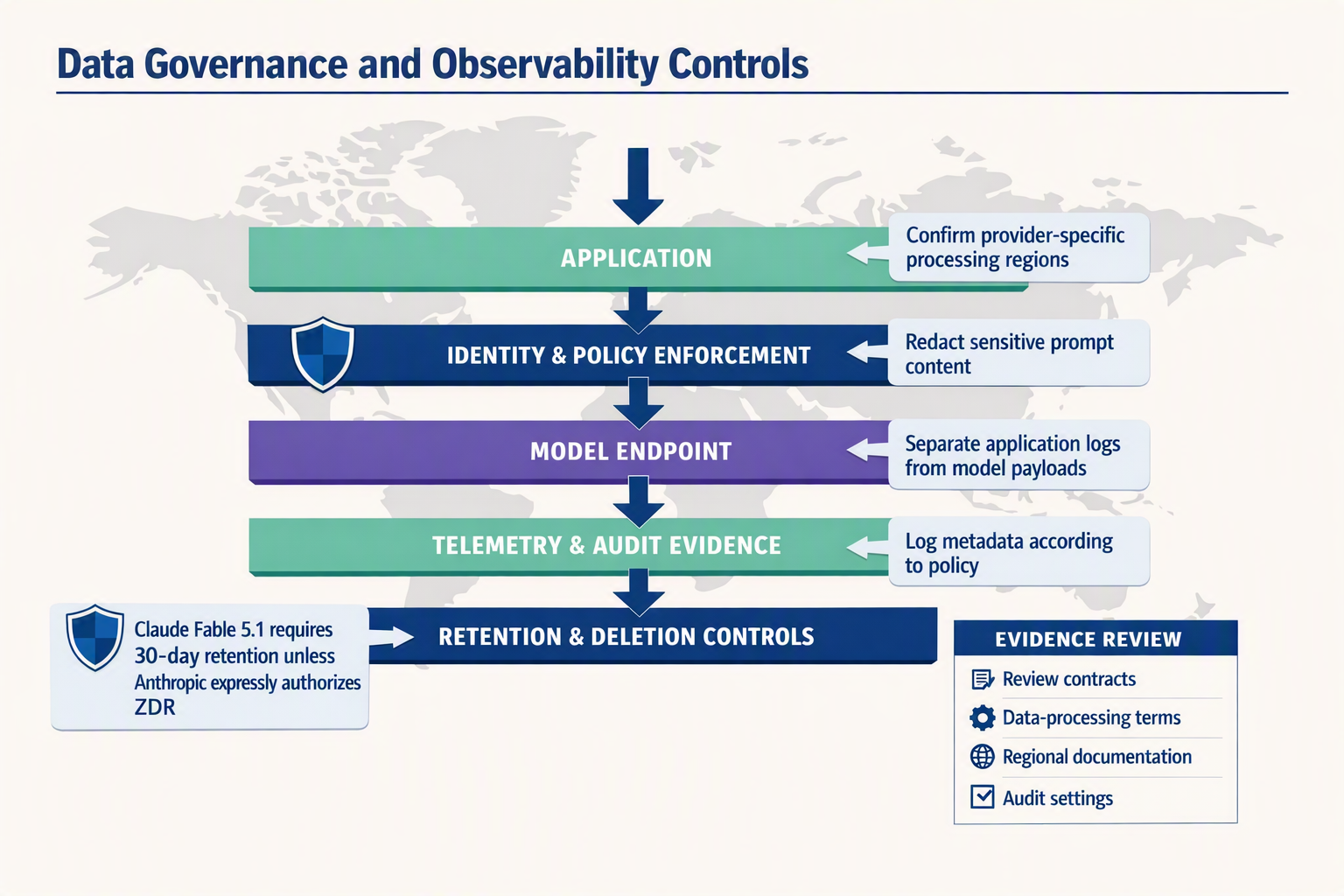
Teams should treat retention, processing location and telemetry as separate controls, because selecting a cloud region does not automatically guarantee zero retention or regional data residency. For Claude Fable 5.1, enterprises should obtain written confirmation of each provider’s current terms, supported regions and logging behavior before production approval.
Establish a defensible data lifecycle
The supplied Anthropic release documentation confirms the model launch but does not specify universal retention periods for every enterprise contract or cloud deployment. Retention claims should therefore be verified against the applicable data-processing agreement, service terms and account configuration—not inferred from a model announcement.
Document how information moves through six stages:
- Collection: Identify prompts, uploaded files, system instructions, tool results and user metadata.
- Transmission: Record every proxy, gateway, private endpoint and content-filtering service in the request path.
- Provider processing: Confirm whether prompts or outputs are retained, for how long, and whether they may be used for model improvement.
- Application storage: Apply explicit retention limits to conversation databases, caches, vector stores and object storage.
- Operational logging: Prevent full prompts, credentials and personal data from entering logs by default.
- Deletion: Test deletion across primary stores, replicas, backups, traces and support systems.
Classify workloads before routing them. Public, internal, confidential and regulated data should have distinct policies, with especially sensitive fields redacted or tokenised before inference.
Validate regional and regulatory boundaries
A deployment region may identify the API endpoint while leaving ambiguity about failover, support access, abuse monitoring or telemetry storage. Require providers to clarify where inference occurs, where data is persisted, where backups reside and whether processing can move during an outage.
For each Anthropic API, Amazon Web Services, Google Cloud or Microsoft Azure deployment, capture:
- Approved inference and storage regions
- Cross-border transfer mechanisms and subprocessors
- Encryption controls and customer-managed-key support
- Disaster-recovery and regional-failover behavior
- Applicable requirements under India’s Digital Personal Data Protection Act, the EU GDPR, sector rules and contractual residency commitments
Do not assume that Claude availability in one provider catalog means availability in every geography. Region-specific deployment must be tested using the exact account, model identifier and endpoint intended for production.
Anthropic’s September 2026 system card states that Claude Fable 5.1 and Claude Mythos 5.1 share an underlying model, with Fable adding safeguards for specified cybersecurity and biology tasks. Those safeguards are relevant risk controls, but they do not replace an enterprise’s privacy impact assessment or regional compliance review.
Build privacy-aware observability
Observability should answer who called the model, from which application, in which region, using what policy, at what cost and with what result—without recreating a sensitive prompt archive.
Capture structured metadata such as:
- Provider, region, model ID and model-version date
- Request and trace IDs, tenant ID and workload classification
- Input/output token counts, latency, retries and status codes
- Safety blocks, tool calls, fallback events and quota errors
- Estimated cost, without storing raw payment or identity data
Route platform-native evidence into the enterprise monitoring stack: Amazon CloudWatch and AWS CloudTrail, Google Cloud Monitoring and Cloud Audit Logs, Azure Monitor and Azure Activity Log, plus approved Anthropic API usage records. Use OpenTelemetry trace IDs across application, gateway and provider boundaries.
Finally, maintain a redaction layer before logs leave the application. Sample payloads only with explicit approval, tightly restrict access, define short retention windows and regularly test whether deletion and residency controls work in practice.
How can you build a portable Claude Fable 5.1 architecture and deployment checklist?
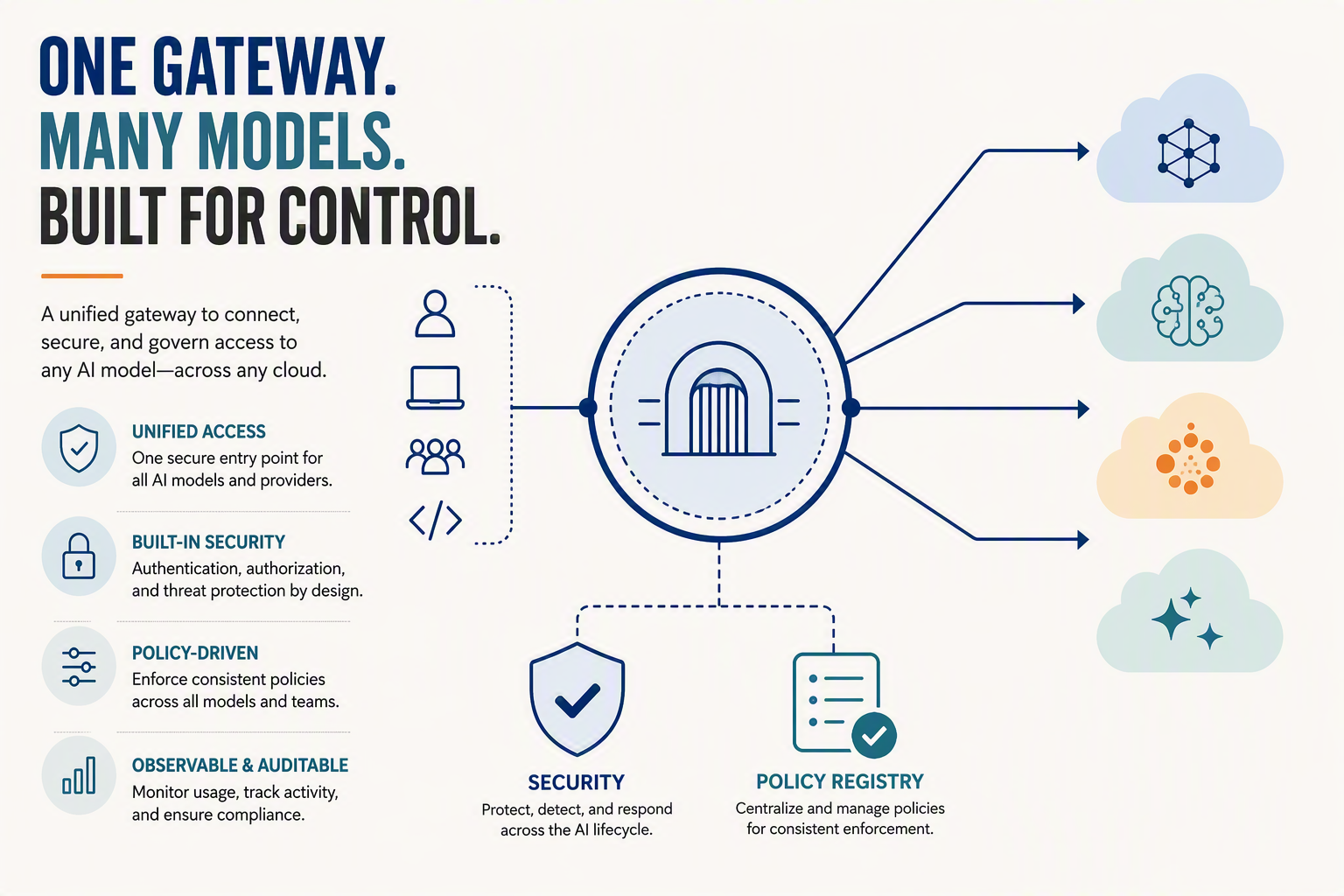
A portable Claude Fable 5.1 architecture separates business logic, model routing, provider authentication and governance controls. Treat the Anthropic API as the currently confirmed deployment target, while keeping AWS, Google Cloud and Microsoft Azure adapters disabled until each provider confirms the model, region and account access.
Build around a provider-neutral control plane
Define an internal AI interface rather than exposing provider SDKs throughout the application. The interface should normalize:
- Requests: system instructions, messages, tools, attachments, maximum output and reasoning settings.
- Responses: generated content, tool calls, token usage, finish status, latency and provider request IDs.
- Errors: authentication failures, throttling, safety refusals, timeouts and unavailable-model responses.
- Model aliases: map an internal name such as
fable-5.1-primaryto each provider’s exact identifier.
Anthropic’s release notes dated September 1, 2026, confirm that the direct Claude Platform identifier is claude-fable-5-1. Do not assume Amazon Bedrock, Google Cloud Vertex AI or Microsoft Azure uses the same identifier, API parameters or feature set.
Place provider-specific adapters behind the interface:
Application → AI gateway/router → Anthropic adapter
                              → AWS adapter
                              → Google Cloud adapter
                              → Azure adapter
A gateway can centralize authentication, quotas, retries, audit metadata and provider selection. Solutions such as CallMissed’s OpenAI-compatible AI gateway illustrate this abstraction pattern by exposing multiple models through one integration with same-tier fallback support; enterprises can apply the same principle through a managed gateway or an internally operated layer.
Keep capability and policy registries separate
Portability does not mean treating every endpoint as identical. Maintain a version-controlled capability registry containing model availability, context limits, tool support, streaming behavior and supported regions. Maintain a separate policy registry covering approved data classifications, identities, retention requirements and jurisdictions.
The Anthropic model overview recommends Claude Fable 5.1 for demanding reasoning and long-horizon agentic work, including cases where Claude Opus 5 at higher effort does not meet evaluation requirements. Anthropic’s September 2026 system card also states that Fable 5.1 shares its underlying model with Claude Mythos 5.1 but applies additional safeguards to specified cybersecurity and biology tasks; applications must therefore test refusals rather than treating the two offerings as operationally interchangeable.
Enterprise deployment checklist
- Verify availability: Record the catalog page, model identifier, access status and supported region for Anthropic, AWS, Google Cloud and Azure. Mark unverified cloud targets as unavailable—not “coming soon.”
- Approve procurement: Confirm the contracting entity, marketplace terms, committed-spend treatment, invoice currency and published model pricing.
- Configure identity: Use workload identities where supported; otherwise store scoped API keys in a secrets manager with rotation and revocation procedures.
- Classify data: Document whether prompts may contain personal, regulated, confidential or residency-constrained information.
- Test model behavior: Run task-quality, safety, tool-use and refusal evaluations against a fixed dataset before enabling traffic.
- Implement observability: Capture provider, model version, request ID, latency, token usage, error category and estimated cost without logging sensitive prompt content by default.
- Engineer resilience: Apply bounded retries, circuit breakers, idempotency controls and fallbacks only to models that passed the same evaluation threshold.
- Plan rollback: Pin routing configuration, retain the previous approved model mapping and test emergency disablement.
- Review continuously: Revalidate catalogs, regions, pricing, quotas and policy documentation after every provider or model change.
This design makes Claude Fable 5.1 enterprise deployment portable without pretending that procurement, safeguards or cloud controls are uniform.
How should enterprises compare Claude Fable 5.1 pricing without making false equivalences?
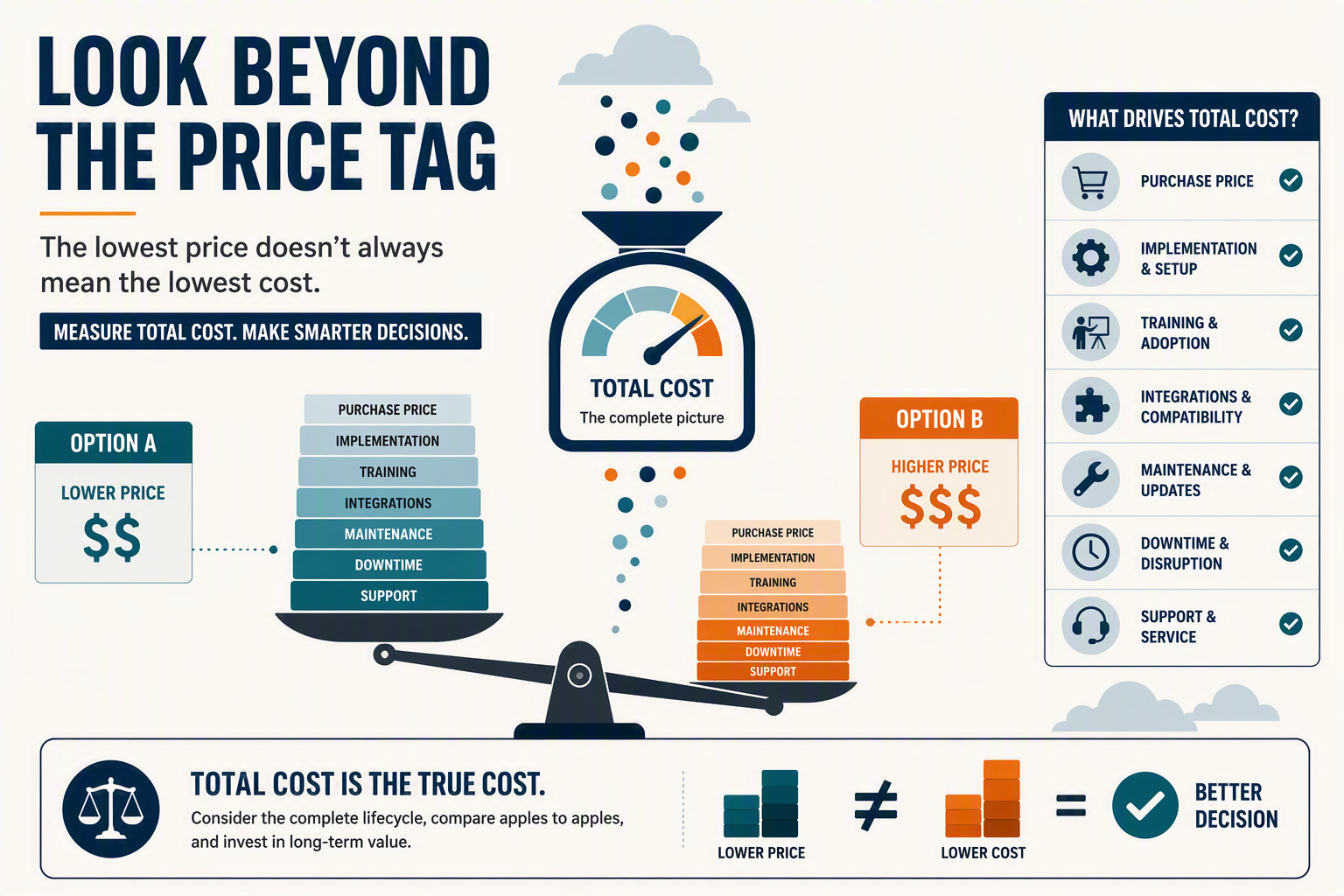
Enterprises should compare cost per completed, quality-approved workload, not merely the advertised price per million tokens. A valid Claude Fable 5.1 pricing analysis must normalize billing units, model configuration, cloud services and contractual discounts—and must not assign prices or availability to platforms whose current catalogs have not been verified.
Establish an evidence baseline
Anthropic’s release notes state that Claude Fable 5.1 launched on September 1, 2026, with the Anthropic API model ID claude-fable-5-1. Anthropic’s model documentation recommends Claude Fable 5.1 for demanding reasoning and long-horizon agentic work, including cases where evaluations on Claude Opus 5 at higher effort remain insufficient.
However, the supplied first-party evidence does not provide comparable price schedules for the Anthropic API, Amazon Bedrock, Google Cloud Vertex AI and Microsoft Azure. Therefore, a defensible comparison as of September 3, 2026 should show an amount only after confirming:
- The exact model ID, version and region
- General availability or account-specific preview status
- Input-token and output-token rates
- Cache-write, cache-read and batch-processing charges
- Tool use, web search, grounding or agent-service fees
- Provisioned-throughput commitments and minimum consumption
- Network egress, private connectivity, logging and support costs
- Enterprise discounts, marketplace credits and committed-spend treatment
A blank or “not verified” entry is more accurate than carrying Anthropic’s direct API price into an AWS, Google Cloud or Azure column.
Normalize the unit of comparison
Use a representative workload rather than an artificial one-million-token example. For each provider, calculate:
Workload cost = input charges + output charges + cache charges + tool charges + platform overhead + network costs
Then divide that amount by successful business outcomes:
Effective unit cost = total workload cost ÷ accepted task completions
For example, an incident-investigation benchmark could measure the cost of producing one analyst-approved root-cause report. This is especially relevant because Anthropic’s September 1, 2026 launch announcement says Claude Fable 5.1 leads the company’s incident-investigation evaluations, which are based on real production incidents. That quality claim does not establish a customer’s cost advantage; enterprises still need their own acceptance tests.
Prevent common false equivalences
Pricing committees should avoid these shortcuts:
- Comparing different model versions: A Claude Fable 5.1 rate is not interchangeable with a Fable 5, Opus 5 or provider alias.
- Ignoring output ratios: Long agentic sessions may produce different input, output and tool-use patterns from short chat requests.
- Treating list price as invoice price: Private offers, cloud commitments, taxes and currency conversion can materially change effective cost.
- Excluding operational services: API management, private networking, audit-log retention, monitoring and security tooling belong in total cost of ownership.
- Assuming equal retry rates: Throttling, timeouts and application-level retries consume resources even when the original task fails.
- Equating safeguards with identical behavior: Anthropic states that Claude Fable 5.1 uses the same underlying model as Claude Mythos 5.1 but applies stronger safeguards to specified cybersecurity and biology tasks; workflow completion rates may therefore differ by use case.
Run a controlled pricing evaluation
Send the same redacted prompt set, token limits, concurrency profile and success rubric through every verified deployment. Record p50 and p95 latency, billed tokens, cache utilization, retries, task acceptance and ancillary cloud charges. Finance should then model on-demand, committed-use and high-volume scenarios separately, preserving the official price sheet, contract date, currency and region as audit evidence.
What do security, platform, finance, and AI governance experts need to review?
The review board should approve a specific model-platform-region configuration, not Claude Fable 5.1 in the abstract. Security, platform engineering, finance and AI governance must jointly verify availability, access boundaries, data handling, operational readiness and commercial terms before production traffic begins.
Cross-functional review matrix
| Review area | Primary owner | Questions to resolve | Required evidence | Release gate |
|---|---|---|---|---|
| Model availability | Platform engineering | Is claude-fable-5-1 deployable in the selected service, account and region? Is preview enrollment required? | Provider catalog entry, successful test request and documented quota | Block deployment until the exact endpoint works; do not infer AWS, Google Cloud or Azure availability from an announcement |
| Identity and access | Security and IAM | Which users, workloads and automation systems can invoke the model? How are credentials rotated and emergency access revoked? | Role matrix, least-privilege policies, secret-management design and access-review schedule | No shared human credentials; production and non-production identities must be separated |
| Data protection | Security and privacy | What prompts, files, retrieved documents and outputs leave the enterprise boundary? Are retention, encryption, residency and provider-training terms acceptable? | Data-flow diagram, provider terms, retention configuration, regional-processing evidence and DPIA where applicable | Prohibit regulated or confidential data until every unresolved data path is classified |
| Model risk | AI governance | Do safeguards, refusal behavior and residual risks match the intended use case? Can humans override consequential outputs? | Anthropic system card review, use-case risk tier, adversarial tests and human-oversight design | High-impact workflows require documented controls, escalation paths and accountable owners |
| Operations | SRE/platform team | Can teams trace requests, monitor token use, detect quality regressions and handle provider outages? | Dashboards, request IDs, redacted logs, quota alerts, rollback plan and incident runbook | Load, failure, timeout and fallback tests must pass before production |
| Commercial control | Finance and procurement | Are pricing units, taxes, support, marketplace commitments and egress costs understood? Who owns budget variance? | Signed quote or official price sheet, forecast by workload, invoice mapping and spend alerts | Approve against measured usage; do not substitute another Claude model’s price |
Evidence the governance team should anchor on
Anthropic’s September 1, 2026 release notes identify claude-fable-5-1 as the Anthropic API model ID for Claude Fable 5.1. That identifier should appear in architecture records, evaluation reports and software bills of materials so reviewers can distinguish the approved model from aliases or future versions.
Anthropic’s September 2026 system card states that Claude Fable 5.1 is available for general use and applies additional safeguards to certain high-risk cybersecurity and biology tasks. Governance teams should review those safeguards as control inputs—not as substitutes for application-level authorization, output validation or human review.
Anthropic also describes Claude Fable 5.1 as the same underlying model as Claude Mythos 5.1, with stronger restrictions for specified cyber and biology activities. Consequently, evaluations must test the deployable Fable endpoint rather than treating Mythos results as automatically transferable.
Recommended approval sequence
- Freeze the deployment tuple: provider, service, model ID, region, account and versioning policy.
- Run representative evaluations: include accuracy, refusal, prompt-injection, data-leakage and long-running-agent tests.
- Validate financial assumptions: replay measured token consumption against an official quote and include networking, logging and support costs.
- Record conditional approval: specify permitted datasets, user groups, tools, transaction limits and fallback models.
- Schedule reassessment: trigger review after model updates, region changes, material incidents or provider-term changes.
As of September 3, 2026, missing cloud-catalog or regional evidence should be recorded as unverified, not interpreted as unavailable or approved. This fail-closed approach keeps a rapidly launched model from bypassing normal enterprise controls.
Frequently asked questions about Claude Fable 5.1 enterprise deployment
Availability and setup
Where is Claude Fable 5.1 available for enterprise deployment?
claude-fable-5-1. Anthropic’s release notes state that Claude Fable 5.1 became generally available on September 1, 2026, for long-running agentic coding, demanding reasoning and knowledge work. No supplied first-party evidence confirms deployable availability on Amazon Bedrock, Google Cloud Vertex AI or Microsoft Azure, so enterprises must check each provider’s live catalog, eligible regions and account access before committing.How do I start a Claude Fable 5.1 enterprise deployment through the Anthropic API?
claude-fable-5-1 through the Claude Messages API. Store credentials in a secrets manager rather than application code, separate development and production workspaces, and apply budget and rate controls. Anthropic’s model documentation recommends Claude Fable 5.1 when evaluations on Claude Opus 5 at higher effort still fall short.Security, governance and procurement
How should identity and access management differ across Anthropic API, AWS, Google Cloud and Azure?
What is the best procurement route for Claude Fable 5.1 enterprise deployment?
What data-governance checks are required before deploying Claude Fable 5.1?
Operations and portability
How can enterprises maintain portability and reliability across Claude Fable 5.1 providers?
Conclusion
Claude Fable 5.1 is ready for enterprise evaluation through the Anthropic API, but deployment on AWS, Google Cloud or Microsoft Azure should remain conditional until each provider confirms catalog, region and account-level availability. Anthropic’s release notes state that Claude Fable 5.1 became generally available on September 1, 2026, under the model ID claude-fable-5-1.
- Verify availability before designing the architecture. Anthropic API access is confirmed as of September 3, 2026; references to Amazon Web Services, Google Cloud or Microsoft Azure do not by themselves guarantee a usable endpoint in every region or tenant. Validate the current Amazon Bedrock, Google Cloud Vertex AI and Microsoft Azure catalogs directly.
- Choose the commercial and governance model—not merely the endpoint. Direct Anthropic procurement may suit teams wanting immediate model access, while a cloud route may align better with existing marketplace agreements, committed spend and consolidated billing. Compare retention, processing regions, encryption boundaries and audit evidence before approving production workloads.
- Make identity and operations first-class requirements. Map Anthropic workspace keys, AWS roles, Google Cloud service accounts or Azure managed identities to least-privilege policies. Production readiness also requires token monitoring, quota alerts, request tracing, fallback behavior and documented incident-response ownership.
- Preserve portability and evaluate total cost. Isolate provider-specific SDKs, identifiers and authentication behind an internal interface. Compare official pricing only on equivalent units, then account for networking, security, observability and operational overhead rather than treating token prices as the complete cost.
What comes next matters: enterprises should watch for official cloud-catalog listings, supported-region expansion, pricing publication and changes to account-level access controls. Anthropic also says Fable 5.1 uses the same underlying model as Claude Mythos 5.1, with stronger safeguards for specified cybersecurity and biology tasks, making system-card updates important governance inputs.
Teams seeking a consistent integration layer can explore CallMissed, an OpenAI-compatible AI gateway spanning multiple models and providers alongside AI voice and multilingual customer-engagement infrastructure. Will your architecture be ready to adopt Claude Fable 5.1 where governance fits best—without rebuilding the application for every provider?
Related Reading
- Claude Fable 5.1 vs GPT-6: Enterprise Agent Tests
- Claude Fable 5.1 Prompting and Migration Guide for Developers
- Claude Fable 5.1 Agentic Coding Guide for Long-Running Software Tasks