Claude Fable 5.1 Pricing: API Costs, Calculator and Examples



Understand Claude Fable 5.1 pricing with verified token and cache rates, worked examples, break-even math, and practical cost controls.
Claude Fable 5.1 Pricing: API Costs, Calculator and Examples
What if a 100,000-token prompt costs $1 to send—but just $0.025 to reuse from cache? That gap makes Claude Fable 5.1 pricing more than a simple per-token calculation: application architecture, response length, caching strategy and provider choice can materially change the final API bill.
The headline API rates
As of September 3, 2026, Anthropic lists Claude Fable 5.1 at $10 per million input tokens and $50 per million output tokens. Anthropic also prices prompt-cache reads at $0.25 per million tokens, making cached input 97.5% cheaper than processing the same number of tokens at the standard input rate.
Output tokens therefore cost five times as much as standard input tokens under Anthropic’s published rates. For teams building coding agents, research tools or long-horizon workflows, controlling generated output can be just as important as shortening prompts.
A straightforward API request containing 100,000 uncached input tokens and producing 20,000 output tokens would cost:
- Input: 100,000 ÷ 1,000,000 × $10 = $1.00
- Output: 20,000 ÷ 1,000,000 × $50 = $1.00
- Total: $2.00 per request
At 10,000 equivalent requests, that workload would reach $20,000, before accounting for caching, batch discounts or platform-specific differences. This is why the Claude Fable 5.1 cost per task is often more useful than the headline price per million tokens.
Why this pricing guide matters now
Anthropic describes Claude Fable 5.1 as suitable for demanding reasoning and long-horizon agentic work, where models may process large repositories, extensive tool results and repeated system instructions. Anthropic announced that Claude Fable 5.1 is available across its platforms, including Amazon Web Services, Google Cloud and Microsoft Azure, expanding the number of purchasing and deployment routes developers must evaluate.
This guide will break down:
- Standard input and output token charges
- Verified cache-read and cache-write pricing
- A reusable API cost-calculation formula
- Worked examples for chat, document analysis and agentic tasks
- Verified batch or cloud-platform rates where available
- Cost-control tactics and comparisons with nearby Anthropic models
- Whether Claude Fable 5.1 retains the pricing structure of Fable 5
Multi-model gateways are also becoming part of this cost-management trend; for example, CallMissed’s OpenAI-compatible API gateway lets developers access multiple model providers through one integration with same-tier fallbacks.
The goal is not merely to quote the Fable 5.1 price. It is to show what Claude Fable 5.1 API pricing means for an actual production workload—and where careful token budgeting can prevent a capable agent from becoming an unexpectedly expensive one.
How much does Claude Fable 5.1 cost as of September 3, 2026?
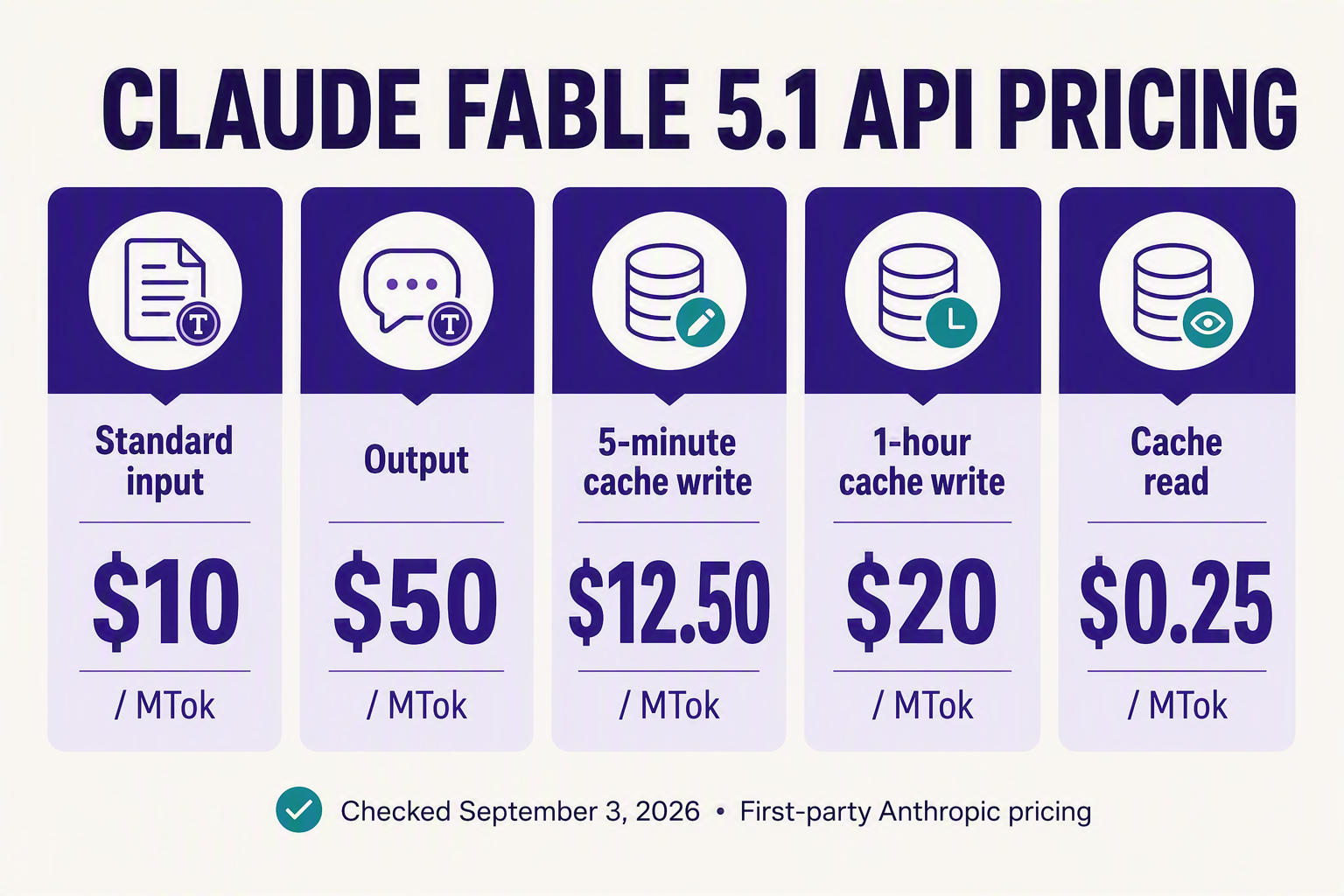
Claude Fable 5.1 pricing is $10 per million input tokens and $50 per million output tokens through the Anthropic API as of September 5, 2026. Prompt-cache hits cost $0.25 per million tokens, or 2.5% of the standard input rate.
Verified Anthropic API rate card
Anthropic’s first-party pricing materials list the following Claude Fable 5.1 pricing:
| Token category | Price per million tokens | Cost per 100,000 tokens |
|---|---|---|
| Standard input | $10.00 | $1.00 |
| Prompt-cache hit | $0.25 | $0.025 |
| Output | $50.00 | $5.00 |
These are usage-based rates rather than fixed per-request fees. The cost of each request depends on the number of standard input, cached input and output tokens billed.
What each charge means
- Standard input: New prompt content processed without a valid cache entry.
- Cache hit: Previously cached prompt content reused before it expires. At $0.25 per million tokens, cache hits are 97.5% cheaper than standard input.
- Output: Tokens generated in the model’s response. Output costs five times as much as standard input at $50 per million tokens.
Cache writes can carry separate rates based on cache duration. Because those charges depend on the applicable Anthropic cache configuration and published rate card, include them in an estimate only when the relevant first-party pricing documentation explicitly confirms the write rate.
Concise Claude Fable 5.1 pricing examples
- 100,000 input tokens and 10,000 output tokens:
(100,000 × $10 / 1,000,000) + (10,000 × $50 / 1,000,000) = $1.50
- 100,000 cached input tokens and 10,000 output tokens:
(100,000 × $0.25 / 1,000,000) + (10,000 × $50 / 1,000,000) = $0.525
- 1 million input tokens and 200,000 output tokens:
$10.00 + $10.00 = $20.00
These examples exclude any applicable cache-write charges, taxes or provider-specific fees.
Direct API versus cloud-platform pricing
The rates above describe direct Anthropic API pricing. Claude Fable 5.1 pricing through AWS, Google Cloud, Microsoft Azure or another cloud marketplace may use different billing units, regional prices, currencies, discounts or contractual terms.
Therefore:
- Use $10 per million input tokens, $50 per million output tokens and $0.25 per million cache-hit tokens for direct Anthropic API estimates.
- Check the selected cloud provider’s first-party pricing page before calculating a marketplace deployment.
- Do not assume Anthropic API discounts, cache terms or billing rules automatically apply to third-party cloud platforms.
All prices in this section were checked against Anthropic’s published pricing materials on September 5, 2026 and are stated in US dollars before applicable taxes.
How does Claude API token billing work, and which tokens appear on your bill?
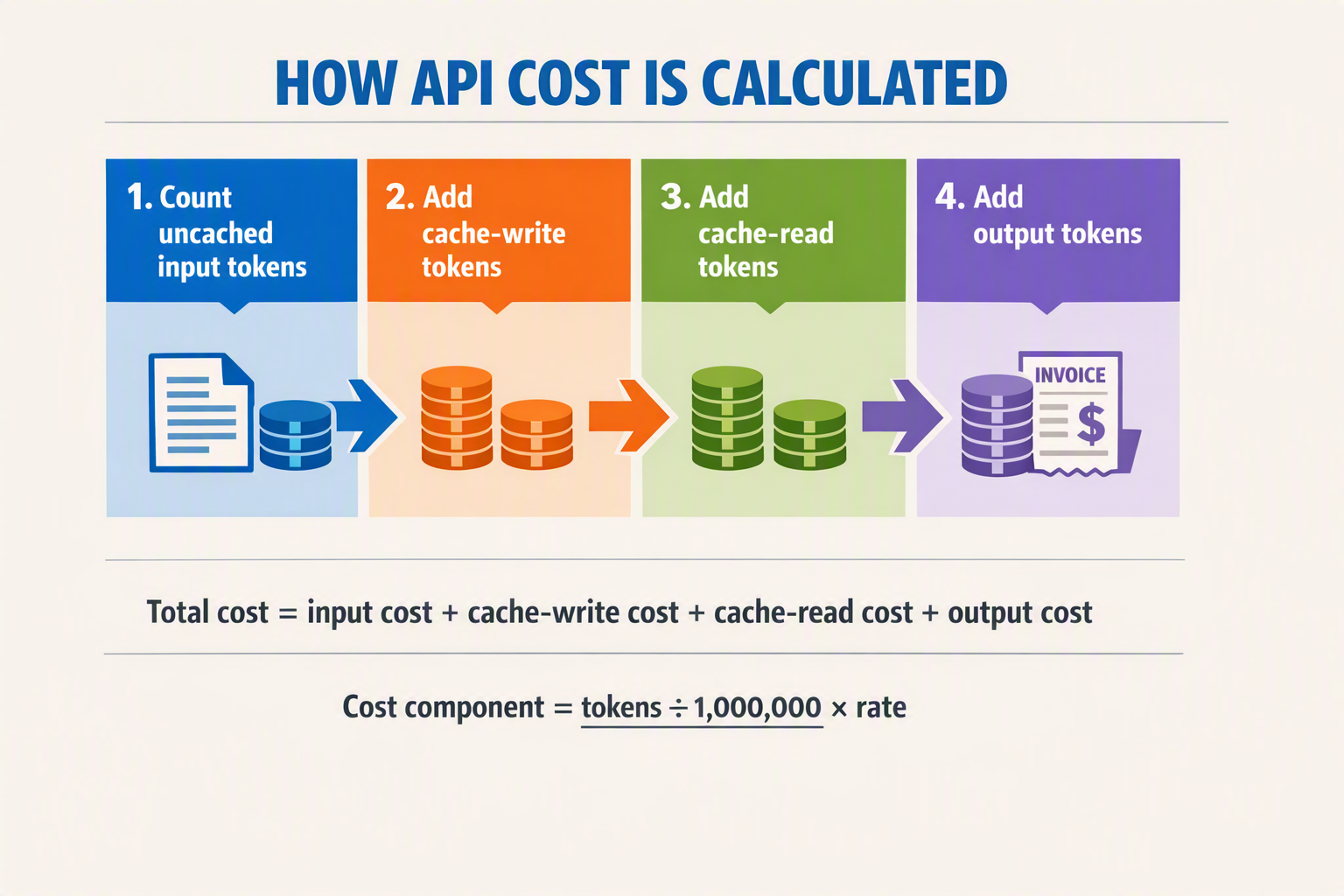
Anthropic bills Claude Fable 5.1 by the tokens processed in each usage category, not by request count, conversation, word count or execution time. A production bill can therefore contain standard input, cache creation, cache-read and output tokens from the same request.
The four billable token categories
Anthropic’s Claude Platform pricing documentation lists four relevant categories for Claude Fable 5.1:
- Standard input tokens: New prompt content processed normally, including system instructions, user messages and other uncached context.
- Cache-creation input tokens: Prompt content written to the prompt cache. Anthropic charges different rates for the five-minute and one-hour cache durations.
- Cache-read input tokens: Previously cached prompt content reused in a later request.
- Output tokens: Content generated by Claude Fable 5.1, including text and model-generated tool-use blocks.
As of September 3, 2026, Anthropic’s Claude Platform documentation prices five-minute cache writes at $12.50 per million tokens, one-hour cache writes at $20 per million tokens, and cache reads at $0.25 per million tokens. Cache creation therefore costs more than ordinary input initially, but successful reuse can quickly offset that premium.
The corresponding per-request formula is:
Cost = standard input cost + cache-write cost + cache-read cost + output cost
Each component equals:
Tokens in category ÷ 1,000,000 × that category’s rate
What counts as input or output?
An API payload can consume more input tokens than the latest user message suggests. Billable input context may include:
- System prompts and developer instructions
- Previous user and assistant messages sent again with the request
- Tool definitions, schemas and descriptions
- Tool results returned to Claude in a subsequent turn
- Documents, images or retrieved knowledge converted into model input
- Uncached portions surrounding a cached prompt prefix
Model-generated answers consume output tokens. If Claude emits a tool call, that generated tool-use block is output; when the application sends the tool’s result back, the result becomes input on the next request. Agentic loops can consequently accumulate charges across several model calls even when the user initiated only one task.
A token is also not equivalent to one word. Tokenization varies with language, formatting, code, punctuation and structured data, so word-count estimates should not be treated as final billing measurements.
How usage appears in an API response
Anthropic API responses expose usage counters such as input_tokens, cache_creation_input_tokens, cache_read_input_tokens and output_tokens. Applications should log these fields per request rather than estimating costs solely from prompt size.
For example, a request using 20,000 ordinary input tokens, 80,000 cache-read tokens and 2,000 output tokens would cost:
- Standard input: 20,000 × $10/MTok = $0.20
- Cache read: 80,000 × $0.25/MTok = $0.02
- Output: 2,000 × $50/MTok = $0.10
- Total: $0.32
Without caching, processing all 100,000 input tokens at the standard rate would make the same request $1.10. The example shows why accurate usage logging—and separating cache hits from ordinary input—is essential when calculating the real Claude Fable 5.1 cost per task.
Which Fable 5.1 prices and product developments are verified by first-party sources?
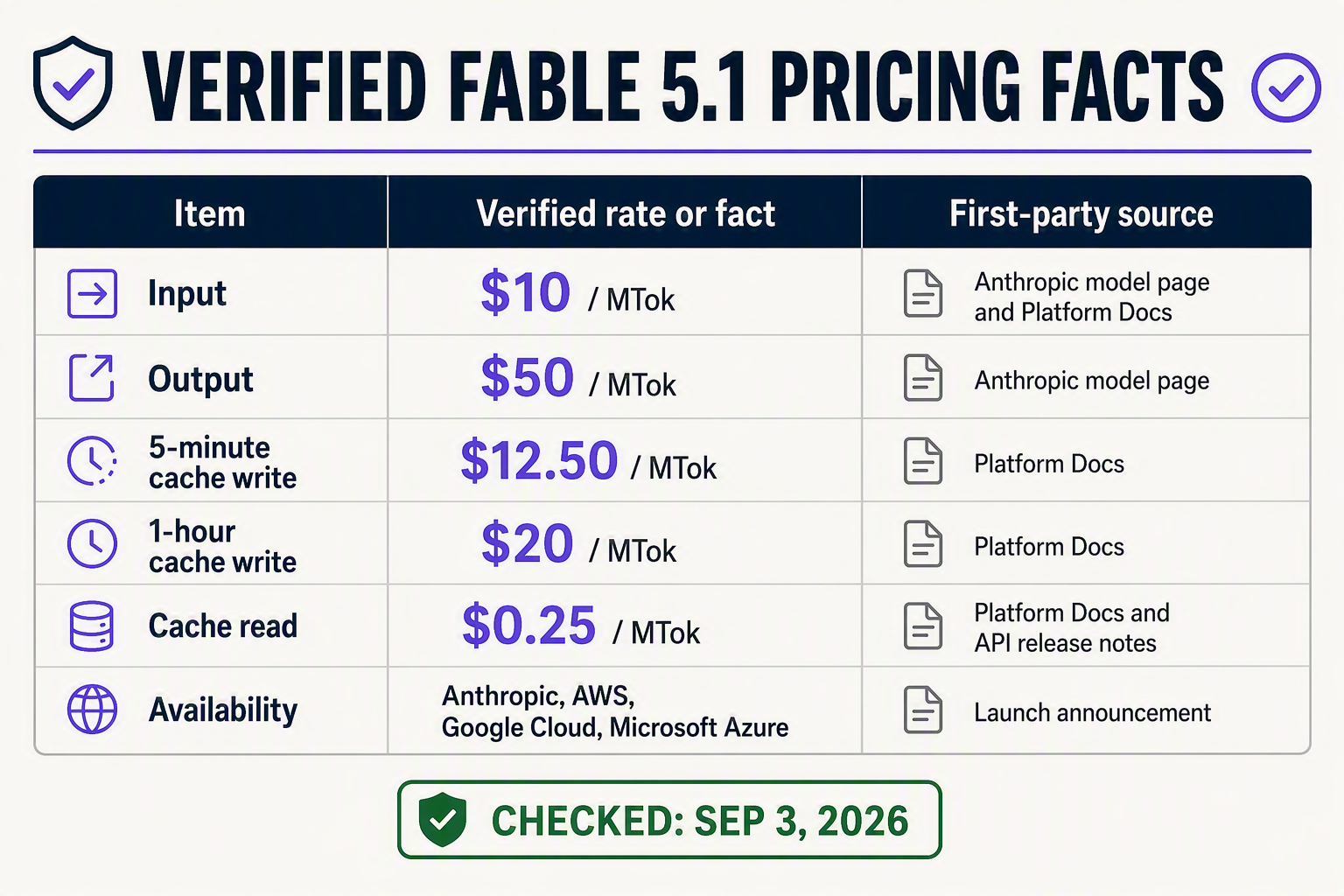
Anthropic’s first-party product pages and Claude Platform documentation verify five core Claude Fable 5.1 rates: standard input, output, two cache-write durations and cache reads. Anthropic also confirms broader cloud availability and continuity with Fable 5 pricing, while the available first-party extracts do not establish numerical batch or cloud-specific rates.
Verified Claude Fable 5.1 pricing
All figures below were checked against Anthropic sources on September 3, 2026. MTok means one million tokens.
| Billing item | Verified price | Relative to input | First-party source |
|---|---|---|---|
| Standard input | $10/MTok | 1× | Anthropic Claude Fable page |
| 5-minute cache write | $12.50/MTok | 1.25× | Claude Platform pricing docs |
| 1-hour cache write | $20/MTok | 2× | Claude Platform pricing docs |
| Cache read | $0.25/MTok | 0.025× | Anthropic and Claude Platform docs |
| Output | $50/MTok | 5× | Anthropic Claude Fable page |
| Fable 5 comparison | Pricing retained | No headline-rate increase | Anthropic product announcement |
Anthropic’s Claude Platform pricing documentation listed the 5-minute cache-write price at $12.50 per million tokens and the 1-hour cache-write price at $20 per million tokens on September 3, 2026. These write charges matter because caching is not immediately free: an application pays a premium when it creates the cached prefix, then receives the much lower $0.25-per-million-token read rate when that content is reused.
Anthropic’s Claude Fable product page says the $0.25 cache-read rate is 75% lower than the corresponding Fable 5 rate. That product-specific reduction is distinct from Anthropic’s broader statement that Claude Fable 5.1 retains Fable 5’s standard pricing structure.
Verified product and availability developments
Anthropic’s announcement verifies several developments relevant to purchasing and deployment:
- Claude Fable 5.1 is available across Anthropic’s platforms, including Amazon Web Services, Google Cloud and Microsoft Azure.
- Anthropic positions Claude Fable 5.1 for “demanding reasoning and long-horizon agentic work,” indicating that its intended workloads may involve substantial context, tool use and generated output.
- Anthropic states that Claude Fable 5.1 and Claude Mythos 5.1 use the same underlying model, although the Claude Platform documentation describes Claude Mythos 5.1 as having limited availability.
- Anthropic’s Claude Platform release notes specifically document the new $0.25-per-million-token cache-read price for Claude Fable 5.1 and Claude Mythos 5.1.
What should not be inferred
A model’s availability through AWS, Google Cloud or Microsoft Azure does not automatically prove identical billing terms across those platforms. Cloud marketplaces can apply different contractual arrangements, regional billing mechanics, commitments or ancillary infrastructure charges.
Likewise, Anthropic’s model documentation references batch discounts, but the supplied first-party evidence does not expose a numerical Fable 5.1 batch rate. Until a rate is visible in the applicable Anthropic or cloud-platform pricing page, cost models should:
- Use the verified standard and caching rates above.
- Treat any batch discount as unconfirmed, not assumed.
- Check the selected provider’s current regional price before production deployment.
- Separate model-token charges from storage, networking, orchestration and tool-execution costs.
What does Claude Fable 5.1 cost for typical API requests and workloads?
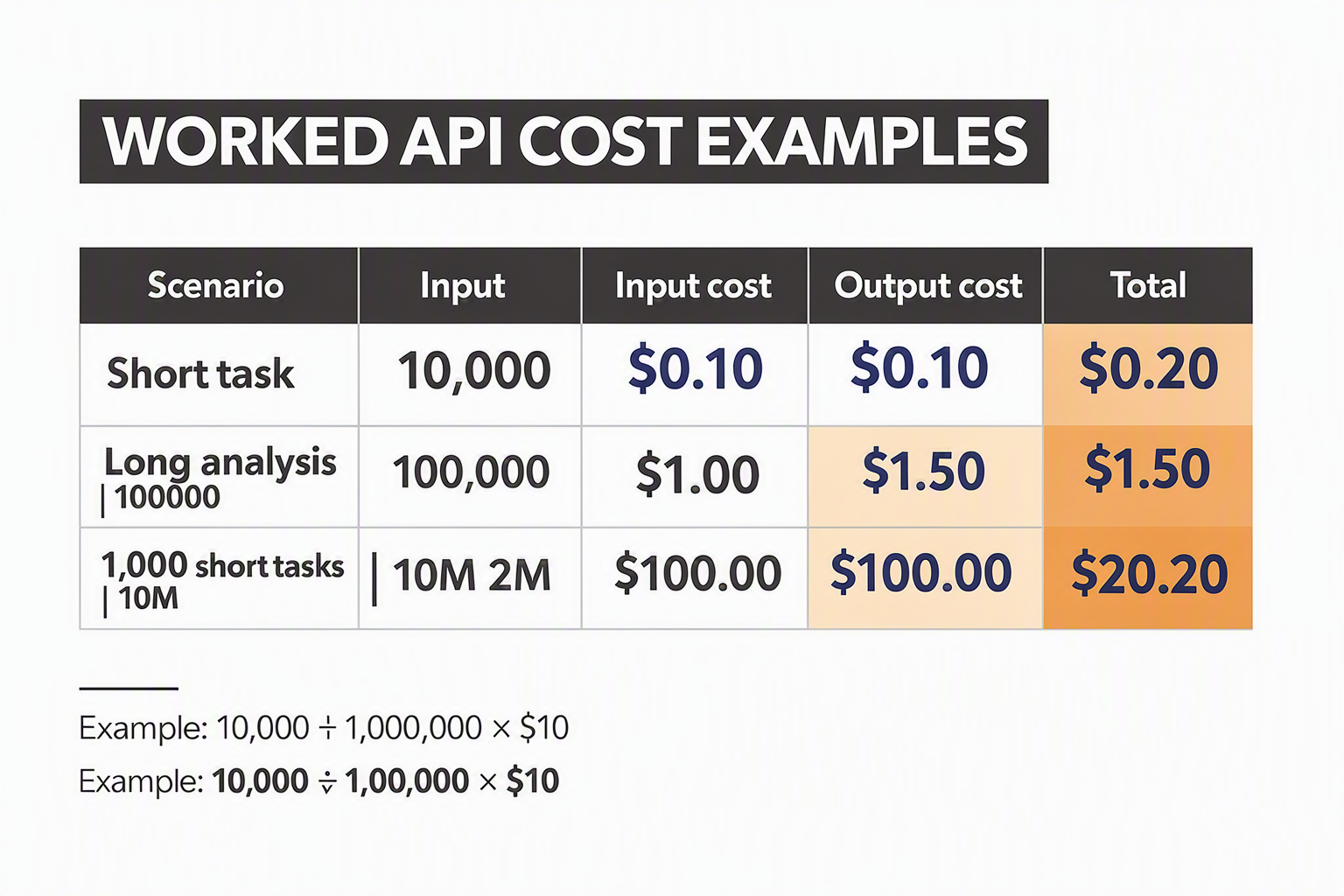
Typical Claude Fable 5.1 requests can cost a few cents for short conversations, tens of cents for retrieval-augmented generation, or several dollars for large agentic runs. The decisive variables are uncached input, cache writes, cache reads and output length.
Worked Claude Fable 5.1 cost examples
The estimates below use Anthropic’s first-party rates checked on September 3, 2026: $10 per million standard input tokens, $50 per million output tokens, $12.50 per million tokens for a five-minute cache write, $20 per million tokens for a one-hour cache write, and $0.25 per million cache-read tokens, according to Claude Platform Docs.
| Typical workload | Token profile | Cost calculation | Estimated API cost |
|---|---|---|---|
| Short chatbot reply | 2,000 input + 500 output | $0.020 + $0.025 | $0.045 |
| Cached support conversation | 1,000 input + 8,000 cache read + 500 output | $0.010 + $0.002 + $0.025 | $0.037 |
| 50,000-token document summary | 50,000 input + 2,000 output | $0.500 + $0.100 | $0.600 |
| RAG research response | 10,000 input + 40,000 cache read + 3,000 output | $0.100 + $0.010 + $0.150 | $0.260 |
| Large coding-agent run | 200,000 input + 25,000 output | $2.000 + $1.250 | $3.250 |
| Cache creation for a large prefix | 100,000 five-minute cache write + 5,000 input + 4,000 output | $1.250 + $0.050 + $0.200 | $1.500 |
These figures represent model-token charges per request. They do not include application hosting, vector databases, network transfer, observability, external tools or cloud-provider fees that may apply outside Anthropic’s direct API pricing.
What changes the cost most?
Generated output is usually the expensive component. In the short-chat example, 500 output tokens cost $0.025, exceeding the $0.020 charge for 2,000 input tokens. Reducing a response from 2,000 to 1,000 tokens saves $0.05 per request, or $500 across 10,000 requests.
Prompt caching can substantially lower repeated-context costs:
- The cached support example costs $0.037, compared with $0.115 if all 9,000 input tokens were processed at the standard rate—a reduction of approximately 67.8%.
- The RAG example costs $0.26, versus $0.65 without caching—a 60% reduction.
- Anthropic’s $0.25-per-million cache-read rate is 97.5% below the $10 standard input rate as of September 3, 2026.
When does cache creation pay off?
A five-minute cache write for a 100,000-token prefix costs $1.25, while processing that prefix normally costs $1.00. Each subsequent cache read costs only $0.025, saving $0.975 per reuse compared with standard input.
For that prefix:
- Write once and reuse once: $1.275 cached versus $2.00 uncached.
- Write once and reuse ten times: $1.50 cached versus $11.00 uncached.
- One-hour cache writes cost more: 100,000 tokens cost $2.00 to write, so the longer cache needs at least two successful reuses to produce a clear saving.
The practical lesson is to model cost per completed task, not merely cost per request: retries, tool loops and verbose outputs can multiply the final Claude Fable 5.1 API cost.
When does Fable 5.1 prompt caching save money, and what is the break-even point?
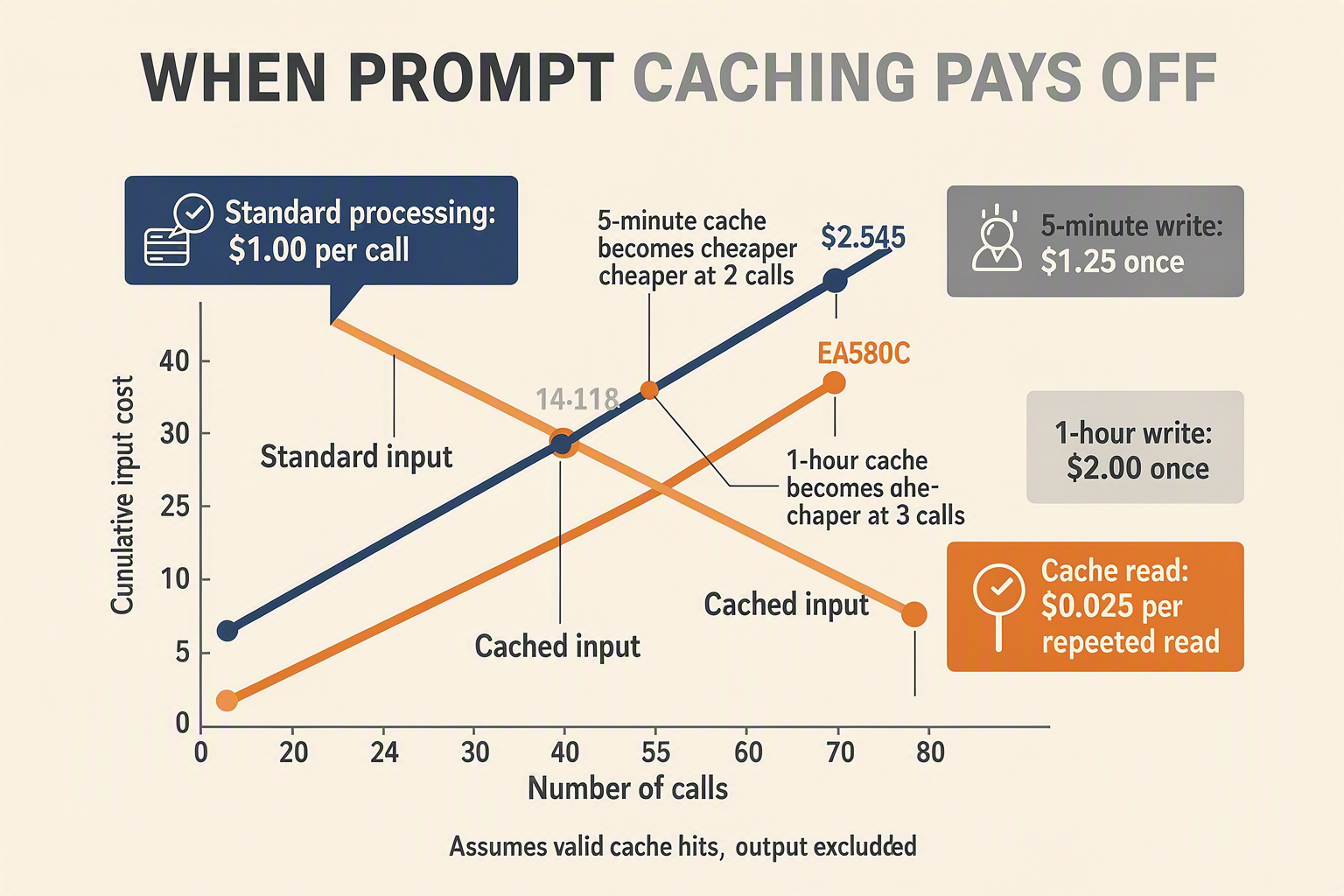
Prompt caching saves money when the same prompt prefix is reused: with Anthropic’s verified rates, a five-minute cache breaks even on the second request, while a one-hour cache becomes cheaper on the third request. These thresholds assume the cached content remains unchanged and subsequent calls qualify as cache reads.
The break-even formula
As of September 3, 2026, Anthropic’s Claude Platform documentation lists these Claude Fable 5.1 cache rates:
- Standard input: $10 per million tokens
- Five-minute cache write: $12.50 per million tokens
- One-hour cache write: $20 per million tokens
- Cache read: $0.25 per million tokens
Anthropic prices a Claude Fable 5.1 cache read 97.5% below standard input, at $0.25 versus $10 per million tokens.
For a reusable prompt block, compare uncached processing with one cache write followed by cache reads:
Uncached cost = N × standard input cost
Cached cost = cache-write cost + (N − 1) × cache-read cost
Here, N is the total number of requests using the same cacheable content. Token volume cancels out when calculating the request-count threshold, so the break-even point is the same for a 10,000-token prefix and a 100,000-token prefix.
Five-minute cache: profitable from request two
For the five-minute cache:
- One uncached request costs $10 per million tokens.
- One cache write costs $12.50 per million tokens.
- Each subsequent cache read costs $0.25 per million tokens.
At two requests, uncached processing costs $20 per million reusable tokens, while caching costs $12.75. That produces a saving of $7.25, or 36.25%, across the two requests.
For a 100,000-token shared prefix, the calculation is:
- Two uncached calls: 2 × $1.00 = $2.00
- Cache write: $1.25
- One cache read: $0.025
- Cached total: $1.275
- Net saving: $0.725
The five-minute option therefore suits bursty workloads such as parallel agent steps, repeated document questions and rapid chat turns.
One-hour cache: profitable from request three
A one-hour write costs twice the standard input rate. At two requests, caching costs $20.25 per million reusable tokens, slightly more than the $20 uncached total. At three requests, however:
- Uncached processing: 3 × $10 = $30
- One-hour write plus two reads: $20 + (2 × $0.25) = $20.50
- Saving: $9.50 per million tokens, or approximately 31.7%
For a 100,000-token prefix, that is $3.00 uncached versus $2.05 cached.
When caching will not reduce the bill
Caching is less effective when:
- A prompt is used only once.
- The reusable prefix changes between calls.
- Requests arrive after the cache expires and require another write.
- Most tokens belong to unique user messages rather than stable instructions, documents or tool definitions.
Output pricing is unaffected by prompt caching. Claude Fable 5.1 output remains $50 per million tokens, according to Anthropic, so teams should combine caching with response-length controls for the largest reduction in Claude Fable 5.1 API cost per task.
Are batch discounts or AWS, Google Cloud and Microsoft Azure prices different?
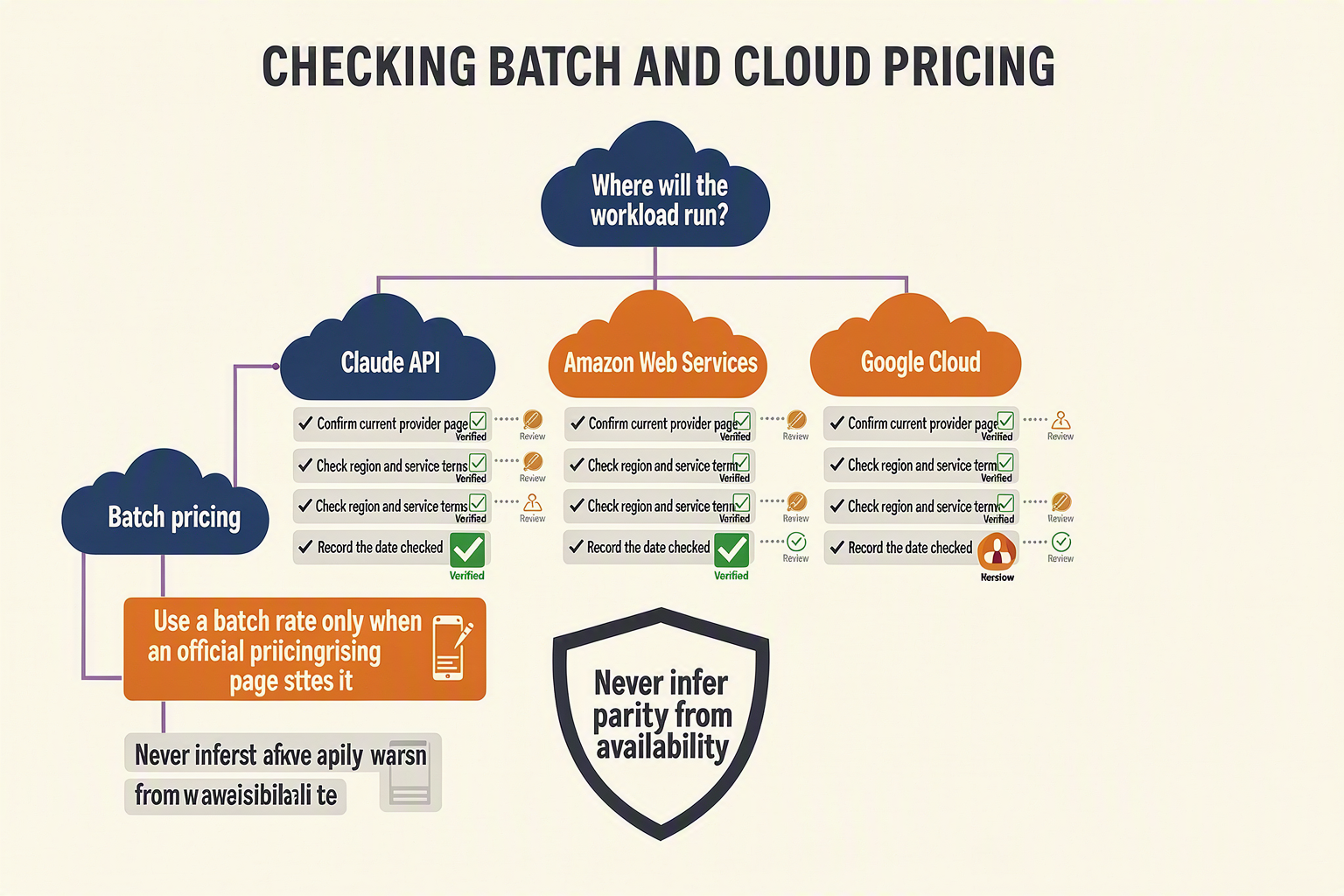
Batch discounts are referenced in Anthropic’s documentation, but the available first-party extracts do not verify a numerical batch rate for Claude Fable 5.1. Likewise, availability on Amazon Web Services, Google Cloud and Microsoft Azure does not mean that pricing, billing units or total platform costs are identical.
What is verified about batch pricing?
Anthropic’s Claude Platform model overview directs readers to pricing information that includes batch discounts and prompt-caching rates. However, the supplied first-party material does not state the percentage discount or provide batch-specific input and output prices for Claude Fable 5.1.
Therefore, this guide does not assume a 50% discount or derive discounted rates from the standard price. As of September 3, 2026, Anthropic lists the following direct Claude Fable 5.1 rates:
- Standard input: $10 per million tokens
- Standard output: $50 per million tokens
- Five-minute cache writes: $12.50 per million tokens
- One-hour cache writes: $20 per million tokens
- Cache reads: $0.25 per million tokens
Anthropic’s Claude Fable product page and Claude Platform pricing documentation provide these standard and caching rates. They do not, in the supplied extracts, establish a numerical Fable 5.1 batch price.
Before budgeting asynchronous work, teams should check Anthropic’s live official pricing page and confirm:
- The batch discount currently applicable to Claude Fable 5.1.
- Whether the discount covers both input and output tokens.
- How prompt-cache writes and reads are treated in batch requests.
- Whether batch jobs have separate limits, completion windows or eligibility rules.
Until those details are verified, use the standard $10 input and $50 output per million tokens as a conservative planning baseline. Batch processing can still suit evaluations, document extraction and offline classification, but projected savings should not be entered into a business case without a current official rate.
Are AWS, Google Cloud and Azure prices identical?
Anthropic announced that Claude Fable 5.1 is available on Amazon Web Services, Google Cloud and Microsoft Azure, in addition to Anthropic’s own platform. That first-party availability statement does not establish identical prices across all four purchasing routes.
Cloud-platform costs can vary because of:
- Region and currency
- Pay-as-you-go versus provisioned-capacity arrangements
- Enterprise agreements and committed-spend discounts
- Taxes, data transfer, storage, logging and orchestration
- Platform-specific batch, caching and quota support
- Marketplace billing rules and minimum commitments
For an accurate comparison, obtain a current quote or calculator result from each provider and normalize it to cost per million input tokens, output tokens, cache writes and cache reads. Then add surrounding infrastructure charges and apply any contractual discounts.
Anthropic’s direct API prices provide a useful reference point, but they should not be copied into an AWS, Google Cloud or Microsoft Azure forecast without verification. Record the provider, region, pricing date, purchase model and currency alongside every estimate so that later price changes or billing discrepancies can be traced.
How does Fable 5.1 pricing compare with Fable 5 and the closest Anthropic alternatives?
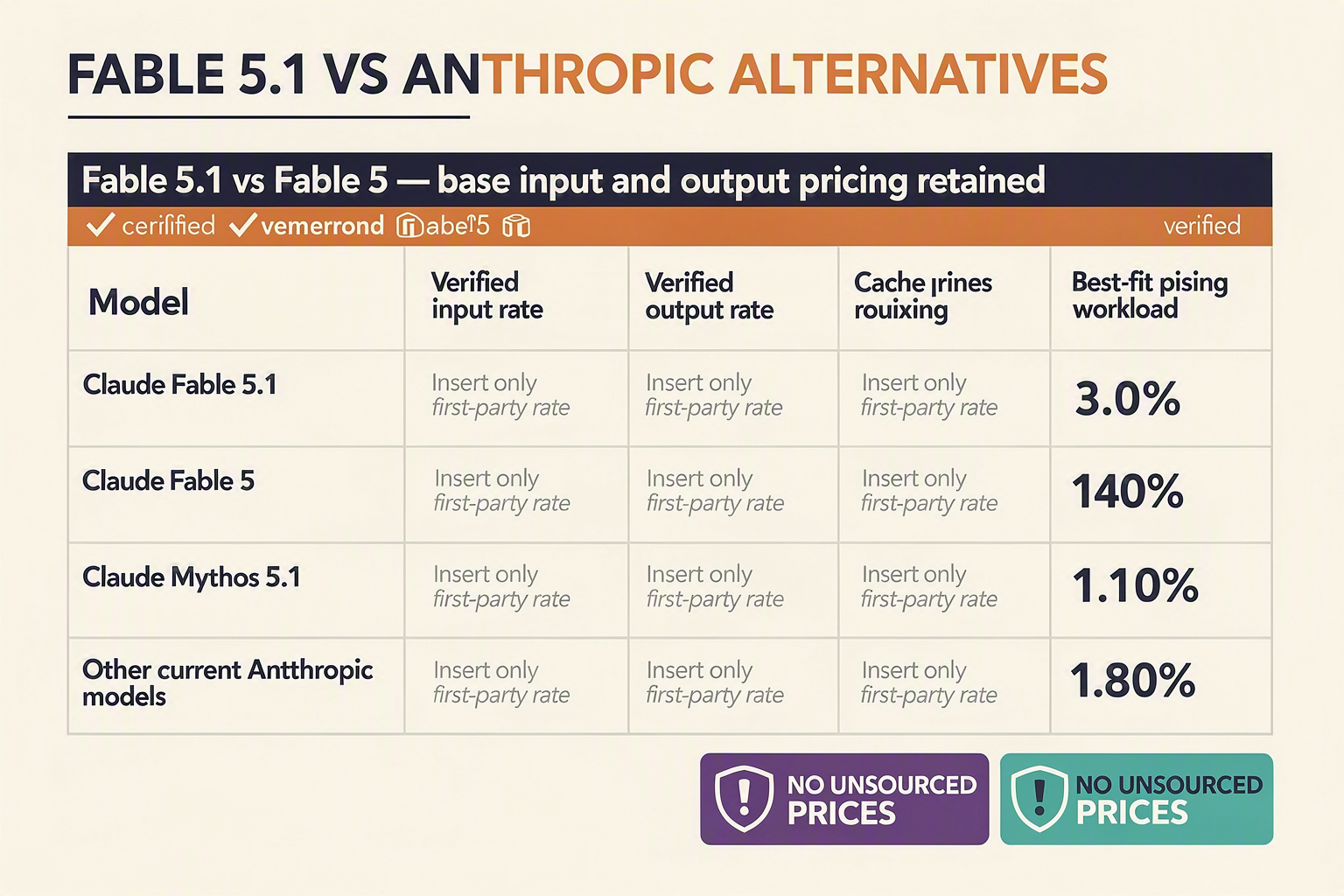
Claude Fable 5.1 keeps Fable 5’s standard $10 input and $50 output rates, but reduces prompt-cache reads from $1 to $0.25 per million tokens. Claude Mythos 5.1 is the closest current Anthropic alternative: Anthropic identifies it as the same underlying model and lists matching headline pricing, although availability differs.
Verified price comparison
| Model | Standard input | Output | Cache read | Key distinction |
|---|---|---|---|---|
| Claude Fable 5.1 | $10/MTok | $50/MTok | $0.25/MTok | Broad availability for demanding agentic work |
| Claude Fable 5 | $10/MTok | $50/MTok | $1/MTok | Previous generation; higher cache-read rate |
| Claude Mythos 5.1 | $10/MTok | $50/MTok | $0.25/MTok | Same underlying model; limited API availability |
| Unspecified Anthropic models | Varies | Varies | Varies | Do not assume Fable rates apply |
Anthropic’s pricing documentation listed Claude Fable 5.1 at $10 per million input tokens, $50 per million output tokens and $0.25 per million cache-read tokens on September 3, 2026. Anthropic’s Fable product page says the new cache-read price is 75% lower than Fable 5’s, which establishes the previous rate at $1 per million tokens.
Anthropic also lists cache writes for Fable 5.1 at $12.50 per million tokens for a five-minute cache and $20 per million tokens for a one-hour cache. A valid comparison must separate those one-time write charges from subsequent cache reads; comparing only the $0.25 read rate understates the cost of creating a cache entry.
What changed from Fable 5?
The Claude Fable 5.1 vs Fable 5 pricing decision is mainly about repeated context rather than ordinary uncached requests.
- Uncached workloads cost the same. One million input tokens plus one million output tokens costs $60 with either generation under the retained headline rates.
- Cached workloads become cheaper. Re-reading 100 million cached tokens costs $25 with Fable 5.1, versus $100 at Fable 5’s $1 rate.
- The saving scales with reuse. That 100-million-token example saves $75, excluding the initial cache-write charge.
Consequently, teams with stable system prompts, code repositories, policy documents or agent instructions receive a clearer cost benefit than applications whose context changes on every request.
How does Mythos 5.1 fit?
Anthropic states that Claude Fable 5.1 and Claude Mythos 5.1 use the same underlying model. Anthropic’s Claude Platform documentation marks Mythos 5.1 as having limited availability, while the launch announcement says Fable 5.1 is available across Anthropic’s platforms, including Amazon Web Services, Google Cloud and Microsoft Azure.
The practical selection sequence is therefore:
- Choose based first on access, deployment platform and product availability.
- Compare any cloud-specific contract or regional charges separately.
- Avoid expecting token-cost savings merely by switching between Fable 5.1 and Mythos 5.1 where matching rates apply.
- Recalculate costs if considering another Anthropic model; pricing should not be inferred from model-family proximity.
For multi-model applications, an OpenAI-compatible gateway such as CallMissed can simplify model switching, but teams should still benchmark complete task cost—including output length, cache writes and cache-hit frequency—rather than comparing input prices alone.
What do Anthropic’s pricing details imply for agents, long contexts and production budgets?

Claude Fable 5.1 pricing makes agent architecture a budget decision: long-running workflows can become expensive when they repeatedly process context or generate verbose responses, while prompt caching can sharply reduce the cost of stable prefixes. Production teams should therefore budget per completed task—not merely per API call.
Agent loops amplify both input and output costs
Anthropic recommends Claude Fable 5.1 for “demanding reasoning and long-horizon agentic work,” according to the Claude Platform model overview. Such agents commonly make multiple model calls, append tool results and carry an expanding conversation history.
Three effects compound:
- Every iteration adds another billable request.
- Previous outputs may return as input on subsequent turns.
- Tool responses consume input tokens, even when generated outside the model.
Consider a 40-step coding agent with a reusable 80,000-token prefix. Without caching, repeatedly processing that prefix consumes 3.2 million input tokens and costs $32. With a five-minute cache write and 39 successful cache reads:
- Initial cache write: 80,000 × $12.50 per million = $1.00
- Subsequent reads: 3.12 million × $0.25 per million = $0.78
- Cached-prefix total: $1.78
- Prefix-cost reduction: $30.22, or approximately 94.4%
This calculation excludes changing conversation history, tool data and generated output, all of which remain billable.
Long context is affordable once, expensive when repeated
A 500,000-token uncached context costs $5 to process at the standard input rate. That may be reasonable for a single high-value analysis, but repeating it 1,000 times would create $5,000 in input charges before any output is generated.
Prompt caching changes the economics when the same repository, policy collection or system prompt is reused. As of September 3, 2026, Anthropic’s pricing documentation lists:
- Five-minute cache writes: $12.50 per million tokens
- One-hour cache writes: $20 per million tokens
- Cache reads: $0.25 per million tokens
Caching is less useful when prompts change substantially, requests arrive outside the cache lifetime or the reusable prefix is too small. Teams should measure the cache-hit rate rather than assuming every eligible request will receive cached pricing.
Output limits are production-budget controls
Claude Fable 5.1 output costs $50 per million tokens, five times the standard input rate, according to Anthropic’s pricing page. An agent producing 80,000 total output tokens across one task incurs $4 in output charges; at 50,000 tasks, that component alone reaches $200,000.
Practical controls include:
- Set an explicit maximum output-token limit for each agent step.
- Request structured, concise responses instead of unrestricted narratives.
- Summarize tool results before adding them to subsequent prompts.
- Stop loops when marginal progress falls below a defined threshold.
- Route routine subtasks to a less costly model where quality testing supports it.
Build budgets around observable unit economics
A production forecast should track cost per successful task, cache-hit rate, tokens per agent step and retry frequency. Anthropic’s API release notes also announced budget-setting functionality on August 7, 2026, providing an additional account-level safeguard.
The most useful planning sequence is:
- Estimate costs from realistic traces.
- Add allowances for retries and failed tasks.
- Model low, expected and peak traffic.
- Set alerts below the hard spending ceiling.
- Recalculate after prompt, tool or model changes.
For agentic workloads, the key conclusion is simple: context reuse, output discipline and loop limits can matter more than request volume alone.
Which cost-control tactics should you use for your workload?
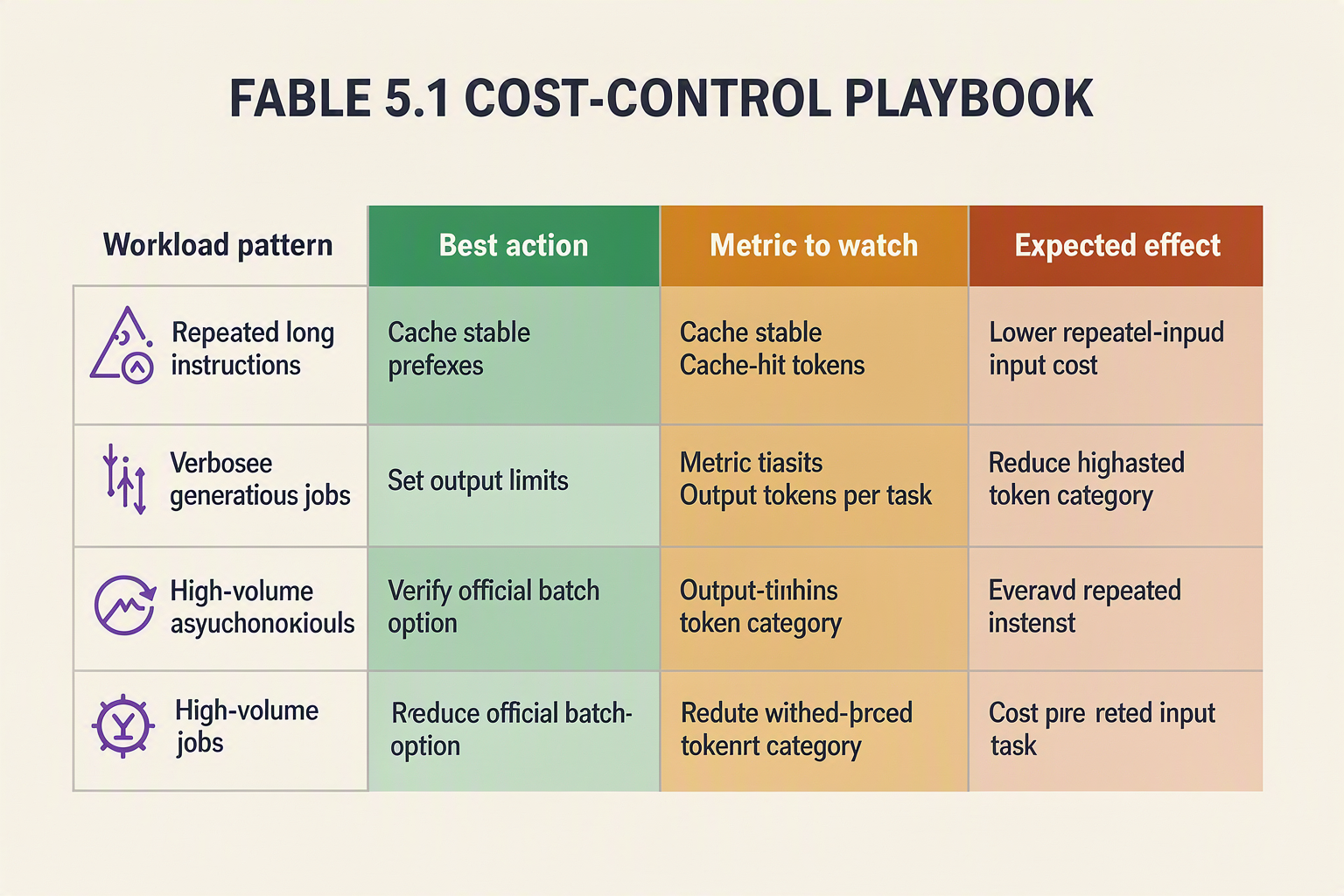
The strongest cost controls for Claude Fable 5.1 are to cap output length, cache stable prompt prefixes, reduce tool-result payloads and route simpler tasks away from the premium model. Apply these controls per workflow rather than relying on a single account-wide token limit.
Cost-control playbook
| Tactic | Best fit | Practical implementation | Illustrative impact |
|---|---|---|---|
| Set output limits | Chat, extraction and structured generation | Set max_tokens, require concise answers and stop once the required schema is complete | Cutting 10,000 output tokens by 25% saves $0.125 per request at the $50/MTok rate |
| Cache stable prefixes | Repeated system prompts, policies, repositories and reference documents | Place reusable content before variable user data and preserve the exact prefix across calls | Reusing 100,000 cached tokens costs $0.025 instead of $1.00, a 97.5% reduction |
| Choose cache duration deliberately | Bursty sessions or recurring agent runs | Use the shorter cache window for tightly grouped calls; pay for longer retention only when reuse is likely | A 100,000-token write costs $1.25 at 5 minutes or $2.00 at 1 hour |
| Trim tool responses | Search, coding and agentic workflows | Return selected fields, relevant file ranges and summarized logs instead of complete payloads | Removing 50,000 uncached input tokens saves $0.50 per run |
| Route by task complexity | Mixed workloads with classification, extraction and deep reasoning | Reserve Claude Fable 5.1 for demanding stages; evaluate a lower-cost model for routine steps | Prevents premium-model rates from applying to every pipeline stage |
| Enforce task-level budgets | Autonomous or long-running agents | Limit iterations, tool calls, retries and cumulative tokens; terminate or escalate at the threshold | Contains loops that could otherwise multiply both input and output charges |
Anthropic’s Claude Platform pricing documentation, checked September 3, 2026, lists Claude Fable 5.1 cache writes at $12.50 per million tokens for five minutes and $20 per million tokens for one hour. Because cache reads cost $0.25 per million tokens, a five-minute cache write generally becomes cheaper than repeatedly processing the same prefix after its first successful reuse; a one-hour write needs more reuse to justify its higher creation charge.
Prioritize output and cache hit quality
Output should be governed explicitly because each generated token costs five times as much as a standard input token. Useful controls include:
- Requesting a fixed number of findings, recommendations or code changes.
- Using structured JSON schemas that discourage explanatory repetition.
- Asking the model to reference stored artifacts rather than reproducing them.
- Ending agent runs when confidence, test or completion criteria are satisfied.
Prompt caching should target large, stable and frequently reused prefixes. Frequently changing conversation histories or one-off documents may incur cache-write charges without producing enough reads to recover the cost. Track write tokens, read tokens and cache-hit rates separately rather than treating all input as one category.
Add operational guardrails
Anthropic’s Claude Platform release notes reported new budget-setting functionality on August 7, 2026. Teams should combine platform budgets with application-level controls because an account ceiling alone cannot identify an inefficient task.
For each production workflow, monitor:
- Input, cache-write, cache-read and output tokens
- Cost per successful task, not merely cost per request
- Retry frequency and agent iterations
- Cache-hit rate by reusable prefix
- Cost differences across Anthropic, Amazon Web Services, Google Cloud and Microsoft Azure purchasing routes
Do not assume batch discounts or cloud-platform rates match direct API pricing. Apply those savings only after verifying the current first-party price for the specific provider, region and deployment route.
Frequently asked questions about Claude Fable 5.1 API pricing
What is the Claude Fable 5.1 API pricing as of September 3, 2026?
How do I calculate the Claude Fable 5.1 cost per API request?
What is the Claude Fable 5.1 cache pricing for reads and writes?
Is Claude Fable 5.1 API pricing identical on Anthropic, AWS, Google Cloud and Microsoft Azure?
Is batch processing cheaper for Claude Fable 5.1?
How can I keep Claude Fable 5.1 API costs under control in production?
Conclusion
Claude Fable 5.1 API pricing rewards disciplined architecture as much as efficient prompting. Based on Anthropic’s first-party rates checked on September 3, 2026, teams should model complete tasks—not merely compare headline token prices.
- Standard input costs $10 per million tokens, while output costs $50 per million tokens, making response length a major budget variable.
- Prompt-cache reads cost $0.25 per million tokens, according to Anthropic on September 3, 2026—97.5% less than standard input processing.
- A request using 100,000 uncached input tokens and 20,000 output tokens costs $2.00; repeated 10,000 times, it reaches $20,000 before verified discounts or platform-specific adjustments.
- Accurate forecasting requires separate calculations for input, output, cache writes, cache reads and request volume, followed by validation against the chosen provider’s current terms.
Looking ahead, watch for changes to prompt-caching rules, batch discounts and pricing across Amazon Web Services, Google Cloud and Microsoft Azure. Multi-model routing and same-tier fallbacks may also become increasingly important as teams balance capability, availability and cost.
To explore this shift, consider CallMissed, an AI communication-infrastructure platform offering an OpenAI-compatible gateway alongside multilingual voice and chatbot capabilities. What would your Claude Fable 5.1 bill look like after applying realistic output limits and cache-hit rates?
Related Reading
- DeepSeek V4 Pro Benchmarks and Pricing: Specs, API Costs, and How to Try It (July 2026)
- Claude Fable 5.1 vs GPT-6: Enterprise Agent Tests
- Cheapest LLM API Provider India: 2026 Pricing Comparison