Claude Fable 5.1 vs GPT-6: Enterprise Agent Tests


Compare Claude Fable 5.1 vs GPT-6 with a reproducible enterprise test plan for agent accuracy, tools, cost, safety, and rollout.
Claude Fable 5.1 vs GPT-6: Enterprise Agent Tests
What if the model that tops a benchmark is still the one most likely to fail your customer at step 17 of a real workflow? The Claude Fable 5.1 vs GPT-6 decision should not be made from headline scores alone; enterprises need workload-specific tests that measure whether GPT-6 Astra or Claude Fable 5.1 can complete accurate, safe and economical agent tasks under production conditions.
Why this comparison matters now
Enterprise agents no longer just draft text. They retrieve records, call APIs, update customer relationship management systems, analyse documents, trigger payments and maintain state across multi-step assignments. A single hallucinated field or malformed tool call can therefore propagate into a consequential business action.
Early GPT-6 Astra case studies illustrate the potential scale of improvement—but also why buyers must validate vendor claims independently. OpenAI reported on September 3, 2026, that Playco reduced manual fixes by 50% while using GPT-6 Astra to create three themed game prototypes from one grey-box foundation. OpenAI also reported on September 3, 2026, that Legora reviewed 41 financial documents in minutes, identified all four planted errors and improved workflow performance by nearly 40% with GPT-6 Astra. These are meaningful vendor-reported outcomes, not universal guarantees or controlled evidence that one model will outperform another on every enterprise workload.
The evidence available for each model may also differ in depth, methodology and reproducibility. That makes enterprise AI model evaluation more important than comparing isolated claims—or assuming that a higher general-purpose benchmark score predicts reliable execution inside your systems.
What a useful evaluation must reveal
This guide turns LLM agent testing into a repeatable side-by-side process. You will learn how to:
- Decompose workflows into reasoning, retrieval, generation, tool-use and approval steps.
- Build accuracy sets from real cases, planted errors and adversarial edge conditions.
- Measure schema compliance, tool-selection accuracy, argument validity and recovery after API failures.
- Test long-running task completion, state retention and performance degradation as context grows.
- Compare median and tail latency, including time to first token and end-to-end completion time.
- Calculate token, caching, retry, tool and human-review costs instead of relying on list prices alone.
- Assess safety, privacy, data retention, access controls and auditability.
- Design observability, fallback routing and staged rollouts for continuous LLM evaluation.
Platforms such as CallMissed, an OpenAI-compatible multi-model gateway, reflect this shift by allowing developers to access multiple model providers through one integration and apply same-tier fallbacks when appropriate.
The objective is not to crown a universal winner. It is to produce an auditable scorecard showing which model performs better for each workload, what failure modes remain, how much successful completion actually costs and where human approval is still necessary. By the end, your GPT-6 Astra or Claude Fable 5.1 choice will rest on production evidence—not benchmark theatre.
Which should you choose: GPT-6 Astra or Claude Fable 5.1?
As of September 5, 2026, both GPT-6 Astra and Claude Fable 5.1 are officially released and documented for enterprise use. The choice in Claude Fable 5.1 vs GPT-6 should nevertheless depend on production-representative agent tests conducted under identical controls. Select the model that satisfies mandatory governance, safety and reliability requirements, then delivers the strongest risk-adjusted performance for each workload—not necessarily one model for the entire enterprise.
Use workload fit, not a universal ranking
Separate each agent workflow into measurable components. A customer-service workflow, for example, may combine intent classification, retrieval, policy reasoning, structured tool calls, response generation and escalation. Testing only the final response can conceal a model that writes persuasively but selects the wrong account, loses state or sends invalid arguments to an API.
Build a workload inventory containing:
- Business objective: Resolve a billing dispute, review financial statements or update a CRM record.
- Reasoning requirement: Classification, calculation, comparison, planning or exception handling.
- Context profile: Prompt size, retrieved documents, conversation history and expected task duration.
- Tool exposure: Read-only retrieval, database writes, messaging or irreversible financial actions.
- Failure impact: Customer inconvenience, regulatory exposure, financial loss or data leakage.
- Success condition: The exact evidence required to mark the workflow complete.
Assign each workload separately. GPT-6 Astra may lead on document analysis while Claude Fable 5.1 performs better on another tested workflow. In a Claude Fable 5.1 vs GPT-6 evaluation, routing tasks to different models is a valid procurement outcome.
Apply three decision gates
Use a staged decision rule rather than immediately averaging every metric:
- Eligibility gate: Confirm privacy, data-retention, residency, access-control and contractual requirements. A model that fails a mandatory governance condition should not reach production, regardless of benchmark performance.
- Reliability gate: Require minimum scores for factual accuracy, tool selection, schema validity, resistance to prompt injection, recovery from tool failures and long-running task completion.
- Economic gate: Among qualifying configurations, compare total cost per successful task, including tokens, cached context, cache writes, retries, tool calls, human review and failed runs.
OpenAI’s officially documented API model ID is gpt-6-astra. Its standard pricing is $10 per million input tokens, $1 per million cached-input tokens, $12.50 per million cache-write tokens and $50 per million output tokens. Claude Fable 5.1 is generally available at $10 per million input tokens and $50 per million output tokens, with cache reads priced at $0.25 per million tokens.
Those rates make caching strategy an important part of the Claude Fable 5.1 vs GPT-6 calculation, but list prices do not determine the winner. Measure actual cache hit rates, output length, retry frequency, tool-call overhead and human intervention. A cheaper cache read provides little value if a model needs more retries or produces more failed runs; a higher-priced configuration may be economical if it completes more tasks correctly on the first attempt.
Treat published results as hypotheses
Official launches and documentation establish availability, features and list pricing—not superiority for a particular enterprise workflow. Vendor benchmarks and customer stories can identify useful test cases, but they cannot replace controlled LLM agent testing.
OpenAI reported on September 3, 2026, that GPT-6 Astra found all four planted errors while Legora reviewed 41 financial documents in minutes. OpenAI also reported that Playco reduced manual fixes by 50% when producing three themed game prototypes from one grey-box foundation with GPT-6 Astra. These vendor-reported customer results make document review and multi-step creative production credible evaluation candidates, but they do not prove that GPT-6 Astra will outperform Claude Fable 5.1 with your data, tools and controls.
For every claim considered during procurement, record:
- The publisher and publication date
- Whether the result is vendor-reported or independently reproduced
- The prompt, tools, model version and sampling settings
- The number, representativeness and difficulty of test cases
- Whether failures, retries and human interventions were counted
- Whether the comparison used equivalent context, caching and tool permissions
Reproduce promising results with your own document formats, terminology, retrieval stack, API schemas and planted-error set. Include ordinary cases, adversarial inputs and rare but costly failures.
The evidence-first verdict on Claude Fable 5.1 vs GPT-6 is therefore conditional: choose GPT-6 Astra where it clears every required gate and achieves the highest risk-adjusted score; choose Claude Fable 5.1 where it does so. Retain workload-level routing when neither model wins consistently, and re-test after model, pricing or infrastructure changes.
What facts about GPT-6 Astra and Claude Fable 5.1 should buyers verify first?
Buyers should first verify that GPT-6 Astra and Claude Fable 5.1 are commercially available model identifiers—not preview names, aliases or speculative labels—and document the exact API versions being compared. Next, confirm each model’s published limits, pricing, data controls and tool-use features directly with OpenAI and Anthropic before designing benchmarks.
Establish an evidence hierarchy
Treat every claim according to its source and reproducibility:
- Primary technical documentation: API references, model cards, system cards, pricing pages and service terms.
- Vendor-published evaluations: Useful when prompts, datasets, scoring methods and comparison settings are disclosed.
- Named customer studies: Relevant evidence of feasibility, but usually specific to one workflow and implementation.
- Independent benchmarks: Stronger when code, data, model snapshots and repeated trials are available.
- Unverified announcements or comparison pages: Leads for investigation, not procurement evidence.
As of September 3, 2026, the supplied research contains OpenAI customer evidence for GPT-6 Astra but no equivalent primary documentation or benchmark evidence for a model explicitly identified as Claude Fable 5.1. Buyers should therefore avoid inventing Claude Fable 5.1 benchmarks or assuming feature parity until Anthropic documentation confirms the model name, release status and specifications.
OpenAI’s customer-story catalogue identifies both Playco and Legora as GPT-6 Astra deployments dated September 3, 2026. Those examples establish that GPT-6 Astra has been applied to game prototyping and financial-document review, but they do not establish its performance on your tools, data or risk controls.
Verify the model identity and access path
Record these facts in a procurement worksheet for each candidate:
- Canonical API model ID, release date and version-pinning policy.
- Availability through the vendor API, cloud marketplaces or approved gateways.
- Preview, beta or general-availability status.
- Supported regions, rate limits, concurrency quotas and capacity commitments.
- Deprecation notice periods and whether silent model updates can occur.
- Eligible modalities, including text, images, files, audio and structured outputs.
Run a simple API request and retain the response metadata. A marketing name is insufficient if the endpoint returns a different model family, dynamically routed snapshot or undocumented alias.
Confirm limits that affect agent design
Enterprise agents depend on more than reasoning quality. Verify the published and experimentally observed values for:
- Input and output token limits, including how tool schemas consume context.
- Native function calling, parallel calls and strict JSON-schema enforcement.
- Prompt caching availability, cache-write pricing, cache-read pricing and expiry rules.
- Maximum file sizes, supported formats and retrieval constraints.
- Streaming support, batch APIs and asynchronous task execution.
- Knowledge-cutoff disclosures and access to web search or enterprise retrieval.
- Timeouts, retry guidance and idempotency support for consequential actions.
Do not interpret a large context window as proof of reliable long-horizon execution; usable recall and state consistency must be tested separately.
Freeze commercial, privacy and safety facts
Before testing, archive dated copies of each provider’s pricing and contractual terms. Confirm per-token charges, cached-token rules, tool fees, regional taxes, committed-use discounts and failed-request billing.
Security review should separately verify data retention, training opt-outs, encryption, subprocessors, regional processing, deletion procedures, audit logs and certifications claimed by each provider. The result should be a versioned fact sheet with every field marked verified, unverified or not supported. Only verified capabilities should enter the Claude Fable 5.1 vs GPT-6 scorecard; everything else becomes a procurement question or test hypothesis.
Which current developments belong in the comparison evidence ledger?
The comparison evidence ledger should include dated, attributable developments that could change a buying decision, while separating vendor-reported case studies from independently reproducible results. As of September 3, 2026, the supplied evidence contains several GPT-6 Astra workload outcomes but no equivalent verified Claude Fable 5.1 results, so the ledger must record that asymmetry rather than interpret missing data as inferior performance.
Current evidence to record
| Development | Source and date | Evidence class | What the ledger should capture |
|---|---|---|---|
| Playco reported 50% fewer manual fixes with GPT-6 Astra | OpenAI, September 3, 2026 | Vendor-reported customer case study | Baseline model, definition of a “manual fix,” task count and whether reviewers were blinded |
| Playco generated three themed game prototypes from one grey-box foundation | OpenAI, September 3, 2026 | Multi-step generation example | Asset consistency, instruction adherence, human interventions and completion time per prototype |
| Legora found all four planted errors in a financial-review workflow | OpenAI, September 3, 2026 | Controlled error-detection example within a customer story | Error types, false-positive count, retrieval setup and repeatability across more documents |
| Legora reviewed 41 financial documents in minutes | OpenAI, September 3, 2026 | Throughput and long-context example | Exact elapsed time, document lengths, token volume, concurrency, retries and human-review time |
| Legora reported a nearly 40% workflow-performance improvement | OpenAI, September 3, 2026 | Vendor-reported operational outcome | Performance formula, comparison baseline, sample size, cost impact and confidence interval |
| No comparable Claude Fable 5.1 result appears in the supplied research set | Supplied search evidence, reviewed September 3, 2026 | Evidence gap—not a negative result | Request Anthropic documentation, benchmark methodology and reproducible API tests before scoring |
How to qualify each development
A claim belongs in the ledger only if evaluators can label its provenance, relevance and reproducibility. OpenAI’s customer stories are useful indicators of where GPT-6 Astra may deserve deeper testing, but they do not establish head-to-head superiority over Claude Fable 5.1.
For every entry, add:
- Claim owner: model provider, customer, independent laboratory or internal evaluation team.
- Evaluation conditions: model version, API date, system prompt, temperature, tools, context size and retry policy.
- Comparator: previous model, human workflow, another provider or no explicit baseline.
- Outcome type: accuracy, tool reliability, latency, cost, safety or long-running completion.
- Verification status: announced, documented, reproduced internally or independently replicated.
- Expiry trigger: model update, pricing change, API revision or a material workflow change.
Turn announcements into testable hypotheses
Each development should produce a test—not bonus points. The Playco result becomes a hypothesis that GPT-6 Astra can reduce human correction during iterative generation. The Legora result becomes separate hypotheses about planted-error recall, false positives, document-scale throughput and end-to-end workflow performance.
Run matched tests against both models using identical source material, tool schemas and pass criteria. If Claude Fable 5.1 lacks published evidence for a category, mark the external-evidence field “not established” and still test it internally. This prevents the Claude Fable 5.1 vs GPT-6 comparison from rewarding marketing visibility instead of production performance.
Finally, preserve failed replications and contradictory findings. A credible enterprise AI model evaluation ledger is an append-only audit trail that distinguishes what a provider announced from what your organisation actually measured.
How should you decompose enterprise workloads and build a representative test set?
Decompose each enterprise workflow into observable, independently scorable steps, then build a test set that mirrors production frequency, business impact and edge-case severity. GPT-6 Astra and Claude Fable 5.1 should receive identical inputs, tools, permissions and success criteria so the comparison measures model behaviour rather than test-design differences.
Map workflows into capability units
Start with 10–20 high-value workflows, not generic prompts. For each workflow, document the trigger, available context, required actions, expected output and conditions requiring human approval.
Break every workflow into units such as:
- Intent and constraint detection: Identify the user’s objective, permissions, deadlines and prohibited actions.
- Retrieval: Select the correct knowledge source and distinguish retrieved evidence from model-generated assumptions.
- Reasoning and calculation: Apply policies, reconcile conflicting records or calculate values.
- Tool planning: Choose the correct API, sequence calls and determine which arguments are required.
- Execution: Produce schema-valid arguments without inventing identifiers or modifying unauthorised fields.
- Verification: Confirm that the tool response satisfies the original request.
- Communication: Generate a grounded, channel-appropriate answer.
- Escalation: Stop and request clarification or human approval when confidence, authority or evidence is insufficient.
A refund agent, for example, might need to authenticate the customer, retrieve an order, interpret policy, calculate eligibility, request approval above a threshold, call a payment API and communicate the outcome. Score these steps separately; an apparently polished final message can conceal an incorrect refund amount or unauthorised action.
Construct a production-shaped test set
Build cases from de-identified production traces, subject-matter-expert scenarios and deliberately constructed failures. Avoid relying only on clean, single-turn examples.
Stratify the set across:
- Frequency: Common requests should represent realistic traffic volume.
- Business impact: Oversample rare but costly actions such as payments, account closures and compliance decisions.
- Complexity: Include short tasks, branching workflows and cases requiring multiple documents or tools.
- Input quality: Test incomplete records, ambiguous language, typographical errors and contradictory instructions.
- Language and channel: Reflect the languages, dialects and formats used by actual customers.
- Temporal conditions: Include expired policies, changed prices and records updated during task execution.
- Adversarial conditions: Add prompt injection, poisoned documents, excessive tool permissions and requests to expose sensitive data.
Use planted-error evaluations where ground truth is objectively verifiable. OpenAI reported on September 3, 2026, that Legora’s GPT-6 Astra workflow reviewed 41 financial documents and detected all four planted errors. That design pattern is more transferable than the result itself: seed known inconsistencies, record their exact locations and test both detection and supporting citations.
Define labels before running either model
Create a reference record for every case containing:
- Accepted final answers and required evidence
- Permitted tool sequence and valid alternatives
- Required, optional and forbidden actions
- Exact calculations or database changes
- Escalation conditions
- Severity-weighted failure labels
Use at least two qualified reviewers for subjective outputs, resolve disagreements before model comparison and keep a hidden holdout set to reduce prompt overfitting. Run each case multiple times at fixed settings to expose nondeterministic failures.
Finally, separate development, validation and production-shadow sets. Do not tune prompts on the final comparison set. The resulting scorecard should report capability-level accuracy and critical-failure rates—not merely one blended average that lets strong writing compensate for unsafe execution.
How do you test accuracy, tool use, recovery, and long-running task completion?
Test GPT-6 Astra and Claude Fable 5.1 on identical, production-derived workflows, then score correctness, tool execution, recovery and end-to-end completion separately. A model passes only when it reaches the right outcome without unsafe actions, hidden human intervention or excessive retries.
Build a labelled accuracy suite
Create a frozen test set from anonymised historical cases, subject-matter-expert scenarios and deliberately difficult inputs. Use at least three strata:
- Routine cases: frequent requests with an established correct answer.
- Boundary cases: ambiguous instructions, conflicting documents, missing fields and unusual formats.
- Adversarial cases: prompt injection, misleading evidence, corrupted files and requests beyond the agent’s authority.
Score structured outputs field by field rather than relying only on subjective ratings. Track exact-match accuracy, factual precision and recall, citation correctness, unsupported-claim rate, abstention quality and severity-weighted errors. A harmless formatting defect should not equal an invented payment amount.
OpenAI reported on September 3, 2026, that Legora’s GPT-6 Astra workflow found all four planted errors across 41 financial documents; enterprises can adapt that planted-error methodology, while independently testing both GPT-6 Astra and Claude Fable 5.1 on their own documents.
Run each case multiple times at the intended temperature because one successful execution does not establish reliability. Report the mean, variance and 95% confidence interval, not merely the best run.
Measure tool use at every decision point
Instrument every API interaction and calculate:
- Tool-selection accuracy: Did the model choose the correct tool?
- Argument validity: Did parameters match the schema and business rules?
- Execution success: Did the downstream system accept the call?
- Action correctness: Was the resulting business change accurate?
- Unnecessary-call rate: Did the agent create avoidable cost or risk?
Include near-duplicate tools, renamed fields, expired credentials and permission-restricted actions. For consequential operations, require the model to stop at an approval checkpoint rather than interpreting an API’s availability as authorisation.
A useful headline metric is clean task completion rate:
Clean completion = tasks completed correctly with zero invalid calls, unplanned retries or human repairs ÷ total tasks.
Inject failures and score recovery
Use controlled fault injection instead of waiting for production incidents. Test HTTP 429 throttling, timeouts, malformed responses, partial writes, stale records, authentication failures and unavailable dependencies.
Successful recovery should include:
- Respecting retry limits and exponential backoff.
- Distinguishing transient errors from permanent failures.
- Checking whether a write succeeded before repeating it.
- Preserving completed work through checkpoints.
- Escalating with a concise, accurate incident summary.
Record recovery success rate, duplicate-action rate, mean retries, rollback success and human-escalation quality. Any duplicate payment, booking or customer message should be treated as a critical failure.
Test long-running completion under growing context
Construct workflows of increasing length—for example, 5, 10, 20 and 40 decision steps—and repeat them with larger documents and longer tool histories. Measure final task success, state-retention accuracy, instruction drift, context-retrieval errors, elapsed time and the step at which failure occurs.
Require checkpointed state outside the conversation context. Then interrupt runs, rotate credentials or restart the orchestration service to verify that each model can resume safely. The winning model is not necessarily the one that reasons best on step one; it is the one that preserves constraints and completes the whole workflow reliably at the required risk threshold.
How should you measure latency, token usage, cache behavior, and total cost per successful task?
Measure user-visible latency and fully loaded cost per successful task, not price per million tokens or a single response-time average. For GPT-6 Astra and Claude Fable 5.1, run identical workloads under controlled concurrency, separate cold and cached requests, and count retries, tool calls, failures and human corrections.
Instrument latency at every stage
Capture timestamps from the client, model gateway and each external tool. Report latency distributions by workload class rather than blending a short classification request with a 20-step agent run.
Track:
- Queue time: request submission to provider acceptance.
- Time to first token (TTFT): submission to the first streamed output token.
- Generation time: first token to final token.
- Tool latency: time spent waiting for search, retrieval, databases and business APIs.
- Reasoning-loop latency: cumulative time across model turns, retries and tool calls.
- End-to-end task time: user submission to validated completion.
Publish p50, p95 and p99, plus timeout rates, instead of averages alone. A model with a fast p50 but an unstable p99 may create poor customer experiences or breach service-level objectives. Run tests at expected production concurrency and at peak load; serial benchmark requests conceal queueing and rate-limit behaviour.
Account for every token
Log token usage per task and per agent step:
- System and policy instructions.
- Conversation history.
- Retrieved knowledge-base content.
- Tool definitions and tool results.
- Model-generated reasoning or output tokens, where exposed.
- Retry, repair and fallback tokens.
Compare median tokens per successful task, not merely tokens per call. One model may charge less per token yet consume more context through repeated tool calls, verbose outputs or schema-repair attempts.
Use the same prompts initially for experimental control, then permit model-specific prompt optimisation in a second test. Report both results: the first measures portability, while the second estimates each model’s achievable production efficiency.
Test cache behaviour explicitly
Caching should be evaluated as a workload property, not assumed from a pricing page. Create three test lanes:
- Cold: unique system instructions and context with no reusable prefix.
- Warm: identical policy, tool schemas and knowledge prefix across requests.
- Partially changed: stable instructions followed by user-specific or newly retrieved content.
- Expired or invalidated: rerun after the documented cache lifetime or a prefix change.
For each lane, record cache-eligible tokens, cache writes, cache hits, discounted reads, hit rate and effective cost. Verify usage fields against invoices because provider terminology and billing rules can differ. Also test whether minor changes—such as tool ordering, timestamps or dynamic identifiers—destroy prefix reuse.
Calculate cost per successful task
Use a fully loaded calculation:
Cost per successful task = (model input + model output + cache writes + cache reads + tool/API fees + retries + fallback calls + human-review cost) ÷ validated successful tasks
A “success” must satisfy the previously defined accuracy, tool-use and completion criteria; a cheap but incorrect run does not belong in the denominator. Report:
- Mean and p95 cost per success
- Cost per 1,000 attempted tasks
- First-pass success cost
- Recovery-adjusted success cost
- Human minutes per completed task
Finally, bootstrap confidence intervals or repeat enough matched trials to expose variance. The purchasing decision should favour the GPT-6 Astra or Claude Fable 5.1 configuration that meets quality and tail-latency thresholds at the lowest risk-adjusted cost, not the model with the lowest advertised token rate.
How do safety, privacy, observability, and fallback models change the result?
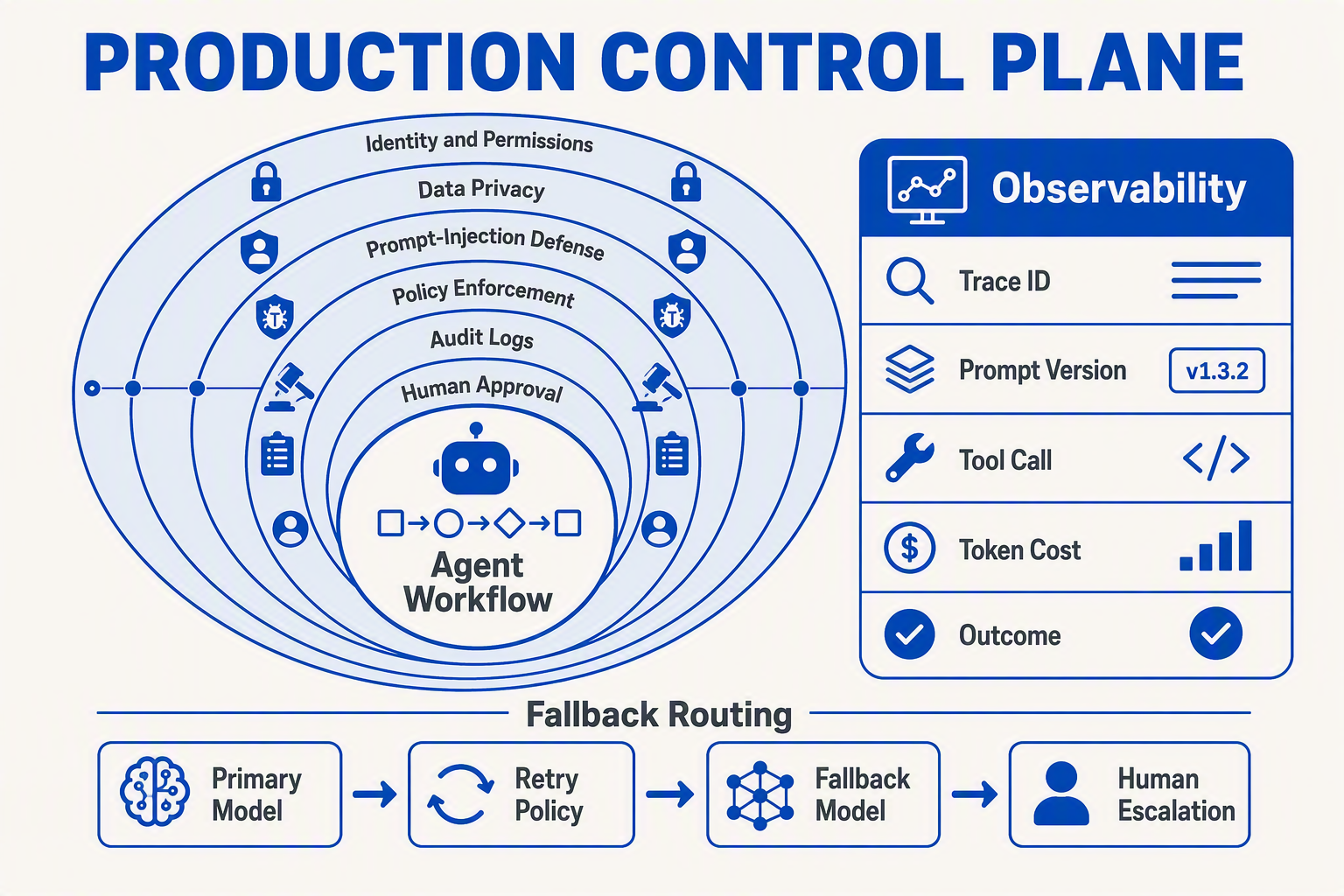
Safety, privacy, observability, and fallback behaviour can reverse a decision based on accuracy benchmarks alone. Treat these capabilities as deployment gates for GPT-6 Astra and Claude Fable 5.1, then validate them through controlled production simulations and contractual review.
Make safety a pass/fail gate
Match safety tests to the agent’s permissions. A support assistant answering policy questions presents less risk than an agent authorised to issue refunds, change account details, or initiate payments.
Build an LLM agent testing suite that includes:
- Prompt injections in user messages, retrieved documents, images, and tool responses.
- Attempts to expose system prompts, credentials, personal data, or other customers’ records.
- Ambiguous high-impact requests that require clarification or human approval.
- Legitimate sensitive requests that reveal excessive refusal behaviour.
- Encoded, multilingual, and multi-turn attacks intended to evade basic filters.
Measure unsafe-action rate, correct-refusal rate, false-refusal rate, and approval-escalation accuracy separately. Apply hard thresholds before weighted scoring; an illustrative policy might require zero unauthorised payment executions, at least 99.5% correct escalation for high-risk actions, and below 2% false refusal for legitimate requests. Enterprise teams must set their actual limits according to regulatory exposure, reversibility, and transaction value.
Verify privacy and governance contractually
Privacy analysis must cover the entire processing chain: prompts, retrieved context, outputs, logs, traces, human-review queues, and fallback providers. Do not infer governance from model behaviour or assume that the terms for GPT-6 Astra and Claude Fable 5.1 are identical across API plans, cloud marketplaces, and deployment regions.
Procurement should verify:
- Retention: What data is stored, where, and for how long?
- Training use: Can enterprise inputs or outputs be used for model improvement?
- Residency: Which regions process prompts, logs, caches, and backups?
- Access controls: Are role-based access, service identities, audit logs, and key rotation supported?
- Compliance evidence: Are relevant audit reports, subprocessors, incident procedures, and deletion commitments documented?
Use synthetic canary identifiers to test whether sensitive fields appear in traces. Confirm that deletion requests propagate across operational logs, evaluation stores, backups, and human-review systems within the contracted window.
Require end-to-end observability
Each execution should record the model and version, prompt version, retrieval sources, tool calls, arguments, policy decisions, latency, token usage, cache behaviour, retries, and final disposition. These records separate model errors from stale retrieval, malformed prompts, unavailable tools, and routing failures.
Replay representative traces against both models after any prompt, policy, tool, or model update. This makes continuous LLM evaluation an operational control rather than a one-time procurement exercise.
Test fallback as an independent system
A provider-neutral model gateway or AI control plane may offer routing, retries, policy enforcement, and cross-provider fallback, but procurement teams must verify each capability, supported model, state-transfer mechanism, and service-level commitment rather than assuming compatibility.
Force at least four failure scenarios:
- Primary-model timeout or rate limit.
- Provider interruption during a multi-step task.
- Safety refusal, which must not be rerouted merely to bypass policy.
- Context transfer after completed tool calls.
Track fallback success rate, duplicate-action rate, added latency, policy consistency, state loss, and cost per recovered task. Protect non-idempotent actions with transaction IDs, tool-side deduplication, and explicit checkpoints. The winning architecture is the one that remains safe, auditable, and recoverable when its preferred model is unavailable—not simply the one with the highest average accuracy.
What do expert evidence and test results imply for architecture and staged rollout?
The available evidence supports a modular, model-agnostic architecture and a gated rollout for both GPT-6 Astra and Claude Fable 5.1. External case studies can justify pilots, but production routing should depend on reproducible, workload-specific tests covering accuracy, tool use, long-running completion, safety, latency and cost.
Convert expert evidence into internal hypotheses
Published results should define what to test—not determine the purchasing decision.
OpenAI reported on September 3, 2026, that GPT-6 Astra found all four planted errors while Legora reviewed 41 financial documents in minutes. OpenAI also reported a performance improvement of nearly 40% in that specific financial-review workflow. Enterprises should attempt to reproduce those results using their own document formats, retrieval pipeline, terminology, access controls and realistic error distributions.
OpenAI reported on September 3, 2026, that Playco reduced manual fixes by 50% while using GPT-6 Astra to create three themed game prototypes from one grey-box foundation. This result suggests that teams should measure human correction time, accepted-output rate and revision count, rather than relying only on subjective output preferences.
The supplied evidence contains no methodologically equivalent Claude Fable 5.1 case study. That is an evidence asymmetry, not evidence of inferior capability. Evaluate both models with identical datasets, tool schemas, prompts, retry limits and scoring rubrics.
Design for replaceability and containment
Keep provider-specific behavior outside core business logic. A practical architecture separates:
- Orchestration: task state, step limits, retry budgets and approval checkpoints.
- Model adapters: prompts, parameters, structured-output handling and response normalization.
- Tool controls: schema validation, authentication, authorization and idempotency.
- Policy enforcement: data classification, permissions and human-review thresholds.
- Evaluation and observability: traces, outcome labels, token usage, latency and regression results.
A gateway or abstraction layer may reduce integration work, but teams must validate its API compatibility, feature coverage, telemetry fidelity and fallback behavior for every target model. Never assume two nominally compatible endpoints handle tool calls, streaming, caching, structured outputs or error codes identically.
Fallbacks should also be policy-controlled. A substitute model should execute a workload only after passing the same accuracy, safety and tool-use gates as the primary model.
Use a five-stage rollout
- Offline replay: Test historical, expert-labelled cases with external actions mocked.
- Shadow production: Process live inputs without exposing outputs or executing tools.
- Read-only pilot: Allow retrieval and analysis while blocking writes and outbound communications.
- Constrained canary: Route a small workload segment through approval-controlled actions.
- Progressive production: Expand traffic only while pre-registered quality, safety, latency and cost limits hold.
Promotion gates should include task-completion rate, critical-error rate, valid tool-call rate, recovery success, p95 end-to-end latency, cost per successful task and human-review minutes. Predefine rollback triggers for permission violations, state loss, runaway retries, unexplained quality regressions and budget overruns.
Make evaluation continuous
Re-run the acceptance suite whenever a model version, prompt, tool, retrieval index or policy changes. Retain trace-level comparisons and maintain a tested, known-safe fallback.
The resulting architecture should operationalize the evaluation outcome: route by verified workload fit, constrain consequential actions and expand only when production evidence remains within agreed thresholds.
What does the enterprise buyer scorecard mean for your team?
The scorecard converts technical test results into a deployment decision tied to business risk. Your team should select GPT-6 Astra, Claude Fable 5.1, or a routed combination only after applying workload-specific weights, mandatory gates and confidence levels—not by averaging every metric equally.
A practical enterprise scorecard
Score each model from 0 to 5 using blinded production-like tests, then calculate weighted score = (rating ÷ 5) × weight. The weights below are a starting template; regulated or high-impact workflows should give more weight to accuracy, safety and auditability.
| Evaluation dimension | Weight | Required evidence | Decision meaning | Accountable owner |
|---|---|---|---|---|
| Outcome accuracy | 25% | Exact-match, rubric and planted-error results | Can the model produce an acceptable business outcome? | Business process owner |
| Tool-use reliability | 20% | Tool selection, valid arguments, retries and recovery | Can the agent act correctly, not merely answer correctly? | Engineering |
| Long-running completion | 15% | Completion rate, state retention and step-level failures | Does reliability persist across the full workflow? | AI platform team |
| Safety and privacy | 15% | Red-team results, access controls, retention and audit tests | Can deployment satisfy policy and regulatory requirements? | Security and legal |
| Cost efficiency | 10% | Tokens, cache hits, retries, tools and human review | What does each successful completion actually cost? | Finance and FinOps |
| Latency and operability | 15% | Median, p95 and p99 latency; logs, fallbacks and alerts | Can the service meet its SLA and be operated safely? | SRE or operations |
A higher total should never override a failed mandatory gate. For example, a customer-support agent that occasionally submits malformed refund amounts should not pass because it is cheaper or faster.
Interpret the result as a portfolio decision
The scorecard can support four outcomes:
- Choose GPT-6 Astra when it clears every gate and produces a materially stronger confidence-adjusted score on the target workflow.
- Choose Claude Fable 5.1 under the same standard, using identical prompts, tools, datasets, limits and retry policies.
- Route by workload when one model performs better on document reasoning while the other is more dependable for tool-heavy or latency-sensitive tasks.
- Defer deployment when neither model clears the minimum accuracy, safety or reliability threshold.
Avoid declaring a winner from a marginal difference. A two-point gap on a 100-point scorecard may disappear across another test sample, prompt revision or API version. Report confidence intervals, failure counts and the number of independently repeated runs alongside each score.
Separate evidence from proof
Vendor case studies can establish useful hypotheses, but they do not replace internal validation. OpenAI reported on September 3, 2026, that GPT-6 Astra found all four planted errors across 41 financial documents in Legora’s workflow and that Playco required 50% fewer manual fixes in its prototyping workflow. Those results justify testing document review and iterative generation, but they do not establish equivalent performance in your data environment or provide Claude Fable 5.1 benchmarks under matched conditions.
Before approval, require:
- A signed record of datasets, prompts, model versions and tool schemas.
- Separate scores for normal, edge-case and adversarial traffic.
- A staged rollout from shadow mode to limited production traffic.
- Automated rollback or fallback rules for threshold breaches.
- A schedule for continuous LLM evaluation after prompt, model or workflow changes.
The final scorecard is therefore not simply a procurement ranking. It is an auditable agreement between business, engineering, security and operations about what “production-ready” means for each agent.
Frequently asked questions about Claude Fable 5.1 vs GPT-6 enterprise testing
Which model wins the Claude Fable 5.1 vs GPT-6 comparison for enterprise AI agents?
How should enterprises interpret Claude Fable 5.1 vs GPT-6 benchmark and customer-case results?
What dataset is needed for an enterprise AI model evaluation?
How do you test GPT-6 Astra and Claude Fable 5.1 for reliable tool use?
How should LLM agent testing measure long-running task performance, latency and cost?
What is the safest way to deploy the winning model after continuous LLM evaluation?
Conclusion
The practical verdict
The Claude Fable 5.1 vs GPT-6 decision should come from production-shaped evidence, not a leaderboard. Choose the model—or model combination—that completes your specific workflows accurately, reliably, safely and economically, especially when tasks extend across many tools and steps.
- Test decomposed workloads, not generic prompts. Separate reasoning, retrieval, generation, tool use and approval stages, then build accuracy sets from real cases, planted errors and adversarial edge conditions. OpenAI reported on September 3, 2026, that GPT-6 Astra helped Legora review 41 financial documents in minutes, identify all four planted errors and improve workflow performance by nearly 40%; buyers should reproduce comparable tests with their own documents, policies and failure thresholds.
- Measure complete agent behaviour. Effective LLM agent testing must track schema compliance, tool-selection accuracy, argument validity, API-failure recovery, state retention and end-to-end task completion. OpenAI reported on September 3, 2026, that Playco reduced manual fixes by 50% while using GPT-6 Astra to create three themed game prototypes from one grey-box foundation, but vendor case studies remain starting points rather than universal guarantees.
- Evaluate production economics and governance together. Compare median and tail latency, time to first token, token consumption, cache savings, retries, tool charges and human-review costs. The same scorecard should assess privacy, retention policies, access controls, safety safeguards and auditability; a cheaper response is not economical if unreliable execution creates more rework or risk.
- Treat selection as continuous LLM evaluation. Instrument prompts, tool calls, errors, costs and outcomes; define fallback routes; and progress from offline testing to shadow traffic, limited cohorts and staged production rollout. Platforms such as CallMissed, an OpenAI-compatible multi-model gateway and AI communication platform, can help teams explore multi-model access and same-tier fallbacks through one integration.
What should enterprises watch next? Model capabilities, latency and pricing will keep changing, so reusable test suites and auditable scorecards will matter more than any static verdict. If GPT-6 Astra or Claude Fable 5.1 changed tomorrow, would your evaluation system reveal whether the change helped—or would your team discover it from a failed customer workflow?
Related Reading
- GPT-5.4 Mini vs Claude Sonnet 4.6 for Agentic Workflows: Pricing, Tools and Trade-offs
- Claude Haiku 4.5 vs GPT-5.4 Nano Latency Comparison: What Can Be Verified?
- Best AI Models of July 2026: Kimi K3 vs Claude Opus 5 vs GPT-5.6