Speech-to-text APIs for Indian Languages Compared 2026


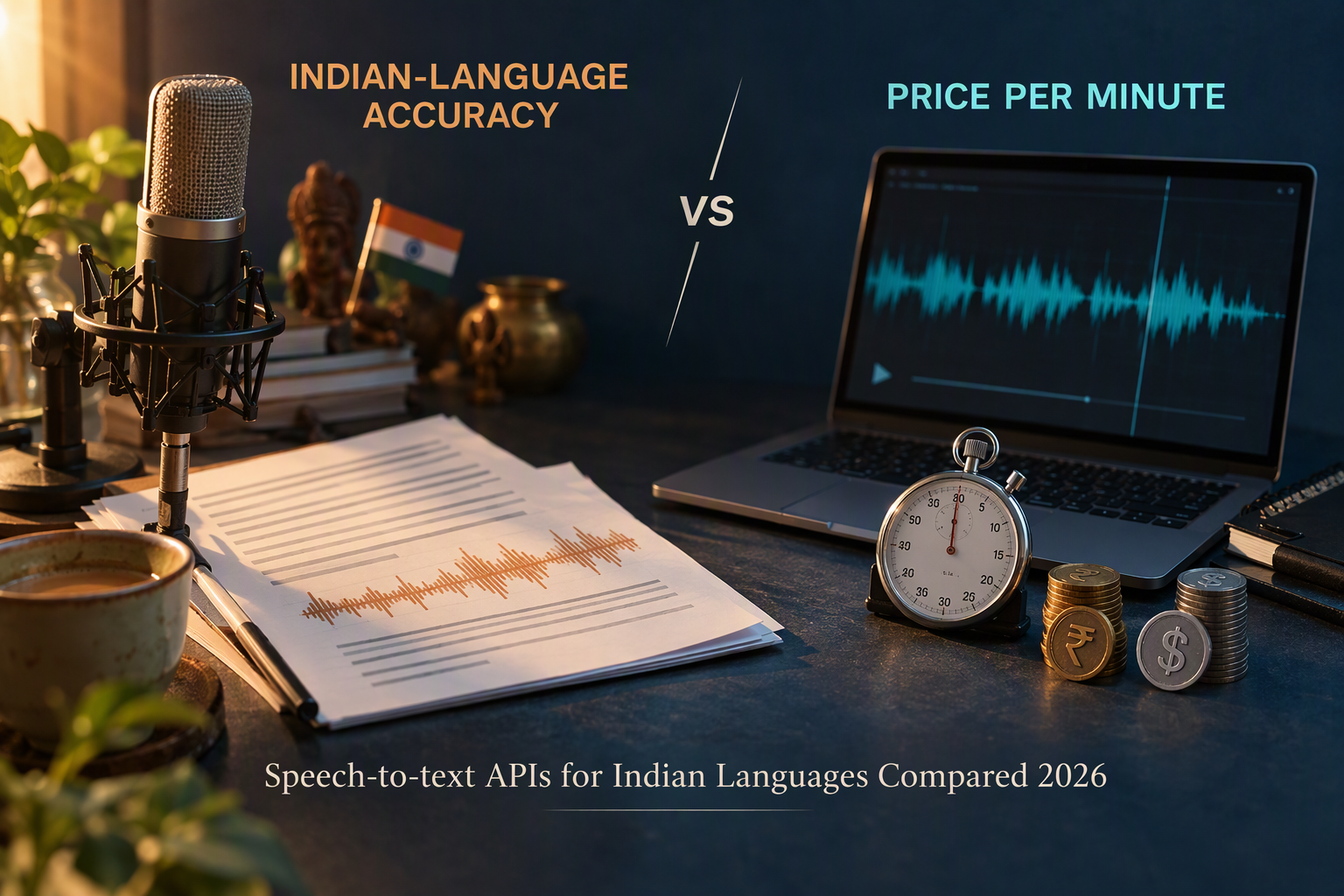
Compare Speech-to-text APIs for Indian languages with a reproducible accuracy test, Hinglish scoring, coverage checks and normalized per-minute costs.
Speech-to-text APIs for Indian Languages Compared 2026
Can a speech recognizer capture “मुझे flight book करनी है” without turning a customer’s request into a transcription error? Speech-to-text APIs for Indian languages need to handle more than vocabulary: they must preserve meaning when speakers switch languages, use regional accents, or call over noisy phone lines.
The technology is advancing quickly. According to Sarvam AI’s Saaras V3 announcement, its earlier Saaras V2.5 model supported 11 Indian languages and recorded approximately 22% word error rate (WER) on the IndicVoices benchmark in June 2025. As of October 2026, Sarvam AI’s speech-to-text product page describes Saaras V3 as trained on more than one million hours of real-world audio, with support for code-mixed speech and noisy telephony. Those developments make this a useful moment to reassess your transcription stack—but vendor claims alone cannot determine which API suits your workload.
What makes an Indian-language speech-to-text API worth choosing?
The strongest choice is the API that accurately transcribes your languages, speakers, and recording conditions at an acceptable cost. A polished Hindi demonstration does not establish performance on Tamil customer calls, Marathi voice notes, or Hindi-English conversations containing addresses and product names.
Sarvam AI’s “Building for Indian Languages” documentation uses “मुझे flight book करनी है” to illustrate why transcription settings matter. Recognizing the spoken words is only part of the task: developers must also decide how those words should appear in the output. Native-script transcription, transliteration, and translation serve different downstream needs and should not be treated as interchangeable.
This comparison examines three practical questions:
- Accuracy: Does the transcript preserve names, numbers, intent, and domain-specific terms—not merely achieve an attractive aggregate WER?
- Code-switching: Does the API retain English words inside Indian-language sentences, and does its output match the script your application expects?
- Price per minute: What does processing your actual audio volume cost, and which billing conditions affect the final total?
How should developers compare the options in 2026?
Start with representative recordings rather than a universal “best API” label. Test clean speech alongside noisy calls, different accents, and mixed-language utterances; then inspect consequential mistakes such as an incorrect appointment time or payment amount.
As of October 2026, CallMissed offers speech recognition in 22 Indian languages plus English, including Hinglish, through its developer AI platform—an example of how access to multilingual transcription is becoming easier to integrate.
The sections ahead compare available evidence, language handling, and per-minute pricing while separating published claims from results you should validate yourself. The goal is a shortlist you can test confidently, not a winner chosen from marketing headlines.
Which speech-to-text API is best for Indian languages? At-a-glance verdict
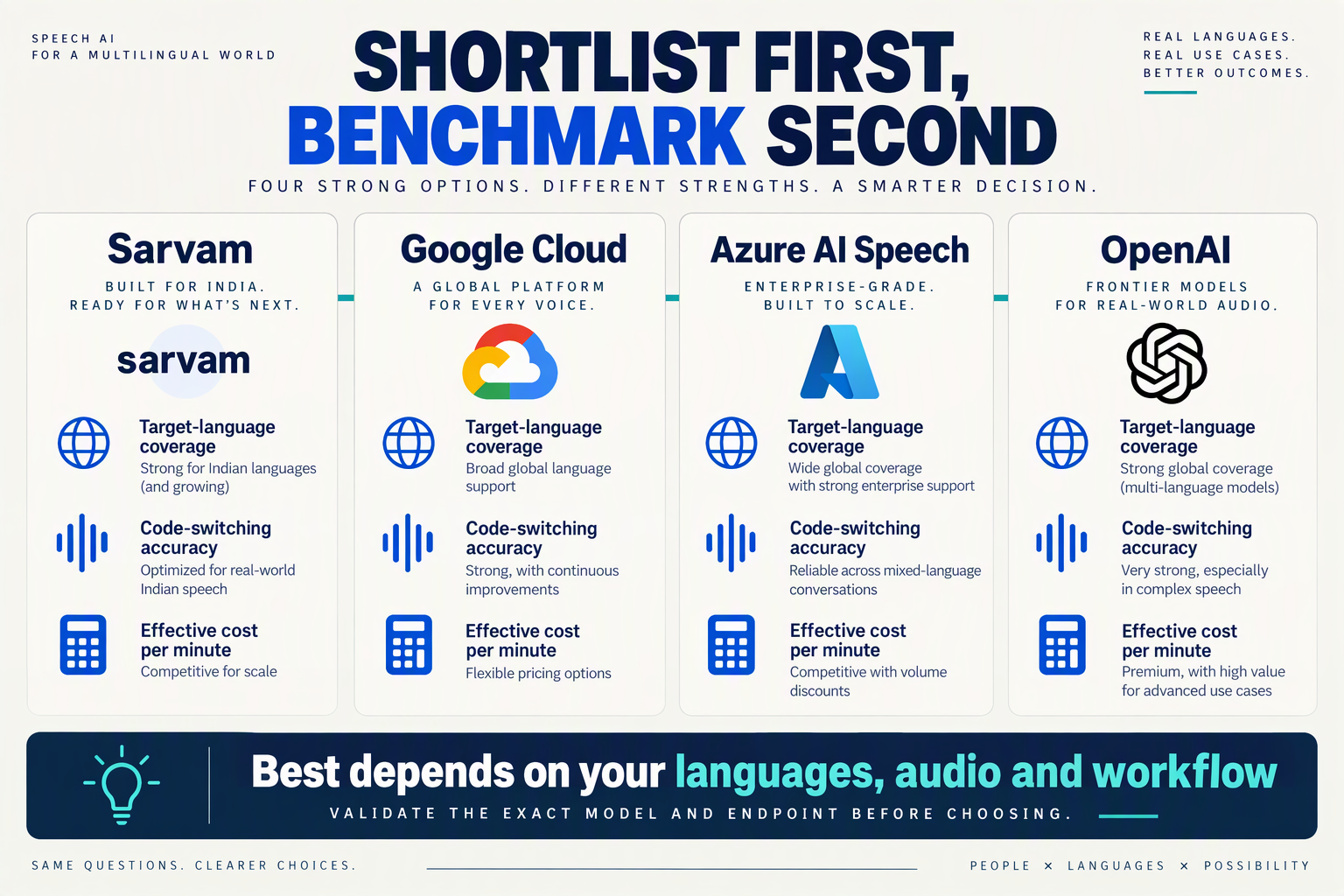
Sarvam AI’s Saaras V3 is a strong first candidate for India-focused transcription; CallMissed is worth shortlisting for access to multiple speech models through one API. Neither is a proven accuracy winner across every Indian language.
- Sarvam AI Saaras V3 — shortlist for Indian-language workflows: As of October 2026, Sarvam AI’s speech-to-text product page lists Accurate, Balanced, and Fast modes, giving developers explicit options for different latency requirements. Start by comparing these modes on identical recordings: a customer-support transcript and an interactive voice assistant may need different accuracy–speed trade-offs.
- Saaras V3 latency — promising, but measure the complete response: As of October 2026, Sarvam AI advertises sub-150ms time to first token on its speech-to-text product page. That is a vendor-reported responsiveness figure, not the time required to finish an entire transcript. Measure final-transcript latency separately, particularly when downstream software needs a complete address, account number, or appointment time.
- Code-switching — choose the output behavior, not just language coverage: Sarvam AI’s “Building for Indian Languages” documentation describes a
modeparameter controlling how Saaras V3 writes speech, as of October 2026. Before selecting an API, specify whether your application needs native-script text, transliteration, or translation; otherwise, an accurate recognition result can still be unsuitable for search, CRM records, or customer-facing messages.
- Accuracy verdict — no defensible universal winner yet: The supplied research does not establish a current, independent, head-to-head benchmark across the shortlisted APIs. Keep word error rate, entity accuracy, and code-switching errors separate in your evaluation. A recognizer that performs well overall can still fail your application if its remaining mistakes disproportionately affect names, prices, dates, or payment references.
- CallMissed — shortlist for integration flexibility: According to CallMissed’s verified product information, as of October 2026 its developer API provides 44 speech-to-text models within a 139-model catalogue, using one API key and balance. OpenAI-compatible audio transcription endpoints let existing SDK integrations work by changing the base URL, making the gateway relevant when developers want to evaluate several models without building separate provider integrations.
- Price per minute — distinguish transcription from voice-agent pricing: As of October 2026, CallMissed lists complete voice-agent plans at ₹4, ₹5, and ₹6 per minute, covering speech recognition, the language model, and voice generation; phone carriage is separate. Those figures are not standalone speech-to-text rates and should not be presented as directly comparable transcription prices.
- Cost verdict — normalize the quote before ranking: Convert an hourly transcription quote into a per-minute figure by dividing by 60. For a clearly hypothetical rate of ₹0.50 per minute, processing 10,000 minutes costs ₹5,000 before taxes or additional charges. Check billing increments, retries, and separately priced capabilities before treating the headline rate as your effective cost.
- Practical winner — select by workload: Start with Saaras V3 for an India-focused pilot, consider a multi-model gateway for integration flexibility, and award the final decision to the API that meets your tested accuracy, output-format, latency, and cost requirements—not the largest language count alone.
Which APIs support your languages, scripts and workflow? Feature comparison
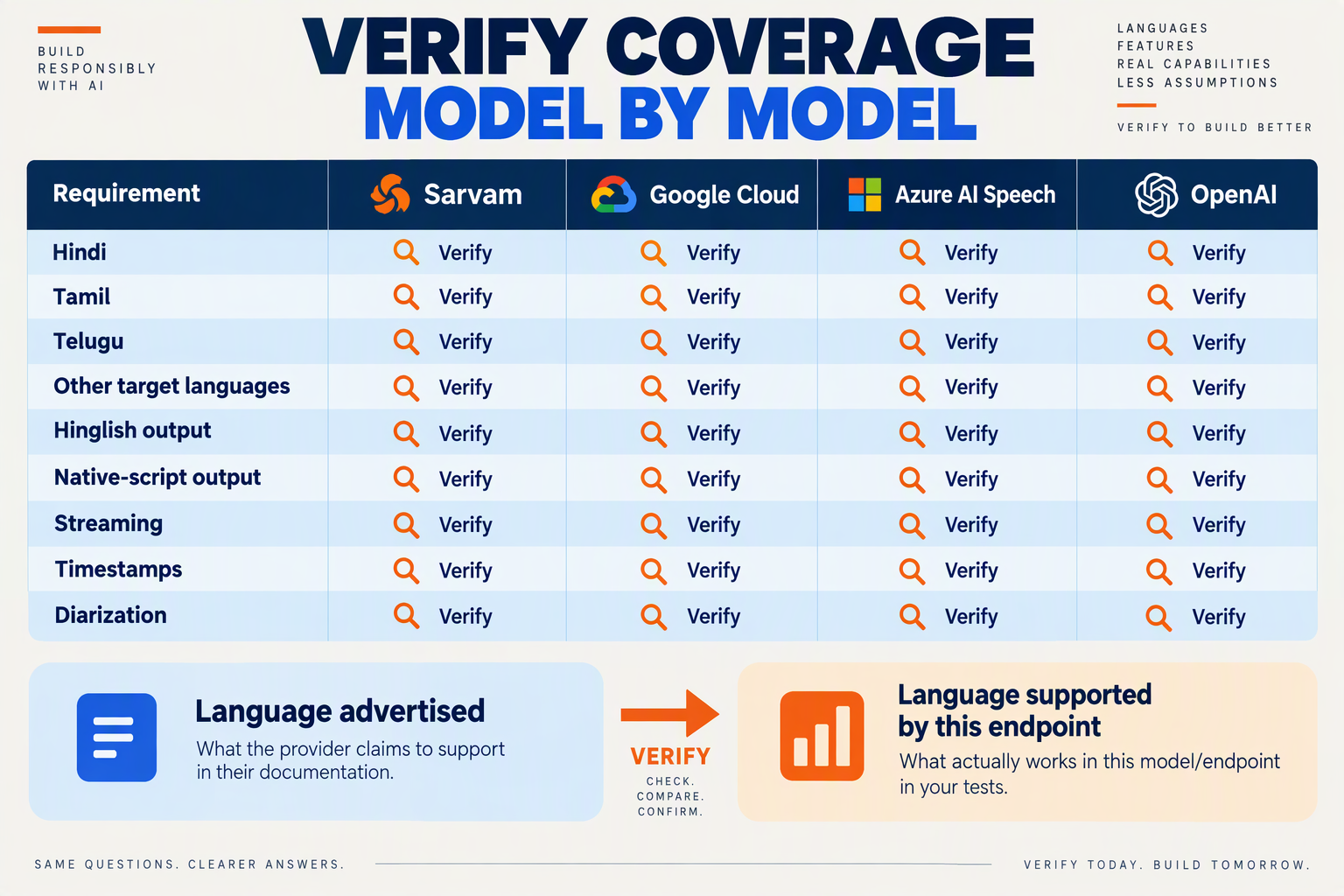
Choose an API by language coverage, output script and integration workflow, not multilingual branding alone. The comparison below reflects the supplied Sarvam AI documentation and verified CallMissed specifications as of October 2026; undocumented capabilities are checks for your shortlist, not assumed features.
- Coverage: Build a language checklist before testing: Hindi-English calls, Tamil voice notes and Marathi recordings are separate requirements. Ask whether each selected model supports your required language explicitly; a platform-wide language catalogue does not establish identical coverage across every model.
- Scripts: Define the transcript your application needs: native-script text, Latin-script transliteration or English translation. Sarvam AI’s “Building for Indian Languages” documentation identifies Saaras V3’s
modeparameter as the control for how recognized speech is written down. - Workflow: Separate uploaded recordings from live transcription. A file-transcription example demonstrates an upload workflow, but it does not establish streaming support, maximum session duration or partial-transcript behavior; confirm those details against the endpoint you will actually deploy.
How do language and workflow features compare?
| Selection criterion | Sarvam AI: Saaras V3 | CallMissed developer AI API | Deployment check |
|---|---|---|---|
| Language selection | Sarvam AI’s example specifies hi-IN | 44 speech-to-text models in the catalogue | Confirm language support per selected model |
| Code-mixed speech | Sarvam AI describes support for code-mixed audio | Speech recognition includes Hinglish | Test English names within regional-language speech |
| Output script | Sarvam AI documents a mode parameter | Script controls are not specified in the fact sheet | Check native-script and transliterated output separately |
| File transcription | Python example uploads audio.wav with saaras:v3 | OpenAI-compatible audio transcription endpoint | Verify formats, file-size limits and audio duration |
| Integration compatibility | Sarvam AI provides its own Python client example | Existing OpenAI SDKs work by changing the base URL | Check authentication and model-specific parameters |
| Processing controls | Sarvam AI lists Accurate, Balanced and Fast modes | Usage and request logs are available | Evaluate transcript quality separately from integration convenience |
- Sarvam AI: As of October 2026, Sarvam AI’s speech-to-text page lists three processing modes—Accurate, Balanced and Fast. Treat these as configuration choices to benchmark on your own recordings, rather than assuming that the fastest setting preserves numbers, names and regional vocabulary equally well.
- CallMissed: As of October 2026, CallMissed’s verified fact sheet lists 44 speech-to-text models and OpenAI-compatible transcription and translation endpoints. This is useful for developers retaining existing SDK integrations, but compatibility does not mean every underlying model exposes the same language options or script controls.
- Acceptance tests: Use one recording containing a regional-language sentence, an English product name and a spoken amount; then compare script consistency, entity preservation and timestamps where available. Before committing, request upload limits, streaming availability, speaker-label support and transcription-specific pricing—the supplied evidence does not establish those details across both options.
Keep price per minute attached to the exact transcription model and endpoint you test. Voice-agent bundle rates and text-to-speech character prices are different products and should not enter a speech-to-text cost comparison.
How should accuracy and Hindi-English code-switching be tested fairly?
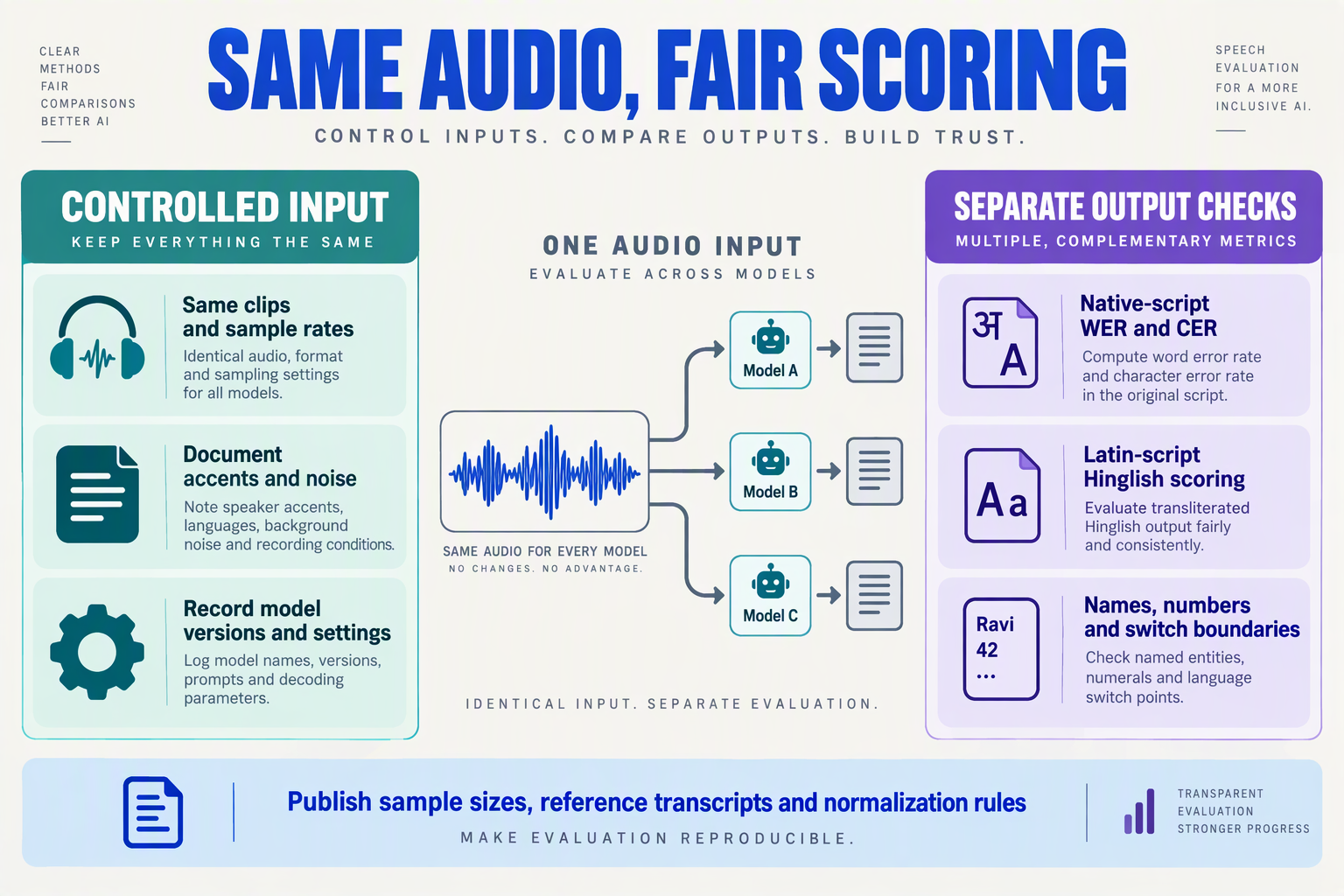
Test every speech-to-text API on identical, held-out recordings, with agreed transcription rules and separate scores for Hindi-English code-switching. Compare recognition errors—not differences caused by translation, transliteration, or audio preprocessing.
- Test corpus: Start with a proposed 300-clip evaluation set: 100 predominantly Hindi clips, 100 Hindi-English clips, and 100 clips from your actual deployment mix. Include regional accents, names, addresses, payment amounts, and interruptions. Keep speakers out of any prompt-tuning dataset, obtain recording consent, and report each language separately so strong Hindi results cannot conceal weak performance elsewhere.
- Reference transcripts: Have two bilingual annotators independently transcribe each recording, then resolve disagreements before scoring. Define whether English words remain in Latin script and how numerals, fillers, punctuation, and abbreviations are represented. Preserve the original reference alongside a normalized version; otherwise, a harmless difference such as “₹500” versus “500 rupees” could distort the comparison.
- Word error rate: Calculate WER = (substitutions + deletions + insertions) ÷ reference words × 100 using the same normalization for every API. In a hypothetical 100-word reference, eight substitutions, three deletions, and two insertions produce 13% WER. Also report character error rate where useful, but inspect errors individually: an incorrect payment amount matters more operationally than a missing filler.
- Code-switching score: Label the English spans inside Hindi sentences and score those spans separately from the full transcript. Include switches at sentence boundaries and within phrases, such as “कल refund process कर देना.” Track English-term retention, Hindi-word accuracy, and whether meaning survives. A transcript can achieve acceptable overall WER while repeatedly corrupting the product names your support workflow needs.
- Output settings: As of October 2026, Sarvam AI’s Building for Indian Languages documentation describes a Saaras V3
modeparameter controlling how speech is written down. Match each API’s output to the same intended task before scoring. Native-script transcription, Roman transliteration, and English translation should be evaluated separately; translated output is not a fair substitute for a verbatim code-mixed transcript.
- Recording conditions: Create separate clean-audio, noisy-call, and overlapping-speech groups, and submit identical files within each group. Where supported, test 8 kHz telephony audio separately from higher-quality recordings rather than averaging them together. Record channel count, codec, sampling rate, and preprocessing. Do not denoise one vendor’s input while giving another the untreated recording.
- Uncertainty and operational errors: Report results by speaker and recording condition, with 95% confidence intervals where your sample supports them. Bootstrap by speaker rather than treating every word as independent. Add exact-match scores for phone numbers, dates, currency amounts, and named entities, plus request-failure rates. A small aggregate WER advantage is inconclusive when uncertainty overlaps or consequential errors increase.
- Reproducible runs: Freeze model identifiers, language hints, vocabulary prompts, and streaming settings, and timestamp the evaluation October 2026. Run streaming and file-based transcription as separate comparisons. As of October 2026, CallMissed’s developer API provides OpenAI-compatible audio transcription endpoints and usage and request logs—useful infrastructure for running a consistent harness, although compatibility alone does not establish recognition accuracy.
How much does each API cost per minute in October 2026? Pricing and value
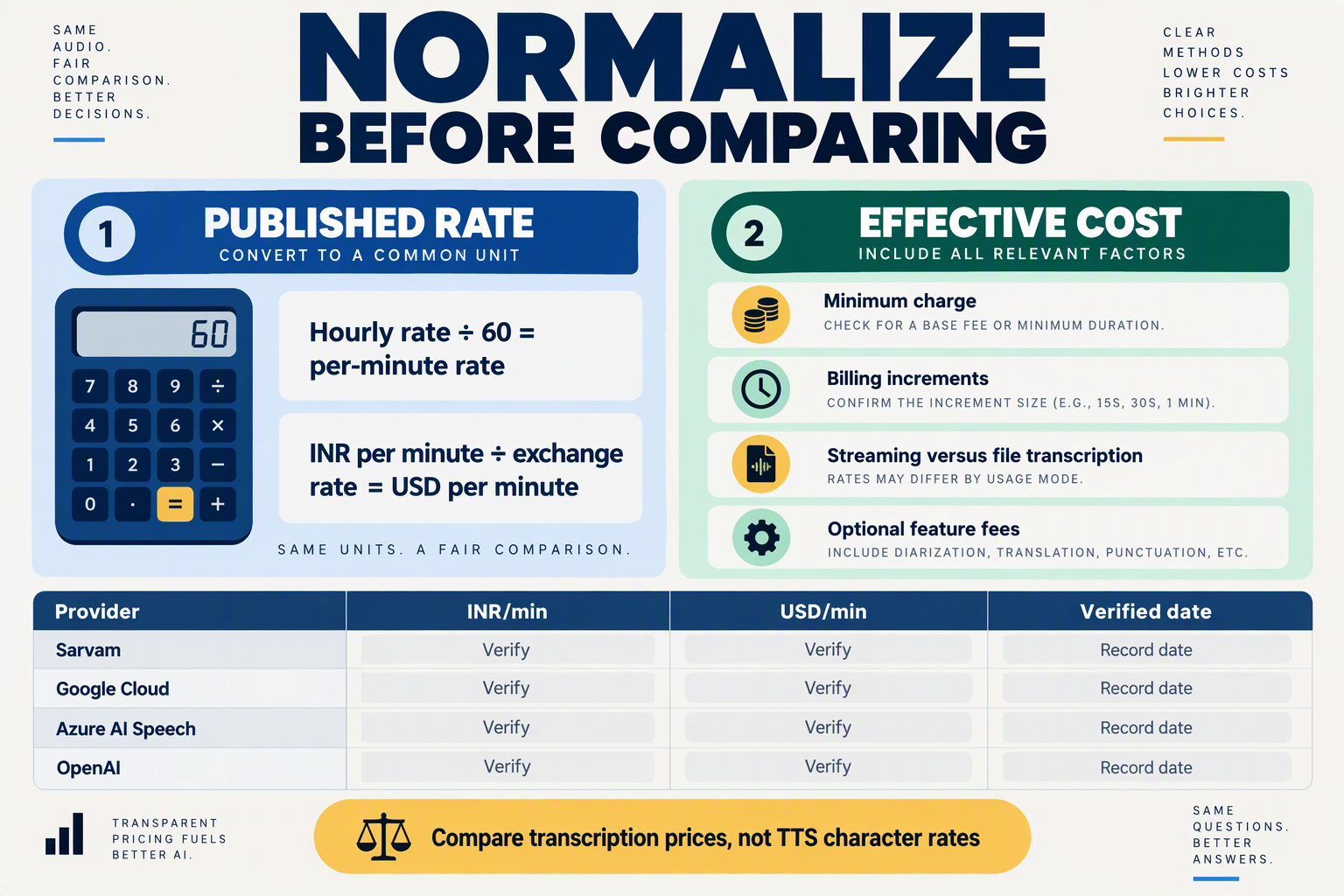
A verified October 2026 price ranking is not possible from the supplied sources: they do not establish comparable, current transcription rates for each provider. Treat missing prices as unverified—not free—and separate standalone speech recognition from bundled voice-agent pricing.
- Comparison basis: Request the price for the same workload: recorded or streaming audio, identical monthly volume, and any required timestamps or speaker diarization.
- Currency basis: As of October 2026, CallMissed’s verified fact sheet uses US$1 = ₹96; the conversions below use that budgeting assumption, not a live exchange-rate quote.
Which speech-to-text API prices are verified for October 2026?
The table distinguishes missing pricing evidence from published product capabilities. Providers without verified rates remain candidates for evaluation, but cannot honestly be ranked by cost from this research alone.
| API or platform | Verified STT price/min | October 2026 evidence | Budgeting action |
|---|---|---|---|
| Sarvam AI Saaras V3, direct | Not established | Supplied Sarvam documentation describes transcription, not a direct rate | Confirm direct API pricing |
| OpenAI transcription API | Not established | No current official pricing supplied | Check model-specific audio rates |
| Google Cloud Speech-to-Text | Not established | No current official pricing supplied | Check API version and volume tier |
| Amazon Transcribe | Not established | No current official pricing supplied | Check region and billing conditions |
| CallMissed developer AI API | Not specified in fact sheet | Verified access to 44 speech-to-text models | Check the selected model’s rate |
- Sarvam AI: Sarvam’s supplied “Building for Indian Languages” documentation explains Saaras V3 transcription modes, but does not establish the direct API’s October 2026 per-minute price.
- CallMissed: According to its verified fact sheet, as of October 2026 its developer API provides one API key and one balance across 139 models, including 44 speech-to-text models; access breadth does not imply identical model pricing.
How do you calculate the real cost per usable transcript?
Price per minute is only the starting point. A cheaper recognizer can cost more overall when staff must correct names, payment amounts, or code-switched phrases; compare that correction burden using your own evaluation recordings.
- Normalize the quote: Divide an hourly rate by 60, then multiply the per-minute rate by your expected billable audio minutes.
- Calculate effective cost: Add transcription charges, required extras, and measured correction costs; divide by minutes that meet your acceptance criteria.
- Worked example: At an illustrative—not vendor-quoted—$0.005/min, 10,000 minutes cost $50, or ₹4,800 using the October 2026 conversion assumption above; at $0.01/min, the same volume costs ₹9,600.
- Bundled voice pricing: CallMissed’s verified October 2026 plans cost ₹4/₹5/₹6 per minute for speech recognition, the language model, and voice together, with a 30-second minimum and phone carriage billed separately; these are not standalone STT rates.
Before choosing, obtain dated quotes and test the same recordings across providers. The defensible value comparison is cost per acceptable transcript, not the lowest headline rate attached to a different workload.
What are the practical pros and cons of each API?
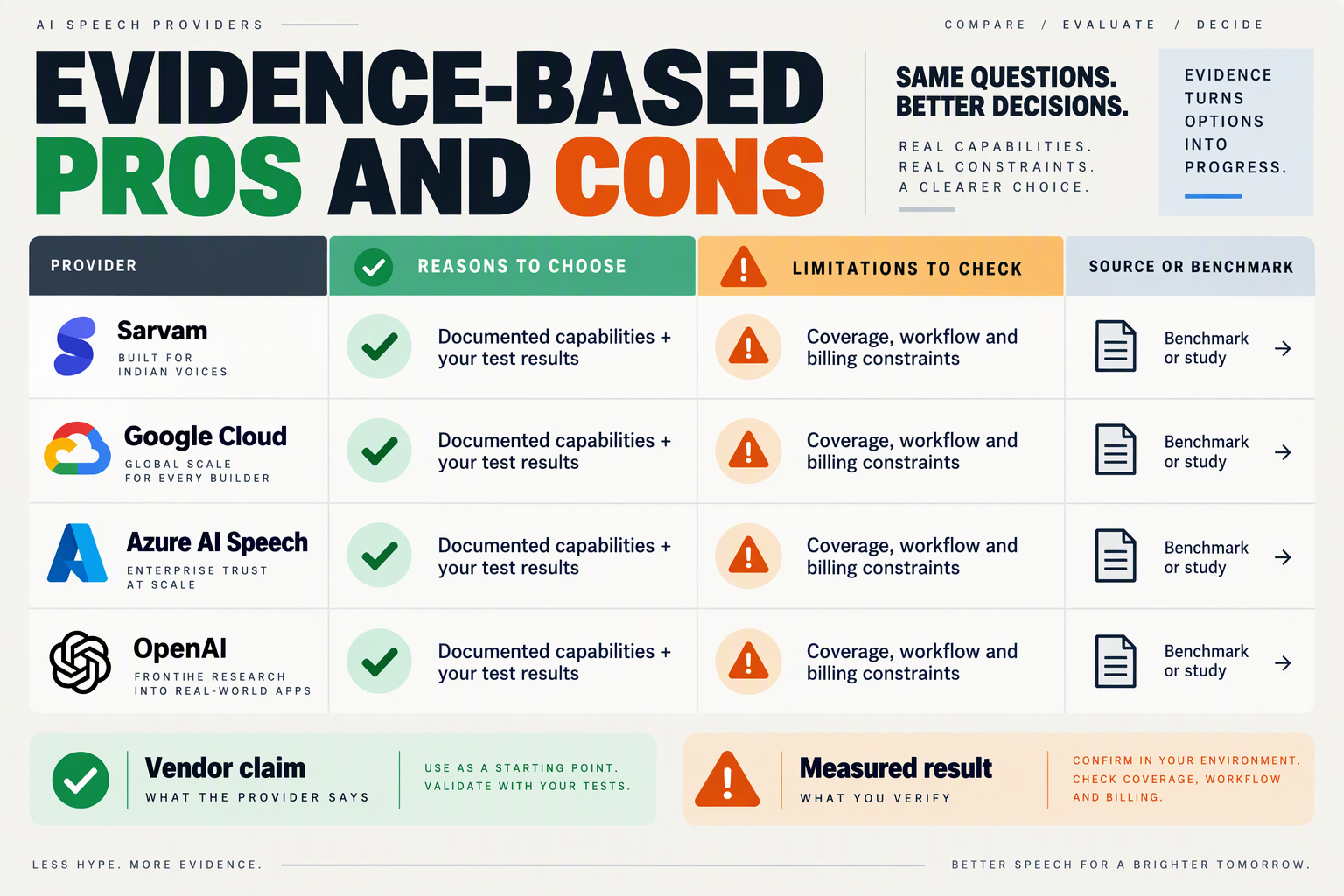
Saaras V3 offers three accuracy–speed configurations; CallMissed offers a multi-model integration route. As of October 2026, the supplied evidence supports comparing these deployment choices—not declaring a universal winner across speech-to-text APIs.
- Comparison scope: Sarvam AI’s Accurate, Balanced, and Fast settings are configurations of one model, not three independent APIs; evaluate them against identical recordings.
- Pricing limitation: The supplied evidence does not establish comparable, verified transcription prices for every option, so the table flags missing rates rather than inventing a price-per-minute ranking.
What are the practical advantages and limitations of each option?
The following product details reflect Sarvam AI’s documentation and CallMissed’s verified fact sheet as of October 2026.
| API or configuration | Practical advantage | Limitation or trade-off | Price-per-minute evidence |
|---|---|---|---|
| Sarvam Saaras V3 — Accurate | A configurable option for workflows prioritising transcription accuracy. | The supplied sources contain no mode-specific WER result; the name is not proof of better performance on your calls. | Verified direct rate not supplied. |
| Sarvam Saaras V3 — Balanced | A middle configuration to test when both responsiveness and transcript quality matter. | No supplied measurements quantify its accuracy or latency difference from the other modes. | Verified direct rate not supplied. |
| Sarvam Saaras V3 — Fast | A configuration to evaluate for interactive speech applications. | Faster output is not automatically a better final transcript; test corrections and consequential errors. | Verified direct rate not supplied. |
| Sarvam Saaras V3 — script-controlled transcription | Sarvam API Docs describe a mode parameter controlling how recognised speech is written. | Output formatting must match downstream search, CRM fields, and human review expectations. | Confirm the rate for the selected endpoint. |
| CallMissed developer AI API | OpenAI-compatible transcription endpoints and access to 44 speech-to-text models through one API key and balance. | Gateway compatibility does not establish equal language coverage or accuracy across individual models. | Model-specific transcription rates are not established by the fact sheet. |
Which trade-offs should developers test before choosing?
- Sarvam Saaras V3: Sarvam AI’s speech-to-text page reports “Sub-150ms time to first token” as of October 2026; this vendor claim does not establish end-to-end latency for your network, audio format, or chosen configuration. Measure first output and final transcript completion separately.
- Script-controlled transcription: Test whether an English product name remains searchable after mixed-language transcription; correct meaning with unexpected script can still break exact-match workflows. Keep transcription, transliteration, and translation as separate acceptance criteria rather than treating every readable output as equivalent.
- CallMissed: As of October 2026, CallMissed’s verified fact sheet lists OpenAI-compatible audio transcription endpoints, usage logs, and request logs. Those capabilities support integration and operational review, but developers should still validate each selected model against their recordings.
- Cost comparison: Normalise quotes to one minute of input audio, then check rounding, minimum charges, retries, and failed-request billing with each provider. For example, an illustrative workload of 10,000 minutes costs 10,000 × the verified per-minute rate, before applicable taxes and additional processing charges.
Practical verdict: shortlist by workflow, then run the same recordings through each candidate. Choose the configuration that preserves critical names, amounts, and intent at an acceptable measured cost—not the option with the most attractive mode label.
Which should you choose—and when does CallMissed fit as an API access layer?
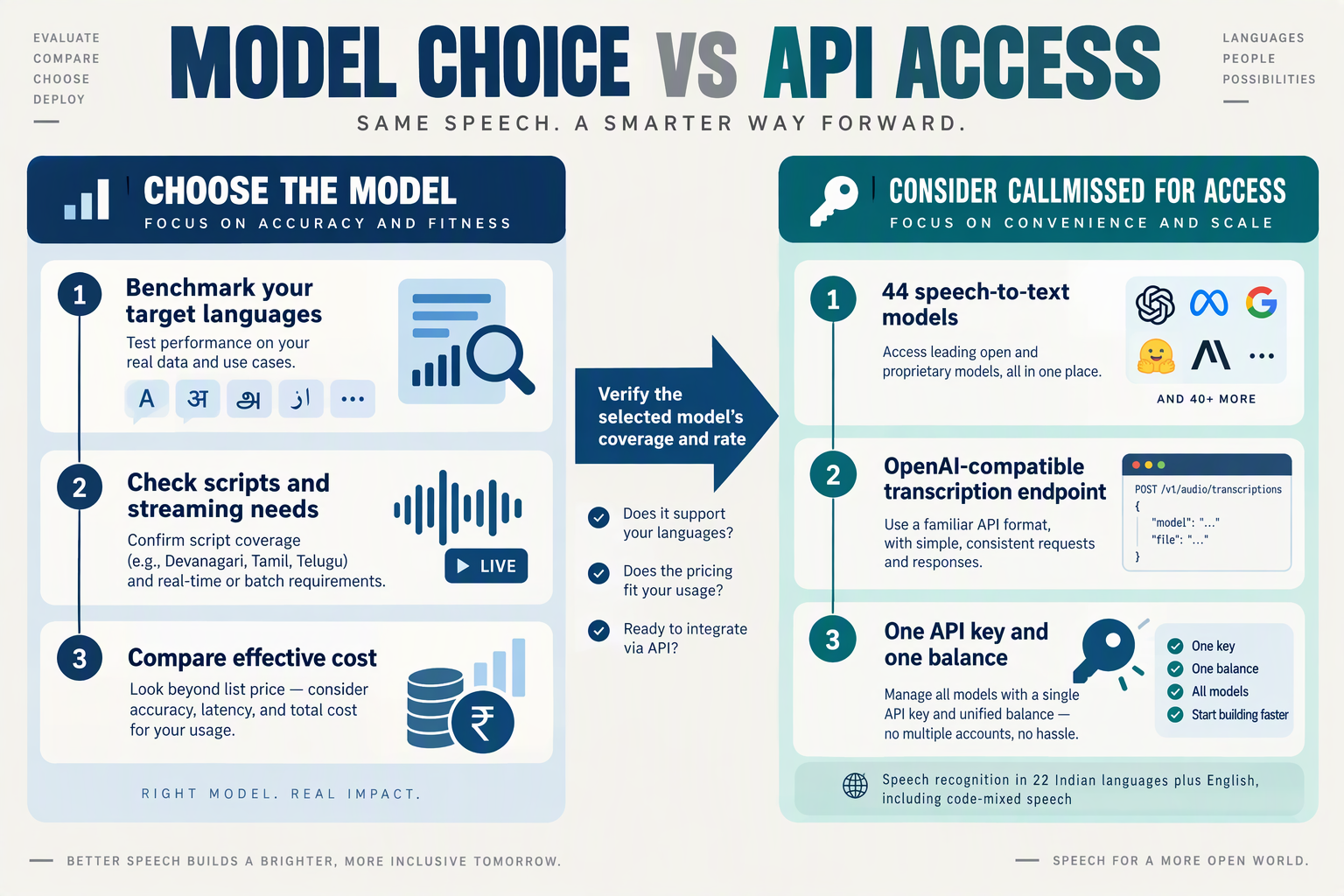
Choose the recognizer that passes your language-specific tests; choose an API access layer when integration consistency matters across multiple models. Accuracy and convenient access are separate decisions—one cannot substitute for the other.
- Sarvam AI Saaras V3: Shortlist this model for Indian-language recordings where code-mixing, regional accents, and noisy telephony are central requirements. As of October 2026, Sarvam AI’s speech-to-text page describes configurable Accurate, Balanced, and Fast modes. Test those settings against the same recordings: a faster configuration is useful only if it preserves the information your application needs.
- Script-sensitive applications: Prioritize output controls when transcripts feed searchable records, subtitles, or customer-facing messages. Sarvam AI’s “Building for Indian Languages” documentation, available as of October 2026, describes a
modeparameter controlling how speech is written down. Check native-script transcription, transliteration, and translation separately; downstream search can fail even when a transcript conveys the right meaning.
- Direct provider integration: Choose direct access when one recognizer meets your requirements and you need its provider-specific configuration. Before committing, check three integration details: supported transcription parameters, returned timestamps or word-level information, and error handling. An abstraction layer is less valuable if your application depends heavily on settings that its common interface does not expose.
- CallMissed’s model access: As of October 2026, CallMissed’s verified fact sheet lists 44 speech-to-text models within a 139-model developer catalogue, accessible through one API key and one balance. That makes the platform relevant when transcription sits alongside language models, speech synthesis, or embeddings. Catalogue breadth supports model selection; it does not establish that every recognizer performs equally well on every Indian language.
- CallMissed’s integration fit: As of October 2026, CallMissed supports OpenAI-compatible audio transcription endpoints, allowing existing compatible SDKs to work by changing the base URL. Its verified default limits are 60 requests/minute on Free, 500 on Starter, 3,000 on Pro, and 10,000 on Enterprise. Check model-specific options before migrating; request limits describe access capacity, not transcription speed or accuracy.
- Price-sensitive workloads: Compare standalone transcription cost per audio minute, not bundled voice-agent pricing. For illustration—not a vendor quote—10,000 minutes at ₹0.50/minute costs ₹5,000, while the same volume at ₹1/minute costs ₹10,000. Check the current tariff, rounding, minimum charges, and retry billing before budgeting; the supplied evidence does not establish a comparable standalone transcription tariff for every option.
- Accuracy-sensitive workflows: Rank candidates by consequential mistakes, not aggregate WER alone. For appointment booking, measure incorrect dates, times, names, and phone numbers separately; for commerce, inspect product names and payment amounts. A lower headline error rate may still be the wrong choice if the remaining errors trigger incorrect bookings or require expensive manual correction.
- Final selection: Keep the recognizer that wins your representative evaluation, then decide whether direct access or a shared gateway simplifies deployment. Confirm three things before launch: the required language and script behavior, measured cost on actual recordings, and feature availability through your chosen endpoint. Re-test after model or configuration changes rather than treating this comparison as a permanent ranking.
Frequently Asked Questions
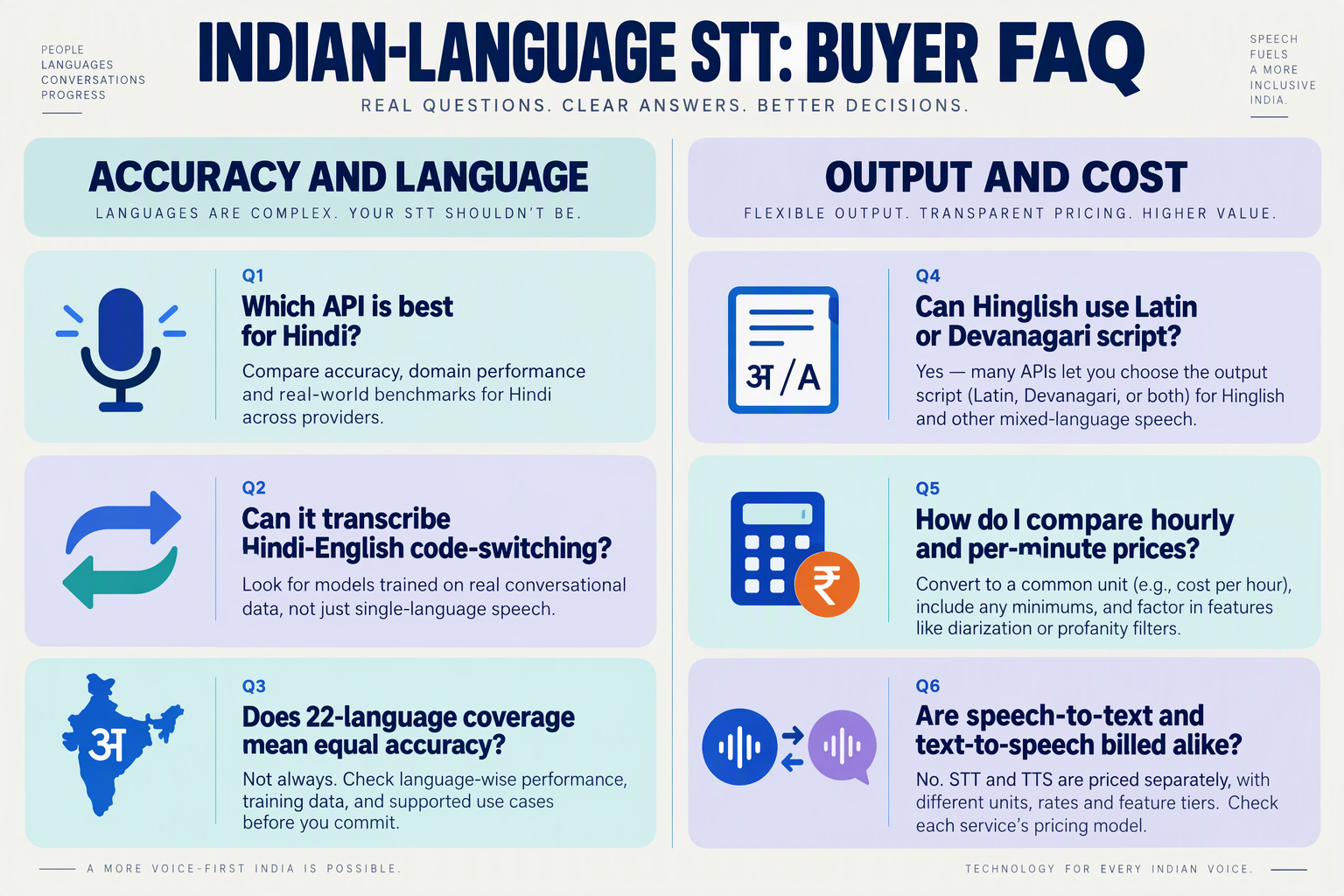
- Q: Which is the best speech-to-text API in India for Hindi accuracy?
A: The best Hindi speech-to-text API is the one that preserves critical information in your recordings, not necessarily the one with the strongest headline benchmark. Sarvam AI’s Saaras V3 announcement reports approximately 22% word error rate on IndicVoices for Saaras V2.5 in June 2025; that historical result does not establish V3’s current Hindi accuracy. Compare candidates on identical Hindi clips, checking names, payment amounts, dates, and regional accents separately from overall WER.
- Q: Can Hinglish speech-to-text APIs return both Devanagari and Roman-script transcripts?
A: Hinglish recognition and output script are separate capabilities: recognizing Hindi-English speech does not automatically guarantee your preferred written format. As of October 2026, Sarvam AI’s “Building for Indian Languages” documentation describes a Saaras V3 mode parameter that controls how speech is written down, distinguishing transcription, transliteration, and translation. Select the appropriate mode and test whether English brand names remain readable rather than assuming every API produces the same script.
- Q: Does 22-language coverage mean equal transcription accuracy across Indian languages?
A: No—language coverage describes availability, not equal accuracy, and it should not be confused with text-to-speech coverage. As of October 2026, CallMissed provides speech recognition in 22 Indian languages plus English, including code-mixed speech such as Hinglish, while its natural text-to-speech voices cover 10 Indian languages plus English. Evaluate each required language separately, because a successful Hindi trial does not establish suitability for Tamil, Marathi, or another language.
- Q: How do I compare the best speech-to-text API in India by price per minute?
A: Convert an hourly transcription rate into a per-minute rate by dividing by 60, then check billing increments, minimum charges, and any additional processing fees. For an illustrative workload of 10,000 audio minutes, multiply the verified per-minute rate by 10,000 before adding applicable taxes or extras; this is a budgeting example, not a quoted vendor price. As of October 2026, CallMissed’s ₹4–₹6/min voice-agent plans bundle recognition, a language model, and voice generation, so those prices are not standalone transcription rates.
- Q: How should I measure Hindi and Hinglish transcription accuracy fairly?
A: Use word error rate alongside task-specific checks: WER counts substitutions, deletions, and insertions relative to a reference transcript. Establish script and normalization rules before scoring, because equivalent words written in Devanagari and Latin characters can otherwise appear as errors. Separately score consequential fields—such as phone numbers, addresses, and appointment times—so a readable transcript does not conceal an operationally important mistake.
- Q: Which speech-to-text API should I test for noisy Indian customer calls?
A: Saaras V3 is a relevant candidate: as of October 2026, Sarvam AI’s speech-to-text product page explicitly describes support for noisy telephony, code-mixed speech, and diverse accents. Treat that as a vendor capability claim rather than proof of accuracy on your calls. Test actual recordings containing interruptions, background noise, and Hindi-English switching, then compare recognition quality and response time under the same conditions.
Conclusion
The best speech-to-text API for Indian languages in 2026 is the one that preserves meaning in your actual recordings—not the one with the most impressive demonstration. Choose by testing accuracy, code-switching, output format, and effective price per minute together, rather than treating any single benchmark or language-support claim as decisive.
- Measure errors that affect outcomes, not just aggregate accuracy. Sarvam AI’s Saaras V3 announcement reports that Saaras V2.5 achieved approximately 22% word error rate on IndicVoices in June 2025. That historical benchmark provides context, but it cannot establish performance on your Tamil customer calls, Marathi voice notes, or Hindi-English booking requests. Check whether transcripts preserve names, payment amounts, appointment times, and domain-specific terms before deciding which API belongs on your shortlist.
- Test code-switching and script handling explicitly. Sarvam AI’s “Building for Indian Languages” documentation illustrates the challenge with “मुझे flight book करनी है”. A useful transcript must retain the intended meaning while producing the script your application expects. Native-script transcription, transliteration, and translation are different outputs, not interchangeable measures of recognition quality. Include mixed-language sentences containing English product names, addresses, and numbers in your evaluation rather than relying only on clean, single-language examples.
- Compare the cost of your workload, not an isolated headline price. Effective price per minute depends on how an API’s billing conditions apply to your actual audio volume. Compare costs using the same representative recordings and expected usage, then assess the transcripts alongside those costs. A cheaper result is not necessarily better value if it changes a customer’s request; equally, a higher price does not establish superior accuracy without evidence from your own tests.
- Treat broader language coverage as access, not proof of accuracy. As of October 2026, CallMissed’s verified product information lists speech recognition in 22 Indian languages plus English, including code-mixed speech such as Hinglish. Developers can explore CallMissed as a platform for multilingual transcription while applying the same workload-specific evaluation. Coverage helps establish which options are worth testing, but regional accents, noisy phone lines, and consequential transcription errors still need direct inspection.
What should developers watch next?
Watch whether advances in Indian-language recognition translate into more reliable results on mixed-language, real-world audio. As of October 2026, Sarvam AI’s speech-to-text product page describes Saaras V3 as trained on more than one million hours of real-world audio, with support for code-mixed speech and noisy telephony; those claims are reasons to reassess your shortlist, not substitutes for validation.
Build a representative test set, compare transcripts and costs, and revisit the results as models evolve. Which API preserves your customers’ meaning most reliably at a price your workload can sustain?
Related Reading
- Best Speech-to-Text API for Indian Languages: 2026
- Best Text to Speech API for Hindi in 2026: 7 Options Compared
- Best Text to Speech API for Hindi in 2026: Pricing, Benchmark, and Production Trade-offs