OpenRouter alternatives: Production API Gateways Compared



Compare OpenRouter alternatives by model capabilities, total workload costs and reproducible latency tests to choose a production gateway.
OpenRouter alternatives: Production API Gateways Compared
A gateway’s model price is not necessarily the price you pay to access that model. Comparing OpenRouter alternatives means looking beyond token rates to funding fees, routing behavior, and the latency your users actually experience.
According to WhichDevTool’s September 29, 2026 reading of OpenRouter’s pricing, OpenRouter applies a 5.5% platform fee when purchasing credits, while per-model token prices generally follow the underlying provider’s prices. That distinction matters when a prototype becomes a production application: a seemingly small pricing difference becomes a recurring budget line, and a convenient API abstraction becomes part of your application’s critical path.
What should you compare beyond model count?
A unified LLM API gateway lets developers access multiple model providers through a common interface. But catalogue size alone cannot tell you whether a gateway fits a customer-support assistant, a coding product, or a latency-sensitive conversational application.
The useful questions are more specific:
- Model coverage: Does the gateway offer the exact models and capabilities your application needs, including embeddings, structured outputs, or speech?
- Effective pricing: What do you pay after credit-purchase fees, applicable surcharges, and the cost of your chosen routing configuration?
- Production latency: How quickly does the first useful token arrive, and how consistent is that timing during busy periods?
- Operational control: Can you choose fallback models, use your own provider credentials, and inspect request-level usage?
As of October 2026, CallMissed’s verified product fact sheet lists 139 models and 26 free-tier models, with OpenAI-compatible and Anthropic-compatible endpoints, caller-chosen fallback models, and usage logs—one example of how unified gateways are expanding beyond basic text generation.
Why does gateway choice matter for production apps?
The abstraction that speeds up development also introduces decisions you need to understand. Data Studios describes OpenRouter’s routing responsibilities as model selection, provider selection, load balancing, and cost optimization; those are separate concerns, not a single guarantee of speed or savings.
Consider a support assistant that prioritizes inexpensive responses but must escalate difficult questions to a more capable model. Its gateway needs an appropriate fallback path, not merely a long model list. A voice application, meanwhile, needs latency measurements that reflect the complete interaction rather than an isolated gateway-overhead claim.
What will this comparison help you decide?
This comparison examines model coverage, pricing mechanics, and production latency so you can build a shortlist around your workload rather than marketing totals. It also distinguishes published product capabilities from performance claims that require testing.
The goal is practical: identify which gateway deserves a production trial, what to measure during that trial, and which costs to include before committing your application’s traffic.
Which gateway fits production? OpenRouter for managed access, LiteLLM for self-hosted control
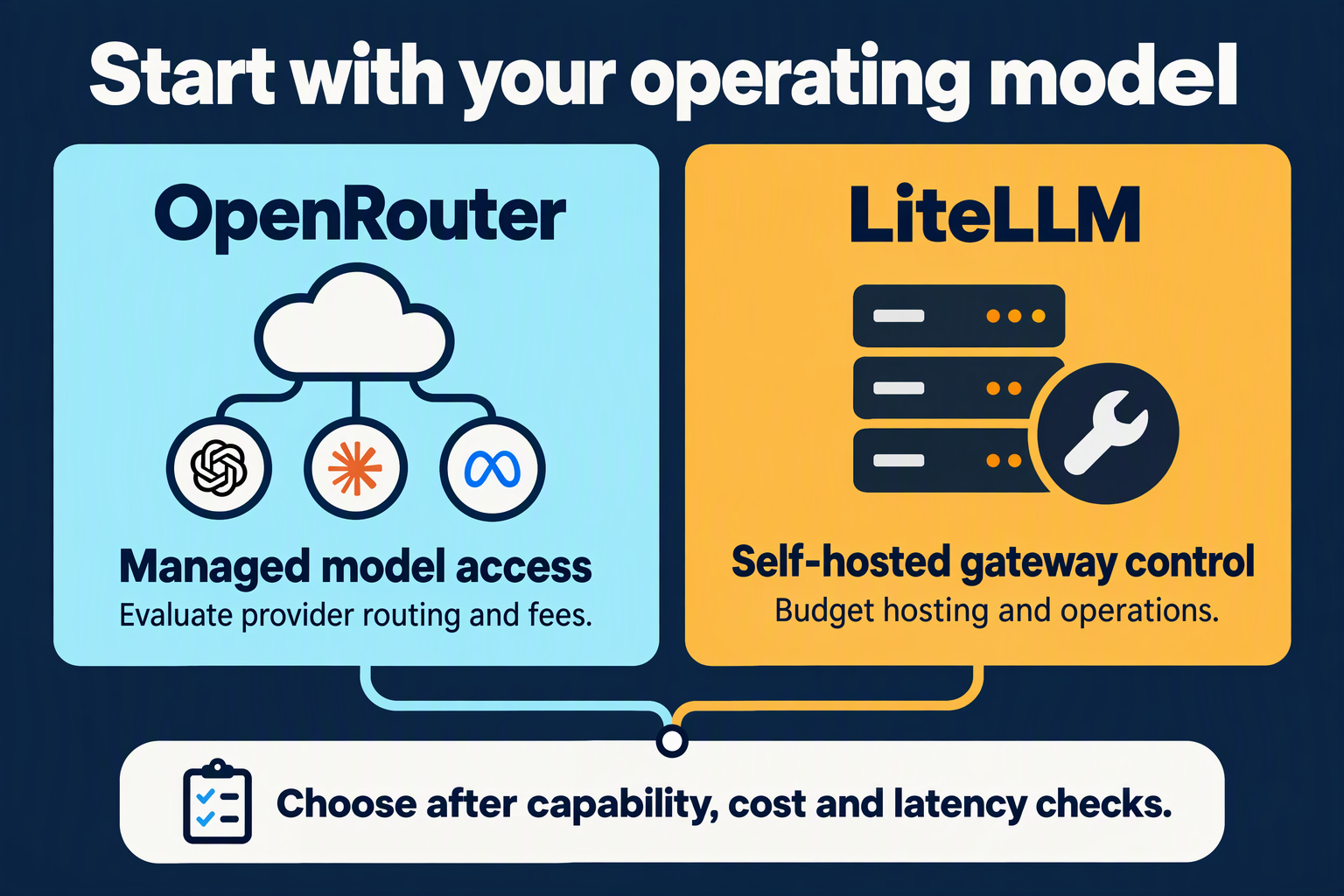
OpenRouter fits teams that want managed model access; LiteLLM fits teams that want to operate the gateway themselves. For production, the deciding factor is who should own routing infrastructure, provider credentials, and incident response—not simply which catalogue is larger.
When should you choose OpenRouter for production?
- OpenRouter: Choose managed access when gateway operations would distract from application delivery. As of October 2026, AppStackBuilder describes OpenRouter as a single OpenAI-compatible API spanning hundreds of models. That makes it a practical shortlist candidate for teams experimenting across providers without deploying a separate proxy; verify each required model and endpoint before committing.
- OpenRouter: BYOK provides credential control without requiring self-hosting. As reviewed in October 2026, OpenRouter’s BYOK documentation says provider keys give customers direct control over provider rate limits and costs. This suits teams with existing provider accounts, but a shared API interface does not remove the quotas attached to those accounts.
- OpenRouter: Evaluate BYOK economics separately from credit-funded requests. OpenRouter’s announcement, available in the October 2026 research context, states that customers receive 1,000,000 free BYOK requests per month. “Free” here concerns gateway BYOK requests—not underlying model inference; provider charges still need their own budget, and the supplied excerpt does not quantify the above-threshold charge.
- OpenRouter: Treat routing flexibility as a configuration decision, not a latency guarantee. Data Studios’ routing explainer, reviewed in October 2026, distinguishes model selection from provider selection. For a production assistant, test the exact provider-routing configuration you intend to deploy: changing the inference provider can change response timing even when the requested model name stays constant.
When should you choose LiteLLM or another gateway?
- LiteLLM: Choose self-hosted control when operating the proxy is an intentional engineering responsibility. For an October 2026 deployment decision, evaluate LiteLLM’s self-hosted proxy against requirements for network placement, credential handling, and deployment configuration. The trade-off is ownership: your team must plan upgrades, capacity, monitoring, and recovery rather than treating those tasks as somebody else’s service.
- LiteLLM: Compare total operating cost, not an assumed zero-cost gateway. For an October 2026 budget, include provider inference, proxy compute, observability, and engineering time. The supplied research contains no verified LiteLLM hosted-plan price or comparable latency benchmark, so neither a dollar-price comparison nor a claim that self-hosting is faster is supported here.
- CallMissed: Consider developer controls alongside the managed-versus-self-hosted split. As of October 2026, CallMissed’s verified fact sheet lists bring-your-own provider keys, response caching, stored prompts, and request logs. Its default per-key limits are 60, 500, 3,000, and 10,000 requests per minute across Free, Starter, Pro, and Enterprise—concrete limits to check against anticipated traffic.
- Production shortlist: Run the same workload before choosing. For an October 2026 evaluation, hold the model, prompt, output length, region, and concurrency constant; record p50/p95 time to first token, completion time, errors, and cost per successful response. Test fallback behavior separately, because a recovered request can still exceed your application’s latency budget.
Which models and API capabilities do OpenRouter, LiteLLM and CallMissed support?
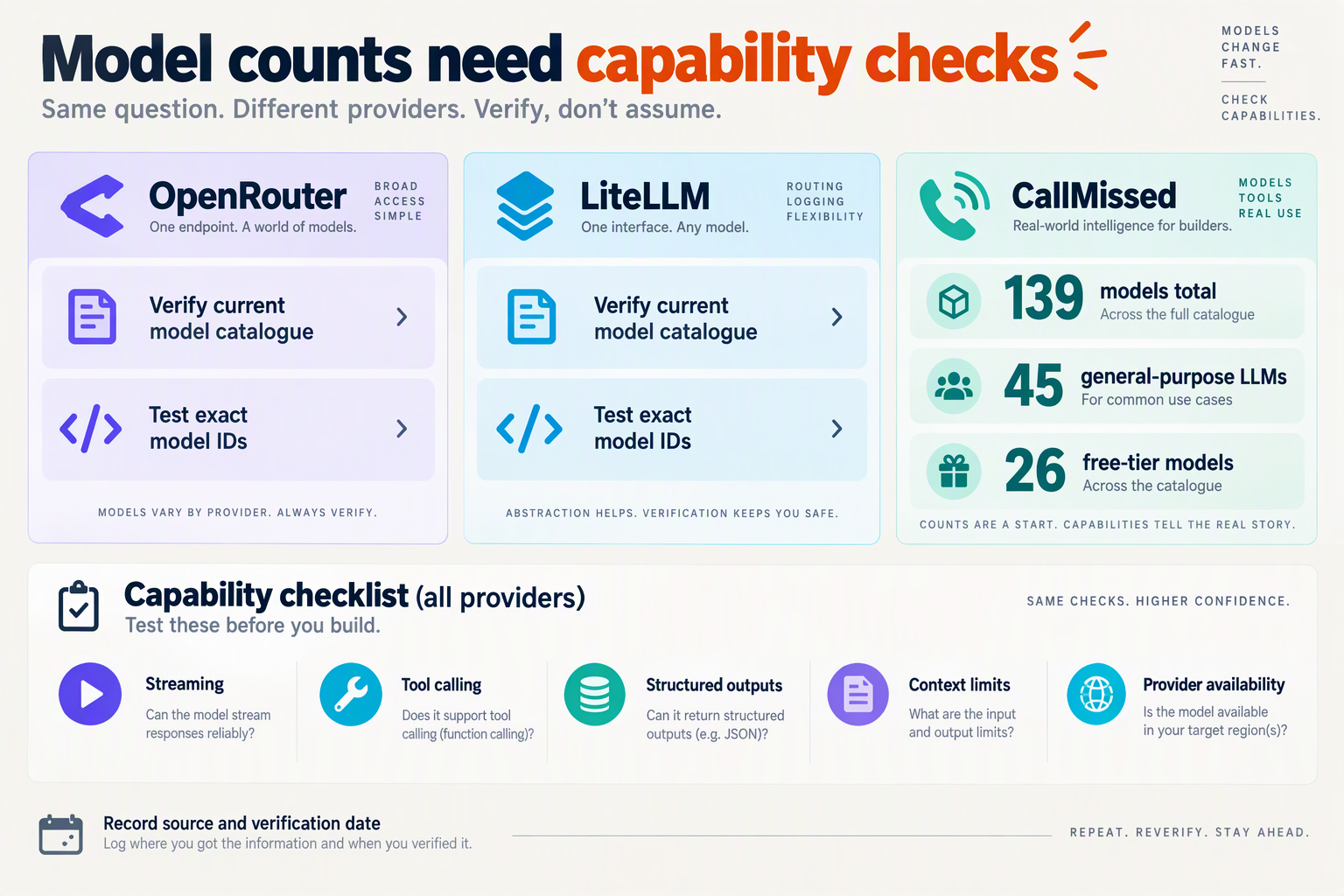
OpenRouter offers a hosted, OpenAI-compatible model catalogue; LiteLLM provides a configurable proxy across provider APIs; CallMissed combines LLM access with speech, image and embedding APIs. For production, compare supported operations—not just whether a model’s name appears in a catalogue.
- OpenRouter: AppStackBuilder’s 2026 overview describes access to hundreds of models, with automatic routing, fallbacks and price/latency optimization; the supplied research does not establish an exact October 2026 catalogue total.
- LiteLLM: Coverage depends on the installed release, provider adapters and configured credentials; the supplied research contains no LiteLLM documentation supporting a current model count or endpoint-by-endpoint comparison.
- CallMissed: As of October 2026, its verified fact sheet lists 45 general-purpose LLMs, 24 realtime voice-agent models, 44 speech-to-text models, 10 text-to-speech models, 14 image models and 2 embedding models.
Which API capabilities should you compare?
Capability snapshot: October 2026. “Verify” means the supplied evidence does not establish current support; it does not mean the capability is unavailable.
| Capability | OpenRouter | LiteLLM | CallMissed |
|---|---|---|---|
| Model coverage | Hundreds, according to AppStackBuilder’s 2026 overview | Depends on release and configured providers; current count unverified | Six model categories, including realtime voice and embeddings |
| API compatibility | OpenAI-compatible API | OpenAI-style proxy interface; verify required endpoints against deployed release | OpenAI-compatible endpoints and Anthropic-compatible /v1/messages |
| Speech, images and embeddings | Verify individual operations and model support | Verify provider adapters and endpoint support | Transcription, translation, speech, images and embeddings |
| Structured application responses | Verify selected model and routing requirements | Verify model/provider parameter handling | Function calling, structured outputs and vision input |
| Routing and fallback | Automatic routing and fallbacks, according to AppStackBuilder | Verify deployment configuration and routing policies | Caller-chosen fallback models |
| Provider credentials | BYOK documented by OpenRouter | Provider credentials depend on deployment configuration | Bring-your-own provider keys |
- Compatibility: An OpenAI-compatible interface reduces integration changes, but does not establish identical support for every endpoint, parameter or response format.
- OpenRouter free access: OpenRouter’s pricing excerpt supplied for this October 2026 comparison lists 25+ free models, while AppStackBuilder’s 2026 overview says 28+; use the primary-source figure rather than presenting either as an exact inventory.
- Evidence limits: The supplied sources support a more detailed hosted-catalogue comparison than a LiteLLM comparison; validate LiteLLM against the release you intend to deploy before making a procurement decision.
How do you check whether a gateway supports your application?
- Define an endpoint contract. List the exact operations your application needs: chat completions, embeddings, transcription or realtime audio. A support assistant that searches documents needs an embedding path as well as a generation model; catalogue breadth cannot substitute for either operation.
- Test feature combinations, not isolated checkboxes. Send representative requests combining streaming, tool calls and structured output. Check whether fallback models preserve those requirements, because a successful fallback response is not necessarily a response your application can parse.
- Separate access from execution quality. Run the same prompts, output limits and tools through each shortlisted configuration. Record time to first useful token, completion time, errors and schema validity; the supplied research does not establish comparable latency benchmarks for these three gateways.
What does OpenRouter versus LiteLLM cost for identical workloads?
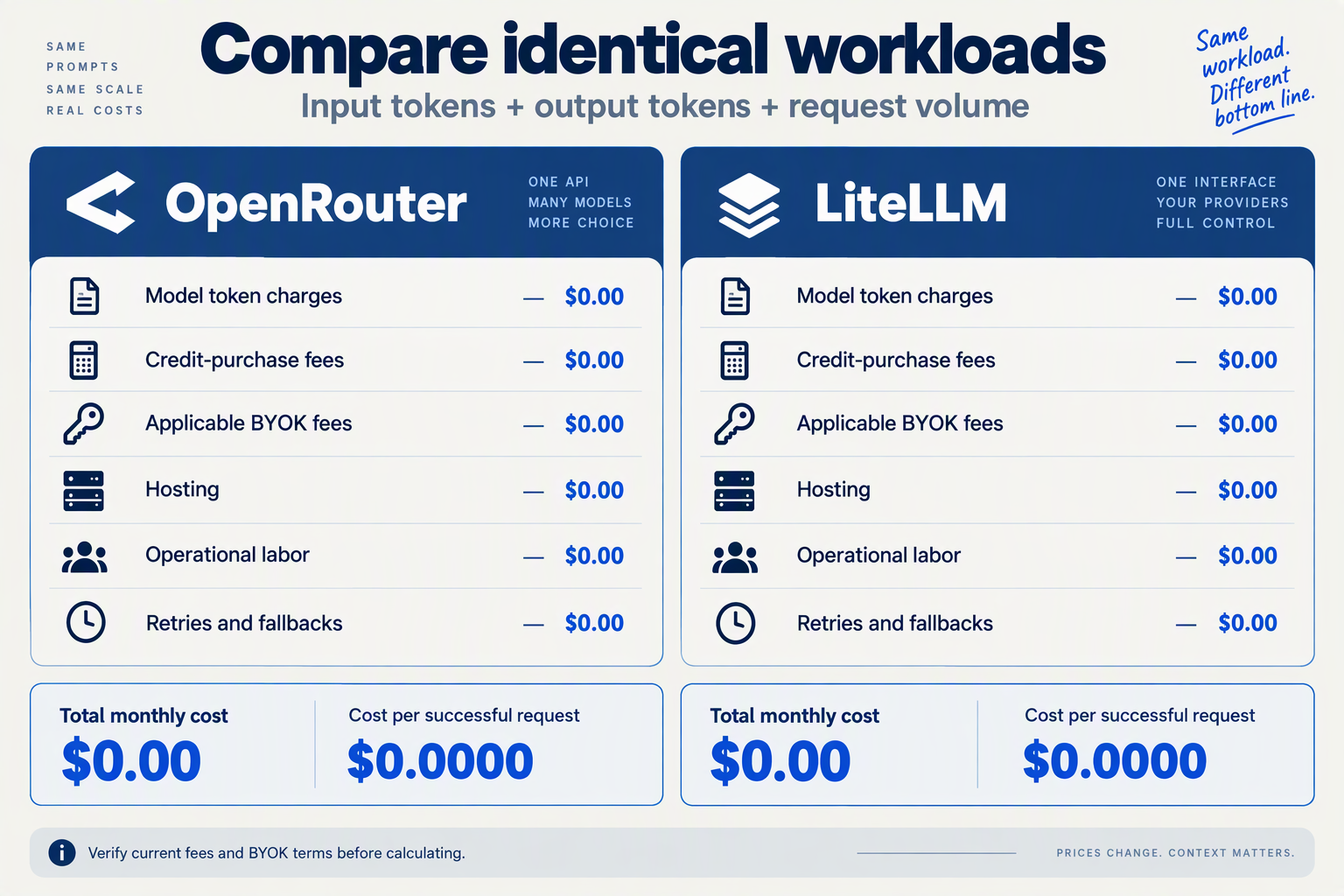
OpenRouter versus LiteLLM costs depend on whether OpenRouter’s credit-funding overhead exceeds your LiteLLM deployment costs. For identical token usage, compare the model bill plus gateway expenses—not token rates alone.
What assumptions make the workload comparison fair?
- Workload: This October 2026 illustration assumes 1,000 input tokens and 500 output tokens per request, with hypothetical provider rates of $1 per million input tokens and $2 per million output tokens. That produces a $0.002 model cost per request; these are calculation inputs, not quoted prices for a named model.
- OpenRouter: WhichDevTool’s September 29, 2026 pricing review reports a 5.5% fee when purchasing credits, with per-model rates generally following provider prices. The table applies that percentage to credits funding the modeled usage; taxes, minimum purchase fees, and other applicable charges are excluded.
- LiteLLM: The self-hosted scenario assumes $100 monthly infrastructure spending, plus L for any applicable license, support, and operational labor costs. The supplied October 2026 research does not establish LiteLLM’s current commercial pricing, so L remains unknown, rather than being silently treated as zero.
What would six identical monthly workloads cost?
Illustrative monthly costs in USD, calculated in October 2026:
| Requests/month | Model bill | OpenRouter: bill × 1.055 | LiteLLM: bill + $100 + L |
|---|---|---|---|
| 10,000 | $20 | $21.10 | $120 + L |
| 50,000 | $100 | $105.50 | $200 + L |
| 100,000 | $200 | $211 | $300 + L |
| 500,000 | $1,000 | $1,055 | $1,100 + L |
| 1,000,000 | $2,000 | $2,110 | $2,100 + L |
| 5,000,000 | $10,000 | $10,550 | $10,100 + L |
The calculation separates provider consumption from gateway ownership costs. It does not assume that either platform produces identical routing, cache behavior, or retry volume without configuration and testing.
When does self-hosting become cheaper?
- Break-even: With L = $0, the illustrative $100 infrastructure bill equals OpenRouter’s percentage overhead at approximately $1,818 in monthly model spending, or 909,091 requests under this token mix. At one million requests, the apparent LiteLLM advantage is only $10 monthly—before labor, support, or licensing.
- Production accounting: Record input tokens, output tokens, cache charges, retries, and fallback-model usage separately, then add hosting, monitoring, and maintenance. A 10% increase in billable token consumption would add $200 to the one-million-request example’s provider bill, outweighing its $10 gateway-cost difference.
- Alternative budgeting: As of October 2026, CallMissed’s verified fact sheet lists one API key and one balance across 139 models, bring-your-own provider keys, and usage and request logs. Those capabilities support another comparison route, but the fact sheet provides no model-specific token rates for declaring the identical workload cheaper.
For production procurement, request the exact model tariff and LiteLLM deployment quote before choosing. Self-hosted is not synonymous with free, and a percentage funding fee is not the same as a markup on every model’s published token price.
How should you benchmark gateway overhead, streaming latency and tail latency?
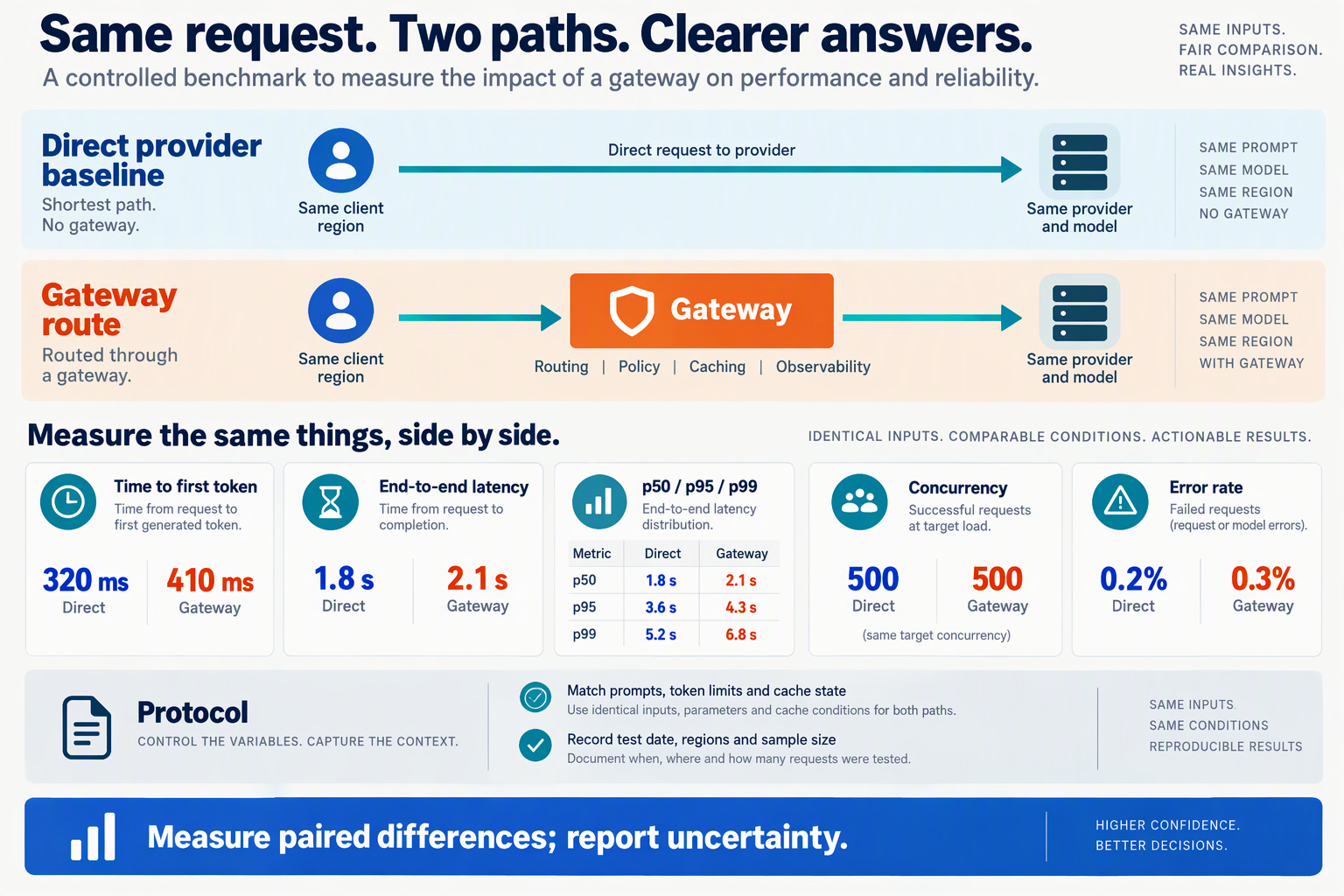
Benchmark direct-provider and gateway requests under matched conditions, then measure first-token timing, completion time, and tail latency separately. A gateway-overhead claim is not an end-to-end application latency guarantee.
How do you isolate LLM API gateway overhead?
- Matched baseline: For an October 2026 evaluation, use the same model version, upstream provider, client region, prompt, output-token limit, and concurrency on both paths. Alternate direct and gateway requests across identical time windows; otherwise, provider load or routing changes can masquerade as gateway overhead.
- Overhead calculation: Calculate the difference between gateway and direct-provider latency distributions, reporting p50, p95, and p99 separately. Label this “observed added latency,” not pure processing overhead: additional network hops, connection setup, and upstream queueing can contribute. Keep connection reuse and cache-hit status consistent, and exclude warm-up requests from steady-state results.
- Published claims: TrueFoundry’s 2026 OpenRouter-pricing article, available in the supplied October 2026 research, advertises approximately 10 ms latency and 350+ requests per second on one vCPU for TrueFoundry’s offering. Treat these as vendor-reported figures—not independently verified results or OpenRouter measurements—and request workload, hardware, concurrency, and measurement-boundary details before comparing them.
Which streaming latency metrics should you measure?
- First useful token: Record request start, response headers, first streaming event, and first visible content token as separate timestamps. An empty event or metadata chunk does not mean the user has received an answer. For structured-output applications, additionally measure time until the first usable, validated object; early text alone may have no application value.
- Streaming continuity: Report time to first token, inter-token gaps, output tokens per second, and total completion time. Use fixed output-length limits and record actual output lengths so shorter answers do not look artificially faster. Track the longest streaming pause: a quick opening token followed by a prolonged stall can still deliver a poor conversational experience.
How should you test tail latency and fallback behavior?
- Load ladder: As an illustrative test plan—not a published benchmark—run 1, 10, and 50 concurrent requests, collecting at least 1,000 completed requests per configuration where practical. With 1,000 observations, p99 reflects roughly the slowest 10 results, so repeat runs across busy and quiet periods and report sample counts alongside percentiles.
- Failure-inclusive reporting: Measure p95/p99 latency, timeout rate, HTTP 429 rate, and fallback frequency together. Keep retries and fallback time inside the user-visible clock, and report failed requests separately rather than silently dropping them. Compare fixed-provider routing with your intended production policy; switching models can change answer quality as well as speed.
- CallMissed test setup: As of October 2026, CallMissed’s verified fact sheet lists default per-key limits of 60 RPM on Free, 500 on Starter, 3,000 on Pro, and 10,000 on Enterprise, plus usage and request logs. Design load tests within the selected tier, correlate client timings with available logs, and avoid interpreting rate-limit responses as gateway-processing latency.
What are the production trade-offs of managed versus self-hosted gateways?
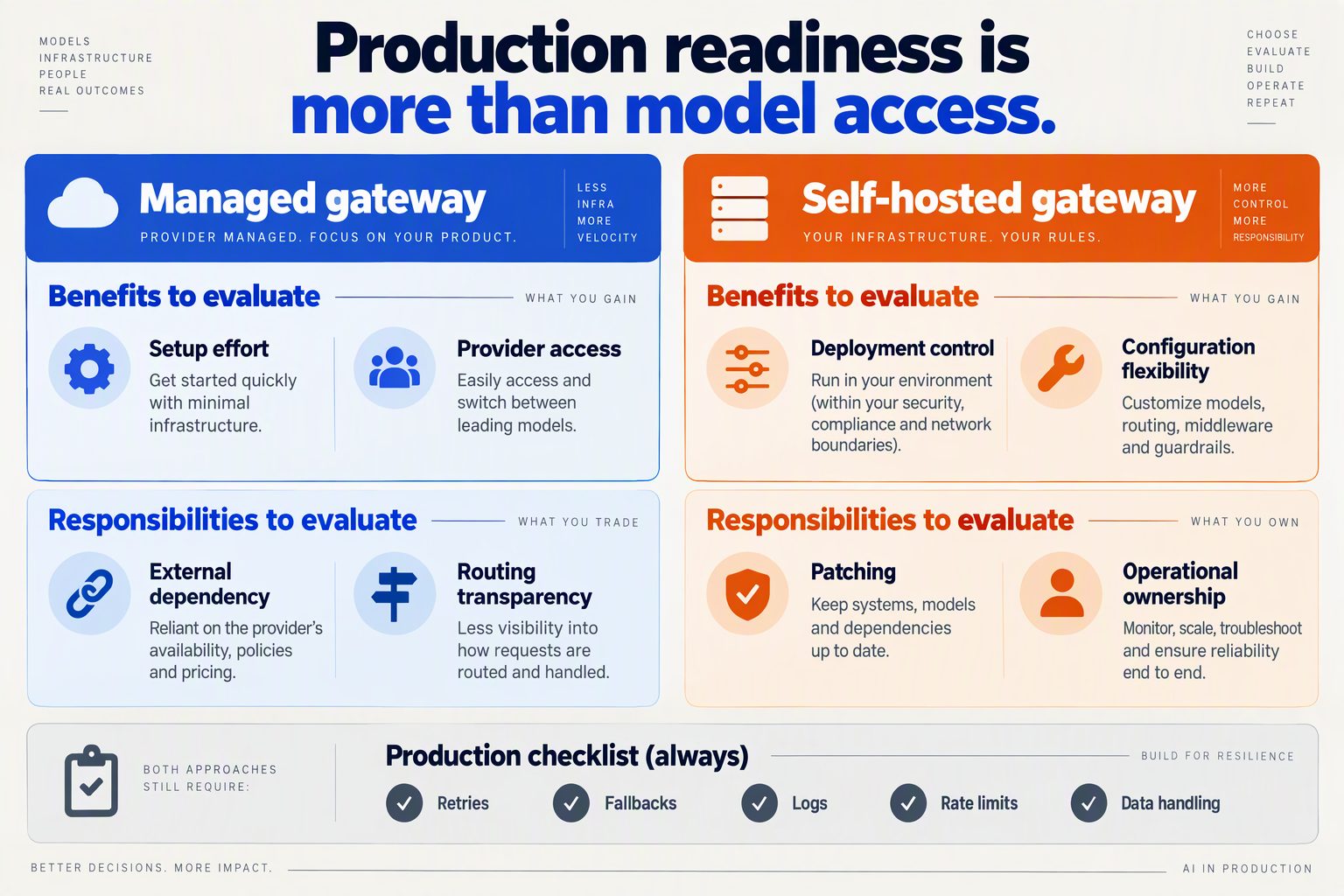
Managed LLM API gateways reduce gateway operations; self-hosted gateways give teams greater control over deployment, routing, and observability. For production apps, compare total operating cost and measured tail latency—not just token prices or advertised gateway overhead.
How do managed and self-hosted gateways compare?
The following is an October 2026 decision framework, not a benchmark: implementation details and contractual guarantees must be checked for each shortlisted gateway.
| Production concern | Managed gateway | Self-hosted gateway | What to verify |
|---|---|---|---|
| Operating cost | Gateway charges plus model usage | Hosting, engineering, on-call, and model usage | Monthly cost at identical traffic |
| Deployment control | Vendor operates gateway infrastructure | Team chooses gateway location and configuration | Required regions and network paths |
| Latency | Includes the managed gateway’s network path | Depends on placement, capacity, and implementation | p50/p95/p99 first-token latency |
| Reliability | Vendor operates the gateway layer | Team owns gateway redundancy and recovery | Failure behavior and recovery time |
| Credentials | Vendor-specific BYOK and secret handling | Team manages provider secrets and rotation | Access controls and key exposure |
| Model maintenance | Vendor maintains supported integrations | Team maintains deployed adapters and upgrades | Capability support, not catalogue size |
Which production trade-offs should you test before choosing?
- Managed operations: Buying a hosted gateway transfers gateway deployment and maintenance work, not responsibility for your application’s reliability. Test provider outages, exhausted quotas, and malformed responses separately; a functioning gateway cannot make an unavailable upstream model respond. Ask which failures trigger retries and which reach your application immediately.
- Self-hosted cost: Compare infrastructure and labor, rather than treating open-source software as zero-cost infrastructure. In an illustrative deployment, three gateway replicas cost 3 × the per-replica hosting charge, before monitoring, load balancing, or engineering time. Provider inference remains a separate expense unless you also operate the models.
- Latency evidence: TrueFoundry’s pricing article, supplied for this October 2026 comparison, advertises “~10ms Latency, Even Under Load” and “350+ RPS on just 1 vCPU.” These are publisher claims, not an independent managed-versus-self-hosted benchmark; the excerpt does not establish equivalent models, payloads, regions, or percentile measurements.
- Benchmark design: Measure p50, p95, and p99 time to first token, total completion time, error rate, and fallback frequency using identical prompts and output limits. Run both options from your application’s deployment region. Report warm connections separately from cold connections so connection setup does not obscure gateway processing overhead.
- Managed capacity: As of October 2026, CallMissed’s verified fact sheet lists default per-key limits of 60 RPM on Free, 500 on Starter, 3,000 on Pro, and 10,000 on Enterprise, alongside BYOK and request logs. These limits support capacity planning; they are not throughput benchmarks, latency guarantees, or substitutes for checking upstream quotas.
- Data control: Self-hosting controls where the gateway runs, but external model requests still leave that gateway for inference. For either architecture, document three data surfaces: prompts, credentials, and logs. OpenRouter’s BYOK documentation, provided for this October 2026 comparison, distinguishes provider-key control over limits and costs from gateway-managed access; BYOK alone does not establish data residency.
Which should you choose: OpenRouter, LiteLLM or CallMissed?
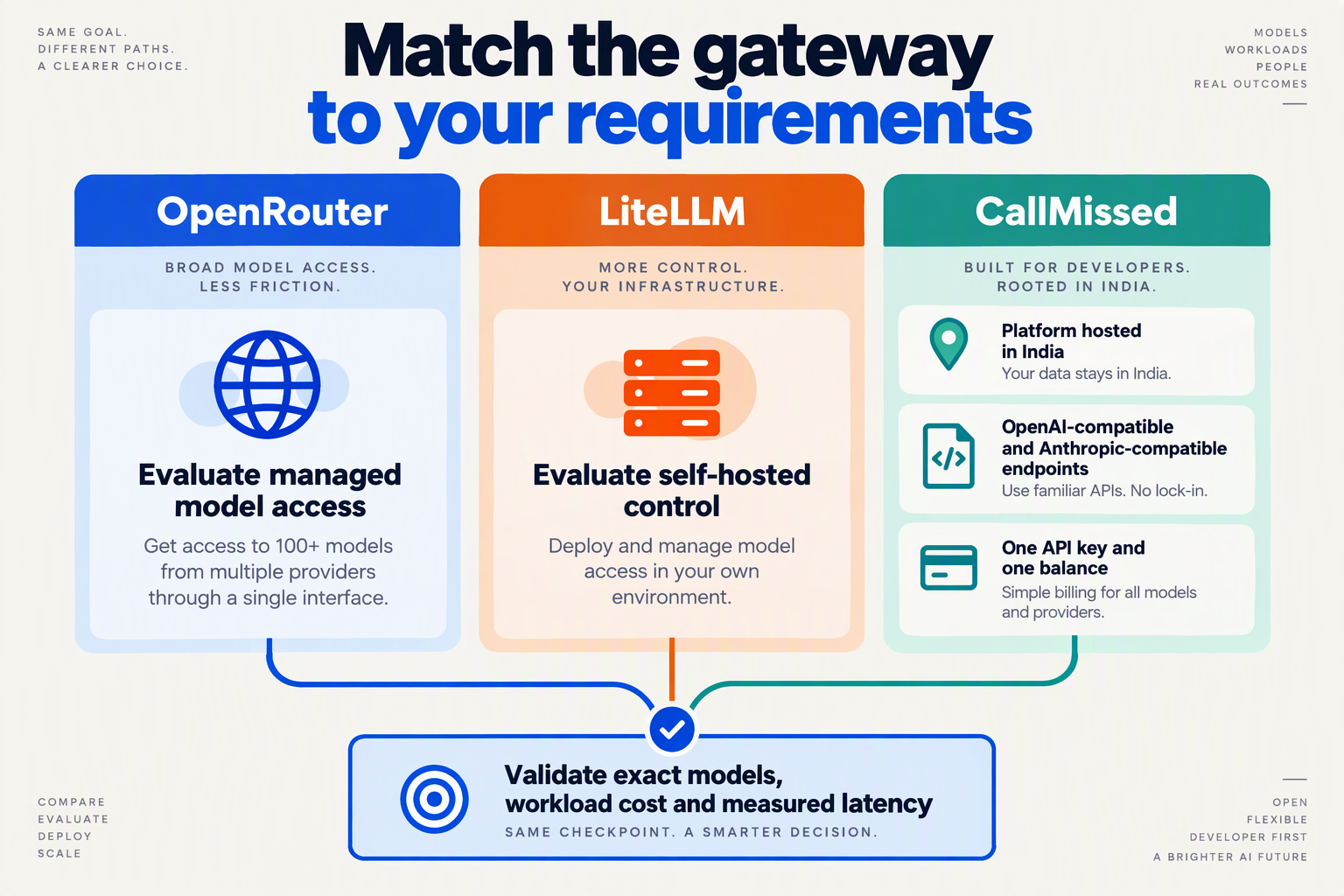
Choose OpenRouter for managed model access, LiteLLM for a gateway you operate, or CallMissed when Indian billing and speech APIs matter alongside LLM access. For production apps, make the final decision with a workload-specific cost and latency test—not catalogue size alone.
Which gateway fits your deployment model?
- OpenRouter: Choose a managed gateway when your team wants provider routing without running that infrastructure itself. AppStackBuilder’s 2026 overview describes an OpenAI-compatible API with automatic routing and fallbacks; confirm that your required models support your actual combination of streaming, tools, and structured output before committing.
- LiteLLM: Choose the self-hosted gateway approach when controlling deployment and configuration is worth taking responsibility for operations. Budget for infrastructure, upgrades, monitoring, and incident response—not just upstream tokens. The supplied research contains no verified LiteLLM pricing or performance figures, so a numerical cost advantage would be unsupported here.
- CallMissed: As of October 2026, CallMissed’s verified fact sheet lists 44 speech-to-text, 10 text-to-speech, and 24 realtime voice-agent models within its API catalogue. That makes CallMissed relevant when one application needs transcription, generated speech, and LLM responses, rather than text generation alone.
Which pricing details should decide your shortlist?
- OpenRouter: For experimentation, OpenRouter’s pricing page supplied for this October 2026 comparison lists 25+ free models across four free providers. Treat that as a discovery option, not a production-capacity commitment: check the selected model’s restrictions and paid availability before designing a service around free access.
- LiteLLM: Compare total operating cost, including upstream usage, gateway hosting, engineering time, and any paid support or licensing applicable to your deployment. Run the calculation at your expected request volume; operating your own gateway can change who controls the infrastructure bill without necessarily reducing the complete application bill.
- CallMissed: As of October 2026, the verified fact sheet lists ₹1-per-credit top-ups, non-expiring credits, and UPI, card, and net-banking payments with GST invoices. Default per-key limits are 60, 500, 3,000, and 10,000 requests per minute across Free, Starter, Pro, and Enterprise; assess token costs separately from request capacity.
How should you validate latency before choosing?
- Latency test: Send the same representative prompts, output limits, streaming settings, and tool schemas through each shortlisted gateway. Measure p50 and p95 time to first token, complete-response time, errors, and fallback frequency. Separate text-only requests from voice workflows, where speech recognition and synthesis add distinct stages.
- Purchase decision: Set acceptance thresholds before testing—for example, your application’s maximum acceptable p95 response time and cost per completed task. The supplied context does not establish a comparable three-way latency benchmark. Choose the gateway that meets those thresholds with an operating model your team can sustain, rather than declaring a universal winner.
Frequently Asked Questions
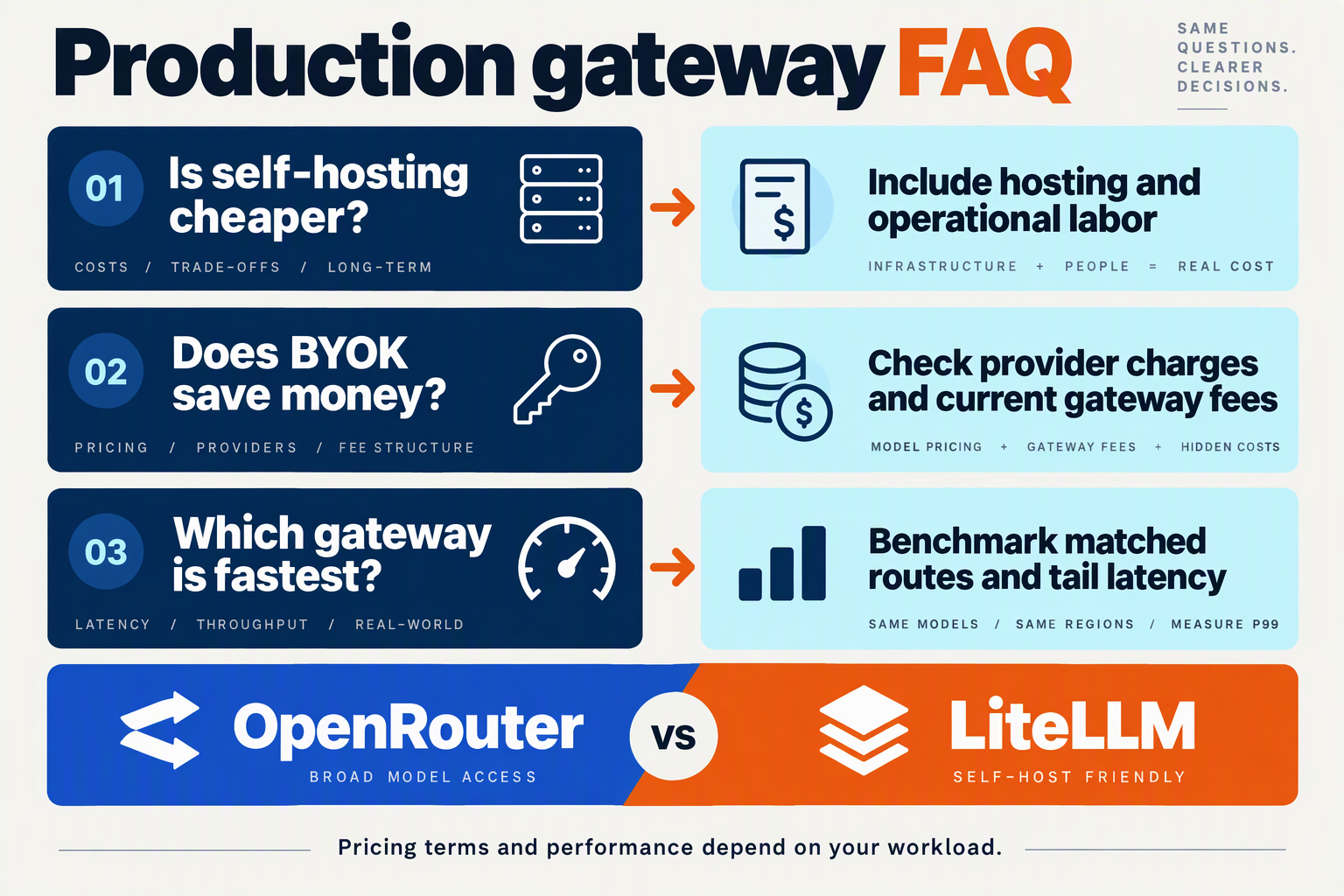
Self-hosting and BYOK can reduce costs, but neither guarantees savings; the fastest gateway depends on your provider, deployment region, and workload. Compare total operating cost and measured latency—not headline token prices alone.
- Q: Is self-hosting an LLM API gateway cheaper than using a managed service?
A: Self-hosting can be cheaper when avoided gateway charges exceed infrastructure, engineering, monitoring, and on-call costs; hosting the gateway does not eliminate upstream model charges. For an October 2026 evaluation, calculate monthly savings as avoided service charges minus hosting and operational costs, including security maintenance and incident response. A low-volume application may save little, while sustained traffic can justify the operational work if the team already maintains production infrastructure.
- Q: Does BYOK save money when comparing OpenRouter alternatives?
A: Bring your own key (BYOK) can save money when your provider contract offers better rates, but gateway surcharges and provider charges still need separate accounting. In the supplied October 2026 research, OpenRouter’s announcement states that customers receive 1,000,000 free BYOK requests per month; “free” refers to gateway BYOK requests, not free model inference. Confirm the allowance’s applicability and overage terms before budgeting, and compare identical model usage under both billing paths.
- Q: Which LLM API gateway is fastest for production applications?
A: The supplied October 2026 evidence does not establish a universal fastest gateway: upstream inference, network distance, queueing, and routing all affect response time. TrueFoundry’s supplied 2026 pricing article advertises approximately 10 ms latency, but that vendor claim is not an independent, matched-workload comparison of every gateway. Treat gateway overhead, time to first token, and full-response completion time as separate measurements rather than interchangeable speed claims.
- Q: How should I benchmark gateway latency fairly?
A: Compare the same model, upstream provider, prompt, output limit, streaming setting, and client region wherever those controls are available. For an October 2026 test plan, use at least three traffic levels—low, expected, and peak—and report p50, p95, and p99 alongside errors, retries, and completed requests per second. Test fallback paths separately: a quick first attempt that fails can produce a slower user experience than a consistently successful route.
- Q: Do free-tier and paid-plan limits matter more than model count?
A: For production workloads, request limits and access to your required capabilities can matter more than catalogue size. As of October 2026, CallMissed’s verified fact sheet lists default per-key limits of 60 requests/minute for Free, 500 for Starter, 3,000 for Pro, and 10,000 for Enterprise. These are request-rate allowances, not latency guarantees; check expected concurrency and upstream constraints before assuming a plan can sustain your application’s traffic.
- Q: How do I choose an LLM API gateway without rewriting my application later?
A: Check compatibility with the endpoints your application actually uses, including streaming, tool calls, structured outputs, and error handling—not merely basic chat completions. For an October 2026 procurement checklist, run four acceptance tests: normal requests, rate-limit handling, provider failure, and fallback behavior, then inspect usage logs against invoices. Keep provider-specific settings isolated in configuration so migration requires fewer application changes, while recognizing that compatible APIs do not guarantee identical behavior.
Conclusion
The strongest OpenRouter alternatives are the gateways that fit your production workload—not simply those with the longest model catalogue or lowest advertised token rate. Choose around the capabilities your application needs, its effective operating cost, and the response times your users actually experience.
- Prioritize usable model coverage over catalogue size. Check whether shortlisted gateways support your exact models and required capabilities, including embeddings, structured outputs, and speech. A customer-support assistant and a conversational voice application can require very different combinations. Treat catalogue breadth as a starting point, then verify that the models and interfaces you intend to use support your application’s critical workflows. More available models do not automatically mean a better production fit.
- Compare effective pricing, not token rates alone. According to WhichDevTool’s September 29, 2026 reading of OpenRouter’s pricing, OpenRouter charges a 5.5% platform fee when purchasing credits, while per-model token prices generally follow underlying provider prices. That distinction belongs in your budget alongside applicable surcharges and routing choices. Estimate costs using your expected request mix rather than a single headline rate, especially when inexpensive responses may need escalation to a more capable model.
- Measure production latency on your own workload. Focus on how quickly the first useful token arrives and how consistently that happens during busy periods. An isolated gateway-overhead claim does not describe the complete user experience, particularly for voice applications. Test the model, provider, and routing configuration you actually plan to deploy. Keep published capabilities separate from performance claims: support for a feature is something you can verify from documentation; responsiveness under your conditions requires measurement.
- Make operational control part of the shortlist. Data Studios describes OpenRouter’s routing responsibilities as model selection, provider selection, load balancing, and cost optimization. Those are distinct decisions, not a combined guarantee of speed or savings. Evaluate caller-controlled fallbacks, provider credentials, and request-level usage visibility against your application’s needs. For a support assistant, a dependable escalation path can matter more than access to additional models that the application will never call.
What should production teams watch next?
Watch how unified gateways balance broader model coverage with clearer pricing and more controllable routing. As catalogues expand, the practical question remains whether that flexibility improves your workload’s cost and responsiveness—not whether a platform advertises more options.
As of October 2026, CallMissed’s verified product fact sheet lists 139 models, 26 free-tier models, OpenAI-compatible and Anthropic-compatible endpoints, caller-chosen fallbacks, and usage logs. Explore CallMissed alongside other shortlisted gateways, then benchmark the same representative requests across each. Which gateway delivers the capabilities, effective cost, and latency your application actually needs?
Related Reading
- Best Text to Speech API for Hindi in 2026: Pricing, Benchmark, and Production Trade-offs
- WhatsApp Business API providers: India SMB Guide 2026
- Twilio Alternatives: CallMissed vs Twilio Costs in India