AI calling agents for Indian SMBs: Support Compared


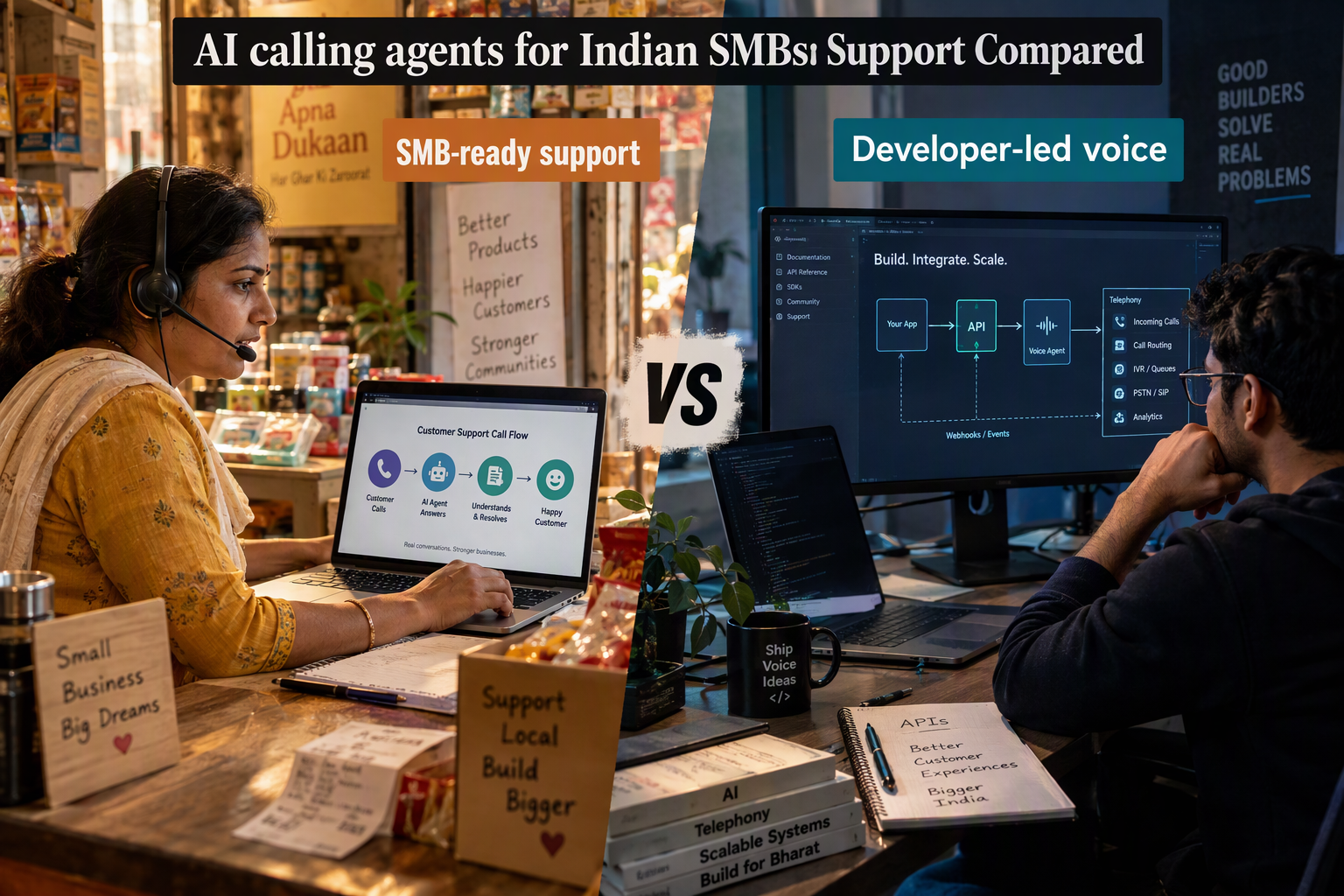
Compare AI calling agents on Indian-language support, monthly costs, escalation workflows and pilot results to shortlist your best fit.
AI calling agents for Indian SMBs: Support Compared
Could a “$0.05-per-minute” AI support agent cost more than its headline price suggests? For Indian SMBs comparing AI calling agents, the answer depends on what that price includes: speech recognition, the language model, voice generation and phone carriage may be billed differently.
As of October 2026, GrowEasy’s published comparison lists Vapi from $0.05 per minute plus speech and model costs, and Retell AI from $0.07 to $0.31 per minute. Those figures are useful starting points—not a like-for-like verdict on the cost of resolving a customer’s problem.
That distinction matters when a small business needs to answer delivery questions, explain refund policies or help customers who switch between Hindi and English mid-sentence. A convincing demo is only the beginning; the practical test is whether the agent understands the request, retrieves the right information and gives your team a workable route to intervene.
What should Indian SMBs compare beyond the advertised price?
The useful comparison is not simply “Which platform sounds most human?” It is “Which platform fits our support workflow, language needs and operating budget?” A developer-led platform can offer flexibility, while a ready-made agent builder may reduce the integration work your business needs to manage.
This guide compares the choices through five customer-support questions:
- Total cost: Which conversation components are included, and which charges sit outside the advertised rate?
- Indian-language fit: Can the proposed setup handle your customers’ languages and code-mixed speech?
- Setup effort: Will your team configure an agent visually or need developers to assemble and maintain the stack?
- Support operations: How will knowledge retrieval, escalation and customer records work in practice?
- Quality control: What can you inspect after a call, and how will you test changes before deployment?
As of October 2026, CallMissed’s verified product information lists a ₹4-per-minute Standard voice-agent plan covering speech recognition, the language model and voice, with phone carriage billed separately and a 30-second minimum per call—an example of why pricing boundaries deserve attention.
Why does separating telephony from voice AI matter?
Choosing a conversational agent does not automatically settle how your business obtains numbers or carries calls. Edesy’s 2026 comparison distinguishes Exotel as a cloud telephony provider from Bolna AI as a voice AI platform: related parts of the calling stack, but not interchangeable products.
We will use that distinction to compare platforms without treating every headline rate as an equivalent package. The goal is a practical shortlist for Indian SMB customer support: what each option requires, what to verify in a pilot, and which trade-offs matter before committing your budget.
Which AI calling agents suit Indian SMB support? At-a-glance verdict
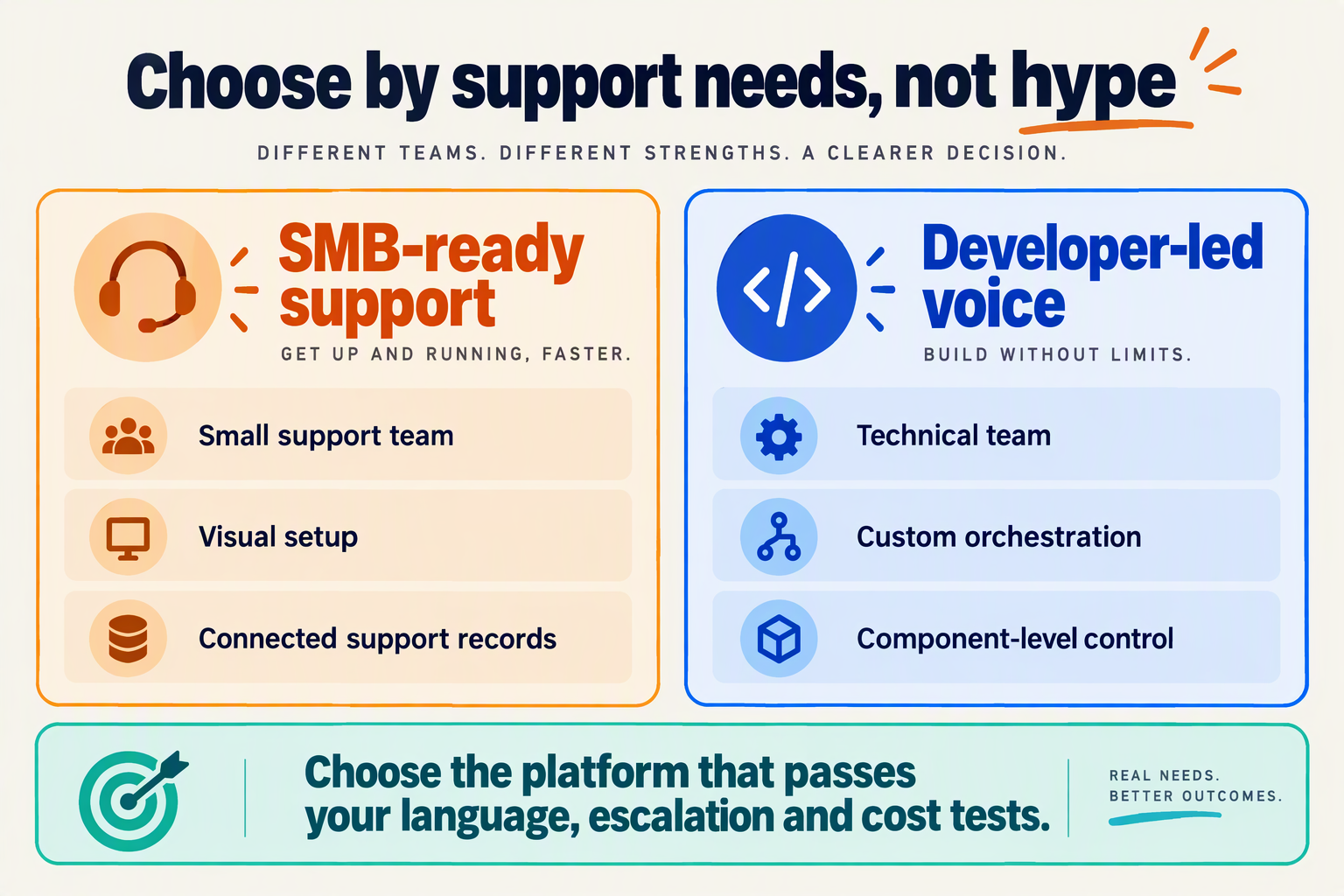
The best AI calling agents for Indian SMBs depend on who will maintain the agent, which languages customers speak, and how support escalations work. Shortlist by operating model—not a universal ranking.
Which AI voice agent platforms should Indian SMBs shortlist?
- CallMissed: For teams seeking no-code setup and Indian-language support, CallMissed’s verified product information, as of October 2026, lists speech recognition in 22 Indian languages plus English, including Hinglish, and natural text-to-speech in 10 Indian languages plus English. Its live monitoring lets supervisors listen, whisper or barge in; test these controls against your actual escalation workflow.
- Vapi: Consider Vapi when developers will own the voice stack and integrations. OmniDimension’s comparison, available as of October 2026, describes Vapi as “developer-led orchestration.” For an SMB, the deciding question is whether someone can maintain the chosen speech, model and telephony configuration—not simply assemble a convincing demonstration.
- Retell AI: Include Retell AI in a developer-managed shortlist, but request a configuration-specific estimate. Ringg’s comparison, available as of October 2026, estimates Retell production costs at approximately $0.13–$0.31 per minute. That differs from the starting range cited earlier; treat this as evidence that published comparisons use different pricing boundaries, not as a verified quote for your deployment.
- Bolna AI: Evaluate Bolna AI when an India-focused voice platform matches your procurement priorities. OmniDimension’s 2026 comparison describes Bolna as Mumbai-based, founded in 2023, and built specifically for Indian enterprises. Enterprise positioning alone does not establish SMB suitability: ask for the supported language configuration, implementation responsibilities and a support-call pilot before deciding.
- Synthflow: Shortlist Synthflow if visual configuration is a priority. OmniDimension’s Retell alternatives comparison, available as of October 2026, identifies Synthflow as a “no-code visual builder.” For customer support, demonstrate three concrete paths before purchase: a knowledge-base answer, an unavailable answer and a request for human assistance; visual setup does not itself prove resolution quality.
- OmniDimension: Consider OmniDimension when your evaluation includes workflow automation beyond the conversation. Its own comparison, available as of October 2026, advertises $0.04–$0.08 per minute with “all-inclusive pricing.” Because this is a vendor-authored claim, request written confirmation of telephony, model, voice and integration inclusions before comparing that range with another platform’s invoice.
- Exotel: Assess Exotel as the telephony component rather than assuming it replaces the conversational agent. Edesy’s 2026 comparison says Exotel supplies Indian numbers and carries calls, while Bolna runs the conversation. If your SMB already has a carrier arrangement, check number continuity and connection requirements before changing either layer of the stack.
- Your final shortlist: These October 2026 sources support a fit-based comparison, not a defensible winner on accuracy or latency. Run the same delivery-status, refund-policy and Hindi–English switching scenarios across candidates. Record task completion, incorrect answers, escalation outcomes and total billed cost; those observations make the verdict specific to your customers rather than another vendor’s marketing benchmark.
How do CallMissed, Bolna, Retell and Vapi compare for support?
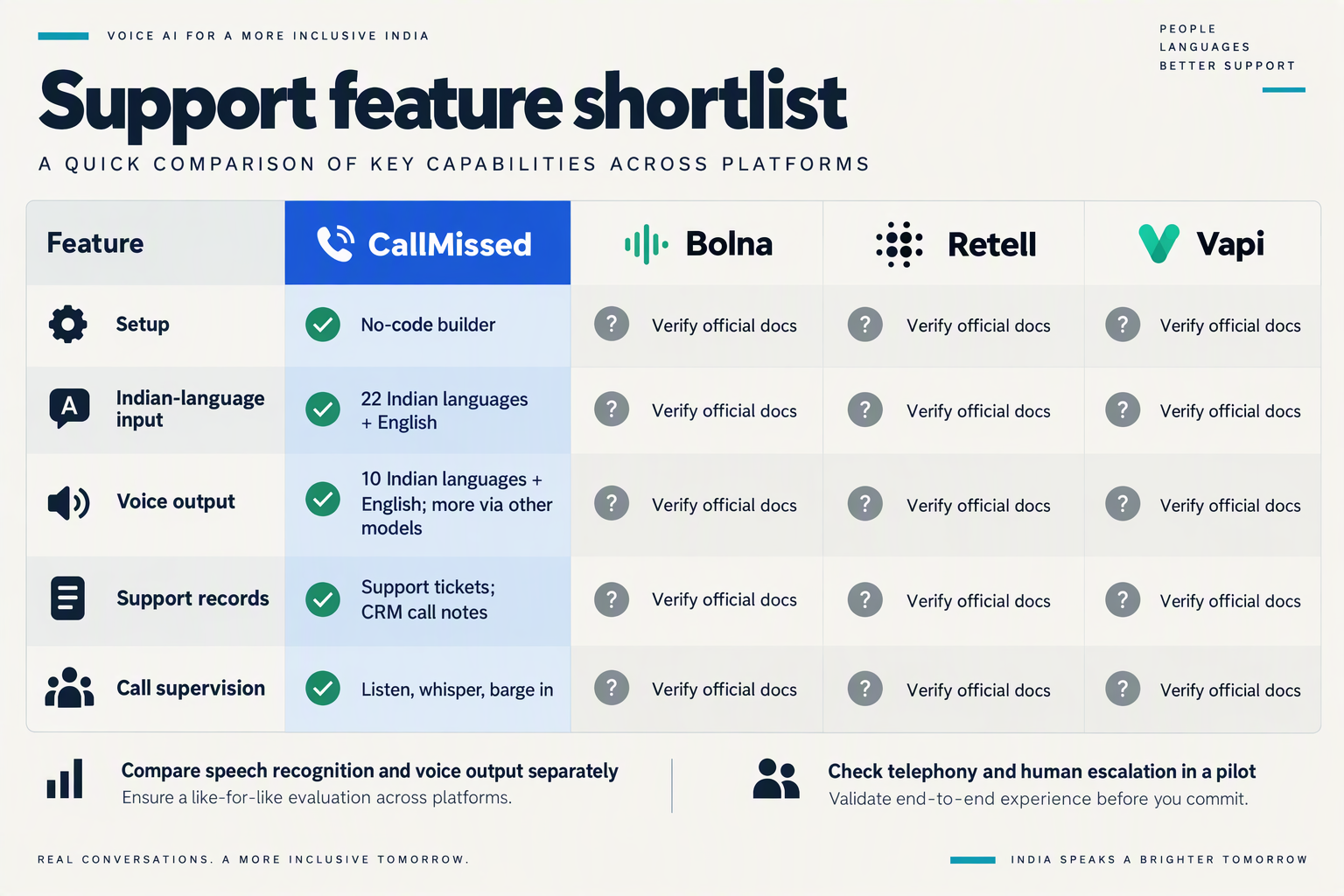
CallMissed offers a documented no-code support stack; Bolna focuses on Indian voice AI, while Retell AI and Vapi offer developer-oriented options. As of October 2026, the available sources support comparing pricing boundaries and implementation needs—not declaring an overall winner.
- Evidence quality: CallMissed’s verified fact sheet provides detailed product specifications; the supplied competitor evidence comes from third-party comparisons, not complete vendor documentation.
- Pricing comparability: Compare speech recognition, language-model usage, voice generation and phone carriage as four separate cost components before treating advertised rates as equivalent.
- Support readiness: Require a demonstration of knowledge retrieval, human escalation and customer-record updates; an attractive voice demo does not establish these three operational capabilities.
| Platform | Published pricing | Setup and positioning | Support evidence available | Priority before purchase |
|---|---|---|---|---|
| CallMissed | Verified October 2026 plans: Standard ₹4/min, Expressive ₹5/min, Best latency ₹6/min; speech recognition, model and voice included; carriage separate | No-code voice/chat builder with knowledge bases, REST tools and versioning | Speech recognition in 22 Indian languages plus English; supervisor listen, whisper and barge-in; CRM call notes | Test regional-language accuracy, carrier costs and escalation under real support conditions |
| Bolna AI | No usable rate supplied in the research excerpts | OmniDimension’s 2026 comparison describes a Mumbai-based voice AI platform built for Indian enterprises | Edesy’s 2026 comparison identifies Bolna as the conversation layer, distinct from phone carriage | Obtain an itemised quote and confirm supported languages, number provisioning and human escalation |
| Retell AI | GrowEasy’s comparison, available for this October 2026 review, lists $0.07–$0.31/min | GrowEasy describes Retell AI as a global developer platform; EchoLeads classifies it as an orchestrator | Supplied excerpts do not establish its language coverage, CRM workflows or escalation configuration | Confirm the selected configuration’s included components and implementation requirements |
| Vapi | GrowEasy’s comparison, available for this October 2026 review, lists a $0.05/min starting rate plus speech and model costs | OmniDimension’s 2026 comparison describes Vapi as developer-led orchestration | Supplied excerpts do not establish its Indian-language coverage or complete support workflow | Price the chosen speech/model stack and test integration and maintenance effort |
How should an Indian SMB use this comparison?
- CallMissed: As of October 2026, its verified fact sheet distinguishes recognition in 22 Indian languages from natural text-to-speech in 10 Indian languages, both plus English; test understanding and spoken replies separately.
- Pilot design: Use the same 20 support scenarios across shortlisted platforms—five delivery questions, five refund requests, five code-mixed conversations and five escalation cases. This is a proposed evaluation method, not a published benchmark.
- Buying decision: Record resolution accuracy, successful escalation, total billed cost and staff intervention for each pilot. Treat “not specified” as a documentation gap to investigate, not proof that a competitor lacks the feature.
The practical shortlist should follow your operating model: configuration-led support teams should examine documented workflow tools, while developer-led teams should examine orchestration flexibility alongside the engineering work required. Neither approach guarantees better support without testing your actual customer conversations.
What do these platforms cost at different monthly call volumes?
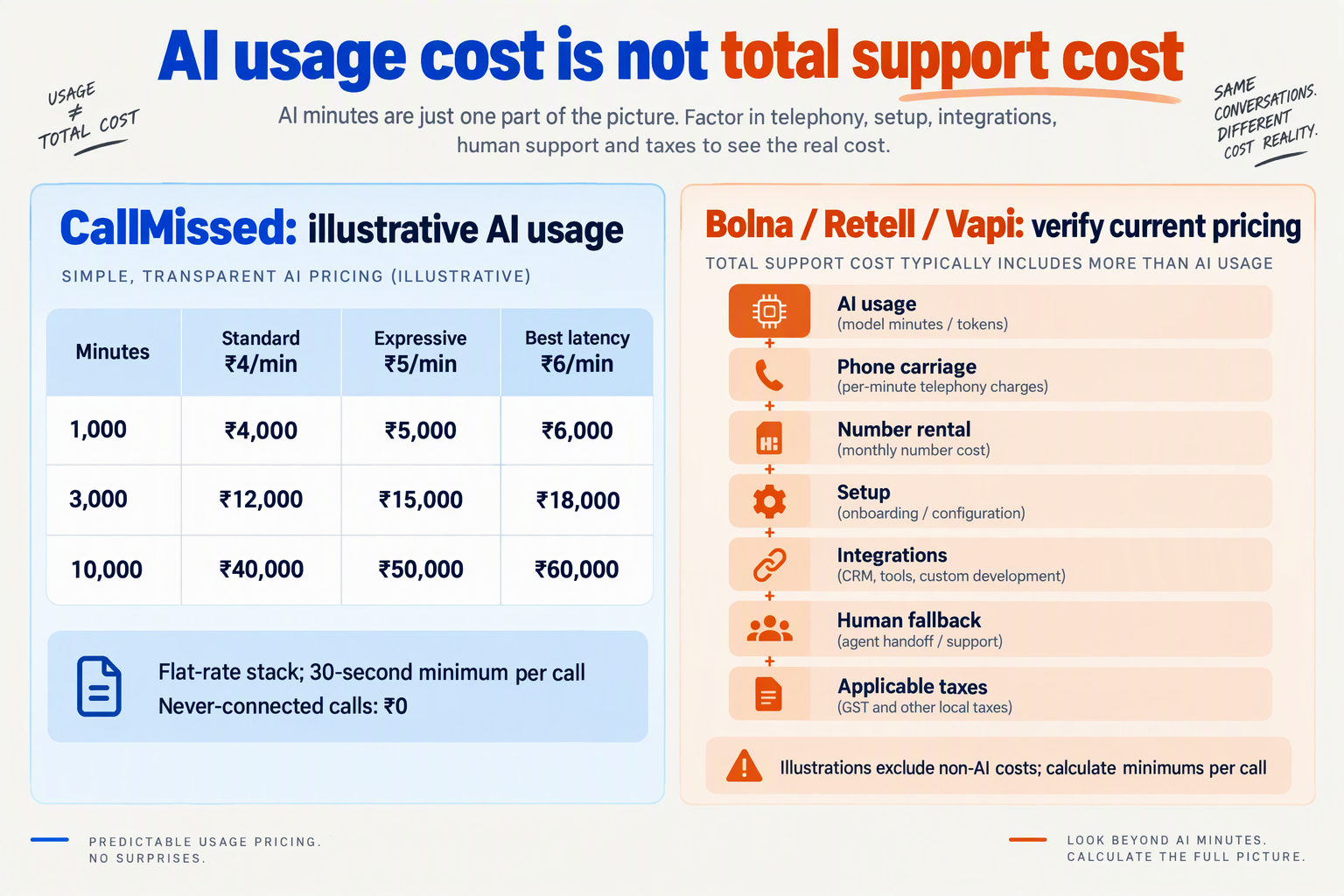
Monthly voice-agent costs depend on billable minutes, not just call counts. The estimates below compare published pricing boundaries—not equivalent, fully loaded customer-support packages.
- Volume assumption: The October 2026 budget model uses 1,000, 5,000 and 10,000 billable minutes; 1,000 calls averaging five minutes would fall in the middle column.
- Currency assumption: USD estimates use ₹96 per US$1, the conversion supplied in CallMissed’s October 2026 fact sheet—not a live exchange-rate quote.
| Platform / pricing basis | Rate per minute | 1,000 minutes | 5,000 minutes | 10,000 minutes |
|---|---|---|---|---|
| CallMissed Standard | ₹4 | ₹4,000 | ₹20,000 | ₹40,000 |
| Vapi published starting fee | $0.05 ≈ ₹4.80 | ₹4,800+ | ₹24,000+ | ₹48,000+ |
| Retell AI published range | $0.07–$0.31 ≈ ₹6.72–₹29.76 | ₹6,720–₹29,760 | ₹33,600–₹1,48,800 | ₹67,200–₹2,97,600 |
| OmniDimension advertised range | $0.04–$0.08 ≈ ₹3.84–₹7.68 | ₹3,840–₹7,680 | ₹19,200–₹38,400 | ₹38,400–₹76,800 |
What is included in these monthly cost estimates?
- CallMissed: Its verified October 2026 fact sheet lists Standard at ₹4/minute, Expressive at ₹5/minute and Best latency at ₹6/minute, covering speech recognition, the language model and voice; phone carriage is separate. At 5,000 minutes, those tiers produce usage estimates of ₹20,000, ₹25,000 and ₹30,000, respectively, before carriage and applicable taxes.
- Vapi: GrowEasy’s comparison, supplied for this October 2026 analysis, lists pricing from $0.05/minute plus speech and model costs. The table’s “+” therefore means additional components remain unpriced: ₹24,000 at 5,000 minutes is a starting-fee calculation, not a complete operating budget.
- Retell AI: GrowEasy lists $0.07–$0.31/minute in the context supplied for October 2026, while Ringg’s 2026 comparison describes production costs of approximately $0.13–$0.31/minute. These different lower bounds make configuration important; request an estimate for the exact model, voice and telephony setup rather than budgeting against the cheapest endpoint.
- OmniDimension: OmniDimension’s own 2026 comparison advertises “all-inclusive pricing” from $0.04–$0.08/minute. Treat that wording as a vendor claim and confirm whether your Indian number, phone carriage, selected voice and support workflow fall within the quoted scope.
How should an SMB turn these rates into a reliable budget?
- Short-call billing: A 30-second minimum per connected call applies to CallMissed’s flat-rate voice plans, according to its October 2026 fact sheet; an unconnected call costs nothing. For example, 1,000 connected calls lasting 10 seconds each create 500 minimum-billed minutes, costing ₹2,000 on Standard, rather than roughly ₹667 calculated from actual speaking time.
- Procurement checklist: Ask every provider to price the same 5,000-minute workload, specifying call duration, language, model, voice, numbers, carriage, taxes and support requirements. Keep introductory credits and recurring charges separate, then measure cost per resolved enquiry during a pilot: a lower minute rate is not necessarily a lower support bill if conversations take longer or require repeat calls.
What are the pros and cons of SMB-ready versus developer-led platforms?
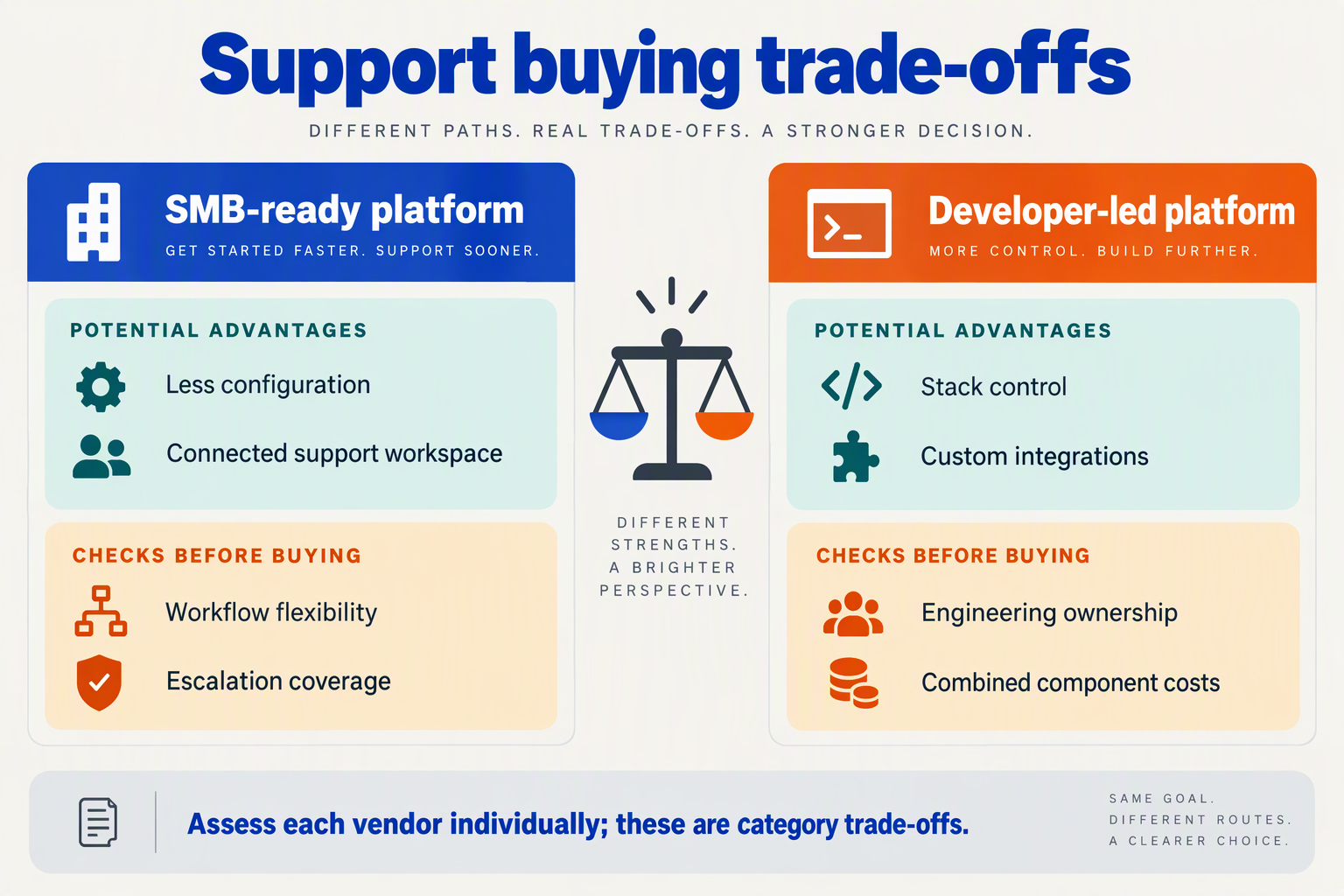
SMB-ready AI voice agent platforms suit teams that want support staff to configure workflows; developer-led platforms suit businesses that need custom integrations and can maintain them. Compare operational ownership—not just whether a product has a visual builder or an API.
- SMB-ready platforms: Prioritise editable knowledge, escalation rules and call review; ask whether a support manager can change a refund policy without a code deployment.
- Developer-led platforms: Prioritise programmable workflows and component choice; assign responsibility for authentication, failed tool calls and regression testing before selecting the stack.
- Category overlap: OmniDimension’s comparison, available as of October 2026, describes Vapi as “developer-led orchestration” and Synthflow as a “no-code visual builder”; these are useful starting labels, not complete capability assessments.
What are the practical pros and cons of each approach?
The following compares selection trade-offs, not universal limitations. A no-code platform may also offer APIs, while a developer-focused platform may include managed infrastructure; verify the specific product rather than assuming the category determines every capability.
| Decision area | SMB-ready advantage | SMB-ready trade-off to check | Developer-led advantage | Developer-led trade-off to check |
|---|---|---|---|---|
| Policy updates | Support staff can edit approved answers | Can changes be previewed and rolled back? | Policies can follow internal release controls | Does each update require engineering time? |
| Order lookup | Prebuilt connectors may simplify setup | Does the connector expose your required fields? | Custom tools can query internal order systems | Who maintains credentials and error handling? |
| Conversation design | Visual flows make routing easier to inspect | Can flows handle exceptions beyond templates? | Code can implement specialised business logic | Who tests branching and unexpected inputs? |
| Language configuration | Preset speech options simplify selection | Test recognition and voice output separately | Components can be selected for language needs | Each combination needs end-to-end testing |
| Human intervention | Integrated controls can simplify supervision | Verify listening, takeover and queue behaviour | Escalation can match existing support systems | Handoff context must be implemented and tested |
| Quality assurance | Built-in scoring can support routine reviews | Can rubrics reflect your actual support policy? | Custom evaluations can mirror internal requirements | Evaluation datasets and monitoring need owners |
How should an Indian SMB choose between them?
- Worked example: For delivery support, test three cases: a successful order lookup, a missing order and an unavailable backend. Prefer the approach that lets your team correct the failure safely—not merely the one that completes the happy-path demo.
- CallMissed: As of October 2026, CallMissed’s verified product information lists a no-code voice-agent builder with publish and rollback, custom REST tools, and call scoring against your own QA rubrics. Those capabilities illustrate how configuration-led deployment and programmable integration can coexist.
- Buying rule: Name two owners before committing: one for customer-support policy and one for technical reliability. If neither can explain how a failed lookup reaches a human, the workflow needs more validation, regardless of platform category.
For the best AI calling agents for Indian SMBs, the decisive question is therefore who can operate the system after launch. Choose manageable flexibility: enough control for your support workflow, without maintenance obligations your team cannot realistically carry.
Which platform passes Hindi, Hinglish and real support workflow tests?
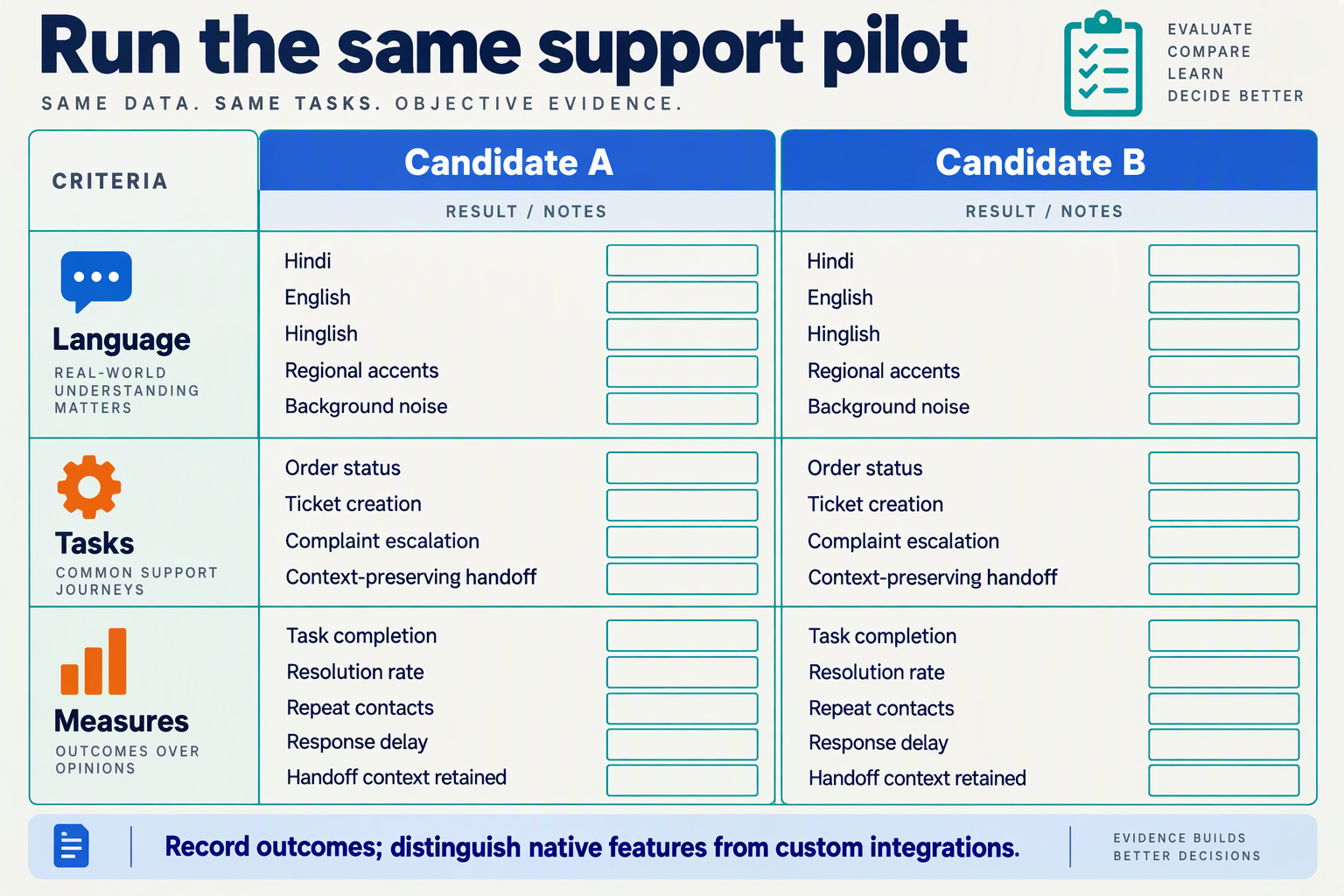
No platform can be declared the Hindi-and-Hinglish winner from the supplied comparisons: they provide positioning, not comparable language-test results. Shortlist on documented capabilities, then make every candidate complete the same support tasks.
Which platforms should you shortlist for Hindi and Hinglish support?
- CallMissed: As of October 2026, CallMissed’s verified fact sheet lists speech recognition in 22 Indian languages plus English, including Hinglish, and natural text-to-speech in 10 Indian languages plus English. Its knowledge-base retrieval, custom REST tools and supervisor listen, whisper and barge-in controls make it a concrete candidate for testing regional-language support—not proof of measured accuracy.
- Bolna AI: OmniDimension’s 2026 comparison describes Bolna AI as a Mumbai-based voice AI platform built specifically for Indian enterprises. That positioning warrants a pilot, but the supplied context contains no comparable Hindi accuracy score. Ask for a demonstration using your customers’ vocabulary, chosen voice and actual support integrations rather than accepting an India-focused label as evidence.
- Vapi and Retell AI: EchoLeads’ 2026 platform map classifies Vapi and Retell among voice-agent orchestrators. Evaluate the configured speech-recognition, language-model and voice combination, not just the platform name. Record the exact configuration for each trial so a later component change does not silently invalidate your Hindi, Hinglish or workflow results.
- Hindi/Hinglish test: Start with 20 scripted calls: 10 Hindi and 10 Hinglish, using identical scenarios across candidates. Include “Mera order kal aana tha—tracking update batao,” a spoken order number and a mid-call language switch. Score intent recognition, identifier capture and task completion separately; this is a proposed pilot design, not a published benchmark.
What should an AI support agent prove before deployment?
- Knowledge accuracy: Give each candidate the same five policy questions, covering delivery delays, cancellations, refunds, damaged goods and an exception absent from the knowledge base. Require answers grounded in approved material and an explicit uncertainty response for the missing policy. Fluent Hindi should not compensate for an invented refund promise or unsupported delivery date.
- Live workflow execution: Test three actions against a sandbox: retrieve an order, create a support ticket and request a callback. Inspect the resulting records rather than trusting “Done” in the conversation. Repeat one request after a simulated tool timeout; check whether the agent avoids duplicate records and clearly explains that the action has not yet succeeded.
- Human escalation: Run four escalation cases: an explicit human request, repeated misunderstanding, an angry customer and an out-of-policy refund. Verify the destination, the information passed onward and what happens when nobody is available. Distinguish supervisor intervention during a call from transferring that call to a staffed support queue; these are different operational requirements.
- Pass/fail decision: Set thresholds before testing—for example, 18 of 20 correctly completed language scenarios and zero invented policy commitments. Treat those numbers as your proposed acceptance criteria, not industry averages. Keep recordings and configuration details, then rerun failed cases after changes; shortlist the setup that meets your requirements consistently, not the demo with the most persuasive voice.
Which should you choose for your team, budget and support workload?
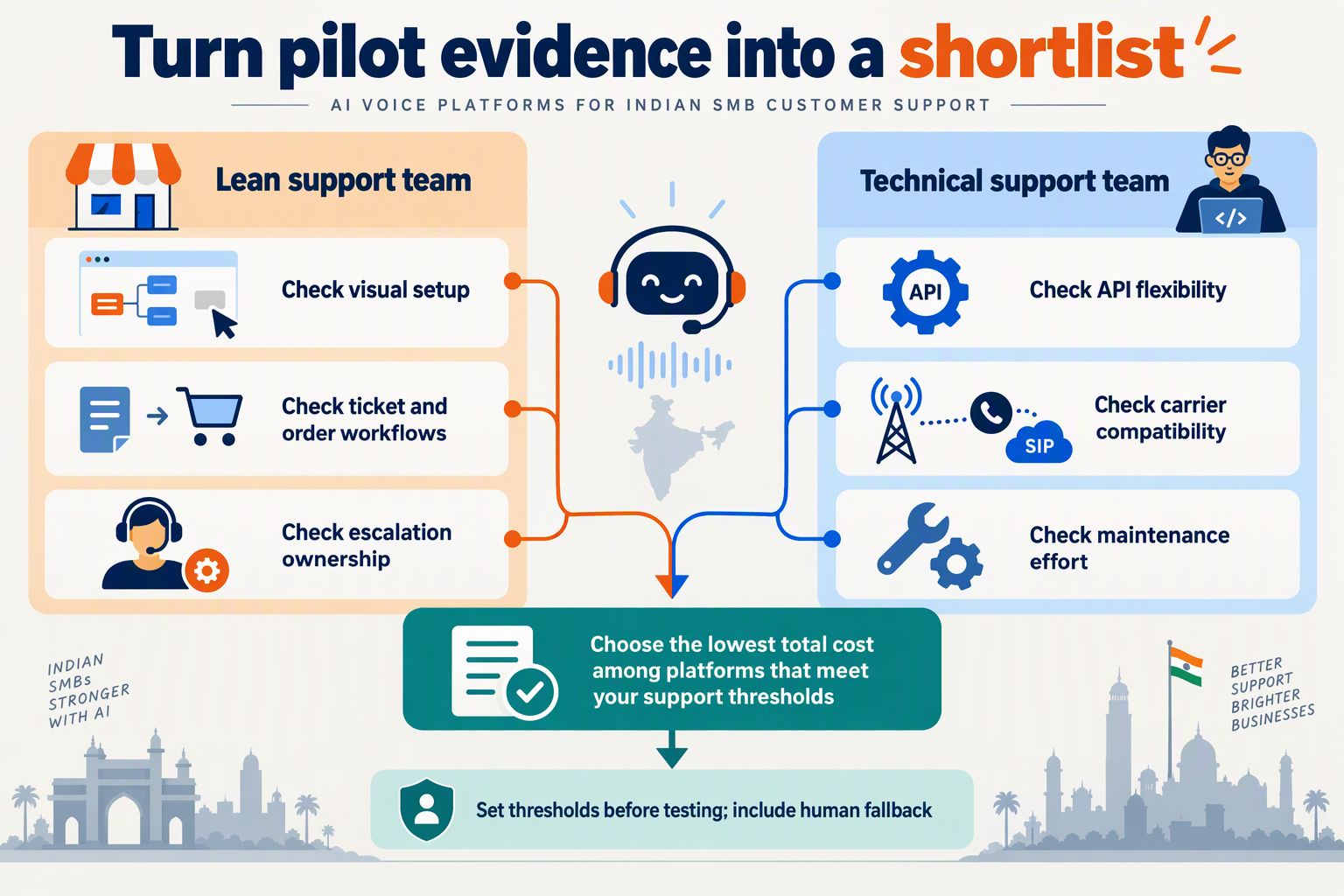
Choose the platform your team can operate reliably—not simply the lowest advertised rate. Match your shortlist to engineering capacity, actual support minutes, escalation needs and language coverage.
- No dedicated developer: Prioritise a visual agent builder and a manageable support workflow. OmniDimension’s October 2026 comparison identifies Synthflow as a no-code visual builder; shortlist it for setup simplicity, then verify Indian-language performance, telephony arrangements and escalation during a trial. A no-code interface alone does not establish suitability for your customers.
- Developer-led team: Consider Vapi or Retell AI when your engineers want responsibility for integration and configuration. GrowEasy’s October 2026 comparison describes both as global developer platforms billed in USD. Request a cost breakdown for your proposed configuration, and include engineering maintenance—not just conversation charges—in the purchasing decision.
- Small team with a defined rupee budget: CallMissed’s verified October 2026 information lists no-code voice-agent building, pay-as-you-go billing and no seat fees. Its Expressive and Best latency plans cost ₹5 and ₹6 per minute, respectively, excluding phone carriage. At 2,000 billed minutes, that means ₹10,000 or ₹12,000 for those conversation components; these are calculations, not complete invoices.
- Existing business phone setup: Treat telephony compatibility as a purchasing gate. Edesy’s 2026 comparison distinguishes Exotel’s cloud telephony role from Bolna AI’s conversational role. Before replacing either layer, ask which numbers, carrier arrangements and routing rules your proposed combination can retain; changing the agent should not accidentally disrupt your support number.
How should you match the platform to your support workload?
- Regional-language support: CallMissed’s verified October 2026 information lists speech recognition in 22 Indian languages plus English, including Hinglish, and natural text-to-speech in 10 Indian languages plus English. Test recognition and spoken responses separately: correctly understanding a Marathi complaint does not, by itself, establish that the selected voice can answer naturally in Marathi.
- Mostly brief status enquiries: Model your actual call-duration distribution before choosing a billing structure. As an illustrative calculation, 1,000 connected calls lasting 15 seconds equal 250 elapsed minutes; a hypothetical 30-second minimum would create 500 billed minutes. Ask every shortlisted provider how minimums, rounding, failed connections and carrier charges affect that workload.
- Refunds, complaints and sensitive exceptions: Prioritise a demonstrated human-escalation route over an impressive introductory greeting. Use the same pilot scenarios across platforms: a disputed delivery, an unavailable order record, a customer changing languages and a request for a supervisor. Check whether the human receives useful context and whether the agent avoids inventing policy exceptions.
- Seasonal or uncertain demand: Compare three forecast scenarios—500, 2,000 and 5,000 billed minutes per month—using each provider’s confirmed configuration and commercial terms. These are planning examples, not market benchmarks. Choose the platform that meets your quality threshold within the realistic workload, then expand only after reviewing resolution quality, transfers and actual invoices.
Frequently Asked Questions
- Q: Which are the best AI calling agents for Indian SMBs handling customer support?
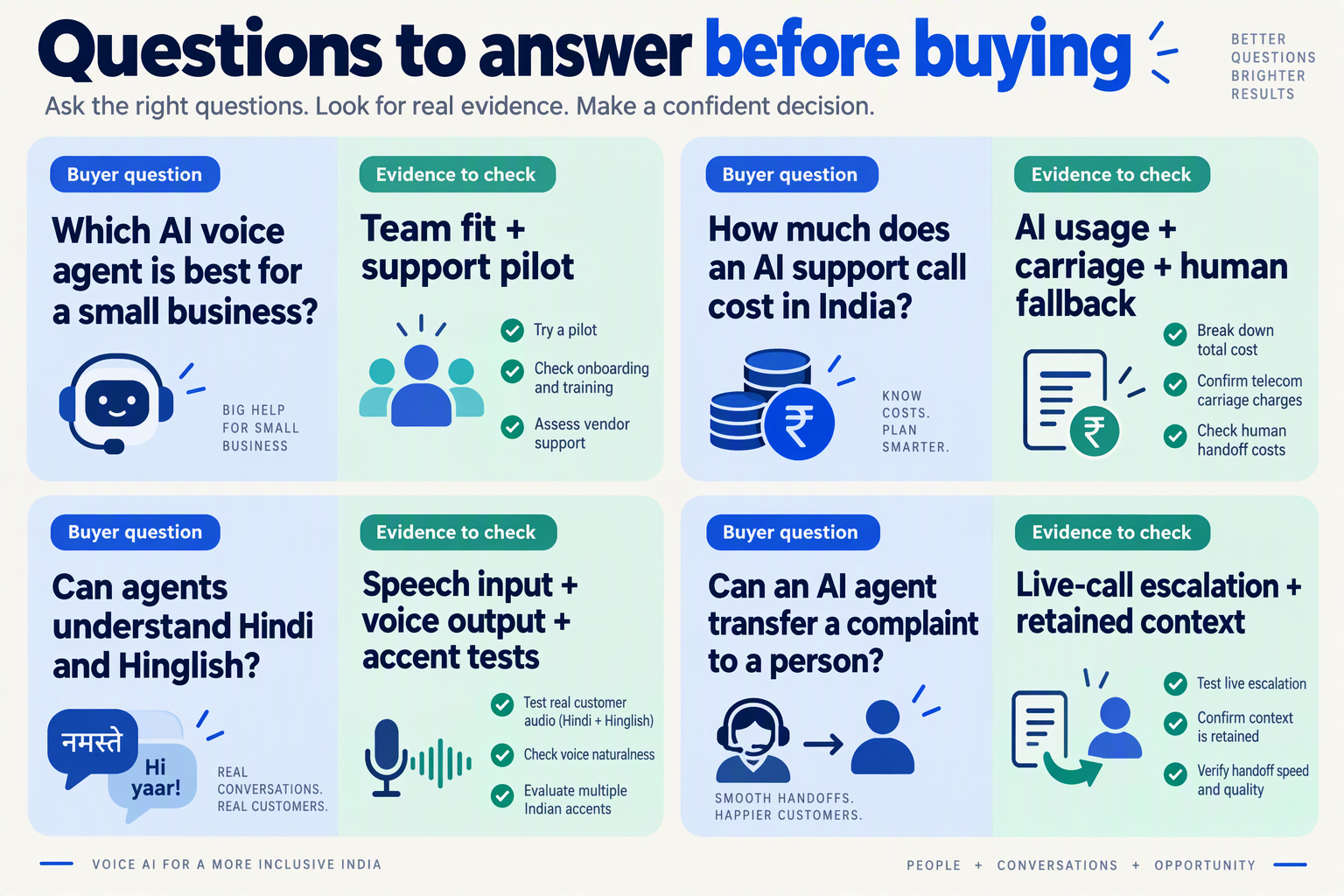
A: The best choice depends on your support languages, integration capacity and total operating cost, rather than voice quality alone. Shortlist platforms against three actual workflows—delivery tracking, refund questions and appointment changes—and require each vendor to demonstrate knowledge retrieval, escalation and accurate customer-record updates. A platform that answers fluently but cannot complete those workflows may create more follow-up work than it removes.
- Q: How much do AI voice agent platforms cost for Indian SMB customer support?
A: As of October 2026, GrowEasy’s comparison lists Vapi from $0.05/minute plus speech and model costs and Retell AI from $0.07–$0.31/minute, so those advertised rates are not equivalent packages. CallMissed’s verified October 2026 product information lists Standard at ₹4/minute, Expressive at ₹5/minute and Best latency at ₹6/minute, including recognition, the language model and voice, with carriage separate and a 30-second minimum. At Standard pricing, 1,000 billable minutes therefore cost ₹4,000 for voice AI before carriage; compare complete quotes rather than converting headline dollar rates alone.
- Q: Can AI calling agents understand Hinglish and regional Indian languages?
A: Yes, supported configurations can recognise code-mixed speech, but recognition coverage does not automatically establish spoken-response quality or task accuracy. As of October 2026, CallMissed’s verified product information lists speech recognition in 22 Indian languages plus English, including Hinglish, and natural text-to-speech in 10 Indian languages plus English. Test authentic customer utterances containing English product names, Hindi sentence structures, regional accents and local addresses; separately check whether the agent understands the request and pronounces its response clearly.
- Q: Can a small business deploy an AI voice agent without developers?
A: A no-code builder can reduce setup work, but your team still needs to configure policies, knowledge sources, permissions and escalation rules. As of October 2026, OmniDimension’s comparison describes Synthflow as a “no-code visual builder” and Vapi as developer-led orchestration, illustrating different implementation approaches rather than a universal quality ranking. Before purchasing, ask who will maintain integrations and update support policies when your catalogue, refund terms or booking process changes.
- Q: What should I check before connecting an AI agent to customer data?
A: Verify data access, retention and human intervention before exposing customer records or enabling account-changing actions. Ask where recordings and transcripts are stored, who can access them, how deletion works, and whether sensitive actions require identity checks or approval. Demonstrate a failed lookup and an unhappy caller during evaluation: the agent should avoid inventing account details and provide a clearly defined route to a person.
- Q: How should I test the best AI calling agents for Indian SMBs before buying?
A: Run the same pilot scenarios across shortlisted platforms and measure correct resolution, escalation accuracy and cost per resolved enquiry. Include interruptions, noisy audio, Hinglish, unavailable order records and requests outside policy; review transcripts rather than relying exclusively on vendor demos. Set acceptance thresholds before testing and distinguish an appropriate escalation from a failed interaction, because safely handing over a sensitive case can be the correct outcome.
Conclusion
The best AI calling agents for Indian SMBs are the ones that fit your customer-support workflow, languages and budget—not simply the ones with the lowest advertised rate. Choose a platform by testing complete conversations, accounting for every billing component and checking whether your team can intervene when needed.
Four takeaways should guide your shortlist:
- Compare total costs, not headline prices. As of October 2026, GrowEasy’s published comparison lists Vapi from $0.05 per minute plus speech and model costs, and Retell AI from $0.07 to $0.31 per minute. These figures are starting points, not equivalent packages. Ask which charges cover speech recognition, the language model, voice generation and phone carriage. For a delivery enquiry or refund request, the useful budget question is what the complete interaction costs—not whether one component looks inexpensive.
- Test Indian-language fit against real support requests. A polished demonstration does not establish whether a proposed setup understands customers switching between Hindi and English. Include code-mixed speech, delivery questions and refund-policy explanations in your pilot. Check whether the agent captures the request correctly, retrieves the relevant information and responds clearly. Language support matters most when it helps customers reach an accurate answer without repeatedly explaining themselves.
- Match setup effort to your team’s capabilities. Developer-led platforms can provide flexibility, while visual agent builders may reduce the integration work an SMB must manage. Neither approach removes the need to configure knowledge, calling arrangements and escalation paths. Edesy’s 2026 comparison distinguishes Exotel’s cloud telephony role from Bolna AI’s voice AI role: supplying numbers and carrying calls is different from running the conversation. Confirm responsibility for both before committing.
- Treat support operations and quality control as purchase criteria. Knowledge retrieval, customer records and human intervention should work together, rather than remain separate checklist items. Inspect what happened after each pilot call and test changes before deployment. A convincing voice is useful, but your team also needs a practical way to identify incorrect answers, understand unresolved requests and decide whether the proposed workflow is ready for customers.
As of October 2026, CallMissed’s verified product information lists a ₹4-per-minute Standard plan covering speech recognition, the language model and voice, with phone carriage billed separately and a 30-second minimum per call. It is one platform worth exploring with these pricing boundaries in mind.
Looking ahead, watch whether platforms make complete costs, multilingual performance and support quality easier to verify—not just demonstrations more impressive. Shortlist your options, run a realistic support pilot, and ask: which setup resolves your customers’ actual problems within your operating budget?
Related Reading
- Claude Sonnet 5.5 Review for Support and Voice Agents
- Least Privilege for AI Agents: Customer Support Guide
- Prompt Injection Protection for AI Agents in Support