AI Adoption in Indian MSMEs: Why SMBs Move Faster on Calls



Explore AI adoption in Indian MSMEs with a practical call-automation budget, data-readiness checklist and pilot metrics to evaluate business value.
AI Adoption in Indian MSMEs: Why SMBs Move Faster on Calls
Why might a small Indian business deploy AI faster than a large enterprise with a bigger technology budget? AI adoption in Indian MSMEs can move faster because simpler decisions and fewer legacy systems make it easier to start with one practical workflow—such as answering customer calls—rather than a company-wide transformation.
As of October 2026, Fortune India’s reporting attributes Indian SMBs’ faster AI adoption to simpler decision-making and fewer legacy systems, while identifying costs and data gaps as continuing obstacles. That combination matters: the ability to launch quickly does not automatically mean a business is ready to automate reliably.
Salesforce’s Agentforce Playbook for Indian SMBs, available in the October 2026 research context, reports that 95% of Indian SMBs using AI report more efficient operations. This is a reported outcome among AI users, not evidence that 95% of all Indian small businesses have adopted AI—or that every deployment delivers the same benefit.
Why are customer calls a practical starting point for AI?
Calls connect AI investment to an immediate business problem: customers need answers, appointments need booking, and employees cannot always pick up. For an owner-led business, testing one narrowly defined call workflow can be more manageable than replacing an entire sales or support system.
Consider a hypothetical repair business. An AI agent could answer opening-hours questions, collect a customer’s appliance details, and request an appointment; a person could handle uncertain diagnoses, disputed charges, or exceptions. The useful question is not whether the agent sounds impressive, but whether customers reach the right next step without repeating themselves.
The catch is data readiness. An outdated service list, inconsistent prices, or missing appointment rules can turn a fast deployment into a frustrating customer experience. Smaller businesses may have fewer legacy systems, but information scattered across spreadsheets, messages, and employees’ memories still needs attention.
As of October 2026, CallMissed supports this approach with a no-code voice-agent builder, knowledge bases from text, web pages and PDFs, and speech recognition in 22 Indian languages plus English, including code-mixed speech such as Hinglish.
This article examines how to turn adoption enthusiasm into a controlled pilot, including:
- Workflow selection: which calls to automate first and which require people.
- Data preparation: the answers, policies, and escalation rules an agent needs.
- Cost evaluation: how usage and phone carriage affect the budget.
- Outcome measurement: tracking completed tasks, handoffs, and customer experience.
The opportunity is faster learning—not automation for its own sake.
Why do Indian SMBs move faster on AI? Simpler decisions enable quicker call pilots
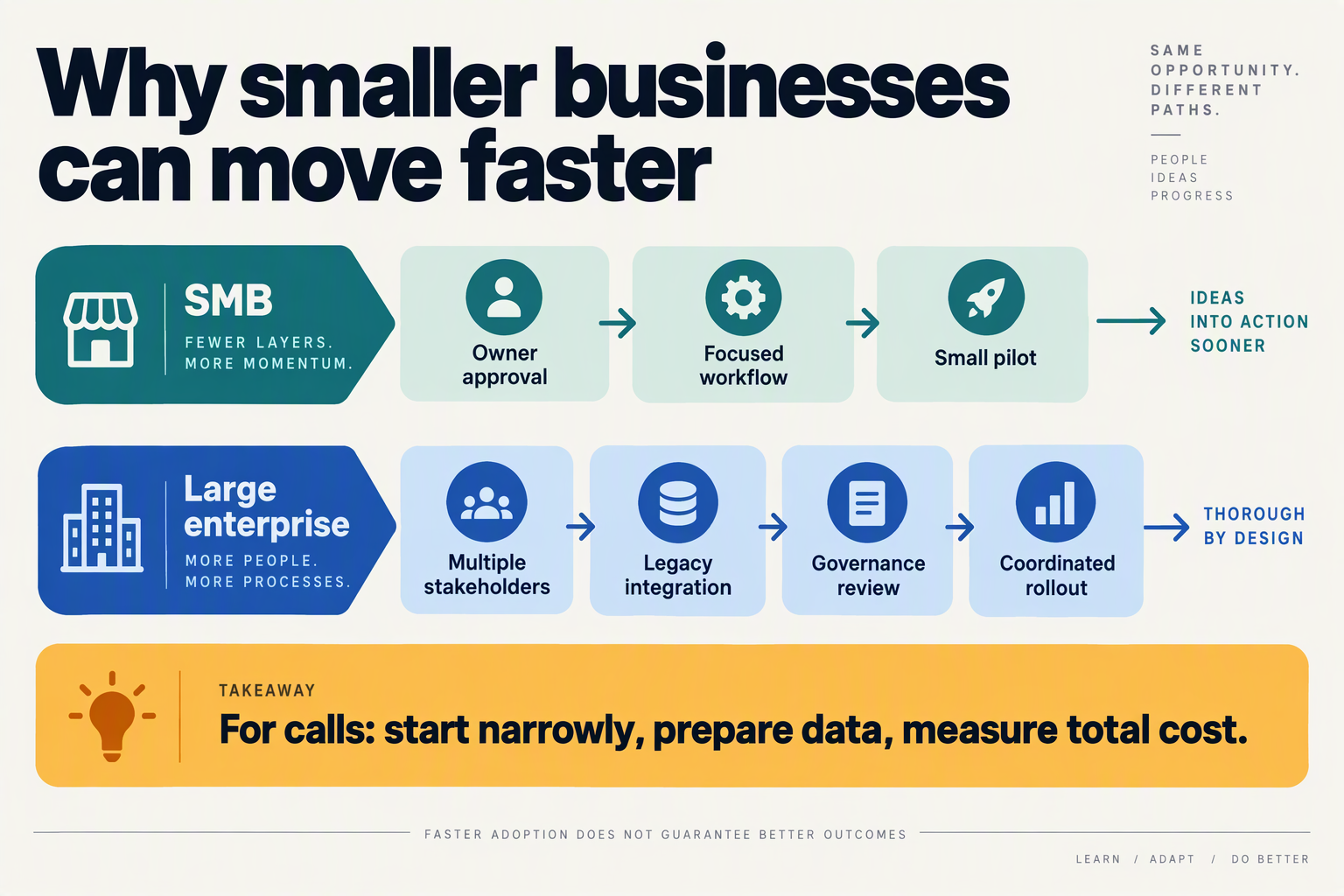
Indian SMBs can move faster on AI because a smaller group can approve a narrowly scoped experiment, resolve operational questions, and change course without coordinating a company-wide rollout. For call automation, that advantage is most useful when the person approving the pilot also understands the customer workflow—and can decide where automation must stop.
How does simpler decision-making speed up an AI call pilot?
Fortune India’s reporting, available in the October 2026 research context, attributes Indian SMBs’ faster AI adoption to simpler decision-making and fewer legacy systems. The practical advantage is a shorter path between identifying a problem and authorising a test, not proof that smaller businesses have better technology.
Consider a hypothetical building-materials distributor receiving calls about product availability. The owner and sales supervisor could agree on a limited pilot: answer standard product questions, collect quantities and delivery locations, and pass quotation requests to a salesperson.
That decision does not require automating procurement, credit approval, or the entire sales pipeline. It requires agreement on three things:
- Scope: which enquiries the agent may handle.
- Authority: what the agent may say or do.
- Accountability: who reviews mistakes and approves changes.
Larger organisations may need additional procurement, security, integration, and departmental reviews. Those controls serve legitimate purposes; an SMB’s opportunity is to keep its own controls proportionate rather than skip them.
Does enthusiasm for AI translate into faster implementation?
Confidence can help unlock a pilot budget, but it cannot replace preparation. As of the October 2026 research context, Salesforce’s Small Business Trends report says SMBs are 1.8 times more likely to prioritise AI investments when they believe AI will be a “game-changer” for their company.
That finding concerns investment priorities; the supplied excerpt does not establish an India-specific implementation-speed measure. For AI adoption in Indian MSMEs, the useful implication is that belief creates momentum—but a bounded experiment makes that momentum actionable.
A business owner can replace “Should we adopt AI?” with a more concrete decision: “Should we test whether an agent can capture complete quotation enquiries without promising prices or stock availability it cannot verify?”
This narrower question makes the required information, risks, and success criteria easier to identify.
What should an SMB approve before the first automated call?
A lightweight pilot charter can preserve speed while preventing informal decisions from becoming customer-facing errors:
- Choose one call intent. Start with quotation intake, not every sales enquiry.
- Name an information owner. Specify who maintains product descriptions and delivery-area rules.
- Set a permission boundary. Let the agent collect requirements; reserve discounts and credit terms for staff.
- Define the exception route. Decide how urgent requests, uncertainty, and complaints reach a person.
- Agree on review and rollback. Check whether enquiries contain the information salespeople need, and stop or revise the pilot when they do not.
As of October 2026, CallMissed supports voice-agent versioning with publish and rollback, alongside call scoring against a business’s own QA rubrics. These capabilities fit a controlled pilot: teams can review behaviour against explicit rules and revert an unsuitable change.
The competitive advantage is therefore not simply launching first. It is shortening the decision-to-learning cycle while keeping customer promises, operational responsibility, and human judgement intact.
What does Salesforce actually say about Indian SMB AI adoption?
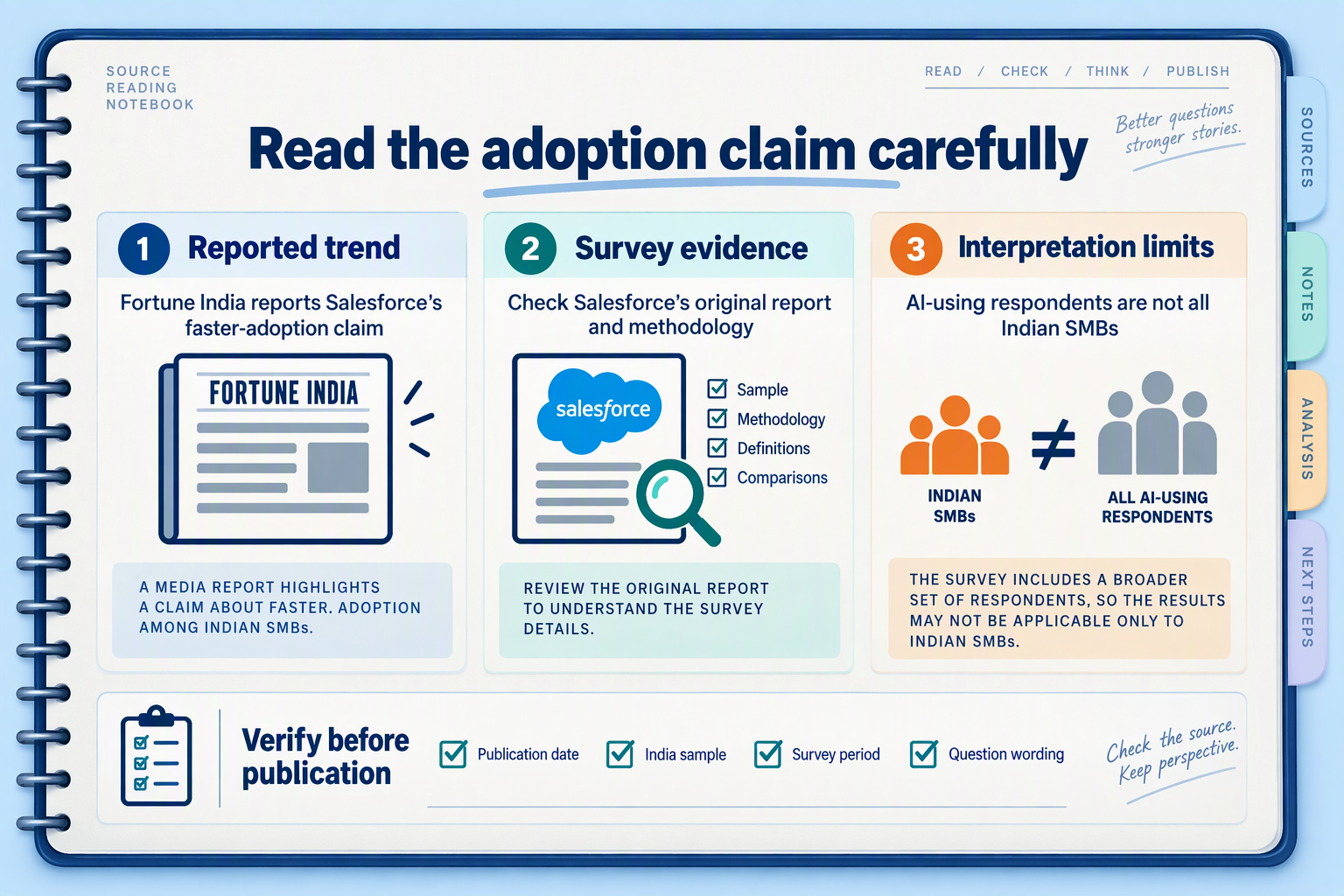
Salesforce’s evidence supports reported efficiency gains among Indian SMBs already using AI, while Fortune India reports that simpler decision-making and fewer legacy systems help smaller firms deploy faster. Neither claim, in the research available as of October 2026, establishes an India-wide adoption rate or a quantified speed advantage over large enterprises.
The distinction matters when interpreting AI adoption in Indian MSMEs: evidence about existing AI users is not evidence about every small business, and reported efficiency is not the same as independently measured return on investment.
What do the Salesforce findings prove—and what remains unproven?
The table separates the supplied findings from their practical implications. Source statements reflect the research available as of October 2026; call-automation implications are implementation guidance, not Salesforce findings.
| Evidence | Named source | What it supports | Call-automation implication |
|---|---|---|---|
| 95% of Indian SMBs with AI report more efficient operations | Salesforce, Agentforce Playbook for Indian SMBs | Reported benefits among existing AI users | Measure whether a pilot improves a specific workflow |
| Indian SMBs are moving faster than large enterprises | Fortune India’s reporting on Salesforce | A qualitative deployment-speed comparison | Test a bounded workflow; do not assume a guaranteed launch time |
| Simpler decision-making helps deployment | Fortune India | An explanation for faster implementation | Identify one accountable pilot owner |
| Fewer legacy systems help deployment | Fortune India | Lower integration complexity can help teams start | Check actual calendar, CRM and telephony dependencies |
| Costs remain an obstacle | Fortune India | Faster adoption does not remove budget constraints | Estimate usage, setup and ongoing operating costs |
| Data gaps remain an obstacle | Fortune India | Deployment speed does not establish data readiness | Validate answers, policies and escalation rules before launch |
According to Salesforce’s Agentforce Playbook for Indian SMBs, available in the October 2026 research context, 95% of Indian SMBs with AI report more efficient operations. The supplied excerpt does not provide the survey’s sample size, fieldwork dates or a call-automation-specific breakdown, so those details should not be inferred.
Does investment enthusiasm mean an AI call agent will pay for itself?
No. Salesforce’s Small Business Trends research, available in the October 2026 context, says SMBs are 1.8 times more likely to prioritise AI investments if they believe AI will be a game-changer for their company. The supplied excerpt does not establish that this figure is India-specific, and it measures investment priorities—not realised financial returns.
For a call pilot, distinguish three outcomes:
- Efficiency: Does the workflow require less employee time?
- Task completion: Does the customer successfully book, obtain an answer or reach the right person?
- Economics: Does the benefit justify the total operating cost?
An agent that answers more calls but creates additional correction work may improve availability without improving overall efficiency.
How should an Indian SMB turn these findings into a test?
Translate the broad claim into a measurable hypothesis: “Automating appointment enquiries will reduce manual handling without increasing booking errors.” Establish a baseline, run a limited pilot, and compare completed bookings, corrections and human handoffs.
As of October 2026, CallMissed provides call transcripts, AI call notes, call scoring against a business’s own QA rubrics, and agent analytics. Those capabilities can support pilot evaluation, but they do not establish that a particular business will reproduce Salesforce’s reported outcomes.
The useful takeaway is permission to test—not proof of guaranteed savings. Salesforce’s findings justify investigating practical AI workflows; the business’s own operating data must determine whether call automation earns a wider rollout.
What is the real cost of AI in Indian marketing and sales?
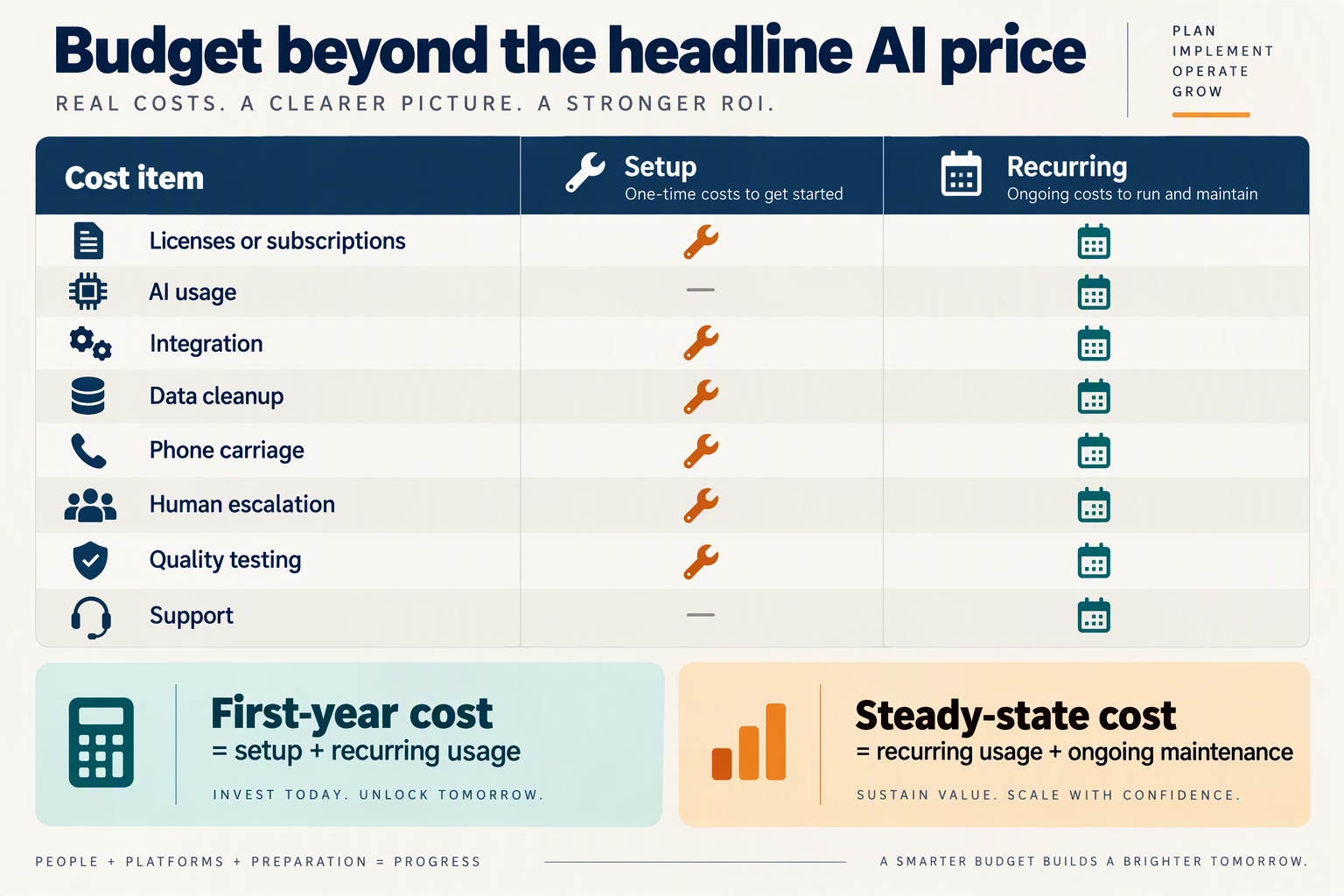
The real cost of AI in Indian marketing and sales is the usage bill plus phone connectivity, data preparation, integrations, and human oversight—not just a subscription price. For call automation, budget around billed minutes and successfully completed tasks, rather than the number of calls an agent can answer.
Fortune India’s reporting, available in the October 2026 research context, identifies costs and data gaps as continuing obstacles for Indian SMBs adopting AI. These obstacles are connected: incomplete product information or unclear sales policies can create longer conversations, repeat calls, and additional human follow-up.
What should an Indian SMB include in its AI call budget?
Separate costs with a published rate from costs that depend on your workflow. As of October 2026, CallMissed’s verified pricing lists flat-rate voice-agent plans covering speech recognition, the language model, and the voice; phone carriage is billed separately.
The table below combines those published rates with implementation costs that businesses should estimate themselves. It is a budgeting framework, not an all-inclusive quote.
| Budget item | Rate or basis, October 2026 | What to account for |
|---|---|---|
| Standard voice agent | ₹4 per billed minute | Natural Indian-language voices; speech recognition, LLM, and voice included |
| Expressive voice agent | ₹5 per billed minute | Richer, more expressive voices across Indian and world languages |
| Best latency voice agent | ₹6 per billed minute | Fastest replies within the platform’s voice-agent plans |
| Phone connectivity | Separately billed carriage | Check carrier charges and any number-rental costs |
| Data and integration work | Business-specific estimate | Prepare approved answers, connect systems, and test workflows |
| Human review and follow-up | Staff time × internal hourly cost | Review exceptions, correct information, and complete handoffs |
For these flat-rate plans, CallMissed specifies a 30-second minimum per call as of October 2026; a call that never connects costs nothing. Short connected calls therefore still consume a minimum billable amount—an important distinction when forecasting high volumes of brief enquiries.
How much would a small call-automation pilot cost?
Consider a hypothetical October 2026 pilot handling 1,000 inbound enquiries, each lasting exactly two minutes. That produces 2,000 billed minutes, with the following AI usage costs calculated from the published rates:
- Standard: 2,000 × ₹4 = ₹8,000
- Expressive: 2,000 × ₹5 = ₹10,000
- Best latency: 2,000 × ₹6 = ₹12,000
These figures exclude phone carriage, setup work, and staff oversight. Real budgets should also allow for longer conversations, repeat enquiries, and connected calls that end without completing the intended task.
Avoid assuming that every automated enquiry replaces an employee’s work. A captured lead may still need qualification; an appointment request may still need confirmation.
Which cost metric should marketing and sales teams track?
Use cost per completed business outcome, alongside the monthly bill:
Cost per completed outcome = total pilot cost ÷ successfully completed target tasks.
If the hypothetical ₹8,000 Standard pilot completes 600 target tasks, its AI usage cost alone is approximately ₹13.33 per completed task. That is an illustrative calculation—not a measured performance benchmark—and the fully loaded cost will be higher.
Track three things together:
- Completion: Did the customer reach the intended next step?
- Rework: How much staff effort remained afterward?
- Quality: Were answers accurate and handoffs appropriate?
A lower per-minute price is useful, but fewer repeat calls and less rework can matter more to the final budget.
Which data gaps should an SMB fix before automating calls?
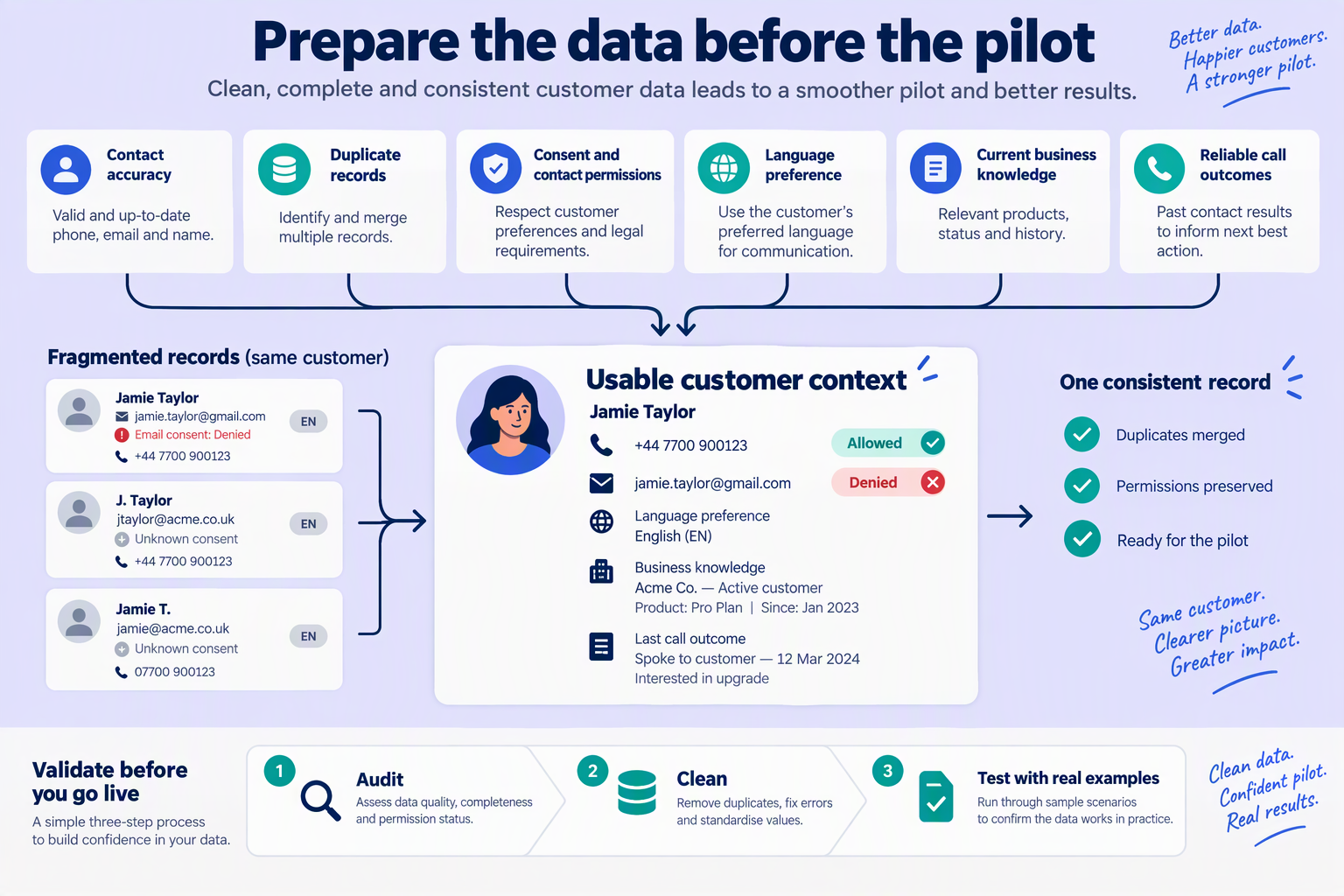
Before automating calls, an SMB should fix gaps in approved answers, customer records, live operational data, and escalation rules. The goal is not to clean every company spreadsheet: it is to make the information needed for one call workflow accurate, accessible, and safe to use.
IBM’s State of Salesforce 2025–2026 report, included in the October 2026 research context, states that organizations ignoring data gaps are 45% less likely to have successfully implemented agentic AI. That finding concerns enterprise implementation, not an Indian SMB call-automation benchmark, but it reinforces a practical lesson: deployment speed cannot compensate for unreliable inputs.
Which business information needs a single source of truth?
Start with information that determines what the agent may tell customers. For a hypothetical appliance-repair business, “service available” is incomplete unless the agent also knows the eligible locations, appliance categories, exclusions, and booking conditions.
Prepare an approved-answer register containing:
- Service scope: what the business handles—and what it does not.
- Charges: inspection fees, taxes, exclusions, and whether a quote requires human approval.
- Policies: cancellation, rescheduling, refunds, warranties, and complaint handling.
- Ownership: who approves each answer and when it was last checked.
Resolve contradictions before uploading documents. If a brochure promises free inspection but the current policy charges a fee, adding both to a knowledge base creates ambiguity rather than readiness.
Give time-sensitive information an expiry or review date. Stable policy documents can support retrieval; changing appointment availability should come from the system that actually manages bookings.
Which customer and operational records must be connected?
An agent answering general questions needs less customer data than an agent changing an appointment. Match access to the task, rather than exposing the entire CRM.
Check three gaps:
- Identity gaps: duplicate contacts, inconsistent phone-number formats, and shared household numbers. A matching phone number alone should not authorize disclosure of sensitive account details.
- Status gaps: missing order references, stale booking states, or unclear payment status. Define which system wins when records disagree.
- Action gaps: no reliable way to confirm that a requested change succeeded. The agent must distinguish “request received” from “appointment confirmed.”
For example, if the booking system times out, the safe response is to explain that confirmation is pending—not invent a slot.
As of October 2026, CallMissed’s built-in CRM supports duplicate merge, custom fields, and per-record timelines, while its voice agents support custom REST tools. These capabilities can help organize records and connect operational systems, but businesses still need to define authoritative sources and access rules.
How should an SMB test data readiness before launch?
Create a small, representative test set drawn from real customer questions, with personal details removed where unnecessary. Include ordinary requests, regional-language phrasing, ambiguous questions, and exceptions.
For each test, record:
- The approved answer or permitted action.
- The source the agent should consult.
- What requires customer verification.
- When the agent must stop and involve a person.
Test deliberately difficult cases: an expired offer, two conflicting prices, an unknown order number, and an unavailable booking system. A correct handoff is a successful outcome when the data cannot support a reliable answer.
For AI adoption in Indian MSMEs, this is a useful launch gate: automate only the tasks whose answers, permissions, and failure paths the business can explain clearly.
How should multilingual AI calls handle language changes and failures?
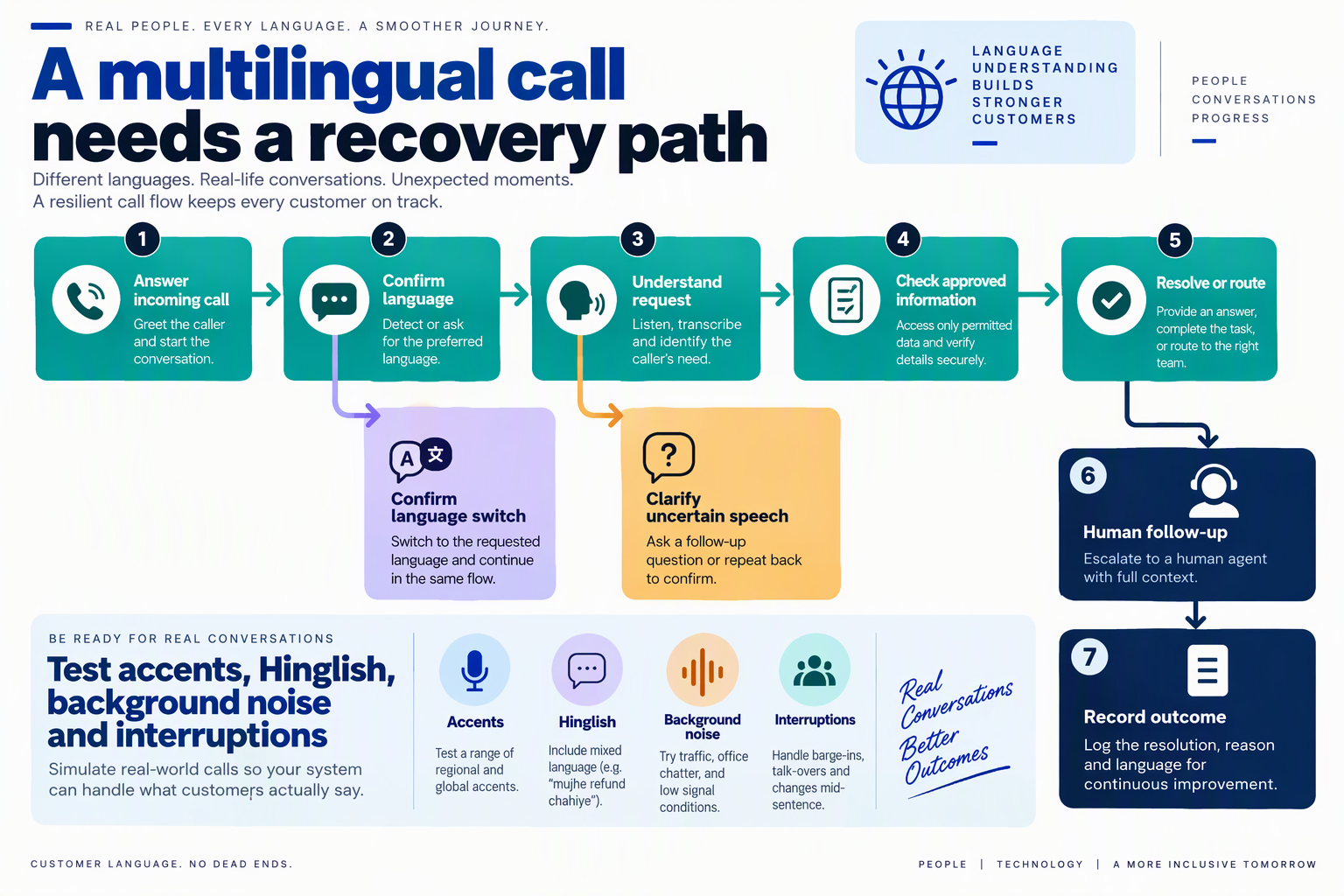
Multilingual AI calls should follow the customer’s preferred language, tolerate code-switching, and confirm important details before taking action. When understanding breaks down, the agent should stop guessing and offer a clear recovery path: clarification, keypad input where appropriate, or a human handoff.
For AI call automation in India, multilingual reliability is not simply a count of supported languages. It is whether a caller can switch languages, correct a misunderstanding, and still complete the task without starting again.
How should an AI voice agent respond when a caller switches languages?
Treat a language change as a conversational preference—not a reason to restart the call. A customer might begin in English, describe a repair problem in Hindi, and use English again for the appliance model.
A practical language policy should:
- Follow explicit requests: “Hindi mein baat kijiye” should take priority over an earlier language selection.
- Preserve task context: Keep the appointment details already collected when the conversation changes language.
- Avoid unnecessary switching: An English product name inside a Hindi sentence does not necessarily mean the caller wants English replies.
- Ask when uncertain: Use a short preference question rather than repeatedly guessing.
For example, after “Kal afternoon mein technician aa sakta hai?”, the agent should clarify the intended appointment date and availability—not translate the sentence mechanically and assume a booking is confirmed.
As of October 2026, CallMissed’s verified product information lists speech recognition in 22 Indian languages plus English, including Hinglish, and natural text-to-speech voices in 10 Indian languages plus English, with additional languages available through other voice models. These are distinct capabilities: teams should verify both recognition and spoken-response coverage for their chosen configuration.
What should happen when the AI mishears a name, number, or date?
Use risk-based confirmation. Mishearing a general question is inconvenient; mishearing a delivery address, payment amount, or appointment date can create an operational error.
A sensible recovery sequence is:
- Clarify the uncertain detail: “Did you say Tuesday or Thursday?”
- Read back critical information: Confirm the complete appointment date, including the month, rather than repeating “tomorrow.”
- Change the input method: Where the workflow supports it, offer keypad entry for numeric information.
- Escalate unresolved ambiguity: Transfer to a person or arrange follow-up instead of recording a guess as fact.
A suggested pilot rule—not an industry benchmark—is to offer human help after two unsuccessful clarification attempts. Explicit requests for a person should bypass that retry sequence.
How should AI calls handle missing answers and technical failures?
Keep knowledge failures, speech failures, and tool failures separate. Each needs a different response:
- Missing policy information: Say the answer is unavailable and route the question to someone authorised to answer.
- Unclear audio: Request a repeat or a quieter connection without blaming the caller’s accent.
- Booking-system failure: Explain that availability could not be checked; do not announce a confirmed appointment.
- Disconnected call: Preserve verified details where the workflow allows, and follow the business’s consent-based follow-up process.
Fortune India’s reporting, in the October 2026 research context, identifies costs and data gaps as continuing obstacles to Indian SMB AI adoption. Multilingual fluency cannot compensate for missing business rules.
How can an SMB test multilingual call reliability?
Build a small test set around actual service scenarios: language changes, regional accents, background noise, corrections, and unavailable systems. Score correct task completion, critical-detail accuracy, and successful escalation separately.
A fluent-sounding call that books the wrong date is a failure. A call that recognises uncertainty and reaches a person safely can be a successful outcome.
How can a small call pilot prove value rather than just show activity?
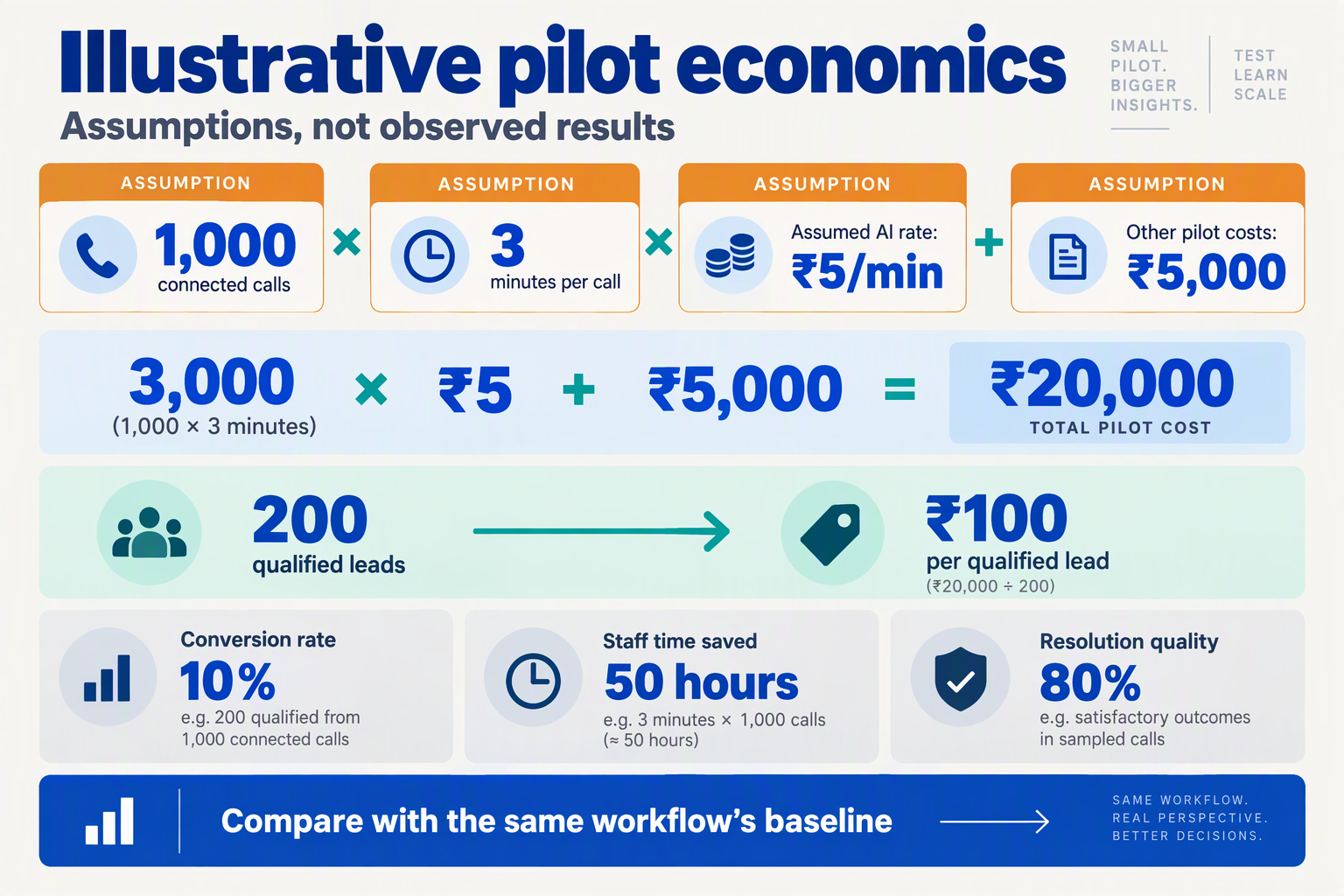
A small call pilot proves value when it improves a verified business outcome at an acceptable total cost, compared with a credible baseline. Calls answered, minutes handled, and transcripts generated show activity; completed appointments, resolved enquiries, and fewer repeat contacts show whether that activity helped.
Fortune India’s reporting, available in the October 2026 research context, identifies “costs and data gaps” as continuing obstacles to Indian SMB AI adoption. A useful pilot tests both: whether the economics work and whether the business’s information supports reliable decisions.
Which outcomes should an AI call pilot measure?
Choose one primary outcome that employees can verify outside the call transcript. For an appointment-booking workflow, that might be appointments attended, not merely appointments requested.
Before launch, write a short measurement agreement:
- Define an eligible call: Specify which enquiries belong in the pilot, excluding unrelated requests.
- Define success: Require a confirmed record in the booking system and, where relevant, subsequent attendance.
- Set guardrails: Track incorrect commitments, repeat calls, complaints, and cases needing human intervention.
- Set a decision rule: Agree on an affordable cost per additional outcome and which errors would trigger a pause.
Keep denominators visible. “Thirty bookings” means little without knowing whether they came from 50 eligible calls or 500. Likewise, a human handoff is not automatically a failure: escalation can be the correct outcome for an exception.
How can a small business compare results fairly?
Use a recent baseline covering comparable opening hours, enquiry types, and promotional conditions. Where practical, alternate comparable time blocks between the existing process and the AI-assisted process rather than comparing a quiet week with a festival rush.
The following is an illustrative October 2026 pilot scenario, not a reported benchmark or CallMissed result:
- Existing process: 200 eligible calls produce 60 bookings and 48 attended appointments.
- AI-assisted process: 200 eligible calls produce 75 bookings and 60 attended appointments.
- Observed difference: Booking conversion rises from 30% to 37.5%, while attended appointments increase by 12.
- Incremental pilot cost: An assumed ₹2,400, including relevant operating expenses, equals ₹200 per additional attended appointment.
The business should compare that ₹200 with the contribution margin, not the revenue, from an appointment. Any claimed staff-time savings should also subtract review, correction, and follow-up work.
Small samples remain uncertain. Treat the difference as a reason to investigate and repeat the test—not proof that automation alone caused the improvement.
What evidence should determine whether the pilot expands?
Review successful calls alongside failures and escalations. Reconcile the agent’s claimed result with booking records, customer follow-ups, and staff checks; a fluent conversation is not evidence of task completion.
As of October 2026, CallMissed provides call recordings, transcripts, AI call notes pushed to the CRM, scoring against a business’s own QA rubrics, and A/B experiments. These capabilities can support a pilot’s evidence trail, while staff still verify downstream outcomes.
Finish with one of three decisions:
- Expand when outcomes improve, economics hold, and guardrails remain acceptable.
- Revise when errors cluster around fixable information or workflow gaps.
- Pause when unreliable answers or correction costs outweigh the benefit.
For AI adoption in Indian MSMEs, the strongest pilot report is not “we automated more calls.” It is “we delivered more verified outcomes, at this cost, with these limitations.”
What should you ask experts before trusting adoption and ROI claims?
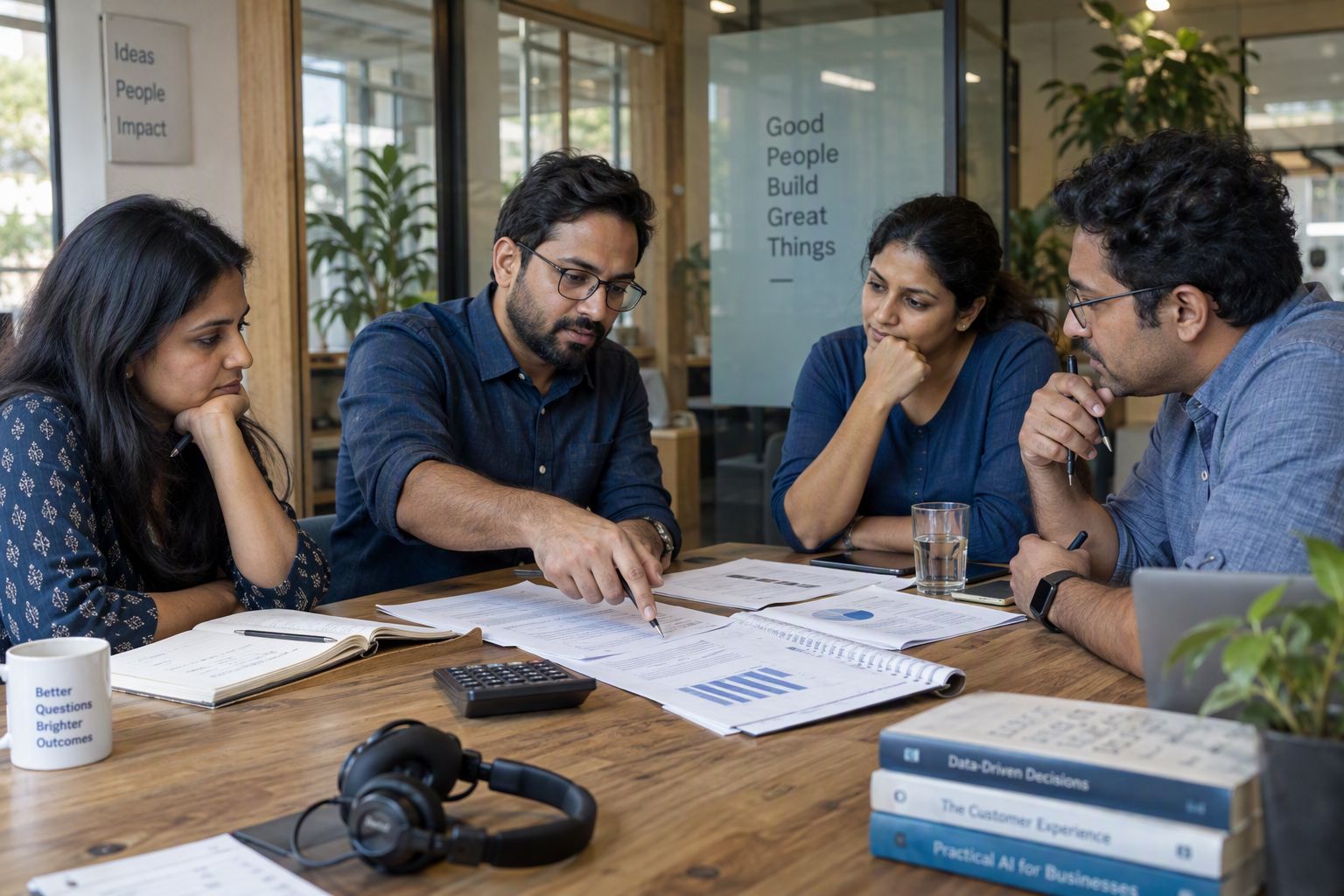
Ask experts to show who was measured, what changed, and how the financial benefit was calculated before trusting AI adoption or ROI claims. For AI call automation in India, credible evidence should distinguish survey sentiment from measured results—and a successful demonstration from dependable performance on real customer calls.
What does “faster AI adoption” actually measure?
Fortune India’s reporting, available in the October 2026 research context, attributes Indian SMBs’ faster AI adoption to simpler decision-making and fewer legacy systems. Before treating that finding as a benchmark, ask whether “faster” means quicker purchasing decisions, shorter deployment times, or a higher share of businesses using AI.
These measures are not interchangeable. A business can approve a pilot quickly without achieving sustained use or positive returns.
Ask the researcher or industry expert:
- Definition: Does adoption mean experimentation, paid subscriptions, or production deployment?
- Comparison: Were SMBs and large enterprises assessed using the same questions and time period?
- Coverage: Which industries, business sizes, and Indian regions were represented?
- Timing: When was the fieldwork conducted, rather than when was the article published?
Also ask whether the research uses SMB and MSME interchangeably. Findings about one surveyed business population should not automatically become claims about every Indian microenterprise.
Does reported efficiency prove financial ROI?
Salesforce’s Agentforce Playbook for Indian SMBs, available in the October 2026 research context, reports that 95% of Indian SMBs with AI report more efficient operations. That statistic describes reported efficiency among AI users; it does not establish audited savings, profitability, or a causal effect.
An expert should explain whether respondents estimated improvements or whether researchers examined operational records. Ask how unsuccessful deployments, abandoned pilots, and businesses not using AI were represented.
For call automation, request three separate answers:
- Operational outcome: Did more callers complete the intended task?
- Economic outcome: Did verified savings or incremental contribution exceed total costs?
- Customer outcome: Did complaints, repeat calls, or unresolved requests increase?
Separating these outcomes prevents “the agent answered more calls” from becoming an unsupported claim that “the business earned more.”
Which costs and assumptions belong in the ROI calculation?
Ask for an itemized calculation, not just a percentage uplift. It should include setup, knowledge-base maintenance, integrations, usage, phone carriage, supervision, and exception handling.
As of October 2026, CallMissed lists flat-rate voice-agent plans at ₹4, ₹5, and ₹6 per minute, covering speech recognition, the language model, and voice; phone carriage is billed separately. That distinction illustrates why experts should specify what a quoted minute actually includes.
A hypothetical calculation—not a market benchmark—shows the issue: if monthly benefits equal ₹20,000 and total monthly costs equal ₹15,000, net benefit is ₹5,000 and ROI is approximately 33%. But staff time saved is not automatically cash saved: ask whether employees used that time productively or whether expenditure actually fell.
What evidence would make the expert change their recommendation?
A trustworthy expert should identify conditions under which automation would not pay off.
Request evidence from calls resembling your own, including regional accents, code-mixed speech, noisy environments, incomplete information, and requests requiring human judgment. Ask for results across those conditions, not only a polished demonstration.
Finally, ask: “What result would make you recommend stopping or narrowing this deployment?” An answer tied to measurable failures is more useful than unconditional confidence. The strongest adoption claim is one with clear boundaries—and the strongest ROI case survives scrutiny of its assumptions.
Where can CallMissed fit into a focused Indian SMB call pilot?
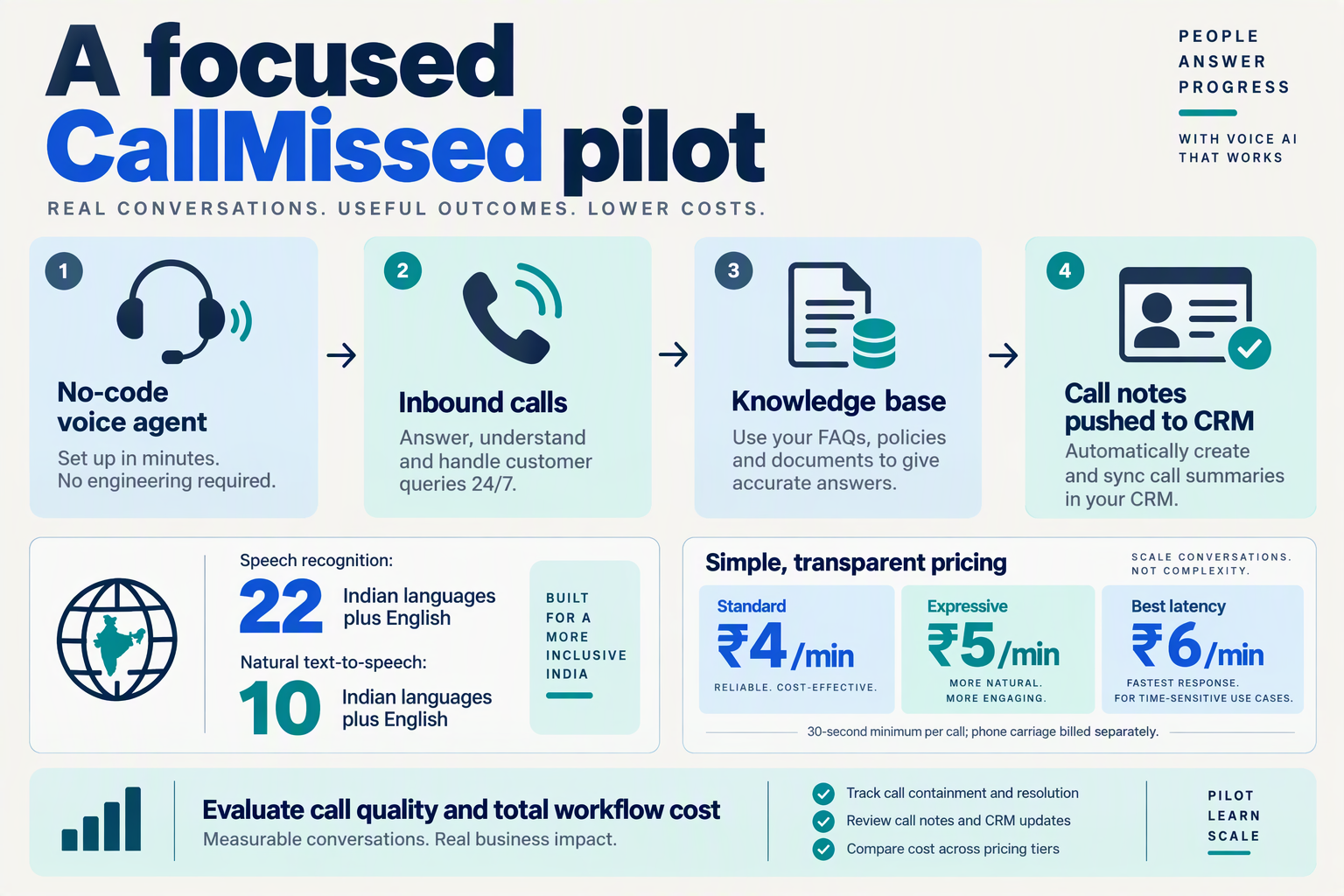
CallMissed can fit into a focused Indian SMB call pilot as the voice-agent, knowledge, and review layer for one clearly bounded workflow—not as a replacement for every customer interaction. As of October 2026, its no-code agent builder, custom REST tools, call transcripts, and evaluation features support testing a specific task before expanding automation.
Fortune India’s reporting, available in the October 2026 research context, identifies costs and data gaps as obstacles to Indian SMB AI adoption. The practical response is to choose a pilot where both the required information and the spending boundary are easy to define.
What should the first call agent actually do?
For a hypothetical appliance-repair business, start with inbound service enquiries, rather than automated diagnosis or unrestricted sales conversations. Define success as collecting the information needed for a person to confirm the next step.
A useful pilot brief would specify:
- Allowed tasks: explain service areas, answer approved questions, and collect appliance type, postcode, and preferred appointment time.
- Required information: a current service list, opening hours, booking rules, and clearly stated exclusions.
- Human-only decisions: disputed charges, safety concerns, unusual repairs, and exceptions to published policies.
Using the platform’s October 2026 capabilities, the business could supply approved text, web pages, or PDFs as a knowledge base and use custom REST tools where a live system lookup is necessary. Collecting an appointment preference is not the same as confirming an available slot: confirmation should depend on a verified scheduling response.
How can the pilot stay connected to existing operations?
The October 2026 product snapshot supports rented phone numbers or an existing carrier through Twilio, Plivo, or any SIP trunk. This gives an SMB a choice between introducing a pilot number and connecting through its existing telephony arrangement; configuration and phone-carriage costs still need checking.
For the first release, keep the operating process simple:
- Publish one controlled agent version. Use versioning and rollback to manage changes to prompts or call settings.
- Review real conversations. Use recordings, transcripts, and AI call notes to check whether the agent captured the necessary details.
- Arrange staffed supervision. Live monitoring supports listening, whispering, and barging in, but a person must actually be available.
- Test before widening scope. Use evaluation suites and call scoring against your own QA rubric, rather than judging performance by how natural the voice sounds.
These capabilities support oversight; they do not establish that a particular business’s workflow is ready for unattended operation.
What would a small pilot cost?
According to CallMissed’s verified October 2026 pricing, the Standard voice-agent plan costs ₹4 per minute, covering speech recognition, the language model, and the voice; phone carriage is billed separately.
For an illustrative pilot of 100 connected calls averaging three minutes, 300 billable minutes would produce ₹1,200 in Standard-plan voice-agent charges, before phone carriage. This is a planning example, not a quoted total or performance benchmark. The plan has a 30-second minimum per call, while calls that never connect cost nothing.
Approve expansion only when reviewed calls show reliable information capture, appropriate handling of exceptions, and an acceptable cost per completed enquiry. Faster AI adoption is valuable when it produces a repeatable operating process—not merely a faster launch.
What should your business do next based on its readiness?
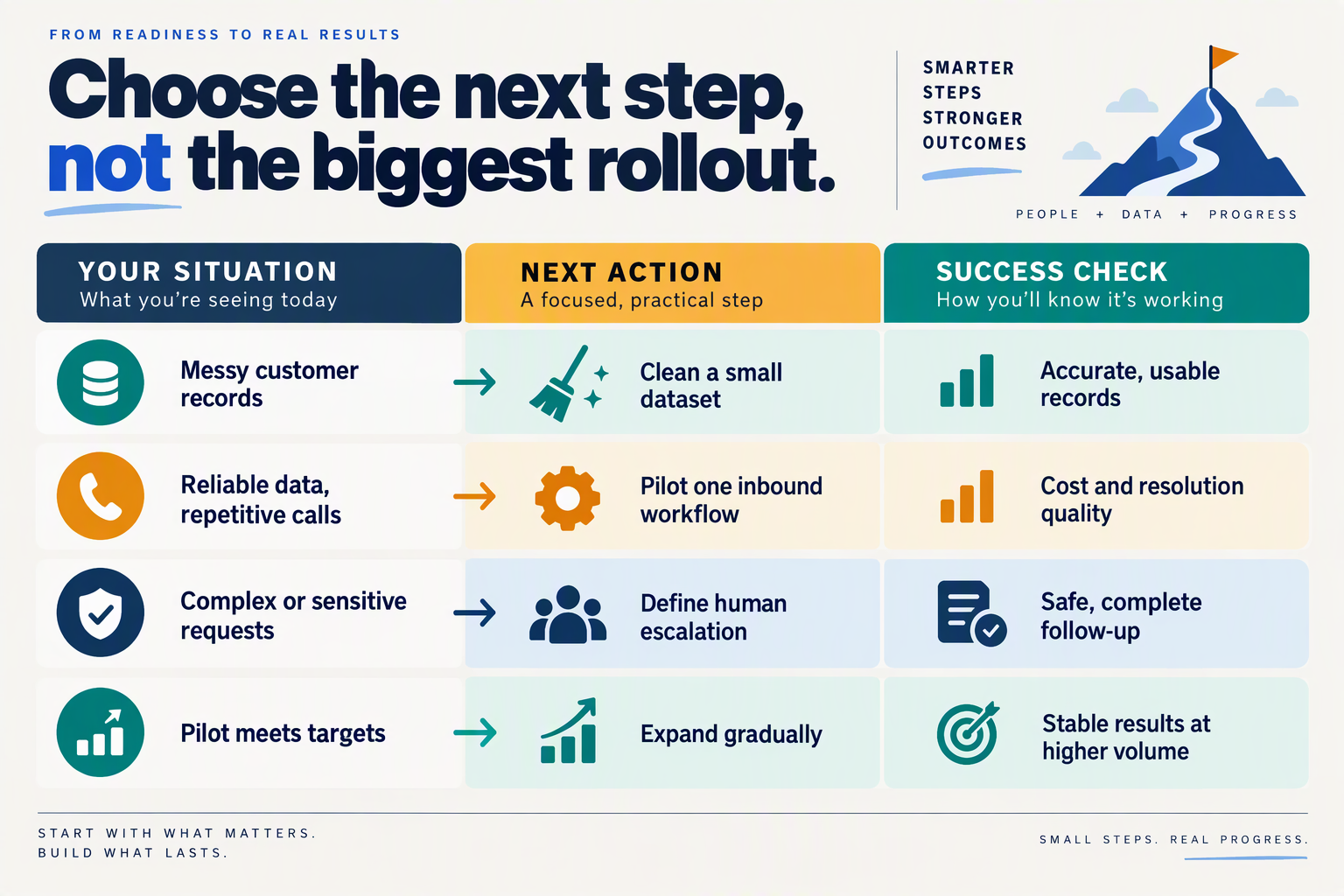
Choose your next step by the weakest part of your readiness—not by how quickly you can launch an AI agent. If your answers, escalation process, or budget are unreliable, fix that constraint first; if they are dependable, move to a narrowly scoped call pilot with explicit expansion criteria.
Fortune India’s reporting, reviewed in October 2026, identifies costs and data gaps as continuing barriers despite Indian SMBs’ faster AI adoption. The practical response is a readiness-based roadmap, rather than the same deployment plan for every business.
Which AI call automation step matches your business’s readiness?
Use this table as a recommended decision framework, not a vendor benchmark. Where several rows describe your business, start with the earliest unresolved constraint.
| Readiness level | What you have today | Best next action | Gate before progressing |
|---|---|---|---|
| Exploring | A general interest in AI, but no defined call problem | Select one frequent, low-risk customer request | Name the workflow owner and define a successful outcome |
| Data-constrained | Answers scattered across messages, documents, and staff | Create an approved answer set with exception rules | Resolve conflicting answers and assign an update owner |
| Pilot-ready | Reliable answers and an available human escalation path | Test internally, then accept a limited set of live calls | Verify task completion, escalation, and captured details |
| Quality-constrained | A working pilot with recurring incorrect answers or failed handoffs | Pause expansion and repair the largest failure category | Retest failed scenarios before increasing traffic |
| Budget-constrained | Useful results, but unclear or excessive operating costs | Calculate cost per completed task and narrow the scope | Confirm total costs fit a pre-approved spending ceiling |
| Expansion-ready | Consistent outcomes, maintained data, and affordable usage | Add one adjacent workflow or language | Demonstrate acceptable results for the new scope separately |
Readiness is workflow-specific. A clinic might be ready to automate opening-hours enquiries while remaining unready for appointment changes involving deposits or cancellation penalties. Passing one workflow’s checks does not establish readiness for every customer conversation.
How should you choose between fixing data and buying more capability?
Fix the bottleneck that prevents a correct customer outcome. A more capable model cannot establish which of two contradictory refund policies your business actually follows.
Salesforce’s Small Business Trends research, available in the October 2026 context, reports that SMBs are 1.8 times more likely to prioritise AI investments when they believe AI will be a game-changer for their company. That finding concerns investment priorities—not deployment success—so enthusiasm should trigger a disciplined test, not automatic expansion.
Before committing more spend, ask:
- Accuracy: Did the agent use the approved answer?
- Completion: Did the customer reach the intended next step?
- Recovery: When automation could not help, did the customer reach a person?
- Economics: What did each successfully completed task cost, including unsuccessful attempts?
What should your team do over the next working week?
- Choose the applicable table row. Record the evidence supporting that choice, rather than relying on a product demonstration.
- Assign one owner and one deliverable. For example: reconcile cancellation rules, document escalation hours, or review failed calls.
- Set a review date and a stop condition. Expand only when the stated gate is met; pause when errors could create customer harm or unauthorised commitments.
As of October 2026, CallMissed supports this evidence-led approach with call scoring against your own QA rubrics, eval suites, and A/B experiments. These capabilities can help teams evaluate changes, but the business still needs to define acceptable outcomes.
The next milestone should be one verified improvement in readiness, not simply more automated minutes.
Frequently Asked Questions
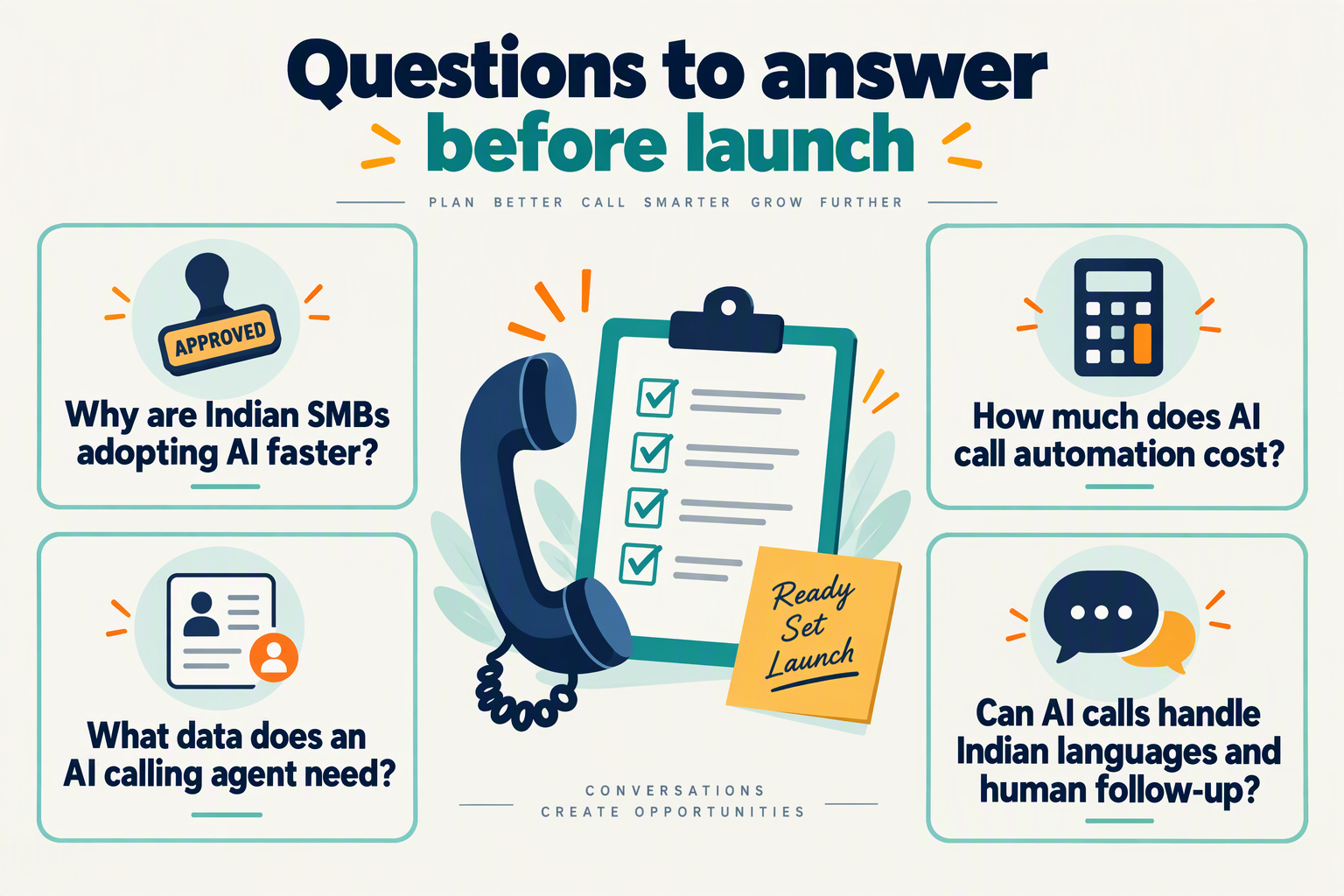
Why is AI adoption in Indian MSMEs moving faster than in large enterprises?
Does Salesforce’s 95% efficiency figure measure AI adoption in Indian MSMEs?
How much does AI call automation cost for a small business in India?
What data should an Indian SMB prepare before automating customer calls?
Can AI call automation handle Indian languages and Hinglish?
How should an Indian SMB decide whether to expand an AI calling pilot?
Conclusion
AI adoption in Indian MSMEs will matter most when faster deployment produces better customer outcomes—not simply more automation. For call automation, the practical advantage is the ability to test one useful workflow, learn from real conversations, and improve without committing to a company-wide transformation.
As of October 2026, Fortune India’s reporting attributes Indian SMBs’ faster AI adoption to simpler decision-making and fewer legacy systems, while highlighting persistent costs and data gaps. That is both an opportunity and a warning: approving a pilot quickly is valuable, but reliable answers, clear boundaries, and affordable usage determine whether it deserves to expand.
Four takeaways should guide the next step:
- Start with a narrow call workflow. Opening-hours questions, collecting service details, or requesting an appointment offer a clearer starting point than handing every customer conversation to an agent. Define the successful next step before deployment, and keep uncertain diagnoses, disputed charges, and other exceptions with people.
- Treat data preparation as implementation work. A knowledge base needs current service information, consistent prices, appointment rules, and explicit escalation instructions. Having fewer legacy systems does not eliminate information gaps; answers scattered across spreadsheets, messages, and employees’ memories still need to be consolidated and checked.
- Evaluate the full operating cost. Budget for expected call usage and phone carriage rather than judging affordability from a headline rate alone. A narrowly scoped pilot makes that evaluation more manageable: the business can compare spending with completed tasks before deciding whether broader automation is justified.
- Measure outcomes, not novelty. Track completed tasks, handoffs, and customer experience, including whether callers must repeat information. Faster deployment is useful only if the resulting workflow helps customers reach the right next step and gives employees a dependable way to handle exceptions.
In Salesforce’s Agentforce Playbook for Indian SMBs, cited in the October 2026 research context, 95% of Indian SMBs using AI report more efficient operations. That finding supports experimentation, but it describes reported outcomes among AI users—not adoption across all SMBs or a guaranteed result for any individual business.
Looking ahead, watch whether businesses turn quick launches into repeatable improvements: cleaner knowledge bases, clearer human escalation, and evidence that call spending translates into completed customer tasks. Those signals will matter more than deployment speed alone.
As of October 2026, readers can explore CallMissed, an AI customer-communication platform offering a no-code voice-agent builder, knowledge bases, and speech recognition in 22 Indian languages plus English, including Hinglish, as one practical route into this trend.
Which recurring customer call could your business improve first—and what evidence would justify expanding beyond that pilot?
Related Reading
- How to Build No-Code AI Agents for Customer Calls & Chat
- Reliable AI Workflows: Why Prompts Aren’t Enough for Support
- AI Receptionist for Small Business: How to Stop Losing Leads From Missed Calls — A Step-by-Step Developer Guide