BharatGen Text Model: What It Means for Voice Agents



Understand where the BharatGen Text Model fits, compare speech-stack components, and plan practical multilingual voice-agent tests for Indian users.
BharatGen Text Model: What It Means for Voice Agents
What good is a voice agent that understands a customer’s words but misses what they mean? The BharatGen Text Model matters because a multilingual language model could strengthen the reasoning layer inside Indian voice agents—not just translate conversations, but help interpret requests across languages, local expressions, and mixed-language speech.
As of October 2026, the Department of Science and Technology’s published account describes BharatGen as India’s first “sovereign multilingual and multimodal” AI-driven large language model. BharatGen’s own overview presents the initiative as a Government of India-backed effort spanning models, datasets, and research. That broader stack matters: building useful voice AI requires more than putting a chatbot behind a microphone.
Why does BharatGen matter for Indian voice agents?
The immediate opportunity is linguistic coverage. In reporting available as of October 2026, BharatGen describes a target of completing AI models for 22 Indian languages; that is a reported development goal, not proof that every language already delivers production-ready voice performance. For businesses, the distinction is crucial: announced language coverage and dependable customer conversations are different milestones.
Consider a customer who starts in Hindi, switches to English for a product name, and finishes with a regional expression. A voice agent must transcribe the speech, interpret the request, decide whether to retrieve information or invoke a tool, and generate an understandable spoken reply. An error at any stage can derail the interaction.
That is why voice AI for Indian languages needs three capabilities working together:
- Speech recognition: accurately capturing accents, names, numbers, and code-mixed speech.
- Language-model reasoning: understanding intent, using business knowledge, and selecting appropriate actions.
- Speech generation: delivering clear, natural responses in the customer’s language.
A sovereign text model could improve the middle layer, but sovereignty alone does not establish accuracy, speed, safety, or deployment readiness. Those qualities require evaluation against real conversations, including interruptions, ambiguous requests, and situations that demand human escalation.
As of October 2026, CallMissed supports speech recognition in 22 Indian languages plus English, including Hinglish, illustrating how multilingual speech capabilities are becoming practical infrastructure for customer communication.
This article explains where the BharatGen Text Model fits in a voice-agent architecture, what an India-focused multilingual stack could change, and what developers should verify before deployment. We will separate official positioning from demonstrated capabilities and outline the tests that matter: language-specific recognition quality, response relevance, conversational delay, and reliable tool execution. The central question is not whether Indian AI can speak—it is whether it can consistently help.
What could the BharatGen Text Model change? A potential reasoning layer—not a complete voice agent
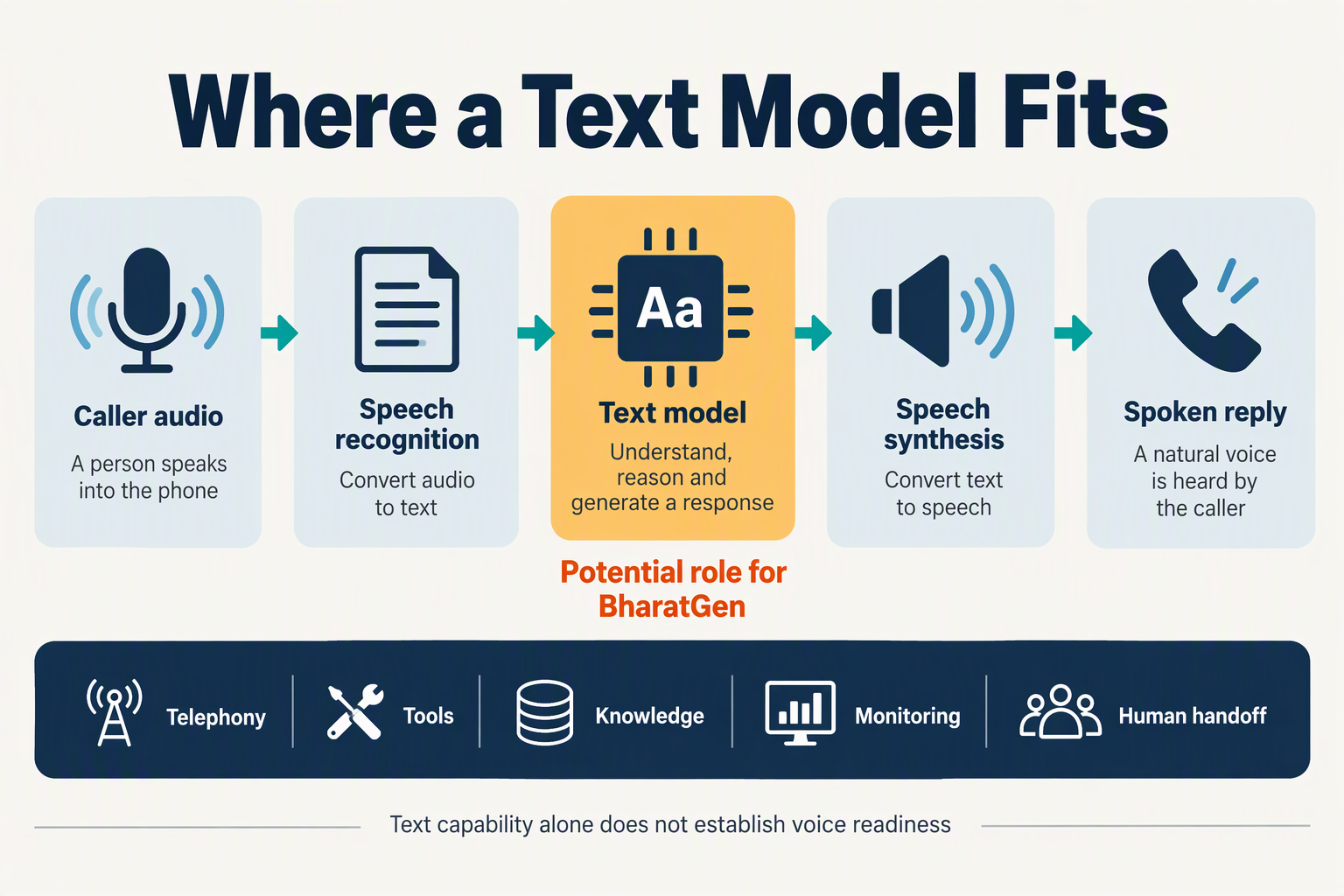
The BharatGen Text Model could provide a reasoning layer that connects a customer’s request to an appropriate business action—if testing demonstrates reliable multilingual understanding and instruction-following. It should not be treated as a complete voice agent: a text model does not, by itself, provide telephony, interruption handling, speech processing, or operational safeguards.
What does “sovereign LLM” mean for a business deploying voice AI?
In the Press Information Bureau account available as of October 2026, Union Minister Dr. Jitendra Singh describes BharatGen as a “government-owned sovereign” multilingual large language model. That positioning makes domestic AI development central to the discussion, but it is not a technical specification for a deployable customer-service system.
For businesses, sovereignty and deployment suitability are separate questions. Before adopting the BharatGen Text Model, teams should establish where inference runs, what access conditions apply, how customer data is handled, and whether the available deployment supports their workload.
An India-backed model does not automatically mean every application using it stores all data in India. Transcription services, application logs, external tools, and customer databases each have their own data flows.
What could a multilingual reasoning layer actually change?
The potential improvement is better interpretation of a request in its business context, rather than simply producing a grammatically correct reply.
Consider an illustrative customer request: “Kal wala order cancel mat karna—bas address change kar do.” The intended action is to change the address, not cancel the order. A useful reasoning layer must preserve that negation, resolve which order the customer means, and check whether an address change is still permitted.
A well-designed workflow would:
- Clarify the reference: identify the relevant order rather than guessing what “kal wala” means.
- Retrieve current information: check order status and the applicable address-change policy.
- Request missing details: collect the new address and any required confirmation.
- Execute an authorised action: call the appropriate business tool only after validation.
- Report the actual result: distinguish a successful update from a rejected or pending request.
These are proposed evaluation tasks, not demonstrated BharatGen capabilities. For building voice AI agents for India, the important question is whether a candidate model handles such distinctions consistently across the languages customers actually use.
Which capabilities must remain outside the text model?
Even excellent reasoning needs an application that controls execution. The model can propose an action; the surrounding system must decide whether that action is allowed.
Keep responsibilities explicit:
- Conversation management: track turns, interruptions, confirmations, and unresolved requests.
- Tool security: validate arguments and enforce customer permissions before changing records.
- Failure handling: provide a fallback when a service times out or returns incomplete information.
- Human escalation: transfer uncertain or sensitive cases instead of improvising answers.
As of October 2026, CallMissed’s verified product facts list knowledge-base retrieval from text, web pages, and PDFs, custom REST tools, and live call handoffs between agents. These capabilities illustrate the application infrastructure needed around a reasoning model; they do not establish a BharatGen integration.
What should developers verify before choosing BharatGen?
Treat BharatGen as a candidate component, not an assumed upgrade. The supplied official descriptions establish the initiative’s positioning, but do not provide text-model benchmarks, inference latency, tool-calling reliability, or deployment terms.
The practical next step is a controlled comparison using consented or synthetic customer conversations. Measure correct intent, appropriate clarification, authorised tool use, and truthful reporting of outcomes—not just fluent multilingual answers.
What do dated government announcements actually confirm about BharatGen?
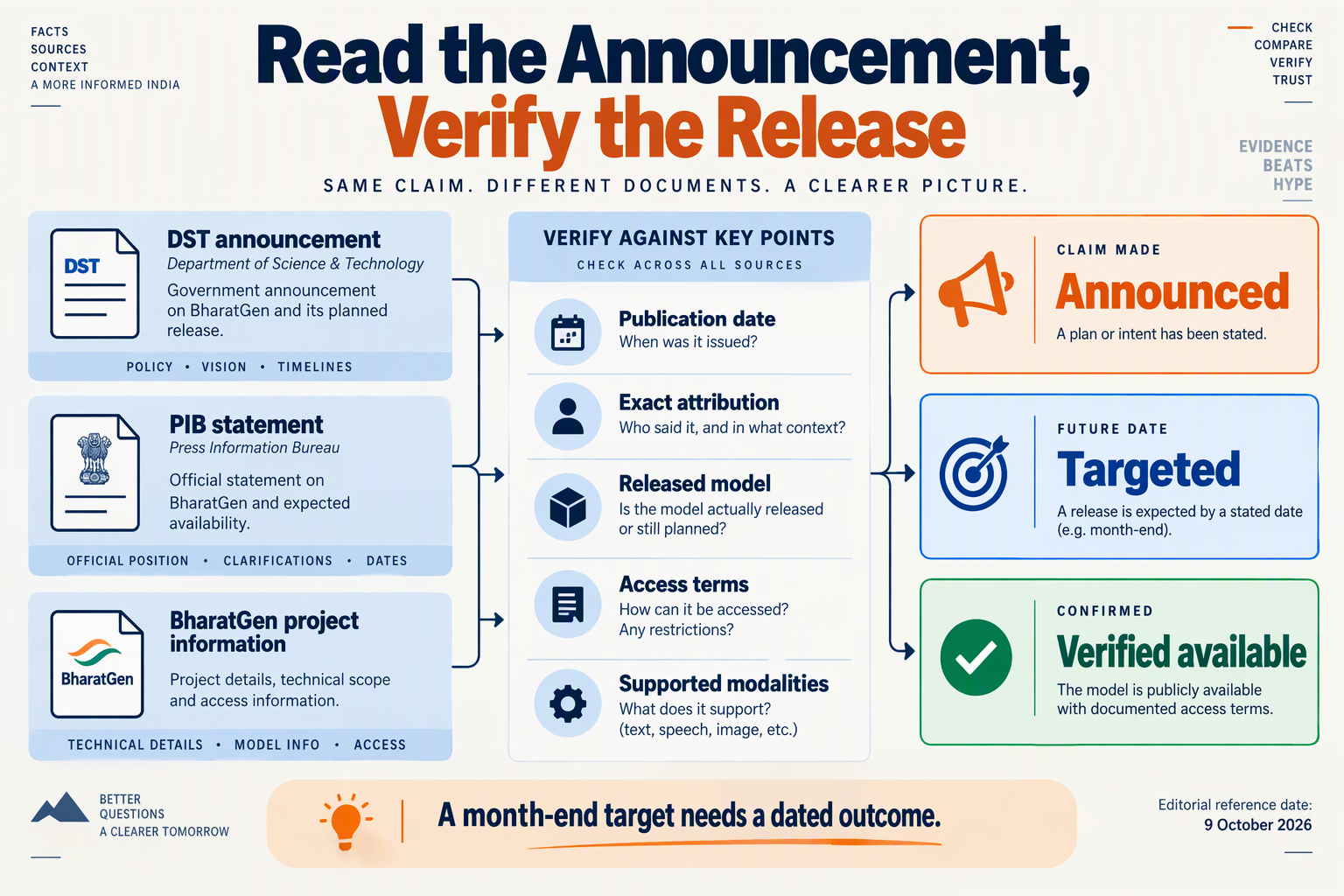
Government announcements confirm BharatGen’s official sovereign-AI positioning and government backing, but the excerpts available for this October 2026 review do not establish a fully released, production-ready voice-agent stack. Crucially, the supplied results omit publication dates, so references to “today” and “month-end” cannot safely be treated as October 2026 milestones.
What do the government sources actually say about BharatGen?
The Department of Science and Technology (DST) describes Minister Dr. Jitendra Singh hailing BharatGen as India’s first “sovereign multilingual and multimodal” AI-driven large language model. That confirms the government’s stated positioning; it does not independently establish comparative performance or availability.
A Press Information Bureau (PIB) excerpt describes BharatGen as “government-owned” and sovereign multilingual AI. BharatGen’s own overview describes a Government of India-backed initiative spanning models, datasets, and research, reinforcing that this is a broader programme rather than merely a text-generation product.
The distinction matters when interpreting the minister’s statement, reported by PIB, that artificial intelligence is “no longer an option but an essential component of working in every sphere of life.” That is a policy signal about AI adoption—not a technical specification for the BharatGen Text Model.
Read these announcements as evidence of:
- Official sponsorship and direction: sovereign, India-focused AI is a stated government priority.
- Programme scope: multilingual and multimodal development extends beyond a single chatbot.
- Public development ambitions: Indian-language coverage is central to the initiative.
Do not read them as certification of accuracy, latency, deployment security, or commercial service guarantees.
Does the 22-language announcement confirm completed models?
BharatGen’s supplied reporting describes a goal of finishing AI models for 22 Indian languages “by month-end”; the excerpt does not provide the publication date needed to identify that deadline. As of this October 2026 review, that evidence supports a reported target, not a verified completion claim.
Three details remain unresolved:
- Which month was intended? A relative deadline needs the original announcement’s date.
- What counts as completion? Training completion, evaluation, public release, and API availability are different milestones.
- Which capabilities cover each language? Text understanding, speech recognition, and speech synthesis require separate evidence.
For example, a model release covering a language would not automatically establish reliable recognition of spoken addresses or natural pronunciation of customer names. Those are distinct voice-system requirements.
How should developers turn announcements into deployment decisions?
For teams building voice AI agents for India, the useful next step is an evidence checklist—not assuming that official endorsement equals integration readiness.
Before selecting BharatGen as a reasoning layer, request:
- A dated release record: model name, version, release date, and supported languages.
- Access and licensing details: downloadable weights or hosted access, permitted uses, and deployment restrictions.
- Language-specific evaluations: named datasets, test methods, and results rather than one aggregate multilingual score.
- Operational documentation: context limits, tool-use support, hosting requirements, and measured response times.
The supplied government excerpts provide none of those technical details. That does not mean the capabilities are absent; it means these announcements alone cannot substantiate them.
The practical conclusion is straightforward: government announcements establish BharatGen’s strategic significance; dated releases and reproducible evaluations must establish its suitability for customer conversations. Keeping those evidence categories separate lets businesses follow India’s sovereign AI progress without mistaking a development milestone for a deployment guarantee.
Which sovereign AI developments are announcements, targets or usable releases?
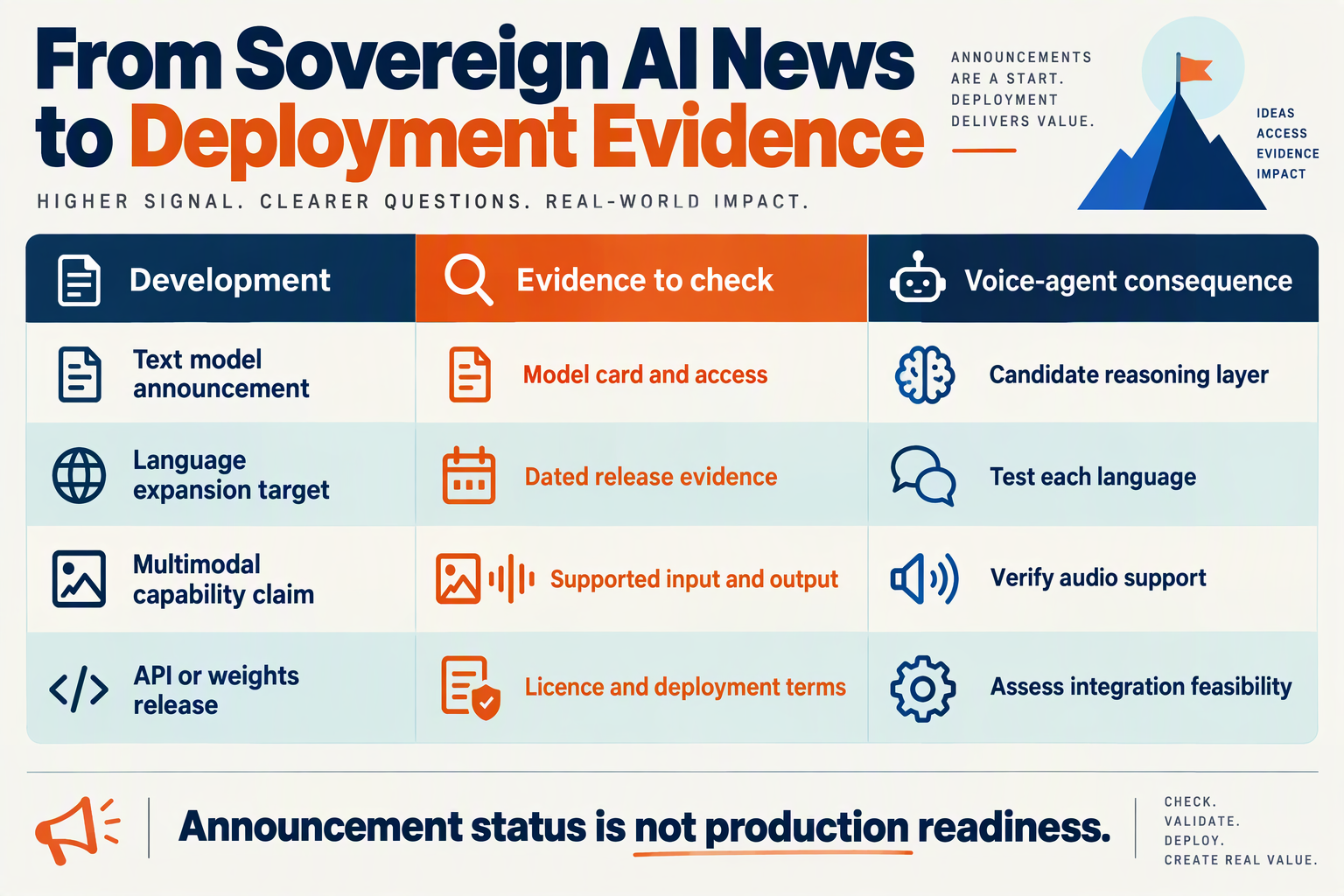
The supplied BharatGen sources establish official announcements and development targets, but do not establish a production-ready release of every component. As of October 2026, teams should distinguish government positioning, promised milestones, and independently testable software before choosing a sovereign LLM for voice-agent deployment.
That distinction does not diminish the initiative’s significance. It determines whether a development belongs on your technology watchlist, in a prototype, or in a customer-facing system.
Which BharatGen claims are announcements rather than release evidence?
The following classification reflects the supplied Department of Science and Technology, Press Information Bureau, and BharatGen material available for this October 2026 review. “Not established” means the supplied evidence is insufficient—not that the capability does not exist.
| Development or claim | Named source | Evidence category | Voice-agent implication |
|---|---|---|---|
| BharatGen described as India’s first “sovereign multilingual and multimodal” AI-driven LLM | Department of Science and Technology | Official positioning | Signals strategic direction; does not establish conversational performance |
| BharatGen described as government-owned | Press Information Bureau | Ownership announcement | Relevant to governance; verify deployment and data-handling arrangements separately |
| Initiative spans models, datasets, and research | BharatGen’s “About” overview | Programme scope | Indicates a broader stack, not a single deployable endpoint |
| Completion of models for 22 Indian languages “by month-end” | BharatGen’s milestone report | Reported target | Requires dated completion evidence and language-specific testing |
| Production access to the BharatGen Text Model | Supplied research excerpts | Not established | Confirm model identifier, access route, licence, and documentation |
| End-to-end, real-time multilingual voice-agent readiness | Supplied research excerpts | Not established | Test speech components, streaming, tool use, and conversational delay |
According to BharatGen’s milestone report reviewed in October 2026, the initiative targeted completing AI models for 22 Indian languages “by month-end”; the supplied excerpt does not identify which month or confirm completion. Consequently, that phrase should not become “available this month” in a procurement document.
What makes a sovereign AI model a usable release?
For building voice AI agents for India, a usable release needs an identifiable artifact and a reproducible access path. Depending on the release format, that could mean downloadable weights with a licence, or a documented hosted API with clear usage terms.
Before promoting an announcement into your deployment roadmap, request:
- Release identity: model name, version, release date, and model card.
- Access and rights: endpoint or repository, authentication requirements, licence, and commercial-use conditions.
- Operational behaviour: streaming support, context limits, structured outputs, and documented tool-calling behaviour where required.
- Language evidence: results for each intended language, including code-mixed conversations—not only an aggregate multilingual score.
These are verification criteria, not claims that BharatGen currently provides or lacks those features.
How should businesses interpret the government’s AI message?
The Press Information Bureau material supplied for this October 2026 review quotes Union Minister Dr. Jitendra Singh: “Artificial Intelligence is no longer an option but an essential component of working in every sphere of life.” That is a policy signal supporting adoption, not a technical acceptance test.
A practical response is to separate strategic commitment from deployment approval. For example, a lender exploring the BharatGen Text Model could prepare a consented Hindi–English evaluation set now, while making production adoption conditional on verified access and successful testing.
The decision rule is straightforward: announcements justify investigation, targets guide monitoring, and verified releases enable evaluation. Customer-facing deployment requires one further step—evidence that the complete voice-agent system works reliably in the business’s actual conversations.
How should you compare BharatGen, Sarvam and BharatGPT across the Indian language AI stack?
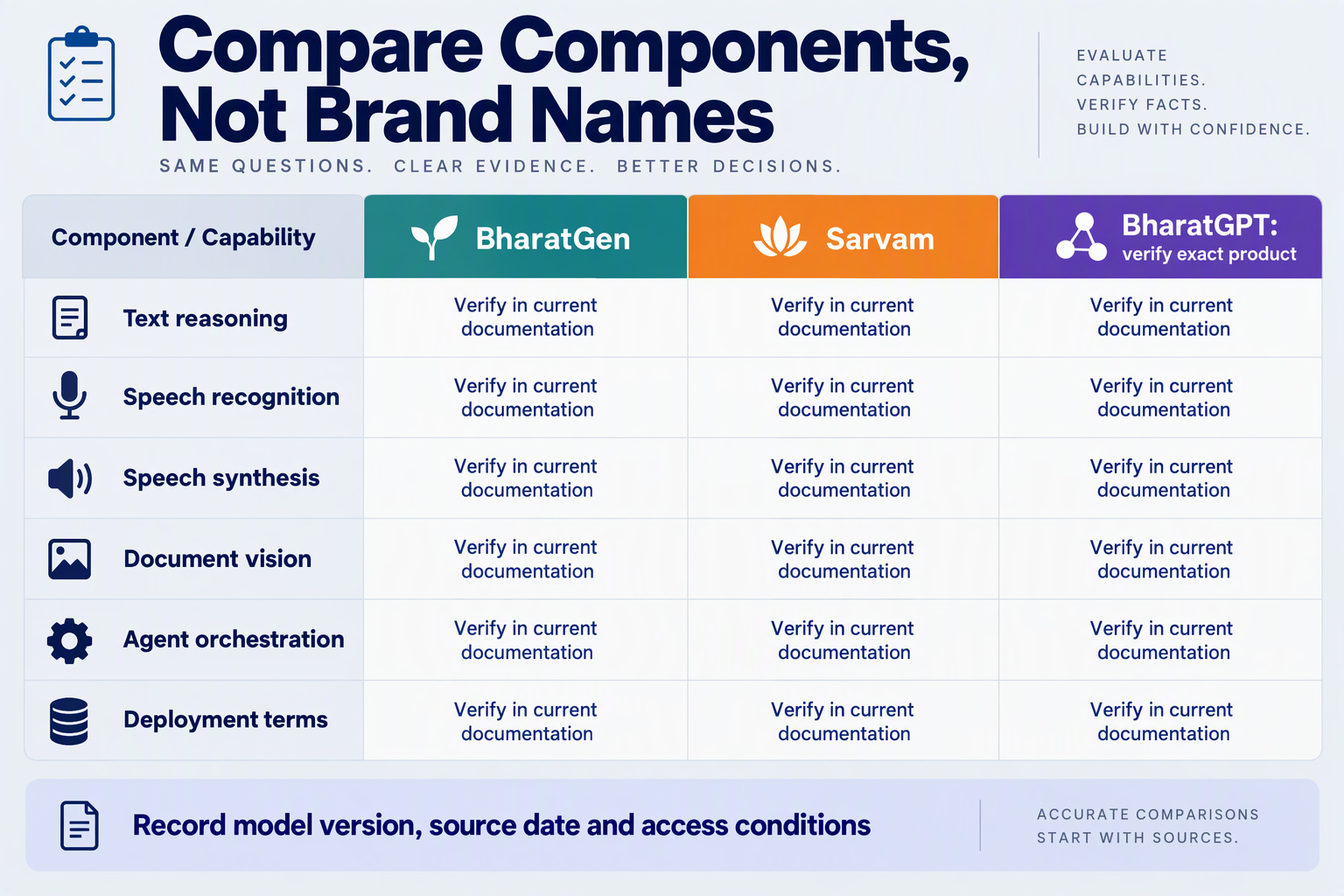
Compare BharatGen, Sarvam AI and BharatGPT by stack layer, verifiable deployment options and language-specific test results—not by their names alone. As of October 2026, the supplied sources establish BharatGen’s government-backed positioning, but do not provide equivalent specifications or comparative benchmarks for Sarvam AI and BharatGPT.
That evidence gap matters: a sovereign AI initiative, a model provider and a branded AI offering are not automatically interchangeable components for building voice AI agents for India.
What does the available evidence establish about each offering?
The following comparison separates documented facts from questions that require current product documentation. “Verify” means the supplied research does not establish the capability—not that the capability is absent.
| Comparison axis | BharatGen | Sarvam AI | BharatGPT |
|---|---|---|---|
| Identity and scope | BharatGen describes a government-backed initiative covering models, datasets and research | Named as a model maker in the supplied API catalogue | Confirm the exact provider, product and model version |
| Sovereignty evidence | DST calls BharatGen “sovereign multilingual and multimodal” | Verify ownership, hosting and processing terms separately | Verify ownership, hosting and processing terms separately |
| Language coverage | BharatGen reports a development target of 22 Indian languages | Verify coverage for each selected model and task | Verify coverage for the specific offering |
| Text-model suitability | Evaluate the BharatGen Text Model for reasoning, retrieval and tool use | Identify and test the exact text model | Establish whether the offering exposes a usable text-model API |
| Speech capabilities | Verify available speech models and interfaces; initiative scope is not a voice-service specification | Verify speech recognition and synthesis independently | Verify whether speech is native or supplied through integrations |
| Production evidence | Request endpoint, licensing and performance documentation | Request model-level pricing, limits and benchmarks | Request provider-level documentation and reproducible benchmarks |
According to BharatGen’s reporting available as of October 2026, completing models for 22 Indian languages is a stated development target; that statement does not establish production performance across every speech and text task. The Department of Science and Technology’s description establishes official positioning, not an independently measured advantage over another provider.
Which tests make this comparison useful for voice agents?
Use the same representative recordings, business knowledge and tool schemas across candidates. Keep the speech recognizer and speech synthesizer constant when comparing language models; otherwise, transcription or voice-generation differences can obscure the reasoning result.
Measure:
- Recognition accuracy: word error rate, plus separate accuracy checks for names, addresses, amounts and account identifiers.
- Task completion: whether the agent resolves the request or correctly escalates—not merely whether its answer sounds fluent.
- Tool reliability: valid arguments, correct tool selection and confirmation before consequential actions.
- Conversational responsiveness: median and tail response times, including retrieval and tool execution.
- Operating cost: total cost per successfully completed interaction, including retries and telephony.
For example, test a delivery-rescheduling request that switches languages halfway through. Score whether the agent preserves the date, retrieves the right order and obtains confirmation before changing it.
How should developers approach integration and procurement?
Separate model choice from orchestration choice. As of October 2026, CallMissed’s verified fact sheet lists Sarvam among its API catalogue’s model makers and provides OpenAI-compatible endpoints; developers should still confirm the particular model and capabilities needed for a Sarvam AI integration.
Before procurement:
- Identify the exact model version and deployment route.
- Verify retention, hosting, licensing and commercial terms.
- Run a language-by-language pilot with human escalation.
The strongest choice is the stack that meets your measured requirements—not the offering with the broadest multilingual or sovereignty label.
How do you build a real-time multilingual voice AI agent, including Sarvam AI integration where supported?
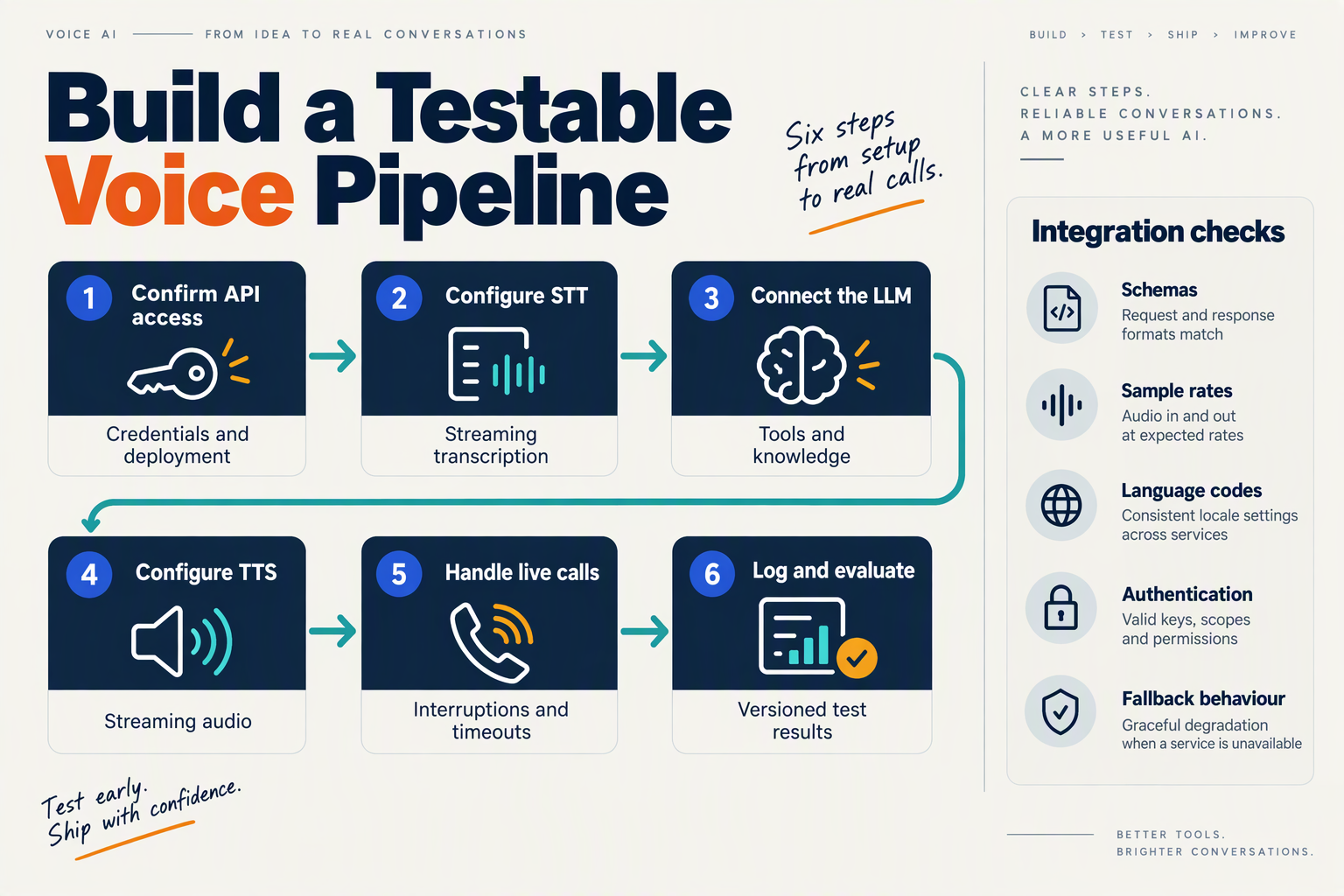
Build a real-time multilingual voice AI agent as a streaming pipeline with explicit language handling, cancellable speech, validated business tools, and human escalation. Add Sarvam AI integration only after confirming that the selected endpoint supports your required language, audio format, and streaming mode—not simply because the provider appears in a model catalogue.
What should you configure before connecting the models?
Start with one bounded task, such as checking an order’s status, rather than an unrestricted customer-service assistant. Define the supported languages, authentication requirements, permitted actions, and conditions for transferring the conversation to a person.
For an initial Hindi–English order-status agent, specify:
- Inputs: spoken order number and customer verification details.
- Knowledge: delivery policies retrieved from approved documents.
- Tool: an authenticated order-status lookup with a strict input schema.
- Fallback: ask for clarification when an identifier is uncertain; escalate after repeated failure.
Keep language preference separate from transcription output. An English product name inside a Hindi sentence should not automatically switch the entire conversation to English.
How do you connect the real-time audio pipeline?
Use this implementation sequence:
- Establish the audio session. Connect the phone or browser audio transport and confirm codec, sample rate, channel count, and session authentication.
- Stream speech recognition. Display partial transcripts if useful, but avoid executing consequential actions from unfinished speech. Use endpoint detection to identify when the customer has finished a turn.
- Run the language model. Supply the finalized transcript, conversation state, retrieved evidence, and permitted tool definitions. Validate tool arguments server-side before execution.
- Stream the spoken response. Send complete, speakable phrases to text-to-speech rather than waiting for an entire long answer.
- Handle interruptions. When the customer speaks again, cancel queued audio and outstanding generation where supported. Record what was actually played so conversation history does not assume the customer heard an interrupted answer.
This last step distinguishes a responsive agent from a chatbot that merely reads its answers aloud.
How should you add Sarvam AI integration where supported?
As of October 2026, CallMissed’s verified product information lists Sarvam among its developer API catalogue providers and offers OpenAI-compatible endpoints plus a managed voice-agent WebSocket. Those facts do not establish that every Sarvam model supports every endpoint or real-time voice capability; verify the exact model and interface before connecting them.
For either direct access or a gateway, check:
- Modality: speech recognition, language-model inference, or speech generation.
- Compatibility: streaming behavior, audio encoding, authentication, and request schema.
- Language coverage: the specific language and code-mixed combinations your users speak.
- Operations: cancellation, timeout behavior, rate limits, and data-handling terms.
Place provider-specific code behind separate speech-recognition, reasoning, and speech-generation adapters. BharatGen’s official overview, available as of October 2026, describes an initiative spanning models, datasets, and research; it does not, in the supplied context, establish a production streaming API for the BharatGen Text Model. Keep that model’s future integration conditional on documented availability.
How do you know the agent is ready for customers?
Test complete conversations, not isolated model demos. Measure end-of-turn-to-first-audio delay, identifier accuracy, successful tool execution, interruption recovery, and human-handoff completion separately for each language.
Include noisy calls, regional accents, corrections, silence, and mid-sentence language switches. For building voice AI agents for India, the release decision should follow these task-level results—not a provider’s headline language count.
How should you test voice AI for Indian languages beyond language-count claims?
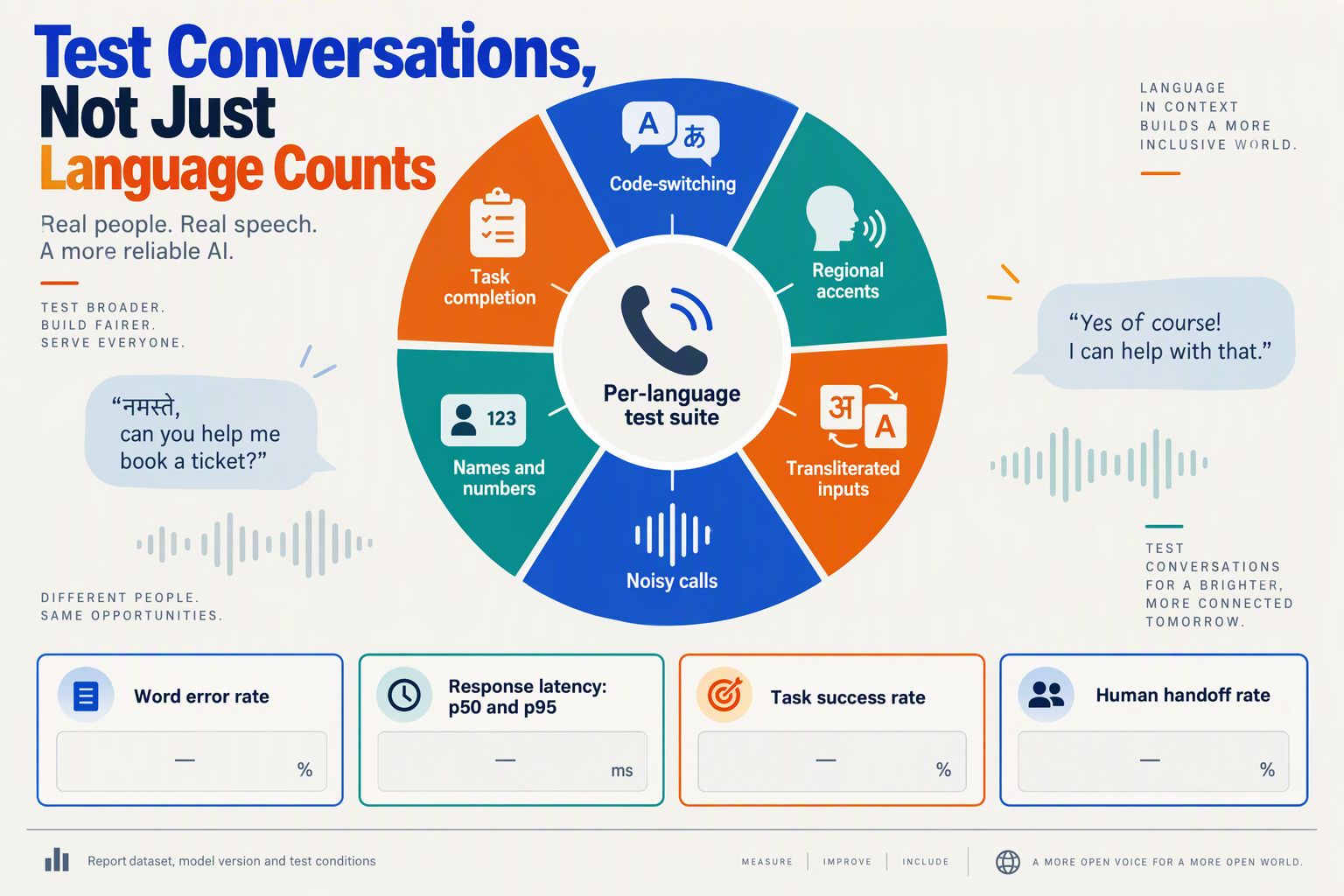
Test voice AI for Indian languages with language-specific, end-to-end conversations—not a checklist of supported languages. Measure whether customers can complete tasks accurately under realistic accents, code-switching, background noise, interruptions, and ambiguous requests.
What should an Indian-language voice AI test set include?
Build the evaluation around your customers’ speech and workflows. A clean recording of formal Hindi cannot establish readiness for a caller mixing Hindi, English product names, and a local place name over a noisy phone connection.
Use this proposed starting protocol—not an industry benchmark:
- Define customer segments: identify priority languages, regional accents, common devices, and actual calling conditions.
- Create representative tasks: include booking changes, order tracking, address confirmation, complaints, and requests for a human.
- Vary the delivery: test code-mixing, hesitations, self-corrections, interruptions, and different speaking speeds.
- Label expected outcomes: record the correct intent, critical entities, permitted tool action, and appropriate escalation.
- Keep a held-out set: reserve conversations that developers have not used to tune prompts or pronunciation handling.
Use consented, appropriately protected recordings where possible. Synthetic examples can supplement coverage, but should not replace real speech or native-speaker review.
Which metrics reveal whether multilingual voice agents actually work?
Track each component separately, then measure the complete interaction. Otherwise, a transcription improvement can conceal a reasoning failure—or a fluent reply can conceal an incorrect business action.
- Speech recognition: report word error rate alongside accuracy for names, amounts, dates, addresses, and order identifiers. State how you normalize spelling and mixed-script transcripts.
- Intent and entity accuracy: check whether the agent understands what the customer wants and extracts the details required to act.
- Tool execution: verify both the selected action and its arguments. “Change my appointment” must not trigger a cancellation.
- Task completion: count independently verified outcomes, not just conversations the agent labels successful.
- Conversational timing: measure end-of-speech-to-first-audio delay at the median and 95th percentile, plus interruption recovery.
- Spoken usability: ask native speakers to assess intelligibility, pronunciation, politeness, and whether clarification sounds natural.
For example, in a hypothetical evaluation, 90 completed tasks out of 100 calls equals 90% task completion. But that aggregate is misleading if Hindi succeeds on 49 of 50 calls while Tamil succeeds on 41 of 50: the language-specific results are 98% and 82%.
Report sample sizes and uncertainty alongside percentages. Small test sets should not support sweeping readiness claims.
How should teams set release gates and compare model changes?
Define acceptance criteria before comparing stacks, and make them specific to business risk. An incorrect payment amount deserves a stricter gate than an awkward greeting; unauthorized actions should block release regardless of average satisfaction.
Run the same held-out conversations against each candidate stack, changing one component at a time where practical. For any proposed BharatGen Text Model integration, distinguish improvements in reasoning from changes caused by speech recognition, voice generation, or orchestration.
As of October 2026, CallMissed provides eval suites, A/B experiments, and call scoring against a team’s own QA rubrics, according to its verified product fact sheet. These capabilities support repeatable evaluation; teams must still define representative datasets and meaningful release gates.
The Department of Science and Technology’s account available as of October 2026 describes BharatGen’s ambition as AI that is “ethical, inclusive, multilingual, and deeply rooted” in India. For deployment decisions, inclusion should mean demonstrably usable conversations across customer groups—not merely more languages on a product page.
Does an Indian-built LLM make your whole voice-agent stack sovereign?
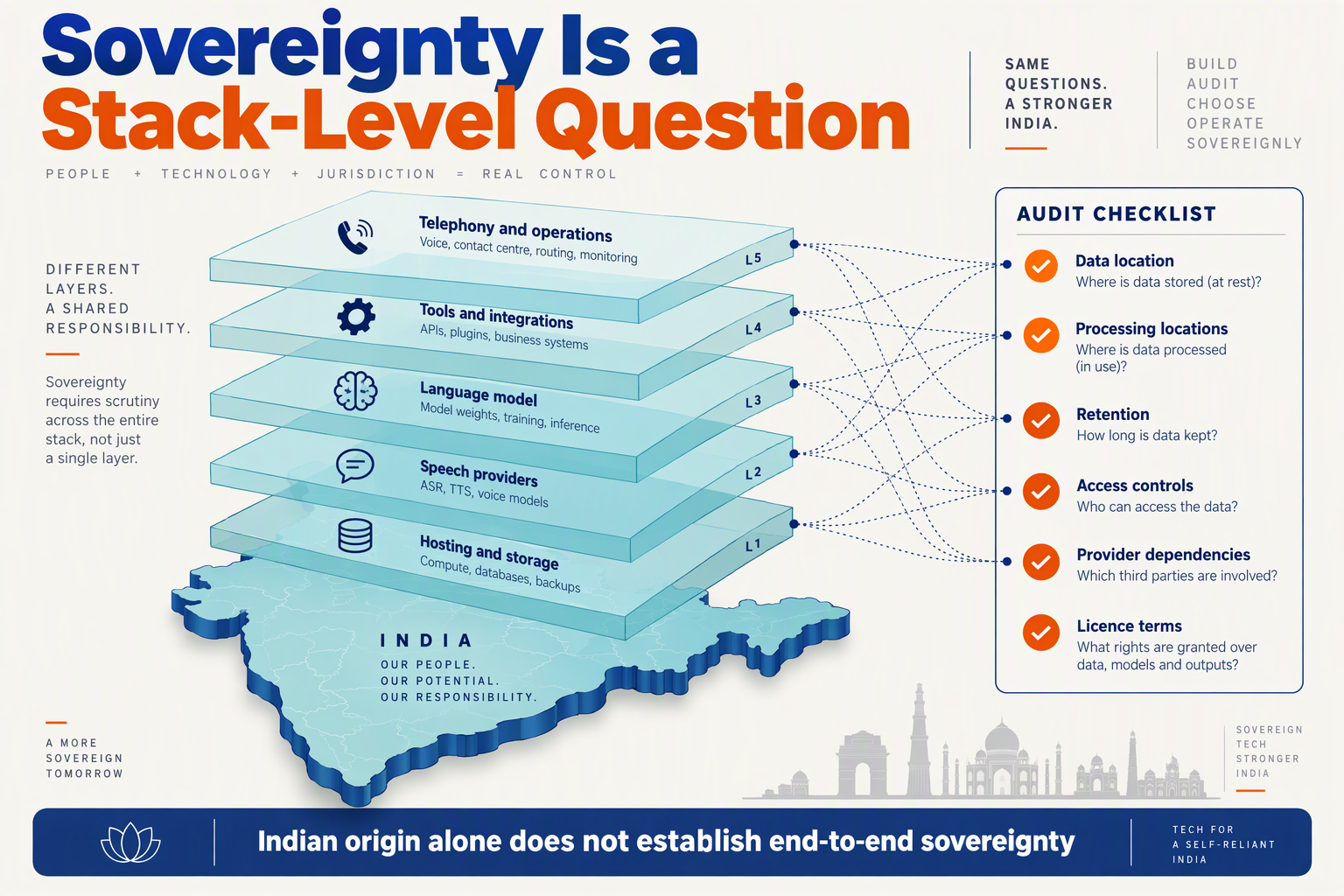
No—an Indian-built LLM does not automatically make your whole voice-agent stack sovereign. Sovereignty depends on where the complete system processes data, who controls its infrastructure, and which external services receive customer information—not just where the language model was developed.
In material available as of October 2026, the Press Information Bureau describes BharatGen as a “government-owned sovereign multilingual” initiative. That positioning concerns BharatGen; it does not automatically extend to every application, cloud service, or telephone integration connected to a BharatGen-based agent.
What is the difference between model sovereignty and stack sovereignty?
Model sovereignty concerns control over the model and its development. Stack sovereignty extends that question to the infrastructure and operational dependencies surrounding the model.
For procurement, separate three concepts that are often bundled together:
- Indian-built: describes the origin of a model or platform.
- India-hosted: describes where specified infrastructure runs.
- Operationally controlled: describes who can access, administer, update, or disconnect the system.
These properties can overlap, but none proves the others. For example, an Indian-developed model served through an overseas endpoint could still send inference data outside India. Conversely, hosting an application in India does not establish that every downstream API processes data there.
BharatGen’s overview, available as of October 2026, describes an initiative spanning models, datasets, and research. Businesses should treat that broad scope as a reason to investigate deployment options—not as evidence that a particular voice-agent implementation meets every sovereignty requirement.
Which voice-agent components need a sovereignty check?
When building voice AI agents for India, trace the actual data path rather than evaluating the LLM in isolation. Include both live processing and the records created afterward.
- Telephony and audio transport: Where do carriers, media gateways, and real-time connections handle customer audio?
- Speech recognition and speech generation: Which endpoints receive audio or response text, and where does processing occur?
- LLM inference and retrieval: Where are prompts, retrieved documents, embeddings, and conversation history processed or stored?
- Business tools: Do CRM, scheduling, payment, or support integrations transfer information to additional providers?
- Observability and recovery: Where do recordings, logs, backups, evaluation datasets, and fallback requests go?
A local primary model is insufficient if an automatic fallback sends the same conversation elsewhere. Likewise, a locally processed call can generate transcripts that subsequently enter a separately hosted analytics system.
What evidence should buyers request before claiming sovereignty?
Ask vendors for a component-level data-flow map, supported by contractual commitments. Useful questions include:
- Which processing locations are guaranteed, and which are merely preferred?
- Who are the subprocessors, and what information does each receive?
- Can administrators restrict external endpoints and fallback models?
- What are the retention, deletion, backup, and remote-access arrangements?
- Can the system continue operating if an upstream provider becomes unavailable?
As of October 2026, CallMissed’s verified product facts state that the AI customer-communication platform is hosted in India. That is a concrete hosting fact; buyers should still verify the processing arrangements of their selected speech models, LLM endpoints, carriers, and integrations before describing an entire deployment as sovereign.
The practical implication is straightforward: the BharatGen Text Model could contribute to a sovereign architecture, but sovereignty must be demonstrated across the deployed system. Claim only the boundaries you can document—such as India-hosted application infrastructure or specified in-country processing—rather than applying an unqualified label to the whole stack.
What do policymakers and engineers say—and which claims need independent evidence?

Policymakers frame BharatGen as a sovereign, inclusive AI initiative; engineers evaluating it for voice agents need evidence of reproducible performance and operational control. Official statements establish policy intent—not independent proof that the BharatGen Text Model is ready for a particular customer-facing workflow.
What are policymakers actually saying about BharatGen?
In the Press Information Bureau material supplied for this article, available as of October 2026, Union Minister Dr. Jitendra Singh describes artificial intelligence as “no longer an option but an essential component of working in every sphere of life.” That statement signals the government’s view of AI as foundational infrastructure, rather than an optional experiment.
The Department of Science and Technology’s account, available as of October 2026, calls BharatGen India’s first “sovereign multilingual and multimodal” AI-driven large language model. BharatGen’s own overview describes a Government of India-backed initiative encompassing models, datasets, and research.
These sources establish the initiative’s official positioning and institutional backing. However, government ownership, domestic hosting, control over model weights, and restrictions on downstream data processing are distinct properties. Procurement teams should ask which definition of “sovereign” applies to the specific service they intend to deploy.
What engineering evidence is missing from the supplied sources?
The supplied context contains no named engineer’s technical assessment, reproducible benchmark report, or independent production evaluation. It would therefore be misleading to present an engineering consensus on BharatGen’s readiness.
For teams building voice AI agents for India, the useful engineering question is narrower: Can this model complete our workflows under our operating conditions? A demonstration of fluent conversation cannot establish reliable account verification, appointment booking, or complaint resolution.
Request an evidence package containing:
- Model identification: the exact release, version, configuration, and access method tested.
- Evaluation provenance: who designed the tests, whether test data overlaps with training data, and whether another team can reproduce the results.
- Language-level results: separate findings for each supported language and code-mixed scenario, rather than one aggregate score.
- Failure disclosure: examples of incorrect tool calls, unsupported answers, and missed escalation conditions.
- Deployment documentation: data flows, retention rules, dependency locations, and access controls.
Which claims most need independent verification?
Three claims deserve particular scrutiny:
- “Supports 22 Indian languages.” BharatGen’s reporting available as of October 2026 describes a target of completing models for 22 Indian languages. A development target does not establish release availability, equal quality across languages, or support for every speech component. The supplied “month-end” wording lacks enough publication context to establish an October deadline.
- “Sovereign means customer data stays in India.” Verify this across the full processing chain, including transcription, model inference, speech generation, logs, and external tools. The label alone does not document those boundaries.
- “Ready for real-time voice agents.” Require end-to-end tests with realistic audio, interruptions, concurrent sessions, and failed dependencies—not text-only model results.
As of October 2026, CallMissed’s verified fact sheet lists caller-chosen fallback models, usage and request logs, and an OpenAI-compatible developer API. Those capabilities illustrate how teams can compare model behavior and investigate failures; they do not independently validate BharatGen.
The practical standard is claim-to-evidence traceability: every deployment-critical promise should map to a documented property, a repeatable test, or an enforceable contractual commitment. Policy ambition explains why the stack matters; independent evidence determines where businesses can safely use it.
What should your team pilot next—and where can CallMissed support speech and live-call testing?
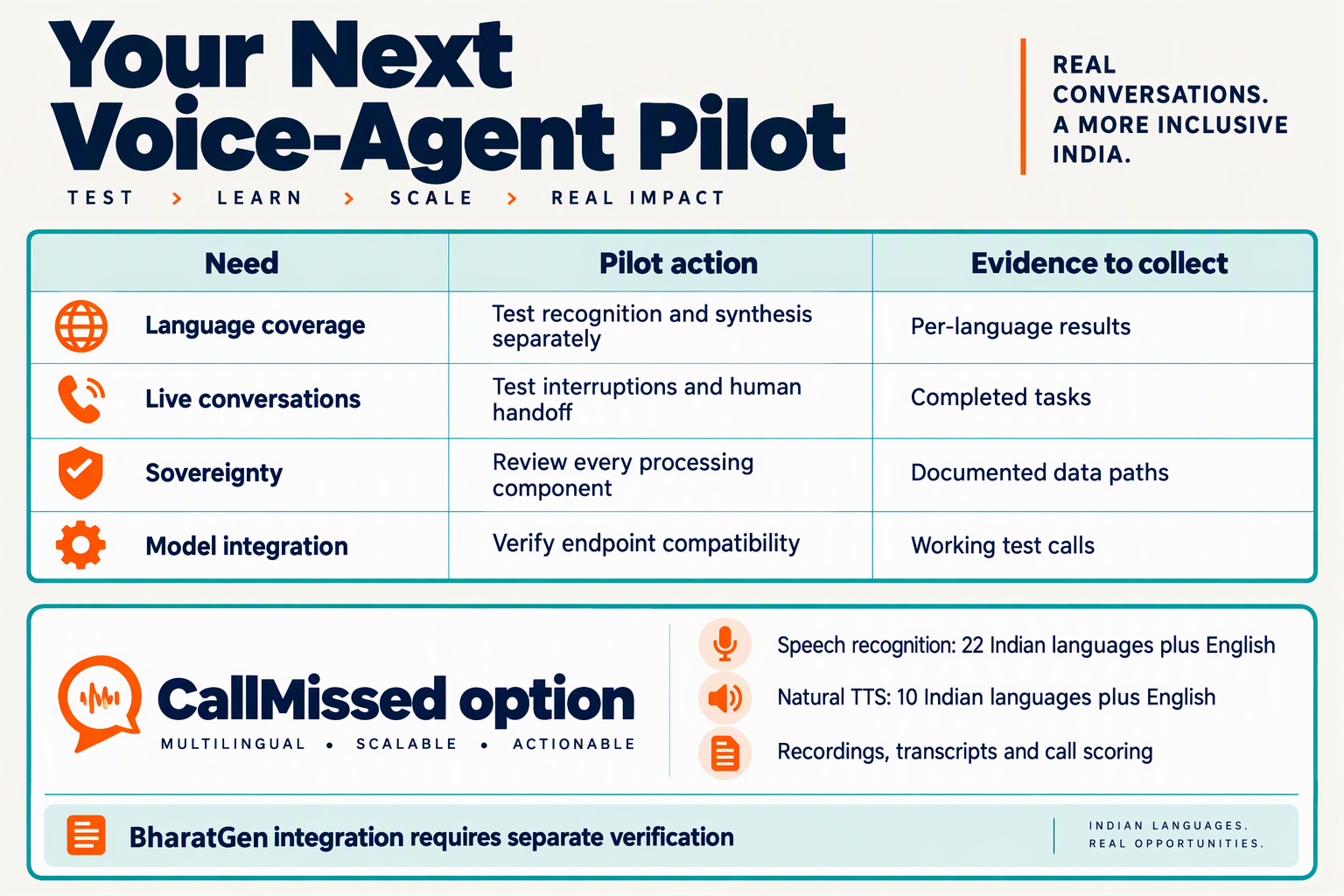
Pilot one narrow customer workflow across your priority languages, then compare speech accuracy, task completion, and live-call reliability before expanding. CallMissed can support speech-component experiments and supervised call testing, but treat any BharatGen Text Model integration as a separate dependency to verify—not an assumed platform capability.
Which multilingual voice-agent tests should you run first?
Start with a bounded task such as checking an order’s status or answering appointment questions. Keep the business knowledge, tool permissions, and test conversations consistent so that changing a model does not also change the task.
The following is a proposed pilot plan, not a published benchmark or a claim about any model’s performance.
| Pilot | Test input | Measure | Expansion gate |
|---|---|---|---|
| Speech recognition | Regional accents, names, addresses, background noise | Word error rate; critical-field accuracy | Required identifiers captured correctly |
| Code-mixed understanding | Hindi-English switches and regional expressions | Intent accuracy; clarification frequency | Agent clarifies instead of guessing |
| Knowledge-grounded answers | Policy questions with approved reference documents | Answer correctness; unsupported claims | Answers match approved material |
| Tool execution | Order lookup or appointment request | Correct arguments; successful execution | Actions occur only with required details |
| Spoken responses | Prices, dates, unfamiliar names | Listener comprehension; pronunciation errors | Customers understand actionable details |
| Supervised live calls | Interruptions, silence, escalation requests | Response delay; task completion; takeover success | Failures remain recoverable |
Score critical fields separately from overall transcription. A transcript can look accurate while containing the wrong order number. Likewise, a fluent answer is not successful if the agent retrieves another customer’s information.
For latency, measure elapsed time from the caller finishing a turn to the first audible response. Report typical and slower-tail results separately; an average alone can conceal frustrating pauses.
Where can CallMissed support the pilot?
According to CallMissed’s product specifications, as of October 2026, its developer API provides 45 speech-to-text models, nine text-to-speech models, and 24 realtime voice-agent models through one API key and balance. Its catalogue includes Sarvam, making it relevant to teams investigating Sarvam AI integration, although teams should verify the exact available model and endpoint before choosing an implementation.
For live-call testing, CallMissed’s October 2026 specifications include:
- A no-code agent builder with knowledge bases, custom REST tools, and version publishing and rollback.
- Web voice sessions and phone calls, using rented numbers or a supported external carrier.
- Supervisor monitoring, with listen, whisper, and barge-in controls.
- Recordings, transcripts, QA scoring, evaluation suites, and A/B experiments for reviewing outcomes.
For budgeting, CallMissed lists its Standard voice-agent plan at ₹4 per minute as of October 2026, covering speech recognition, the language model, and voice; phone carriage is separate. Ten connected calls lasting two minutes each would therefore cost ₹80 for those agent components, before carriage, with a 30-second minimum per call.
What should determine whether you expand?
The Department of Science and Technology’s account available as of October 2026 describes BharatGen as “sovereign multilingual and multimodal.” That positioning makes evaluation worthwhile, but it does not replace workflow-specific evidence.
Before increasing traffic:
- Confirm access and deployment requirements for the BharatGen Text Model.
- Set language-specific acceptance criteria using your existing service quality as the baseline.
- Document failure handling, including clarification, blocked actions, and human takeover.
For building voice AI agents for India, expand only where measured customer outcomes justify it—not simply where language support is announced.
Frequently Asked Questions
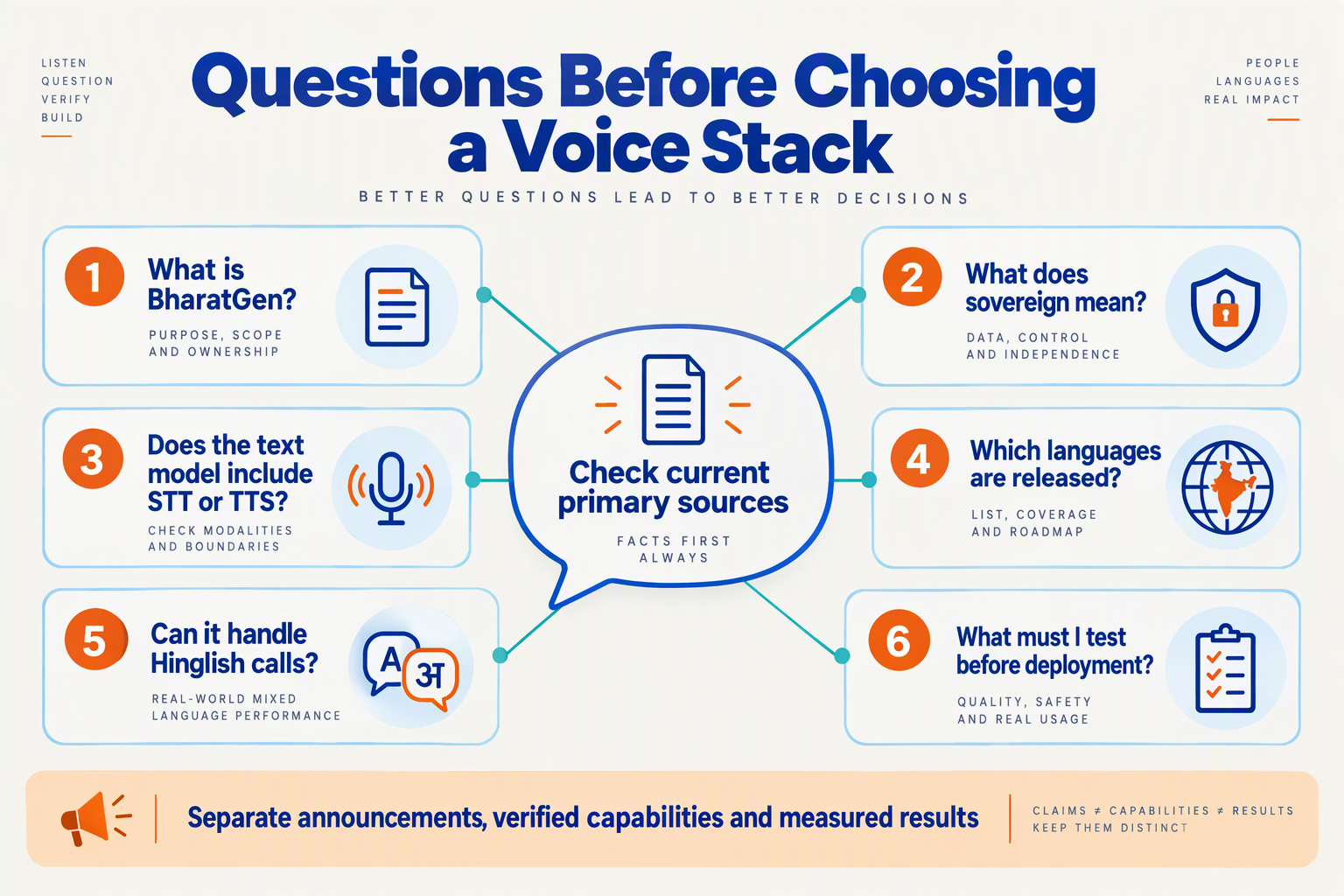
What is BharatGen, and how is the BharatGen Text Model relevant to voice agents?
Does BharatGen include speech recognition and text-to-speech?
How many Indian languages does the BharatGen Text Model support?
How should you benchmark the BharatGen Text Model for voice agents?
Does a sovereign Indian LLM guarantee data residency or regulatory compliance?
Can businesses start building voice AI for Indian languages while evaluating BharatGen?
Conclusion
The BharatGen Text Model could strengthen the reasoning layer of Indian voice agents, helping them interpret intent across languages rather than merely translate words. Its practical value will depend on how reliably that reasoning works alongside speech recognition, speech generation, business knowledge, and tools.
The Department of Science and Technology’s published account, available as of October 2026, describes BharatGen as India’s first “sovereign multilingual and multimodal” AI-driven large language model. That positioning signals an important direction for India’s AI infrastructure, but it should not be mistaken for evidence that every customer-facing use case is ready for deployment.
Four takeaways matter most for teams building voice AI agents for India:
- Reasoning is the opportunity—not a replacement for the whole voice stack. A multilingual text model could help interpret local expressions, resolve ambiguous requests, and select appropriate actions. Accurate transcription and understandable spoken responses remain separate requirements.
- Language coverage must translate into conversational reliability. BharatGen’s published material, available as of October 2026, describes a development target covering 22 Indian languages. Teams should treat that figure as a reported goal, not a guarantee of production-ready performance across every language, accent, or mixed-language conversation.
- Sovereignty and performance answer different questions. An India-focused model and dataset ecosystem could support locally relevant AI development. Businesses still need evidence of response relevance, conversational delay, safe behavior, and dependable tool execution before entrusting it with customer interactions.
- Evaluate complete conversations, not isolated answers. A customer switching between Hindi, English product names, and regional expressions tests the entire pipeline. Useful evaluations should also include interruptions, unclear requests, and cases where the agent must hand the conversation to a person.
What should businesses watch for next?
Watch for demonstrated, language-specific results and clearer deployment guidance—not simply broader announcements. The meaningful milestone will be evidence that multilingual reasoning improves complete conversations without introducing unacceptable delays or unreliable actions.
That is the practical implication of the broader trend toward AI becoming essential to everyday work: adoption must be accompanied by verification. For voice agents, the question is not whether a model can produce an impressive answer, but whether the system can consistently understand a customer and complete the right task.
Readers exploring this shift can consider CallMissed, an AI customer-communication platform that, as of October 2026, supports speech recognition in 22 Indian languages plus English, including Hinglish. That capability illustrates the speech infrastructure a multilingual reasoning layer must work alongside; it does not establish a BharatGen integration.
Before your next deployment, ask: Can your voice agent understand the customer’s meaning—and act on it reliably—in the language they actually use?
Related Reading
- Local Voice Agents: What IBM Granite 4.2 Means in 2026
- Human-in-the-Loop for AI Voice Agents: Safety Playbook
- Gemini 3.8 Text-to-Speech: What Changes for AI Agents?