AI Agent Execution: Why Support Needs Verification



Learn how AI agent execution evidence helps support teams trace handoffs, investigate errors, and distinguish signed records from correct outcomes.
AI Agent Execution: Why Support Needs Verification
An AI support agent can say “your refund is complete” without proving that any money moved. AI agent execution verification matters because a convincing response is not evidence of a completed action: support teams need to establish what ran, under whose authority, and what changed.
That distinction is timely. According to CyberNewswire’s announcement published by DevOps on September 29, 2026, Archipelo introduced Salmon, Execution Verification Infrastructure (EVI) for AI agents and autonomous systems. The supplied launch coverage describes cryptographically signed, verifiable execution records—a move toward making agent activity independently checkable rather than simply readable in a conversation transcript.
As of October 2026, the announcement offers a useful lens for customer support: when agents can invoke tools and change business records, evaluating their answers is only part of evaluating their reliability. The consequential question is whether the promised action actually happened.
Why does customer support need execution verification?
Consider a hypothetical refund workflow. A customer requests a refund, an agent checks eligibility, calls a payment tool, updates the support ticket, and sends confirmation. Each step can appear reasonable while the overall workflow fails: the payment request might be rejected, the ticket might close prematurely, or a retry might submit the same operation twice.
Execution verification infrastructure for AI agents addresses the evidence surrounding those actions. A practical verification design should help answer:
- Authorization: Was this agent permitted to issue this refund?
- Execution: Which tool was called, with which relevant inputs?
- Outcome: Did the payment system confirm success or merely acknowledge receipt?
- Traceability: Can reviewers connect the customer request, tool result, and final response?
The distinction is crucial: cryptographic evidence can establish record integrity without establishing business correctness. A signed record of an unauthorized refund remains evidence of an unauthorized refund. Verification therefore belongs alongside policy checks, outcome validation, and human escalation—not in place of them.
As of October 2026, CallMissed supports custom REST tools, call transcripts, and AI call notes pushed to the CRM, illustrating why support platforms need to distinguish conversational records from evidence of completed actions.
This article will unpack what Salmon EVI’s announcement signals, how execution provenance differs from ordinary logging, and where verification belongs in customer-support workflows. Using refunds, account updates, and escalations as examples, we will examine what teams should record, which outcomes require independent confirmation, and when a human should intervene. The goal is practical: replace “the agent said it happened” with evidence that supports accountable operations.
Why does AI agent execution need verification in customer support?
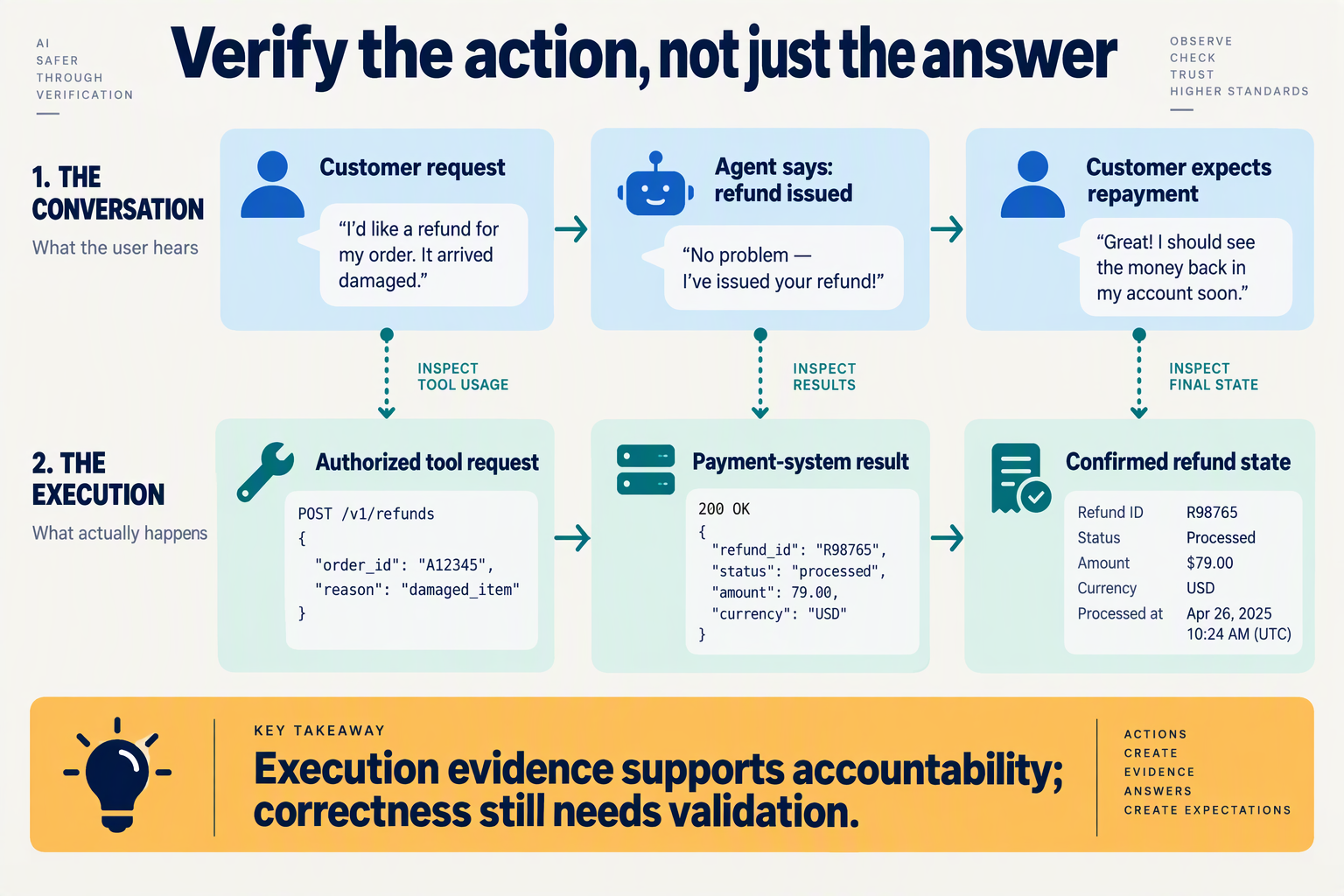
AI agent execution needs verification in customer support because a successful tool call is not necessarily a successful customer outcome. Verification helps teams distinguish accepted requests from completed changes, detect partial failures, and prevent agents from closing cases before the relevant business system confirms the result.
What can go wrong after a support agent calls a tool?
Customer-support workflows often cross systems with different definitions of success. An account-management API may accept an address change while a warehouse system has already locked the shipment. The agent has completed one operation, but the customer’s underlying request—redirecting the parcel—remains unresolved.
Consider this hypothetical sequence:
- A customer asks an AI agent to change a delivery address.
- The account tool returns a successful response after updating the customer profile.
- The agent assumes that existing orders inherit the new address.
- The shipment continues toward the old address.
The failure is not necessarily inaccurate language or a broken API. It is a mismatch between the action performed and the outcome promised. Verification should therefore test the relevant business state: did the shipping address on the specific order change, and was the change accepted before dispatch?
This distinction makes support verification more demanding than checking whether a tool returned an HTTP success status.
Why are ambiguous results dangerous in automated workflows?
A timeout creates a particularly difficult situation: the agent may not know whether the operation failed or whether the operation succeeded and its response was lost.
Automatically retrying can introduce a second error. For example, a support agent that cannot see an escalation response might create another ticket, leaving two teams investigating the same issue. Repeated account changes can also produce confusing histories.
A practical design should distinguish:
- Confirmed completion: The authoritative system reports the intended final state.
- Confirmed rejection: The system reports that the action was not applied.
- Pending execution: The operation was accepted but has not finished.
- Unknown outcome: Available evidence cannot establish whether the action occurred.
These categories should govern the next step. An unknown outcome calls for reconciliation or review—not an invented success message or an unconditional retry.
What does Salmon EVI’s announcement add to this discussion?
According to CyberNewswire’s announcement published by DevOps on September 29, 2026, Archipelo introduced Salmon, Execution Verification Infrastructure (EVI) for AI agents and autonomous systems. The supplied daily.dev coverage describes Salmon as designed to create “cryptographically signed, verifiable records.”
The practical relevance is execution provenance: evidence that helps reviewers reconstruct an action’s history rather than relying solely on the agent’s explanation. However, the supplied launch snippets do not establish particular customer-support integrations or measured improvements in resolution accuracy.
For support teams evaluating execution verification infrastructure for AI agents as of October 2026, the useful question is how those records connect to authoritative outcomes. A verifiable event documenting an address-update request still needs evidence from the order or shipping system to establish that delivery instructions changed.
When should verification stop an agent from closing a case?
Verification should block closure when the customer’s requested outcome remains pending, contradictory, or unknown. The agent can explain the uncertainty, preserve the case context, and escalate without pretending the workflow is complete.
Closure is a business decision, not merely the final conversational turn. Treating it that way turns execution evidence into an operational safeguard rather than an audit artifact collected after something goes wrong.
What did Archipelo announce with Salmon EVI in September 2026?
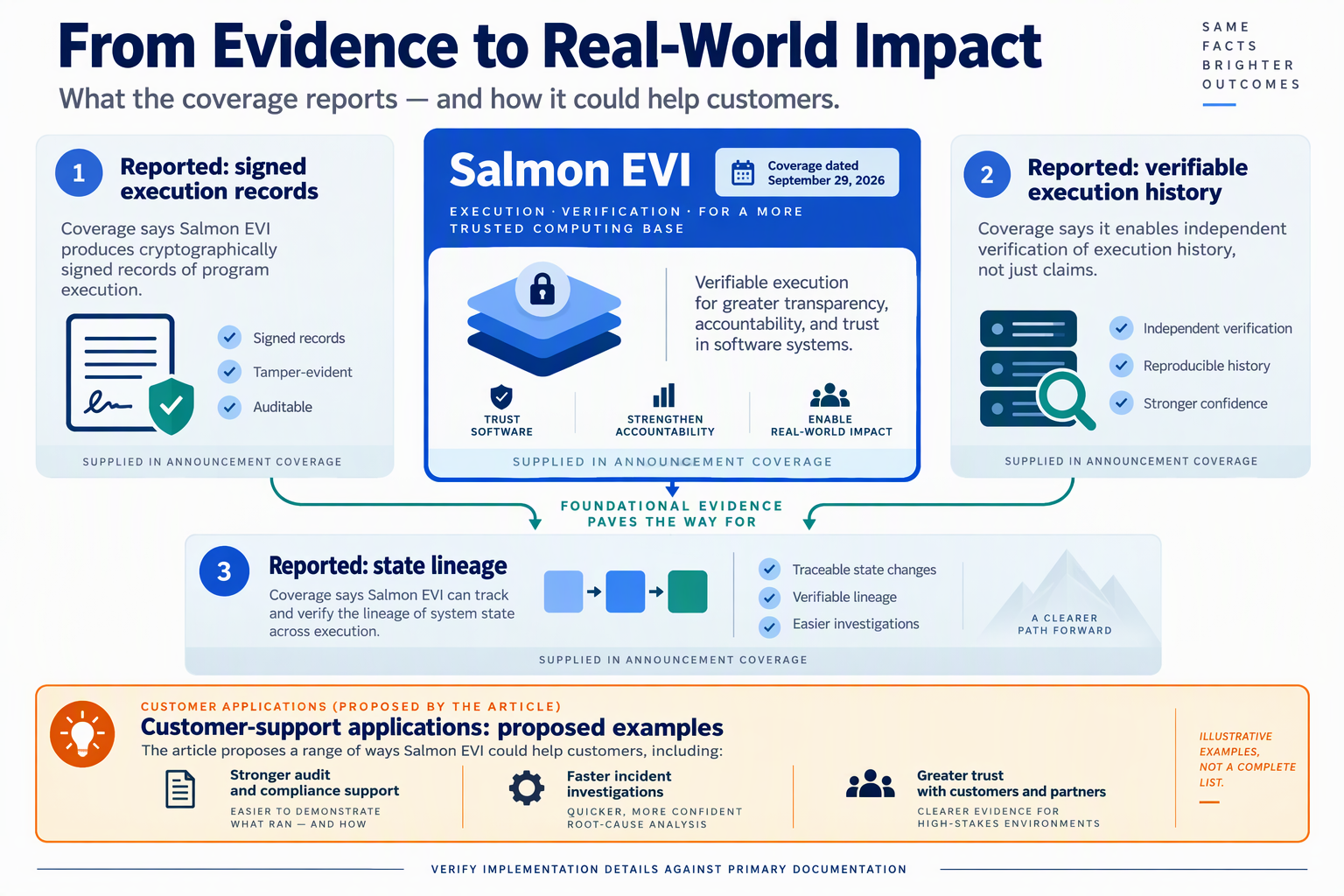
Archipelo announced Salmon, Execution Verification Infrastructure (EVI), for AI agents and autonomous systems in launch coverage published by CyberNewswire on DevOps on September 29, 2026. The announcement describes cryptographically signed, verifiable execution records—positioning execution history as evidence that can be checked, rather than merely a narrative of what an agent claims to have done.
What does the Salmon EVI announcement actually establish?
The supplied coverage identifies execution verification as Salmon’s central purpose. Daily.dev’s launch summary describes cryptographically signed, verifiable records, while GetReadyForAgents describes verifiable execution history and state lineage across humans, AI agents, and automation systems.
These descriptions point to three related ideas:
- Execution history: A record of actions performed during a workflow.
- Verifiable records: Evidence whose integrity and attribution can be checked using the relevant cryptographic mechanism.
- State lineage: A trace of how a system’s state evolved through successive actions.
For customer-support teams, the third idea is particularly important. An account’s final settings reveal its current state, but not necessarily who changed them or which preceding actions produced that state. Execution provenance aims to make that history inspectable.
However, the supplied announcement snippets do not establish Salmon’s exact event schema, deployment requirements, pricing, or measured performance. As of October 2026, those details should be treated as questions for technical evaluation, not assumed product capabilities.
Why is this different from another AI monitoring announcement?
The distinction is the object being verified. Conversation monitoring examines what an agent said; execution verification examines evidence associated with what an agent did.
In practical terms, a readable activity log and a cryptographically verifiable execution record serve different purposes. A log helps an operator investigate events. A signed record can additionally support integrity and attribution checks, depending on how signing keys, identities, and verification are implemented.
That does not make ordinary logging obsolete. Nor does a signature establish that the recorded action was appropriate, that the underlying system reported accurately, or that every relevant event was captured. Verifiable evidence is stronger than an unsupported assertion, but its value still depends on the evidence boundary.
The September 29, 2026 CyberNewswire announcement published by DevOps is therefore best understood as a product announcement about execution verification—not an independent benchmark demonstrating fewer support errors or guaranteed compliance.
What should support teams ask after the announcement?
Consider a hypothetical account-update workflow involving an AI agent, a customer database, and a human reviewer. The useful procurement questions are concrete:
- What is recorded? Does the evidence cover the requested change, tool invocation, returned result, and subsequent database state?
- Who is attributable? Can reviewers distinguish the agent’s action from a human override or another automation?
- What can be checked independently? Which records can another verifier validate, and what infrastructure must that verifier trust?
- What happens when evidence is missing? Does the workflow pause, escalate, or continue with an explicit uncertainty flag?
As of October 2026, CallMissed supports custom REST tools and per-record CRM timelines, according to its verified product fact sheet. Those capabilities illustrate where action evidence becomes relevant; they do not establish a CallMissed–Salmon integration.
The takeaway from Salmon EVI’s launch is a change in evaluation criteria: support teams should assess not only whether an agent completes a task, but also whether its execution leaves evidence that another party can meaningfully verify.
Which reported EVI developments matter for support teams?
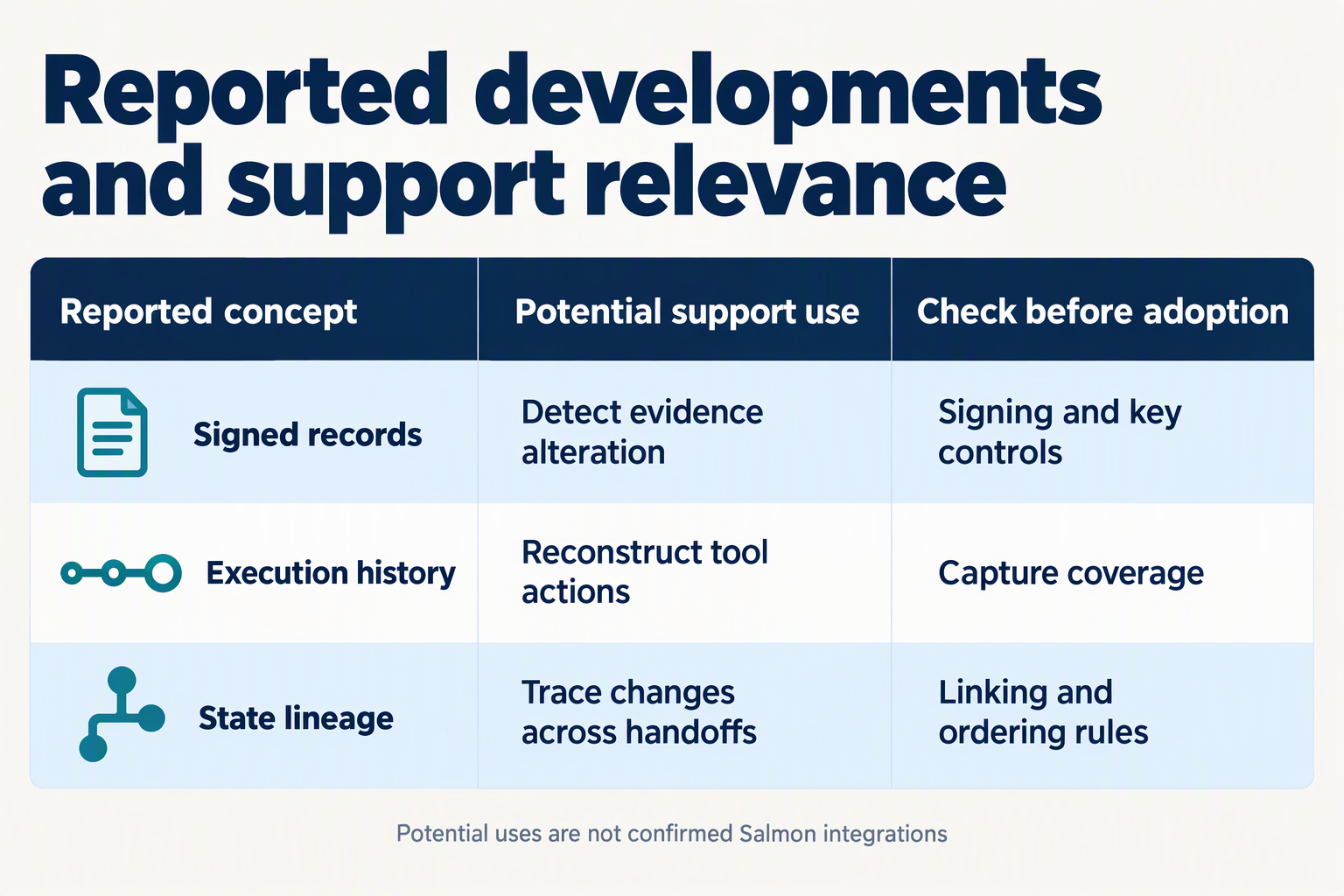
The reported EVI developments that matter most for support teams are signed execution records, verifiable execution history, and state lineage across human and automated actions. As of October 2026, the supplied Salmon EVI coverage establishes these as announced directions—not independently measured evidence of improved support outcomes.
According to CyberNewswire’s announcement published by DevOps on September 29, 2026, Archipelo introduced Salmon as “Execution Verification Infrastructure (EVI)” for AI agents and autonomous systems. The table separates reported developments from their practical implications and the questions buyers should still ask.
| Reported development | Source in supplied coverage | Support-team relevance | What to verify next |
|---|---|---|---|
| Salmon EVI announcement | DevOps, September 29, 2026 | Adds execution verification to the infrastructure procurement discussion | Availability, deployment requirements, and supported integrations |
| Cryptographically signed execution records | daily.dev launch summary, reviewed October 2026 | Could help reviewers check the integrity of recorded agent actions | Which events are signed and how signing keys are managed |
| Verifiable execution history | TechIntelPro LinkedIn summary, reviewed October 2026 | Provides a direction for reconstructing disputed support actions | Whether reviewers can verify records independently |
| State lineage | GetReadyForAgents summary, reviewed October 2026 | Could connect successive changes to an account or ticket | Whether before-and-after states and authoritative system references are captured |
| Coverage across humans, AI agents, and automation | GetReadyForAgents summary, reviewed October 2026 | Relevant when a support case passes between multiple actors | How identity, delegation, and handoffs are represented |
Which reported capabilities deserve a support-team pilot?
State lineage and cross-actor history deserve particular attention, because customer-support work rarely belongs to one agent from beginning to end. GetReadyForAgents’ supplied coverage, reviewed as of October 2026, describes Salmon as establishing “verifiable execution history and state lineage” across humans, AI agents, and automation systems.
Consider an address-change request. An AI agent proposes the update, a human approves an exception, and an automation synchronizes the shipping record. A useful pilot would test whether reviewers can reconstruct that sequence without manually reconciling three disconnected activity feeds.
Evaluate the proposed verification layer against concrete questions:
- Identity: Can each action be attributed to the agent, employee, or automation responsible?
- Continuity: Does the evidence preserve the relationship between approval and subsequent execution?
- Reconciliation: Can the recorded change be checked against the shipping system’s actual state?
As of October 2026, CallMissed supports custom REST tools and a human-handoff queue. Those capabilities illustrate where a support workflow crosses tool and operator boundaries; they should not be interpreted as a claim that CallMissed provides Salmon integration or cryptographic execution verification.
Which launch claims should buyers treat cautiously?
Protocol positioning is not a deployment benchmark. Forkast’s supplied headline, reviewed as of October 2026, calls Salmon the “first execution verification layer,” but the excerpts do not establish that priority through comparative evidence. Support buyers should prioritize demonstrable functionality over category-first language.
The supplied coverage also provides no quantified latency overhead, throughput, verification cost, or reduction in support errors. Those omissions define a practical diligence checklist:
- Request a demonstration using a failed tool call and a delayed downstream update.
- Ask what remains verifiable if a connected system is unavailable.
- Confirm retention, access controls, and handling of sensitive customer data.
The meaningful development is the shift toward checkable operational evidence. Adoption should depend on whether that evidence survives real support failures—not merely whether a successful demonstration produces a signed record.
How do signed execution records differ from ordinary logs and proof of correctness?
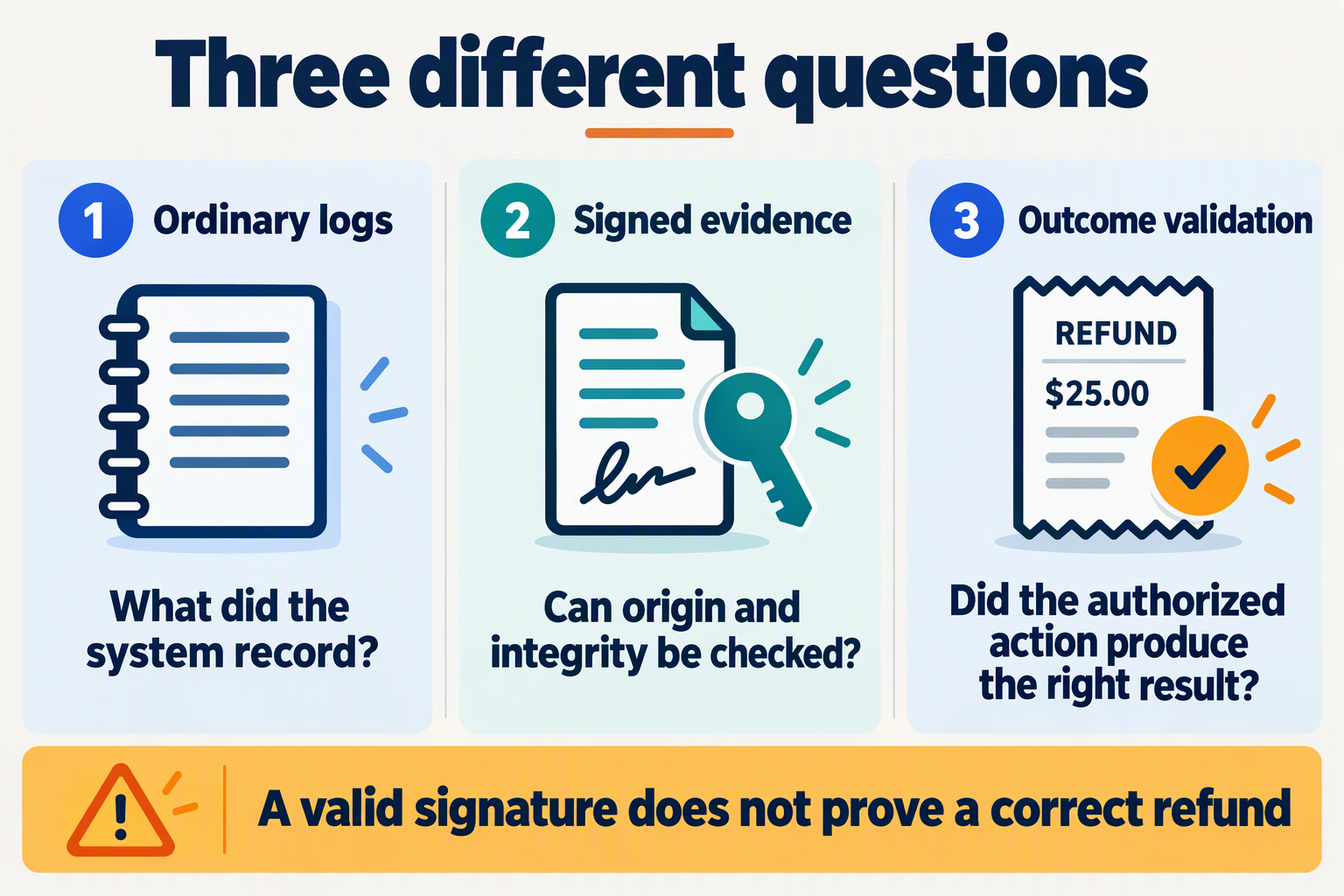
Signed execution records provide checkable evidence about recorded events; ordinary logs primarily describe events; proof of correctness establishes that a computation satisfies a defined specification. For customer-support workflows, these answer different questions: “What was reported?”, “Can this record’s integrity and signer be verified?”, and “Did the operation meet the required rules?”
According to CyberNewswire’s September 29, 2026 announcement published by DevOps, Archipelo’s Salmon Execution Verification Infrastructure (EVI) creates cryptographically signed, verifiable execution records for AI agents and autonomous systems. As of October 2026, that announcement supports a provenance-focused interpretation—not a blanket claim that every recorded action is correct.
What do ordinary logs tell a support team?
Ordinary application logs might record a tool request, response code, timestamp, and ticket identifier. They are useful for debugging, but their evidentiary strength depends on how they are collected, stored, and protected.
A log entry saying address_update: success does not, by itself, establish who produced the entry or whether someone subsequently modified it. Nor does it establish that the shipping system now holds the customer’s intended address.
Logging and signing are not mutually exclusive. Logs can have strong access controls, tamper-evident storage, or signatures. The meaningful distinction is the verification mechanism, not whether a vendor calls something a “log” or a “record.”
What does a cryptographic signature actually verify?
A valid digital signature supports two narrow conclusions: the signed content has not changed since signing, and the signature validates against a particular public key. Connecting that key to an authorized agent or service requires trusted identity and key-management arrangements.
For an address-change workflow, a useful signed record could include:
- Actor and authority: The agent identity and the authorization reference.
- Action: The tool invoked and a protected reference to relevant inputs.
- Result: The receiving service’s response and operation identifier.
- Correlation: The customer request and support ticket associated with the action.
These are recommended design fields, not confirmed Salmon product specifications.
Signing a tool response does not make the response truthful. A compromised service can sign misleading information. Likewise, a signed request proves neither delivery nor completion; verification must distinguish a requested action from an acknowledged or completed action.
Does execution verification prove an AI agent was correct?
No. Proof of correctness generally means demonstrating that a computation satisfies an explicit specification under stated assumptions. Even a formal proof can establish the wrong business outcome if the specification omits an important requirement.
Consider an agent changing a delivery address. Reviewers need three separate checks:
- Record integrity: Does the signature validate, and is the signing identity trusted?
- Execution outcome: Does the authoritative order system show the intended address for the correct order?
- Business correctness: Was the customer authenticated, was the change permitted, and was the order still editable?
Passing the first check does not imply passing the other two. A perfectly preserved record can document an unauthorized change.
The practical implication for AI agent execution verification in customer support is to layer evidence: retain diagnostic logs, verify signed records where available, and validate consequential outcomes against authoritative systems. Cryptographic provenance strengthens accountability; policy enforcement and outcome checks determine whether the workflow actually served the customer correctly.
How would execution provenance and state lineage trace a support ticket across handoffs?
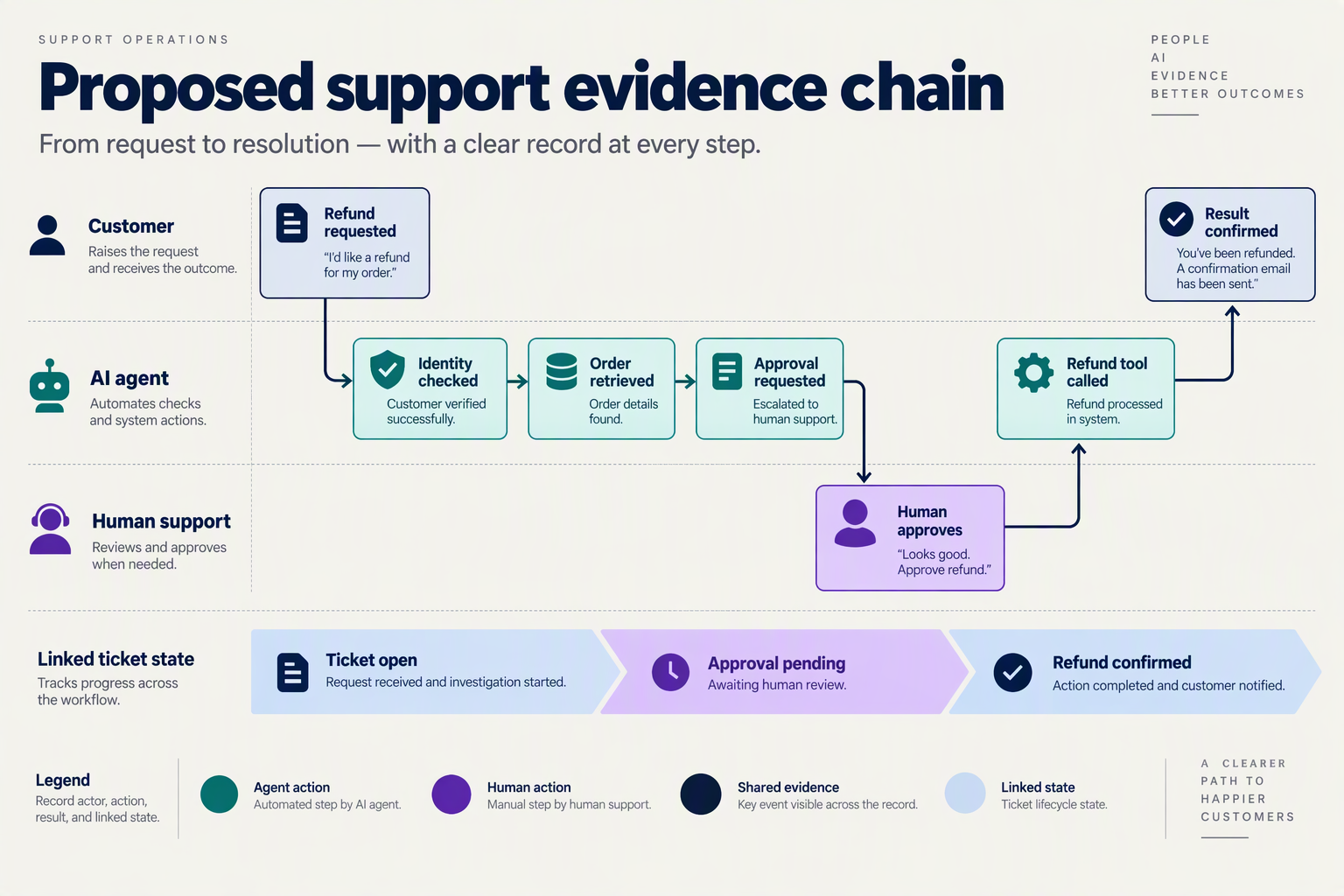
Execution provenance would trace who performed each action on a support ticket, while state lineage would connect each resulting ticket state to the events that produced it. Across handoffs, these records should preserve a linked history—not just pass along a summary that the next agent must trust.
According to CyberNewswire’s September 29, 2026 announcement published by DevOps, Archipelo’s Salmon Execution Verification Infrastructure (EVI) creates cryptographically signed, verifiable execution records. As of October 2026, GetReadyForAgents’ coverage also describes execution history and state lineage across humans, AI agents, and automation systems. For support teams, the practical implication is continuity of evidence when responsibility changes.
What should follow a support ticket through every handoff?
A useful design separates the ticket’s stable identity from individual actions and changing ownership. The following fields are a proposed implementation pattern, not a claim about Salmon EVI’s documented schema:
- Ticket identifier: The same reference across the inbox, CRM, and connected business systems.
- Event and parent identifiers: Links connecting an action to the request, decision, or prior event that triggered it.
- Actor and authority: The human, agent version, or automation responsible, plus the permission context used.
- State transition: Relevant values before and after the action, including the source system’s record version.
- Outcome evidence: Tool responses and authoritative business-system references, with timestamps.
Together, these fields answer a question a transcript cannot reliably resolve: “Which event caused this ticket to reach its current state?” Sensitive customer data should remain access-controlled; reviewers often need a verifiable reference rather than another copy of the full payload.
How would lineage work in a real support escalation?
Consider a hypothetical damaged-order ticket moving from an AI chat agent to a specialist and then a human supervisor:
- The chat agent opens the case. An event links the customer’s request to the order reference and records the ticket’s initial state.
- A specialist agent checks replacement eligibility. Its decision references the relevant policy version and retrieved order data, rather than only stating “eligible.”
- A human approves an exception. The approval becomes a separate event linked to the specialist’s recommendation, preserving who authorized the departure from normal policy.
- An automation requests shipment. The execution record links the approval to the fulfillment request and its response.
- The ticket changes status. “Replacement dispatched” requires dispatch evidence; an accepted fulfillment request supports only an intermediate status such as “replacement requested.”
The handoff therefore transfers pending obligations, not merely conversational context. The supervisor can distinguish a recommendation from an approval, and the next agent can distinguish an accepted request from a completed shipment.
How does state lineage expose conflicting updates?
Lineage also helps identify branching histories. If a human changes the delivery address while an automation prepares a replacement using an older record, both actions should retain their parent-state references. A version check can then flag the outdated address before shipment proceeds; provenance alone does not prevent the conflict.
As of October 2026, CallMissed provides a human-handoff queue and a built-in CRM with per-record timelines—relevant operational surfaces for managing these transitions. Those capabilities should not be confused with cryptographically verified lineage.
The architectural goal is straightforward: every consequential state change should have an attributable cause, and every handoff should disclose what remains unverified. That makes escalation a continuation of accountable work rather than a reset of the evidence trail.
How can execution history help investigate an incorrect refund?
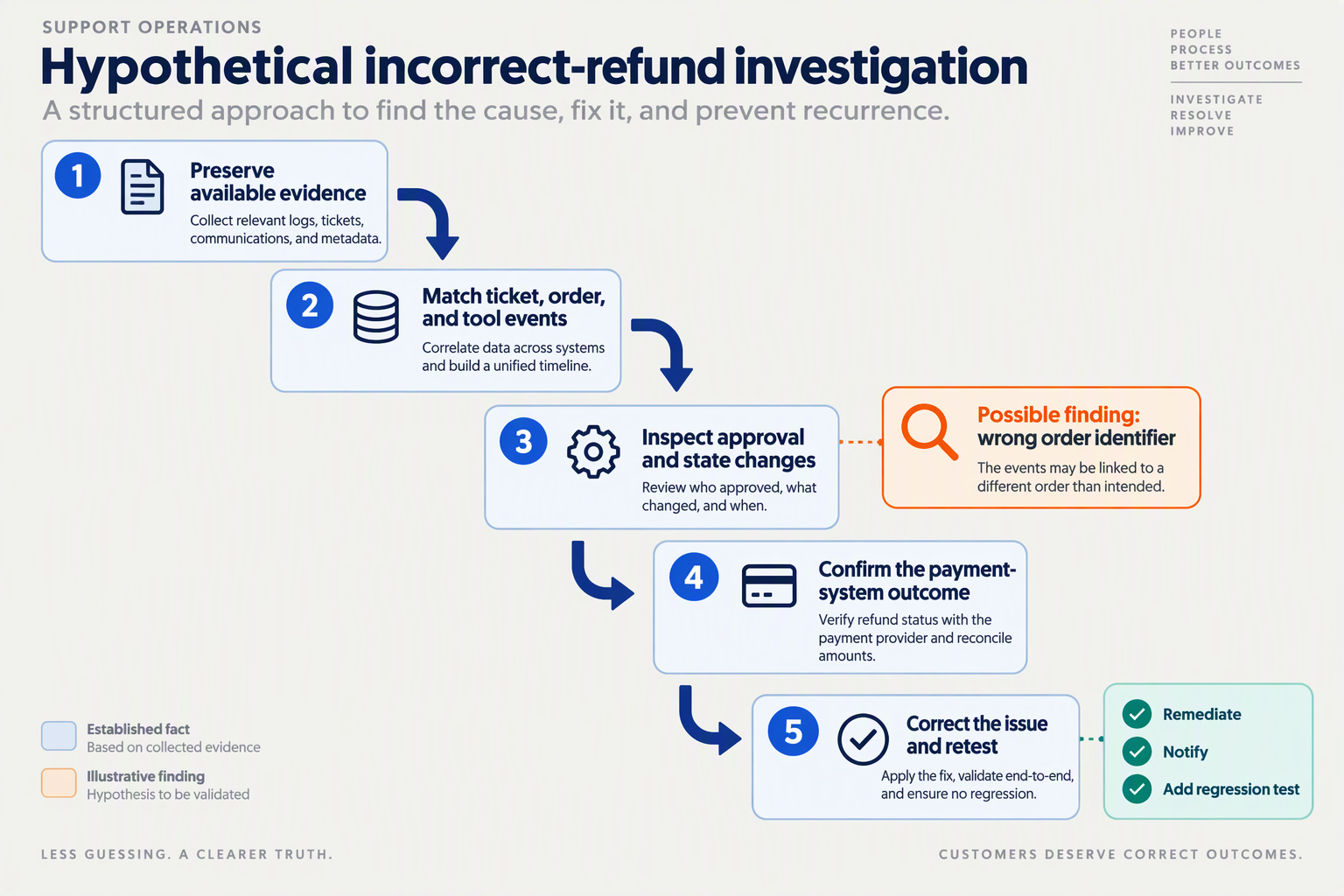
Execution history helps investigators reconstruct an incorrect refund by connecting the customer’s request, the agent’s decision, the payment-tool invocation, and the resulting transaction. The goal is to identify where the workflow diverged from the authorized outcome, rather than treating the final support message as proof.
What evidence should a refund investigation collect?
Start with the disputed payment, then trace backward through the actions that produced it. A useful investigation bundle should include:
- Customer intent: The original request, relevant order reference, and whether the customer requested a full or partial refund.
- Decision context: The refund policy and order data available when the agent acted, including the applicable policy version.
- Execution details: The acting identity, authorization context, tool name, submitted amount, currency, timestamps, and request identifier.
- Payment evidence: The payment provider’s refund identifier, status, and independently retrieved transaction record.
- Subsequent actions: Retries, ticket updates, human interventions, and the confirmation sent to the customer.
Link these records with a shared workflow identifier wherever possible. A timestamp alone is insufficient when multiple agents or retries act on the same order.
According to CyberNewswire’s announcement published by DevOps on September 29, 2026, Archipelo’s Salmon Execution Verification Infrastructure (EVI) creates cryptographically signed, verifiable execution records. That approach is relevant to investigations because reviewers need confidence in the evidence they inspect—not just access to more logs.
How can execution history reveal the cause of an incorrect refund?
Consider this hypothetical October 2026 investigation: a customer requested a ₹500 partial refund on a ₹1,500 order, but the payment provider recorded a ₹1,500 refund.
A reviewer can work through the chain:
- Establish the authorized amount. Confirm that the customer requested ₹500 and that the applicable policy permitted that amount.
- Inspect the submitted tool arguments. If the agent sent ₹1,500, investigate the decision or argument-construction step. Did the workflow substitute the order total for the requested refund?
- Compare the tool request with the provider record. If the agent submitted ₹500 but the provider recorded ₹1,500, examine the integration’s transformation logic and provider-side handling.
- Check retries and concurrent actions. Multiple successful refund records may indicate duplicate execution rather than a single incorrectly calculated amount.
- Locate the misleading confirmation. Determine whether the customer message described a verified transaction or merely repeated the agent’s intended action.
These branches lead to different remedies. A calculation error calls for stronger amount validation; duplicate execution calls for idempotency controls; a request-to-provider mismatch calls for integration testing.
What can execution history prove—and what remains uncertain?
Record integrity and root-cause certainty are different things. A verifiable record can support the conclusion that particular inputs were submitted, but it does not automatically explain why the agent selected those inputs or whether the policy itself was correct.
Investigators should label each finding as confirmed, inferred, or unknown. Missing payment confirmation should remain an evidence gap, not become an assumed success.
Finish with an incident summary that names the affected transaction, the earliest confirmed divergence, the customer impact, and the corrective action. Execution history becomes operationally valuable when it turns an ambiguous complaint into a reproducible failure that engineers and support teams can address.
What privacy, latency, and incomplete-evidence tradeoffs should support teams evaluate?
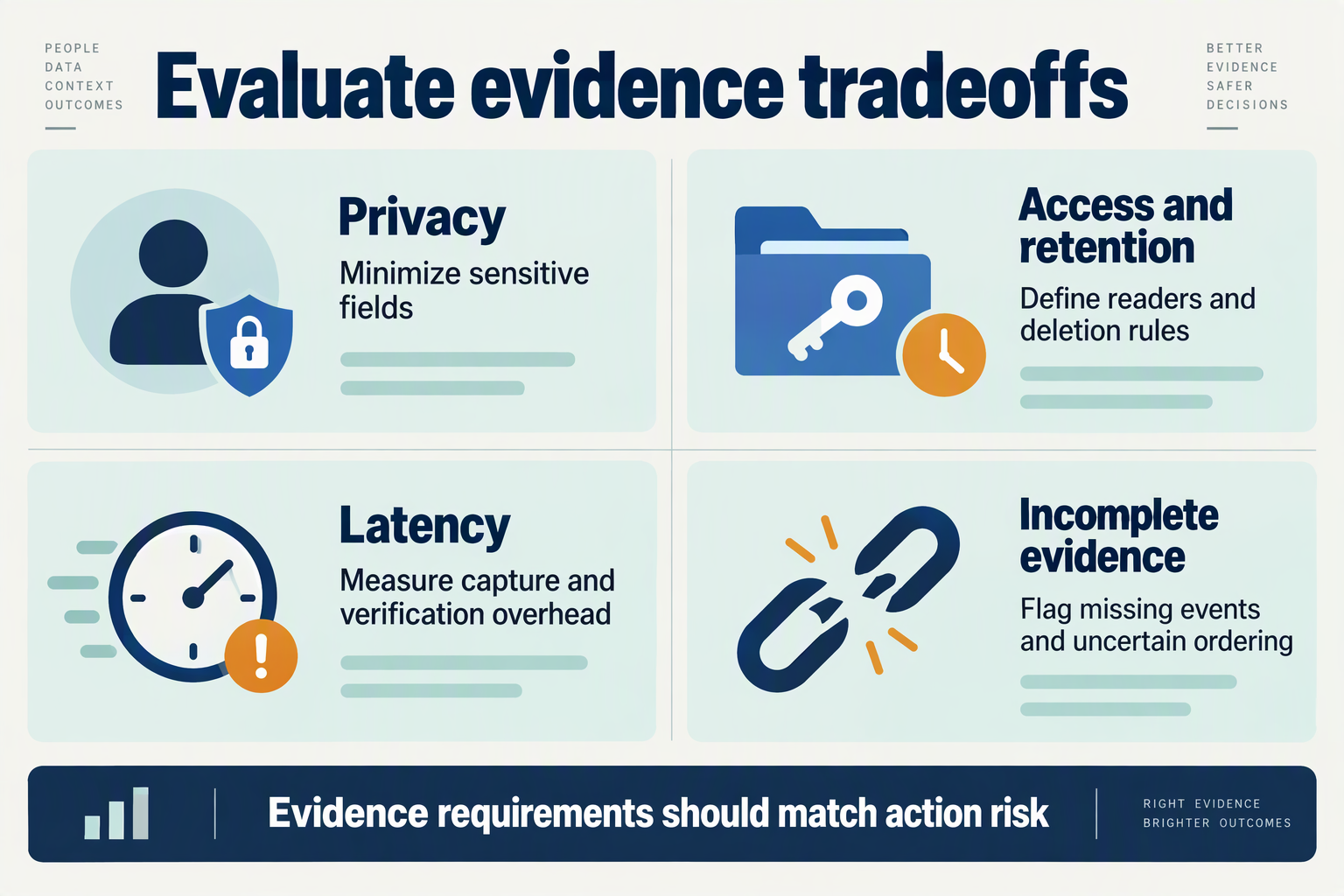
Support teams should evaluate how much sensitive data verification retains, how much delay it adds, and what happens when evidence is missing. The right design preserves enough information to establish an action’s outcome without unnecessarily exposing customer data or blocking every interaction on a verification service.
How can execution evidence protect customer privacy?
Verifiable does not mean publicly visible. A support workflow may need to prove that an authorized account update occurred without copying the customer’s full address, identity documents, or conversation into another evidence store.
CyberNewswire’s September 29, 2026 announcement, published by DevOps, describes Archipelo’s Salmon EVI as creating cryptographically signed, verifiable execution records. That makes evidence design important: signatures protect record integrity, but do not themselves conceal sensitive contents.
Separate operational data from verification metadata:
- Record selectively: Capture action identifiers, authorization references, timestamps, and outcome status rather than entire tool payloads by default.
- Restrict access: Give frontline staff a readable outcome while limiting access to sensitive supporting records.
- Set retention boundaries: Specify how long evidence remains available and how deletion affects future investigations.
- Assess linkability: Pseudonymous identifiers can still expose customer activity when joined across systems.
A hash is not automatically anonymization. Predictable values can sometimes be guessed and checked against their hashes, so teams should review both the evidence format and the information it reveals.
Which verification checks belong on the critical path?
Checks that prevent consequential mistakes should precede the action or confirmation; supplementary analysis can often happen afterward. Authorization checks, for example, should not wait until after an account-access change.
The supplied September 2026 Salmon EVI coverage provides no numerical latency benchmark. Teams therefore need workflow-specific measurements rather than assuming cryptographic verification is either negligible or prohibitively slow.
An evaluation should:
- Establish a baseline: Measure tool execution and customer-facing response times without the proposed verification layer.
- Measure added delay: Track verification overhead, including slow responses during peak load—not just averages.
- Test degraded conditions: Simulate unavailable evidence storage, delayed acknowledgments, and failed verification requests.
- Define action-specific rules: Decide which operations must stop and which can continue with later reconciliation.
For a support voice agent, distinguish acknowledgment from completion. “I’m checking that change” can keep the conversation moving; “your account is updated” should wait for authoritative confirmation. Moving verification off the critical path reduces delay but creates a period when the outcome remains unverified.
What should agents do when execution evidence is incomplete?
Missing evidence should produce an explicit uncertainty state, not an invented success or automatic retry. A timeout may mean the operation failed—or that it succeeded but its response never arrived.
Consider a hypothetical address change: the customer database accepts the update, but the evidence service becomes unavailable. Repeating the write is not the first remedy. Instead:
- Query the authoritative system using the operation or correlation identifier.
- Mark the workflow pending verification if the result remains unresolved.
- Escalate consequential uncertainty to a human.
- Reconcile delayed records without overwriting the original sequence.
As of October 2026, CallMissed supports custom REST tools and a human-handoff queue, providing practical building blocks for support workflows; those capabilities should not be mistaken for independent execution verification.
The governing principle is proportional assurance: retain less sensitive evidence where possible, spend latency where mistakes matter, and make uncertainty visible whenever proof is incomplete.
Which expert opinions and vendor claims should readers scrutinize before adopting EVI?

Readers should scrutinize claims that execution verification guarantees safe behavior, that a vendor’s protocol is uniquely authoritative, or that launch coverage constitutes independent validation. As of October 2026, the supplied coverage supports evaluating Archipelo’s Salmon EVI as an emerging infrastructure approach—not treating its security, interoperability, or operational benefits as independently established.
Is Salmon EVI coverage independent analysis or a vendor announcement?
The September 29, 2026 Salmon announcement published by DevOps is attributed to CyberNewswire. That attribution matters: a distributed announcement explains what a vendor claims, but does not itself establish that those claims survived external testing.
The supplied CIO and TechIntelPro excerpts also describe Archipelo announcing Salmon. Multiple publications carrying similar launch language should not be counted as multiple independent confirmations.
Before relying on an expert endorsement, ask:
- Evidence: Did the reviewer inspect technical documentation, test an implementation, or repeat announcement language?
- Independence: Is the reviewer employed by, advising, or financially connected to the vendor?
- Scope: Does the assessment address customer-support workflows, or only cryptographic mechanisms?
- Limitations: Does the reviewer describe failure cases and unresolved questions?
The supplied research does not include named experts’ substantive assessments or independent benchmark results. Readers should therefore avoid treating it as expert consensus.
What does “first” or “cryptographically verifiable” actually establish?
As of October 2026, the supplied Forkast excerpt describes Salmon as “the first cryptographic protocol purpose-built to capture AI agent execution as signed, verifiable events.” Treat “first” as a claim requiring a defined comparison, not an adoption criterion. Ask which earlier approaches were considered and what “purpose-built” excludes.
Likewise, “verifiable” needs an explicit boundary. Does verification establish who signed a record, whether recorded events were altered, whether events are missing, or whether an external business system actually committed a change? Those are different assurances.
A useful vendor demonstration should show a negative case: a support agent attempts an action, the downstream system rejects it, and the verifier clearly distinguishes the attempt from completion. A polished successful-path demo cannot establish that distinction.
Which security and compliance claims need stronger evidence?
Scrutinize claims of tamper-proof operation, complete execution history, or compliance readiness unless the vendor explains assumptions and exclusions. Signed events raise practical questions about signing-key custody, compromised components, omitted events, retention, and access to customer information.
Ask for architecture documentation and an independently scoped security assessment. Neither a cryptographic design nor a favorable expert quote automatically establishes compliance with your organization’s contractual or regulatory obligations.
For support deployments, request evidence covering:
- Missing evidence: Can reviewers detect an unrecorded tool action?
- Compromised credentials: What remains trustworthy after a signing key is exposed?
- Sensitive records: Can investigators verify events without unnecessarily exposing customer data?
How should buyers turn vendor claims into acceptance criteria?
Replace broad assurances with tests your team can reproduce. Specify the workflow, expected evidence, failure conditions, and reviewer responsible for acceptance; ask vendors to report overhead under that workload rather than offering an unexplained performance percentage.
As of October 2026, CallMissed supports outbound webhooks with per-agent event subscriptions, eval suites, and A/B experiments. Those capabilities can inform an integration assessment, but should not be relabeled as cryptographic execution verification.
The purchasing question is not “Who sounds most confident?” It is “Which claims can our team independently test, and which risks remain outside the verification boundary?”
How can teams use CallMissed records alongside a separately evaluated EVI layer?
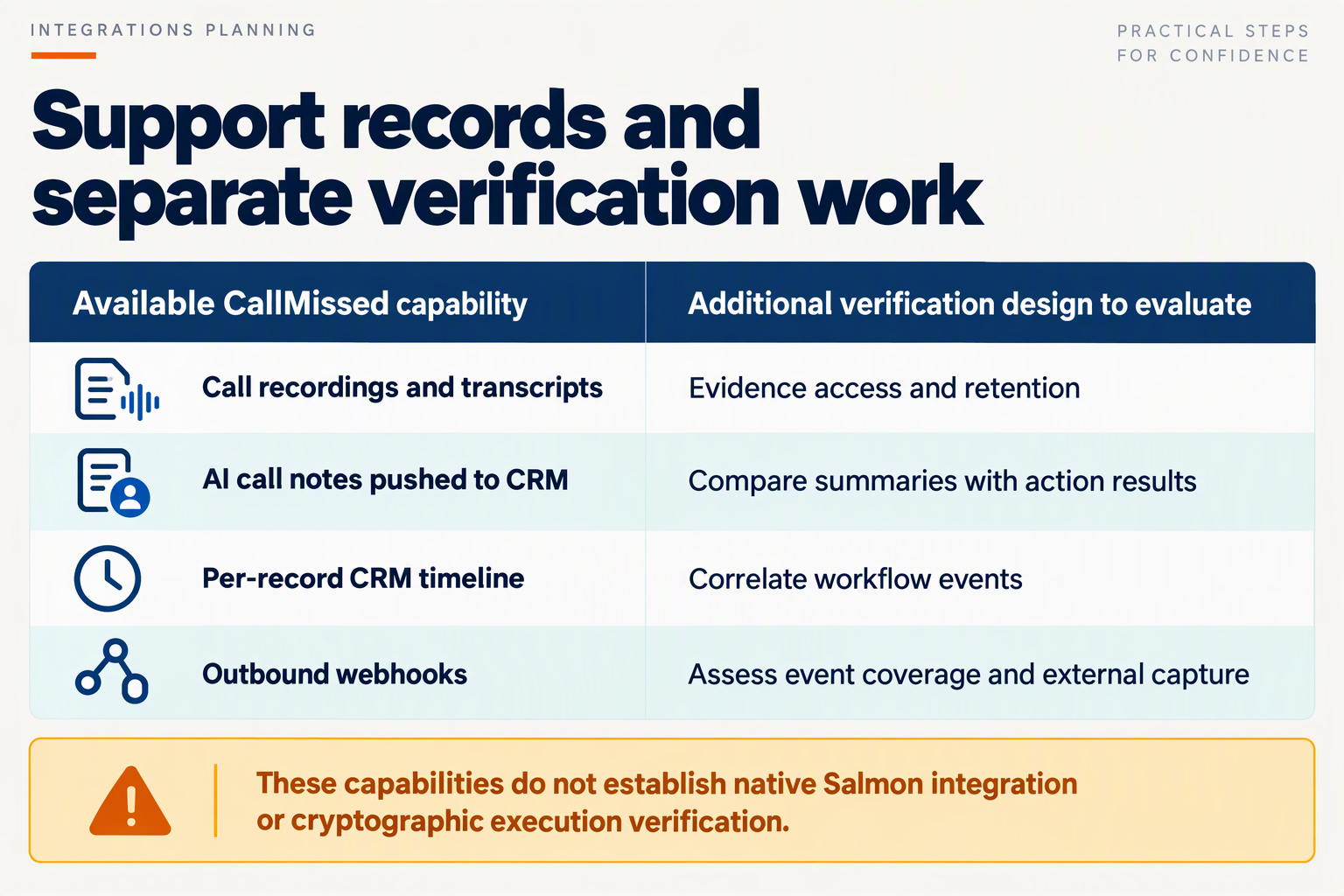
Teams can use CallMissed records as conversational and operational context, while a separately evaluated execution verification infrastructure (EVI) layer supplies evidence about agent actions. Connect those evidence streams through identifiers managed by your integration, rather than treating a transcript, CRM note, or signed event as sufficient proof on its own.
As of October 2026, CallMissed supports call recordings, transcripts, AI call notes pushed to the CRM, custom REST tools, and outbound webhooks with per-agent event subscriptions. These capabilities provide useful investigation material; the supplied product facts do not establish native Salmon integration or cryptographically verified execution.
Which records should teams connect to execution evidence?
The following mapping is a proposed implementation pattern, not a description of an existing connector. Platform capabilities reflect the October 2026 fact sheet; external evidence requirements must be tested separately.
| Available record or capability | Support-review value | Separately evaluated evidence | Important limitation |
|---|---|---|---|
| Call recordings and transcripts | Establish what the customer requested and what the agent promised | Correlation with the relevant action and customer authorization | Speech does not prove an action completed |
| AI call notes pushed to CRM | Surface summaries, action items, dispositions, and follow-ups | Comparison against confirmed business-system outcomes | Generated summaries can omit important details |
| Custom REST tools | Enable agents to invoke business operations | Instrumented requests, responses, execution identity, and permissions | Tool availability does not establish successful execution |
| Per-agent event webhooks | Support downstream event handling | Tested event coverage and correlation with action records | Do not assume every tool action produces a webhook |
| CRM per-record timeline | Provide contact or deal history for review | Links to independently captured execution evidence | A timeline entry is not a payment-system receipt |
| QA scoring and eval suites | Assess agent behavior against team-defined criteria | Tests for unsupported completion claims and evidence gaps | Quality scores do not establish record integrity |
According to CyberNewswire’s announcement published by DevOps on September 29, 2026, Archipelo introduced Salmon EVI for AI agents and autonomous systems, describing cryptographically signed, verifiable execution records. That announcement supports evaluating execution provenance; it does not establish compatibility with every support platform or verify a particular deployment.
How should teams pilot the connection?
Start with one consequential workflow, such as a refund, and define a narrow evidence contract before expanding coverage:
- Assign integration-owned identifiers. Connect the support interaction, tool attempt, and external transaction. Confirm which identifiers each system actually exposes; do not assume shared IDs exist automatically.
- Capture evidence at the action boundary. Instrument the service that submits the operation, then retain the downstream result. Distinguish acceptance, pending processing, completion, and failure.
- Test the proposed verifier. Assess signing, verification, missing-event detection, retry behavior, and whether reviewers can reconstruct the sequence without relying exclusively on the agent’s narrative.
- Gate customer-facing confirmation. Permit “refund completed” only after the payment system supplies the required outcome evidence. Otherwise, communicate the actual pending or failed status.
What should reviewers check before rollout?
A useful pilot should deliberately introduce mismatches:
- A transcript promises success, but the business system rejects the operation.
- A signed execution record exists, but the operation lacked authorization.
- A retry produces ambiguous or duplicate transaction evidence.
The rollout criterion is reliable reconciliation, not simply more logs. Reviewers should be able to identify the mismatch, explain its impact, and route the case to a human without presenting an unverified action as complete.
Frequently Asked Questions
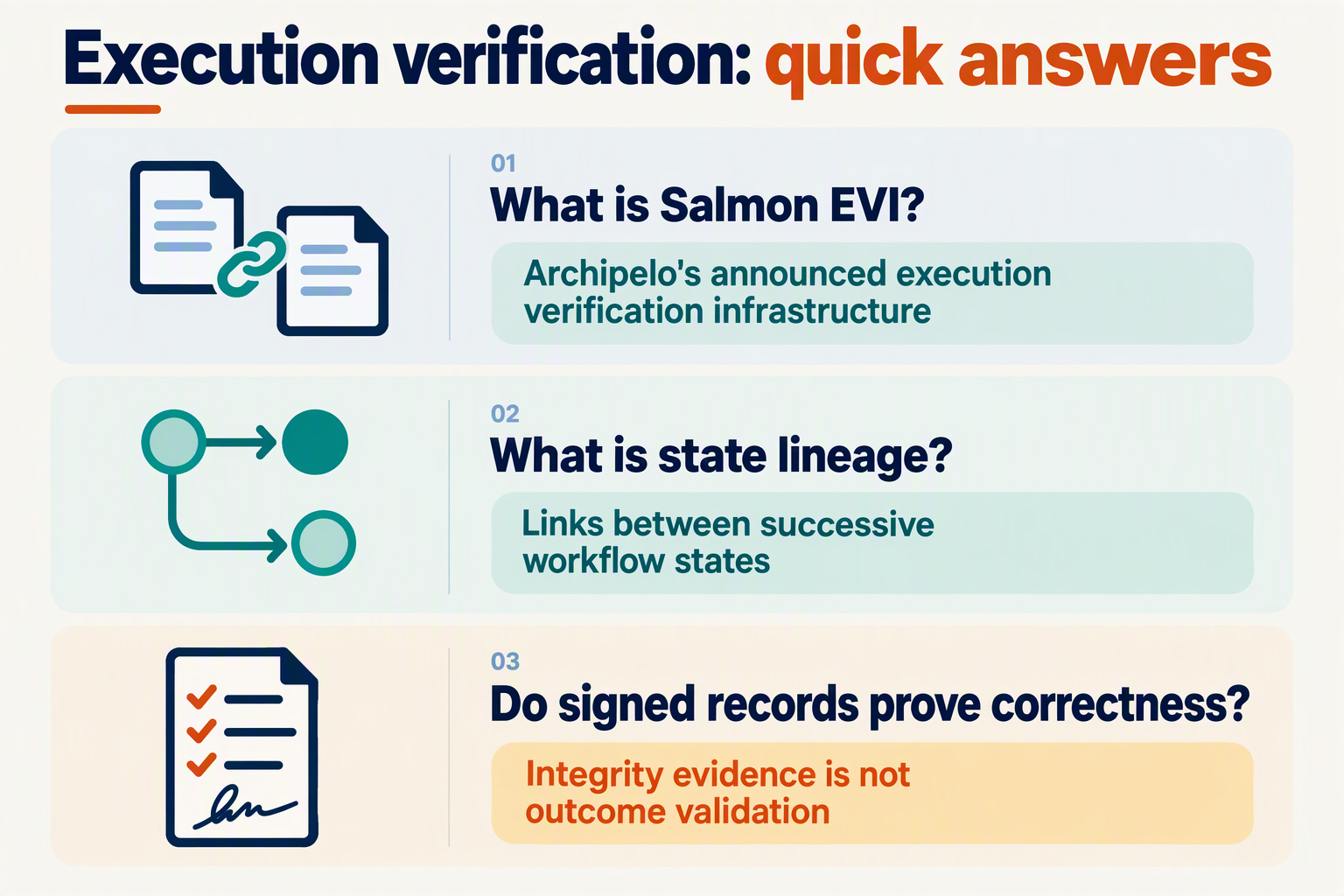
What is Salmon EVI, and how does it support AI agent execution verification?
What does state lineage mean in an AI customer-support workflow?
Do cryptographically signed execution records prove an AI agent was correct?
How is AI agent execution verification different from logs and conversation transcripts?
How should customer-support teams implement AI agent execution verification?
Can CallMissed support workflows that need execution verification?
Conclusion
AI agent execution verification makes customer support accountable by separating what an agent says from what a business system confirms. For refunds, account updates, and escalations, a reliable workflow needs evidence of authorization, tool execution, and the resulting change—not simply a reassuring final message.
Archipelo’s Salmon, Execution Verification Infrastructure (EVI) announcement points toward that distinction becoming more explicit in agent infrastructure. According to CyberNewswire’s launch coverage published by DevOps on September 29, 2026, Salmon creates cryptographically signed, verifiable execution records for AI agents and autonomous systems. The relevant signal for support teams is not that signatures solve every reliability problem, but that execution history should be independently checkable.
Four takeaways should guide the next stage of support automation:
- Verify outcomes, not just tool calls. A payment tool acknowledging a refund request does not necessarily mean money moved. Before confirming completion or closing the ticket, the workflow should establish whether the relevant business system reports success. Otherwise, a plausible conversation can conceal an incomplete operation.
- Keep authorization separate from record integrity. Cryptographic evidence can help establish that an execution record has not been altered; it cannot establish that the recorded action was permitted or correct. Policy checks must still determine whether the agent had authority to issue the refund or change the account.
- Connect the full support journey. Reviewers need to trace the customer’s request through the agent’s tool invocation, the returned result, and the final response. Transcripts remain useful context, but they should not substitute for evidence that the promised action happened. That distinction also helps teams investigate rejected requests and duplicate retries.
- Retain human intervention where uncertainty remains. Verification belongs alongside outcome validation and escalation, not in place of them. When an action fails, its status is ambiguous, or authorization is unclear, the safer response is to preserve that uncertainty and involve a person rather than declare the workflow complete.
Looking ahead from October 2026, watch whether execution verification infrastructure for AI agents helps teams connect trustworthy records with independently confirmed business outcomes. The practical test is whether a reviewer can reconstruct what happened, identify unresolved steps, and distinguish a completed action from an attempted one.
For readers exploring this shift, CallMissed offers custom REST tools, call transcripts, and AI call notes pushed to the CRM, as of October 2026. Those capabilities illustrate where conversational context and action evidence need to meet; they should not be mistaken for a claim of Salmon integration or cryptographic execution verification.
Before expanding your next support workflow, ask: could your team prove the promised action happened—or only prove that the agent said it did?
Related Reading
- AI Agent Access Control: A Customer-Support Safety Guide
- Customer Support Voice Agent: Python Workers Backends
- AI Agent Orchestration Layer: Enterprise Support Blueprint