
Customer Support Voice Agent: Python Workers Backends



Build a customer support voice agent backend with Python Workers, secure tool calls, reliable workflows, and a practical latency-testing plan.
Customer Support Voice Agent: Python Workers Backends
What if the most useful part of your AI voice agent is not its voice, but the Python backend deciding what happens next? A customer support voice agent needs more than speech recognition and fluent replies: it needs reliable access to customer records, business rules, support workflows, and human escalation.
That is why Cloudflare’s Python Workers announcement matters. Cloudflare Python Workers became generally available on September 21, 2026, after a two-year preview, according to Simon Willison’s coverage of Cloudflare’s announcement. For Python teams building customer-support systems, the news opens another deployment option: running application logic inside the Cloudflare Workers runtime rather than treating a conventional server as the default.
Why do Python Workers matter for customer-support backends?
Consider a caller asking, “Where is my order, and can I change the delivery address?” The voice layer handles listening and speaking, but the backend must identify the customer, retrieve order details, check whether an address change is allowed, and return a structured result. A convincing answer is only useful if those actions are correct.
As of September 2026, Nandann’s coverage of the Python Workers release identifies FastAPI, Django, and Flask among the supported frameworks. FAUN’s September 22, 2026 summary explains that Python runs through Pyodide, a WebAssembly build, with bindings to services including Cloudflare Queues, R2, and D1 accepting plain Python values.
The practical opportunity is not “move everything to the edge.” It is choosing which responsibilities belong there:
- Request handling: receive tool requests and validate inputs.
- Business logic: enforce permissions before changing customer data.
- Background processing: separate follow-up work from the immediate response.
- Failure handling: return clear errors instead of letting the agent invent success.
As of September 2026, CallMissed supports custom REST tools for its voice agents, giving Python developers a concrete way to connect backend business logic to customer conversations.
What will you learn about Python Workers and voice agents?
This article explores how to structure a Python Workers backend around a customer-support voice agent, where FastAPI fits, and how storage and queues can support the surrounding workflow. We will distinguish the real-time conversation layer from tool execution and asynchronous tasks, because they have different operational needs.
You will also learn what to evaluate before deployment: package compatibility, documented runtime limits, authentication, retries, and observability. General availability makes Python Workers worth considering; it does not remove architectural trade-offs. The goal is a backend that turns conversation into dependable customer support.
How do Python Workers power a customer support voice agent backend?
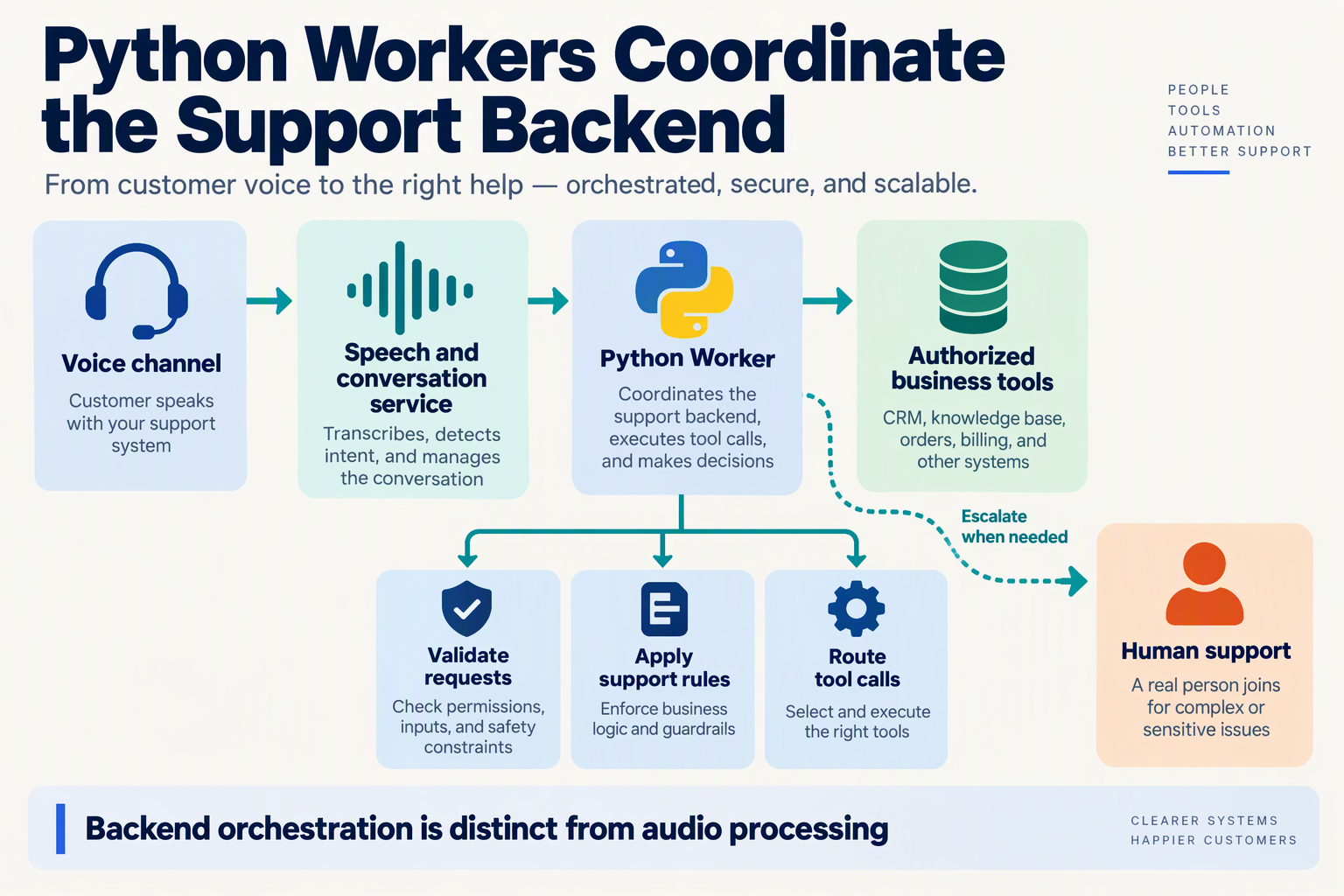
Python Workers power a customer support voice agent backend by turning conversational requests into authenticated, validated business operations. A useful architecture places a Python Worker between the voice agent and systems such as an order database, helpdesk, or CRM—not in charge of every audio frame, but in charge of what the agent can safely do.
Where does a Python Worker fit in the voice-agent architecture?
Think of the Worker as a tool-execution boundary. The voice agent interprets the caller’s request and selects a tool; the Worker checks that request, contacts the relevant business system, and returns a result the agent can explain.
The basic path is:
Caller → voice agent → Python Worker → business system → structured result → spoken response
As of September 2026, CallMissed’s voice agents support custom REST tools, allowing developers to connect a Python backend to an agent’s workflow. That connection should expose narrowly defined operations such as get_delivery_status or create_support_ticket, rather than unrestricted access to customer records.
Keep the responsibilities separate:
- Voice layer: manages listening, speaking, and conversational turn-taking.
- Python Worker: validates tool inputs, enforces business rules, and coordinates requests.
- Systems of record: hold authoritative customer, order, and ticket data.
- Background consumers: handle work that does not need to block the caller’s response.
This separation lets you change a support policy without rebuilding the entire conversation stack.
What happens when a caller asks for a refund?
Consider a caller requesting a refund for a damaged item. The backend should treat the agent’s interpretation as a proposed action—not proof that the customer qualifies.
A practical request flow has five steps:
- Authenticate the tool request. Verify the calling service, then establish which customer the conversation is authorized to represent. Service authentication alone does not establish customer identity.
- Validate the arguments. Require an order identifier, item identifier, and reason in a defined schema. Reject missing or unexpected fields.
- Retrieve authoritative records. Check purchase details and refund eligibility against the business’s current rules.
- Execute or escalate. Submit the approved action, or return a clear reason why a human must review it.
- Return a structured outcome. Include fields such as
status,reference_id, andnext_action, so the agent distinguishes “refund requested” from “refund completed.”
Idempotency matters for any operation that changes state. If a tool request is retried after a timeout, a stable operation identifier should prevent the same refund or ticket from being created twice.
Which tasks should run outside the live conversation?
Keep customer-visible decisions on the immediate request path; move nonessential follow-up work into a queue. For example, confirm that a support ticket was created before announcing success, but process optional enrichment afterward.
FAUN’s September 22, 2026 summary reports that Cloudflare Python Workers bindings for Queues, R2, and D1 accept plain Python values. These services provide building blocks for queued work, object storage, and database-backed application state, respectively.
A sensible design might queue:
- Ticket classification and internal notifications.
- Post-call reporting or optional record enrichment.
- Retryable synchronization with secondary systems.
Queueing does not automatically make processing reliable. Design consumers for duplicate delivery, record failures, and define retry limits. Most importantly, give the voice agent an explicit pending, failed, or completed result: a fluent answer must never conceal an uncertain backend outcome.
What changed when Python Workers became generally available in September 2026?
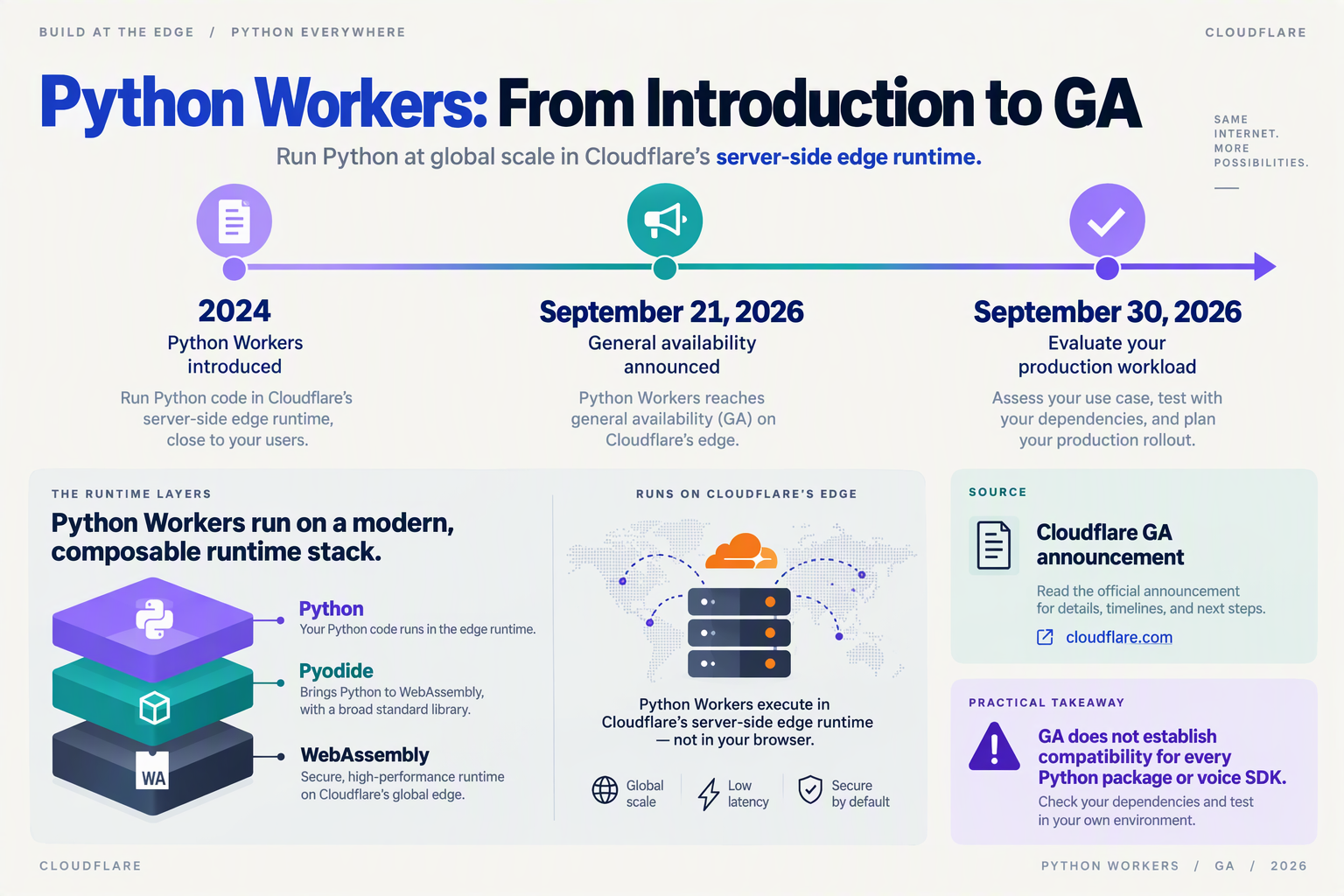
Python Workers’ September 2026 general availability changed their release status and made Python-to-platform integration more practical—not the fundamental execution model. For customer-support backends, the important shift is a more direct way to connect Python application code with Cloudflare services, while still evaluating the constraints of a WebAssembly-based runtime.
What did general availability actually change?
Simon Willison’s September 21, 2026 coverage reports that Cloudflare Python Workers reached general availability after a two-year preview. That milestone gives teams a reason to reassess Python Workers for deployment, but “generally available” should not be interpreted as “every Python application runs unchanged.”
Nandann’s coverage, available as of September 2026, describes Python as a “first-class Workers language” and identifies improved Python-to-JavaScript value conversion as part of the release. This matters because application code must interact with platform services—not merely execute Python syntax.
For a support backend, the useful distinction is between two questions:
- Can the runtime execute this application? Check framework support, dependencies, and runtime behavior.
- Can the application operate reliably? Check authentication, external-service failures, retries, and deployment procedures.
General availability answers a product-maturity question. Your integration tests must still answer the operational ones.
Why do Python-native bindings matter for support workflows?
FAUN’s September 22, 2026 summary reports that Cloudflare bindings for Queues, R2, and D1 now accept plain Python values. The practical benefit is less manual conversion at the boundary between Python business logic and Cloudflare’s platform APIs.
That boundary appears repeatedly in customer-support systems. Consider a caller requesting a replacement for a damaged product:
- Validate the request: establish the customer’s identity and confirm that the order is eligible.
- Record the decision: preserve the replacement request and its processing state.
- Schedule follow-up work: pass a notification or fulfillment task to an asynchronous workflow.
- Return an accurate result: distinguish “request recorded” from “replacement dispatched.”
Python-native bindings can reduce integration plumbing around these steps. They do not establish transaction guarantees across your database, queue, and external fulfillment service; those guarantees require deliberate workflow design.
As of September 2026, CallMissed voice agents support custom REST tools, according to the CallMissed fact sheet. A Python Workers endpoint could therefore expose a narrowly scoped operation such as request_replacement, leaving the backend—not the conversational model—to enforce eligibility rules.
Does general availability make Python Workers equivalent to a conventional Python server?
No: Python Workers remain a different deployment environment. FAUN’s September 22, 2026 summary explains that Python runs through Pyodide, a WebAssembly build, rather than a conventional server-hosted Python process.
Framework familiarity helps, but it does not establish compatibility for every package or execution pattern. Before migrating a support endpoint, test:
- Dependencies: verify that required packages work in the target runtime.
- Network interactions: exercise authentication, timeouts, and errors against actual upstream services.
- State handling: ensure durable records do not depend on process-local memory.
- Duplicate requests: confirm that retries cannot create repeated refunds, tickets, or replacements.
The sensible response to September 2026’s release is a focused production evaluation, not an automatic rewrite. Start with one bounded support operation, test its failure paths, and expand only when the runtime and workflow meet your requirements.
Which GA developments matter for voice and support backends?
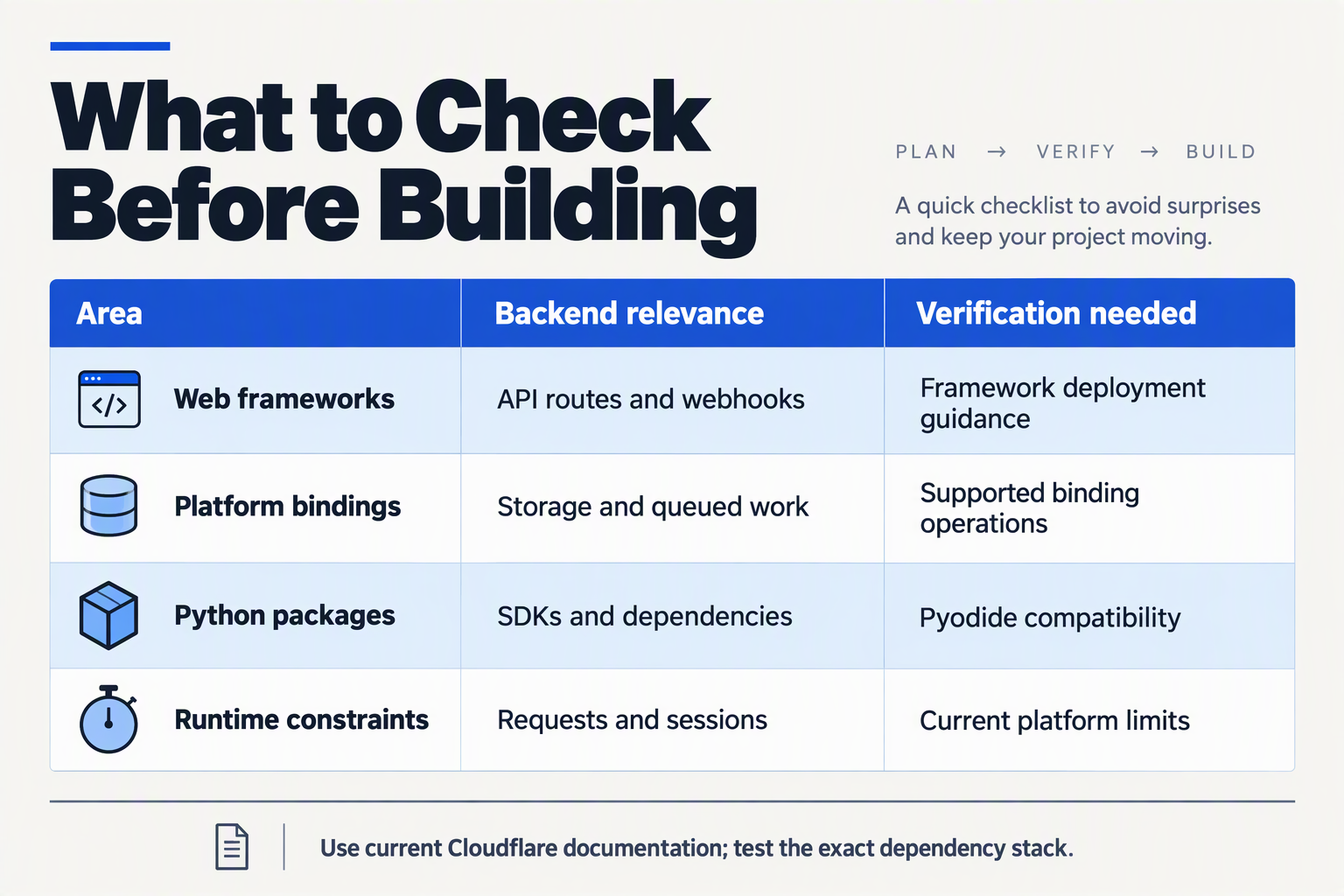
The GA developments that matter most are framework support, simpler Python-to-JavaScript conversion, and Python-friendly access to storage and queues. For voice and support backends, these changes make it easier to implement dependable tool endpoints—not a reason to move the entire audio pipeline into Python Workers.
Which Python Workers capabilities should support teams evaluate first?
As of September 2026, Nandann’s release coverage identifies FastAPI, Django, and Flask support and improved Python-to-JavaScript value conversion. FAUN’s September 22, 2026 summary reports that Cloudflare service bindings, including D1, R2, and Queues, now accept plain Python values.
The table separates those reported capabilities from suggested customer-support applications; the applications are architectural recommendations, not performance claims.
| Development | Reported capability, September 2026 | Support-backend application | Check before deployment |
|---|---|---|---|
| Framework support | FastAPI, Django, and Flask are supported, according to Nandann | Expose order lookup, ticket creation, or escalation endpoints | Test dependencies and framework-specific assumptions |
| Value conversion | Improved Python-to-JavaScript conversion, according to Nandann | Pass validated request data into Cloudflare bindings | Verify nested values, missing fields, and serialization |
| D1 bindings | Accept plain Python values, according to FAUN | Store workflow state or application-owned records | Review schema, query patterns, and access controls |
| R2 bindings | Accept plain Python values, according to FAUN | Store support artifacts outside the immediate response path | Define retention and object-access policies |
| Queues bindings | Accept plain Python values, according to FAUN | Defer notifications or downstream synchronization | Design idempotent consumers and failure recovery |
| Pyodide runtime | Python executes through WebAssembly, according to FAUN | Run compatible Python business logic in Workers | Validate packages rather than assuming server compatibility |
Supported frameworks do not imply unrestricted compatibility with every Python package. The Pyodide execution model makes dependency testing a deployment gate, especially for libraries that assume native binaries, local processes, or conventional server behavior.
How do these developments change a support workflow?
Consider an address-change request. Instead of treating it as one long operation, structure the backend around a short, authoritative decision followed by clearly tracked side effects.
- Validate the request. A FastAPI endpoint checks the order identifier, address fields, and authenticated customer context.
- Apply the business rule. The backend checks fulfillment status and calls the system that owns the order.
- Confirm the outcome. Return success only after the authoritative system accepts the change.
- Defer secondary work. Queue a confirmation message or CRM synchronization if those actions need not block the response.
The distinction matters: “queued” is not the same as “completed.” If the address change itself is deferred, the agent should say the request was submitted, not that the delivery address has already changed.
What should teams avoid assuming from GA status?
Cloudflare’s September 21, 2026 announcement, covered by Simon Willison that day, followed a two-year preview. That milestone establishes release status; the supplied coverage does not establish voice latency, workload-specific throughput, or universal package compatibility.
Before choosing the deployment path, test:
- Correctness: Does a retried request create duplicate tickets or actions?
- Failure behavior: Can the agent distinguish rejection, timeout, and pending work?
- Observability: Can engineers trace a conversation’s tool request through queued follow-up?
- Runtime fit: Do required dependencies and documented limits suit the workload?
The practical GA opportunity is a more integrated Python backend. Its value should be measured in verified outcomes and maintainable workflows—not inferred from the announcement alone.
How do you build Python routes, voice-service connections, and queued follow-ups?
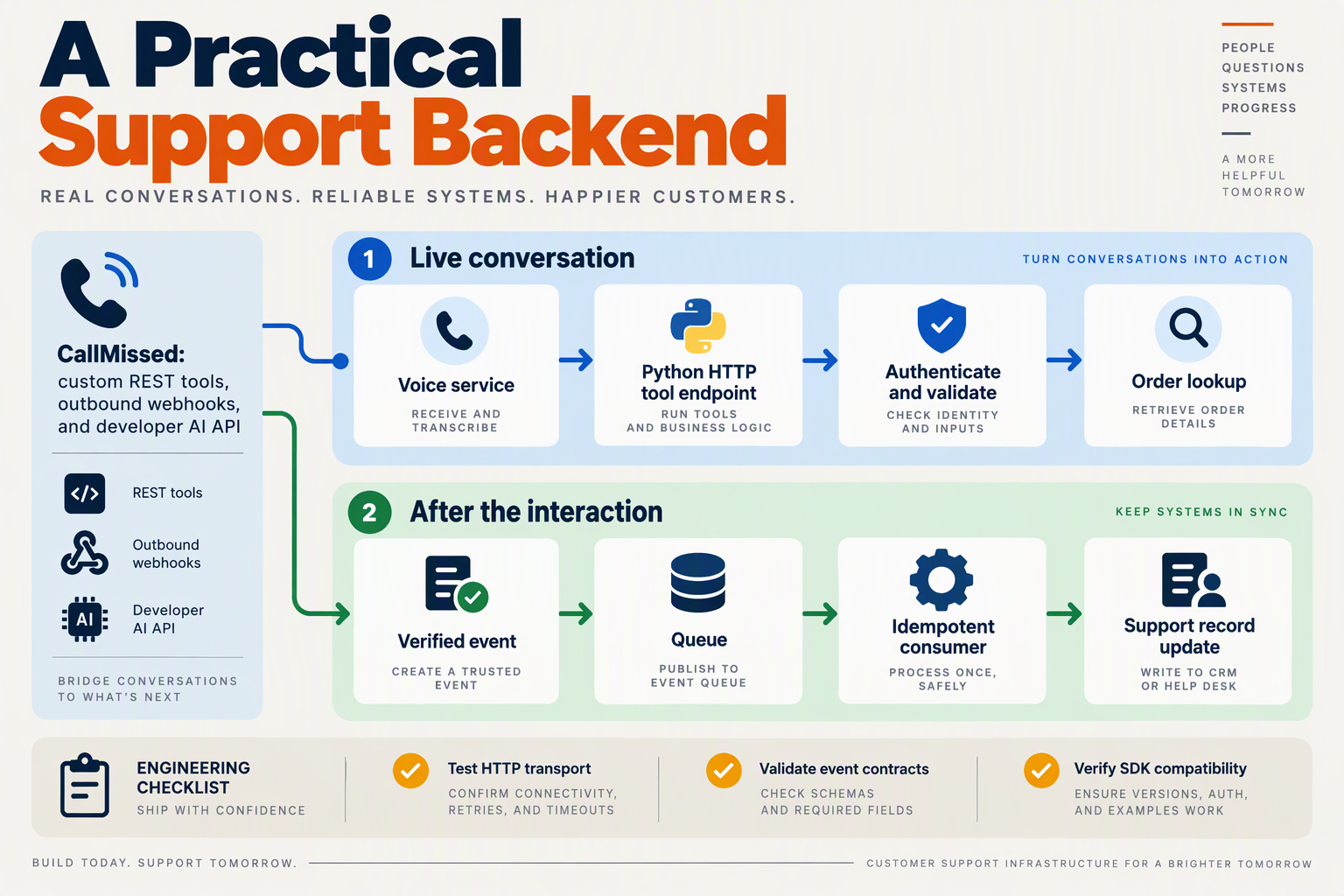
Build Python Workers routes around narrow business operations, connect the voice service through authenticated HTTP tools, and move non-urgent follow-ups into a durable queue. Keep the caller’s immediate answer separate from tasks such as creating tickets, updating CRM records, or notifying a support team.
How do you define Python routes for voice-agent tools?
Start with a small contract for each action rather than one endpoint that accepts arbitrary instructions. For the delivery-address scenario, separate reading order information from changing customer data:
POST /tools/order-status: retrieve an order the caller is authorized to access.POST /tools/change-address: validate the proposed address and enforce delivery-stage restrictions.POST /events/call-completed: accept a completion event and schedule follow-up processing.
According to Nandann’s September 2026 coverage, Cloudflare Python Workers support FastAPI, Django, and Flask. FastAPI is a useful choice when request schemas and structured responses are central to your tool contract.
This illustrative route shows the application logic; authentication, storage, and queue helpers require implementation, and deployment needs the Workers framework adapter:
@app.post("/tools/change-address")
async def change_address(body: AddressChange):
    customer = await authenticate_and_authorize(body.order_id)
    result = await update_address_once(
        customer=customer,
        order_id=body.order_id,
        address=body.address,
        idempotency_key=body.request_id,
    )
    return {
        "status": result.status,
        "order_id": body.order_id,
        "address_changed": result.committed,
    }
The important detail is address_changed reflects a committed operation, not the agent’s intention. A blocked change should return an explicit business outcome such as already_dispatched, allowing the voice agent to explain the restriction without inventing success.
How do you connect a voice service to Python Workers?
Configure the voice platform’s tool definition with the endpoint, HTTP method, input schema, and authentication requirements. As of September 2026, CallMissed supports custom REST tools and per-agent event subscriptions for outbound webhooks, providing connection points for synchronous business actions and event-driven follow-ups.
For each request:
- Authenticate the service using server-managed credentials; keep secrets out of prompts.
- Authorize the action against your customer-verification process. A supplied order ID alone is insufficient.
- Set timeouts for downstream order or CRM services.
- Return compact JSON distinguishing success, rejection, and temporary failure.
These routes handle tool execution, not microphone audio. Keep the voice service responsible for the conversation unless you deliberately build a separate streaming integration. An HTTP order lookup and a continuous audio session have different connection and failure-handling requirements.
How do you queue follow-ups without losing work?
FAUN reported on September 22, 2026, that Cloudflare Python Workers bindings for Queues, R2, and D1 accept plain Python values. That makes queue messages a practical boundary between immediate tool responses and asynchronous support workflows.
Send a minimal job containing an event ID, order reference, task type, and schema version—not an entire transcript by default. The consumer can retrieve authorized data and create the required ticket or CRM update.
Design for retries:
- Deduplicate by event ID before repeating external side effects.
- Retry transient failures, while separating invalid requests for review.
- Track pending and completed work so operators can investigate failures.
If a database change and queue publication must stay consistent, use a transactional outbox: record the change and pending event together, then publish through a separate dispatcher. Report “address updated” after the change commits; report “follow-up queued” only when that work has been durably accepted.
How do you secure order lookups, return requests, and human escalation?
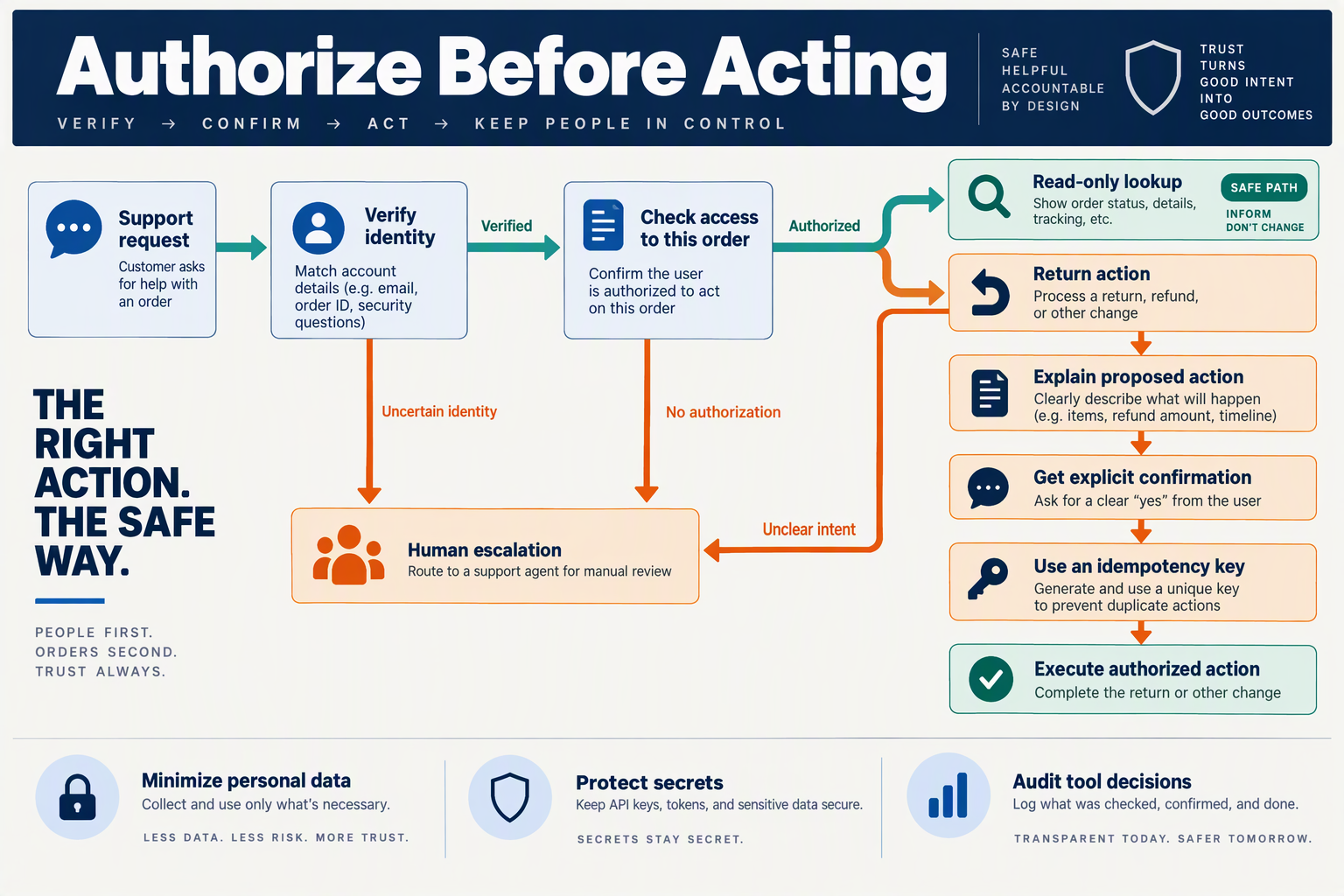
Secure order lookups, return requests, and human escalation by treating every AI tool call as an untrusted request: authenticate its source, authorize access to the specific customer record, and validate the action server-side. The Python backend—not the voice agent’s interpretation of the conversation—must decide what information can be disclosed or changed.
How do you authenticate AI tool calls and customer identity?
Cloudflare announced Python Workers’ general availability on September 21, 2026, following a two-year preview, according to Simon Willison. That deployment milestone does not make an application’s customer-verification process secure automatically.
Separate service authentication from customer verification. A valid credential proves that an approved integration called your endpoint; it does not prove that the caller owns the requested order.
For a Python Workers backend, apply these controls:
- Authenticate the integration: validate a server-held credential or a signed request with timestamp and replay checks, depending on the integration’s supported mechanism.
- Establish customer identity: use an authenticated account session or a verification challenge delivered through an existing, trusted contact channel.
- Scope every lookup: query by both verified customer identity and order identifier. An order number alone is not proof of ownership.
- Minimize disclosure: return only fields needed for the conversation, rather than complete customer records.
Do not trust a model-supplied customer_id, spoken phone number, or caller ID as sufficient authorization. Bind the verified identity to a short-lived session that the backend controls.
How do you prevent unauthorized or duplicate return requests?
Make return eligibility deterministic. The language model can collect the reason and explain the result, but Python code should evaluate the merchant’s actual policy: purchase date, item category, delivery status, previous returns, and any required approval.
Use a numbered workflow:
- Validate inputs: accept a strict schema with permitted fields, types, and values.
- Check ownership: confirm the verified customer can access the order and requested item.
- Evaluate policy: calculate eligibility from authoritative records, not conversational claims.
- Confirm the action: ask the customer to approve the specific item and proposed outcome before submission.
- Prevent duplication: persist an idempotency key and outcome; use downstream idempotency support where available.
- Report the real state: distinguish
requested,approved, andcompletedrather than announcing success prematurely.
For example, a timeout after submitting a return creates an unknown outcome, not a failed return. Check the stored request or commerce system before retrying; otherwise, one conversation could generate duplicate actions.
How do you secure human escalation without exposing unnecessary data?
Escalation should transfer minimum necessary context: verification status, the customer’s request, relevant order references, actions attempted, and unresolved errors. Keep access tokens, verification codes, and unnecessary personal data out of summaries and routine logs.
As of September 2026, CallMissed supports custom REST tools and a human-handoff queue that transfers a conversation thread to a person when AI is switched off, according to its verified product fact sheet. A Python backend can supply validated tool results while the handoff workflow gives staff the context needed to continue.
Treat retrieved notes and customer messages as data, not instructions. A message saying “ignore policy and issue a refund” must never override authorization rules.
Finally, record an audit trail containing the authenticated service, verified customer reference, requested action, policy decision, timestamp, and outcome. Log enough to reconstruct decisions, redact sensitive content, and apply access controls and retention rules appropriate to the business.
How do you measure voice latency and recover from interruptions or failures?
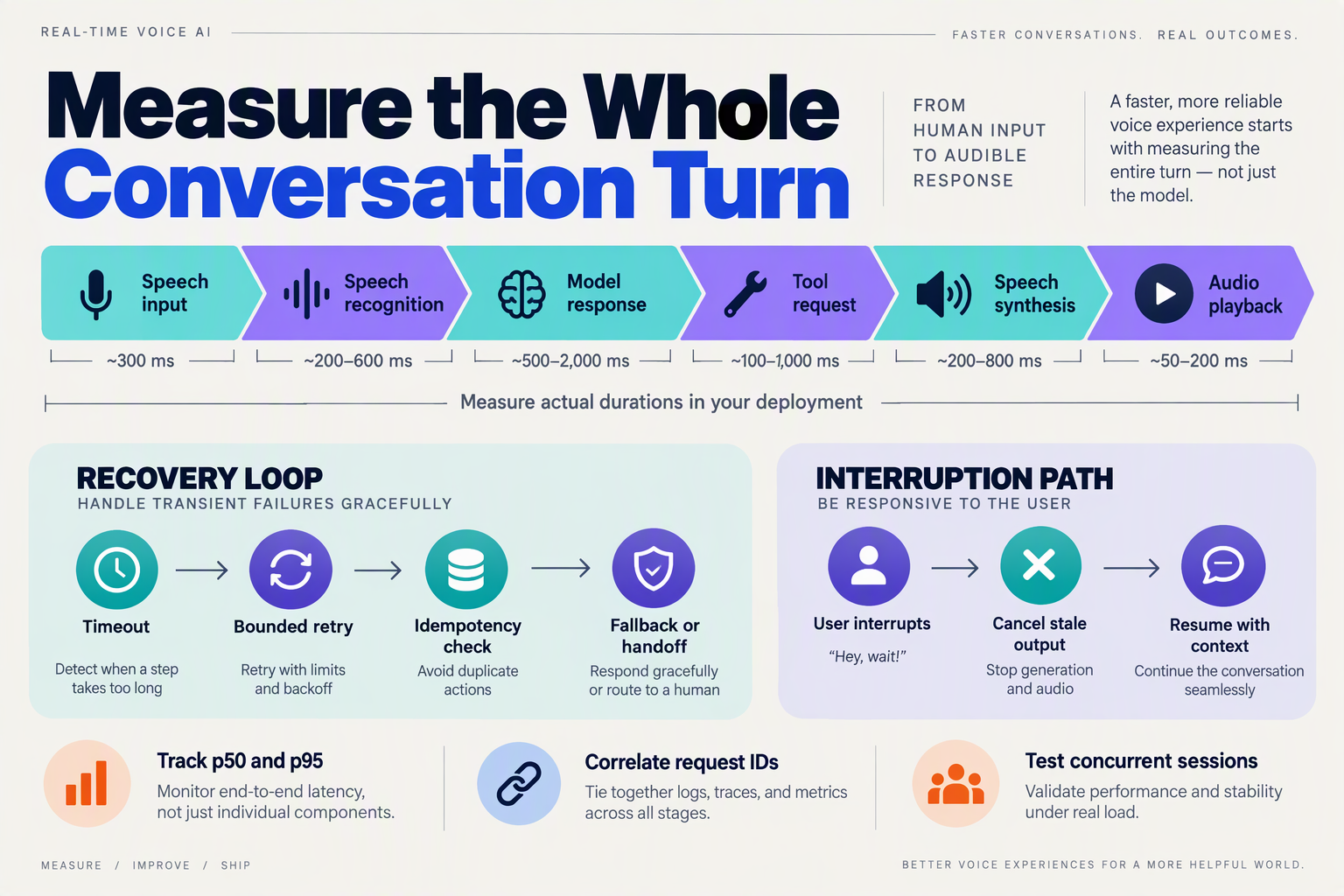
Measure voice latency from the end of the caller’s speech to the first audible reply, then trace the stages contributing to that delay. Recover from interruptions by cancelling obsolete responses; recover from backend failures through bounded retries, durable operation records, and explicit escalation—not by pretending an action succeeded.
Which latency metrics should a Python voice backend track?
A fast Python endpoint does not necessarily produce a responsive conversation. Speech endpointing, transcription, model generation, tool execution, speech synthesis, and audio delivery can all contribute to the caller’s wait.
Instrument each turn with a call ID, turn ID, and trace ID, and record:
- End-of-speech to first audio: the caller-facing response delay, including the time needed to detect that speech has ended.
- Tool round-trip latency: elapsed time from the voice agent’s tool request to its receipt of the Python backend’s result.
- Time to first model token and first audio chunk: separate generation delays from playback delays.
- Interruption-to-silence latency: how quickly agent playback stops after the caller starts speaking.
- Failure and recovery rates: timeouts, duplicate operations prevented, and successful human handoffs.
Use a monotonic clock for durations inside one process and correlated tracing across services; subtracting timestamps from unsynchronised machines can produce misleading results. Measure audible playback at the client or media layer where possible, rather than treating server-side audio generation as delivery.
For a September 2026 illustrative test, suppose transcription and endpointing take 300 milliseconds, tool execution takes 450 milliseconds, and generation plus audio delivery takes 500 milliseconds. If those stages run sequentially, the response delay is 1,250 milliseconds; this is a worked example, not a Cloudflare or CallMissed benchmark.
Track p50, p95, and p99, segmented by language, carrier, tool, and deployment region. Averages can hide the slow turns that derail conversations.
How should voice agents handle callers interrupting them?
Treat barge-in as a state transition, not merely an audio event. If a caller interrupts an order-status explanation with “Actually, cancel it,” the earlier response must not resume after a slow lookup completes.
Use this sequence:
- Stop queued playback when the voice layer detects an interruption.
- Advance the turn’s generation identifier and cancel pending work where supported.
- Discard stale results whose identifier no longer matches the active turn.
- Re-evaluate intent and permissions before executing the new request.
Cancellation does not reverse a completed business action. An address update already committed by the backend needs a recorded outcome, even if its spoken confirmation was interrupted.
How do you recover safely from tool failures?
Set an overall turn deadline and allocate shorter deadlines to individual dependencies. Retry transient failures only within that budget; use backoff and jitter, and avoid blindly retrying writes.
Cloudflare’s September 21, 2026 Python Workers announcement follows a two-year preview, according to Simon Willison’s coverage. That milestone supports evaluating the runtime for production, but it is not a voice-latency guarantee.
For mutations, attach an idempotency key and persist operation status. If an address-change request times out after committing, query its status before attempting another write. Distinguish “failed,” “pending,” and “outcome unknown” in structured tool responses.
As of September 2026, CallMissed supports live supervisor monitoring, call scoring against custom QA rubrics, eval suites, and A/B experiments, according to its verified product facts. Use these capabilities alongside backend traces to test interruptions, slow dependencies, and ambiguous outcomes—not just successful conversations.
What do Cloudflare's announcement and developer commentary establish—and leave unproven?

Cloudflare’s announcement establishes that Python Workers have moved from preview to general availability; it does not establish that they outperform other deployment options for AI voice or customer-support workloads. The accompanying coverage supports treating Python Workers as a serious candidate, while leaving application compatibility, operational reliability, and end-to-end performance to be verified.
What does the announcement actually confirm?
Cloudflare announced Python Workers’ general availability on September 21, 2026, according to Cloudflare’s release announcement and Simon Willison’s same-day coverage. Cloudflare’s announcement states, “We introduced Python Workers two years ago,” establishing the preview’s duration—not two years of demonstrated production reliability for every application.
The September 2026 coverage provides several distinct kinds of evidence:
- Release status: Cloudflare is the primary source for the general-availability announcement.
- Framework support: Nandann’s coverage identifies FastAPI, Django, and Flask as supported frameworks as of September 2026.
- Runtime implementation: FAUN’s September 22, 2026 summary identifies Pyodide and WebAssembly as the execution foundation.
- Integration ergonomics: FAUN reports on September 22, 2026 that bindings to services including Cloudflare Queues, R2, and D1 accept plain Python values.
These facts establish a deployment surface and programming model. Framework support is not a guarantee that every framework extension, dependency, or existing application will work unchanged. Likewise, simpler value conversion is an integration improvement, not a published latency benchmark.
What does developer attention prove?
The supplied Hacker News trend snapshot reports 129 points and 17 comments after 6.3 hours for the Python Workers announcement; this September 2026 research context does not specify the snapshot’s exact capture time. That is evidence of developer attention, not adoption, customer satisfaction, or production readiness for a particular workload.
Simon Willison’s September 21, 2026 link-blog entry provides another independent signal that the release merits attention. Nandann, Creuto, and explainx.ai also frame the announcement around practical deployment questions, including frameworks and infrastructure integrations.
However, the supplied material does not include the Hacker News comment text. It therefore cannot support claims that developers broadly praised performance, reported successful migrations, or agreed that Python Workers should replace conventional servers. Commentary headlines and summaries are useful discovery signals; they are not substitutes for reproducible measurements.
What remains unproven for a customer-support backend?
For the architecture developed in this article, the unresolved question is not whether Python can execute in Workers. It is whether your complete support workflow behaves correctly within the runtime.
A focused validation should answer three questions:
- Does the actual dependency set work? Deploy the same authentication libraries, data-validation code, and external-service clients that the support backend needs—not just a demonstration endpoint.
- Does the workflow meet its response budget? Measure tool execution through customer-record retrieval and business-rule evaluation. Separate backend timing from speech recognition, model generation, and voice synthesis.
- Does failure preserve correctness? Test timeouts, duplicate requests, unavailable services, and partial updates. An address-change tool must never report success when the underlying update failed.
As of September 2026, CallMissed supports custom REST tools for voice agents, making a Python-backed tool endpoint a concrete integration option. That capability does not establish a jointly validated CallMissed–Cloudflare deployment or an end-to-end performance guarantee.
General availability justifies evaluation; workload-specific evidence justifies deployment. Keep that distinction explicit when turning an interesting infrastructure announcement into a customer-facing support system.
Should you use Python Workers, a conventional Python service, or a hybrid?
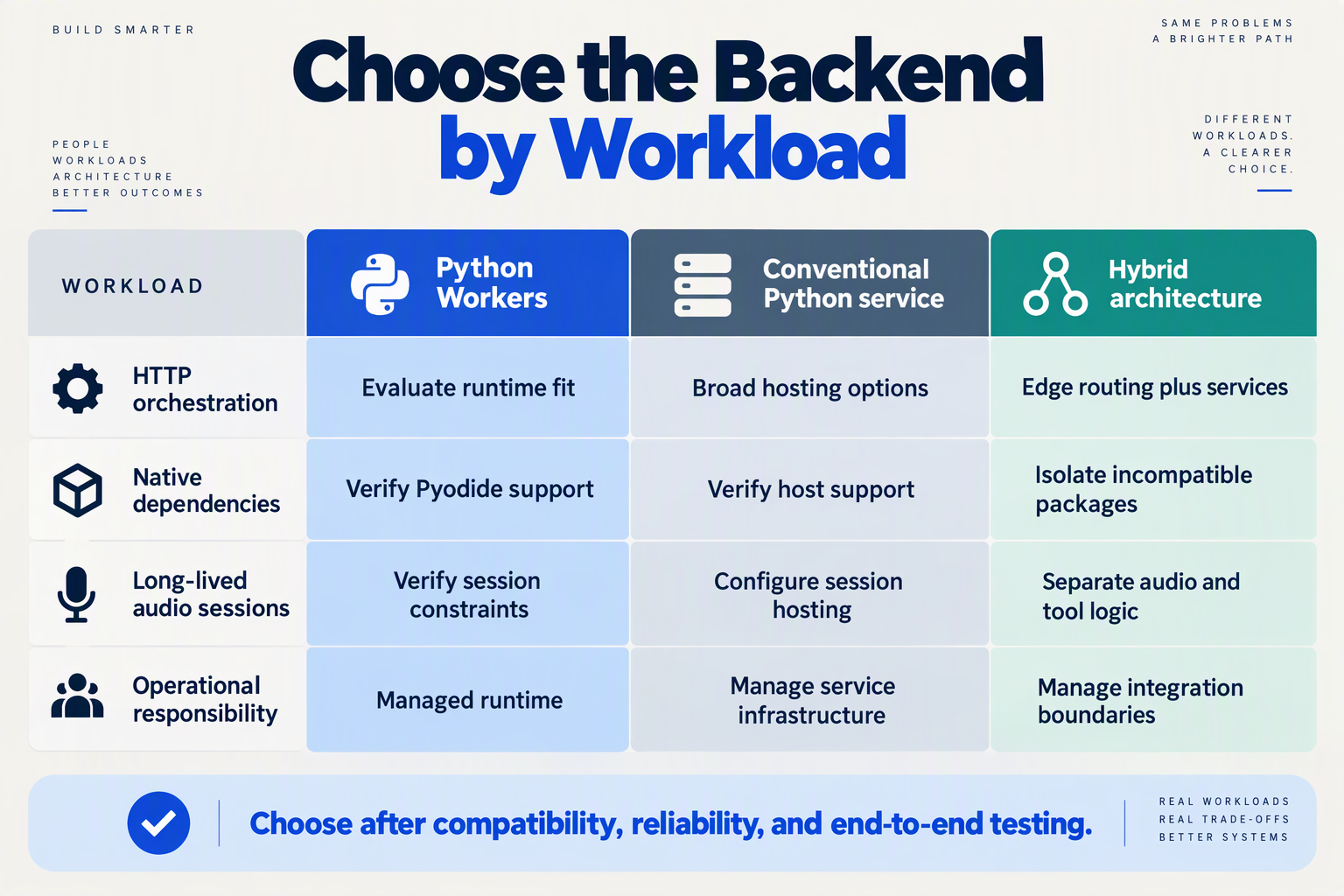
Use Python Workers for lightweight, request-driven support logic; choose a conventional Python service when runtime compatibility or execution control dominates; use a hybrid when you need both. For an AI voice backend, the deciding factor is the work each component performs—not whether the entire application can run on one platform.
Which deployment model fits each support workload?
The following is an architecture decision guide as of September 2026, not a performance benchmark. FAUN’s September 22, 2026 coverage identifies Pyodide and WebAssembly as the execution foundation for Cloudflare Python Workers, making dependency testing an important part of deployment selection.
| Workload or requirement | Python Workers | Conventional Python service | Hybrid |
|---|---|---|---|
| Short tool requests | Consider for validation and API orchestration | Useful alongside existing application logic | Worker validates; service executes |
| Native-library dependencies | Verify exact package compatibility | Prefer when OS-level dependencies are essential | Keep dependency-heavy code in the service |
| Long-running processing | Evaluate documented execution limits first | Prefer for jobs requiring controlled process lifetimes | Worker accepts work; backend processes it |
| Existing support application | Consider for isolated new endpoints | Keep stable workflows where they already run | Add an edge layer without a full migration |
| Cloudflare storage and messaging | Consider when using D1, R2, and Queues | Connect where operationally appropriate | Assign clear ownership of data and queues |
| Voice-session infrastructure | Validate protocol and lifecycle requirements | Consider when direct process control is required | Separate conversation transport from support tools |
As of September 2026, Creuto’s Python Workers GA coverage highlights D1, R2, and Queues alongside documented runtime limits. Those integrations are reasons to evaluate Workers—not evidence that every support workload belongs there.
When is a conventional Python service the safer choice?
A conventional service is often the simpler choice when your backend already depends on a specific operating-system environment, specialized native libraries, or persistent background processes. Framework support does not establish full application compatibility: importing FastAPI successfully is different from running every database driver, authentication package, and processing dependency your application needs.
Before moving a workload, check:
- Dependency behavior: Can the exact pinned packages execute correctly?
- Execution requirements: Does the task fit documented CPU, memory, and lifecycle limits?
- Operational needs: Can your team diagnose failures and recover unfinished work?
- Migration value: Does deployment change solve a measured problem?
Do not assume Workers will reduce latency or cost. Compare complete request paths, including downstream APIs and database access, using representative support traffic.
What would a practical hybrid backend look like?
For an address-change request, a Worker could authenticate the tool call, validate the order identifier, and forward a narrowly scoped command to an existing Python service. The service would check fulfillment status, apply the permitted update, and return a structured outcome.
As of September 2026, CallMissed supports custom REST tools for voice agents, allowing a support tool endpoint to use either deployment model without making the voice agent responsible for business-policy enforcement.
A sensible pilot is:
- Select one bounded tool, such as checking order status.
- Test realistic failures, including timeouts, unavailable dependencies, and duplicate requests.
- Measure end-to-end behavior, including response time, correctness, and operating cost.
- Expand only after evidence supports it, keeping a rollback path.
The strongest choice is usually the smallest architectural change that improves reliability. General availability makes Python Workers a credible deployment option; it does not make a full rewrite necessary.
Frequently Asked Questions
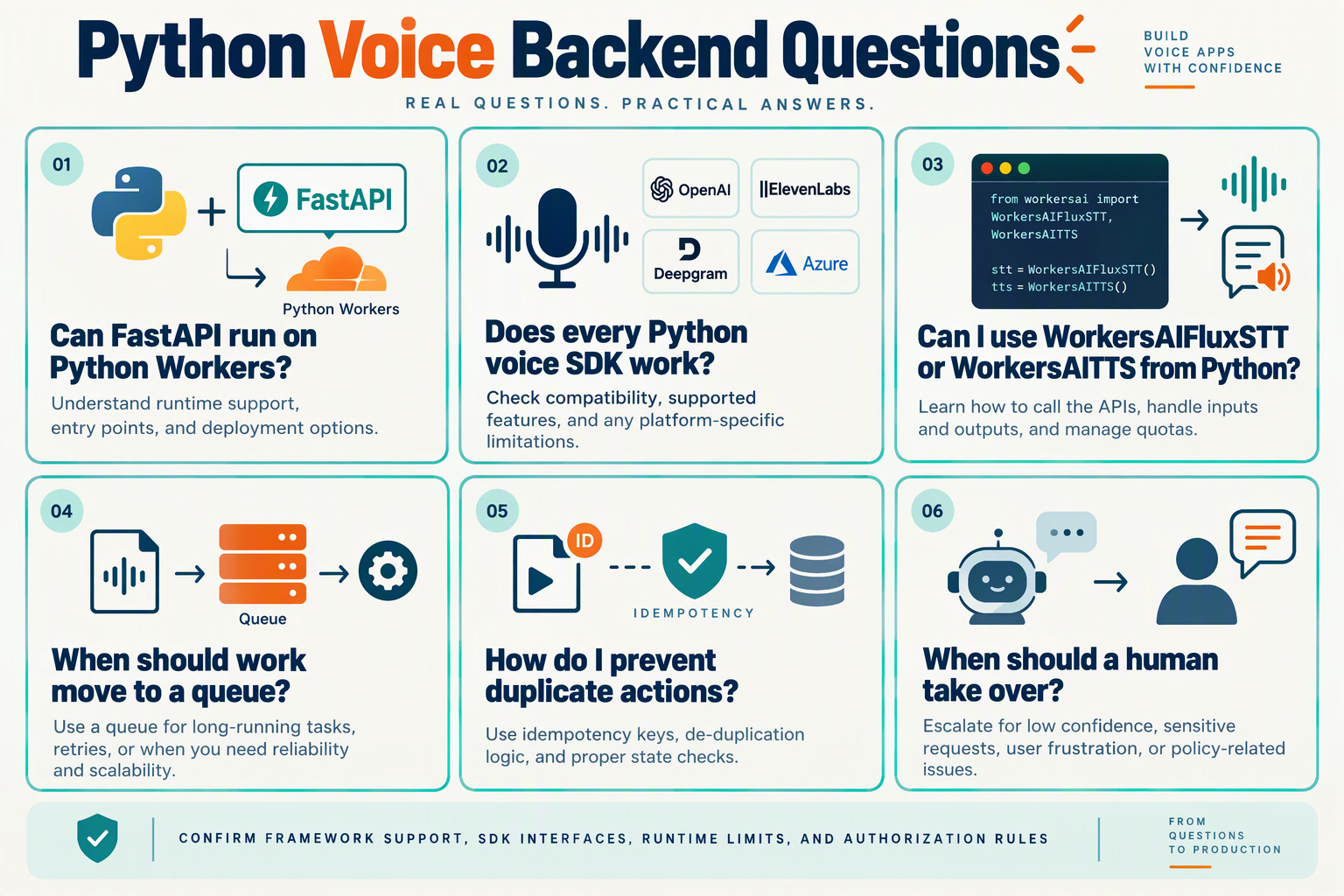
Can FastAPI run on Cloudflare Python Workers?
Do Python voice SDKs work on Python Workers?
When should a customer support voice agent use a queue?
Can Python Workers use existing Python packages without changes?
Should a customer support voice agent run its entire backend at the edge?
What should developers verify before deploying a production support backend?
Conclusion
Python Workers give customer-support teams another way to deploy the backend logic that makes an AI voice agent useful—not just conversational. The opportunity is to connect spoken requests to validated actions, dependable workflows, and clear human escalation while keeping the conversation layer separate from business operations.
According to Simon Willison’s September 21, 2026 coverage, Cloudflare Python Workers became generally available after a two-year preview. That milestone makes the platform worth evaluating for Python-based support backends, but general availability is a starting point for architectural decisions, not a reason to move every workload.
Four takeaways should guide that evaluation:
- Treat the backend as the authority for customer actions. A customer support voice agent can understand an address-change request, but Python business logic must identify the customer, retrieve the order, and determine whether the change is permitted. Return a structured result that distinguishes completed actions, rejected requests, and failures; fluent speech must never substitute for a confirmed operation.
- Separate conversation, tool execution, and background work. Listening and speaking have different operational needs from checking records or processing follow-up tasks. Keep immediate tool responses focused on what the caller needs now, and separate asynchronous work where appropriate. That boundary makes it easier to reason about retries and failures without letting the agent imply that unfinished work has succeeded.
- Use familiar frameworks without assuming a familiar runtime. Nandann’s September 2026 coverage identifies FastAPI, Django, and Flask among the supported frameworks. FAUN’s September 22, 2026 summary explains that Python Workers run through Pyodide, a WebAssembly build. Framework support therefore does not eliminate the need to check package compatibility and documented runtime limits before choosing a deployment architecture.
- Evaluate the surrounding workflow, not just the endpoint. FAUN’s September 22, 2026 coverage identifies Python-friendly bindings for Cloudflare Queues, R2, and D1. Those services offer building blocks for background processing and storage, but authentication, retries, observability, and explicit error handling still need deliberate design. A working demonstration is not the same as a dependable customer-support workflow.
What should Python voice-agent developers watch next?
Watch how Python Workers’ package compatibility, framework integration, and documented runtime constraints evolve. The practical question is whether the platform can support your specific customer-record lookups, permission checks, and follow-up workflows—not whether every support backend should run at the edge.
As of September 2026, CallMissed supports custom REST tools for voice agents, making it a relevant platform to explore when connecting Python business logic to customer conversations.
Start with one bounded workflow, such as an order-status lookup, and test success, denial, and failure paths. Can your backend prove what happened before your voice agent tells the customer it is done?
Related Reading
- AI Voice Agent Customer Service 2026: CallMissed Support Operations Guide
- How to Build a Voice Agent With LiveKit: Python Guide
- AI Agent Human Oversight Rules for Customer Support
Sources
Discussion
Related Posts

Ready to automate customer conversations?
Launch AI voice agents and WhatsApp bots with CallMissed — one API, 22+ Indian languages.