Twilio Voice Pricing in 2026: What an AI Agent Really Costs



Understand Twilio Voice Pricing with US rate tables, reproducible AI-call budgets, hidden cost checks, and practical ways to compare voice stacks.

Twilio Voice Pricing in 2026: What an AI Agent Really Costs
How does a voice rate of $0.0085 per minute become a $785 bill for 10,000 AI-handled minutes—before the language model and other costs? Twilio Voice Pricing makes more sense when you separate the cost of connecting a call from the cost of running the AI conversation.
In this November 2026 pricing snapshot, Twilio lists communications rates starting at $0.0085 per minute for inbound calls and $0.014 per minute for outbound calls. Twilio’s United States Programmable Voice pricing page separately lists Conversation Relay at $0.07 per minute. These are different billing components, not interchangeable estimates of what a complete AI agent costs.
For a simple illustration, assume 10,000 US inbound local-call minutes, with Conversation Relay active throughout every minute. At Twilio’s published rates in this November 2026 snapshot, inbound calling totals $85, while Conversation Relay adds $700, producing a $785 subtotal. That is $0.0785 per minute, before phone-number rental, language-model usage, application hosting, taxes, or any additional services your architecture requires.
The distinction matters because a buyer budgeting only for telephone minutes would miss most of that example’s subtotal. A developer, meanwhile, needs to understand which components are already bundled: according to Quiq’s 2026 Twilio pricing breakdown, Conversation Relay includes real-time transcription during the active AI session. Adding a separate transcription estimate automatically could therefore double-count a capability rather than reveal a genuine expense.
This guide will help you build a budget around the actual call journey, including:
- Telephony: inbound versus outbound rates, number rental, destinations, and additional call legs.
- AI architecture: Conversation Relay versus a custom stack, with language-model and speech costs mapped to the chosen approach.
- Optional services: recording, analytics, and other features that can introduce separate charges.
- Monthly forecasting: worked examples that distinguish connected call minutes from active AI-session minutes.
We will also explain why US starting rates should not be treated as a worldwide quote, and how transfers, billing increments, and usage assumptions can change the final estimate.
As of November 2026, platforms such as CallMissed offer another budgeting approach: its Standard voice-agent plan bundles speech recognition, the language model, and voice at ₹4 per minute, with phone carriage billed separately and a 30-second minimum per call.
The goal is not to crown the cheapest headline rate. It is to make each quote comparable: the same geography, call direction, conversation duration, AI components, and operational requirements—so you can predict what an answered customer conversation actually costs.
What does a Twilio AI agent really cost beyond carrier minutes?
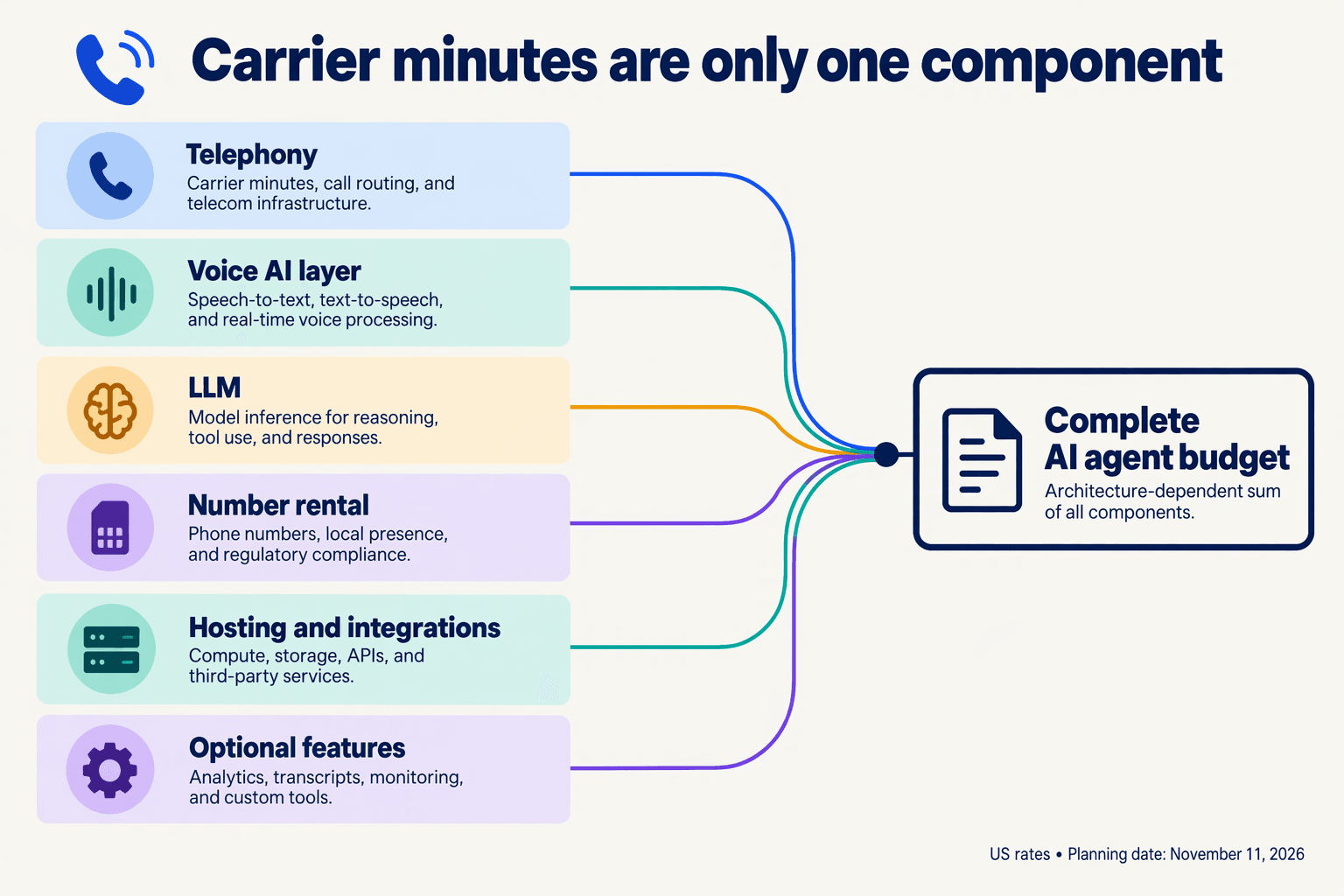
A Twilio AI agent costs more than carrier minutes because you also pay for the voice-AI connection, language-model usage, application infrastructure, and any enabled add-ons. The practical budgeting unit is an answered conversation—not a single advertised per-minute rate.
Which costs belong in a Twilio AI agent budget?
Build a ledger that separates usage-based charges from fixed monthly expenses. For a November 2026 estimate, account for these categories:
- Call connectivity: billable minutes for each telephone leg, using the relevant country, destination, number type, and call direction.
- AI conversation infrastructure: Twilio Conversation Relay or the components of a custom speech pipeline.
- Model inference: language-model requests, including conversation history, retrieved information, and tool results sent to the model.
- Application operations: hosting, database access, integrations, monitoring, and engineering maintenance.
- Optional services: recording, advanced diagnostics, branded calling, or other explicitly enabled features.
Number rental remains separate from usage. According to Quiq’s 2026 Twilio pricing breakdown, published US monthly rental rates are $1.15 for a local number and $2.15 for a toll-free number, as of November 2026.
The budgeting rule is simple: include a charge because your architecture uses it, not because it appears somewhere on a pricing page.
How does Conversation Relay change a custom-stack estimate?
Conversation Relay and a custom audio pipeline require different cost ledgers. With Relay, identify the managed capabilities already included before adding external speech services; with a custom pipeline, price each component you actually deploy.
For a custom implementation, the ledger might contain audio transport, speech recognition, language-model inference, and speech synthesis. According to Quiq’s 2026 breakdown, Twilio Media Streams costs $0.0044 per minute as of November 2026; that transport charge is not a complete AI-agent price.
Your developer estimate should therefore answer:
- Which service receives the audio?
- Which services turn speech into text and generate spoken replies?
- Which model processes the conversation, and how is its usage billed?
- Which components are bundled rather than charged separately?
This distinction also applies when evaluating other platforms. As of November 2026, CallMissed’s custom-stack option bills components by the second with no component minimum, plus a separate ₹1-per-minute platform fee with a 30-second minimum; phone carriage is billed separately. That structure needs a different calculation from an all-inclusive AI-component rate.
Which optional charges can materially change the bill?
Small charges become meaningful when applied across thousands of conversations. According to Quiq’s 2026 breakdown, Twilio’s published November 2026 rates include:
- Voice Insights advanced features: $0.0024 per minute.
- Branded calling: $0.12 per call.
- Conference calls: starting at $0.0018 per participant per minute.
For a worked add-on estimate, assume 10,000 eligible calls averaging three minutes, with branded calling on every call and advanced Voice Insights applied throughout. Using those published rates, branded calling adds $1,200, while advanced Voice Insights adds $72—a calculated $1,272 beyond connectivity and AI processing.
This is an illustrative configuration, not a default Twilio bill. Before approving a quote, ask for every enabled service, its billing unit, and the minutes or calls to which it applies. Twilio Voice Pricing becomes predictable when each line item has an explicit usage assumption.
What are the published US Twilio Voice rates? (Official source)
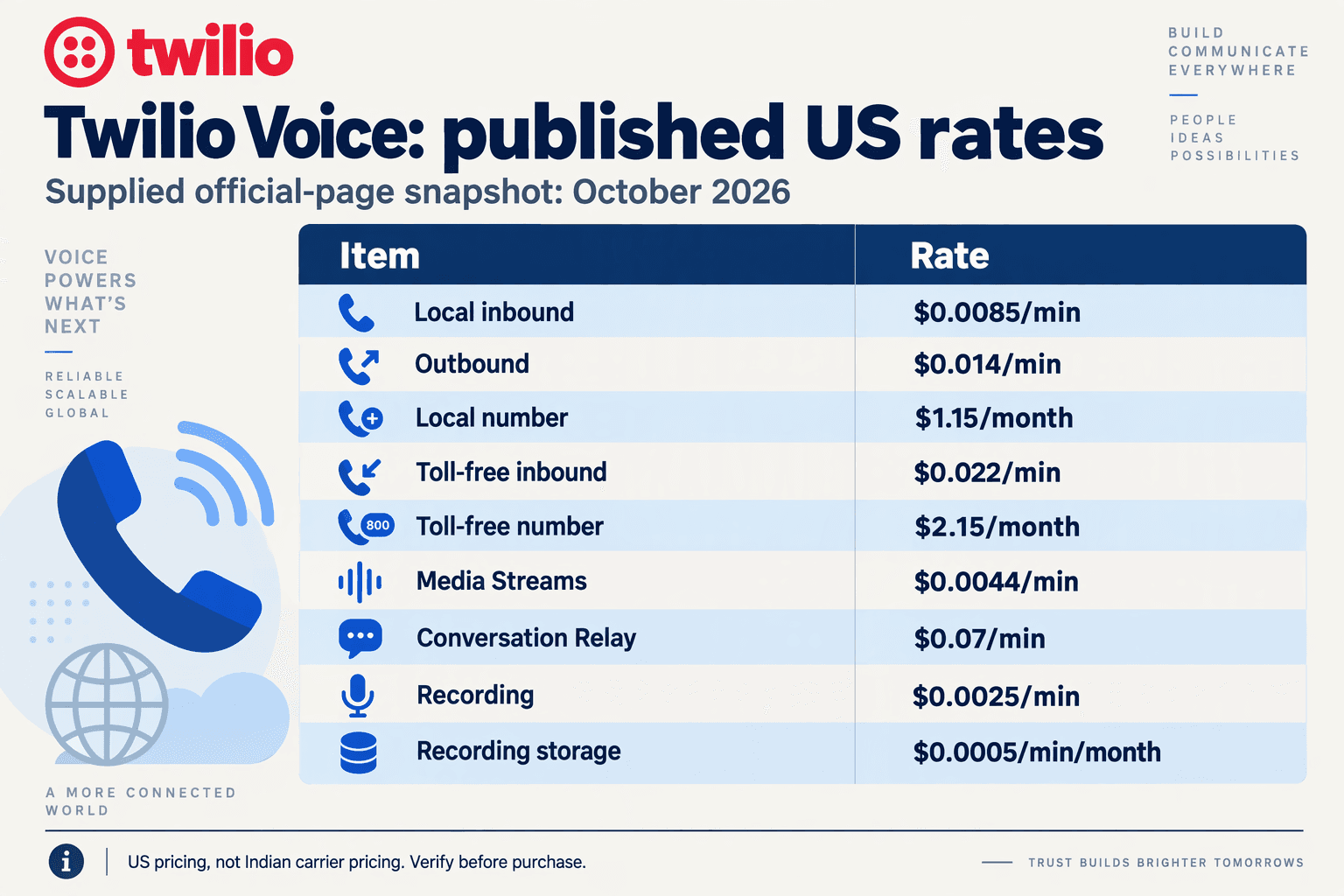
Twilio’s published US Voice rates distinguish call minutes, monthly number rental, and AI-session services. In the November 2026 snapshot, Twilio lists calling rates starting at $0.0085 per inbound minute and $0.014 per outbound minute, while its US Programmable Voice page lists Conversation Relay separately at $0.07 per minute.
What are Twilio’s US per-minute and phone-number prices?
The table below summarizes the US pricing available in the supplied November 2026 research. Twilio’s pricing pages directly support the headline calling rates and Conversation Relay price; Quiq’s “2026 Twilio Voice Pricing: A Full Breakdown” supplies the local-number, toll-free-number, and toll-free inbound figures.
| Cost item | Published US rate | Billing unit | Source |
|---|---|---|---|
| Receive calls on a local number | $0.0085 | Per minute | Twilio; Quiq |
| Make calls—starting rate | $0.014 | Per minute | Twilio |
| Receive calls on a toll-free number | $0.022 | Per minute | Quiq |
| Rent a local phone number | $1.15 | Per number/month | Quiq |
| Rent a toll-free phone number | $2.15 | Per number/month | Quiq |
| Use Conversation Relay | $0.07 | Per active session minute | Twilio |
These are separate billing items, not six alternative prices for the same service. A local inbound call using Conversation Relay combines the relevant inbound charge with the Relay charge; the phone number adds a monthly expense.
The outbound figure is a starting rate, not a universal quote for every destination. Before approving a budget, match the applicable Twilio rate to the number type, destination, and call direction.
How much does choosing a toll-free number change the budget?
For a November 2026 planning example, assume 2,000 billable inbound minutes and one rented number. Using the rates reported by Quiq in its 2026 breakdown:
- Local number: 2,000 × $0.0085 = $17 in inbound usage; adding $1.15 rental produces $18.15.
- Toll-free number: 2,000 × $0.022 = $44 in inbound usage; adding $2.15 rental produces $46.15.
- Difference: the toll-free configuration adds $28 per month in this example, before AI services and other expenses.
This comparison isolates the number choice rather than changing the AI architecture. Both totals exclude Conversation Relay, language-model usage, hosting, taxes, and additional services.
For buyers, the practical question is whether a toll-free number’s customer-facing value justifies the incremental cost. For developers, the lesson is to make number type an explicit budget input, rather than applying the local inbound rate to every incoming call.
Which additional published rates belong outside the base-rate table?
Optional services deserve separate budget lines because they depend on implementation. According to Quiq’s 2026 Twilio pricing breakdown, the November 2026 reference figures include:
- Media Streams: $0.0044 per minute.
- Voice Insights advanced features: $0.0024 per minute.
- Streaming transcription: $0.027 per minute.
- Conference calls: starting at $0.0018 per participant per minute.
Do not automatically add every optional rate to every conversation. First identify which services the application actually invokes, then apply each service’s billing unit to its relevant usage.
The useful output is a rate card mapped to your call flow: one row for each chargeable component, with its source, unit, and expected quantity. That turns published Twilio Voice pricing into an auditable estimate rather than a headline-rate guess.
What prerequisites and workload assumptions do you need before estimating costs?
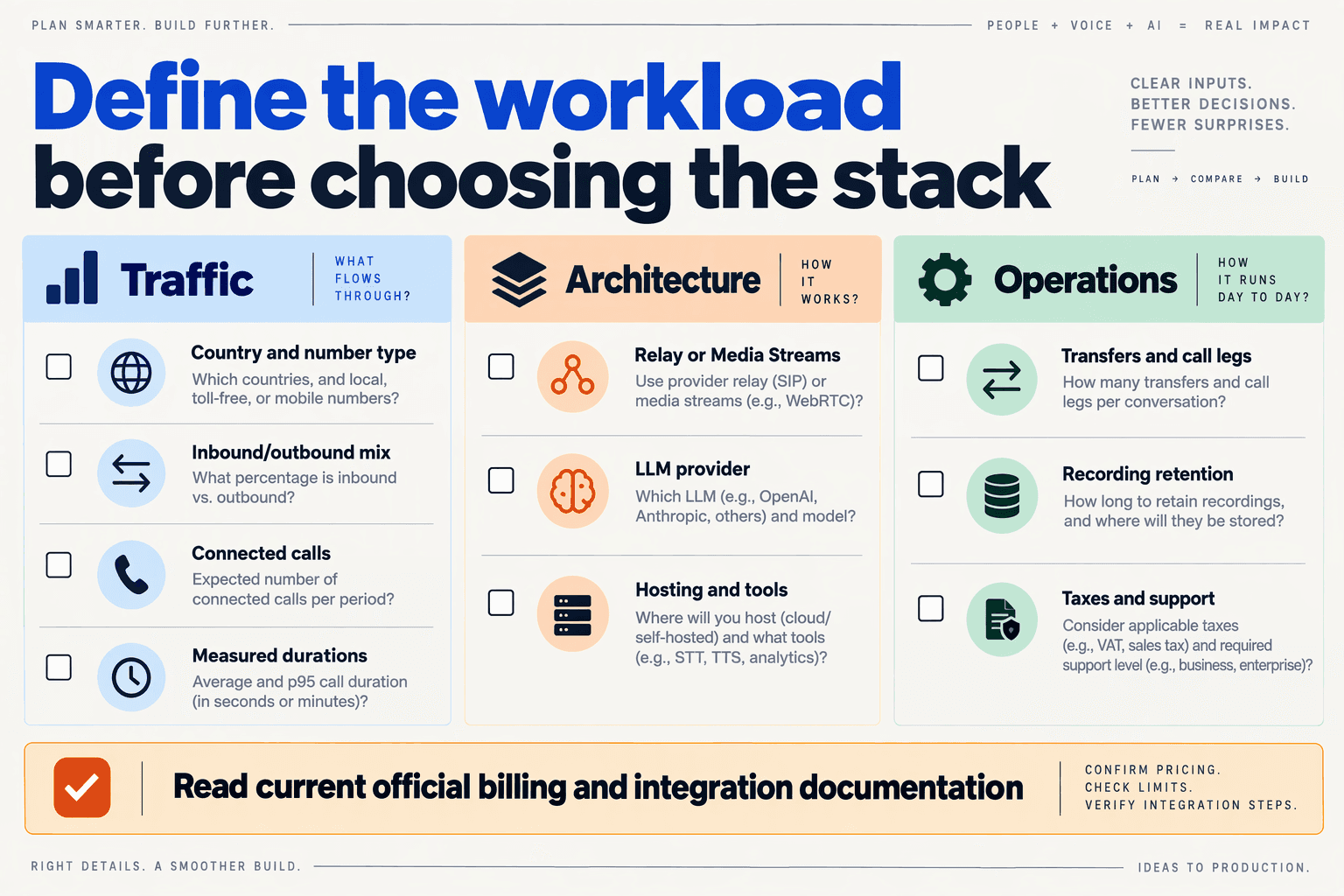
Before estimating Twilio Voice Pricing, define where calls travel, how long each billable component runs, and which services your architecture actually uses. You also need a call-flow diagram, destination-specific rates, and sample call records—not just a forecast of “monthly minutes.”
What inputs should your voice-cost worksheet contain?
Use the following checklist to build a comparable estimate. The example values are planning assumptions for November 2026, not Twilio benchmarks or guaranteed billing outcomes.
| Input | What to establish | Example assumption | Cost implication |
|---|---|---|---|
| Geography and numbers | Number country, local or toll-free type, destination | One US local number | Determines number rental and applicable calling rates |
| Volume and duration | Connected calls and duration distribution | 2,000 calls averaging 3 minutes | Produces 6,000 raw customer-call minutes |
| Active AI time | Time when the AI session is running | 2.5 minutes per call | Produces 5,000 AI-session minutes |
| Transfers and call legs | Transfer frequency, destination, additional-leg duration | 20% transferred; 2-minute additional leg | Adds 800 raw outgoing-leg minutes |
| Architecture and billing units | Relay or custom speech stack; rounding and minimums | Verify each component separately | Prevents duplicate services and incorrect minute totals |
| Operations and capacity | Recording, hosting, integrations, peak concurrency | Price required services; test busy periods | Captures costs and deployment constraints beyond usage |
Treat missing inputs as unresolved assumptions, not zero-cost items. For example, “recording undecided” belongs in the worksheet as a pending decision rather than disappearing from the budget.
How should you separate customer minutes from billable usage?
Build the estimate around call legs and service timelines. A customer conversation, an outgoing transfer leg, and an active AI session are different usage measurements, even when they belong to one interaction.
Using the illustrative November 2026 workload above:
- Customer-call duration: 2,000 × 3 minutes = 6,000 raw minutes.
- AI-session duration: 2,000 × 2.5 minutes = 5,000 raw minutes.
- Additional transfer-leg duration: 2,000 × 20% × 2 minutes = 800 raw minutes.
That creates 6,800 raw call-leg minutes, but only 5,000 AI-session minutes. Do not multiply every service rate by either total indiscriminately; apply each rate to its own eligible usage, then account for its billing rules.
Quiq’s 2026 Twilio pricing breakdown, used for this November 2026 snapshot, models a contact-center overflow scenario with 90,000 inbound minutes, 45,000 Conversation Relay minutes, and 11,250 human-transfer minutes. Those separate quantities demonstrate why one headline “minutes” figure is insufficient.
What should developers verify before buyers approve the budget?
Before implementation, confirm:
- Account readiness: number availability, relevant geographic permissions, and applicable business or regulatory requirements.
- Integration readiness: working application endpoints, language-model credentials, tool access, and transfer routing.
- Measurement readiness: timestamps for connection, AI-session start and stop, transfers, and disconnects.
- Capacity assumptions: peak simultaneous calls, provider limits, and expected handling of traffic spikes.
For architecture comparisons, document exactly what each price includes. As of November 2026, CallMissed supports a custom voice stack with components billed by the second without a component minimum, plus a separate ₹1-per-minute platform fee with a 30-second minimum; phone carriage is separate. That distinction illustrates why billing units must accompany every quoted rate.
Finally, calculate low, expected, and high usage cases. Vary call duration and transfer frequency first: both can change the budget substantially without changing the number of customers served.
How do Conversation Relay and Media Streams change the cost components?
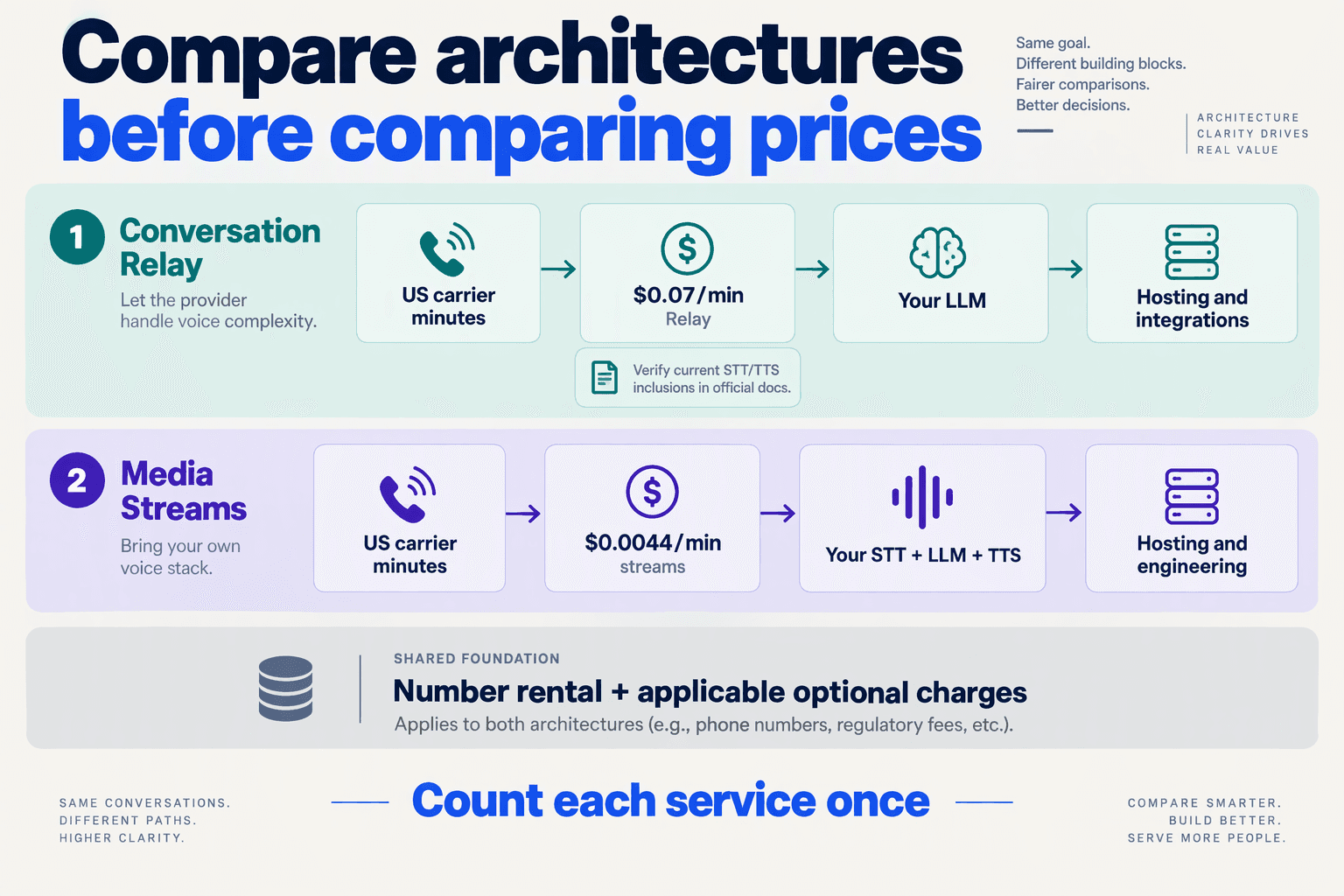
Conversation Relay adds a managed voice-AI layer; Media Streams adds audio transport for a stack you assemble yourself. For a November 2026 Twilio Voice pricing comparison, the important distinction is which speech, model, and infrastructure costs remain outside each service’s headline rate.
What does each architecture add to your Twilio bill?
Twilio’s United States Programmable Voice pricing page lists Conversation Relay at $0.07 per minute in this November 2026 snapshot. Quiq’s 2026 Twilio Voice Pricing: A Full Breakdown lists Media Streams at $0.0044 per minute; that lower rate is a transport charge, not a complete AI-agent price.
The table below maps the cost components for budgeting as of November 2026. Separately purchased capabilities depend on your implementation and provider contracts.
| Cost component | Conversation Relay approach | Media Streams approach | Budget treatment |
|---|---|---|---|
| Telephone connection | Separate Voice charges | Separate Voice charges | Keep carrier minutes outside the AI subtotal |
| Voice infrastructure | $0.07/min, according to Twilio | $0.0044/min, according to Quiq | Apply each rate to its billable service usage |
| Real-time transcription | Included during the active AI session, according to Quiq | Budget your selected speech-recognition service | Avoid automatically adding transcription to Relay |
| Language-model processing | Budget the selected LLM separately | Budget the selected LLM separately | Estimate tokens and model-specific rates |
| Speech output | Confirm included voices and configuration | Budget your selected speech-generation service | Check voice-provider charges and billing units |
| Application infrastructure | Budget orchestration and integrations | Budget audio handling, orchestration, and integrations | Include hosting and engineering overhead |
Do not automatically add both service rates to every AI minute. Treat Conversation Relay and Media Streams as alternative architecture budgets unless your actual call flow uses both.
Is Media Streams cheaper than Conversation Relay?
Media Streams has the lower published service rate, but that does not establish a lower total operating cost. A custom stack must account for the capabilities and operational work that sit beyond audio transport.
Using the November 2026 rates reported by Twilio and Quiq, the difference between Conversation Relay and Media Streams is $0.0656 per minute, before external AI services and infrastructure.
For 2,000 billable service minutes, the arithmetic is:
- Conversation Relay: 2,000 × $0.07 = $140.
- Media Streams: 2,000 × $0.0044 = $8.80.
- Service-fee difference: $140 − $8.80 = $131.20.
That $131.20 is budget headroom, not demonstrated savings. To compare fairly, add each architecture’s remaining speech, LLM, hosting, and operational costs. Custom speech-service charges can consume the apparent advantage before engineering time enters the calculation.
Which usage measurements should developers track?
Track connected-call duration separately from AI-service usage. Quiq’s 2026 contact-center example distinguishes 90,000 inbound voice minutes from 45,000 Conversation Relay minutes, illustrating why one duration assumption should not drive every billing line.
For a useful implementation estimate, capture:
- Service start and stop times: identify when Relay or streaming actually runs.
- Provider usage: retain speech-service units and LLM token counts.
- Transfer boundaries: distinguish the AI session from subsequent human-call legs.
- Infrastructure consumption: measure hosting and integration work rather than assuming they are free.
Choose Conversation Relay when reducing voice-infrastructure integration work is the priority. Consider Media Streams when control over the speech and model stack justifies the additional implementation responsibility—and validate that choice against a complete cost ledger.
How do you calculate a hypothetical budget for 1,000 AI calls?
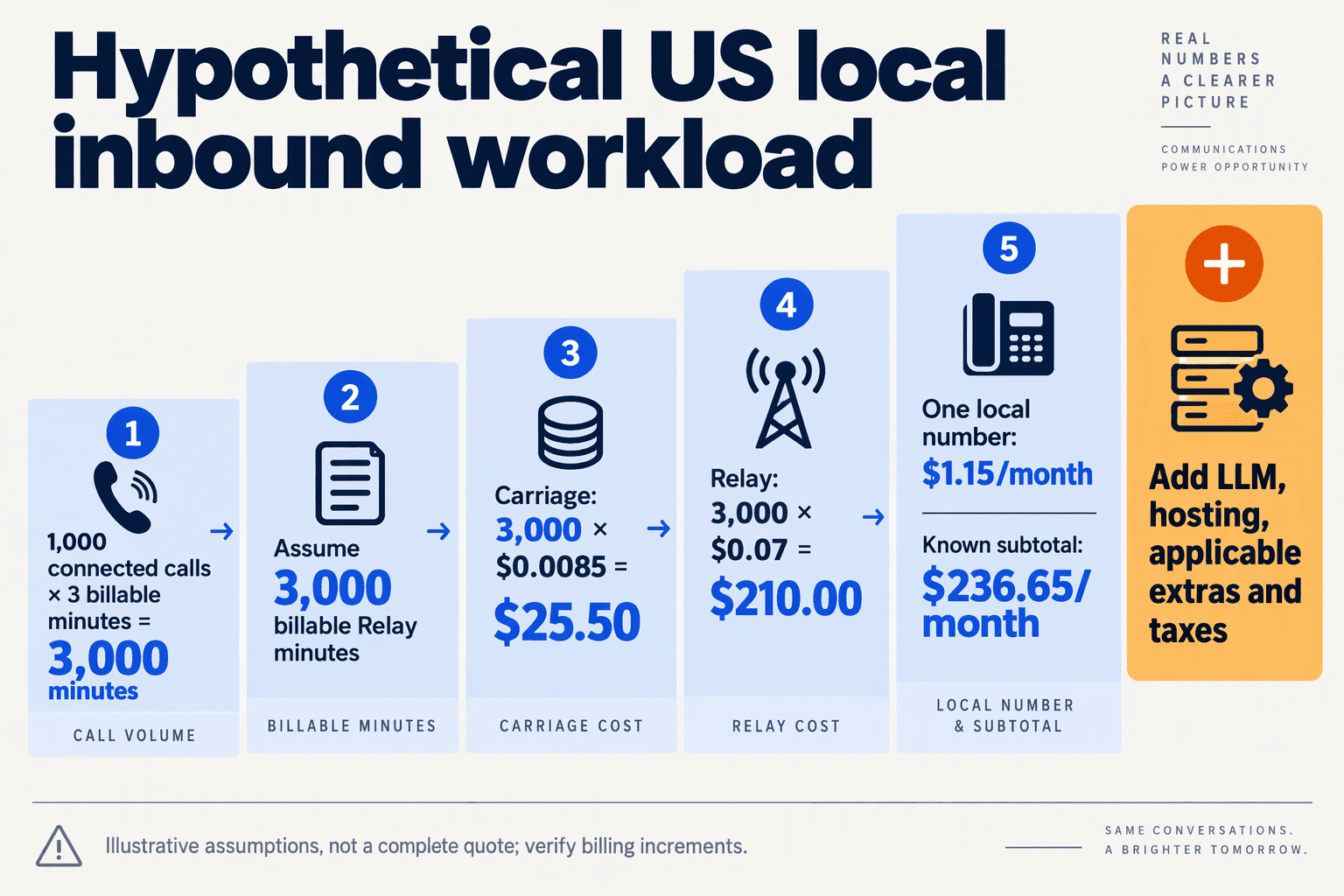
For 1,000 connected AI calls averaging three billed minutes each, a hypothetical US inbound budget is $286.65 before taxes and optional services, using the November 2026 rates and illustrative allowances below. Of that total, $235.50 covers inbound telephony plus Twilio Conversation Relay; the remaining amount covers one local number and assumed language-model and hosting costs.
What assumptions should your 1,000-call budget use?
Start with a defined workload, not just a call count. For this November 2026 planning example, assume:
- 1,000 connected inbound calls to one US local number.
- Three billed minutes per call, producing 3,000 telephone minutes.
- Conversation Relay active for all three minutes, producing 3,000 AI-session minutes.
- No human transfers, recording, branded calling, or additional analytics.
- $20 for language-model usage and $30 for application hosting, both hypothetical allowances—not vendor quotes.
The equal telephone and AI-session durations simplify this example. In production, use separate measurements for each: a customer waiting in a queue or speaking to a human can consume telephone minutes without consuming the same number of AI-session minutes.
How do you calculate each monthly cost?
Use this formula:
Monthly budget = telephony + active AI sessions + number rental + language-model usage + hosting + selected extras.
Twilio’s pricing page lists inbound calling starting at $0.0085 per minute in the November 2026 snapshot. Twilio’s United States Programmable Voice pricing page lists Conversation Relay at $0.07 per minute in the same snapshot.
Quiq’s 2026 Twilio Voice Pricing: A Full Breakdown lists a US local phone number at $1.15 per month, as referenced for this November 2026 estimate.
| Budget item | Calculation | Monthly estimate |
|---|---|---|
| US inbound local calling | 3,000 minutes × $0.0085 | $25.50 |
| Twilio Conversation Relay | 3,000 minutes × $0.07 | $210.00 |
| One local phone number | 1 × $1.15 | $1.15 |
| Language-model allowance | Hypothetical allocation | $20.00 |
| Application hosting allowance | Hypothetical allocation | $30.00 |
| Total before taxes and extras | Sum of listed items | $286.65 |
That produces an estimated cost of approximately $0.287 per connected call. It is a planning result for this workload, not a universal Twilio AI-agent price.
According to Quiq’s 2026 breakdown, Conversation Relay includes real-time transcription during the active AI session. This example therefore does not add a separate streaming-transcription charge.
How much contingency should you add?
An illustrative 15% contingency adds approximately $43, bringing the working budget to roughly $330. That percentage is a planning choice, not a Twilio fee or an industry benchmark.
Before approving the budget:
- Test longer conversations. Increasing average duration from three to four billed minutes adds 1,000 minutes. At the November 2026 rates above, telephony and Conversation Relay alone increase by $78.50.
- Measure language-model consumption. Replace the $20 allowance with observed input, output, and conversation-history usage at your chosen model’s rates.
- Reconcile billing units. Calculate billable duration from individual calls rather than assuming raw audio minutes equal invoice minutes.
- Price operational exceptions. Add destination-specific transfer legs, selected services, and applicable taxes separately.
The most useful next step is a representative pilot: measure billed minutes, active AI-session minutes, and model spend, then replace assumptions with those observations.
How can you reduce voice costs without comparing unequal workloads?
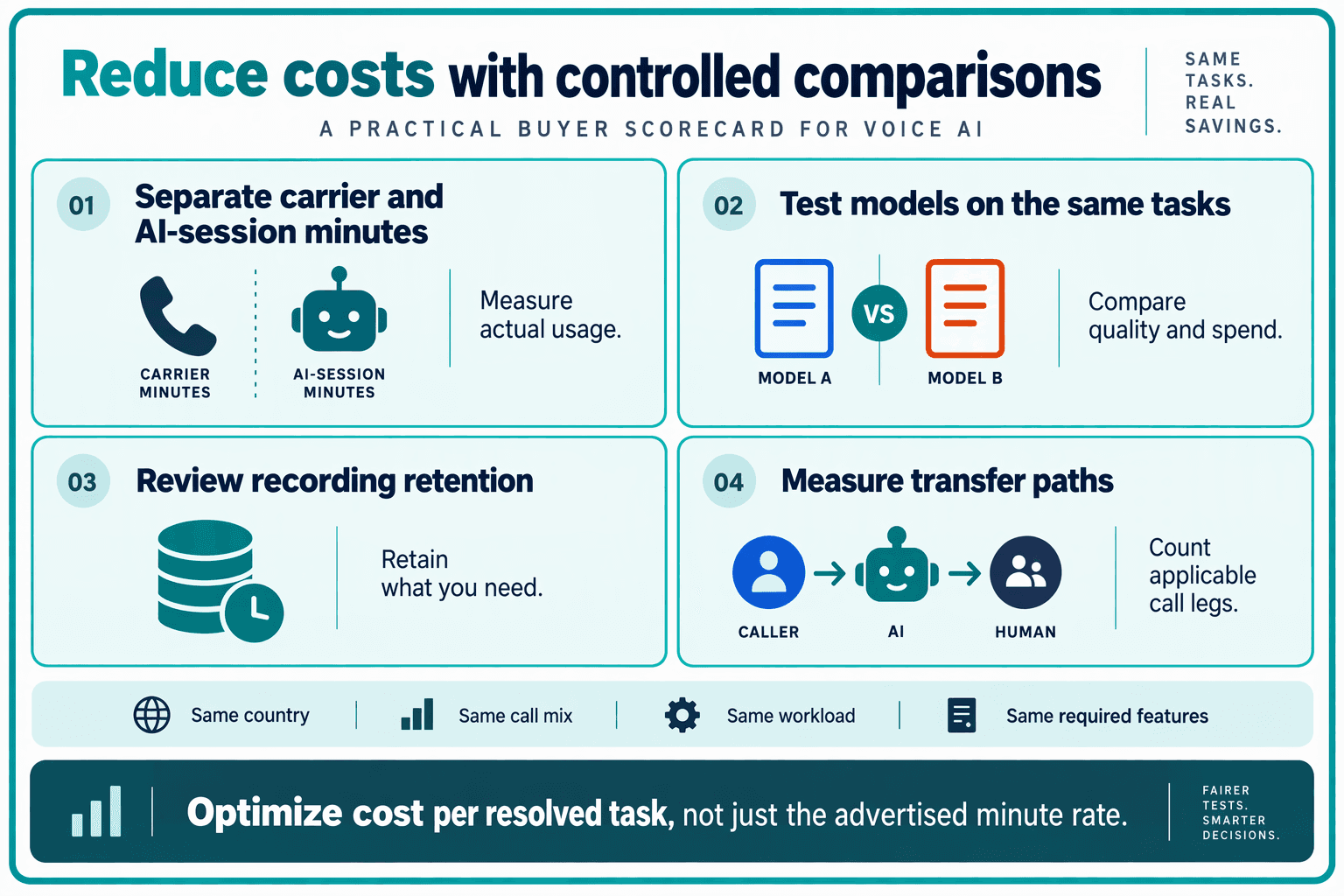
Reduce voice costs by changing billable usage or architecture while holding service requirements constant. A fair comparison uses the same destinations, call mix, conversation quality, transfer requirements, and billing increments—not merely two advertised per-minute rates.
Which workload assumptions should stay identical?
Use this checklist before comparing Twilio Voice pricing with another provider or a custom AI stack. Each saving should come from removing unnecessary consumption, not quietly reducing the service delivered.
| Cost lever | Hold constant | Potential saving | Validation check |
|---|---|---|---|
| Carrier routing | Country, number type, direction | Lower carriage charges | Quote identical destinations |
| AI-session duration | Completed customer tasks | Fewer active AI minutes | Separate AI time from connected time |
| Speech architecture | Languages, voice quality, responsiveness | Remove redundant services | Check what each bundle includes |
| Model selection | Accuracy and tool-use requirements | Lower model usage cost | Replay representative conversations |
| Human transfers | Escalation policy and resolution quality | Less avoidable overlap | Measure each billable call leg |
| Billing increments | Call count and duration distribution | Less minimum-charge overhead | Calculate charges per call |
Do not compare US local inbound rates against toll-free, international, or outbound workloads. Similarly, a cheaper model is not a genuine saving if it creates more retries, longer conversations, or additional human escalations.
How much can shorter AI sessions save?
According to Twilio’s United States Programmable Voice pricing page, Conversation Relay costs $0.07 per minute as of November 2026. That makes active-session duration a measurable optimization target, distinct from the duration of the telephone connection.
Consider an illustrative workload with 10,000 active Relay minutes:
- Baseline: 10,000 × $0.07 = $700 in Relay charges.
- Optimized: 8,000 × $0.07 = $560 in Relay charges.
- Difference: $140, or 20% of the Relay component, not 20% of the entire bill.
This saving is conditional: your implementation must actually reduce billable Relay usage. Removing unnecessary conversational turns or ending the AI session when its work is complete may help; simply labeling part of a connected session “hold time” does not establish that billing stops.
According to Quiq’s 2026 Twilio pricing breakdown, available in this November 2026 snapshot, Conversation Relay already includes real-time transcription during the active AI session. Check for overlapping transcription purchases before adding another speech-recognition line item, while retaining any separate service required for a different recording or compliance workflow.
When is a custom voice stack worth testing?
A custom stack deserves evaluation when its component-level savings exceed the additional integration and operating work. Compare speech recognition, model usage, speech synthesis, streaming infrastructure, and platform fees together.
As of November 2026, CallMissed supports a custom voice stack with components billed by the second without a component minimum, plus a separate ₹1-per-minute platform fee with a 30-second minimum per call; phone carriage is billed separately. This illustrates why “per-second billing” must be checked component by component rather than assumed to apply to the whole invoice.
Before switching architectures:
- Replay the same workload: include short calls, interruptions, regional-language speech, and transfers.
- Measure completed outcomes: calculate total cost per resolved request alongside cost per minute.
- Reject false economies: retain options that meet your quality requirements after counting retries, human handling, and engineering overhead.
The useful benchmark is a comparable completed conversation, not the cheapest isolated minute.
Which billing mistakes make an AI voice budget misleading?
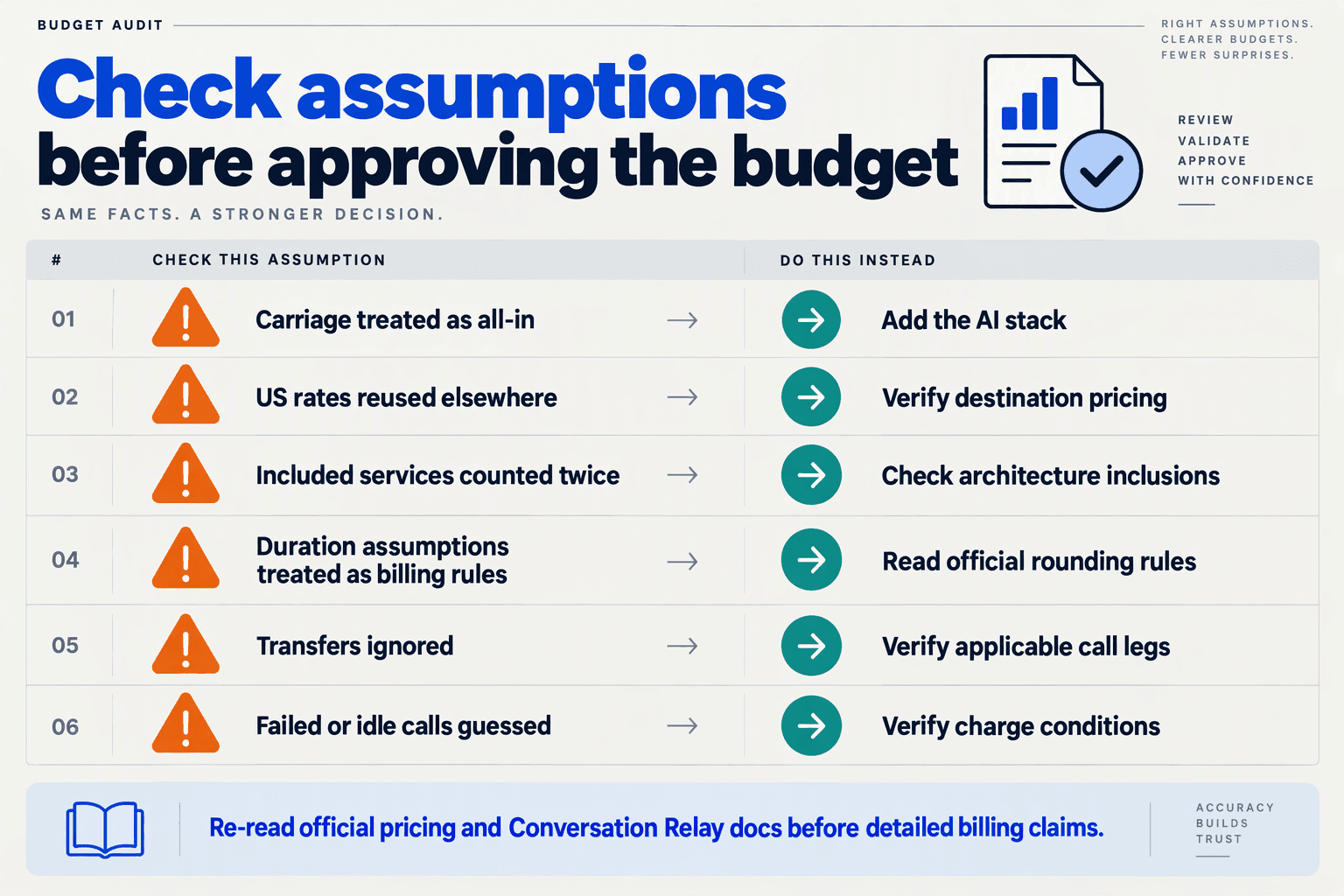
An AI voice budget becomes misleading when it mixes different billing meters, counts bundled services twice, or accepts a headline total without reconciling its line items. Treat your estimate as an auditable usage model—not simply call volume multiplied by a per-minute rate.
Which billing assumptions should you audit before approving a budget?
Use the following checklist for a November 2026 pricing review. Each row identifies a budgeting error and the evidence needed to correct it.
| Billing mistake | Why it misleads | What to check |
|---|---|---|
| Using one duration for everything | Carrier connections, AI sessions, and transferred conversations can have different durations. | Track connected time, active AI time, and each additional call leg separately. |
| Counting transcription twice | A bundled speech service may overlap with a separately budgeted transcription service. | Confirm inclusions and identify any additional transcription workflow. |
| Forecasting from average call length alone | Minimums and billing increments can make billable duration exceed measured duration. | Apply each service’s billing rules to individual calls before aggregating. |
| Applying US starting rates globally | Geography, destination, number type, and call direction affect the applicable rate. | Match every traffic segment to its relevant rate card. |
| Copying an unreconciled example total | A published total may include assumptions or charges absent from the visible breakdown. | Sum every line item and investigate any difference. |
| Keeping one rate across a price change | A forecast spanning an effective-date boundary can understate future spending. | Split projected usage into periods with the applicable prices. |
How can developers prevent overlapping usage charges?
Create a billing map that connects each enabled service to its usage meter. Do not assume every service runs for the entire customer interaction—or that similarly named services perform separate jobs.
According to Quiq’s 2026 Twilio Voice Pricing: A Full Breakdown, reviewed for this November 2026 snapshot, Conversation Relay includes real-time transcription during the active AI session. A separate transcription allowance therefore needs a specific justification, such as an independently enabled workflow, rather than automatic inclusion.
For each representative call, capture:
- Session boundaries: when the carrier connection and AI session start and stop.
- Transfer behavior: which call legs remain connected after handoff.
- Enabled services: what actually generates usage, rather than what appears in the architecture diagram.
Test short calls, abandoned interactions, and human transfers separately. An average-duration forecast can conceal the very cases where billing assumptions diverge.
Should you trust the total in a published pricing example?
Recalculate it first. A useful example can still contain an unexplained gap between its displayed components and its stated total.
In Quiq’s ecommerce example, reviewed in November 2026, the eight displayed line items sum to $1,331.15, while the stated estimated monthly total is $1,494.29—a difference of $163.14. That difference does not establish its cause; it shows that the visible breakdown alone cannot reproduce the total.
Before adopting an example, ask whether the difference reflects omitted charges, additional assumptions, taxes, or an arithmetic issue. Keep unresolved amounts explicit rather than silently absorbing them into “AI cost.”
How should you handle rates that change during your forecast?
Budget by effective date, not just the date you created the spreadsheet.
As of November 11, 2026, CallMissed’s Best latency voice-agent plan costs ₹6 per minute, increasing to ₹8 per minute for calls starting on or after November 30, 2026, according to CallMissed’s verified pricing facts. Phone carriage is billed separately.
A November forecast crossing that boundary therefore needs two usage buckets. The same discipline applies to any provider’s scheduled pricing change: preserve the rate, effective date, and assumptions alongside the estimate.
When is CallMissed a useful alternative—or a complement to Twilio?
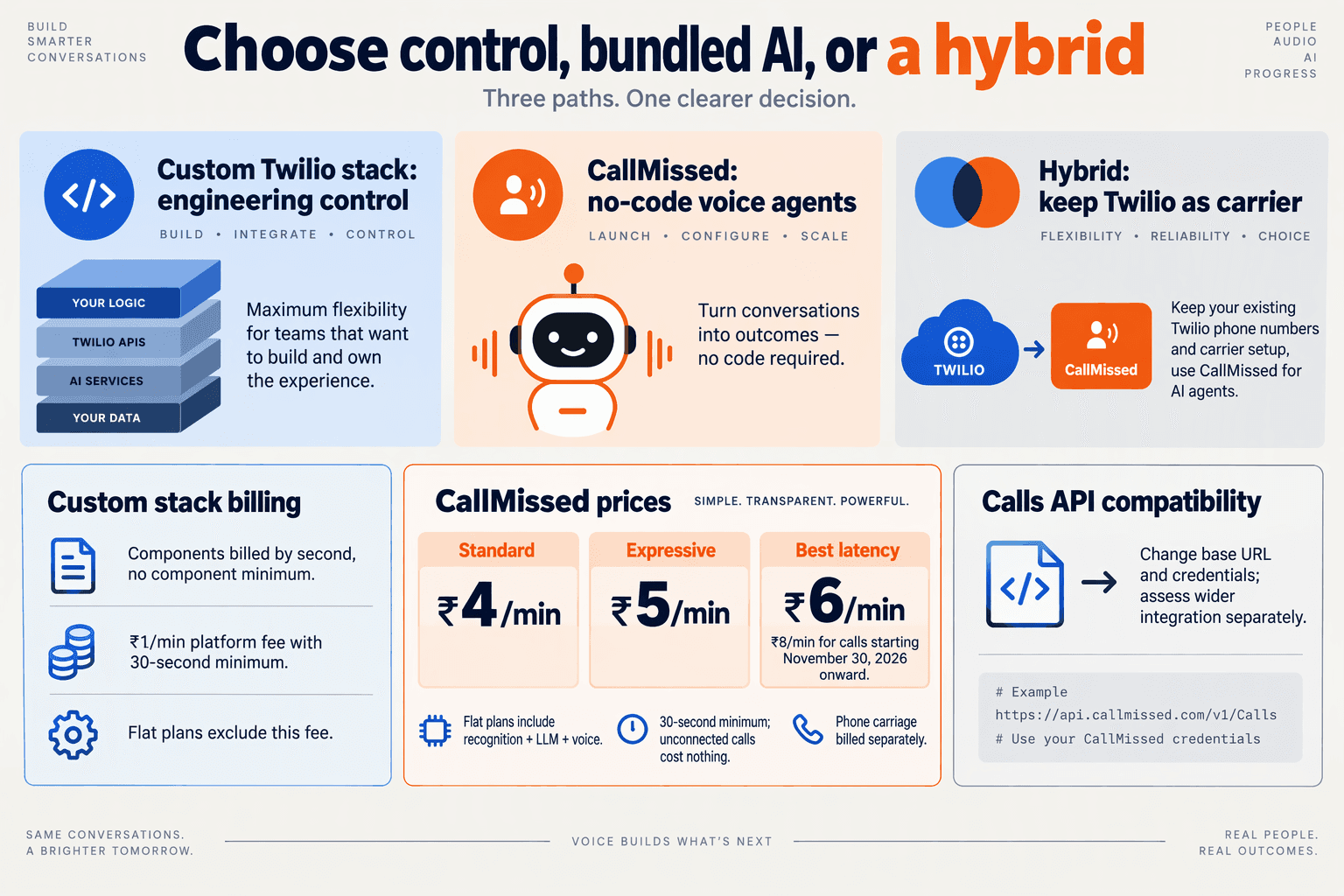
CallMissed is a useful alternative for the AI-agent layer when you want bundled voice pricing, no-code configuration, or Indian-language support. It can also complement Twilio rather than replace it: as of November 11, 2026, you can retain Twilio as your carrier and connect it to the platform’s voice agents.
The decision is architectural, not simply a search for “cheaper Twilio.” Separate the components you want to keep—numbers, carrier connectivity, application logic—from the components you want another platform to manage.
When should you keep Twilio and change the AI layer?
According to CallMissed’s verified product fact sheet, the following capabilities and prices apply as of November 11, 2026. The table distinguishes a carrier-preserving integration from an application migration; these are different projects.
| Your requirement | Relevant capability | Deployment choice | What to verify |
|---|---|---|---|
| Keep your carrier arrangement | Bring your own carrier: Twilio, Plivo, or any SIP trunk | Complement Twilio with a managed AI-agent layer | Carrier charges remain separate |
| Simplify AI cost forecasting | Expressive plan: ₹5/min, covering recognition, language model, and voice | Use bundled agent pricing | 30-second minimum per call; carriage extra |
| Prioritize voice responsiveness | Best latency plan: ₹6/min currently | Choose the platform’s fastest-reply voice tier | ₹8/min for calls starting on or after November 30, 2026 |
| Serve regional Indian audiences | Recognition in 22 Indian languages plus English, including Hinglish; natural voices in 10 plus English | Select recognition and voice capabilities separately | Test the actual language pair and code-mixed speech |
| Reduce agent-building work | No-code builder with knowledge base, REST tools, versioning, publish, and rollback | Move agent configuration into a managed console | Validate tools, retrieval, and escalation behavior |
| Reuse a Calls API integration | Twilio-compatible Calls API, using a changed base URL and credentials | Consider an API migration | Test the application’s specific call flows before switching |
Compatibility is a starting point, not proof of complete application parity. A successful API request does not establish that every routing rule, webhook handler, transfer, or operational workflow behaves as your existing application expects.
How do you compare costs without claiming a universal winner?
Compare equivalent architectures rather than adjacent headline rates. Twilio’s United States Programmable Voice pricing page lists Conversation Relay at $0.07 per minute in the November 2026 snapshot; that is a voice-AI infrastructure component, not a complete managed-agent quote.
Quiq’s 2026 Twilio pricing breakdown says Conversation Relay already includes real-time transcription during active AI sessions. Do not automatically add standalone transcription to that architecture, and do not assume its scope matches a bundle that also includes language-model usage.
For a concrete budget check, 1,000 billable minutes on the Expressive plan cost ₹5,000 for the bundled agent layer as of November 11, 2026, excluding phone carriage. Short calls can change the relationship between elapsed minutes and billed minutes because of the per-call minimum.
Use this evaluation sequence:
- Normalize the workload: same destinations, call direction, duration distribution, and transfer behavior.
- Map included components: recognition, model, voice, carrier connectivity, and application hosting.
- Test operational fit: tool execution, regional speech, human escalation, and failure handling.
The strongest reason to switch is a better fit for your required workflow and budget structure—not an unsupported promise that one platform is cheaper everywhere. Keeping Twilio for connectivity while changing the agent layer may be the more practical first step.
Frequently Asked Questions
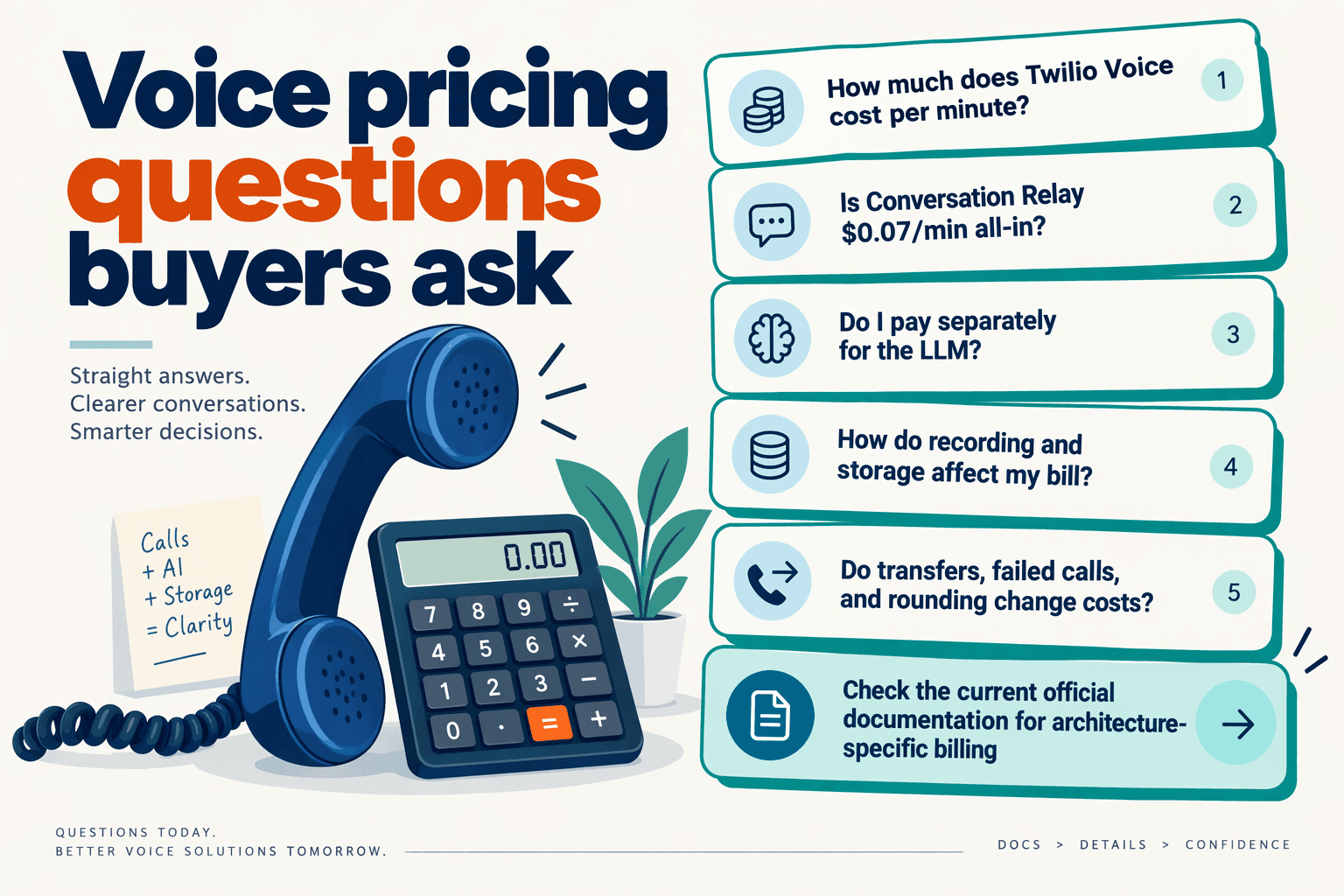
Is $0.07 per minute the complete Twilio Voice Pricing for an AI agent?
Does Twilio Conversation Relay pricing include transcription?
How do human transfers affect Twilio Voice Pricing?
Is a custom Twilio Media Streams AI stack cheaper than Conversation Relay?
Does Twilio Voice Pricing use the same rates worldwide?
What should buyers check when comparing bundled AI voice-agent quotes?
Which resources should you use to validate the budget and test your next step?

Use Twilio’s official pricing pages to validate rates, product documentation to confirm billing boundaries, and a measured pilot to test your assumptions. Treat third-party cost breakdowns as architecture checklists—not substitutes for a destination-specific quote or your own usage records.
Which sources should you trust for Twilio Voice pricing?
Start with these resources, in this order:
- Twilio’s main pricing page: Use it to identify the service categories you need. In the November 2026 pricing snapshot, Twilio advertises communications rates starting at $0.0085 per inbound minute and $0.014 per outbound minute; “starting at” is not a quote for every destination.
- Twilio’s country-specific Programmable Voice pricing page: Validate your geography, number type, call direction, and optional services. Twilio’s United States Programmable Voice pricing page lists Conversation Relay at $0.07 per minute in the November 2026 snapshot.
- Twilio’s documentation for your selected architecture: Confirm when each service starts and stops billing, which capabilities are included, and how transfers create additional call legs. Save the relevant documentation alongside your estimate.
- Your account’s usage records and invoices: After testing, reconcile actual charges against your spreadsheet rather than assuming configured session duration equals billable usage.
Record the source name, retrieval date, currency, geography, and billing unit for every rate. That turns a pricing spreadsheet into an auditable budget rather than a collection of headline numbers.
How should you use third-party pricing breakdowns?
Use Quiq’s “2026 Twilio Voice Pricing: A Full Breakdown” to discover costs your architecture might otherwise overlook, then verify each applicable item with Twilio.
For example, Quiq’s November 2026 pricing context lists Media Streams at $0.0044 per minute and streaming transcription at $0.027 per minute. Those are checklist entries, not charges to automatically stack onto every implementation.
Quiq also states that Conversation Relay includes real-time transcription during the active AI session in its 2026 breakdown. Ask whether an additional transcription service serves a separate requirement before budgeting for both.
Recalculate illustrative totals yourself. A third-party scenario may include assumptions or charges that are not obvious from its displayed line items; unexplained differences should become questions for the vendor, not inherited spreadsheet formulas.
What should your next pilot measure?
Run a small, representative pilot before committing to a monthly forecast:
- Define the workload: Include ordinary conversations, short calls, interruptions, unsuccessful connections, and human transfers.
- Capture usage separately: Log connected carrier minutes, active AI-session minutes, transfer legs, model consumption, and enabled add-ons.
- Reconcile the bill: Compare measured usage with charged units and investigate differences.
- Score outcomes: Track task completion, escalation frequency, response delay, and cost per successfully resolved conversation—not just cost per minute.
If you are evaluating another implementation, keep the workload and quality rubric identical. As of November 2026, CallMissed offers a Twilio-compatible Calls API, with migration by changing the base URL and credentials, alongside eval suites and A/B experiments. Test application behavior and billing rather than assuming compatibility makes every deployment detail identical.
Your final deliverable should be a dated budget with a tested usage model, an explicit exclusions list, and a reconciliation trail. That is a stronger purchasing basis than choosing whichever provider displays the lowest starting rate.
Conclusion
Twilio Voice Pricing in 2026 is a starting point for budgeting, not the complete cost of an AI-handled conversation. The useful comparison is what each architecture costs for the same geography, call direction, conversation duration, and operational requirements—not which provider advertises the lowest telephone rate.
Four takeaways should guide your next estimate:
- Separate connectivity from conversation costs. Using Twilio’s published US rates in the November 2026 snapshot, 10,000 inbound local-call minutes at $0.0085 per minute plus 10,000 Conversation Relay minutes at $0.07 produce a $785 subtotal. That example still excludes language-model usage, number rental, hosting, taxes, and any additional services required by the implementation. Treating the $85 telephone component as the entire budget would substantially understate this architecture’s cost.
- Map the stack before adding line items. According to Quiq’s 2026 Twilio pricing breakdown, Conversation Relay includes real-time transcription during the active AI session. Automatically adding separate transcription charges can therefore double-count a capability. Conversely, a custom architecture needs its own component-by-component estimate rather than assumptions borrowed from a bundled service. Buyers and developers should agree on exactly what each quote includes.
- Forecast the actual call journey. Connected telephone minutes and active AI-session minutes are not necessarily identical. Transfers, additional call legs, billing increments, and optional recording or analytics can change the final estimate. A useful forecast documents these assumptions explicitly, so a longer call or a different handoff pattern does not become an unexplained billing surprise.
- Compare equivalent scope, not headline prices. US starting rates should not be treated as worldwide quotes, and inbound and outbound traffic need separate assumptions. Keep destinations, number requirements, AI components, and operational features consistent across proposals. Otherwise, an apparently lower per-minute price may simply describe a smaller portion of the service you need.
What should buyers watch as voice AI pricing evolves?
Watch what moves into—or remains outside—the advertised bundle, and recheck published rates before committing to a deployment. As call volumes and conversation patterns change, update telephone-minute and AI-session forecasts separately rather than scaling one headline rate across every interaction. That discipline makes future pricing changes easier to evaluate without rebuilding the budget from scratch.
For another budgeting approach, explore CallMissed: as of November 2026, its Standard voice-agent plan bundles speech recognition, the language model, and voice at ₹4 per minute, with phone carriage billed separately and a 30-second minimum per call. Evaluate that structure against the same call journey, rather than comparing it directly with carrier-only pricing.
Before choosing your stack, can you explain every charge behind one answered customer conversation—and forecast what happens when that conversation runs longer or transfers to a person?
Related Reading
- AI Voice Agent for Insurance India: Rules and Cost (2026)
- AI Voice Agent for Clinics India: Hindi Booking Guide 2026
- GPT-4o API pricing 2026: Compare Compatible API Costs