Credit-based billing for AI SaaS: Implementation Guide



Credit-based billing for AI SaaS with atomic ledgers, payment webhooks, cost-to-credit calculations, and tests that prevent double charges.

Credit-based billing for AI SaaS: Implementation Guide
What stops two simultaneous AI requests from spending the same customer credits? Credit-based billing for AI SaaS requires more than a balance field: implement an append-only credit ledger, reserve credits atomically before execution, and settle each reservation against actual usage afterward.
That architecture answers the question, “How do I implement per-credit billing for AI features in my SaaS?” It also separates three concerns that are easily confused: collecting payments, granting credits, and charging for AI consumption. Your payment provider handles money; your application still needs a reliable way to authorize work and explain every balance change.
Why does AI credit billing need more than a payment integration?
An AI feature can consume different amounts of compute depending on the model, input length, output length, or audio duration. Charging a predictable number of credits without understanding those costs can leave your margins exposed; charging an opaque amount afterward can leave customers frustrated.
As of November 2026, Stripe’s usage-based billing guidance recommends reserving expected costs before execution and settling against actual usage afterward. Stripe also warns that “at-least-once delivery” guarantees duplicates, making unique event IDs and deduplication essential to preventing double billing.
The tooling is evolving, too. Stripe’s October 28, 2026 preview API documentation says credit grants currently support metered billable items—a useful capability, but not a replacement for application-level spending controls.
As of November 2026, CallMissed’s developer AI API illustrates this consolidation trend with one balance across 159 models, using credits valued at ₹1 each that never expire.
What will this implementation guide help you build?
You will learn how to connect the customer-facing credit system to the underlying cost of AI operations without treating every request as identical. The guide covers:
- Pricing: Translate tokens, audio seconds, or feature actions into explicit credit charges.
- Ledger design: Record grants, reservations, settlements, releases, and adjustments without overwriting transaction history.
- Concurrency controls: Prevent simultaneous requests from overspending one balance.
- Payment integration: Grant subscription or purchased credits only after verified payment events.
- Customer visibility: Show available credits, pending reservations, and itemized usage.
- Reconciliation: Compare billed usage with provider records and investigate discrepancies.
For a hypothetical request, reserve 10 credits, settle 7 credits after completion, and release the remaining 3. If the same completion event arrives twice, its idempotency key must prevent a second debit.
The goal is not simply to accept payments. It is to make AI spending predictable, auditable, and safe under retries and concurrent requests.
How do you implement per-credit billing for AI features in your SaaS? Define a credit unit and maintain an auditable ledger connected to verified payments and feature entitlements. Atomically reserve credits before execution, settle actual usage afterward, and reconcile payments, usage, and balances.
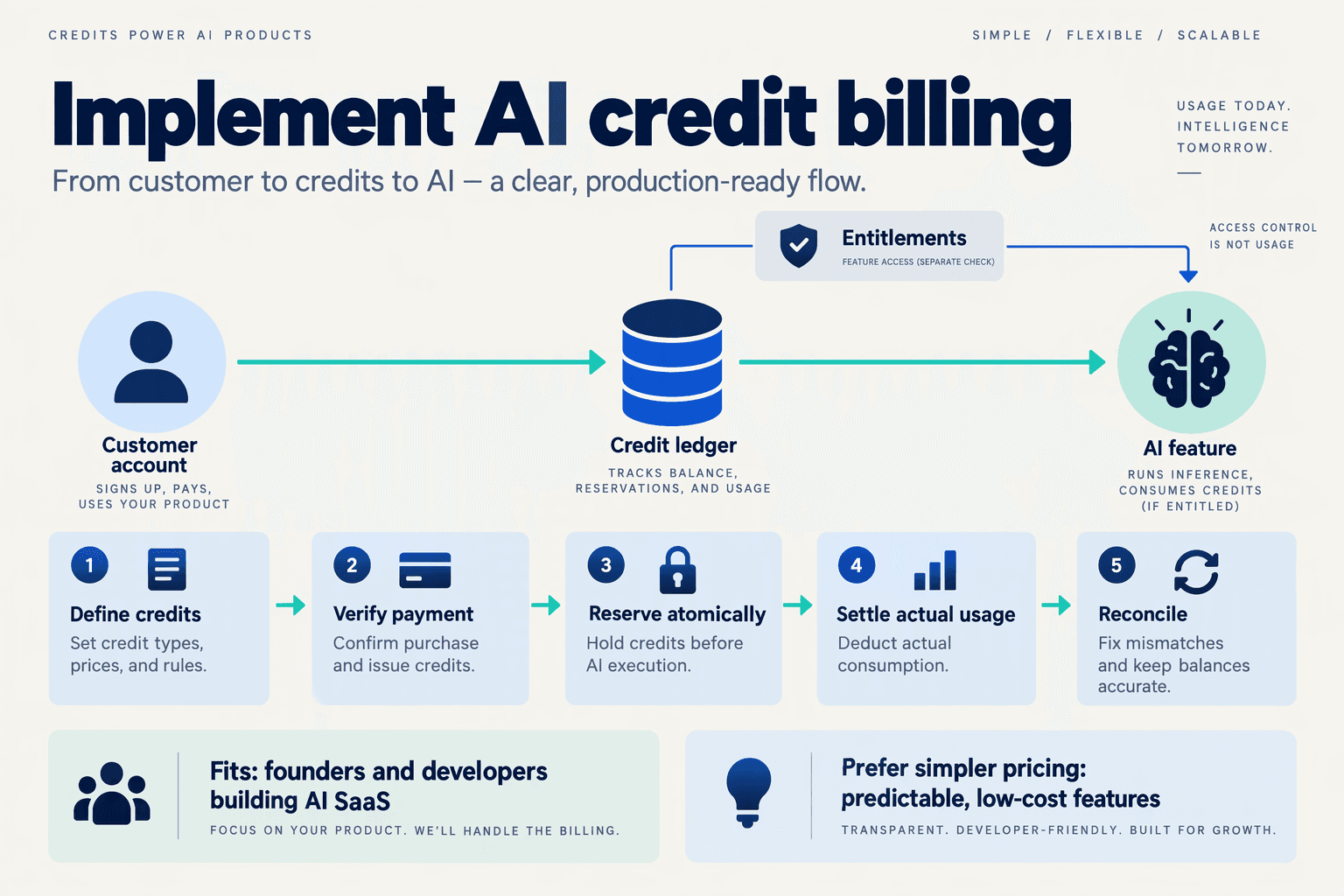
Implement per-credit billing for AI features in your SaaS as an authorization workflow: define what credits buy, connect grants to verified payments, and record every spending decision in an auditable ledger. Keep payment status, feature access, and available credit balance separate so a successful charge does not accidentally authorize every AI feature.
How do you define a credit unit for AI features?
Choose a customer-facing unit, then publish how each feature converts usage into credits. A credit can represent purchasing value rather than a fixed token count, allowing different models and modalities to have different prices.
For a hypothetical pricing schedule, define one credit as $0.01 of purchasing value and charge:
- Document extraction: 2 credits per completed document.
- Text generation: Token-based charges using a published model-specific rate.
- Audio transcription: Duration-based charges with an explicit rounding rule.
Specify minimum charges, failed-request treatment, and expiration before launch. Use integer subunits internally if fractional credits are necessary, and attach a pricing version to each request so later price changes cannot alter historical charges.
What should an auditable credit ledger record?
Store immutable events with an account ID, event ID, event type, credit amount, timestamp, and originating payment or usage reference. Connect settlement and release events to their reservation; connect refunds and reversals to their original grant.
Maintain two distinct quantities:
Available credits = posted credit balance − outstanding reservations.
A reservation reduces spending availability without becoming a final consumption charge. Settlement debits the posted balance and closes the corresponding hold; unused reserved credits become available again.
Useful event types include grants, reservations, settlements, releases, expirations, and adjustments. Corrections should create compensating entries rather than edit history. As of November 2026, Augere Labs’ implementation guidance recommends recording billable events in an append-only ledger with idempotency keys.
How do payments and entitlements authorize an AI request?
Use this implementation sequence:
- Verify payment server-side. Validate the payment provider’s webhook signature and qualifying payment status; never grant purchased credits from a browser success redirect.
- Deduplicate the grant. Enforce a unique constraint on the payment reference and grant type.
- Check entitlements. Confirm that the account can access the requested feature or model, independently of its balance.
- Reserve atomically. In one database transaction, check available credits, create the reservation, and update any balance projection using locking or a conditional update.
- Execute within limits. Bound output tokens, audio duration, or other cost drivers so execution cannot silently exceed its authorized budget.
- Settle once. Record measured usage and the final charge, close the hold, and release any remainder.
Entitlements also include throughput controls. As of November 2026, CallMissed’s developer AI API lists default per-key limits of 60 requests per minute on Free and 500 on Starter—illustrating why balance authorization and request-rate authorization are separate checks.
How do you reconcile credits when execution fails?
Treat timeouts as unknown outcomes, not automatic refunds: a provider may have completed work even when your application missed the response. Persist request identifiers and recover usage before settling or releasing the reservation.
As of November 2026, Stripe’s AI billing guidance recommends reserving expected costs before execution and settling actual usage afterward. Reconcile payment-backed grants, provider usage, settlements, and ledger-derived balances regularly; flag unmatched payments, duplicate usage, and stale holds for investigation.
What must founders and developers prepare before setup, and what constraints affect implementation?
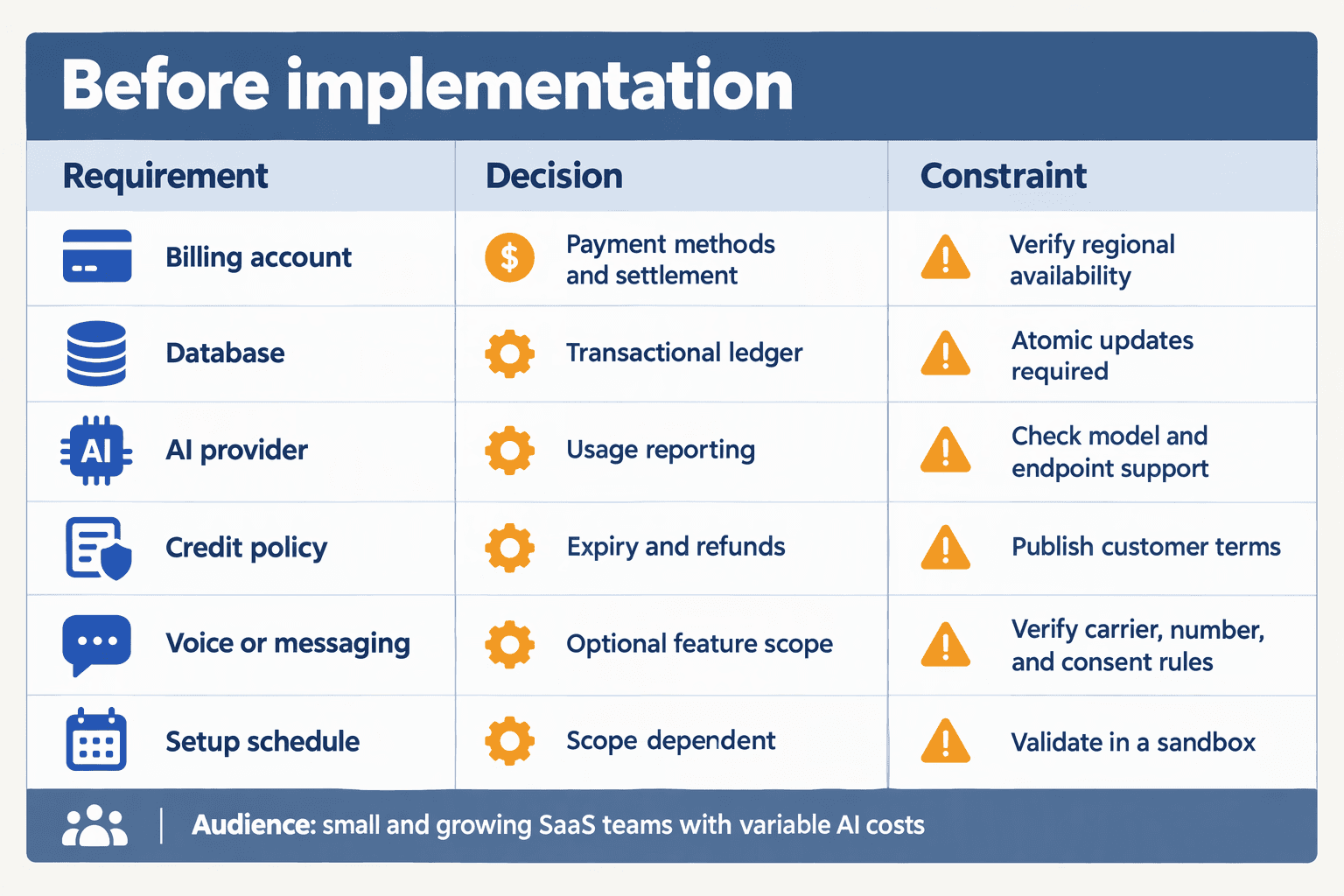
Before implementing per-credit billing for AI features in your SaaS, prepare a pricing specification, usage-event contract, account ownership model, and written credit policies. The main constraints are variable provider costs, incomplete usage reports, subscription timing, and differences between your application’s credit rules and your payment provider’s billing capabilities.
What should your implementation checklist include?
Use this checklist to resolve product and engineering decisions before writing billing code. Treat each row as a required design artifact, not simply a configuration option.
| Preparation area | Artifact to prepare | Implementation constraint | Acceptance check |
|---|---|---|---|
| Billable units | Map each feature to tokens, audio seconds, images, or completed actions | Provider usage units may differ from customer-facing credits | Every feature has an explicit conversion rule |
| Cost and margin | Model input, output, tool, and retry costs | Long outputs and multi-step workflows can increase costs | Test typical and high-cost requests |
| Usage contract | Define account ID, request ID, model, quantity, timestamp, and pricing version | Streaming interruptions can leave usage incomplete | Document how missing usage is resolved |
| Account ownership | Decide whether credits belong to a user, workspace, or organization | Shared balances require consistent authorization | Every request resolves to one billing account |
| Credit policies | Specify rollover, expiry, refunds, and grant priority | Subscription and purchased credits may need different treatment | Policies match checkout and balance displays |
| Billing lifecycle | Map payment events, renewals, cancellations, and plan changes | Payment arrival and entitlement timing may differ | Test delayed events and mid-cycle upgrades |
How should founders define the economics before choosing tools?
Start with provider cost, then decide how much complexity customers should see. A fixed charge per feature is easy to understand, but requires limits on expensive inputs, output lengths, and tool calls.
For a hypothetical pricing exercise, suppose an action costs ₹0.80 to deliver and sells for 2 credits valued at ₹1 each. Its gross margin before payment fees, taxes, support, and other overhead is 60%: (₹2 − ₹0.80) ÷ ₹2. This is a worked example, not a provider benchmark.
Prepare three scenarios:
- Typical: Expected input length, output length, and tool usage.
- Expensive: Large inputs, extended outputs, and repeated tool calls.
- Interrupted: A timeout or disconnect after the provider has incurred costs.
As of November 2026, CallMissed’s developer AI API offers response caching, bring-your-own provider keys, and usage and request logs. These capabilities illustrate why your cost model should account for the execution path rather than assume every request has identical economics.
Which billing policies are difficult to change later?
Rollover and renewal boundaries deserve explicit decisions. Makerkit’s credit-based billing documentation, referenced as of November 2026, implements rollover by adding credits rather than resetting the balance; that choice affects how unused entitlements accumulate.
Streak Engineering’s implementation account, referenced as of November 2026, uses Stripe’s billing cycle anchor, expressed as a Unix timestamp in seconds. Align renewal logic with the actual billing cycle rather than assuming every subscription refreshes on the first day of the month.
Before setup, complete these steps:
- Version the pricing rules so historical charges remain explainable.
- Define failure policies for unavailable usage data and partially completed work.
- Confirm payment-tool compatibility with your chosen credit policies.
A payment integration cannot settle these product decisions for you. Resolve them first, and the subsequent ledger, metering, and checkout implementation becomes substantially clearer.
How much does credit billing cost, how do you calculate margins, and where do Stripe, Lago, Kill Bill, and CallMissed fit? (TABLE; vendor pricing sources as of November 10, 2026)
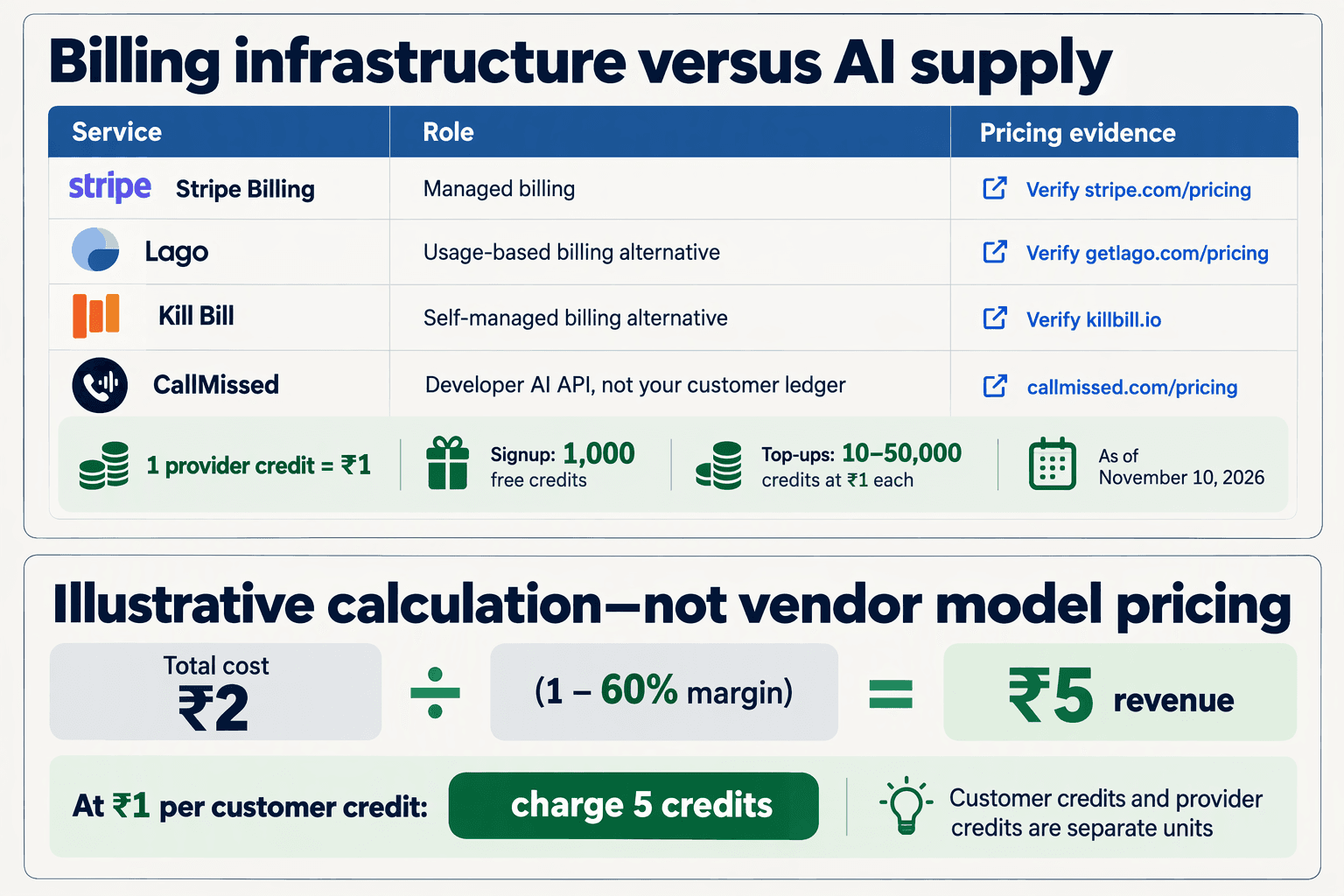
Credit billing costs include AI consumption, payment processing, billing software, and the infrastructure that meters usage. Calculate margins from realized revenue—not the number of credits granted—and distinguish payment collection, usage billing, and upstream AI supply when comparing vendors.
Where do Stripe, Lago, Kill Bill, and CallMissed fit?
The table below separates their architectural roles. Pricing evidence is limited: the supplied research includes Stripe documentation and CallMissed’s verified fact sheet, but no official Stripe fee schedule or Lago and Kill Bill pricing sources. Their numerical fees therefore cannot be presented as verified on November 10, 2026.
| Product | Role in your stack | Pricing evidence, November 10, 2026 | Budget consideration |
|---|---|---|---|
| Stripe Payments | Collect customer payments | Processing fees not supplied | Check country, currency, payment method, and transaction fees |
| Stripe Billing | Meter usage and generate invoices | Billing fees not supplied; Stripe’s AI billing guide describes metered invoicing | Budget separately from payment processing |
| Lago | Usage-billing layer to evaluate | No official pricing source supplied | Verify deployment costs, commercial terms, and required features |
| Kill Bill | Subscription and billing layer to evaluate | No official pricing source supplied | Verify hosting, maintenance, integration, and support costs |
| CallMissed developer AI API | Upstream AI consumption—not your customer billing engine | CallMissed’s verified fact sheet: ₹1 per credit, with credits that never expire, as of November 10, 2026 | Top-ups range from 10–50,000 credits; calculate downstream charges from actual consumption |
These are not interchangeable purchases. A payment processor collects money, a billing layer calculates charges, and an AI API supplies the capability your customer consumes.
How do you calculate margins for AI credits?
Start with net revenue per redeemed credit and the cost of delivering the associated feature. Keep taxes collected on behalf of authorities out of revenue.
For a hypothetical pricing model—not a vendor quote—as of November 2026:
- A customer pays $10 for 1,000 credits, making revenue $0.01 per credit.
- An AI action consumes 10 credits, producing $0.10 revenue.
- AI inference and directly attributable delivery infrastructure cost $0.04.
- Gross margin is ($0.10 − $0.04) ÷ $0.10 = 60%.
If allocated payment and billing fees add $0.01 per action, contribution margin falls to 50%. That distinction prevents a healthy-looking inference margin from hiding transaction overhead.
For a target gross margin:
Required revenue = delivery cost ÷ (1 − target margin)
At $0.04 delivery cost and a 60% target, the required revenue is $0.10. Round customer-facing credit charges upward only under a clearly disclosed rule.
Which hidden costs should your credit price cover?
Include costs customers do not necessarily see:
- Retries and failed executions: upstream requests may cost money even when you refund customer credits.
- Variable workloads: longer outputs, different models, and audio duration change delivery cost.
- Payment economics: small top-ups can make fixed transaction fees disproportionately expensive.
- Billing operations: event ingestion, reconciliation, support, hosting, and maintenance consume budget.
Stripe’s usage-based billing guidance, supplied for this November 2026 review, warns that “at-least-once delivery” guarantees duplicates. Deduplication protects customer charges; separately track provider attempts so internal cost reports capture genuine retry expenses.
Finally, calculate margin by feature and model, not just account balance. Profitable short requests can otherwise conceal loss-making long ones.
Step 1: How do you build an auditable credit ledger with atomic reservations and idempotency?
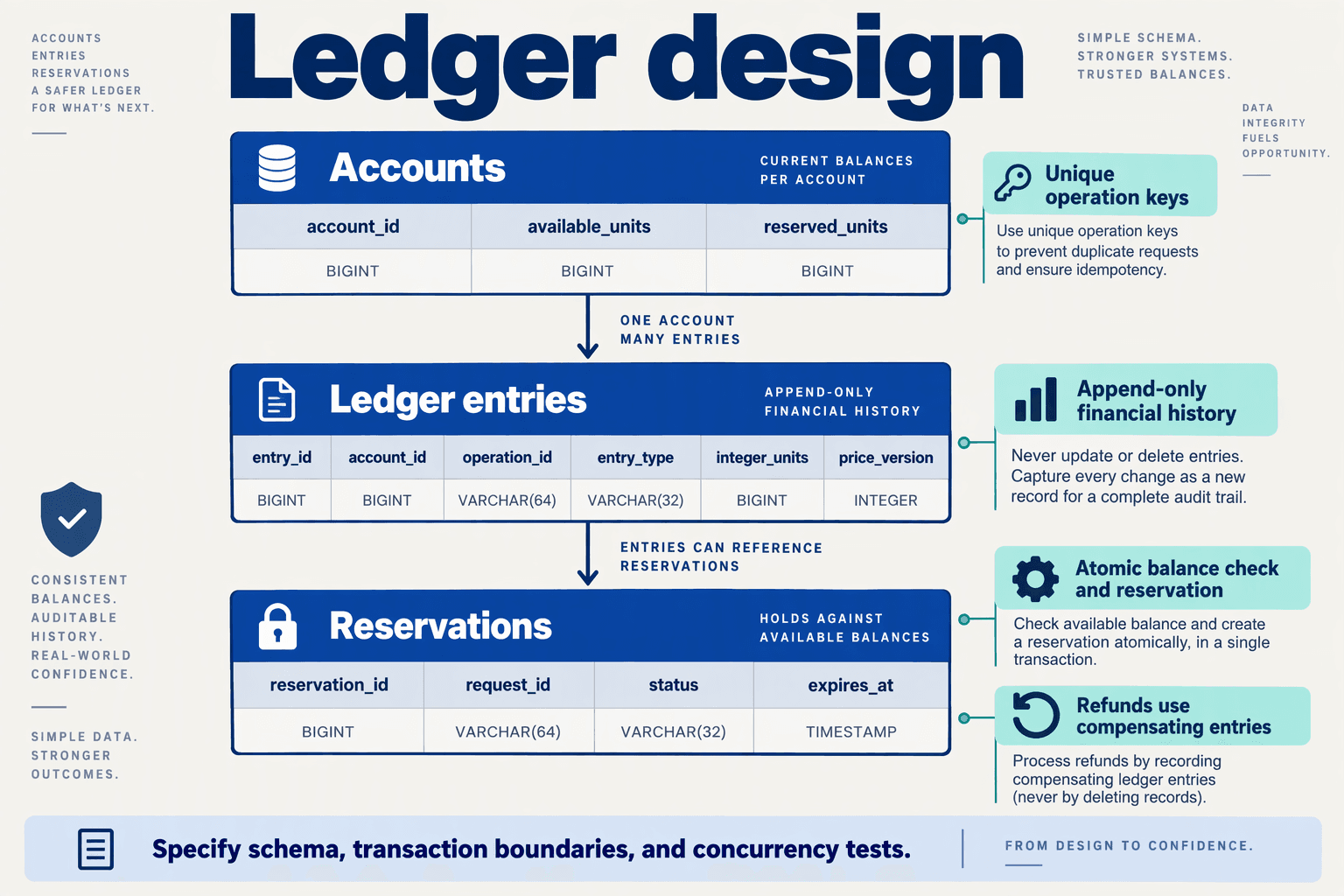
Build an append-only credit ledger alongside a transactional balance projection: reserve credits and record the reservation in one database transaction, then settle actual usage through an idempotent state transition. Every balance change should identify its account, originating request, and reason.
What should an auditable credit ledger store?
Use three related records rather than one mutable balance field:
- Account balance:
account_id,available_units, andheld_units—a fast projection updated transactionally. - Reservation:
reservation_id,account_id,request_id,reserved_units,status, and timestamps. - Ledger entry:
entry_id,account_id,reservation_id,operation_key, entry type, available/held deltas, usage reference, pricing version, and timestamp.
Store credits as integer subunits, not floating-point numbers. For example, your application could define one credit as 1,000 subunits; that is an implementation choice, not an industry standard.
Make ledger rows immutable. Correct mistakes with compensating entries that reference the original transaction. The balance projection must be rebuildable from ledger deltas.
As of November 2026, Augere Labs’ guidance on usage-based billing for AI SaaS recommends recording billable events in an append-only ledger with idempotency keys.
How do you reserve credits without a race condition?
Serialize balance mutations for each account using a database row lock or an equivalent conditional update. Never read the balance, authorize execution, and decrement it in separate transactions.
A PostgreSQL-style transaction can follow this sequence:
BEGIN
  Lock account row: SELECT ... FOR UPDATE
  Look up (account_id, operation_key)
  If already processed: return stored result
  If available_units < requested_units: reject
  Insert reservation
  Update balance: available -= requested; held += requested
  Insert matching ledger entry
  Insert durable execution job
COMMIT
Add a unique constraint on (account_id, operation_key) as a backstop. Store a request-payload hash with the key: a retry with identical parameters returns the original result; reusing that key with different parameters should fail.
Commit before calling the AI provider. The durable job, written in the same transaction, closes the failure gap where credits are reserved but the application crashes before scheduling execution.
How should settlement and release work?
Use explicit transitions: reserved → settled or reserved → released. Lock both the reservation and account in a consistent order, and write the transition, balance changes, and ledger entry atomically.
For a hypothetical 12-credit reservation that consumes 9 credits:
- Reservation changes available credits by −12 and held credits by +12.
- Settlement changes held credits by −12 and available credits by +3, while recording the 9-credit charge.
- A duplicate settlement returns the existing outcome without changing either balance.
Bound execution to the reserved budget where possible. If additional spending is necessary, authorize an incremental reservation first; do not silently permit negative balances.
As of November 2026, Stripe’s AI billing guidance states that “at-least-once delivery” guarantees duplicates—so both incoming event IDs and reservation state transitions need deduplication.
What makes the ledger operationally auditable?
Reconcile ledger-derived totals against balance projections, and retain provider usage identifiers and the pricing version used for settlement. As of November 2026, CallMissed’s developer AI API provides usage and request logs, useful evidence when reconciling upstream consumption with your SaaS ledger.
Treat timeouts as unknown outcomes, not automatic refunds: investigate or reconcile provider execution before releasing holds. Your audit trail should explain not just what changed, but which request authorized it and why.
Step 2: How do you connect purchases, verified webhooks, subscription grants, and feature entitlements?
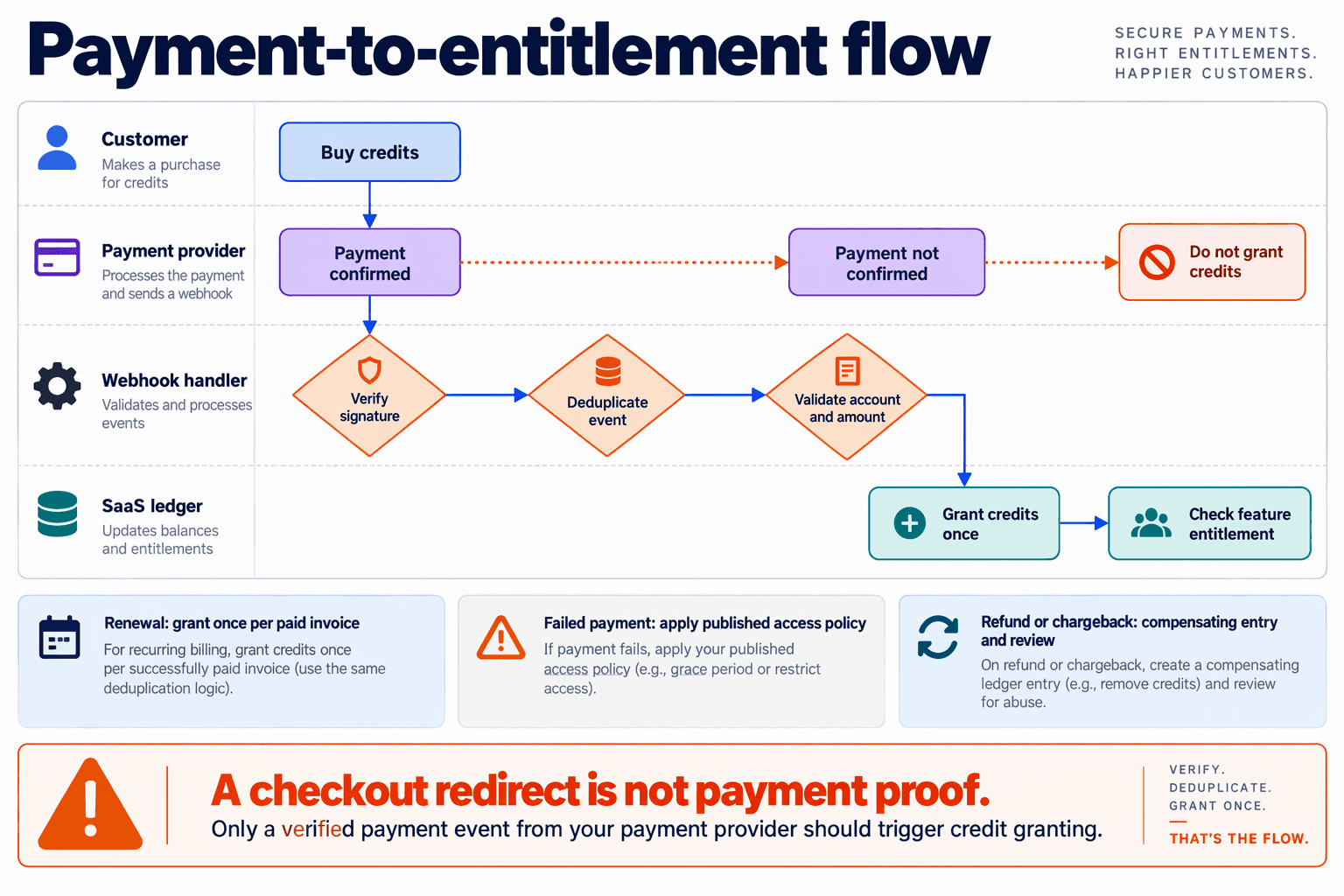
Connect purchases to credits through a verified, idempotent payment-event pipeline, and manage feature entitlements separately from the spendable balance. A successful checkout redirect is not proof of payment: only a validated payment outcome should authorize a purchased-credit grant.
How do you turn a purchase into a verified credit grant?
Create a server-side purchase record before sending the customer to checkout. Store the account ID, credit quantity, currency, price version, and payment-provider reference; never trust a credit quantity submitted by the browser.
Process payment notifications in this order:
- Verify the webhook signature against the unmodified request body using the provider’s signing secret and timestamp checks.
- Persist the verified event in a durable inbox with a unique constraint on
(provider, event_id). - Confirm the payment outcome. Resolve the purchase through trusted server-side references and check its amount, currency, and paid status. For delayed payment methods, wait for confirmed success.
- Apply the grant transactionally. Insert the credit grant and mark the purchase fulfilled in one database transaction.
- Acknowledge durable receipt, then retry background processing safely if fulfillment fails.
Use two layers of deduplication: the webhook event ID prevents duplicate delivery processing; a business key such as purchase:{purchase_id} prevents different events from fulfilling the same purchase twice. As of November 2026, Stripe’s usage-based billing guidance explicitly warns that “at-least-once delivery” guarantees duplicates.
How should subscription renewals allocate credits?
Grant recurring credits against a paid invoice and its applicable billing period, rather than a subscription-created event or an independently scheduled monthly reset.
As of November 2026, Streak Engineering’s Implementing AI credit subscriptions identifies Stripe’s billing cycle anchor, expressed as a Unix timestamp, as a natural basis for subscription credit periods. Makerkit’s credit-billing documentation, also referenced as of November 2026, illustrates rollover by adding credits in its onInvoicePaid handler instead of resetting the balance.
Record these fields for each allocation:
- Account and subscription IDs
- Invoice and eligible invoice-line IDs
- Period start and end
- Grant quantity and pricing-policy version
- Expiration or rollover policy, if applicable
Define upgrade proration, cancellation, and first-month bonuses explicitly. A paid upgrade invoice should not accidentally trigger another full monthly allocation.
For a concrete pricing-policy example, as of November 2026, CallMissed’s developer AI API lists its Pro plan at ₹4,999 per month, with 6,000 included credits in the first month and 5,000 thereafter. That distinction requires a first-period rule—not one grant amount attached permanently to the plan.
How do feature entitlements differ from credits?
Entitlements answer “may this account use this feature?”; credits answer “can this account fund this request?” Evaluate both before authorizing AI execution.
Keep entitlements in a separate policy record covering model access, feature availability, and request limits. A customer can retain purchased credits while losing subscription-only features; conversely, an entitled customer might lack enough credits for a request.
Do not apply webhook updates blindly in arrival order. Reconcile subscription state against the provider’s current authoritative record when events arrive late or conflict.
What happens after refunds or processing failures?
Represent refunds with linked adjustment entries, not deleted grants. If the credits were already spent, apply a documented policy—such as restricting further spending pending review—rather than silently rewriting usage history.
Retry failed fulfillment from the durable inbox, alert on unresolved paid-but-unfulfilled purchases, and reconcile payment records against grants. Every paid purchase should resolve to one grant or a documented exception.
Step 3: How do you meter AI usage, reserve credits, settle actual costs, and handle retries or streaming failures?
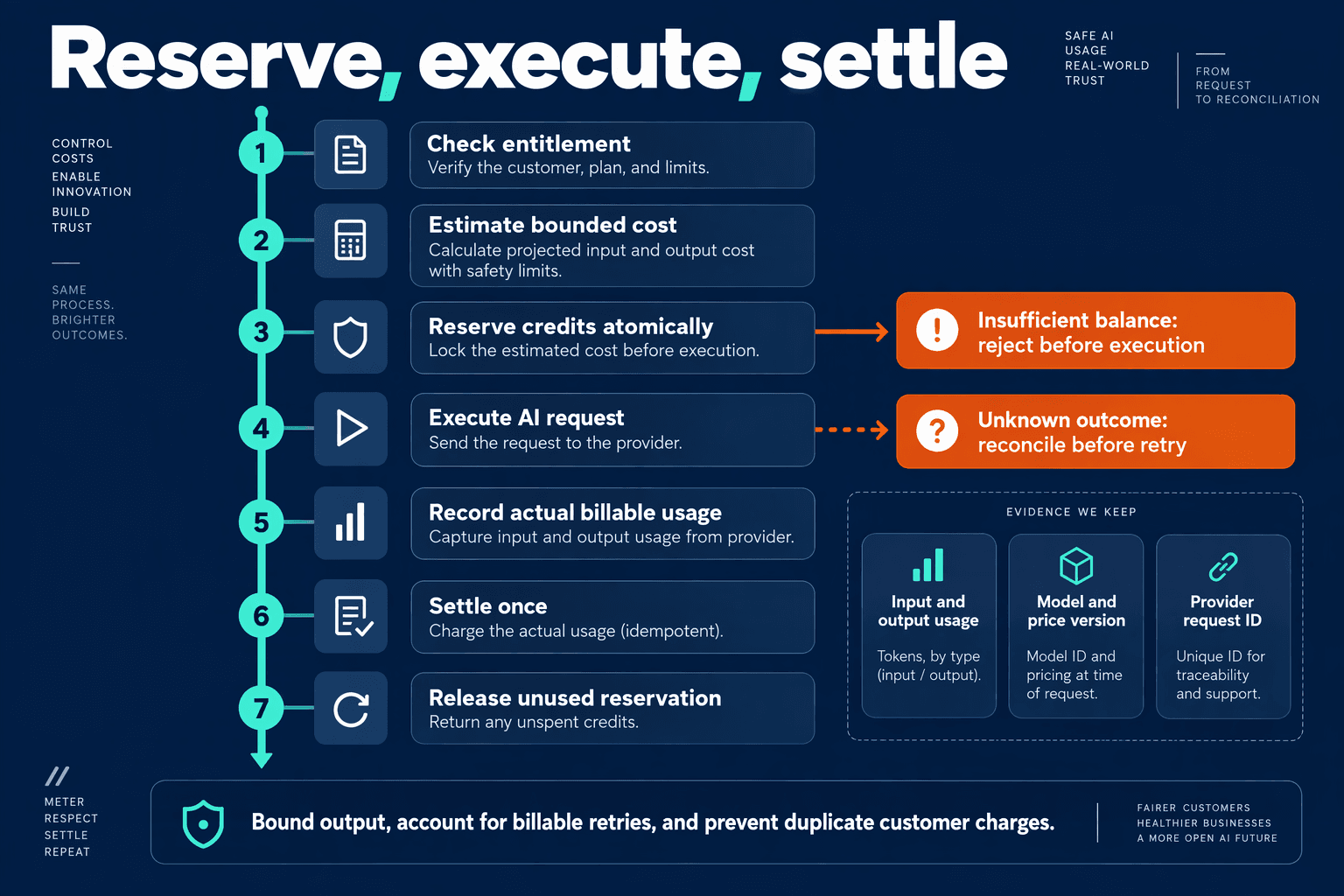
Meter AI usage on your server, reserve credits before dispatch, and settle each logical operation once against verified usage. Treat retries, fallbacks, and interrupted streams as execution attempts—not automatically as additional customer purchases.
What usage should you record for each AI request?
Create an operation ID for the customer’s action and a separate attempt ID for every provider execution. This distinction lets you track retry costs without double-charging the customer.
Record enough information to reproduce the charge:
- Identity: tenant, operation ID, attempt ID, and provider request ID.
- Consumption: model, input/output tokens, audio duration, or other billable units.
- Pricing: your credit-rate version, provider-rate version, and applicable rounding rule.
- Outcome: timestamps, completion status, reservation ID, and usage evidence.
Use server-side provider responses or reconciled provider records as evidence; never trust usage totals submitted by the browser. Keep provider cost separate from customer credit charges, because your pricing policy may absorb failed attempts.
As of November 2026, CallMissed’s developer AI API offers usage and request logs plus caller-chosen fallback models—useful capabilities when investigating multiple attempts behind one customer operation. Your SaaS still needs its own customer-level billing records.
How do you reserve credits without allowing overspending?
Reserve a bounded maximum charge, rather than an optimistic average, when customers cannot spend beyond their prepaid balance. Estimate input consumption, enforce an output limit, and include other chargeable components.
In its usage-based billing guidance, consulted in November 2026, Stripe recommends reserving expected costs before execution and not running the action if authorization fails.
Implement the sequence as follows:
- Deduplicate the action. Require an idempotency key scoped to the tenant; reject reuse with a different request payload.
- Authorize atomically. In one database transaction, lock or conditionally update the account, verify available credits, and create the reservation.
- Dispatch durably. Persist a job or transactional outbox entry with the reservation so a process crash cannot silently lose authorized work.
- Enforce the budget. Cap generation or obtain an additional atomic reservation before exceeding the original authorization.
Do not hold a database transaction open while waiting for the AI provider.
How do you settle actual costs and release unused credits?
Convert verified usage into credits using the pricing version captured at authorization. Use integer credit subunits and a documented rounding rule.
For a hypothetical November 2026 implementation, reserve 12 credits, settle 8.4 credits, and release 3.6 credits. Commit the settlement, release, and terminal operation status in one transaction, protected by a unique settlement key.
If actual usage exceeds the reservation, apply an explicit policy: collect an authorized incremental debit, absorb the excess, or stop earlier. Never silently create an unauthorized negative balance.
How should retries and streaming failures affect billing?
A disconnected stream does not prove that generation stopped or that provider cost was zero. Distinguish delivery failure from execution failure:
- Duplicate customer request: return the existing operation; do not create another charge.
- Confirmed failure before billable execution: release the reservation.
- Timeout with unknown execution status: retain a pending state and investigate before retrying.
- Interrupted stream: request cancellation where supported, then recover final usage or reconcile provider records.
- Retry or fallback: log another attempt and apply your disclosed customer-charging policy.
Do not release reservations solely because a timer expires: unresolved provider work may still incur cost. A reconciliation worker should resolve stale operations, and late corrections should create auditable adjustment entries, not rewrite settled history.
How do you add credits to an existing SaaS and improve margin protection, rollover, and reconciliation?
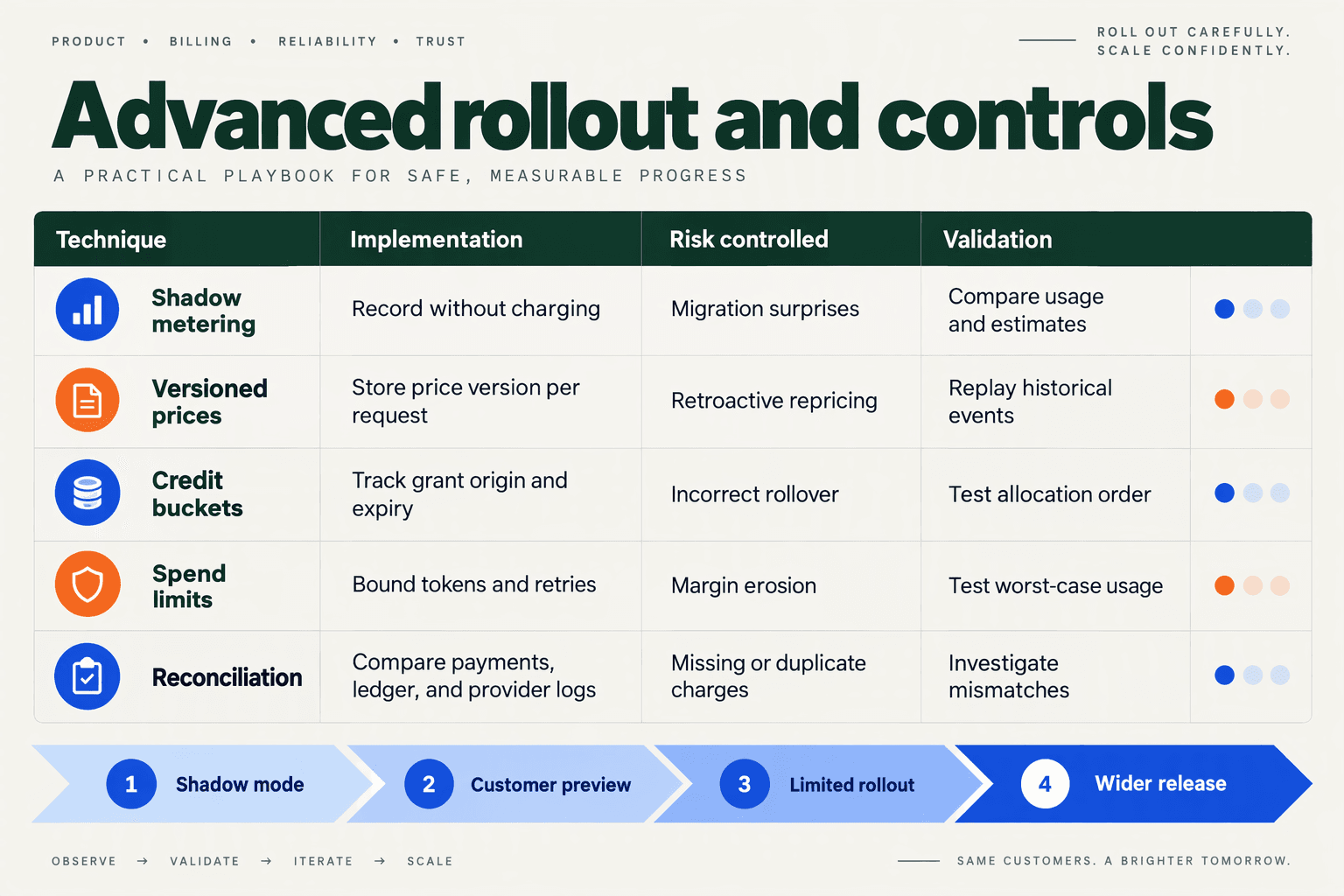
Add credits to an existing SaaS through a staged migration, keeping subscription access separate from AI spending. Protect margins with cost-based credit prices, define rollover rules for each grant type, and reconcile payments, customer debits, and provider costs independently.
How do you migrate an existing SaaS to credit billing safely?
Start by metering AI features without charging customers. This shadow-billing period reveals expensive workflows and lets you compare proposed credit charges with actual provider costs before changing customer entitlements.
Use this implementation checklist for a November 2026 rollout:
| Area | Implementation step | Protection gained | Acceptance check |
|---|---|---|---|
| Existing subscriptions | Map each plan to an explicit recurring credit grant | Preserves promised entitlements | Renewal grants match the plan |
| Shadow billing | Calculate hypothetical charges alongside current billing | Exposes underpriced features | Compare charges with provider costs |
| Margin controls | Version credit prices; bound output and tool usage | Limits unexpected cost exposure | Expensive workflows meet margin target |
| Rollover | Track grants separately by origin and expiry | Prevents accidental balance resets | Renewal preserves eligible credits |
| Migration | Issue a uniquely identified opening-balance grant | Prevents duplicate imports | Imported totals match approved balances |
| Reconciliation | Match payments, usage debits, and provider records | Detects missing or duplicate charges | Unmatched records enter an exception queue |
Roll out enforcement to a small cohort first. Keep a rollback switch that disables credit enforcement without deleting usage history or completed charges.
How do credits protect AI feature margins?
Credits protect margins only when their selling value covers the underlying cost. A fixed credit allowance does not automatically make an unbounded AI workflow profitable.
For a hypothetical November 2026 pricing model, assume one credit sells for ₹1, an action costs ₹2, and the target gross margin is 60%. The minimum charge is:
Credit charge = cost ÷ (1 − target margin) ÷ selling value per credit
That action needs 5 credits, because ₹2 ÷ 0.40 ÷ ₹1 = 5. Include directly attributable infrastructure and tool costs—not just model tokens—and calculate margins using discounted selling prices when applicable.
- Bound expensive operations: Limit output length, audio duration, and tool iterations.
- Version prices: Store the applicable price version on each usage record.
- Handle overruns explicitly: Stop, request authorization, or absorb the excess according to a disclosed policy.
How should subscription credits and purchased credits roll over?
Keep subscription, purchased, and promotional credits in separate grant buckets. Define expiry, rollover caps, refund treatment, and spending order before launch; spend eligible credits with the earliest expiry first.
As reviewed in November 2026, Makerkit’s credit-billing documentation implements rollover by adding renewal credits rather than resetting the balance. That preserves unused credits, but your application still needs grant-level rules for caps and expiry.
CallMissed’s verified pricing, as of November 2026, provides a concrete non-expiring model: credits cost ₹1 each and never expire. Non-expiring credits simplify customer expectations, but require ongoing visibility into outstanding balances.
What should daily credit reconciliation compare?
Reconcile three independent records: payment-backed grants, customer usage charges, and provider consumption. They need not share identical totals: customer charges include margin, while provider records represent costs.
- Match successful payments and renewals to their credit grants.
- Match completed AI operations to settlements or documented zero-charge outcomes.
- Match provider usage to internal cost records, allowing for reporting delays.
Investigate unmatched records rather than silently correcting balances. Use compensating ledger entries with reasons and references so refunds, adjustments, and migration fixes remain auditable.
Which credit-billing mistakes cause double charges, negative balances, or misleading margins?
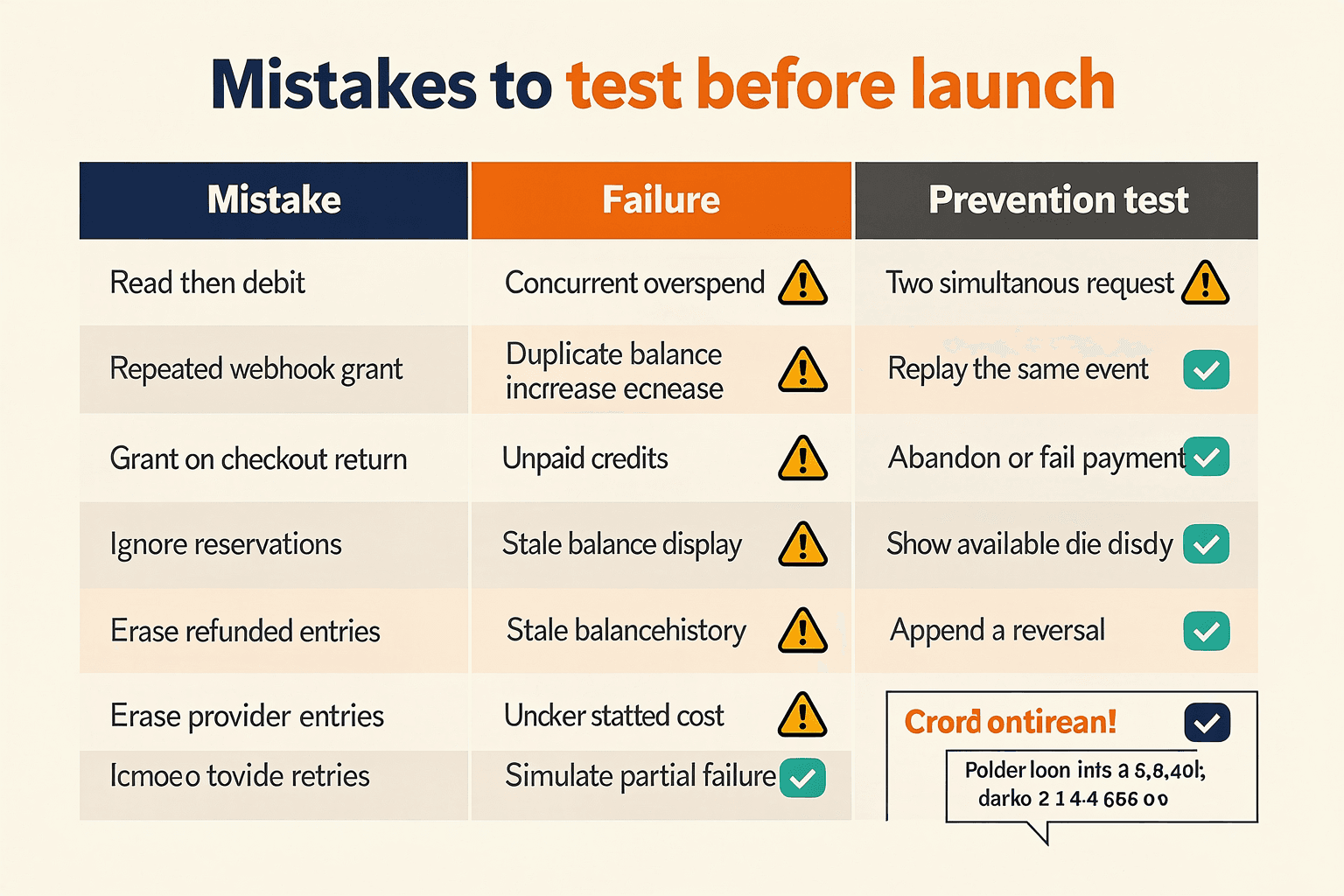
The most damaging per-credit billing mistakes are treating retries as new purchases, authorizing concurrent spending without locking funds, and calculating margins from credits sold rather than services delivered. Prevent these failures with enforceable transaction rules—and test the failure paths, not just successful requests.
Which credit-billing bugs should you test before launch?
The table below turns common failure modes into concrete acceptance tests. Numerical examples are hypothetical implementation tests, not industry benchmarks.
| Mistake | Billing consequence | Required safeguard | Acceptance test |
|---|---|---|---|
| Deduplicating webhook deliveries but not business operations | Separate events for one paid invoice grant credits twice | Enforce uniqueness on the invoice-linked grant, not only the webhook event ID | Deliver two different events referencing one invoice; create one grant |
| Reading a balance before updating it in a separate transaction | Concurrent requests authorize more credits than available | Atomically reserve funds using a conditional update or transactional lock | With 12 credits available, submit two 8-credit reservations; only one succeeds |
| Allowing repeated or conflicting reservation transitions | A retry settles twice, or a late callback debits released funds | Enforce valid state transitions and one settlement per reservation | Replay completion and cancellation callbacks in different orders; preserve one valid outcome |
| Treating a provider timeout as proof of zero usage | Credits are released despite provider-side execution costs | Keep uncertain usage pending; reconcile before final settlement | Simulate execution followed by a lost response; investigate before releasing funds |
| Rounding every small usage event upward | Customers pay inflated totals and reports disagree | Store integer microcredits; apply a documented rounding rule at settlement | Ten events costing 0.1 credit each total 1 credit, not 10 |
| Counting all top-up proceeds as usage revenue | Unspent balances make consumption margins look artificially high | Separate cash collected, credits outstanding, and revenue allocated to consumed usage | Sell 100 credits and consume 20; report collections separately from consumption |
Stripe’s usage-based billing guidance, reviewed as of November 2026, states that “at-least-once delivery” guarantees duplicates. The practical implication extends beyond webhook handling: two distinct event IDs can still describe the same economic operation.
How should you handle requests that exceed their reservation?
A reservation is an authorization limit, not permission to debit an unlimited final amount. If actual usage can exceed the estimate, choose the policy before launching the feature:
- Incremental authorization: Reserve additional credits before allowing more billable execution.
- Execution limits: Bound output tokens, audio duration, or tool iterations to fit authorized spending.
- Explicit overage rules: Permit a controlled negative balance only when the customer’s agreement allows it.
Do not silently choose the third option because settlement encountered insufficient funds. A customer-facing spending limit is misleading if backend callbacks can bypass it.
Why can a correct balance still hide an unprofitable feature?
Customer credit prices and supplier costs are different measurements. For each completed operation, compare allocated consumption revenue with actual provider costs, including retries and fallback executions—even when your policy charges the customer only once.
As of November 2026, CallMissed’s verified pricing sets 1 credit at ₹1, with credits that never expire. For a SaaS building on CallMissed’s developer AI API, that supplier-credit denomination does not determine the SaaS’s own customer-facing credit price or gross margin.
Keep three separate reports: cash collections, customer credit movements, and provider consumption costs. Review discrepancies by request ID and pricing version; otherwise, a balanced ledger can conceal a loss-making AI feature.
Which implementation resources and launch checks should you use next?
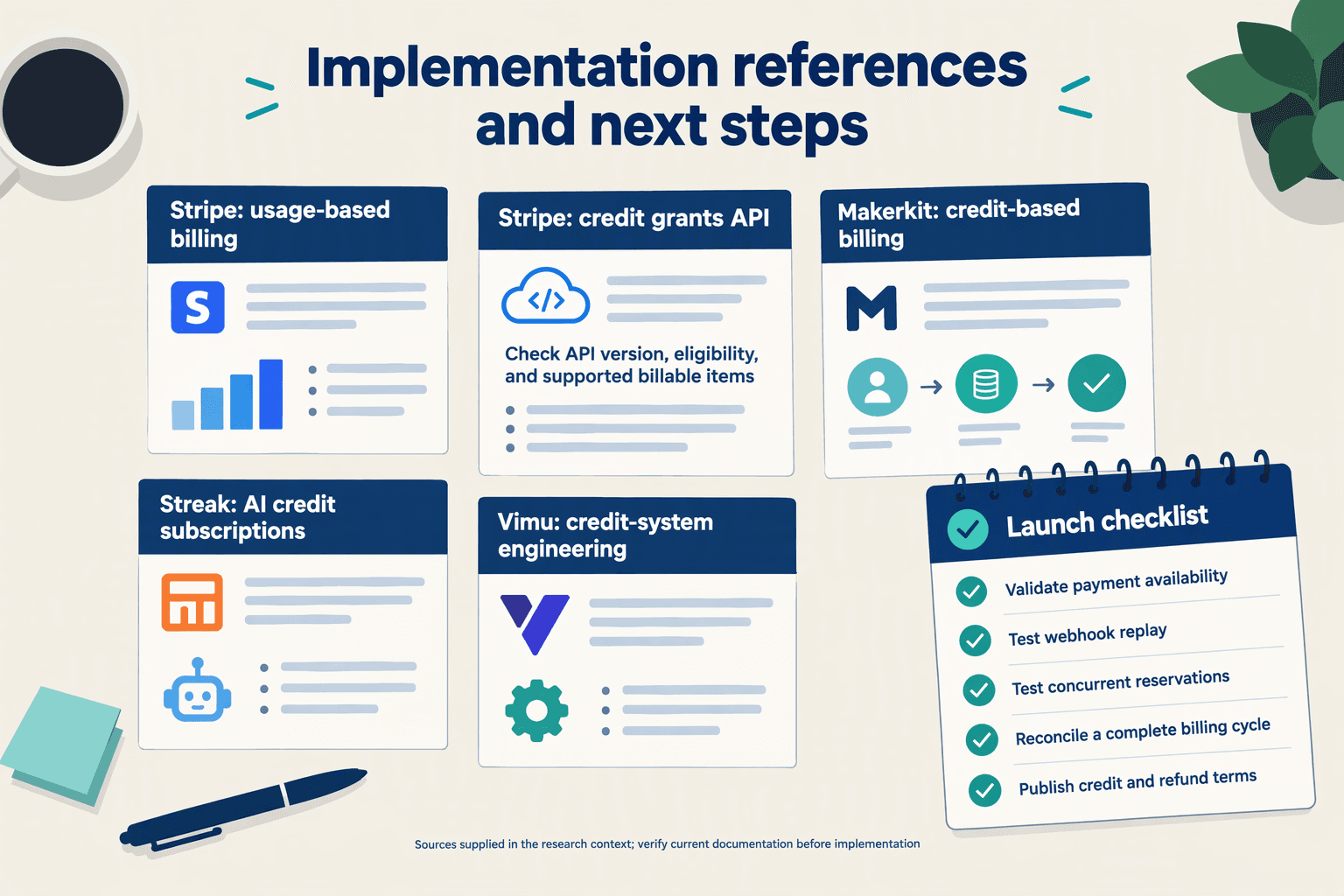
Use official billing API documentation, implementation examples matched to your stack, and a failure-focused launch checklist. Before releasing per-credit billing for AI features in your SaaS, require evidence that payment retries, interrupted AI requests, and subscription changes produce explainable credit transactions—not just successful checkout screens.
Which implementation resources should your engineering team use?
Give each resource a specific job rather than treating any tutorial as a complete production architecture:
- Stripe API Reference: Use the official documentation to verify payment events, meter events, adjustments, and credit-grant behavior. Stripe’s October 28, 2026 preview API documentation states that credit grants support “metered billable items”; check applicability before assuming grants cover your pricing configuration.
- Makerkit’s Next.js/Supabase credit-billing guide: Use this for stack-specific integration patterns. As reviewed in November 2026, Makerkit’s rollover example calls
add_creditsinstead of resetting the balance—a useful distinction when purchased credits must survive subscription renewal. - Streak Engineering’s “Implementing AI credit subscriptions”: Consult this when aligning allocations with subscription periods. As reviewed in November 2026, Streak identifies Stripe’s billing-cycle anchor as a Unix timestamp in seconds; use explicit period boundaries rather than an independent monthly cron schedule.
- Vimu’s credit-system case study: Use its discussion of metering alongside Stripe subscriptions and billing bugs as a review companion, not a substitute for your own acceptance tests.
Pin API versions and record documentation review dates in your implementation notes. This makes future behavior changes easier to distinguish from application defects.
What should you test before launching AI credit billing?
Turn billing requirements into automated tests with explicit expected outcomes. Stripe’s usage-based billing guidance, reviewed in November 2026, warns that “at-least-once delivery” guarantees duplicates; your tests should therefore assume repeated and delayed events.
- Replay a successful payment webhook. Deliver the same event repeatedly and confirm that it creates exactly one credit grant.
- Interrupt an AI request after provider execution. Confirm that recovery can find the request, reconcile usage, and resolve its reservation without blindly rerunning paid work.
- Change a subscription near renewal. Test upgrades, downgrades, cancellation, and late payment notifications against your documented allocation policy.
- Exercise rounding boundaries. Test very small charges and repeated fractional usage. Confirm that the displayed balance agrees with the ledger under your chosen precision rules.
- Replay a historical usage event after changing prices. Confirm that reconciliation uses the recorded pricing version, not today’s rate.
- Simulate a missing provider usage record. Ensure the discrepancy enters a review queue instead of silently becoming a customer charge or disappearing.
For every test, retain the request ID, payment event ID, ledger entries, expected balance, and actual balance as release evidence.
How should you run a controlled billing launch?
Start with shadow metering: calculate proposed charges without debiting customer credits, then compare those calculations with provider usage records. Next, enable charging for a limited cohort with spending limits and a documented support escalation path.
As of November 2026, CallMissed’s developer AI API provides usage and request logs, which can support provider-side reconciliation when your SaaS uses CallMissed; your application must still maintain its own customer-facing ledger.
Before expanding access, confirm:
- Operations: Alerts identify unresolved reservations and reconciliation differences.
- Support: Staff can explain charges and issue auditable adjustments.
- Rollback: You can disable new billable AI work without blocking settlement of existing requests.
The launch gate is simple: every credit movement must be traceable, and every unresolved charge must have an owner.
Frequently Asked Questions
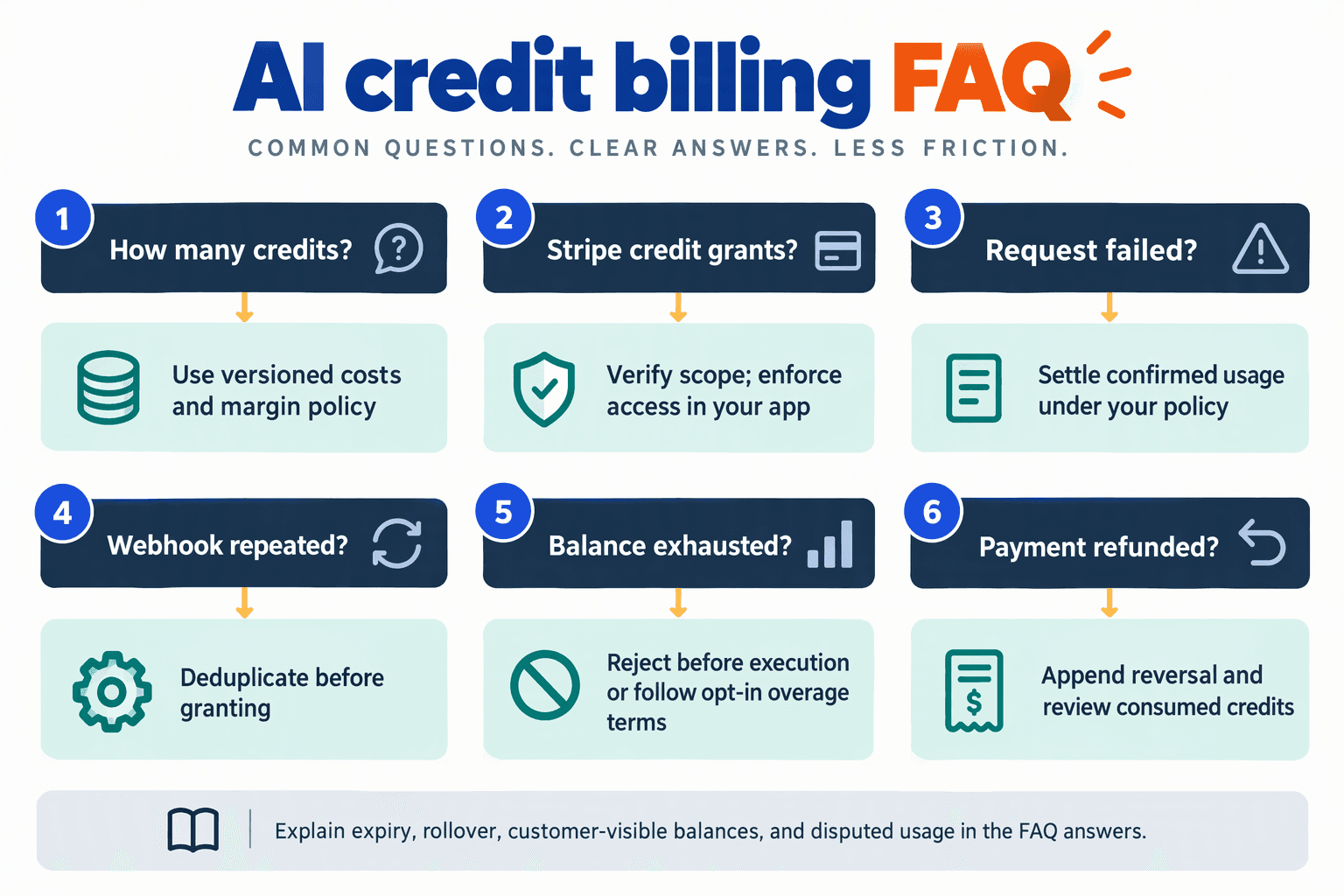
How do I implement per-credit billing for AI features in my SaaS and decide how many credits each action costs?
Can I use Stripe credit grants instead of building my own AI credit ledger?
How should I implement per-credit billing for AI features in my SaaS when requests fail or time out?
How do I prevent duplicate Stripe webhooks from granting or charging credits twice?
What should happen when a customer’s AI credit balance runs out?
How should AI credits be adjusted when a payment is refunded?
Conclusion
To implement per-credit billing for AI features in your SaaS, use an append-only ledger, reserve credits atomically before running requests, and settle reservations against actual consumption. Keep payment collection, credit grants, and usage charges separate so every balance change remains explainable under concurrency, retries, and failed requests.
The implementation comes down to four principles:
- Price the work, not just the request. Translate tokens, audio seconds, or feature actions into explicit credit charges that reflect underlying costs. A customer-facing credit unit can simplify purchasing, but your internal metering must retain enough detail to explain charges and assess margins. Different models and workloads should not accidentally become identical expenses.
- Make authorization atomic and history immutable. Record grants, reservations, settlements, releases, and adjustments without overwriting previous transactions. Reserve the expected charge before execution; if the reservation fails, do not run the action. In the guide’s hypothetical example, reserving 10 credits, settling 7, and releasing 3 preserves both spending control and a clear transaction trail.
- Treat duplicate events as normal operating conditions. Stripe’s usage-based billing guidance, reviewed as of November 2026, warns that “at-least-once delivery” guarantees duplicates. Give payment and usage events unique identifiers, enforce idempotency, and grant purchased or subscription credits only after verified payment events. Replaying a completion event must never create another debit.
- Make balances understandable and reconcile regularly. Show available credits separately from pending reservations, alongside itemized usage. Compare application charges with provider records and investigate discrepancies rather than assuming successful payment processing means accurate consumption billing. Customer visibility and reconciliation serve different purposes: one explains spending, while the other checks whether that explanation is correct.
What should SaaS teams watch next in AI credit billing?
Watch how billing providers expand credit-grant and metering capabilities without confusing those capabilities with application-level authorization. Stripe’s October 28, 2026 preview API documentation states that credit grants currently support metered billable items; that support does not replace the controls needed to prevent two simultaneous AI requests from spending the same credits.
As of November 2026, CallMissed’s developer AI API offers one balance across 159 models, with credits valued at ₹1 each that never expire. Readers can explore CallMissed as a concrete example of consolidated AI consumption, while retaining responsibility for their own SaaS pricing, customer ledger, and spending controls.
As model choices and consumption patterns evolve, the durable advantage is not a particular billing integration. It is an auditable system that connects payments, permissions, usage, and customer explanations.
Before shipping, test this: can your system handle concurrent requests and replayed events without overspending or charging twice?
Related Reading
- Proxy-based LLM observability for Support API Teams
- Cheapest LLM API Provider in India in 2026: Workload-Based Cost Guide
- AI Phone Receptionist Buyer’s Guide 2026 for Appointment-Based Businesses