
Cheapest LLM API Provider in India in 2026: Workload-Based Cost Guide


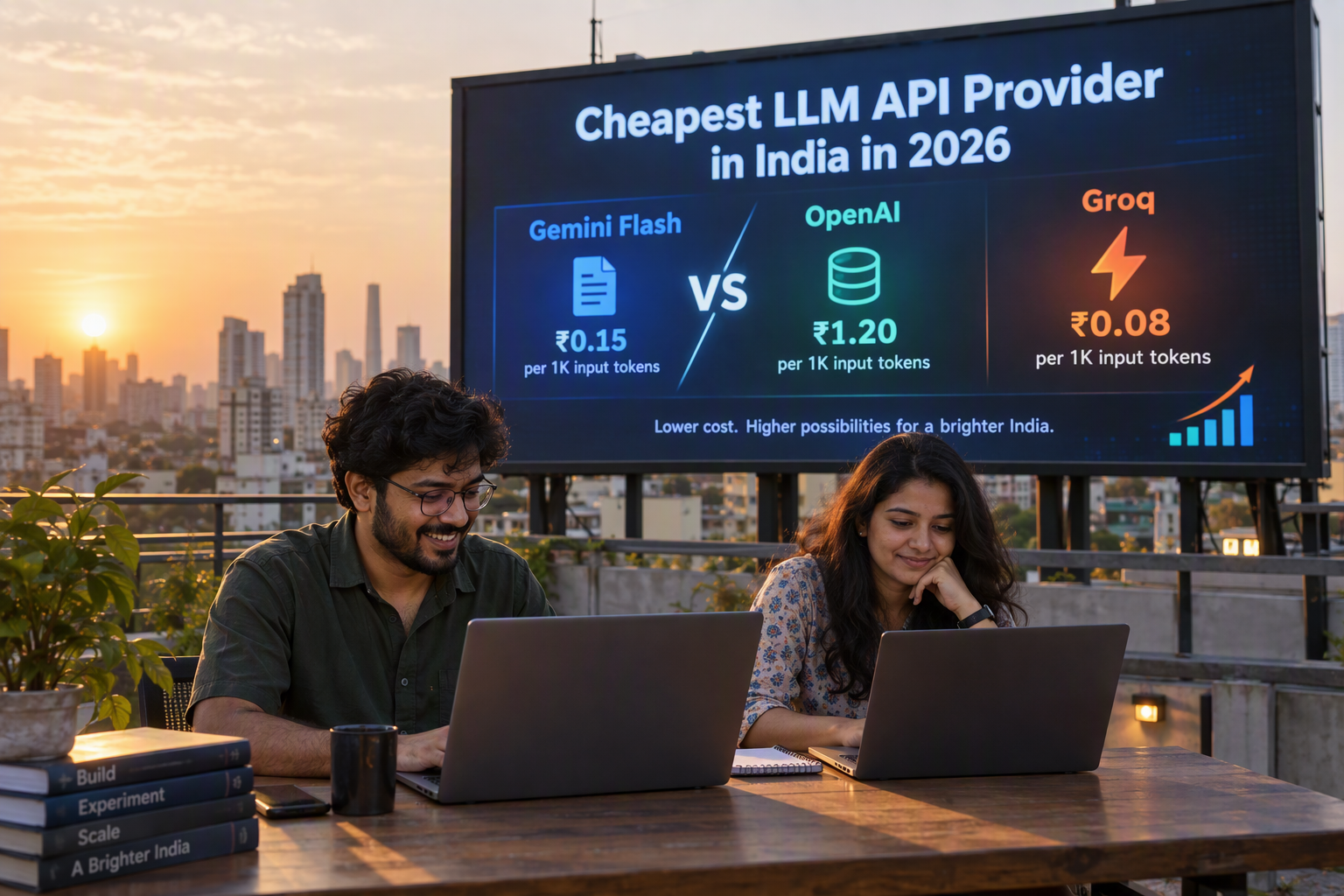
Compare the cheapest LLM APIs in India for 2026 with token prices, INR cost formulas, tax caveats, and workload-based recommendations.
Cheapest LLM API Provider in India in 2026: Workload-Based Cost Guide
What if the cheapest LLM API provider in India could reduce a WhatsApp support bot’s monthly bill from roughly ₹3,800 to ₹1,250? According to Rohit Raj’s 2026 India MVP analysis, Gemini 2.5 Flash costs about ₹1,250 monthly for 10,000 conversations, while GPT-5-mini costs approximately ₹3,800 for the same workload. But the lowest per-token price is not automatically the lowest total cost: context length, output volume, caching, GST, latency, reliability and model quality can change the answer. This guide compares LLM API economics by workload—from low-volume prototypes and customer-support bots to high-throughput production systems—and explains when APIs, aggregators or self-hosting make financial sense. Platforms such as CallMissed also reflect this shift by giving developers access to multiple models through one OpenAI-compatible gateway and billing account.
What is the cheapest LLM API provider in India in 2026?
Short answer
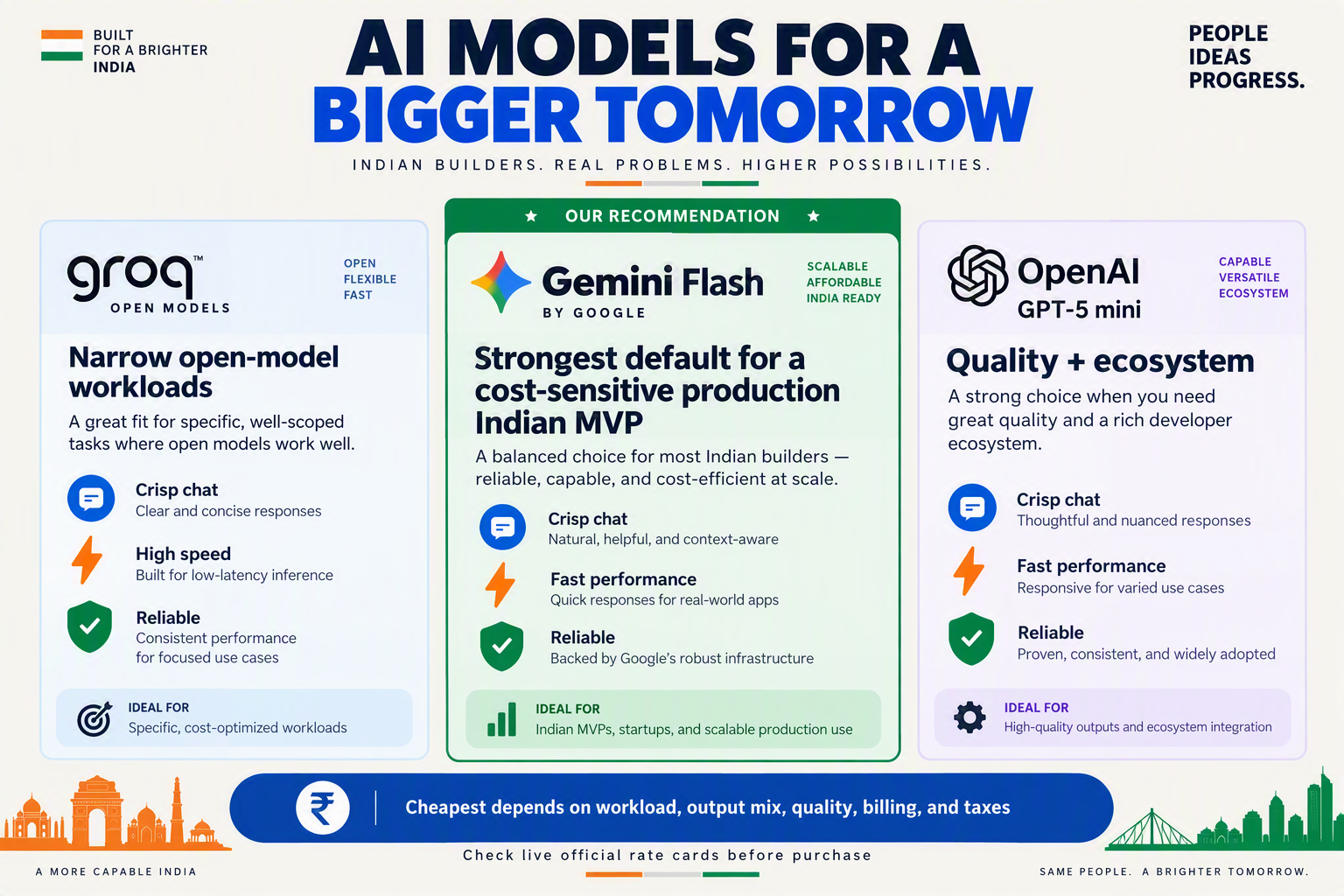
There is no universally cheapest LLM API provider in India in 2026 because the lowest-cost option depends on token volume, model capability, output length and billing terms. For a specific 10,000-conversation WhatsApp support-bot workload, Rohit Raj’s 2026 comparison estimates Gemini 2.5 Flash at approximately ₹1,250 per month, compared with approximately ₹3,800 per month for GPT-5-mini. These are conditional estimates—not guaranteed quotes—so verify each provider’s current rate card, model access, currency conversion and applicable taxes before committing.
What do the India cost estimates show?
Rohit Raj’s 2026 India MVP comparison is a useful starting benchmark, but its monthly totals depend on assumptions such as conversation length, input-to-output token ratio, model selection and total usage. The estimates indicate:
- Gemini 2.5 Flash: Approximately ₹1,250 per month for 10,000 WhatsApp support-bot conversations in Rohit Raj’s modelled scenario.
- GPT-5-mini: Approximately ₹3,800 per month for the same scenario, making the estimate roughly three times higher than Gemini’s.
- Practical interpretation: Gemini 2.5 Flash may be the more economical first benchmark for a cost-sensitive, high-volume MVP, while GPT-5-mini could be preferable if stronger responses reduce failed interactions, escalations or rework.
The figures should not be treated as a provider-wide ranking. A bot that generates long answers, processes documents, retains extensive conversation history or invokes tools can produce a very different invoice from a short-form classification or extraction workflow.
Are Groq and open-model APIs cheaper?
Groq and other open-model routes can be cheaper for narrow workloads, particularly when a smaller model meets the application’s quality requirements. CostBench’s 2026 benchmark reports Groq at approximately $0.13 per 1 million input tokens, the lowest input-token price among the 14 providers surveyed.
That figure covers input tokens only; it is not a complete Indian monthly bill. Compare these factors before selecting a low-cost route:
- Input-to-output mix: Output tokens often carry different pricing, and verbose responses can dominate total spend.
- Model availability: The lowest advertised price is irrelevant if the required context window, reasoning mode, vision capability or function calling is unavailable.
- Latency and reliability: Rate limits, response speed and failure handling can affect support staffing, conversions and customer satisfaction.
- Taxes and billing: Currency conversion, platform markups, minimum commitments and 18% GST where applicable can change the final rupee cost. The Neildave India calculator highlights GST and reverse-charge considerations.
- Integration effort: Separate SDKs, monitoring systems, usage dashboards and failure-handling logic can offset a lower token price.
Platforms such as CallMissed offer multiple models through one OpenAI-compatible API key and endpoint with one balance. That can simplify integration and consolidated usage management, although the cheapest choice still depends on the selected model and measured workload.
How should Indian teams choose the cheapest provider?
Use Gemini 2.5 Flash’s ₹1,250 estimate as an initial benchmark, then test GPT-5-mini, Groq and suitable open-model options against representative token traces. The cheapest LLM API provider in India is ultimately the route with the lowest total cost for the required quality, latency, access and operational reliability—not necessarily the provider with the lowest advertised price per million tokens.
Which provider wins at a glance for each Indian workload?
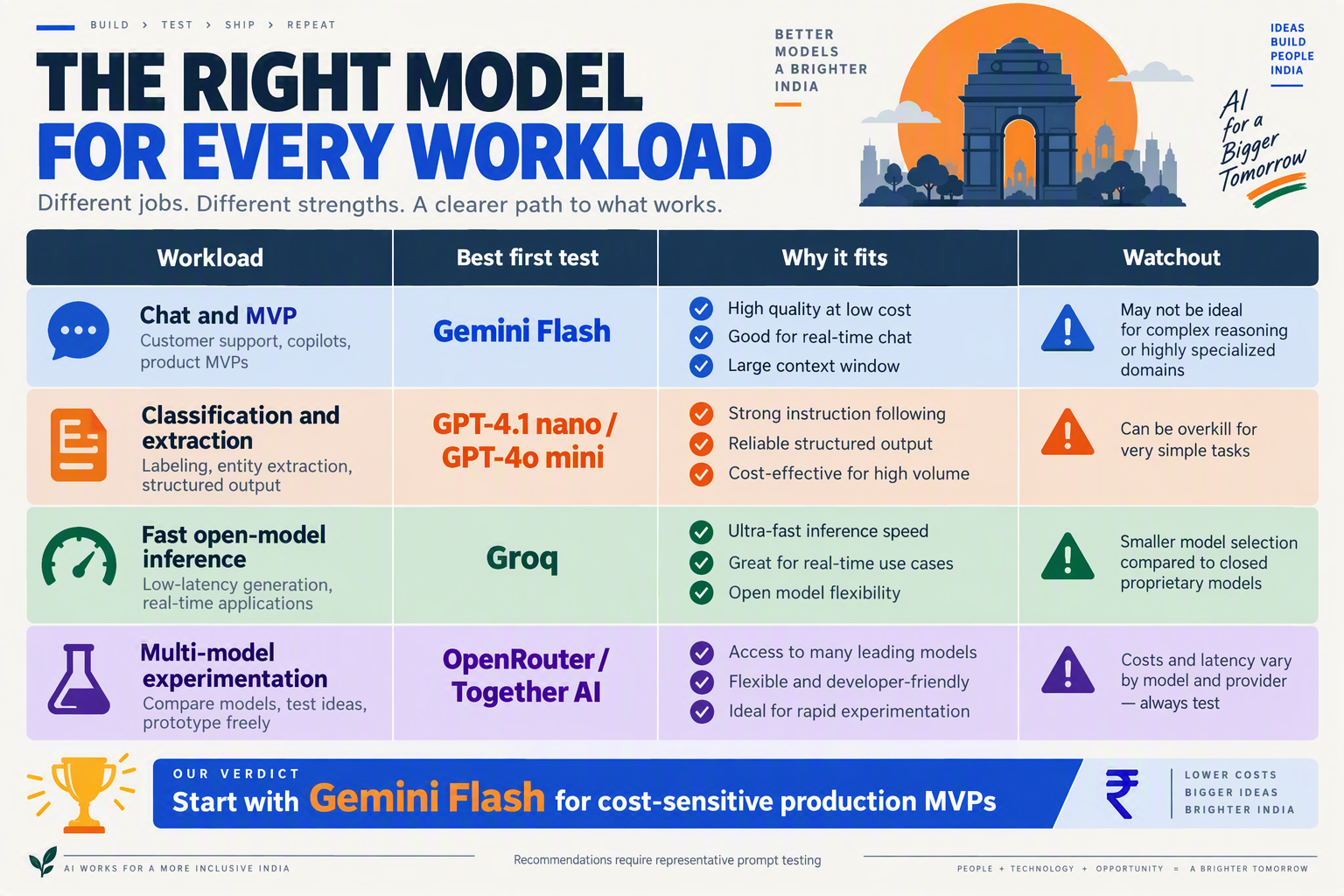
The cheapest LLM API provider in India depends on workload, token mix, quality requirements, and operating scale—not on a single universal ranking. For a cost-sensitive MVP, Gemini 2.5 Flash is the clearest candidate; GPT-5 mini fits teams prioritising OpenAI tooling and quality trade-offs; and Groq deserves consideration when input-token pricing and latency-sensitive serving are central.
Best shortlist by workload
- Cost-sensitive 10,000-conversation MVP: Gemini 2.5 Flash
Gemini 2.5 Flash is the strongest budget candidate for an Indian MVP based on Rohit Raj’s 2026 scenario: approximately ₹1,250 per month for a 10,000-conversation WhatsApp support bot. Treat this as a workload estimate, not a universal production quote, because the final bill changes with prompt length, output length, caching, tool calls, and exchange rates.
- Quality-constrained MVP using OpenAI tooling: GPT-5 mini
GPT-5 mini is a practical choice when a team already depends on OpenAI’s SDKs, conventions, evaluation tools, or broader ecosystem. Rohit Raj estimates approximately ₹3,800 per month for the same 10,000-conversation workload and describes GPT-5 mini as the safer default when response quality is what blocks shipping. The higher estimated cost may be justified if fewer escalations, retries, or prompt-engineering cycles reduce total engineering effort.
- Lowest input-token price: Groq
Groq is an input-price candidate rather than a guaranteed cheapest end-to-end provider. CostBench reports Groq at approximately $0.13 per 1 million input tokens, compared with a $0.545 per 1 million input-token market median across 14 major providers in its 2026 benchmark. However, output pricing, the specific model available through Groq, context limits, rate limits, and feature compatibility can materially change the total cost. Calculate input and output tokens separately before selecting Groq on price alone.
API versus self-hosting
For most early Indian products, managed APIs are simpler to budget and operate. However, the break-even point depends on sustained volume, model size, utilisation, hardware depreciation, engineering capacity, and reliability requirements.
TechPlained’s 2026 analysis presents the following workload thresholds:
| Sustained daily volume | TechPlained’s analysis | Practical interpretation |
|---|---|---|
| Below 3 million tokens/day | APIs generally win | Avoid fixed infrastructure while usage is still variable |
| 3–30 million tokens/day | Cloud GPUs can win | Compare utilisation, inference efficiency, and engineering overhead |
| Above 30 million tokens/day | Hardware may repay investment | TechPlained estimates an 18–24-month hardware payback period |
These thresholds are TechPlained’s analysis, not universal rules. A regulated workload may favour self-hosting earlier for control or data-governance reasons, while an unpredictable workload may remain better suited to APIs even at high volume.
Bottom line
Start with Gemini 2.5 Flash when minimising MVP spend is the priority. Choose GPT-5 mini when OpenAI compatibility and quality justify the additional estimated cost. Evaluate Groq when input-token economics are unusually important, but include output and model-availability costs. Revisit self-hosting only after sustained usage makes TechPlained’s API-versus-infrastructure analysis relevant to your actual traffic.
How do the leading LLM APIs compare on models, prices, and billing?
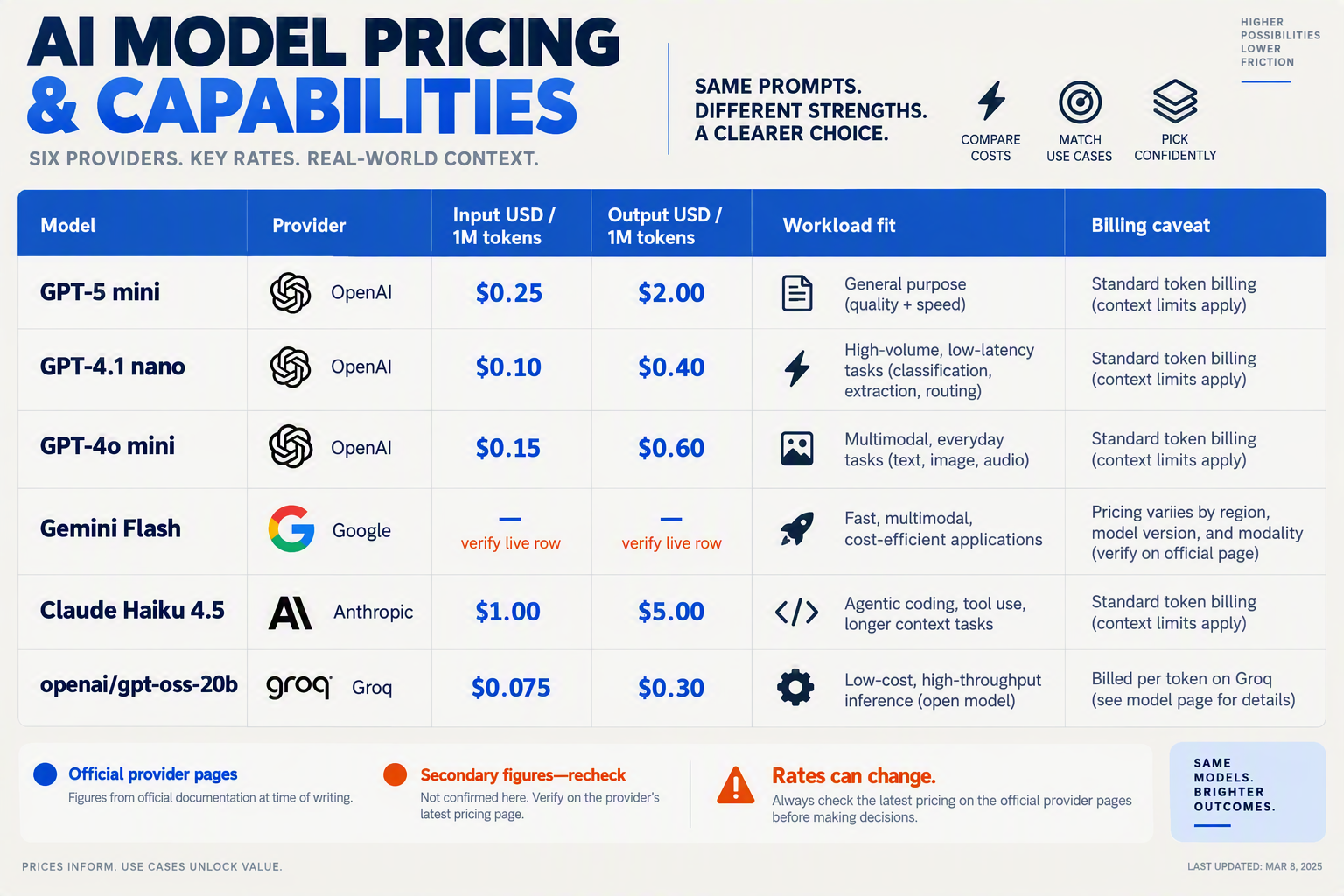
The cheapest LLM API provider in India depends on model choice, input/output token ratios, billing tier, and currency costs. A low input rate does not guarantee the lowest monthly bill when a workload generates long answers or retries frequently.
Which LLM API has the lowest listed token price?
The table uses USD per 1 million tokens. Official provider prices are identified where available; every secondary-source figure requires verification against the provider’s current pricing page before deployment.
| Model | Provider | Input USD/1M | Output USD/1M | Workload fit and billing caveat |
|---|---|---|---|---|
| GPT-5 mini | OpenAI | $0.25 | $2.00 | Production chatbots, support automation, and general-purpose applications; verify current official pricing, taxes, currency conversion, and any tool charges. |
| GPT-4.1 nano | OpenAI | $0.10 | $0.40 | High-volume classification, extraction, routing, and short responses; official rates should still be checked for cached-input treatment and current terms. |
| GPT-4o mini | OpenAI | $0.15 | $0.60 | Cost-sensitive conversational and structured-generation workloads; actual spend varies with token volume, output length, and supported modalities. |
| Gemini paid-tier example | Google Gemini Developer API | $0.375 | Verify exact model | Useful for teams evaluating Google’s Gemini ecosystem; Google’s listed input example applies through December 31, 2026, but model, tier, output rate, and promotions require verification. |
| Claude Haiku 4.5 | Anthropic | $1.00 | $5.00 | Instruction-following and customer-support workloads; this is a secondary-source figure reported by Finout and Stackcapybara, not CostBench, and must be checked with Anthropic. |
| openai/gpt-oss-20b | Groq | $0.075 | $0.30 | High-throughput inference and classification; the figure is a secondary-source estimate reported by CostBench, requiring verification against Groq’s model pricing, limits, and serving terms. |
How should Indian teams calculate LLM API cost?
Use this reproducible formula:
Estimated cost = (input tokens ÷ 1,000,000 × input price) + (output tokens ÷ 1,000,000 × output price)
For a hypothetical workload using 10 million input tokens and 2 million output tokens per month, GPT-5 mini would cost:
- Input: 10 × $0.25 = $2.50
- Output: 2 × $2.00 = $4.00
- Estimated API total: $6.50
- At a hypothetical exchange rate of ₹85 per US dollar: 6.50 × 85 = ₹552.50
This example excludes taxes, payment fees, exchange-rate spreads, retries, tools, and other provider-specific charges. The same token volume can produce a very different result on a model with a higher output rate.
- GPT-4.1 nano is a candidate for routing, tagging, extraction, and other narrow tasks because its listed rates are lower than GPT-5 mini’s.
- GPT-5 mini may justify its higher price when stronger responses reduce retries, escalation, or human review.
- CostBench reports a 2026 market median of $0.545 per 1 million input tokens and $1.94 per 1 million output tokens across 14 providers, but that benchmark aggregates models and should not be treated as a provider-wide quote.
- Rohit Raj’s 2026 India MVP analysis estimates roughly ₹1,250 monthly for Gemini 2.5 Flash and ₹3,800 for GPT-5 mini for a 10,000-conversation WhatsApp support bot; those are workload assumptions, not universal prices.
Tax/GST and reverse-charge treatment depend on the buyer, supplier, and transaction structure. The Neildave India LLM Cost Calculator is a secondary calculator, so finance or tax advisers should verify the applicable treatment rather than applying a blanket 18% assumption.
India-focused platforms such as CallMissed offer one API key and balance across 134 models, including 27 on the free tier; teams should still compare the selected model’s actual usage cost, limits, and billing terms.
How much will each LLM API cost in India after token usage, conversion, and taxes?
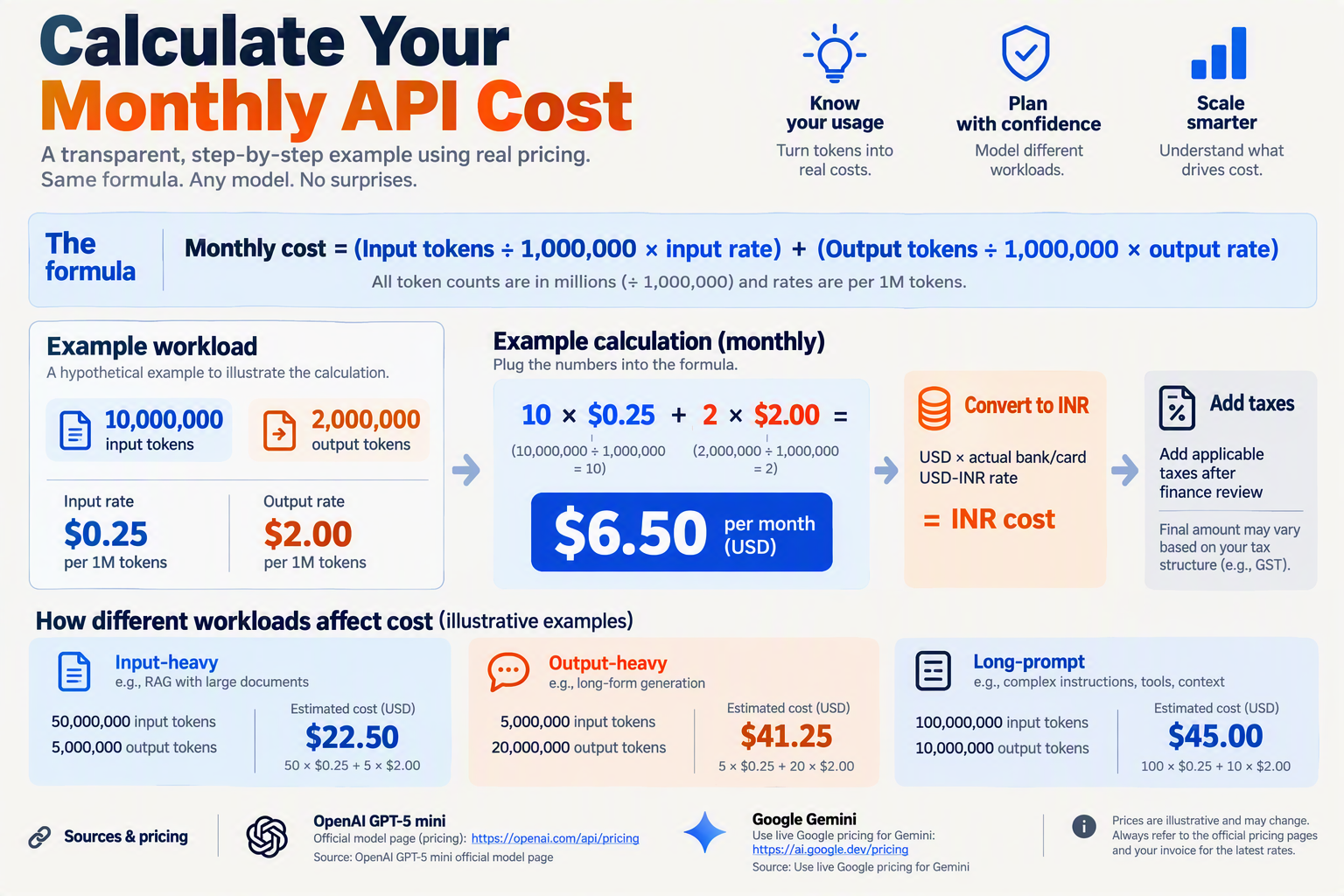
A realistic India bill is measured token usage × the provider’s USD price, followed by your actual bank, card, invoice, and tax treatment. There is no universally valid $/₹ conversion or automatic 18% GST rule for every buyer, so compare providers in the billing currency first and convert using the rate that will actually appear on your invoice or statement.
India LLM API cost comparison
| Provider or model | Published pricing signal | What the figure represents | Cost interpretation |
|---|---|---|---|
| Gemini 2.5 Flash | ₹1,250/month estimate | Rohit Raj’s estimate for 10,000 WhatsApp-support conversations | A practical low-cost production benchmark, not a universal tariff |
| GPT-5-mini | ₹3,800/month estimate | Rohit Raj’s estimate for the same 10,000-conversation scenario | Higher spend may be justified when output quality is the shipping constraint |
| Groq | $0.13 per 1M input tokens | Input-only benchmark reported by CostBench in 2026 | Add output tokens and the price of the selected model before estimating a monthly bill |
| OpenRouter | $0–$75 per 1M tokens | Broad range reported by CostBench in 2026 | The routed model, token direction, and provider determine the actual cost |
| Claude API | Up to $25 per 1M output tokens | Premium output-side benchmark reported by CostBench in 2026 | Output-heavy workflows can become expensive quickly |
Rohit Raj estimates ₹1,250 per month for Gemini 2.5 Flash and approximately ₹3,800 per month for GPT-5-mini for a 10,000-conversation WhatsApp-support bot, according to his 2026 India MVP analysis. These are scenario estimates; they should not be presented as fixed provider prices or adjusted with an assumed GST percentage.
How do you calculate an LLM API bill without inventing an exchange rate?
Use this formula separately for input and output:
Monthly provider charge = (input tokens ÷ 1,000,000 × input price) + (output tokens ÷ 1,000,000 × output price)
Then apply the commercial treatment that actually applies to your account:
Estimated INR cost = USD charge × your bank/card/invoice conversion rate + applicable taxes or fees
For a transparent hypothetical, OpenAI’s published GPT-5 mini rates used in this example are $0.25 per 1M input tokens and $2.00 per 1M output tokens, according to OpenAI’s official API pricing. Suppose a support bot consumes 100M input tokens and 20M output tokens in one month:
- Input: 100 × $0.25 = $25
- Output: 20 × $2.00 = $40
- Provider subtotal: $65
- INR conversion: $65 × your actual settlement or invoice rate
- Tax: add or account for only the taxes applicable to your entity, transaction, and billing arrangement
This example deliberately stops before producing an INR total. The Neildave India calculator discusses modeling 18% GST or reverse-charge treatment, but tax handling can vary by buyer, registration status, documentation, and input-tax-credit eligibility. Confirm the treatment with your finance or tax adviser rather than adding 18% universally.
What changes the cheapest LLM API provider in India?
- Token mix: A chatbot producing long answers may cost more than a short-answer bot with the same conversation count.
- Caching and context: Repeated system prompts, retrieved documents, and conversation history can materially increase input tokens.
- Fallbacks: A low headline rate may not remain lowest if reliability requirements route requests to premium models.
- Model routing: CallMissed’s OpenAI-compatible gateway provides one balance across 134 models, including 27 free-tier models, so teams can test lower-cost models and reserve premium models for complex requests without rewriting standard SDK integrations.
The cheapest LLM API provider in India is therefore workload-dependent: measure tokens, preserve the original billing currency, apply the real conversion and tax treatment, and compare quality and fallback requirements alongside price.
What are the pros and cons of Gemini, OpenAI, Groq, Together AI, and OpenRouter?
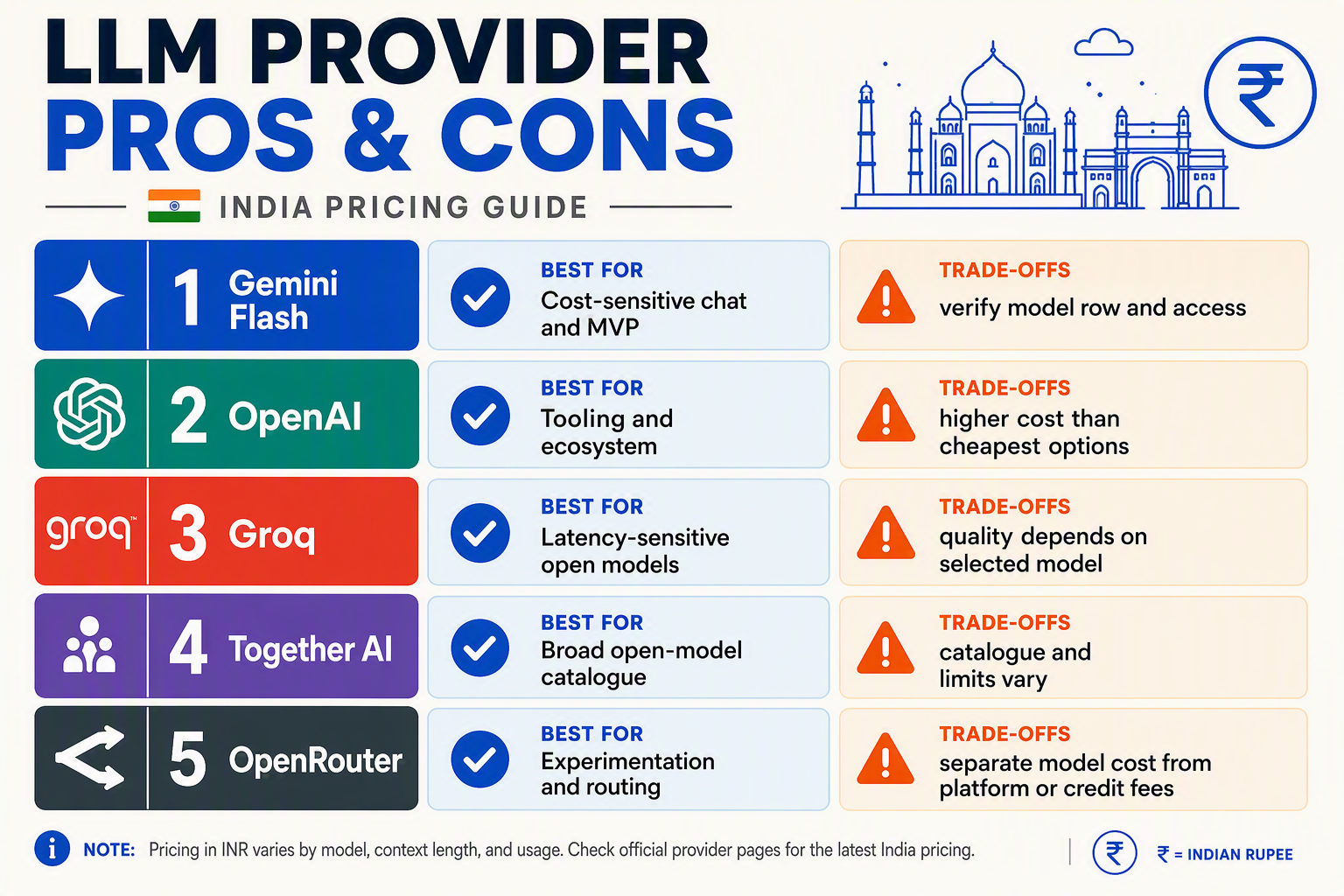
The cheapest LLM API provider in India depends on workload, not just the lowest advertised token rate. Gemini may be a strong starting point for cost-sensitive MVPs, while Groq can be attractive for input-heavy traffic; OpenAI, Together AI, and OpenRouter require model-level comparisons before you estimate the final bill.
| Provider | Potential advantages | Trade-offs to check | India cost signal | Suitable workload |
|---|---|---|---|---|
| Google Gemini | Competitive pricing can make it attractive for high-volume text or support workloads; compare the specific model and tier | Limits, pricing, and observed output quality can differ by model; validate multimodal or production requirements directly | Rohit Raj estimates Gemini 2.5 Flash at about ₹1,250 per month for 10,000 WhatsApp support conversations in 2026 | Cost-sensitive MVPs and support automation |
| OpenAI | A widely considered option when teams value predictable integration and model capabilities for a production use case | May cost more for the same workload; test whether higher spend reduces rework, retries, or human escalation | Rohit Raj estimates GPT-5-mini at about ₹3,800 per month for the same 10,000-conversation workload | Applications where quality and reliability of the chosen model justify the budget |
| Groq | Very low input-token pricing may benefit workloads that process large prompts or documents | Output pricing, available models, limits, and production suitability can materially change total cost; benchmark end-to-end latency rather than assuming it | CostBench reports approximately $0.13 per 1 million input tokens in 2026 | Input-heavy or latency-sensitive applications where the selected model fits |
| Together AI | Access to multiple open models can support experimentation and model-specific testing | Cost depends on the selected model, input/output mix, throughput, context length, and hosting terms; there is no single representative platform rate | Use live, model-specific pricing rather than a provider-wide estimate | Open-model evaluation and specialized workloads |
| OpenRouter | A broad catalogue can simplify comparisons across providers and models through one service | Prices, availability, provider policies, and routing behavior vary by model and underlying provider; verify the exact route and terms | CostBench reports a catalog range of approximately $0–$75 per 1 million tokens in 2026 | Multi-model experiments and teams comparing several upstream options |
How should Indian teams compare these LLM API providers?
Start with a representative workload rather than a provider label. Record input tokens, output tokens, context length, requests per minute, model tier, retries, streaming needs, and required response quality. Groq’s low input price, for example, does not automatically produce the lowest invoice if the application generates long responses or uses a more expensive model.
Rohit Raj’s 2026 estimate places Gemini 2.5 Flash at roughly one-third of GPT-5-mini’s monthly cost for the stated 10,000-conversation WhatsApp scenario, but that is a workload estimate—not a universal provider ranking. CostBench’s 2026 benchmark also reports a market median of $0.545 per 1 million input tokens and $1.94 per 1 million output tokens, showing why both sides of the token bill matter.
India tax treatment is buyer-specific. The Neildave India calculator advises checking whether 18% GST or reverse-charge treatment applies to the purchaser and transaction; do not add GST uniformly without confirming the billing arrangement.
For teams that want to compare models without rewriting every integration, CallMissed’s developer AI API, as of September 2026, provides one API key and one balance for 134 models. Its OpenAI-compatible endpoints support existing SDK patterns by changing the base URL, while the exact model, token usage, and applicable pricing still determine the cost.
How should you choose the cheapest API for your specific workload?
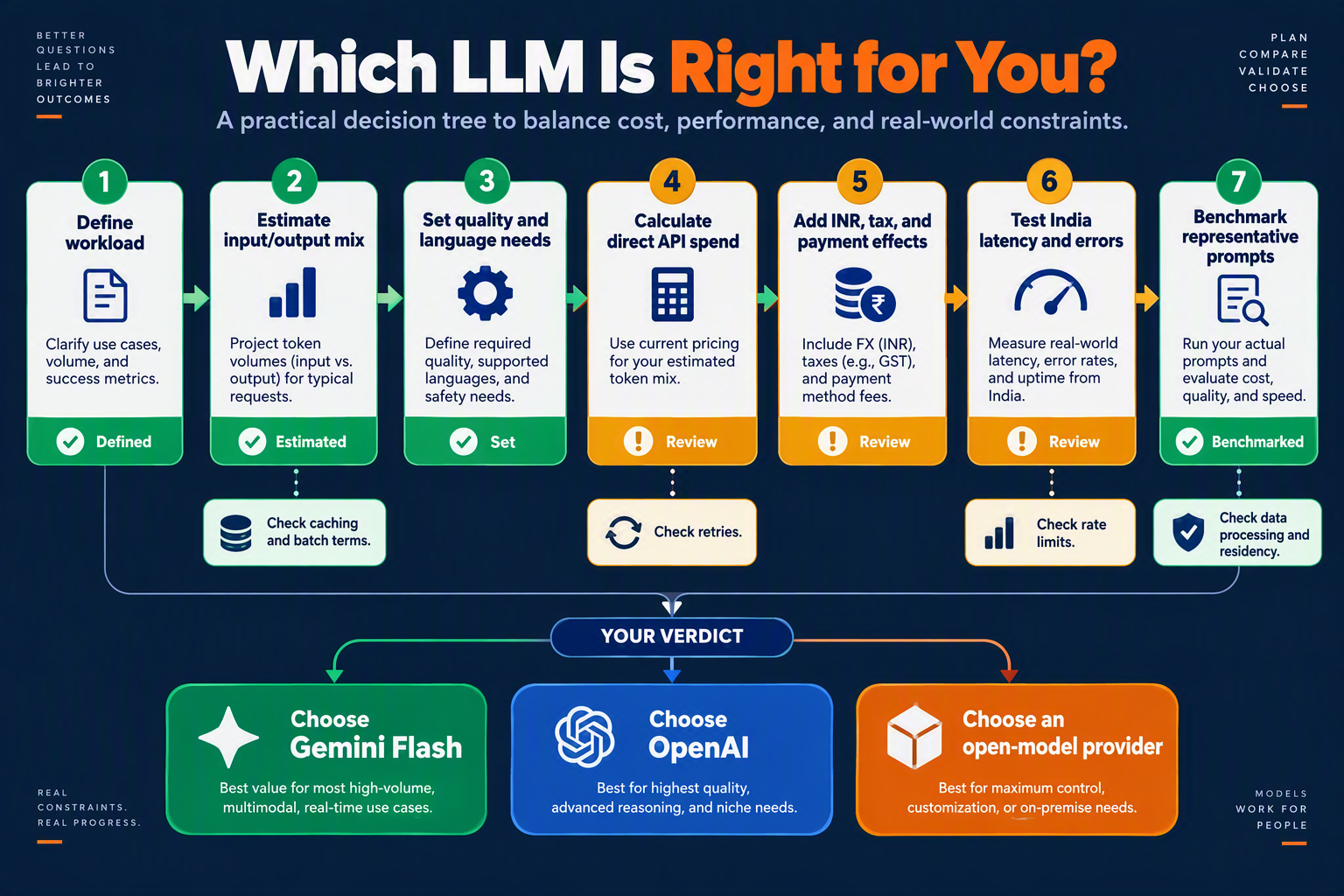
Choose the cheapest LLM API provider in India by measuring total cost for your workload—not by comparing input-token prices alone. The right decision combines model quality, input and output volume, latency requirements, taxes, failure rates, and the engineering cost of managing multiple providers.
Which API is cheapest for different workloads?
Use the following workload-based starting points, then validate them with your own prompts and traffic profile:
- Low-volume prototypes: Run a small paid test or use a provider-offered trial or free access where officially available. Measure at least 100–500 requests, including input tokens, output tokens, error rates, and response times, before committing to a monthly budget. For example, CallMissed provides 1,000 free credits on signup, as of September 2026.
- Indian WhatsApp support bots: Benchmark Gemini 2.5 Flash first when conversations are relatively short and cost is the primary constraint. Rohit Raj estimates approximately ₹1,250 per month for 10,000 conversations in an Indian WhatsApp support-bot workload, excluding taxes and application-layer costs.
- Quality-sensitive workflows: Test GPT-5-mini when stronger outputs could reduce manual review, escalations, or failed conversations. Rohit Raj estimates roughly ₹3,800 per month for the same 10,000-conversation workload, although your prompt length and response volume may produce a different result.
- Short-response workloads with tight response-time targets: Evaluate Groq if its available models satisfy your quality and feature requirements. CostBench reports approximately $0.13 per 1 million input tokens for Groq in its 2026 benchmark, but that figure does not establish a universal performance advantage; output pricing, model availability, queueing, network conditions, and your region can change the final cost and user experience.
- Long-context applications: Compare cached-input, uncached-input, and output-token rates together. Document summarisation can become expensive when each request includes a large context and produces a long answer, even if the headline input price appears low.
How should you compare taxes and operational costs in India?
Add tax treatment based on your buyer status, provider invoicing structure, and applicable Indian rules, rather than automatically adding GST to every estimate. The Neildave India LLM Cost Calculator highlights 18% GST and reverse-charge considerations, but whether GST is charged by the provider or handled by the buyer can depend on the transaction and the customer’s tax position. Confirm the treatment with the provider and your tax adviser.
Operational costs also include retries, fallback requests, observability, prompt testing, and switching between incompatible SDKs. These can outweigh a small difference in token price.
When does a multi-model API reduce total cost?
Multi-model systems are useful when one application has several cost and quality tiers. CallMissed’s developer AI API provides 134 models through one API key and one balance, with OpenAI-compatible endpoints, caller-chosen fallback models, and usage and request logs. A team can route classification or simple FAQ requests to a lower-cost model while reserving more capable models for complex reasoning, without maintaining separate billing integrations for every model.
What is the practical selection process?
- Record input tokens, output tokens, response times, retries, and failure rates.
- Calculate monthly spend, including applicable buyer-specific tax treatment and fallback usage.
- Run the same evaluation set across two or three providers.
- Select the lowest-cost model that meets your quality, reliability, and response-time threshold.
- Recheck the estimate when traffic, prompts, model pricing, or output length changes.
For larger workloads, compare APIs with self-hosting. TechPlained estimates that APIs generally win below 3 million tokens per day, cloud GPUs may become more attractive at 3–30 million tokens daily, and sustained volumes above 30 million tokens per day may justify hardware with an estimated 18–24-month payback. Treat those figures as planning benchmarks, not guarantees.
Frequently Asked Questions
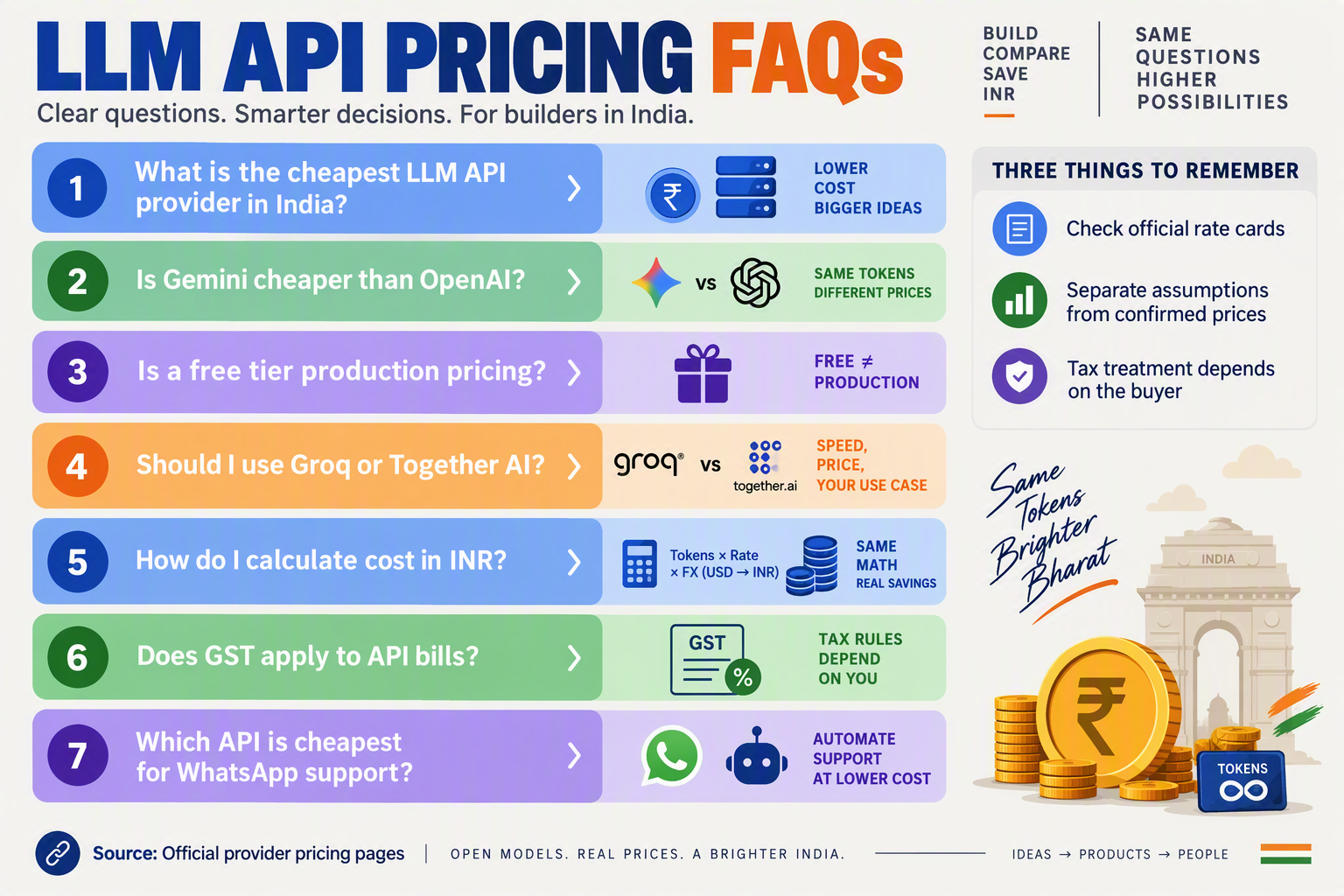
The cheapest LLM API provider in India in 2026 depends on workload—not only the advertised input-token price. Compare input and output tokens, conversation length, model quality, currency conversion, applicable taxes, latency, fallback options and operational overhead before choosing a provider.
What is the cheapest LLM API provider in India in 2026?
Is Gemini 2.5 Flash cheaper than GPT-5-mini for Indian businesses?
Which is the cheapest LLM API provider in India for high-volume applications?
Are LLM API aggregators cheaper than direct providers in India?
How should Indian developers calculate GST on LLM API costs?
Should I self-host an LLM instead of choosing the cheapest LLM API provider in India?
Conclusion
The cheapest LLM API provider in India depends on the workload, not just the headline token price:
- Gemini 2.5 Flash is a strong cost benchmark at roughly ₹1,250 monthly for 10,000 WhatsApp conversations, versus approximately ₹3,800 for GPT-5-mini, according to Rohit Raj’s 2026 analysis.
- Compare output volume, GST, latency, reliability and quality, not input pricing alone.
- Aggregators and gateways can simplify multi-model routing and fallback coverage.
- Watch how rupee billing, model pricing and self-hosting economics evolve.
To explore this shift, visit CallMissed. Which model delivers the lowest total cost for your next workload?
Related Reading
- Cheapest LLM API Provider in India (2026): Real Token Pricing, INR Cost Guide & Verdict
- Cheapest LLM API Provider India: A Citation-Ready Cost Decision Guide by Workload
- Cheapest LLM API Provider India: 2026 Cost Comparison
Sources
Discussion
Related Posts
Ready to automate customer conversations?
Launch AI voice agents and WhatsApp bots with CallMissed — one API, 22+ Indian languages.