
Sarvam AI vs Deepgram for Indian Languages: Accuracy, Pricing, and Best Use Cases


Compare Sarvam AI and Deepgram for Indian languages across Hindi ASR, language coverage, latency, pricing, deployment, and production trade-offs.
Sarvam AI vs Deepgram for Indian Languages: Accuracy, Pricing, and Best Use Cases
What if the most accurate speech API for Indian languages is not the one optimized for global English benchmarks? This Sarvam AI vs Deepgram for Indian languages comparison starts with a practical verdict: Sarvam AI is the stronger starting point for Indic-first applications, while Deepgram may suit teams prioritizing a broader global speech stack and existing integrations. Sarvam’s official documentation highlights transcription, translation, transliteration, text-to-speech, and conversational AI tuned for Hindi, Tamil, Telugu, and other major Indian languages—including code-mixed input. Its API pricing page also lists ₹1,000 in free credits, while Sarvam’s Bulbul V3 TTS is reported at ₹30 per 10,000 characters in August 2026 beta pricing by InVideo. We’ll compare accuracy, language coverage, pricing, latency, and best use cases—and explain where platforms such as CallMissed fit into India’s growing multilingual voice-AI ecosystem.
Which is better for Indian languages: Sarvam AI or Deepgram?
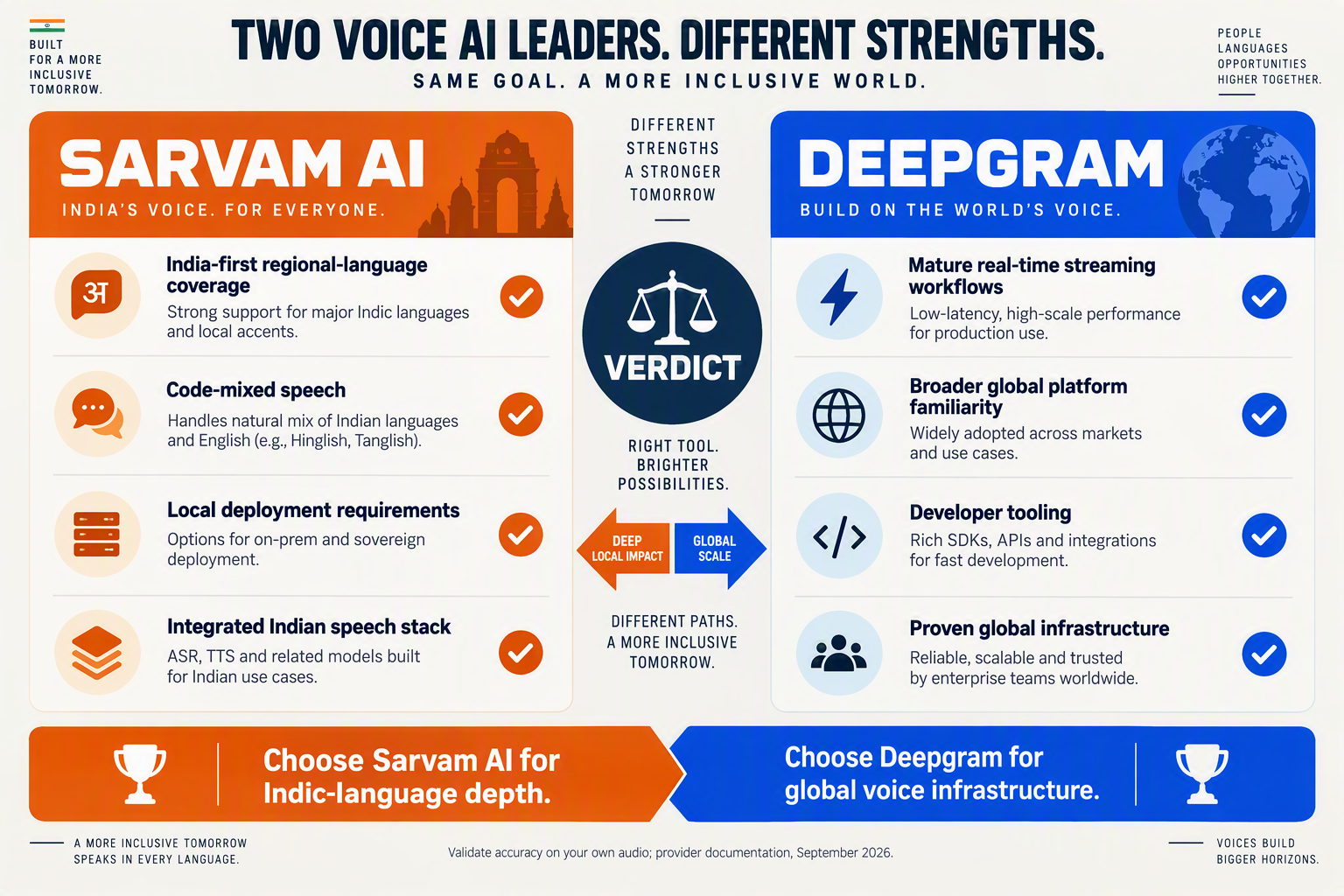
Sarvam AI is the better-supported first choice when an application is specifically built for Indian-language speech, although the available evidence does not establish a definitive winner for every use case. Sarvam AI’s official documentation explicitly covers Indic-language speech, translation, transliteration, text-to-speech, and conversational AI, while Deepgram’s current Indian-language coverage, model behavior, and pricing should be verified in its official documentation before production selection.
Which platform has stronger Indian-language support?
Sarvam AI’s clearest differentiator is its explicit focus on how Indian languages are spoken and written. Sarvam AI Docs describes production APIs for speech-to-text, translation, transliteration, text-to-speech, and conversational AI, tuned for Hindi, Tamil, Telugu, and other major Indian languages, including code-mixed input.
For a Hindi-English, Tamil-English, or other regional-language application, compare both providers on:
- Recognition of regional accents and conversational speech
- Code-switching between English and an Indian language
- Native-script output and Romanized transliteration
- Translation between Indian languages
- Streaming support and latency for voice interactions
- Punctuation, speaker separation, and domain-specific vocabulary
The supplied research does not provide a comparable Deepgram source for these capabilities. As a result, claims about Deepgram’s Indian-language model coverage or code-mixing performance should not be assumed without checking Deepgram’s current official model and language documentation.
Does Sarvam offer a broader Indic speech workflow?
Sarvam AI presents a broader India-focused workflow around speech. Sarvam AI Docs identifies Saaras V3 as its speech-recognition model and documents Bulbul V3 for text-to-speech, alongside translation and transliteration APIs. This combination is relevant to call-center automation, multilingual education, government services, and voice interfaces that must move between speech, translated text, native scripts, and Romanized text.
Deepgram should be assessed against the same end-to-end requirements rather than by brand familiarity alone. Confirm the exact Deepgram model, supported Indian languages, script behavior, code-switching performance, streaming behavior, and output quality for each production route.
How do Sarvam AI and Deepgram pricing compare?
Sarvam AI has more concrete pricing evidence in the supplied sources, but buyers should still confirm current rates and plan terms before budgeting.
- Sarvam AI Pricing states that every plan starts with ₹1,000 in free credits, according to the provider’s pricing page.
- PriceTimeline reported Sarvam speech-to-text pricing of $0.35 per audio hour, rising to $0.53 per hour with diarization.
- InVideo reported Bulbul V3 beta pricing of ₹30 per 10,000 characters in August 2026.
These figures are source- and plan-specific rather than a complete cost comparison. Deepgram’s applicable pricing, model tiers, add-ons, and Indian-language availability must likewise be verified in its current official pricing and documentation. A fair test should measure transcription accuracy, diarization needs, audio volume, text-to-speech characters, and any translation or infrastructure costs together.
Which is better for Indian-language applications?
Choose Sarvam AI first when the core requirement is an Indic-language application with documented support for regional speech, code-mixed input, translation, transliteration, and Indian-language text-to-speech.
Choose Deepgram only after validating the exact language and model fit through current documentation and representative benchmarks. The evidence-backed conclusion is: Sarvam AI has the clearer documented advantage for Indian-language specialization, while Deepgram requires additional verification before a comparable head-to-head verdict can be made.
What are Sarvam AI and Deepgram, and what does this comparison measure?
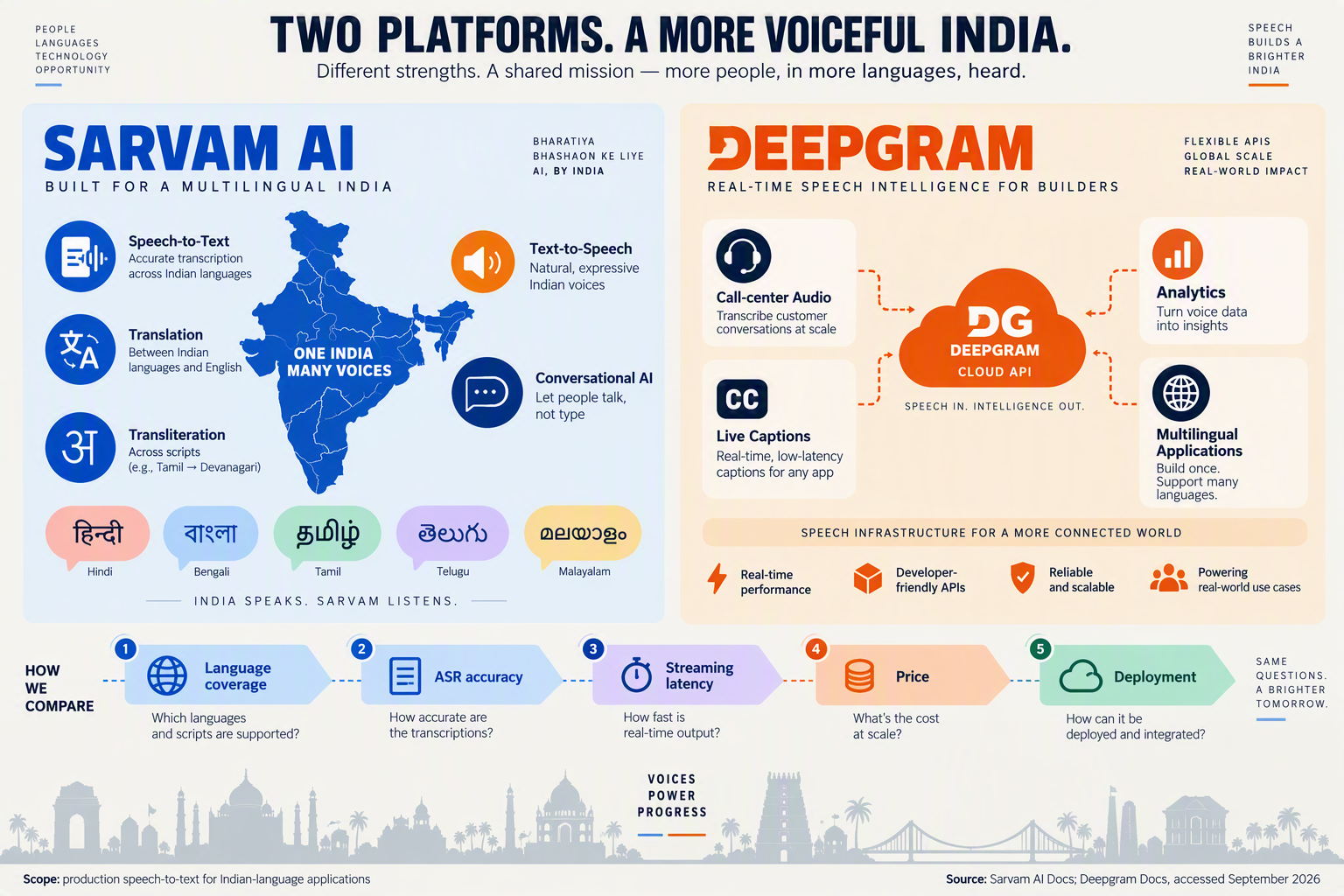
Sarvam AI and Deepgram should not be treated as interchangeable on the basis of brand or English-language benchmarks alone. This comparison measures how each platform should be evaluated for Indian-language speech applications, with verified Sarvam capabilities separated from Deepgram capabilities that require confirmation in Deepgram’s current official documentation.
What Sarvam AI provides
Sarvam AI is an India-focused language and speech platform with production APIs covering:
- Speech-to-text transcription
- Translation
- Transliteration
- Text-to-speech
- Conversational AI
Sarvam AI’s official documentation states that these APIs are tuned for Hindi, Tamil, Telugu, and every major Indian language, including code-mixed input. That makes language coverage, mixed-language speech, native-script output, and transliteration central evaluation criteria—not optional add-ons.
Sarvam’s documented product scope extends beyond transcription. A team building an Indian-language voice workflow may need to compare speech recognition, translation, transliteration, voice generation, and conversational capabilities together rather than judging only word-error rate.
What this comparison asks about Deepgram
The available research for this comparison does not include Deepgram’s official model documentation, endpoint specifications, or pricing pages. Therefore, claims about Deepgram’s Indian-language coverage, supported models, streaming behavior, diarization, latency, TTS languages, or pricing must be verified directly with Deepgram before making a product decision.
For Deepgram, the relevant verification checklist includes:
- Which current speech-to-text models and endpoints support each target Indian language
- Whether the selected model handles code-switching, regional accents, and noisy audio
- Availability of streaming transcription, punctuation, timestamps, and speaker separation
- Which text-to-speech voices and languages are production-ready
- API limits, regional availability, service-level commitments, and current usage pricing
This approach avoids presenting unverified Deepgram characteristics as established facts while still creating a useful head-to-head framework.
What the head-to-head comparison measures
The comparison should assess the same workload on both platforms, using representative Indian-language recordings and production requirements:
- Language coverage: Hindi, Tamil, Telugu, and other required languages, including mixed-language utterances.
- Recognition quality: Accuracy across accents, background noise, conversational speech, and domain vocabulary.
- Output handling: Native scripts, transliteration, translation quality, punctuation, timestamps, and formatting.
- Voice generation: Naturalness, pronunciation, available voices, latency, and control over speaking style.
- Developer operations: API design, authentication, streaming, SDKs, observability, quotas, and error handling.
- Commercial fit: Free credits, per-minute or per-character rates, minimum commitments, and scale economics.
Pricing context
Sarvam AI’s official API pricing page states that every plan starts with ₹1,000 in free credits. InVideo reported Bulbul V3 beta pricing of ₹30 per 10,000 characters in August 2026. Those figures provide a concrete starting point for Sarvam’s cost analysis, but Deepgram pricing should be checked against its current official documentation for the exact model, endpoint, audio duration, TTS usage, and feature tier.
The eventual verdict should therefore be workload-specific: Sarvam is directly documented for an Indic-first, multilingual stack, while Deepgram’s Indian-language fit must be verified model by model before comparison.
How do Sarvam AI and Deepgram compare on Indian-language features?
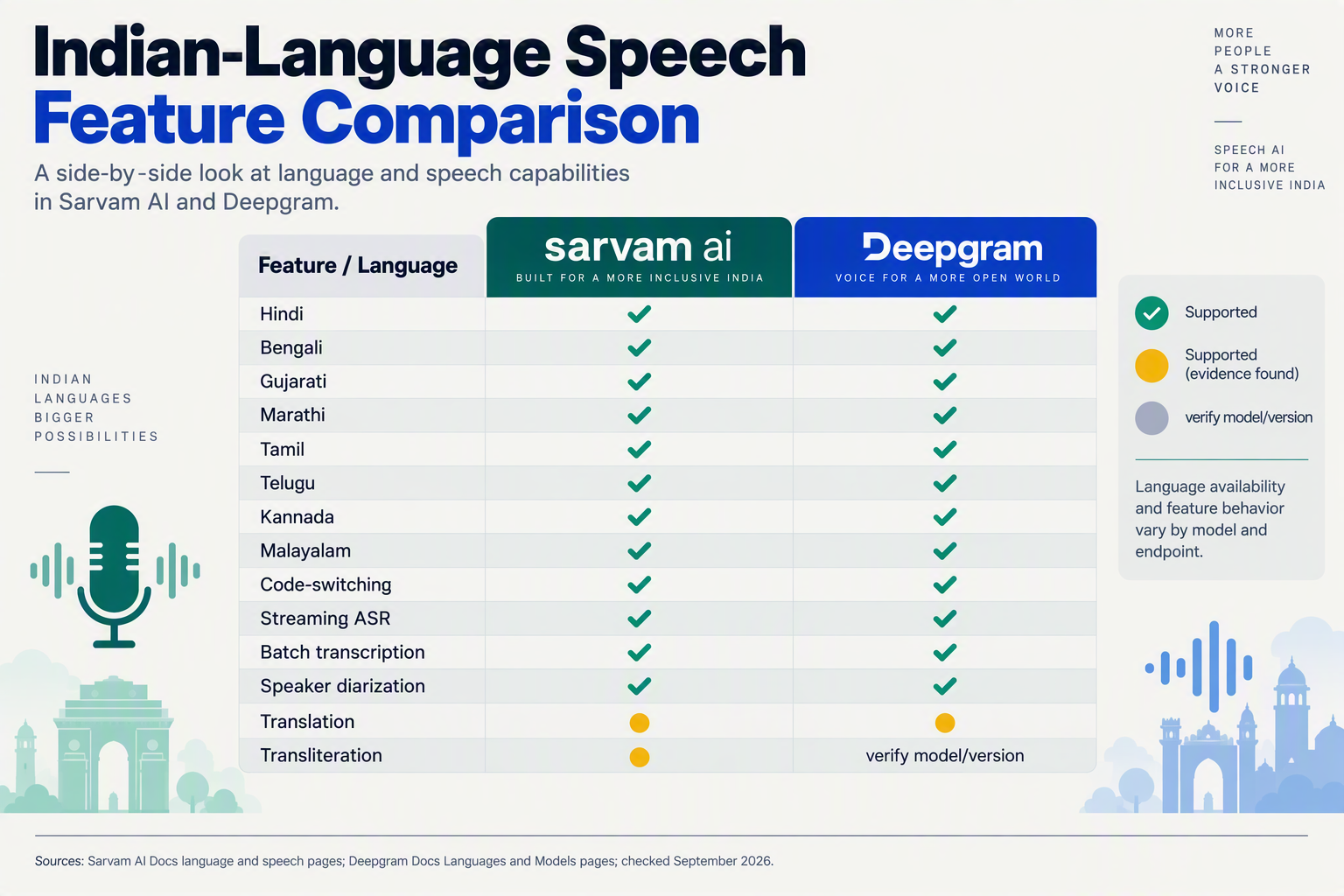
Sarvam AI is the more explicitly India-focused choice in the supplied documentation, while Deepgram requires model- and endpoint-level verification for Indian-language requirements. Sarvam AI Docs describes production-ready APIs for transcription, translation, transliteration, text-to-speech, and conversational AI across Hindi, Tamil, Telugu, and “every major Indian language,” including code-mixed input. The available research does not provide equivalent Deepgram language or model details, so teams should not infer coverage without checking Deepgram’s official documentation.
Feature comparison
| Comparison area | Sarvam AI | Deepgram | Decision point |
|---|---|---|---|
| Indian-language positioning | India-focused language stack covering major Indian languages and code-mixed input, according to Sarvam AI Docs | Verify supported Indian languages, scripts, dialects, and code-mixing by model in Deepgram’s official docs | Choose based on documented coverage for the target audience |
| Speech-to-text | Saaras V3 is Sarvam AI’s speech-recognition model for Indian-language workflows; test native scripts, transliteration, accents, and noisy audio | Verify STT model availability, language support, streaming behavior, and Indian-accent performance with Deepgram | Compare word error rate on representative Indian recordings |
| Text-to-speech | Bulbul V3 is Sarvam AI’s India-oriented TTS model family; verify voice, language, pronunciation, and streaming requirements | Verify Indian-language voices, scripts, pronunciation controls, streaming, and commercial terms in Deepgram’s official docs | Evaluate naturalness and intelligibility with native speakers |
| Translation and transliteration | Sarvam AI Docs lists both translation and transliteration APIs alongside transcription and TTS | Verify whether the required workflows are available directly or need additional services | Native-script and Romanized-output quality may determine implementation effort |
| Conversational workflows | Sarvam AI Docs includes conversational AI as part of its documented API surface | Verify which components are available for the intended voice-agent workflow | Map the full pipeline: speech recognition, reasoning, translation, and speech generation |
| Pricing signal | Sarvam AI’s official pricing page states that every plan begins with ₹1,000 in free credits; InVideo reported Bulbul V3 beta pricing of ₹30 per 10,000 characters in August 2026 | Verify current model-specific rates, minimums, and feature charges in Deepgram’s official pricing documentation | Calculate total cost using actual audio hours, characters, and traffic |
What the evidence supports
Sarvam AI’s India orientation is explicit rather than inferred. Sarvam AI Docs names Hindi, Tamil, Telugu, and every major Indian language, while also calling out code-mixed input—important for speech such as Hindi-English or Tamil-English used in customer conversations. Explainx.ai similarly describes Sarvam AI as a broader stack spanning speech recognition, text-to-speech, translation, chat, and document intelligence.
The Deepgram side of this comparison should remain evidence-led: confirm the exact model, Indian-language list, supported scripts, regional pronunciation behavior, latency, quotas, and data-handling terms from Deepgram’s official sources before selecting it.
Practical decision framework
- Start with coverage: list the required languages, scripts, accents, and code-mixed patterns.
- Build a benchmark set: include native-script prompts, Romanized text, background noise, telephone audio, and regional accents.
- Measure five outcomes: word error rate, translation accuracy, latency, TTS naturalness, and cost.
- Run a workflow test: evaluate the complete path from speech recognition through translation or LLM reasoning to generated speech.
For applications serving Bharat, Sarvam AI is the better-documented starting point in the supplied evidence. Deepgram can be considered after its official documentation and a task-specific benchmark confirm that the selected models meet the same Indian-language requirements.
How much do Sarvam AI and Deepgram cost for Indian speech workloads?
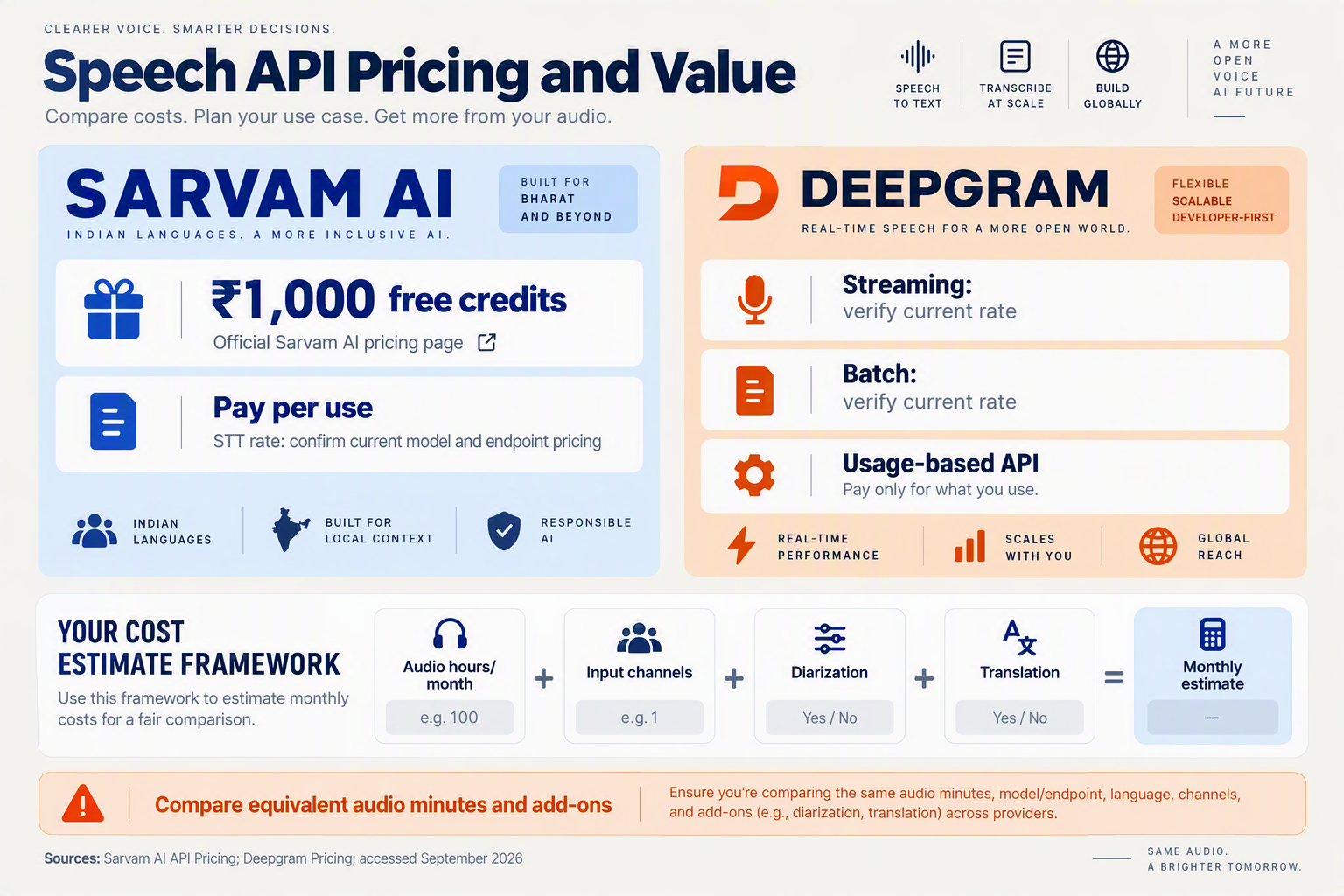
Sarvam AI is currently easier to budget for India-first speech workloads because its reported usage rates provide concrete STT and diarization benchmarks. Deepgram pricing must be checked against the selected model, API endpoint, features, and commercial agreement; a generic speech quote is not enough for an apples-to-apples comparison.
What do Sarvam AI and Deepgram charge for Indian speech workloads?
| Workload | Sarvam AI | Deepgram | Pricing implication |
|---|---|---|---|
| Speech-to-text | $0.35 per audio hour, according to PriceTimeline | Confirm current model-specific rate | Sarvam provides a usable India-oriented baseline |
| STT with diarization | $0.53 per audio hour, according to PriceTimeline | Confirm diarization pricing or surcharge | Speaker identification should be costed separately |
| Text-to-speech | ₹30 per 10,000 characters for Bulbul V3 beta pricing in August 2026, reported by InVideo | Confirm selected voice and character-based rate | Compare both price and Indic pronunciation quality |
| New-account allowance | ₹1,000 in free credits, listed on Sarvam AI’s official API Pricing page | Check current trial or credit terms | Free allowances can materially change pilot economics |
| Translation or transliteration | Price depends on the selected Sarvam API operation | Confirm whether the operation is bundled or separate | Include multilingual post-processing in the total budget |
The Sarvam figures are usage-based rather than fixed monthly subscriptions. Sarvam AI’s official API Pricing page states that every plan starts with ₹1,000 in free credits, while PriceTimeline reports STT at $0.35 per audio hour and STT with diarization at $0.53 per audio hour. These are useful planning figures, but buyers should confirm current rates, taxes, minimums, and production terms before signing a contract.
For a 100-hour STT pilot, the PriceTimeline rate implies approximately $35 before taxes or additional services. The same pilot would cost approximately $53 if every hour used diarization at the reported rate. Those estimates exclude storage, application infrastructure, retries, translation, and any separate real-time or voice-agent components.
Sarvam’s Bulbul V3 TTS pricing should be treated as a dated beta reference: InVideo reported ₹30 per 10,000 characters in August 2026. A meaningful TTS comparison should multiply the expected character volume by the applicable rate and then test:
- Indic pronunciation across the target languages
- Code-mixed speech and regional names
- Streaming behavior and response latency
- Voice quality at the required volume
- Whether translation, transliteration, or post-processing is billed separately
Deepgram buyers should request a quote or verify the live pricing page for the exact STT model, prerecorded versus streaming endpoint, diarization, language coverage, and volume tier. That is especially important when comparing a regional-language workload with a global speech API whose commercial price may vary by configuration.
For teams evaluating a broader infrastructure layer, CallMissed’s developer AI API offers one balance across 45 speech-to-text models and 9 text-to-speech models, with 1 credit equal to ₹1 as of September 2026. Its speech recognition supports 22 Indian languages plus English, while its natural text-to-speech support covers 10 Indian languages plus English—these figures apply to different capabilities and should not be conflated.
What are the main pros and cons of Sarvam AI versus Deepgram?
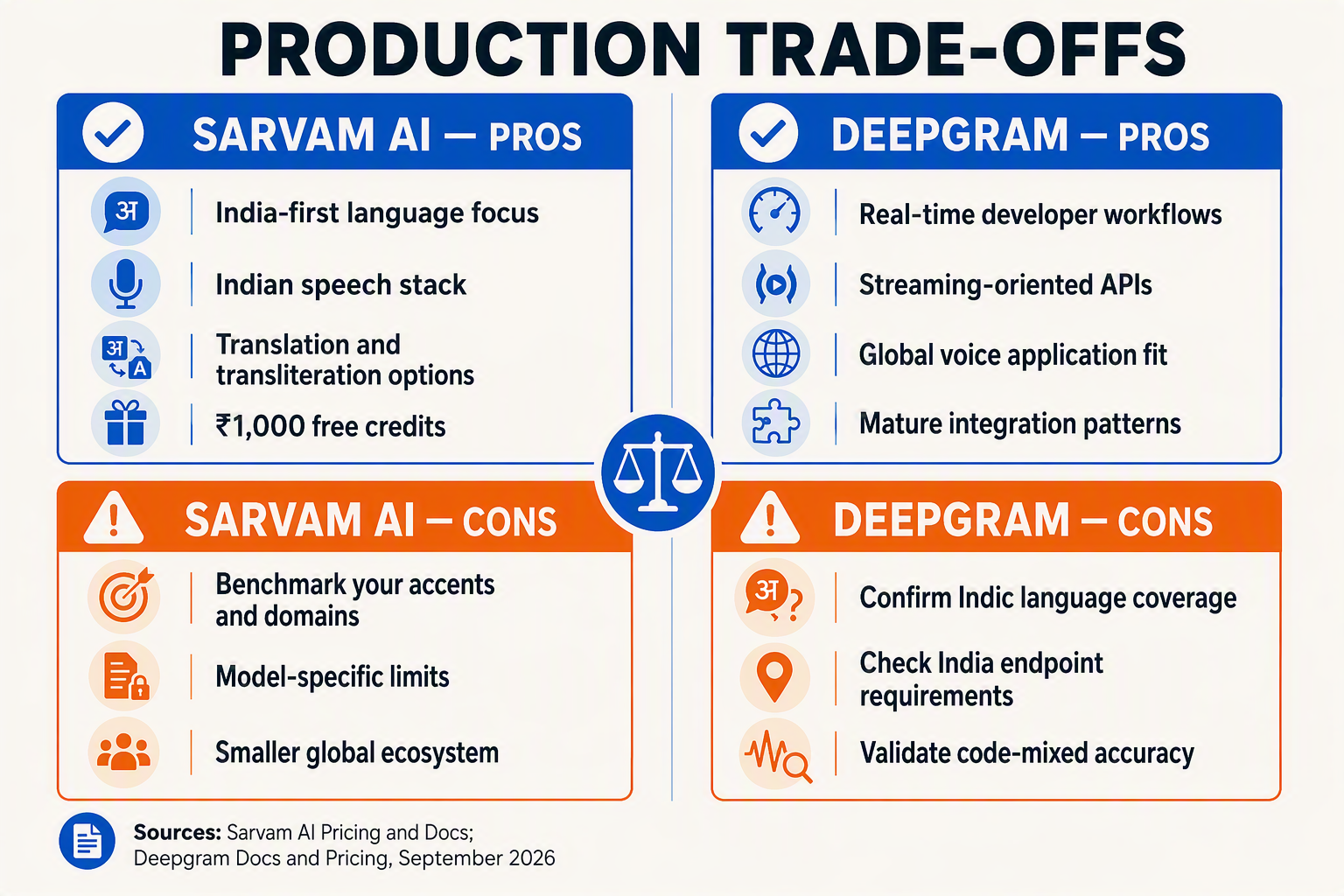
Sarvam AI is the stronger fit for India-first speech applications, while Deepgram may suit teams prioritizing a broader speech-infrastructure deployment. The central trade-off is Indic-language specialization versus global platform flexibility. Neither choice should be made from language lists alone: test representative recordings for code-switching, accents, background noise, latency, diarization, and production cost.
- Sarvam AI — pros: Sarvam’s official API documentation lists production-ready APIs for speech-to-text, translation, transliteration, text-to-speech, and conversational AI. The documentation specifically describes support tuned for Hindi, Tamil, Telugu, and other major Indian languages, including code-mixed input.
- Sarvam AI — cons: Organizations serving substantial non-Indian markets should validate international language coverage, regional voice availability, and cross-market quality before standardizing on Sarvam.
- Deepgram — pros: Deepgram is a practical candidate for teams evaluating a global speech platform, especially when a deployment spans Indian and international markets. However, buyers should assess the exact Deepgram model and endpoint for each target language and workflow.
- Deepgram — cons: Do not assume uniform performance across Indian languages. Test punctuation, code-switching, speaker diarization, streaming behavior, noisy audio, and domain-specific vocabulary using production-like samples.
- Pricing: Sarvam AI’s official pricing page lists ₹1,000 in free API credits. InVideo reported Bulbul V3 beta text-to-speech pricing of ₹30 per 10,000 characters in August 2026; because that figure is beta pricing, confirm current production rates. Deepgram pricing should be checked against the selected model, endpoint, audio volume, and usage category.
| Evaluation area | Sarvam AI | Deepgram | Main implication |
|---|---|---|---|
| Indian-language positioning | India-first speech and language platform | Global speech platform; verify language-level support | Sarvam presents a clearer Indic specialization |
| Speech workflow coverage | STT, TTS, translation, transliteration, and conversational AI | Evaluate the specific speech APIs and models required | Sarvam may reduce the number of separate language components |
| Code-mixed Indian speech | Official documentation explicitly mentions code-mixed input | Test the selected model with real code-switched recordings | Benchmark Hinglish and other mixed-language traffic directly |
| Text-to-speech economics | Bulbul V3 beta was reported at ₹30 per 10,000 characters in August 2026 | Model- and usage-dependent pricing | Compare like-for-like quality, volume, and commercial terms |
| Best-fit deployment | Indian customer support, voice products, and multilingual Bharat-focused applications | Multi-region speech deployments requiring global coverage | Geographic scope should drive the shortlist |
How should teams choose between Sarvam AI and Deepgram?
Choose Sarvam AI when Indian-language recognition, translation, transliteration, and voice generation are central requirements and the product is primarily designed for Indian users. Choose Deepgram when a team needs to evaluate speech infrastructure across multiple global markets and is prepared to validate Indian-language performance model by model.
For a more flexible provider strategy, CallMissed provides speech recognition in 22 Indian languages plus English and natural text-to-speech voices in 10 Indian languages plus English, as verified in the CallMissed product facts for September 2026. That distinction matters: the 22-language figure applies to speech recognition, not text-to-speech.
Which provider should you choose for your Indian-language speech project?
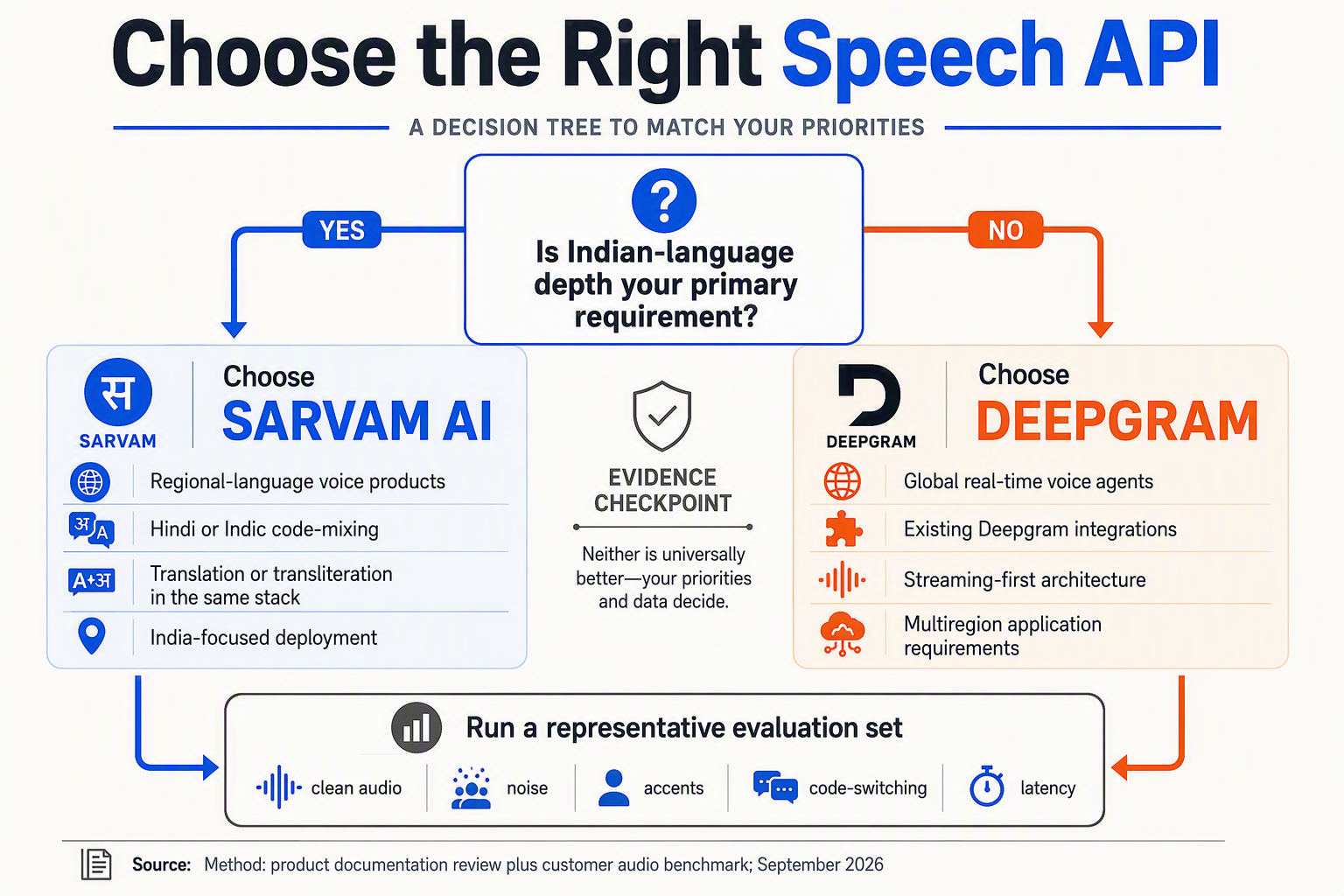
Sarvam AI is the stronger default for Indian-language-first speech projects, while Deepgram is worth choosing when an existing global speech stack, international coverage, or established integrations carries more weight. The right decision should come from production-like tests of transcription accuracy, code-switching, latency, voice quality, diarization, and total cost—not English benchmarks alone.
When should you choose Sarvam AI for Indian languages?
Choose Sarvam AI when regional-language coverage and Indic-language workflows are central to the product.
- Indian-language depth: Sarvam AI’s official API documentation lists transcription, translation, transliteration, text-to-speech, and conversational AI for Hindi, Tamil, Telugu, and other major Indian languages, including code-mixed input.
- End-to-end Indic workflows: Sarvam combines Saaras V3 speech recognition with Bulbul V3 text-to-speech, which can reduce the need to assemble separate services for transcription, translation, transliteration, and voice generation.
- India-focused pricing: Sarvam AI’s official pricing page states that every plan starts with ₹1,000 in free credits. InVideo reported Bulbul V3 beta pricing of ₹30 per 10,000 characters in August 2026; treat beta pricing as subject to change.
- Bharat-facing use cases: Sarvam is a natural candidate for call centres, voice bots, education, healthcare, and customer-support products where users may move between English, Hindi, and regional languages within one interaction.
Sarvam is especially compelling when the application needs more than raw speech recognition—for example, converting a spoken regional-language message into text, translating it, and responding with locally appropriate speech.
When should you choose Deepgram for Indian-language speech?
Choose Deepgram when speech infrastructure must fit an existing, broader deployment strategy.
- Existing investment: Teams already using Deepgram APIs, SDKs, streaming patterns, monitoring, or internal speech tooling may save engineering effort by extending that stack.
- Global product requirements: Deepgram may be a practical option when the same speech layer must serve Indian customers alongside users in North America, Europe, and other markets.
- Focused speech pipelines: Deepgram can suit products primarily requiring speech-to-text or text-to-speech, particularly when translation, transliteration, and other Indic-language transformations are handled elsewhere.
- Operational continuity: A mature integration can matter as much as model capability when a team has established authentication, observability, fallback, and post-processing around its current provider.
That does not make Deepgram automatically better for Indian languages. It means the decision depends on whether Indic specialization or global stack continuity is the project’s dominant constraint.
How should you test Sarvam AI versus Deepgram?
Run the same representative audio through both providers before committing. Include:
- Language coverage: Hindi, Tamil, Telugu, and the specific regional languages your customers use.
- Code-switching: Hinglish and mixed-language speech, including English product names and regional-language grammar.
- Real conditions: Telephone audio, background noise, multiple speakers, accents, interruptions, and different microphone quality.
- Business metrics: Word error rate, named-entity accuracy, diarization, response latency, voice naturalness, failure rate, and cost per completed interaction.
Platforms such as CallMissed can also support Indian-language voice automation: as of September 2026, CallMissed provides speech recognition in 22 Indian languages plus English, while its natural text-to-speech voices cover 10 Indian languages plus English. That distinction matters when evaluating an end-to-end voice system rather than comparing speech-recognition APIs alone.
Frequently Asked Questions
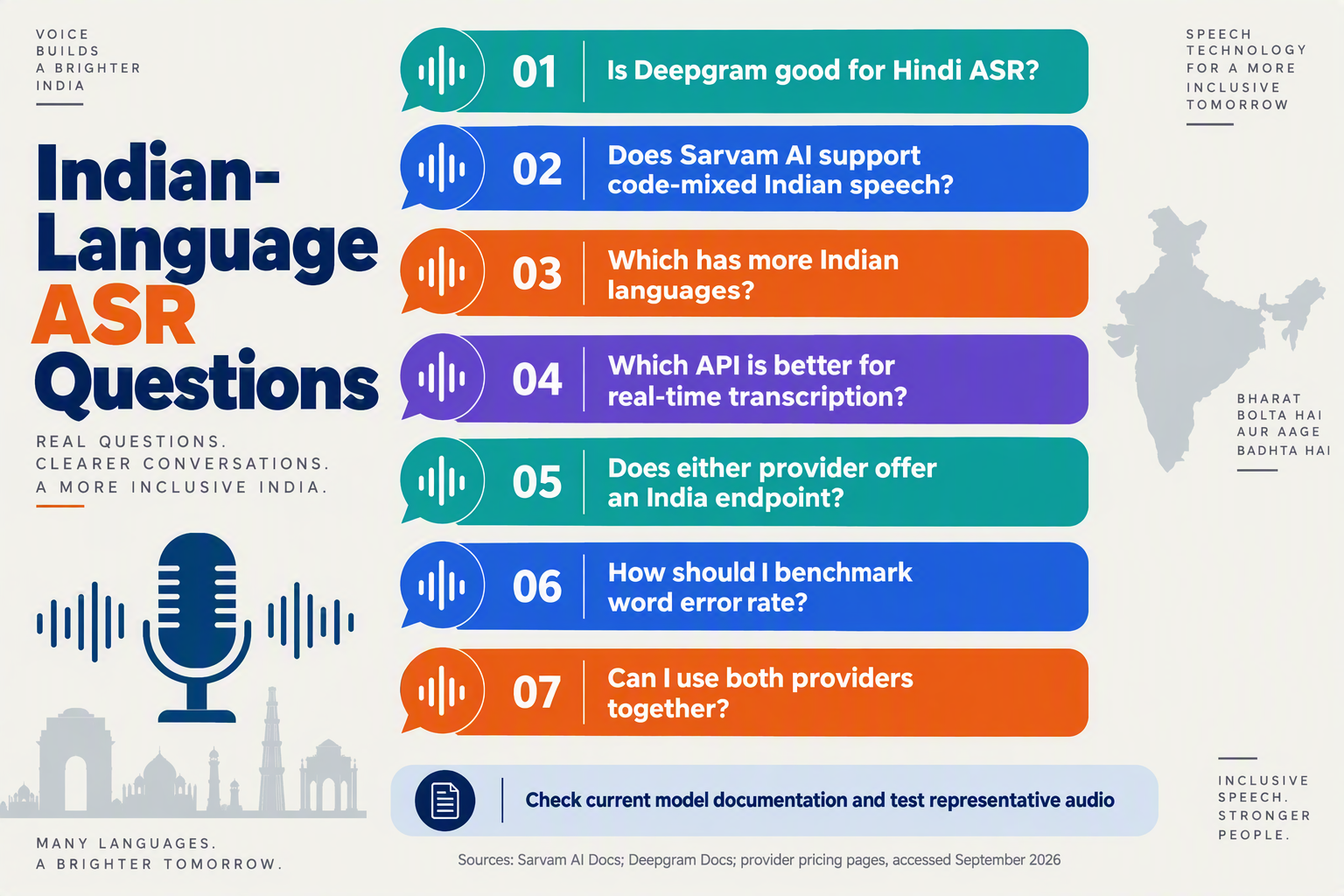
Is Sarvam AI or Deepgram better for Indian languages?
How does Sarvam AI vs Deepgram compare for Hindi and code-mixed speech?
Which platform offers more Indian-language speech features?
What does Sarvam AI cost compared with Deepgram?
Is Sarvam AI a good choice for Indian-language text-to-speech?
Should developers use Sarvam AI, Deepgram, or an API gateway?
Conclusion
Overall, Sarvam AI is the stronger starting point for Indian-language applications, while Deepgram remains compelling for globally distributed products and established speech infrastructure.
- Sarvam’s docs cover Indic-first transcription, translation, transliteration, TTS, and code-mixed speech.
- Sarvam Bulbul V3 was reported by InVideo at ₹30 per 10,000 characters in August 2026 beta pricing.
- Sarvam’s pricing page lists ₹1,000 in free credits; Deepgram costs should be verified by model and usage.
- Test language-level accuracy, latency, diarization, and script handling before committing.
Watch how both platforms improve regional-language quality and economics. To explore this trend, check out CallMissed, which supports multilingual voice agents and chatbots. Which stack best matches your users’ languages and workflows?
Related Reading
- Best Voice AI API for Indian Languages in 2026: Pricing, Coverage, and Use Cases
- Grok Bot Automation in 2026: Use Cases, Controls, and Pilot Plan
- Deepgram Nova-3 vs Whisper large v3 turbo accuracy: What the Evidence Actually Shows
Sources
Discussion
Related Posts
Ready to automate customer conversations?
Launch AI voice agents and WhatsApp bots with CallMissed — one API, 22+ Indian languages.