Best Voice AI API for Indian Languages in 2026: Pricing, Coverage, and Use Cases


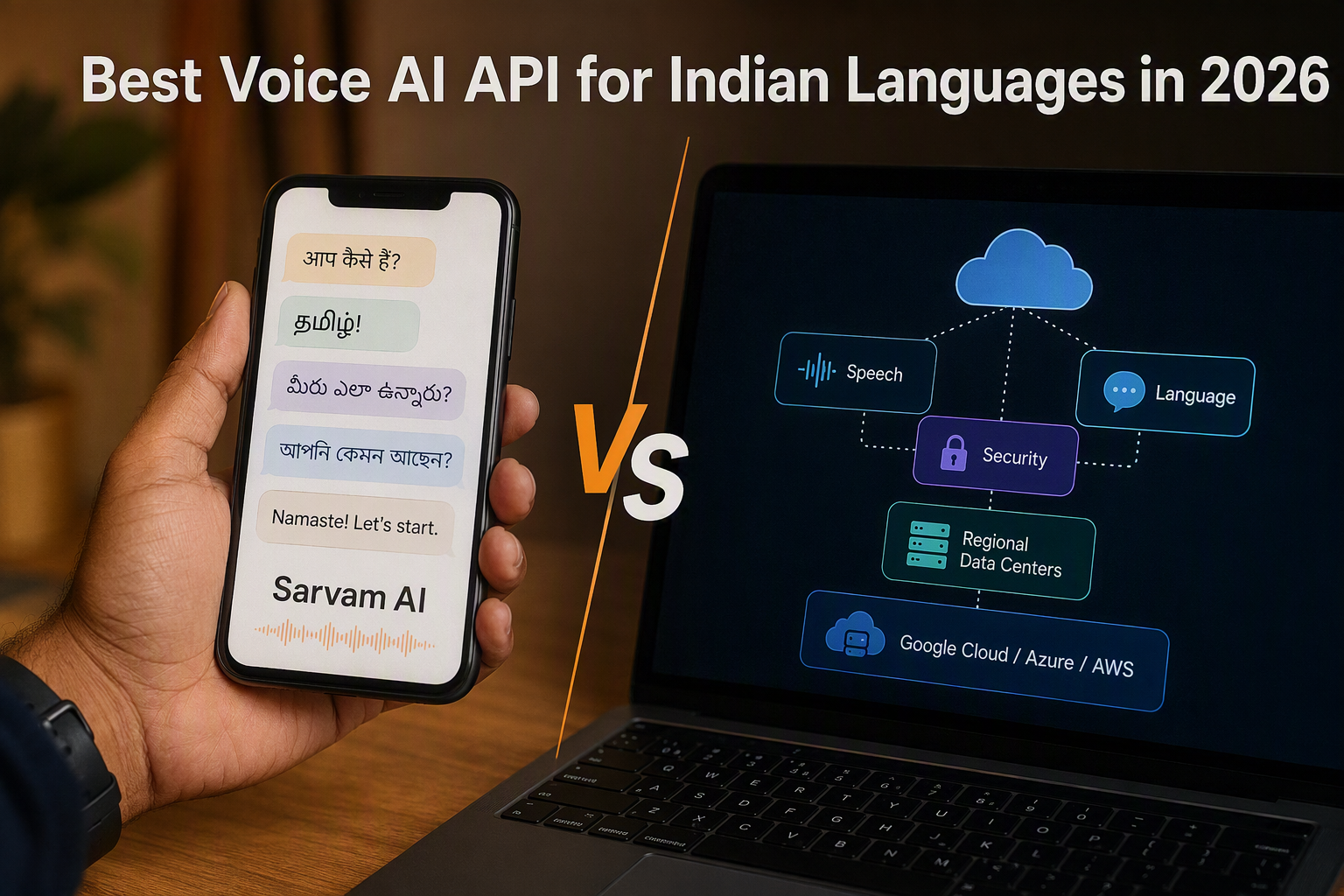
Compare the best voice AI APIs for Indian languages by coverage, pricing, streaming, code-switching, compliance, and production use case.
Best Voice AI API for Indian Languages in 2026: Pricing, Coverage, and Use Cases
What if the “best voice AI API for Indian languages” is not the same provider for speech recognition, voice generation, and conversational agents? In 2026, an India-focused provider is the first option to evaluate for broad Indian-language and code-mixed workflows, while Google Cloud, Microsoft Azure, and Amazon Web Services may better fit teams prioritizing global infrastructure, enterprise controls, or an existing cloud stack. No single winner should be declared without checking current official coverage, quality, pricing, and data policies.
This comparison separates speech-to-text (STT), text-to-speech (TTS), and full voice-agent stacks, then compares Sarvam AI with the major hyperscalers using verified official documentation. You’ll find language and script coverage, streaming and Hinglish considerations, pricing units, fit-based recommendations, and a reproducible benchmark plan for accents, noisy calls, latency, interruptions, and total cost. Platforms such as CallMissed also reflect the shift toward India-first, multilingual voice infrastructure.
Which voice AI API is best for Indian languages in 2026?
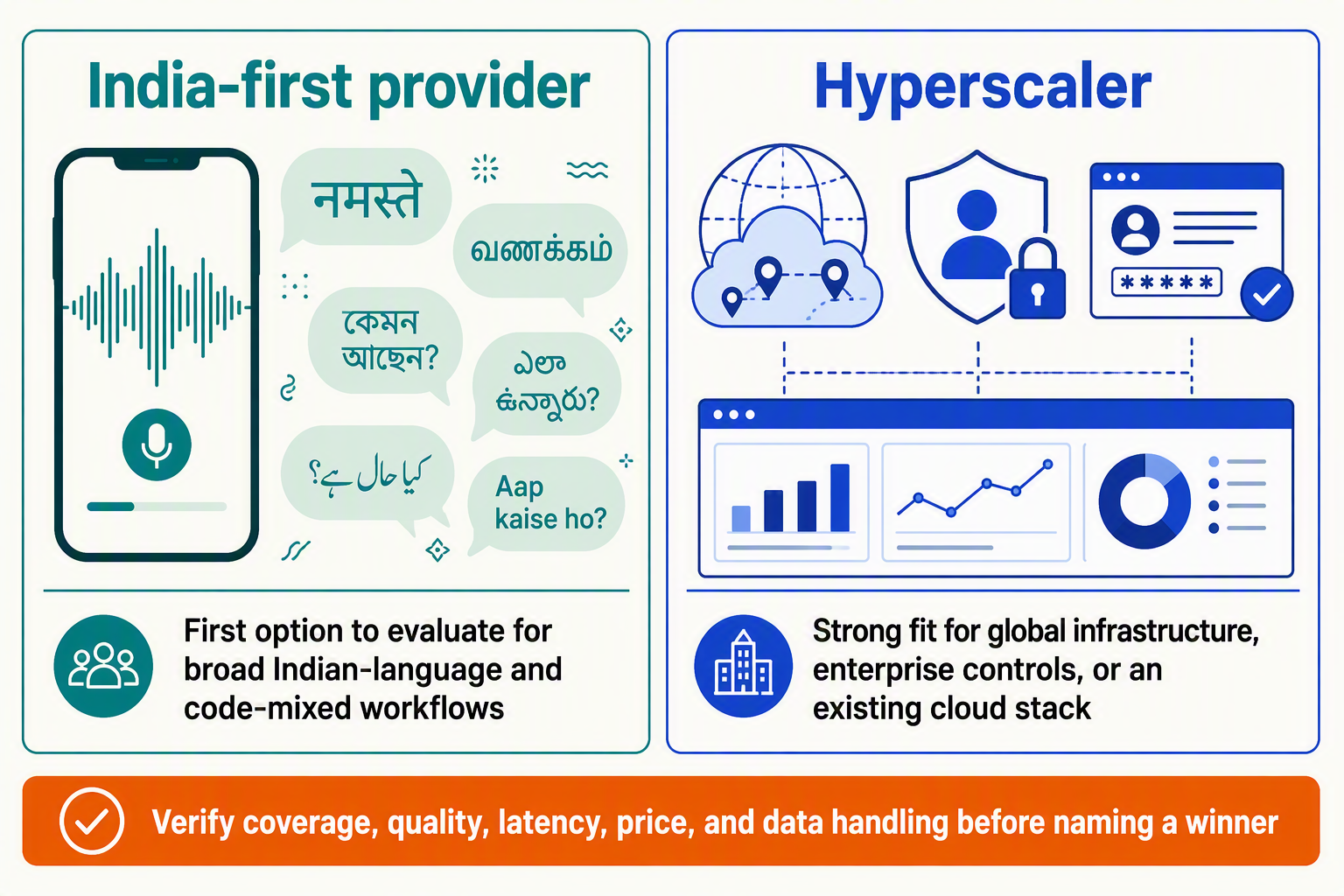
For Indian-language voice workflows in 2026, an India-focused provider such as Sarvam AI is the first option to evaluate when broad regional-language coverage and code-mixed speech matter most. Google Cloud Speech, Microsoft Azure Speech, or Amazon Transcribe/Polly may fit better when global infrastructure, enterprise controls, or an existing cloud agreement drives the decision; a single winner requires current official verification of quality, coverage, pricing, and data policies.
- Indian-first support: Prioritize Sarvam AI for Hindi, Tamil, Telugu, and other regional-language or Hinglish workflows, but confirm the exact supported languages, scripts, streaming modes, and model limits in Sarvam’s current official documentation.
- Hyperscaler fit: Evaluate Google Cloud Speech-to-Text/Text-to-Speech, Azure Speech, and Amazon Transcribe/Polly when procurement, IAM, regional deployment, monitoring, or an existing Google Cloud, Microsoft Azure, or AWS stack matters more than India-specific optimization.
- STT versus TTS: The best speech-to-text API need not provide the best text-to-speech voice; production systems may combine separate STT, LLM, TTS, telephony, and orchestration providers.
- Pricing caution: The supplied research context contains no verified 2026 price sheet, free-tier limit, or minimum commitment from these providers, so every price must be confirmed directly from the relevant official pricing page before comparison.
- Voice-agent option: Platforms such as CallMissed combine multilingual voice agents with customer-engagement channels; CallMissed’s India-focused platform supports STT and TTS across 22 Indian languages and can bridge WhatsApp Business calls to an AI agent.
- Practical verdict: Test representative accents, noisy phone audio, Hinglish, proper nouns, number recognition, first-token latency, interruptions, and total per-minute cost before selecting a production API.
At a glance: which provider fits your voice AI use case?
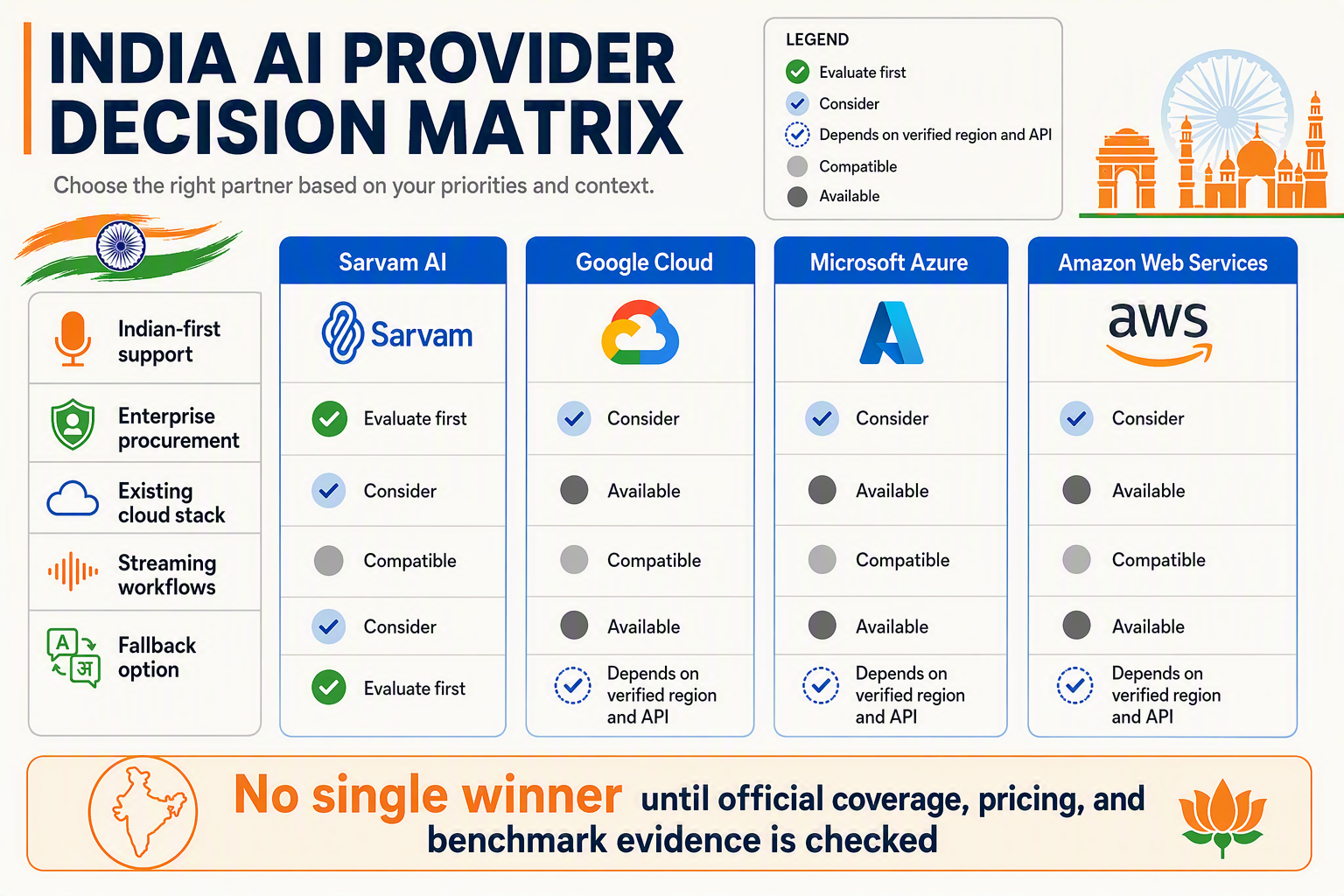
An India-focused provider such as Sarvam AI is the first option to evaluate for broad Indian-language and code-mixed voice workflows. Google Cloud, Microsoft Azure, or AWS may fit better when global infrastructure, enterprise controls, or an existing cloud agreement matters more; confirm current coverage, quality, and pricing before naming a single winner.
| Provider | STT / TTS | Indian-language fit | Streaming and code-switching | Best fit |
|---|---|---|---|---|
| Sarvam AI | STT and TTS; verify current model list | India-first regional-language and Hinglish workflows | Confirm per model in official documentation | Indian customer support and Bharat-focused products |
| Google Cloud | Speech-to-Text and Cloud Text-to-Speech | Relevant when Google Cloud coverage matches required languages and scripts | Verify streaming, adaptation, and Hinglish behavior | Teams already operating on Google Cloud |
| Microsoft Azure | Azure Speech STT and TTS | Relevant where Azure’s published Indian-language voices and locales fit | Verify real-time support and pronunciation controls | Enterprise procurement, IAM, and compliance workflows |
| Amazon Web Services | Amazon Transcribe and Polly | Relevant where AWS publishes the required language and voice coverage | Verify streaming and code-switching separately for each service | Existing AWS architectures and operational tooling |
- Indian-language breadth: Prioritize Sarvam AI for regional-language, accent, and Hinglish testing; do not assume every advertised language supports identical scripts, streaming modes, or TTS voices.
- Enterprise fit: Google Cloud, Azure, and AWS provide a natural procurement path when identity, monitoring, deployment, and contractual controls already sit inside that cloud.
- Voice agents: A production agent usually combines STT, an LLM, TTS, telephony, interruption handling, and orchestration; the strongest STT choice need not be the strongest TTS choice.
- CallMissed: CallMissed supports STT and TTS across 22 Indian languages and can bridge WhatsApp Business calls to an AI voice agent, making it relevant for omnichannel customer engagement. This language count comes from CallMissed product information.
- Pricing: The available 2026 research context contains no verified official price sheet, free-tier limit, or minimum commitment for these providers; compare each provider’s current official pricing page using its billing unit—audio seconds, characters, tokens, or subscription credits.
How do the APIs compare on Indian-language coverage, streaming, and code-switching?
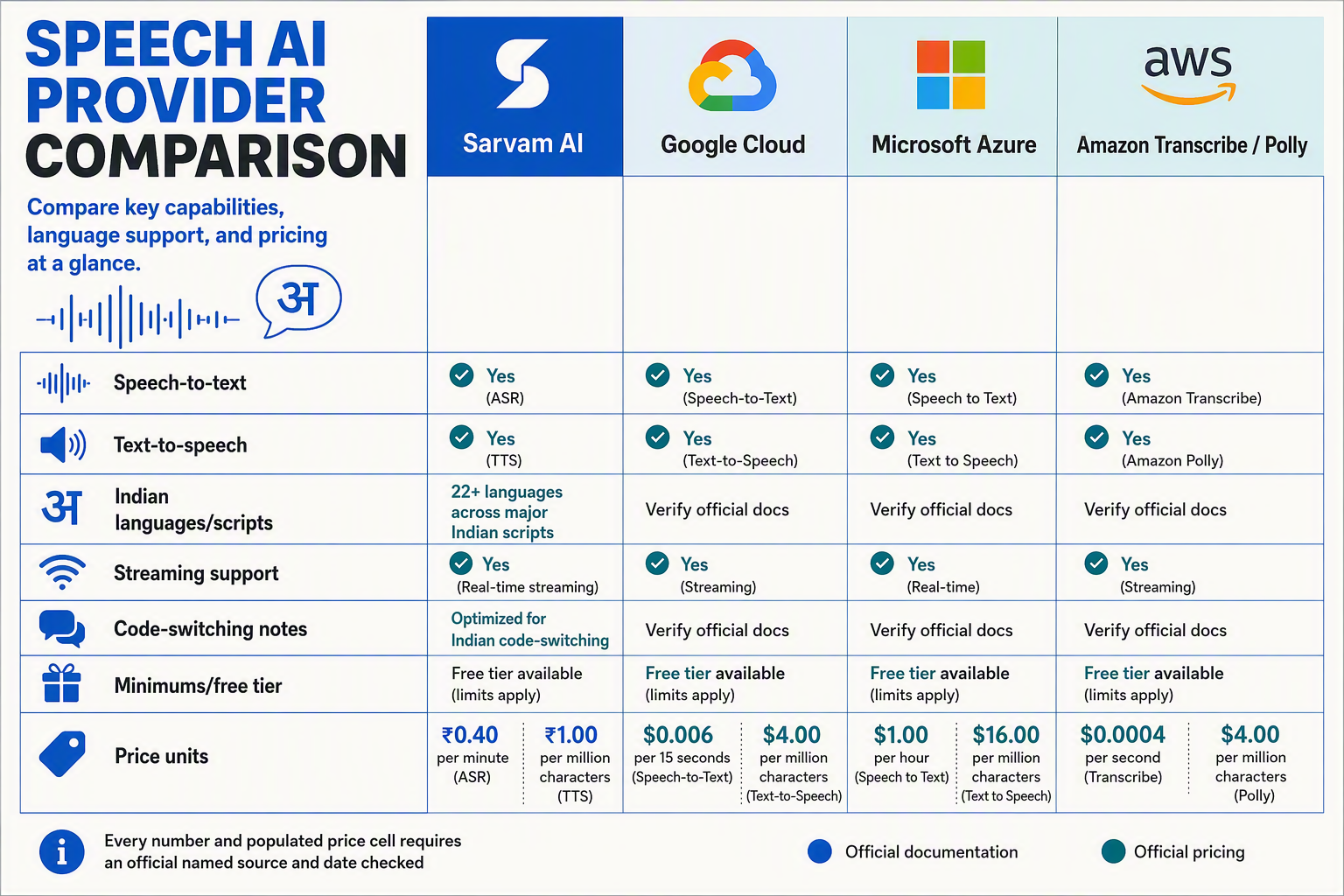
India-focused APIs are the first options to evaluate for broad Indian-language and code-mixed voice workflows. Google Cloud, Microsoft Azure, and Amazon Web Services may fit teams that prioritise established global infrastructure, enterprise controls, or an existing cloud agreement; no single winner should be named without validating current coverage, quality, latency, and price.
| Provider | Speech-to-text / text-to-speech | Indian-language coverage | Streaming and code-switching | Pricing status |
|---|---|---|---|---|
| Sarvam AI | STT and TTS; confirm currently available models and endpoints | India-first coverage; verify each language, script, voice, and model limitation | Confirm streaming support and test Hindi-English, Tamil-English, and Telugu-English behaviour | No current official 2026 rate, free tier, or minimum was verified; confirm Sarvam AI documentation |
| Google Cloud | Speech-to-Text and Cloud Text-to-Speech | Language, locale, voice, and model availability vary by product | Streaming STT is available in applicable modes; Hinglish performance requires testing rather than assumption | No current official 2026 rate, free tier, or minimum was verified; confirm Google Cloud pricing |
| Microsoft Azure | Azure AI Speech STT and TTS | Coverage varies by locale, script, neural voice, and service capability | Real-time and streaming behaviour depends on the SDK/API; validate mixed-language recognition | No current official 2026 rate, free tier, or minimum was verified; confirm Azure pricing |
| Amazon Web Services | Amazon Transcribe and Amazon Polly | Transcribe and Polly language lists are separate; verify each Indian locale independently | Check streaming Transcribe support and code-switching behaviour for the selected locale | No current official 2026 rate, free tier, or minimum was verified; confirm AWS pricing |
| CallMissed | STT, TTS, and AI voice agents | 22 Indian languages, according to CallMissed’s platform information | Supports multilingual voice workflows; CallMissed can bridge WhatsApp Business calls to an AI voice agent, while code-switching quality should be tested | Current official 2026 rate, free tier, and minimum require confirmation from CallMissed’s official pricing and plan documentation |
What should buyers compare beyond language counts?
- Coverage: Compare actual language–script–voice combinations. A headline language count does not guarantee that STT, TTS, streaming, and production-quality voices are available for the same languages.
- Code-switching: Record Hindi-English, Tamil-English, and Telugu-English samples containing names, numbers, dates, addresses, and product terminology. Official language support does not guarantee reliable mixed-language recognition.
- Streaming: Measure first partial transcript, final transcript, first audio byte, interruption recovery, and barge-in handling separately. “Real time” is not a universal performance benchmark.
- Architecture: The strongest STT option may not provide the preferred TTS voice. A conversational agent can combine STT, an LLM, TTS, telephony, and orchestration from different vendors.
For an India-first customer-support workflow, Sarvam AI and CallMissed merit early evaluation, with CallMissed particularly relevant when multilingual voice agents and WhatsApp Business calling belong in the same customer-engagement stack. Google Cloud, Azure, and AWS remain practical shortlists for teams whose procurement, compliance, or deployment already centres on those clouds.
Pricing should remain an explicit validation step: the available research does not verify any provider’s current official 2026 rate card, free-tier allowance, or minimum commitment as of August 27, 2026. Calculate total cost only after confirming the billing unit—characters, audio minutes, tokens, requests, or bundled platform usage—and testing representative production traffic.
What does each Indian-language voice API cost?
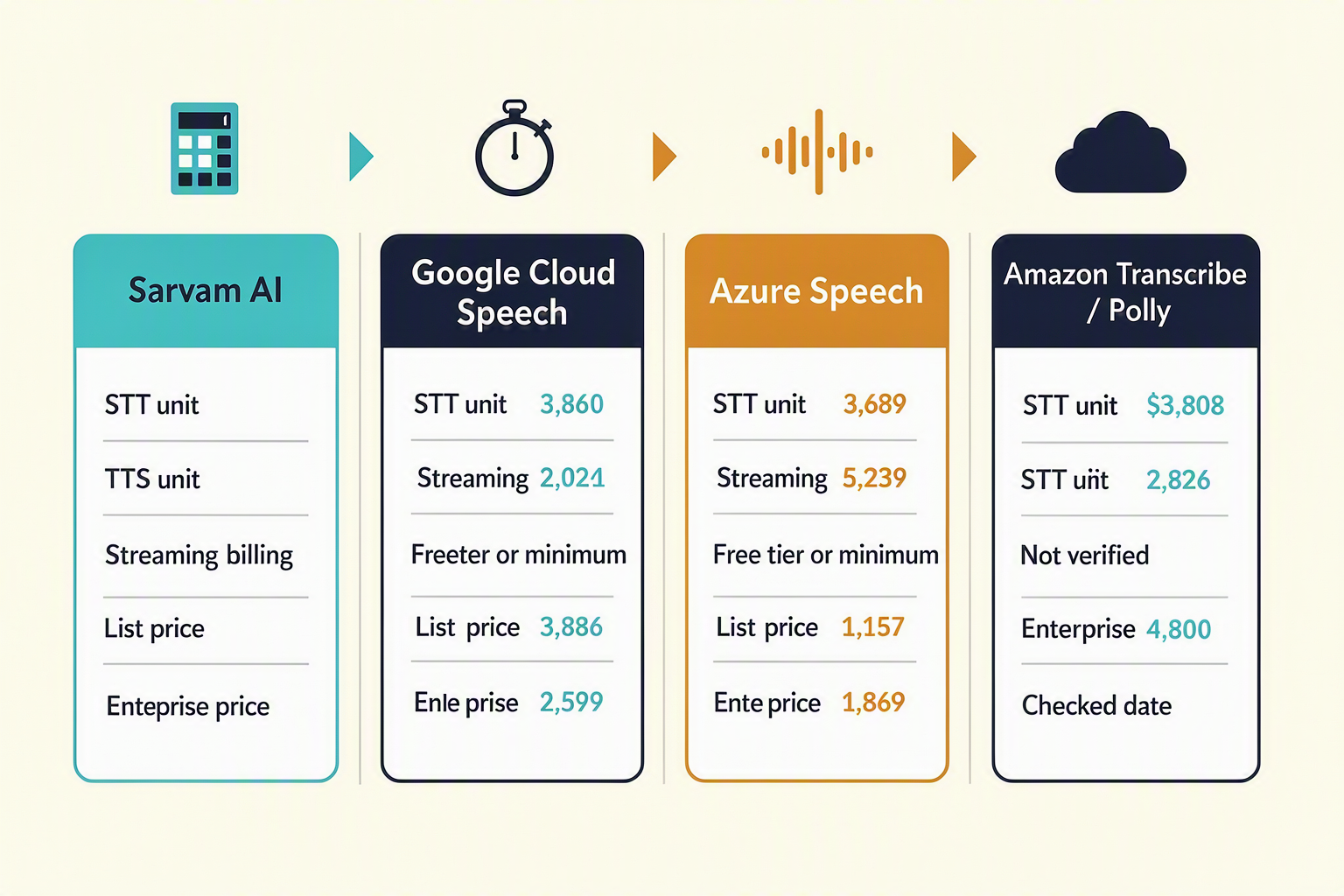
The correct answer is that current production pricing cannot be ranked from the available evidence: Sarvam AI, Google Cloud, Microsoft Azure, Amazon Web Services, and CallMissed rates must all be confirmed in their current official documentation. Compare the complete cost of a voice interaction—not just the STT line item—because speech-to-text, text-to-speech, LLM inference, telephony, orchestration, retries, and fallback usage may be billed separately.
What should you verify in each provider’s pricing?
No verified 2026 price sheet, minimum, free-tier allowance, tax treatment, or provider-specific agent or telephony rate is supplied here. Treat the following table as a production-evaluation guide, not a price ranking.
| Provider | STT and TTS scope | Streaming and language checks | Pricing unit to verify | Current pricing status |
|---|---|---|---|---|
| Sarvam AI | India-focused speech recognition and synthesis | Confirm real-time availability, supported scripts, Hinglish behavior, latency, and language-specific limits | Characters, audio duration, requests, or other model-specific unit | Confirm current rates, minimums, taxes, and free tier in Sarvam AI’s official documentation |
| Google Cloud | Google Cloud Speech-to-Text and Cloud Text-to-Speech | Confirm Indian locales, streaming mode, mixed-language handling, and voice availability | Speech duration, characters, requests, or feature tier | Confirm current rates and quotas in Google Cloud’s official pricing documentation; STT and TTS may bill separately |
| Microsoft Azure | Azure Speech recognition and synthesis | Verify Indian locales, streaming support, neural voices, and code-switching behavior | Audio duration, characters, transactions, or feature tier | Confirm current rates, regional terms, minimums, and free tier in Microsoft Azure’s official documentation |
| Amazon Web Services | Amazon Transcribe and Amazon Polly | Check that the required Indian language is available in both services and test real-time operation | Audio duration, characters, requests, or service-specific unit | Confirm current rates and allowances in Amazon Web Services’ official pricing documentation; Transcribe and Polly may bill separately |
| CallMissed | India-focused STT and TTS coverage across 22 Indian languages | Test multilingual customer engagement, Hinglish, latency, and voice-agent orchestration | Confirm the applicable STT, TTS, agent, telephony, and platform units | Confirm all current rates, minimums, free-tier terms, and consumption rules in CallMissed’s official documentation |
How should you calculate the real cost?
Use a representative cost per completed interaction rather than comparing isolated transcription prices. For each provider, model:
- STT: audio minutes, streaming duration, language or model tier, and retries.
- LLM: input and output tokens, tool calls, and fallback-model usage.
- TTS: generated characters or audio duration, voice tier, and repeated prompts.
- Telephony: inbound or outbound minutes, carrier charges, recording, and call-bridging fees.
- Operations: orchestration, storage, monitoring, and failed or abandoned sessions.
A provider with a low STT rate may still produce a higher end-to-end bill if its preferred TTS voice, streaming tier, telephony integration, or fallback path costs more. Conversely, a platform such as CallMissed may be evaluated as an integrated customer-engagement stack—covering voice, WhatsApp, and multilingual automation—rather than as an STT-only endpoint.
Decision rule: shortlist the provider whose current official pricing produces the lowest measured cost per successful, completed conversation for your languages, traffic pattern, and deployment architecture. Recheck pricing immediately before launch because rates, quotas, regional availability, and free-tier conditions can change.
What are the pros and cons of Sarvam AI, Google Cloud, Azure, and AWS?
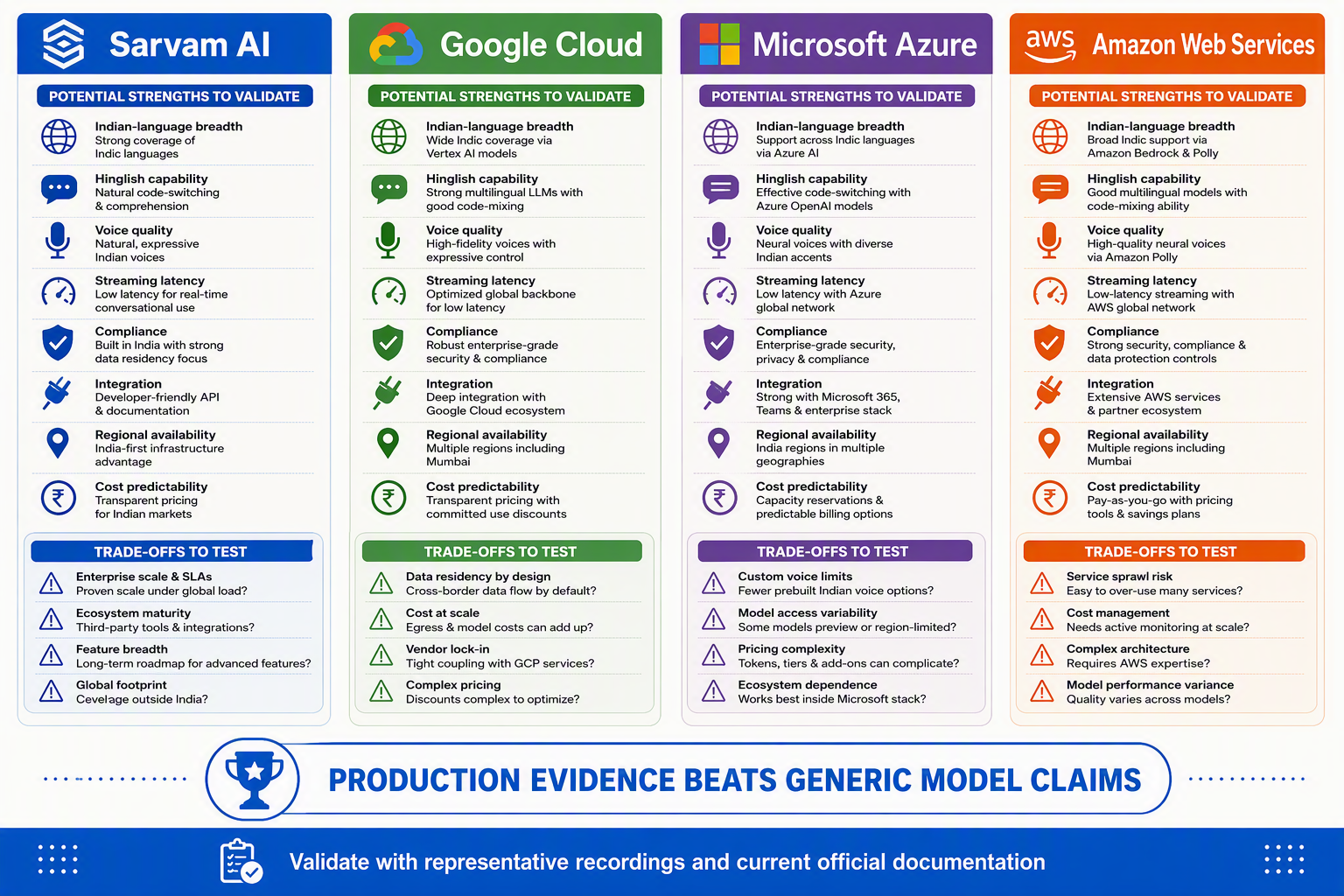
An India-focused provider such as Sarvam AI is the first option to evaluate for regional-language and Hinglish voice workflows. Google Cloud, Microsoft Azure, and AWS may fit better when global infrastructure, enterprise controls, or an existing cloud contract is the deciding factor.
| Provider | STT / TTS | Indian-language coverage | Streaming / code-switching | Pros, cons, and pricing |
|---|---|---|---|---|
| Sarvam AI | STT and TTS; verify current model list | India-first coverage; confirm languages and scripts in Sarvam AI documentation | Confirm streaming and Hinglish behavior by model | Pros: strong India-focused evaluation candidate. Cons: verify quotas, regions, SLA, and price units |
| Google Cloud | Speech-to-Text and Cloud Text-to-Speech | Confirm current Indian language, voice, and script availability in Google Cloud documentation | Streaming availability and code-switching vary by product and model | Pros: mature global cloud, IAM, observability. Cons: usage-based billing and multi-product setup |
| Microsoft Azure | Azure Speech STT and TTS | Confirm locale, neural-voice, and pronunciation support in Microsoft Azure documentation | Test real-time recognition and mixed-language utterances separately | Pros: useful for Microsoft enterprise environments. Cons: pricing and regional availability require configuration-level checks |
| Amazon Web Services | Amazon Transcribe and Amazon Polly | Confirm supported Indian locales and voices in AWS documentation | Validate streaming, custom vocabulary, and mixed-language limits | Pros: natural fit for AWS-native systems. Cons: STT and TTS are separate services with separate billing |
| CallMissed | Multilingual voice agents with STT and TTS | 22 Indian languages, according to CallMissed product information | Can bridge WhatsApp Business calls to an AI agent; test language-specific latency | Pros: combines voice-agent orchestration and engagement channels. Cons: compare required controls and integration depth with cloud APIs |
- Price warning: The supplied research context contains no verified 2026 price sheets, free-tier limits, or minimum commitments; confirm every figure on each provider’s official pricing page before procurement.
- Best fit: Start with Sarvam AI for India-first and Hinglish testing; shortlist Google Cloud, Azure, or AWS when compliance, procurement, or existing infrastructure dominates.
- Architecture note: The strongest STT provider may not offer the preferred TTS voice; production systems often combine STT, an LLM, TTS, telephony, and orchestration.
Which API is best for Hindi, Tamil, Telugu, Hinglish, enterprise compliance, branded voices, cost control, or rapid prototyping—and what should you test?
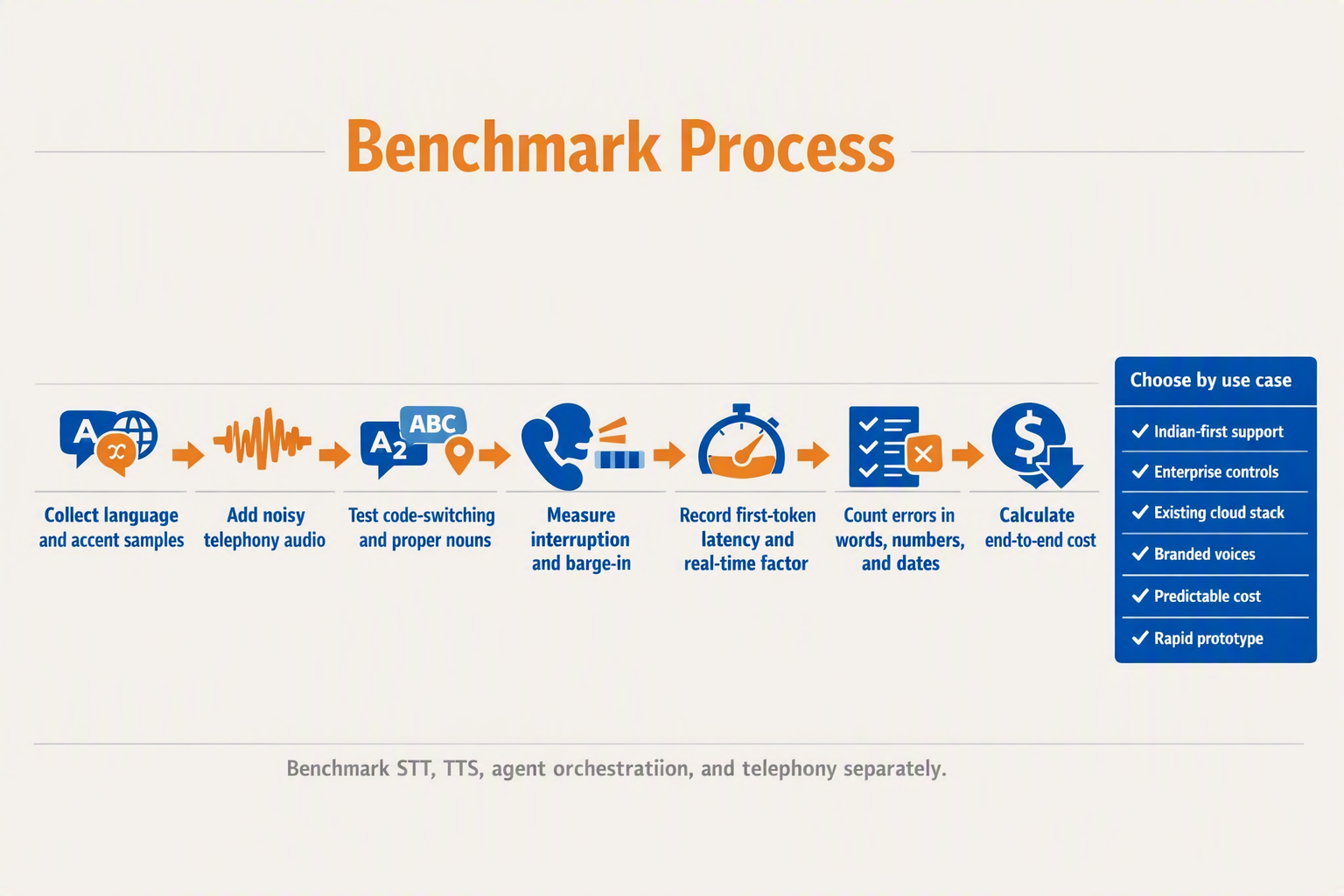
An India-focused provider such as Sarvam AI is the first option to evaluate for Hindi, Tamil, Telugu, and Hinglish workflows, while Google Cloud, Microsoft Azure, and AWS may better fit enterprises prioritising established infrastructure, governance, or an existing cloud stack. There is no universal winner: verify current language coverage, streaming performance, data terms, and pricing with each provider before committing.
Which API fits each production use case?
- Hindi, Tamil, or Telugu: Shortlist Sarvam AI, then benchmark it against Google Cloud Speech-to-Text, Microsoft Azure Speech, and Amazon Transcribe using native scripts, regional accents, names, dates, and noisy recordings. Confirm current availability in each provider’s official documentation.
- Hinglish and code-switching: Begin with an India-focused provider, but test Hindi–English switching within the same utterance. Separate Hindi and English language listings do not prove that an API handles code-switching accurately.
- Enterprise compliance: Google Cloud, Microsoft Azure, and AWS may suit organisations requiring established IAM, audit, monitoring, procurement, and governance controls. Verify processing regions, retention, training-use policies, encryption, and contractual terms directly with Google Cloud, Microsoft, or AWS.
- Branded voices: Compare Azure Speech, Google Cloud Text-to-Speech, Amazon Polly, and Sarvam AI for voice inventory, custom-voice eligibility, consent requirements, and commercial usage rights. Naturalness alone does not determine whether a voice is legally usable.
- Cost control: Compare the billed unit—audio duration, characters, tokens, or another usage measure—alongside minimums, free tiers, rounding, concurrency limits, and fallback charges. The available research does not verify current 2026 price sheets, so commercial terms require confirmation from each provider’s official pricing page.
- Rapid prototyping: CallMissed product information describes STT and TTS coverage across 22 Indian languages, making it a relevant platform to evaluate for India-first experiments. Confirm supported integration methods, model access, quotas, and current commercial terms directly with CallMissed before selecting it for production.
- WhatsApp voice workflows: Platforms such as CallMissed can bridge WhatsApp Business calls to an AI voice agent. Test call setup, latency, handoff to humans, interruption handling, and compliance requirements separately from speech recognition quality.
- Full voice agents: Treat STT, LLM, TTS, telephony, interruption handling, and orchestration as separate components. The strongest STT API may not be the best TTS API for the same application.
What should you test before choosing?
- Record matched Hindi, Tamil, Telugu, English, and Hinglish samples across relevant accents, speaking speeds, scripts, proper nouns, numbers, and dates.
- Replay clean microphone and noisy telephony audio, then measure word-error patterns, hallucinated words, first-token latency, real-time factor, and streaming stability.
- Test barge-in and interruption recovery: speak over the agent, pause mid-sentence, correct a name, and switch languages during a turn.
- Calculate end-to-end cost per minute using the provider’s confirmed billing unit, including STT, LLM, TTS, telephony, storage, and fallback usage.
- Review data residency, retention, deletion, consent, and human-escalation controls before sending customer recordings.
For broader architecture guidance, compare this evaluation with the Multilingual AI Voice Agent India: 2026 Buyer and Language-Testing Guide and the Multilingual Customer Engagement India: 2026 AI Voice, WhatsApp and Email Guide.
What are the most common questions about Indian-language voice AI APIs?
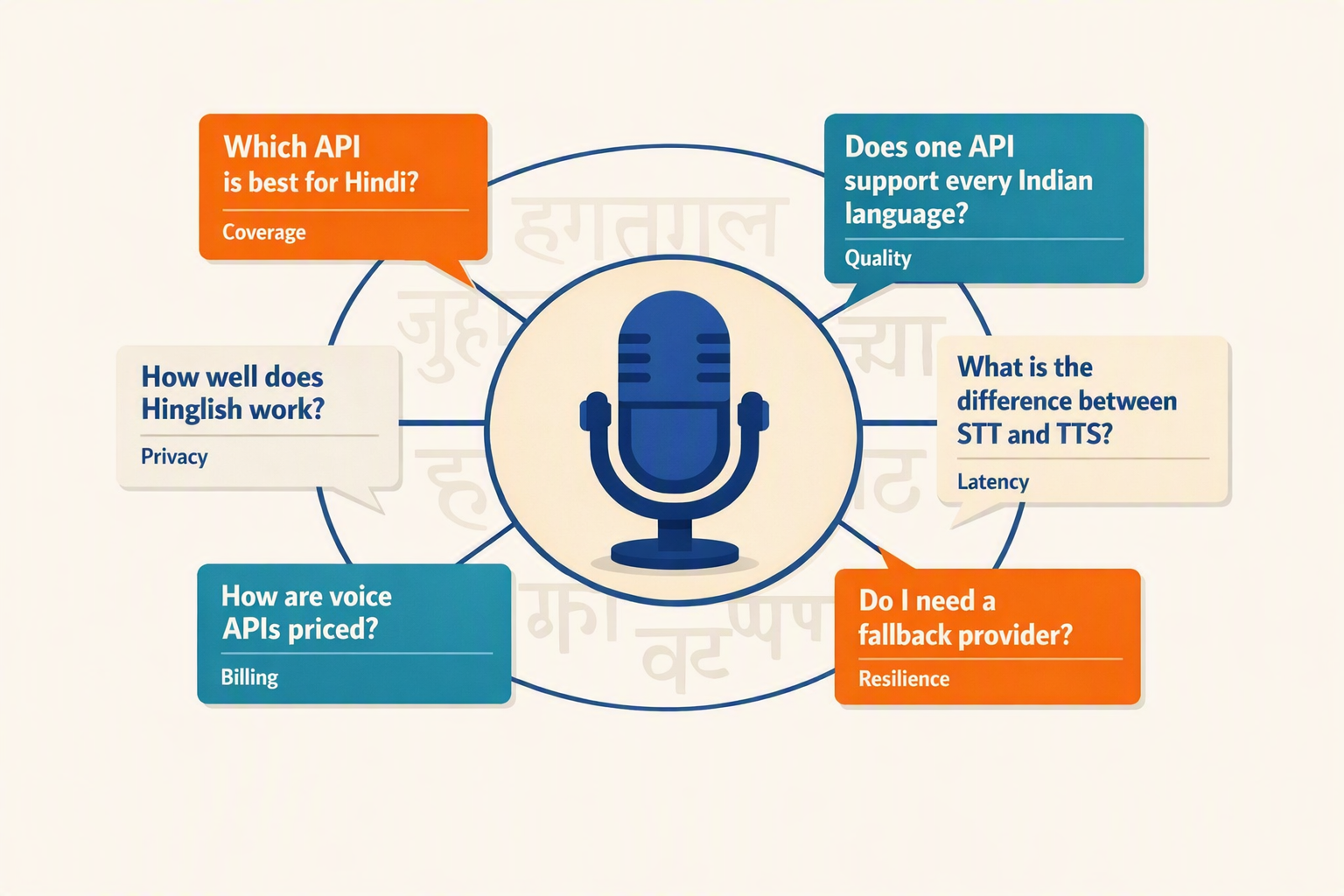
The best voice AI API for Indian languages depends on whether you prioritize regional-language breadth, enterprise controls, existing cloud infrastructure, or full voice-agent deployment. Evaluate an India-focused provider first for code-mixed and regional workflows, then validate Google Cloud, Microsoft Azure, and AWS against your own recordings and current pricing.
- Q: What is the best voice AI API for Indian languages in 2026?
A: An India-focused provider such as Sarvam AI is the first option to evaluate for broad Indian-language and Hinglish workflows, while Google Cloud Speech, Microsoft Azure Speech, and Amazon Transcribe/Polly may fit better when global infrastructure or enterprise procurement matters. No universal winner can be declared without verifying current language coverage, streaming behavior, quality, data handling, and price for the target use case.
- Q: Which is the best voice AI API for Hindi, Tamil, and Telugu?
A: Compare the provider’s current official language and script lists rather than assuming that “Indian languages” means all regional languages, dialects, or writing systems are supported equally. Test Hindi, Tamil, and Telugu with local accents, code-switching, names, numbers, dates, and telephone audio; CallMissed, for example, supports speech-to-text and text-to-speech across 22 Indian languages according to its platform capability documentation.
- Q: Is one API enough for every Indian language and voice use case?
A: Usually not: speech-to-text (STT), text-to-speech (TTS), and conversational voice agents have different quality and integration requirements. A production stack may combine an STT API, large language model, TTS API, telephony provider, interruption handling, analytics, and orchestration layer, with separate providers selected for recognition and voice quality.
- Q: Which voice AI API is best for Hinglish and code-switching?
A: Prioritize providers that document mixed-language recognition and test them on natural Hindi-English, Tamil-English, or Telugu-English speech rather than isolated sentences. Measure transcription errors in brand names, English product terms, proper nouns, numerals, and regional accents; a model that performs well on clean Hindi may behave differently on noisy, code-mixed calls.
- Q: How much does an Indian-language voice AI API cost?
A: Pricing may be metered by audio minutes, audio seconds, characters, generated tokens, requests, or bundled voice-agent usage, so compare the complete unit economics rather than a headline rate. The supplied 2026 research context does not verify current official price sheets, free-tier limits, or minimum commitments for Sarvam AI, Google Cloud, Microsoft Azure, or AWS; confirm each provider’s pricing page before procurement.
- Q: Do Indian-language voice AI APIs support privacy, fallback providers, and WhatsApp calls?
A: Check retention, training-use policies, encryption, regional processing, deletion controls, and enterprise agreements directly in each provider’s current documentation; “cloud hosted” does not by itself establish a specific data-residency guarantee. A fallback provider is useful for availability and language coverage, while platforms such as CallMissed can combine multilingual voice agents with WhatsApp Business voice calls and broader customer-engagement workflows.
Conclusion
The best voice AI API for Indian languages in 2026 depends on the workflow: evaluate India-focused providers first for broad regional-language and Hinglish coverage, while Google Cloud, Azure, and AWS may suit enterprise governance or existing cloud stacks.
- Separate STT, TTS, and full voice-agent requirements.
- Confirm official 2026 pricing, language coverage, scripts, streaming, and data policies.
- Benchmark accents, noisy calls, code-switching, latency, interruptions, and total cost.
As Indian-language models mature, quality and predictable pricing will matter even more. Explore CallMissed to see how multilingual voice agents and chatbots are evolving—and which stack fits your next use case.