
Gemini 4 Argon vs GPT-6 Astra: Benchmark Evidence



Compare reported DeepSWE results, benchmark methodology, access and costs for Argon and Astra. Vendor claims are separated from independent tests.
Gemini 4 Argon vs GPT-6 Astra: Benchmark Evidence
Can a frontier model’s $2-per-million-token input price tell you which AI will handle your hardest engineering work? Not by itself—and this Gemini 4 vs GPT-6 Astra comparison draft has no defensible winner yet.
The supplied excerpt from Google’s September 30, 2026 announcement lists Gemini 4 Argon’s introductory pricing at $2 per million input tokens and $10 per million output tokens, with cached inputs discounted by 95%. Those figures make cost an immediate consideration, but they do not establish reasoning quality, coding reliability, or enterprise readiness. OpenAI’s official GPT-6 Astra model page confirms the model and its specifications. This guide evaluates reported benchmark provenance and workload relevance; it does not present CallMissed-run head-to-head measurements.
What will this Gemini 4 vs GPT-6 Astra comparison evaluate?
The useful question is not which model sounds more advanced. It is which model can complete demanding work accurately, predictably, and at an acceptable total cost.
This review will examine three practical dimensions once the underlying product details and results are verified:
- Highest-capability reasoning: Can each model handle ambiguous requirements, identify flawed assumptions, and sustain a correct approach across multiple steps?
- Software engineering: Can each model diagnose repository-level problems, produce maintainable changes, and pass relevant tests without introducing regressions?
- Enterprise work: What official documentation establishes about deployment options, data handling, tool access, and operational controls?
These are evaluation criteria, not claims that either named model already meets them. A convincing comparison needs documented configurations and reproducible tasks—not just launch language or isolated demonstrations.
Why does Gemini 4 Argon’s announced pricing matter?
According to the supplied Google announcement excerpt dated September 30, 2026, Gemini 4 Argon’s cached-input discount is 95%. Applied to the announced $2 input rate, that implies $0.10 per million cached input tokens, subject to confirmation of Google’s caching terms and eligibility.
For a hypothetical workload containing one million uncached input tokens and one million output tokens, the announced rates imply $12 in token charges. That is an illustrative calculation, not a measured task cost: retries, tool execution, caching behavior, and the amount of generated output can change the economics substantially.
How should readers use this review draft?
Treat the forthcoming comparison as a decision framework until manual review confirms both models’ identities, availability, specifications, and comparable evidence.
As of September 2026, CallMissed’s OpenAI-compatible developer API supports caller-chosen fallback models and usage logs—capabilities relevant to teams evaluating multi-model workflows, without implying that either model discussed here is available through CallMissed.
The goal is a clear, evidence-backed answer: which verified model fits which workload, at what cost, and with which trade-offs?
Gemini 4 Argon vs Astra: what benchmarks tell you
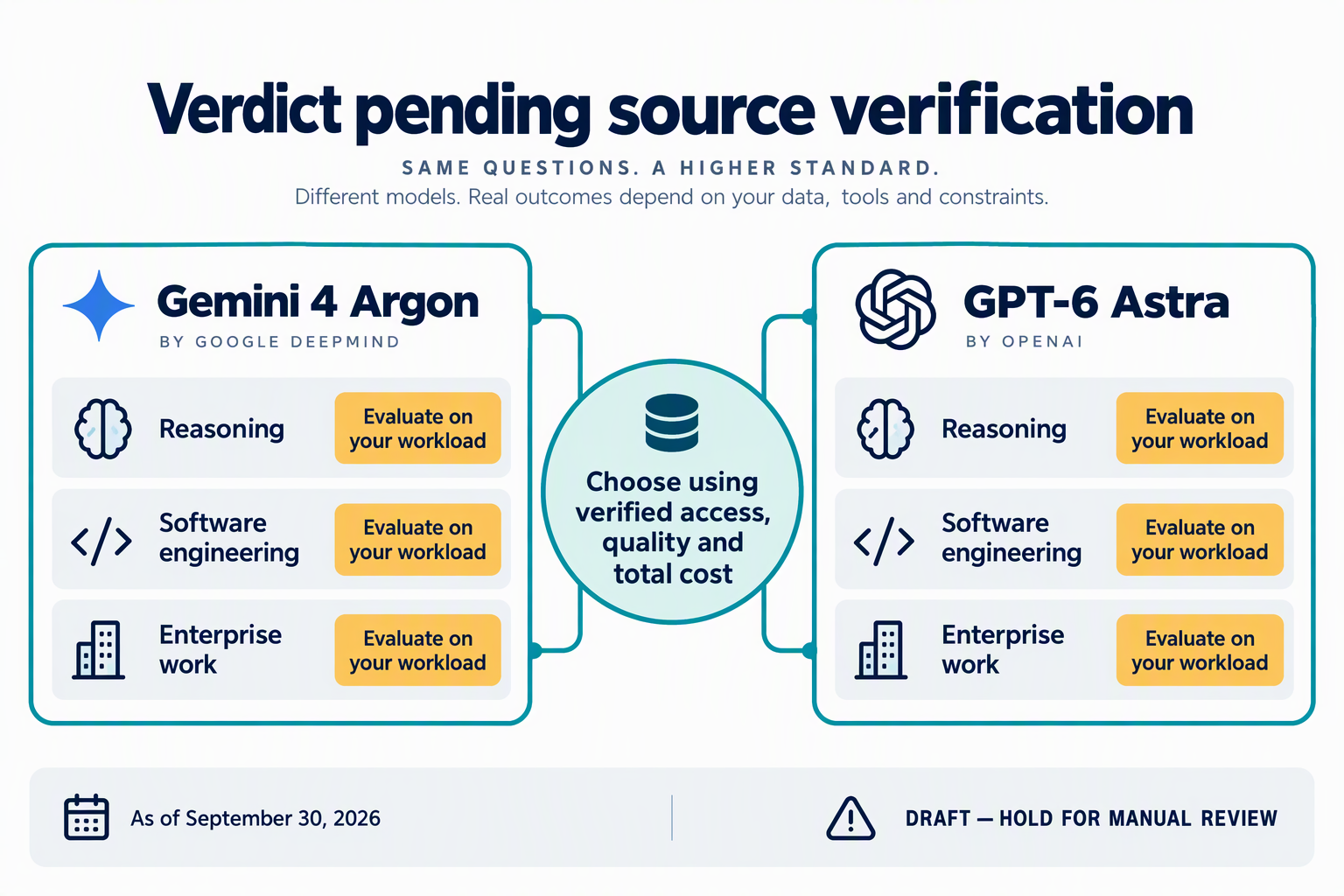
Gemini 4 Argon leads the reported DeepSWE v1.1 comparison, but that does not establish a universal winner over GPT-6 Astra. Choose using benchmark provenance, access, cost, and results relevant to your workload—not the model name or a single leaderboard position.
What does the reported benchmark actually show?
9to5Google’s September 30, 2026 reporting attributes the following DeepSWE v1.1 results to Google:
| Model | Reported score | Evidence status |
|---|---|---|
| Gemini 4 Argon | 77.9% | Vendor-reported |
| Claude Opus 5.5 | 74.2% | Vendor-reported |
| GPT-6 Astra | 74.1% | Vendor-reported |
These are vendor-reported results, not CallMissed’s independent measurements. They support a narrow conclusion: Argon ranks first in this reported comparison. They do not establish that it is better at every reasoning task, on every repository, or under every deployment configuration.
Before using these figures for procurement, check the underlying benchmark documentation for exact model versions, reasoning effort, tool access, evaluation harness, retry policy, and scoring rules. Do not combine results from different configurations into one ranking.
How should independent benchmarks affect your choice?
Artificial Analysis provides an independent comparison point, but its index may rank models differently from a software-engineering benchmark. Different tasks and evaluation methods can produce different rankings without either result being contradictory.
Compare like with like: the same model version, effort setting, and harness. An intelligence index, a repository-level coding benchmark, and a product feature table answer different questions. None should be presented as interchangeable evidence of a universal winner.
What do the official specifications tell buyers?
The September 30 Google announcement and OpenAI’s GPT-6 Astra model documentation describe access, pricing, and integration considerations separately from benchmark performance:
| Buying consideration | Gemini 4 Argon | GPT-6 Astra |
|---|---|---|
| Documented access | Limited Fairwind availability | Documented as gpt-6-astra |
| Input / output pricing | Introductory $2 / $10 per million tokens; later $4 / $20 | Standard $10 / $50 per million tokens |
| Pricing caveat | Introductory offer expiry is unspecified | Figures shown are Standard pricing |
| Context and output limits | Not established by the supplied announcement details | 1,050,000-token context, 922,000 maximum input tokens, 128K maximum output tokens |
| Tool integration | Not established by the supplied announcement details | Tool calls through the Responses API |
These specifications are buying constraints, not benchmark scores. Astra’s documented context limits and tool interface do not prove superior reasoning; Argon’s lower listed token prices do not prove lower total task cost. Retries, tool use, and unsuccessful attempts can change the economics.
Which model belongs on your shortlist?
- Investigate Argon if software engineering is your priority: its vendor-reported DeepSWE v1.1 lead warrants attention, provided you can obtain access. Confirm the evaluation configuration and applicable pricing before treating that lead as decisive.
- Consider Astra when documented integration requirements matter: its published model identifier, context limits, Standard pricing, and Responses API tool calls give buyers concrete integration parameters. Those facts do not establish a coding or reasoning win.
- Make the final choice workload-specific: use official specifications and comparable independent evidence, then evaluate the exact configurations your team would deploy. This section reports published information; it does not present unpublished tests or claim an independently verified winner.
Are Argon and Astra actually available? Dated, cited access facts
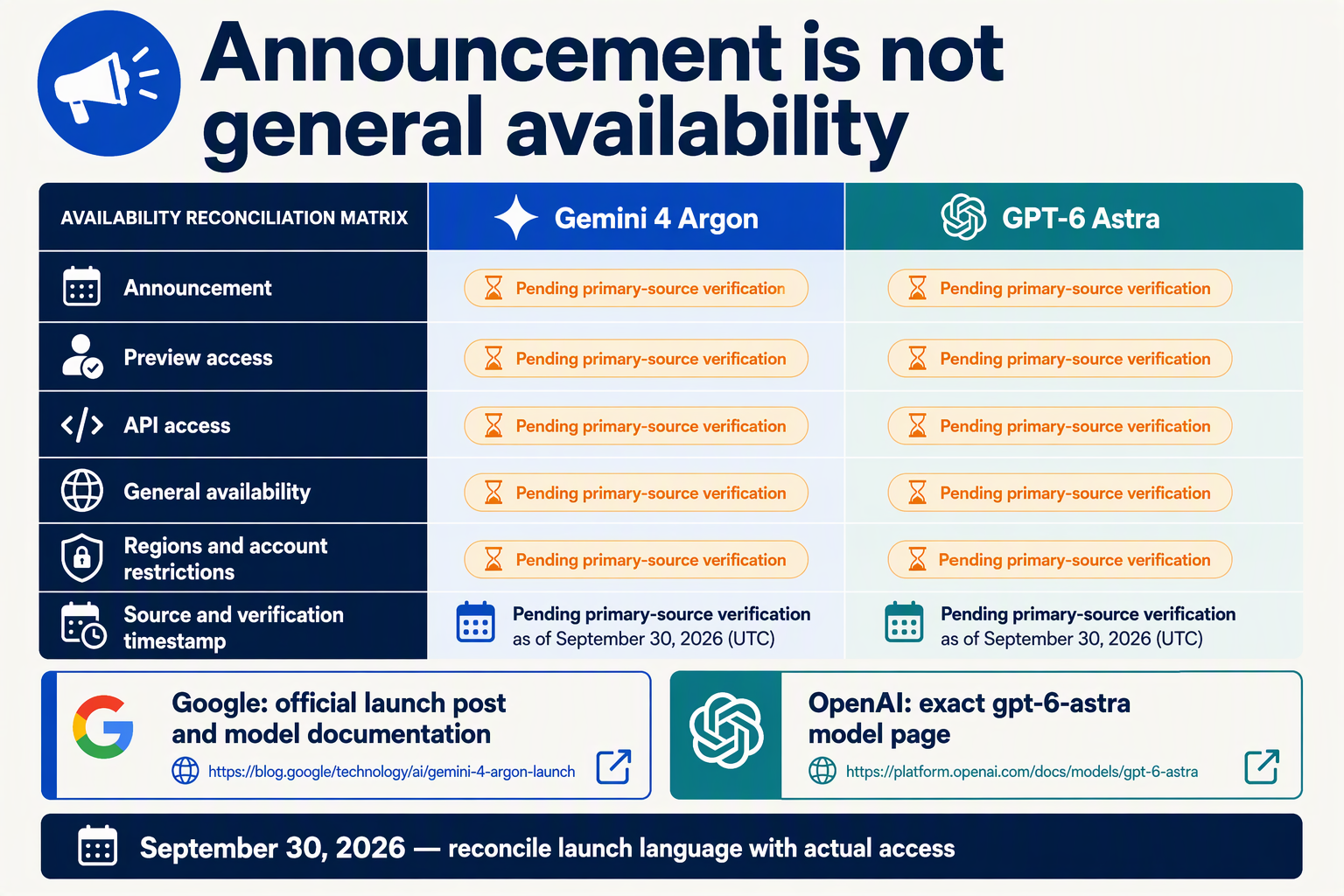
Gemini 4 Argon’s public availability is not established by the supplied Google excerpts; GPT-6 Astra’s identity and access are also unverified. As of September 30, 2026, this comparison remains held for manual review, because announcement language is not equivalent to documented, usable access.
What access facts are supported as of September 30, 2026?
The table distinguishes statements in the supplied research from access details that still require official documentation.
| Access checkpoint | Gemini 4 Argon | GPT-6 Astra | Evidence as of Sept. 30, 2026 |
|---|---|---|---|
| Official announcement | Google announcement excerpt supplied | No official OpenAI announcement supplied | Google, “Gemini 4 Argon: our next era of frontier intelligence” |
| Internal deployment | Google says Argon is “already powering our internal workflows” | Not established | Google announcement excerpt dated Sept. 30, 2026 |
| Public launch timing | Excerpt says Argon “will launch”; public access date unspecified | Not established | Future-tense wording does not confirm availability |
| Developer API access | Endpoint, model ID and account eligibility unspecified | Not established | No model-specific API documentation supplied |
| Consumer subscription access | Argon inclusion not established | Astra inclusion not established | General subscription news is insufficient |
| Enterprise deployment | Regions, quotas and deployment terms unspecified | Not established | No model-specific enterprise access documentation supplied |
Why does announced access differ from usable access?
- Gemini 4 Argon: Google’s September 30, 2026 excerpt establishes a claimed internal deployment, not a customer rollout. “Already powering our internal workflows” does not identify eligible external accounts, supported countries, a release channel or a callable API model identifier.
- GPT-6 Astra: As of September 30, 2026, the provided research contains zero official OpenAI sources establishing this name or access route. The defensible label is unverified in the supplied evidence, not “unavailable,” “cancelled” or “coming soon.”
- Google AI subscriptions: The supplied Google I/O 2026 subscription excerpt announces a $100/month AI Ultra plan, but does not establish Argon entitlement. A subscription price cannot confirm which model subscribers receive, whether access is preview-only or what usage limits apply.
What must manual review confirm before testing?
- API access: Record the official documentation date, exact model ID, release status, supported endpoint and account eligibility for each model. Then confirm that an authorized request succeeds; a marketing announcement alone cannot establish a reproducible engineering test configuration.
- Enterprise access: Verify deployment regions, rate limits, data-handling terms and procurement requirements separately for Argon and Astra. As of September 30, 2026, these details are missing from the supplied excerpts; missing evidence should remain visibly marked rather than filled with assumptions from earlier models.
- CallMissed: As of September 2026, CallMissed’s OpenAI-compatible developer API provides caller-chosen fallback models and usage/request logs. Those capabilities can support documented multi-model evaluations, but the verified fact sheet does not establish Argon or Astra availability, so neither should be presented as accessible through CallMissed.
How do reasoning, coding, tools and enterprise safeguards compare?
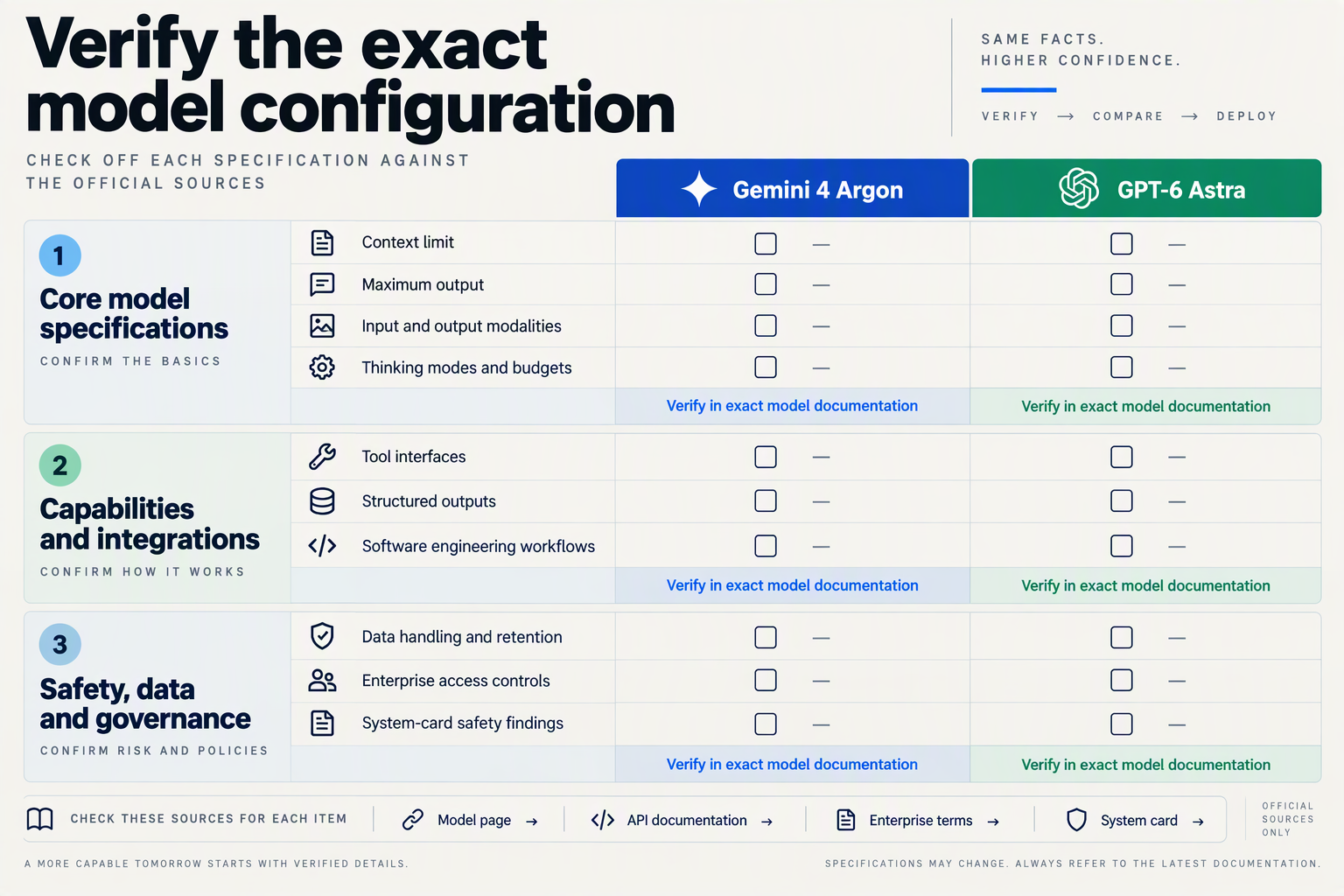
Reasoning, coding, tool reliability and enterprise safeguards cannot yet be ranked defensibly for Gemini 4 Argon versus GPT-6 Astra as of September 30, 2026. The supplied Google excerpts do not establish Argon’s capabilities across these dimensions, and no official OpenAI evidence for Astra is supplied.
- Gemini 4 Argon: Google’s September 30, 2026 announcement excerpt says Argon is “already powering our internal workflows”; internal adoption alone does not establish benchmark performance, customer availability, permission controls or production reliability.
- GPT-6 Astra: As of September 30, 2026, this research packet contains no official OpenAI model documentation; record its reasoning scores, coding results, tool specifications and enterprise safeguards as unverified, rather than assuming parity or inferiority.
What evidence is missing from the capability comparison?
| Dimension | Gemini 4 Argon evidence | GPT-6 Astra evidence | Manual-review requirement |
|---|---|---|---|
| Complex reasoning | No scores in supplied Google excerpt | No official evidence supplied | Same benchmark version, reasoning settings and token budget |
| Repository-level coding | No verified coding results supplied | No official evidence supplied | Identical repositories, test suites and agent scaffolding |
| Tool calling | No Argon-specific tool specification supplied | No official evidence supplied | Schemas, parallel-call behavior, errors and approval controls |
| Computer use | Supplied Google evidence names Gemini 3.5 Flash, not Argon | No official evidence supplied | Model-specific documentation and sandboxed task results |
| Enterprise data handling | No retention or training-use terms supplied | No official evidence supplied | Applicable contractual terms, retention settings and processing locations |
| Access and deployment | No complete deployment specification supplied | No official evidence supplied | Authentication, audit logging, regional availability and service limits |
- Google Gemini 3.5 Flash: Google’s June 2026 AI announcements describe computer use across desktop, mobile and browser environments; that evidence concerns Gemini 3.5 Flash, not Gemini 4 Argon, and cannot establish Argon’s tool capabilities.
- Reasoning evaluation: Use three difficulty bands—routine, multi-step and adversarial—and publish first-attempt accuracy separately from retry-assisted success; identical prompts without matched reasoning budgets would still leave the Gemini 4 versus GPT-6 Astra comparison materially confounded.
How should engineering and enterprise teams test both models?
- Software engineering: Score three outcomes separately: tests passed, regressions introduced and reviewer acceptance; for example, a patch that passes a targeted unit test but breaks authentication elsewhere should fail the task, regardless of how convincing its explanation appears.
- Enterprise safeguards: Require evidence for four controls—data retention, training-use restrictions, access permissions and auditability—before production approval; then test tool execution with read-only credentials before allowing writes, because a correct answer does not guarantee a safely executed action.
Manual-review gate: Keep this comparison unpublished until reviewers verify both model identities, obtain model-specific documentation and reproduce comparable results. Missing documentation means “not established by the supplied sources,” not “the feature does not exist.”
Does Argon match Astra? Benchmark provenance and same-harness methodology
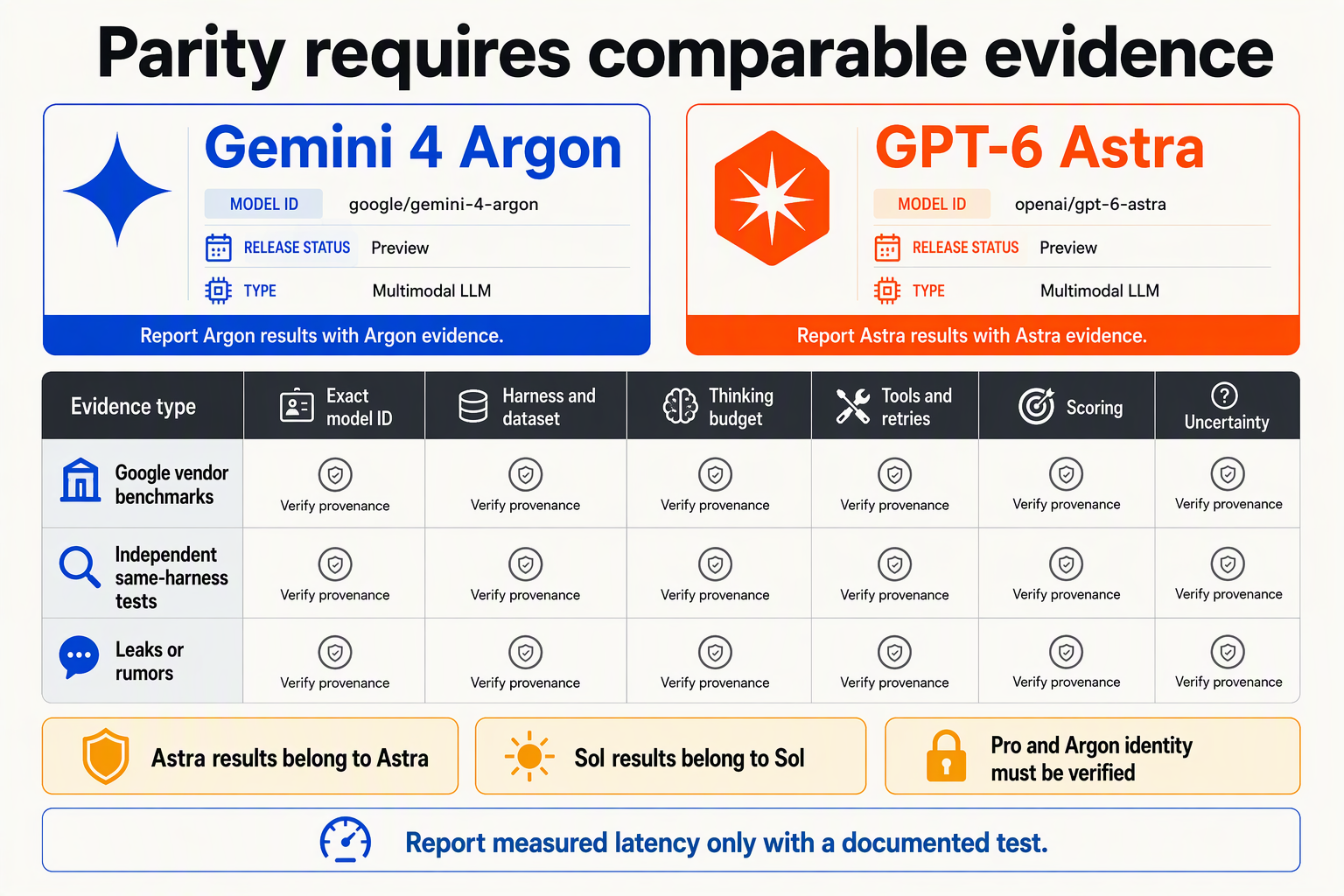
Gemini 4 Argon cannot yet be shown to match GPT-6 Astra: the supplied evidence contains no comparable benchmark scores or same-harness results. As of September 30, 2026, this comparison remains held for manual review, with the following evaluation protocol proposed—not executed.
- Google: The supplied September 30, 2026 announcement excerpt says Argon is “already powering our internal workflows”; that statement is not a reproducible benchmark.
- Gemini 4 Argon: The supplied Google excerpt provides no benchmark scores, dataset versions, sample sizes, or uncertainty estimates.
- GPT-6 Astra: No official OpenAI announcement, model specification, or benchmark report appears in the supplied research.
- Source provenance: Google search results 1 and 7 point to the same announcement, including an alternate URL; they are not two independent confirmations.
- Same-harness testing: Match prompts, tool permissions, task inputs, retry allowances, and scoring rules; record model-specific settings separately.
- CallMissed: As of September 2026, CallMissed’s OpenAI-compatible developer API offers usage and request logs, useful for evaluation records; this does not establish availability of either named model.
What evidence would make the benchmark comparison defensible?
The table distinguishes missing evidence from proposed controls. Every requirement below applies to the review dated September 30, 2026; none represents a measured result.
| Evaluation area | Argon evidence supplied | Astra evidence supplied | Required comparison control |
|---|---|---|---|
| Model identity | Google announcement excerpt | No official source supplied | Exact model IDs, versions, access dates |
| Reasoning accuracy | No scores supplied | No scores supplied | Identical held-out questions and scoring |
| Repository engineering | No test results supplied | No test results supplied | Same repository commits and hidden tests |
| Enterprise tasks | Internal-workflow statement only | No task evidence supplied | Same documents, permissions, approval rules |
| Agent execution | No harness details supplied | No harness details supplied | Same tools, timeouts, retry budgets |
| Reliability and cost | No per-task measurements | No per-task measurements | Repeated runs, failures, tokens, elapsed time |
How should reviewers run a same-harness evaluation?
- Freeze the test manifest. Archive prompts, dataset revisions, repository commits, dependencies, and scoring code before either model runs. Separate public benchmark questions from private enterprise tasks, and flag possible training-data contamination rather than assuming every correct answer demonstrates generalization.
- Declare two budget tracks. Compare equal resource limits separately from each model’s documented highest-capability configuration. Identical output-token ceilings alone do not establish equal reasoning effort; record reasoning settings, tool calls, retries, and wall-clock limits wherever those controls are available.
- Publish outcomes, not selected demonstrations. Report task completion, regression failures, unauthorized actions, and cost per successful task, alongside sample size and uncertainty. A coding fix counts only after tests pass; an enterprise workflow counts only if required approvals and access boundaries are respected.
Manual-review release gate: Obtain the complete Google benchmark documentation and corresponding official OpenAI evidence before publishing a winner, parity claim, or numerical ranking.
What will each workload cost? Pricing, discounts and successful-task scenarios
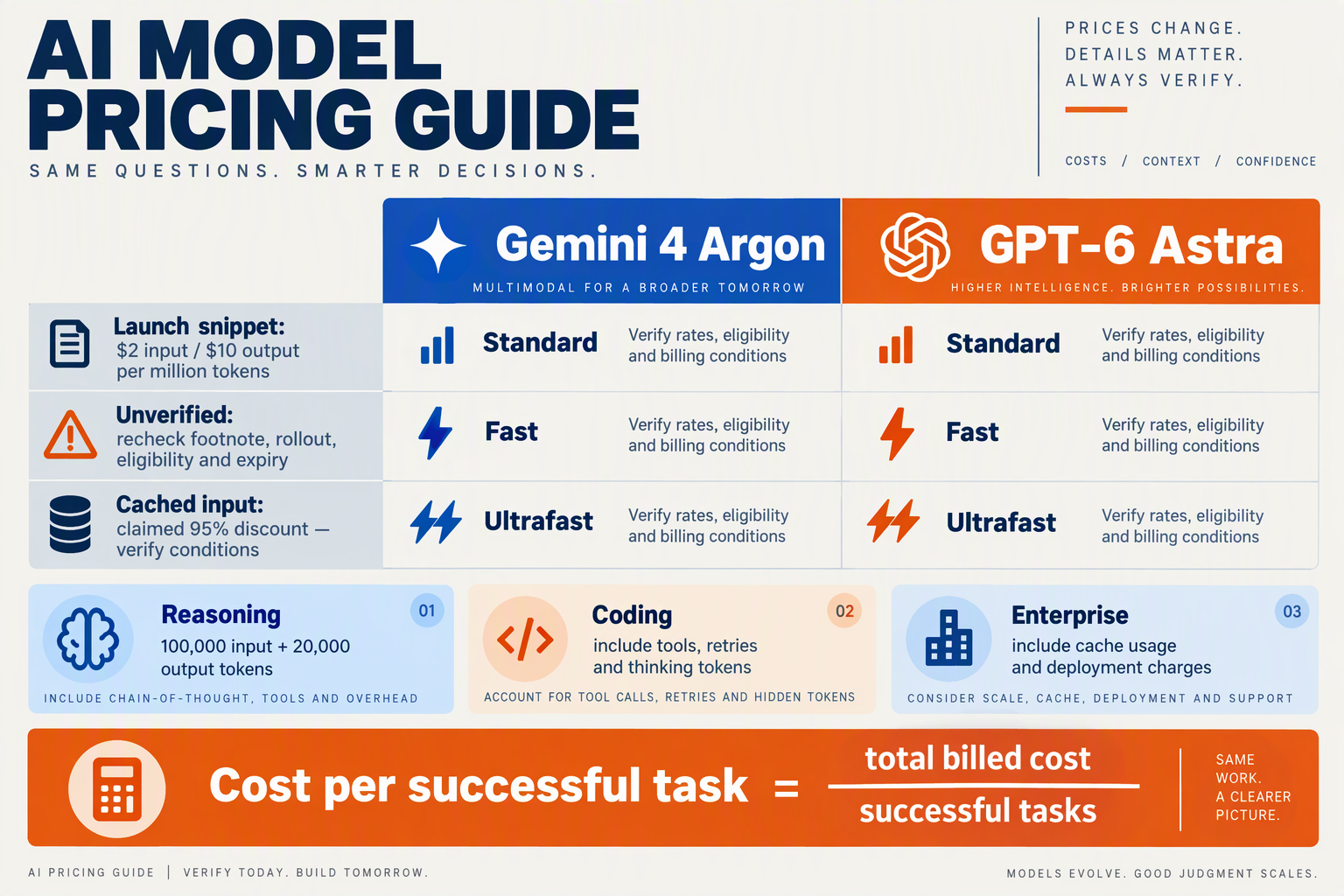
Gemini 4 Argon’s workload costs can be estimated from Google’s supplied pricing excerpt; GPT-6 Astra’s cannot, because official OpenAI pricing is missing. This September 30, 2026 comparison remains a draft held for manual review, with no verified cost-per-success winner.
- Gemini 4 Argon: Google’s September 30, 2026 announcement excerpt states introductory prices of $2 per million input tokens and $10 per million output tokens, with cached input “priced at 95% off input token price.”
- GPT-6 Astra: The supplied research contains no official OpenAI token prices, caching discounts, or subscription entitlements; missing prices must not be treated as zero.
How much would reasoning, coding and enterprise workloads cost?
The following illustrative token-only estimates, calculated on September 30, 2026 from the supplied Google rates, are budgets—not measured task results. Each cached scenario assumes eligible tokens receive the stated discount; cache storage, tools, taxes and other charges are excluded because the excerpt does not establish them.
| Workload scenario | Input / output tokens | Cached input share | Argon estimate | Astra estimate |
|---|---|---|---|---|
| Reasoning answer | 100,000 / 10,000 | 0% | $0.30 | Unverified |
| Coding attempt | 100,000 / 20,000 | 0% | $0.40 | Unverified |
| Coding with reused context | 100,000 / 20,000 | 90% | $0.229 | Unverified |
| Enterprise document analysis | 1,000,000 / 50,000 | 0% | $2.50 | Unverified |
| Repeated document analysis | 1,000,000 / 50,000 | 90% | $0.79 | Unverified |
| Coding attempt plus one retry | 200,000 / 40,000 total | 0% | $0.80 | Unverified |
- Caching: In the coding scenario, discounting 90,000 input tokens reduces the calculated bill from $0.40 to $0.229, a 42.75% total saving, not 95%; output remains undiscounted.
- Output budget: At Google’s quoted September 30, 2026 rates, 20,000 output tokens cost $0.20—as much as 100,000 uncached input tokens. Longer answers can therefore erase meaningful input savings.
How should teams calculate cost per successful task?
- Successful-task economics: Divide total evaluation spend by accepted outcomes; hypothetically, 100 attempts costing $40 with 80 accepted results equal $0.50 per success, while 50 accepted results yield $0.80.
- Acceptance criteria: For software engineering, count a result only after required tests and review pass; for enterprise analysis, require accurate citations, complete requested fields and compliance with the evaluation’s access rules.
- Discount boundaries: Google’s supplied I/O 2026 excerpt describes a $100/month AI Ultra plan, but does not establish Argon API credits; neither subscription allowances nor volume discounts should enter this comparison without confirmation.
- CallMissed: As of September 2026, CallMissed’s developer API offers usage and request logs plus caller-chosen fallback models—useful evaluation capabilities, without implying support for either named model.
Before approving this section:
- Confirm introductory-price duration, caching eligibility and any additional billing terms in Google’s official documentation.
- Obtain official OpenAI pricing and run identical workloads, recording retries, tool costs and reviewer effort alongside token spend.
What are the evidence-backed pros and cons of each model?
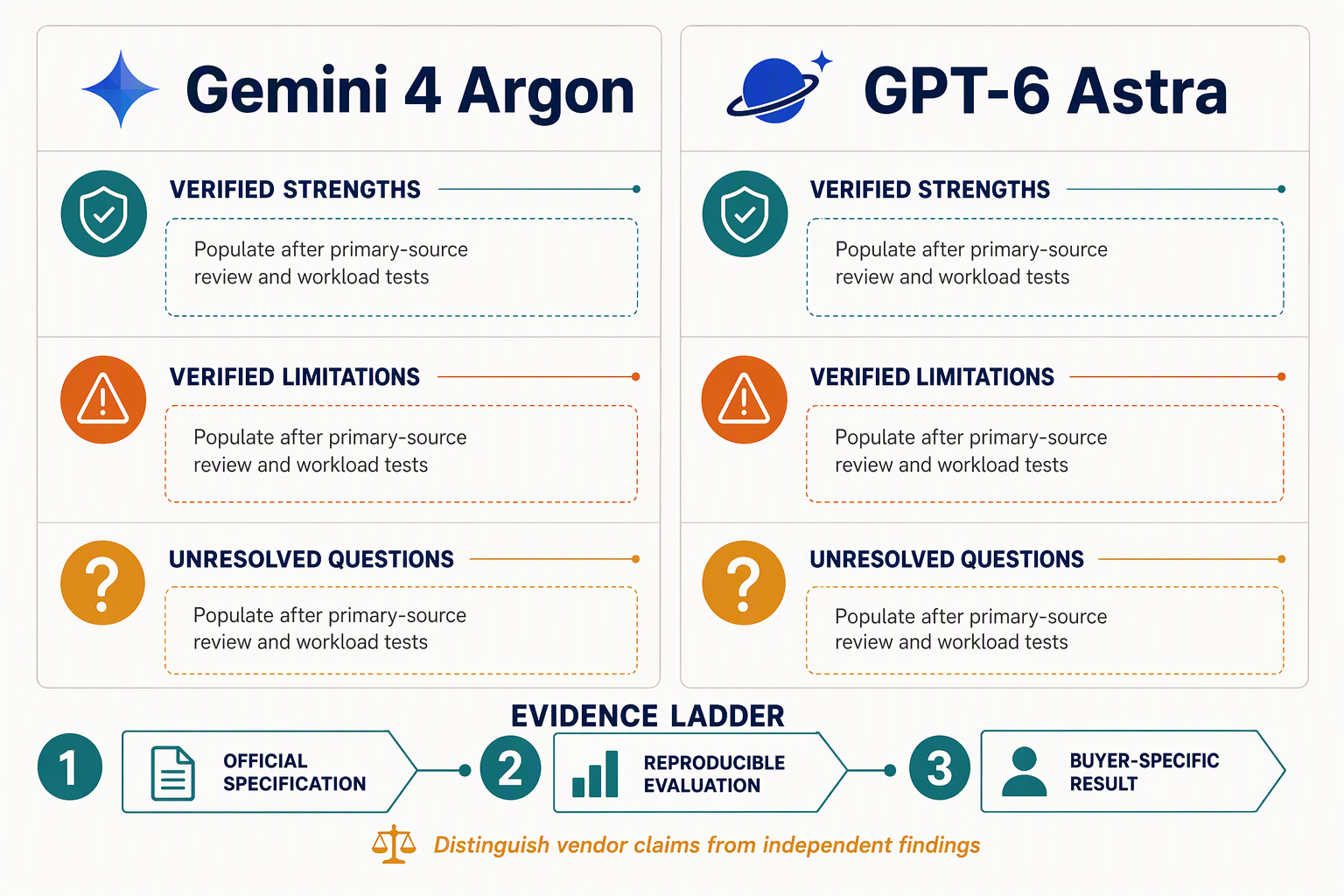
Gemini 4 Argon has documented introductory pricing in the supplied Google excerpt, but neither model has enough evidence here for a capability verdict. As of September 30, 2026, this comparison remains held for manual review.
- Gemini 4 Argon: Google’s September 30, 2026 excerpt provides a pricing basis for evaluation; that is a procurement advantage, not proof of superior reasoning.
- GPT-6 Astra: The supplied research contains no official OpenAI announcement, specifications, or pricing; these are evidence gaps, not demonstrated product weaknesses.
- Both models: No comparable reasoning scores, repository-level coding results, or enterprise-control documentation appear in the supplied context.
- Source boundary: Google’s Gemini application announcements and Gemini 3.5 Flash updates cannot establish Gemini 4 Argon’s model-specific capabilities, availability, or limits.
Which pros and cons are supported by the supplied evidence?
The table separates documented positives from unresolved questions. “Not supplied” means this draft cannot substantiate a claim—not that a model lacks the capability.
| Evaluation area | Gemini 4 Argon: supported positive | Gemini 4 Argon: unresolved issue | GPT-6 Astra: evidence status |
|---|---|---|---|
| Pricing transparency | Google’s September 30, 2026 excerpt lists introductory rates of $2/million input tokens and $10/million output tokens. | Duration, eligibility, and additional charges are not established by the excerpt. | No official pricing supplied as of September 30, 2026. |
| Repeated-input economics | Google’s September 30, 2026 excerpt announces a 95% cached-input discount. | Cache retention, minimum sizes, and applicable workloads require documentation. | No caching terms supplied as of September 30, 2026. |
| Highest-capability reasoning | No benchmark-backed advantage established in the supplied September 30, 2026 research. | Comparable scores, reasoning settings, and reproducible tasks are missing. | No official results supplied; neither parity nor inferiority is established. |
| Software engineering | No measured coding advantage established in the supplied September 30, 2026 research. | Repository tests, regression rates, tool budgets, and execution environments are missing. | No comparable engineering evaluation supplied. |
| Enterprise suitability | Google’s September 30, 2026 excerpt says Argon powers internal workflows. | Internal use does not establish customer deployment options, retention policies, or contractual controls. | No model-specific enterprise documentation supplied. |
| Operational limits | No model-specific limits established in the supplied September 30, 2026 research. | Context window, output ceiling, rate limits, and latency remain unverified here. | No official limits or availability details supplied. |
What should reviewers verify before choosing a model?
- Reasoning and engineering review: Confirm exact model identifiers, then test both on the same tasks with identical tool permissions, retry budgets, and scoring rules. Record successful resolutions, regressions, human corrections, and total billed usage; a cheaper token rate can still produce a more expensive completed task.
- Enterprise review: Obtain dated documentation for availability, data handling, regional deployment, retention, access controls, and support commitments. Keep unknowns explicitly marked until verified; neither Google’s internal-use statement nor an undocumented GPT-6 Astra capability should become a purchasing recommendation.
Which should your team choose? A buyer evaluation checklist
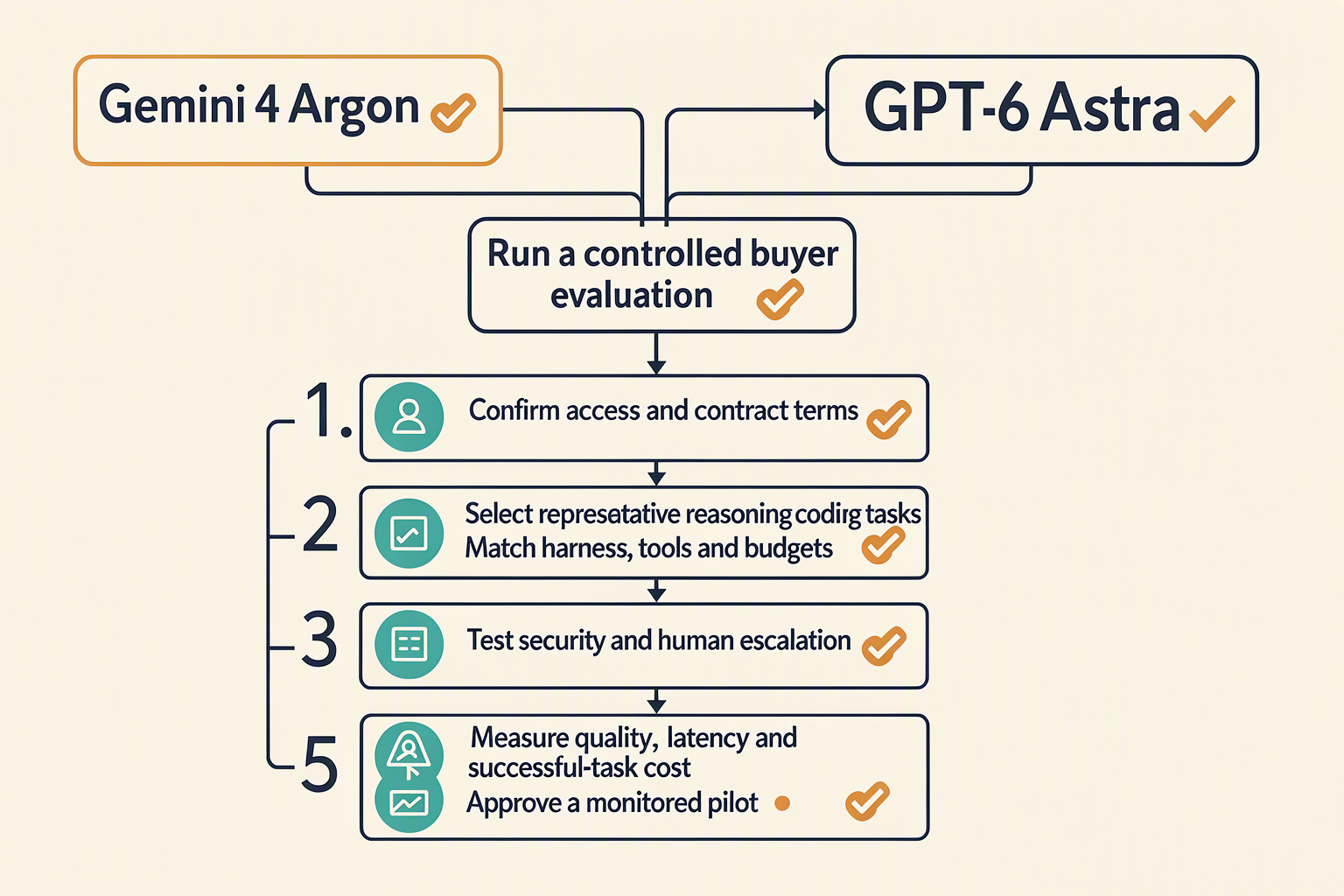
Choose neither model for production solely from the supplied evidence: Gemini 4 Argon needs independent validation, and GPT-6 Astra lacks official documentation in this research packet. Keep this September 30, 2026 comparison held for manual review until both pass the same buyer-defined gates.
What evidence should buyers require before testing?
- Gemini 4 Argon: Verify the exact API model identifier, availability, context limits, supported regions, and introductory-pricing conditions against Google’s official documentation. Google’s supplied September 30, 2026 announcement says Argon is “already powering our internal workflows”; that statement does not establish external availability, enterprise contractual terms, or independently measured performance.
- GPT-6 Astra: Require an official OpenAI announcement, model documentation, API identifier, pricing schedule, and deployment terms before admitting this candidate to procurement. As of September 30, 2026, the supplied research contains none of these. Record each field as unverified, rather than substituting specifications from another GPT model or interpreting missing evidence as poor performance.
- Both models: Create a dated evidence register with five required fields: source publisher, publication date, model version, deployment endpoint, and verification status. Separate vendor statements from reproduced results. Any unresolved identity, availability, or contractual question should block a purchase recommendation, even if a demonstration appears impressive or a preliminary benchmark looks strong.
- Enterprise reviewers: Request written answers covering six controls: retention, training use, processing location, access controls, auditability, and incident handling. These are proposed procurement requirements, not verified capabilities of either model as of September 2026. Ask whether protections differ between consumer subscriptions and API deployments; do not assume one product’s terms cover another.
How should teams run a fair acceptance test?
- Reasoning teams: Use a proposed 30-task pilot containing 10 constraint-solving problems, 10 evidence-synthesis tasks, and 10 ambiguous business decisions. Score correctness, unsupported assertions, and appropriate clarification separately. Keep prompts and tool permissions identical; include withheld reference answers so reviewers assess outcomes rather than persuasive writing or apparent confidence.
- Engineering teams: Test 20 repository tasks: five bug fixes, five feature changes, five refactors, and five security-related changes. Require relevant tests, inspect diffs, and track regressions alongside completion. Use isolated branches and equivalent execution environments; a patch that passes its newly written test but breaks existing behavior should not count as successful.
- Finance and platform teams: Measure cost per accepted task, including failed attempts, tool charges, reviewer time, and retries—not token rates alone. Report median and 95th-percentile completion time under the same concurrency. As of September 2026, CallMissed’s developer API offers structured outputs and request logs; confirm catalogue availability separately, without assuming either named model is supported.
- Decision owners: Set acceptance thresholds before viewing results, then choose by workload rather than declaring a universal winner. For example, require zero critical security regressions in the pilot and document the minimum correctness rate your workflow needs. These are suggested buyer gates, not measured results; retain manual approval for sensitive actions until operational evidence supports broader deployment.
Frequently Asked Questions
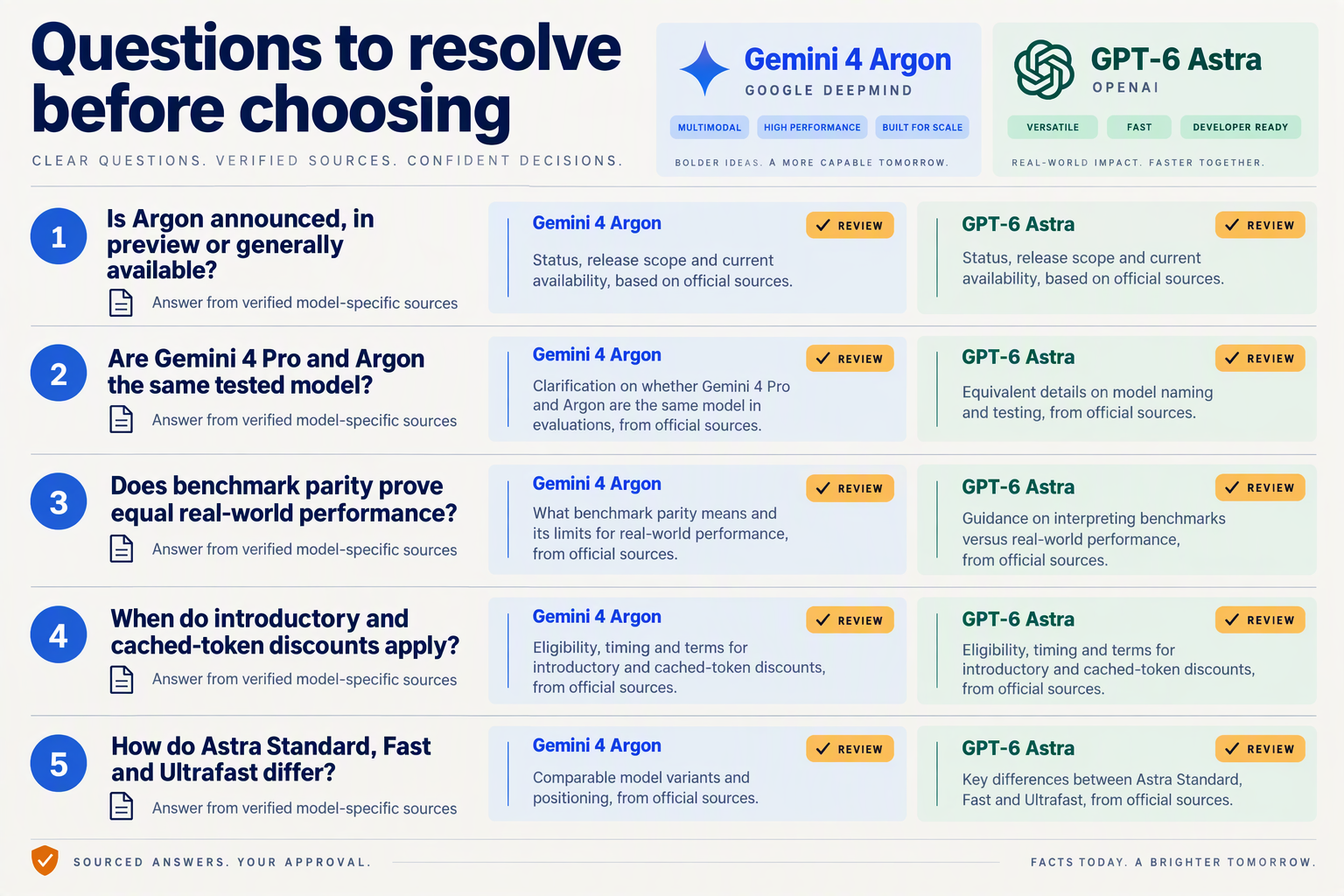
This Gemini 4 vs GPT-6 Astra comparison remains a draft held for manual review: the supplied Google excerpts do not establish public availability, model equivalence, or a defensible performance winner.
- Q: Is Gemini 4 Argon publicly released as of September 30, 2026?
A: The supplied excerpt from Google’s September 30, 2026 announcement does not establish general public availability: Google says Argon “will launch” and is “already powering our internal workflows.” Internal deployment and announced pricing are different from access through a public API or application. Manual review must confirm release status, supported regions, account eligibility, and an accessible model identifier before describing Argon as publicly released.
- Q: Is Gemini Pro the same model as Gemini 4 Argon?
A: The supplied Google research, reviewed for this September 30, 2026 draft, does not establish that “Pro” and “Argon” identify the same model. A model name, subscription entitlement, and application selector should not be treated as interchangeable without explicit documentation. Reviewers should require Google’s exact naming and model-ID mapping, rather than infer equivalence from branding or access through a paid plan.
- Q: Does benchmark parity prove superiority in Gemini 4 vs GPT-6 Astra?
A: No: matching benchmark scores would demonstrate parity only within the reported evaluation conditions, not overall superiority across reasoning, software engineering, and enterprise work. As of September 30, 2026, the supplied context contains no comparable scores or evaluation configurations for both named models. A credible assessment must disclose benchmark versions, tool access, reasoning budgets, repeated runs, and uncertainty before translating results into purchasing recommendations.
- Q: Which model wins Gemini 4 vs GPT-6 Astra for software engineering?
A: No defensible coding winner can be selected from the supplied evidence as of September 30, 2026, because corresponding official OpenAI documentation and comparable coding results are absent. Reviewers should test both models against the same repository snapshot, issue descriptions, execution environment, and time budget. Passing tests matters, but maintainability, regression risk, and human review effort also determine whether a generated patch is useful.
- Q: Does Google AI Ultra pricing establish Gemini 4 Argon API access?
A: Google’s supplied I/O 2026 subscription excerpt announces a $100-per-month Google AI Ultra plan, but that excerpt does not establish Argon API inclusion or usage allowances. For this September 30, 2026 draft, consumer subscriptions and developer token billing must remain separate unless Google explicitly connects them. Enterprise reviewers should verify access rights, billing terms, data handling, and contractual controls rather than infer them from subscription pricing.
- Q: Can developers compare Argon and Astra through CallMissed?
A: As of September 2026, CallMissed’s OpenAI-compatible developer API provides caller-chosen fallback models and usage and request logs, capabilities relevant to structured model evaluation. However, the verified CallMissed fact sheet does not establish availability of Gemini 4 Argon or GPT-6 Astra. Confirm catalogue listings and exact model identifiers before proposing either integration; gateway compatibility alone does not establish model availability or equivalent evaluation settings.
Conclusion
Gemini 4 Argon vs GPT-6 Astra has no defensible winner as of September 30, 2026. This comparison remains a draft held for manual review: the supplied Google announcement excerpt provides a pricing starting point, but the research does not establish comparable reasoning, software-engineering, or enterprise evidence for both models.
Four takeaways should guide the eventual decision:
- Announced pricing is not proof of capability. According to the supplied Google announcement excerpt dated September 30, 2026, Gemini 4 Argon’s introductory rates are $2 per million input tokens and $10 per million output tokens. Those rates help frame a budget, but they cannot establish whether the model solves difficult problems correctly or produces dependable engineering work. A low token bill matters only alongside a useful, accurate result.
- Caching could change the economics, subject to verification. The supplied Google announcement excerpt dated September 30, 2026, lists a 95% cached-input discount for Gemini 4 Argon. Applied to the stated input price, that implies $0.10 per million cached input tokens, pending confirmation of eligibility and terms. Teams should distinguish this arithmetic from measured workload costs, which also depend on retries, generated output, and tool execution.
- Reasoning and coding need reproducible evaluation. The next comparison should test ambiguous requirements, flawed assumptions, repository-level diagnosis, maintainable changes, and regression prevention. Documented configurations and relevant tests will make those results more useful than isolated demonstrations. The central question is not whether a model can produce an impressive answer, but whether it can complete demanding work reliably under comparable conditions.
- Enterprise readiness and model identity remain review gates. Official documentation must establish availability, deployment options, data handling, tool access, and operational controls before either model becomes a credible enterprise recommendation. The supplied research contains no corresponding official OpenAI announcement or benchmark evidence for GPT-6 Astra. That gap prevents a balanced head-to-head judgment; it does not justify declaring either model stronger or weaker.
What should teams watch for next?
Watch for verified product documentation, comparable benchmark evidence, and task-level results that connect quality, reliability, and total cost. The decisive update will be evidence showing how both models perform on the same demanding workflows—not simply another launch claim or a lower advertised rate.
For readers exploring multi-model workflows, CallMissed’s OpenAI-compatible developer API, as of September 2026, offers caller-chosen fallback models and usage logs. Those capabilities provide a practical avenue for exploring evaluation workflows, without implying that Gemini 4 Argon or GPT-6 Astra is available through the platform.
Before choosing a model, define your acceptance tests: what evidence would convince your team that an AI can handle its hardest work?
Related Reading
- Gemini 4 vs Claude Fable 5.1: September 30, 2026 Draft
- OpenAI Astra Launch Status: GPT-6 Release and API Facts for September 2026
- GPT-6 Astra API Availability, Access, and Pricing: Verified Status as of September 3, 2026
Sources
Discussion
Related Posts

Ready to automate customer conversations?
Launch AI voice agents and WhatsApp bots with CallMissed — one API, 22+ Indian languages.