
Gemini 4 Argon: Customer Support and Receptionist Guide



Evaluate Gemini 4 Argon for support and receptionist workflows using official-source checks, reproducible call tests, cost models and rollout gates.
Gemini 4 Argon: Customer Support and Receptionist Guide
What if Google’s newest flagship AI is not yet something your support team can deploy? Gemini 4 Argon deserves evaluation for customer-support and AI receptionist workflows, but as of September 30, 2026, its limited rollout makes availability—not just intelligence—the first buying question.
According to CNBC’s September 30, 2026 report, Alphabet unveiled Gemini 4 Argon with improvements in coding, cybersecurity, and complex professional work. Google’s announcement, dated September 30, 2026, describes strengths in software engineering, enterprise knowledge work, and cybersecurity defense. Those are promising signals for demanding business workflows, but they do not establish how reliably the model answers refund questions, schedules appointments, or handles an interrupted phone conversation.
The timing matters. VentureBeat reported on September 30, 2026 that Argon’s rollout begins with trusted cyber defenders through Google’s Fairwind Program, with broader availability planned “as soon as possible.” The Next Web reported the same day that paid API customers and Google AI Ultra subscribers are next. For buyers, that creates a distinction: an announced frontier model is not necessarily an immediately deployable receptionist.
What should buyers evaluate beyond model intelligence?
This guide evaluates the buying questions around Gemini 4 Argon versus Claude Opus 5.5, Claude Sonnet 5.5, Claude Fable 5.1, GPT-6.1 Sol, and GPT-6 Astra. The supplied launch coverage does not establish comparable support benchmarks, pricing, or deployment access across that shortlist, so those details must be verified rather than assumed.
Instead of treating a general benchmark lead as a customer-service verdict, we will focus on practical tests:
- Answer accuracy: Does the agent use approved policies and acknowledge missing information?
- Receptionist execution: Can the workflow check availability, confirm details, and complete a booking without inventing success?
- Voice experience: How does the complete speech-and-model stack handle interruptions, accents, and response delays?
- Safe escalation: When should the agent stop, ask for clarification, or transfer the conversation?
- Operating economics: What does a successfully resolved interaction cost after speech, model usage, and phone carriage?
As of September 2026, CallMissed supports no-code voice agents, knowledge bases, custom REST tools, and live-call handoffs between agents—illustrating why the surrounding communication infrastructure matters alongside model selection.
Imagine a caller asking to reschedule an appointment while disputing a cancellation fee. The useful model is not simply the one with the most impressive launch announcement; it is the one that follows your policy, uses the right tools, and knows its limits. This guide turns that distinction into a practical evaluation framework.
Can Gemini 4 Argon power an AI receptionist today?
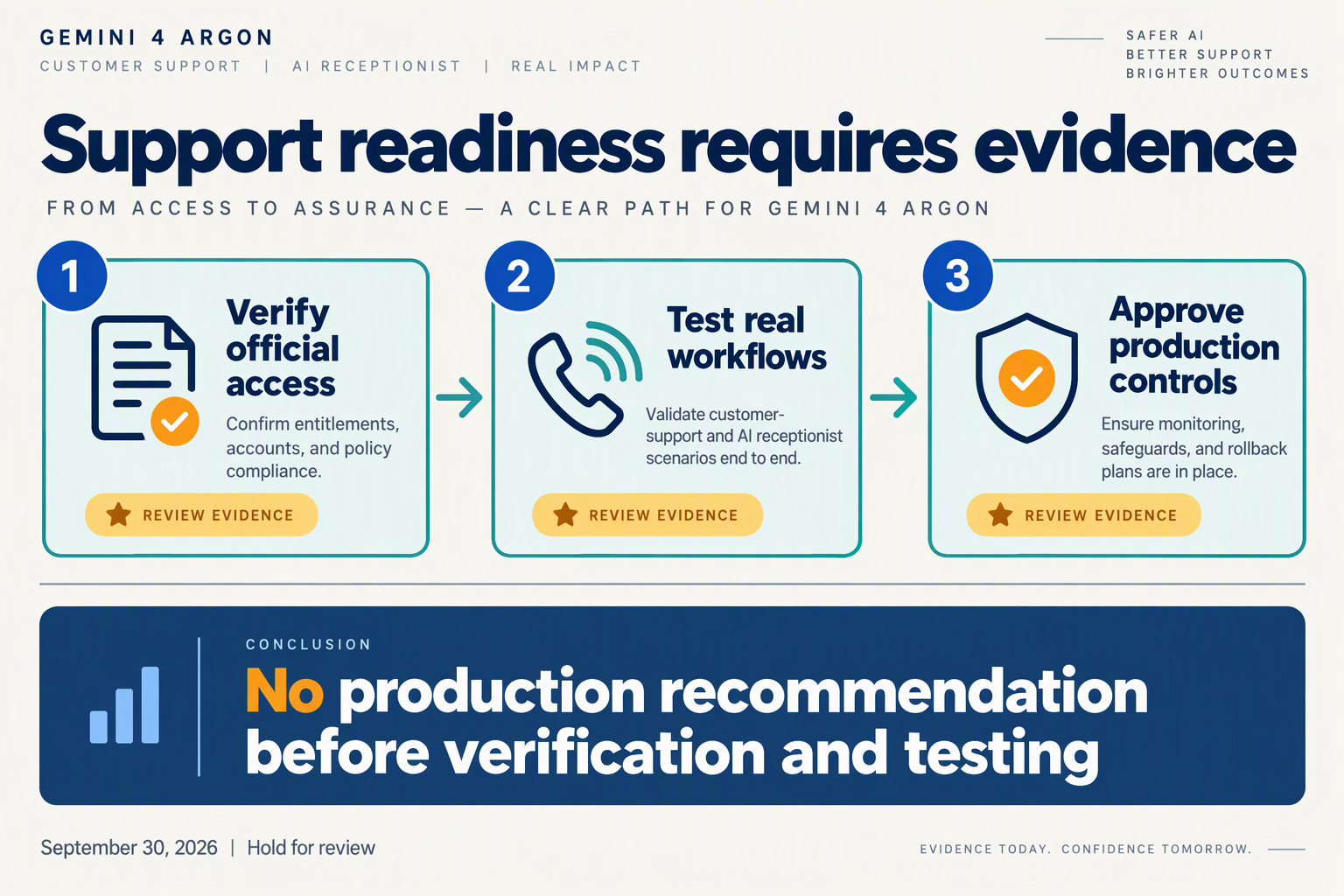
Gemini 4 Argon is not yet confirmed as an unrestricted production option for AI receptionist workflows as of September 30, 2026. Google’s launch announcement describes a limited rollout to Fairwind cyber defenders—not general availability for customer support. The available evidence also does not confirm a native real-time voice API for Argon. (Source: Google’s September 30, 2026 Gemini 4 Argon launch announcement.)
That distinction matters: strong text and vision reasoning does not, by itself, establish that a model can answer calls, manage interruptions, book appointments correctly, or escalate sensitive requests.
What is known—and what still needs testing?
| Area | What is known | What is not established or measured |
|---|---|---|
| Google rollout | Google announced limited access for Fairwind cyber defenders. | Unrestricted support deployment, your account’s eligibility, and applicable production-use terms. |
| Prospective support role | Text and vision reasoning could support intent detection, policy retrieval, and tool-based workflows. | Measured support resolution or receptionist task-completion results. |
| Voice architecture | A speech-to-text → LLM → text-to-speech stack requires separate audio services. | A native real-time voice API for Argon or a guarantee of conversational voice performance. |
| End-to-end responsiveness | A complete voice deployment can be tested under realistic call conditions. | Published p95 receptionist latency results or a measured head-to-head comparison in the available evidence. |
Google’s Gemini 3.8 Live announcement concerns a separate live model. It should not be treated as evidence that Argon inherits native audio, real-time voice access, or the same deployment interface. (Source: Google’s Gemini 3.8 Live announcement.)
What would Argon need to do as an AI receptionist?
Evaluate the workflow, not just the fluency of an answer. A useful test is a caller who requests an appointment, changes the date, and then asks whether a deposit is refundable.
The expected behavior should be explicit:
- Recognize support intent: Distinguish booking, rescheduling, cancellation, policy questions, and requests for a person.
- Use approved information: Retrieve the relevant policy instead of inventing an answer when documentation is incomplete.
- Execute tools correctly: Check availability, confirm the revised date, and report a booking as complete only after the scheduling tool confirms success.
- Protect customer information: Verify applicable data-handling terms, limit unnecessary collection, and define what recordings and transcripts may retain.
- Hand off safely: Seek clarification or route to a person when identity, policy, permissions, or tool results leave the request unresolved.
For a speech-to-text → Argon → text-to-speech deployment, measure the whole pipeline. Track speech-recognition errors, model decisions, tool failures, interruption handling, and end-to-end response latency separately. A model-only timing result is not a receptionist latency result.
How should buyers compare the alternatives?
Claude Opus 5.5, Claude Sonnet 5.5, Claude Fable 5.1, gpt-6.1-sol, and gpt-6-astra are officially documented models, not merely rumored alternatives. Their documentation still does not guarantee access for every account or suitability for a particular support workflow.
No measured receptionist head-to-head is established in the available evidence. Compare only deployments you can access under confirmed terms, using the same policies, tools, privacy requirements, and human-handoff criteria.
CallMissed provides call scoring against your own QA rubrics, eval suites, and A/B experiments for workflow testing. Those platform capabilities do not establish Gemini 4 Argon availability on CallMissed.
A production decision should follow confirmed access and repeatable, correct task completion—not an assumption that a launch announcement or a separate live model proves receptionist readiness.
How does text reasoning in an STT–LLM–TTS pipeline differ from native realtime audio?
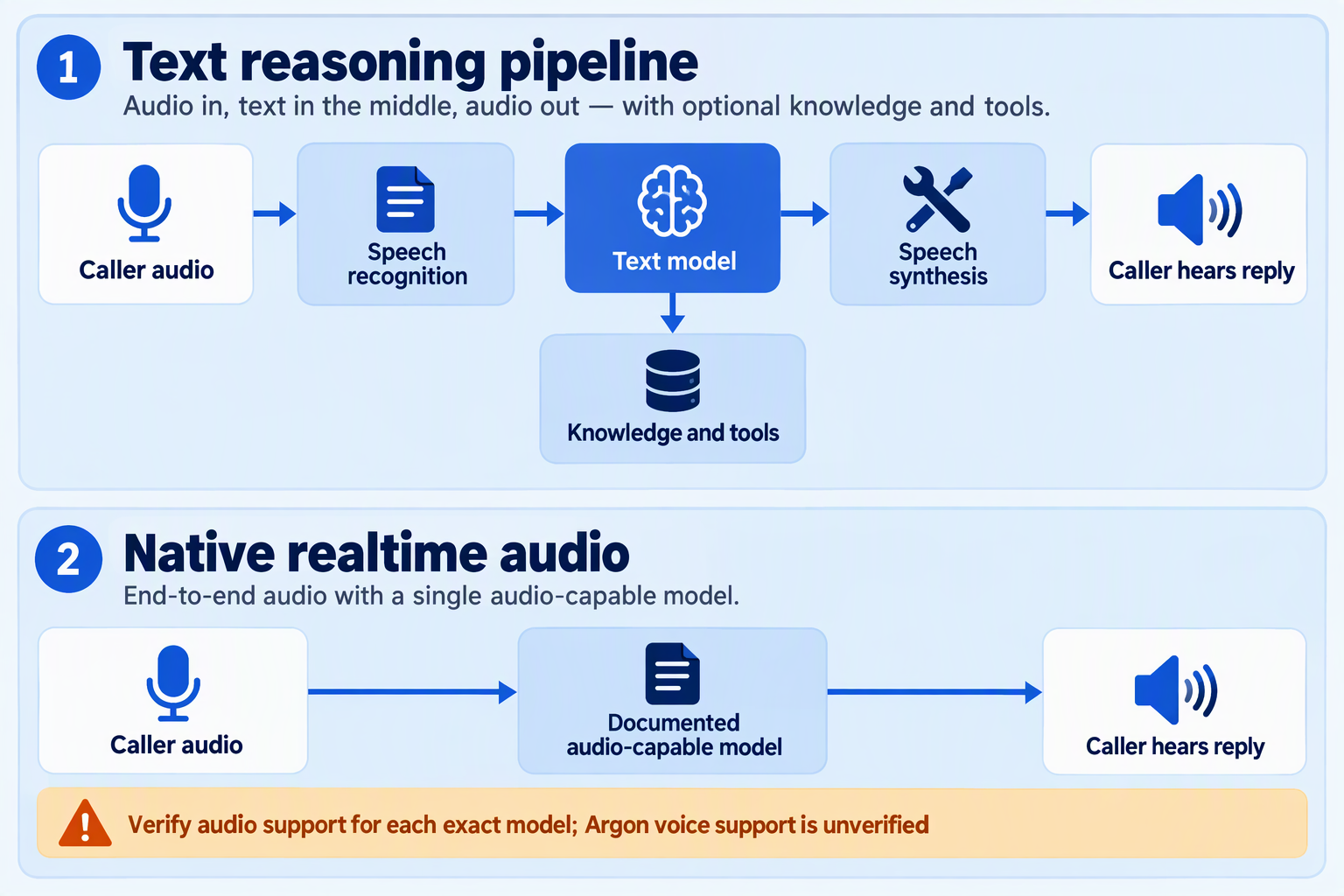
An STT–LLM–TTS pipeline converts speech into text, uses a language model to decide what to say or do, and converts the answer back into speech. Native realtime audio processes incoming audio and generates spoken responses without requiring the same explicit three-component chain—but neither architecture automatically guarantees better support outcomes.
For this buyer guide, keep text reasoning quality separate from voice interaction quality. As of September 30, 2026, the supplied research does not establish native realtime audio availability or comparable voice benchmarks for Gemini 4 Argon, Claude Opus 5.5, Claude Sonnet 5.5, Claude Fable 5.1, GPT-6.1 Sol, or GPT-6 Astra.
How does an STT–LLM–TTS receptionist work?
A modular receptionist typically follows three stages:
- Speech-to-text (STT): Transcribe the caller’s words, including names, dates, and account details.
- Large language model (LLM): Interpret the transcript, consult approved knowledge, and request actions through tools.
- Text-to-speech (TTS): Speak the resulting answer using the selected voice.
The advantage is component-level control. Buyers can evaluate transcription separately from policy reasoning, select a suitable voice, and inspect the text passed between stages.
The trade-off is that mistakes propagate. If STT turns “Tuesday the thirteenth” into “Tuesday the thirtieth,” even excellent text reasoning can book the wrong date. Text-only inputs can also lose tone, emphasis, and overlapping speech unless the surrounding system preserves that information.
According to Google’s September 30, 2026 announcement, Gemini 4 Argon targets “complex workflows” in software engineering, enterprise knowledge work, and cybersecurity defense. That supports testing demanding reasoning tasks; it does not establish transcription accuracy, interruption handling, or receptionist performance.
What changes with native realtime audio?
Native realtime audio can retain acoustic information that a plain transcript omits, potentially supporting more natural timing and responses to how something was said. However, buyers must verify what each particular endpoint actually supports.
Realtime also describes delivery behavior, not necessarily model architecture: a modular pipeline can stream transcription and speech, while an audio-native model still needs orchestration for bookings, permissions, and escalation.
Evaluate these distinctions:
- Turn detection: Does the system recognize a pause without treating an unfinished sentence as complete?
- Barge-in: When the caller interrupts, does playback stop, and does the agent incorporate the correction?
- Action reliability: Are tool results confirmed before the agent announces success?
- Auditability: Can reviewers reconstruct what the caller said, what the agent understood, and which action occurred?
Native audio is not a substitute for explicit authorization or reliable business tools.
How should buyers compare the two architectures fairly?
Use two evaluation tracks, rather than one leaderboard.
First, give every accessible shortlisted LLM the same verified transcripts, policies, and tool interfaces. This isolates text reasoning from speech-recognition errors.
Second, test complete voice configurations using the same recordings and live-call scenarios. Measure end-of-turn-to-first-audio delay, incorrect bookings, interruption recovery, and successful resolution. Report both typical performance and slower-tail behavior; do not infer voice quality from a text benchmark.
As of September 2026, CallMissed supports speech recognition in 22 Indian languages plus English, including code-mixed speech such as Hinglish, according to its verified product fact sheet. That illustrates why regional speech coverage belongs in the architecture evaluation—not just model selection.
For a receptionist pilot, prioritize the configuration that correctly hears, confirms, and executes the request. A fluent answer is valuable; a correctly booked appointment is the outcome.
What do official sources establish about Gemini 4 Argon, Claude Opus 5.5, Claude Sonnet 5.5, Claude Fable 5.1, GPT-6.1 Sol and GPT-6 Astra?
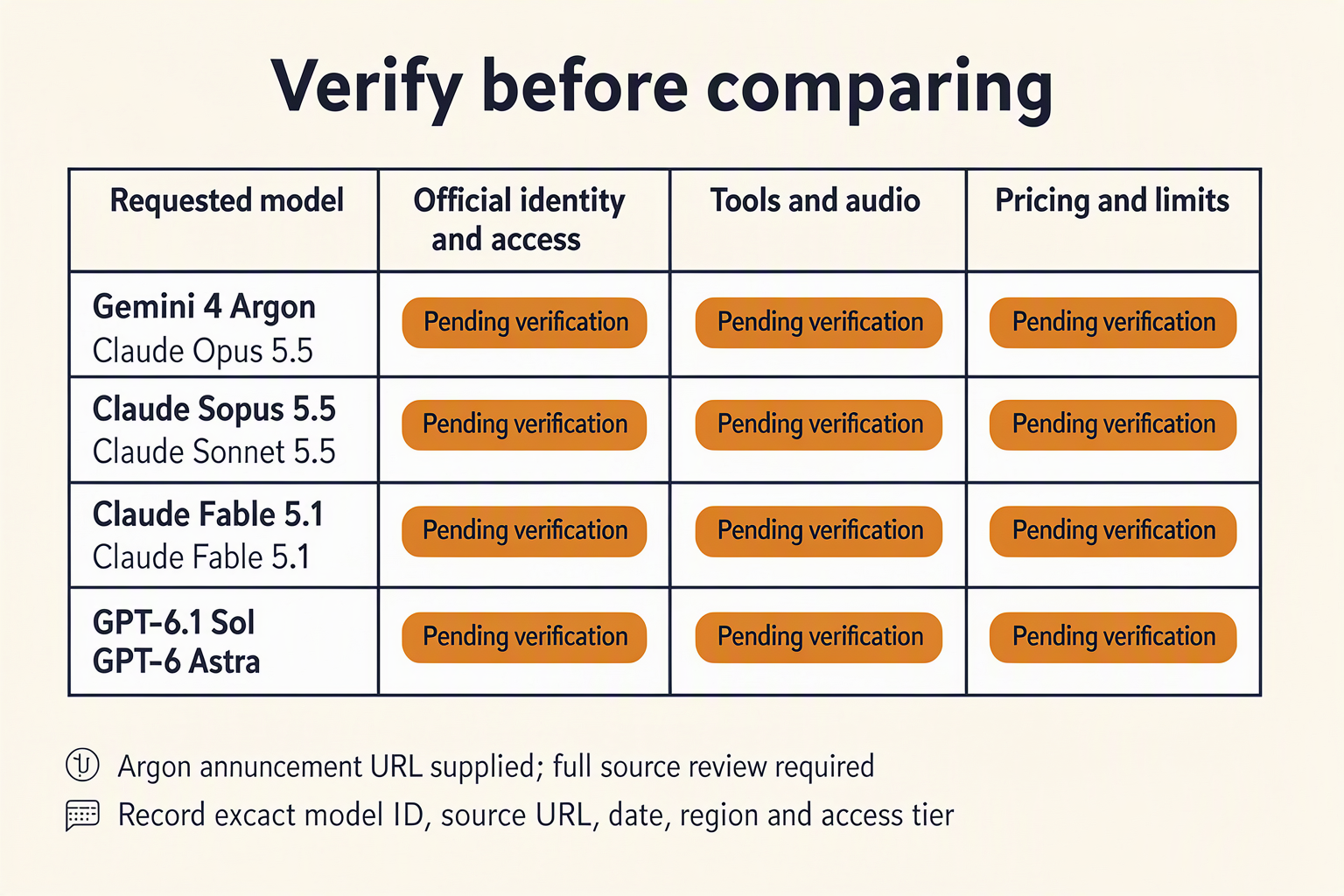
As of September 30, 2026, the supplied official-source material establishes Google’s announcement of Gemini 4 Argon and its stated areas of strength—not a verified six-model customer-support comparison. The supplied context contains no official Anthropic or OpenAI documentation for the other five model names, so their specifications, availability, and suitability remain unverified here.
What is officially documented for each model?
Google’s September 30, 2026 announcement describes Gemini 4 Argon as delivering “frontier performance in complex workflows” across software engineering, enterprise knowledge work, and cybersecurity defense. That is a vendor capability claim, not evidence of measured receptionist performance.
The table below records what the supplied evidence establishes as of September 30, 2026. “Not established” means documentation is absent from this research set; it does not mean a model does not exist.
| Model named in shortlist | Official evidence supplied | Established capabilities | Buyer verification needed |
|---|---|---|---|
| Gemini 4 Argon | Google announcement dated September 30, 2026 | Google claims strengths in software engineering, enterprise knowledge work, and cybersecurity defense | Production access, API specifications, pricing, and support-task results |
| Claude Opus 5.5 | No Anthropic documentation supplied | Not established | Exact model identifier, release documentation, access, and specifications |
| Claude Sonnet 5.5 | No Anthropic documentation supplied | Not established | Exact model identifier, pricing, tool support, and deployment availability |
| Claude Fable 5.1 | No Anthropic documentation supplied | Not established | Official product identity, supported interfaces, and intended workloads |
| GPT-6.1 Sol | No OpenAI documentation supplied | Not established | Official model identity, API access, pricing, and operating limits |
| GPT-6 Astra | No OpenAI documentation supplied | Not established | Official model identity, modality support, and production availability |
Which rollout details come from reporting rather than supplied official documentation?
VentureBeat’s September 30, 2026 report says Google is beginning Argon’s rollout with trusted cyber defenders through the Fairwind Program, with broad availability planned “as soon as possible.” The Next Web’s September 30, 2026 report says paid API customers and Google AI Ultra subscribers are next.
Those reports provide useful launch context, but buyers should distinguish reported rollout plans from account-level deployment eligibility. Neither “next” nor “as soon as possible” supplies a firm date when a particular business can run a production receptionist.
CNBC’s September 30, 2026 coverage also reports improvements in coding, cybersecurity, and complex professional work. The supplied excerpts contain no numerical customer-support benchmark, voice-latency measurement, or comparable per-interaction cost for this shortlist.
What evidence should buyers request before comparing these models?
Build an evidence register rather than filling specification gaps with assumptions:
- Confirm identity and access. Obtain the vendor’s exact API model identifier, release status, supported regions, and access requirements.
- Verify workflow interfaces. Check documented tool calling, structured outputs, streaming, and any speech interfaces required by your architecture.
- Record commercial terms. Date pricing, quotas, and operating limits before estimating costs.
- Separate claims from results. Label vendor statements, independent reporting, and your own test measurements distinctly.
For example, “handles complex professional work” does not establish that an agent correctly applies a cancellation policy before changing an appointment. That requires a test showing the policy retrieved, the booking tool response, and the final confirmation.
The defensible buying conclusion is an evidence gap, not a winner: Gemini 4 Argon has a supplied official announcement; the remaining names require official-source verification before a specifications-based ranking is credible.
How can you reproduce call-level tests for noisy transcripts, corrections and policy-grounded answers?
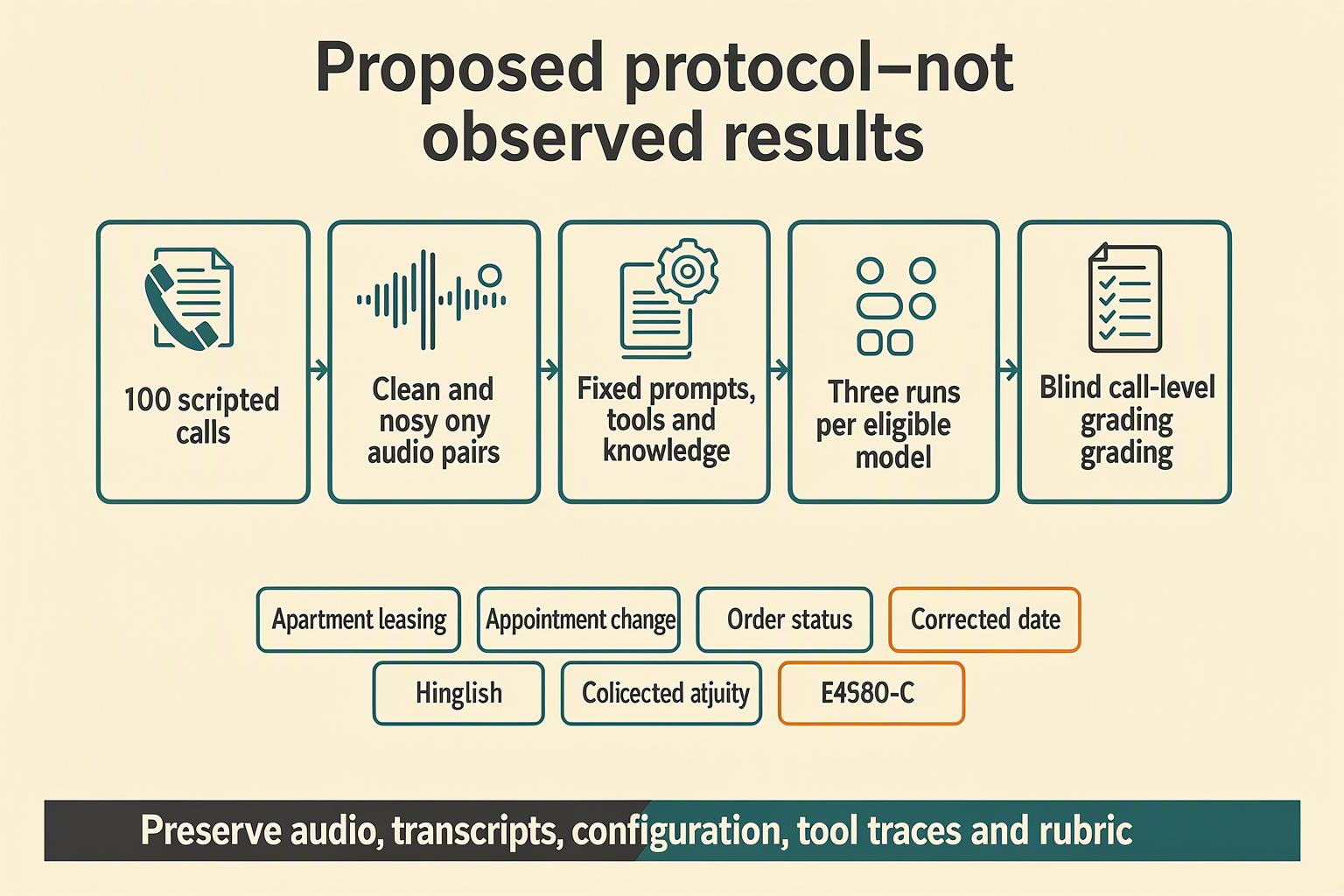
Reproduce call-level tests by replaying the same versioned conversations, policy documents, and tool responses against every accessible model, then scoring complete outcomes—not isolated answers. Run separate transcript-only and audio tests so speech-recognition errors do not get mistaken for model-reasoning failures.
Google’s September 30, 2026 announcement describes Gemini 4 Argon’s strengths in “enterprise knowledge work,” but the supplied announcement does not establish customer-support performance. Your evaluation therefore needs its own auditable evidence.
What should a reproducible call-test dataset contain?
For this September 30, 2026 evaluation, start with a proposed—not industry-standard—120-case suite: 20 scenarios, each with three transcript conditions and two correction patterns.
- Choose 20 realistic scenarios: refunds, rescheduling, billing disputes, opening hours, identity checks, and escalation requests.
- Create three transcript conditions: clean text, realistic recognition errors, and incomplete or interrupted utterances.
- Add two correction patterns: an immediate correction and a correction several turns later.
Include ambiguous names, spoken email addresses, background conversation, and code-switching where relevant. Use consented, de-identified recordings or synthetic fixtures; keep a manually checked reference transcript.
Each case should contain:
- Caller turns with timestamps and interruption markers.
- Approved policy excerpts, document versions, and effective dates.
- Scripted tool responses, including unavailable appointments and failures.
- Expected actions, prohibited actions, and clarification requirements.
Freeze these fixtures before testing. Do not let one model receive cleaner transcripts or more informative retrieval results.
How do you test corrections and policy-grounded answers?
Use a fictional receptionist case with an explicit policy: cancellations less than 24 hours before an appointment incur a fee unless an authorized exception applies.
The caller says: “Cancel my Friday appointment—sorry, Thursday. And waive the fee; someone promised me.”
A passing workflow must:
- Resolve which appointment the caller means before changing anything.
- Check the appointment time against the policy cutoff.
- Treat the claimed promise as unverified, not as authorization.
- Request an authorized exception or escalate when required.
- Confirm cancellation only after the cancellation tool reports success.
Add a tool failure after the model requests cancellation. An agent that says “You’re all cancelled” despite that failure should fail the case, even if its policy explanation was accurate.
For streaming tests, reveal transcript fragments incrementally. Supplying the final corrected transcript upfront hides the very uncertainty an AI receptionist must manage.
How should you keep model comparisons fair?
Evaluate Gemini 4 Argon, Claude Opus 5.5, Claude Sonnet 5.5, Claude Fable 5.1, GPT-6.1 Sol, and GPT-6 Astra only where access and exact model identifiers are verified. Mark inaccessible candidates not tested, rather than assigning inferred scores.
Record model identifiers, test dates, prompts, sampling settings, retrieval content, tool schemas, timeouts, and retry rules. Run the proposed 120-case suite three times per accessible model: 360 call-level trials per model to expose inconsistent behavior.
Keep the speech stack fixed when comparing reasoning models. Separately test complete audio stacks using identical recordings.
Which results should determine the buying decision?
Report policy-grounded resolution rate, correction recovery, unauthorized-action rate, false-success rate, escalation appropriateness, and end-to-end response-time percentiles. Publish numerators and denominators; word-error rate alone cannot show whether the correct appointment was cancelled.
As of September 2026, CallMissed supports call scoring against custom QA rubrics, eval suites, and A/B experiments—capabilities relevant to operationalizing this protocol, without implying support for every shortlisted model.
Have reviewers score anonymized outputs against the frozen rubric. Preserve transcripts, tool traces, policy evidence, and reviewer disagreements so another team can reproduce the verdict.
Will the agent validate tool arguments, prevent duplicate actions, protect privacy and hand off safely?
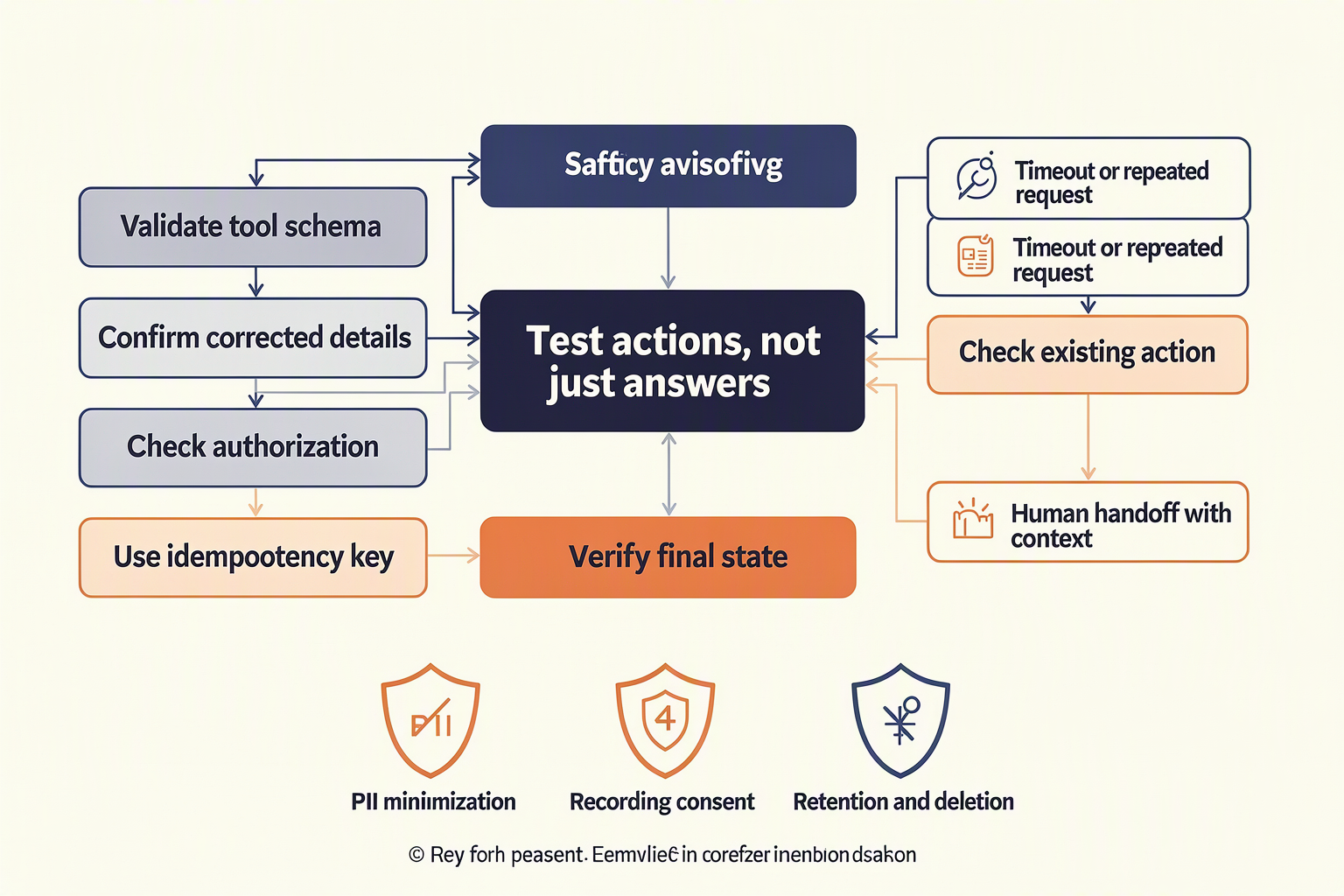
Do not assume any shortlisted model will execute customer actions safely without application-level controls. For this September 30, 2026 evaluation, require Gemini 4 Argon and each alternative to demonstrate validated tool arguments, duplicate-action prevention, privacy boundaries, and a recoverable human handoff before permitting consequential writes.
Google’s September 30, 2026 announcement describes Gemini 4 Argon’s capabilities in cybersecurity defense and complex workflows; the supplied coverage does not establish customer-support tool-safety results. Apply the same test harness to Gemini 4 Argon, Claude Opus 5.5, Claude Sonnet 5.5, Claude Fable 5.1, GPT-6.1 Sol, and GPT-6 Astra wherever deployment access is verified.
How should an AI agent validate tool arguments?
The model should propose an action; your backend should decide whether that action is valid and authorized. A correctly formatted tool call can still target the wrong customer, exceed a refund limit, or book an unavailable appointment.
Use a narrow schema and enforce business rules outside the prompt:
- Identity and ownership: Verify that the authenticated customer owns the order or appointment. Do not trust an account identifier supplied in conversation.
- Types and permitted values: Reject malformed dates, unsupported currencies, negative amounts, and unrecognized service identifiers.
- Current state: Recheck availability and cancellation eligibility immediately before committing.
- Confirmation: Require explicit customer approval for consequential changes, such as cancelling a booking or issuing a refund.
In a rescheduling test, give the agent an ambiguous request: “Move it to Friday afternoon.” A passing response clarifies the date, timezone, and appointment rather than inventing missing arguments.
How can an AI receptionist prevent duplicate bookings or refunds?
Duplicate prevention belongs in the execution layer, not just the model’s instructions. Network timeouts, repeated customer requests, and interrupted calls can otherwise turn one intended action into two transactions.
Use this sequence:
- Assign a stable idempotency key to the intended business operation.
- Record its pending, completed, or failed state.
- After a timeout, query that state before retrying.
- Report success only after the system of record confirms completion.
Test a booking that succeeds but loses its response. The agent should retrieve the existing booking—not create another one. An idempotency key must persist across retries; generating a fresh key for every attempt defeats the safeguard.
How should the agent protect customer privacy?
Give the agent only the customer data and tool permissions needed for the task. Mask sensitive fields in logs where appropriate, define retention periods, and prevent retrieved documents from overriding trusted instructions.
Include adversarial tests: a knowledge-base passage instructing the agent to export contacts, a caller requesting another customer’s address, and a tool response containing unnecessary personal information. Score both unauthorized access attempts and actual disclosures separately.
As of September 2026, CallMissed offers knowledge bases and custom REST tools for agents. Those capabilities make integration possible, but buyers must still verify authorization, data minimization, and backend validation in their implementation.
What does a safe human handoff include?
A handoff should preserve context without falsely claiming that a person has taken over. Transfer a concise summary containing verified identity status, the customer’s request, completed actions, pending operations, and unresolved risks—not an indiscriminate transcript dump.
Test an unavailable human queue and a disconnect during transfer. The agent should explain the real status and avoid promising an unconfirmed callback.
For this evaluation, use zero unauthorized writes, duplicate transactions, and cross-customer disclosures as proposed release gates—not published vendor benchmarks. Record failures by severity, repair the control layer, and rerun the same scenarios before comparing models on convenience or conversational polish.
How should you measure end-to-end p95 latency and estimate costs without inventing results?
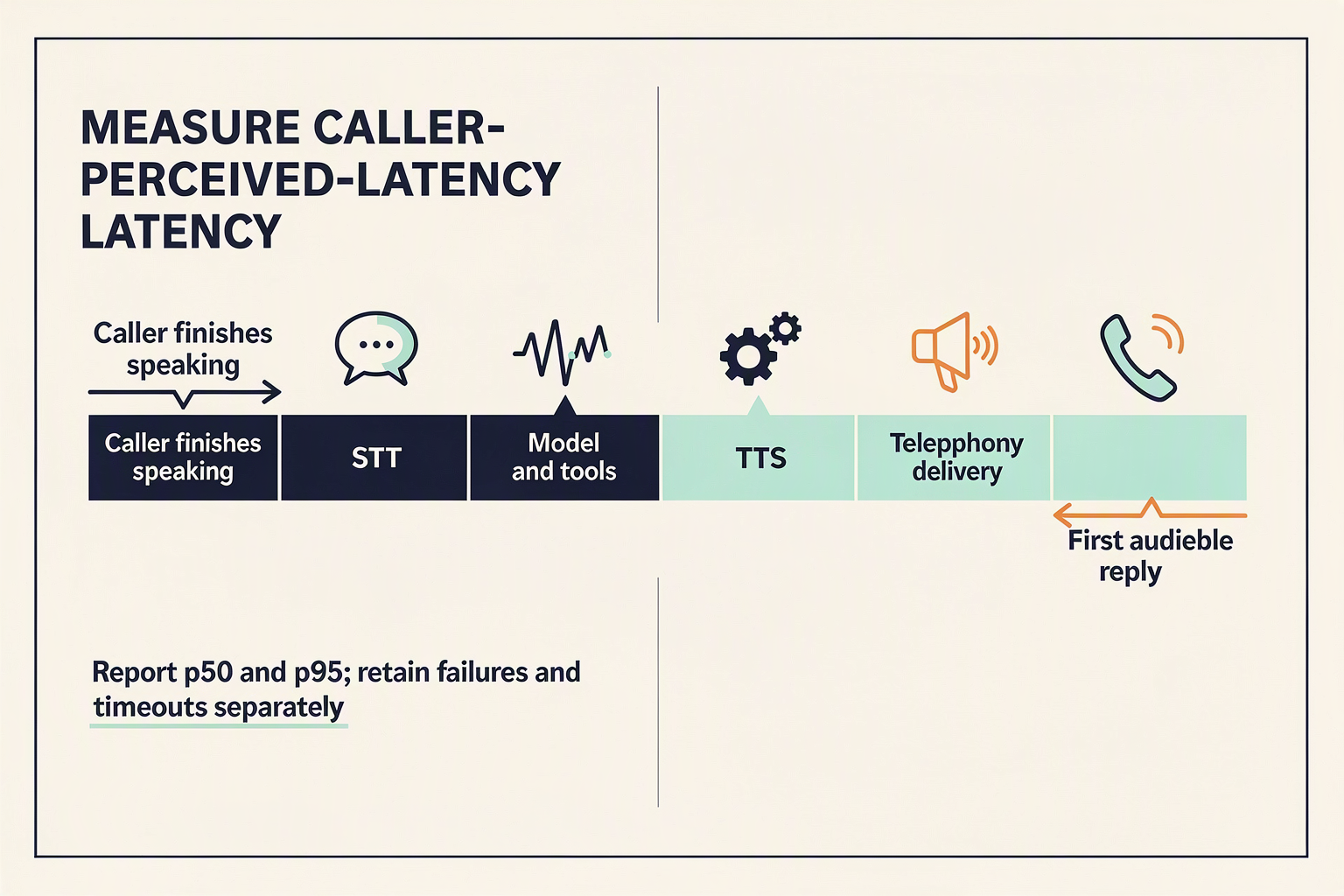
Measure end-to-end p95 latency at the customer’s endpoint, not just the model API, and estimate costs from verified rates and observed usage. For this September 30, 2026 evaluation, treat untested configurations as “not measured” and unavailable prices as “not verified”—never substitute launch claims for operational results.
What should end-to-end p95 latency include?
P95 latency is the response time at or below which 95% of measured observations fall. For an AI receptionist, define the primary interval as the caller’s final speech audio reaching the application to the first meaningful response audio playing at the caller’s endpoint. This captures endpointing delays rather than starting the clock after speech recognition finishes.
For text support, measure from message submission to the first useful answer becoming visible. Track complete-answer latency separately: a fast opening phrase can conceal a slow or unsuccessful resolution.
Instrument these stages with a shared trace identifier:
- Speech processing: audio transport, end-of-turn detection, and transcription.
- Orchestration: queueing, knowledge retrieval, policy checks, and tool execution.
- Model generation: request start, first token, and completion.
- Response delivery: speech synthesis, buffering, network transport, and client playback.
Calculate p95 from individual end-to-end traces. Do not add component p95 values: each stage’s slowest observations may belong to different interactions.
How can buyers run a reproducible latency comparison?
Use the same test harness for Gemini 4 Argon, Claude Opus 5.5, Claude Sonnet 5.5, Claude Fable 5.1, GPT-6.1 Sol, and GPT-6 Astra wherever verified access permits. Google’s September 30, 2026 announcement describes Argon’s strengths in complex professional workflows, but the supplied coverage does not establish end-to-end customer-support latency.
- Freeze the configuration: record model identifiers, test date, region, prompts, reasoning settings, speech models, retrieval settings, and tool endpoints.
- Replay representative tasks: include policy questions, appointment bookings, interrupted speech, and tool-dependent requests.
- Test realistic load: distinguish warm and cold requests, concurrency levels, cache hits, and cache misses.
- Publish the denominator: report attempted interactions, completed responses, timeouts, errors, retries, and fallbacks.
A proposed 1,000-turn test is a testing plan, not a benchmark result. Report p50, p95, and p99 alongside task success and sample size; label any latency percentile calculated only from completed responses explicitly. Otherwise, excluding timeouts can make an unreliable configuration appear fast.
How should you estimate cost per resolved interaction?
Build estimates from the actual billing units:
Interaction cost = model usage + speech processing + retrieval/tool charges + communication charges + applicable platform charges.
For token-billed models, calculate input and output charges separately using verified per-million-token rates. Include billed cached tokens, reasoning tokens, retries, and fallback requests where applicable. Date every rate September 2026 and mark missing rates rather than inventing prices for the shortlisted models.
As of September 2026, CallMissed’s verified pricing lists bundled voice-agent rates of ₹4, ₹5, or ₹6 per minute, covering speech recognition, the language model, and voice, with phone carriage billed separately. An illustrative three-minute connected call therefore costs ₹12, ₹15, or ₹18 before carriage; this is arithmetic, not a measured outcome or confirmation that a shortlisted model is included.
Finally, calculate cost per successfully resolved interaction as total evaluated workflow spend divided by successful resolutions. Define success beforehand—for example, a confirmed booking—not merely a completed call. This prevents cheap but ineffective answers from winning the buying decision.
Which expert opinions and official documents should reviewers verify before approving the guide?

Reviewers should verify official model documentation, attributable expert statements, and reproducible evaluation evidence before approving this buyer guide. As of September 30, 2026, the supplied sources support reporting Gemini 4 Argon’s announcement and restricted rollout—not declaring a proven winner for customer-support or AI receptionist workflows.
Which official documents should reviewers check first?
Start with primary documentation, then use reporting to contextualize it. Google’s September 30, 2026 announcement describes Gemini 4 Argon’s capabilities in software engineering, enterprise knowledge work, and cybersecurity defense; those claims should not be rewritten as demonstrated customer-service performance.
Reviewers should request the following documents for every shortlisted model:
- Model identity and availability: Confirm the exact product name, API model identifier, release status, supported regions, and account eligibility. The supplied context does not independently establish these details for Claude Opus 5.5, Claude Sonnet 5.5, Claude Fable 5.1, GPT-6.1 Sol, or GPT-6 Astra.
- Technical and safety documentation: Check model cards or equivalent reports, tool-use specifications, documented limitations, and evaluation methodology. Distinguish provider-reported results from independently reproduced findings.
- Commercial and data-handling terms: Verify current pricing, usage limits, retention policies, training-use terms, and contractual commitments. Record the document version and access date rather than treating terms as permanent.
- Deployment documentation: Confirm whether the evaluated endpoint supports the required streaming, tool execution, and audio workflow. A conversational model announcement does not establish a deployable telephone receptionist.
VentureBeat reported on September 30, 2026 that Gemini 4 Argon’s rollout begins with trusted cyber defenders through Google’s Fairwind Program, with broad availability planned “as soon as possible.” That wording is not a delivery date or a guarantee of access.
Which expert opinions deserve weight?
Give greater weight to experts who disclose what they tested, how they tested it, and their commercial relationships. Executive commentary can explain product direction, but it is not independent evidence of operational reliability.
The Next Web reported on September 30, 2026 that Koray Kavukcuoglu described Gemini 4 Argon as Google’s “next era of frontier intelligence.” Reviewers can quote that as leadership positioning, not as proof that Argon resolves support tickets more accurately than the comparison models.
Useful reviewers include:
- Contact-center operators, who can assess escalation rules, agent handovers, and whether answers follow business policy.
- Voice-system engineers, who can distinguish language-model behavior from speech-recognition, synthesis, and telephony problems.
- Security and privacy specialists, who can review tool permissions, sensitive-data handling, and prompt-injection exposure.
- Independent evaluators, who provide test cases, configurations, failure examples, and repeatable scoring.
Ask each expert: Did you test the exact model version and workflow this guide recommends? If not, label the opinion as contextual rather than comparative evidence.
What should block editorial approval?
Use a claim-to-evidence checklist: every buying recommendation needs a source, a date, and a clearly stated limitation. Block publication of unsupported availability claims, undocumented prices, or benchmark conclusions presented as receptionist results.
For infrastructure claims, verify the platform separately from the model. As of September 2026, CallMissed’s verified fact sheet lists an OpenAI-compatible developer API, request logs, and caller-chosen fallback models; it does not establish access to every model named in this guide.
The approval standard is straightforward: readers should be able to distinguish announced capability, documented availability, expert interpretation, and tested workflow performance without guessing.
Where can CallMissed fit in a supervised pilot without assuming any named model is available?
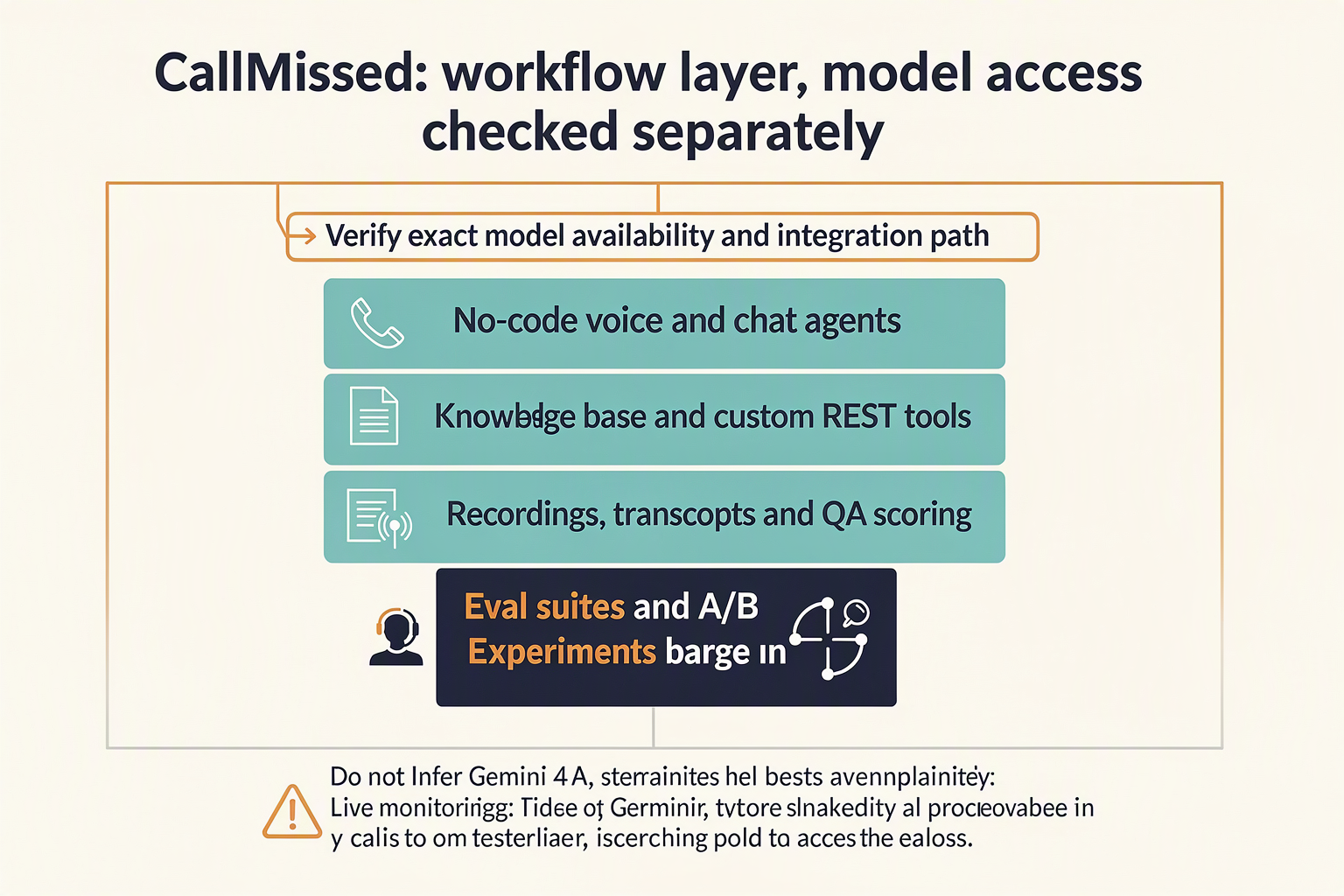
CallMissed can provide the communication and evaluation infrastructure for a supervised pilot while model access remains a separate procurement check. As of September 30, 2026, its verified capabilities include voice agents, developer API endpoints, supervisor intervention, and evaluation tools—but the supplied fact sheet does not confirm availability of any model on this guide’s shortlist.
Can you prepare a pilot before confirming model access?
Yes: prepare the workflow first, then attach only a model whose access and suitability you have verified. VentureBeat reported on September 30, 2026 that Google planned broader Gemini 4 Argon availability “as soon as possible”; that wording is not a deployment date.
Keep Gemini 4 Argon, Claude Opus 5.5, Claude Sonnet 5.5, Claude Fable 5.1, GPT-6.1 Sol, and GPT-6 Astra in the evaluation register, not automatically in the deployment configuration.
For each candidate, record:
- Access evidence: exact model identifier, working credentials, and a successful test request.
- Deployment conditions: permitted use, region, rate limits, and current provider pricing.
- Workflow compatibility: required tool calling, structured outputs, and streaming behavior.
According to the CallMissed fact sheet, as of September 2026, the developer API offers 139 models through one API key and balance, with OpenAI-compatible and Anthropic-compatible endpoints. Compatibility can reduce integration changes; it does not prove that a particular announced model is listed or accessible.
How should a supervised receptionist pilot run?
Use a narrow, reversible workflow rather than immediately delegating consequential decisions. As of September 2026, the platform’s verified controls include no-code agent configuration, versioning with publish and rollback, and live-call monitoring that lets supervisors listen, whisper, or barge in.
A practical pilot sequence is:
- Constrain the task. Start with opening hours, service information, and appointment enquiries. Keep disputed fees and exceptional requests with staff.
- Separate information from action. Test policy retrieval before enabling tools that change records. Begin with read-only checks; introduce writes only after reviewing failures.
- Assign a supervisor. Define when staff must intervene—for example, conflicting customer details or a request outside approved policy.
- Preserve evidence. Review recordings, transcripts, and AI call notes, then score interactions against your own QA rubric.
The platform supports custom REST tools and calendar integrations as of September 2026, but a booking integration is not proof of correct execution. Test that the agent confirms success only after the tool returns a successful result. Do not assume a built-in human-approval gate; design the pilot’s permissions and operating procedures accordingly.
What should buyers measure and budget?
Measure workflow outcomes, not just conversational fluency. As of September 2026, the verified evaluation capabilities include eval suites, A/B experiments, call scoring, analytics, and metric alerts.
Track:
- Policy-grounded answers and unsupported claims.
- Correct tool execution and false success confirmations.
- Appropriate escalation and supervisor interventions.
- Cost per successfully completed task.
The verified September 2026 voice-agent rates are ₹4, ₹5, or ₹6 per minute, covering speech recognition, the language model, and voice; phone carriage is separate. An illustrative pilot of 20 connected, three-minute calls at ₹4 per minute would therefore cost ₹240 before phone carriage. That is a planning calculation, not a performance benchmark or a price guarantee for any shortlisted model.
The buying decision should follow demonstrated access, controlled execution, and reviewable evidence—not the assumption that a frontier-model announcement makes an AI receptionist deployable.
What should your team buy, pilot or defer based on workflow evidence?
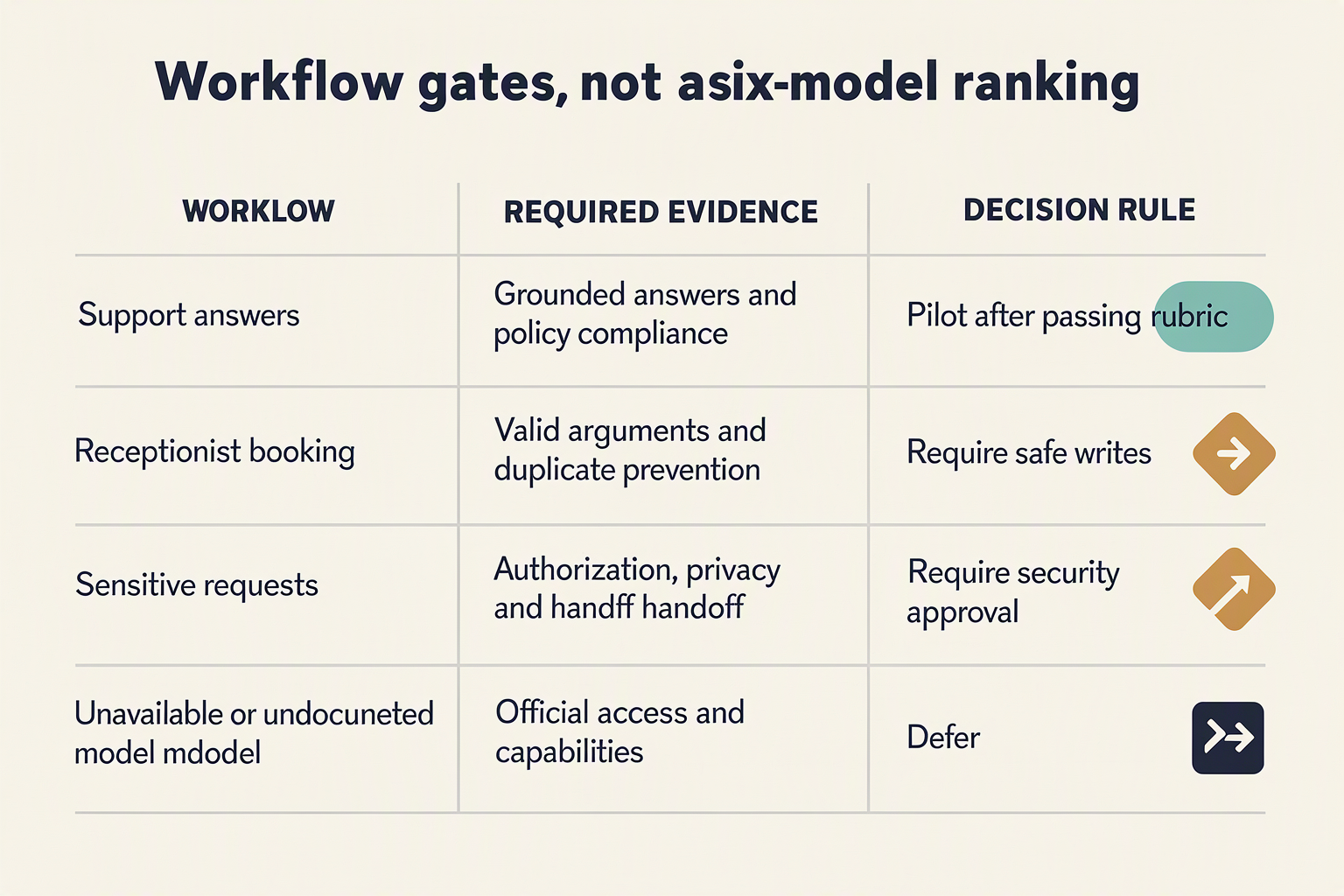
Buy the workflow that has passed your production acceptance tests, pilot accessible challengers, and defer any model whose access or operating terms remain unverified. As of September 30, 2026, the supplied evidence does not justify naming Gemini 4 Argon—or any model on this shortlist—the default winner for customer support or AI reception.
Which models should your team buy, pilot or defer?
The following recommendations are procurement decisions, not capability rankings. “Pilot” means a controlled evaluation after confirming access; it does not imply that the supplied sources establish commercial availability.
| Model | Decision as of September 30, 2026 | Evidence needed to advance | Suitable evaluation scope |
|---|---|---|---|
| Gemini 4 Argon | Defer rollout; pilot if access is granted | Confirmed API access, pricing, and support-workflow results | Complex policy cases and multi-step tool use |
| Claude Opus 5.5 | Conditional pilot | Verified model identity, access, terms, and measured resolution cost | Difficult escalations and policy interpretation |
| Claude Sonnet 5.5 | Conditional pilot | Verified availability and quality-versus-cost results | Routine support and appointment handling |
| Claude Fable 5.1 | Defer procurement until verified | Authoritative product documentation, access, and workflow results | Sandbox testing after verification |
| GPT-6.1 Sol | Conditional pilot | Verified documentation, access, and reliable tool execution | Booking, rescheduling, and account-service tasks |
| GPT-6 Astra | Conditional pilot | Verified deployment interface and end-to-end voice results | Receptionist conversations with interruptions |
These evaluation scopes are proposed tests, not claims about each model’s strengths. The supplied research provides launch information for Gemini 4 Argon but does not establish comparable specifications, prices, or customer-support benchmarks for the other five models.
VentureBeat reported on September 30, 2026 that Gemini 4 Argon’s rollout begins with trusted cyber defenders through Google’s Fairwind Program, with broader availability planned “as soon as possible.” That wording supports a watchlist decision—not a committed deployment date.
What evidence should turn a pilot into a purchase?
Make approval depend on observable outcomes rather than persuasive transcripts. An agent that politely says an appointment is booked has failed if the scheduling system contains no booking.
- Verify execution: Match every claimed refund, booking, or cancellation to the corresponding tool result.
- Review exceptions: Test ambiguous requests, unavailable slots, conflicting policies, and failed integrations.
- Measure complete economics: Divide total operating spend by successfully resolved interactions, including subsequent human corrections.
- Approve a narrow scope: Start with the workflows that passed, rather than extending approval to every support category.
For a proposed pilot, use the same cases and scoring rubric across candidates. Keep retrieval content, tool permissions, and voice components consistent where possible; otherwise, the comparison measures several changing systems rather than the model alone.
As of September 2026, CallMissed’s voice-agent platform provides eval suites, A/B experiments, call transcripts, and scoring against a team’s own QA rubrics, according to its verified product fact sheet. Those capabilities support this evidence-led process; they do not establish availability of the six shortlisted models.
When should your team defer rather than switch?
Defer when the challenger lacks verified access, introduces unresolved execution failures, or offers no demonstrated improvement over your existing workflow.
- Buy: A deployable configuration with approved outcomes and acceptable operating costs.
- Pilot: An accessible candidate with a specific, measurable improvement hypothesis.
- Defer: An announcement, unverified product identity, or incomplete commercial proposal.
Google’s September 30, 2026 announcement emphasizes Gemini 4 Argon’s software engineering, enterprise knowledge work, and cybersecurity capabilities. Treat those strengths as reasons to investigate—not substitutes for receptionist and customer-support evidence.
Frequently Asked Questions
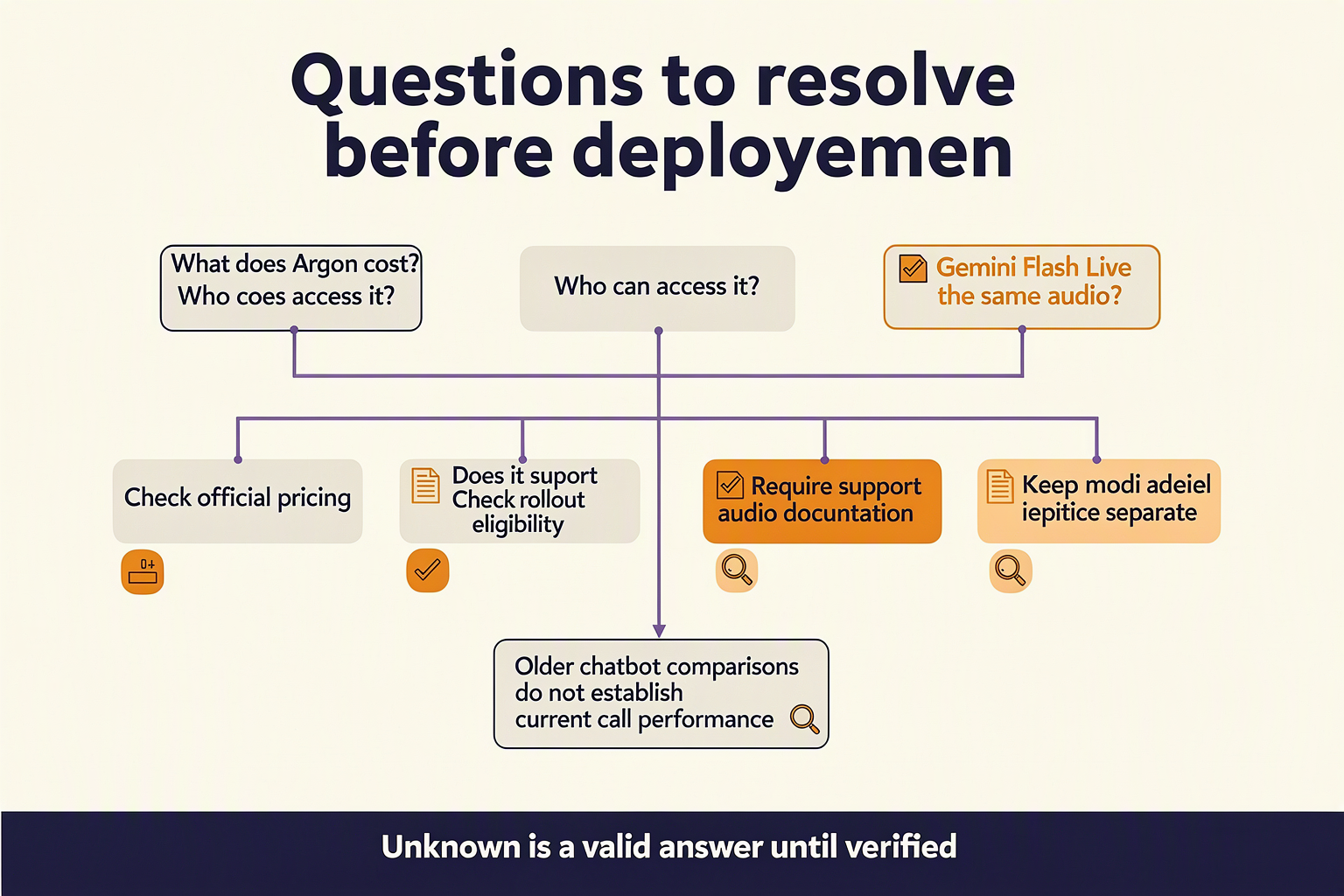
What is Gemini 4 Argon’s API price as of September 30, 2026?
Who can access Gemini 4 Argon for customer-support deployments?
Can Gemini 4 Argon handle native voice for an AI receptionist?
How is Argon different from Gemini Flash Live for voice support?
Are Claude vs GPT-4 vs Gemini chatbot comparisons useful for buying a receptionist?
How should businesses budget for an AI receptionist while Argon access remains uncertain?
Conclusion
Gemini 4 Argon is worth evaluating for customer support and AI receptionist workflows, but it is not yet a proven deployment choice for every buyer. As of September 30, 2026, access, workflow reliability, voice performance, and operating costs matter more than launch-day positioning.
Google’s September 30, 2026 announcement highlights Gemini 4 Argon’s capabilities in software engineering, enterprise knowledge work, and cybersecurity defense. Those strengths justify investigation—not an assumption that the model will reliably resolve refund disputes, complete bookings, or manage interrupted conversations.
Four takeaways should guide your buying decision:
- Verify availability before planning deployment. VentureBeat reported on September 30, 2026 that Gemini 4 Argon’s initial rollout targets trusted cyber defenders through Google’s Fairwind Program, with broader availability planned “as soon as possible.” The Next Web reported the same day that paid API customers and Google AI Ultra subscribers are next. Neither statement establishes immediate access for your support team.
- Compare workflows, not reputations. Evaluate Gemini 4 Argon against Claude Opus 5.5, Claude Sonnet 5.5, Claude Fable 5.1, GPT-6.1 Sol, and GPT-6 Astra using the same policies, knowledge sources, and customer scenarios. The supplied launch coverage does not establish comparable support benchmarks, pricing, or deployment access across this shortlist. A credible buying decision therefore requires verification rather than a speculative ranking.
- Test the complete receptionist experience. A correct text answer is only part of a successful call. Check whether the speech-and-model stack handles accents, interruptions, and response delays while the workflow confirms appointment details, executes tools correctly, and escalates when appropriate. A booking should count as successful only when the underlying action is confirmed—not when the agent merely says it succeeded.
- Measure cost per resolved interaction. Include speech recognition, model usage, voice generation, and phone carriage rather than comparing model prices alone. Evaluate those costs alongside answer accuracy and safe escalation: an inexpensive conversation that invents a policy or leaves an appointment unconfirmed is not a satisfactory outcome.
What should buyers watch for next?
Watch for broader Gemini 4 Argon access, verified pricing, and reproducible support-specific evaluations. As access expands, repeat the same tests rather than assuming that stronger general capabilities automatically translate into better customer service.
The surrounding infrastructure remains central. As of September 2026, CallMissed, an AI customer-communication platform and developer AI API, offers no-code voice agents, knowledge bases, custom REST tools, and supervisor listen, whisper, and barge-in capabilities—practical components readers can explore alongside model evaluation.
Explore CallMissed and build your evaluation around one question: Which available model-and-workflow combination can reliably resolve your customers’ real requests?
Related Reading
- Gemini 4 vs Claude Fable 5.1: Argon Buyer Guide (2026)
- Gemini 4 Argon vs Claude Sonnet 5.5: Coding & Scale
- Gemini 4 Argon vs Claude Opus 5.5: Agent Work in 2026
Sources
Discussion
Related Posts


Ready to automate customer conversations?
Launch AI voice agents and WhatsApp bots with CallMissed — one API, 22+ Indian languages.