WhatsApp helpdesk software: India Buyer Guide 2026



Compare WhatsApp helpdesk software for Indian B2C teams on ticket ownership, human escalation, voice continuity and total cost before buying.
WhatsApp helpdesk software: India Buyer Guide 2026
Who owns a customer’s complaint after the chatbot stops answering? WhatsApp helpdesk software should make that answer obvious: a named agent, a trackable ticket and enough context to resolve the issue without asking the customer to start again.
For Indian B2C teams choosing software in October 2026, that is the buying challenge—not simply whether a platform can send WhatsApp messages. A delivery query can become a refund dispute, move to a voice call and require an update to the customer record. If those steps sit in disconnected queues, fast chatbot replies can still produce slow resolutions.
The supplied research points toward this operational focus. Pepper Cloud’s helpdesk guide highlights agent assignment, SLA tracking, escalation and reporting alongside automation. Robylon describes six steps for turning WhatsApp conversations into trackable tickets, starting with a Business API connection rather than relying on the app. For buyers reviewing these sources in October 2026, the useful takeaway is clear: assess what happens after a message arrives, not just how quickly software acknowledges it.
There is also a cost consideration when support moves from messaging to voice. According to CallMissed’s verified product information, as of October 2026, Meta does not charge for customer-initiated WhatsApp Business calls; that does not mean AI processing or every other service component is free. A buyer should separate channel charges from platform, automation and voice-agent costs before comparing quotes.
What should Indian teams test before choosing WhatsApp helpdesk software?
This guide will help you evaluate three connected requirements:
- Ticket ownership: Can your team identify the responsible agent, priority, next action and escalation deadline—not merely see an unread conversation?
- AI-to-human escalation: Does the handoff give a person the customer’s question and relevant history, while stopping the AI from sending conflicting replies?
- WhatsApp, voice and CRM continuity: Can agents find the order details, previous interactions and follow-up tasks needed to complete the job?
As of October 2026, CallMissed reflects this direction through its official Meta Cloud API connection, live shared inbox, human-handoff queue, support tickets, built-in CRM and WhatsApp Business Calling with AI voice agents.
We will use practical buying scenarios—an order-status request, a disputed refund and a customer who switches to a call—to distinguish useful capabilities from attractive demos. You will learn what to request in a trial, which costs to clarify and how to judge whether automation reduces work or merely transfers it. The goal is clear accountability and completed resolutions, not more conversations.
Which WhatsApp helpdesk should you choose? Start with clear ownership, reliable human handoff and linked customer records
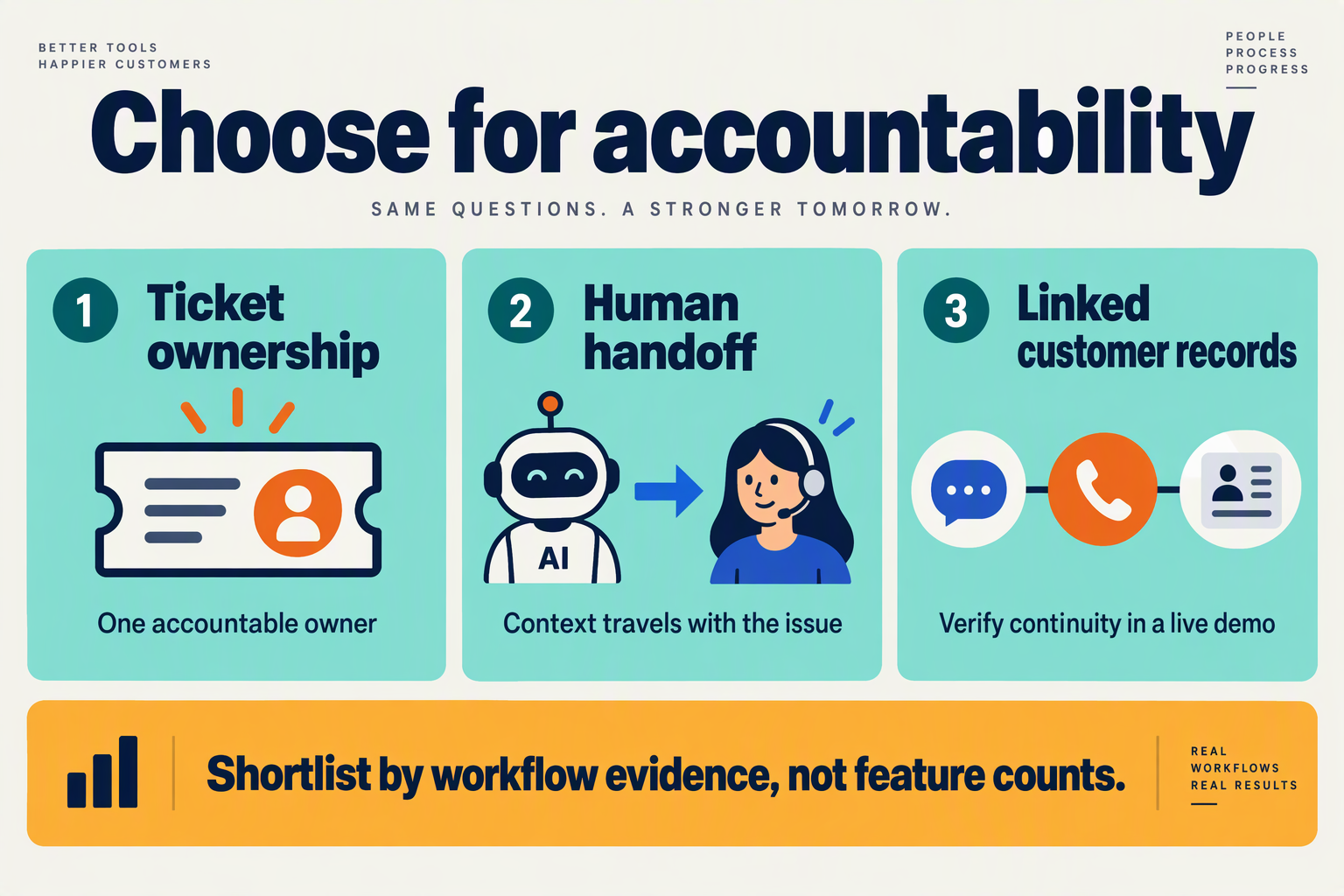
Choose WhatsApp helpdesk software that makes responsibility visible, transfers control cleanly from AI to a person, and connects support work to customer records. For an October 2026 shortlist, treat these as pass-or-fail trial requirements, not features to accept from a slide deck.
How do you test whether ticket ownership is real?
Ask each vendor to demonstrate a complaint that remains unresolved across a shift change. A shared inbox shows where messages arrive; accountable ticketing shows who must act next.
Pepper Cloud’s helpdesk guide, reviewed for this October 2026 buyer guide, identifies agent assignment, SLA tracking, escalation and reporting as evaluation areas. Translate those categories into a practical test:
- Create the case: Send a WhatsApp message about an incorrect delivery and check whether the issue becomes an identifiable support record.
- Assign responsibility: Give the case to one agent, then transfer it to another. Verify that the current owner and pending action remain visible.
- Test an unattended case: Leave the issue unresolved and inspect how the system exposes overdue work or supports escalation.
- Reopen the complaint: Have the customer message again after closure. Check whether the earlier case can be found without searching multiple inboxes.
Pass condition: A supervisor can identify the owner, outstanding action and escalation status without reading every message. Ask vendors to distinguish standard functionality from configuration work or a separate integration.
What should happen when an AI chatbot hands off to a human?
A reliable handoff transfers control and usable context, not just a notification. The receiving agent should understand why the AI stopped, what the customer needs and what has already been attempted.
YCloud’s 2026 customer-service guide describes AI agents handing conversations to humans under defined conditions using configured knowledge, workflows, escalation rules and business logic. That makes configuration quality part of the purchase decision—not an implementation detail to postpone.
Run three scenarios in the trial:
- Explicit request: The customer writes, “Please connect me to a person.”
- Unresolved dispute: The customer challenges a refund explanation after receiving an automated answer.
- Unavailable information: The AI cannot find the order or verify an answer from its approved knowledge.
For each scenario, inspect the receiving queue, available history and customer-facing response. Fail the test if the AI continues sending conflicting answers while a human is handling the thread. Also ask what happens outside staffed hours: an honest acknowledgement and a pending case are more useful than an implied immediate response.
How do you check WhatsApp, voice and CRM continuity?
Use one customer and one unresolved issue throughout the demonstration. Start with a WhatsApp delivery complaint, move to a voice interaction, then ask an agent to record the follow-up against the customer.
Check whether the agent can retrieve:
- The relevant contact and order reference.
- Earlier messages and available call records.
- The promised next action and its responsible person.
- Any duplicate customer records that could fragment the history.
As of October 2026, CallMissed’s verified product information lists a live WhatsApp shared inbox, a human-handoff queue, support tickets and a built-in CRM with per-record timelines. CallMissed also supports WhatsApp Business Calling with AI voice agents and AI call notes pushed to the CRM. These are relevant shortlist capabilities; buyers should still verify the exact workflow in a trial rather than assume every interaction links automatically.
Choose the platform that completes this end-to-end test with the least operational ambiguity. A convincing demo ends with an owned, actionable case—not merely a successful chatbot reply.
When does an Indian B2C team need a helpdesk rather than the WhatsApp Business app or a shared inbox?
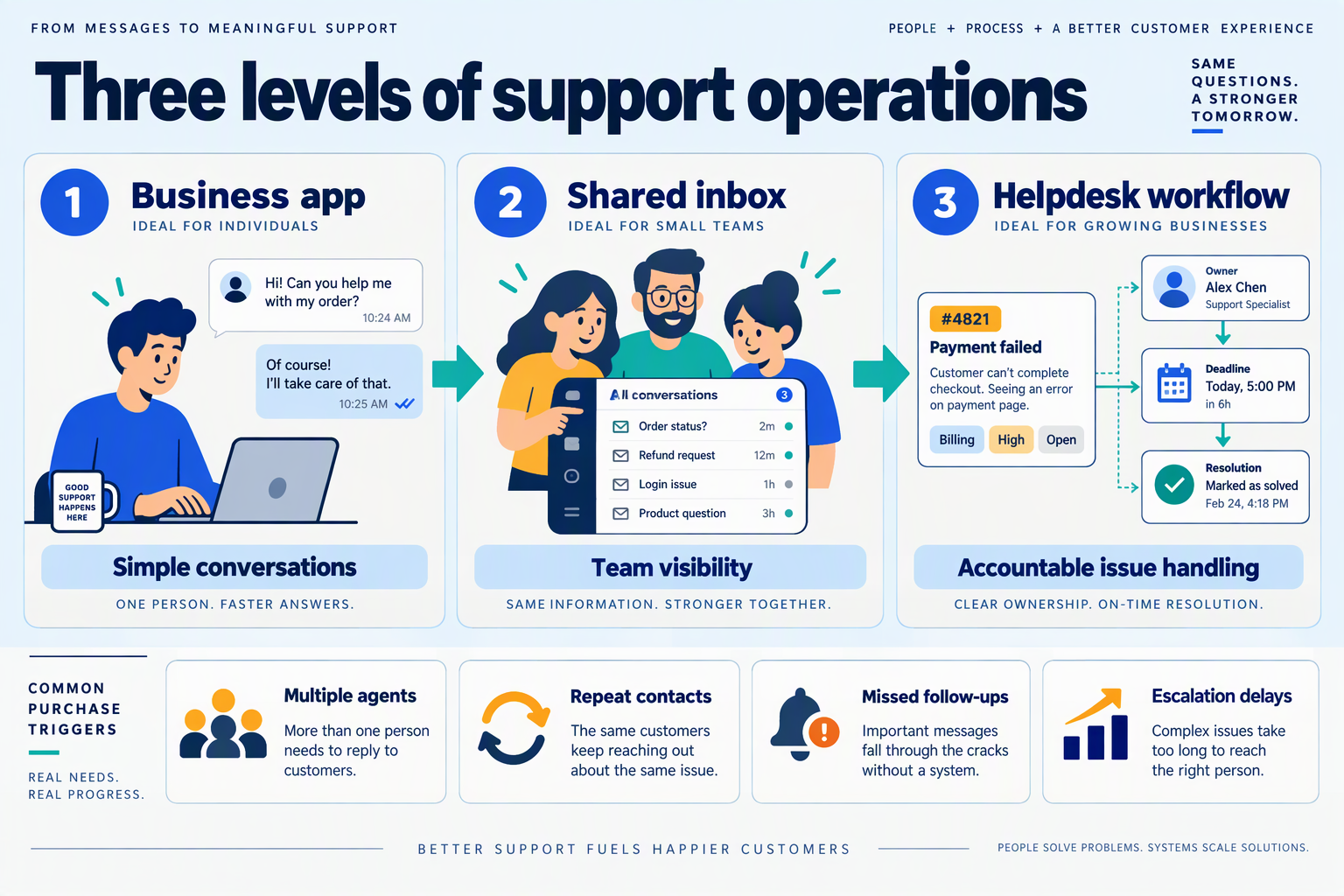
An Indian B2C team needs a WhatsApp helpdesk when resolving a customer’s issue requires accountable work beyond replying to a message: another department’s action, a deadline, an AI-to-human handoff or follow-up after a call. The WhatsApp Business app or a shared inbox may remain sufficient when the person answering can also complete the request without coordinating a separate workflow.
Is your problem message access or resolution management?
For buyers evaluating software in October 2026, the useful distinction is not simply “app versus API.” It is conversation visibility versus case accountability.
A small team answering product availability questions may need little more than access to chats and a clear working arrangement. A shared inbox becomes useful when several people need to see and respond to incoming messages. A helpdesk becomes necessary when seeing the conversation does not tell anyone what must happen next.
Look for these operational warning signs:
- Unowned follow-ups: “We’ll check with the warehouse” has no responsible person or due time.
- Shift-change losses: The next agent sees the chat but cannot identify the pending action.
- Premature closure: Support marks a conversation finished while a refund or replacement remains unresolved.
- Duplicate work: Two agents contact another department about the same complaint.
Pepper Cloud’s helpdesk guide, reviewed for this October 2026 buyer guide, identifies agent assignment, SLA tracking, escalation and reporting as evaluation criteria. Those capabilities matter because a reply and a resolution are different events.
Does your workflow need a ticket even when the chat goes quiet?
A ticket tracks unfinished work; a conversation tracks communication. Consider a hypothetical prepaid-order complaint from a customer in Jaipur: the courier marks the parcel delivered, but the customer disputes receipt.
The agent can acknowledge the complaint immediately. Resolution may still require delivery evidence, a warehouse check and an authorised refund decision. If the customer stops messaging, the obligation does not disappear.
Run this diagnostic before buying:
- Name the owner: Who remains responsible while another team investigates?
- Define the next action: What evidence or approval is needed, and by when?
- Test reopening: If the customer returns tomorrow, can the agent resume the same unresolved issue?
If those answers currently live in personal notes or spreadsheets, you need ticketing functionality—not necessarily a separate product labelled “helpdesk.” A shared inbox with genuine case-management capabilities may qualify.
When do AI escalation and voice make a helpdesk necessary?
AI creates another coordination boundary. A bot may answer an order-status question correctly but need human intervention when the customer disputes the answer, requests an exception or asks to speak to someone.
YCloud’s 2026 customer-service guide describes AI handoff under defined conditions using configured knowledge, workflows and escalation rules. The buying implication is to test what happens at that boundary, rather than accept a chatbot demonstration as proof of resolution management.
As of October 2026, CallMissed’s verified product information lists a human-handoff queue where switching off AI hands the thread to a person, alongside support tickets, SLA policies and a built-in CRM. These are relevant capabilities to evaluate together; their presence does not replace testing your workflow.
Finally, simulate a customer moving from WhatsApp to a call. If the agent must reconstruct the complaint or nobody owns the promised callback, the team has outgrown message handling. Buy for the unresolved work between interactions, not just the interactions themselves.
Which WhatsApp helpdesk capabilities deserve scrutiny in 2026?
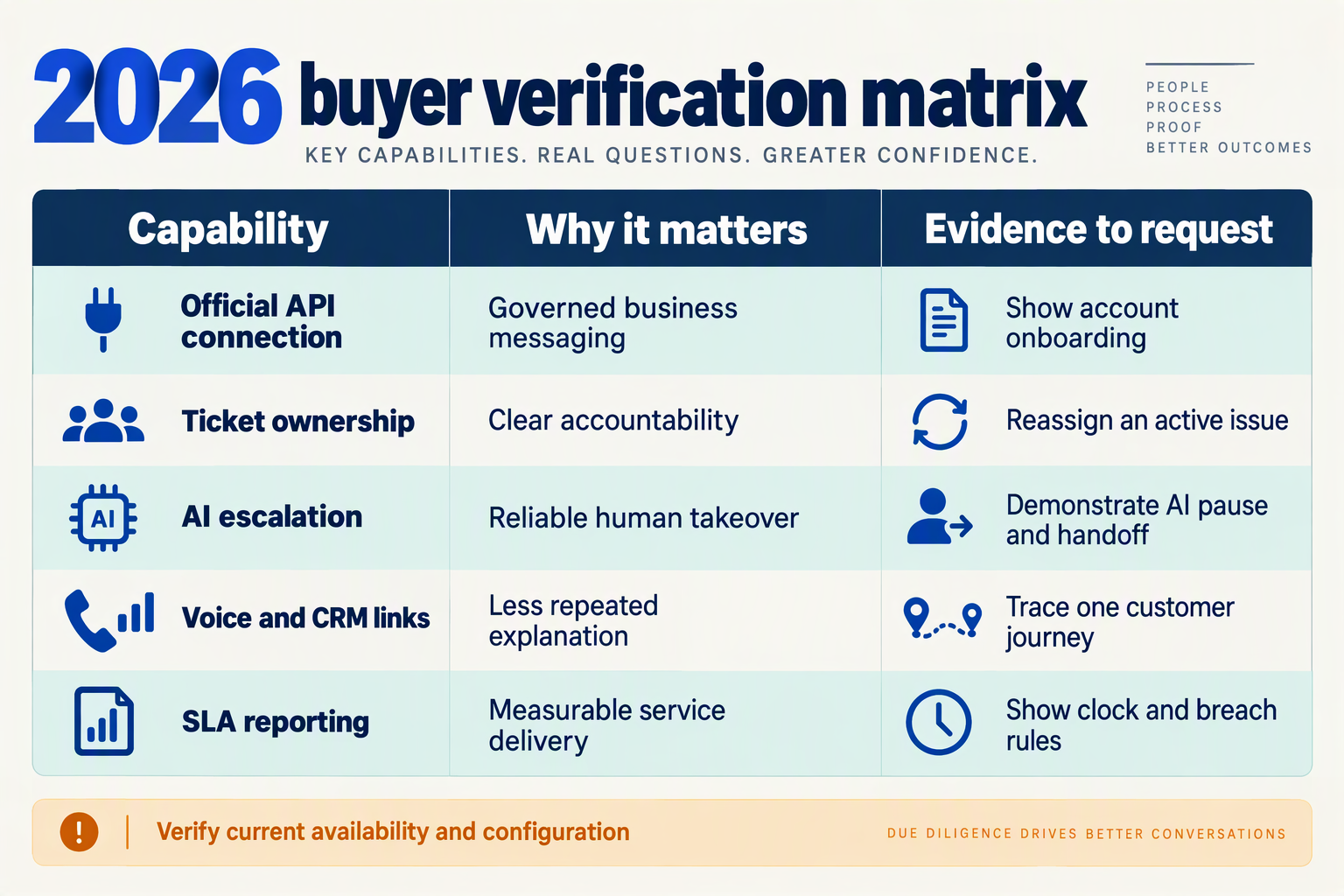
Scrutinise ownership changes, escalation behaviour, cross-channel records, language handling and resolution reporting—not just whether a WhatsApp inbox includes AI. For an October 2026 shortlist, require vendors to demonstrate each capability with a difficult customer case, including what happens when automation fails or an agent is unavailable.
Which WhatsApp helpdesk features should buyers test in a trial?
Use this evaluation table for WhatsApp helpdesk software trials in October 2026. The acceptance criteria below are buyer requirements, not claims that every platform provides them.
| Capability | Trial scenario | Evidence to request | Warning sign |
|---|---|---|---|
| Ticket ownership | Reassign a refund complaint during a shift change. | Named owner, reassignment history and an explicit next action. | Moving queues leaves the ticket unowned. |
| AI-to-human escalation | Customer disputes the bot’s answer and requests a person. | AI stops replying; the human receives the reason for escalation and conversation history. | Bot and agent send conflicting answers. |
| SLA handling | Escalate a case shortly before its deadline. | Visible deadline, overdue alert and documented pause rules. | Reassignment silently resets the clock. |
| WhatsApp-to-voice continuity | Customer calls after sending an order complaint. | Demonstration of customer matching and access to the existing case. | Agent must reconstruct the complaint. |
| CRM and commerce access | Customer has two orders and a changed phone number. | Correct contact matching, order lookup and controlled record updates. | Records merge solely because names match. |
| Resolution reporting | Customer returns after a ticket was marked resolved. | Reopened-case tracking, escalation reporting and clear metric definitions. | An automated reply counts as resolution. |
Pepper Cloud’s helpdesk guide, reviewed for this October 2026 comparison, identifies agent assignment, SLA tracking, escalation and reporting as capabilities to evaluate. The practical distinction is whether those features remain reliable during transfers, exceptions and reopened complaints.
How should you test AI-to-human escalation?
Test escalation as a state change, not a notification. A message saying “connecting you to an agent” proves little unless responsibility actually transfers and the AI stops responding.
YCloud’s 2026 customer-service guide describes AI handoff under defined conditions, using configured knowledge, workflows, escalation rules and business logic. That makes configuration part of the purchase decision: ask who maintains those rules and how changes are tested.
Run three checks:
- Explicit request: Ask for a human even when the bot knows the answer.
- Unsupported request: Ask for an exception outside the approved refund policy.
- Unavailable team: Escalate outside staffed hours and inspect the customer-facing response, queue status and follow-up responsibility.
As of October 2026, CallMissed’s verified product information lists a human-handoff queue where switching the AI off hands the thread to a person, alongside support tickets, SLA policies and a built-in CRM. Those are relevant building blocks; buyers should still verify their complete escalation workflow in a trial.
What should count as a successful cross-channel resolution?
A successful resolution completes the customer’s requested outcome without losing accountability when the channel changes. A transcript alone is insufficient if the refund decision, promised callback or responsible employee remains unclear.
For a disputed delivery, inspect:
- Identity: Did the call match the correct customer and order?
- Action: Was the promised follow-up recorded with an owner?
- Outcome: Does reopening the complaint change the resolution report?
Define these pass conditions before the demo. Otherwise, a polished conversation can conceal an unfinished support process.
Who owns the ticket when customers reopen issues, change numbers or contact two channels at once?
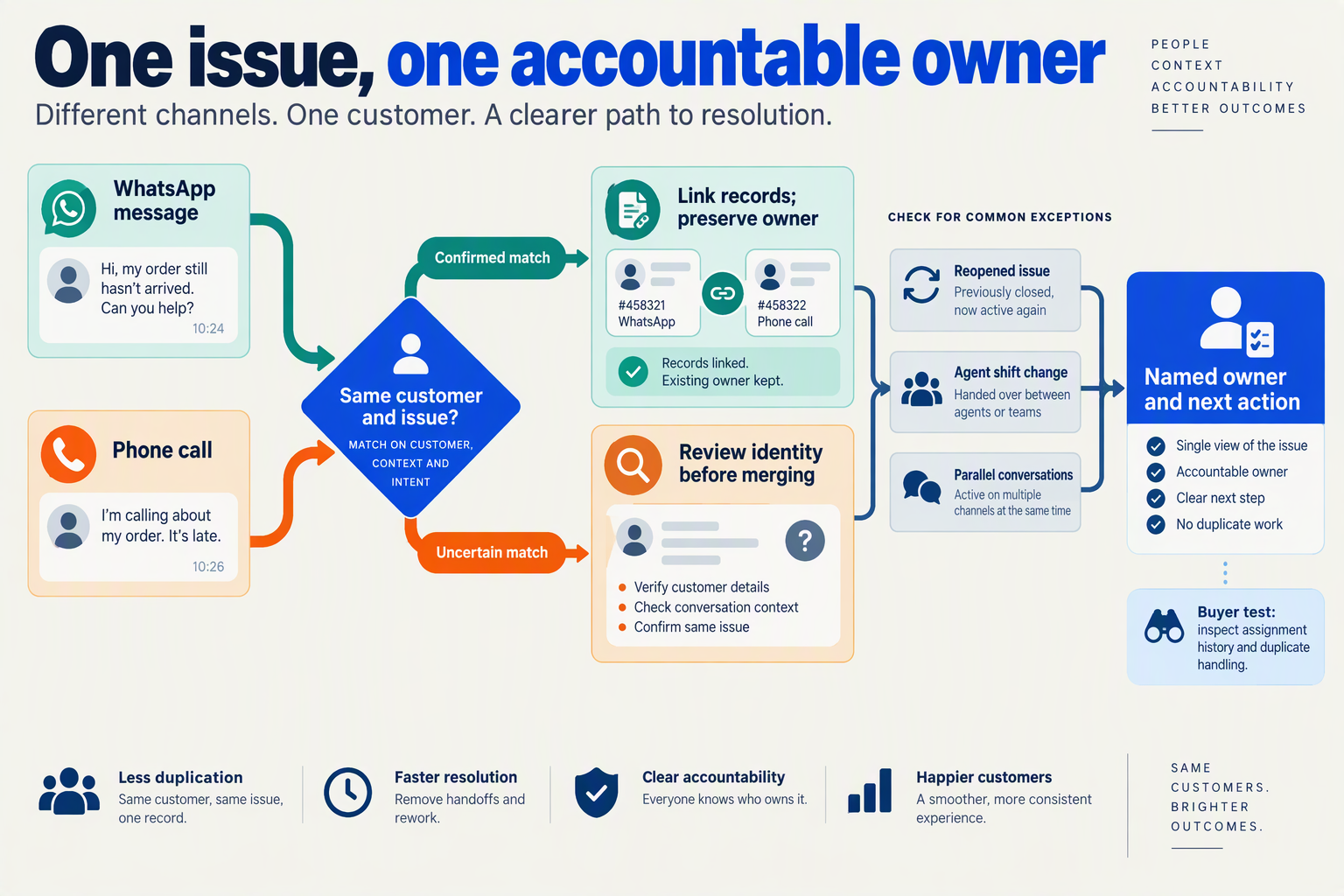
One named agent should remain accountable for the issue until another agent explicitly accepts ownership—even when the customer reopens it, changes numbers or contacts WhatsApp and voice simultaneously. For an October 2026 buying decision, test whether the helpdesk preserves that accountability across tickets, conversations and customer records rather than treating every new message as a fresh case.
Who should own a reopened WhatsApp support ticket?
A reopened complaint should follow a documented rule: return to the previous owner where practical, or enter a reassignment queue with a clear deadline. “Resolved” should describe the issue’s state, not erase its history.
Pepper Cloud’s helpdesk guide, reviewed for this October 2026 buyer guide, identifies agent assignment, SLA tracking and escalation as evaluation criteria. Apply those criteria to a harder scenario: a customer reports that a promised refund still has not arrived.
Ask the vendor to demonstrate:
- History retention: Does the reopened ticket show the original complaint, promised action and reason for closure?
- Owner availability: What happens if the previous agent is off shift or has left the team?
- SLA treatment: Does reopening restart a timer, resume it or create a separate deadline? Can managers see the earlier delay?
- AI behaviour: Can a reopened dispute stay with a human instead of restarting an unsuitable automated flow?
The important trade-off is continuity versus availability. Returning every issue to its original owner preserves context but can delay action; reassignment works only if the receiving agent gets the unresolved commitment, not merely a transcript.
How should a helpdesk handle customers who change phone numbers?
Treat a phone number as a contact method, not conclusive proof of identity. A new WhatsApp number should not automatically expose an existing customer’s order history or merge two records.
For Indian B2C teams, request a demonstration involving an order reference and an approved identity-verification step. The agent should be able to record the verified relationship between the new contact and the existing customer without losing the previous interaction history.
As of October 2026, CallMissed’s verified product information lists built-in CRM contacts, per-record timelines, custom fields and duplicate merge. Those are relevant foundations, but buyers should separately verify how identity checks, merge permissions and ticket ownership work in their intended workflow.
Test an incorrect merge, too: ask how staff recover when two family members share an order reference. Record consolidation must not silently transfer access to sensitive information.
What happens when WhatsApp and voice arrive at the same time?
Run this three-step acceptance test using a fictional refund dispute:
- Open the WhatsApp issue. Assign it to Agent A and record the next action.
- Start a voice call before resolution. Ask whether Agent B can identify the existing issue without creating a competing refund request.
- Escalate from AI to a person. Check that the human receives the unresolved question and that automated replies stop conflicting with the human response.
Robylon’s WhatsApp ticketing guide describes six steps from messages to trackable tickets, beginning with a Business API connection; for buyers reviewing it in October 2026, ticket creation is the starting point, not proof of cross-channel ownership.
Your pass condition should be simple: one accountable owner, one agreed next action and linked interactions. Separate tickets can be appropriate for genuinely different problems, but two channels discussing the same refund should not produce contradictory promises or duplicate financial actions.
How should AI escalate to a human without losing context or continuing to reply?
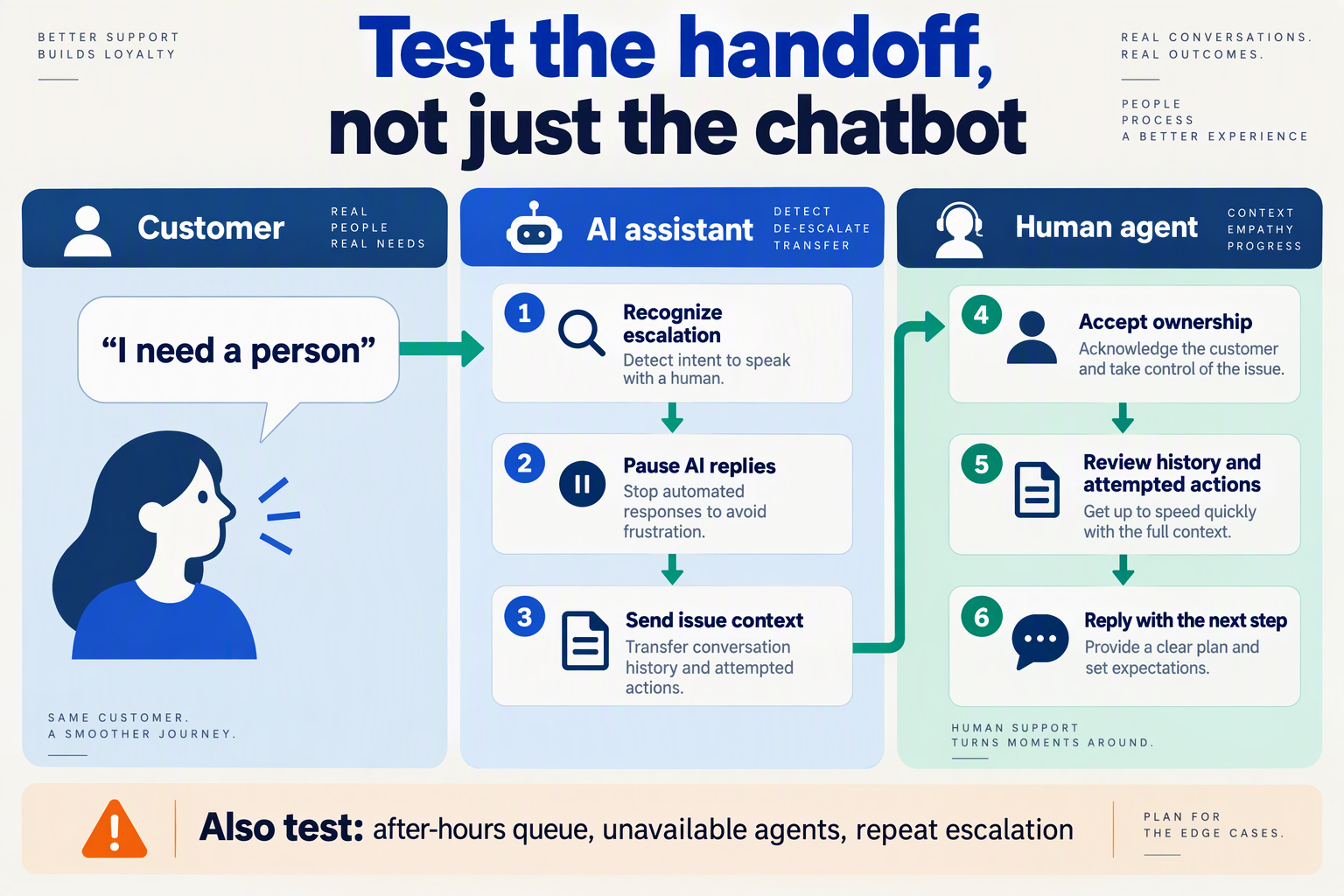
AI should escalate by transferring the conversation to a human-owned queue, preserving the evidence needed to act and stopping automated replies before the agent takes over. For an October 2026 buying decision, test this as a change in conversation control—not merely a notification that someone needs help.
YCloud’s 2026 customer-service guide describes AI handoffs under defined conditions using configured knowledge, workflows, escalation rules and business logic. The buyer’s task is to verify what happens during that transition: who can reply, what context arrives and how the customer knows a person is taking responsibility.
When should a WhatsApp AI agent escalate?
Define escalation around customer intent, business risk and the limits of automation. A request to “speak to someone” should not trigger another round of chatbot troubleshooting.
For an Indian B2C support trial in October 2026, configure and test these scenarios:
- Explicit human request: Include English, regional-language and code-mixed requests such as “agent se baat karni hai.”
- Disputed outcome: The customer rejects an order status, refund decision or previous explanation.
- Missing evidence: The AI cannot retrieve the relevant order or finds conflicting information.
- Restricted action: The resolution requires an approval that the AI is not authorised to give.
- Repeated failure: The conversation loops without moving toward resolution.
AgenticWhatsup’s 2026 article identifies low confidence, negative sentiment and VIP status as escalation triggers. Treat these as candidate signals, not sufficient safeguards: an angry customer may still need a straightforward tracking update, while a politely worded payment dispute may require immediate human review.
What context should reach the human agent?
The handoff should deliver a compact action brief plus access to the original conversation. A generated summary helps an agent orient quickly, but it must not replace the evidence behind a disputed claim.
Ask vendors to demonstrate this handoff package:
- Customer and case identifiers: Contact record, ticket reference and verified order reference.
- Reason for escalation: What triggered the transfer and what the customer wants.
- Work already completed: Questions asked, checks performed and tool results.
- Unresolved issue: The decision or action still needed, with uncertainties marked.
- Supporting evidence: Relevant messages, attachments and any available voice transcript.
- Next responsibility: Assigned queue or agent, priority and response deadline.
For example, a useful brief says: “Customer disputes the delivered status; tracking shows delivery, but receipt is unconfirmed. No refund promised. Human review needed.” It should not convert “refund requested” into “refund approved.”
How do you stop the AI from replying after handoff?
Require an explicit human-control state that blocks AI responses until an authorised person returns the conversation to automation. An assignment label alone does not prove that reply control has changed.
As of October 2026, CallMissed’s verified product information states that its human-handoff queue transfers the thread to a person when the AI is switched off. Its agent assist provides suggested replies and knowledge snippets—useful support for a human without treating suggestions as autonomous customer messages.
Test the transition in this order:
- Trigger escalation while an AI response is still being generated.
- Send another customer message before an agent accepts the ticket.
- Have the agent reply and check that no delayed AI answer follows.
- Transfer the ticket between people and verify that automation remains paused.
- Explicitly resume AI handling and confirm that the change is visible.
Also test an unavailable queue. The customer should receive a clear acknowledgement and realistic next step, not an unsupported promise of immediate assistance. A handoff succeeds only when context, ownership and reply control move together.
How can CallMissed fit a WhatsApp, voice and CRM shortlist—and what continuity should you verify in a demo?
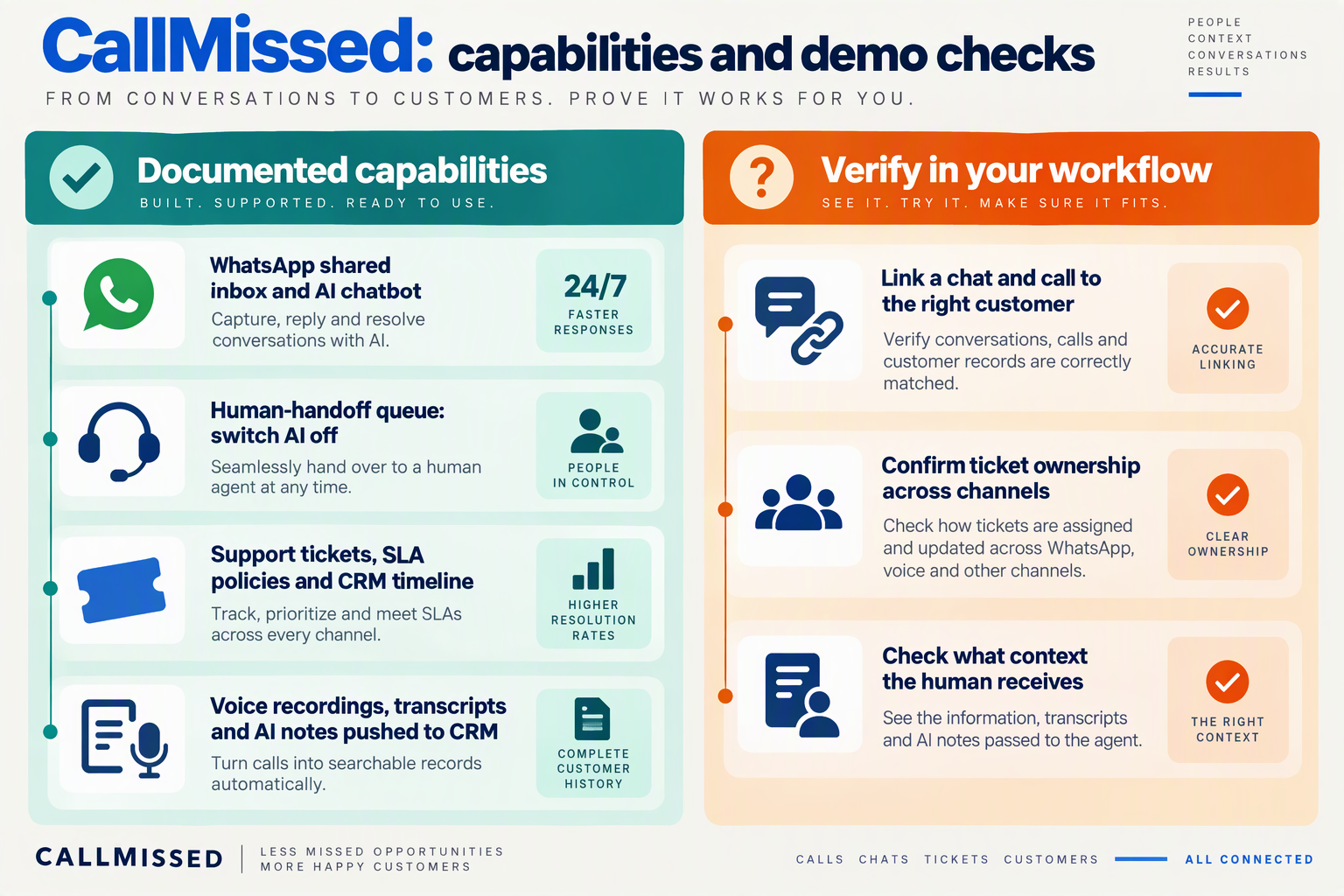
CallMissed fits a shortlist when an Indian B2C team wants WhatsApp support, AI voice agents and customer records within one platform. The deciding demo should prove whether ownership and context survive a channel change—not simply show that each channel works separately.
According to CallMissed’s verified product information, as of October 2026, the platform combines an official Meta Cloud API connection, a live shared inbox, a human-handoff queue, support tickets, SLA policies and a built-in CRM. Its WhatsApp Business Calling capability lets customers reach an AI voice agent by calling the business on WhatsApp. These are relevant building blocks; they do not, by themselves, establish automatic ticket linkage or seamless context transfer.
Which capabilities make it relevant to an Indian B2C shortlist?
The useful distinction is between answering a query and supporting the work that follows. According to CallMissed’s verified product information, as of October 2026:
- Human escalation: Switching the AI off hands the thread to a person through the human-handoff queue.
- Customer records: The built-in CRM includes contacts, tasks, notes, custom fields and a per-record timeline.
- Voice follow-through: Call recordings, transcripts and AI call notes—including summaries, action items, disposition and follow-up—can be pushed to the CRM.
- Operational connections: Available integrations include Shopify, WooCommerce and HubSpot, alongside custom REST tools and outbound webhooks.
- Regional speech: Speech recognition supports 22 Indian languages plus English, including code-mixed speech such as Hinglish; natural text-to-speech voices support 10 Indian languages plus English.
These capabilities justify a practical evaluation for regional commerce and support teams. However, speech-language coverage should not be treated as proof that every chosen voice, workflow or customer scenario performs equally well.
How should you test WhatsApp-to-voice-to-CRM continuity?
Ask the vendor to demonstrate one unresolved refund complaint, using a test customer and order rather than three disconnected channel demos.
- Start on WhatsApp. Have the customer supply an order reference and explain that a promised refund has not arrived. Inspect where the reference, complaint and conversation are stored.
- Request a person. Trigger the proposed escalation process. Verify that AI replies stop, a responsible human becomes identifiable and the customer’s unresolved request remains visible.
- Move to a WhatsApp call. Ask whether the voice agent receives the existing complaint context. If it does not, document what configuration or integration would be required.
- Inspect the records afterward. Check where the transcript, summary and follow-up appear, whether they connect to the correct customer and whether the original ticket remains findable.
- Resume the WhatsApp thread. Ask the assigned agent to continue the case without requesting the order reference again.
A CRM entry is not the same as continuity. The important evidence is that the next person can locate the right case, understand the previous promise and take responsibility for the next action.
What should count as a successful demo?
Set acceptance criteria before the session:
- Ownership: An accountable person and next action are visible after escalation.
- Context: Order details and prior commitments remain accessible across the tested journey.
- Record integrity: Repeat contacts do not silently create disconnected customer records.
- Failure handling: The team can recover when a tool lookup or record update fails.
- Implementation clarity: The vendor distinguishes standard functionality from configuration and custom integration.
Shortlist on the demonstrated workflow, not the breadth of the feature list. Any continuity gap should become a documented implementation requirement before purchase.
How much will your WhatsApp helpdesk cost once messaging, AI, voice and integration work are included?
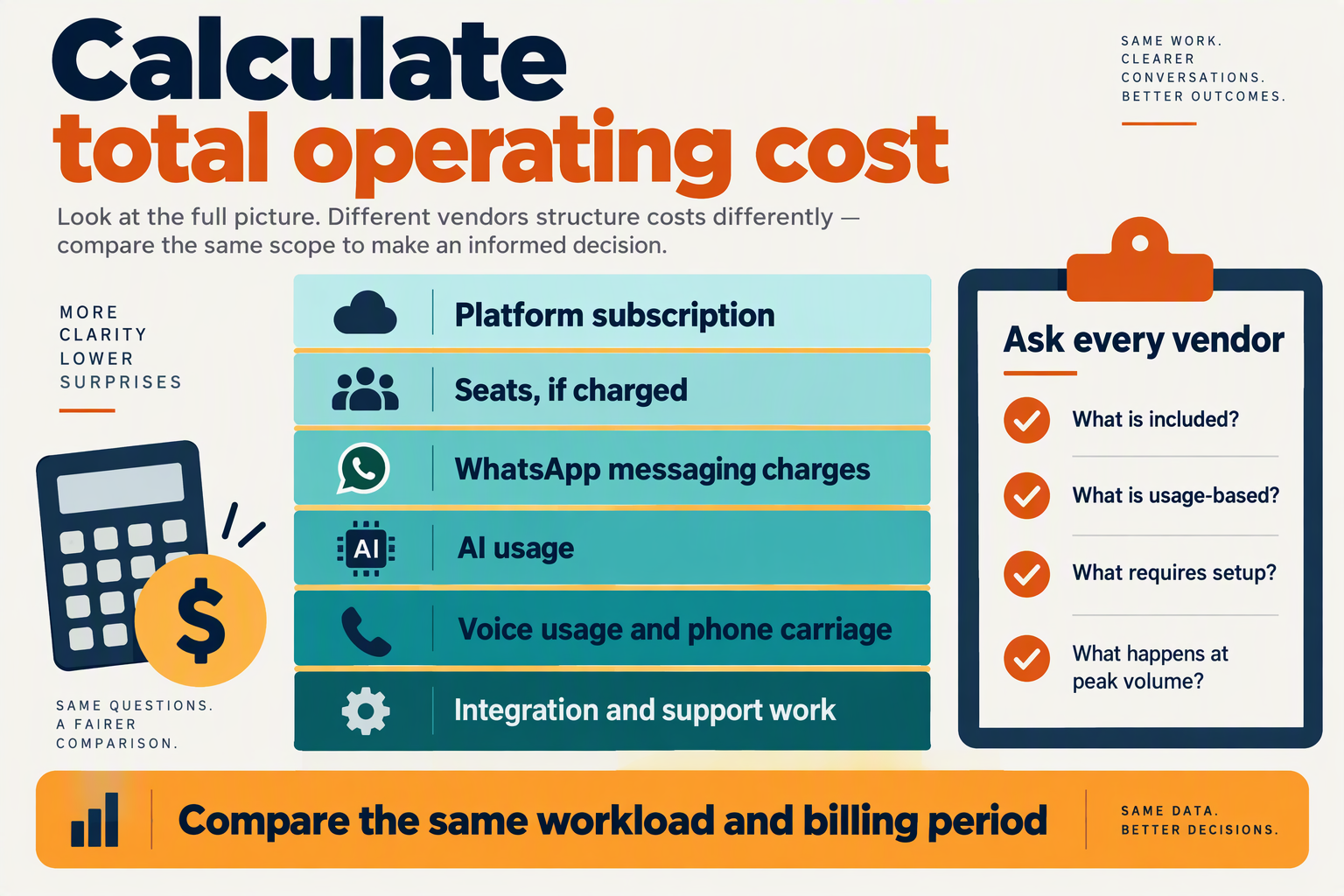
Your WhatsApp helpdesk cost is the platform fee plus messaging, AI usage, voice, integration work and the human effort needed to finish unresolved cases. For an October 2026 comparison, ask every vendor to price the same workload—not just quote a starting subscription.
What should a complete WhatsApp helpdesk quote include?
Separate the quote into these cost buckets so that “included” has a precise meaning:
- Platform access: Subscription, agent seats, additional inboxes, support tickets, reporting and any paid onboarding.
- WhatsApp messaging: Applicable Meta charges and any provider markup. Request the message categories, recipient markets and charging assumptions used in the estimate.
- AI processing: Whether billing is per message, conversation, resolution, token or credit; whether retries and unsuccessful answers consume usage.
- Voice: AI-agent minutes, minimum call duration, telephone carriage where applicable, recordings and any separately priced processing.
- Integrations: Initial setup, custom development, CRM subscriptions, ongoing maintenance and failed-sync recovery.
- Human operations: Time spent on escalations, duplicate tickets, correcting customer records and reviewing AI answers.
YCloud’s 2026 buyer guide describes architecture, configuration, testing and ongoing technical work as considerations for configurable AI support. Treat these as budget items: connecting an order system is not the same as maintaining a reliable refund workflow.
How do you compare subscription and usage-based pricing?
Convert each proposal into a monthly workload estimate, then test a higher-volume scenario. A seat-based quote may rise with staffing; a usage-based quote may rise with longer conversations, repeated questions or more voice minutes.
According to CallMissed’s verified product information, as of October 2026, CallMissed offers pay-as-you-go pricing without seat fees, with one credit equal to ₹1 and credits that never expire. Its Pro plan costs ₹4,999 monthly, adding 6,000 credits in the first month and 5,000 thereafter; distinguish subscription payments, included credits and additional consumption rather than adding all three indiscriminately.
For voice budgeting, CallMissed’s verified October 2026 pricing lists Standard AI voice agents at ₹4 per minute, covering speech recognition, the language model and voice, with a 30-second minimum per call; phone carriage is billed separately. These are specific voice costs, not an all-inclusive WhatsApp helpdesk price.
What does a realistic cost calculation look like?
Use a transparent planning example rather than an unsupported “average cost”:
- Estimate voice demand: Assume 500 support calls monthly, averaging four billable minutes: 2,000 minutes.
- Apply the selected rate: At the ₹4-per-minute Standard rate above, that produces ₹8,000 in voice usage, before applicable credit allowances and other charges.
- Budget integration work: As an illustrative internal assumption—not a vendor quote—12 hours at ₹1,500 per hour equals ₹18,000 upfront, or ₹3,000 monthly when spread across six months.
- Add the missing components: Platform payments, messaging, chatbot usage, maintenance, applicable taxes and human handling still need separate estimates.
The example therefore has ₹11,000 in monthly voice usage and amortised setup costs, not a ₹11,000 total bill.
Which billing questions should you ask before signing?
Ask what counts as a billable resolution, whether a reopened ticket is charged again, and whether AI-to-human escalations incur AI charges. Request spending alerts, usage exports and the rules for unused balances.
Finally, compare cost per genuinely resolved case, including human work. A cheaper chatbot is poor value if the customer must repeat the complaint on a call and an agent must rebuild the CRM record manually.
What should support leaders, integration engineers and privacy reviewers ask before purchase?

Before purchasing WhatsApp helpdesk software, require three separate sign-offs: operational acceptance from support, integration acceptance from engineering and data-handling acceptance from privacy reviewers. As of October 2026, a convincing demo is not enough: each stakeholder should request evidence against the same customer journey, including exceptions and failures.
What should support leaders ask about accountability?
Ask the vendor to demonstrate a disputed refund that arrives near shift change, escalates from AI to a person and remains unresolved overnight. This exposes operational gaps that a straightforward order-status demo can hide.
Pepper Cloud’s helpdesk guide, reviewed for this October 2026 buyer guide, identifies agent assignment, SLA tracking, escalation and reporting as evaluation criteria. Turn those categories into questions with observable answers:
- Ownership: “When an agent finishes their shift, who becomes responsible for open tickets? Can we distinguish the assigned agent from the person who last replied?”
- Escalation: “Can customers explicitly request a human? What happens when nobody is available, and how is the waiting customer informed?”
- SLA behaviour: “Which events start, pause and restart the SLA clock? Does moving a conversation between queues reset it?”
- Resolution reporting: “Can we separate bot-handled queries, human resolutions, reopened tickets and abandoned conversations?”
Request a sample report and an actual ticket timeline. A fast acknowledgement should not automatically count as a completed resolution.
What should integration engineers ask about WhatsApp, voice and CRM continuity?
Ask engineers to verify identity mapping and failure recovery, not merely whether a connector appears on a feature list. Robylon’s WhatsApp ticketing guide, reviewed in October 2026, describes a six-step process beginning with a Business API connection; purchasing that connection is only the starting point.
Use these technical questions:
- Record matching: “Which identifier links the WhatsApp contact, voice interaction, order and CRM record? How are shared phone numbers or duplicate contacts handled?”
- Write-back: “Which system owns ticket status and customer details? What happens when two agents update the same record?”
- Recovery: “If a CRM update fails after a refund conversation, are retries safe from duplication, and can engineers replay the failed event?”
- Channel transition: “Can you show exactly what context reaches the human when messaging becomes a call—and what does not?”
According to CallMissed’s verified product information, as of October 2026, CallMissed offers WhatsApp Business Calling, a human-handoff queue, a built-in CRM and outbound webhooks with per-agent event subscriptions. Buyers should still test the required workflow rather than assume those components automatically provide every desired synchronisation behaviour.
What should privacy reviewers ask before approving customer data access?
Request a data-flow diagram, contractual answers and configuration evidence covering messages, attachments, transcripts, recordings and AI processing.
- “Which organisations process each data type, and in which countries?”
- “What are the retention periods, deletion procedures and backup-deletion limitations?”
- “Is customer content used for model training, and what contractual controls apply?”
- “Who can access or export sensitive conversations, and what access records are available?”
Have reviewers assess applicable Indian data-protection obligations and any sector-specific requirements. Hosting location alone is not proof of compliance.
What evidence should determine the purchase decision?
Make approval conditional on:
- Support: a passed shift-change and escalation test.
- Engineering: a demonstrated failed-update recovery.
- Privacy: an accepted data-processing agreement and documented data flows.
Record unresolved gaps with an owner and deadline before signing—not as informal promises for after deployment.
Which demo tests and pilot acceptance criteria should your team use?
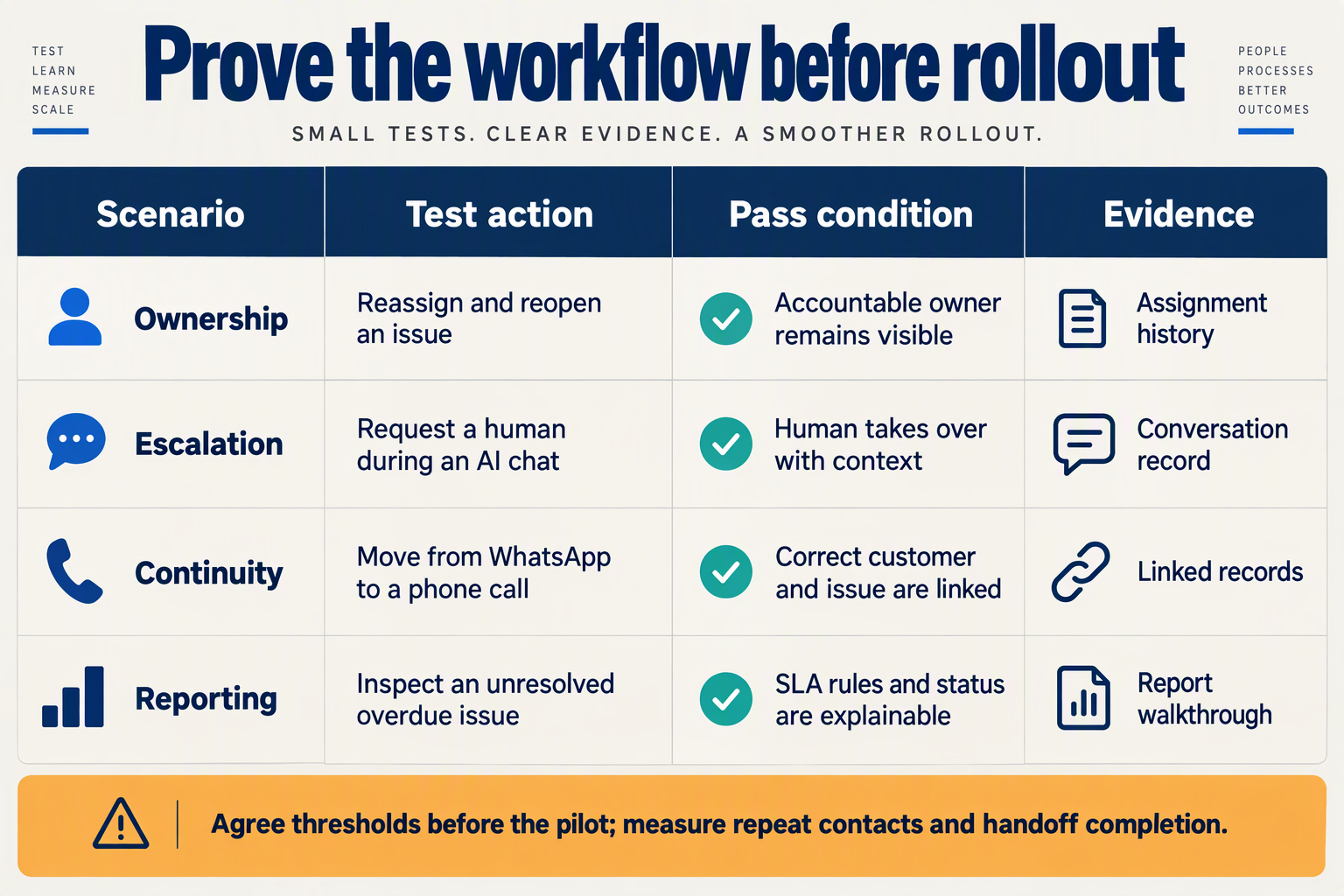
Use scripted failure scenarios, not a vendor’s happy-path walkthrough, to evaluate WhatsApp helpdesk software. For an October 2026 pilot, agree on measurable acceptance criteria before testing: every case needs an owner, escalation must stop conflicting AI replies, and channel changes must preserve usable customer context.
Which scenarios should you run during the demo?
Give every shortlisted vendor the same fictional customer, order and refund policy. Ask your agents—not just the vendor’s demonstrator—to complete the following tests and export the evidence.
The thresholds below are suggested buyer-set targets for an October 2026 pilot, not published industry benchmarks or verified vendor performance.
| Demo test | Scenario to run | Suggested acceptance criterion | Evidence required |
|---|---|---|---|
| Ticket ownership | Send a delivery complaint, then reassign it during a shift change. | Every test ticket has a named owner, priority and next action; no orphaned tickets. | Assignment history and queue export. |
| AI-to-human escalation | Dispute a refund, then explicitly request a person. | Human queue entry within 60 seconds; zero AI replies after takeover. | Timestamped transcript and handoff record. |
| Context transfer | Ask an agent to resolve the escalated refund. | Order ID, complaint, previous answer and escalation reason are available without customer repetition. | Agent view and completed case notes. |
| WhatsApp-to-voice continuity | Start in chat, call the business, then return to messaging. | The agent can identify the same customer and retrieve the relevant interaction history. | Linked records or demonstrated retrieval workflow. |
| SLA and absence handling | Leave an urgent case unattended; make its owner unavailable. | Every overdue test case is visibly flagged and reaches the agreed fallback owner. | SLA report and reassignment evidence. |
| CRM update and recovery | Record a promised refund follow-up; interrupt a configured integration. | Follow-up reaches the correct record; failed updates are detectable and recoverable without duplicates. | CRM timeline, task and recovery log. |
Pepper Cloud’s helpdesk guide, reviewed for this October 2026 comparison, identifies agent assignment, SLA tracking, escalation and reporting as evaluation areas. The table turns those feature labels into observable operational outcomes.
Robylon’s WhatsApp ticketing guide describes six steps from messages to trackable tickets, beginning with a Business API connection; reviewed in October 2026, that supports testing the actual connected workflow rather than an inbox mock-up.
How should you structure the pilot?
- Establish a baseline: Measure your current ownership gaps, repeat explanations, resolution times and handling costs before deployment.
- Use a controlled sample: A proposed starting point is 100 cases over two working weeks, spanning shifts, Hindi-English code-mixing, repeat contacts and difficult refund requests.
- Separate demo success from production readiness: Repeat critical scenarios under realistic staffing and permissions, including agent absence and integration failure.
Record both the numerator and denominator: “19 of 20 escalations preserved context” is more useful than “handoff worked well.”
What should block purchase approval?
Treat missing ownership, AI replies after human takeover and updates to the wrong customer record as release blockers, not defects that a strong average score can hide.
- Operations approves ownership, escalation and queue handling.
- IT approves record matching, integration recovery and access controls.
- Finance approves observed usage against the quoted cost model.
According to CallMissed’s verified product information, as of October 2026, CallMissed provides a live shared inbox, human-handoff queue, support tickets, built-in CRM and WhatsApp Business Calling with AI voice agents. Those capabilities make relevant pilot components; require the same evidence before assuming they deliver your team’s intended end-to-end workflow.
Frequently Asked Questions
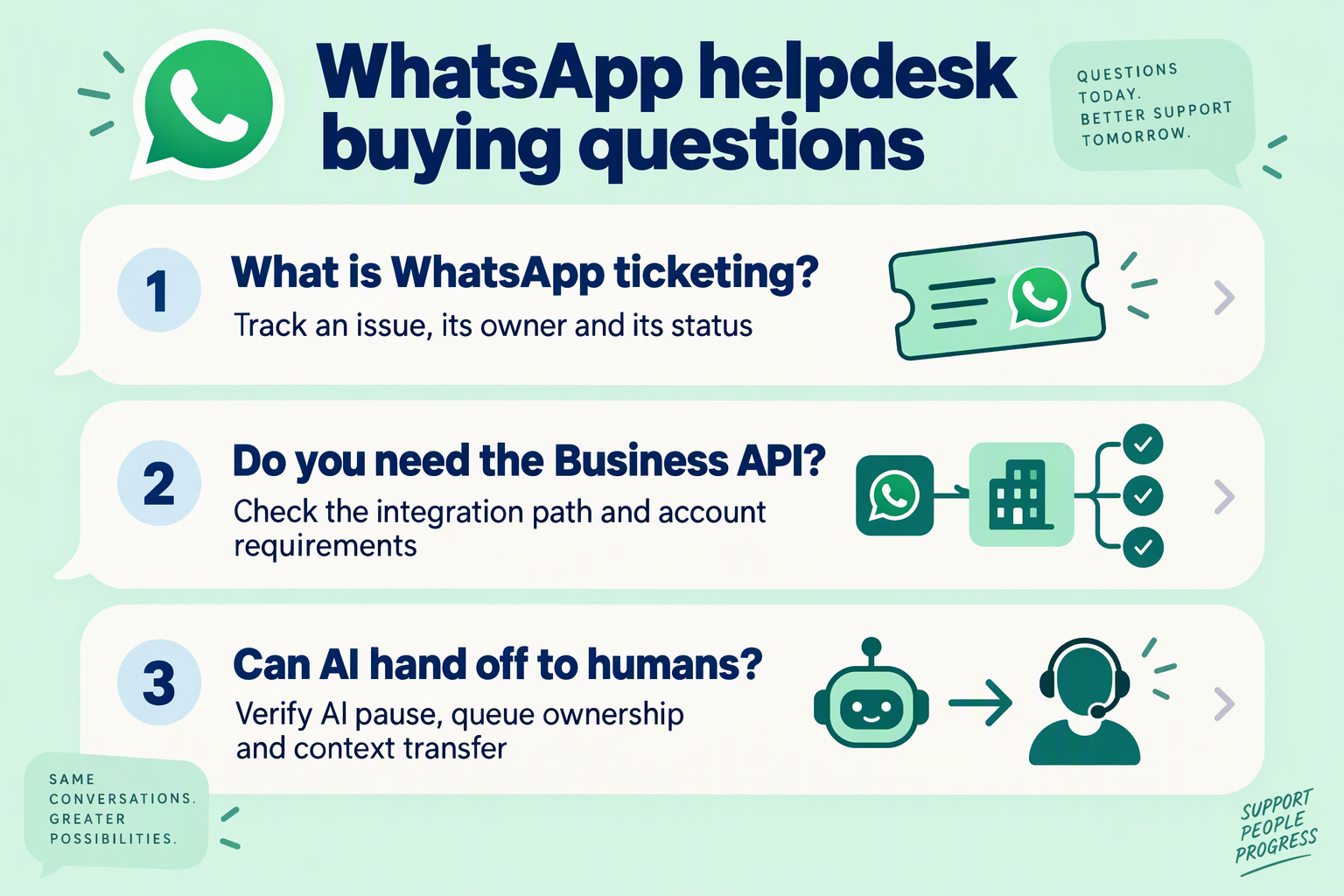
What is WhatsApp ticketing, and how is it different from a shared inbox?
Does WhatsApp helpdesk software need the WhatsApp Business API?
Can AI in WhatsApp helpdesk software hand off to a human agent?
How should WhatsApp helpdesk software assign ticket ownership across shifts?
Can WhatsApp support connect to voice calls and a CRM without losing context?
What costs should Indian businesses check before buying a WhatsApp helpdesk?
Conclusion
Choose WhatsApp helpdesk software that makes every unresolved complaint someone’s responsibility, transfers control cleanly from AI to a person, and keeps customer information accessible across messaging, voice and CRM. For Indian B2C buyers in October 2026, those operational basics matter more than an impressive chatbot demonstration.
The central lesson is to evaluate the complete resolution journey—not just the first automated reply. A delivery question that becomes a disputed refund should remain understandable and actionable when a human takes over or the customer switches to a call.
Keep four priorities at the centre of your shortlist:
- Make ticket ownership explicit. Ask your team to identify the responsible agent, priority, next action and escalation deadline during a trial. Pepper Cloud’s helpdesk guide, reviewed for this October 2026 buyer guide, highlights agent assignment, SLA tracking, escalation and reporting alongside automation. An unread-message count is not a substitute for accountability.
- Test AI-to-human escalation under pressure. Use a disputed refund, not only a straightforward order-status request. Check whether the person receives the customer’s question and relevant history, and whether the AI stops sending conflicting replies after handoff. A transfer should reduce uncertainty rather than create another conversation the customer must manage.
- Verify WhatsApp, voice and CRM continuity. Follow the same customer across a message, a call and a follow-up task. Agents should be able to find the order details and previous interactions needed to finish the job. Robylon’s guide describes six steps for turning WhatsApp chats into trackable tickets, beginning with a Business API connection; the buying lesson is to inspect the workflow beyond the messaging interface.
- Compare complete costs, not isolated channel prices. Separate messaging charges, platform costs, automation and voice-agent processing before comparing quotes. According to CallMissed’s verified product information, as of October 2026, Meta does not charge for customer-initiated WhatsApp Business calls. That does not make the AI handling those calls—or every other service component—free.
What should buyers watch for next?
Watch whether increasingly capable AI makes ownership and escalation clearer, rather than simply handling more conversations. The useful direction is tighter coordination between automated responses, human decisions and customer records; buyers should demand evidence of that coordination in realistic trials.
As of October 2026, CallMissed is a platform worth exploring for this direction: its verified offering includes an official Meta Cloud API connection, live shared inbox, human-handoff queue, support tickets, built-in CRM and WhatsApp Business Calling with AI voice agents.
Before committing, run one complaint through the entire journey. When the chatbot stops, can your team show who owns the next step—and carry the issue through to resolution without making the customer start again?
Related Reading
- WhatsApp Business API providers: India SMB Guide 2026
- Best New AI Models October 2026: Complete Buyer's Guide
- Gemini vs Claude vs GPT (2026): Enterprise Buyer Guide