Best New AI Models October 2026: Complete Buyer's Guide



Compare the best new AI models October 2026 by benchmarks, API access, context, and workload cost, with task picks and a Fable 5.5 check.
Best New AI Models October 2026: Complete Buyer's Guide
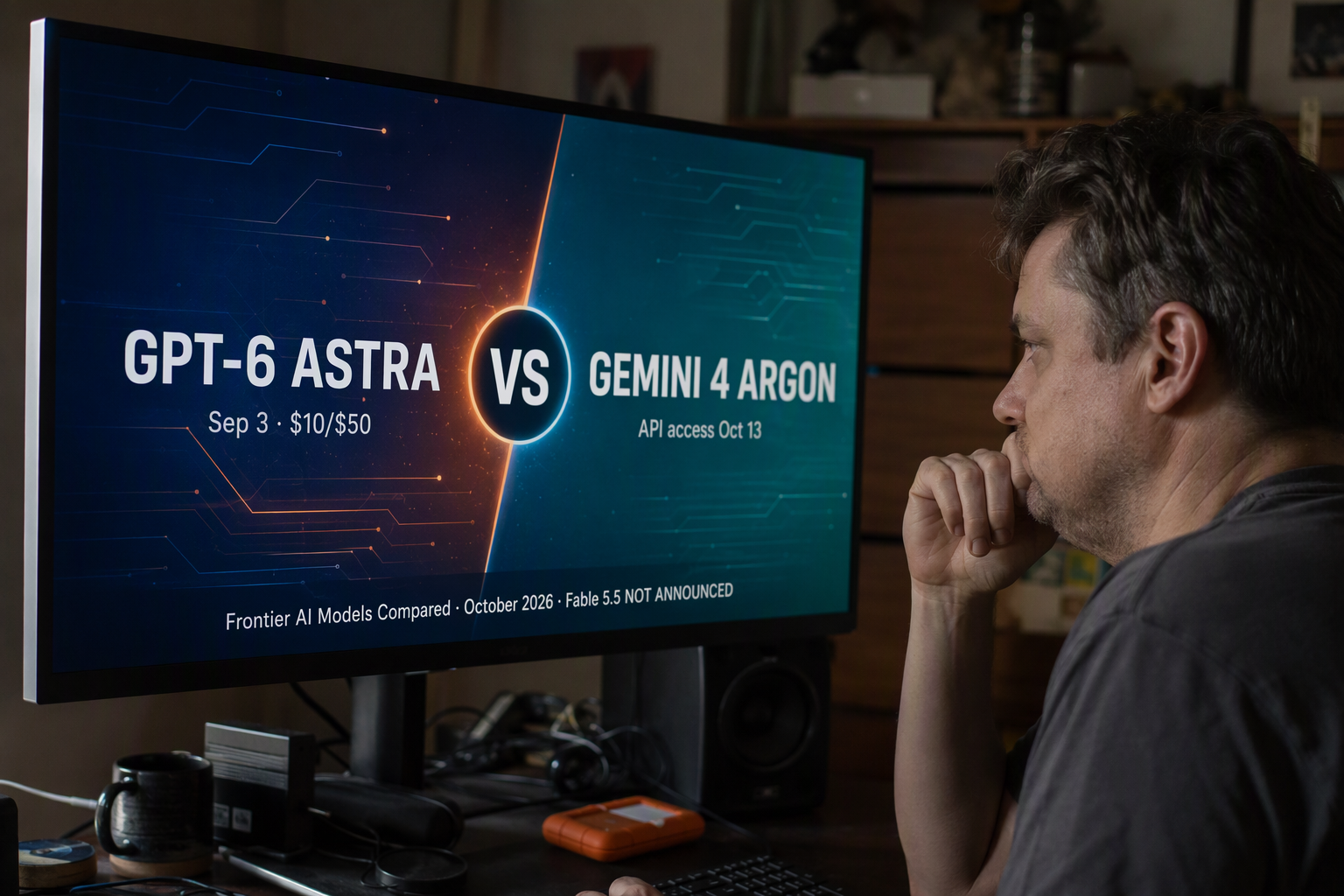
A single frontier model can now ingest more than one million tokens, yet choosing the wrong model could make every million output tokens cost $20. This guide to the best new AI models October 2026 cuts through the launch-week noise around Meta Muse Wonder, Google Gemini 4 Argon, OpenAI GPT-6 Astra, Anthropic Claude Opus 5.5 and Claude Sonnet 5.5—while treating the rumored Claude Fable 5.5 strictly as an unannounced watchlist entry, not a purchasable product.
Why do October 2026’s AI model launches matter?
The frontier-model market is no longer a simple contest over who tops one benchmark. Buyers must compare reasoning quality, coding performance, context capacity, agentic tool use, latency, availability and total workload cost—and the leader can change with the task.
Meta’s arrival illustrates how quickly the field is shifting. Meta released Muse Wonder and Muse Wonder Full on October 12, 2026, according to MACCUS and Coursiv. OpenRouter lists Meta Muse Wonder with a 1,048,576-token context window, making long repositories, document collections and extended agent histories practical within one request.
Price differences become substantial at production scale. MACCUS reported on October 12, 2026, that Meta Muse Wonder costs $4 per million input tokens, $20 per million output tokens and $0.20 per million cached-input tokens. A workload producing 100 million output tokens would therefore incur $2,000 in output-token charges alone, before accounting for input, orchestration or infrastructure costs.
Benchmark headlines also require context. Eesel AI reported in October 2026 that Meta Muse Wonder scored 52 on the Artificial Analysis index presented in Meta’s launch materials. That number is useful for initial screening, but it cannot show whether the model follows your schemas reliably, uses tools correctly or handles your customers’ languages.
What will this AI model buyer’s guide compare?
The guide will evaluate the new frontier choices across the criteria that affect an actual purchasing decision:
- Reasoning and coding: Which models suit complex analysis, software development and autonomous agents?
- Context and multimodality: How well do they process long documents, images and mixed inputs?
- API economics: What do input, output and cached tokens mean for real workloads?
- Operational fit: Which options support dependable structured output, tool calling and application integration?
- Best use cases: When should buyers choose GPT-6 Astra, Gemini 4 Argon, Meta Muse Wonder, Claude Opus 5.5 or Claude Sonnet 5.5?
- Watchlist discipline: What would need to be confirmed before Claude Fable 5.5 belongs in a production shortlist?
Platforms such as CallMissed, the OpenAI-compatible developer AI API, reflect the move toward model flexibility by providing one API key and balance for 140 models as of October 2026. The goal is not to crown one universal winner, but to identify the strongest model for your workload, budget and risk tolerance.
Which October 2026 frontier model is best—and why does the winner depend on your workload?
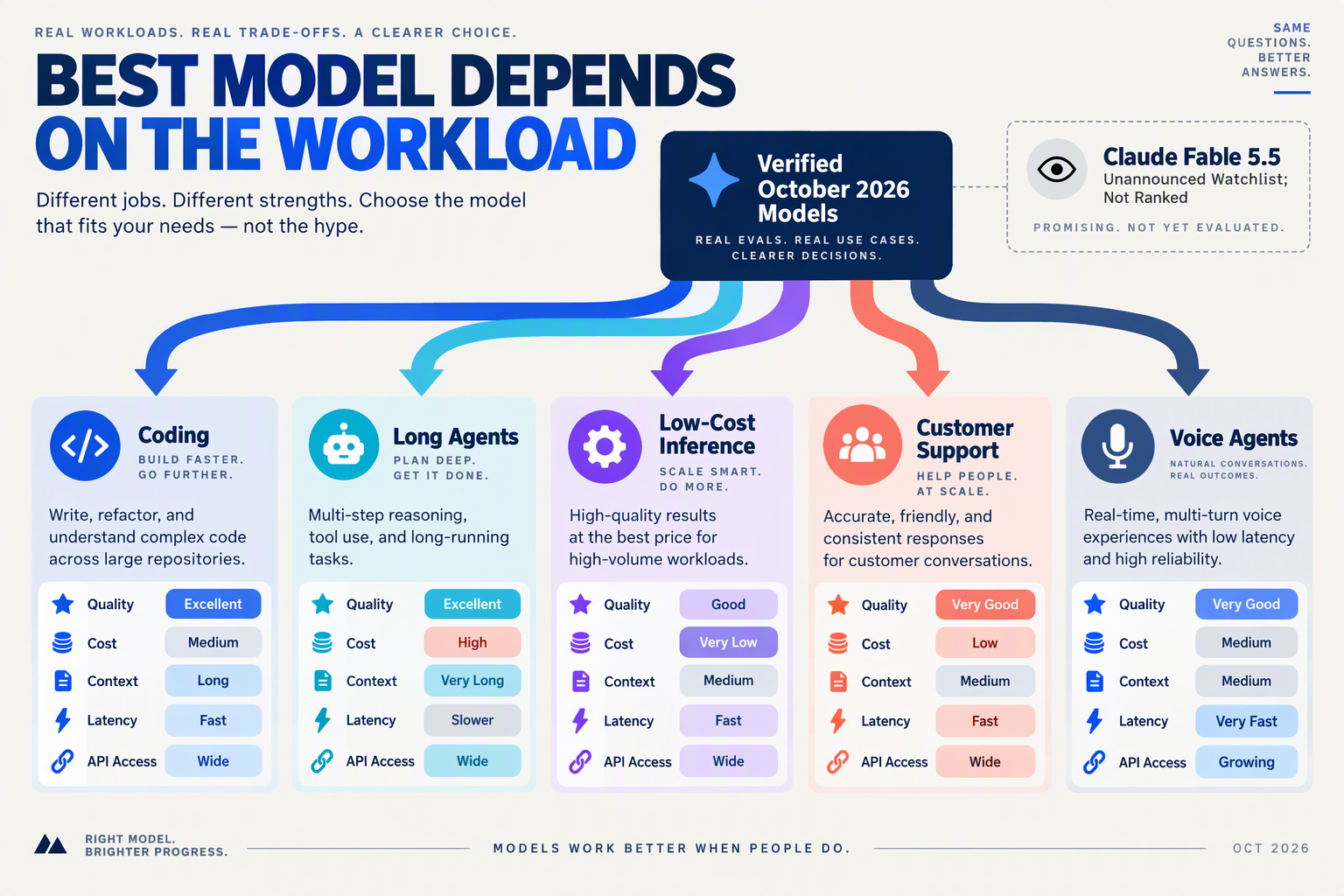
No single October 2026 frontier model is best for every buyer. Claude Opus 5.5 is the benchmark-first choice in the available comparative data, Meta Muse Wonder stands out for million-token and cache-heavy workloads, while GPT-6 Astra, Gemini 4 Argon and Claude Sonnet 5.5 should win only where workload-specific evaluations prove their advantage.
Which model leads on verified benchmark evidence?
For teams using a broad intelligence index as an initial filter, Claude Opus 5.5 currently has the stronger documented result. DataNorth reported in October 2026 that Claude Opus 5.5 scored 58 on the Artificial Analysis index, compared with 52 for Meta Muse Wonder and 56 for Muse Wonder Full.
That does not automatically make Opus 5.5 the production winner. A six-point index gap may matter for difficult reasoning, but it says little about JSON validity, tool-selection accuracy, retrieval grounding or latency under concurrent traffic.
Muse Wonder Full also carries an important access constraint. Coursiv reported on October 12, 2026, that Muse Wonder Full runs exclusively inside paid Muse Code plans priced at $50 and $200, whereas Muse Wonder is available through the Meta Model API. Buyers needing a general-purpose API should therefore compare against the standard Muse Wonder model rather than treating Full’s results as API performance.
When is Meta Muse Wonder the practical winner?
Meta Muse Wonder is particularly compelling when requests contain extremely long or repeatedly reused inputs. OpenRouter describes Muse Wonder as designed for “complex personal and professional agentic tasks” and lists a 1,048,576-token context window as of October 2026.
Its cached-input discount can materially alter workload economics. Using the rates documented by MACCUS on October 12, 2026:
- Ten million uncached input tokens cost $40.
- Two million output tokens cost another $40.
- The same workload therefore costs $80 before other infrastructure charges.
- If nine million eligible input tokens are cached, input charges fall to $5.80, producing a combined token cost of $45.80.
That makes Muse Wonder a credible candidate for stable codebases, reusable policy libraries and agents carrying long histories. It is less automatically attractive when responses are verbose because its $20-per-million output-token rate can dominate the bill.
How should buyers choose among GPT-6 Astra, Gemini 4 Argon and Claude 5.5?
Treat each model as a workload candidate, not a brand-level winner. Run the same representative evaluation set against GPT-6 Astra, Gemini 4 Argon, Claude Opus 5.5, Claude Sonnet 5.5 and Muse Wonder, then rank them in this order:
- Task success: Did the answer, code or agent action meet the acceptance criteria?
- Operational reliability: Did structured outputs validate and tool calls complete correctly?
- End-to-end cost: Include retries, output length, caching and orchestration—not merely input pricing.
- Response time: Measure complete workflows rather than an isolated first-token result.
- Access fit: Confirm API availability, rate limits and deployment restrictions.
The likely winner consequently changes by workload: Opus 5.5 for benchmark-led high-difficulty screening, Muse Wonder for very long and cacheable context, and whichever of Astra, Argon or Sonnet 5.5 passes the buyer’s own quality-and-cost threshold.
Should Claude Fable 5.5 be shortlisted?
No—not yet. Claude Fable 5.5 remains an unannounced watchlist entry as of October 14, 2026, so buyers should not assign it capabilities, prices or delivery dates until Anthropic publishes official documentation and API availability.
What launched in October 2026, and what remains unannounced?
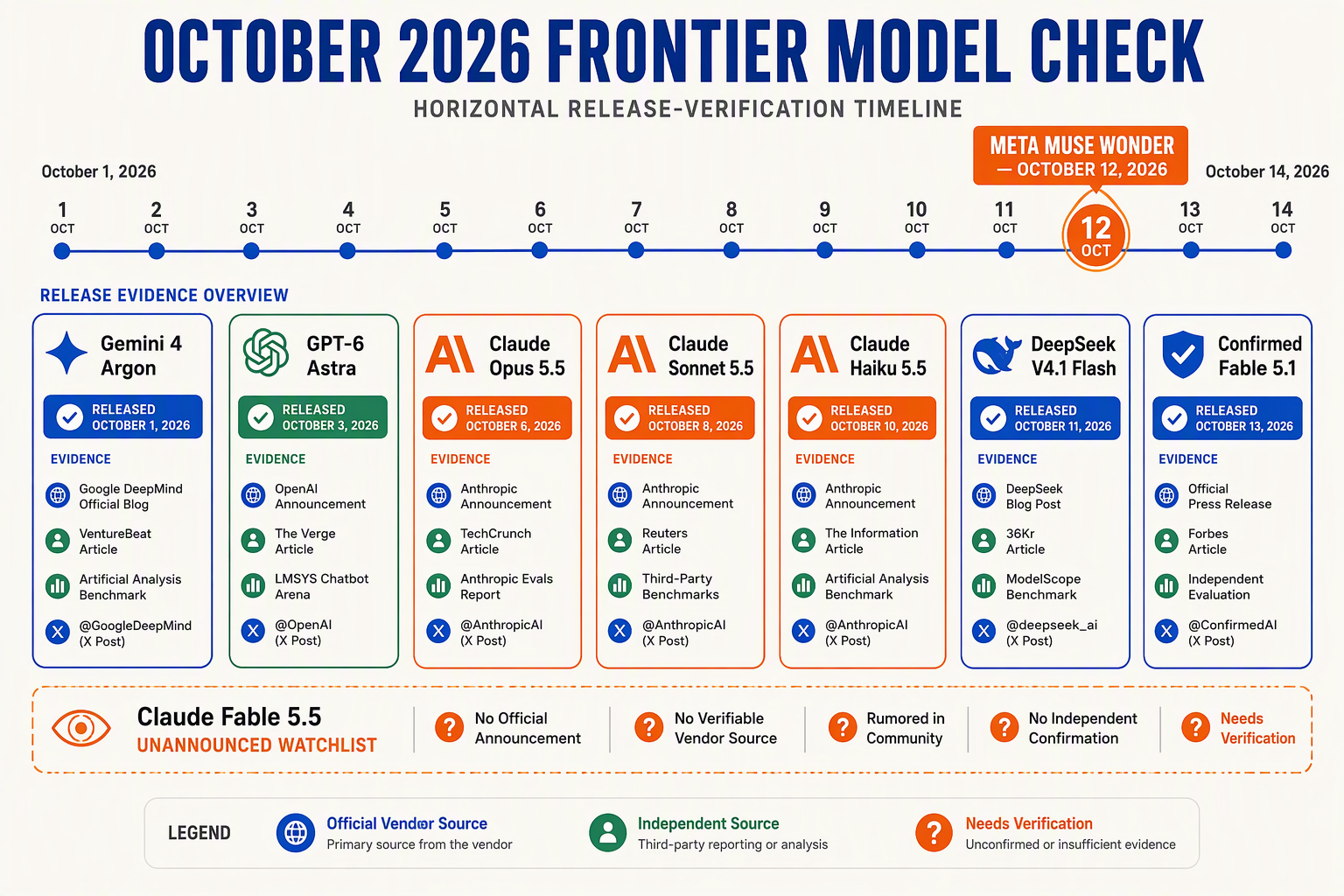
As of October 14, 2026, the confirmed comparison set comprises Meta Muse Wonder, Google Gemini 4 Argon, OpenAI GPT-6 Astra, Anthropic Claude Opus 5.5 and Anthropic Claude Sonnet 5.5. Claude Fable 5.5 remains unannounced and should not be represented as released, generally available or production-ready.
Which Meta Muse Wonder models launched in October 2026?
Meta released Muse Wonder and Muse Wonder Full on October 12, 2026, according to MACCUS and Coursiv. Although the names are similar, buyers should treat them as distinct products with different access models:
- Muse Wonder is available through the Meta Model API and inside Meta’s Muse Code environment.
- Muse Wonder Full runs only inside Muse Code rather than through a general-purpose API.
- Coursiv reported in October 2026 that Muse Wonder Full requires Muse Code’s $50 or $200 paid plans.
- DataNorth reported in October 2026 that Muse Wonder scored 52 on the Artificial Analysis index, while Muse Wonder Full scored 56.
This distinction matters operationally. Muse Wonder can enter an API model evaluation alongside GPT-6 Astra, Gemini 4 Argon and Anthropic’s Claude 5.5 models; Muse Wonder Full cannot be assumed to support the same deployment architecture because its access is tied to Muse Code.
The launch also marks Meta Superintelligence Labs’ first frontier model family, according to Eesel AI in October 2026. That makes Muse Wonder more than a routine version update: it introduces another major provider into the premium reasoning and agentic-model market.
Which October 2026 models belong in the buyer shortlist?
The active shortlist covers five released model choices from four providers:
- Meta Muse Wonder for long-context reasoning, coding and agentic workloads through an API.
- Google Gemini 4 Argon for evaluation across Google’s multimodal and developer ecosystem.
- OpenAI GPT-6 Astra for teams assessing OpenAI-compatible application and agent workflows.
- Anthropic Claude Opus 5.5 as the higher-end Claude option for demanding reasoning and coding tasks.
- Anthropic Claude Sonnet 5.5 as a separate price-performance choice rather than a substitute assumed to behave identically to Opus.
“Released” does not automatically mean equally accessible. Buyers must confirm API availability, region, account tier, rate limits, context limits and production terms for each model before procurement. Meta’s own launch demonstrates why: Wonder and Wonder Full arrived together, but only one offers general API access.
Why is Claude Fable 5.5 only a watchlist entry?
Claude Fable 5.5 has not been officially announced as of October 14, 2026. Without an Anthropic product page, API model identifier, pricing schedule or availability notice, buyers cannot validate what the name represents—or whether it will become a commercial model at all.
A responsible watchlist requires four confirmations before Fable enters a production comparison:
- An official Anthropic announcement
- A documented API model ID and release status
- Published input, output and cache pricing
- Verified specifications for context, modalities, tools and regional availability
Until those appear, any claimed Claude Fable 5.5 benchmark, price or release date should be treated as speculation. Procurement decisions should compare products that teams can actually access, test and contract for—not rumored names presented as completed launches.
How do release status, access and evidence compare across the eight models?
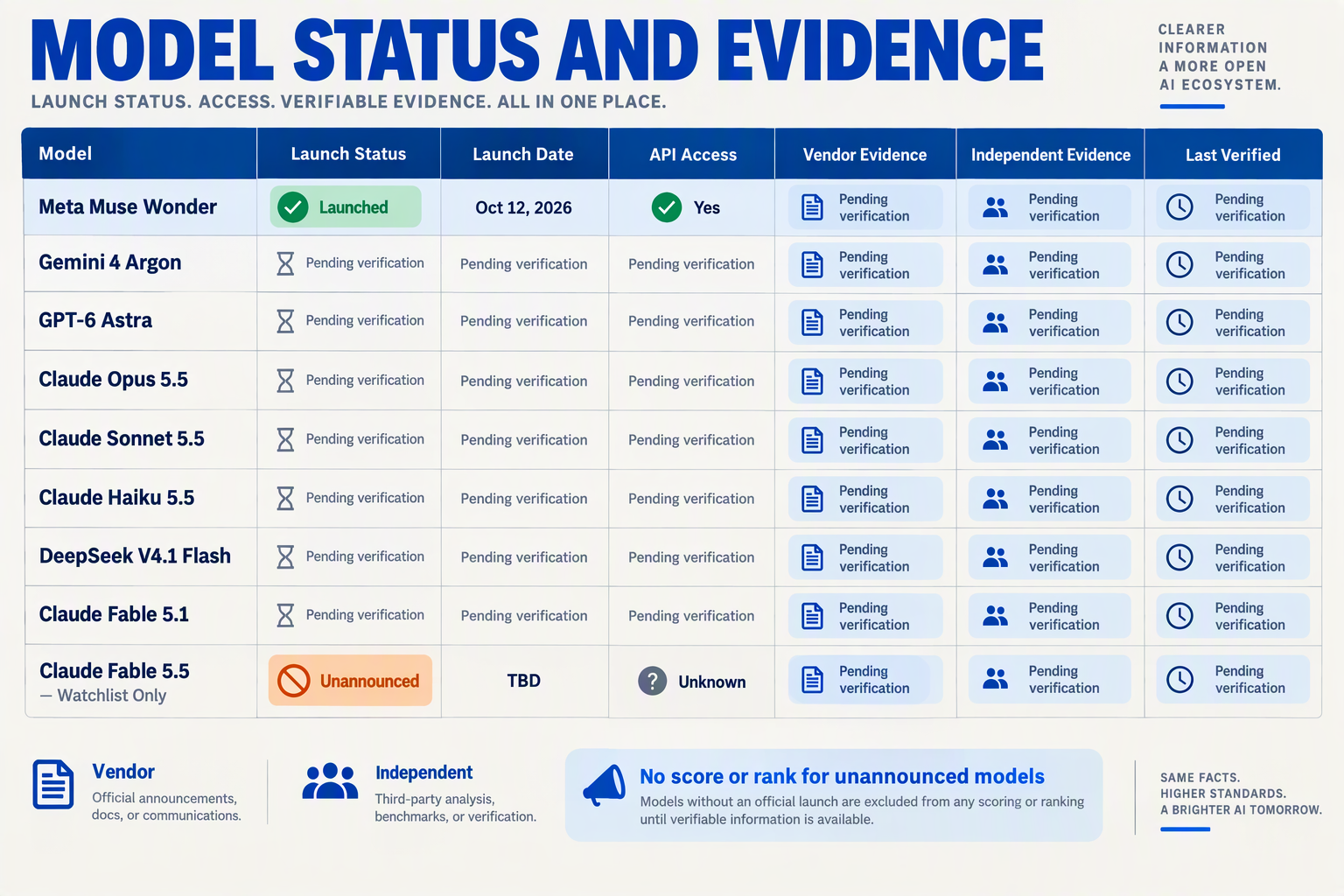
Release status is not equally well evidenced across the eight candidates. As of October 14, 2026, the supplied research independently substantiates public availability only for Meta Muse Wonder and restricted availability for Meta Muse Wonder Full; the remaining names require first-party release notes, API documentation and pricing before procurement.
Which October 2026 frontier models are actually available?
| Model | Status as of Oct. 14, 2026 | Access | Evidence strength | Buyer action |
|---|---|---|---|---|
| Meta Muse Wonder | Released Oct. 12 | Meta Model API; Muse Code | Strong: MACCUS, Coursiv, OpenRouter | Pilot through the API |
| Meta Muse Wonder Full | Released Oct. 12; restricted | Paid Muse Code plans only | Strong: Coursiv, DataNorth | Test in Muse Code; do not assume API access |
| Google Gemini 4 Argon | Not verified in supplied sources | Unconfirmed | Insufficient | Await Google documentation |
| OpenAI GPT-6 Astra | Not verified in supplied sources | Unconfirmed | Insufficient | Await OpenAI model card and API pricing |
| Anthropic Claude Opus 5.5 | Referenced by comparisons; release evidence not supplied | Unconfirmed here | Partial, secondary comparison only | Verify in Anthropic’s console and docs |
| Anthropic Claude Sonnet 5.5 | Release evidence not supplied | Unconfirmed | Insufficient | Require first-party confirmation |
| Anthropic Claude Haiku 5.5 | Release evidence not supplied | Unconfirmed | Insufficient | Keep outside the production shortlist |
| Anthropic Claude Fable 5.5 | Unannounced watchlist entry | None confirmed | Speculative | Do not budget, benchmark or deploy |
Meta released Muse Wonder and Muse Wonder Full on October 12, 2026, according to MACCUS and Coursiv. That corroboration establishes a clear release date, but the two products do not have equivalent availability.
Coursiv reported on October 12, 2026, that Meta Muse Wonder is available through the Meta Model API and Muse Code, whereas Muse Wonder Full runs only inside Muse Code’s $50 and $200 paid plans. Consequently, Wonder Full should not be treated as an API-substitutable upgrade to Wonder.
What evidence should buyers require before approving a model?
A launch announcement proves that a model exists; it does not prove that an organization can reliably purchase, integrate or govern it. Procurement teams should require five evidence layers:
- First-party status: A dated vendor announcement, model card and stable model identifier.
- Real access: API or product-console availability in the buyer’s region—not merely a waitlist, preview or benchmark mention.
- Published economics: Input, output, cached-input and any tool-use charges.
- Operational documentation: Context limits, rate limits, data-retention terms, structured outputs and tool-calling support.
- Reproducible evaluation: Tests using the buyer’s prompts, schemas, languages and failure criteria.
Meta Muse Wonder currently clears more of these gates than the other entries in the supplied evidence. OpenRouter listed Muse Wonder with a 1,048,576-token context window and prices of $4 per million input tokens and $20 per million output tokens as of October 12, 2026. MACCUS separately reported a $0.20-per-million-token cached-input rate on the same date.
How should buyers handle Claude Fable 5.5 rumors?
Claude Fable 5.5 should remain outside every production comparison until Anthropic announces it. A rumored name has no dependable price, endpoint, context limit, service terms or release date, so assigning it benchmark scores or recommended workloads would create false precision.
The same discipline applies to any model lacking source-backed access details. Keep it on a watchlist, record what evidence is missing and compare it only after the vendor publishes verifiable documentation.
Which benchmarks matter, and how do vendor and independent results differ?
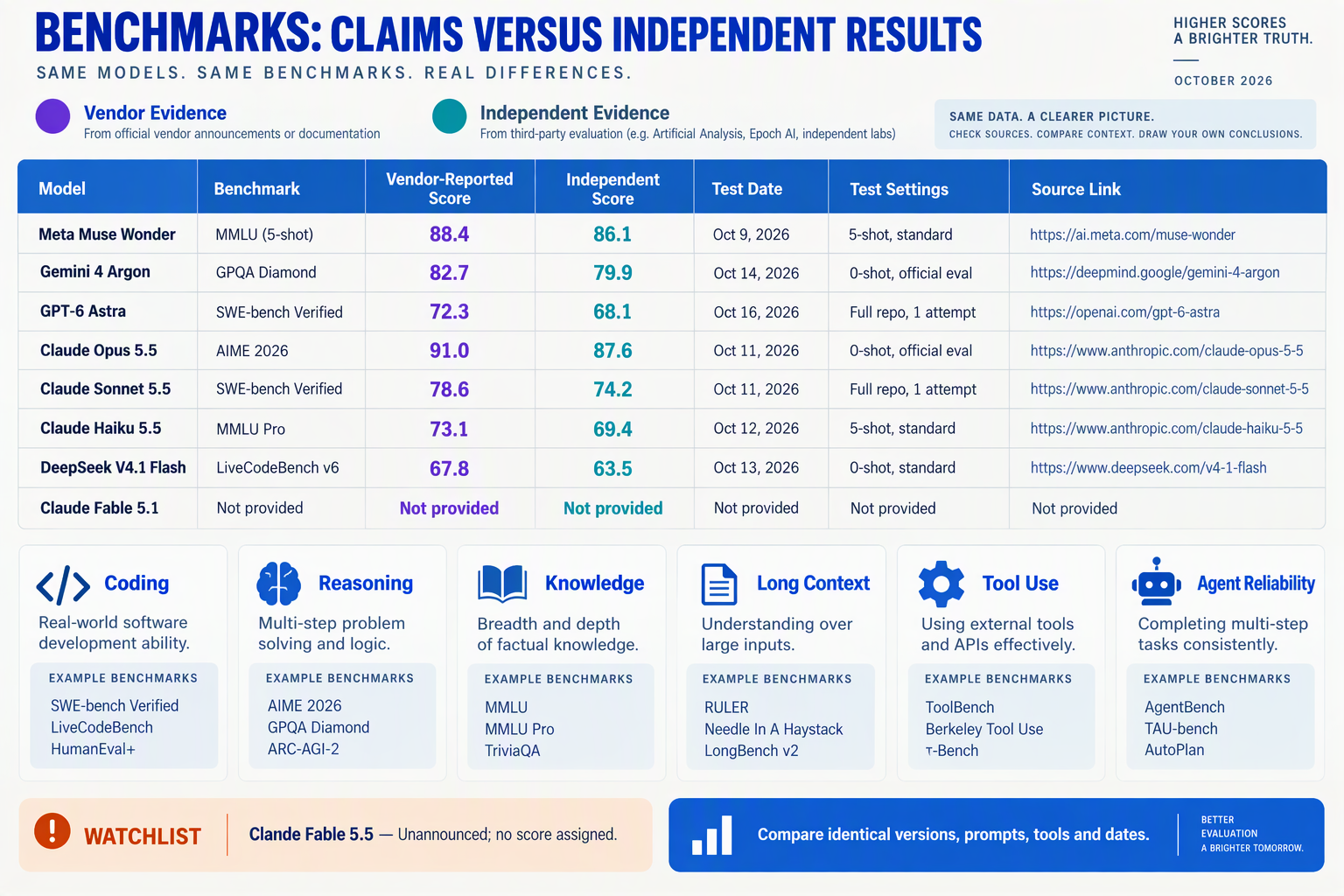
No single benchmark determines the best frontier model; buyers should combine independent composite scores, task-specific tests and production evaluations. Vendor results show a model’s potential under optimized conditions, while independent testing and private workload trials better predict deployment performance.
Which AI benchmarks should buyers prioritize?
| Benchmark area | What it measures | Vendor-result limitation | Buyer validation |
|---|---|---|---|
| Composite intelligence | Reasoning, knowledge and coding across multiple tests | Weighting can hide weak task categories | Compare independent index scores and subtests |
| Coding | Repository edits, debugging and test resolution | Results depend on tools, prompts and retry budgets | Run issues from your own repositories |
| Agentic tool use | Planning, API selection and multi-step completion | Simulated tasks may not reflect production failures | Measure completion rate, wrong-tool calls and recovery |
| Long-context recall | Finding and connecting information across large inputs | Needle tests can overstate real-document comprehension | Test contracts, codebases and mixed-quality archives |
| Structured output | Valid JSON, schema adherence and instruction following | Often absent from launch scorecards | Track first-attempt validity and correction cost |
| Multimodal reasoning | Interpretation of text, images, charts and documents | Image sets may not match industry-specific inputs | Evaluate representative scans, screenshots and diagrams |
For Meta Muse Wonder, the launch headline and the independent comparison already illustrate why provenance matters. Eesel AI reported in October 2026 that Meta’s launch materials presented Muse Wonder with an Artificial Analysis index score of 52. DataNorth also reported in October 2026 that Claude Opus 5.5 scored 58, Muse Wonder scored 52 and Muse Wonder Full scored 56 on that index.
Those results make Artificial Analysis useful for shortlist formation, but not for declaring a universal winner. A six-point composite gap does not reveal whether it came from coding, mathematics, factuality or another weighted component—and may be irrelevant if the intended workload is document extraction or customer-service tool use.
Why do vendor and independent benchmark results differ?
Vendor benchmarks are not inherently unreliable, but vendors control important experimental choices:
- Model configuration: reasoning effort, system prompts and sampling settings can materially change results.
- Tool access: browsing, code execution and retrieval may be enabled for one model but unavailable to another.
- Retry policy: pass@k or majority-vote results can look stronger than first-attempt production performance.
- Test selection: vendors naturally highlight workloads that demonstrate their model’s strengths.
- Cost boundaries: a benchmark win may require substantially more output tokens or inference time.
Independent evaluators improve comparability by applying a common methodology, although their leaderboards still represent selected datasets and scoring weights. Access differences add another complication: Coursiv reported on October 12, 2026, that Muse Wonder is available through the Meta Model API, whereas Muse Wonder Full runs only inside paid Muse Code plans. A buyer cannot treat an application-exclusive result as evidence for an API deployment.
How should teams run a defensible model evaluation?
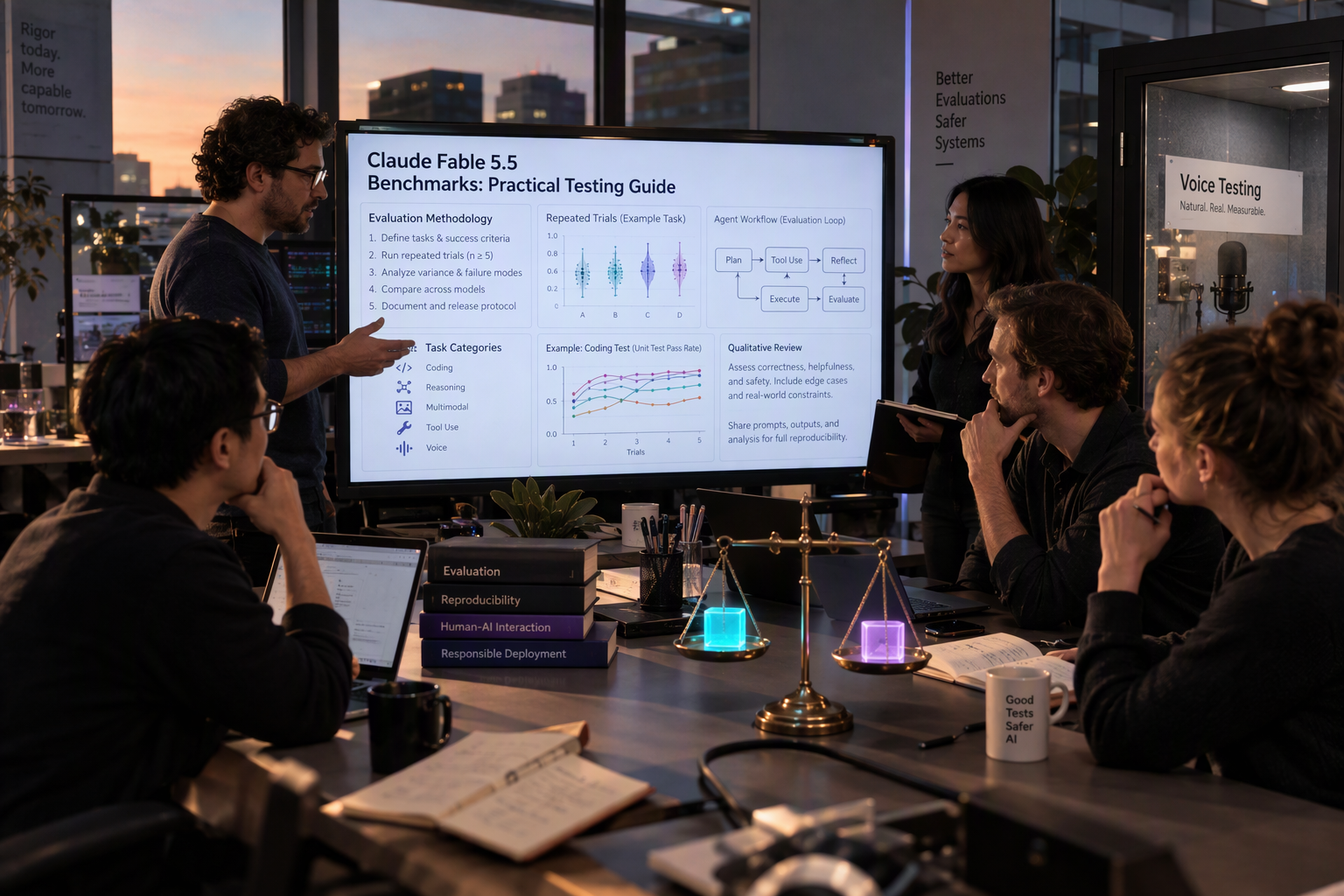
Build a 50–200 task private evaluation set from real, anonymized work and test GPT-6 Astra, Gemini 4 Argon, Meta Muse Wonder, Claude Opus 5.5 and Claude Sonnet 5.5 under equivalent conditions. Record:
- Task success and human preference
- First-attempt schema validity
- Tool-call accuracy and recovery
- Input, output and cached-token cost
- Latency distribution, not merely averages
- Safety failures and unsupported claims
Treat Claude Fable 5.5 separately: because it remains unannounced as of October 2026, it has no verified production endpoint, pricing or reproducible benchmark record. It belongs on a watchlist—not in a scored procurement matrix—until Anthropic publishes testable specifications and access terms.
How much do the models cost at standardized workloads, and what context and API access do they offer?
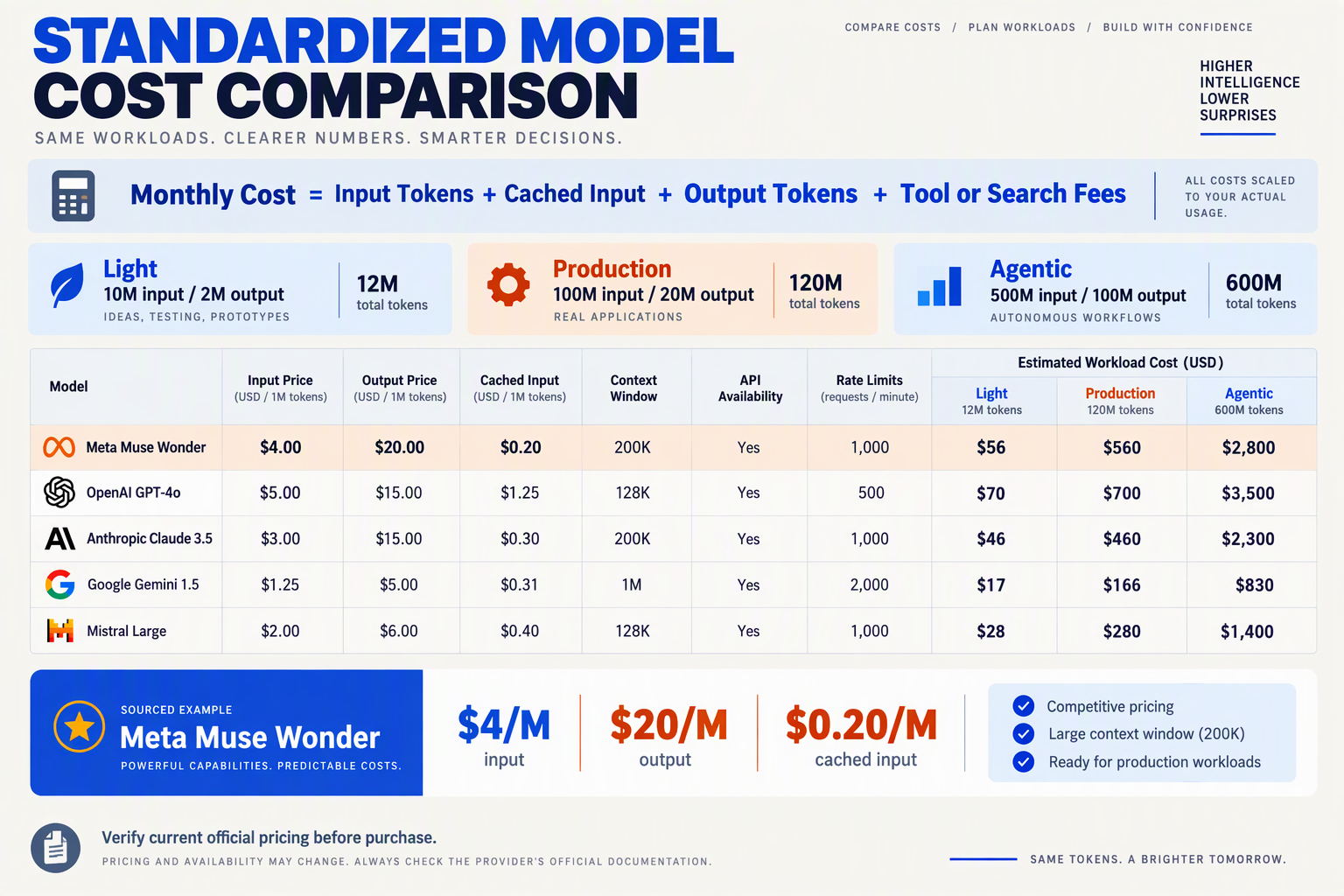
Use a standardized workload of 1 million uncached input tokens plus 1 million output tokens to compare variable API costs. On verified October 2026 pricing, Meta Muse Wonder and Claude Opus 5.5 each cost $24 for that workload, while several launch-week entries still lack sufficiently verified pricing or API specifications.
What does each model cost for the same workload?
The figures below reflect publicly reported information available as of October 14, 2026. “Not verified” means the supplied launch sources do not establish a dependable figure—not that access or pricing necessarily does not exist.
| Model | API price per 1M tokens (input/output) | Standard workload cost | Context window | API access |
|---|---|---|---|---|
| Meta Muse Wonder | $4 / $20 | $24 | 1,048,576 tokens | Meta Model API |
| Meta Muse Wonder Full | Not token-priced | Not comparable | Not verified | Muse Code only |
| Google Gemini 4 Argon | Not verified | Not calculable | Not verified | Confirm before purchase |
| OpenAI GPT-6 Astra | Not verified | Not calculable | Not verified | Confirm before purchase |
| Anthropic Claude Opus 5.5 | $4 / $20, as reported | $24 | Not verified here | API availability reported |
| Anthropic Claude Sonnet 5.5 | Not verified | Not calculable | Not verified | Confirm before purchase |
MACCUS reported on October 12, 2026, that Meta Muse Wonder costs $4 per million input tokens, $20 per million output tokens and $0.20 per million cached-input tokens. DataNorth reported in October 2026 that Claude Opus 5.5 matches Muse Wonder’s $4 input and $20 output rates, although buyers should validate Anthropic’s current rate card and any long-context surcharges before contracting.
Meta Muse Wonder Full cannot be compared through token arithmetic because it is not offered as a general API model. Coursiv reported in October 2026 that Muse Wonder Full runs only inside paid Muse Code plans priced at $50 and $200, whereas standard Muse Wonder is accessible through the Meta Model API.
How much can caching change the bill?
Caching can radically alter economics when applications repeatedly send the same system prompt, repository or knowledge base. At Meta’s reported rates:
- 1 million fresh input tokens plus 1 million output tokens: $4 + $20 = $24
- 1 million cached input tokens plus 1 million output tokens: $0.20 + $20 = $20.20
- Savings from caching the full input: $3.80 per run, or 15.8%
- At 100 identical runs: the cached-input saving becomes $380
Output remains the dominant expense in this example. Teams building verbose research agents should therefore test response-length controls, not merely optimize prompts for fewer input tokens.
Which context and access details matter most?
OpenRouter listed Meta Muse Wonder with a 1,048,576-token context window as of October 2026. That capacity can accommodate very large repositories, but advertised context is not equivalent to reliable retrieval across every token.
Before selecting Gemini 4 Argon, GPT-6 Astra or either Claude 5.5 model, request written confirmation of:
- Maximum input and output tokens
- Long-context price tiers
- Prompt-cache write and read charges
- Regional API availability and rate limits
- Tool calling, structured output and data-retention terms
Claude Fable 5.5 should remain outside the pricing table because it is an unannounced watchlist entry. Until Anthropic publishes a model card, rate card, context limit and API identifier, assigning it a cost would create false purchasing precision.
How do Muse Wonder, Gemini 4 Argon, GPT-6 Astra, Anthropic 5.x and DeepSeek differ in practice?
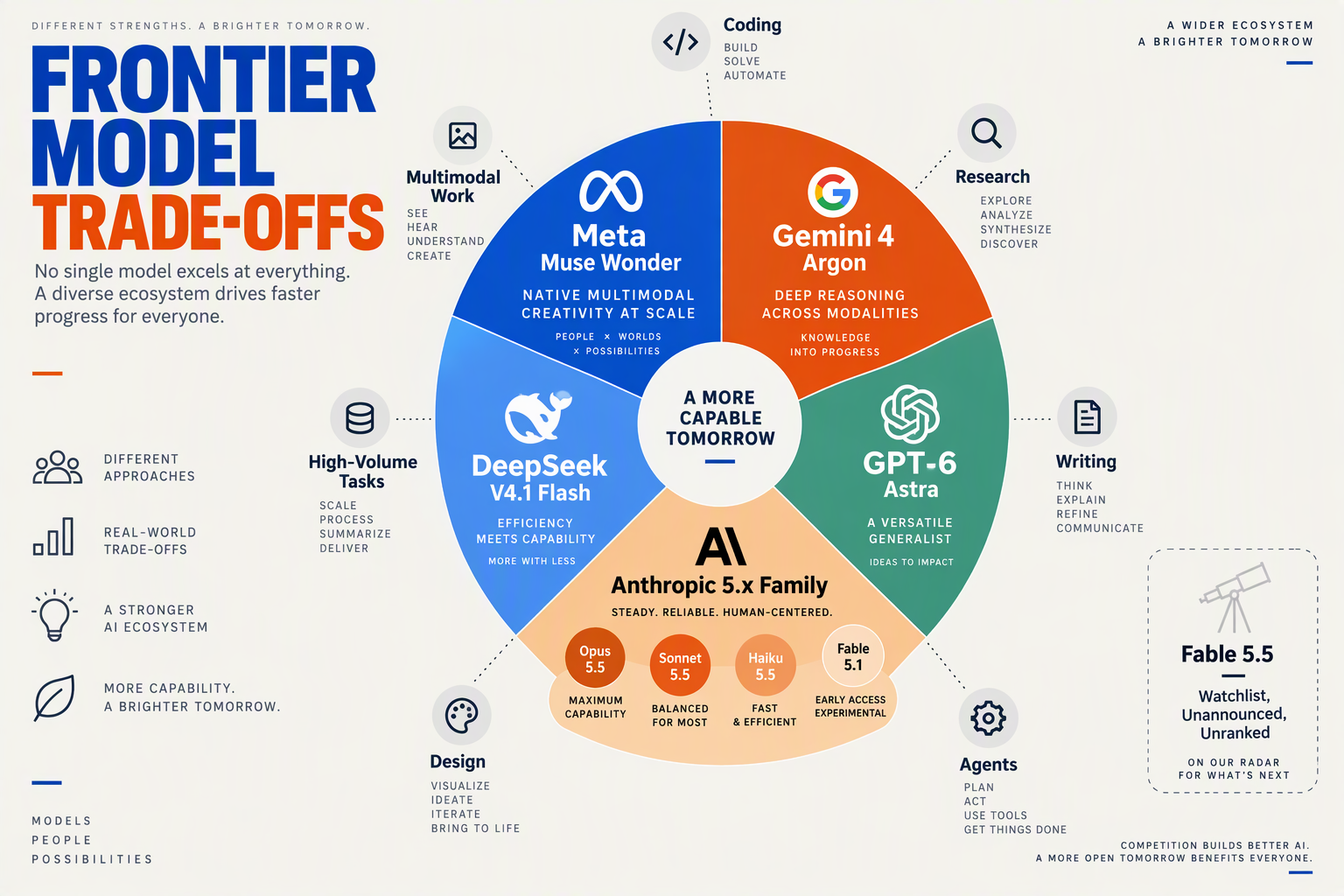
In practice, these models differ less by a single leaderboard position than by context capacity, tool reliability, output cost and deployment fit. Meta Muse Wonder has the clearest independently documented specifications in the available October 2026 research; Gemini 4 Argon, GPT-6 Astra, Anthropic 5.x and DeepSeek candidates still require workload-specific validation before purchase.
Where does Meta Muse Wonder fit best?
Meta Muse Wonder is the strongest documented candidate here for extremely long-context analysis and extended agent histories. OpenRouter listed a 1,048,576-token context window for Meta Muse Wonder as of October 14, 2026, enough to accommodate large codebases or document collections—although retrieval quality can still decline before the technical limit.
Its trade-off is output cost. MACCUS reported on October 12, 2026, that Muse Wonder costs $4 per million input tokens, $20 per million output tokens and $0.20 per million cached-input tokens. Buyers should therefore favor prompt caching and concise outputs when repeatedly processing the same repository or knowledge base.
Meta’s premium variant is not an interchangeable API option. Coursiv reported in October 2026 that Muse Wonder Full runs only inside paid Muse Code plans priced at $50 and $200, while standard Muse Wonder is available through the Meta Model API.
How should buyers compare Gemini 4 Argon, GPT-6 Astra and Anthropic 5.x?
Treat Google Gemini 4 Argon, OpenAI GPT-6 Astra, Anthropic Claude Opus 5.5 and Claude Sonnet 5.5 as separate workload candidates rather than as one ordered ranking:
- Test Gemini 4 Argon on image-rich documents, large mixed-media inputs and workflows integrated with Google services.
- Test GPT-6 Astra on structured outputs, function calling, multi-step agents and compatibility with existing OpenAI-style applications.
- Evaluate Claude Opus 5.5 for the hardest reasoning, coding and document-analysis tasks where quality may justify premium expenditure.
- Evaluate Claude Sonnet 5.5 for higher-volume production workloads where responsiveness and cost can matter more than extracting the final increment of reasoning performance.
These are testing priorities, not guaranteed advantages. Procurement teams should require current API documentation, regional availability, rate limits and dated pricing before assigning production traffic.
The published benchmark comparison also discourages assumptions. DataNorth reported in October 2026 that Muse Wonder scored 52 on Artificial Analysis, compared with 58 for Claude Opus 5.5, despite both carrying $4 input and $20 output rates per million tokens. A six-point index gap is relevant, but schema compliance, tool completion and latency on your workload may produce a different winner.
Where does DeepSeek belong in the shortlist?
“DeepSeek” is a provider, not a sufficiently precise purchasing choice. Buyers must record the exact model identifier and version, then test:
- Reasoning accuracy under a fixed token budget.
- Code correctness using executable tests rather than preference scores.
- Tool-call success, including malformed arguments and recovery.
- Total cost per completed task, not merely price per token.
- Hosting, data-governance and regional availability requirements.
A multi-model gateway can make this evaluation repeatable. CallMissed, the OpenAI-compatible developer AI API, provides one API key and balance across 140 models as of October 2026, with caller-selected fallback models, request logs and structured-output support.
Should Claude Fable 5.5 influence a purchase now?
No. Claude Fable 5.5 remains an unannounced watchlist entry as of October 14, 2026, so it should receive no production score, assumed price or architectural claim. Add it to the shortlist only after Anthropic confirms availability, model specifications, pricing and API terms.
How do these launches affect model routing, lock-in and evaluation—including a CallMissed implementation example?
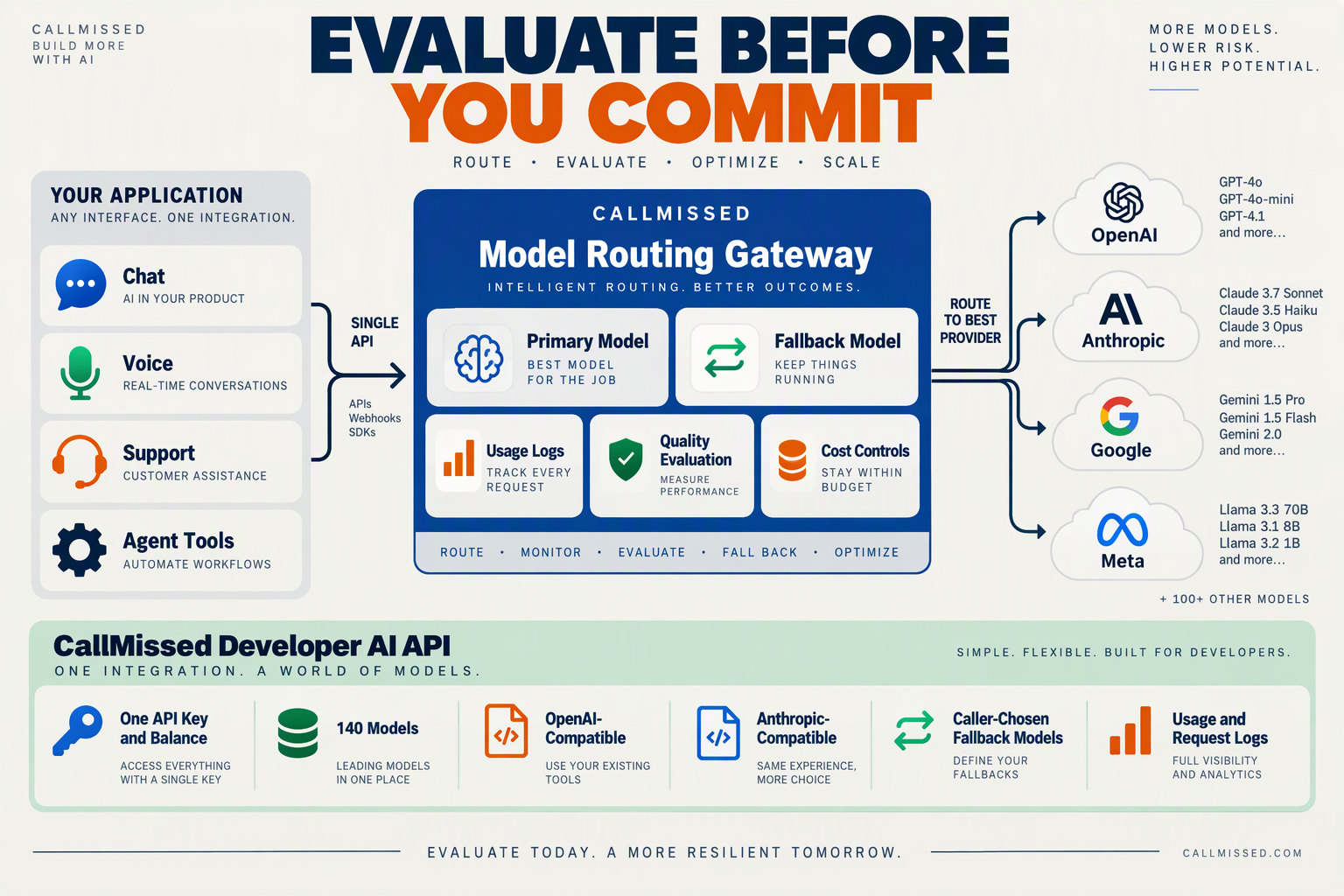
Model routing reduces dependence on any single frontier provider, but it only works when prompts, tool schemas and evaluations remain portable. Buyers should treat GPT-6 Astra, Gemini 4 Argon, Meta Muse Wonder, Claude Opus 5.5 and Claude Sonnet 5.5 as workload-specific candidates, while keeping the unannounced Claude Fable 5.5 outside production plans.
How should businesses route requests between frontier models?
A practical router should select models using measured workload requirements, not launch rankings. OpenRouter describes Meta Muse Wonder as a “frontier reasoning model” for “complex personal and professional agentic tasks,” but that positioning does not establish its fitness for every application.
Use a routing hierarchy such as:
- Classify the request: coding, retrieval, document analysis, customer support or tool-driven action.
- Apply hard constraints: required context, vision support, structured outputs, data residency and maximum acceptable cost.
- Choose the evaluated primary model: select the candidate with the strongest task-specific pass rate.
- Specify fallbacks: retry only for defined conditions such as timeouts, provider errors or invalid schemas.
- Log the decision: retain model, prompt version, latency, token consumption, tool results and evaluation outcome.
Do not route solely to the cheapest model. A lower token price can still increase total cost if the model generates longer answers, retries tools or requires human correction.
How can buyers reduce AI model lock-in?
Lock-in occurs at more than the API layer. Applications can become dependent on proprietary prompt syntax, tool-calling behavior, cached context, model-specific reasoning controls or an interface with no equivalent API.
Access differences already demonstrate this risk. Coursiv reported in October 2026 that Meta Muse Wonder Full runs only inside paid Muse Code plans priced at $50 and $200, rather than through the Meta Model API. That makes Muse Wonder Full harder to place inside a provider-neutral production router than the API-accessible Muse Wonder model.
Buyers should therefore:
- Maintain a canonical message and tool schema independent of any provider.
- Isolate provider-specific parameters inside adapters.
- Store prompts and evaluation datasets outside provider consoles.
- Define fallback behavior explicitly rather than silently substituting models.
- Test exportability of logs, responses and usage records.
- Avoid designing around Claude Fable 5.5 until Anthropic confirms its existence, API access, pricing, limits and terms.
What should a multi-model evaluation measure?
Run the same versioned test set against every candidate, including GPT-6 Astra, Gemini 4 Argon and the announced Claude 5.5 models. Measure both quality and operational behavior:
- Task success: correct answer or completed business outcome.
- Tool accuracy: correct tool, arguments and execution order.
- Schema compliance: valid JSON and required fields.
- Groundedness: unsupported claims per response.
- Latency: median and tail response times.
- Cost per successful task: total spend divided by accepted outcomes.
- Fallback rate: percentage requiring another model or human review.
A benchmark score can shortlist a model; only representative production tests can approve it.
What does a CallMissed model-routing implementation look like?
With CallMissed, the OpenAI-compatible developer AI API, an application can implement routing in its own policy layer and send selected requests through compatible endpoints. As of October 2026, CallMissed provides one API key and balance for 140 models, including 45 general-purpose LLMs, with streaming, structured outputs, function calling, request logs and caller-chosen fallback models.
For example, a support system could route routine classification to a cost-controlled model, send difficult reasoning cases to a frontier candidate, and invoke a tested fallback when the primary returns an invalid schema. CallMissed’s stored prompts, response caching and usage logs can help keep the experiment reproducible—but model promotion should still depend on the buyer’s own acceptance thresholds, not launch-week claims.
What do vendor claims and independent experts agree—and disagree—on?

Vendor materials and independent analysts broadly agree on pricing, access and headline capabilities, but they diverge on what benchmark results prove about production value. For buyers comparing Meta Muse Wonder, Gemini 4 Argon, GPT-6 Astra, Claude Opus 5.5 and Claude Sonnet 5.5, verified specifications are dependable starting points—not final rankings.
Where do vendor claims and independent reports agree?
The strongest agreement surrounds Meta Muse Wonder’s commercially verifiable details:
- Meta Muse Wonder launched on October 12, 2026, according to MACCUS, Coursiv and Eesel AI.
- Muse Wonder costs $4 per million input tokens, $20 per million output tokens and $0.20 per million cached-input tokens as of October 12, 2026, according to MACCUS.
- OpenRouter listed Muse Wonder with a 1,048,576-token context window in October 2026.
- Muse Wonder Full runs inside paid Muse Code plans rather than Meta’s general Model API as of October 2026, according to Coursiv.
Analysts also agree that Meta has entered the frontier tier rather than merely producing another inexpensive open model. DataNorth reported in October 2026 that Muse Wonder scored 52 on the Artificial Analysis index, compared with 58 for Claude Opus 5.5. That six-point difference indicates competitive performance, but it does not establish parity across every workload.
Where do experts challenge vendor benchmark narratives?
The disagreement concerns interpretation, especially when vendors select benchmarks, configurations and competitors for launch charts. Eesel AI notes that the Artificial Analysis score of 52 appeared in Meta’s own launch presentation, so buyers should distinguish a benchmark result from independently reproduced application performance.
Coursiv reported that Muse Wonder Full won seven of the 14 benchmark rows included in the comparison it examined in October 2026. A seven-of-14 result can support Meta’s claim of frontier competitiveness, yet it also shows why “wins the most rows” is not equivalent to “best model for every buyer.”
Three caveats matter:
- Composite scores hide workload variation. A model can perform strongly on reasoning while trailing on coding, tool use or instruction adherence.
- The tested product may not be the purchasable API model. Muse Wonder Full’s Muse Code-only availability makes its results less relevant to teams evaluating Meta Model API deployment.
- Token price does not equal task cost. A $20 output rate can be economical if fewer retries are required—or expensive if verbose reasoning and failed tool calls inflate usage.
How should buyers reconcile conflicting AI model claims?
Run the same evaluation suite against every accessible candidate, using production-like prompts and deterministic pass criteria. Measure:
- Task success rate, including correct tool execution
- Structured-output validity and schema compliance
- Median and tail latency
- Input, cached-input and output consumption
- Human escalation and retry rates
- Cost per completed task, not merely cost per token
Model-flexible infrastructure can make this comparison easier. CallMissed, the OpenAI-compatible developer AI API, provides access to 140 models through one API key and balance as of October 2026, while supporting request logs, fallback models and structured outputs.
What should buyers believe about Claude Fable 5.5?
Treat Claude Fable 5.5 as an unannounced watchlist entry, not an available Anthropic product or benchmarked alternative. Until Anthropic publishes specifications, pricing, API availability and reproducible evaluations, Fable 5.5 should receive zero weight in procurement scoring; GPT-6 Astra, Gemini 4 Argon, Muse Wonder, Claude Opus 5.5 and Claude Sonnet 5.5 should likewise be ranked only on verified, workload-specific evidence.
Which model should you buy for coding, long agents, low-cost inference, support or voice?
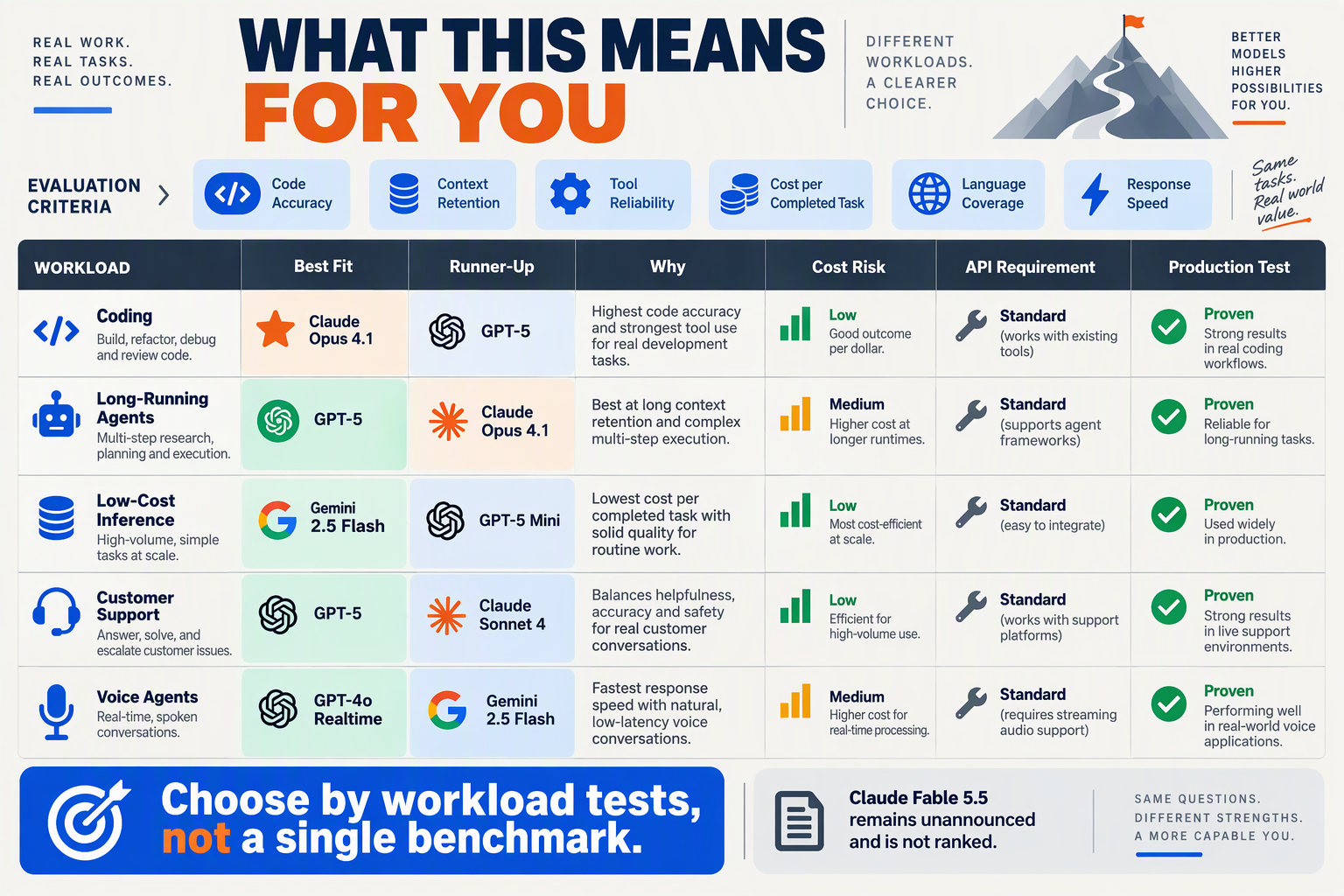
Buy by workload, not by benchmark rank: shortlist GPT-6 Astra for demanding coding, Gemini 4 Argon for multimodal workflows, Claude Opus 5.5 for complex agents, Claude Sonnet 5.5 for support-oriented cost control and Meta Muse Wonder for million-token context or cache-heavy inference. Keep Claude Fable 5.5 off procurement lists until Anthropic announces its specifications, pricing and availability.
Which October 2026 model fits each workload?
| Workload | First model to test | Why it belongs on the shortlist | What to validate before buying |
|---|---|---|---|
| Production coding | GPT-6 Astra | Candidate for difficult implementation, debugging and repository-level reasoning | Pass rate on your codebase, regression rate, tool use and cost per merged change |
| Long-running agents | Claude Opus 5.5 | Candidate for complex planning and multi-step tool orchestration | Tool-call accuracy, recovery from failures, context retention and output cost |
| Million-token analysis | Meta Muse Wonder | OpenRouter lists a 1,048,576-token context window | Recall at different context depths, latency and whether retrieval is cheaper |
| Cache-heavy inference | Meta Muse Wonder | Published cached-input price is substantially below its standard input price | Cache-hit rate, cache rules and end-to-end savings under real traffic |
| Customer support | Claude Sonnet 5.5 | Sensible evaluation candidate where quality, speed and operating cost must balance | Policy adherence, escalation accuracy, multilingual quality and hallucination rate |
| Multimodal workflows | Gemini 4 Argon | Candidate for applications combining text with visual or other mixed inputs | Supported modalities, structured-output reliability, throughput and regional access |
These are starting points for evaluation, not unconditional winners. No comparable October 2026 pricing, context and benchmark figures for GPT-6 Astra, Gemini 4 Argon, Claude Opus 5.5 or Claude Sonnet 5.5 were included in the verified research supplied for this guide, so procurement should wait for official rate cards and workload-specific tests.
When is Meta Muse Wonder the clearest purchase?
Meta Muse Wonder has the strongest documented case here for very long inputs and repeated context. OpenRouter listed Meta Muse Wonder with a 1,048,576-token context window as of October 2026.
MACCUS reported on October 12, 2026, that Meta Muse Wonder costs $4 per million input tokens, $20 per million output tokens and $0.20 per million cached-input tokens. That pricing favors workloads that repeatedly reuse a stable repository, policy library or agent history—but output-heavy generation can still become expensive.
Quality must be tested independently. Eesel AI reported in October 2026 that Meta’s launch materials gave Muse Wonder a score of 52 on the Artificial Analysis index. A composite score cannot reveal whether the model follows a specific JSON schema, chooses the correct support action or survives a 30-step agent trajectory.
What should voice-AI buyers choose?
For voice, do not select a text frontier model in isolation. Measure speech recognition, turn-taking latency, interruptions, text-to-speech quality, tool execution and telephony costs as one system.
As of October 2026, CallMissed’s developer AI API provides 24 realtime voice-agent models within a 140-model catalogue, while its voice platform combines speech recognition, a language model and voice at flat rates of ₹4, ₹5 or ₹6 per minute, depending on the tier. That model flexibility is useful for routing support conversations to a fast model while reserving expensive frontier reasoning for escalations.
Should buyers wait for Claude Fable 5.5?
No production purchase should depend on Claude Fable 5.5 yet. Treat it as an unannounced watchlist entry until Anthropic confirms:
- The model’s official name and release date
- API and regional availability
- Context window and modality support
- Input, output and caching prices
- Independent coding, agent and safety results
Until then, benchmark the five purchasable candidates against the same tasks and choose using cost per successful outcome, not cost per token alone.
Frequently Asked Questions
Which are the best new AI models October 2026 for business use?
How should buyers compare the best new AI models October 2026?
Is Claude Fable 5.5 available, and should businesses wait for it?
How much does Meta Muse Wonder cost compared with other October 2026 AI models?
What is the difference between Meta Muse Wonder and Muse Wonder Full?
Is a one-million-token context window enough to choose an AI model?
Conclusion
The best new AI model of October 2026 is not one universal winner. The right purchase depends on whether your workload prioritizes reasoning, coding, long context, multimodal inputs, agentic tool use, latency or predictable API costs.
- Match the model to the workload. GPT-6 Astra, Gemini 4 Argon, Meta Muse Wonder, Claude Opus 5.5 and Claude Sonnet 5.5 should be tested against representative prompts, schemas and tool calls. Public benchmarks can narrow a shortlist, but production evaluations reveal whether a model reliably follows instructions, generates valid structured output and performs well with your customers’ languages.
- Treat context capacity as a capability, not a target. OpenRouter listed Meta Muse Wonder with a 1,048,576-token context window as of October 2026, making it relevant for large codebases, document collections and extended agent histories. Buyers should still test retrieval accuracy across the full window rather than assuming that every included token receives equal attention.
- Model economics extend beyond input pricing. MACCUS reported on October 12, 2026, that Meta Muse Wonder costs $4 per million input tokens, $20 per million output tokens and $0.20 per million cached-input tokens. At that rate, 100 million output tokens would cost $2,000, demonstrating why output length, caching and orchestration design belong in every procurement calculation.
- Use benchmarks as evidence, not verdicts. Eesel AI reported in October 2026 that Meta Muse Wonder scored 52 on the Artificial Analysis index shown in Meta’s launch materials. That result offers a useful comparison point, but it does not replace testing for coding quality, tool-call success, latency consistency or end-to-end workload cost.
What should AI buyers watch next?
Watch for independent evaluations, stable API availability, revised pricing and clearer operational data across all five announced model families. Claude Fable 5.5 must remain a watchlist entry until Anthropic formally announces it and confirms specifications, pricing, access and supported capabilities; rumors are not a sound basis for architecture or budget decisions.
Model flexibility may become more valuable as frontier leadership keeps changing. As of October 2026, CallMissed, the OpenAI-compatible developer AI API, provides one API key and balance for 140 models, alongside caller-chosen fallback models, usage logs and request logs. Teams can explore CallMissed as one practical route for evaluating and switching among models without rebuilding every integration.
The decisive question is therefore not “Which model won launch month?” but which model delivers the strongest verified outcome on your workload, at a cost and operational risk your organization can sustain?
Related Reading
- Frontier AI Models Compared October 2026: Fable 5.5 Not Out
- LLM comparison 2026: Best Models for Customer Support
- Large Language Models: Customer Support's Future in 2026