
Gemini 4 Argon: What Google Announced September 30, 2026



Understand Gemini 4 Argon announcement claims, access stages, specification gaps, and the evidence developers and enterprise buyers should check.
Gemini 4 Argon: What Google Announced September 30, 2026
Google’s Gemini 4 Argon announcement puts software engineering, legal and finance knowledge work, and cybersecurity defense in the spotlight—not just chatbot conversations. Published on September 30, 2026, Google’s launch post describes “frontier performance in complex workflows,” making this a release developers and enterprise buyers should examine through the lens of practical execution, not headline claims alone.
The immediate question is straightforward: what did Google actually announce, and what does that mean for production deployments? Google’s official announcement identifies those workload priorities, the restricted Fairwind rollout, introductory $2/$10 per-million input/output rates, a 95% eligible cached-input discount and later $4/$20 rates. Public API identifiers, universal account access and the introductory expiry date are not established by the retrieved evidence. Reported output limits must not be confused with input context capacity. Those details matter: a promising model announcement is not, by itself, evidence that a particular enterprise workflow is ready to migrate.
This launch also arrives amid a rapid sequence of Gemini updates. According to Google’s August 2026 AI announcements, Gemini 3.7 Flash arrived just three weeks after Gemini 3.6 Flash, with improvements targeting software engineering, knowledge work, and agents. Google’s announcement updated September 17, 2026, introduced Gemini 3.8 Live and Gemini 3.8 Live Extended Thinking for near-real-time reasoning and voice-agent interactions. Gemini 4 Argon therefore enters an ecosystem already evolving across coding, automation, and conversational AI.
What should developers and enterprise buyers look for in Gemini 4 Argon?
The useful distinction is between announced capabilities, measured performance, and operational readiness. Google’s description of complex workflows points toward consequential business tasks; buyers still need evidence about reliability, access, cost, and controls before translating that positioning into procurement decisions.
For example, a legal research assistant must do more than produce fluent answers: an evaluation should test citation accuracy, handling of conflicting documents, and escalation when evidence is insufficient. A software engineering agent needs assessment against a team’s repositories and review standards, rather than an assumption that broad frontier-performance language guarantees dependable code changes.
This explainer will separate the launch’s documented claims from questions that require additional official detail:
- Capabilities: Which workloads does Google explicitly highlight?
- Access and economics: What availability and pricing information is confirmed?
- Evidence: Which benchmarks or demonstrations support the claims?
- Enterprise implications: What should teams validate before adoption?
As of September 2026, CallMissed’s OpenAI-compatible developer AI API includes Google among its catalogue providers, illustrating the broader move toward multi-model infrastructure without establishing Gemini 4 Argon availability.
The goal is a grounded launch briefing: understand Google’s announcement, identify its practical significance, and avoid mistaking missing information for confirmed product functionality.
Gemini 4 Argon launch: confirmed facts
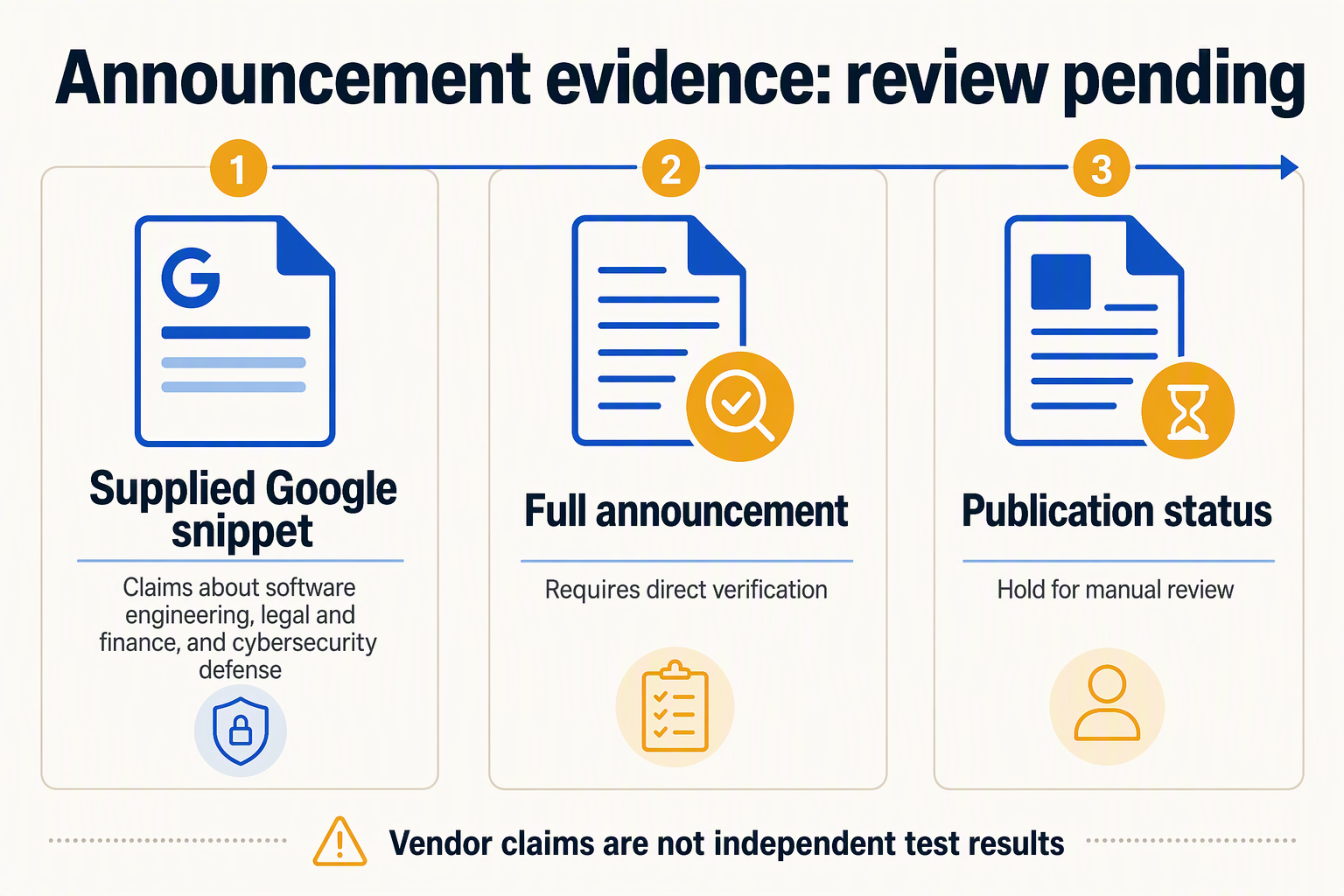
Google’s September 30, 2026 announcement introduces Gemini 4 Argon for complex professional workflows: software engineering, legal and finance knowledge work, and cybersecurity defense. The initial release is a limited Fairwind rollout for trusted cybersecurity defenders—not public general availability. An announcement should therefore not be read as confirmation that every developer can access the model.
What capabilities and performance did Google announce?
In its launch announcement, “Gemini 4 Argon: our next era of frontier intelligence,” Google describes Argon as delivering “frontier performance in complex workflows.” That is Google’s positioning, rather than an independently established conclusion.
9to5Google reports the following vendor-supplied DeepSWE v1.1 results:
| Model | Reported score |
|---|---|
| Gemini 4 Argon | 77.9% |
| Opus | 74.2% |
| Astra | 74.1% |
These are vendor-reported benchmark claims, not tests run by CallMissed. They should not be treated as proof of production-safe code changes, reliable legal or financial advice, or autonomous cybersecurity remediation.
What does the one-million-token headline mean?
September 30 coverage from 9to5Google and AlphaSignal explicitly describes a one-million-token output limit, increased from 64,000 tokens.
That reporting concerns generated output. It does not establish a one-million-token input context window, and it does not mean every account can generate that much output in a single request. The input context limit and account-specific output availability remain separate questions to check in developer documentation.
What pricing did Google announce?
Google announced introductory token pricing, with higher rates to follow:
| Pricing stage | Input per million tokens | Output per million tokens |
|---|---|---|
| Introductory | $2 | $10 |
| Later announced rates | $4 | $20 |
Google also announced a 95% discount on eligible cached input. Applied to the introductory $2 input rate, that works out to $0.10 per million eligible cached input tokens—a derived figure, not the price for all input.
The supplied announcement information does not establish an expiration date for the introductory pricing. Do not assume those rates are permanent or attach an unconfirmed deadline.
Can developers use it now?
The confirmed initial access is limited, not public GA. Before planning an integration, check Google’s release-status updates and API pricing documentation for applicable access conditions, model identifiers, limits, and billing terms.
The practical takeaway: Google has announced a workflow-focused model, pricing, and vendor-reported performance results. Broad developer availability, input context size, and account-level output limits should not be inferred from those headlines.
Which Gemini 4 Argon key facts are sourced, unverified, or unspecified?
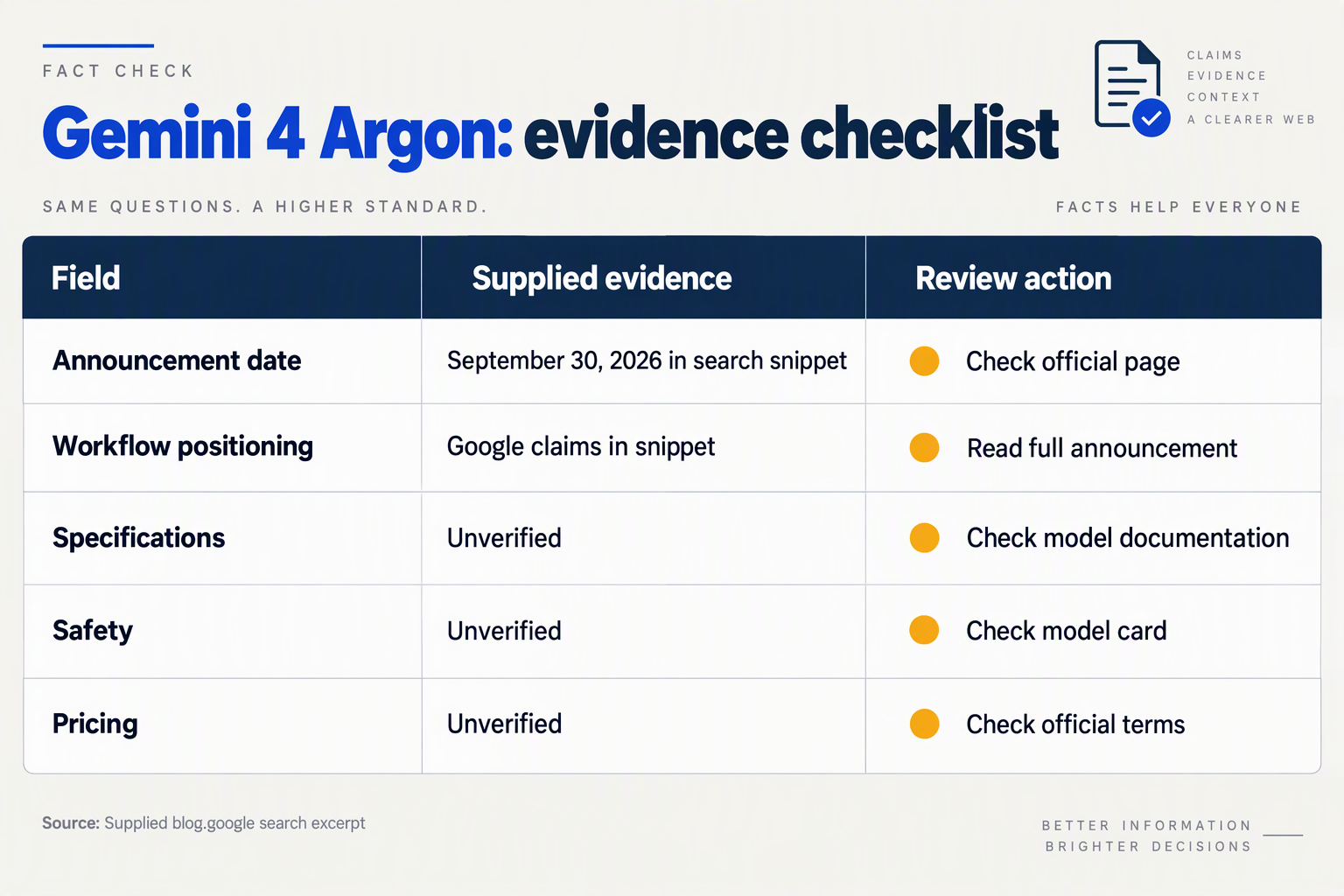
The supplied Google sources support Gemini 4 Argon’s launch identity and stated workload priorities, but not a complete technical or commercial specification. As of September 30, 2026, details absent from the supplied announcement excerpt should be marked unspecified, while claims extending beyond that evidence should be treated as unverified.
That distinction prevents two common mistakes: presenting Google’s positioning as independently measured performance, and treating missing information as proof that a capability does not exist.
Which Gemini 4 Argon claims have official source support?
The following evidence ledger reflects the provided Google excerpts, not a review of the full announcement, API documentation, or model card.
| Fact or claim | Evidence in supplied context | Status | Buyer implication |
|---|---|---|---|
| Product name and launch date | Google’s launch listing names Gemini 4 Argon and is dated September 30, 2026. | Sourced | Establishes announcement identity, not general availability. |
| Target workloads | Google names real-world software engineering, enterprise knowledge work such as legal and finance, and cybersecurity defense. | Sourced positioning | Use these areas to select evaluation tasks. |
| “Frontier performance” | Google uses this phrase for complex workflows; the excerpt supplies no scores or test methodology. | Sourced claim; superiority unverified | Request benchmark definitions and reproducible results. |
| API access and rollout | No endpoint, model identifier, access tier, or regional rollout appears in the supplied excerpt. | Unspecified | Confirm access before scheduling integration work. |
| Pricing and operating costs | No token prices, caching charges, or service limits appear in the supplied excerpt. | Unspecified | Do not calculate production economics from assumed rates. |
| Technical and enterprise specifications | Context limits, supported modalities, latency, data controls, and deployment restrictions are absent from the excerpt. | Unspecified | Obtain documentation before architecture or procurement approval. |
According to Google’s September 30, 2026 launch excerpt, Gemini 4 Argon delivers “frontier performance in complex workflows.” That quotation establishes what Google claims, but does not establish a numerical advantage over another model.
What is the difference between unverified and unspecified?
Unverified means a proposition lacks sufficient supporting evidence in the material available here. Unspecified means the provided source does not state the detail at all; it does not mean Google necessarily omitted it from every launch document.
For this Gemini 4 Argon explainer:
- Sourced: Google explicitly identifies cybersecurity defense as a target workload in its September 30, 2026 announcement excerpt.
- Unverified: Any assertion that Gemini 4 Argon outperforms every competing model would require comparative evidence not supplied here.
- Unspecified: The excerpt gives no context-window size, so neither a numerical limit nor an “unlimited context” description is justified.
Related Google announcements cannot fill those gaps automatically. A capability documented for another Gemini model is not evidence that Gemini 4 Argon supports the same interface, operating limits, or deployment options.
How should teams turn this evidence ledger into an adoption decision?
Use three verification gates before moving from launch interest to production planning:
- Confirm availability. Obtain the official model identifier, supported service, account eligibility, and applicable regions.
- Validate performance. Test representative repositories, document sets, or defensive-security tasks with explicit success criteria and human review.
- Establish operating terms. Verify prices, quotas, data handling, retention, and contractual commitments for the intended deployment.
For example, a finance-document assistant needs evidence of accurate extraction and source attribution—not merely finance appearing in Google’s workload list. The practical rule is simple: an announced use case justifies investigation; documented specifications and workload testing justify adoption.
Who can actually access it: announced, preview, generally available, or enabled for an account?
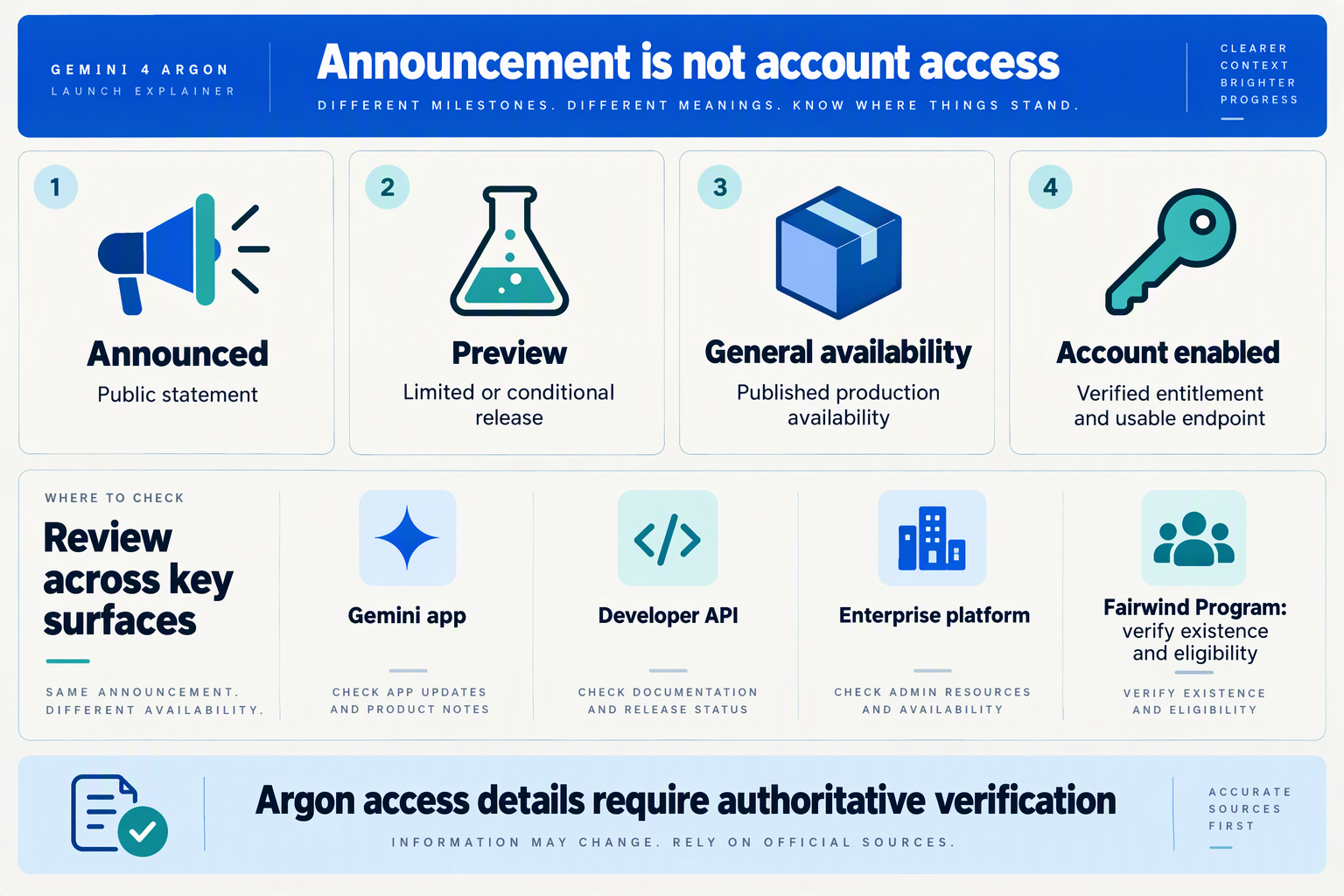
Gemini 4 Argon is confirmed as announced, but the supplied official launch excerpt does not establish who can use it. As of September 30, 2026, preview access, general availability, supported API routes, and account-level enablement remain unverified in the provided material—not necessarily unavailable.
Where is Gemini 4 Argon access actually confirmed?
Google’s September 30, 2026 post, titled “Gemini 4 Argon: our next era of frontier intelligence,” establishes the announcement. However, the supplied excerpt does not identify a developer endpoint, eligible subscription, enterprise rollout schedule, or access application process.
The table separates documented announcement status from access routes buyers should verify. “Not established” means the provided evidence does not answer the question; it is not a claim that Google has withheld access.
| Access route | Status on Sept. 30, 2026 | What the supplied evidence confirms | What to verify next |
|---|---|---|---|
| Official Google announcement | Announced | Google published the Argon launch post | Full availability wording |
| Google AI Studio | Not established | No AI Studio access details | Model selection and eligibility |
| Gemini API | Not established | No callable model identifier or endpoint | Model ID, credentials, quotas |
| Google Cloud Vertex AI | Not established | No enterprise deployment details | Supported locations and permissions |
| Gemini app | Not established | No app-tier or account rollout details | Eligible plans and model selection |
| Third-party model gateways | Not established | No Argon-specific gateway listing | Explicit model support and routing |
These are verification routes, not a confirmed distribution list. Access through one surface would not establish access through another: an app rollout, for example, would not prove that developers can call the same model through an API.
What is the difference between announced, preview, and generally available?
Announced means a product has been publicly introduced. Preview usually denotes access under evaluation-stage conditions, while generally available indicates a broader release under the provider’s published terms; the exact conditions must come from Google’s product documentation.
For Gemini 4 Argon, the supplied September 30 material supports the first label only. Do not infer preview or general availability from the launch headline, demonstrations, or descriptions of capabilities.
Enterprise buyers should distinguish:
- Release status: Has Google explicitly labelled the relevant offering preview or generally available?
- Access scope: Which products, locations, plans, and customer groups are eligible?
- Operational terms: What quotas, support commitments, and usage restrictions apply?
How can developers confirm access for their own account?
Account enablement requires an account-specific check, even after a provider confirms broader availability. A model appearing in documentation does not prove that a particular project has permission or sufficient quota to invoke it.
Use this sequence before scheduling an Argon evaluation:
- Find the official model identifier. Confirm the exact name and supported API surface rather than guessing from the marketing name.
- Check the intended project. Verify credentials, permissions, billing requirements, and any location restrictions documented by Google.
- Run a minimal request. Record the requested model identifier, returned model metadata where available, and any access or quota errors.
- Separate testing from procurement. A successful request establishes access at that moment—not production suitability or contractual coverage.
For launch-day planning, the defensible conclusion is narrow: Google has announced Gemini 4 Argon; the supplied evidence does not yet establish a deployable access path for a specific developer or enterprise account.
What specifications and modalities are confirmed—and is the reported 1 million-token limit output or context?
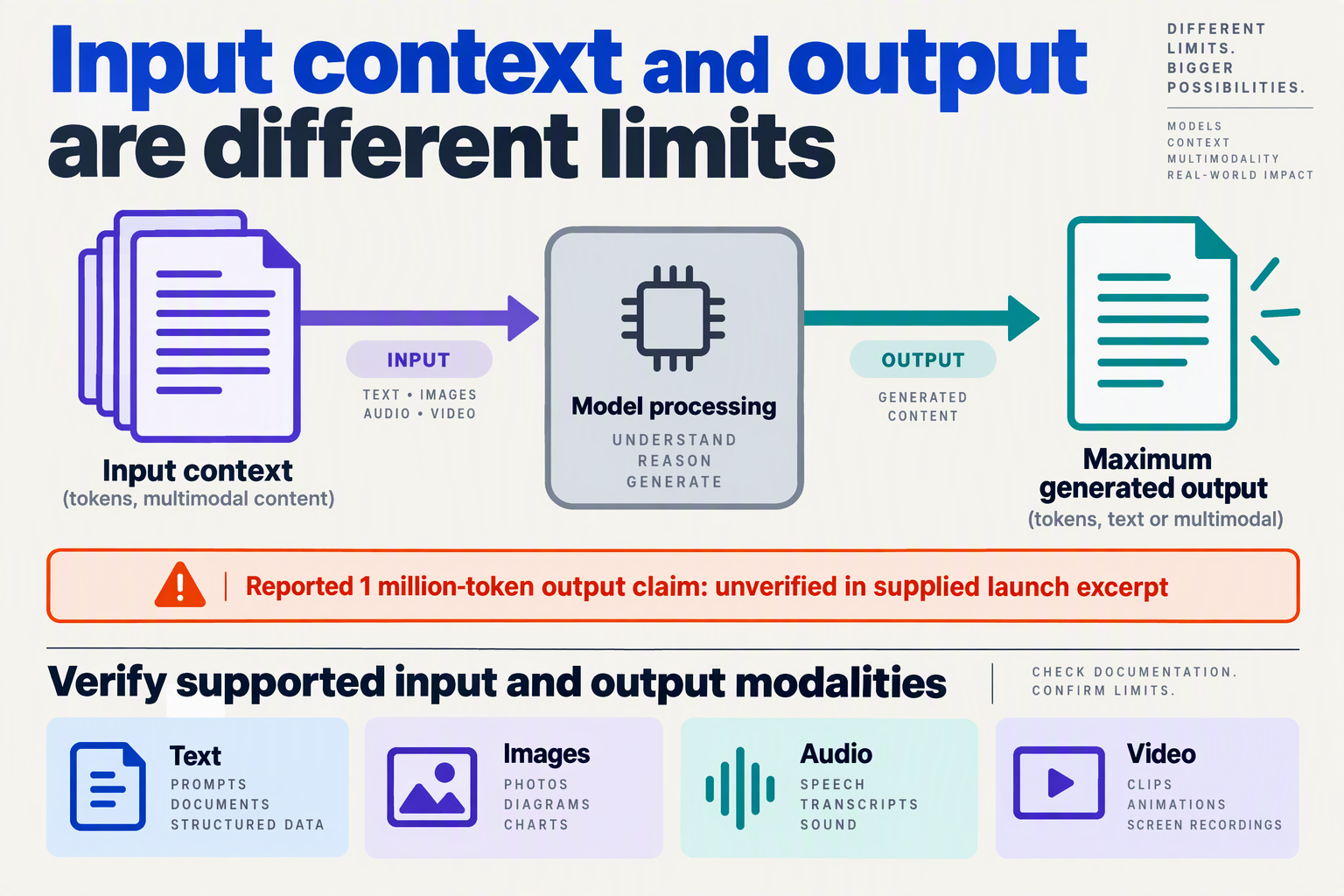
The supplied excerpt of Google’s September 30, 2026 Gemini 4 Argon announcement does not confirm a token limit or enumerate supported input and output modalities. The reported 1 million-token figure therefore cannot be classified as either an output limit or a context window from the available official evidence.
That distinction matters for implementation: processing a large document collection and generating a very long response are different capabilities, governed by different limits.
Is Gemini 4 Argon’s reported 1 million-token limit output or context?
Neither interpretation is verified by the supplied Google launch excerpt as of September 30, 2026. Treat “1 million tokens” as an unverified specification until Google’s model documentation explicitly identifies what the number measures.
Three terms should remain separate:
- Input-token limit: The maximum material a request can supply, subject to the endpoint’s accounting rules.
- Context window: The model’s working token budget. Provider documentation must establish whether and how input, generated output, conversation history, and other material count toward it.
- Maximum output tokens: The ceiling on generated tokens for a response—not a promise that every request will produce that length.
A large context window does not establish an equally large output allowance. Likewise, an API parameter requesting a particular response length does not prove the model supports that maximum.
For enterprise buyers, a useful procurement question is: “What are the documented maximum input and output limits for the exact model ID and endpoint we will use?” A headline number without those details is insufficient for capacity planning.
Which Gemini 4 Argon modalities are confirmed?
The available Google launch excerpt does not specify text, image, audio, or video interfaces for Gemini 4 Argon. It describes performance in workloads, not a modality matrix.
Google’s September 30, 2026 announcement says Gemini 4 Argon delivers “frontier performance in complex workflows,” including software engineering, legal and finance knowledge work, and cybersecurity defense. Those use cases do not independently establish image understanding, speech generation, video processing, or native tool execution.
Similarly, Google’s announcement updated September 17, 2026 introduces Gemini 3.8 Live and Gemini 3.8 Live Extended Thinking for near-real-time reasoning and voice agents. That separate announcement is not evidence that Gemini 4 Argon exposes the same voice interfaces.
Developers should request explicit documentation for:
- Accepted inputs: Text, images, audio, video, and supported file formats.
- Generated outputs: Text, structured data, speech, or other media.
- Interaction modes: Request-response, streaming, or bidirectional real-time sessions.
- Operational constraints: File sizes, media duration, token accounting, and endpoint-specific restrictions.
How should developers validate the specifications before integration?
Use a short, evidence-led acceptance checklist:
- Identify the exact model and endpoint. Record the model ID, version, and documentation date rather than relying on the Gemini family name.
- Verify separate token ceilings. Check input, context, and output limits, including how tool results and retained history are counted.
- Test the intended workload. For a legal assistant, validate both document ingestion and the required answer length; successful ingestion alone does not establish reliable synthesis.
As of September 2026, CallMissed’s developer AI API offers OpenAI-compatible endpoints and includes Google among its catalogue providers. However, compatibility with a gateway does not establish Gemini 4 Argon availability or override model-specific limits.
The practical conclusion: do not design around a million-token output—or context—assumption until Google documents it explicitly.
Which benchmark and introductory pricing claims can be verified from official sources?
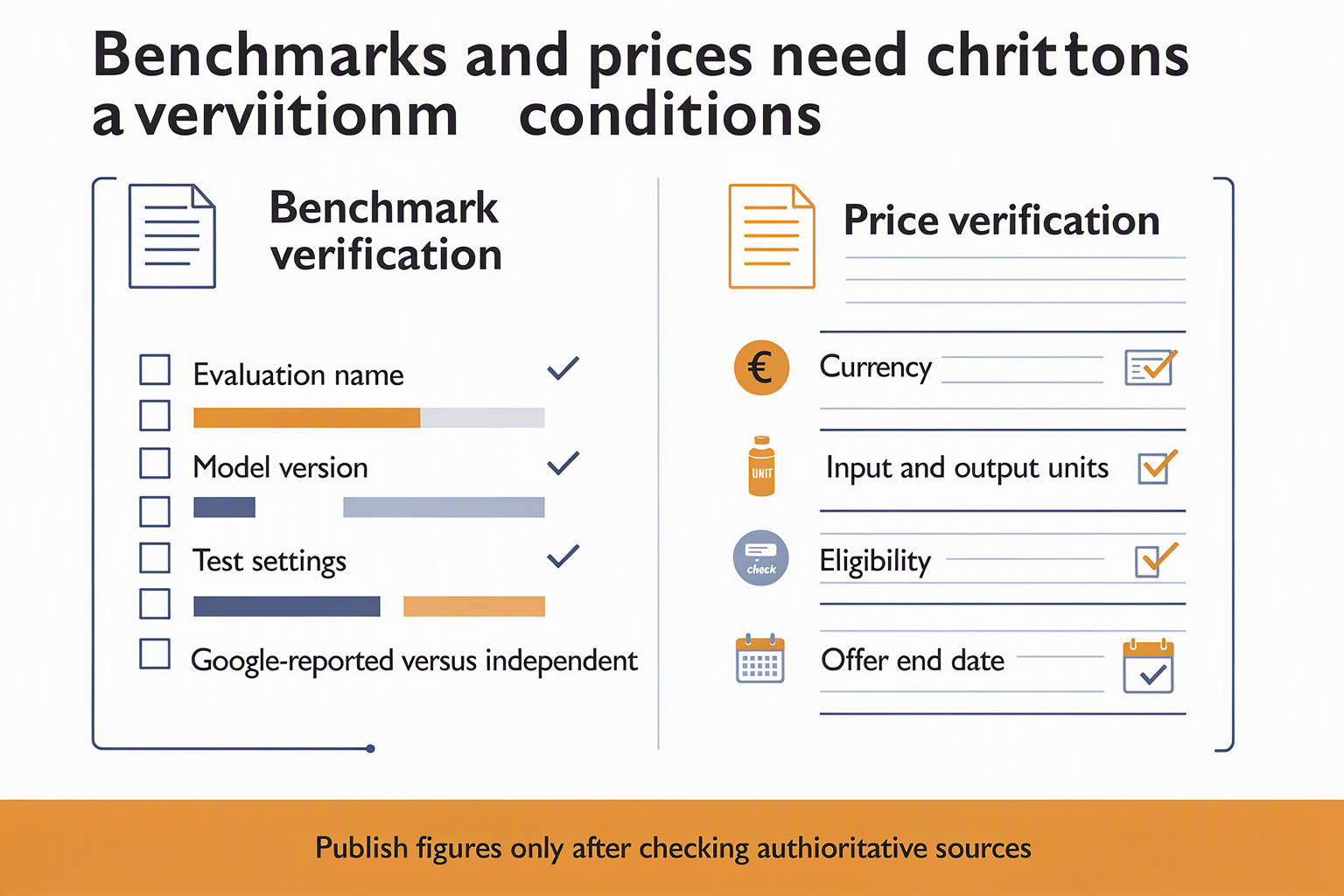
No numerical Gemini 4 Argon benchmark score or introductory API price can be verified from the supplied official-source excerpts as of September 30, 2026. Google’s launch excerpt supports a qualitative performance claim, but it does not provide the measurements or commercial terms needed to validate a leaderboard position or calculate deployment costs.
What benchmark claims does Google actually support?
Google’s September 30, 2026 launch announcement says Gemini 4 Argon delivers “frontier performance in complex workflows” across real-world software engineering, enterprise knowledge work such as legal and finance, and cybersecurity defense.
That wording identifies the intended workloads. It does not, in the supplied excerpt, establish:
- A named benchmark, test-set version, or numerical score.
- A comparison against a specific competing model.
- The tools, reasoning settings, or inference budget used during evaluation.
- Whether results came from independent testing or Google’s internal evaluations.
This is an evidence boundary, not proof that Google has published no benchmark results elsewhere. The available search excerpt is insufficient to verify any specific Argon score; readers should not treat an unseen chart or an unattributed social-media number as confirmed launch evidence.
Can earlier Gemini benchmark claims be applied to Argon?
No—performance claims belong to the model and evaluation configuration tested. Google’s official I/O 2026 developer highlights describe Gemini 3.5 Flash as operating four times faster than other frontier models while surpassing Gemini 3.1 Pro on almost all benchmarks. That is a claim about Gemini 3.5 Flash, not Gemini 4 Argon.
The distinction matters because “faster” can refer to different measurements: response latency, generation throughput, or total task-completion time. The supplied I/O excerpt does not identify the comparator models or measurement conditions, so even that earlier claim needs methodological context before informing procurement.
For Argon, developers should request three things before accepting a benchmark comparison:
- Exact evaluation identity: benchmark name, version, scoring method, and model identifier.
- Comparable execution conditions: tools, retry limits, reasoning budget, and token allowances.
- Operational relevance: whether the test measures successful task completion, rather than only answer quality.
A coding score, for example, should not automatically be presented as evidence of legal citation accuracy or cybersecurity reliability.
What introductory pricing can enterprise buyers verify?
The supplied September 30, 2026 Google launch excerpt contains no verifiable introductory pricing for Gemini 4 Argon. It does not establish input-token rates, output-token rates, promotional credits, discount duration, or eligibility conditions.
Before calculating a launch offer’s value, buyers should obtain official terms covering:
- Billing units: input, output, cached tokens, and any separately billed tools.
- Offer boundaries: eligible accounts, regions, access channels, and expiry dates.
- Production economics: rate limits, retry costs, and charges after the introductory period.
Gateway pricing must also remain separate from Google’s model-specific pricing. As of September 2026, CallMissed’s verified fact sheet lists 1,000 free signup credits for its developer platform; that does not establish Gemini 4 Argon availability, eligibility, or Google’s introductory terms.
The defensible purchasing metric is cost per successfully completed workflow. An attractive token price can still produce an expensive deployment if tasks require repeated attempts or substantial human review. Until official Argon rates and reproducible results are available in the evidence, numerical cost-performance comparisons should remain explicitly unverified.
What did Google claim about legal, financial, and cybersecurity workflows—and what safety evidence supports those claims?

Google positioned Gemini 4 Argon for legal and financial knowledge work and cybersecurity defense, but the supplied launch excerpt does not document safety results for those workflows. Google’s September 30, 2026 announcement claims “frontier performance in complex workflows”; that wording establishes a capability claim, not evidence of reliable legal advice, financial decisions, or autonomous security operations.
What did Google actually claim about legal and financial workflows?
Google’s September 30, 2026 launch excerpt explicitly identifies “enterprise knowledge work like legal and finance” among Gemini 4 Argon’s target workloads. The excerpt does not identify particular legal tasks, financial datasets, evaluation methods, or error rates, so narrower claims—such as verified contract-review accuracy or dependable investment analysis—would go beyond the supplied evidence.
For enterprise buyers, workflow performance needs to be broken into observable behaviors. A useful pilot would distinguish between retrieving information, interpreting it, and taking an action based on that interpretation.
Consider two hypothetical evaluations:
- Legal: Ask the model to compare a contract amendment with the original agreement, identify changed obligations, and attach source passages to each finding. Reviewers should check omissions, conflicting clauses, and whether the answer respects the specified jurisdiction.
- Finance: Ask the model to reconcile a management report against underlying spreadsheets. Reviewers should check calculations, reporting periods, units, and whether assumptions are clearly separated from recorded facts.
These are proposed buyer tests, not demonstrations reported in Google’s supplied announcement. A polished summary should not receive the same evaluation weight as a correctly supported conclusion.
What safety evidence supports the cybersecurity claim?
Google’s September 30, 2026 announcement names “cybersecurity defense” as a Gemini 4 Argon capability area. However, the supplied excerpt contains no cybersecurity benchmark scores, red-team findings, prompt-injection results, or measurements of unsafe tool use.
That evidence gap does not prove the model is unsafe. It means this section cannot establish its safety from the available material—or infer that Google published no additional evidence elsewhere.
Security buyers should separate three questions:
- Detection quality: Can the model distinguish malicious activity from legitimate administration, and explain its conclusion using available telemetry?
- Action safety: Can the deployed system prevent unauthorized changes, credential exposure, or destructive remediation?
- Adversarial resilience: Does the system resist instructions embedded in logs, documents, tickets, or other untrusted inputs?
An analyst-assistance deployment and an agent authorized to change production systems have different risk profiles. Evidence supporting the former should not automatically justify the latter.
What should enterprises require before approving these workflows?
For a September 2026 procurement review, request task-specific evaluations and deployment controls, rather than treating “frontier performance” as a safety certification. Ask for:
- A model card or safety report describing evaluation scope and limitations.
- Results for relevant failure modes, including unsupported conclusions and adversarial inputs.
- Permission boundaries, approval gates, audit records, and rollback procedures.
- Clear handling of confidential material, retention, and access controls.
As of September 2026, CallMissed’s developer AI API offers usage and request logs alongside structured outputs and function calling. Those infrastructure capabilities can support application evaluation and traceability, but they do not independently validate Gemini 4 Argon’s safety or establish its availability through CallMissed.
The defensible conclusion: Google announced consequential workflow ambitions; the supplied launch evidence does not yet substantiate task-level safety assurances. Enterprises should match each proposed permission and business consequence to an explicit test before deployment.
Why does this announcement matter to developers and enterprise buyers before production adoption?

Gemini 4 Argon matters because Google is positioning frontier AI around workflows where mistakes have operational consequences—not simply around better conversational answers. For developers and enterprise buyers, the September 30, 2026 announcement is a reason to prepare controlled evaluations, not an automatic trigger for production migration.
What should developers evaluate beyond answer quality?
Google’s September 30, 2026 launch excerpt describes Gemini 4 Argon as delivering “frontier performance in complex workflows,” including software engineering, legal and finance knowledge work, and cybersecurity defense. The practical implication is that evaluation must cover the complete workflow, including tool interactions, recovery from failures, and human review.
Consider an agent assigned to fix a repository issue. A useful result is not merely a plausible patch: the change must satisfy the request, pass relevant tests, avoid unrelated modifications, and remain understandable to reviewers.
A developer evaluation should therefore measure:
- Task completion: Did the system achieve the requested outcome under realistic constraints?
- Intervention burden: How often did a person need to correct, restart, or supervise the workflow?
- Failure recovery: What happened when a tool timed out, returned incomplete data, or denied access?
- Boundary compliance: Did the agent respect permissions and approval requirements?
These are proposed evaluation criteria, not published Gemini 4 Argon results. The supplied announcement excerpt does not establish scores for them.
How should enterprise buyers calculate production value?
Enterprise buyers should compare cost per accepted outcome, rather than treating model pricing alone as the business case. An inexpensive attempt can become costly if employees must repeatedly verify or repair the output.
For a finance-document workflow, define an accepted outcome as an extraction that matches the source, identifies missing information, and passes the organization’s review rules. Then calculate:
Cost per accepted outcome = total model, tooling, infrastructure, and review costs ÷ accepted outcomes.
Track turnaround time separately. A model that reduces processing time but increases specialist review may offer a different business benefit than headline speed suggests.
As of September 30, 2026, the supplied Google launch excerpt does not confirm Gemini 4 Argon pricing or deployment restrictions. Procurement teams should therefore keep preliminary business cases conditional on official commercial and service documentation.
Which controls should come before production access?
Google’s June 2026 AI announcements described computer use in Gemini 3.5 Flash across desktop, mobile, and browser environments. That earlier development provides relevant ecosystem context, but does not establish computer-use support for Gemini 4 Argon.
Before granting any candidate model consequential access, teams should:
- Start with read-only evaluation using approved test data.
- Limit tool permissions to the minimum needed for each task.
- Require human approval before consequential changes.
- Record decisions and tool actions for investigation and review.
- Define rollback and escalation procedures before expanding deployment.
How can teams avoid making adoption irreversible?
Keep model selection separate from business logic wherever practical, and validate each replacement against the same acceptance tests. Portability reduces integration friction; it does not guarantee equivalent behavior.
As of September 2026, CallMissed’s OpenAI-compatible developer AI API supports caller-chosen fallback models, structured outputs, and usage and request logs. Those capabilities illustrate useful infrastructure patterns for controlled evaluation, without establishing Gemini 4 Argon availability through CallMissed.
The buying decision should follow demonstrated workflow value and verified controls—not the launch label alone.
What independent industry reaction is documented, and how does it differ from Google's claims?

No independent industry reaction to Gemini 4 Argon is documented in the supplied research as of September 30, 2026. The available material establishes Google’s launch positioning, but does not include third-party testing, analyst commentary, developer reports, or enterprise customer assessments that confirm or challenge it.
That distinction limits what this explainer can responsibly conclude. Missing independent evidence is not evidence of poor performance—or proof that no outside reactions exist. It means the research available for this section cannot establish an industry verdict.
Which sources actually document the Gemini 4 Argon launch?
All eight search results supplied for this September 30, 2026 explainer come from Google’s blog, rather than independent publishers. The directly relevant source is Google’s launch article, “Gemini 4 Argon: our next era of frontier intelligence,” dated September 30, 2026.
Google’s announcement describes Gemini 4 Argon as delivering “frontier performance in complex workflows” across software engineering, enterprise knowledge work such as legal and finance, and cybersecurity defense. This is an attributable statement of Google’s positioning, not an independently verified finding.
The other supplied results include Google’s Innovation & AI index, earlier Gemini announcements, and Japanese-language product posts. These provide ecosystem context, but they do not constitute outside responses to Argon.
The source audit therefore separates three categories:
- Documented: Google’s launch date, announcement title, and stated workload focus.
- Not documented in the supplied material: Independent benchmark results, named analyst reactions, or hands-on developer evaluations of Gemini 4 Argon.
- Not established: Industry consensus, comparative leadership, or production outcomes for enterprise buyers.
How does independent evidence differ from Google’s claims?
Google’s claims describe intended strengths; independent evaluation would test whether those strengths hold under disclosed conditions. A launch statement can identify the right workloads without showing how consistently a model completes them, what assistance it requires, or what failures remain.
For developers, a useful outside assessment would distinguish a model’s contribution from the surrounding agent system. Repository access, tool permissions, retry budgets, and human intervention can all affect an engineering demonstration. Without those details, a successful example cannot establish repeatable performance.
For enterprise buyers, independent evidence should also examine whether results survive realistic constraints. A finance workflow that produces a convincing explanation is different from one that reconciles figures correctly, preserves source provenance, and flags uncertainty. These are evaluation requirements—not documented shortcomings of Gemini 4 Argon.
What should buyers request before treating the launch as validated?
A practical evidence checklist makes the next round of reporting more useful:
- Reproducible methodology: Request task definitions, model identifiers, evaluation dates, tool configurations, and scoring rules.
- Representative outcomes: Look for completion rates, failure categories, and human-review requirements across multiple tasks—not just selected successes.
- Comparable conditions: Check whether competing systems receive equivalent tools, context, and compute budgets before accepting rankings.
- Operational measurements: Seek measured cost, response time, and reliability for the intended workflow once access and pricing are documented.
- Disclosure of relationships: Identify whether reviewers received early access, sponsorship, or implementation support.
As of September 30, 2026, the defensible conclusion is narrow: Google has announced Gemini 4 Argon’s complex-workflow ambitions; the supplied research does not independently validate those ambitions. Developers and procurement teams should treat the launch as a reason to investigate, not as a substitute for external evidence or their own acceptance tests.
How does the announcement fit the release timeline, including the unverified September 22 reference?
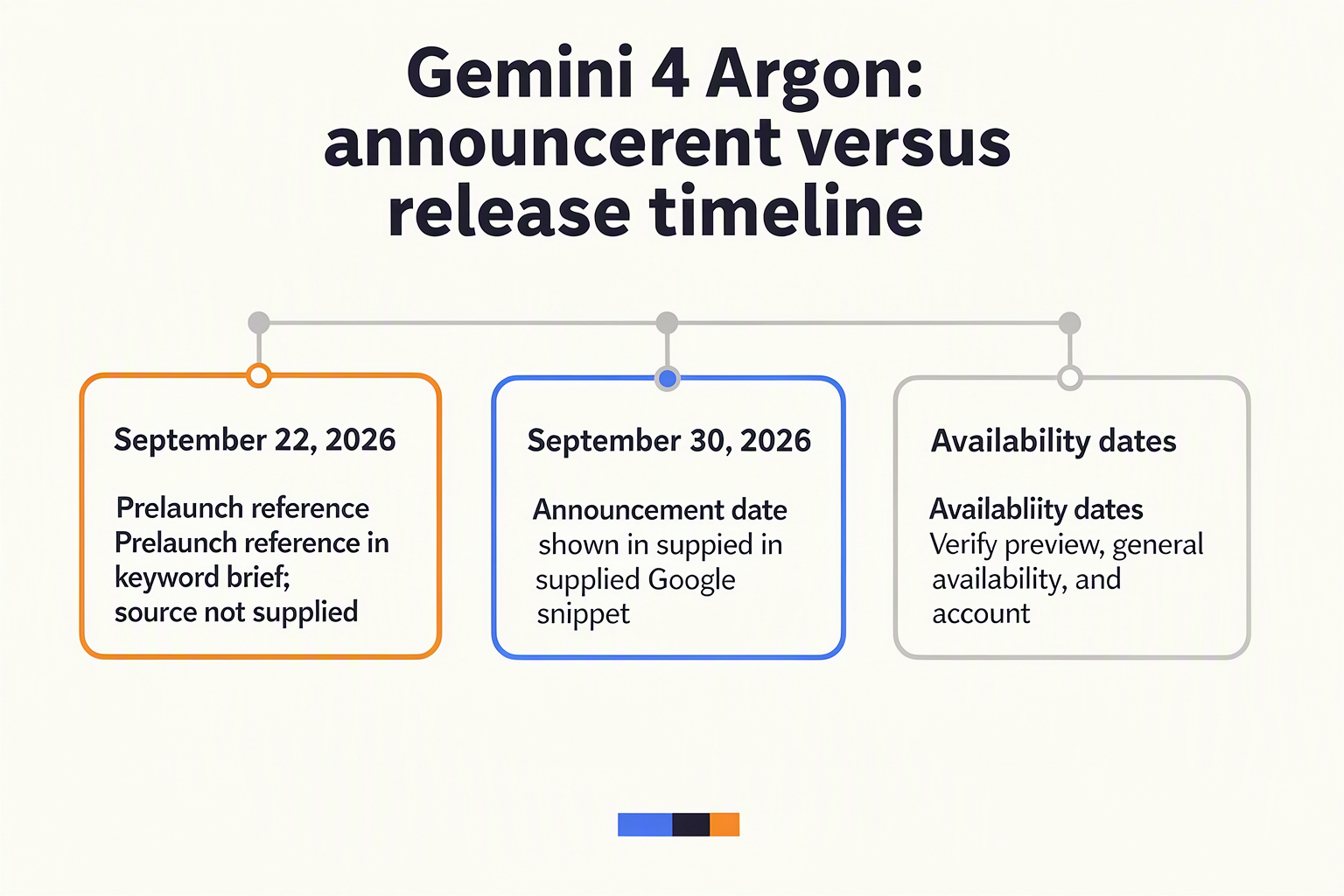
September 30, 2026 is the documented publication date for Google’s Gemini 4 Argon announcement in the supplied official-source material. The September 22 reference remains unverified: none of the provided Google excerpts establishes that date as an announcement, preview, or availability milestone.
The timeline places Argon after several Gemini updates focused on agentic execution and real-time interaction. However, the chronology should not be mistaken for a confirmed migration path: successive announcements do not establish that one model replaces another or shares its deployment options.
Where does Gemini 4 Argon sit in Google’s 2026 release timeline?
| Date or period | Announcement | Evidence from Google | Timeline interpretation |
|---|---|---|---|
| Google I/O 2026; exact date not supplied | Gemini 3.5 Flash | Google’s developer highlights describe the model’s availability and its role in agent-driven workflows. | Earlier context for Google’s emphasis on moving from prompts to actions. |
| June 2026 roundup | Gemini 3.5 Flash computer use | Google describes agents that can see, reason, and act across desktop, mobile, and browser environments. | Documents computer-use capabilities; the roundup does not establish their exact release day. |
| August 2026 roundup | Gemini 3.7 Flash | Google reports improvements for coding and agents, following Gemini 3.6 Flash by three weeks. | Establishes a relative release interval, not exact launch dates for both models. |
| Updated September 17, 2026 | Gemini 3.8 Live and Live Extended Thinking | Google’s post introduces two models focused on near-real-time reasoning and voice agents. | The visible date is an update date, which should retain that label. |
| September 22, 2026 | Unverified reference | No supporting announcement or milestone appears in the supplied Google material. | Do not classify this as an Argon launch, preview, or access date. |
| September 30, 2026 | Gemini 4 Argon | Google’s launch post describes “frontier performance in complex workflows.” | Documented announcement publication date; access timing requires separate evidence. |
According to Google’s August 2026 AI announcements, Gemini 3.7 Flash arrived three weeks after Gemini 3.6 Flash. That interval supports the observation that Google was updating Gemini rapidly, but it cannot establish a missing September milestone.
Does September 22 establish an earlier Gemini 4 Argon launch?
No—not from the evidence provided. An unsupported date should remain an unresolved reference rather than become a second launch date through repetition.
To validate September 22, an editor or procurement team would need an attributable record identifying both the date and the event:
- An official announcement: a Google publication explicitly naming Gemini 4 Argon.
- An access milestone: release notes documenting preview or general availability.
- A revision record: evidence distinguishing original publication from a later update.
Without that evidence, the defensible wording is: “Google published its Gemini 4 Argon announcement on September 30, 2026; the September 22 reference is unverified in the supplied sources.”
Why do these date distinctions matter for enterprise buyers?
Announcement, document update, and production availability are different milestones. Conflating them can create incorrect assumptions about when a model became accessible, which terms applied, or whether an evaluation used the announced version.
For an internal launch tracker, record three fields separately:
- Announcement date, supported by the publisher’s dated post.
- Access date, supported by official API or deployment documentation.
- Evaluation date and model identifier, captured from the team’s actual test environment.
As of September 30, 2026, the supplied evidence supports Argon’s announcement date and stated workload priorities—not a September 22 release or a confirmed production-access schedule.
Frequently Asked Questions
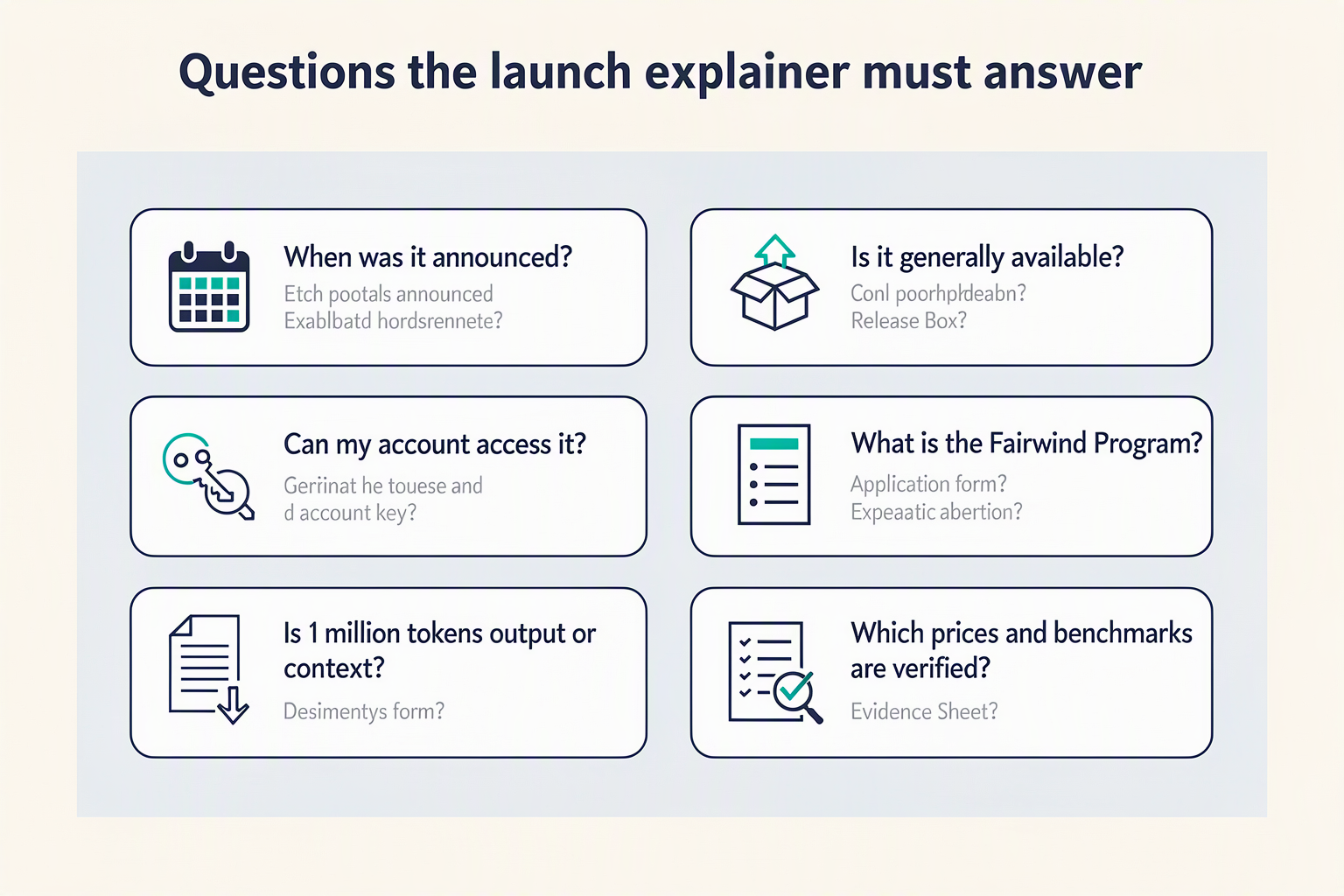
What is the Gemini 4 Argon release date?
Who has access to Gemini 4 Argon at launch?
What is Fairwind, and is it part of Google’s Gemini launch?
Which Gemini 4 Argon context-window and API limits are verified?
What Gemini 4 pricing is confirmed for developers and enterprises?
What should enterprise buyers verify before adopting the new Gemini model?
Conclusion
Gemini 4 Argon signals Google’s push toward complex business workflows, but the supplied launch excerpt does not establish production readiness. Google’s September 30, 2026 announcement highlights software engineering, legal and finance knowledge work, and cybersecurity defense; developers and enterprise buyers should treat those priorities as a starting point for evaluation, not a substitute for operational evidence.
Four takeaways should guide the next decision:
- The announcement is about execution, not just conversation. Google’s September 30, 2026 launch post describes “frontier performance in complex workflows.” The practical question is whether Gemini 4 Argon can complete a team’s actual tasks accurately and consistently—not simply generate convincing responses about them.
- Capability claims and measured performance remain separate. The supplied Google excerpt identifies target workloads but provides no benchmark scores. For software engineering, evaluation should use representative repositories and review standards; for legal research, it should test citation accuracy, conflicting evidence, and appropriate escalation when documents do not support an answer.
- Access and economics still need confirmation. As of September 30, 2026, the supplied announcement excerpt does not establish Gemini 4 Argon’s API availability, pricing, context-window size, or deployment restrictions. That is a limitation of the available evidence, not proof that Google has withheld those details everywhere. Buyers should verify the relevant official documentation before budgeting or planning migration.
- The wider Gemini release cycle makes repeatable evaluation important. According to Google’s August 2026 announcements, Gemini 3.7 Flash arrived three weeks after Gemini 3.6 Flash. Google’s announcement updated September 17, 2026 also introduced Gemini 3.8 Live and Gemini 3.8 Live Extended Thinking, reinforcing the need to assess each release against its intended workload rather than assume newer means suitable.
What should teams watch for after the Gemini 4 Argon launch?
Watch for official access documentation, pricing, benchmark methodology, and deployment controls—and then compare those details with results from your own workflow tests. The most consequential next development will be evidence connecting Google’s stated ambitions to reliable execution under real enterprise constraints.
A sensible next step is a bounded pilot, not an immediate migration. Define what a successful code change or evidence-backed research answer looks like, record failures, and retain human review where mistakes carry significant consequences.
To explore the broader infrastructure trend, consider CallMissed’s OpenAI-compatible developer AI API: as of September 2026, Google is among its catalogue providers. That offers a relevant route into multi-model development, without implying Gemini 4 Argon availability.
Before adopting Gemini 4 Argon, which real workflow would you use to prove that its announced capabilities translate into dependable results?
Related Reading
- Gemini 4 vs GPT-6 Astra: September 30, 2026 Review Draft
- Gemini 4 Argon API Pricing and Access: Sep 30, 2026
- Gemini 4 vs Claude Fable 5.1: Argon Buyer Guide (2026)
Sources
Discussion
Related Posts



Ready to automate customer conversations?
Launch AI voice agents and WhatsApp bots with CallMissed — one API, 22+ Indian languages.