
Gemini 4 Argon API Migration: An Engineering Checklist



Plan a Gemini 4 Argon migration with API verification, schema checks, tool-safety tests and rollback gates before changing agent providers.
Gemini 4 Argon API Migration: An Engineering Checklist
What if your agent’s first migration failure is not a weaker answer, but a tool result attached to the wrong call? Gemini 4 Argon API migration should begin with an interface audit—not a model-name swap—because endpoints, content structures, tool identifiers, and conversation state can determine whether an agent works at all.
As of September 30, 2026, UA.NEWS, reporting on CNBC coverage, says Alphabet has unveiled Gemini 4 Argon, with initial availability planned for trusted cybersecurity partners. That makes preparation timely, but it does not establish general API access, a production model identifier, or compatibility with existing Gemini endpoints. For teams planning a move from applications targeting Claude 5.5 or GPT-6.1 Sol, the first checkpoint is therefore verification: confirm source-model assumptions and target-model access before changing production code.
Why does an agent migration require more than changing the endpoint?
An agent application relies on a contract spanning messages, tool execution, state, and streamed events. A successful text response proves only one part of that contract.
Google AI for Developers’ Interactions API documentation, reviewed for this September 30, 2026 checklist, describes one unified endpoint and calling pattern for standard Gemini models and specialized agents. It also documents optional server-side conversation state through previous_interaction_id and streaming that can interleave text and generated images. Those capabilities warrant explicit adapter decisions rather than assumptions about equivalence with another provider’s request format.
A Google AI Developers Forum report provides a concrete warning: an Interactions API function-calling example for gemini-3-flash-preview allegedly omitted a required id field. This is a reported documentation issue—not evidence of an Argon defect—but it illustrates why engineers must validate tool-call correlation against actual responses.
What will this engineering checklist help you verify?
This guide separates documented Gemini API behavior from Argon-specific details that still require confirmation. You will learn how to inspect:
- Endpoints and access: API versions, authentication, model identifiers, and availability.
- Message and content schemas: roles, instructions, multimodal payloads, and output parsing.
- Tool calls and results: identifiers, argument validation, error handling, and duplicate-execution protection.
- State and streaming: conversation continuity, event handling, cancellation, and retries.
- Release readiness: regression tests, observability, staged rollout, and rollback criteria.
As of September 2026, CallMissed’s developer AI API offers OpenAI-compatible and Anthropic-compatible endpoints, illustrating how gateways can simplify integration boundaries without removing the need for model-specific validation.
The goal is a migration you can explain, test, and reverse—not merely a request that returns HTTP 200.
Can you migrate to the Gemini 4 Argon API?
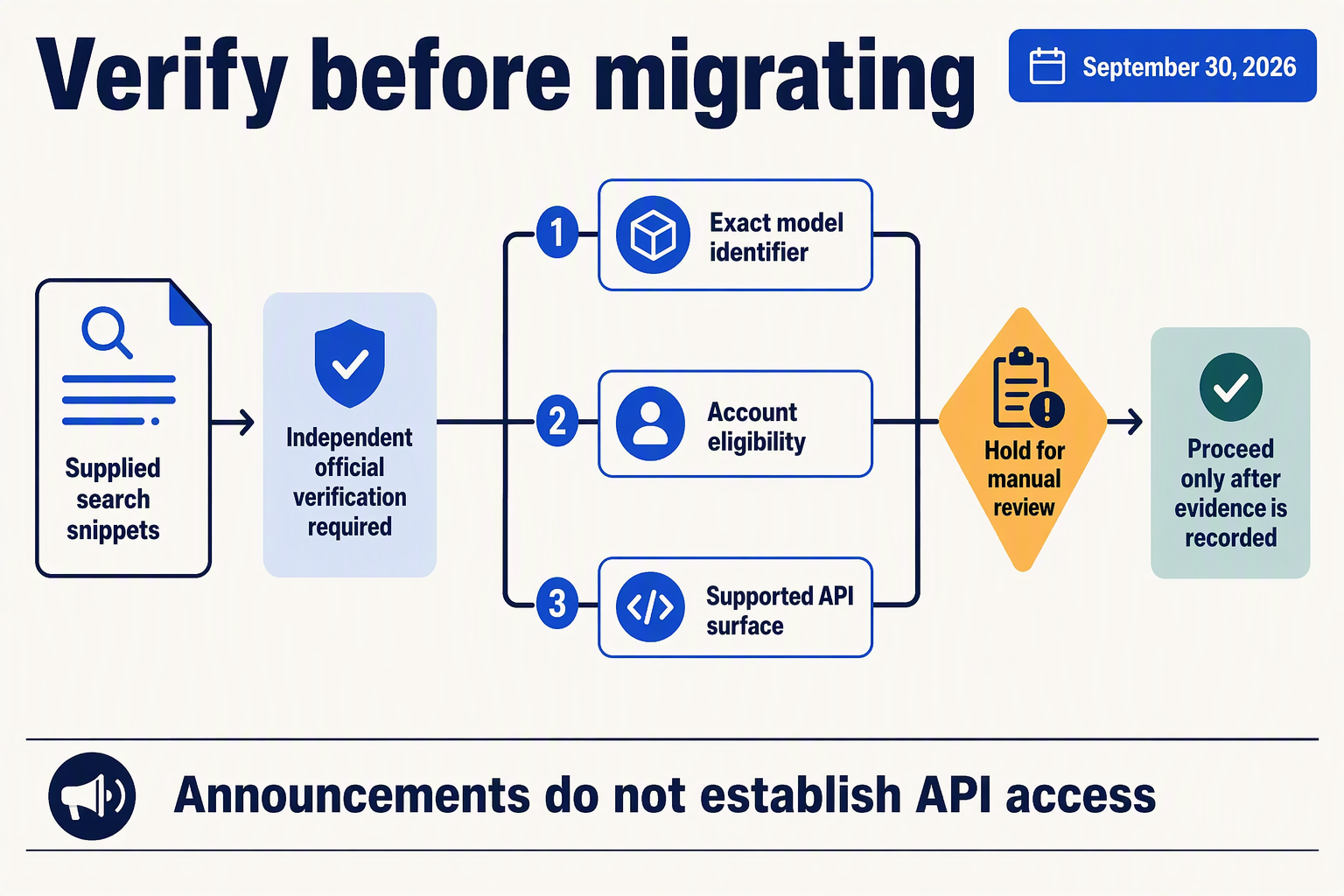
Prepare the migration now, but do not switch production traffic until Argon access and its API contract are verified for your account. Google’s September 30, 2026 announcement describes limited Fairwind access for trusted defenders; it does not confirm an unrestricted public API, a public model identifier, or an endpoint your application can call.
What does the announcement establish?
The announcement establishes an initial, restricted availability path—not general migration readiness. Check Google’s official launch coverage for the availability scope, then obtain account-specific access documentation before implementing the target adapter.
Keep three checkpoints separate:
- Announcement: Google has introduced the model and described its initial audience.
- Documented access: Your account has permission to use a named model through a specified API endpoint and schema.
- Executable integration: Authenticated requests and representative agent exchanges succeed under that contract.
Google’s Interactions API documentation recommends a general interface for Gemini models and agents. That recommendation is not proof that Argon supports Interactions. Do not infer an Argon endpoint, invent a model identifier, or write an SDK call around an assumed contract.
What can engineering prepare now?
Freeze the application’s existing interface contract and evaluation baseline before changing providers. Capture representative, sanitized fixtures for:
- Messages, system instructions, tool definitions, arguments, and results.
- Structured-output schemas and invalid-output handling.
- Conversation state, including multi-turn tool exchanges.
- Streaming events, completion signals, cancellations, and partial failures.
- Timeouts, retries, rate-limit handling, and duplicate-execution protection.
Use the same frozen evaluation set for the current implementation and the eventual Argon candidate. Define acceptance thresholds before inspecting candidate results, including task success, tool correctness, schema compliance, and operational cost.
Treat gpt-6.1-sol and Claude 5.5 as the source models, not as unresolved announcement names. Still record what the deployed application actually sends: provider, base URL, API version, model string, SDK version, and any gateway alias mapping. An official model name does not eliminate configuration drift.
For OpenAI Astra/Sol 6.1 tool-calling workflows, preserve the required Responses API contract. Follow OpenAI’s function-calling documentation when capturing tool calls and returning results; do not assume a Chat Completions-shaped exchange is interchangeable.
What evidence unlocks implementation?
Create a dated access record containing:
- Account authorization: Written confirmation that the intended project or account may use Argon for the proposed workload.
- Target contract: The documented model identifier, API endpoint, request and response schemas, authentication requirements, and lifecycle restrictions.
- Permissions and terms: Supported tools and modalities, production-use permissions, quotas, billing, and data-handling requirements.
- Authenticated proof: A successful sandbox request, with timestamp, sanitized request shape, response status, and returned model metadata where available.
- Agent proof: A harmless tool exchange that returns a tool result and demonstrates correct continuation.
Only then implement target-specific mappings. Another organization’s access, a successful text response, or general Gemini documentation cannot substitute for these checks.
What release gates must pass before production routing changes?
Require explicit pass/fail evidence for:
- Tool-ID pairing: Every tool result maps to the correct originating call, including parallel calls.
- JSON correctness: Arguments and structured responses satisfy the application’s schemas.
- State continuity: Multi-turn context and tool results survive the documented state-management flow.
- Streaming correctness: Partial events are assembled correctly, and disconnects cannot trigger unintended actions.
- Retries and idempotency: Transient failures do not duplicate externally visible operations.
- Controlled rollout: Shadow evaluation avoids live side effects; canary traffic has predefined stop conditions and a tested rollback path.
- Human approval: Consequential side effects remain behind an explicit approval boundary.
Execute the migration only after documented account access, verified endpoint and schema permissions, successful contract tests, and rollout approval. Until those gates pass, continue preparation and evaluation while leaving production routing unchanged.
Which endpoints, authentication methods and SDK contracts must you verify?
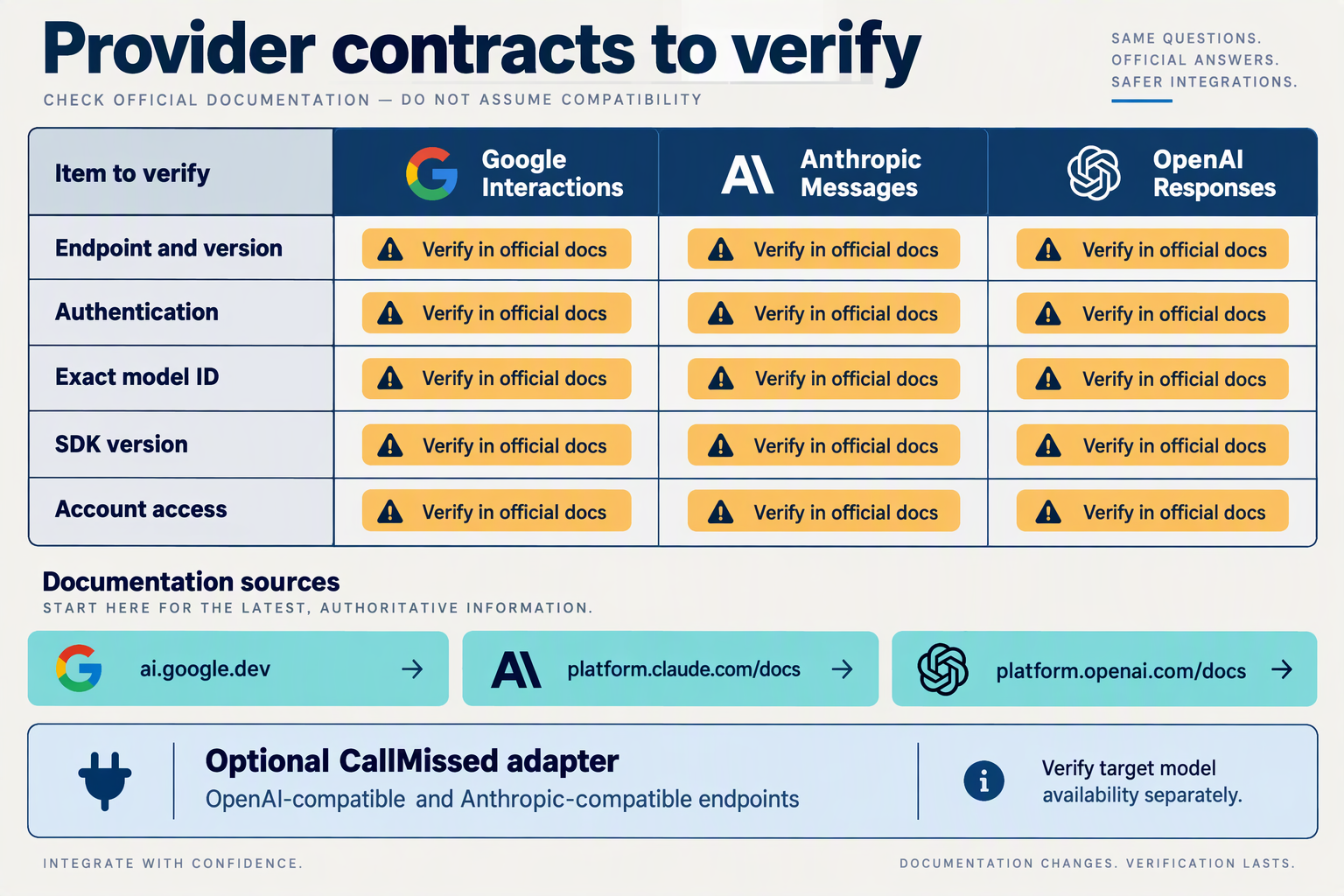
Verify the API host and version, authorized model identifier, authentication flow, SDK method, and request/response contract before routing an agent to Gemini 4 Argon. As of September 30, 2026, the supplied sources do not establish an Argon production endpoint or SDK contract, so treat those details as release gates—not configuration values to guess.
Which API contracts belong in the migration checklist?
Use this matrix to audit applications currently targeting Claude 5.5 or GPT-6.1 Sol. Record the source application’s actual wire contract rather than inferring compatibility from its model label.
| Contract boundary | What to verify | Required evidence |
|---|---|---|
| Host and API version | Approved target host, route, version, and deployment environment | A successful request against the authorized target; no inferred Argon route |
| Model identifier and access | Exact model ID, account entitlement, and availability restrictions | Provider-confirmed identifier and successful invocation from the deployment account |
| Authentication | Accepted credential type, header format, scopes, and credential lifecycle | Valid credentials succeed; missing, invalid, and revoked credentials fail safely |
| SDK contract | Package version, client initialization, invocation method, and supported parameters | Pinned dependency and a minimal integration test |
| Messages and tool payloads | Instruction placement, content types, tool definitions, and result correlation | Captured request/response fixtures that pass adapter validation |
| Transport and errors | Streaming interface, timeout behavior, error structure, and retry handling | Tests covering completion, interruption, authentication failure, and throttling |
Evidence boundary: Google AI for Developers documents a unified Interactions API calling pattern for standard Gemini models and specialized agents in the material reviewed for this September 30, 2026 checklist. That documentation does not, by itself, establish that Gemini 4 Argon is available through the same interface.
How should you verify authentication without assuming compatibility?
Keep authentication separate from payload translation. A gateway-compatible message format does not establish that a direct Google endpoint accepts the same credentials or headers.
For each deployment environment, document:
- Credential source: where credentials are loaded and how rotation reaches running workers.
- Authorization boundary: which account, project, or other provider-defined entitlement permits target-model access.
- Failure behavior: how the application handles rejected credentials without exposing secrets in logs.
- Routing controls: how configuration prevents production traffic from reaching an unintended host.
UA.NEWS, reporting on CNBC on September 30, 2026, describes Gemini 4 Argon’s initial availability as planned for trusted cybersecurity partners. Accordingly, an access-denied response should trigger entitlement investigation—not an automatic assumption that the request schema is wrong.
What must the SDK prove before you change production configuration?
Google AI for Developers’ documentation reviewed on September 30, 2026 shows the Python pattern from google import genai, genai.Client(), and client.interactions.create(...). This establishes a documented Gemini integration pattern, not confirmed Argon support or a particular package version.
Run three acceptance tests:
- Minimal invocation: submit a small text request using the confirmed target identifier and inspect the complete response.
- Agent round trip: invoke a harmless test tool, return its result, and verify that execution resumes with correct correlation.
- Transport parity: compare non-streaming and streaming behavior, checking completion signals and error propagation.
Pin the SDK version that passes these tests and preserve sanitized fixtures. Migration readiness means a reproducible contract, not merely a successful import or one plausible model response.
How do you translate message schemas and preserve tool-call/result pairing?
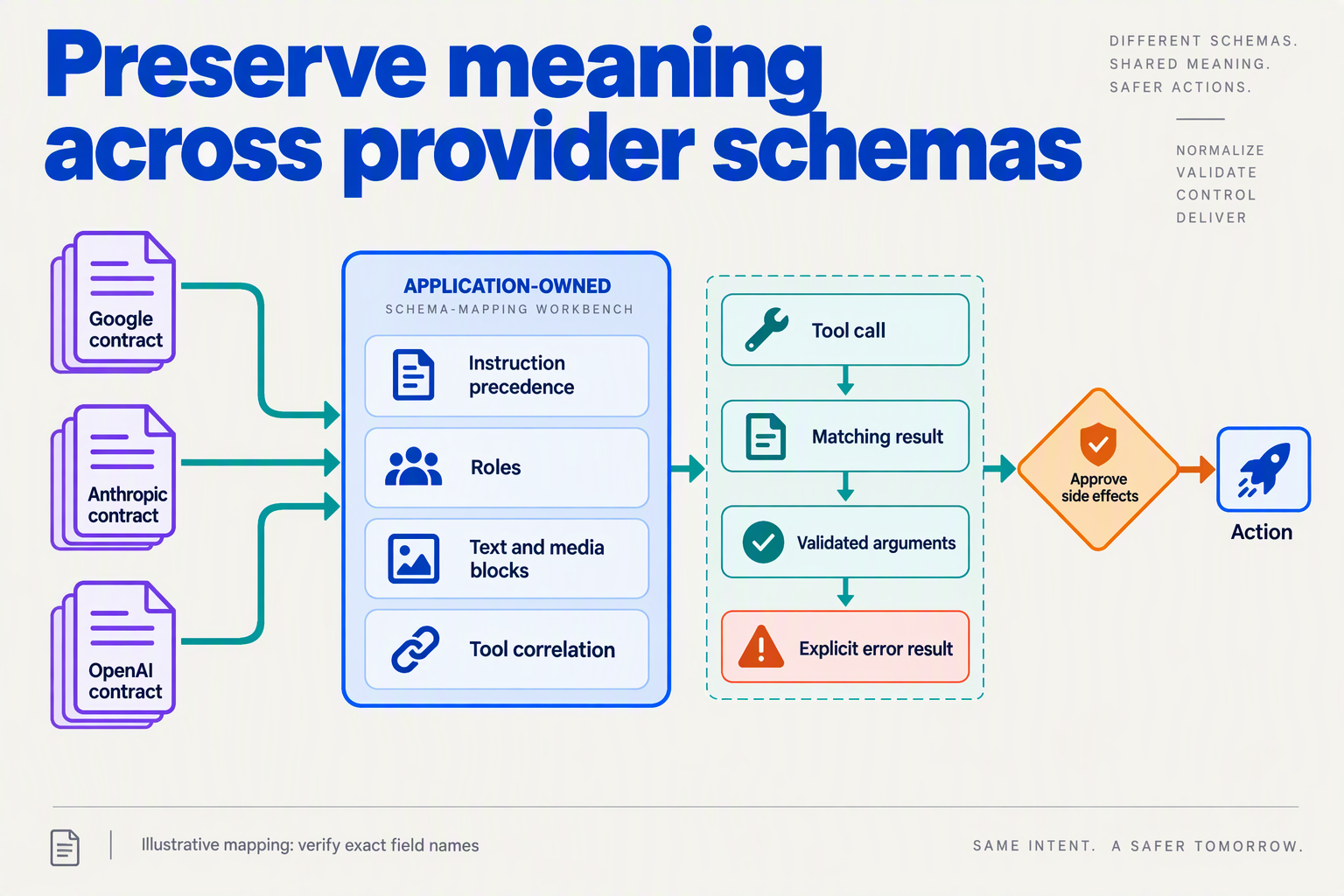
Translate messages through a provider-neutral conversation model, then serialize them into the deployed endpoint’s verified schema. Preserve tool-call/result pairing with an explicit correlation ledger, never array position, tool name, or assumed equivalence between provider fields.
As of September 30, 2026, the supplied Google AI for Developers documentation describes Gemini Interactions API capabilities but does not establish a Gemini 4 Argon-specific message contract. The supplied research also does not verify the deployed OpenAI Responses or Anthropic Messages contracts; inspect those contracts before implementing migration adapters.
How should you normalize messages before converting them?
Separate instructions, speaker roles, typed content, tool requests, and tool results in your internal representation. Flattening a conversation into one text prompt discards boundaries that distinguish application instructions from user requests and external tool data.
The following is pseudocode for application-owned records, not request fields for Gemini, OpenAI Responses, or Anthropic Messages:
Message(role, content_blocks)
ToolCall(local_id, provider_id, name, arguments)
ToolResult(local_id, status, content_blocks)
Implement these mapping rules:
- Instructions: Map system and developer instructions to the destination’s documented instruction mechanism. Never silently downgrade privileged instructions into user text.
- Roles: Preserve message authorship and treat tool results as external data, not new user commands.
- Content: Retain text, images, audio, and attachments as typed blocks; validate supported formats, MIME types, references, and limits.
- Arguments: Validate arguments as internal objects, then encode them exactly as the destination requires.
- Continuation metadata: Preserve opaque provider state when required, without exposing it as user-visible content.
Google AI for Developers’ Interactions streaming documentation, supplied for this September 30, 2026 checklist, states that requesting text and image output can produce interleaved text and generated images. Your adapter therefore needs multiple content blocks rather than a single-string assumption.
As of September 2026, CallMissed’s developer AI API offers OpenAI-compatible Responses API and Anthropic-compatible Messages endpoints. That compatibility can simplify integration, but it does not replace checking the selected endpoint’s message and correlation contract.
How do you preserve tool-call/result correlation across providers?
Inspect and verify the deployed OpenAI Responses and Anthropic Messages contracts, including their documented call/result correlation fields. Verify the authorized Gemini destination separately; the supplied research does not establish that these contracts share identifiers, field names, or result-placement rules.
Maintain a ledger connecting each local execution ID to its provider correlation identifier, originating turn, and conversation context.
For every tool cycle:
- Capture the call: Store the complete identifier, tool name, validated arguments, and originating context.
- Allocate a local execution ID: Use it for tracing and duplicate-execution checks.
- Record execution state: Track pending, successful, and failed executions; apply explicit retry rules.
- Serialize the result: Populate the destination’s documented correlation field and required placement.
- Validate completeness: Reject orphan results, ambiguous matches, and duplicate terminal results.
A local ID cannot substitute for a provider-required identifier. If that identifier is missing, stop the tool cycle or follow the endpoint’s documented recovery procedure.
What regression tests catch incorrect tool-result pairing?
Start with two simultaneous calls to the same tool using different arguments. Request orders A and B through lookup_order, then deliberately return B’s result first.
The test passes only when both results remain attached to their originating calls. Add fixtures for malformed arguments, tool failures, duplicate deliveries, missing identifiers, and multiple calls within one turn.
Test full conversation replay separately from server-managed continuation. Google AI for Developers documents optional server-side state through previous_interaction_id in the supplied September 30, 2026 research; verify how that mechanism interacts with tool results before relying on continuation during migration.
How should you verify reasoning controls and structured-output guarantees?
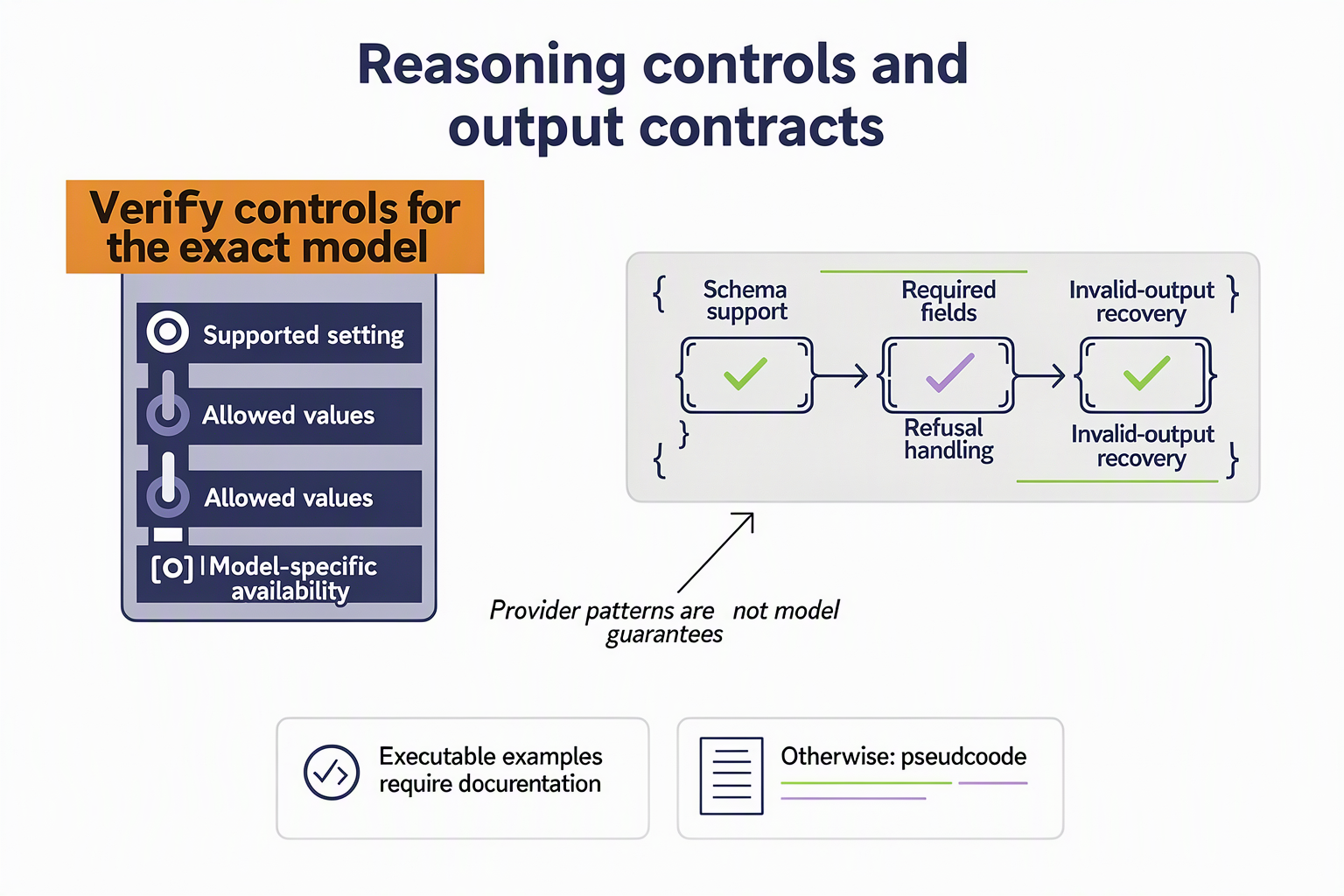
Verify reasoning controls against the target endpoint’s documented request contract, and verify structured outputs against an independent validator—not the model’s assurance that its JSON is valid. As of September 30, 2026, the supplied Google AI for Developers documentation does not establish Gemini 4 Argon-specific reasoning parameters or schema guarantees, so treat both as unverified migration gates.
Which reasoning settings actually work on the target model?
Do not copy a reasoning setting from an application targeting Claude 5.5 or GPT-6.1 Sol and assume Gemini 4 Argon interprets it equivalently. A parameter accepted by a gateway may still be rejected, transformed, or unsupported downstream.
Build a reasoning-control capability record for the exact model, endpoint, API version, and SDK version under test:
- Supported controls: Record documented parameter names, allowed values, defaults, and incompatible combinations.
- Observed behavior: Check whether omitted, valid, and invalid values produce the documented response or error.
- Resource accounting: Capture any documented usage fields, total latency, and application-level task success.
- Evidence boundary: Separate documented behavior from experimental observations and unresolved assumptions.
Compare configurations on identical tasks with fixed tools and inputs. Include an ambiguous instruction, a multi-step calculation, and a task requiring tool evidence. Judge correctness and policy compliance—not the length of a reasoning summary. Visible reasoning text is not proof of reasoning quality, and your application should not depend on access to private internal reasoning.
As of September 2026, CallMissed’s developer AI API lists reasoning effort control and structured outputs among its capabilities. Those gateway capabilities still require model-specific validation; they do not establish Gemini 4 Argon support.
Does structured output guarantee the contract your application needs?
Distinguish three outcomes: parseable JSON, schema-valid data, and semantically correct data. An output can pass the first two checks while containing an invented customer identifier or an unsupported refund decision.
Google AI for Developers’ streaming documentation, reviewed for this September 30, 2026 checklist, says requesting text and image through response_format can produce interleaved outputs. That establishes a modality-selection capability—not, by itself, a strict JSON Schema enforcement guarantee.
Before enabling structured output, verify:
- Which schema dialect and keywords the endpoint supports.
- Whether enforcement covers nested objects, required fields, enums, and additional properties.
- How refusals, truncation, safety filtering, and tool calls appear.
- Whether streamed fragments require assembly before validation.
Treat tool arguments and final structured answers as separate contracts. Support for one does not prove support for the other.
What tests should block the migration?
Use a small adversarial fixture set before expanding to production-shaped evaluations:
- Required-field test: Request an object containing
decision,customer_id, andevidence; reject missing fields. - Constraint test: Define
decisionas an enum and disallow unexpected properties; test invalid values and extra keys. - Evidence test: Supply a known customer record; reject identifiers or claims absent from the permitted evidence.
- Failure-path test: Exercise refusals, token-limit truncation, malformed tool results, and interrupted streams.
- Control test: Send an unsupported reasoning value; check for documented rejection rather than silently assuming enforcement.
Set an explicit release gate: no invalid or incomplete output may reach a consequential action. Measure first-pass validity separately from repaired-output validity, cap retries, and route unresolved failures to a safe fallback. Repairing JSON must never become permission to invent missing business facts.
How do you adapt streaming events without breaking agent execution?
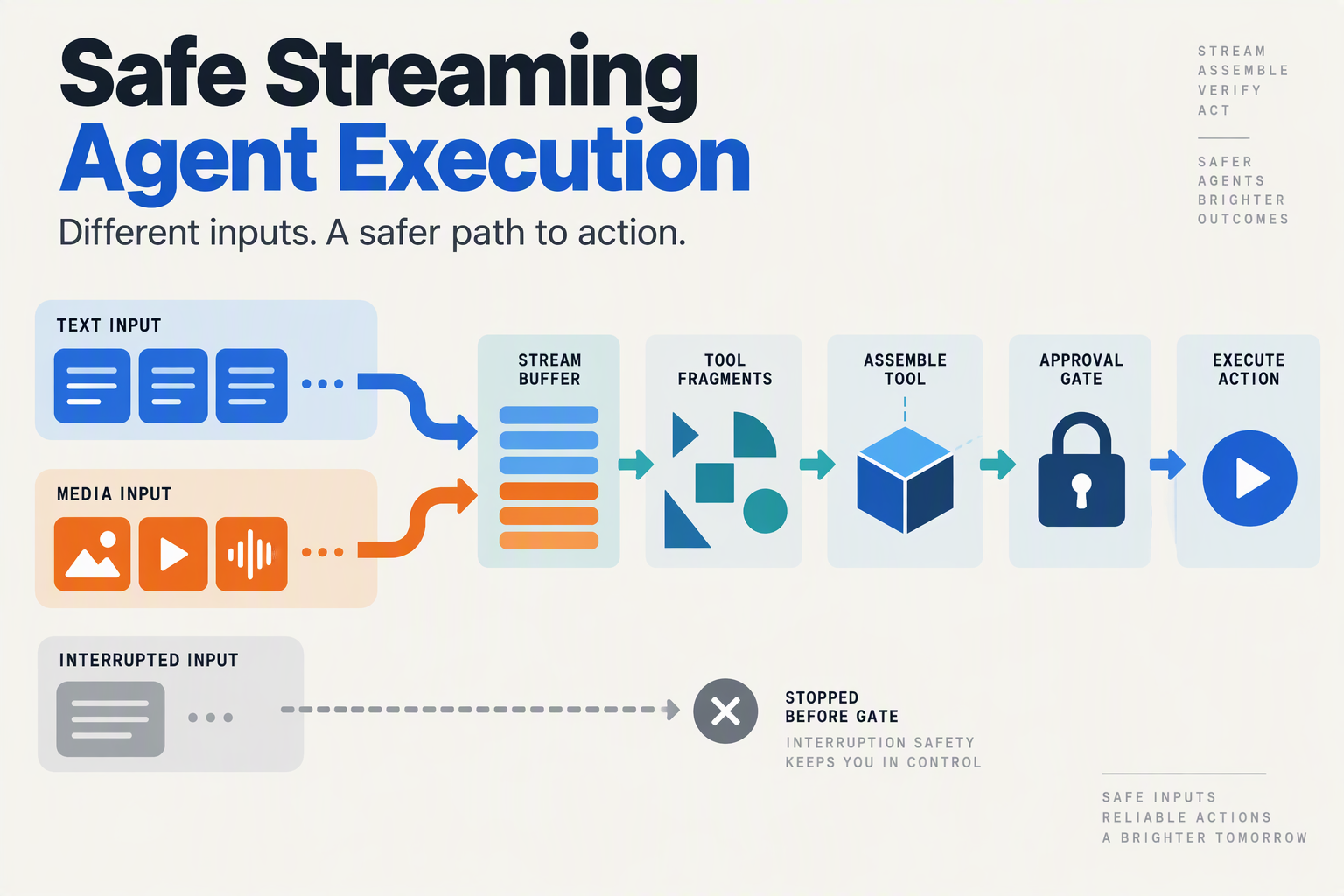
Adapt streaming through a provider-specific event decoder and a provider-neutral execution state machine. For a Gemini 4 Argon API migration, keep partial output separate from executable tool requests, and verify the target endpoint’s actual event contract before enabling side effects.
How should you normalize Gemini streaming events?
Google AI for Developers’ Interactions API streaming documentation, reviewed for this September 30, 2026 checklist, states that requesting text and image in response_format can produce interleaved text and generated images. A decoder that treats every payload as an assistant-text token can therefore corrupt both presentation and execution state.
Define an internal event vocabulary rather than exposing provider events directly to your agent loop:
- Text delta: append displayable text to the correct output item.
- Media update: route image or other supported content to a modality-specific handler.
- Tool-argument delta: accumulate arguments without executing them.
- Tool-call completion: validate the assembled call and evaluate execution eligibility.
- Terminal outcome: record successful completion, failure, or cancellation.
These are application-defined categories, not claimed Gemini event names. Build the mapping from documented schemas and captured responses for the endpoint you will actually use; do not assume an existing Claude or OpenAI stream handler is interchangeable.
Preserve interaction identifiers, output-item identifiers, tool-call identifiers, and ordering metadata where supplied. Avoid synthesizing correlation from arrival order alone: two calls to the same tool still need distinct execution records.
When is a streamed tool call safe to execute?
A tool call is safe to dispatch only when its arguments are complete, its identity is established, and application validation and authorization succeed. Valid JSON is necessary but insufficient: an early fragment can parse successfully without representing the final arguments.
Use this execution sequence:
- Buffer by call identity. Keep argument fragments separate from text and other calls.
- Wait for the documented completion signal. Do not use a UI flush, network chunk boundary, or arbitrary timeout as a substitute.
- Validate the assembled request. Check the tool name, argument schema, permissions, and business constraints.
- Record the execution decision. Apply your duplicate-execution policy before dispatching.
- Correlate the result. Attach the tool outcome to the originating call, then continue using the endpoint’s verified continuation contract.
For example, a refund agent must not execute issue_refund when the stream merely reveals an order identifier. Wait for the completed request, validate the amount and currency, and use an application-level operation key to guard against replay.
How do you test interruptions, retries, and unknown events?
Treat transport closure as ambiguous, not proof of successful generation. Likewise, cancelling a model stream does not undo a tool action that your application has already started.
Test these cases before rollout:
- Fragmented arguments: split JSON inside strings, escape sequences, and numbers.
- Mixed output: interleave text, media updates, and tool-related events.
- Interrupted execution: disconnect before dispatch, during execution, and after completion but before result delivery.
- Replay: reconnect or retry after an uncertain outcome; verify that business side effects are not duplicated.
- Schema drift: log unknown events safely, but block execution when required identity or completion information is missing.
As of September 30, 2026, UA.NEWS, reporting on CNBC coverage, describes Gemini 4 Argon’s initial availability as planned for trusted cybersecurity partners; that report does not establish Argon’s streaming schema. Keep Argon-specific mappings unverified until confirmed, and make recorded event traces—not a convincing text response—the acceptance evidence for your adapter.
How do you preserve context, conversation state and portable rollback history?
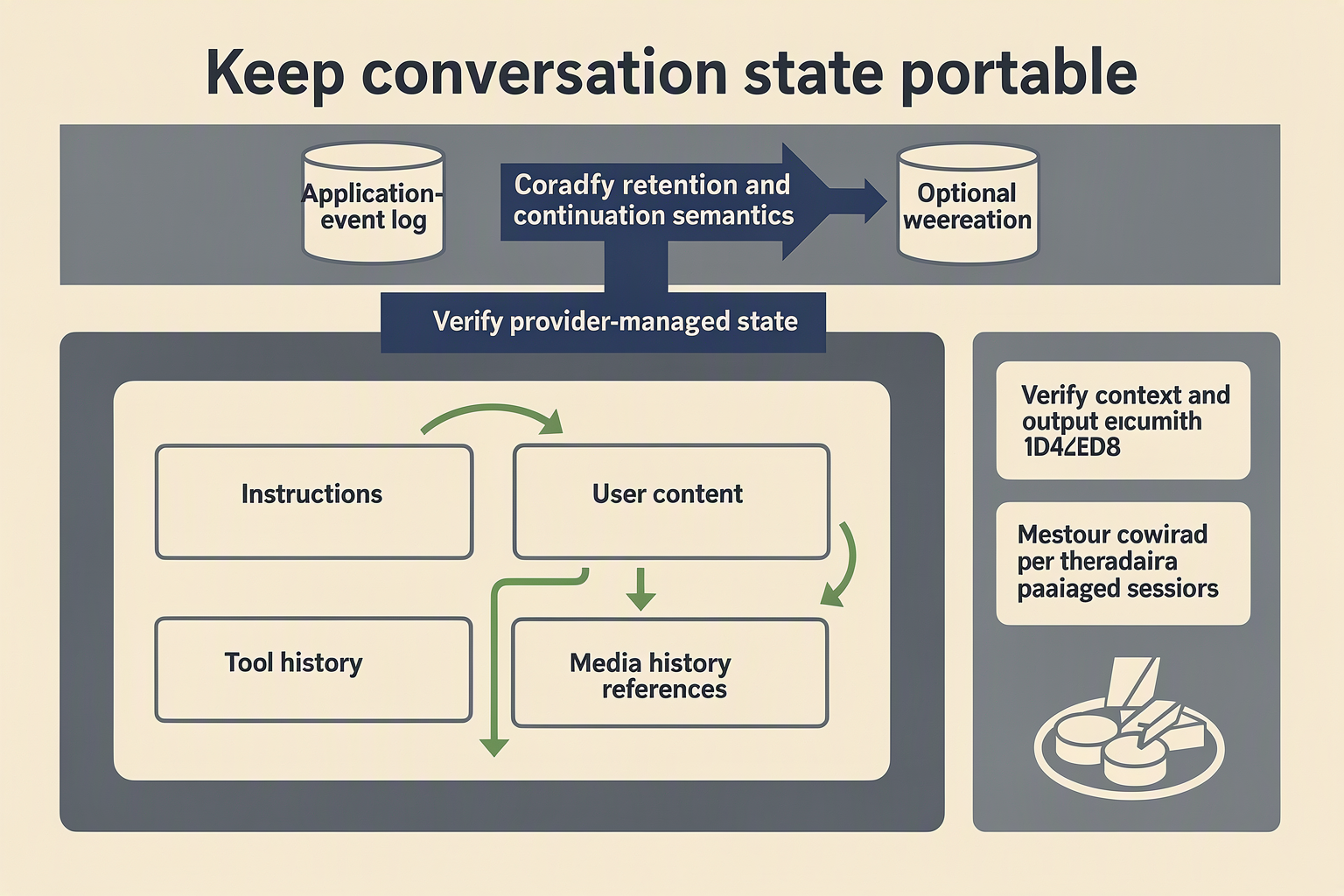
Preserve context by keeping an application-owned conversation ledger, then translating that ledger into each provider’s request format. Treat server-side conversation identifiers as continuity shortcuts—not as your only history or a portable rollback mechanism.
For this September 30, 2026 migration checklist, Google AI for Developers documents optional server-side state through previous_interaction_id in the Gemini Interactions API. That documented capability does not establish Gemini 4 Argon support, retention guarantees, or portability to applications targeting Claude 5.5 or GPT-6.1 Sol; verify those contracts before deployment.
What conversation state should your application store?
Store enough information to reconstruct the conversation’s meaning and execution status without depending on a provider-hosted thread. A transcript alone is insufficient: it may omit tool outcomes, instruction changes, or attachments needed to reproduce the next request.
Use a versioned internal schema with these fields:
- Identity and ordering: conversation ID, branch ID, event ID, sequence number, and timestamp.
- Messages and content: speaker, ordered content blocks, text, attachment references, MIME types, and integrity hashes.
- Execution records: tool name, validated arguments, correlation identifiers, execution status, results, and idempotency keys.
- Configuration: instruction version, tool-schema version, adapter version, requested model, and generation settings.
- Provider references: interaction identifiers and raw response envelopes, stored separately from portable content.
Protect sensitive records with access controls and a defined retention policy. Preserve observable messages and execution evidence; do not assume hidden model reasoning is available or transferable.
How should you handle Gemini server-side conversation state?
Use previous_interaction_id only after testing how the chosen endpoint handles continuation, failures, and unavailable history. Keep a local checkpoint alongside every successfully committed interaction.
Google AI for Developers’ Interactions documentation, reviewed for this September 30, 2026 checklist, describes linking specialized-agent work and standard-model follow-up using previous_interaction_id. This supports continuity within the documented API, not automatic cross-provider conversation transfer.
A practical checkpoint sequence is:
- Record the outbound request and its ledger position before submission.
- Persist returned content and identifiers as the response arrives.
- Mark completion explicitly, distinguishing completed, interrupted, and failed turns.
- Advance the continuation pointer only after the application commits the turn.
- Reconstruct from local history when switching providers, using the destination adapter’s supported schema.
Do not send a Gemini interaction identifier to another provider and expect equivalent state.
How do you compress context without losing important decisions?
Separate durable task state from conversational wording. Maintain a structured snapshot of confirmed facts, user constraints, unresolved questions, completed actions, and pending approvals.
When summarizing older turns:
- Retain exact values that drive execution, such as order identifiers or approved amounts.
- Attach provenance so each summary claim points to its originating event.
- Keep original records available; a summary is a derived artifact, not the authoritative history.
- Measure the assembled request against the verified target model’s context limits rather than assuming an Argon limit.
For example, preserve “refund approved; execution pending” separately from “refund completed.” Compression must not turn an intention into an accomplished action.
What makes rollback history genuinely portable?
Rollback should restore configuration and reconstruct context—not repeat side effects. Branch from a committed checkpoint, select the previous adapter and model configuration, and replay conversation records without re-executing completed tools.
As of September 2026, CallMissed’s developer AI API offers usage and request logs plus caller-chosen fallback models. These are useful integration capabilities, but application-owned checkpoints still determine whether a fallback preserves task state safely.
Test rollback after an interrupted response, a completed tool action, and a compressed-history boundary. Success means the restored agent knows what happened, what remains pending, and which actions must never run twice.
Which errors can you retry safely, and when should fallback stop?
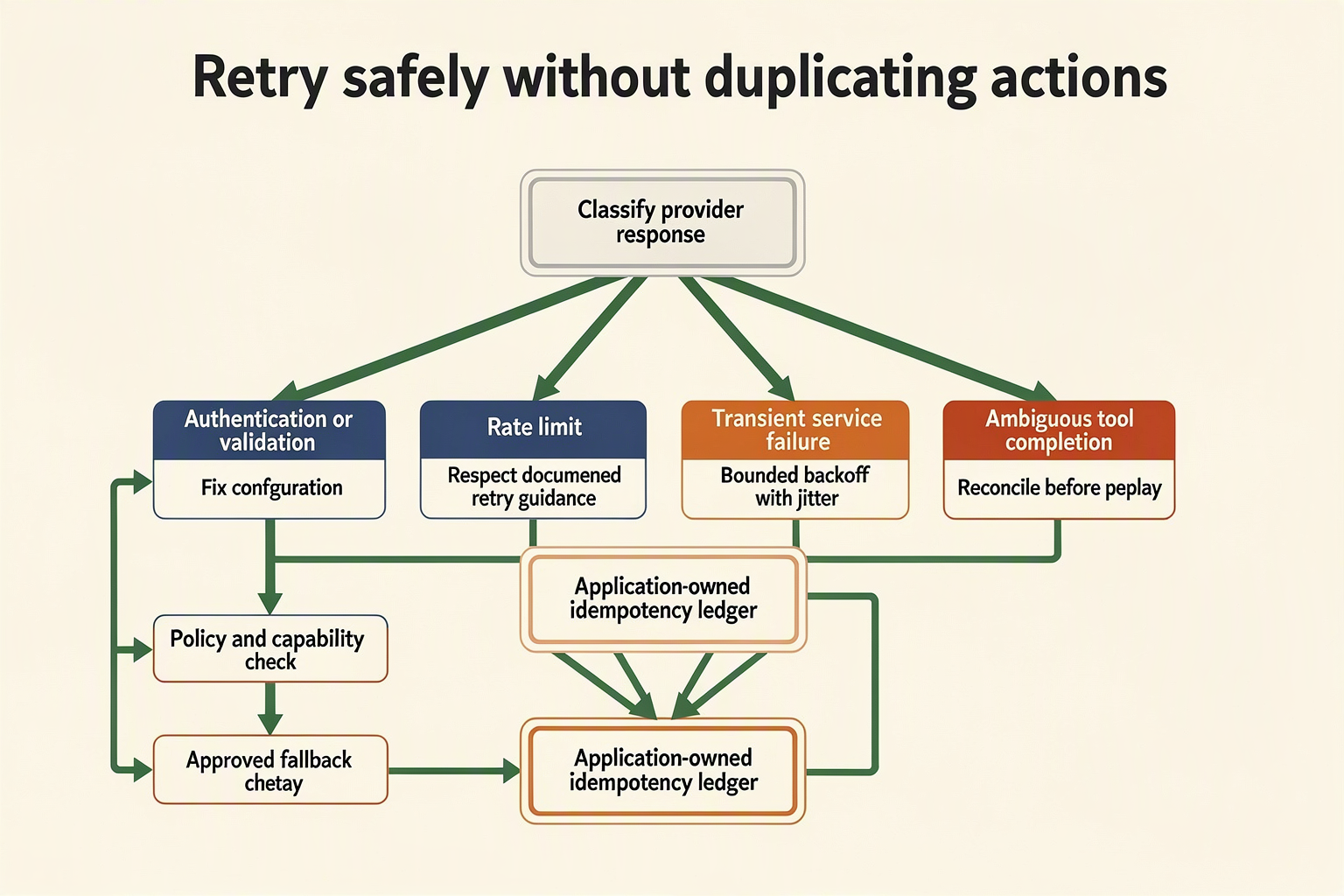
Retry transient failures only when replay cannot duplicate side effects; stop fallback when execution state is uncertain, the error requires a configuration change, or the request’s budget is exhausted. For a Gemini 4 Argon API migration, treat these as application-level safeguards—not verified Argon retry guarantees—as of September 30, 2026.
Which API errors should trigger a retry?
Classify failures by cause and replay safety, rather than retrying every unsuccessful request. The following is a proposed engineering policy, not an Argon-specific status-code contract:
- Connection failures before sending the request: Usually retryable. Distinguish these from read timeouts after submission, when the server may already have accepted work.
- HTTP 429 rate limiting: Retry only if the condition is temporary. Respect
Retry-Afterwhen supplied; exhausted quotas or billing restrictions need intervention, not repeated requests. - HTTP 502, 503, and 504: Candidates for bounded retries, provided replay is safe. A gateway timeout does not prove that upstream processing stopped.
- HTTP 500: Consider a limited retry, but stop if the same request repeatedly fails.
- HTTP 400, 401, 403, and model-not-found responses: Do not retry unchanged requests. Fix the schema, credentials, permissions, or model selection first.
- Safety refusals: Do not switch models merely to bypass a refusal. Apply the application’s safety policy independently of the provider.
For illustration—not as a provider recommendation—use three total attempts, exponential backoff with jitter, and a shared deadline across retries and fallbacks. Check whether the SDK already retries so that application-level retries do not multiply attempts unexpectedly.
When is replaying an agent turn unsafe?
A model-request retry and a tool-execution retry are different operations. Regenerating an answer may be harmless; repeating a payment, booking, or outbound message may not be.
Google AI for Developers’ Interactions API documentation, reviewed for this September 30, 2026 checklist, documents optional server-side state through previous_interaction_id. That capability makes state reconciliation important: do not assume an interrupted interaction left no persistent state.
Before replaying a failed turn:
- Check the operation ledger. Record a stable application operation ID, tool-call correlation, execution status, and committed result.
- Reconcile uncertain outcomes. Query the booking or payment system before repeating an operation whose response was lost.
- Reuse confirmed results. If a tool completed, supply its recorded result through the validated adapter rather than executing it again.
- Block unresolved duplicates. If completion cannot be established, pause for reconciliation or human review.
Google AI for Developers’ streaming documentation, reviewed on September 30, 2026, describes interleaved text and generated-image output. Consequently, a stream interruption is not proof that nothing was produced; track accepted events and tool execution separately.
When should model fallback stop?
Stop fallback when the next model cannot safely continue the workflow—not simply when the candidate list ends.
Define explicit stopping conditions:
- Unknown side-effect status: No further autonomous execution until reconciliation.
- Broken input contract: Repair malformed content or tool-result identifiers before switching providers.
- Missing capabilities or approval: Stop if the fallback lacks required tools, modalities, or authorization for the data involved.
- Budget exhaustion: Enforce one deadline and attempt budget across the entire fallback chain.
As of September 2026, CallMissed’s developer AI API supports caller-chosen fallback models. That provides routing control, but the application must still enforce replay safety and stopping rules.
Test the decisive failure case: a tool commits successfully, its response disappears, and fallback begins. The correct outcome is one committed operation, not another execution under a different model.
Which frozen tests and expert sign-offs should gate a Claude or GPT-6.1 Sol migration?
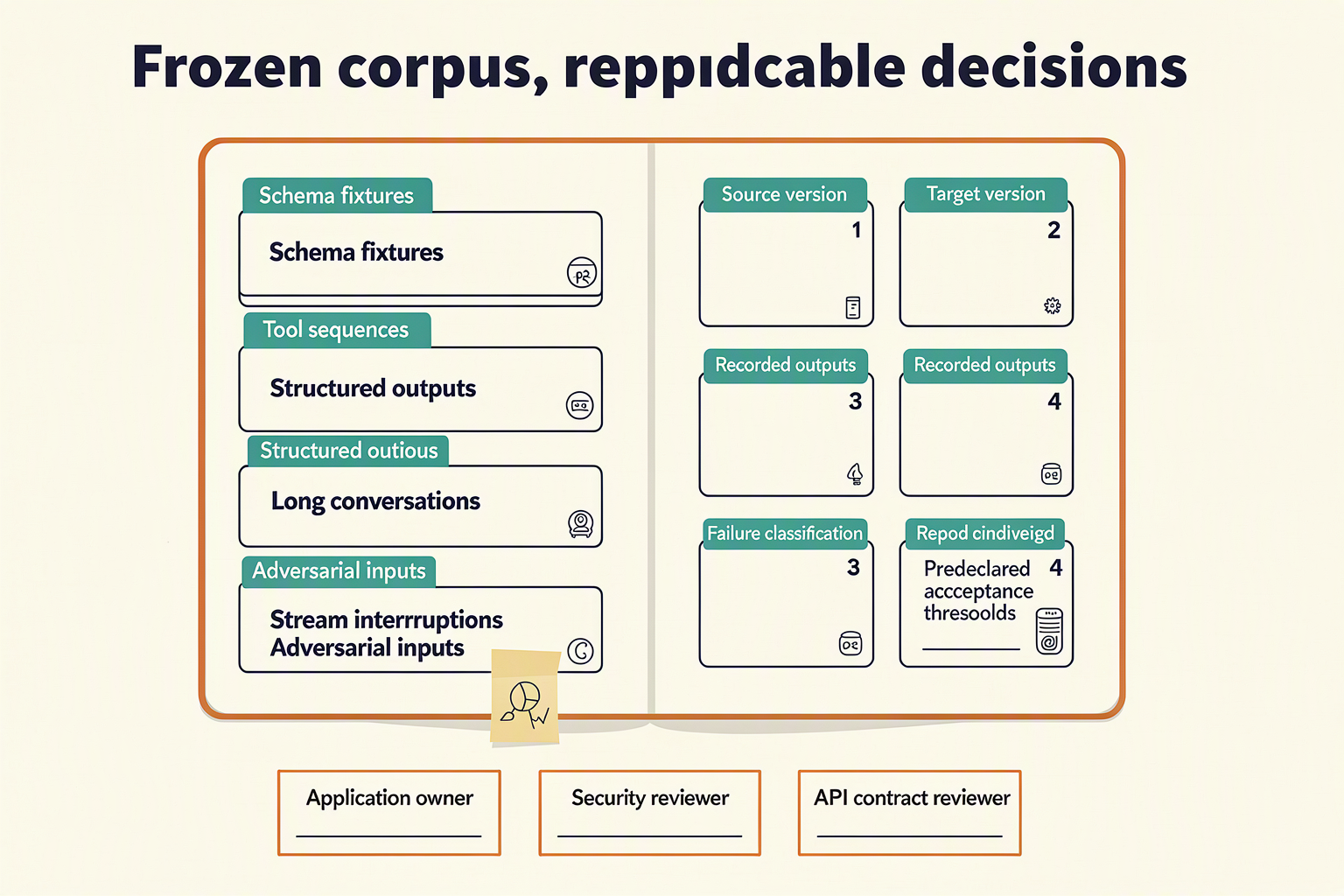
Gate a Claude or GPT-6.1 Sol migration on versioned regression tests, zero unresolved critical safety failures, and named expert approvals—not a few convincing conversations. For Gemini 4 Argon, production approval must also depend on verified target access and API behavior; as of September 30, 2026, the supplied announcement does not establish general API availability.
Which regression tests should be frozen before migration?
Freeze the evaluation inputs, expected invariants, scoring rubric, and baseline results before tuning the target adapter. Keep a separate development set: repeatedly adjusting prompts against the release suite turns a regression gate into a training exercise.
For this September 30, 2026 checklist, use these test groups:
- Contract fixtures: Sanitized requests and responses covering instructions, message roles, multimodal content, malformed payloads, and unsupported fields. Require schema-valid output and explicit handling of rejected inputs.
- Tool-execution fixtures: Multiple calls, reordered results, invalid arguments, tool errors, and interrupted execution. Assert correct call/result association and no duplicate side effects after retries.
- Conversation fixtures: Follow-up questions, instruction changes, context truncation, and isolated user sessions. Assert that required context survives and information never crosses session boundaries.
- Streaming fixtures: Partial events, disconnects, cancellation, and mixed output types. Assert that incomplete output cannot trigger an irreversible action.
- Task and safety fixtures: Representative business tasks, ambiguous requests, malicious instructions inside retrieved content, and requests requiring human escalation.
Google AI for Developers documents optional server-side state through previous_interaction_id in the Interactions API documentation supplied for this September 30, 2026 checklist. Accordingly, freeze tests for both retained-state behavior and your application’s recovery path when a continuation fails.
Google AI for Developers’ streaming documentation, supplied for the same checklist, describes interleaved text and generated images. Where your application uses those modalities, test event ordering and parser behavior rather than treating every stream fragment as text.
What pass thresholds should block a release?
Separate hard invariants from scored quality. A fluent answer cannot compensate for executing the wrong tool.
Recommended release gates—not published Gemini benchmarks—are:
- 100% pass rate for critical invariants: authorization, session isolation, tool-result correlation, and duplicate-execution prevention.
- No unresolved critical or high-severity security findings under your organization’s severity policy.
- Task-quality non-inferiority within a predeclared margin, measured against the frozen source-system baseline.
- Latency, cost, and failure rates within application-specific budgets, measured under representative concurrency.
Run nondeterministic tasks repeatedly and report uncertainty, not just an average score. Record the model identifier, API version, SDK version, adapter commit, prompts, tool schemas, and test date with every result.
The Google AI Developers Forum report supplied for this September 30, 2026 checklist alleges a missing required function-call id in a gemini-3-flash-preview documentation example. Treat it as justification for executable contract tests—not evidence of an Argon defect.
Who must sign off before production traffic moves?
Require explicit approval from:
- Integration engineering: validates adapters, state handling, retries, and rollback.
- Security and privacy: reviews permissions, sensitive-data flows, and adversarial tests.
- Domain experts: judge factual correctness, escalation decisions, and consequential actions.
- Operations and the product owner: accept service budgets, monitoring, and remaining limitations.
Each approval should identify the tested release artifact and accepted exceptions. Unknown Argon behavior remains an open gate, not an assumption that compatibility will hold.
What should your shadow, canary and rollback checklist include?
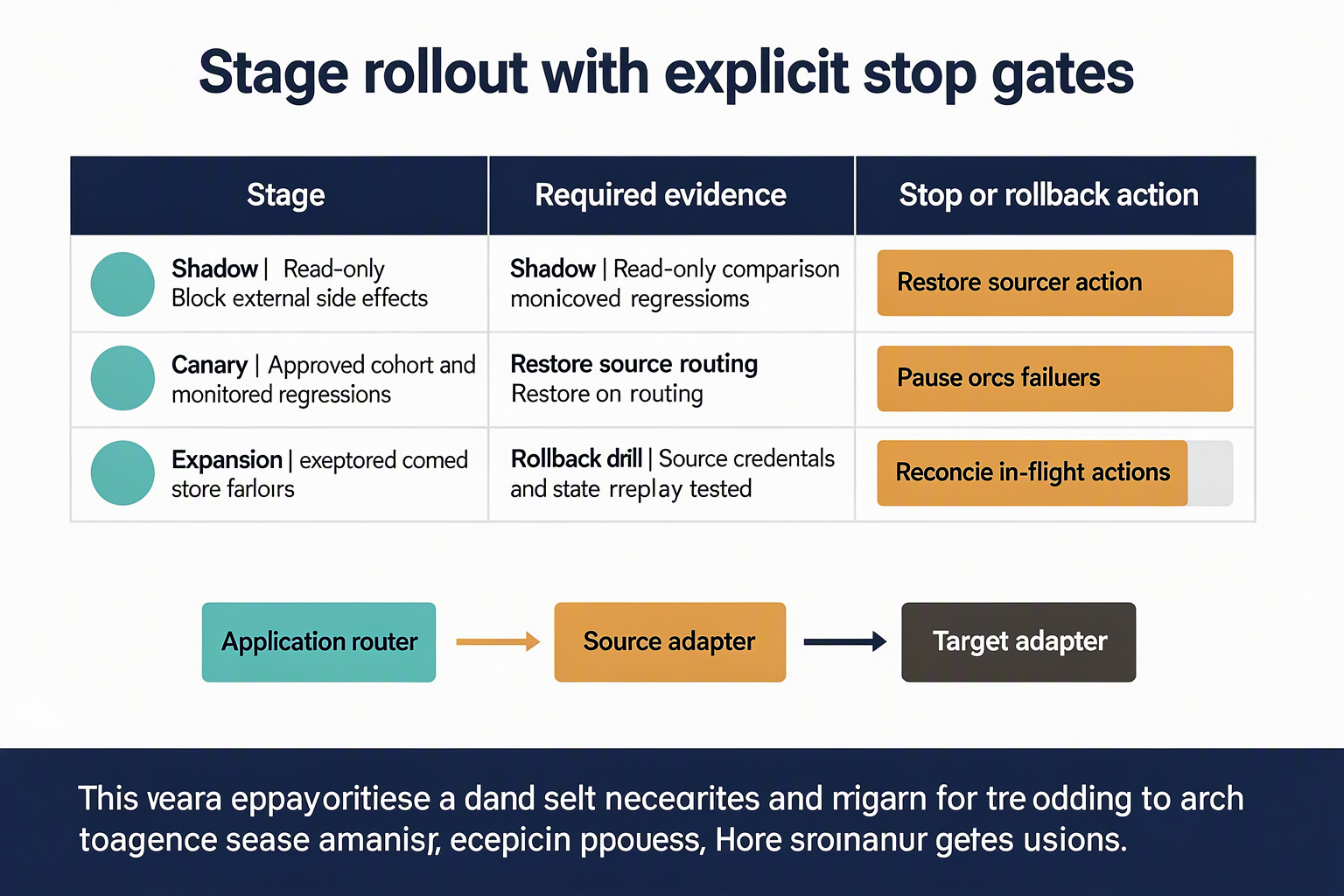
Your shadow, canary and rollback checklist should define what traffic is tested, which actions may execute, how failures are measured, and who can restore the previous provider. For a Gemini 4 Argon API migration, production rollout must remain blocked until target access and the supported API contract are verified.
As of September 30, 2026, UA.NEWS, reporting on CNBC coverage, describes Gemini 4 Argon’s initial availability as planned for trusted cybersecurity partners. That report does not establish general API availability; the checklist below is an engineering release plan, not confirmation that Argon is production-ready for your application.
What should each migration stage prove?
Use this checklist for applications currently targeting Claude 5.5 or GPT-6.1 Sol. The percentages are illustrative rollout settings, not Google recommendations or measured benchmarks.
| Stage | Traffic and execution | Required evidence | Stop or rollback trigger |
|---|---|---|---|
| Access gate | No production routing | Verified model identifier, endpoint, permissions and supported SDK | Access or contract remains unconfirmed |
| Offline replay | Sanitized recorded conversations; mocked tools | Valid parsing, tool-result correlation and task completion against a fixed baseline | Any critical schema or correlation failure |
| Shadow | Copy eligible requests; suppress user-visible responses and tool side effects | Paired quality, latency, token usage and error comparisons | Sensitive-data exposure or attempted unauthorized action |
| Initial canary | Example: 1% of eligible sessions; low-risk workflows | Successful end-to-end sessions with approved tool permissions | Duplicate write, broken state or critical safety failure |
| Expanded canary | Example: 5%, then 25%; advance only after review | Stable results across languages, modalities and workflow types | Predeclared quality, cost or latency limit exceeded |
| Rollback drill | Restore previous routing; reconcile in-flight work | Tested session recovery, audit trail and tool-execution ledger | Recovery cannot meet the team’s declared objective |
How should shadow testing handle tools and conversation state?
Shadow mode must not become a second production executor. Run candidate tool requests against mocks, read-only services, or captured results; never let both providers send the same message, charge the same customer, or update the same record.
Google AI for Developers’ Interactions API documentation, reviewed for this September 2026 checklist, documents optional server-side state through previous_interaction_id. Consequently, retain a provider-neutral conversation record rather than treating a Google interaction identifier as portable rollback state.
For each paired run, capture:
- Contract evidence: adapter version, request schema, parsed output and tool-call/result identifiers.
- Outcome evidence: task completion, rejected arguments, human escalation and duplicate-action attempts.
- Operational evidence: time to first usable response, end-to-end duration, retries and actual billed usage.
Google AI for Developers also documents interleaved text and generated images in Interactions API streams, as reviewed in September 2026. Test cancellation and partially consumed streams—not just completed text responses.
What makes rollback safe rather than merely fast?
Define rollback thresholds before the canary starts. Separate immediate-stop events, such as unauthorized writes, from aggregate regressions assessed over a declared observation window.
- Pin sessions: avoid switching providers midway through an unresolved tool exchange.
- Reconcile actions: consult an execution ledger before retrying pending writes.
- Restore deliberately: route new sessions back first; recover existing sessions from normalized history.
As of September 2026, CallMissed’s developer AI API supports caller-chosen fallback models and usage and request logs. Those capabilities can support fallback routing and investigation, but they do not establish Argon availability or replace application-level replay and duplicate-execution safeguards.
A migration is ready only when the team has demonstrated both successful candidate execution and safe recovery after failure.
Frequently Asked Questions
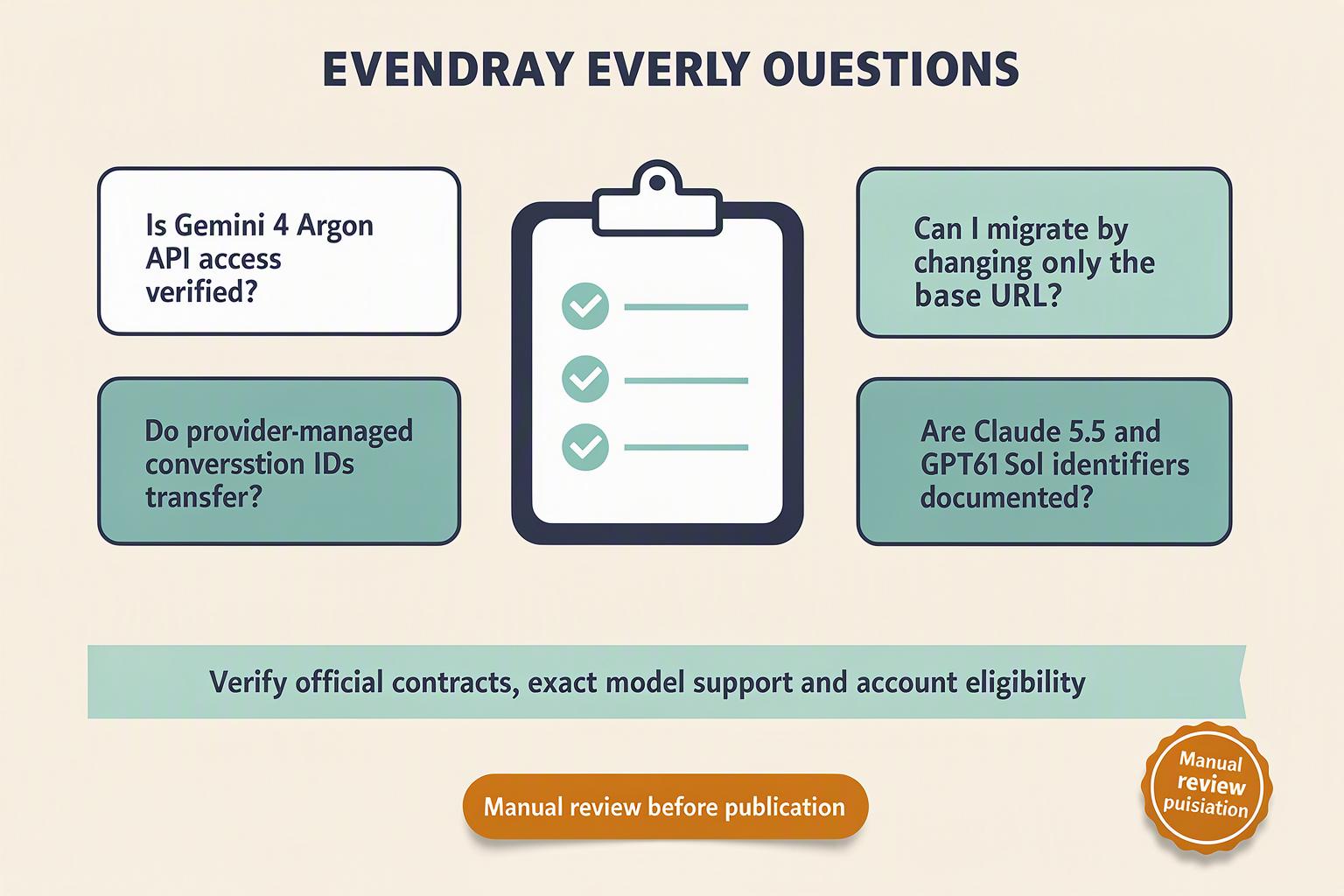
Is Gemini 4 Argon API migration possible with verified public access as of September 30, 2026?
Is changing the base URL enough for Gemini 4 Argon API migration?
Can conversation state transfer during Gemini 4 Argon API migration?
previous_interaction_id in the Interactions API, as reviewed on September 30, 2026, but the supplied documentation does not establish cross-provider state import. Build a replayable transcript containing relevant instructions, messages, tool results, and durable business facts, then test whether the destination preserves task continuity without re-executing completed actions.How should developers validate Gemini tool calls and tool results?
id in an Interactions example for gemini-3-flash-preview; that is a documentation report, not an Argon-specific finding. Include tests for parallel calls, malformed arguments, tool failures, and repeated delivery, using application-level execution records to prevent a retried request from repeating a payment or booking.Will existing streaming handlers work with the Gemini Interactions API?
response_format, so a parser must distinguish output types instead of concatenating every event. Test partial outputs, disconnects, cancellation, and tool-event ordering separately, and confirm Argon’s supported streaming behavior before enabling the corresponding production path.Can an AI gateway simplify migration without guaranteeing Gemini 4 Argon support?
Conclusion
Gemini 4 Argon API migration should be treated as a contract migration, not a model-name substitution. For agent applications targeting Claude 5.5 or GPT-6.1 Sol, readiness means proving that endpoints, messages, tools, and conversation state work together before production traffic moves.
As of September 30, 2026, UA.NEWS, reporting on CNBC coverage, describes Gemini 4 Argon’s initial availability as planned for trusted cybersecurity partners; that report does not establish general API access or a production model identifier. Preparation can begin now, but deployment decisions should remain conditional on verified access and documentation.
What should engineers verify before migrating an agent to Gemini 4 Argon?
- Confirm the endpoint and access contract. Verify authentication, API versions, source-model assumptions, and the target model identifier before changing configuration. Google AI for Developers’ Interactions API documentation, reviewed for this September 2026 checklist, describes a unified calling pattern for models and agents—but that documented interface is not confirmation that Argon supports a particular endpoint.
- Make message and content mapping explicit. Audit roles, instructions, multimodal payloads, and response parsing rather than assuming equivalent fields mean equivalent behavior. A successful text response is only an initial check: regression tests must also exercise the content structures and conversation sequences your application actually uses.
- Prove tool-call integrity. Correlate every result with the correct call identifier, validate arguments, and test errors, retries, and duplicate-execution protection. The Google AI Developers Forum report cited in this September 2026 checklist concerns an allegedly missing required
idin agemini-3-flash-previewdocumentation example—not an Argon defect—but reinforces why examples need validation against actual responses.
- Release only with tested continuity and recovery. Exercise conversation state, streaming events, cancellation, and retries alongside observability, staged rollout, and rollback criteria. Google AI for Developers’ documentation, reviewed for this September 2026 checklist, describes optional state through
previous_interaction_idand interleaved text-and-image streaming; adapters should handle those behaviors deliberately rather than assume compatibility with another provider’s event model.
Looking ahead, watch for confirmed Argon access, supported endpoints, model identifiers, and published schema details. Those disclosures should determine when preparation becomes implementation, and when controlled testing can become a production rollout. Until then, keep documented Gemini behavior separate from unverified Argon-specific assumptions.
As of September 2026, CallMissed’s developer AI API offers OpenAI-compatible and Anthropic-compatible endpoints, plus usage and request logs. Readers can explore CallMissed as an integration option while retaining the model-specific checks this migration requires.
Run the interface audit before changing the model: can your team demonstrate that every tool result, streamed event, and conversation transition survives—and that rollback works when one does not?
Related Reading
- Gemini 4 Argon API Pricing and Access: Sep 30, 2026
- GPT-6 Claude API Migration Guide for Engineering Teams
- Gemini 4 vs Claude Fable 5.1: Argon Buyer Guide (2026)
Sources
Discussion
Related Posts



Ready to automate customer conversations?
Launch AI voice agents and WhatsApp bots with CallMissed — one API, 22+ Indian languages.