
GPT-6 Claude API Migration Guide for Engineering Teams



A GPT-6 Claude API migration playbook for mapping prompts, tools, schemas, evaluations, costs, latency, fallbacks, and staged rollout.
GPT-6 Claude API Migration Guide for Engineering Teams
Would you trust a one-line model-name swap when the new API can change how your application reasons, calls tools, validates JSON, and waits for external work? This GPT-6 Claude API migration guide treats a move from Claude 5.5 to GPT-6—or the reverse—as a production-system change, not a vendor SDK edit.
Why does this migration matter now?
As of September 2026, OpenAI’s Models documentation lists GPT-6 Sol with a 1.05-million-token context window, a 128,000-token maximum output, and prices of $2 per million input tokens and $10 per million output tokens. OpenAI’s Model Guidance calls GPT-6 Astra “our most intelligent model yet” and documents asynchronous tool calling: GPT-6 can keep reasoning or call other tools while an application executes a tool marked async: true. Those capabilities can reshape agent architecture, throughput assumptions, and timeout handling.
Timing adds operational pressure. OpenAI’s Deprecations page says the gpt-5.4-cyber model will be removed on October 1, 2026, following other September 2026 removals; the broader lesson is that aliases and snapshots need explicit lifecycle monitoring. By contrast, the research contains no primary Anthropic documentation confirming Claude 5.5’s API behavior. This guide therefore labels every Claude 5.5-specific detail that cannot be verified rather than turning assumptions into migration requirements.
What will engineering teams learn?
You will map the OpenAI Responses API and Anthropic Messages-style request patterns, then test prompt portability instead of assuming identical behavior. The guide covers tool and function schemas, strict structured outputs, context-window strategy, multimodal inputs, safety controls, streaming, retries, and model-specific error handling. It also shows where adapter layers help—and where they can conceal meaningful differences in reasoning controls, content blocks, tool-call IDs, and completion semantics.
Two directional checklists will separate migrate Claude to GPT-6 work from migrate GPT-6 to Claude 5.5 work. A comparison table, sample evaluation plan, common pitfalls, and FAQs will turn the analysis into an executable sequence for platform, application, security, and finance teams.
How should teams reduce migration risk?
The safest path is evidence-led: build a frozen test corpus, define pass/fail rubrics, capture outputs and traces, measure p50/p95 latency and end-to-end cost, shadow production traffic, canary a small cohort, and preserve rollback. Evaluate correctness, schema adherence, tool selection, refusal behavior, long-context retrieval, and multimodal accuracy separately; a single aggregate score can hide a release-blocking regression.
For provider-neutral experimentation, CallMissed offers OpenAI-compatible and Anthropic-compatible endpoints, fallbacks, request logs, and 138 models as of September 2026.
Can you safely migrate between Claude 5.5 and GPT-6?
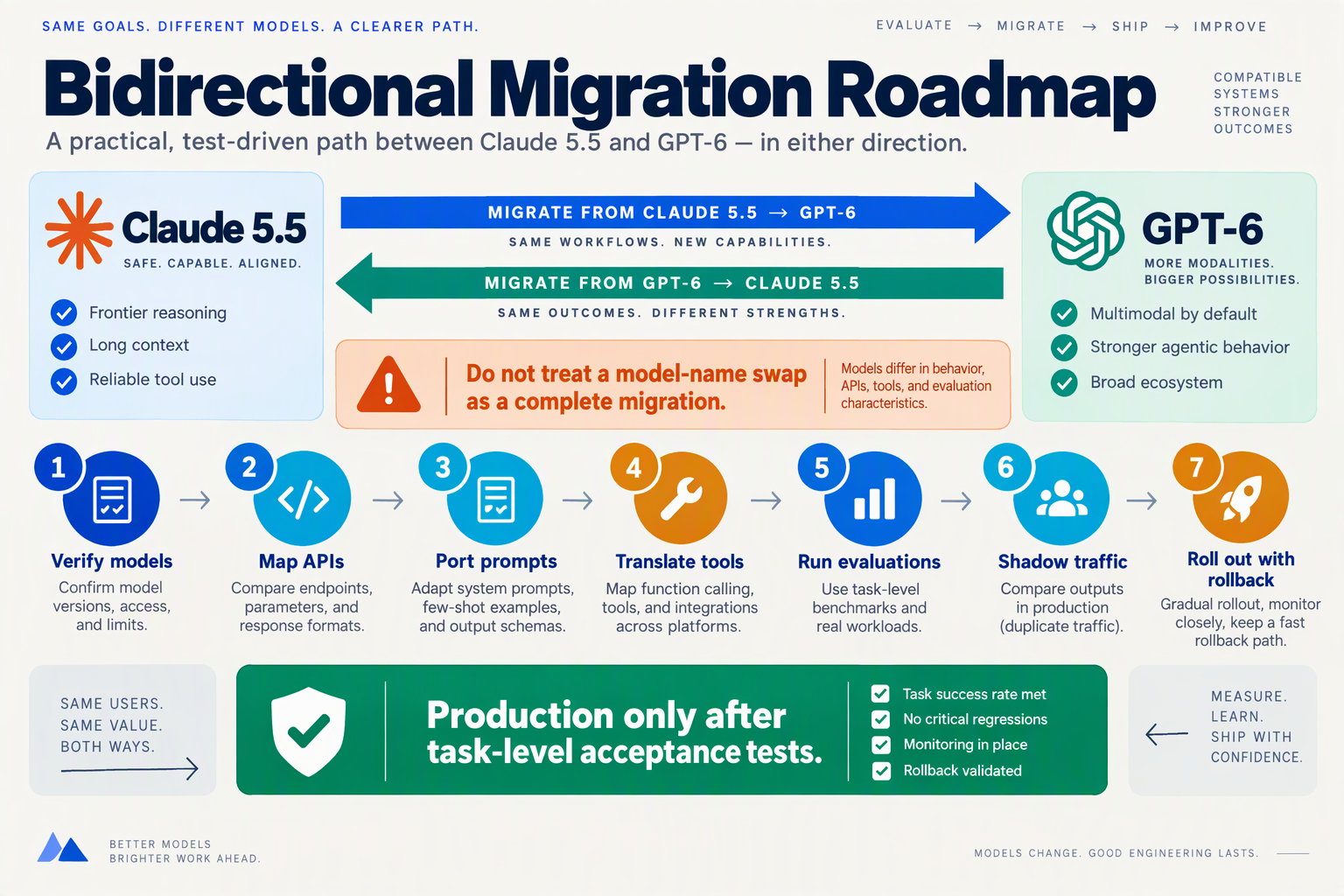
Yes—but only if you treat the migration as a behavioral compatibility project with measurable release gates. A provider adapter can translate request shapes, but it cannot guarantee equivalent reasoning, tool use, JSON validity, safety behavior, latency, or cost.
What does a safe GPT-6 Claude API migration require?
A safe migration preserves the application’s observable contract, not necessarily identical wording. Before changing production traffic, define which behaviors must remain stable across three layers:
- Transport contract: authentication, endpoints, streaming events, timeouts, retries, and error handling.
- Model contract: instruction following, reasoning depth, refusals, context use, and multimodal interpretation.
- Application contract: valid structured data, correct tool selection, side-effect safety, response quality, and service-level objectives.
OpenAI’s Text Generation documentation recommends pinning production applications to specific model snapshots rather than relying exclusively on moving aliases. As of September 2026, OpenAI’s Retrieve Model API reference also shows that model metadata can include a shutdown_date; its gpt-6-astra example lists October 23, 2026. Teams should therefore monitor model lifecycle metadata and maintain a tested replacement path.
The corresponding Claude 5.5 snapshot names, lifecycle dates, context limits, pricing, and supported controls are not confirmed in the supplied primary Anthropic documentation. Treat those fields as discovery tasks, not facts inferred from earlier Claude releases.
Which differences can break an otherwise valid migration?
The highest-risk differences occur where model output triggers code or business actions:
- Message semantics: system instructions, user content, assistant history, and provider-specific content blocks may not map one-to-one.
- Tool execution: tool definitions can differ in naming constraints, schema support, call identifiers, parallelism, and result submission.
- Structured outputs: “return JSON” is weaker than enforcement against a schema; test optional fields, enums, nesting, nullability, and refusal cases.
- Conversation state: applications must verify whether state is passed explicitly, referenced by an ID, stored by the provider, or reconstructed locally.
- Streaming: event names, partial tool arguments, completion signals, and usage reporting can change parser behavior.
- Safety controls: equivalent prompts can produce different refusals, redactions, or handling of borderline requests.
These are bidirectional risks. Teams that migrate Claude to GPT-6 must accommodate GPT-6-specific Responses API semantics, while teams that migrate GPT-6 to Claude 5.5 must remove or replace any GPT-6 feature without a documented Claude equivalent.
What evidence is enough to approve the switch?
Use explicit gates rather than relying on subjective side-by-side review:
- Functional gate: Every critical workflow completes correctly, including tool failures and malformed inputs.
- Schema gate: Machine-readable outputs satisfy the production validator at the required rate.
- Safety gate: High-risk test categories meet approved refusal and escalation rules.
- Performance gate: p50 and p95 end-to-end latency remain within workload-specific limits.
- Economic gate: Cost per successfully completed task—not merely price per token—stays within budget.
- Operational gate: Logs preserve model version, request ID, tool trace, token usage, latency, error class, and fallback path.
- Rollout gate: Shadow testing, a limited canary, automated rollback, and the previous provider configuration are ready.
The migration is safe when both models pass the same application-level contract and remaining differences are documented, monitored, and reversible. API compatibility is only the starting point; production equivalence must be demonstrated.
Which GPT-6 and Claude 5.5 details are confirmed as of September 29, 2026?

As of September 29, 2026, primary documentation from both OpenAI and Anthropic confirms production-relevant details for GPT-6 and Claude 5.5. Anthropic officially documents Claude Opus 5.5 and Claude Sonnet 5.5, so engineering plans no longer need to treat those models as provisional.
The APIs are not drop-in equivalents, however. OpenAI centers GPT-6 integrations on the Responses API, while Claude 5.5 uses Anthropic’s Messages API conventions. Model selection, reasoning controls, tool calls, streaming events and response parsing should remain provider-specific behind a shared application interface.
Which GPT-6 specifications are confirmed?
OpenAI documents GPT-6 Sol and GPT-6 Luna as distinct GPT-6 options rather than interchangeable aliases. GPT-6 Sol is documented as a reasoning model with six reasoning-effort settings:
nonelowmediumhighxhighmax
The following GPT-6 details are documented as of September 29, 2026:
- Model identifier in API examples: OpenAI uses
gpt-6-astrain Responses API examples. - Primary interface: OpenAI demonstrates GPT-6 through the Responses API at
/v1/responses. - GPT-6 Sol tools: Function calling, web search, file search and computer use are listed.
- Knowledge cutoff: GPT-6 Sol has a documented cutoff of April 20, 2026.
- Snapshot strategy: OpenAI recommends pinning production applications to specific model snapshots rather than depending uncritically on moving aliases.
- Previous-generation guidance: OpenAI’s GPT-5 documentation describes GPT-5 as its previous model and recommends the latest GPT-6 Astra for coding, reasoning and agentic workloads.
Do not transfer Sol’s reasoning controls, limits or tool support to Luna—or to every model carrying a GPT-6 name—without checking that model’s documentation. Maintain a per-model capability registry covering context, output limits, tools, reasoning settings, streaming behavior and lifecycle metadata.
Which Claude 5.5 specifications are confirmed?
Anthropic officially documents two Claude 5.5 models:
| Model | API model ID | Context window | Maximum output | Input price | Output price |
|---|---|---|---|---|---|
| Claude Opus 5.5 | claude-opus-5-5 | 1M tokens | 128k tokens | $4/MTok | $20/MTok |
| Claude Sonnet 5.5 | claude-sonnet-5-5 | 1M tokens | Check the current model documentation | $2/MTok | $10/MTok |
Claude Opus 5.5 uses always-on adaptive thinking. Applications should not assume this maps directly to OpenAI’s discrete GPT-6 reasoning-effort values.
Claude Sonnet 5.5 launched on September 28, 2026 and is available through the Anthropic API and supported cloud channels. Its documented cache-read price is $0.20 per million tokens.
The shared 1M-token context window does not imply identical output limits, reasoning behavior, latency, caching economics or tool execution. Opus 5.5 and Sonnet 5.5 should have separate configuration records even when an application exposes them through the same internal provider adapter.
How do the OpenAI and Anthropic API shapes differ?
A migration requires more than replacing one model ID with another:
- OpenAI: GPT-6 examples use
POST /v1/responses, with Responses API items and OpenAI-specific reasoning and tool-call structures. - Anthropic: Claude 5.5 uses the Messages API, with Anthropic content blocks and
tool_use/tool_resulthandling. - Reasoning controls: GPT-6 Sol exposes explicit reasoning-effort levels, while Claude Opus 5.5 uses always-on adaptive thinking.
- Tool correlation: Each provider has its own identifiers and message structures for matching tool results to requests.
- Streaming: Event names, payload shapes and completion conditions differ and should be parsed with provider-specific state machines.
- Token limits: Context size and maximum output are separate controls; a 1M-token context window does not authorize a 1M-token response.
A reliable abstraction should normalize application concepts—messages, tools, usage and final output—without pretending the underlying wire formats are identical.
What does asynchronous tool calling confirm for GPT-6?
OpenAI’s Model Guidance confirms that a GPT-6 tool marked async: true can run while the model continues reasoning, invokes another tool or answers an independent part of the request. The application later submits the result using the original call_id.
That contract creates concrete implementation requirements:
- Persist each asynchronous tool-call ID across workers and retries.
- Support multiple outstanding calls without assuming sequential completion.
- Define deadlines for abandoned or delayed external operations.
- Make execution idempotent so retries cannot duplicate payments, bookings or messages.
- Test whether streamed responses contain useful output before every asynchronous operation finishes.
- Preserve provider-specific tool state instead of translating it into a generic synchronous loop.
Claude’s Messages API tool blocks should not be assumed to reproduce OpenAI’s asynchronous call_id contract automatically. If one orchestration layer supports both providers, implement explicit adapters and test concurrency, retries and partial streaming independently.
Are the GPT-6 lifecycle dates confirmed?
OpenAI’s Retrieve Model API reference includes a gpt-6-astra example with a shutdown_date of October 23, 2026. Because model metadata can change, teams should verify the live model record and account notices rather than treating a documentation example as an irrevocable availability guarantee.
OpenAI’s Deprecations page also states that gpt-5.4-cyber will be removed on October 1, 2026. This does not establish the lifecycle of every GPT-6 model, but it demonstrates why production systems need snapshot pinning, model-health checks and tested fallbacks.
For Claude 5.5, use Anthropic’s current model documentation and lifecycle notices rather than inferring deprecation dates from earlier Claude generations. Keep model IDs, pricing and limits in configuration so they can be updated without redeploying the entire application.
Which key API differences matter in 2026?
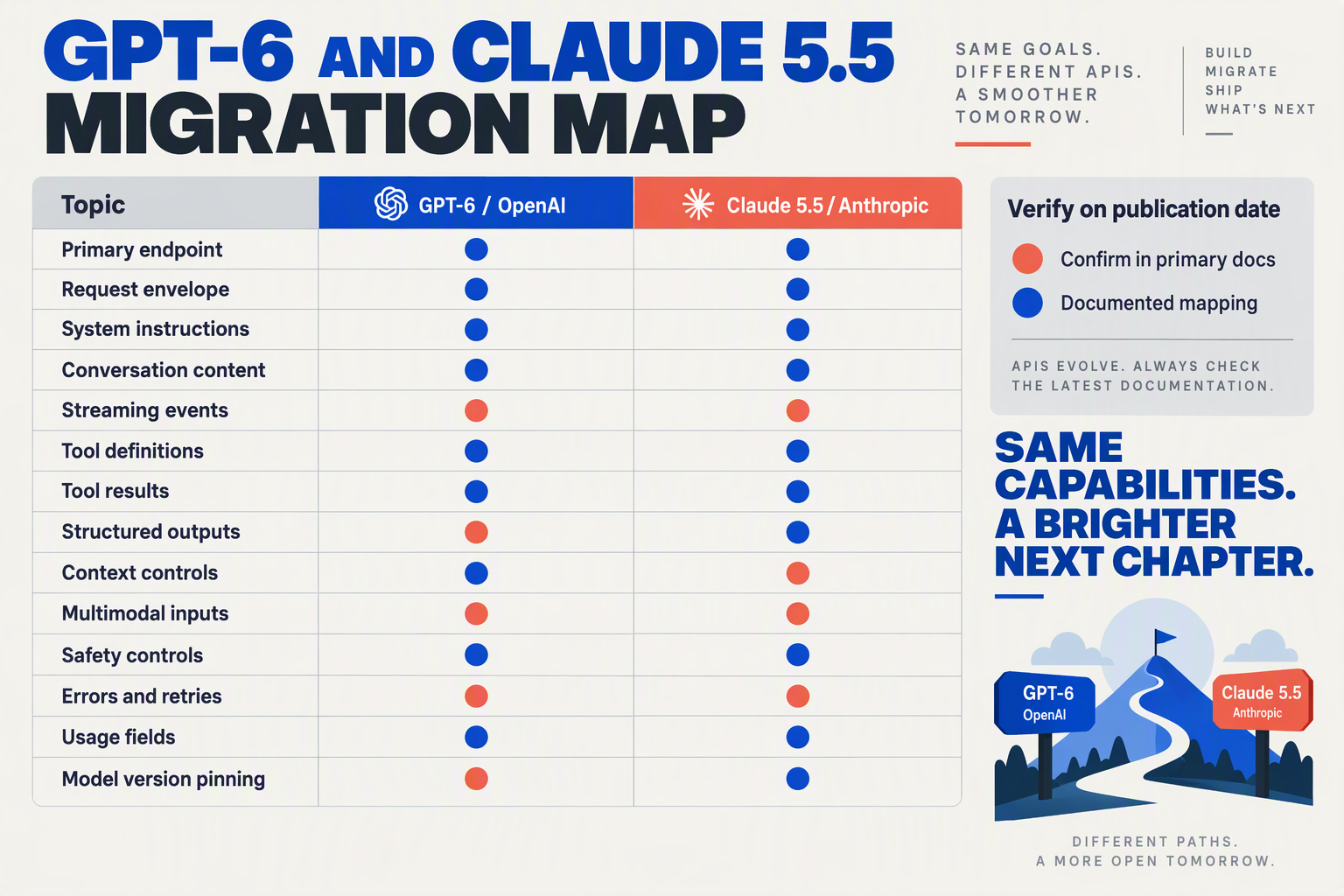
The key API differences in 2026 are request and response envelopes, tool-call lifecycles, structured-output enforcement, streaming events, and model controls. Treat these as adapter and orchestration changes—not as fields that can be solved by replacing a model name.
How do the GPT-6 and Claude 5.5 API contracts compare?
The OpenAI Responses API is documented for GPT-6, but the supplied primary research does not confirm Claude 5.5’s exact contract as of September 2026. Consequently, Claude 5.5 entries below are verification requirements, not assumed capabilities.
| API area | GPT-6 via OpenAI Responses API | Claude 5.5 migration requirement | Engineering action |
|---|---|---|---|
| Request envelope | Uses /v1/responses with fields such as model and input | Confirm the current Messages-style endpoint, role rules, and content-block schema | Map both providers into an internal request type |
| Response parsing | Returns a response object whose output can contain multiple typed items | Verify content-block types, stop reasons, usage fields, and empty-output behavior | Parse by item type; never assume one text string |
| Tool calls | Supports functions and custom tools; tool results must retain the original call identifier | Confirm tool-use IDs, result-block format, and whether parallel calls are supported | Persist provider IDs and validate every tool result |
| Asynchronous tools | A tool marked async: true can run while GPT-6 continues other reasoning or work | No Claude 5.5 equivalent is confirmed by the supplied research | Add a capability flag and synchronous fallback |
| Structured outputs | Test the chosen GPT-6 model and endpoint for schema enforcement and refusal handling | Verify supported JSON-schema subset and invalid-output behavior | Validate locally and retry or repair deterministically |
| Model controls | GPT-6 exposes model-specific reasoning settings; supported values vary by model | Confirm Claude 5.5 thinking, token-budget, and sampling controls | Translate intent, not parameter names |
OpenAI’s Model Guidance states in September 2026 that GPT-6 asynchronous tool calling can continue reasoning, invoke other tools, or answer independent work while an application executes a tool marked async: true. The application later submits the result using the original call_id, so losing that identifier can strand an otherwise valid workflow.
Which differences should the adapter normalize?
A provider-neutral adapter should normalize stable application concepts while preserving provider-native data for debugging:
- Input roles and content: Convert application messages into each API’s accepted text, image, and tool-result blocks.
- Completion state: Map provider-specific stop reasons into internal states such as
completed,tool_pending,length_limited,refused, andfailed. - Tool identity: Store both an internal invocation ID and the provider’s original tool-call ID.
- Usage accounting: Record input, output, cached, and reasoning-related usage separately where reported.
- Errors and retries: Distinguish rate limits, transient server failures, invalid schemas, context overflow, and safety refusals.
Do not flatten native responses before logging them. The raw event sequence is essential when diagnosing duplicated tools, missing arguments, or a stream that ends without user-visible text.
What must remain provider-specific?
Keep reasoning controls, asynchronous execution, safety behavior, and stream-event parsing behind explicit capability checks. OpenAI’s Models documentation lists GPT-6 Sol with a 1.05-million-token context window and 128,000-token maximum output as of September 2026, but those limits should not become shared defaults for Claude 5.5.
Before migration, run contract tests against the exact model snapshot or alias selected in production. Assert accepted parameters, schema compliance, tool-call ordering, terminal events, token limits, and retry behavior; fail deployment when documentation or observed behavior diverges.
How do you port prompts, structured outputs, context, multimodal inputs, and safety controls?
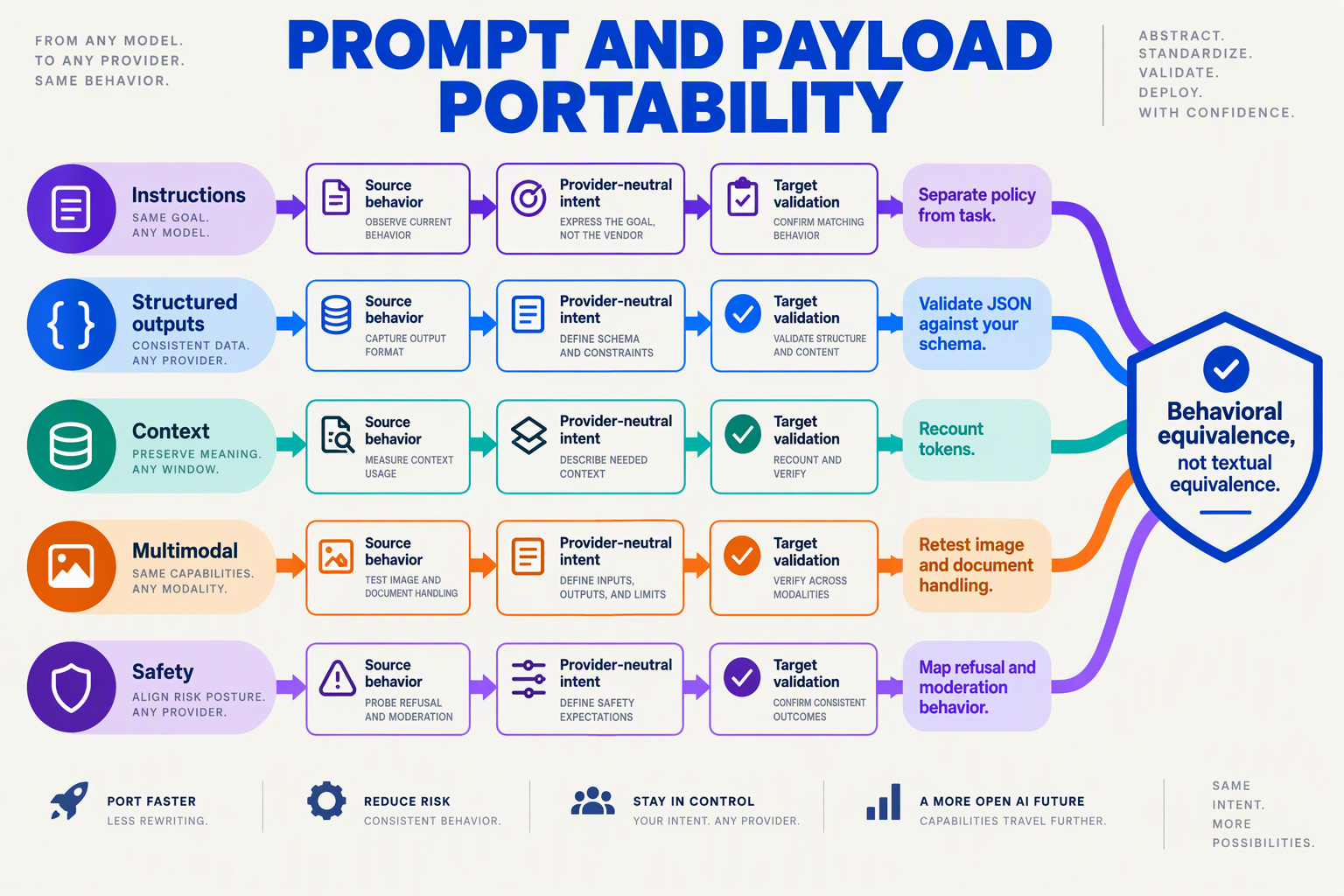
Port the behavioral contract, not merely the prompt text: separate instructions from user data, define machine-checkable output schemas, budget context explicitly, normalize multimodal inputs, and reproduce safety policies in application code. Because the supplied research does not include primary Anthropic documentation confirming Claude 5.5 behavior, treat every Claude 5.5-specific capability as unverified until tested against its current API and exact model snapshot.
How do you make prompts portable between Claude 5.5 and GPT-6?
Start by converting each production prompt into provider-neutral components:
- Policy: non-negotiable permissions and prohibitions.
- Task: the requested operation and success criteria.
- Context: retrieved documents, conversation history, and tool results.
- Output contract: required fields, formatting, and examples.
- Uncertainty rule: when to abstain, ask a question, or escalate.
Keep trusted instructions separate from untrusted user or retrieved content. Do not assume that role precedence, XML-like delimiters, examples, or phrases such as “think step by step” will produce equivalent behavior across models.
Run prompt ablations to determine whether provider-specific wording remains necessary. Pin the selected model snapshot where available: OpenAI’s Text Generation documentation explicitly recommends snapshots when applications require consistent model behavior.
How should structured outputs and tool schemas be migrated?
Use one canonical JSON Schema internally, then compile it into each provider’s accepted request format. Validate outputs in your application even when a model offers strict schema enforcement.
For every schema:
- Set
additionalProperties: falsewhere unexpected keys are unsafe. - Distinguish required fields from nullable fields.
- Constrain enums, lengths, numeric ranges, and nested arrays.
- Test Unicode, empty values, malformed dates, and oversized responses.
- Reject or repair invalid JSON through a bounded retry—not an infinite loop.
Preserve tool-call IDs and map tool results back to the originating call. This becomes especially important with GPT-6 asynchronous tools: OpenAI’s Model Guidance says a tool marked async: true can run while GPT-6 continues reasoning, invokes other tools, or answers independent work; the result must be returned using the original call_id.
How do you migrate context and long conversations?
Do not fill a large context window simply because it exists. As of September 2026, OpenAI’s Models documentation gives GPT-6 Sol a 1.05-million-token context window and a 128,000-token maximum output.
Test context behavior at multiple depths:
- Place the decisive fact near the beginning, middle, and end.
- Measure retrieval accuracy as irrelevant material increases.
- Reserve tokens for output, tool results, and retry instructions.
- Summarize older turns while retaining decisions, citations, and unresolved tasks.
- Compare full-context prompting with retrieval-augmented generation.
For Claude 5.5, confirm the exact context and output limits from current Anthropic documentation or API metadata before setting truncation thresholds.
How should multimodal inputs and safety controls be ported?
Create an internal content model for text, images, files, and tool results, then translate only modalities supported by the destination model. Test file-size limits, MIME handling, image ordering, OCR accuracy, unsupported formats, and whether URLs or uploaded assets are accepted; never infer Claude 5.5 modality support from an earlier Claude release.
Finally, implement safety as layered enforcement:
- Pre-screen inputs for policy and sensitive data.
- Authorize tools server-side with least privilege.
- Validate destinations, arguments, and transaction limits.
- Post-screen outputs before execution or display.
- Log refusal category, override attempts, and human escalation.
Replay both clearly disallowed and borderline cases. A migration passes only when refusal precision, helpful safe alternatives, and tool authorization meet predefined thresholds—not when the destination model merely sounds cautious.
How do you translate tool schemas, agent loops, and SDKs with a provider-neutral adapter?
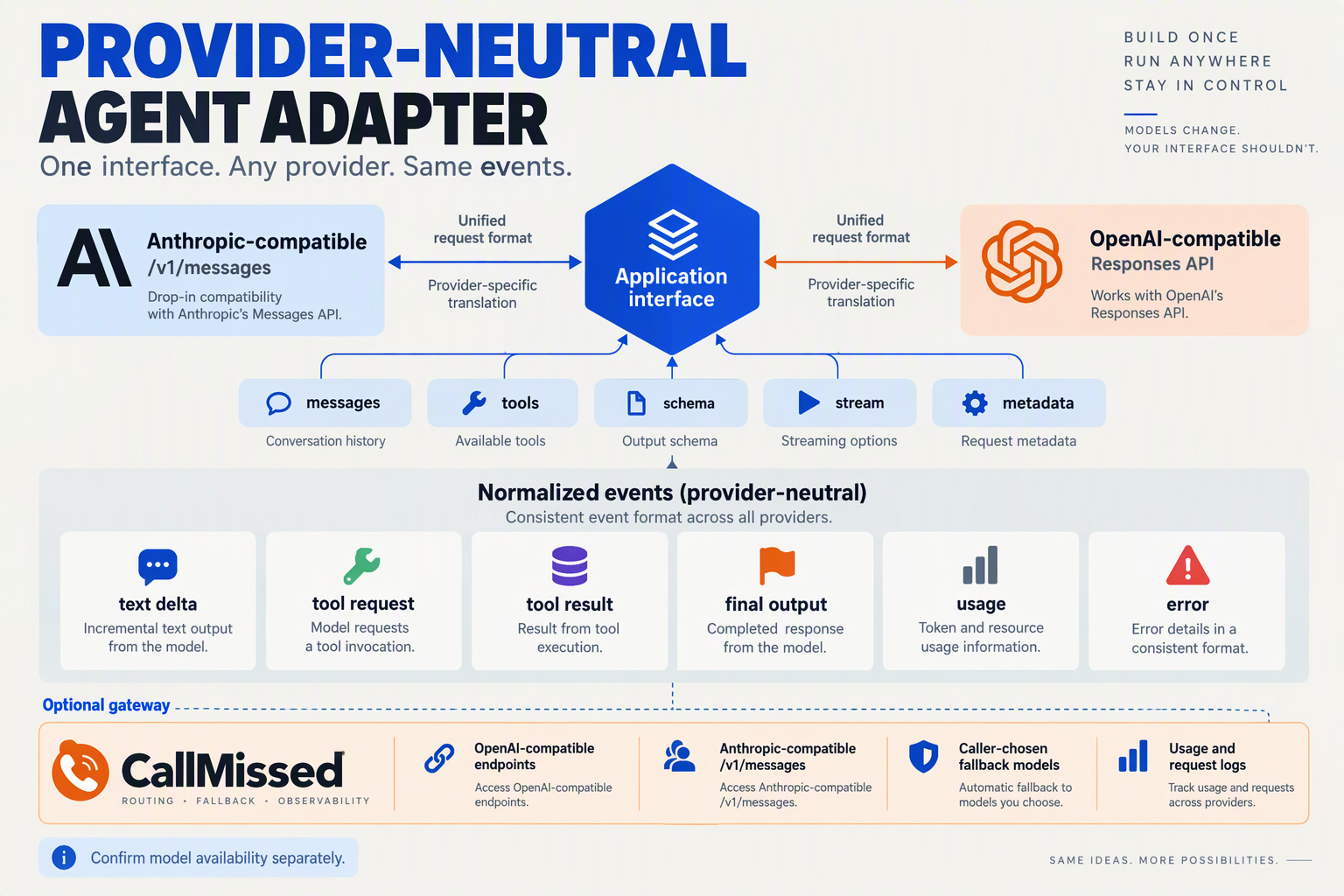
A provider-neutral adapter should define one canonical tool contract and agent state machine, then translate requests, events, tool calls, and results at each provider boundary. Do not reduce migration to renaming SDK fields: GPT-6 supports asynchronous tool execution, while Claude 5.5’s corresponding behavior is unconfirmed by the supplied primary documentation as of September 2026.
How should you design a provider-neutral tool schema?
Start with the smallest schema both model paths can execute reliably. Keep provider-specific options in an extensions object rather than allowing them to leak into business logic.
{
  "name": "lookup_order",
  "description": "Return an order by its exact ID.",
  "input_schema": {
    "type": "object",
    "properties": {
      "order_id": {"type": "string"}
    },
    "required": ["order_id"],
    "additionalProperties": false
  },
  "execution": {"mode": "blocking"}
}
The adapter should perform four transformations:
- Map canonical
input_schemato the provider’s accepted tool or function schema. - Normalize generated arguments into a parsed object and retain the original arguments for debugging.
- Convert provider tool-call identifiers into an internal
operation_id. - Validate arguments locally before executing tools, even when a provider offers strict schema enforcement.
Treat unsupported JSON Schema keywords as deployment errors—not fields to silently remove. Test enums, nullable values, nested arrays, length limits, and additionalProperties: false against each pinned model snapshot.
How should the agent loop handle synchronous and asynchronous tools?
Implement the loop as an explicit state machine: model requested → tool proposed → arguments validated → execution started → result submitted → model resumed → completed or failed.
OpenAI’s Model Guidance states in September 2026 that GPT-6 tools marked async: true can run while GPT-6 continues reasoning, calls other tools, or answers independent parts of the request. The application must return the result using the original call_id.
A portable loop should therefore:
- Store every provider call ID alongside an internal operation ID.
- Support multiple outstanding operations without assuming response order.
- Make tool execution idempotent using operation-based deduplication keys.
- impose per-tool deadlines, cancellation rules, and retry limits.
- Append results exactly once and reject unknown or completed call IDs.
- expose
blocking,parallel, andasynchronouscapabilities explicitly.
When routing to a model without verified asynchronous semantics, downgrade asynchronous to blocking or reject the request. Never emulate concurrency silently, because it can change tool ordering and final answers.
How do you make OpenAI and Anthropic SDKs interchangeable?
Keep official SDK objects inside provider-specific clients. Application code should depend on internal types such as CanonicalRequest, ToolInvocation, UsageRecord, StreamEvent, and CanonicalResponse.
Normalize streaming into events such as:
text.deltareasoning.statustool.startedtool.arguments.deltatool.completedresponse.completedresponse.failed
Preserve the raw provider response beside the normalized record. Otherwise, the adapter can hide finish reasons, safety outcomes, usage accounting, or newly introduced content blocks.
Solutions such as CallMissed’s OpenAI-compatible and Anthropic-compatible endpoints can reduce SDK rewrites; as of September 2026, CallMissed also supports caller-chosen fallback models, structured outputs, function calling, and request logs. Even with a common endpoint, teams should retain provider-specific conformance tests because wire compatibility does not guarantee identical model behavior.
What should you test before switching providers?
Run contract tests that verify:
- Required and malformed tool arguments
- Duplicate, delayed, and out-of-order results
- Zero, one, and multiple tool calls
- Stream interruption and replay behavior
- Unknown call IDs and tool timeouts
- Schema adherence after retries
- Raw-to-canonical usage and error mapping
A successful adapter preserves semantics, observability, and rollback, not merely request syntax.
What evaluation plan catches quality, tool, JSON, context, multimodal, and safety regressions?
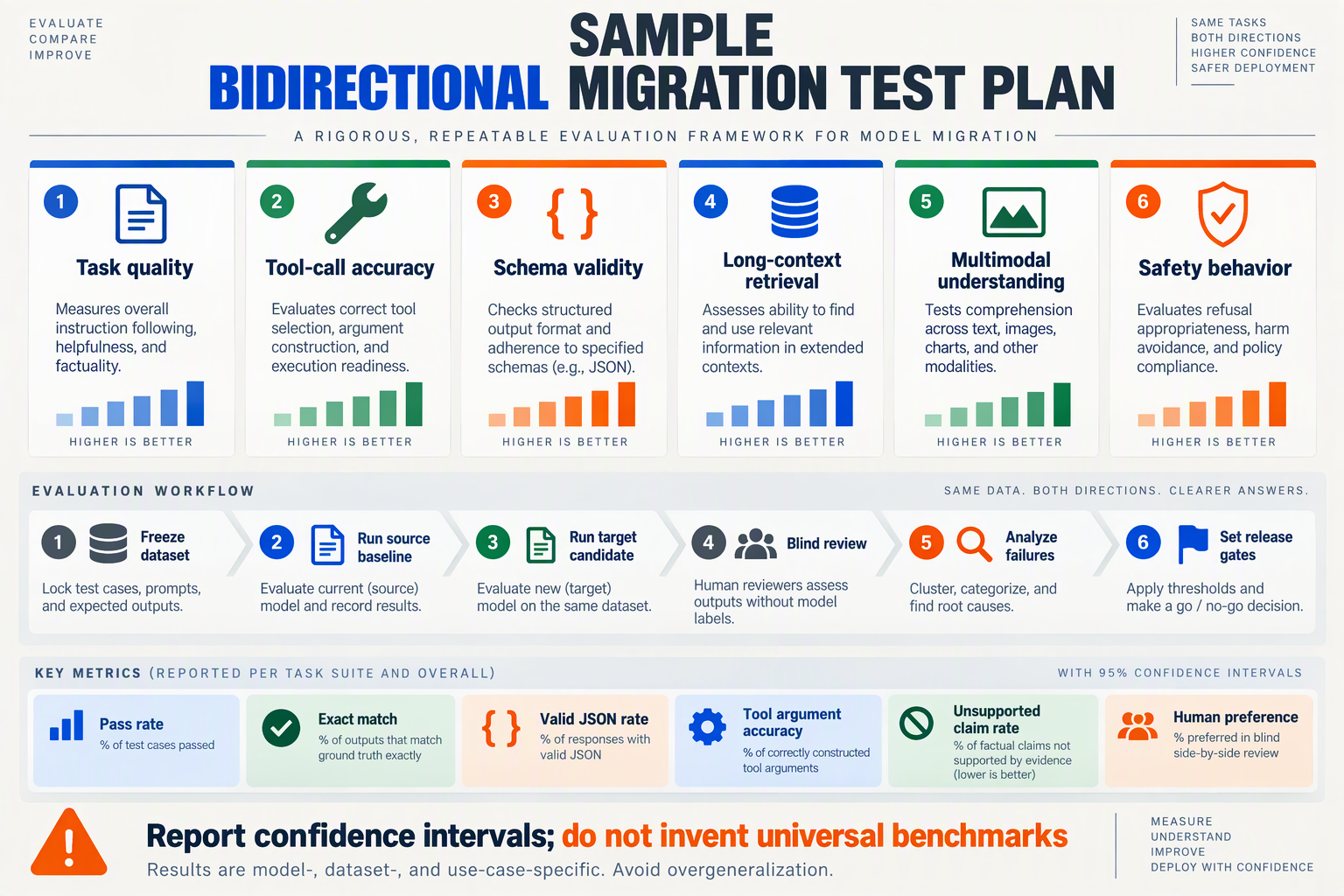
A migration evaluation should use paired tests, domain-specific scoring, production traces, and hard release gates. Test GPT-6 and Claude 5.5 on identical inputs, but normalize only transport differences—not model outputs, tool decisions, refusals, or JSON repairs that could conceal regressions.
How should you build the migration test set?
Create a version-controlled corpus from four sources:
- 40% representative production requests, sampled across intents, languages, customer tiers, and input lengths.
- 25% difficult or previously failed requests, including ambiguous instructions and malformed data.
- 20% adversarial cases, such as prompt injection, unsafe requests, and attempts to expose hidden instructions.
- 15% synthetic boundary tests, covering maximum schema depth, large files, unusual images, and delayed tools.
Remove personal data, freeze prompts and tool definitions, and pin model snapshots where available. OpenAI’s Text Generation documentation recommends pinning production applications to specific snapshots rather than relying on moving aliases.
Because primary Anthropic documentation confirming Claude 5.5 behavior was unavailable in the supplied research as of September 2026, treat its context, multimodal, structured-output, and safety limits as verification tasks, not inherited assumptions.
Which quality and context tests catch subtle regressions?
Score each answer independently for factual correctness, instruction compliance, completeness, citation fidelity, tone, and unsupported claims. Use deterministic validators where possible and blinded human reviewers for subjective dimensions; disagreements should be adjudicated against a written rubric.
Run context tests at multiple load levels:
- The same fact near the beginning, middle, and end of the input
- Distractor documents containing plausible but incorrect answers
- Multi-turn conversations with conflicting earlier instructions
- Inputs at 25%, 50%, 75%, and near the documented context limit
- Requests requiring evidence from several distant passages
OpenAI’s Models documentation lists GPT-6 Sol with a 1.05-million-token context window and a 128,000-token maximum output as of September 2026. Do not infer that successful request acceptance guarantees reliable retrieval across that entire window.
How should tools and structured JSON be evaluated?
Replay realistic tool workflows and record tool-selection accuracy, argument validity, unnecessary calls, missing calls, call-ID matching, retries, and final-answer grounding. Include unavailable tools, timeouts, permission errors, duplicate results, and malicious content returned by a tool.
OpenAI’s Model Guidance states in September 2026 that GPT-6 supports asynchronous tool calling through async: true and returns results against the original call_id. Test out-of-order completion, parallel calls, late results, and cancellation rather than evaluating only immediate tool responses.
For JSON, validate outputs against the actual production schema. Measure:
- Parse success before any repair
- Required-field and enum compliance
- Extra properties and incorrect types
- Unicode, escaping, null, and numeric-edge handling
- Whether refusals remain distinguishable from valid business objects
A repair middleware pass should be reported separately; otherwise, it can make a weaker model appear schema-compliant.
What multimodal and safety cases belong in the release gate?
Multimodal tests should vary resolution, orientation, OCR quality, handwriting, charts, screenshots, and contradictory text-image evidence. Evaluate both extraction accuracy and whether the model admits when visual evidence is unreadable.
Safety testing should include prompt injection, data-exfiltration attempts, disallowed content, benign requests resembling unsafe ones, and tool actions requiring authorization. Track both unsafe compliance and false refusals.
Approve migration only when every critical lane passes its predefined threshold, no severity-one safety or tool-action failure appears, and reviewers can inspect raw requests, responses, tool traces, token usage, errors, and latency. Run at least two passes to expose nondeterministic failures, then investigate regressions individually rather than accepting a higher aggregate score that masks a production blocker.
How should you test token cost, latency, observability, retries, and fallback routing?
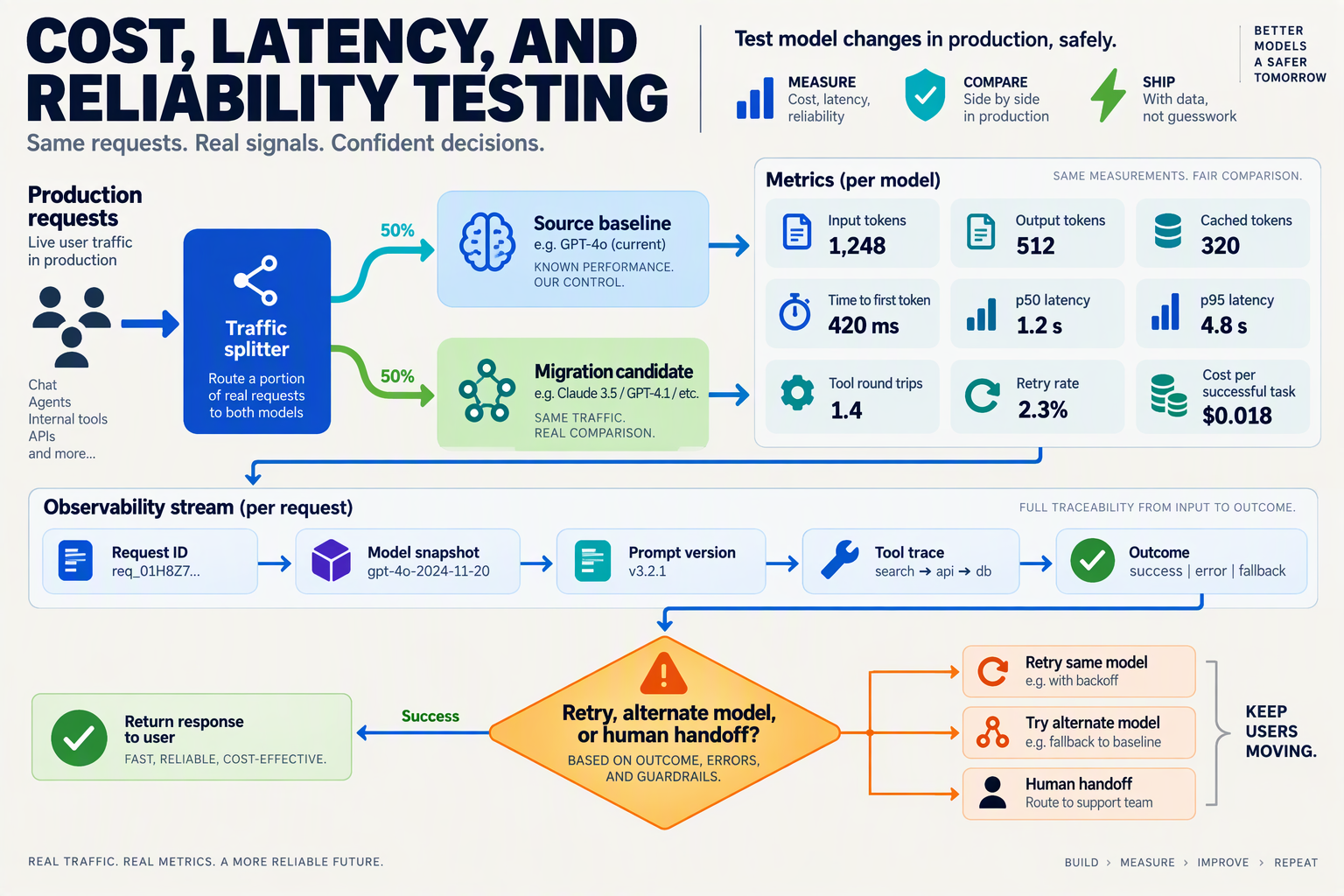
Test both models with the same frozen workload, but compare cost per successful task and end-to-end latency, not headline token prices or time to first token alone. Instrument every attempt, tool call, retry, and fallback so a cheaper or faster model does not hide lower accuracy or higher recovery costs.
How should you calculate token cost?
Run a representative corpus containing short chats, long-context requests, structured outputs, and tool-heavy workflows. Record provider-reported input and output tokens for each attempt, then calculate:
Total task cost = input cost + output cost + tool/search charges + retry cost + fallback cost.
OpenAI’s Models documentation prices GPT-6 Sol at $2 per million input tokens and $10 per million output tokens as of September 2026. A request using 100,000 input tokens and 10,000 output tokens would therefore cost $0.30 before external tool charges: $0.20 for input plus $0.10 for output.
The supplied primary research does not confirm Claude 5.5 pricing, caching discounts, or token-accounting rules. Retrieve those values from Anthropic’s current documentation before testing a Claude 5.5 to GPT-6 migration, and do not assume each provider tokenizes identical text into the same number of tokens.
Report at least:
- Mean, median, p95, and maximum cost per request
- Cost per rubric-passing task
- Retry and fallback cost as a percentage of total spend
- Cost by workload class, tenant, and prompt version
- Input-to-output token ratio and unexpected output growth
Which latency metrics should you benchmark?
Measure latency from the user’s perspective across warmed and cold connections. Run enough samples to expose tail behavior rather than publishing a single average.
- Time to first token
- Time to complete response
- Tool-selection and tool-execution time
- Structured-output validation time
- End-to-end p50, p95, and p99 latency
- Recovery time after retries or fallback routing
OpenAI’s Model Guidance states in September 2026 that GPT-6 can continue reasoning, invoke other tools, or answer independent work while an async: true tool is executing. Consequently, GPT-6 tests should distinguish model latency from external-tool latency and verify that asynchronous execution actually improves the complete workflow.
What should your observability capture?
Create one trace per user task and connect all model attempts through a shared correlation ID. Each trace should capture:
- Provider, requested model, returned model ID, and snapshot
- Prompt-template version and anonymized input hash
- Token counts, estimated charge, and duration
- Finish status, schema-validation result, and refusal category
- Tool name, call ID, arguments, duration, and outcome
- HTTP status, timeout, retry reason, and fallback decision
- Evaluation score and final user-visible result
OpenAI’s Text Generation guidance recommends pinning production applications to specific model snapshots; as of September 2026, logging the actual snapshot is essential for separating application regressions from model changes.
How should retries and fallback routing work?
Use a bounded policy rather than retrying every failure:
- Retry transient timeouts, rate limits, and server errors with exponential backoff and jitter.
- Do not blindly retry invalid schemas, authentication failures, safety refusals, or oversized contexts.
- Make side-effecting tools idempotent so a replay cannot create duplicate orders or messages.
- Set separate budgets for model attempts, elapsed time, and total task cost.
- Route to the alternate model only when its capabilities satisfy the request’s tools, modality, context, and output contract.
Test fallbacks with injected timeouts, malformed tool results, rate limits, and partial streams. As of September 2026, CallMissed’s OpenAI-compatible and Anthropic-compatible developer API supports caller-chosen fallback models, usage and request logs, and one shared balance, providing a practical environment for controlled cross-model routing experiments.
What do official guidance and independent experts recommend for staged rollout?

Official OpenAI guidance and provider-neutral release engineering practice point to the same strategy: pin model versions, validate behavior offline, shadow real traffic, expand through controlled canaries, and retain instant rollback. No current primary Anthropic documentation or named independent study in the supplied research verifies Claude 5.5-specific rollout behavior, so teams should test those details rather than infer them from earlier Claude releases.
What does OpenAI officially recommend for GPT-6 rollouts?
OpenAI’s Text Generation documentation recommends pinning production applications to specific model snapshots because behavior can change between model versions. Treat aliases as evaluation targets, not immutable production dependencies.
OpenAI’s Model Guidance also requires architectural testing, not merely output comparison. As of September 2026, GPT-6 supports asynchronous tool calling, allowing the model to continue reasoning, invoke other tools, or answer independent work while an application executes a tool marked async: true; the result must be returned using the original call_id, according to OpenAI. A canary must therefore test orchestration state, duplicate execution, late tool results, and timeout recovery.
Lifecycle monitoring belongs in the rollout plan:
- OpenAI’s Deprecations page says Sora 2 aliases and snapshots were removed on September 24, 2026, after notice on March 24, 2026.
- OpenAI’s Deprecations page says
gpt-5.4-cyberwill be removed on October 1, 2026. - OpenAI’s Retrieve Model reference shows that model metadata can include a
shutdown_date, which deployment automation should monitor where available.
What rollout stages should engineering teams use?
Use measurable gates rather than calendar-based promotion:
- Compatibility gate: Run contract tests against request fields, streaming events, tool-call IDs, structured-output schemas, finish states, retries, and safety handling.
- Offline quality gate: Compare GPT-6 and Claude 5.5 on the frozen corpus using task-specific rubrics. Review high-risk failures manually instead of relying only on model-based judges.
- Shadow gate: Duplicate eligible production requests without exposing candidate responses. Disable side effects or route tools to sandboxes so shadow calls cannot send messages, modify records, or place orders.
- Internal canary: Release to employees or test tenants first. Verify dashboards, traces, alerts, rate limits, and rollback controls under realistic concurrency.
- Customer canary: Start with a small, low-risk cohort and expand only when correctness, schema adherence, p95 latency, cost per successful task, refusal rates, and tool errors remain within predefined limits.
- Progressive promotion: Increase traffic in controlled steps while preserving the previous model snapshot and prompt bundle.
- Post-release hold: Continue side-by-side sampling after full promotion to detect drift, rare safety failures, and long-context regressions.
How should independent recommendations be interpreted?
The supplied September 2026 research does not contain a named independent benchmark comparing production rollouts of Claude 5.5 and GPT-6. Claims that experts universally prefer one model, canary percentage, or evaluation threshold would therefore be unsupported.
Instead, define thresholds from your own baseline. A migration should stop automatically if any critical schema, security, billing, or irreversible tool-action test fails—even when aggregate quality improves.
For provider-neutral testing, CallMissed’s developer AI API provides OpenAI-compatible and Anthropic-compatible endpoints, caller-selected fallback models, and request and usage logs as of September 2026. That can simplify controlled comparisons, but teams should still preserve provider-specific traces because a common interface can hide meaningful differences in reasoning, streaming, and tool semantics.
What does each migration direction require from your team?
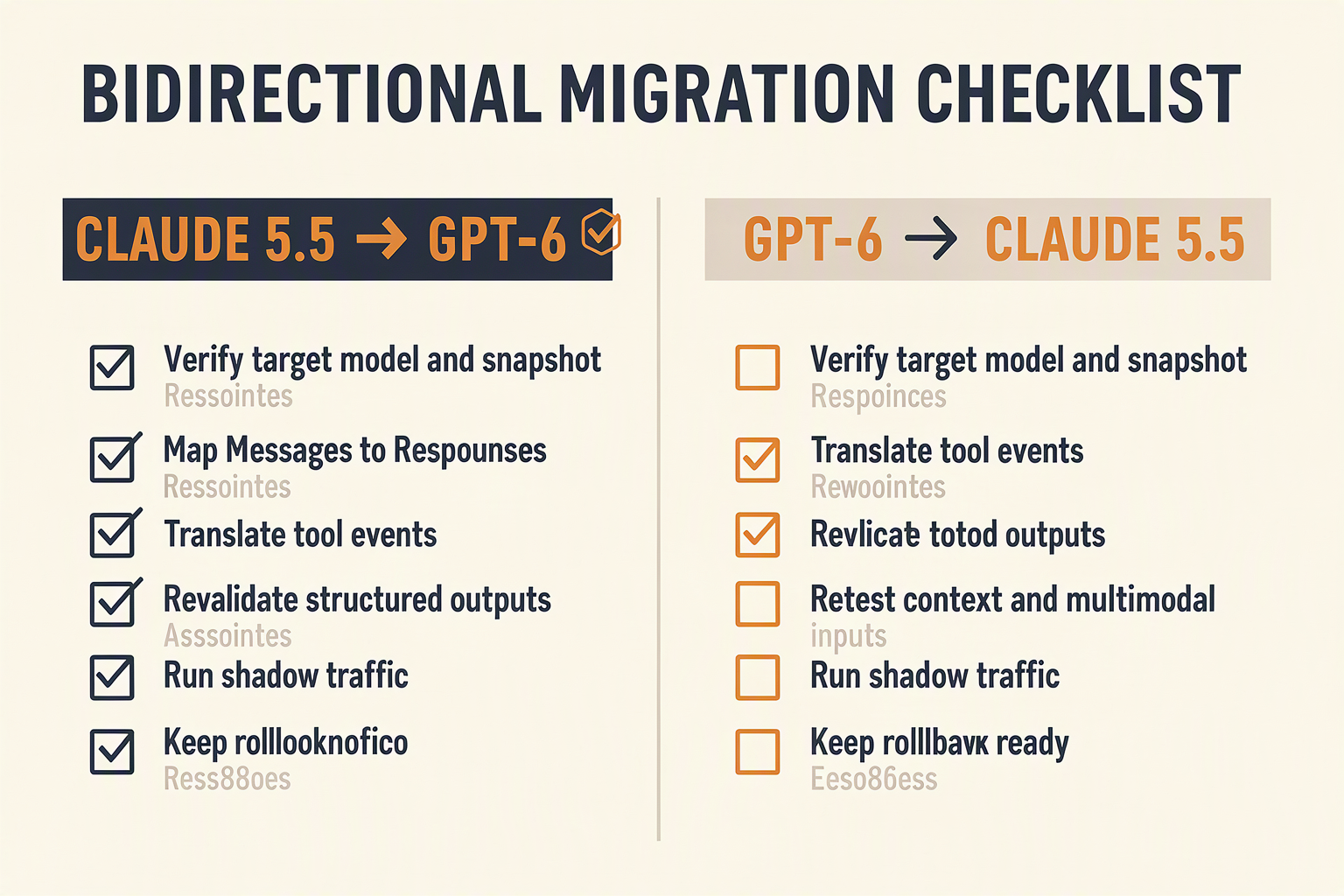
A Claude 5.5-to-GPT-6 migration primarily requires adopting and validating OpenAI’s Responses API semantics, while a GPT-6-to-Claude 5.5 migration requires removing GPT-6-specific assumptions and first confirming Claude 5.5’s actual contract. Both directions need coordinated work across application engineering, platform, security, quality, and finance—not merely a model identifier change.
What changes for each migration direction?
| Workstream | Claude 5.5 → GPT-6 | GPT-6 → Claude 5.5 | Primary owner | Exit evidence |
|---|---|---|---|---|
| API and streaming | Map Messages-style content blocks, stop states, usage fields, errors, and streams to the OpenAI Responses API. | Replace Responses API events and output parsing only after verifying Claude 5.5’s documented request, stream, and completion semantics. | Platform engineering | Contract and stream-event tests pass |
| Prompts and reasoning | Retune system instructions and explicitly test GPT-6 reasoning-effort settings rather than copying provider-specific prompt syntax. | Remove reliance on GPT-6 reasoning controls; determine Claude 5.5’s supported controls from primary Anthropic documentation. | Applied AI | Frozen prompt corpus meets task rubrics |
| Tools and agents | Convert tool definitions, preserve tool-call IDs, and decide whether functions should use async: true. | Replace asynchronous-tool assumptions with a provider-neutral state machine unless Claude 5.5 documents equivalent behavior. | Agent engineering | Multi-tool, timeout, retry, and replay tests pass |
| Structured outputs | Validate required fields, enums, nested objects, refusals, and malformed-output recovery against GPT-6. | Reconfirm schema enforcement and JSON behavior; do not assume strict-output parity without Claude 5.5 documentation. | Application engineering | Schema adherence reaches the team’s release threshold |
| Context and media | Recalculate truncation around the chosen GPT-6 model; test image, file, and long-context retrieval separately. | Discover Claude 5.5’s verified context, output, and multimodal limits before setting chunking or upload policies. | AI platform | Boundary and retrieval tests pass |
| Operations and rollout | Benchmark cost and p50/p95 latency, shadow traffic, canary by cohort, monitor model lifecycle, and preserve rollback. | Repeat identical measurements using Claude-specific errors, quotas, safety behavior, and billing data. | SRE, security, finance | Canary remains within approved SLO and budget limits |
Which direction creates more discovery work?
Migrating GPT-6 to Claude 5.5 carries more specification-discovery risk in the supplied research. As of September 2026, the available context contains no primary Anthropic documentation confirming Claude 5.5’s context window, structured-output behavior, tool semantics, pricing, or multimodal limits. Those fields must remain unconfirmed until the team retrieves current Anthropic model and API documentation.
By comparison, OpenAI publishes concrete GPT-6 details. OpenAI’s Models documentation states in September 2026 that GPT-6 Sol provides a 1.05-million-token context window, a 128,000-token maximum output, and pricing of $2 per million input tokens and $10 per million output tokens. OpenAI’s Model Guidance also documents asynchronous tools: an application marks a tool async: true, then returns the result using the original call_id.
How should teams divide the migration?
Use one accountable owner for each gate:
- Platform engineering: adapters, authentication, streaming, retries, quotas, and fallback routing.
- Applied AI: prompt revisions, task rubrics, tool selection, and refusal evaluation.
- Security: data retention, tool permissions, media handling, and safety-policy review.
- SRE and finance: p50/p95 latency, timeout rates, token usage, and end-to-end cost.
- Product operations: shadowing, canary cohorts, rollback criteria, and user-impact review.
Model lifecycle must also be treated as an operational dependency. OpenAI’s Retrieve Model API example lists a October 23, 2026 shutdown date for gpt-6-astra, so teams should verify the selected model’s current metadata and pin an approved snapshot where available.
For dual-provider testing, CallMissed’s OpenAI-compatible and Anthropic-compatible endpoints can support adapter validation, caller-chosen fallbacks, and request logging across the migration; production acceptance should still be based on each provider’s verified native behavior.
Frequently Asked Questions
Can a GPT-6 Claude API migration be completed by changing only the model name?
How do I migrate Claude to GPT-6 without rewriting every prompt?
What tool-calling changes should I test when moving between Claude 5.5 and GPT-6?
async: true can run while GPT-6 continues reasoning or handles independent work, and its result must return with the original call_id.How should structured outputs be validated after switching AI providers?
What should teams benchmark when they migrate GPT-6 to Claude 5.5?
What is the safest rollout plan for a bidirectional GPT-6 Claude API migration?
gpt-5.4-cyber will be removed on October 1, 2026, illustrating why lifecycle monitoring matters, while CallMissed’s OpenAI-compatible and Anthropic-compatible endpoints, caller-chosen fallbacks, and request logs can support provider-neutral testing across 138 models as of September 2026.Conclusion
Migrating between Claude 5.5 and GPT-6 is feasible, but it should be managed as a production-system migration, not a model-name substitution. The release gate is evidence that prompts, tool calls, structured outputs, safety behavior, latency, and cost remain acceptable under realistic traffic.
- Translate API semantics explicitly. Map OpenAI Responses API objects to Anthropic Messages-style content blocks, including roles, tool-call IDs, streaming events, completion states, and errors. An adapter can reduce integration work, but it must not conceal provider-specific behavior.
- Retest prompts, tools, and schemas. Prompt portability is never guaranteed. Validate tool selection, argument generation, strict JSON conformance, refusals, multimodal inputs, long-context retrieval, and asynchronous execution; OpenAI’s Model Guidance states that GPT-6 can continue reasoning while an application executes a tool marked
async: true.
- Measure the complete workload. Use a frozen evaluation corpus and separate rubrics for correctness, schema adherence, tool use, safety, and multimodal accuracy. Record p50 and p95 latency, retries, token consumption, tool costs, and end-to-end cost rather than relying on one aggregate benchmark.
- Deploy through reversible stages. Shadow production traffic, inspect traces, canary a limited cohort, pin model snapshots where available, and preserve rollback. OpenAI’s Deprecations page says
gpt-5.4-cyberwill be removed on October 1, 2026, illustrating why lifecycle monitoring belongs in normal operations.
What comes next will depend on changing model snapshots, reasoning controls, tool semantics, prices, and verified Claude 5.5 documentation. As of September 2026, OpenAI lists GPT-6 Sol with a 1.05-million-token context window, 128,000-token maximum output, and pricing of $2 per million input tokens and $10 per million output tokens; teams should recheck those primary sources before every rollout.
For provider-neutral testing, explore CallMissed, an AI infrastructure platform offering OpenAI-compatible and Anthropic-compatible endpoints, caller-selected fallbacks, request logs, and access to 138 models as of September 2026. If your preferred model changed tomorrow, would your architecture let you evaluate, canary, and roll back safely?
Related Reading
- Claude Fable 5.1 vs GPT-6 Astra: 2026 API Migration and Routing Guide
- GPT-6 Luna vs Claude Opus 5.5: 2026 API Comparison
- Claude Opus 5.5 API Pricing & Migration Guide
Sources
Discussion
Related Posts


Ready to automate customer conversations?
Launch AI voice agents and WhatsApp bots with CallMissed — one API, 22+ Indian languages.