Goodcall pricing vs CallMissed: Which Fits You? (2026)


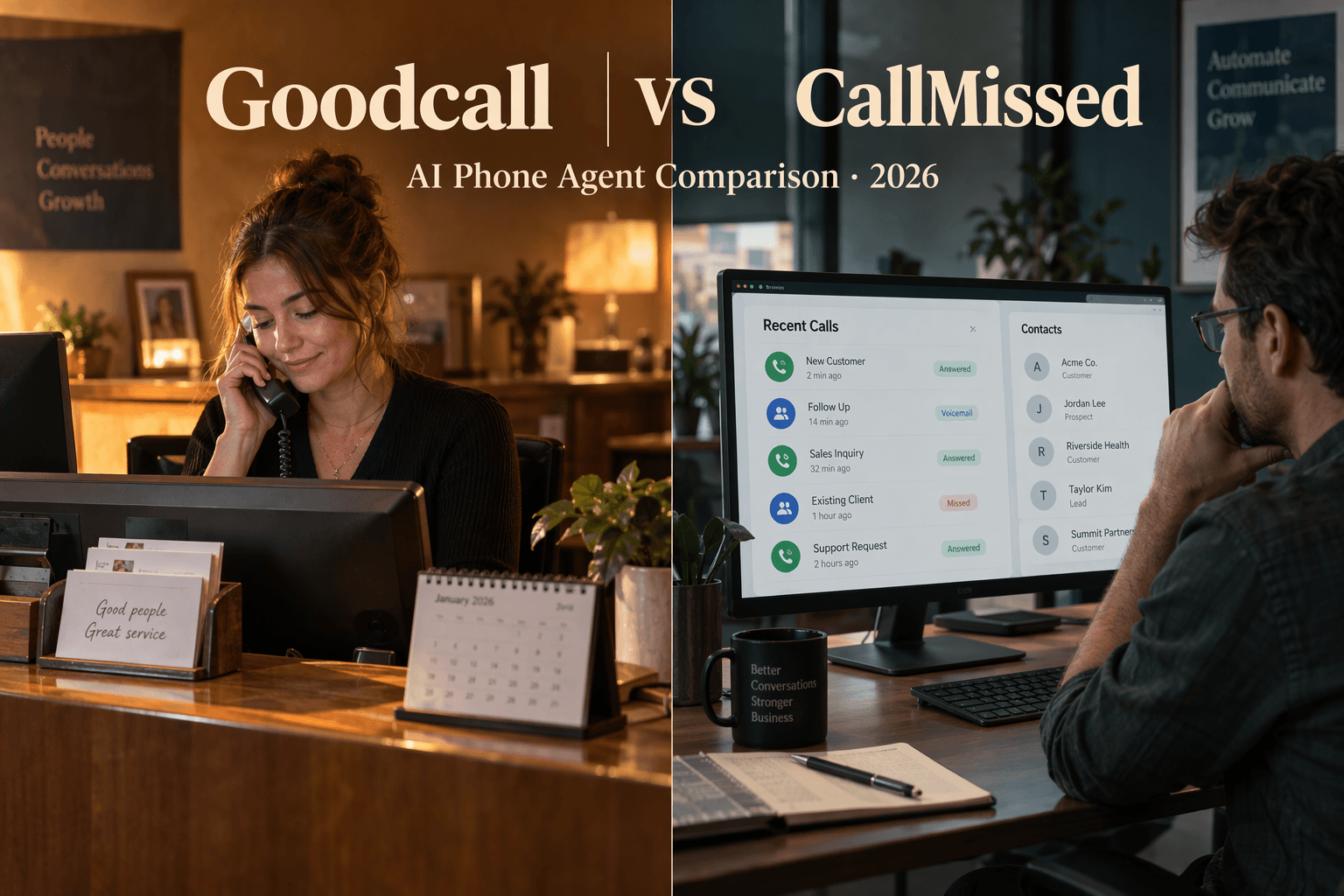
Compare Goodcall pricing with CallMissed's 2026 rates, billing units, language support and practical tests to choose the right AI phone agent.

Goodcall pricing vs CallMissed: Which Fits You? (2026)
Could a nine-minute booking call cost the same as a thirty-second enquiry? According to Goodcall’s pricing page, as reviewed on November 11, 2026, Goodcall pricing does not meter minutes: its Starter plan costs $79 a month for 100 unique customers, with additional customers billed at $0.79 each. That makes the buying decision less about the cheapest headline price and more about how your customers actually use the phone.
The distinction matters because call volume, caller count and conversation length are different measurements. Ten customers calling repeatedly can create substantial phone traffic without increasing the number of unique customers. Conversely, a business receiving short enquiries from many first-time callers can reach a customer allowance quickly, even when its total conversation time stays modest.
As of November 2026, CallMissed offers a different approach: its Standard AI voice-agent plan costs ₹4 per minute, covering speech recognition, the language model and voice, with a 30-second minimum per call and phone carriage billed separately, alongside speech recognition in 22 Indian languages plus English, including code-mixed speech such as Hinglish. These differences make billing structure and language requirements practical starting points—not minor details to check after choosing a platform.
Goodcall’s published allowances also show why comparisons need more than a monthly subscription figure. According to Goodcall’s pricing page, as reviewed on November 11, 2026, Growth costs $129 monthly for 500 unique customers, while Scale costs $299 monthly for 2,000 unique customers. Goodcall defines a unique customer as one phone number counted once per month; its pricing page says spam and wrong numbers do not count.
Consider two businesses with the same number of calls. A repair shop might receive several follow-up calls from each customer, while a local retailer might receive a fresh caller for almost every enquiry. Under customer-based billing, those businesses can have very different usage profiles; under minute-based billing, conversation duration becomes central instead. Neither model is automatically cheaper without those inputs.
This comparison will help you evaluate:
- Billing fit: how unique-customer allowances compare with metered conversation time.
- Real operating costs: where overages, minimum charges and phone carriage affect the total.
- Workflow fit: what to check around connected tools, team access and everyday call handling.
- Language needs: why recognition coverage matters for regional and multilingual callers.
The goal is not to declare a universal winner. It is to help you choose an AI phone agent whose pricing and capabilities match your business, using the November 2026 figures and the questions that actually change a purchasing decision.
Which fits your business: Goodcall or CallMissed?
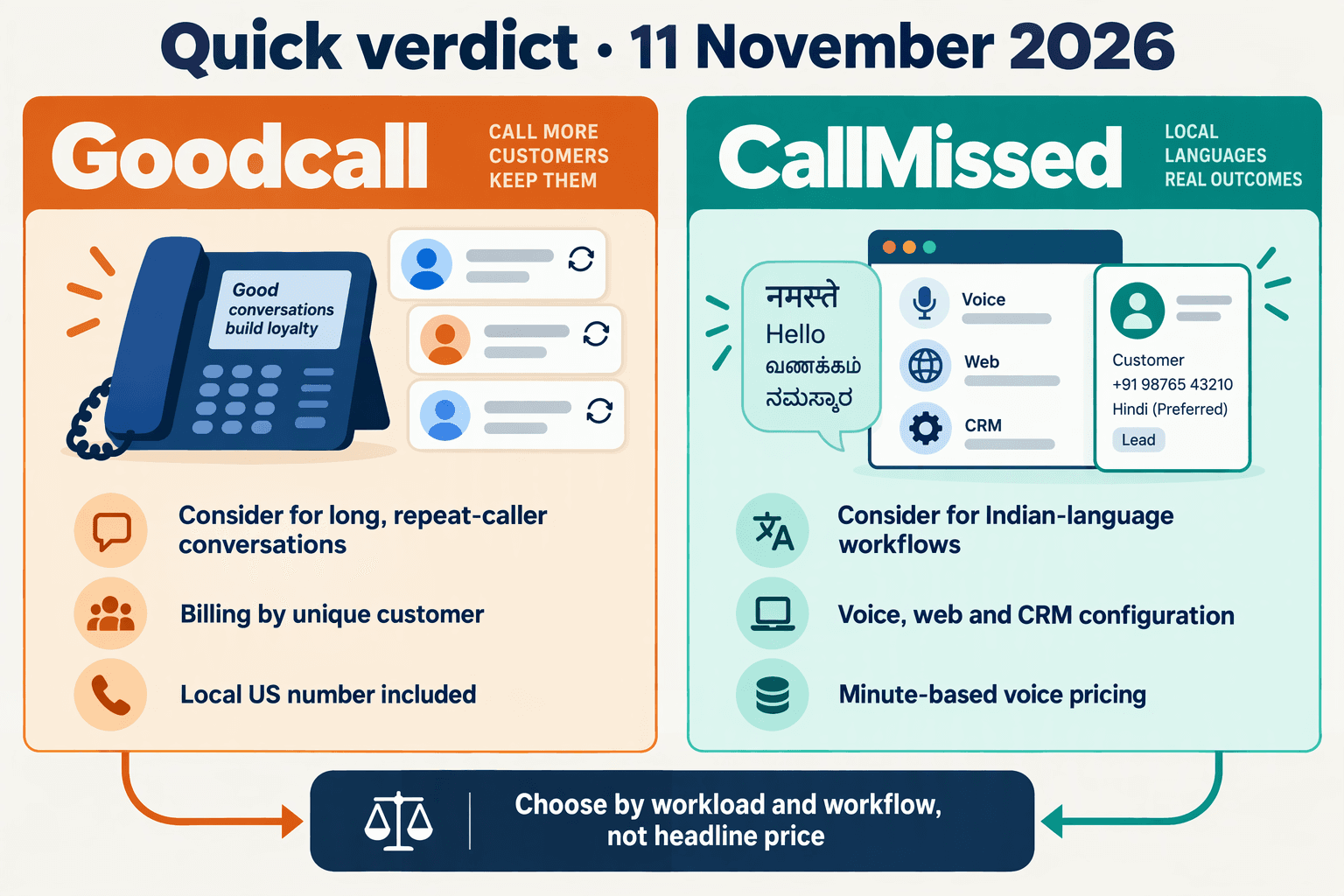
Choose Goodcall if its published allowances match your phone-support workflow; choose CallMissed if you need configurable call handling, connected business systems and supervisor controls. As of November 11, 2026, workflow fit—not the headline subscription price—is the stronger starting point.
What should you check before choosing an AI phone agent?
- Goodcall: Match specialist capacity to your workflow. According to Goodcall’s pricing page, reviewed November 11, 2026, Starter includes 5 workers, Growth 10, and Scale 20. Goodcall defines workers as specialists such as bookers or message takers; the operator and greeter do not count. Map your required specialist roles before choosing a tier.
- Goodcall: Count connected tools before subscribing. Goodcall’s pricing page lists 1 external tool on Starter, 5 on Growth and 15 on Scale, as reviewed November 11, 2026. An API, MCP server or custom code block each counts once, regardless of how many workers use it; transfers, hang-ups and call handling do not count.
- Goodcall: Check team access and record retention together. According to Goodcall’s pricing page, reviewed November 11, 2026, Starter includes 1 team member and 30-day call history, Growth 5 members and 90 days, and Scale 10 members and unlimited history. A shared operation should evaluate both allowances rather than selecting solely on customer volume.
- Goodcall: Separate testing allowances from live-call billing. Goodcall’s pricing page, reviewed November 11, 2026, describes approximately 100, 500 and 2,000 test runs across Starter, Growth and Scale respectively, with testing top-ups available in $5 increments. Its “AI usage” allowance concerns agent testing—not customer conversations—so buyers should budget for iteration when building complex workflows.
- CallMissed: Evaluate configurable operations, not just answering. As of November 2026, CallMissed’s verified product facts list a no-code voice-agent builder, visual call flows, DTMF menus, call queues, agent-to-agent live-call handoffs and supervisor listen, whisper and barge-in controls. These capabilities are relevant when calls must move between specialists or require human intervention; test the actual escalation path before deployment.
- CallMissed: Match integrations and review tools to daily work. As of November 2026, CallMissed’s verified product facts include Shopify, WooCommerce, HubSpot, Cal.com, Google Calendar and Gmail integrations, plus MCP-server connections by URL. Call recordings, transcripts, CRM-pushed AI notes and scoring against your own QA rubrics provide concrete capabilities to evaluate against scheduling, commerce and quality-review requirements.
- Phone setup: Verify the complete routing path. Goodcall’s pricing page says every plan includes a local number, with existing numbers supported through forwarding, as reviewed November 11, 2026. Test forwarding, transfers and what happens when the receiving person cannot answer. Number availability and the practical customer experience deserve checking before you commit.
- Buying process: Run the same acceptance test on both. Use a booking request, a changed appointment, an unavailable staff member and an unclear enquiry. Record whether each agent completes the task, preserves the details and escalates appropriately. Published allowances establish eligibility; a repeatable trial establishes whether the configuration actually fits your business.
How do setup, languages and integrations compare?
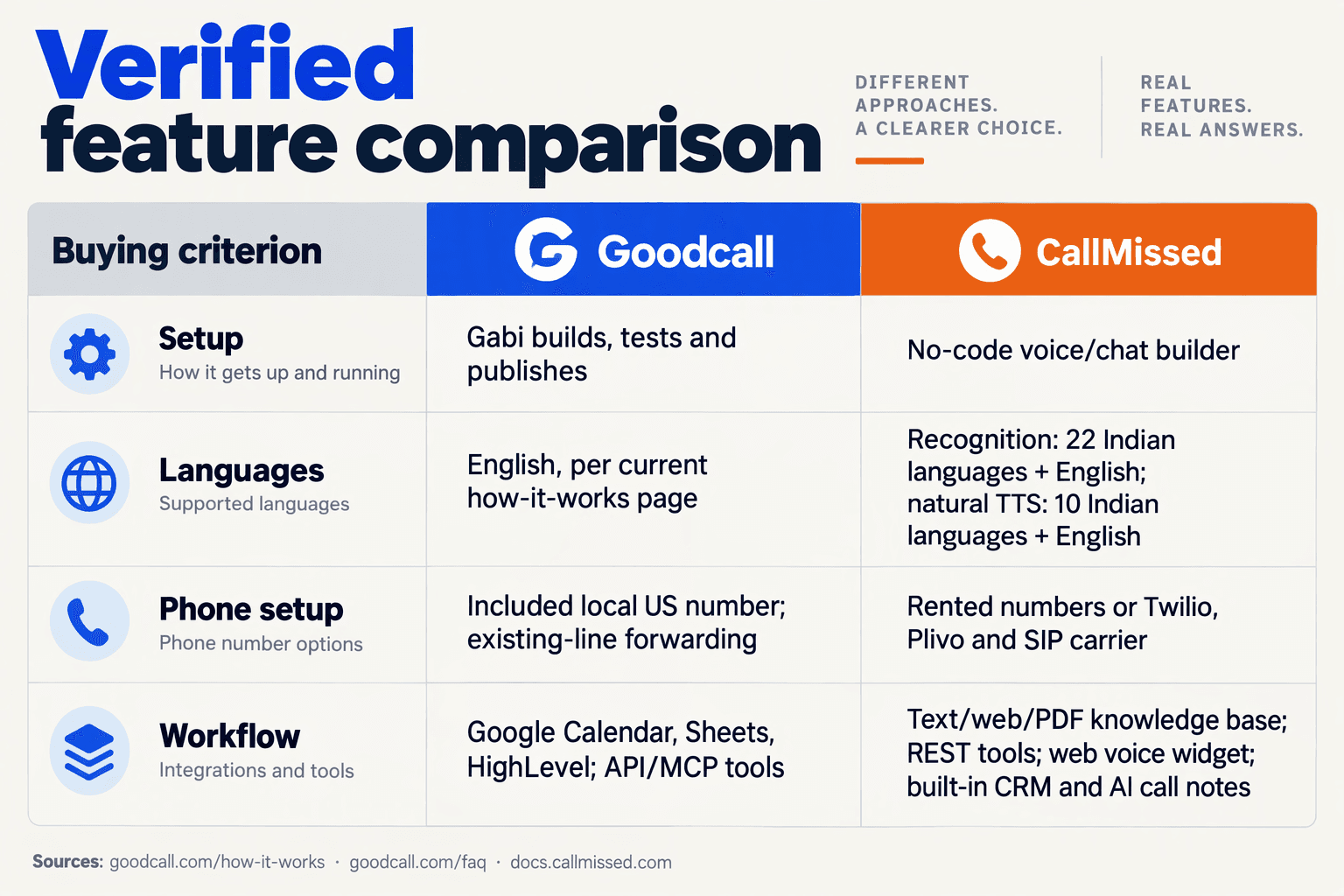
Setup and integration fit depend on how you configure the agent, connect business systems and validate real calls—not just whether a demo sounds convincing. As of November 11, 2026, the supplied sources document both platforms’ configuration options, but do not establish Goodcall’s language coverage.
- Goodcall: Goodcall’s pricing page, reviewed November 11, 2026, says you can build and test a free demo agent, paying when you connect a number. Use that stage to test your actual booking questions, transfer instructions and business terminology.
- CallMissed: According to its verified November 2026 fact sheet, the no-code builder includes prompts, voices, languages, knowledge bases, tools and call settings, with versioning, publishing and rollback. That makes configuration changes reversible rather than requiring you to recreate an agent.
- Goodcall: Goodcall’s pricing page describes “agent-powered edits”: explain a change in plain English and Gabi rewrites the agent. As reviewed November 11, 2026, these edits are unlimited on every plan; automated test-run allowances are separate.
What setup, language and integration features are documented?
The table reflects Goodcall’s supplied pricing page and CallMissed’s verified fact sheet as of November 11, 2026. “Not established” means the supplied evidence does not answer the question—not that a feature is unavailable.
| Buying criterion | Goodcall | CallMissed |
|---|---|---|
| Agent setup | Free demo agent; plain-English edits through Gabi | No-code builder; publish and rollback |
| Pre-launch testing | About 100 / 500 / 2,000 test runs on Starter / Growth / Scale | Eval suites and A/B experiments |
| Speech recognition | Language coverage not established by supplied source | 22 Indian languages plus English; includes Hinglish |
| Text-to-speech | Voice-language coverage not established by supplied source | Natural voices in 10 Indian languages plus English; additional languages through other models |
| Existing phone service | Included local number or forwarding from an existing number | Rented numbers or bring Twilio, Plivo or any SIP trunk |
| Connected systems | 1 / 5 / 15 external tools on Starter / Growth / Scale; APIs, MCP servers and code blocks count | Shopify, WooCommerce, HubSpot, Cal.com, Google Calendar, Gmail, REST tools and MCP servers |
What should you test before choosing an AI phone agent?
- Language validation: Recognition and voice generation are different capabilities. Test the same regional-language enquiry, English address and code-mixed conversation on both shortlisted agents; check the transcript and spoken reply separately, rather than treating a language count as proof of accuracy.
- Integration planning: List every required connection before selecting a plan. Under Goodcall’s documented counting rule, each connected API, MCP server or custom code block counts once, regardless of how many workers use it; transfers and hang-ups do not count.
- Workflow acceptance: Run one complete booking scenario: identify the caller, retrieve relevant information, check availability, create the appointment and transfer an exception. Verify permissions, field mapping and failure handling in your own systems; a listed integration alone does not prove your specific workflow is ready.
How do Goodcall and CallMissed charge?
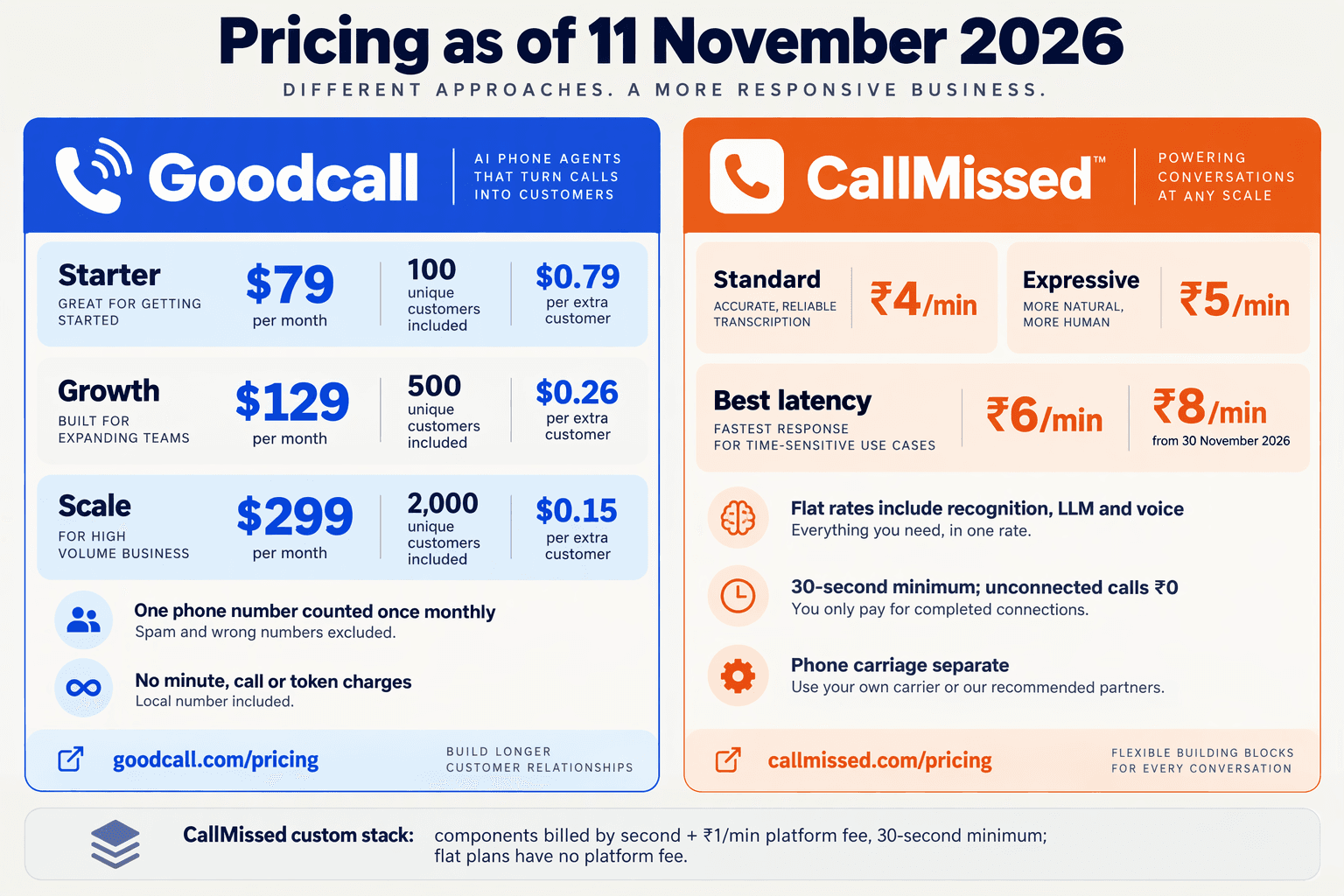
Goodcall charges by unique customers; CallMissed charges for AI voice-agent usage by time, with phone carriage separate. Compare the total bill at your expected caller count and conversation length—not just the advertised starting price.
- Billing basis: Goodcall’s pricing page, reviewed November 11, 2026, states “We never meter minutes”; one phone number counts once monthly, while spam and wrong numbers are excluded.
- Comparison boundary: The November 2026 options below are billing choices, not equivalent feature bundles; Goodcall subscriptions and minute-priced voice tiers serve different budgeting purposes.
| Provider | Option | Price as of November 11, 2026 | Billing boundary |
|---|---|---|---|
| Goodcall | Starter | $79/month | 100 unique customers; $0.79 per additional customer |
| Goodcall | Growth | $129/month | 500 unique customers; $0.26 per additional customer |
| Goodcall | Scale | $299/month | 2,000 unique customers; $0.15 per additional customer |
| Goodcall | Enterprise | Contact sales | Volume pricing, onboarding and an SLA |
| CallMissed | Standard voice | ₹4/minute | Speech recognition, language model and voice included |
| CallMissed | Expressive voice | ₹5/minute | Richer, more expressive Indian- and world-language voices |
| CallMissed | Best latency voice | ₹6/minute currently | ₹8/minute for calls starting on or after November 30, 2026 |
| CallMissed | Custom voice stack | Components billed per second, plus ₹1/minute platform fee | Components have no minimum; platform fee has a 30-second minimum |
When does upgrading Goodcall become cheaper?
- Starter → Growth: Using Goodcall’s November 11, 2026 published rates, 164 unique customers cost $129.56 on Starter versus $129 on Growth; at 163 customers, Starter remains cheaper at $128.77.
- Growth → Scale: Using the same published rates, 1,154 unique customers cost $299.04 on Growth versus $299 on Scale; at 1,153 customers, Growth costs $298.78. These are customer-charge comparisons, before considering differences in team, tool or testing allowances.
What would a realistic monthly bill look like?
- Worked example: At 600 unique customers, Goodcall Growth costs $155: $129 + (100 × $0.26), using its November 2026 pricing. Assuming each customer makes exactly one connected two-minute call, CallMissed Standard usage costs ₹4,800: 600 × 2 × ₹4; four-minute calls raise that usage charge to ₹9,600, before separate phone carriage.
- Budget checks: As of November 2026, Goodcall includes a local number and offers test-usage top-ups in $5 increments; CallMissed flat voice plans have a 30-second minimum, charge nothing for calls that never connect, and do not incur the custom-stack ₹1/minute platform fee.
For a useful quote comparison, supply three inputs: monthly unique phone numbers, connected calls and average connected-call duration. Repeat callers affect those inputs differently, so a customer allowance cannot be converted into minutes without assumptions.
Keep the example’s dollar and rupee totals separate until you choose an exchange rate, and add applicable account-plan costs, phone carriage and taxes before treating either figure as a complete monthly budget.
What would the same hypothetical workload cost?
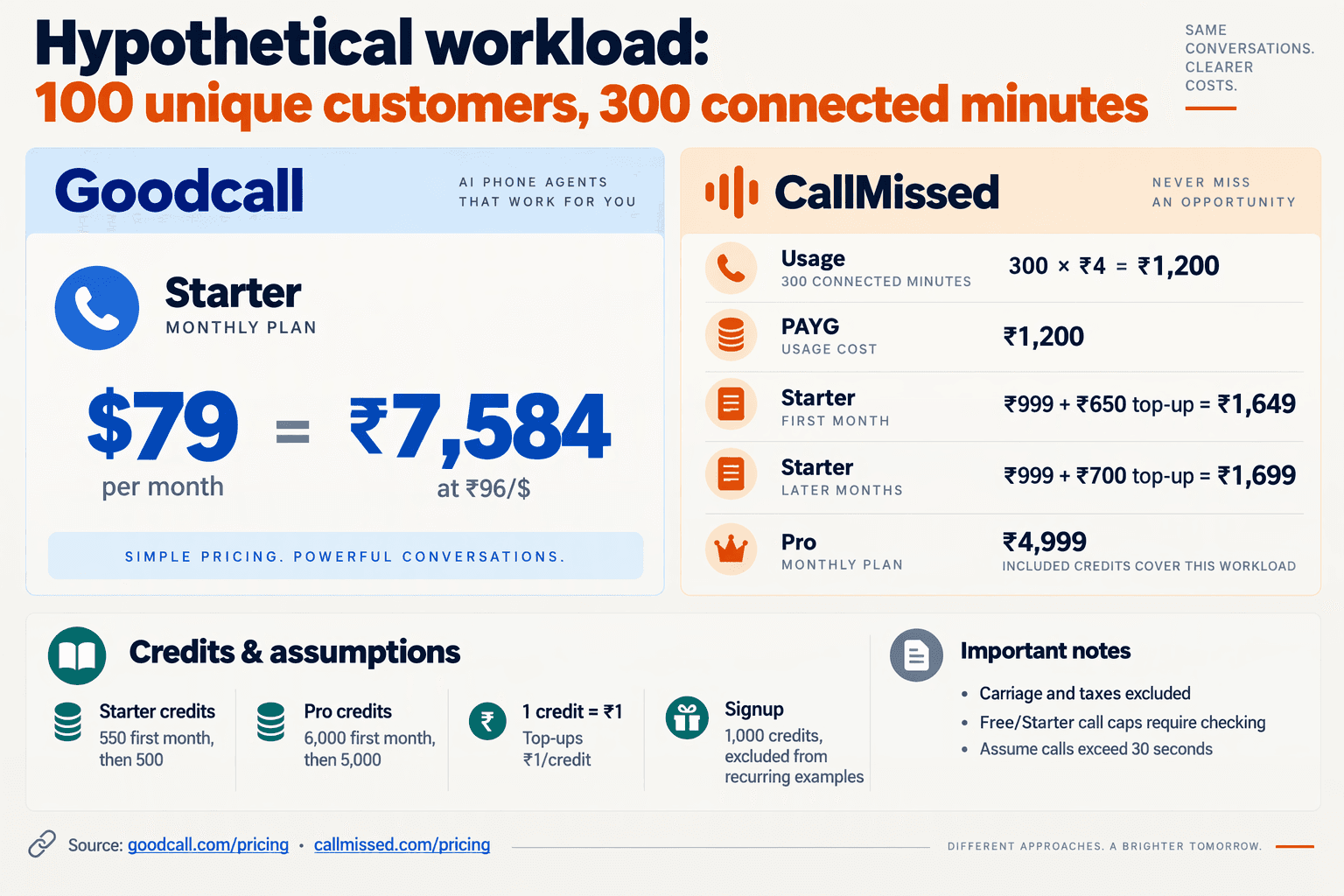
The same workload can favour either billing model: short calls reduce CallMissed’s metered cost, while longer conversations leave Goodcall’s customer-based charge unchanged. These hypothetical estimates use pricing available on November 11, 2026, not measured customer results.
What assumptions make the cost comparison fair?
- Workload: Each row assumes 1.5 connected calls per unique customer, with every call lasting the stated average duration; these are modelling assumptions, not usage benchmarks.
- Goodcall: Goodcall’s pricing page, reviewed November 11, 2026, lists Starter at $79/100 customers, Growth at $129/500, and Scale at $299/2,000; the table selects the cheapest published plan for each row.
- CallMissed: As of November 2026, Standard costs ₹4/minute, including speech recognition, the language model and voice, with a 30-second minimum per connected call; the table calculates usage charges before phone carriage.
- Currency: Dollar equivalents use CallMissed’s November 2026 fact-sheet conversion of $1 = ₹96 for illustration, not a live foreign-exchange quote; taxes, forwarding costs and optional purchases are excluded.
How much would six example workloads cost?
| Customers / calls | Average call | Billed minutes | Goodcall monthly | CallMissed Standard usage |
|---|---|---|---|---|
| 100 / 150 | 0.5 min | 75 | $79 — Starter | ₹300 ≈ $3.13 |
| 100 / 150 | 4 min | 600 | $79 — Starter | ₹2,400 ≈ $25 |
| 500 / 750 | 2 min | 1,500 | $129 — Growth | ₹6,000 ≈ $62.50 |
| 500 / 750 | 6 min | 4,500 | $129 — Growth | ₹18,000 ≈ $187.50 |
| 2,000 / 3,000 | 2 min | 6,000 | $299 — Scale | ₹24,000 ≈ $250 |
| 2,500 / 3,750 | 2 min | 7,500 | $374 — Scale + overage | ₹30,000 ≈ $312.50 |
What could change the apparent winner?
- Goodcall overages: The final row adds 500 × $0.15 = $75 to Scale’s $299 subscription, using Goodcall’s published November 2026 rate. Enterprise pricing is quote-based and could change that result; no unpublished discount is assumed.
- Conversation length: At 500 customers and 750 calls, the illustrative usage-only crossover is 3,096 minutes, or about 4.13 minutes per call: $129 × ₹96 ÷ ₹4. CallMissed phone carriage would move that crossover lower, so it is not an all-in break-even figure.
- Minimums and repeat callers: Under CallMissed’s November 2026 terms, 150 connected ten-second calls would still incur 75 billable minutes, costing ₹300 before carriage. Goodcall’s pricing page counts one phone number once monthly and excludes spam and wrong numbers, so reconcile billable customers separately from raw call logs.
- Budget completeness: Goodcall’s November 2026 pricing includes a local number; CallMissed bills phone carriage separately. Before adopting a table row as your budget, confirm carrier charges, account funding and capacity: CallMissed’s Free and Starter tiers have monthly call caps, while Pro and above are limited by requests per minute.
Compare your own customer count and duration distribution—not just total calls. The table shows why a short-enquiry business and a long-booking business can reach different purchasing decisions even with identical caller volumes.
What are the practical pros and cons?
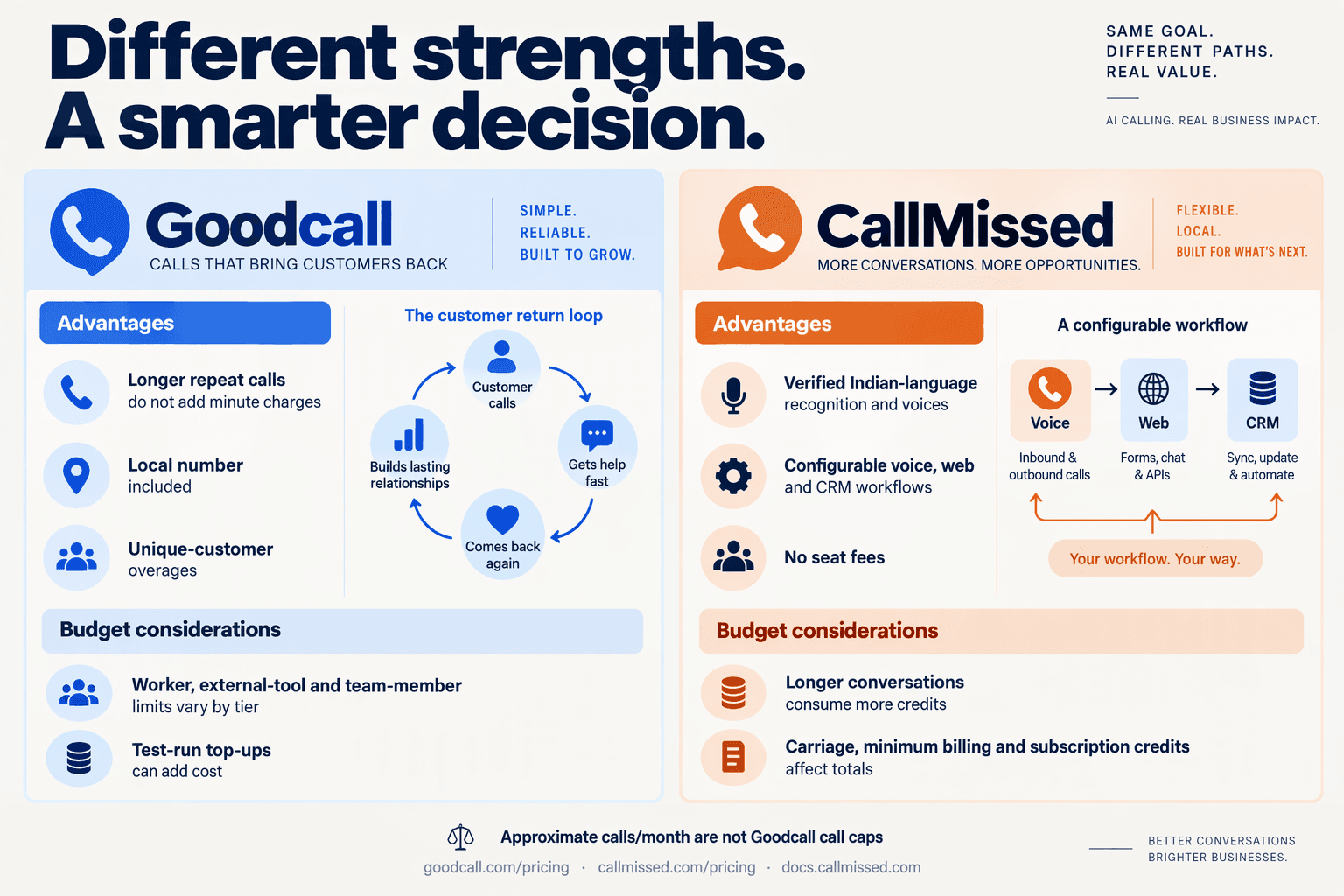
Goodcall offers clearly published allowances for tools, testing and team access; CallMissed offers configurable call handling and supervision features. The practical trade-off is between fitting your workflow into published plan limits and managing the configuration and usage costs of a broader communication stack.
What operational advantages and limitations should buyers compare?
The product details below reflect November 11, 2026, using Goodcall’s pricing page and CallMissed’s verified product fact sheet; unpublished limits should be confirmed before purchase.
| Buying factor | Goodcall: advantage | CallMissed: advantage | Practical limitation or check |
|---|---|---|---|
| Connected tools | Starter includes 1 external tool, Growth 5, and Scale 15. | Supports custom REST tools, MCP servers by URL, and integrations including Shopify and HubSpot. | Goodcall counts an API, MCP server or custom code block as a tool; confirm required integrations before choosing a tier. |
| Specialist workflows | Starter includes 5 workers, Growth 10, and Scale 20; operator and greeter do not count. | Squads can hand a live call from one agent to another. | Worker counts and live-agent handoffs are different capabilities; demonstrate your complete workflow rather than comparing labels. |
| Human supervision | Published plans include 1, 5 or 10 team members, respectively. | Supervisors can listen, whisper or barge into live calls. | Confirm who needs account access, who receives transfers, and who needs live supervision. |
| Call review | Starter retains 30 days of call history; Growth 90 days; Scale offers unlimited history. | Provides recordings, transcripts, AI call notes and scoring against your own QA rubrics. | CallMissed’s supplied fact sheet does not specify retention periods; verify storage and deletion requirements. |
| Testing | Approximately 100, 500 or 2,000 test runs, depending on plan; top-ups start at $5. | Supports evaluation suites, A/B experiments and versioning with publish and rollback. | Confirm testing charges and allowances; a test-run count alone does not establish evaluation quality. |
| Phone setup | Every plan includes a local number; existing numbers can forward calls. | Offers rented numbers or bring-your-own carrier through Twilio, Plivo or any SIP trunk. | Forwarding and carrier integration require different setup; CallMissed bills phone carriage separately. |
How should you turn these pros and cons into a buying test?
- Goodcall: Its pricing page defines an external tool as an API, MCP server or custom code block; inventory connections before assuming Starter’s single tool is sufficient.
- Goodcall: “Unlimited” plain-English agent-powered edits are included on every plan, according to its November 2026 pricing page; test whether a nontechnical manager can safely update booking rules.
- CallMissed: Publish-and-rollback versioning, custom QA rubrics and live supervision are relevant strengths when operational control matters; test them with a deliberately incorrect booking scenario.
- Access: Map receptionists, managers and administrators separately; Goodcall’s published 1/5/10-member allowances may affect tier selection even when caller volume is low.
- Evidence: Use the same five scenarios in both demonstrations: booking, cancellation, repeat caller, unavailable appointment and human transfer; record completion and correction needs.
- Procurement: Request written answers on retention, testing costs, carrier charges and permissions; missing details are verification tasks, not evidence that either platform lacks a capability.
Which should you choose after a practical evaluation?
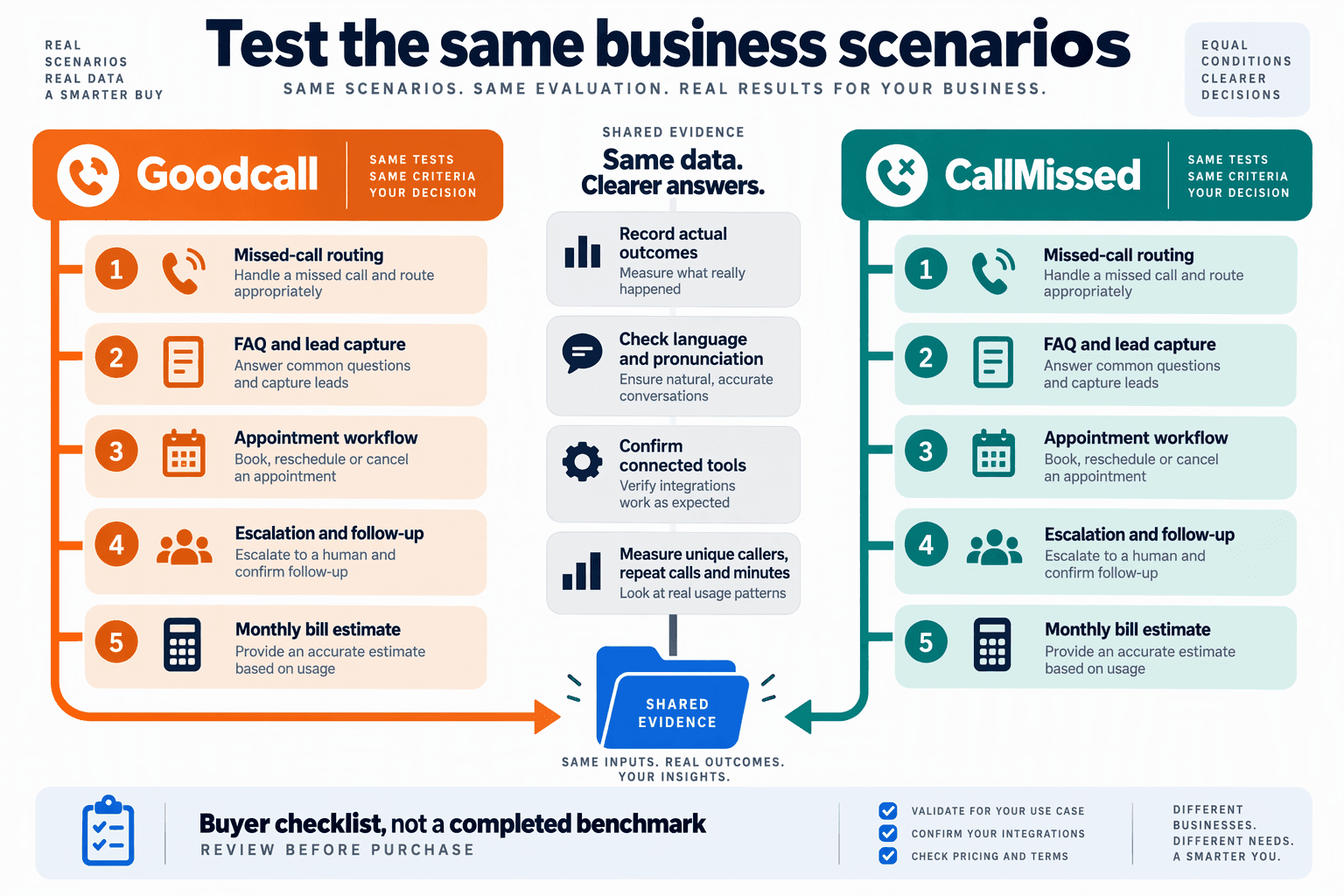
Choose the platform that completes your real calls reliably and produces the more suitable bill—not the one that performs best in a scripted demo.
How should you turn a trial into a buying decision?
- Evaluation scorecard: Run the same 20 scenarios on both platforms: five bookings, five changes or cancellations, five information requests and five exceptions requiring human help. This is a suggested evaluation set, not a vendor benchmark. Record task completion, incorrect commitments, transfer outcomes and required corrections; weight costly mistakes more heavily than polished greetings.
- Goodcall: Test before connecting your number. According to Goodcall’s pricing page, reviewed November 11, 2026, its free demo agent can be built and tested before payment, with payment starting when a number is connected. Include your hardest workflow in that demo rather than assuming a successful greeting proves booking or escalation readiness.
- CallMissed: As of November 2026, its no-code agent builder includes versioning with publish and rollback, while eval suites and A/B experiments support structured testing. Use those capabilities to compare two prompts against the same scenarios, then retain the version with fewer operational errors—not simply the more conversational voice.
- Cost replay: Apply each billing model to one representative month of actual traffic. For example, 600 unique customers would cost $155 on Goodcall Growth, calculated from its November 11, 2026 published price: $129 plus 100 × $0.26. Separately total connected minutes, applicable minimums and phone carriage for the metered option; compare equivalent currencies.
- Integration acceptance: Complete an end-to-end transaction, not just a connection test: find availability, create a booking, change it and verify the destination record. According to Goodcall’s pricing page on November 11, 2026, Growth permits five external tools, counting APIs, MCP servers and custom code blocks. Inventory your required connections before selecting that tier.
- Language acceptance: Test 10 representative utterances per required language, including names, addresses, dates and code-switching. Measure recognition and spoken-response quality separately; language coverage alone does not establish either. Have a fluent reviewer check whether the agent preserves the customer’s intent and confirms critical details without switching to an unsuitable language.
- Operating ownership: Assign one business owner and one backup before launch, then rehearse changing opening hours, correcting an answer and reviewing a disputed call. Goodcall’s pricing page, reviewed November 11, 2026, lists five team members and 90-day call history on Growth. Check whether your staffing and review cycle fit those allowances.
- Final decision: Require zero incorrect bookings or unauthorized commitments in the acceptance set; treat this as your proposed launch gate, not a promised vendor result. Choose only after workflow accuracy, access requirements and the cost replay pass. Start with a limited call scope and expand after reviewing failures from real conversations.
Frequently Asked Questions
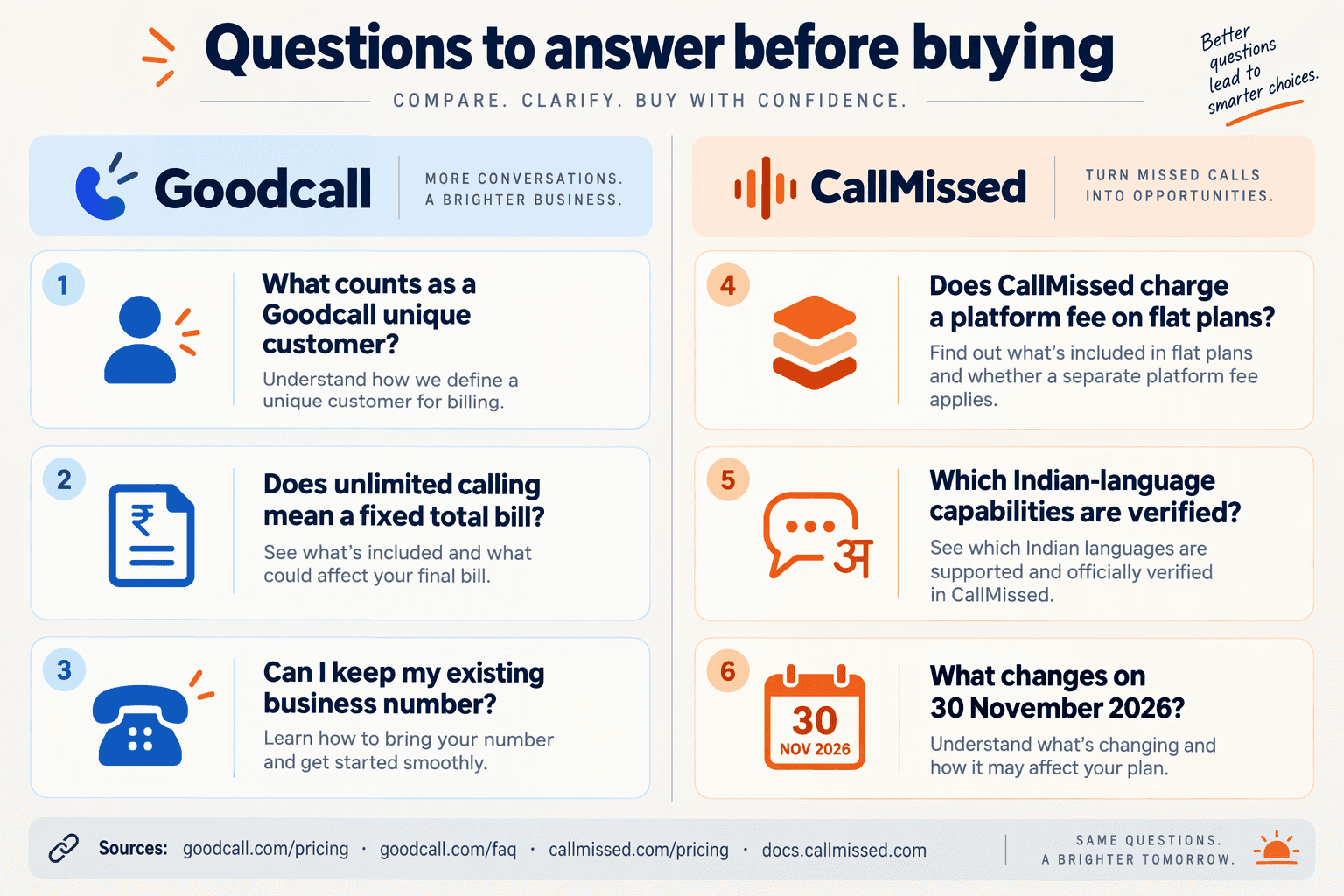
- Q: Goodcall vs CallMissed: how do billing overages work?
A: According to Goodcall’s pricing page, reviewed November 11, 2026, additional unique customers cost $0.79 on Starter, $0.26 on Growth and $0.15 on Scale; repeat calls from the same number do not add another customer that month. For example, 120 qualifying unique customers on Starter produce a $94.80 monthly bill: $79 plus $15.80 in overages. The alternative minute-based model makes conversation duration, rather than distinct caller count, central to your estimate.
- Q: Can I keep my existing business phone number with either AI phone agent?
A: Goodcall’s pricing page, reviewed November 11, 2026, says every plan includes a local number and businesses can retain an existing number by forwarding calls. The alternative platform’s verified November 2026 specifications support rented numbers or bringing Twilio, Plivo or any SIP trunk. Forwarding and bringing your own carrier are different arrangements, so confirm routing, transfer behaviour and carrier charges before changing your live business line.
- Q: Goodcall vs CallMissed: which supports Indian languages and Hinglish?
A: As of November 2026, CallMissed’s verified specifications list speech recognition in 22 Indian languages plus English, including code-mixed speech such as Hinglish, and natural text-to-speech voices in 10 Indian languages plus English. Recognition coverage does not mean every language has the same voice options. The supplied Goodcall pricing page does not establish language coverage, so request demonstrations in your customers’ languages rather than interpreting missing information as lack of support.
- Q: Are phone charges and short calls included in AI voice-agent pricing?
A: As of November 2026, the verified flat-rate voice plans cover speech recognition, the language model and voice, but phone carriage is separate and connected calls have a 30-second minimum. A call that never connects costs nothing, while custom-stack billing adds a ₹1-per-minute platform fee with its own 30-second minimum; flat plans do not pay that fee. Goodcall’s reviewed pricing page states that minutes, calls and tokens are not metered, and a local number is included.
- Q: Can I test an AI phone agent before paying for live calls?
A: According to Goodcall’s pricing page, reviewed November 11, 2026, businesses can build and test a free demo agent, paying when they connect a number. The alternative platform’s verified November 2026 offer provides 1,000 signup credits, with credits that never expire. These are different trial arrangements, so test booking accuracy, caller interruptions and human transfers while checking which activities consume credits or test allowances.
- Q: Will AI phone-agent prices change after November 2026?
A: The verified pricing schedule available on November 11, 2026, lists the Best latency voice plan at ₹6 per minute, rising to ₹8 per minute for calls starting on or after November 30, 2026. That is a 33.3% increase for that specific plan, not a stated increase across all voice plans. Budget using the call’s start date, and recheck published prices before committing to a deployment that crosses the changeover.
Conclusion
Choose the billing model that matches your callers—not simply the lowest advertised price. As of November 11, 2026, Goodcall’s customer-based pricing and CallMissed’s minute-based voice-agent pricing reward different usage patterns, so neither is automatically cheaper for every business.
The practical takeaway is to compare your actual phone traffic, operating requirements and language needs before committing:
- Separate unique customers from conversation time. According to Goodcall’s pricing page, reviewed on November 11, 2026, Starter costs $79 monthly for 100 unique customers, Growth costs $129 for 500, and Scale costs $299 for 2,000. Goodcall counts one phone number once per month, regardless of repeat calls, and excludes spam and wrong numbers. That structure deserves consideration when customers call repeatedly or conversations run long. Businesses receiving many short enquiries from different callers should calculate how quickly they would exhaust the allowance instead.
- Compare the complete bill, including overages and carriage. According to Goodcall’s pricing page, reviewed on November 11, 2026, additional unique customers cost $0.79 on Starter, $0.26 on Growth and $0.15 on Scale, with a local number included. According to CallMissed’s verified product fact sheet, as of November 2026, its Standard voice-agent plan costs ₹4 per minute, including speech recognition, the language model and voice, with a 30-second minimum per call and separate phone carriage charges. Compare these structures using the same representative month rather than treating dollars per customer and rupees per minute as directly interchangeable.
- Check workflow fit alongside pricing. According to Goodcall’s pricing page, reviewed on November 11, 2026, Starter includes one external tool and one team member, while Growth includes five of each. Connected-tool allowances, team access and call-history requirements can therefore influence the appropriate plan even before customer volume does. Test the booking, transfer and everyday call-handling scenarios your business actually depends on; a lower subscription is not useful if the selected plan does not accommodate the required workflow.
- Validate language requirements with real conversations. Recognition coverage matters when callers use regional languages or mix languages during an enquiry. Test the accents, vocabulary and code-mixed speech your customers commonly use, alongside the agent’s ability to complete the task. Treat language fit as an operating requirement, not a feature-box shortcut.
What should buyers watch next?
As AI phone agents evolve, watch for changes to pricing, allowances and language coverage, then reassess against your own caller mix. A plan that fits today may need revisiting as repeat bookings, new enquiries or conversation lengths change.
Explore CallMissed alongside Goodcall using representative calls and a complete cost estimate. Which platform fits the conversations your business expects next—not just the calls it receives today?