GPT-4o API pricing 2026: Compare Compatible API Costs


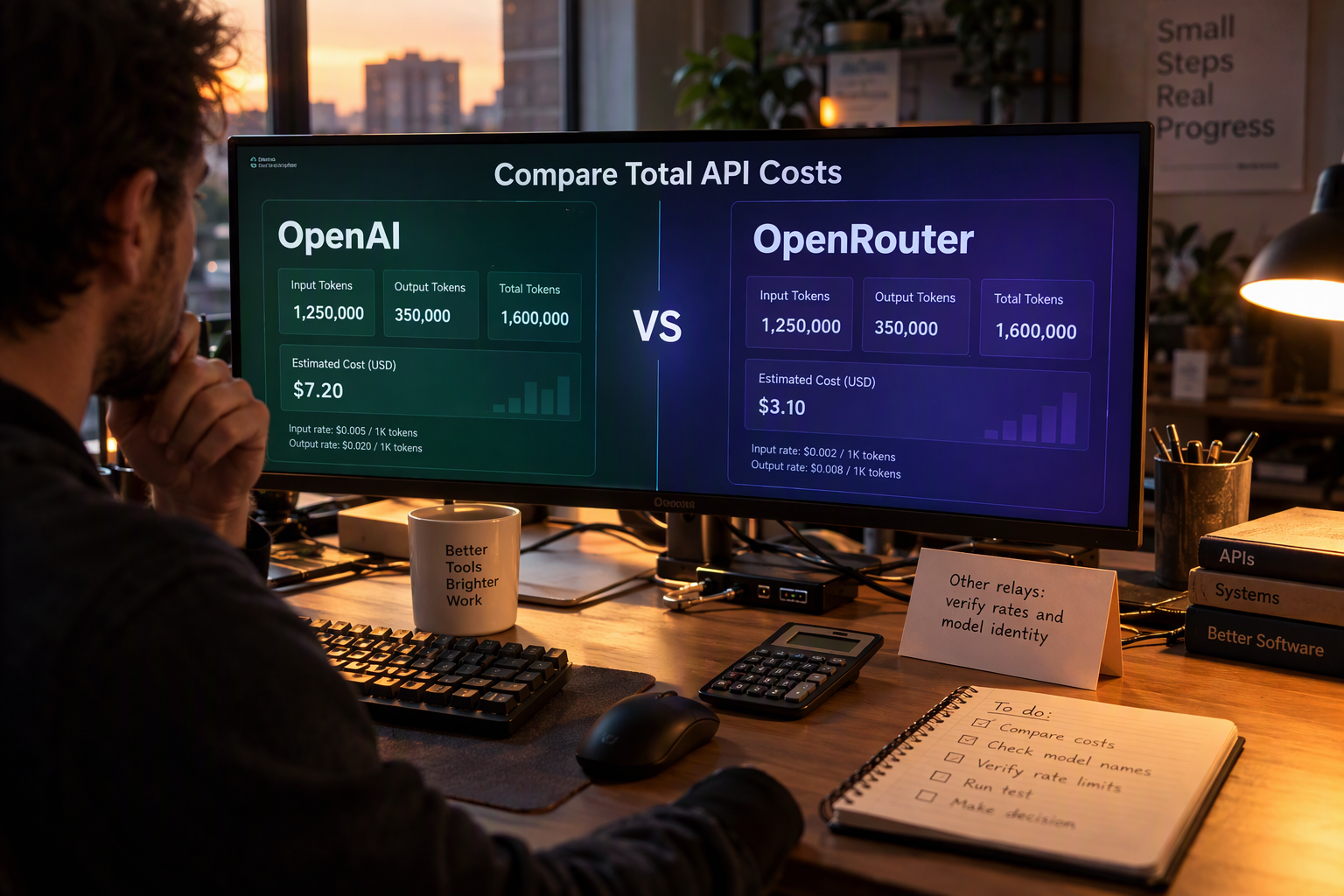
Compare GPT-4o API pricing across compatible providers, calculate workload costs, and check model identity and fees before choosing an API.
GPT-4o API pricing 2026: Compare Compatible API Costs
The cheapest OpenAI-compatible API for GPT-4o access cannot be identified from headline token prices alone. The available GPT-4o API pricing comparisons show matching base rates for OpenAI and OpenRouter, while discount claims need verification against fees, model versions, and your actual input-to-output ratio.
CostBench’s comparison, last verified on July 30, 2026, lists GPT-4o at $2.50 per million input tokens and $10 per million output tokens through both OpenRouter and OpenAI directly. That makes output tokens four times as expensive as input tokens at those listed rates—a meaningful difference for applications generating long answers, support summaries, or code. A provider advertising cheap input can still produce a larger bill if its output pricing is less competitive.
The comparison matters in October 2026 because the supplied sources do not tell a completely consistent pricing story. PromptCost.org’s 2026 guide describes a 1% OpenRouter markup, while CostBench describes passthrough rates plus a platform markup. Neither excerpt establishes the complete checkout cost for every payment method or account arrangement. Meanwhile, Crazyrouter’s GPT-4o page advertises “Save 45%,” but the supplied excerpt does not establish the conditions behind that claim. Treat that percentage as a comparison lead—not a verified saving for your workload.
How should you compare GPT-4o API costs?
Start with a representative workload rather than a provider’s lowest advertised number. Using CostBench’s July 30, 2026 listed rates, one million input tokens plus one million output tokens costs $12.50 before additional fees. A workload with four million input tokens and one million output tokens costs $20 on the same basis. These examples show why “cost per million tokens” is incomplete unless the comparison separates both directions.
This guide will help you evaluate:
- Input and output pricing: Calculate both using your application’s token mix.
- Additional charges: Check platform fees, payment charges, currency conversion, and taxes where applicable.
- Model identity: Confirm that the endpoint serves the GPT-4o version you intend to use, rather than assuming API compatibility guarantees identical model access.
- Operational fit: Compare rate limits, fallback behavior, and integration requirements alongside price.
As of October 2026, CallMissed offers OpenAI-compatible endpoints, caller-chosen fallback models, and usage and request logs—capabilities relevant to evaluating multi-model infrastructure, although its supplied fact sheet does not establish a GPT-4o-specific price.
The goal is a decision-ready comparison, not an unsupported cheapest-provider badge. You will learn which quoted prices are comparable, where advertised savings require further checks, and how to estimate a realistic bill before moving an existing integration. Choose the lowest verified total cost for the GPT-4o access you actually need—not simply the smallest number on a pricing page.
Which OpenAI-compatible API is cheapest for GPT-4o access?
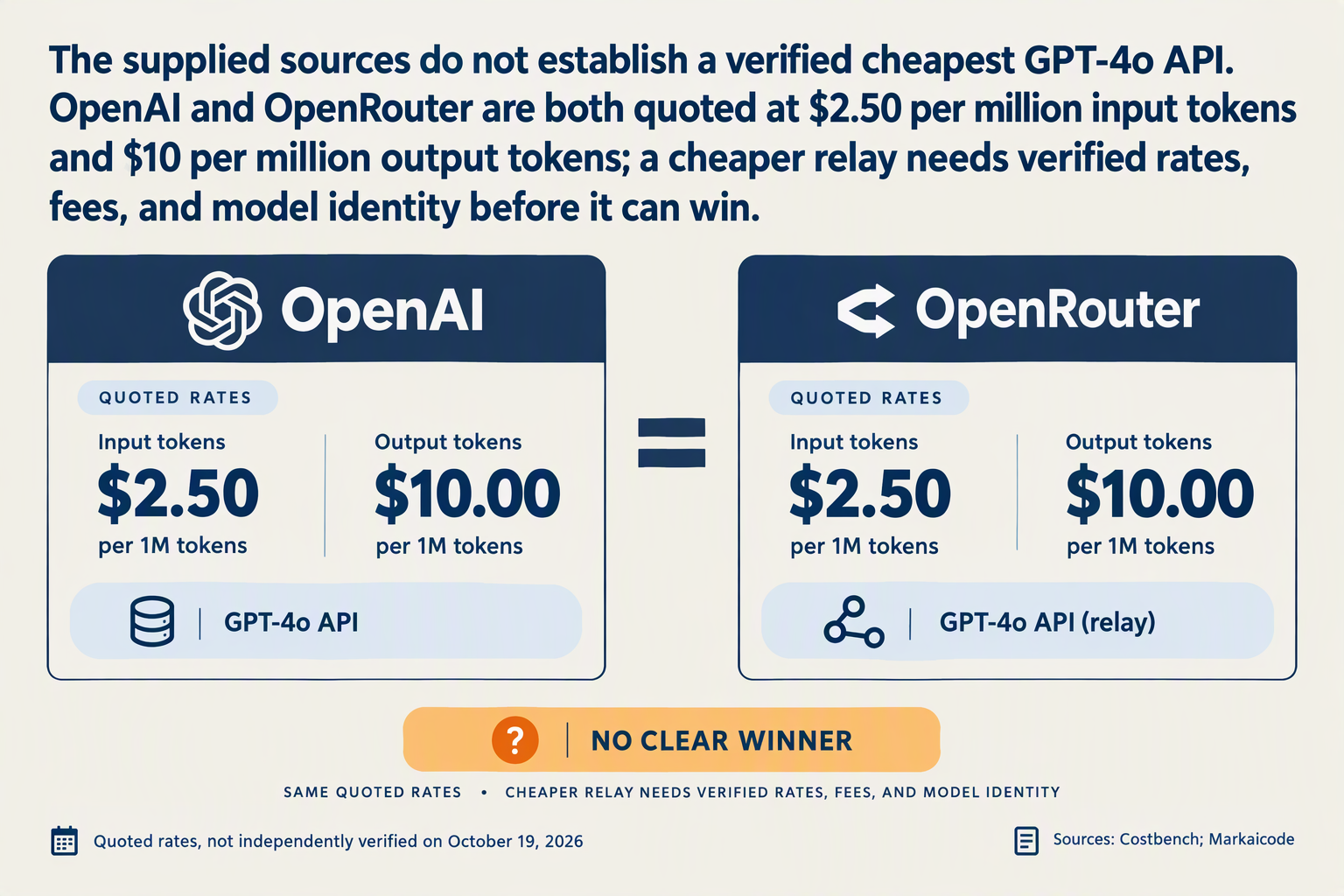
No provider is established as the cheapest OpenAI-compatible API for GPT-4o access by the supplied evidence as of October 2026. OpenAI is the direct-price benchmark; OpenRouter’s fees and Crazyrouter’s discount conditions need checking before either earns a lowest-cost recommendation.
Which providers belong on the GPT-4o pricing shortlist?
- OpenAI: CostBench’s comparison, verified July 30, 2026, lists direct GPT-4o access at $2.50 per million input tokens and $10 per million output tokens. Use this as the baseline quote—not a guarantee of today’s checkout price—and compare the same model version, token mix, currency, and tax treatment across alternatives.
- OpenRouter: Markaicode’s 2026 pricing breakdown corroborates matching OpenAI and OpenRouter GPT-4o token rates, while PromptCost.org’s 2026 guide describes a 1% markup. Matching token prices therefore do not establish matching total costs. Ask whether any platform charge applies to token usage, credit purchases, or another billing amount before calculating savings.
- Crazyrouter: Crazyrouter’s GPT-4o page advertises “Save 45%” in the context supplied for this October 2026 comparison, but the excerpt provides no separate input/output rates or qualifying conditions. Keep Crazyrouter on the quote-request shortlist; do not convert that headline into a verified per-token price or an unconditional cheapest-provider recommendation.
- CallMissed: As of October 2026, CallMissed’s verified fact sheet lists 124 models, OpenAI-compatible endpoints, and usage and request logs. Those are useful strengths for developers evaluating a multi-model gateway, but the sheet establishes neither GPT-4o-specific availability nor pricing. Request both explicitly before including CallMissed in a GPT-4o cost ranking.
What would make one GPT-4o API genuinely cheaper?
- A workload-specific quote: For October 2026 evaluation, consider 2 million input tokens and 500,000 output tokens: CostBench’s July 30 rates produce a $10 baseline before additional charges. This input-heavy example gives providers a concrete workload to price, rather than letting an attractive input rate conceal expensive generated answers.
- A clearly defined fee: If PromptCost.org’s 2026 reported 1% OpenRouter markup applied to that entire $10 token bill, the illustrative total would be $10.10 before other charges. This is conditional arithmetic, not a verified invoice; the supplied excerpts do not establish the markup’s application or complete payment costs.
- Equivalent model access: As of October 2026, require each quote to identify the requested GPT-4o model ID, whether requests can fall back to another model, and how fallback usage is billed. OpenAI compatibility describes an integration interface; it does not, by itself, prove identical model delivery or equivalent pricing.
- A reproducible buying decision: For an October 2026 purchase, compare a small, identical request set against each shortlisted endpoint and retain the usage records. Choose the lowest documented total for successful, equivalent GPT-4o requests; label any provider with missing rates or unexplained discounts “not yet rankable,” rather than assuming it is cheaper.
Which providers support the GPT-4o features your application needs?
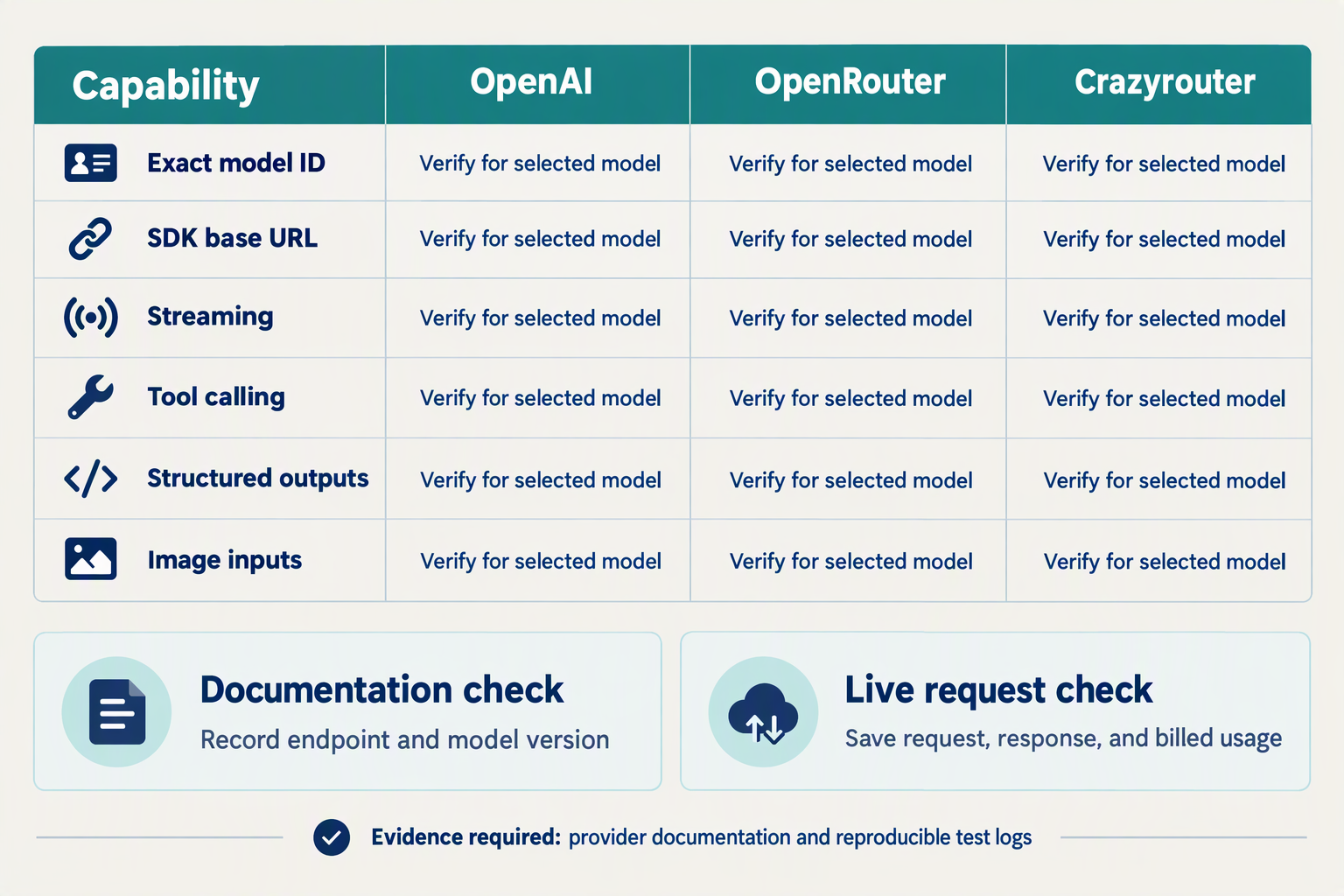
OpenAI compatibility does not guarantee identical GPT-4o features, model versions, or availability. As of October 2026, the supplied sources support a pricing comparison more clearly than a feature-parity comparison; distinguish documented capabilities from features you still need to test.
| Provider | GPT-4o evidence | API compatibility evidence | Feature evidence supplied | Before choosing |
|---|---|---|---|---|
| OpenAI | Direct access listed by CostBench, July 30, 2026 | Native OpenAI API | No detailed feature matrix in excerpts | Verify snapshot availability |
| OpenRouter | Access listed by CostBench, July 30, 2026 | Aggregation described; endpoint details absent | No GPT-4o-specific feature matrix | Test required parameters |
| Crazyrouter | GPT-4o model page in supplied results | Not established by excerpt | No verified feature specifications | Confirm model identity and support |
| CallMissed | GPT-4o availability not established by fact sheet | OpenAI-compatible endpoints | Streaming, function calling, structured outputs, vision input | Confirm GPT-4o access and model-specific support |
Which GPT-4o features should you verify before switching APIs?
- Model identity: Request the exact model identifier your application uses, then inspect the returned identifier and provider documentation. An accepted
modelparameter alone does not establish that the requested snapshot is being served; record this check alongside your October 2026 comparison.
- Streaming: Test incremental responses with your existing SDK, including cancellation, interrupted connections, and final usage reporting. A streaming chatbot should not be evaluated only through non-streaming requests: passing a basic completion test leaves its actual delivery path untested.
- Function calling: Run a representative tool workflow with required arguments, optional fields, and error recovery. Check whether tool selections and arguments reach your application correctly, rather than treating a successful HTTP response as evidence that an agent integration works.
- Structured outputs and vision: Validate JSON against your actual schema and submit a representative image request. These are separate acceptance tests: a provider can expose compatible request shapes without the supplied evidence establishing support for every GPT-4o parameter.
- CallMissed: According to the CallMissed fact sheet, as of October 2026, its developer API supports 124 models, with default per-key limits of 60, 500, 3,000, and 10,000 requests per minute across Free, Starter, Pro, and Enterprise. Those are gateway capabilities—not proof of GPT-4o availability.
How should feature support affect the cheapest-provider decision?
- Evidence quality: CostBench’s comparison, verified July 30, 2026, establishes listed GPT-4o access through OpenAI and OpenRouter, not full feature parity. Crazyrouter’s “Save 45%” page title likewise does not establish streaming, tool support, or model-version guarantees.
- Availability: A October 15, 2026 LinkedIn post by Stanislav Sorokin reports a January 14, 2027 shutdown for named GPT-4o snapshots, attributing the announcement to OpenAI. Verify this against OpenAI’s official deprecations documentation before relying on that reported deadline.
- Purchase decision: Exclude endpoints that fail mandatory feature tests before comparing costs. For a support agent, for example, cheaper text generation is not an equivalent substitute if required tool calls or schema-constrained responses fail; test the complete workflow before migration.
What does GPT-4o cost for your input and output mix?
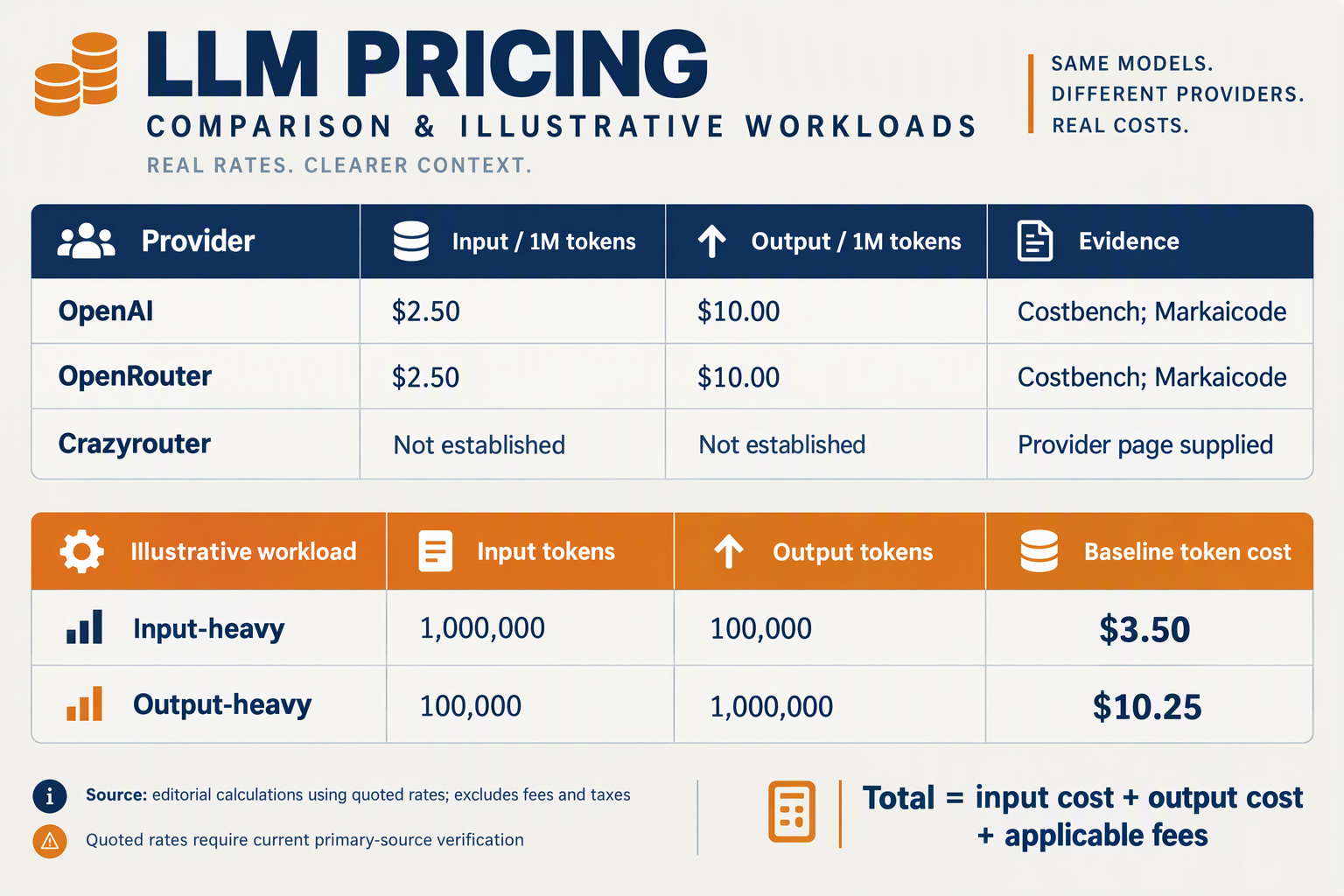
GPT-4o cost depends on the share of tokens your application generates, not just the total token count. For this October 2026 comparison, the table uses CostBench’s July 30, 2026 benchmark of $2.50 per million input tokens and $10 per million output tokens, before additional fees.
How much does one million combined GPT-4o tokens cost?
Each row holds total usage at one million tokens, making the effect of your input-to-output mix directly comparable. These are calculated workload estimates—not newly verified October 2026 provider quotes.
| Input/output mix | Input tokens | Output tokens | Base cost | Output share of bill |
|---|---|---|---|---|
| 95% / 5% | 950,000 | 50,000 | $2.875 | 17.4% |
| 90% / 10% | 900,000 | 100,000 | $3.25 | 30.8% |
| 80% / 20% | 800,000 | 200,000 | $4.00 | 50.0% |
| 70% / 30% | 700,000 | 300,000 | $4.75 | 63.2% |
| 50% / 50% | 500,000 | 500,000 | $6.25 | 80.0% |
| 20% / 80% | 200,000 | 800,000 | $8.50 | 94.1% |
How should you use your token mix to compare providers?
- Calculation: Using CostBench’s July 30, 2026 rates, calculate dollars as
(input tokens × 2.50 + output tokens × 10) ÷ 1,000,000. Count the complete submitted input, including system instructions, conversation history, and retrieved passages—not just the customer’s latest message.
- Request-level example: At those benchmark rates, a request containing 2,000 input tokens and 500 output tokens costs $0.01 before fees. Running that same request 1,000 times costs $10; this is a calculated estimate, not a measured application bill.
- Input-heavy workloads: At a 95% input / 5% output mix, input accounts for approximately 82.6% of base spending. Document classification or short-answer extraction can therefore benefit substantially from lower input pricing, provided actual token logs confirm that mix.
- Output-heavy workloads: At a 20% input / 80% output mix, output accounts for approximately 94.1% of base spending. For long-form generation, prioritize the quoted output rate: a low input price has limited influence on the final total.
- Discount sensitivity: At the table’s 80% / 20% mix, input and output each cost $2. A hypothetical 20% discount on either rate alone reduces the $4 bill to $3.60—a 10% overall saving, not 20%.
- OpenRouter fee scenario: PromptCost.org’s 2026 guide describes a 1% markup. If that percentage applies to the calculated $4 workload, the total becomes $4.04; confirm the fee basis before treating this illustration as an actual checkout price.
- CallMissed evaluation: As of October 2026, CallMissed’s verified fact sheet lists 60 requests per minute on Free and 500 on Starter. These limits help assess operational fit, but the sheet supplies no GPT-4o-specific rate, so CallMissed cannot receive a cost ranking here.
- Decision rule: Request separate input and output quotes for the exact GPT-4o model identifier, then apply your measured mix and applicable charges. Rank providers by that calculated total—not by the cheapest advertised input token.
Does a cheap relay actually deliver the GPT-4o version you requested?
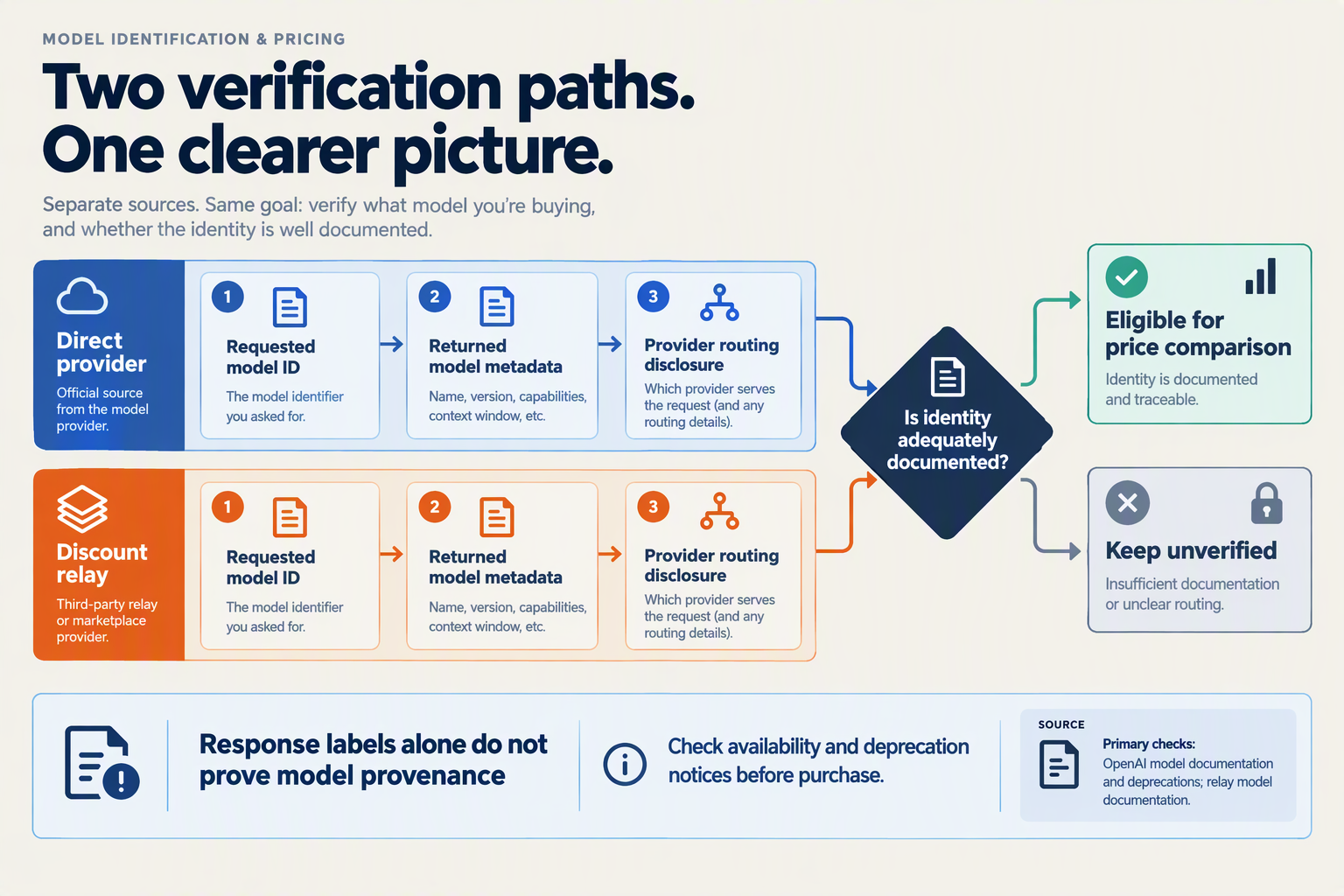
OpenAI compatibility does not prove that a relay delivers the GPT-4o snapshot you requested. For an October 2026 buying decision, require evidence of model identity, routing behavior, and continued availability before treating a discounted endpoint as equivalent access.
How can you verify a relay’s GPT-4o model identity?
- Exact model ID: Ask whether the endpoint accepts a dated identifier such as
gpt-4o-2024-08-06orgpt-4o-2024-11-20, rather than only thegpt-4oalias. Record the requested identifier and returnedmodelfield for every test. A matching response label is useful evidence, but not independent proof of the upstream model.
- Upstream evidence: Request documentation explaining which provider serves the request, whether aliases are remapped, and what happens when a snapshot becomes unavailable. Save the documentation with an October 2026 review date. If the relay cannot explain its mapping, classify version fidelity as unverified, not automatically fraudulent or equivalent to direct access.
- Controlled comparison: Run a proposed 30-prompt evaluation against the relay and your reference endpoint: 10 structured-output tasks, 10 tool-calling tasks, and 10 representative application questions. Keep prompts and supported generation settings consistent. This is a practical screening protocol—not a published benchmark—and differences alone cannot establish that substitution occurred.
- Failure behavior: Test an invalid model identifier and ask how unavailable models are handled. Your acceptance criterion should distinguish an explicit error from a documented fallback. A successful HTTP response proves that a request completed; it does not establish that the requested GPT-4o version produced the answer.
What evidence should affect your buying decision?
- Discount claims: Crazyrouter’s GPT-4o page advertises “Save 45%” in the supplied context reviewed for October 2026, but that excerpt does not establish snapshot identity or discount conditions. Ask for the exact model mapping and applicable rate before comparing savings; the advertised percentage cannot answer the version-fidelity question.
- Lifecycle checks: In an October 15, 2026 LinkedIn post, Stanislav Sorokin reported that OpenAI’s October 14 deprecations page scheduled several snapshots, including
gpt-4o-2024-08-06andgpt-4o-2024-11-20, for shutdown on January 14, 2027. This is a secondary report: verify OpenAI’s primary documentation before relying on that deadline or a relay’s availability promise.
- Routing controls: As of October 2026, CallMissed’s verified fact sheet lists caller-chosen fallback models and usage and request logs. Those capabilities are relevant to a routing audit, but the sheet does not establish GPT-4o snapshot availability. Ask separately which requested, routed, and returned model details are visible in the logs.
- Purchase threshold: Mark a relay verified for your use case only after documenting the accepted snapshot, mapping policy, fallback behavior, and evaluation results. If any item remains unresolved, label the offer “GPT-4o access—version unverified.” The cheapest OpenAI-compatible API is not a decision-ready choice when the product identity remains uncertain.
What are the advantages and trade-offs of each option?
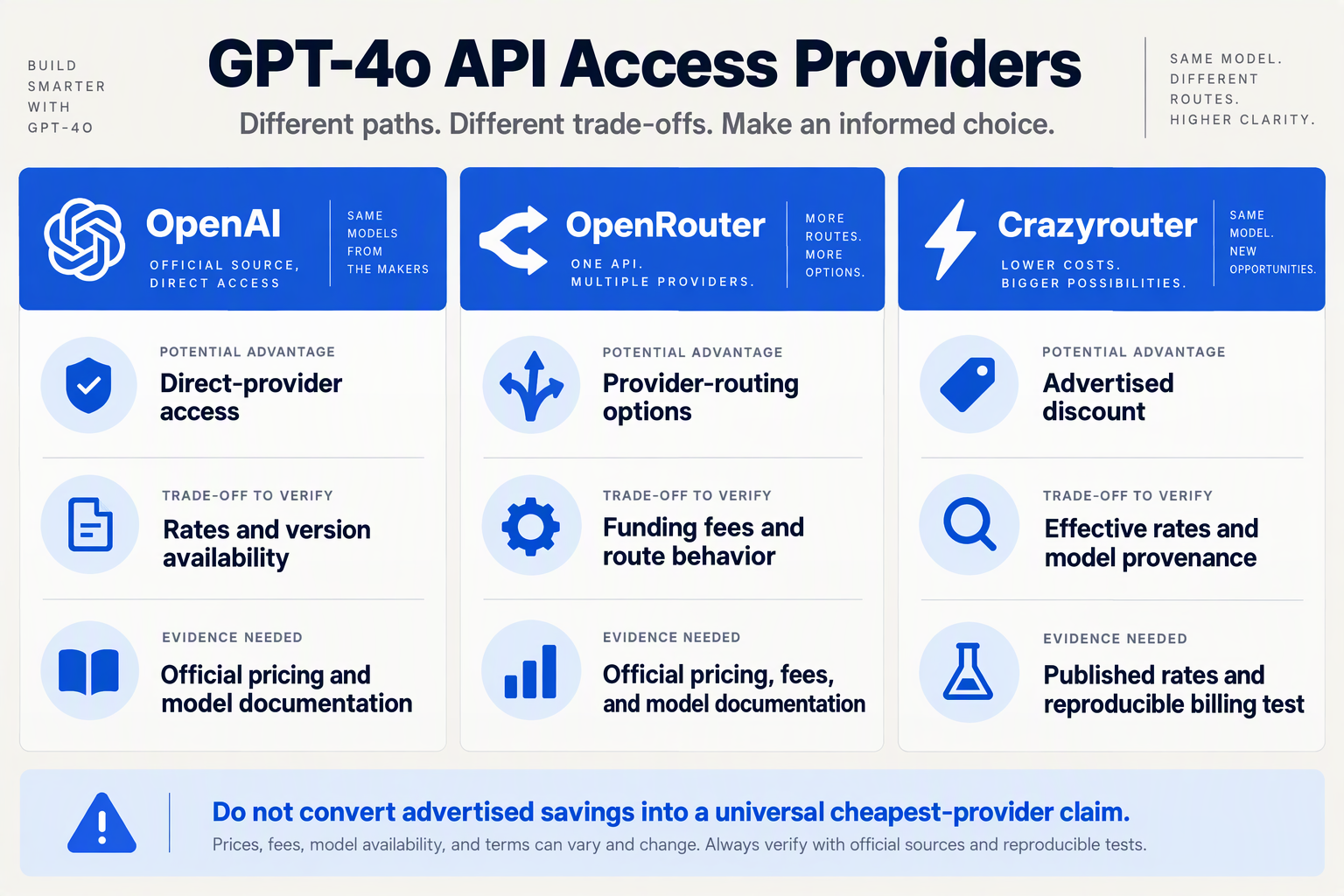
Each option offers a different advantage: direct purchasing, multi-provider aggregation, advertised discounts, or broader developer infrastructure. For the cheapest OpenAI-compatible API for GPT-4o access, choose on verified billing and model availability—not API compatibility alone.
- OpenAI direct: Use direct purchasing as the baseline when evaluating whether an intermediary’s additional features justify its final bill.
- OpenRouter: Evaluate aggregation separately from savings; access to multiple providers can simplify operations without necessarily lowering GPT-4o token charges.
- Crazyrouter: Request the actual input/output rate card and discount conditions before treating the advertised percentage as a procurement-ready saving.
- CallMissed: Evaluate its developer capabilities independently; the supplied fact sheet does not establish GPT-4o availability or a GPT-4o-specific price.
Which advantages and trade-offs matter for each API option?
| Option | Main advantage | Price evidence | Trade-off or verification needed |
|---|---|---|---|
| OpenAI direct | Direct purchasing provides the reference point for comparing intermediary costs. | CostBench, last verified July 30, 2026, lists GPT-4o at $2.50/M input and $10/M output through OpenAI directly. | The supplied excerpts do not establish account-specific limits or the complete October 2026 bill; confirm current pricing and the required model version. |
| OpenRouter | PromptCost.org’s 2026 guide describes aggregation that avoids managing separate API keys for multiple providers. | CostBench’s July 30, 2026 comparison lists $2.50/M input and $10/M output; PromptCost.org’s 2026 guide describes a 1% markup. | Matching base rates are not proof of matching checkout totals. Resolve the markup treatment before comparing invoices or forecasting monthly spending. |
| Crazyrouter | Its GPT-4o page provides a discount candidate worth investigating. | Crazyrouter advertises “Save 45%” in the supplied context reviewed for October 2026; the excerpt provides no verification date or complete rate schedule. | Verify the comparison baseline, eligible model, input/output charges, and discount conditions. The supplied evidence cannot substantiate a 45% saving for your application. |
| CallMissed | As of October 2026, its verified fact sheet lists 124 models, one API key and balance, OpenAI-compatible endpoints, and caller-chosen fallbacks. | As of October 2026, the fact sheet lists 1 credit = ₹1, pay-as-you-go billing, and credits that never expire—not a GPT-4o rate. | Confirm GPT-4o catalogue availability and pricing before shortlisting for this query. Its free-tier models must not be assumed to include GPT-4o. |
What should you verify before choosing an option?
- Billing evidence: Compare the same token counts and currency across all four options; record token charges, platform charges, payment costs, and applicable taxes separately rather than combining verified rates with unverified discount assumptions.
- Migration effort: Run your existing SDK against the proposed endpoint and test streaming, tool calls, errors, and output structure; an OpenAI-compatible interface does not, by itself, establish identical behavior for every request.
- Model continuity: In an October 15, 2026 LinkedIn post, Stanislav Sorokin reports a January 14, 2027 shutdown for named GPT-4o snapshots, citing OpenAI’s deprecations page. Verify that report against OpenAI’s primary documentation before committing to a long-lived integration.
Which API should you choose for your workload and location?
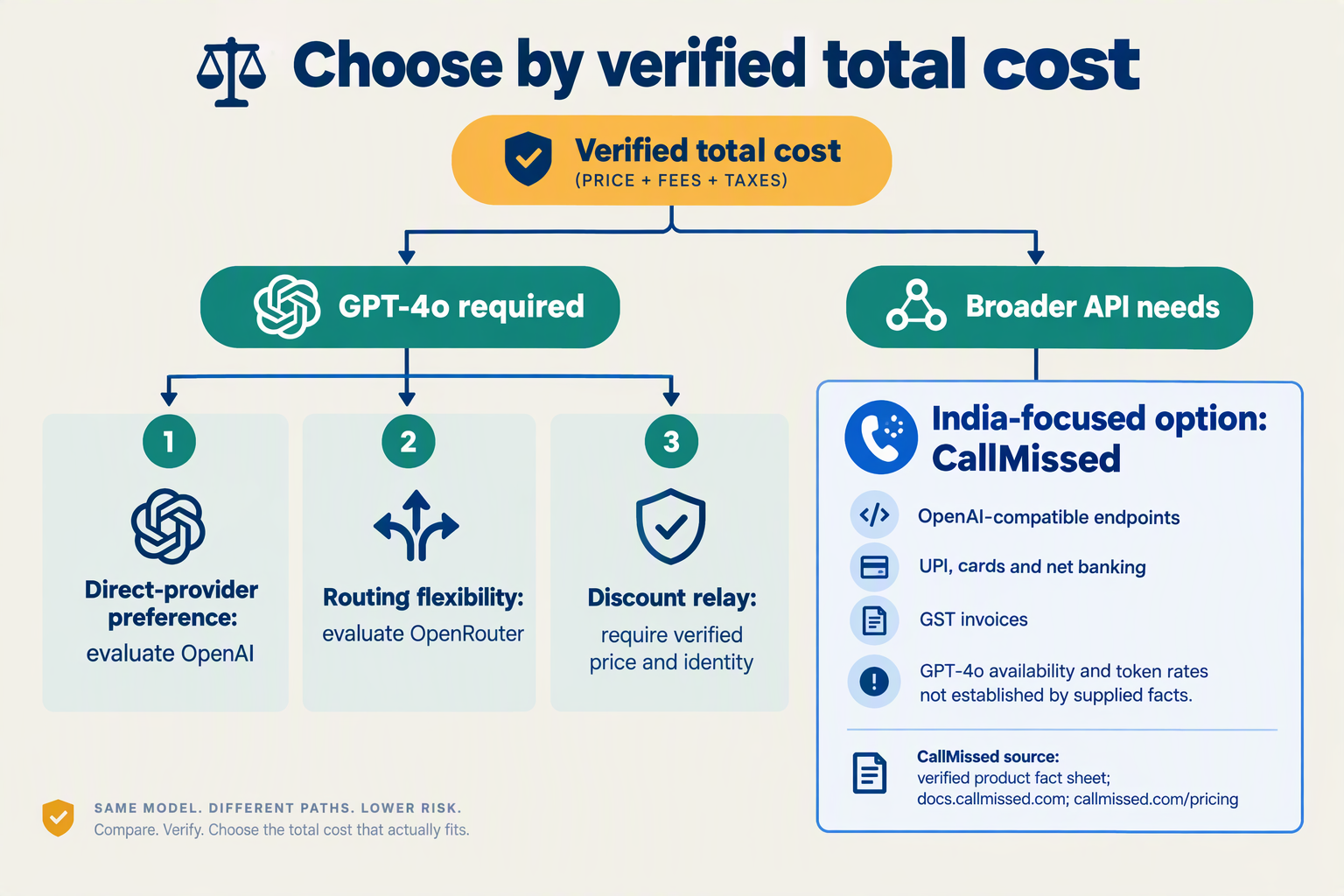
Choose OpenAI directly for a GPT-4o-only integration, or evaluate a compatible gateway when multi-model access or local billing matters. As of October 2026, the supplied evidence does not establish a universal cheapest provider.
Which API fits a GPT-4o-only workload?
- OpenAI direct: Start here if your application requires GPT-4o rather than interchangeable models. CostBench’s July 30, 2026 comparison establishes matching OpenAI and OpenRouter base rates, so aggregation alone does not demonstrate savings.
- Output-heavy applications: Budget around generated tokens, not request counts. Using CostBench’s July 30, 2026 rates, a hypothetical workload of 200,000 input tokens and 800,000 output tokens costs $8.50 before fees, making response length a practical optimization target.
- Strict model requirements: Before switching endpoints, record the exact GPT-4o model identifier and test structured outputs, tool calls, and representative prompts. OpenAI compatibility describes an interface, not proof of identical model versions, behavior, or availability.
- Production purchasing: Compare invoices for the same test workload rather than advertised discounts. Include unsuccessful requests where billable, retries, payment charges, and taxes; ask each provider which charges apply before committing production traffic.
Which gateway fits a multi-model application?
- OpenRouter: Consider aggregation when your application needs multiple providers behind one integration. PromptCost.org’s 2026 guide describes a 1% markup, while CostBench’s July 30, 2026 listing describes passthrough pricing plus a platform markup; verify the applicable fee.
- Crazyrouter: Treat the GPT-4o page’s “Save 45%” headline, supplied for this October 2026 comparison, as a verification lead. The excerpt does not establish the reference price, discount conditions, or final cost for your token mix.
- CallMissed: According to its verified fact sheet, as of October 2026, the OpenAI-compatible developer API supports 124 models, caller-chosen fallbacks, response caching, and request logs. These support multi-model evaluation, but no supplied GPT-4o-specific price establishes a cheapest-provider claim.
- Fallback-dependent workloads: Decide whether substituting another model is acceptable before enabling routing. For example, a support-summary application may tolerate substitution after testing, while an evaluation explicitly measuring GPT-4o must preserve model identity.
How should your location change the decision?
- India-based teams: CallMissed’s verified fact sheet lists UPI, cards, net banking, GST invoices, and India hosting as of October 2026. These are concrete procurement advantages; verify GPT-4o availability and its applicable rate separately.
- Data-sensitive organizations: India hosting does not, by itself, establish where every upstream model processes prompts. Ask for contractual details covering inference location, retention, subprocessors, and transfers before treating any gateway as a residency solution.
- Cross-border buyers: Compare the actual payment-currency invoice, conversion charges, and applicable taxes. A lower dollar-denominated token quote may not produce the lowest local-currency bill after checkout; use the same workload and billing period.
- Latency-sensitive applications: Benchmark from your users’ region using representative requests and concurrent traffic. Measure first-token time, completed-response time, errors, and retry costs together; the supplied sources establish no regional performance winner.
Frequently Asked Questions
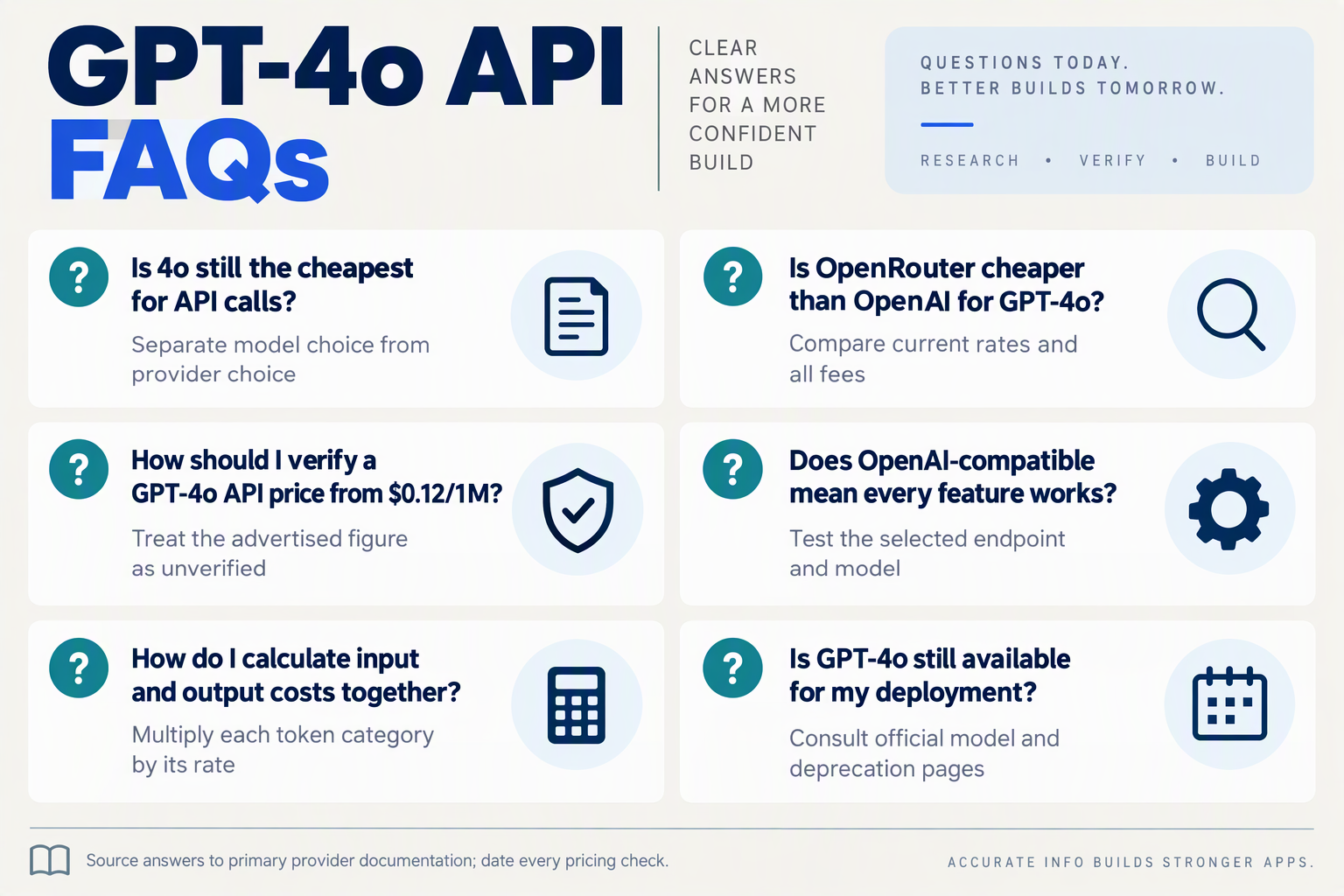
Cheap GPT-4o access means the lowest verified cost for your workload, not the lowest advertised rate. These six questions address billing, compatibility, free access, and model availability.
- Q: What is the cheapest OpenAI-compatible API for GPT-4o access?
A: As of October 2026, the supplied evidence does not establish a single cheapest provider: CostBench’s July 30, 2026 verification lists both OpenAI and OpenRouter at $2.50 per million input tokens and $10 per million output tokens. Those matching rates establish a baseline, not an all-inclusive bill. Ask each provider for the exact model identifier, applicable fees, and a workload estimate before ranking offers.
- Q: How do I calculate my monthly GPT-4o API bill?
A: Multiply monthly input and output tokens by their respective rates, then add applicable platform charges, payment fees, and taxes. For 10,000 requests averaging 1,500 input tokens and 300 output tokens, the estimated token cost is $67.50, using CostBench’s July 30, 2026 rates: $37.50 for input plus $30 for output. As an October 2026 budgeting example, this excludes retries and additional charges; measure those separately in production.
- Q: How can I verify the cheapest OpenAI-compatible API for GPT-4o access before switching?
A: Run the same representative requests through each candidate and compare billed cost per successfully completed task, rather than price per request alone. PromptCost.org’s 2026 guide describes a 1% OpenRouter markup, while the supplied Crazyrouter page advertises “Save 45%” without establishing the conditions behind that saving. As of October 2026, neither claim should replace checking the billing terms, model version, failed-request treatment, and actual invoice.
- Q: Does OpenAI-compatible mean I can migrate without changing my application?
A: OpenAI-compatible describes an interface, not guaranteed equivalence across models, parameters, or responses; test streaming, tool calls, structured outputs, and error handling wherever your application uses them. As of October 2026, CallMissed’s verified fact sheet specifies OpenAI-compatible endpoints that support existing SDKs through a base-URL change, alongside caller-chosen fallback models and request logs. However, that fact sheet does not establish a GPT-4o-specific price or confirm GPT-4o availability, so compatibility alone cannot qualify a cheapest-provider claim.
- Q: Can I get free GPT-4o API access through an aggregator?
A: As of October 2026, the supplied research does not verify an ongoing free GPT-4o API offering. CostBench’s July 30, 2026 comparison says many community-hosted open-source models are free with rate limits, which is not evidence that GPT-4o is free. Distinguish temporary signup credits from a continuing free tier, and confirm which model receives the allowance before budgeting around it.
- Q: Is GPT-4o API access being discontinued in January 2027?
A: A October 15, 2026 LinkedIn post by Stanislav Sorokin reports that OpenAI listed January 14, 2027 shutdown dates for specific GPT-4o snapshots, including gpt-4o-2024-08-06 and gpt-4o-2024-11-20. The supplied context contains that secondary report, not the official deprecation notice, so treat the dates as requiring confirmation. Before buying credits or committing to an integration, check OpenAI’s official notice and your provider’s migration policy for the exact model identifier.
Conclusion
The cheapest OpenAI-compatible API for GPT-4o access is the one with the lowest verified total cost for your workload—not the lowest advertised token price. As of October 2026, the supplied comparisons do not establish a single cheapest provider once fees, model identity, and operational requirements are considered.
Four takeaways should guide your decision:
- Compare input and output costs separately. CostBench’s comparison, verified on July 30, 2026, lists GPT-4o at $2.50 per million input tokens and $10 per million output tokens through both OpenAI and OpenRouter. At those rates, output tokens cost four times as much as input tokens. Applications producing lengthy answers therefore need a different cost calculation from applications processing large inputs and returning short responses. Matching headline rates do not automatically mean matching final bills.
- Treat discount claims as starting points, not conclusions. Crazyrouter’s GPT-4o page advertises “Save 45%,” but the supplied excerpt does not establish the conditions required to achieve that saving. PromptCost.org’s 2026 guide describes a 1% OpenRouter markup, while CostBench describes passthrough pricing plus a platform markup. Before choosing a provider, verify applicable platform charges, payment fees, currency conversion, and taxes rather than assuming the advertised comparison covers everything you will pay.
- Price a representative workload before migrating. Using CostBench’s July 30, 2026 rates, one million input tokens plus one million output tokens costs $12.50 before additional fees; four million input tokens plus one million output tokens costs $20. These examples provide a baseline, not a universal monthly estimate. Apply the same calculation to your own token mix, then compare the resulting total across providers using equivalent assumptions. A lower input rate matters less when most spending comes from generated output.
- Verify model identity and operational fit alongside price. An OpenAI-compatible endpoint does not, by itself, establish access to the exact GPT-4o version your application requires. Confirm the model version, rate limits, fallback behavior, and integration requirements before committing. A nominal saving is less useful if the endpoint cannot support your intended workload. Keep those checks attached to the pricing comparison so that a purchasing decision reflects usable access rather than an isolated number.
Looking ahead, watch for changes to fees, discount conditions, and model availability, and repeat your workload calculation when those change. As of October 2026, CallMissed offers OpenAI-compatible endpoints, caller-chosen fallback models, and usage and request logs—capabilities readers can explore when evaluating adaptable AI infrastructure, without assuming a verified GPT-4o-specific price.
Before switching providers, calculate your real bill: which option delivers the lowest verified cost for the GPT-4o access you actually need?
Related Reading
- Claude Fable 5.1 vs GPT-6 Astra Pricing: Real API Costs in 2026
- GPT-6 Luna API Pricing, Limits and Setup Guide 2026
- GPT-6 Luna API: Pricing, Model ID and Setup in 2026