
GPT-6 Luna API: Pricing, Model ID and Setup in 2026


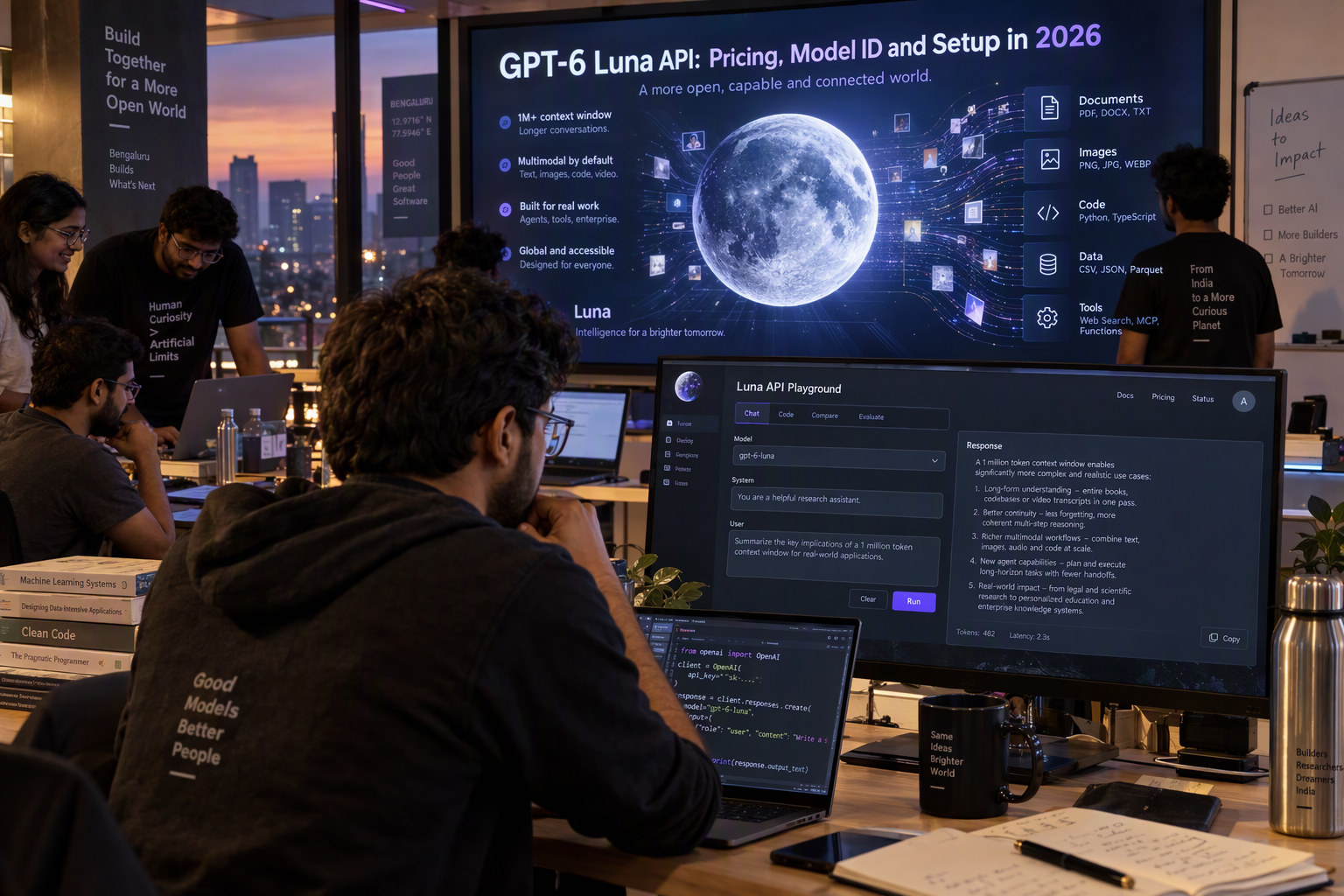
Learn how the GPT-6 Luna API works, its pricing factors and limits, and how to deploy gpt-6-luna through CallMissed’s compatible API.
GPT-6 Luna API: Pricing, Model ID and Setup in 2026
A 1.05-million-token context window can turn GPT-6 Luna into a reasoning engine for entire codebases, document collections, and long-running workflows—without forcing teams into a premium model for every request. The newly released GPT-6 Luna API targets focused, high-volume, cost-sensitive workloads, combining configurable reasoning with a 1,050,000-token context window and up to 128,000 output tokens, according to OpenAI’s model documentation as of September 2026.
That combination matters now because AI adoption is moving beyond occasional prompts toward production workloads involving thousands—or millions—of repeated tasks. Think support-ticket classification, structured data extraction, product-catalog enrichment, compliance review, code analysis, and multi-step agent workflows. In these environments, even small differences in per-token cost, output limits, and reasoning efficiency can materially change the economics of deployment.
OpenAI describes GPT-6 Luna as its “most efficient model for focused, high-volume tasks.” The model supports six reasoning-effort settings—none, low, medium, high, xhigh, and max—with medium as the default, according to OpenAI’s September 2026 API documentation. This gives developers a practical control: use lighter reasoning for routine transformations and reserve deeper computation for ambiguous analysis or complex tool decisions. OpenAI also recommends the Responses API when applications require built-in tools and function calling.
GPT-6 Luna became part of the expanded GPT-6 family alongside GPT-6 Sol on September 22, 2026, following the earlier introduction of GPT-6 Astra, according to OpenAI. That positioning makes Luna especially relevant for teams seeking GPT-6 capabilities at production scale rather than using the largest model indiscriminately.
As of September 2026, OpenAI GPT-6 Luna is available through CallMissed’s OpenAI-compatible API and playground, allowing existing OpenAI SDK integrations to connect by changing the base URL and credentials.
This guide covers the details developers need before shipping: GPT-6 Luna pricing, the exact model ID, context and output limits, reasoning controls, and a step-by-step API setup. It also examines which workloads fit Luna best—and where a larger GPT-6 model may still justify its cost.
What happened in the GPT-6 Luna API launch?

OpenAI launched GPT-6 Luna on September 22, 2026, expanding the GPT-6 family with a smaller, efficiency-focused reasoning model for repetitive production workloads. On the same date, GPT-6 Luna became available through the CallMissed API and playground, giving developers another route to test and deploy the model with OpenAI-compatible endpoints.
When did OpenAI release GPT-6 Luna?
OpenAI announced GPT-6 Sol and GPT-6 Luna on September 22, 2026, after introducing the flagship GPT-6 Astra earlier that month. OpenAI’s September 2026 API changelog lists the production model ID as gpt-6-luna.
The release establishes three distinct roles within the GPT-6 family:
- GPT-6 Astra targets the most demanding work where maximum intelligence and alignment are the priority.
- GPT-6 Sol broadens the family with another frontier-capability option.
- GPT-6 Luna prioritizes efficient reasoning for focused, high-volume tasks.
This is not simply a faster preset for a larger model. GPT-6 Luna is a separately addressable API model, so development teams can route suitable requests to it without using the highest-capability GPT-6 tier for every operation.
What shipped with the GPT-6 Luna API?
The launch combines unusually large input and output allowances with developer controls designed for production systems. According to OpenAI’s model comparison documentation in September 2026, GPT-6 Luna supports a 1,050,000-token context window and a maximum output of 128,000 tokens.
OpenAI’s September 2026 documentation also identifies April 20, 2026 as GPT-6 Luna’s knowledge cutoff. Its supported API capabilities include:
- Streaming, allowing applications to display or process output as it is generated.
- Function calling, enabling the model to invoke application-defined tools.
- Structured outputs, useful for returning schema-constrained JSON.
- Image input, supporting workflows that combine visual and textual information.
- Chat Completions and Responses API access, accommodating both established integrations and tool-centric agent designs.
OpenAI recommends the Responses API when an application depends on built-in tools or function calling. That distinction matters for teams deciding whether to preserve an existing chat-completions architecture or build a more stateful, tool-using workflow.
What does CallMissed availability change for developers?
As of September 2026, developers can select OpenAI GPT-6 Luna in the CallMissed playground for interactive testing or call it programmatically through CallMissed’s OpenAI-compatible AI gateway. Existing OpenAI SDK applications can connect by changing the base URL and credentials rather than rewriting their integration around a proprietary interface.
CallMissed provides one API key and one balance across 138 models as of September 2026, including models from OpenAI, Google, Moonshot, Sarvam, DeepSeek, Zhipu, Amazon, xAI, NVIDIA, and Mistral. That multi-model setup makes the Luna launch operationally useful: teams can test GPT-6 Luna against alternative models, configure caller-chosen fallbacks, and retain a consistent API surface.
The practical announcement, therefore, is broader than a catalogue update. GPT-6 Luna is now deployable as an efficiency-oriented reasoning layer for applications where request volume, context length, output size, and model cost must be balanced deliberately.
What are the key GPT-6 Luna specifications?
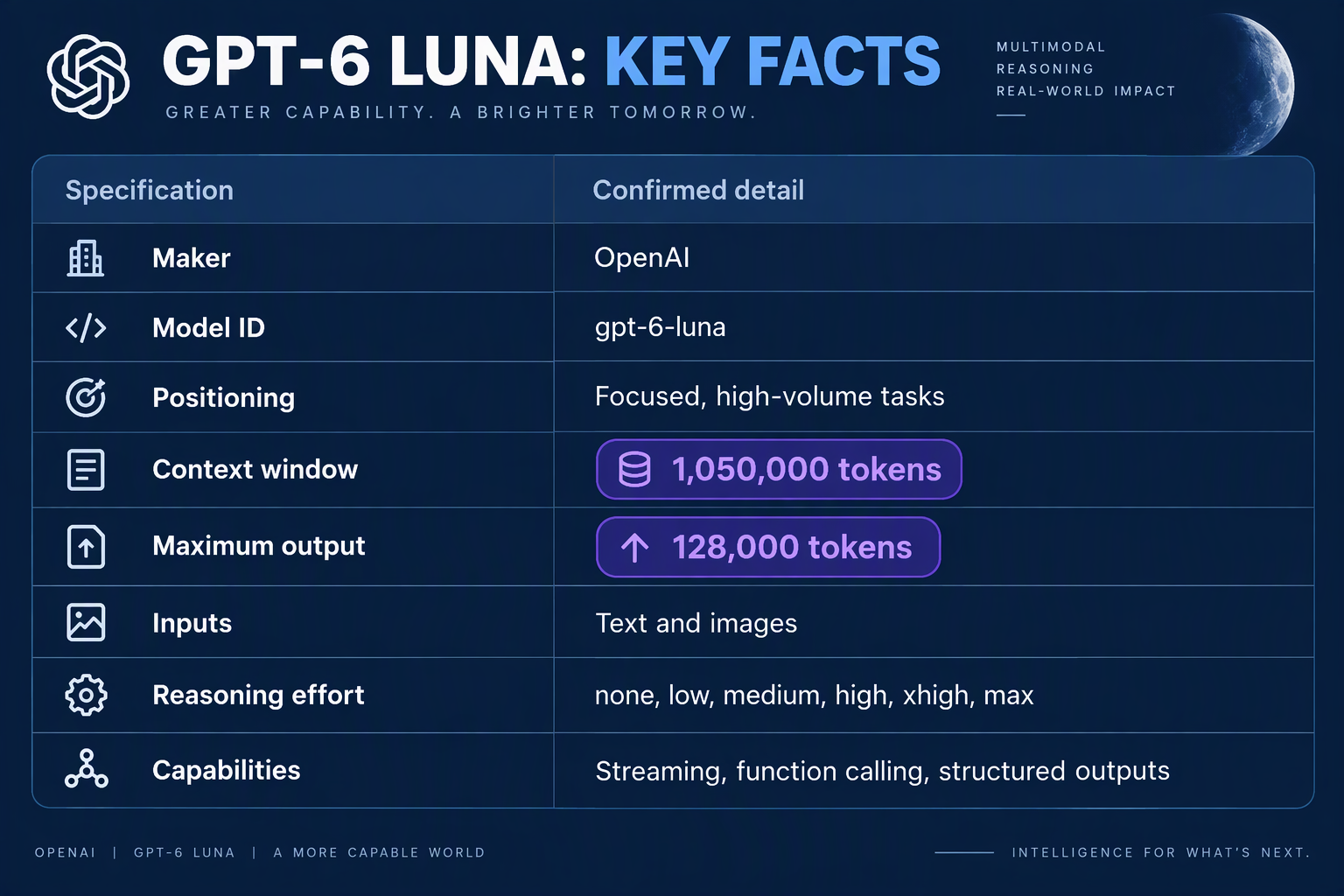
GPT-6 Luna is an efficiency-focused reasoning model with a 1,050,000-token context window, a 128,000-token maximum output, image input, structured outputs, function calling, and six reasoning-effort levels. OpenAI identifies gpt-6-luna as the model ID and recommends the Responses API for applications using built-in tools and function calling.
What are the headline GPT-6 Luna specifications?
| Specification | GPT-6 Luna value | Practical significance |
|---|---|---|
| Model ID | gpt-6-luna | Use this identifier in API requests |
| Context window | 1,050,000 tokens | Processes large repositories or document collections |
| Maximum output | 128,000 tokens | Supports long reports, code and structured results |
| Reasoning effort | none, low, medium, high, xhigh, max | Lets applications balance depth against cost and speed |
| Default reasoning | medium | Provides a general-purpose starting point |
| Knowledge cutoff | April 20, 2026 | Determines the model’s built-in knowledge boundary |
OpenAI’s model comparison documentation listed GPT-6 Luna’s context window as 1,050,000 tokens as of September 2026. The same OpenAI documentation listed a 128,000-token maximum output and an April 20, 2026 knowledge cutoff as of September 2026.
These are limits rather than guaranteed request sizes. Developers still need to reserve context capacity for generated output, tool results, instructions, and conversation history. For retrieval-augmented generation, sending only relevant passages can also be cheaper and more reliable than filling the complete window.
Which API capabilities does GPT-6 Luna support?
OpenAI’s September 2026 model comparison lists support for:
- Streaming, enabling applications to display tokens before generation finishes.
- Function calling, allowing GPT-6 Luna to select application-defined tools.
- Structured outputs, useful when downstream systems require schema-conforming JSON.
- Image input, supporting workflows that combine visual and textual evidence.
- Reasoning-effort control, so developers can tune computation to each request.
- Chat Completions and Responses API endpoints, with OpenAI recommending Responses for built-in tools.
The six-level reasoning range is particularly important for high-volume systems. A product-catalog normalization job might use none or low, while a difficult contract analysis or multi-tool decision could use high, xhigh, or max. Because medium is the default, production teams should set the parameter explicitly when predictable behavior and spend matter.
What do the specifications mean for production deployments?
The central trade-off is capacity versus selectivity. GPT-6 Luna can accept unusually large inputs, but a million-token prompt is not automatically better than a smaller, carefully retrieved context. Larger requests increase processing requirements and may introduce irrelevant evidence that complicates reasoning.
As of September 2026, CallMissed exposes GPT-6 Luna through its OpenAI-compatible developer API and playground. CallMissed supports Chat Completions, the Responses API, streaming, function calling, structured outputs, vision input, reasoning-effort control, caller-selected fallback models, and request logs, making the model suitable for both interactive evaluation and production integration.
One deployment distinction matters: OpenAI’s documentation lists v1/batch among its own GPT-6 Luna endpoints, but CallMissed does not offer a batch API as of September 2026. Applications using CallMissed should submit standard API requests within their applicable rate limits rather than assuming OpenAI Batch API compatibility.
Why does GPT-6 Luna matter for high-volume workloads?
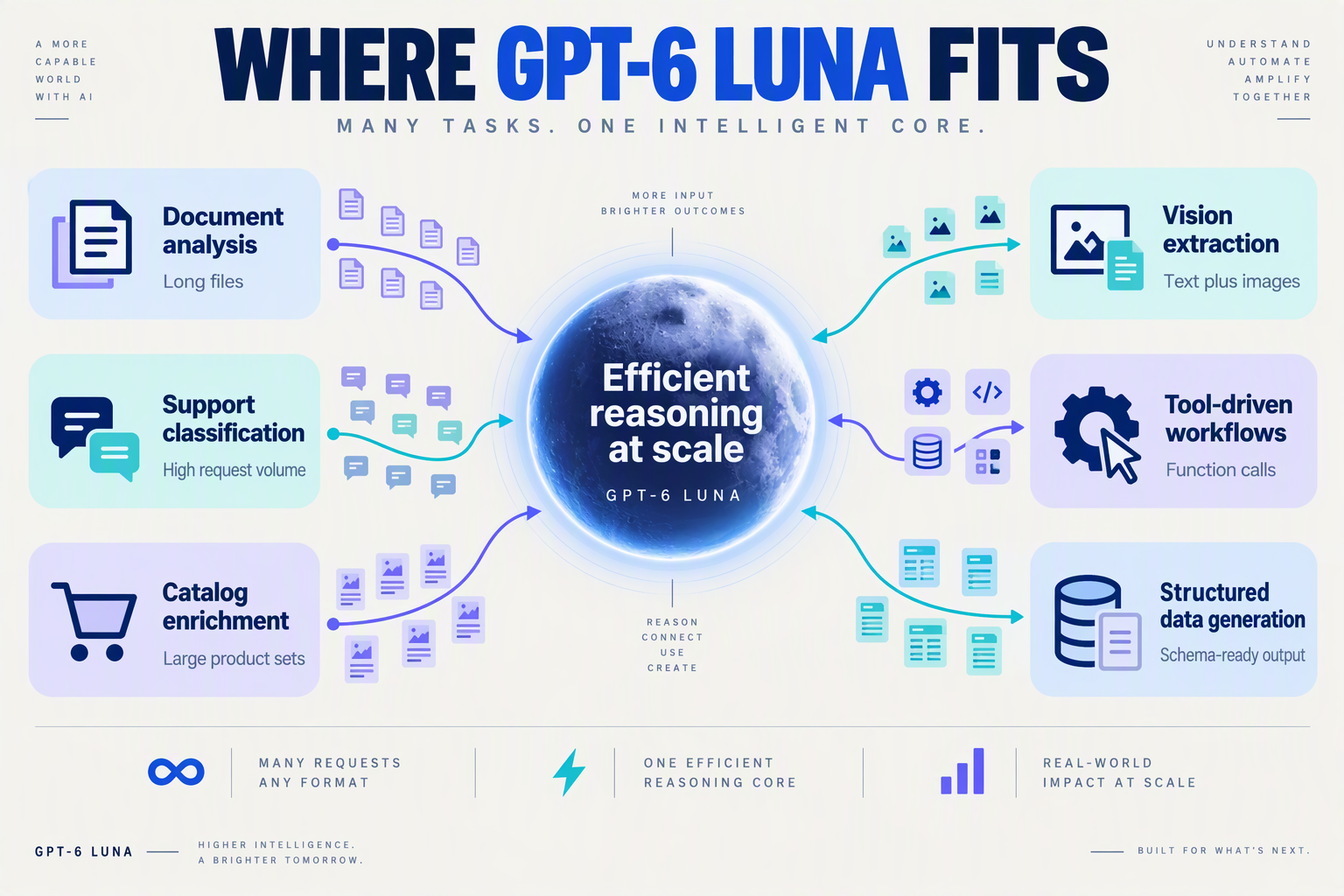
GPT-6 Luna matters because high-volume AI systems are constrained by aggregate cost, context handling, and predictable output—not merely peak intelligence. OpenAI positions GPT-6 Luna as its “most efficient model for focused, high-volume tasks,” making it a practical default for repetitive workflows where using a larger model on every request would waste compute.
How does GPT-6 Luna improve workload economics?
At production scale, modest efficiency gains compound quickly. A workflow processing 500,000 support cases per month may involve classification, retrieval, summarisation, structured extraction, and tool selection for each case; unnecessary reasoning across those steps can substantially increase total token consumption.
GPT-6 Luna lets developers match reasoning depth to task difficulty:
- None or low: formatting, tagging, routing, and straightforward extraction.
- Medium: general analysis and routine agent decisions; this is the default.
- High or xhigh: ambiguous documents, complex comparisons, and multi-step planning.
- Max: the hardest cases that justify additional reasoning compute.
OpenAI’s September 2026 model documentation lists six reasoning-effort settings for GPT-6 Luna: none, low, medium, high, xhigh, and max. This enables a tiered architecture in which routine requests stay lightweight while difficult cases receive more computation or escalate to a larger model.
Why does long context matter at high volume?
A large context window reduces the engineering overhead associated with splitting, ranking, and repeatedly reassembling source material. OpenAI’s September 2026 model comparison lists GPT-6 Luna with a 1,050,000-token context window and a maximum output of 128,000 tokens.
That capacity can support workloads such as:
- Reviewing an extensive contract set with associated policies and correspondence.
- Analysing a repository with source files, tests, documentation, and issue history.
- Processing long customer timelines without discarding earlier interactions.
- Converting large catalogues or reports into validated structured data.
- Running agent workflows that accumulate substantial tool results.
Long context does not eliminate retrieval-augmented generation. Sending one million tokens with every request may be inefficient when retrieval can select a few relevant passages. Its value is architectural flexibility: teams can retrieve selectively for routine jobs while retaining the option to analyse an entire working set when omissions would be costly.
Which production pattern makes the most sense?
A cost-aware GPT-6 Luna pipeline can use staged reasoning:
- Filter and classify incoming work with low reasoning.
- Retrieve only relevant evidence from the available corpus.
- Generate structured output with an explicit schema.
- Escalate uncertain cases to high or maximum reasoning.
- Route exceptional cases to a larger GPT-6 model or human reviewer.
This approach avoids treating every request as equally difficult. It also makes model evaluation more meaningful because teams can measure accuracy, escalation rate, token usage, and failure patterns separately for each stage.
For developers implementing that routing, CallMissed’s OpenAI-compatible AI API supports streaming, function calling, structured outputs, caller-selected fallback models, response caching, and request logs as of September 2026. Those capabilities are particularly relevant to high-volume systems because efficiency depends on the surrounding orchestration—not just the model selected.
How does GPT-6 Luna compare with GPT-5.6 Luna?
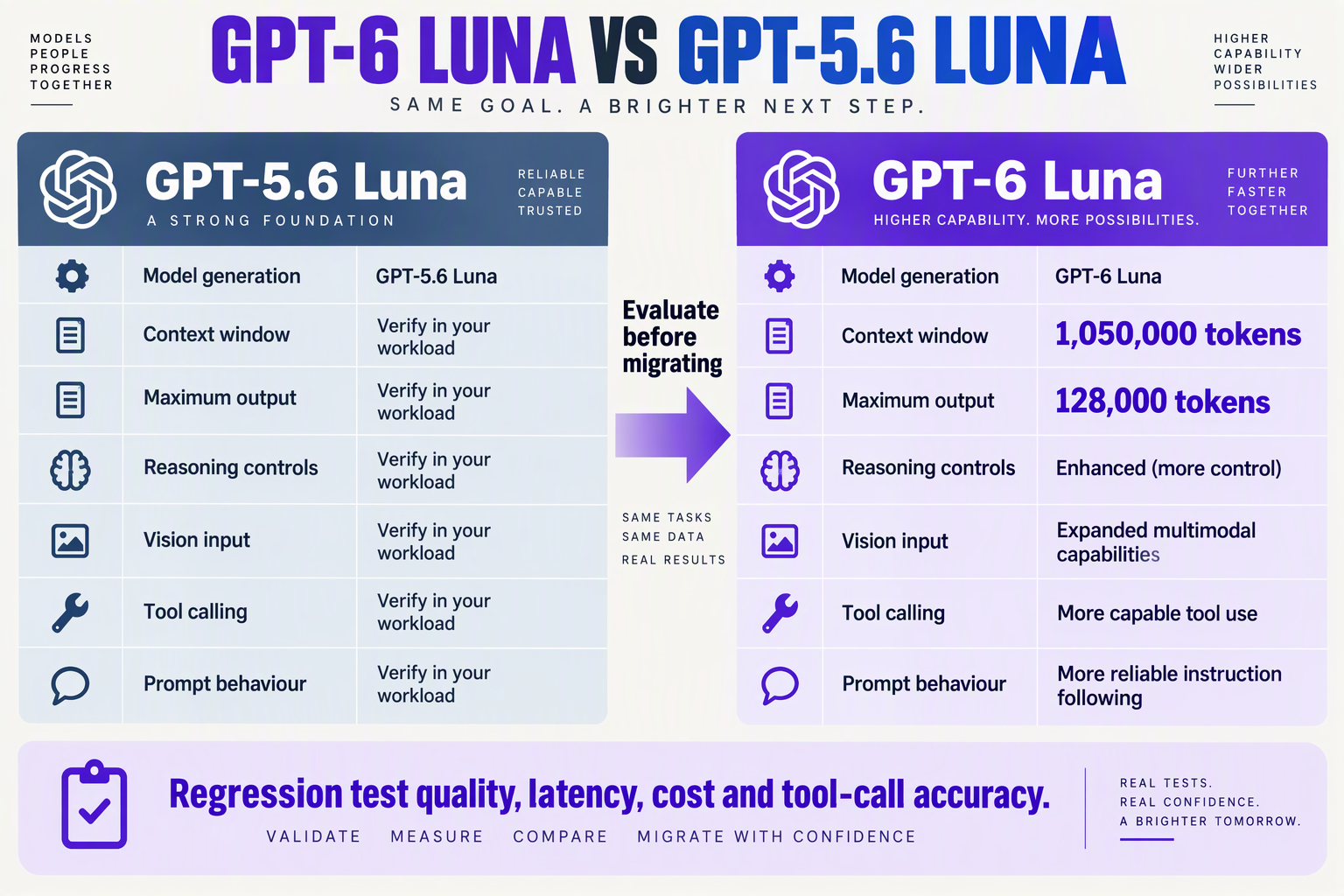
GPT-6 Luna succeeds GPT-5.6 Luna in the efficiency-focused tier, but it preserves the same core mission: economical reasoning for focused, high-volume workloads. The clearest documented upgrade is GPT-6 Luna’s production envelope—a 1,050,000-token context window, 128,000 maximum output tokens, and GPT-6-generation capabilities—rather than a completely different workload profile.
What are the main differences between GPT-6 Luna and GPT-5.6 Luna?
OpenAI describes GPT-5.6 Luna as a model for “cost-sensitive, high-volume workloads” that roughly corresponds to the nano tier in earlier GPT-5 families. OpenAI describes GPT-6 Luna as its “most efficient model for focused, high-volume tasks,” indicating continuity in positioning while moving the Luna tier into the GPT-6 family.
The practical differences documented as of September 2026 are:
- Model generation: GPT-6 Luna belongs to the GPT-6 family introduced alongside GPT-6 Sol on September 22, 2026; GPT-5.6 Luna remains part of the preceding GPT-5.6 generation.
- Long-context capacity: OpenAI’s September 2026 model documentation gives GPT-6 Luna a 1,050,000-token context window.
- Output capacity: OpenAI lists GPT-6 Luna’s maximum output at 128,000 tokens, supporting unusually long reports, code generation, and structured transformations.
- Knowledge cutoff: OpenAI’s model comparison documentation lists April 20, 2026 as GPT-6 Luna’s knowledge cutoff.
- Positioning: GPT-5.6 Luna is explicitly linked to the earlier nano tier, whereas GPT-6 Luna is framed as the efficient GPT-6 option for focused work at scale.
OpenAI has not provided a benchmark in the supplied launch materials that quantifies GPT-6 Luna’s accuracy, latency, or cost advantage over GPT-5.6 Luna. Teams should therefore avoid translating “newer generation” into an assumed percentage improvement without workload-specific evaluation.
Do both Luna models support adjustable reasoning effort?
GPT-6 Luna and GPT-5.6 Luna support the same six documented reasoning-effort levels: none, low, medium, high, xhigh, and max. OpenAI’s API documentation identifies medium as the default for both models as of September 2026.
That continuity makes migration easier because applications can retain an existing reasoning policy:
- Use none or low for extraction, tagging, rewriting, and deterministic formatting.
- Use medium as the general-purpose default.
- Escalate to high, xhigh, or max for difficult code analysis, ambiguous documents, or multi-step tool selection.
Reasoning effort remains a trade-off rather than a universal quality switch. Deeper settings can be valuable for complex decisions, while unnecessary reasoning can increase token consumption and response time in repetitive pipelines.
Should existing GPT-5.6 Luna applications migrate immediately?
Migration should be based on measured task performance, not the model name alone. GPT-6 Luna is the stronger candidate when an application needs its documented 1.05-million-token context, 128,000-token outputs, or access to the newer GPT-6 family.
A controlled evaluation should compare:
- task accuracy and schema compliance;
- input, reasoning, and output-token consumption;
- end-to-end latency at realistic concurrency;
- tool-call reliability and recovery behavior;
- cost per successfully completed task.
GPT-5.6 Luna may remain appropriate for stable, validated workflows. GPT-6 Luna becomes especially compelling when long-context processing or newer-generation reasoning can reduce chunking, orchestration, and retry overhead.
How much does GPT-6 Luna pricing cost in production?
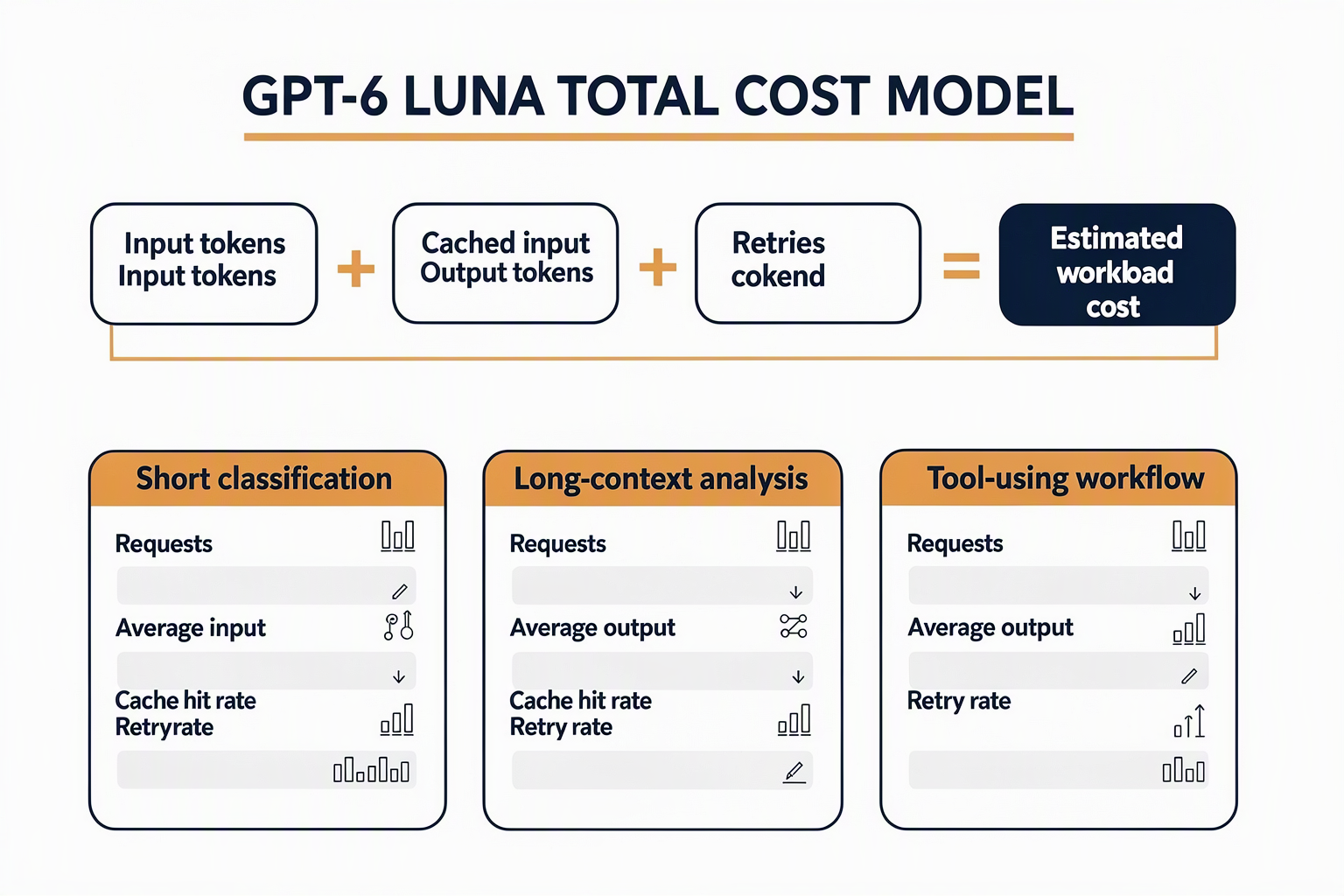
GPT-6 Luna’s production cost depends on the live input- and output-token rates multiplied by actual usage; the supplied OpenAI launch documentation does not publish an exact per-million-token price. As of September 2026, teams should verify the current rate shown in their API provider’s pricing page or playground rather than relying on an estimated launch price.
How should teams calculate GPT-6 Luna API costs?
A practical production estimate separates input tokens, output tokens, and any provider-level charges. Use this formula with the current rates displayed for gpt-6-luna:
Estimated model cost = (input tokens ÷ 1,000,000 × input rate) + (output tokens ÷ 1,000,000 × output rate)
For example, suppose an application processes 100,000 jobs per month, with each job consuming 4,000 input tokens and generating 500 output tokens. Monthly volume would be:
- 400 million input tokens
- 50 million output tokens
- 100,000 total API requests
Multiply those totals by the live GPT-6 Luna rates. This workload-based calculation is more reliable than comparing headline prices alone because output length, prompt reuse, retries, and reasoning effort can materially affect the bill.
The 1,050,000-token context window documented by OpenAI in September 2026 is a capacity limit, not a recommended prompt size. Sending an entire repository or document archive with every request can be significantly more expensive than retrieving only the relevant sections.
Does reasoning effort change the production budget?
Potentially, yes. OpenAI’s September 2026 documentation supports six reasoning.effort settings for GPT-6 Luna: none, low, medium, high, xhigh, and max, with medium as the default.
Teams should benchmark representative requests at several settings rather than automatically choosing max:
- Use none or low for classification, formatting, routing, and simple extraction.
- Test medium for routine analysis and tool selection.
- Reserve high, xhigh, or max for ambiguous cases that demonstrably benefit from deeper reasoning.
- Record token usage, accuracy, latency, retries, and human-review rates for every test.
A cheaper request that produces more corrections may cost more operationally than a moderately priced request that succeeds on the first attempt. The relevant metric is therefore cost per accepted result, not merely cost per token.
What does GPT-6 Luna cost through CallMissed?
As of September 2026, CallMissed uses one shared credit balance across its developer AI API, with one credit equal to ₹1, approximately US$0.0104, and credits do not expire. CallMissed provides 1,000 free credits at signup and charges no per-seat fee.
Published CallMissed credit options include:
- 100 credits for ₹99
- 510 credits for ₹449
- 1,050 credits for ₹849
- 5,500 credits for ₹3,999
- Starter: ₹999 monthly with 550 credits
- Pro: ₹4,999 monthly with 6,000 credits
- Enterprise: ₹20,000 monthly with 26,000 credits
The final GPT-6 Luna spend still depends on the model’s live usage rate and workload characteristics. Before deployment, run a production-shaped sample through CallMissed’s OpenAI-compatible API, measure actual token consumption, and project monthly costs at expected traffic plus a retry and growth buffer.
How do you call gpt-6-luna through the CallMissed API?
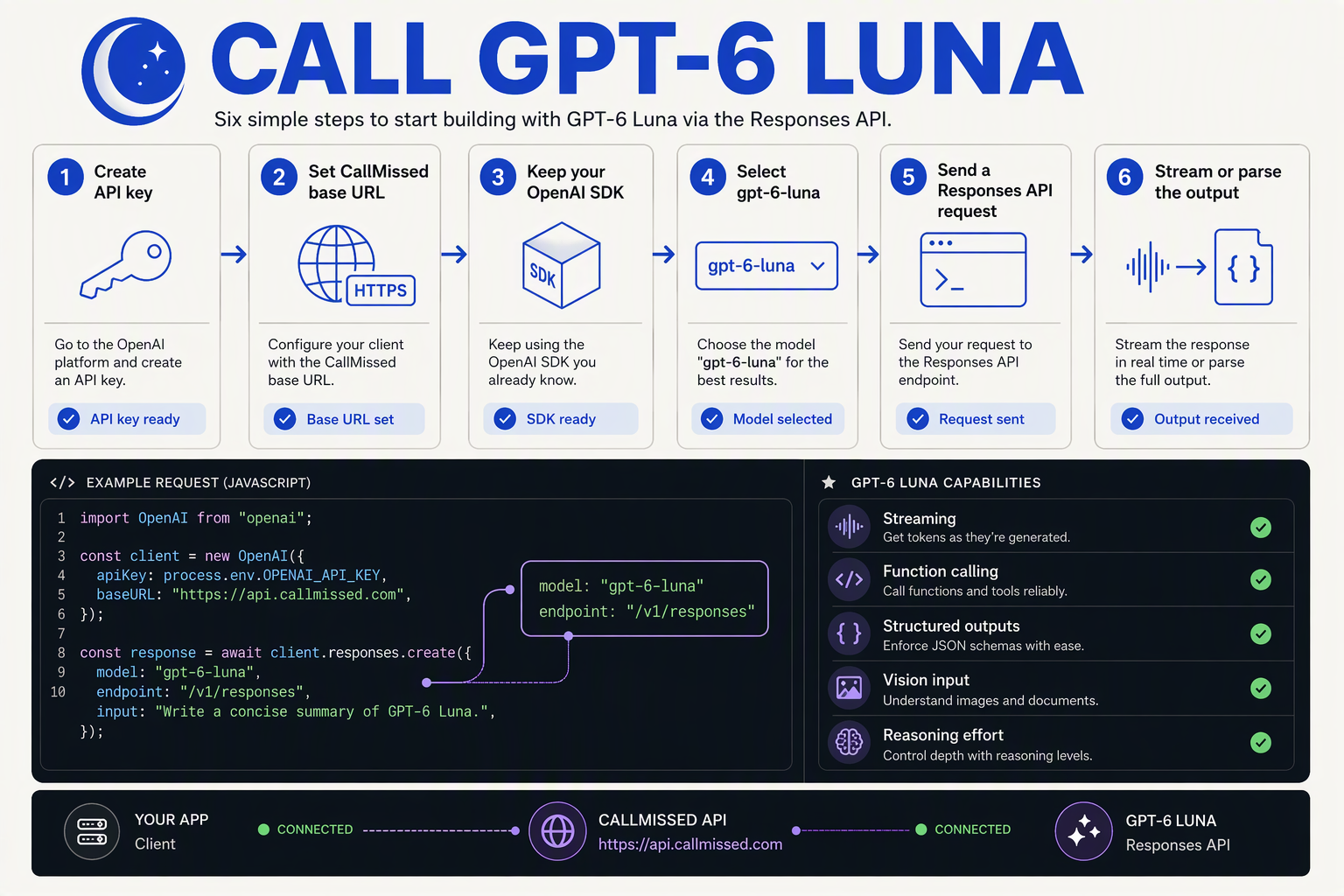
Call GPT-6 Luna through CallMissed’s OpenAI-compatible Responses API by using the model ID gpt-6-luna, setting the base URL to https://api.callmissed.com/v1, and authenticating with a CallMissed API key. Existing OpenAI SDK applications generally require only a base-URL and credential change.
How do you set up GPT-6 Luna on CallMissed?
- Create or sign in to a CallMissed account.
- Generate an API key from the developer console.
- Store the key in an environment variable rather than hard-coding it:
export CALLMISSED_API_KEY="your_api_key"- Install the official OpenAI Python SDK:
pip install openai- Send a request with
gpt-6-lunaas the model ID.
CallMissed provides one API key and one balance across 138 AI models, including general-purpose language, speech, image, embedding, and real-time voice models, as of September 2026. The gateway supports both OpenAI-compatible endpoints and an Anthropic-compatible /v1/messages endpoint.
What does a GPT-6 Luna Python request look like?
OpenAI recommends the Responses API for applications using built-in tools or function calling. This Python example selects low reasoning effort for a focused classification task:
import os
from openai import OpenAI

client = OpenAI(
    api_key=os.environ["CALLMISSED_API_KEY"],
    base_url="https://api.callmissed.com/v1"
)

response = client.responses.create(
    model="gpt-6-luna",
    reasoning={"effort": "low"},
    input=(
        "Classify this support request as billing, technical, "
        "account, or other: 'My card was charged twice.'"
    ),
    max_output_tokens=100
)

print(response.output_text)
OpenAI’s model documentation listed six GPT-6 Luna reasoning settings in September 2026: none, low, medium, high, xhigh, and max. The default is medium, so the reasoning field can be omitted when that balance is appropriate.
A practical routing policy is:
noneorlow: tagging, extraction, normalization, and simple rewritingmedium: general analysis and routine agent decisionshighor above: ambiguous documents, difficult code analysis, and multi-step reasoning
Higher effort can increase the computation used for an answer, so it should be assigned according to task difficulty rather than applied to every request.
How do you call GPT-6 Luna with cURL?
The same request can be made directly over HTTPS:
curl https://api.callmissed.com/v1/responses \
  -H "Authorization: Bearer $CALLMISSED_API_KEY" \
  -H "Content-Type: application/json" \
  -d '{
    "model": "gpt-6-luna",
    "reasoning": {"effort": "low"},
    "input": "Extract the invoice number, date, currency, and total.",
    "max_output_tokens": 300
  }'
GPT-6 Luna supports a 1,050,000-token context window and up to 128,000 output tokens, according to OpenAI’s model comparison documentation in September 2026. Applications should still cap output for short tasks because a large supported maximum is not a reason to generate unnecessary tokens.
What should you verify before deploying?
Test the model in the CallMissed playground before moving prompts into production, then validate:
- reasoning effort and output limits;
- streaming and function-call behavior;
- structured-output schemas;
- fallback handling and request logging;
- application-level timeouts and cost controls.
As of September 2026, CallMissed’s default per-key limits are 60 requests per minute on Free, 500 on Starter, 3,000 on Pro, and 10,000 on Enterprise. These limits should inform concurrency, retry, and queue design for high-volume GPT-6 Luna workloads.
How should teams benchmark and migrate to GPT-6 Luna?
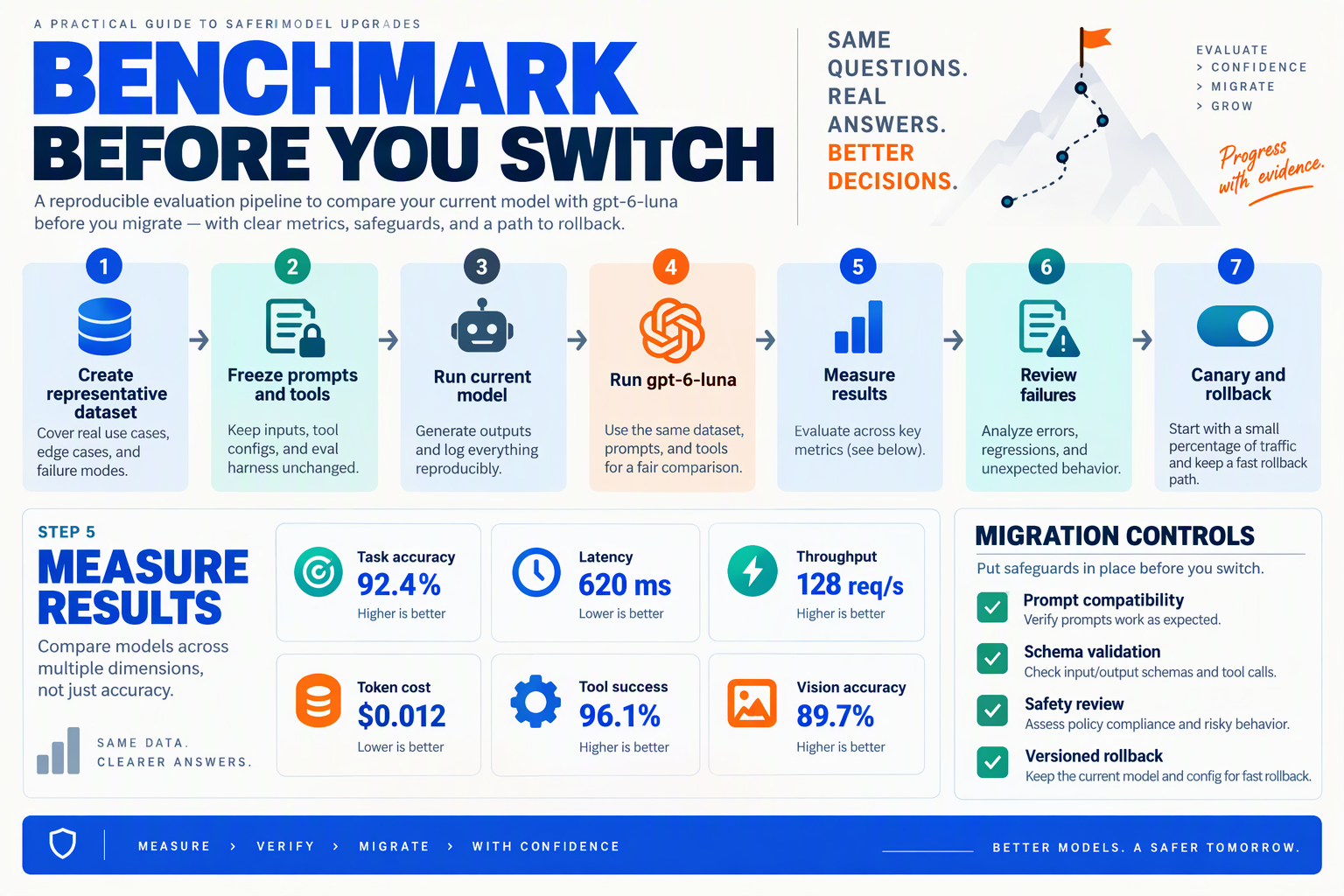
Teams should benchmark GPT-6 Luna against their current production model using representative requests, then migrate through a staged rollout with explicit quality, latency, reliability, and cost thresholds. The most useful metric is not price per token alone, but cost per successful task at each reasoning-effort setting.
What should a GPT-6 Luna benchmark measure?
Build an evaluation set from anonymized production traffic rather than relying on generic leaderboards. Include routine cases, difficult examples, malformed inputs, multilingual content, tool failures, and requests near the application’s context limits.
Measure five dimensions:
- Task quality: exact-match accuracy, rubric scores, extraction precision and recall, or human preference.
- Total cost: input, cached input, reasoning, and output-token charges per completed task.
- Responsiveness: median and p95 end-to-end latency, including tool execution.
- Reliability: schema-valid response rate, function-call accuracy, retries, refusals, and timeouts.
- Efficiency: tokens consumed and successful tasks completed per minute.
OpenAI’s September 2026 documentation describes GPT-6 Luna as its “most efficient model for focused, high-volume tasks,” but teams should verify that claim against their own workload. A support classifier, repository-analysis agent, and compliance reviewer can produce substantially different price-performance results.
How should teams test Luna’s reasoning settings?
Run the same evaluation set across none, low, medium, high, xhigh, and max reasoning effort. OpenAI’s September 2026 model documentation identifies medium as the default, but the default should be a baseline—not an automatic production choice.
A practical routing policy might be:
- Use none or low for classification, formatting, deduplication, and straightforward extraction.
- Use medium for ordinary analysis and multi-step structured outputs.
- Escalate to high, xhigh, or max only when confidence checks detect ambiguity, conflicting evidence, or complex tool decisions.
Test long-context performance separately at increasing prompt sizes. OpenAI’s model comparison documentation listed a 1,050,000-token context window and 128,000 maximum output tokens as of September 2026; however, teams should measure retrieval accuracy across the prompt rather than assuming every included token receives equal practical attention.
What is the safest GPT-6 Luna migration plan?
- Freeze the baseline. Record the current model, prompt version, tool definitions, temperature, latency, token usage, and failure rate.
- Run offline shadow tests. Replay representative requests against Luna without exposing responses to users.
- Validate interfaces. Test streaming, structured outputs, function arguments, image inputs, error handling, and maximum response lengths.
- Start a small canary. Route a limited percentage of eligible traffic to Luna and retain an automatic fallback.
- Expand by workload. Move predictable tasks first; keep high-risk or unusually complex cases on the incumbent model until Luna passes their evaluation threshold.
- Monitor drift. Track quality, cost per success, schema failures, tool errors, and p95 latency by prompt version and reasoning level.
For teams using CallMissed’s OpenAI-compatible AI API, existing OpenAI SDK applications can migrate by changing the base URL and credentials. As of September 2026, CallMissed also supports caller-selected fallback models, streaming, structured outputs, response caching, and request logs—useful controls for canary deployments and rollback planning.
Finally, conduct a capacity test before full rollout. As of September 2026, CallMissed’s default per-key limits range from 60 requests per minute on Free to 10,000 requests per minute on Enterprise, so expected concurrency, retries, and burst traffic should be included in the migration plan.
How is the industry reacting to GPT-6 Luna?

Early industry reaction to GPT-6 Luna is pragmatic rather than benchmark-driven: developers are focusing on its production economics, unusually long context window, and adjustable reasoning budget. As of September 29, 2026, independent performance studies remain limited, so the strongest signals come from OpenAI’s positioning, API specifications, and deployment options.
Why are developers interested in GPT-6 Luna?
The central appeal is frontier-model functionality shaped for repetitive workloads. OpenAI describes GPT-6 Luna as its “most efficient model for focused, high-volume tasks,” language that positions the model for operational use rather than occasional flagship demonstrations.
Three specifications are driving attention:
- A 1,050,000-token context window, according to OpenAI’s model comparison documentation in September 2026.
- Up to 128,000 output tokens, enabling unusually long reports, transformed documents, or generated code.
- Six reasoning-effort levels—none, low, medium, high, xhigh, and max—with medium as the default, according to OpenAI’s GPT-6 Luna API documentation in September 2026.
This configuration reflects a broader shift in AI engineering: teams increasingly want to decide how much reasoning each request deserves. A catalog-normalization job may run with no or low reasoning, while an exception involving conflicting records can be escalated to high or max.
What does GPT-6 Luna signal about the LLM market?
GPT-6 Luna reinforces the industry’s movement away from a “largest model for everything” strategy. OpenAI previously described GPT-5.6 Luna as corresponding roughly to the nano tier used in earlier GPT-5 families; GPT-6 Luna continues the efficiency-oriented role while adding the capabilities and scale of the GPT-6 generation.
The emerging deployment pattern is a model portfolio:
- Route predictable extraction, classification, and enrichment work to an efficient model.
- Increase reasoning effort for difficult cases instead of changing models immediately.
- Escalate only the most consequential or ambiguous requests to a larger model.
- Measure accuracy, latency, and total token consumption on real production data.
That approach can reduce unnecessary inference spending, but Luna’s large limits should not be mistaken for a requirement to fill every request. A 1.05-million-token capacity expands what is possible; it does not remove the need for retrieval, context filtering, caching, or disciplined prompt design.
Is GPT-6 Luna receiving universal praise?
It is too early for a defensible consensus. OpenAI released GPT-6 Luna on September 22, 2026, and the supplied launch materials do not include broad independent benchmark results or third-party production studies. Teams should therefore treat vendor descriptions as a starting point and test domain-specific accuracy, tool use, structured-output reliability, latency, and cost.
Availability also differs by product surface. OpenAI’s Help Center states that GPT-6 Sol and GPT-6 Luna are available for ChatGPT Work and Codex but not in Chat, as of September 2026. That distinction makes Luna primarily an API and workflow story rather than a general ChatGPT rollout.
For developers evaluating that API story, CallMissed’s OpenAI-compatible AI gateway provides access through its API and playground. Existing OpenAI SDK projects can use CallMissed-compatible endpoints by changing the base URL and credentials, making side-by-side workload testing more practical without rewriting the application layer.
When were GPT-6 Luna and related models released?
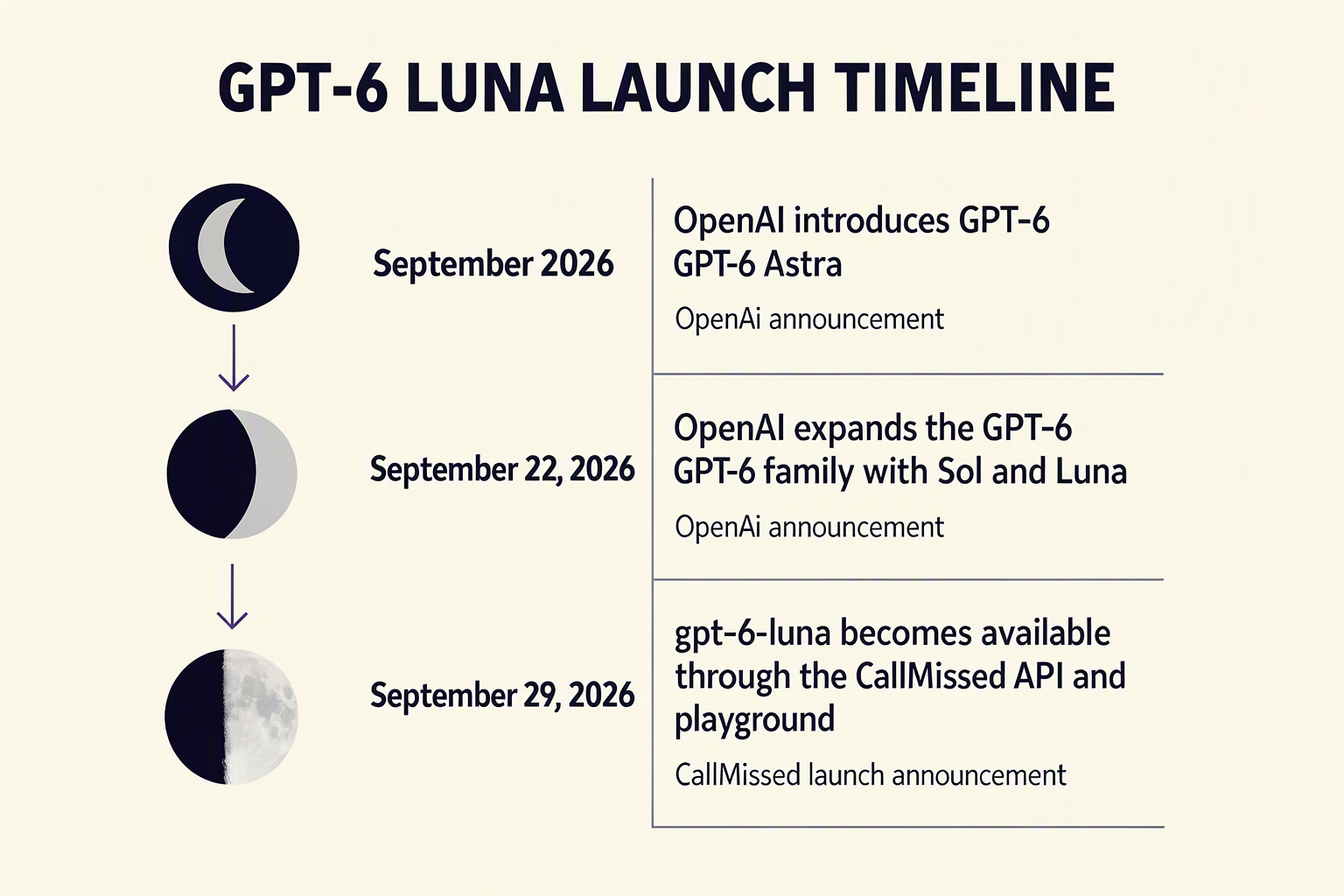
OpenAI released GPT-6 Luna and GPT-6 Sol on September 22, 2026, after introducing GPT-6 Astra earlier in September 2026. GPT-6 Luna also became available through CallMissed’s API on September 22, creating a same-day route for OpenAI-compatible deployments.
What is the GPT-6 model release timeline?
| Date | Model or event | Release significance | Named source |
|---|---|---|---|
| Earlier in September 2026 | GPT-6 Astra introduced | Established the flagship GPT-6 model before the family expanded; the provided announcement excerpt does not specify the exact launch day | OpenAI |
| September 22, 2026 | GPT-6 Sol released | Added another GPT-6 option for demanding professional workloads | OpenAI API Changelog |
| September 22, 2026 | GPT-6 Luna released | Added an efficiency-focused reasoning model for high-volume, cost-sensitive tasks | OpenAI |
| September 22, 2026 | GPT-6 family update published | OpenAI updated the GPT-6 Astra announcement to confirm the addition of Sol and Luna | OpenAI |
| September 22, 2026 | GPT-6 Luna added to CallMissed API | Enabled deployment through an OpenAI-compatible developer endpoint | CallMissed launch announcement |
| September 29, 2026 | Current documented availability | GPT-6 Luna remains documented under the model ID gpt-6-luna | OpenAI model documentation |
OpenAI’s API Changelog records the release of gpt-6-sol and gpt-6-luna on September 22, 2026. This matters because the changelog identifies the production model IDs developers use, rather than merely announcing a future preview.
Was GPT-6 Luna released at the same time as GPT-6 Astra?
No. GPT-6 Astra arrived earlier in September 2026, while GPT-6 Sol and GPT-6 Luna expanded the family on September 22. OpenAI’s GPT-6 Astra announcement includes an update dated September 22, 2026, explicitly noting the addition of the two related models.
The staggered sequence clarifies the intended product structure:
- GPT-6 Astra anchors the family’s flagship tier.
- GPT-6 Sol provides another option for advanced work.
- GPT-6 Luna prioritizes efficient reasoning for focused workloads at scale.
GPT-6 Luna is therefore not a renamed Astra release or a silent model revision. It is a separately documented model with its own identifier, positioning, limits, and configurable reasoning controls.
Where was GPT-6 Luna available at launch?
Availability depends on the product surface. OpenAI’s Help Center states that GPT-6 Sol and GPT-6 Luna are available for ChatGPT Work and Codex but are not available in Chat, as of September 2026. Developers should not assume that an API launch automatically means the model appears in every consumer ChatGPT interface.
For API users, OpenAI documents GPT-6 Luna for the Chat Completions API and Responses API. OpenAI recommends the Responses API when an application needs built-in tools or function calling.
As of September 2026, CallMissed provides GPT-6 Luna through its OpenAI-compatible developer API, where existing OpenAI SDK integrations can use a different base URL and credentials. CallMissed’s broader API uses one key and one balance across 138 models, providing a practical way to evaluate Luna alongside models from OpenAI, Google, Moonshot, DeepSeek, xAI, Mistral, and other listed makers without rebuilding the integration for each provider.
Frequently Asked Questions
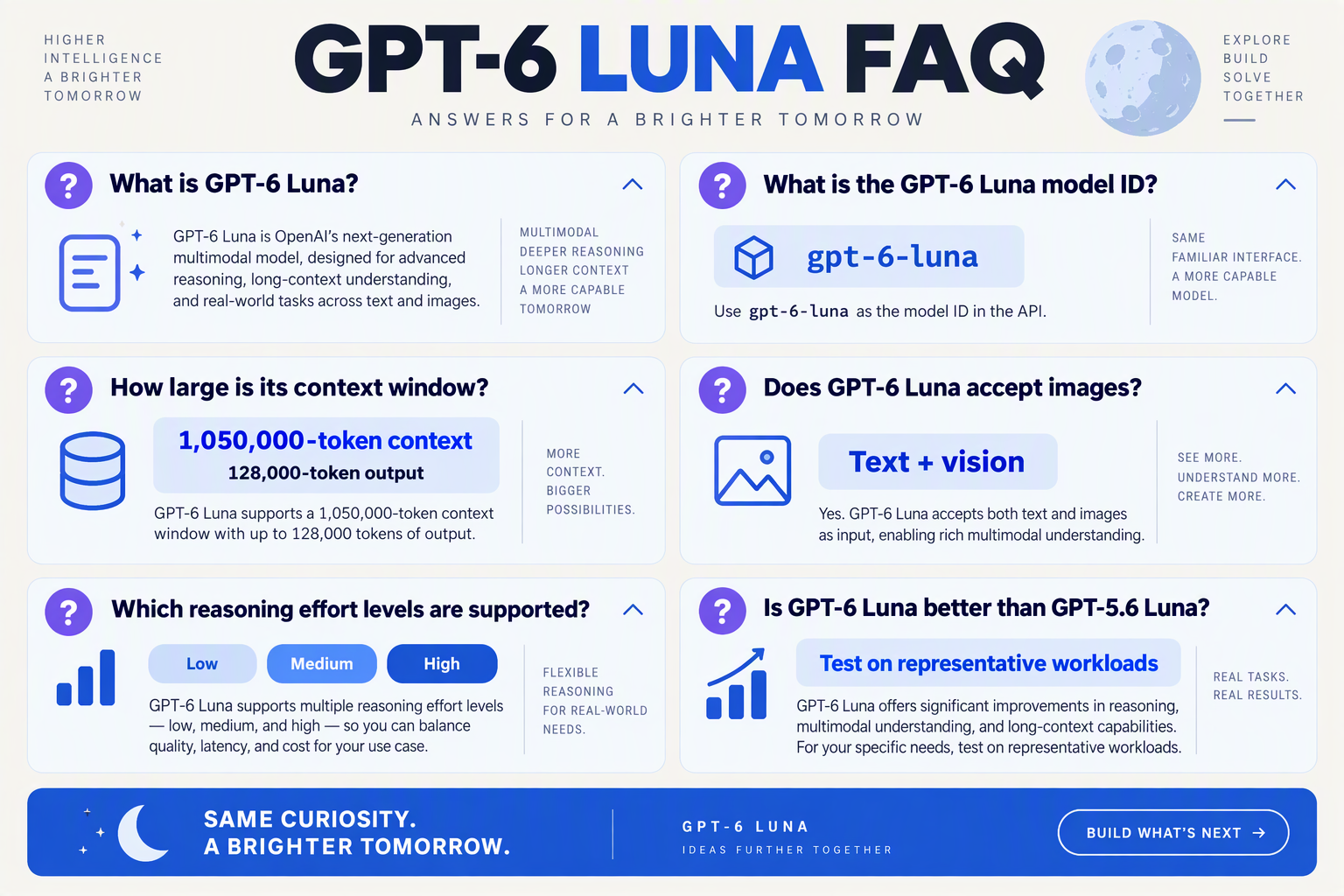
What is GPT-6 Luna, and when was it released?
gpt-6-luna.What are the GPT-6 Luna context window and maximum output limits?
Which reasoning-effort settings does GPT-6 Luna support?
Which workloads are the best fit for Luna?
Is Luna available in ChatGPT or only through an API?
v1/chat/completions and v1/responses, according to OpenAI’s September 2026 model comparison. OpenAI recommends the Responses API when an application needs built-in tools and function calling.How can developers access GPT-6 Luna through CallMissed?
gpt-6-luna in the CallMissed playground or call it through CallMissed’s OpenAI-compatible API, changing the base URL and credentials in an existing OpenAI SDK integration. CallMissed provides one API key and balance across a catalogue of 138 models, with streaming, function calling, structured outputs, vision input, reasoning-effort control, fallback models, and request logs. Default per-key limits range from 60 requests per minute on Free to 10,000 on Enterprise, although applications should still load-test their specific request sizes and concurrency patterns.Conclusion
GPT-6 Luna’s significance lies in combining long-context reasoning with controls designed for high-volume, cost-sensitive production workloads. Rather than applying maximum computation to every prompt, teams can match reasoning effort—and therefore resource use—to each task.
The key takeaways are:
- GPT-6 Luna launched on September 22, 2026. OpenAI introduced the model alongside GPT-6 Sol as an expansion of the GPT-6 family following GPT-6 Astra.
- The model is built for scale. OpenAI describes GPT-6 Luna as its “most efficient model for focused, high-volume tasks,” making it relevant to repeated workflows such as ticket classification, document extraction, catalogue enrichment, compliance checks, and code analysis.
- GPT-6 Luna supports unusually large workloads. OpenAI’s September 2026 documentation specifies a 1,050,000-token context window and a maximum output of 128,000 tokens, creating room for large repositories, extensive document collections, and long-running agent state.
- Developers can tune the reasoning depth. As of September 2026, the GPT-6 Luna API supports none, low, medium, high, xhigh, and max reasoning-effort settings, with medium as the default. The exact model ID is
gpt-6-luna, while OpenAI recommends the Responses API for built-in tools and function calling.
CallMissed’s OpenAI-compatible developer API provides a practical route for integrating OpenAI models through existing SDKs by changing the base URL and credentials. The broader CallMissed catalogue spans 138 models under one API key and balance as of September 2026, which also gives developers options for caller-selected fallback models, structured outputs, streaming, and response caching.
What comes next will matter more than the launch announcement itself. Teams should watch real production behavior across long-context accuracy, reasoning-effort settings, tool reliability, output-token consumption, and total cost per completed task—not merely the advertised token price. The strongest deployments will likely route routine transformations through lighter reasoning while reserving high, xhigh, or max for decisions where additional computation creates measurable value.
Explore the evolving model ecosystem through CallMissed—then ask: which parts of your current AI workload genuinely need maximum reasoning, and which could scale more efficiently with GPT-6 Luna?
Related Reading
- GPT-5.6 Luna vs GPT-6 Luna: API Pricing & Model IDs
- GPT-6 Sol and Luna API Guide: Model IDs & Pricing
- GPT-6 Sol API Guide: Pricing, Context Window and Setup
Sources
Discussion
Ready to automate customer conversations?
Launch AI voice agents and WhatsApp bots with CallMissed — one API, 22+ Indian languages.