
GPT-6 Sol API Guide: Pricing, Context Window and Setup



Learn confirmed GPT-6 Sol availability, API setup, pricing, context limits, multimodal features, migration steps, use cases and risks.
GPT-6 Sol API Guide: Pricing, Context Window and Setup
How can GPT-6 Sol already have a documented GPT-6.1 Sol successor while some OpenAI pages still reference GPT-5.6 Sol? That naming overlap makes a carefully sourced GPT-6 Sol API guide essential for developers and business buyers deciding what is released, what is accessible, and what remains unconfirmed as of September 2026.
OpenAI’s official model documentation describes GPT-6 Sol as “built for complex coding and agentic workflows” and specifies gpt-6-sol as the model identifier for API requests. OpenAI’s release index also lists GPT-6 Sol and GPT-6 Luna as models intended to bring frontier intelligence into everyday work, while the company positions Sol toward higher-capability tasks and Luna toward a different balance of capability and cost.
However, a model appearing in official documentation does not automatically answer the questions that matter in production. Availability may depend on the API account, deployment region, service tier, endpoint, or feature being used. OpenAI’s separate GPT-6.1 Sol documentation, for example, explicitly mentions US and EU data residency and says Fast mode is unavailable with EU data residency—an important reminder that model access and operating modes can vary by configuration.
Why does GPT-6 Sol matter now?
GPT-6 Sol arrives as AI development shifts from isolated chat prompts to long-running, tool-using agents that write code, inspect files, search systems, and complete multi-step business processes. In that environment, buyers must evaluate more than headline intelligence:
- Input and output token pricing, including any cached-input rates
- The officially supported context window and maximum output
- Text, image, audio, and other multimodal inputs
- Function calling, structured outputs, web search, and agentic tool use
- Coding and reasoning performance under realistic workloads
- Latency, data residency, safety controls, and migration complexity
The API ecosystem is also becoming increasingly model-agnostic. As of September 2026, CallMissed, the OpenAI-compatible AI gateway, provides one API key and balance for 138 models, including 42 general-purpose large language models, illustrating how teams can evaluate new OpenAI models without designing every application around a single provider.
What will this guide verify?
This guide separates officially confirmed GPT-6 Sol facts from assumptions, leaked specifications, and details that OpenAI has not publicly documented. It will provide a quick-answer summary, facts table, setup walkthrough, practical API example, pricing analysis, context-window details, and coverage of multimodal input, tool calling, coding, reasoning, safety, limitations, and ideal use cases.
Most importantly, the guide will treat unavailable specifications as unconfirmed rather than filling gaps with estimates. That distinction matters when a small difference in token price, context capacity, or tool support can materially change the cost and architecture of a production AI system.
What is GPT-6 Sol, and is it officially available?
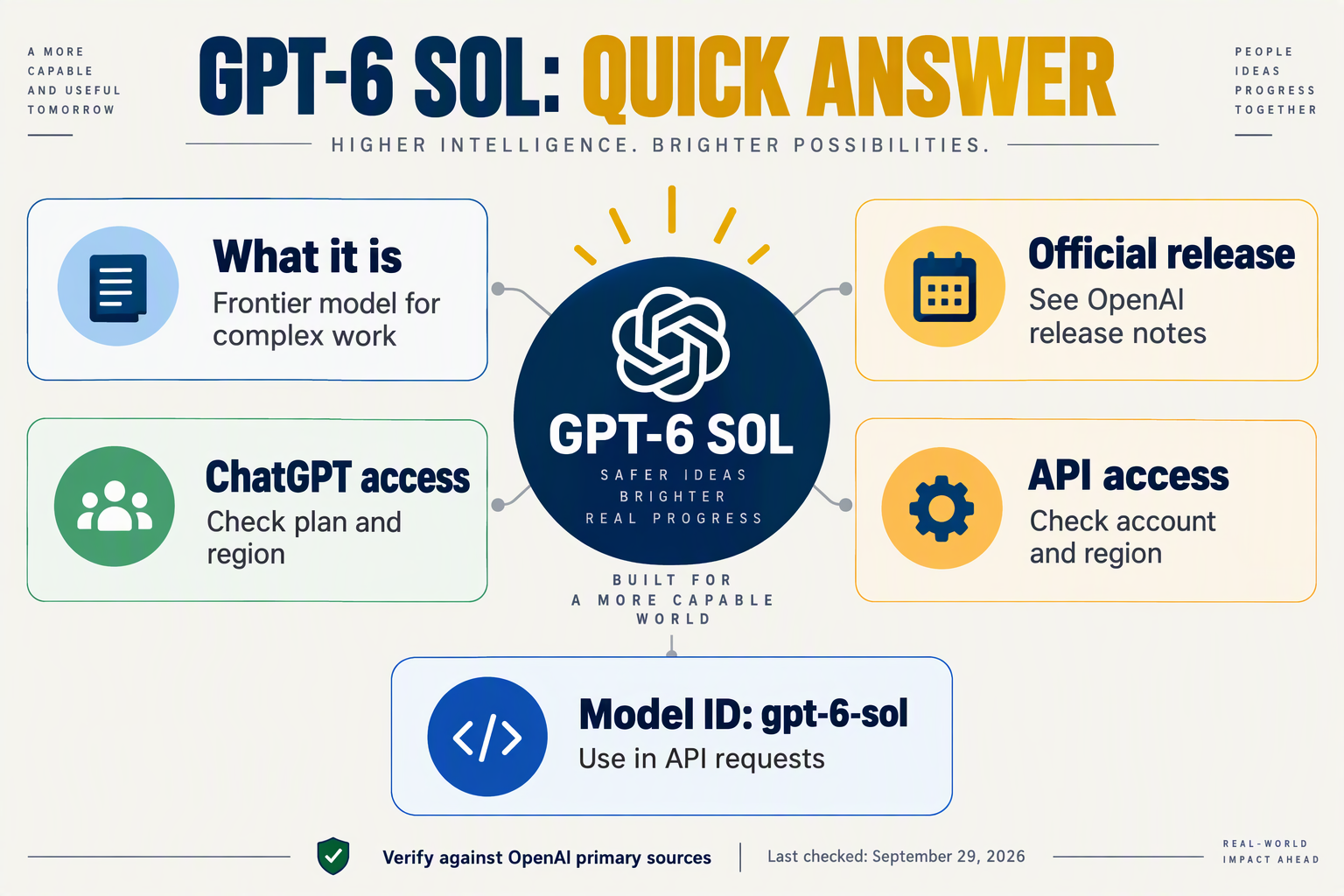
GPT-6 Sol is an officially announced OpenAI model designed for complex coding and agentic workflows. As of September 2026, OpenAI documents gpt-6-sol for API requests, but the available primary sources do not establish that every API account, region, cloud deployment, or ChatGPT plan can access it.
Is GPT-6 Sol an official OpenAI release?
Yes. Three OpenAI sources confirm the model’s official status:
- OpenAI’s “Introducing GPT-6 Sol and Luna” announcement presents both models as ways to bring frontier intelligence into everyday work.
- The OpenAI Research release index, available as of September 2026, lists GPT-6 Sol and GPT-6 Luna with different balances of capability and cost.
- The OpenAI developer documentation states that GPT-6 Sol is “built for complex coding and agentic workflows” and instructs developers to use
gpt-6-solin API requests.
Together, these sources provide stronger confirmation than a leak, benchmark screenshot, cached search result, or third-party model catalogue. GPT-6 Sol should therefore be treated as a released and documented OpenAI model, not a rumoured codename.
However, “released” and “universally accessible” are different claims. OpenAI’s model page confirms an API identifier, but the supplied documentation does not say that access is automatically enabled for every organization.
Is GPT-6 Sol available through the API?
OpenAI officially specifies gpt-6-sol as the API model identifier as of September 2026. Developers with an eligible account should verify access directly rather than assuming that documentation guarantees availability.
A reliable validation process is:
- Check whether
gpt-6-solappears in the models available to the target API project. - Send a minimal request through the endpoint recommended in OpenAI’s current documentation.
- Confirm that the request succeeds under the intended organization, project, region, and service tier.
- Test required features—such as tools, structured output, streaming, or multimodal input—individually before production deployment.
An “unknown model,” permission, or regional error does not prove that GPT-6 Sol is unofficial. It may indicate staged access, an account restriction, an unsupported endpoint, or a deployment-specific limitation.
Is GPT-6 Sol available in ChatGPT?
The supplied primary sources do not conclusively confirm GPT-6 Sol availability in specific ChatGPT plans. OpenAI’s announcement describes everyday-work use, while its developer page explicitly confirms API usage; neither excerpt provides a plan-by-plan ChatGPT access matrix.
This distinction is especially important because the OpenAI Help Center separately documents GPT-5.6 Sol and GPT-5.6 Sol Pro in ChatGPT. Those names should not be treated as aliases for GPT-6 Sol without explicit OpenAI confirmation.
Why do GPT-5.6 Sol and GPT-6.1 Sol appear at the same time?
OpenAI’s documentation reflects multiple model generations and product surfaces. As of September 2026, OpenAI separately identifies:
gpt-5.6-solgpt-6-solgpt-6.1-sol
The GPT-6.1 Sol API page also states that it supports US and EU data residency, while Fast mode is unavailable with EU data residency. That does not invalidate GPT-6 Sol; it shows why buyers must evaluate an exact model identifier and deployment configuration rather than relying on the shared Sol family name.
How did GPT-6 Sol emerge, and where does it fit in OpenAI’s model lineup?

GPT-6 Sol emerged from OpenAI’s role-based model strategy, in which names such as Sol, Luna, Terra, and Astra indicate different capability and cost profiles. As of September 2026, OpenAI positions GPT-6 Sol as the GPT-6 option for complex coding and agentic workflows, while GPT-6 Luna targets a different balance of capability and cost.
What is the lineage from GPT-5.6 Sol to GPT-6 Sol?
OpenAI first used Sol within the GPT-5.6 family. OpenAI’s GPT-5.6 preview described three distinct roles:
- GPT-5.6 Sol: the flagship model
- GPT-5.6 Terra: a balanced model for everyday work
- GPT-5.6 Luna: a fast, affordable option
OpenAI stated that GPT-5.6 Terra offered performance competitive with GPT-5.5 while being 2× cheaper, according to its GPT-5.6 preview available as of September 2026. That comparison illustrates the portfolio logic: model selection was based not simply on generation number, but on the required balance among capability, speed, and cost.
The same role-based naming continued into GPT-6. OpenAI’s release announcement presents GPT-6 Sol and GPT-6 Luna as two ways to bring frontier intelligence into everyday work. However, OpenAI has not publicly confirmed that GPT-6 Sol is architecturally derived from GPT-5.6 Sol, so “successor” should describe its product position, not an assumed technical lineage.
Where does GPT-6 Sol sit beside Astra and Luna?
The clearest interpretation of OpenAI’s published lineup as of September 2026 is:
- GPT-6 Astra occupies the top end for the most demanding work. OpenAI called Astra “the most intelligent and aligned model in the world” when introducing the broader GPT-6 lineup.
- GPT-6 Sol focuses on high-capability production workloads, particularly software development and agents.
- GPT-6 Luna provides another capability-cost balance for everyday work.
OpenAI’s API documentation gives GPT-6 Sol the concise description “built for complex coding and agentic workflows.” That wording suggests a practical specialization: Sol is intended for applications that must plan, generate or modify code, call tools, and execute multi-step tasks—not merely produce conversational answers.
This positioning does not establish precise performance gaps between Astra, Sol, and Luna. Without directly comparable official benchmarks, buyers should not assume that Sol is uniformly better than Luna or that Astra is preferable for every workload; latency, price, tool reliability, and task-specific accuracy can change the decision.
Why do GPT-5.6 Sol and GPT-6.1 Sol appear at the same time?
OpenAI’s documentation surfaces can describe different product generations simultaneously. As of September 2026:
- The OpenAI Help Center still describes GPT-5.6 Sol for coding, research, cybersecurity, science, computer use, and design.
- The OpenAI API catalog documents GPT-6 Sol under the identifier
gpt-6-sol. - A separate API page documents GPT-6.1 Sol under
gpt-6.1-sol. - OpenAI states that GPT-6.1 Sol supports US and EU data residency, but its Fast mode is unavailable with EU data residency.
These entries confirm that the names exist in official OpenAI materials, but they do not prove identical availability across ChatGPT, the API, regions, or account tiers. Developers should therefore treat the model identifier returned by their account’s model-discovery workflow as the operational source of truth, while viewing product announcements as portfolio context.
Which GPT-6 Sol release, access and specification details are confirmed?
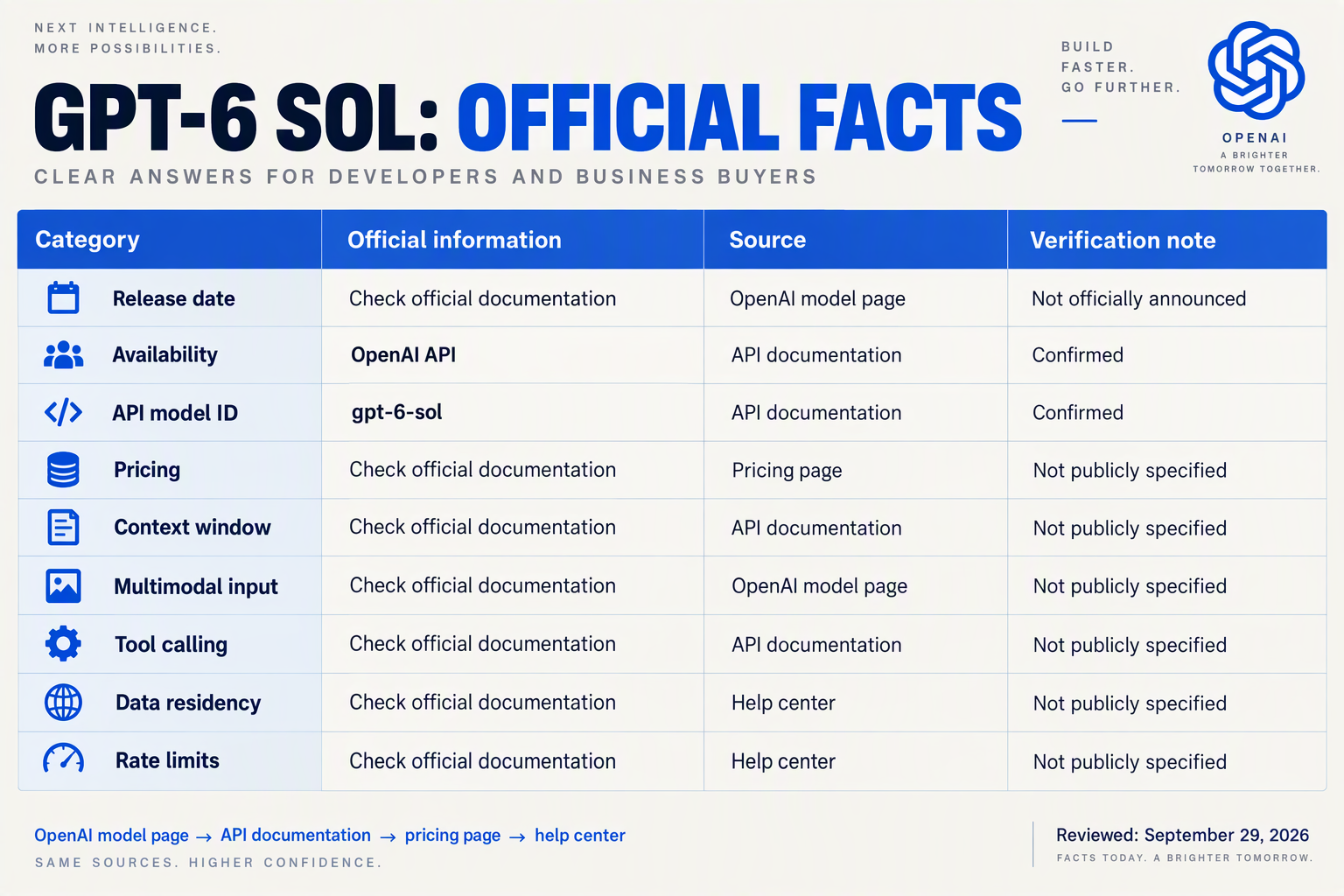
OpenAI has confirmed GPT-6 Sol as a released model with an official API identifier, but the supplied primary sources do not confirm universal account access, pricing, context capacity, maximum output, or supported multimodal formats. As of September 2026, production buyers should treat those missing specifications as unconfirmed rather than extrapolating from GPT-5.6 Sol or GPT-6.1 Sol.
What GPT-6 Sol information has OpenAI officially confirmed?
| Detail | Status as of September 2026 | Official evidence | Practical implication |
|---|---|---|---|
| Model release | Confirmed | OpenAI’s announcement is titled “Introducing GPT-6 Sol and Luna,” and the OpenAI Research release index lists both models. | GPT-6 Sol is an announced product, not merely a leak or rumored codename. |
| Intended workload | Confirmed | OpenAI’s API documentation calls GPT-6 Sol “built for complex coding and agentic workflows.” | Evaluate it for software engineering and multi-step agents, not just conversational tasks. |
| API model identifier | Confirmed | OpenAI Developer documentation instructs developers to use gpt-6-sol. | Applications should request this exact identifier when access is available. |
| Account and regional availability | Not fully confirmed | The cited GPT-6 Sol page does not specify account tiers, regions, rollout percentages, or residency options. | Verify access inside the target production account and deployment region. |
| Token pricing | Not confirmed in the supplied sources | No official input, cached-input, or output token rates appear in the provided GPT-6 Sol material. | Do not build a cost forecast from GPT-5.6 or GPT-6.1 pricing. |
| Context and multimodality | Not confirmed in the supplied sources | The cited documentation excerpt gives no context-window, output-limit, image, audio, or video specifications. | Test only documented modalities and limits before committing an architecture. |
Does an API model page mean every developer can access GPT-6 Sol?
No. An official model page and model ID confirm that GPT-6 Sol is an API product, but they do not establish that every organization, project, region, or service tier can invoke it immediately.
Developers should verify availability using the actual account intended for production:
- Check whether
gpt-6-solappears in the account’s available model list or console. - Send a minimal request using the documented model identifier.
- Record any permission, regional, endpoint, or tier restriction returned by the API.
- Repeat the check in staging and production because project entitlements may differ.
- Obtain written confirmation for residency or compliance requirements rather than assuming successor-model policies apply.
Can GPT-6.1 Sol specifications be applied to GPT-6 Sol?
No—specifications for GPT-6.1 Sol should not automatically be attributed to GPT-6 Sol. OpenAI Developer documentation states that GPT-6.1 Sol supports US and EU data residency and that Fast mode is unavailable with EU data residency, but those statements belong specifically to gpt-6.1-sol.
The documented successor also does not prove that GPT-6 Sol has been deprecated. OpenAI may keep multiple generations available for compatibility, cost, latency, or regional reasons; the supplied sources do not establish a retirement date.
Similarly, OpenAI’s Help Center describes GPT-5.6 Sol as a separate model for coding, research, cybersecurity, science, computer use, and design. The shared “Sol” label indicates product-family positioning—not interchangeable API identifiers, prices, limits, or capabilities.
How do developers access the GPT-6 Sol API and make a first call?
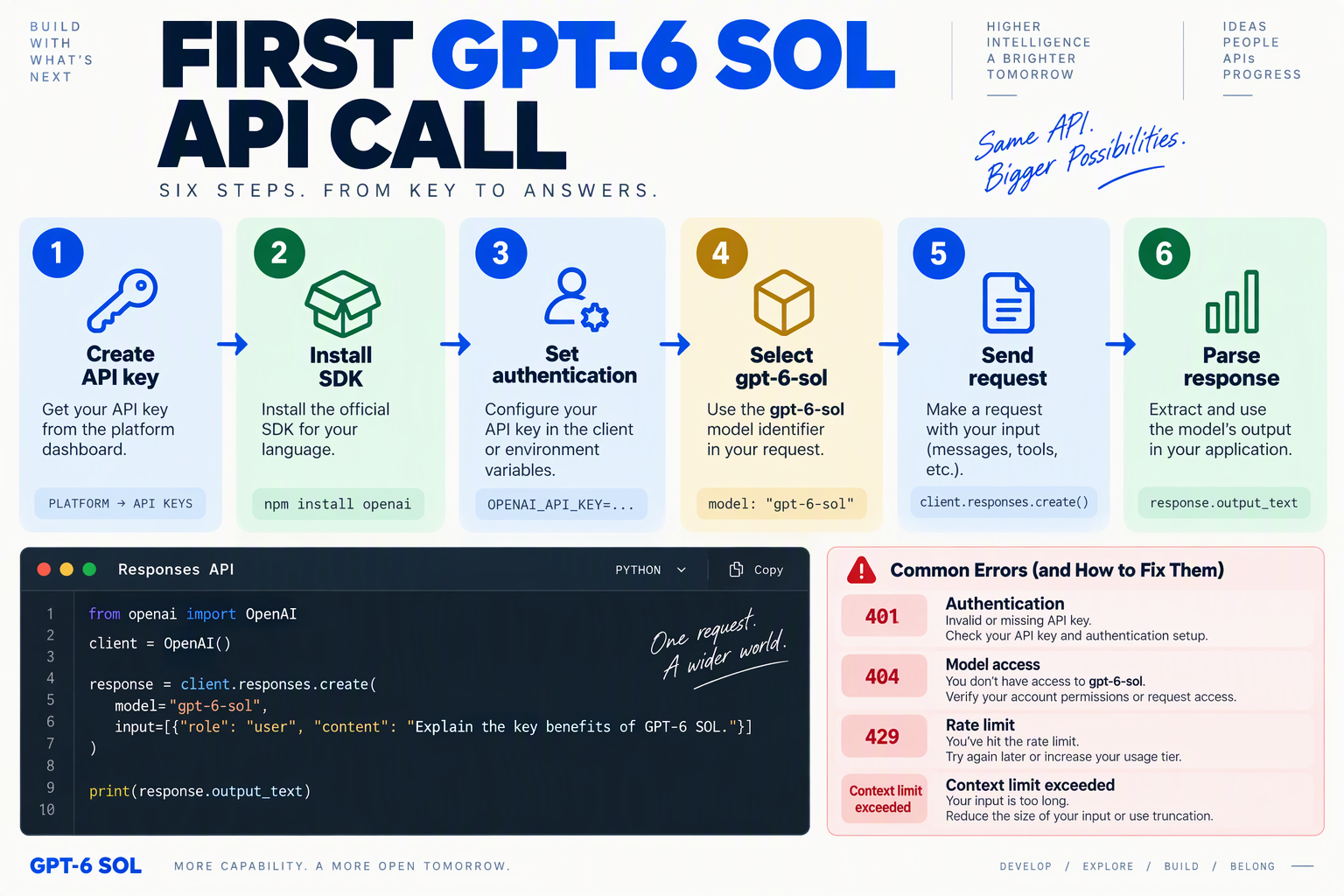
Developers access GPT-6 Sol through the OpenAI API using the model identifier gpt-6-sol. As of September 2026, OpenAI’s official model documentation says, “Use gpt-6-sol in your API requests,” but developers should still verify account, region, endpoint, and service-tier access before planning a production deployment.
What do you need before calling GPT-6 Sol?
Set up an OpenAI Platform account, create an API key, and enable billing or appropriate organizational credits. Store the key in an environment variable rather than embedding it in source code:
export OPENAI_API_KEY="your_api_key_here"API availability and ChatGPT availability are separate considerations. Access to a model in a ChatGPT workspace does not necessarily confirm that the same organization can call it through the API.
Before integration, confirm:
gpt-6-solappears among the models available to your API project.- The project has sufficient usage limits and billing enabled.
- Your selected endpoint supports the required tools and input types.
- Regional processing and data-residency settings meet company policy.
- Your application can handle rate limits, timeouts, and model-access errors.
This verification matters because OpenAI’s GPT-6.1 Sol documentation explicitly distinguishes US and EU data residency and states that Fast mode is unavailable with EU data residency as of September 2026. OpenAI has not provided the same residency detail in the supplied GPT-6 Sol model-page excerpt, so teams should not assume identical behavior.
How do you make a first GPT-6 Sol API request?
A minimal request can use OpenAI’s Responses API. The following curl example sends a small coding task while keeping the initial test easy to inspect:
curl https://api.openai.com/v1/responses \
  -H "Authorization: Bearer $OPENAI_API_KEY" \
  -H "Content-Type: application/json" \
  -d '{
    "model": "gpt-6-sol",
    "input": "Write a Python function that removes duplicate strings while preserving order."
  }'
OpenAI describes GPT-6 Sol as “built for complex coding and agentic workflows” on its official API model page as of September 2026. Nevertheless, a short deterministic task is preferable for the first call because it isolates authentication and model-access problems from tool orchestration or long-running reasoning.
For Python, install the current OpenAI SDK and make the equivalent request:
pip install --upgrade openaifrom openai import OpenAI
client = OpenAI()
response = client.responses.create(
model="gpt-6-sol",
input="Explain two failure modes of an autonomous coding agent."
)
print(response.output_text)What if the GPT-6 Sol request fails?
Diagnose errors systematically rather than immediately changing the model name:
- 401 authentication error: Check the API key, project, and environment variable.
- 403 access error: Confirm that the organization or project is authorized for GPT-6 Sol.
- 404 model error: Verify the exact identifier
gpt-6-soland account availability. - 429 rate-limit error: Reduce concurrency, add exponential backoff, and inspect project limits.
- Regional or feature conflict: Recheck residency, endpoint, tool, and operating-mode restrictions.
For production, log request IDs, latency, token usage, selected model, and error codes—but never API keys or sensitive prompt content. Also pin the model identifier explicitly and test upgrades separately; OpenAI already documents gpt-6.1-sol as a distinct successor identifier, so silently substituting versions could change behavior, availability, or cost.
How much does GPT-6 Sol cost, and how should you calculate API spend?
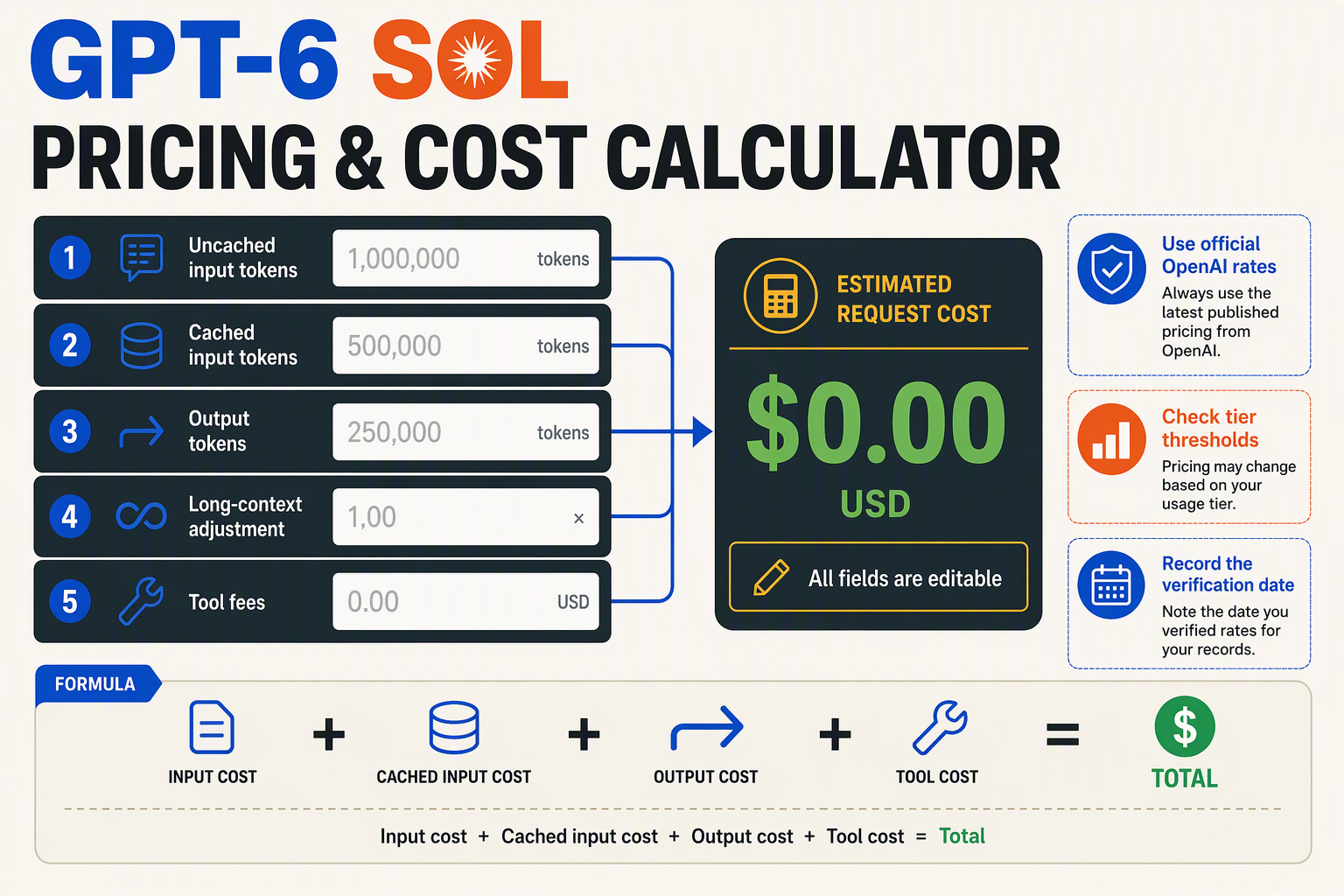
OpenAI’s supplied GPT-6 Sol materials do not confirm exact input-token, cached-input, or output-token prices as of September 2026. Until rates appear on an official OpenAI pricing page or account-specific API console, buyers should treat any third-party dollar figure as unverified and calculate spend with variables rather than borrowing GPT-5.6 Sol or GPT-6.1 Sol pricing.
What is the confirmed GPT-6 Sol API price?
No specific GPT-6 Sol price is stated in the available OpenAI announcement, release index, or model documentation. OpenAI says GPT-6 Sol and GPT-6 Luna provide different balances of “capability and cost,” but that relative positioning is not a published rate card.
Before approving production use, verify pricing for the exact API model identifier, gpt-6-sol, and record:
- Uncached input price per 1 million tokens
- Cached input price, if prompt caching is supported and discounted
- Output price per 1 million tokens
- Whether internal reasoning tokens count as billable output
- Charges for web search, file storage, code execution, audio, images, or other tools
- Batch, priority, flex, reserved-capacity, or regional pricing differences
Do not assume a ChatGPT subscription includes API usage. ChatGPT plans and API billing are generally separate commercial products, so procurement teams should confirm both contracts independently.
How do you calculate GPT-6 Sol token spend?
Use this monthly formula once OpenAI publishes or displays the applicable rates:
Monthly model cost = (uncached input tokens ÷ 1,000,000 × input rate) + (cached input tokens ÷ 1,000,000 × cached rate) + (output tokens ÷ 1,000,000 × output rate)
Then add non-token charges:
Total API spend = model cost + tool calls + search + storage + multimodal processing + service-tier charges
For example, suppose an application processes 80 million uncached input tokens, 120 million cached input tokens, and 20 million output tokens per month. Its model bill would be:
(80 × input rate) + (120 × cached-input rate) + (20 × output rate)This is deliberately a variable-based example: inserting speculative GPT-6 Sol rates would turn a useful forecast into a misleading quote.
Which workload metrics matter most?
Token price alone rarely predicts the final bill. Measure these production variables:
- Tokens per completed task: Include retries, agent loops, tool results, and failed runs.
- Output-to-input ratio: Long code generation and detailed analysis can make output pricing dominant.
- Cache-hit rate: Stable system prompts, schemas, and reference material may reduce repeated-input expense if discounted caching is available.
- Agent step count: A five-step workflow can invoke the model five or more times for one user request.
- Success-adjusted cost: Divide total spend by successfully completed tasks, not raw requests.
A model costing more per token can still be economical if it completes workflows with fewer retries or less human review. Conversely, routing simple extraction or classification jobs to a lower-cost model may materially reduce blended spend.
How should businesses set a GPT-6 Sol budget?
Run a representative pilot and report median, 95th-percentile, and maximum cost per task. Set hard output limits, cap agent iterations, monitor tool usage, and create alerts at daily and monthly thresholds.
For purchasing decisions, maintain three scenarios—expected traffic, 2× growth, and a retry-heavy stress case. Final budgets should use the rate displayed by OpenAI for the organization’s region, service tier, and account as of the purchase date, because GPT-6 Sol’s public price remains unconfirmed in the supplied official materials as of September 2026.
How do the context window, multimodal inputs and tool calling work?
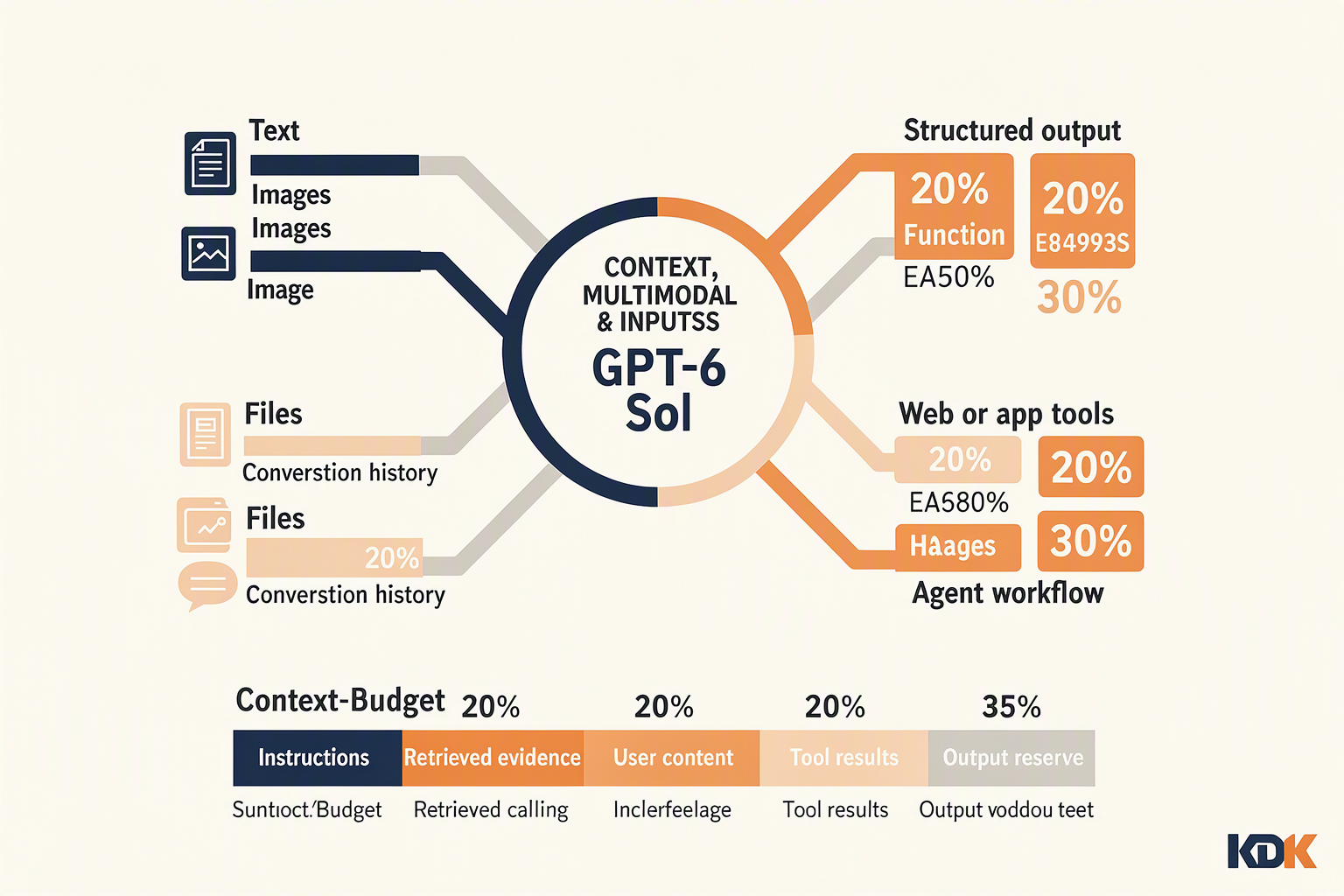
GPT-6 Sol is positioned for long-context, multimodal, tool-using agent workflows, but OpenAI’s publicly indexed documentation does not currently specify its exact context capacity, supported input modalities, or complete tool compatibility. As of September 2026, developers should treat those details as deployment-specific and unconfirmed until they appear in the model page or account-level API metadata.
What is the GPT-6 Sol context window?
A context window is the total token budget available for a request, potentially including instructions, conversation history, source documents, tool definitions, tool results, image representations, and generated output. OpenAI’s GPT-6 Sol model page identifies gpt-6-sol and describes the model as “built for complex coding and agentic workflows,” but the supplied official documentation does not publish a numerical context-window or maximum-output limit as of September 2026.
Do not infer GPT-6 Sol’s limit from GPT-5.6 Sol, GPT-6 Astra, or GPT-6.1 Sol. Related model names do not guarantee identical capacities.
Until OpenAI confirms the limits, production applications should:
- Count tokens before sending large repositories or document collections.
- Reserve output capacity rather than filling the entire available context.
- Retrieve only relevant passages through retrieval-augmented generation (RAG).
- Summarize completed agent steps and discard redundant tool output.
- Test the actual deployment for over-limit errors and truncation behavior.
A larger context window can reduce retrieval steps, but it does not automatically improve accuracy. Long prompts increase cost and can bury important instructions among irrelevant material.
Which multimodal inputs does GPT-6 Sol accept?
The official sources supplied here do not enumerate whether GPT-6 Sol accepts images, audio, video, or files directly. Consequently, text support is implied by its coding and agentic positioning, while every non-text modality should remain marked unconfirmed until OpenAI documents the corresponding request format.
Before designing a multimodal workflow, verify four separate capabilities:
- Whether the model accepts the modality as input.
- Whether it can return that modality or only produce text.
- Which endpoint, MIME types, file sizes, and encoding methods are supported.
- Whether modality-specific tokens or processing carry separate prices.
For example, an invoice agent may need image understanding, structured JSON output, and a separate OCR fallback. A voice assistant may instead require speech-to-text and text-to-speech models around GPT-6 Sol rather than native audio processing. “Multimodal” should never be treated as a single yes-or-no feature.
How does tool calling work with GPT-6 Sol?
OpenAI’s description of GPT-6 Sol as designed for agentic workflows indicates that tool use is central to its intended role, but it does not by itself confirm every function-calling feature or built-in tool. Developers should verify support for function calling, structured outputs, web search, code execution, and remote tool protocols individually.
A typical tool loop works as follows:
- The application sends instructions plus a schema describing an allowed function.
- GPT-6 Sol proposes a tool name and structured arguments.
- Application code validates permissions and executes the function.
- The tool result returns to the model for interpretation.
- GPT-6 Sol produces an answer or requests another approved tool.
The model should never receive unrestricted authority simply because it can call tools. Production systems need schema validation, least-privilege credentials, confirmation gates for consequential actions, timeouts, audit logs, and limits on repeated calls. For business buyers, these controls matter as much as model intelligence because tool access can affect customer records, payments, source code, and external communications.
How capable is GPT-6 Sol at coding and reasoning, and what are its safety limits?
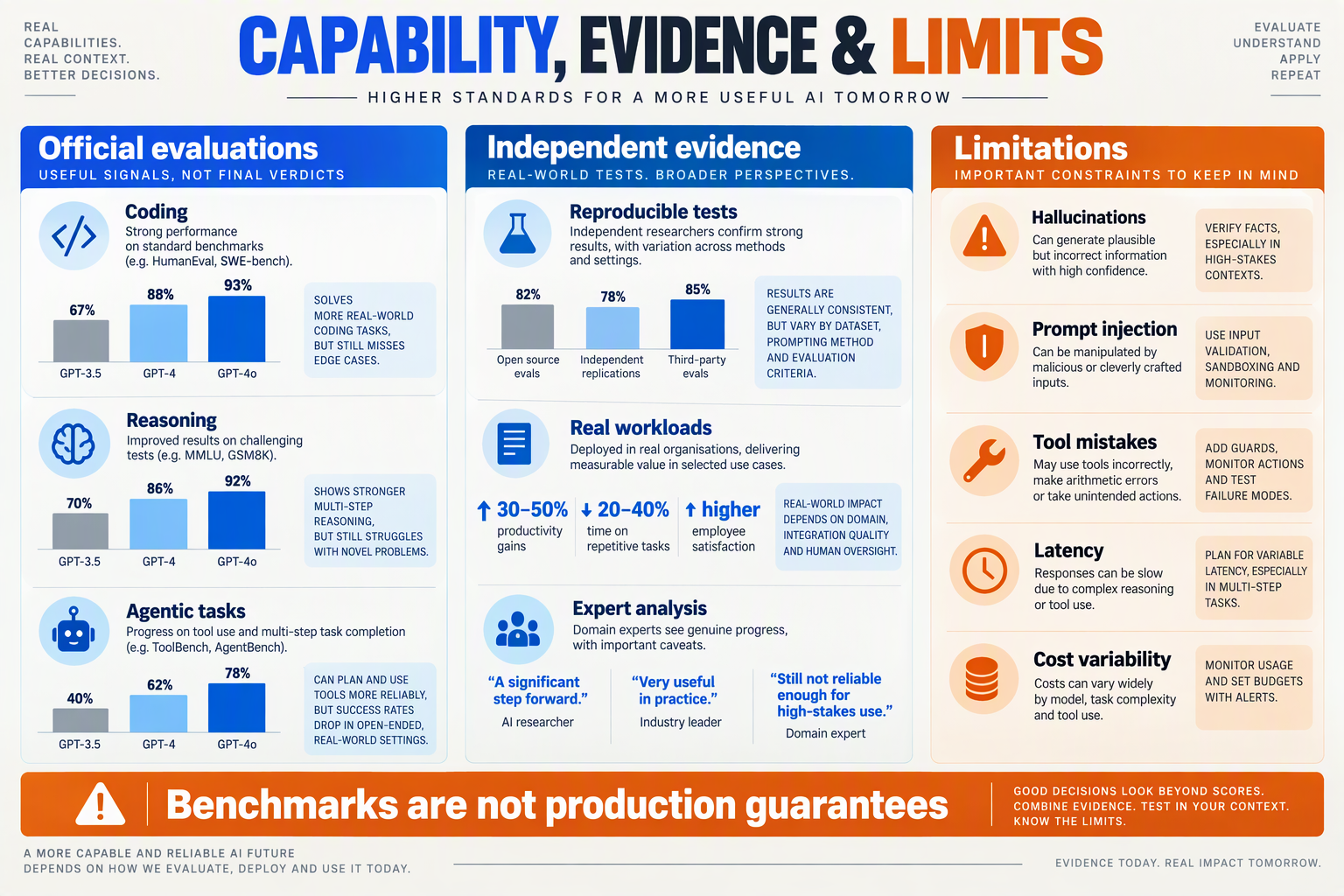
GPT-6 Sol is officially positioned for demanding coding and agentic work, but the available OpenAI sources do not provide benchmark scores or quantified safety results. As of September 2026, buyers should treat its comparative coding performance, reasoning reliability, and refusal rates as unconfirmed until OpenAI publishes reproducible evaluations.
How strong is GPT-6 Sol at coding?
OpenAI’s GPT-6 Sol model documentation identifies complex coding and agentic workflows as target workloads. However, OpenAI’s cited September 2026 materials do not report GPT-6 Sol results for benchmarks such as SWE-bench Verified, LiveCodeBench, Terminal-Bench, HumanEval, or Aider’s polyglot benchmark.
That leaves several important questions unanswered:
- How often does GPT-6 Sol resolve real GitHub issues without human intervention?
- Does it outperform GPT-5.6 Sol on unfamiliar repositories?
- How reliably can it run tests, diagnose failures, and revise a patch?
- Does performance decline during long, multi-file coding sessions?
- What are its latency and cost trade-offs at higher reasoning settings?
The absence of published scores does not imply weak performance; it means buyers lack enough evidence for a defensible comparison. A useful internal evaluation should include repository navigation, code generation, debugging, test creation, dependency upgrades, security review, and rollback after a failed change.
How should developers test GPT-6 Sol’s reasoning?
Test complete workflows, not isolated riddles. Agentic reasoning depends on planning, tool selection, state management, and recovery from incorrect assumptions.
A practical evaluation can follow five steps:
- Give GPT-6 Sol a realistic task with incomplete or conflicting requirements.
- Allow only the tools available in production, such as repository search or approved APIs.
- Require structured outputs for plans, tool arguments, and final results.
- inject tool failures, stale documentation, and misleading retrieved content.
- Score correctness, completion rate, tool-call accuracy, cost, latency, and human-review time.
Model-agnostic infrastructure can make these comparisons easier. As of September 2026, CallMissed’s OpenAI-compatible developer API supports structured outputs, function calling, caller-chosen fallback models, and request logs, allowing teams to apply consistent evaluation and observability patterns across supported models without assuming that every new model is automatically available.
What are GPT-6 Sol’s confirmed safety limits?
The cited OpenAI sources do not provide a GPT-6 Sol system card, quantified jailbreak rate, secure-coding score, or detailed prohibited-use evaluation as of September 2026. OpenAI’s description of GPT-6 Astra as its “most intelligent and aligned model” should not be transferred to GPT-6 Sol; the statement names a different model.
Until model-specific evidence is published, production systems should assume that GPT-6 Sol can:
- Generate plausible but incorrect code or explanations
- Follow malicious instructions embedded in files or retrieved pages
- Call an inappropriate tool or supply unsafe arguments
- Expose secrets included in prompts, logs, or tool responses
- Produce insecure code despite confident reasoning
The safest deployment pattern combines least-privilege tool access, schema validation, secret redaction, sandboxed execution, dependency scanning, audit logs, spending limits, and human approval for destructive actions. GPT-6 Sol may accelerate software work, but it should not independently merge code, modify production infrastructure, transfer funds, or access sensitive records without deterministic controls and accountable review.
How should teams migrate to GPT-6 Sol and prepare it for production?
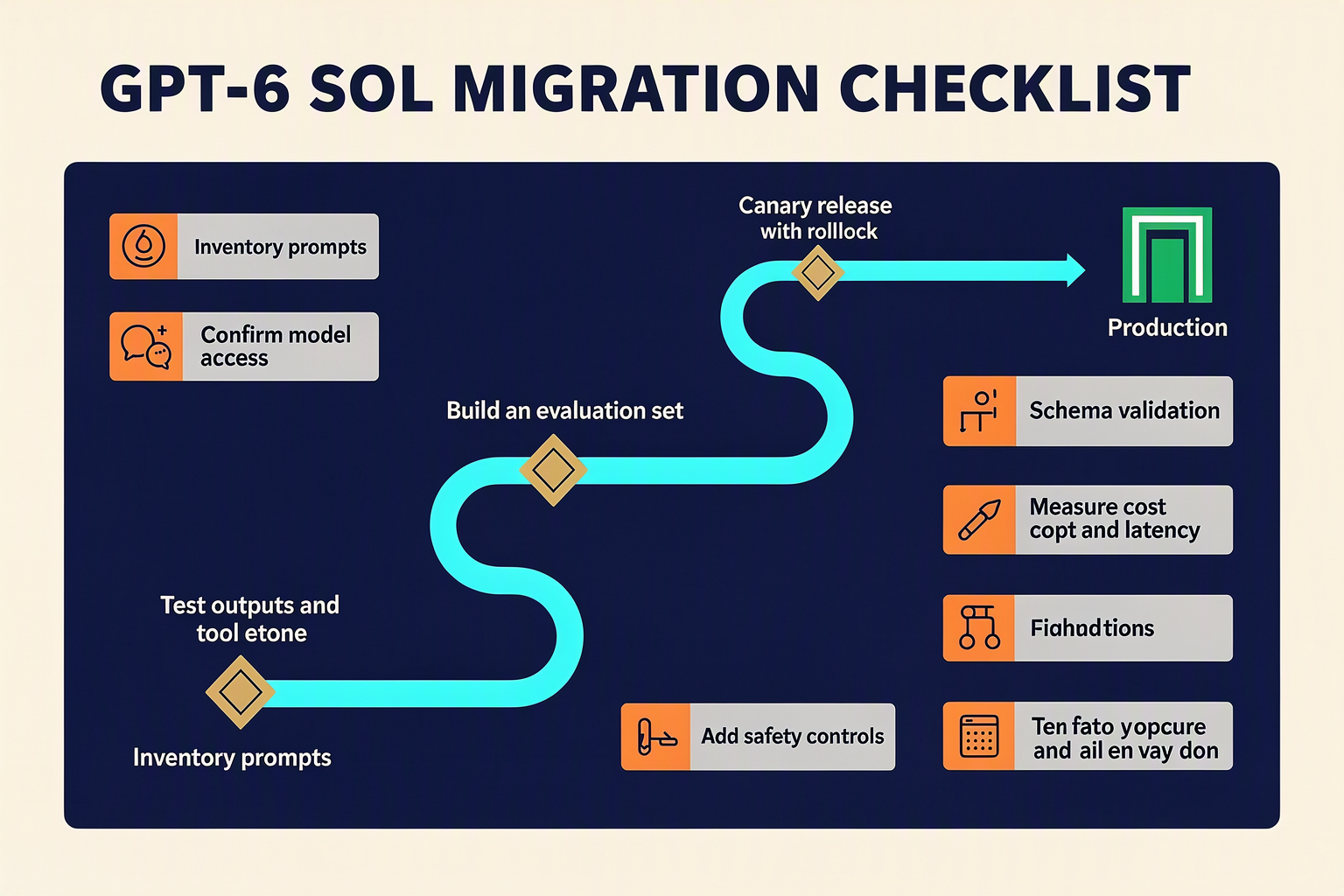
Teams should migrate to GPT-6 Sol through an evaluation-driven, reversible rollout rather than replacing an existing model in one step. Treat gpt-6-sol as a new production dependency: verify account access, benchmark representative workloads, cap spending, test tool failures, and retain a proven fallback.
What should teams verify before migrating to GPT-6 Sol?
OpenAI’s model documentation describes GPT-6 Sol as “built for complex coding and agentic workflows” and specifies gpt-6-sol as the API model identifier as of September 2026. Before changing application code, confirm that this identifier works with the intended account, endpoint, region, service tier, and production project.
Build a migration inventory covering:
- Current models, prompts, system instructions, and reasoning settings
- Expected input, output, and cached-token volumes
- Function definitions, structured-output schemas, and external tools
- Context lengths encountered in real requests—not merely the documented maximum
- Latency targets, retry policies, rate limits, and concurrency peaks
- Data-retention, residency, privacy, and human-approval requirements
Do not transfer specifications from a related model. OpenAI’s GPT-6.1 Sol documentation, for example, confirms US and EU data residency and states that Fast mode is unavailable with EU data residency as of September 2026; those statements should not automatically be treated as GPT-6 Sol capabilities.
How should developers benchmark GPT-6 Sol?
Create a versioned evaluation set from sanitized production traffic. A useful suite should include ordinary requests, high-value workflows, edge cases, adversarial inputs, malformed tool results, and tasks the existing model regularly fails.
Score GPT-6 Sol against the incumbent model on:
- Task quality: correctness, completeness, groundedness, and instruction adherence
- Coding performance: compilation, unit-test pass rate, security defects, and unnecessary changes
- Agent reliability: correct tool selection, argument validity, loop frequency, and task completion
- Structured output: schema-valid response rate and recovery from validation errors
- Operational performance: end-to-end latency, token consumption, error rate, and cost per completed task
- Safety: prompt-injection resistance, sensitive-data handling, and compliance with approval boundaries
Evaluate complete workflows rather than isolated responses. A more expensive request can still reduce total operating cost if it requires fewer retries, tool calls, or human corrections.
What is the safest GPT-6 Sol production rollout?
Use staged deployment with explicit rollback criteria:
- Shadow mode: send copied, non-customer-facing requests to GPT-6 Sol.
- Internal pilot: expose results to employees and trained reviewers.
- Canary release: route a small percentage of eligible traffic to the model.
- Progressive expansion: increase traffic only after quality, cost, and safety gates pass.
- Rollback readiness: preserve the previous model, prompts, and tool schemas as a deployable version.
Pin the exact model identifier instead of silently adopting a newer successor such as gpt-6.1-sol. Log model name, prompt version, tool calls, token usage, latency, errors, and user-visible outcomes for every request.
How can teams avoid provider lock-in during migration?
Keep model selection in configuration, use portable message and tool schemas, and isolate provider-specific parameters behind an adapter. As of September 2026, CallMissed, the OpenAI-compatible AI gateway, provides one API key and balance for 138 models, including 42 general-purpose LLMs, while supporting caller-selected fallback models and request logs. Teams should still verify that GPT-6 Sol is available in their chosen gateway and account before planning deployment around it.
The production decision should ultimately rest on measured business outcomes: cost per resolved task, defect rate, human-review time, and successful workflow completion.
Which GPT-6 Sol use cases fit developers, businesses and AI receptionists?
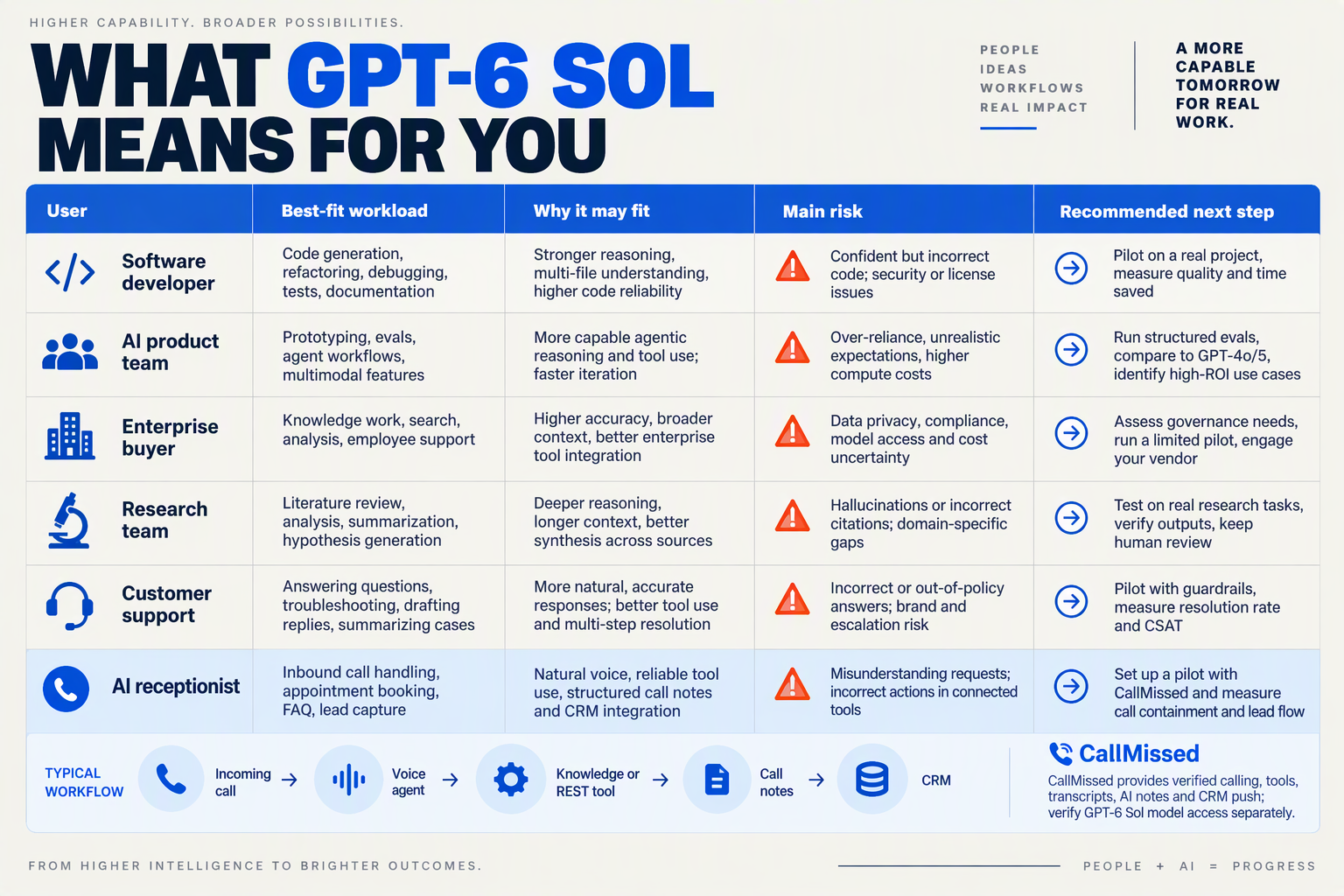
GPT-6 Sol is best matched to complex coding, tool-using agents, and consequential workflows that benefit from deeper reasoning. It is a less obvious default for simple classification, high-volume templated responses, or latency-sensitive voice turns where a smaller or voice-native model may be more economical.
Which workloads are the strongest fit for GPT-6 Sol?
As of September 2026, OpenAI describes GPT-6 Sol as “built for complex coding and agentic workflows.” That official positioning supports the use cases below, but it does not prove that GPT-6 Sol will outperform every alternative on a company’s private data.
| Use case | Primary buyer | GPT-6 Sol fit | Practical implementation |
|---|---|---|---|
| Complex repository coding | Software teams | Strong | Trace dependencies, plan multi-file changes, generate patches, run tests, and request approval before merging |
| Autonomous developer agents | Platform teams | Strong | Connect issue trackers, code search, sandboxes, and CI tools through controlled function calls |
| Multi-step business operations | Operations leaders | Strong | Validate documents, query internal systems, apply policy rules, and return structured decisions |
| Research and knowledge synthesis | Analysts and consultants | Potentially strong | Combine retrieval with source-aware summaries; require citations and human review for critical conclusions |
| Customer-support resolution | Support teams | Selective | Use Sol for difficult cases, tool-based troubleshooting, and escalation summaries rather than every routine message |
| AI receptionist reasoning | Contact-centre teams | Selective | Route calls, inspect CRM context, book appointments, or explain policies while a dedicated speech stack handles audio |
These recommendations are workload hypotheses, not universal rankings. OpenAI’s release index says GPT-6 Sol and GPT-6 Luna offer different balances of capability and cost, so routing easy requests to Luna or another economical model may reduce operating expense without weakening complex cases.
How should developers deploy GPT-6 Sol safely?
Developers should start with bounded, observable tasks rather than granting an agent unrestricted access to production systems. A practical rollout has four stages:
- Build an evaluation set from real coding tickets, support cases, or operational exceptions.
- Require structured outputs so downstream software can validate fields and reject malformed responses.
- Place approval gates before destructive actions such as merging code, issuing refunds, or modifying customer records.
- Measure task completion, correction rate, latency, and total token cost against at least one alternative model.
Tool permissions should follow the principle of least privilege. Read-only search and CRM lookup can be enabled first; payments, account changes, outbound communications, and code deployment should require tighter controls.
Does GPT-6 Sol fit an AI receptionist?
GPT-6 Sol may fit the reasoning and tool-use layer of an AI receptionist, but buyers should not assume that a general-purpose model alone supplies telephony, speech recognition, synthesis, interruption handling, call transfer, or operational monitoring. Those capabilities normally come from a dedicated voice platform.
For example, CallMissed combines voice-agent configuration with custom REST tools, knowledge retrieval, call transcripts, AI call notes, and inbound or outbound calling. As of September 2026, CallMissed also supports speech recognition in 22 Indian languages plus English, including code-mixed speech such as Hinglish; GPT-6 Sol should only be selected within such a stack after confirming model availability and testing end-to-end response time.
The strongest receptionist pattern is tiered routing: use deterministic menus or a faster model for greetings and common questions, invoke GPT-6 Sol for complex policy or tool-based requests, and transfer sensitive or uncertain cases to a person.
Frequently Asked Questions
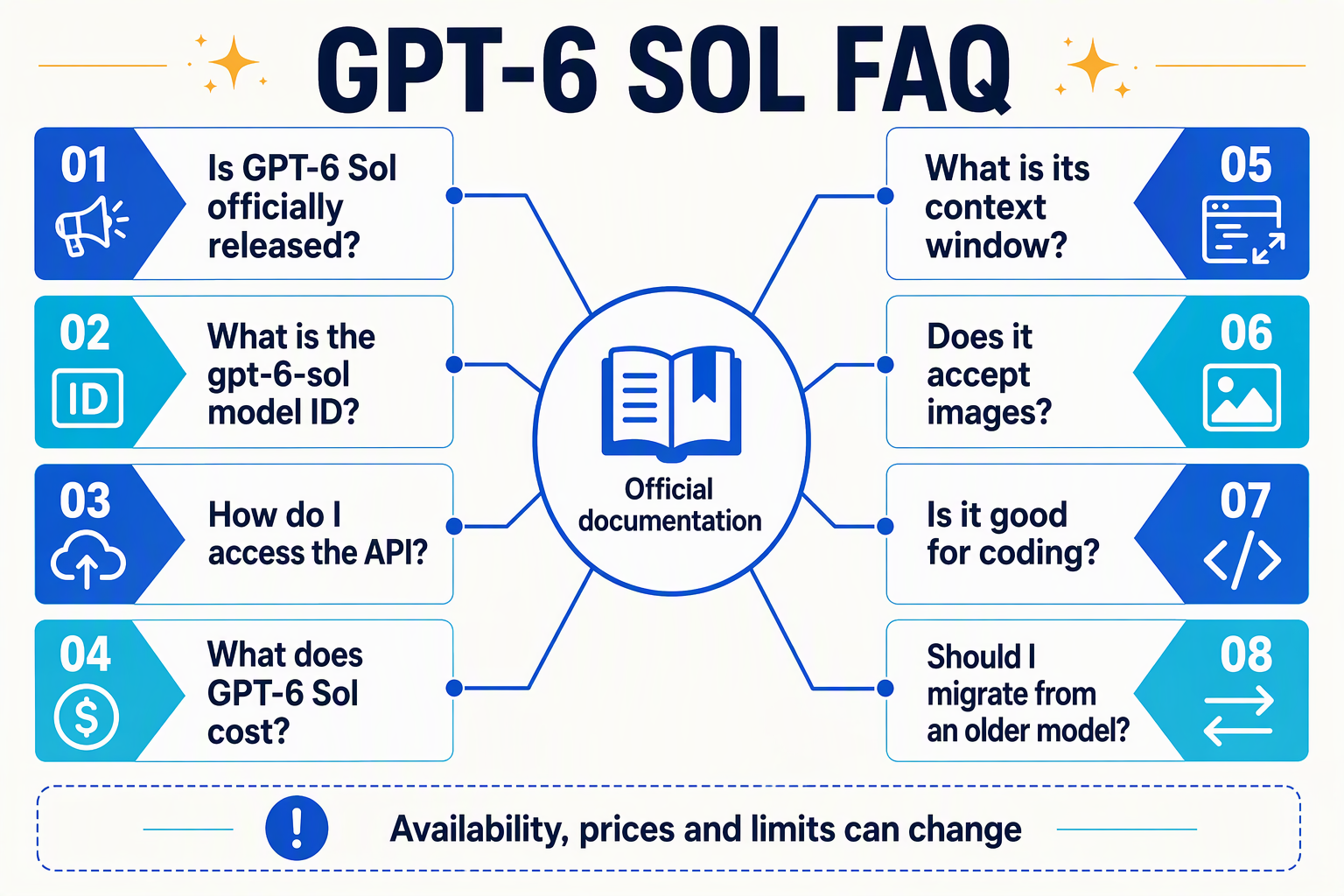
Is GPT-6 Sol officially released and available now?
gpt-6-sol, although actual access can still vary by account, region, service tier, endpoint, and staged rollout status.How do developers access GPT-6 Sol through the OpenAI API?
gpt-6-sol as the model identifier in a supported OpenAI API request, according to OpenAI’s model documentation as of September 2026. Before deploying, verify that the identifier appears in the project’s available-model list and test required features—such as streaming, structured output, function calling, and image input—because a documented model name does not confirm that every capability is enabled for every account.What is the GPT-6 Sol API price per million tokens?
What context window and multimodal inputs does GPT-6 Sol support?
What is the difference between GPT-5.6 Sol, GPT-6 Sol, and GPT-6.1 Sol?
gpt-6.1-sol as a distinct successor supporting US and EU data residency, with Fast mode unavailable under EU data residency, so teams should not silently substitute one model identifier for another.Should businesses migrate production applications to GPT-6 Sol immediately?
Conclusion
GPT-6 Sol is a documented OpenAI model for complex coding and agentic workflows, but production decisions should rely on account-level API checks and official specifications—not naming assumptions. As of September 2026, OpenAI identifies gpt-6-sol as the API model ID, while documentation for GPT-5.6 Sol and GPT-6.1 Sol shows that availability, operating modes, and residency conditions can differ across versions and configurations.
- Separate confirmation from inference. OpenAI’s September 2026 model documentation calls GPT-6 Sol “built for complex coding and agentic workflows,” and OpenAI’s release index lists GPT-6 Sol alongside GPT-6 Luna. Any pricing, context-window, output-limit, or multimodal specification not stated in current primary documentation should remain labelled unconfirmed.
- Test access before planning a migration. A published model page does not guarantee identical access for every API account, region, endpoint, or service tier. Developers should query available models, run a minimal request with
gpt-6-sol, and confirm required features such as structured outputs, function calling, image input, and streaming in their own environment.
- Evaluate total workflow economics. Token prices matter, but so do cached-input rates, output volume, tool calls, latency, reliability, and engineering effort. Business buyers should benchmark representative coding, reasoning, and agentic tasks instead of extrapolating from headline demonstrations.
- Design for model portability. As of September 2026, CallMissed, the OpenAI-compatible AI gateway, offers one API key and balance across 138 models, including 42 general-purpose LLMs. That model-agnostic approach can help teams compare alternatives and reduce integration rewrites as model families evolve.
What comes next may be as important as the initial GPT-6 Sol release. Watch OpenAI’s model documentation, pricing pages, deprecation notices, residency guidance, and GPT-6.1 Sol updates for confirmed changes to access, context capacity, multimodal support, and operating modes.
To explore how flexible AI infrastructure is evolving, check out CallMissed—and ask: is your application architecture ready for the next model change without a costly rebuild?
Related Reading
- GPT-6 Sol and Luna API Guide: Model IDs & Pricing
- GPT-6 Sol vs Claude Opus 5.5: Pricing & API Comparison
- Claude Sonnet 5.5 API Pricing, Context and Access
Sources
Discussion
Related Posts



Ready to automate customer conversations?
Launch AI voice agents and WhatsApp bots with CallMissed — one API, 22+ Indian languages.