GPT-6 Sol API on CallMissed: Model ID and Examples



Learn how to call GPT-6 Sol through CallMissed, compare endpoints, understand its 1.05M context window and plan agent workloads.

GPT-6 Sol API on CallMissed: Model ID and Examples
What if a single model could inspect more than one million tokens of code, documents, and images before producing an answer? The GPT-6 Sol API brings OpenAI’s frontier reasoning model to enterprise agents, software engineering, and complex knowledge work—and it is now available to developers.
As of September 2026, OpenAI documents a 1,050,000-token context window and a 128,000-token maximum output for GPT-6 Sol, giving developers room for large repositories, lengthy research records, and multi-step agent traces in one request. OpenAI’s developer documentation says GPT-6 Sol is “built for complex coding and agentic workflows” and identifies the API model ID as gpt-6-sol.
Why does that matter now? Context size is not merely a leaderboard number: it determines whether an agent can examine an entire working set or must split it across retrieval steps that can lose dependencies. GPT-6 Sol’s combination of text and vision input, configurable reasoning, and tool calling makes it relevant to workflows where the model must understand evidence, decide what to do next, invoke software, and continue from the result. OpenAI’s September 2026 product announcement presents GPT-6 Sol and GPT-6 Luna as models offering “different balances of capability and cost.”
Compared with prior general-purpose GPT releases, GPT-6 Sol is positioned more explicitly around sustained, tool-using work rather than isolated chat responses. That distinction is practical, not cosmetic: a coding agent may need to map a repository, inspect an error image, edit files, run tests through tools, and explain the resulting patch. A knowledge-work agent may need to reconcile contracts, policies, tables, and diagrams while preserving citations and producing a structured deliverable.
This launch guide will show you:
- What GPT-6 Sol is: its maker, modality, reasoning profile, and limits.
- Where it fits: enterprise-agent, coding, research, document-analysis, and visual-understanding use cases.
- How to call it: a practical request using
gpt-6-sol, plus guidance on streaming, tools, structured outputs, and reasoning controls. - What to evaluate: context utilization, output quality, latency, cost, and safeguards for production deployment.
Because CallMissed uses OpenAI-compatible endpoints, OpenAI SDK integrations can switch the base URL and credentials while selecting gpt-6-sol; one API key and balance cover a catalogue of 138 models as of September 2026. The sections ahead focus on implementation decisions rather than hype: selecting prompts that exploit long context, deciding when tools outperform extra reasoning, controlling outputs for downstream systems, and testing model behavior against coding and enterprise knowledge tasks. No invented benchmark can answer whether a frontier model fits your workflow; an evaluation can.
What is GPT-6 Sol, and how can developers access it?
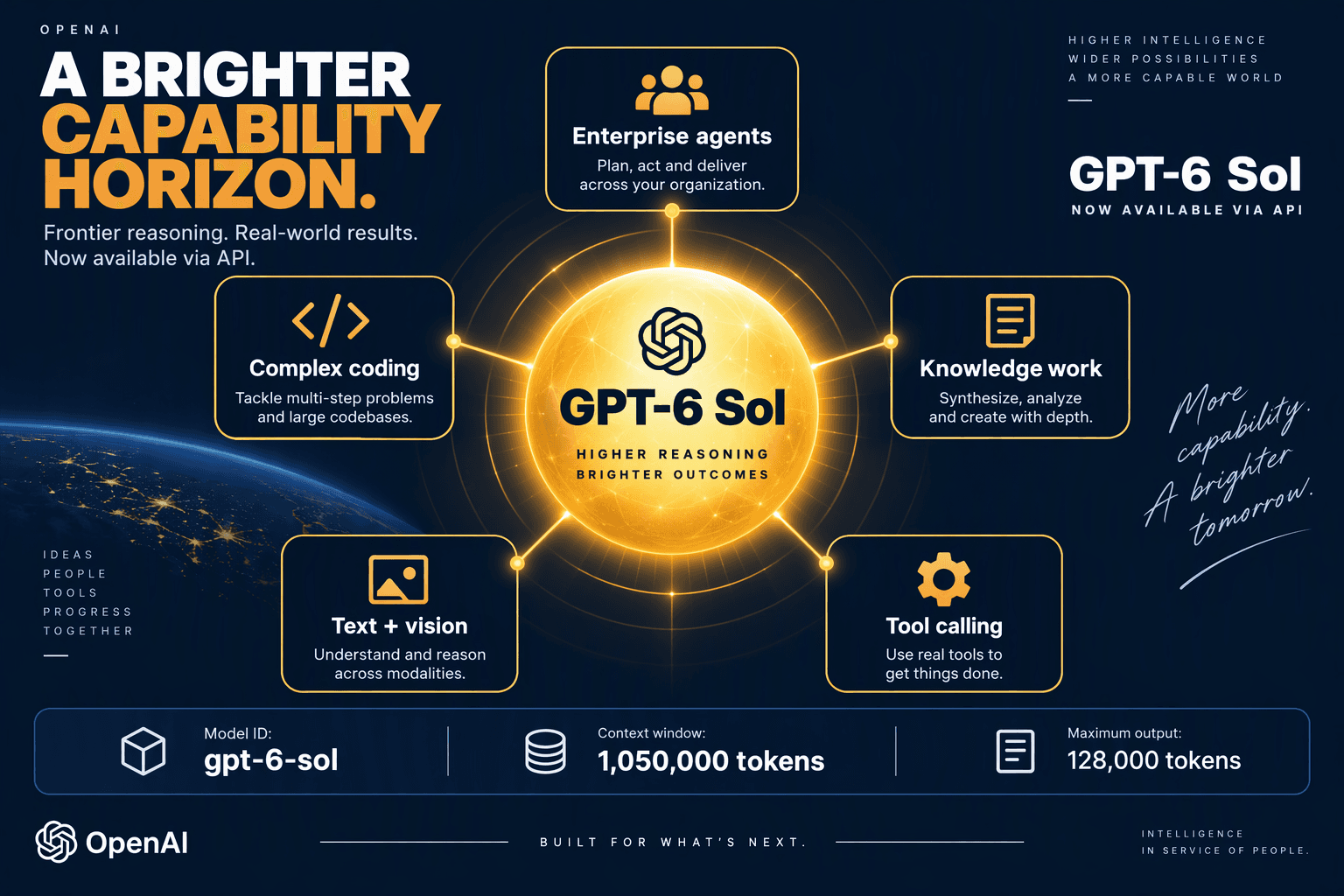
GPT-6 Sol is OpenAI’s frontier reasoning model for long-running coding, enterprise-agent, and complex knowledge workflows. Developers can access the gpt-6-sol model through CallMissed’s OpenAI-compatible API and test prompts in the CallMissed playground as of September 2026.
Who makes GPT-6 Sol, and what is it designed to do?
OpenAI develops GPT-6 Sol as part of the GPT-6 model family. OpenAI’s September 2026 announcement positions GPT-6 Sol and GPT-6 Luna as frontier models offering “different balances of capability and cost,” while OpenAI’s developer documentation describes GPT-6 Sol as “built for complex coding and agentic workflows.”
That positioning makes GPT-6 Sol particularly relevant when a task requires several capabilities together:
- Multimodal analysis: Accept text and vision inputs, such as source files alongside architecture diagrams or error screenshots.
- Sustained reasoning: Work through interdependent evidence instead of answering an isolated question.
- Tool calling: Invoke application functions, databases, search systems, or execution environments and then reason over their results.
- Controlled outputs: Return structured data that downstream software can validate and process.
- Large working sets: Analyze extensive repositories, document collections, or agent histories without fragmenting every task into small prompts.
OpenAI documents a 1,050,000-token context window and a 128,000-token maximum output for GPT-6 Sol as of September 2026. Those limits support unusually large inputs and deliverables, although developers should still retrieve only relevant material because unnecessary tokens can increase cost, latency, and distraction.
How do developers access the GPT-6 Sol API?
CallMissed provides an OpenAI-compatible API, so an application already using the OpenAI Python SDK can generally keep its request structure and change the base URL, credentials, and model selection. CallMissed offers one API key and balance across a catalogue of 138 models as of September 2026, with streaming, function calling, structured outputs, vision input, reasoning-effort control, and caller-selected fallback models.
A minimal Python request looks like this:
import os
from openai import OpenAI

client = OpenAI(
    api_key=os.environ["CALLMISSED_API_KEY"],
    base_url=os.environ["CALLMISSED_BASE_URL"]
)

response = client.responses.create(
    model="gpt-6-sol",
    input="""
    Review the supplied service specification.
    Identify integration risks and return a prioritized remediation plan.
    """
)

print(response.output_text)
To begin:
- Create or open a CallMissed account and obtain an API key.
- Set the CallMissed API base URL shown in the documentation or account configuration.
- Choose
gpt-6-solin the playground or send it as themodelvalue in an API request. - Start with a bounded evaluation, using representative documents, code, images, and tool schemas.
- Log quality, token use, latency, and tool failures before expanding the workflow.
When should developers choose GPT-6 Sol?
GPT-6 Sol is a strong candidate when the model must maintain state across many artifacts and actions—for example, reviewing a monorepo, reconciling policies with contracts, or coordinating a tool-using support agent. For short extraction, classification, or routine chat, teams should also test smaller models; the right production choice depends on measured accuracy, responsiveness, and cost rather than context size alone.
What happened in the GPT-6 Sol announcement?

OpenAI announced GPT-6 Sol alongside GPT-6 Luna in September 2026, positioning the pair as frontier models with “different balances of capability and cost.” The launch also makes the gpt-6-sol model available through the CallMissed OpenAI-compatible API, allowing developers to test and integrate it without adopting a new SDK interface.
What did OpenAI announce with GPT-6 Sol?
The announcement expands the GPT-6 family beyond GPT-6 Astra, which OpenAI introduced earlier in September 2026 for its most demanding workloads. Rather than presenting GPT-6 Sol as a universal replacement, OpenAI describes it as a model designed specifically for complex coding and agentic workflows.
The launch has three practical components:
- A new API model: Developers can select GPT-6 Sol with the model ID
gpt-6-sol. - A work-oriented reasoning profile: OpenAI emphasizes coding, enterprise agents, and complex knowledge work rather than simple conversational tasks.
- Broader product availability: OpenAI’s September 2026 release notes say GPT-6 Sol and GPT-6 Luna are being introduced in ChatGPT Work and Codex, while API access supports custom applications.
This positioning matters because agentic systems require more than fluent text generation. An enterprise agent may need to inspect evidence, maintain a plan, call tools, process the results, and produce an output that another system can reliably consume.
Which GPT-6 Sol capabilities were confirmed?
OpenAI’s developer documentation confirms several specifications that distinguish the model:
- 1,050,000-token context window
- 128,000-token maximum output
- Text and vision input
- Reasoning controls
- Tool calling
- Support for complex coding and agentic workflows
OpenAI documented a 1,050,000-token context window and a 128,000-token maximum output for GPT-6 Sol in September 2026. Those limits make the model relevant to repository-scale analysis, extensive document collections, long agent histories, and deliverables that exceed the practical output capacity of many earlier models.
The multimodal capability is equally important. A developer can design a workflow that combines source code, written requirements, architecture diagrams, screenshots, and other visual evidence instead of creating separate text-only and image-processing pipelines.
How does this announcement change developer access?
The immediate change is that developers have another frontier reasoning option for applications where working-set size and multi-step execution are central constraints. Suitable evaluation scenarios include:
- Tracing dependencies across a large software repository
- Reviewing contracts alongside policies, tables, and scanned exhibits
- Building agents that call internal APIs and continue reasoning from results
- Analyzing screenshots or diagrams alongside technical documentation
- Producing long, structured reports from heterogeneous evidence
As of September 2026, CallMissed provides gpt-6-sol through its OpenAI-compatible developer API. Existing OpenAI SDK integrations can change the base URL and credentials, select the new model ID, and retain familiar capabilities such as streaming, function calling, structured outputs, vision input, reasoning-effort control, and caller-chosen fallback models.
The announcement is therefore less about a larger chatbot and more about a model intended to sustain complicated work across long contexts, multiple modalities, and external tools. The next question for development teams is not whether every task needs GPT-6 Sol, but which workflows benefit enough from those capabilities to justify production deployment.
What are the key GPT-6 Sol specifications?
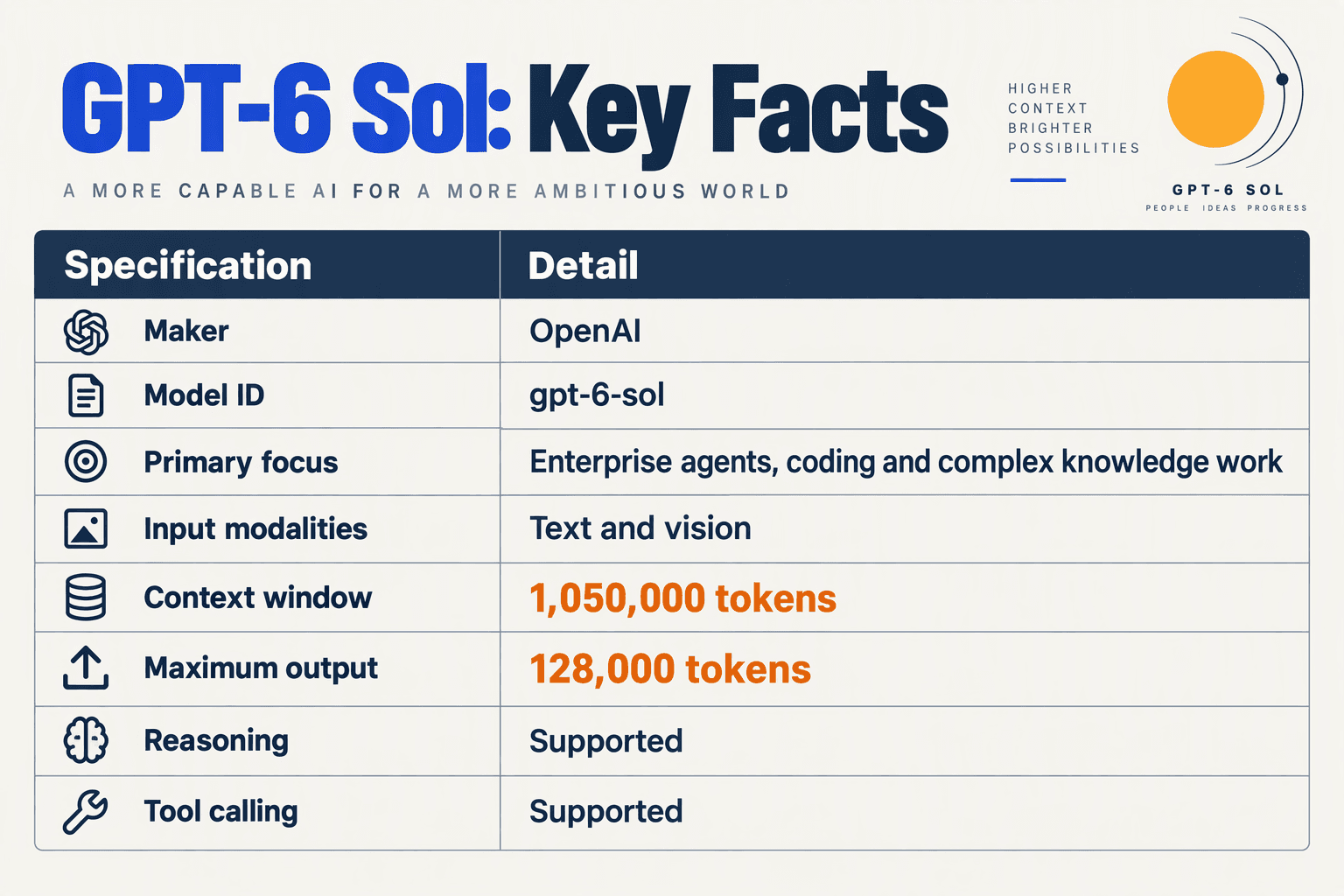
GPT-6 Sol is a multimodal frontier reasoning model with a 1,050,000-token context window, a 128,000-token maximum output, and support for tool calling. OpenAI positions the model for complex coding, enterprise agents, and knowledge workflows that require sustained reasoning across large collections of text and images.
What are the GPT-6 Sol API limits and capabilities?
| Specification | GPT-6 Sol detail | Practical significance |
|---|---|---|
| Developer | OpenAI | Part of OpenAI’s GPT-6 model family |
| API model ID | gpt-6-sol | Use this exact identifier in API requests |
| Context window | 1,050,000 tokens | Accommodates large repositories, documents, images, prompts, and agent history |
| Maximum output | 128,000 tokens | Supports long reports, code changes, and structured deliverables |
| Input modalities | Text and vision | Analyzes documents, source code, screenshots, charts, and diagrams |
| Core capabilities | Reasoning and tool calling | Enables agents to plan, invoke external software, and continue from tool results |
OpenAI’s developer documentation states that GPT-6 Sol is “built for complex coding and agentic workflows” and specifies gpt-6-sol as its API model ID. OpenAI documented a 1,050,000-token context window for GPT-6 Sol as of September 2026.
OpenAI also documented a 128,000-token maximum output for GPT-6 Sol as of September 2026. That unusually large output allowance is relevant when a task must produce extensive code, detailed analysis, or machine-readable records—but developers should still constrain outputs when shorter responses reduce latency and cost.
What does the 1.05-million-token context window enable?
A large context window lets GPT-6 Sol consider more of a workflow’s working set in one request. Concrete applications include:
- Reviewing a multi-package software repository alongside issue history, architecture documents, and test results.
- Comparing long contracts, operating procedures, and regulatory materials while retaining cross-document dependencies.
- Processing screenshots or diagrams together with the text and code needed to interpret them.
- Preserving longer agent traces, including instructions, tool results, intermediate findings, and previous decisions.
However, context capacity is a ceiling rather than a guarantee of equal attention to every token. Production evaluations should test whether critical evidence is retrieved and cited correctly at different prompt positions. Teams should also compare full-context prompting with retrieval-augmented generation because sending less, better-selected evidence may be faster and more economical.
Which specifications still require workload-level testing?
The published specifications do not replace application-specific measurements. OpenAI’s launch materials describe GPT-6 Sol and GPT-6 Luna as offering “different balances of capability and cost,” so model selection should reflect the task rather than model-family ranking alone.
Developers should measure:
- Accuracy: Does the model produce correct code, conclusions, and citations?
- Tool reliability: Does it choose appropriate functions and supply valid arguments?
- Long-context recall: Can it find decisive details without overlooking contradictory evidence?
- Output control: Does it consistently follow schemas, length limits, and formatting rules?
- Latency and cost: Do additional context and reasoning materially improve the result?
As of September 2026, developers can address gpt-6-sol through CallMissed’s OpenAI-compatible API by changing the base URL and credentials in an existing OpenAI SDK integration. CallMissed also supports streaming, function calling, structured outputs, vision input, and reasoning-effort control at the gateway level, allowing teams to evaluate GPT-6 Sol using production-oriented request patterns rather than chat-only tests.
How does GPT-6 Sol compare with earlier models?
GPT-6 Sol represents a shift from broad chat capability toward sustained reasoning, tool use, and agentic execution. Its clearest advantage over earlier models is not a claimed benchmark lead but a documented 1,050,000-token context window, 128,000-token maximum output, and explicit focus on complex coding and enterprise workflows.
What changed from GPT-5.6 Sol to GPT-6 Sol?
| Model | OpenAI positioning | Limits stated in cited sources | Practical comparison |
|---|---|---|---|
| GPT-5.6 Sol | Complex work across coding, research, cybersecurity, science, computer use, design, and knowledge work | Not specified in the cited OpenAI Help Center material | Broad reasoning model for demanding professional tasks |
| GPT-5.6 Sol Pro | Highest-capability GPT-5.6 option for difficult tasks and longer-running workflows | Not specified in the cited OpenAI Help Center material | Earlier premium option for tasks requiring more sustained reasoning |
| GPT-6 Astra | Described by OpenAI as its “most intelligent and aligned model” when introduced earlier in September 2026 | Not specified in the cited launch excerpt | Positioned for the most demanding and important projects |
| GPT-6 Sol | “Built for complex coding and agentic workflows,” according to OpenAI’s developer documentation | 1,050,000-token context; 128,000-token maximum output | Frontier reasoning for large working sets, enterprise agents, and software engineering |
OpenAI’s September 2026 documentation gives GPT-6 Sol a 1,050,000-token context window and 128,000-token maximum output, making the model’s capacity substantially more concrete than the positioning information available in the cited material for GPT-5.6 Sol, GPT-5.6 Sol Pro, and GPT-6 Astra.
The table deliberately avoids unsupported benchmark comparisons. OpenAI’s supplied launch material does not provide directly comparable scores for coding accuracy, latency, hallucination rates, or tool-use reliability across these four models.
Is GPT-6 Sol simply a larger-context model?
No. Long context is useful only when the model can reason across it and take appropriate actions. OpenAI combines GPT-6 Sol’s context capacity with text and vision input, configurable reasoning, and tool calling.
That combination changes the workflows developers can attempt:
- A coding agent can inspect source files, architecture notes, test output, and screenshots before proposing a patch.
- A compliance agent can compare contracts, policies, tables, and scanned documents while retaining more of the original evidence.
- A research agent can maintain a longer trace of sources, intermediate findings, tool results, and unresolved questions.
- An enterprise agent can call internal tools and continue reasoning from returned data rather than ending with a text-only recommendation.
Earlier GPT models could support portions of these workflows, but GPT-6 Sol is positioned explicitly around completing the multi-stage workflow, not merely answering its first prompt.
Should developers replace every earlier model with GPT-6 Sol?
Not automatically. OpenAI’s September 2026 announcement says GPT-6 Sol and GPT-6 Luna provide “different balances of capability and cost,” which reinforces the need for task-based routing rather than universal replacement.
Evaluate GPT-6 Sol against earlier models using:
- End-to-end task completion, including tool calls and recovery from failures.
- Context utilization, especially whether relevant evidence remains influential deep into a request.
- Structured-output validity for downstream software.
- Latency and cost per completed task, not simply cost per token.
- Human-reviewed accuracy on representative coding and knowledge-work cases.
CallMissed’s OpenAI-compatible API supports streaming, function calling, structured outputs, reasoning controls, request logs, and caller-selected fallback models as of September 2026. Those capabilities let teams compare gpt-6-sol with alternatives through a consistent integration while keeping model selection tied to measured workload requirements.
Which enterprise, coding and knowledge-work use cases fit GPT-6 Sol?
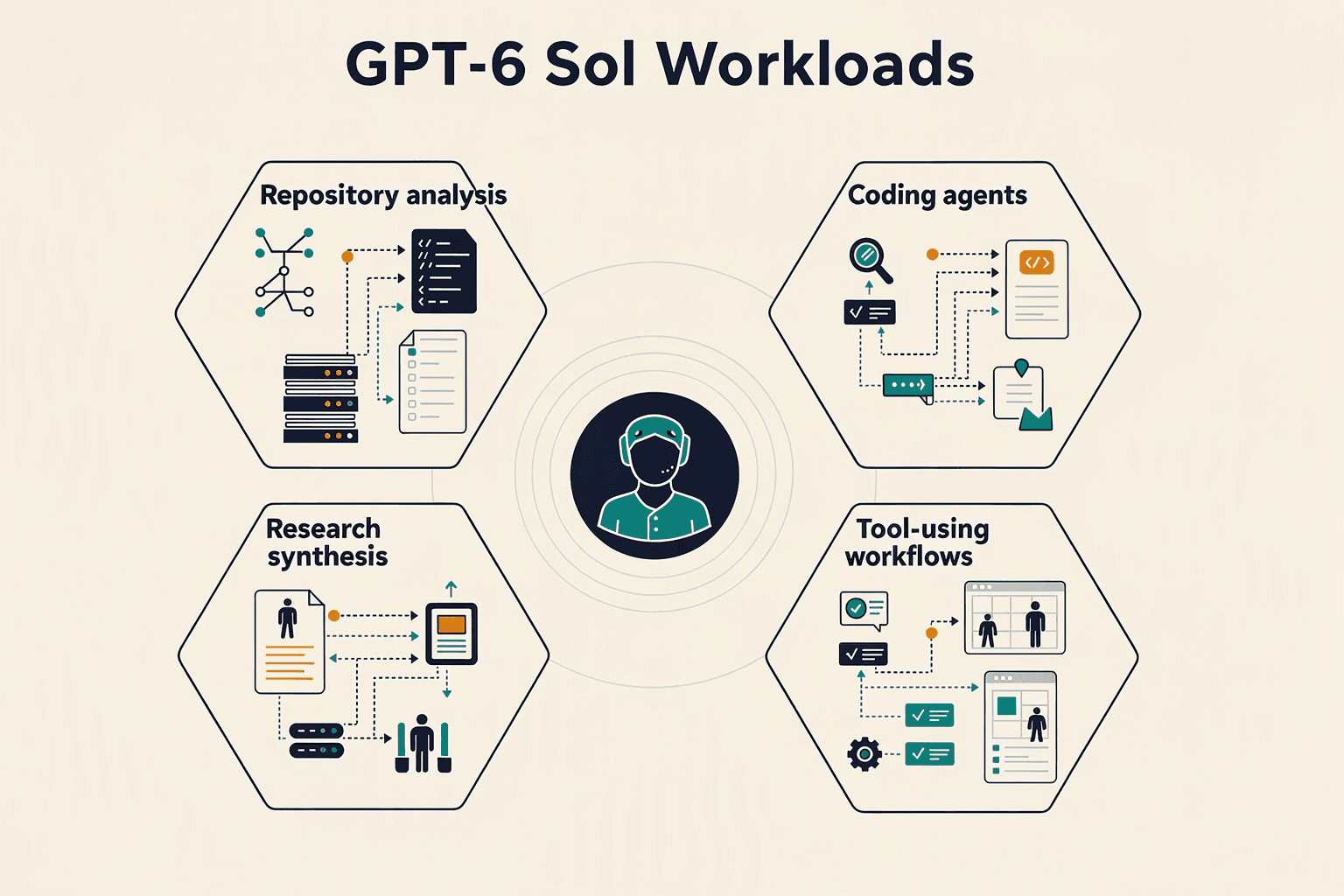
GPT-6 Sol fits high-complexity workflows that combine large working sets, multi-step reasoning, visual evidence, and external tools. The strongest candidates are repository-scale coding agents, enterprise operations agents, and knowledge-work systems where missing a dependency is more costly than processing additional context.
Which enterprise-agent workflows suit GPT-6 Sol?
OpenAI describes GPT-6 Sol as “built for complex coding and agentic workflows” in its September 2026 developer documentation. That positioning favors agents that must plan, call tools, interpret results, and revise their approach—not simple FAQ bots or deterministic automations.
Promising enterprise use cases include:
- Operations investigation: Correlate policies, incident records, screenshots, service documentation, and tool results before proposing remediation.
- Compliance review: Compare contracts, controls, internal procedures, and supporting evidence, then return findings in a structured schema for human approval.
- Customer-escalation analysis: Examine a long interaction history alongside product documentation and account data retrieved through authorized tools.
- Procurement support: Reconcile proposals, specifications, pricing tables, diagrams, and contractual terms while identifying unresolved differences.
- Workflow orchestration: Select and invoke CRM, ticketing, calendar, or internal APIs based on the current task state.
Use least-privilege permissions, tool allowlists, approval gates, and complete action logs for consequential operations. A capable reasoning model should recommend actions; it should not automatically receive unrestricted access to production systems.
Which coding tasks benefit from GPT-6 Sol?
GPT-6 Sol is particularly relevant when solving a software problem requires understanding relationships across many files. OpenAI documented a 1,050,000-token context window and a 128,000-token maximum output for GPT-6 Sol in September 2026.
That capacity can support:
- Repository mapping: Identify services, dependencies, data flows, ownership boundaries, and likely change surfaces.
- Cross-file refactoring: Update interfaces, implementations, tests, configuration, and documentation together.
- Migration planning: Inspect legacy code and generate phased plans for framework, database, or API transitions.
- Debugging from mixed evidence: Combine source code, stack traces, logs, architecture diagrams, and screenshots.
- Agentic repair loops: Edit files, invoke tests or linters through tools, inspect failures, and refine the patch.
A one-million-token context does not guarantee perfect recall or correct code. Evaluate test-pass rate, regression frequency, dependency identification, security findings, and reviewer acceptance on representative repositories rather than relying on model size alone.
Which knowledge-work tasks are a practical fit?
GPT-6 Sol’s text-and-vision input makes it suitable for evidence packages containing prose, tables, charts, scanned pages, and diagrams. Practical applications include research synthesis, due-diligence review, policy reconciliation, technical-documentation analysis, and preparation of structured decision briefs.
For example, an analyst could provide annual reports, market studies, product diagrams, and internal assumptions, then ask the model to:
- Separate sourced facts from interpretations.
- Identify contradictions and missing evidence.
- Produce a comparison matrix in a defined JSON schema.
- Draft recommendations with document-level citations.
- Route unanswered questions to search or enterprise-data tools.
When should teams choose a smaller model instead?
GPT-6 Sol may be unnecessary for short classification, extraction, rewriting, or low-risk chat. OpenAI’s September 2026 announcement says GPT-6 Sol and GPT-6 Luna offer “different balances of capability and cost,” so teams should route straightforward tasks to a less resource-intensive model and reserve GPT-6 Sol for harder cases.
CallMissed’s OpenAI-compatible API supports caller-chosen fallback models, structured outputs, function calling, streaming, and reasoning-effort control as of September 2026. Those capabilities let developers test gpt-6-sol within a routed architecture instead of forcing every request through the same model.
How do you use gpt-6-sol with CallMissed’s OpenAI-compatible API?
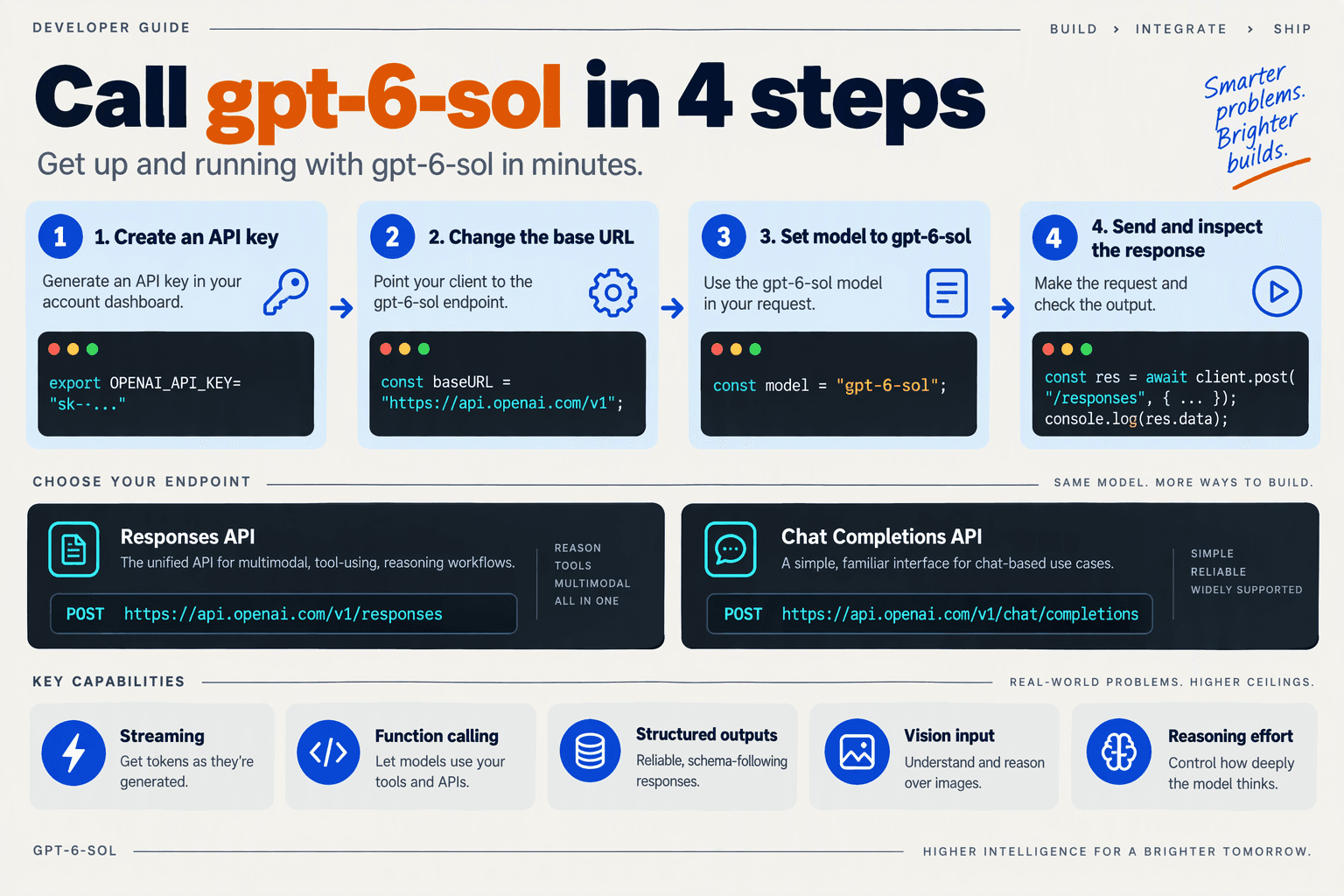
Use the GPT-6 Sol API through CallMissed by keeping the standard OpenAI SDK, changing the API key and base URL, and setting the model ID to gpt-6-sol. CallMissed supports OpenAI-compatible Responses API and chat-completions endpoints, so most existing integrations require only configuration changes.
How do you make your first GPT-6 Sol API request?
As of September 2026, the recommended implementation path is:
- Create a CallMissed API key and store it as an environment variable.
- Install or update the official OpenAI Python SDK.
- Point the SDK at CallMissed’s API base URL.
- Send a Responses API request with
model="gpt-6-sol". - Log request identifiers and usage before moving into production.
pip install --upgrade openai
export CALLMISSED_API_KEY="your_api_key"import os
from openai import OpenAI
client = OpenAI(
api_key=os.environ["CALLMISSED_API_KEY"],
base_url="https://api.callmissed.com/v1"
)
response = client.responses.create(
model="gpt-6-sol",
input=[
{
"role": "system",
"content": (
"You are a senior software engineer. Identify the root cause, "
"propose the smallest safe patch, and list the required tests."
)
},
{
"role": "user",
"content": "Analyze the attached repository context and incident report."
}
],
reasoning={"effort": "medium"}
)
print(response.output_text)OpenAI’s developer documentation identifies gpt-6-sol as the exact API model ID in September 2026. CallMissed’s OpenAI-compatible design means developers can preserve familiar SDK methods while replacing the base URL and credentials.
Which GPT-6 Sol settings should you configure?
Start conservatively rather than filling the model’s entire context window on the first request. The 1,050,000-token context limit documented by OpenAI in September 2026 is a capacity ceiling, not a target.
Configure these controls according to the workload:
- Reasoning effort: Use lower settings for classification or extraction and higher settings for difficult debugging, planning, or evidence reconciliation.
- Streaming: Enable streaming when users need visible progress during long answers.
- Structured outputs: Define a schema when another service must consume fields such as
risk_level,patches, orcitations. - Function calling: Give the model narrowly scoped tools for repository search, test execution, CRM retrieval, or database queries.
- Vision input: Include screenshots, architecture diagrams, scanned documents, or interface states when visual evidence affects the answer.
- Output limits: Set a practical cap instead of defaulting to GPT-6 Sol’s documented 128,000-token maximum output.
CallMissed also supports caller-selected fallback models, response caching, stored prompts, bring-your-own provider keys, and request and usage logs as of September 2026. One CallMissed API key and balance can access a catalogue of 138 models, allowing teams to route simpler tasks to smaller models while reserving GPT-6 Sol for demanding work.
How should you add tools safely?
Do not expose unrestricted infrastructure directly to an enterprise agent. Define tools with explicit parameters, validate every argument server-side, and require human approval for destructive operations.
A production coding workflow might let GPT-6 Sol:
- Search approved repository paths.
- Read selected files and build logs.
- Propose a patch in a structured format.
- Run tests inside an isolated environment.
- Return the patch, test results, and unresolved risks.
This design uses GPT-6 Sol for reasoning while keeping authorization, execution, and audit controls in deterministic application code. Before deployment, test malformed tool arguments, prompt injection inside retrieved documents, excessive context, timeouts, and incomplete streamed responses.
How should teams estimate GPT-6 Sol pricing and token usage?
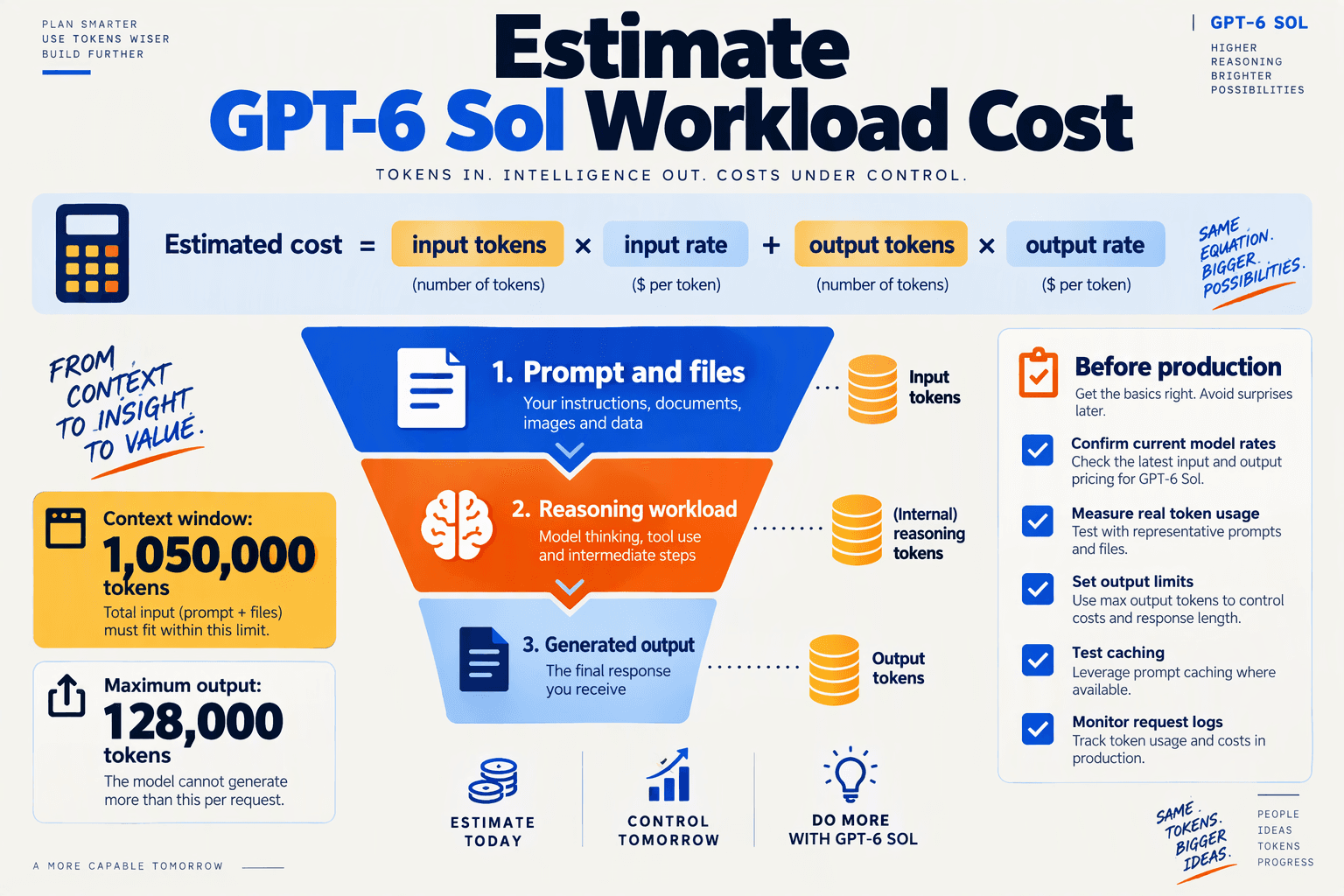
Estimate GPT-6 Sol API pricing from measured input, cached-input, reasoning, and output usage—not from the model’s maximum context window. Because the supplied OpenAI launch materials do not specify a verified per-token price, teams should use the live CallMissed model rate card as of September 2026 rather than relying on an assumed or third-party figure.
How do you calculate GPT-6 Sol API cost?
Start with the applicable prices per one million tokens and calculate each billed category separately:
Estimated cost =
(input tokens ÷ 1,000,000 × input rate)
+ (cached tokens ÷ 1,000,000 × cached-input rate)
+ (output tokens ÷ 1,000,000 × output rate)
+ tool or search charges
If reasoning tokens are reported separately, confirm whether the current rate card counts them as output tokens or applies another rate. The API usage object and CallMissed request logs should be the source of truth for production accounting.
For example, suppose one repository-analysis run consumes:
- 420,000 input tokens
- 180,000 cached-input tokens
- 35,000 generated and reasoning tokens
- Three billable tool operations
Insert those quantities into the current rate card instead of pricing the request as though it used the full context allowance. This workload consumes 635,000 token units across the listed categories, but each category may have a different rate.
Does the 1.05-million-token context window determine the bill?
No. A context window is a capacity limit, not a flat request charge. OpenAI’s developer documentation lists a 1,050,000-token context window and 128,000-token maximum output for GPT-6 Sol as of September 2026, but a request using 90,000 input tokens is normally estimated from its actual metered usage.
Large-context workflows can still become expensive because every included file, tool result, conversation turn, and image representation contributes to the working context. Teams should therefore:
- Measure prompt composition: Separate system instructions, retrieved documents, conversation history, images, and tool results.
- Set output limits: A 128,000-token ceiling does not mean an application should permit outputs that large.
- Control reasoning effort: Use higher reasoning settings only when evaluation results justify the additional consumption.
- Reuse stable context: Cache repeated policies, schemas, or repository maps where supported.
- Trim tool responses: Return relevant fields rather than entire database records or logs.
How should teams budget GPT-6 Sol on CallMissed?
CallMissed uses credits, where one credit equals ₹1, approximately US$0.0104, as of September 2026. Credits never expire, so teams can translate forecasted model usage into credits after applying the current gpt-6-sol rates.
A practical budget should include three scenarios:
- Typical: Median tokens and tool calls from representative tasks.
- Heavy: Large repositories, long documents, or repeated agent loops.
- Guardrail: Maximum allowed input, output, tool iterations, and spend per request.
CallMissed provides 1,000 free credits on signup as of September 2026, which can support initial evaluations, although the number of GPT-6 Sol requests depends entirely on their measured token usage and current model rates. Run a fixed evaluation set first, record cost per successful task—not merely cost per request—and then project monthly volume with a contingency allowance for retries, unusually long outputs, and multi-step agent execution.
What are developers and the industry saying about GPT-6 Sol?

The early signal around GPT-6 Sol is strong interest in its long-context, coding, and agentic capabilities—but the verified launch record does not yet include broad, independent developer benchmarks. The responsible takeaway is therefore promising architecture, pending workload-specific evidence, rather than an unsupported claim that the model leads every task.
What is OpenAI saying about GPT-6 Sol?
OpenAI describes GPT-6 Sol as “built for complex coding and agentic workflows” in its September 2026 developer documentation. That language positions the model for sustained tasks in which an agent must interpret evidence, call tools, evaluate results, and continue working—not merely generate a one-shot response.
OpenAI’s September 2026 launch announcement says GPT-6 Sol and GPT-6 Luna offer “different balances of capability and cost.” This framing suggests that model selection should depend on workload requirements rather than a simple newest-is-best rule.
Two specifications are attracting particular attention:
- OpenAI documents a 1,050,000-token context window for GPT-6 Sol as of September 2026.
- OpenAI documents a 128,000-token maximum output for GPT-6 Sol as of September 2026.
- GPT-6 Sol accepts text and vision input and supports reasoning and tool calling.
- OpenAI identifies the API model ID as
gpt-6-sol.
The million-token context window is especially relevant to repository analysis, document review, and agents carrying long execution histories. However, a large context limit does not guarantee that every fact within a million-token prompt will be recalled or weighted correctly.
What are developers likely to test first?
Developer discussion should ultimately be grounded in reproducible evaluations. For GPT-6 Sol, the most useful early tests are likely to include:
- Repository-scale coding: Can the model trace dependencies across services, propose a patch, and preserve existing interfaces?
- Long-document accuracy: Does answer quality remain stable when relevant evidence appears near the beginning, middle, or end of a large context?
- Tool-use reliability: Does the model select the correct function, produce valid arguments, and recover sensibly after tool errors?
- Visual reasoning: Can GPT-6 Sol connect screenshots, architecture diagrams, charts, and accompanying text?
- Structured-output compliance: Does it consistently return schema-valid data under realistic prompts and long conversations?
Teams should also measure time to first token, total task completion time, token consumption, citation accuracy, tool-call success, and human correction rates. These operational metrics are more informative than isolated anecdotal prompts.
What does the industry response mean for production teams?
The industry significance is less about context-window spectacle and more about whether GPT-6 Sol can reduce orchestration complexity. If one request can retain a repository, specifications, tool results, and agent state, developers may need fewer retrieval and summarization stages—but larger prompts can also increase cost, latency, and irrelevant-context risk.
The practical position is evaluate before standardizing. Build a test set from real incidents, code changes, contracts, or support cases; compare GPT-6 Sol with existing production models; and inspect failure modes manually.
As of September 2026, developers can run those comparisons through CallMissed’s OpenAI-compatible API and playground using gpt-6-sol. CallMissed provides one API key and balance across 138 models, making side-by-side evaluation possible without rewriting an OpenAI SDK integration beyond changing the base URL and credentials.
What is the release timeline for the GPT-6 Sol family?
The GPT-6 Sol family rollout began in September 2026, following GPT-6 Astra earlier that month and launching alongside GPT-6 Luna. As of September 29, 2026, gpt-6-sol is documented for API use and available through CallMissed’s OpenAI-compatible API; OpenAI has also announced GPT-6.1 Sol as a subsequent upgrade.
What are the key GPT-6 Sol release milestones?
| Release milestone | Timing | Product or model | Availability/status |
|---|---|---|---|
| GPT-6 Astra introduced | Earlier in September 2026 | GPT-6 Astra | Preceded the Sol and Luna launch |
| GPT-6 Sol and Luna announced | September 2026 | GPT-6 Sol, GPT-6 Luna | Presented as different capability-and-cost options |
| GPT-6 Sol API documentation published | September 2026 | gpt-6-sol | Documented for API requests |
| CallMissed API availability | September 2026 | gpt-6-sol | Available through OpenAI-compatible endpoints |
| ChatGPT Work and Codex rollout | September 2026 release cycle | GPT-6 Sol, GPT-6 Luna | Announced by OpenAI for both products |
| GPT-6.1 Sol follow-on announced | Announced by September 29, 2026 | GPT-6.1 Sol | Upgrade focused on agentic coding and professional work |
The sequence matters because GPT-6 Sol is not an isolated release. OpenAI’s September 2026 announcement describes GPT-6 Sol and GPT-6 Luna as bringing frontier intelligence to everyday work with “different balances of capability and cost,” while GPT-6 Astra occupies the more capability-intensive end of the family.
OpenAI’s developer documentation separately identifies gpt-6-sol as the API model ID and says GPT-6 Sol is “built for complex coding and agentic workflows.” That documentation is the authoritative reference for developers deciding which identifier to place in production requests.
Is GPT-6 Sol available now through the API?
Yes. As of September 29, 2026, developers can call gpt-6-sol through CallMissed’s OpenAI-compatible API. Existing OpenAI SDK implementations can change the base URL and credentials rather than replacing the client library.
CallMissed provides one API key and one balance across 138 models, including 42 general-purpose large language models, as of September 2026. Availability through a multi-model gateway is useful during a staged rollout because teams can evaluate GPT-6 Sol against other supported models without maintaining a separate integration for every provider.
A sensible deployment sequence is:
- Confirm model access with a small, deterministic request.
- Run representative evaluations using real coding or enterprise-document tasks.
- Test tool failures and malformed outputs, not only successful paths.
- Measure token consumption, latency, and cost against an existing baseline.
- Promote gradually using application-level monitoring and fallback models.
How does GPT-6.1 Sol affect adoption plans?
OpenAI’s DevDay 2026 recap describes GPT-6.1 Sol as a major GPT-6 Sol upgrade for agentic coding, computer use, and professional work. OpenAI also says GPT-6.1 Sol Ultrafast is “coming soon,” but that wording is not a firm general-availability date.
Developers should therefore treat each family member as a versioned deployment target, not assume silent equivalence. Pin the intended model ID, preserve evaluation results by version, and review OpenAI’s model documentation before changing production traffic.
Frequently Asked Questions
What is the GPT-6 Sol API designed for?
What are the GPT-6 Sol context-window and output limits?
How do I call the GPT-6 Sol API through CallMissed?
gpt-6-sol in an OpenAI-compatible request, with the CallMissed API base URL and your CallMissed credentials replacing the corresponding OpenAI settings. As of September 2026, CallMissed supports OpenAI-compatible chat completions and Responses API endpoints, including streaming, function calling, structured outputs, vision input, reasoning-effort control, and caller-selected fallback models; existing OpenAI SDK applications can therefore migrate by changing the base URL, credentials, and model selection.Does GPT-6 Sol support images, reasoning, and tool calling?
Is GPT-6 Sol suitable for production enterprise agents?
How much does GPT-6 Sol cost through CallMissed, and what account limits apply?
Conclusion
GPT-6 Sol shifts frontier AI from isolated answers toward sustained, tool-using work across large codebases, enterprise records, and multimodal evidence. The GPT-6 Sol API is especially relevant when an agent must reason, act through tools, inspect results, and continue without losing its working context.
- Scale: OpenAI’s developer documentation lists a 1,050,000-token context window and 128,000-token maximum output as of September 2026.
- Agentic capability: OpenAI describes GPT-6 Sol as “built for complex coding and agentic workflows,” with configurable reasoning, tool calling, and text-plus-vision input.
- Practical access: Developers can select the model ID
gpt-6-solthrough CallMissed’s OpenAI-compatible API by changing the base URL and credentials in an existing OpenAI SDK integration. - Production discipline: Teams should test context utilization, output quality, latency, cost, tool reliability, and safeguards against their own coding or knowledge-work tasks rather than relying on unverified benchmarks.
What comes next will be determined not only by larger context windows, but by how reliably models use that context and complete multi-step workflows. Watch for improvements in tool selection, long-context accuracy, structured outputs, and evaluation methods.
To experiment with gpt-6-sol while accessing a catalogue of 138 AI models through one API key and balance, explore CallMissed. Which workflow will you evaluate first?
Related Reading
- GPT-6 Sol and Luna API Guide: Model IDs & Pricing
- GPT-6 Sol vs GPT-6 Luna: Price, API and Verdict
- GPT-5.6 Luna vs GPT-6 Luna: API Pricing & Model IDs