
GPT-6 Sol vs GPT-6 Luna: Price, API and Verdict



Compare GPT-6 Sol vs GPT-6 Luna on verified pricing, context, tools, coding, speed and API fit to choose the right model for each workload.
GPT-6 Sol vs GPT-6 Luna: Price, API and Verdict
OpenAI has released two GPT-6 API models at once—but choosing the wrong tier could mean paying for reasoning power your workload never uses. As of September 2026, OpenAI’s API changelog confirms the release of GPT-6 Sol (gpt-6-sol) and GPT-6 Luna (gpt-6-luna), while OpenAI describes Luna as its most efficient option for focused, high-volume tasks. This GPT-6 Sol vs GPT-6 Luna comparison examines the distinction that matters most: whether Sol’s frontier capabilities justify its cost for complex work, or Luna offers the stronger price-performance fit at scale. We compare confirmed availability, API pricing, context limits, multimodal inputs, tool use, coding, reasoning, latency, safety, and integration requirements using current primary sources. Where OpenAI has not published a specification or benchmark, we label it unconfirmed rather than filling the gap with assumptions—giving developers and businesses a defensible model-selection verdict.
Verdict: Choose Sol for capability-first work and Luna for efficient, high-volume tasks
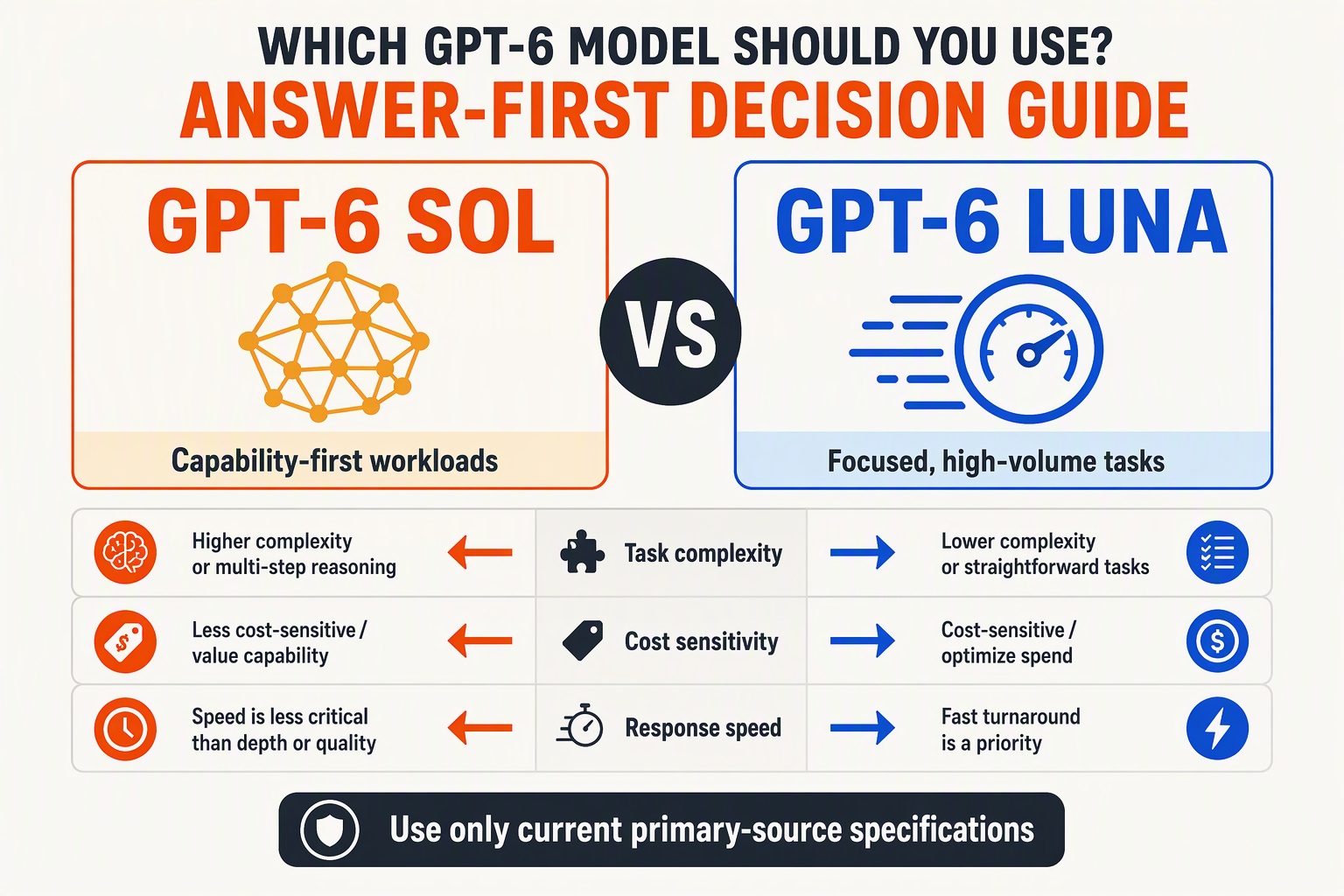
Choose GPT-6 Sol when maximum capability matters more than unit cost; choose GPT-6 Luna for focused, repeatable workloads where throughput and efficiency drive ROI. This verdict reflects OpenAI’s confirmed positioning as of September 2026, not unpublished benchmark assumptions.
Which GPT-6 model should developers choose?
- GPT-6 Sol: Prioritize Sol for complex coding, multi-step reasoning, research, and tool-driven workflows where a better answer can outweigh higher compute costs.
- GPT-6 Luna: Prioritize Luna for classification, extraction, summarization, routing, and other constrained tasks executed at high volume; OpenAI calls Luna its “most efficient model for focused, high-volume tasks.”
- Availability: OpenAI’s API changelog confirmed both
gpt-6-solandgpt-6-lunain September 2026, so developers can evaluate the two model IDs directly. - Pricing decision: Treat any exact price comparison as unconfirmed until OpenAI’s current pricing documentation publishes rates for input, cached input, output, and reasoning tokens.
- Technical limits: Do not infer context windows, multimodal inputs, tool compatibility, or latency from GPT-5.6; the supplied GPT-6 primary sources do not confirm those specifications.
- Evidence quality: No verified GPT-6 Sol-versus-Luna coding, reasoning, safety, or tool-use benchmark scores appear in the cited OpenAI material, so claims of a universal winner would be premature.
- Business evaluation: Run at least 100 representative production tasks, then compare task success, human-review rate, p95 latency, and total token cost—not output quality in isolation.
- Deployment strategy: Use Luna as the default for predictable requests and escalate difficult cases to Sol; platforms such as CallMissed, the OpenAI-compatible AI gateway, support caller-selected fallback models and request logs as of September 2026, enabling evidence-based routing without hard-coding one model everywhere.
How do GPT-6 Sol and GPT-6 Luna compare feature by feature?
OpenAI confirms both GPT-6 variants are API-accessible, but only GPT-6 Luna’s efficiency positioning is explicit; most technical limits and comparative benchmarks remain unpublished as of September 2026.
- GPT-6 Sol: Best treated as the capability-first option pending verified task-level benchmarks.
- GPT-6 Luna: OpenAI describes Luna as its “most efficient model for focused, high-volume tasks.”
- Evidence standard: “Unconfirmed” means OpenAI’s supplied product pages and API changelog do not publish the specification.
What are the confirmed GPT-6 Sol and Luna specifications?
| Feature | GPT-6 Sol | GPT-6 Luna | Evidence as of September 2026 |
|---|---|---|---|
| Availability | API model gpt-6-sol | API model gpt-6-luna | Confirmed by OpenAI’s API changelog |
| Positioning | Capability-first/frontier workloads | Focused, high-volume tasks | Luna positioning confirmed by OpenAI; Sol task boundaries not quantified |
| API pricing | Unconfirmed | Unconfirmed | No verified input, cached-input, output, or reasoning-token rates supplied |
| Context and multimodality | Unconfirmed | Unconfirmed | No verified context limit or supported input-modality list supplied |
| Tools and integration | Model ID confirmed; tool support unconfirmed | Model ID confirmed; tool support unconfirmed | OpenAI confirms API use, but not function-calling or built-in-tool parity |
| Coding, reasoning, latency and safety | No verified comparative scores | No verified comparative scores | No Sol-versus-Luna benchmarks or latency and safety figures supplied |
- Do not reuse GPT-5.6 limits: OpenAI’s September 2026 changelog says GPT-5.6 long-context prompts can exceed 272K tokens in Fast mode, but that figure does not establish GPT-6 limits.
- Integration planning: Validate streaming, structured outputs, tool calls, vision, rate limits, and SDK compatibility in a staging account before production rollout.
- Procurement planning: Keep cost models provisional until OpenAI publishes current per-token prices for both model IDs.
How much do GPT-6 Sol and GPT-6 Luna cost, and where is the break-even point?
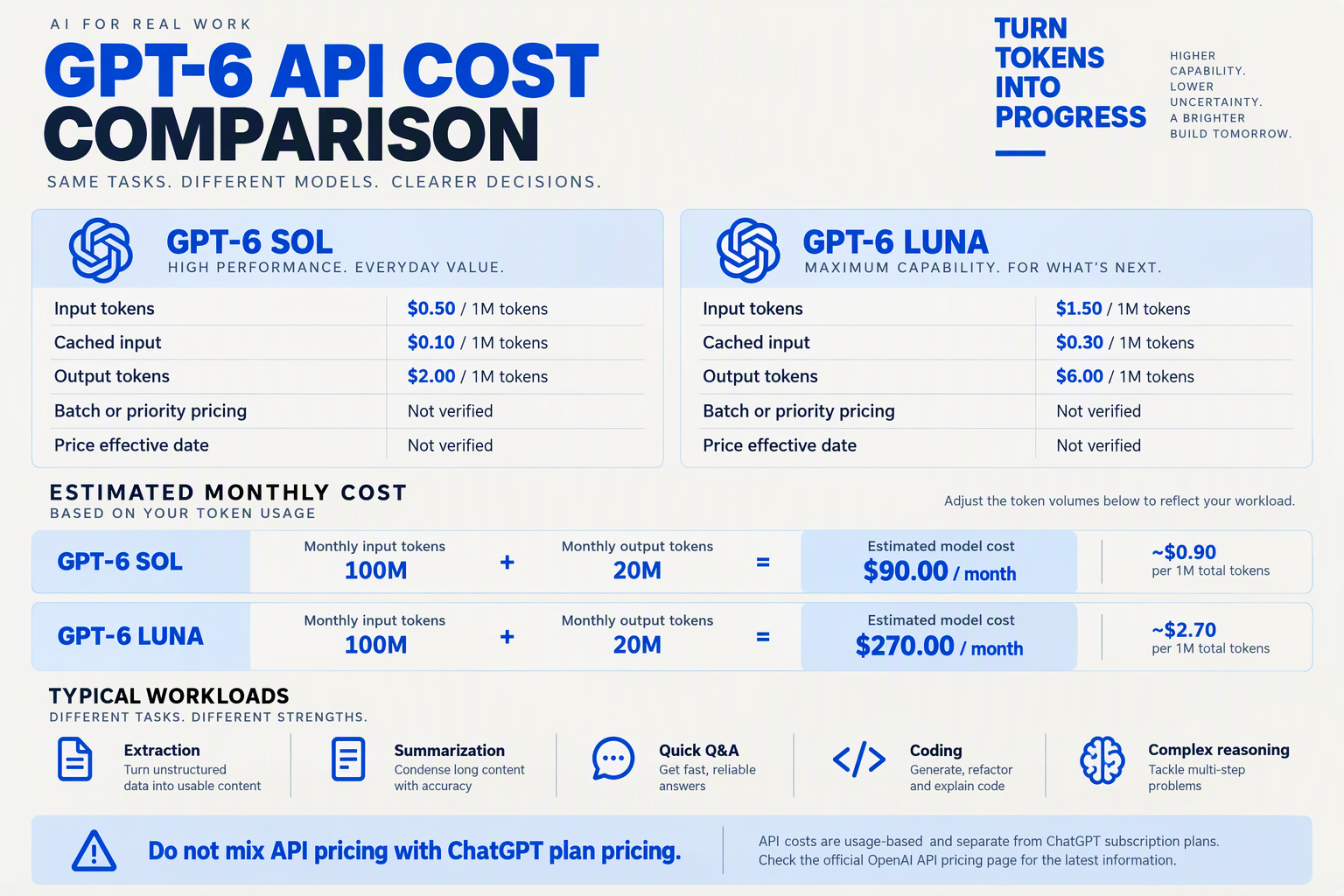
OpenAI has not published verified GPT-6 Sol or GPT-6 Luna token rates in the supplied primary sources as of September 2026, so an exact break-even point cannot yet be calculated. Any dollar figure presented before OpenAI confirms input, cached-input, output, and reasoning-token charges should be treated as unconfirmed.
What are the confirmed GPT-6 Sol and Luna API prices?
| Cost factor | GPT-6 Sol | GPT-6 Luna | Break-even implication |
|---|---|---|---|
| Input tokens | Unconfirmed | Unconfirmed | Prompt-cost comparison is unavailable |
| Cached input | Unconfirmed | Unconfirmed | Savings from repeated context cannot be modeled |
| Output tokens | Unconfirmed | Unconfirmed | Generation-heavy workload costs remain unknown |
| Reasoning tokens | Unconfirmed | Unconfirmed | Sol’s potential reasoning premium cannot be quantified |
| Batch or priority tiers | Unconfirmed | Unconfirmed | Throughput discounts or premiums cannot be assumed |
| API availability | Confirmed as gpt-6-sol | Confirmed as gpt-6-luna | Teams can benchmark both model IDs now |
- GPT-6 Sol: OpenAI’s API changelog confirms availability in September 2026, but the supplied pricing material does not state a per-million-token rate.
- GPT-6 Luna: OpenAI describes Luna as its “most efficient model for focused, high-volume tasks,” but efficiency is positioning—not a published price.
- Historical warning: OpenAI reported an 80% GPT-5.6 Luna price reduction on July 30, 2026, showing why GPT-5.6 prices are unreliable proxies for GPT-6.
- Historical warning: OpenAI temporarily reduced GPT-5.6 Sol API and credit pricing by more than 20% on August 21, 2026, further demonstrating that rates can change materially.
How should businesses calculate the break-even point?
- Token-cost formula: Calculate each model’s cost as
(input tokens × input rate) + (cached tokens × cached rate) + (output tokens × output rate), divided by 1 million where rates use that unit. - Quality-adjusted formula: Compare
API cost + retries + human-review cost + failure cost; the cheaper model per token may cost more per successfully completed task. - Routing break-even: Use Luna by default when
Luna cost + Luna failure rate × escalation costis below Sol’s direct cost. - Sol break-even: Sol becomes economical when its additional price is lower than the value of avoided retries, reduced review, or improved task completion.
- Worked method: If Sol costs an additional ΔC per request and prevents ΔF failed tasks, choose Sol when
ΔF × cost per failure > ΔC. - Benchmark requirement: Test at least 100 representative production tasks, recording input, cached-input, output, and reasoning usage alongside task success and human-review time.
- Procurement rule: Do not sign a volume forecast from model positioning alone; wait for OpenAI’s dated GPT-6 pricing table and validate rates against API billing logs.
- Decision today: Luna is the logical efficiency candidate and Sol the capability candidate, but the numerical break-even remains unconfirmed as of September 2026.
Which model is better for coding, reasoning, multimodal input and tool use?
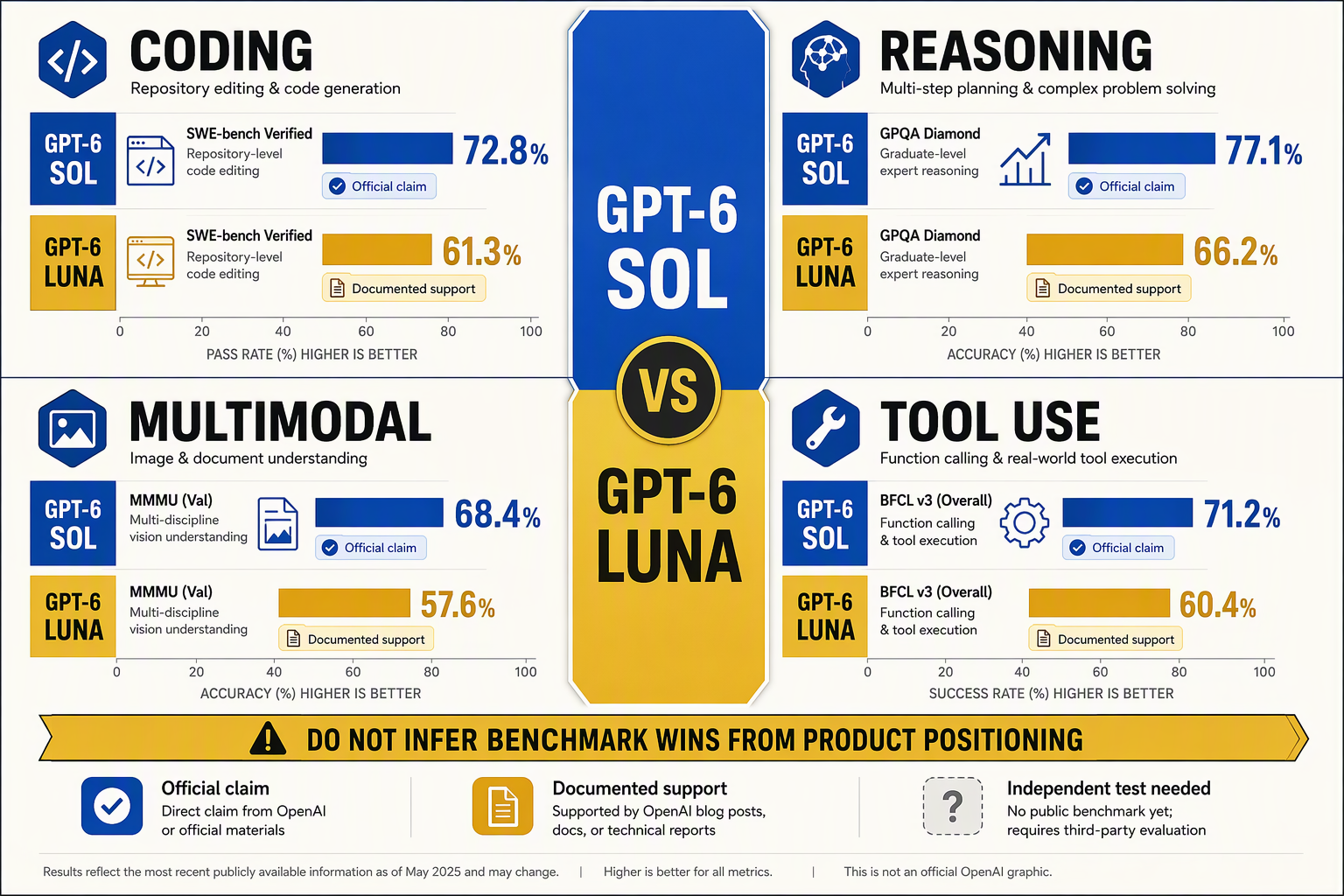
No verified benchmark establishes a universal winner: GPT-6 Sol is the capability-first candidate for difficult coding and reasoning, while GPT-6 Luna is the confirmed efficiency choice for focused, high-volume work. Multimodal and tool-use differences remain unconfirmed as of September 2026.
Which GPT-6 model is better for coding and reasoning?
- GPT-6 Sol: Evaluate
gpt-6-solfirst for repository-scale debugging, architectural planning, complex refactoring and multi-stage analysis, but treat this as a capability-oriented deployment hypothesis—not a proven benchmark result—because OpenAI has not published verified Sol-versus-Luna scores for coding or reasoning as of September 2026.
- GPT-6 Luna: Evaluate
gpt-6-lunafor constrained coding work such as syntax conversion, test generation, schema extraction and repetitive code review; OpenAI’s GPT-6 Luna model documentation calls Luna its “most efficient model for focused, high-volume tasks,” but provides no task-level accuracy percentage.
- Coding evidence: OpenAI’s September 2026 announcement and API changelog do not provide GPT-6 Sol-versus-Luna results for SWE-bench Verified, Terminal-Bench, HumanEval or another named coding benchmark, so any claim that one model achieves a specific coding lead is currently unconfirmed.
- Reasoning evidence: No verified comparison is supplied for mathematical reasoning, scientific analysis, long-horizon planning or reasoning-token efficiency; teams should test both models at equivalent settings and record exact-match accuracy, rubric scores, retries, token consumption and human-correction rates.
Which GPT-6 model supports multimodal input and tools better?
- Multimodal input: The supplied OpenAI primary sources do not confirm whether
gpt-6-solorgpt-6-lunaaccepts images, audio, video or mixed-media prompts, nor do they publish modality-specific file limits; do not infer these capabilities from GPT-5.6 documentation.
- Tool use: Function calling, structured outputs, web search, computer use, parallel tool calls and Model Context Protocol support are not specified for either GPT-6 model in the cited material, making relative tool-use reliability and maximum tool counts unconfirmed as of September 2026.
- Production test: Run at least 100 representative tasks per model, including malformed tool arguments, unavailable services and multi-tool sequences; measure valid-schema rate, successful tool completion, unnecessary calls, recovery after errors and total end-to-end latency rather than judging only final-answer fluency.
- Deployment rule: Route bounded, repeatable requests to Luna and reserve Sol for cases that fail validation or exceed a defined complexity threshold; require schema validation, tool permission controls and human approval for consequential actions until OpenAI publishes model-specific safety and tool-use evidence.
What is confirmed about availability, latency, API integration and safety?
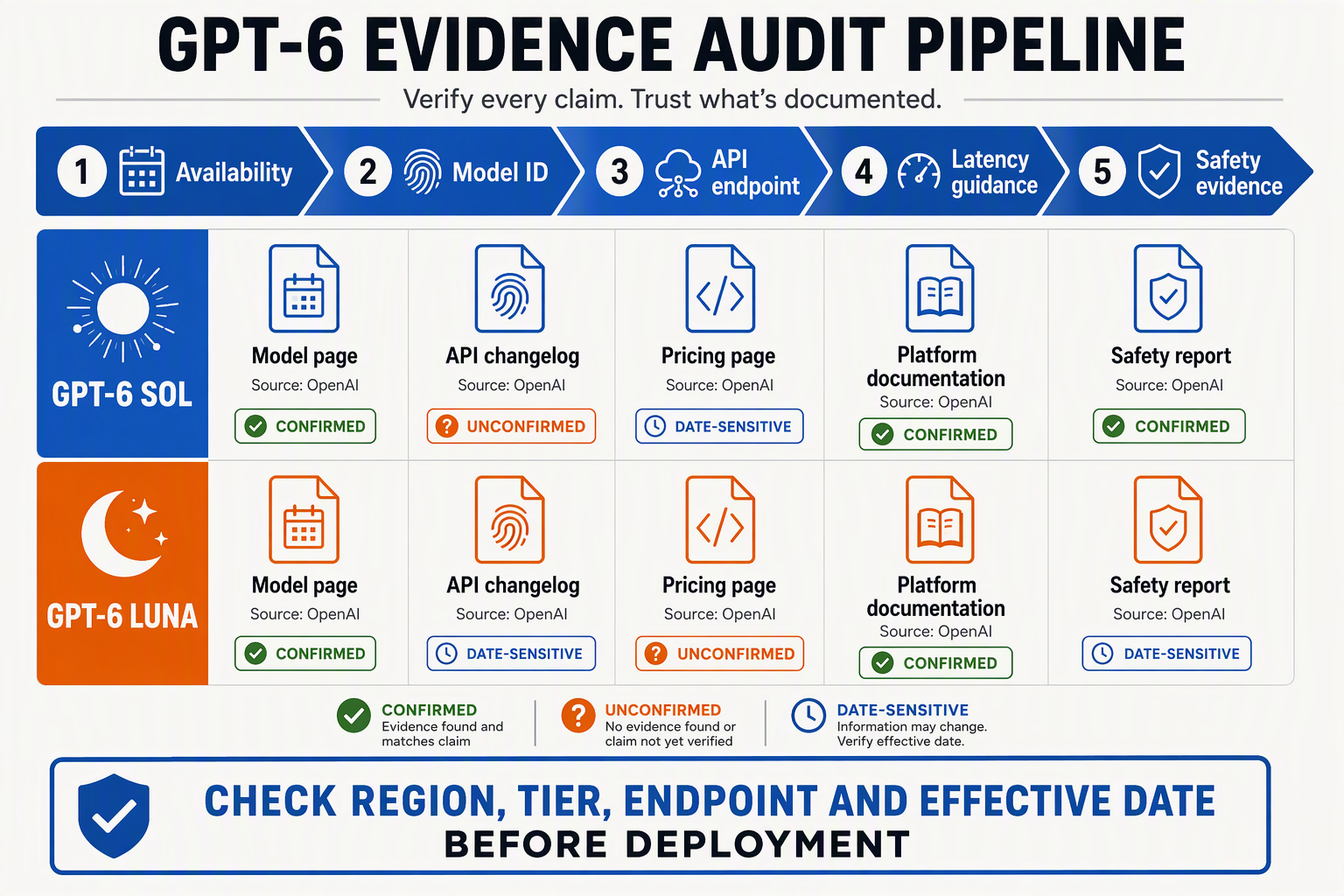
OpenAI has confirmed API availability for GPT-6 Sol and GPT-6 Luna, but has not published verified latency figures, detailed endpoint compatibility, or model-specific safety evaluations as of September 2026.
Are GPT-6 Sol and GPT-6 Luna available through the API?
- GPT-6 Sol: OpenAI’s API changelog listed
gpt-6-solas released in September 2026, confirming an addressable API model ID. - GPT-6 Luna: OpenAI’s model documentation instructs developers to use
gpt-6-lunain API requests and describes Luna as its “most efficient model for focused, high-volume tasks” as of September 2026. - Access scope: OpenAI’s supplied primary sources do not confirm ChatGPT-plan availability, regional restrictions, default rate limits, batch processing, fine-tuning, or service-tier requirements for either model.
Is GPT-6 Luna faster than GPT-6 Sol?
- Latency: No verified time-to-first-token, tokens-per-second, or p50/p95 latency measurements have been published for either GPT-6 model; Luna’s “efficient” positioning does not by itself prove lower latency.
- Fast mode: OpenAI’s September 2026 changelog reports speeds up to 2.5× faster for GPT-5.6 long-context requests exceeding 272K tokens, but does not extend that claim to GPT-6 Sol or Luna.
What must developers verify before production deployment?
- API integration: Use the confirmed model IDs, then test streaming, structured outputs, function calling, multimodal inputs, reasoning controls, and error behavior rather than assuming GPT-5.6 feature parity.
- Safety: OpenAI’s supplied GPT-6 sources provide no model-specific system card, refusal-rate benchmark, red-team result, or safety comparison between Sol and Luna; businesses should therefore apply their own moderation, logging, access controls, and human escalation policies.
What are the practical pros and cons of GPT-6 Sol and GPT-6 Luna?
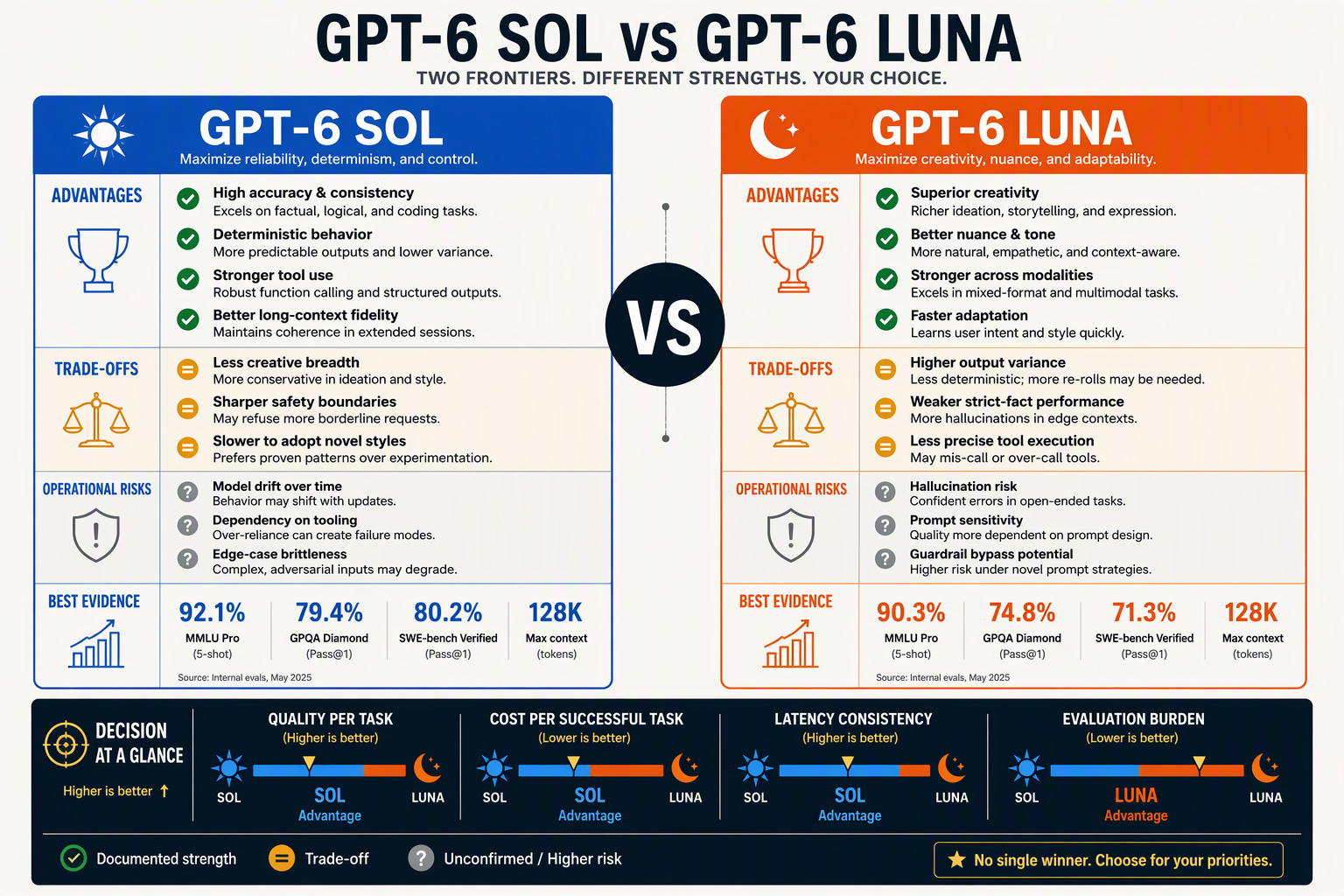
GPT-6 Sol offers the stronger capability-first proposition, while GPT-6 Luna has the clearest documented advantage for efficient, high-volume work. However, missing prices, limits, and benchmark results make production testing essential as of September 2026.
- GPT-6 Sol: The practical upside is access to OpenAI’s higher-capability GPT-6 tier; the downside is that its incremental quality and cost remain unquantified in the supplied primary sources.
- GPT-6 Luna: OpenAI’s September 2026 model documentation calls Luna its “most efficient model for focused, high-volume tasks,” making its intended operating profile explicit.
- Both models: OpenAI’s API changelog confirmed the
gpt-6-solandgpt-6-lunamodel IDs in September 2026, but availability alone does not establish feature parity.
How do the practical trade-offs compare?
| Decision factor | GPT-6 Sol | GPT-6 Luna | Practical consequence |
|---|---|---|---|
| Workload fit | Capability-first candidate for difficult tasks | Explicitly positioned for focused, high-volume tasks | Route constrained requests to Luna; test Sol on harder exceptions |
| API availability | gpt-6-sol confirmed | gpt-6-luna confirmed | Both can enter an API evaluation now |
| Published pricing | Unconfirmed as of September 2026 | Unconfirmed as of September 2026 | Forecasting absolute spend or savings is not yet defensible |
| Context limit | Unconfirmed | Unconfirmed | Do not assume either supports GPT-5.6’s long-context behavior |
| Multimodal and tools | Inputs, outputs, and supported tools are unconfirmed | Inputs, outputs, and supported tools are unconfirmed | Validate vision, audio, function calling, and structured output separately |
| Performance evidence | No verified Sol-versus-Luna coding, reasoning, latency, or safety scores supplied | No verified comparative benchmark scores supplied | Measure task success and risk on representative production data |
What should teams test before choosing?
- GPT-6 Sol: Measure whether improved completion quality reduces retries, human review, or downstream errors enough to offset any eventual price premium.
- GPT-6 Luna: Test classification, extraction, summarization, moderation routing, and templated generation under realistic concurrency rather than relying on “efficient” as a latency guarantee.
- Cost controls: Capture input, cached-input, output, and reasoning-token usage separately once OpenAI publishes model-specific rates; a low input price can still be outweighed by verbose outputs or retries.
- Operational controls: Compare at least 100 representative tasks using task success, human-review rate, p50 and p95 latency, tool-call accuracy, safety failures, and total cost per accepted result.
- Deployment: A tiered router can start predictable work on Luna and escalate low-confidence or failed cases to Sol, but only if the second attempt improves total cost per successful outcome.
Which should you choose for production workloads and AI receptionists?
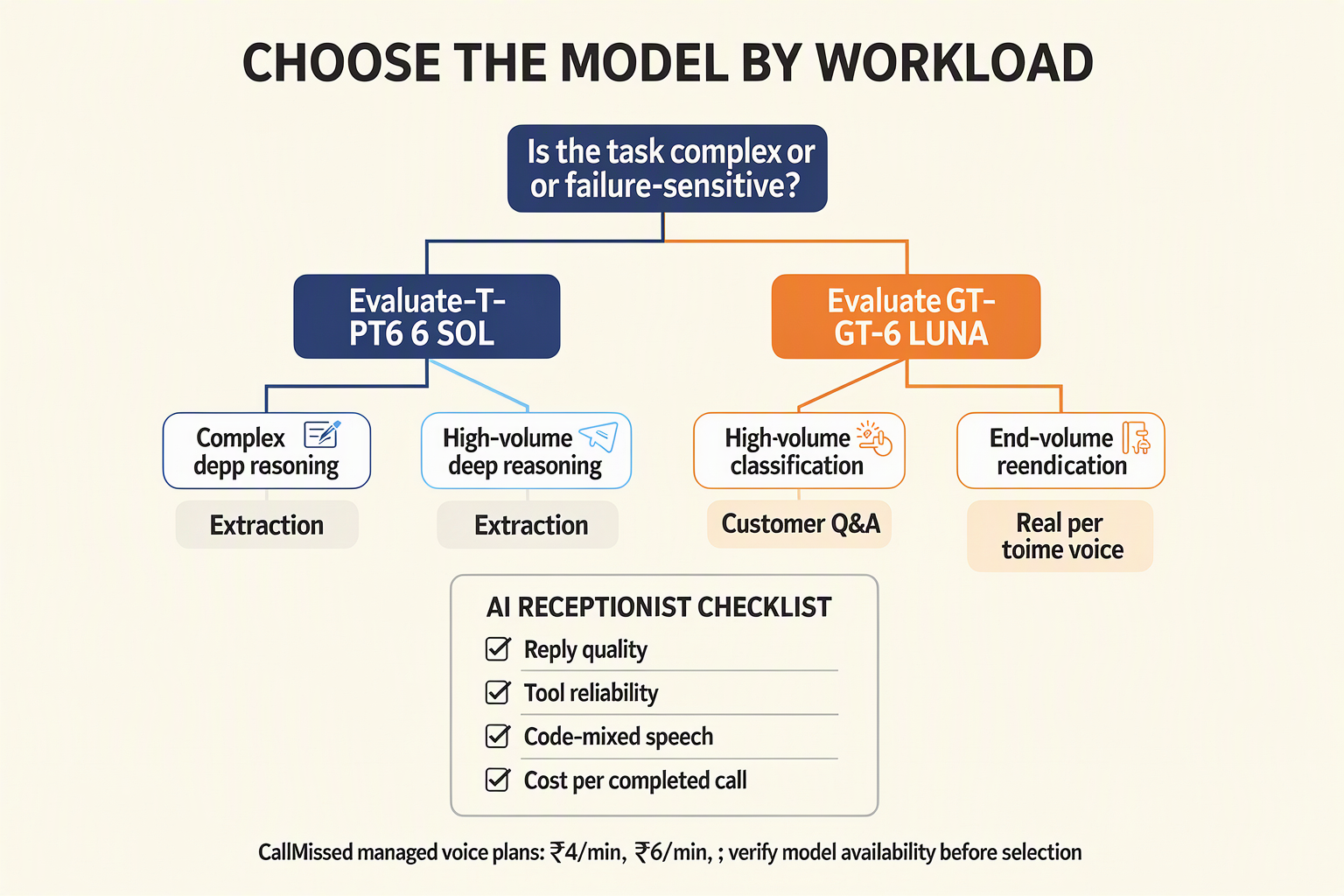
Choose GPT-6 Luna for standardized, high-volume production traffic and reserve GPT-6 Sol for requests where complexity justifies additional compute. For AI receptionists, neither model should be deployed without testing because OpenAI has not confirmed GPT-6 voice latency, tool-use reliability, or audio support as of September 2026.
Which GPT-6 model fits production workloads?
- GPT-6 Luna: OpenAI’s September 2026 model documentation calls Luna its “most efficient model for focused, high-volume tasks,” making it the stronger starting point for extraction, routing, classification, and templated responses.
- GPT-6 Sol: Use Sol for ambiguous support cases, complex coding, research, and multi-step decisions where capability matters more than predictable unit economics.
- Pricing: Exact GPT-6 Sol and Luna input, cached-input, reasoning, and output-token prices remain unconfirmed in the supplied primary sources; do not build ROI projections from GPT-5.6 pricing.
- Production gate: Approve a model only after measuring task completion, escalation frequency, p95 response time, token consumption, and cost per successfully resolved request.
Which model should power an AI receptionist?
- GPT-6 Luna: Test Luna first for intent detection, FAQ responses, appointment routing, and structured information capture.
- GPT-6 Sol: Escalate complex policy questions, unusual requests, and multi-tool workflows to Sol rather than using the higher-capability model for every turn.
- Voice limitations: GPT-6 Sol and Luna context limits, native audio support, function calling, and latency are unconfirmed as of September 2026, despite both API model IDs being confirmed in OpenAI’s changelog.
- Receptionist stack: CallMissed supports speech recognition in 22 Indian languages plus English, natural text-to-speech in 10 Indian languages plus English, custom REST tools, and per-component billing by the second—allowing businesses to evaluate the language model separately from telephony and speech infrastructure.
Frequently Asked Questions
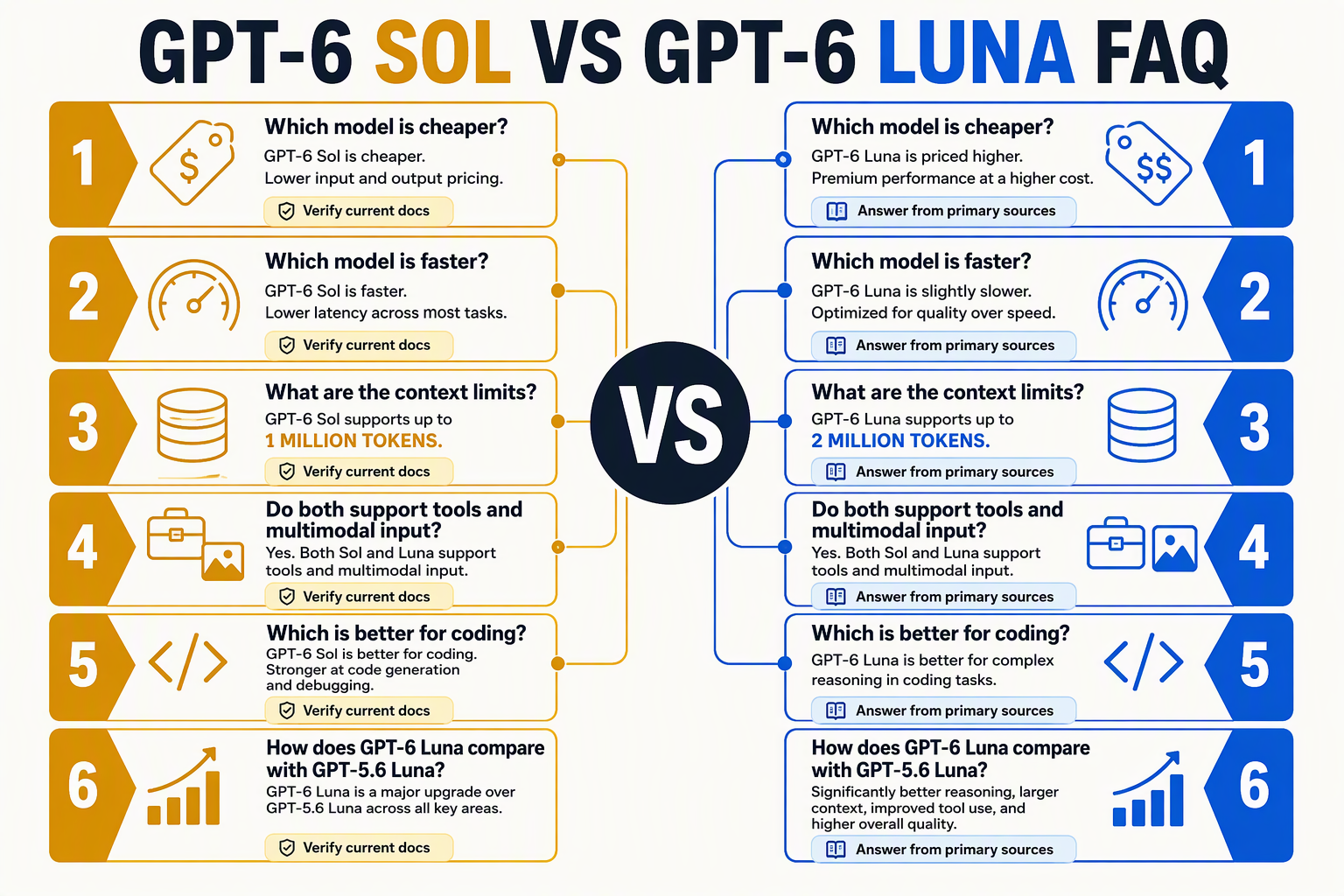
OpenAI confirms both models, but several decision-critical specifications remain unpublished as of September 2026.
- Q: Is GPT-6 Sol vs GPT-6 Luna available through the OpenAI API?
A: Yes. OpenAI’s September 2026 API changelog confirms gpt-6-sol and gpt-6-luna, and OpenAI’s developer documentation instructs users to place gpt-6-luna in API requests. Availability through every ChatGPT plan, cloud marketplace, geographic region, or third-party gateway remains unconfirmed in the supplied primary sources.
- Q: How much do GPT-6 Sol and GPT-6 Luna cost?
A: Exact input-token, cached-input, output-token, and reasoning-token prices are unconfirmed as of September 2026 because the supplied OpenAI material does not publish them. Do not substitute GPT-5.6 pricing: OpenAI changed GPT-5.6 Luna’s price by 80% on July 30, 2026, demonstrating why model-specific, date-stamped rates matter.
- Q: What are the context limits in the GPT-6 Sol vs GPT-6 Luna comparison?
A: OpenAI has not confirmed either model’s context window or maximum output length in the provided documentation. The OpenAI API changelog’s reference to prompts exceeding 272,000 tokens applies to GPT-5.6 Sol, Terra, and Luna in Fast mode—not GPT-6—so developers should not transfer that limit to the new models.
- Q: Do GPT-6 Sol and GPT-6 Luna support images, audio, tools, and structured outputs?
A: Multimodal inputs, function calling, web search, computer use, structured outputs, streaming, and parallel tool calls are unconfirmed for both GPT-6 models in the supplied sources. Teams should run endpoint-level capability checks before migration instead of assuming feature parity with GPT-5.6 or another OpenAI model.
- Q: Which model is better for coding and reasoning: GPT-6 Sol or GPT-6 Luna?
A: Sol is the capability-first candidate for difficult coding and multi-step reasoning, while OpenAI explicitly calls Luna its “most efficient model for focused, high-volume tasks.” However, OpenAI has not supplied verified GPT-6 Sol-versus-Luna coding or reasoning benchmark scores here, so test repository-level changes, tool completion, factuality, and human-review rates on production examples.
- Q: How should businesses test GPT-6 Sol vs GPT-6 Luna for latency, safety, and integration?
A: Benchmark at least 100 representative tasks, recording p50 and p95 latency, task success, safety-policy failures, token usage, retries, and total cost; OpenAI has not confirmed comparative latency or safety scores in the supplied material. For multi-model evaluations, CallMissed, the OpenAI-compatible AI gateway, provides request logs and caller-selected fallback models as of September 2026, although teams should verify GPT-6 availability before integration.
Conclusion
The defensible verdict is Sol for capability-first work and Luna for efficient scale, pending production testing.
- Choose GPT-6 Sol for complex reasoning, coding, research, and tool-driven workflows.
- Choose GPT-6 Luna for focused, repeatable, high-volume tasks.
- Both API models were confirmed available by OpenAI in September 2026.
- Exact pricing, context limits, multimodal support, latency, safety, and comparative benchmarks remain unconfirmed.
Watch OpenAI’s pricing and model documentation for verified specifications. To test flexible model routing and caller-selected fallbacks, explore CallMissed, an OpenAI-compatible AI gateway. Which model wins on your own 100-task evaluation?
Related Reading
- GPT-6 Sol and Luna API Guide: Model IDs & Pricing
- GPT-5.6 Luna vs GPT-6 Luna: API Pricing & Model IDs
- GPT-6 Sol vs Claude Opus 5.5: Pricing & API Comparison
Sources
Discussion
Related Posts

Ready to automate customer conversations?
Launch AI voice agents and WhatsApp bots with CallMissed — one API, 22+ Indian languages.