
GPT-6 API Guide: Sol, Luna and Astra Facts for 2026


Use this GPT-6 API guide to verify Sol and Luna availability, model IDs, pricing, limits, setup, migration, and production safeguards.
GPT-6 API Guide: Sol, Luna and Astra Facts for 2026
What if the “GPT-6 Sol API” you are trying to call does not officially exist under that name? As of September 2026, OpenAI’s primary documentation identifies Sol and Luna as GPT-5.6 models, with the model identifiers gpt-5.6-sol and gpt-5.6-luna; the documented GPT-6 model is GPT-6 Astra, identified as gpt-6-astra. That naming distinction is crucial because an incorrect model ID can stop an otherwise valid API integration from working.
The confusion is understandable. OpenAI’s 2026 product lineup places GPT-5.6 Sol, Terra and Luna alongside GPT-6 Astra, while ChatGPT offers GPT-6 Pro powered by GPT-6 Astra on eligible plans. OpenAI’s model catalog describes GPT-6 Astra as its “most capable model, built for the hardest end-to-end work,” but ChatGPT subscription access should not be assumed to equal API access, pricing or rate limits.
The differences are substantial enough to affect architecture and budgets. OpenAI’s model documentation listed GPT-5.6 Luna with a 1,050,000-token context window, a 128,000-token maximum output and a February 16, 2026 knowledge cutoff as of September 2026. OpenAI’s API pricing page listed GPT-5.6 Luna at $0.20 per million input tokens, while the model catalog listed GPT-6 Astra at $10 per million input tokens and $50 per million output tokens. OpenAI also announced on August 21, 2026 that GPT-5.6 Sol API and credit pricing had been reduced by more than 20% for three months, making date-specific price verification essential.
This practical GPT-6 API guide separates documented facts from ambiguous product terminology. It will show developers:
- Which Sol, Luna and Astra APIs are actually available
- The exact model identifiers and verified prices
- Context windows, modalities and output limits
- Support for tool calling and structured outputs
- Rate-limit checks, migration steps and production safeguards
- Cost examples and model-selection guidance for text and voice agents
For developers comparing multiple providers, CallMissed, an OpenAI-compatible AI gateway, offers one API key and balance across 136 models as of September 2026, allowing existing SDKs to connect by changing the base URL. Whether integrating directly or through a gateway, the rule is the same: verify every identifier and capability against current primary documentation rather than building around an unofficial “GPT-6 Sol” or “GPT-6 Luna” label.
Do GPT-6 Sol and GPT-6 Luna APIs actually exist in 2026?

OpenAI officially announced GPT-6 Sol and GPT-6 Luna on September 22, 2026, but this review did not find matching OpenAI developer documentation confirming that either model is available through the API. An OpenAI-domain product snippet stating “Introducing GPT-6 Sol and Luna” supports the launch and names; it does not establish callable model IDs, endpoints or API access.
Are “GPT-6 Sol” and “GPT-6 Luna” official OpenAI model names?
Yes. The official-domain launch snippet dated September 22, 2026 is evidence that GPT-6 Sol and GPT-6 Luna are official product names.
However, product-launch evidence and API availability are different. As of September 22, 2026, this review could not verify corresponding entries in OpenAI’s developer model documentation. It therefore cannot confirm:
- Exact API model identifiers
- Supported API endpoints
- Account or regional availability
- Input or output limits
- Context-window size
- Token pricing
- Rate limits
- Tool, vision or structured-output support
In particular, developers should not assume that gpt-6-sol or gpt-6-luna are callable identifiers merely because those strings follow OpenAI’s familiar naming pattern.
How can developers verify API availability?
Treat the announcement, developer documentation and account-level access as separate checks:
- Open the official OpenAI model catalog. Look for a dedicated developer page naming Sol or Luna and showing the exact API identifier.
- Inspect your authenticated model list. Confirm that the identifier appears for the API project and organization that will run the application.
- Check endpoint compatibility. Verify that official documentation supports the endpoint and features your integration requires.
- Send a minimal test request. Use the documented identifier with a short prompt before testing tools, large inputs or production workloads.
- Preserve the complete error response. Authentication, permissions, endpoint compatibility and model access can fail for different reasons.
- Verify limits and pricing separately. Do not reuse figures from GPT-5.6 or another GPT-6 model.
- Record the verification date. Model access, pricing and limits can change after launch.
A successful request from one account does not prove universal availability. Access may vary by project, organization, region or account tier.
Does ChatGPT access prove API access?
No. Access through ChatGPT or another OpenAI product does not establish API access. A product announcement can confirm that a model exists without confirming a public API release, a callable identifier or entitlement for a particular API account.
Likewise, seeing Sol or Luna in a user interface does not reveal API pricing, context limits, supported endpoints or rate limits. Those details should come from current developer documentation and the authenticated account.
What should production code call?
Do not deploy a guessed identifier such as:
OPENAI_MODEL=gpt-6-solInstead, wait for an exact identifier to appear in official developer documentation and confirm that it is available to the production API project. Keep the verified value in configuration rather than hard-coding it:
OPENAI_MODEL=<officially-documented-model-id>At startup, validate that the configured model is accessible and compatible with the required endpoint. Define an explicitly approved fallback, but do not silently map an unverified Sol or Luna name to GPT-5.6 or another model; that could change cost, behavior and capabilities without the operator’s knowledge.
Why are GPT-5.6 Sol and Luna confused with GPT-6 Astra?
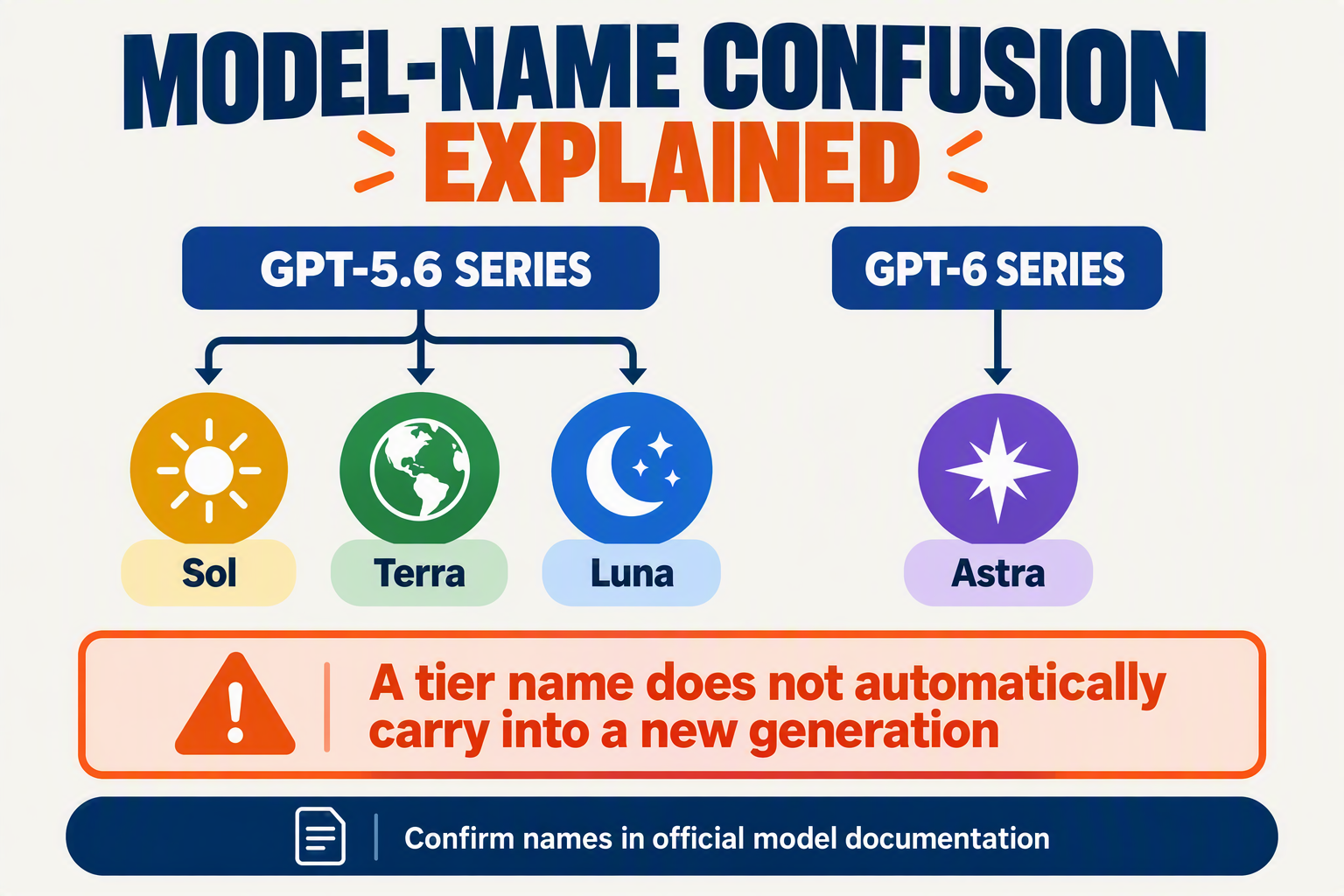
GPT-5.6 Sol and Luna are confused with GPT-6 Astra because OpenAI presents all three in the same 2026 product ecosystem, while ChatGPT uses a separate “GPT-6 Pro” label powered by Astra. The names describe different layers—model family, individual model and ChatGPT plan experience—so “GPT-6 Sol API” is understandable search shorthand, but not a documented API name.
Why does OpenAI’s 2026 naming create confusion?
Three naming systems overlap:
- Model family: GPT-5.6 or GPT-6
- Model name: Sol, Terra, Luna or Astra
- ChatGPT product label: GPT-6 Pro
OpenAI’s model catalog places GPT-5.6 Sol, GPT-5.6 Terra and GPT-5.6 Luna near GPT-6 Astra. That visual proximity can make Sol and Luna look like GPT-6 performance tiers rather than members of the GPT-5.6 series.
OpenAI’s Help Center adds another layer: GPT-6 Pro is powered by GPT-6 Astra and is available in ChatGPT on Pro $100, Pro $200, Business and Enterprise plans, subject to plan-specific conditions as of September 2026. “GPT-6 Pro” is therefore a ChatGPT-facing product label, while gpt-6-astra is the documented API model identifier.
What do Sol, Luna and Astra actually refer to?
The safest interpretation is to treat each complete name as an indivisible product identifier:
- GPT-5.6 Sol: A GPT-5.6-series model addressed through
gpt-5.6-sol - GPT-5.6 Luna: A lower-cost GPT-5.6-series model addressed through
gpt-5.6-luna - GPT-6 Astra: The documented GPT-6 model addressed through
gpt-6-astra - GPT-6 Pro: A ChatGPT experience powered by GPT-6 Astra, not an API identifier
OpenAI described Luna as bringing “strong capability at our lowest cost” in its GPT-5.6 Sol preview. OpenAI’s API pricing page listed Luna at $0.20 per million input tokens as of September 22, 2026, reinforcing that Sol and Luna represent different price-performance points within GPT-5.6—not separate GPT-6 editions.
Why can ChatGPT access be mistaken for API availability?
A model visible in ChatGPT does not establish its API model ID, billing terms or account limits. ChatGPT subscriptions and API usage are separate commercial surfaces, and the Help Center’s eligibility list for GPT-6 Pro does not document API entitlements.
Developers should verify four items independently before implementation:
- The model appears in OpenAI’s API model catalog
- The exact identifier is accepted by the API
- Pricing appears on the current API pricing page
- The project’s API account exposes the required model and rate limits
How should developers handle unofficial GPT-6 Sol API references?
Treat “GPT-6 Sol API” and “GPT-6 Luna API” as ambiguous search terms, then map them to documented identifiers only after confirming the user’s intent. Do not silently rewrite an unknown model name in production.
A robust integration should:
- Reject unsupported IDs such as
gpt-6-sol - Suggest
gpt-5.6-sol,gpt-5.6-lunaorgpt-6-astra - Log the requested and resolved model separately
- Avoid inferring capabilities from family names
- Recheck pricing during temporary promotions
That last safeguard matters because OpenAI announced on August 21, 2026 that GPT-5.6 Sol API and credit pricing would fall by more than 20% for three months. Names may remain stable while prices, access conditions and limits change.
What do official OpenAI sources confirm about Sol, Luna, and Astra?
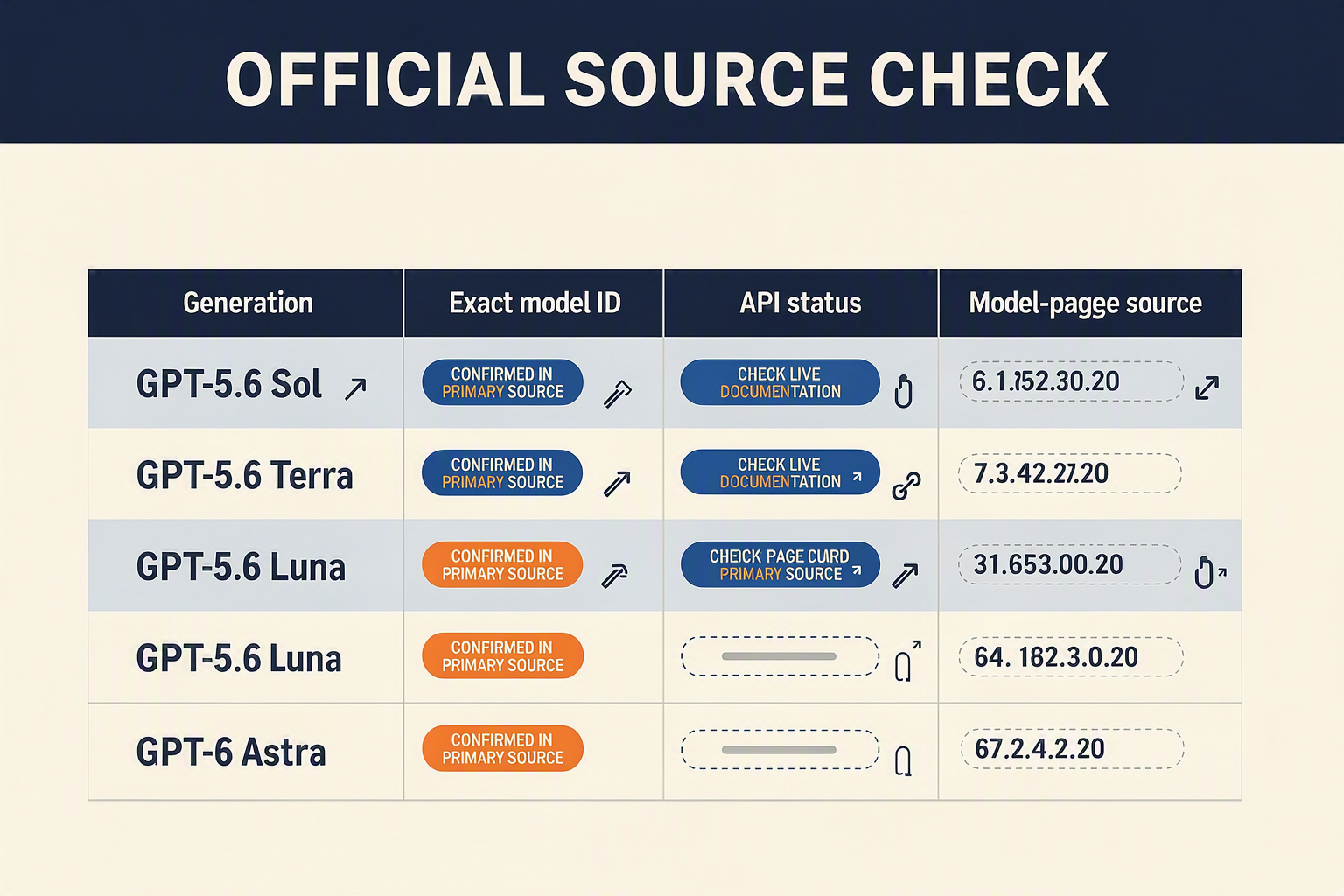
Official OpenAI sources confirm that Sol and Luna belong to GPT-5.6, while Astra is the documented GPT-6 model. As of September 22, 2026, the verified API identifiers are gpt-5.6-sol, gpt-5.6-luna and gpt-6-astra; OpenAI does not document gpt-6-sol or gpt-6-luna.
What specifications has OpenAI officially documented?
| Specification | GPT-5.6 Sol | GPT-5.6 Luna | GPT-6 Astra | Official source |
|---|---|---|---|---|
| API identifier | gpt-5.6-sol | gpt-5.6-luna | gpt-6-astra | OpenAI model catalog |
| Official family | GPT-5.6 | GPT-5.6 | GPT-6 | OpenAI model catalog |
| Input price | $4.00/1M tokens | $0.20/1M tokens | $10.00/1M tokens | OpenAI API Pricing, September 2026 |
| Cached input price | $0.40/1M tokens | $0.02/1M tokens | Not verified from supplied sources | OpenAI API Pricing |
| Output price | Not verified from supplied sources | Not verified from supplied sources | $50.00/1M tokens | OpenAI model catalog |
| Context and output limits | Not verified from supplied sources | 1,050,000-token context; 128,000-token output | Not verified from supplied sources | OpenAI Luna model page |
OpenAI’s API Pricing page listed GPT-5.6 Sol input at $4 per million tokens and GPT-5.6 Luna input at $0.20 per million tokens as of September 22, 2026. The same page listed cached-input rates of $0.40 and $0.02 per million tokens, respectively.
OpenAI’s model catalog listed GPT-6 Astra at $10 per million input tokens and $50 per million output tokens as of September 2026. OpenAI describes GPT-6 Astra as its “most capable model, built for the hardest end-to-end work.”
Which context-window details are confirmed?
The most complete published specification in the supplied primary sources is for Luna:
- Context window: 1,050,000 tokens
- Maximum output: 128,000 tokens
- Knowledge cutoff: February 16, 2026
- Reasoning tokens: Supported
OpenAI’s GPT-5.6 Luna model page documented a 1,050,000-token context window and 128,000-token maximum output as of September 2026. Those numbers must not be copied to Sol or Astra; model-family membership does not imply identical limits.
Are modalities, tool calling and rate limits officially confirmed?
The reviewed excerpts do not provide enough model-specific information to publish exact modality, tool-calling, structured-output or numeric rate-limit claims for all three models. Developers should therefore avoid assuming that a feature exposed by an API endpoint is supported identically by gpt-5.6-sol, gpt-5.6-luna and gpt-6-astra.
Before production deployment, verify:
- Input modalities, including whether image, audio or video input is accepted.
- Tool and function calling, including parallel calls and schema restrictions.
- Structured outputs, particularly strict JSON Schema compatibility.
- Endpoint compatibility, such as Responses API versus Chat Completions.
- Account-specific rate limits, rather than copying limits from another model or usage tier.
Pricing also requires date-aware checks. OpenAI announced on August 21, 2026 that GPT-5.6 Sol API and credit pricing would drop by more than 20% for three months. Because that reduction is explicitly temporary, production cost calculators should store the retrieval date and re-check OpenAI’s pricing page before forecasting usage beyond November 2026.
Finally, ChatGPT availability is separate from API availability. OpenAI’s Help Center says GPT-6 Pro is powered by GPT-6 Astra and is available on eligible Pro, Business and Enterprise plans, but a ChatGPT subscription does not establish API entitlement, quotas or pricing.
How can you verify model access and send your first API request?
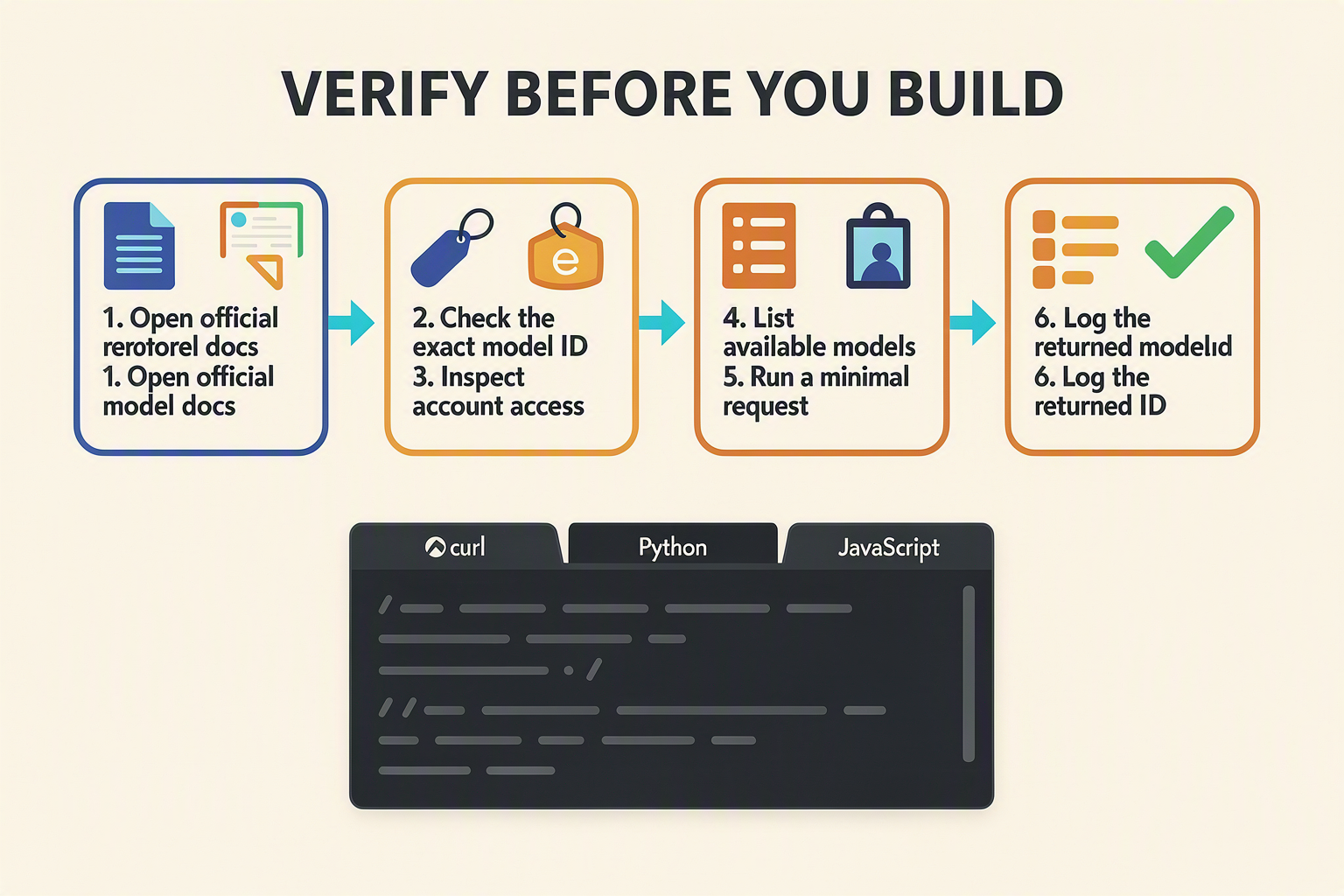
Verify access with a project-scoped API key, retrieve the exact model identifier, and then run a minimal Responses API request. As of September 22, 2026, test gpt-5.6-sol, gpt-5.6-luna or gpt-6-astra—not the undocumented identifiers gpt-6-sol and gpt-6-luna.
How do you check whether your API key can access a model?
Use the same API key and project that your production application will use. ChatGPT access is not proof of API entitlement: OpenAI Help Center lists GPT-6 Pro, powered by GPT-6 Astra, for eligible ChatGPT plans, but API access is governed separately.
First, retrieve the model directly:
export OPENAI_API_KEY="your-project-api-key"

curl https://api.openai.com/v1/models/gpt-5.6-luna \
  -H "Authorization: Bearer $OPENAI_API_KEY"
Repeat the request with gpt-5.6-sol or gpt-6-astra when evaluating those models. The OpenAI Models catalog listed all three identifiers as of September 22, 2026, while the dedicated OpenAI model page confirmed gpt-5.6-luna.
Interpret the result carefully:
- Successful model response: The key can discover that identifier, but you should still send a generation request to verify endpoint access.
- Authentication error: Check the API key, organization and project configuration.
- Model-not-found or access error: Confirm spelling, account eligibility and regional or project restrictions before changing code.
- Rate-limit or quota error: Review the project’s current limits and billing state rather than assuming a universal limit.
OpenAI’s supplied public search results do not establish one numeric rate limit for every Sol, Luna or Astra account. Treat the limits shown in your OpenAI project dashboard and returned by the live API as authoritative.
How do you send the first GPT-5.6 Luna API request?
Start with a short, deterministic task that makes failures easy to diagnose:
curl https://api.openai.com/v1/responses \
  -H "Authorization: Bearer $OPENAI_API_KEY" \
  -H "Content-Type: application/json" \
  -d '{
    "model": "gpt-5.6-luna",
    "input": "Return exactly this JSON object: {\"status\":\"ok\"}"
  }'
The equivalent Python request uses the official OpenAI SDK:
from openai import OpenAI

client = OpenAI()

response = client.responses.create(
    model="gpt-5.6-luna",
    input='Return exactly this JSON object: {"status":"ok"}'
)

print(response.output_text)
To test Sol or Astra, change only the model value:
model="gpt-5.6-sol"
# or
model="gpt-6-astra"
OpenAI’s September 2026 catalog describes GPT-6 Astra as its model for the hardest end-to-end work, so avoid using Astra merely as an access probe if Luna can validate the integration more economically.
What should you verify before writing production code?
A successful first response is only the beginning. Record the following evidence for each environment:
- Exact model ID returned by the API.
- HTTP status, request ID and response metadata for debugging.
- Input, output and reasoning-token usage, where reported.
- Observed rate-limit and quota errors under the production project.
- Endpoint compatibility for tools, structured output or multimodal inputs.
- Fallback behavior when the preferred model is unavailable.
Do not silently replace gpt-6-sol with another model. Reject unsupported configuration values during startup and map human-facing labels such as “Sol” to the verified identifier gpt-5.6-sol explicitly.
What are the verified prices, rate limits, context windows, and capabilities?
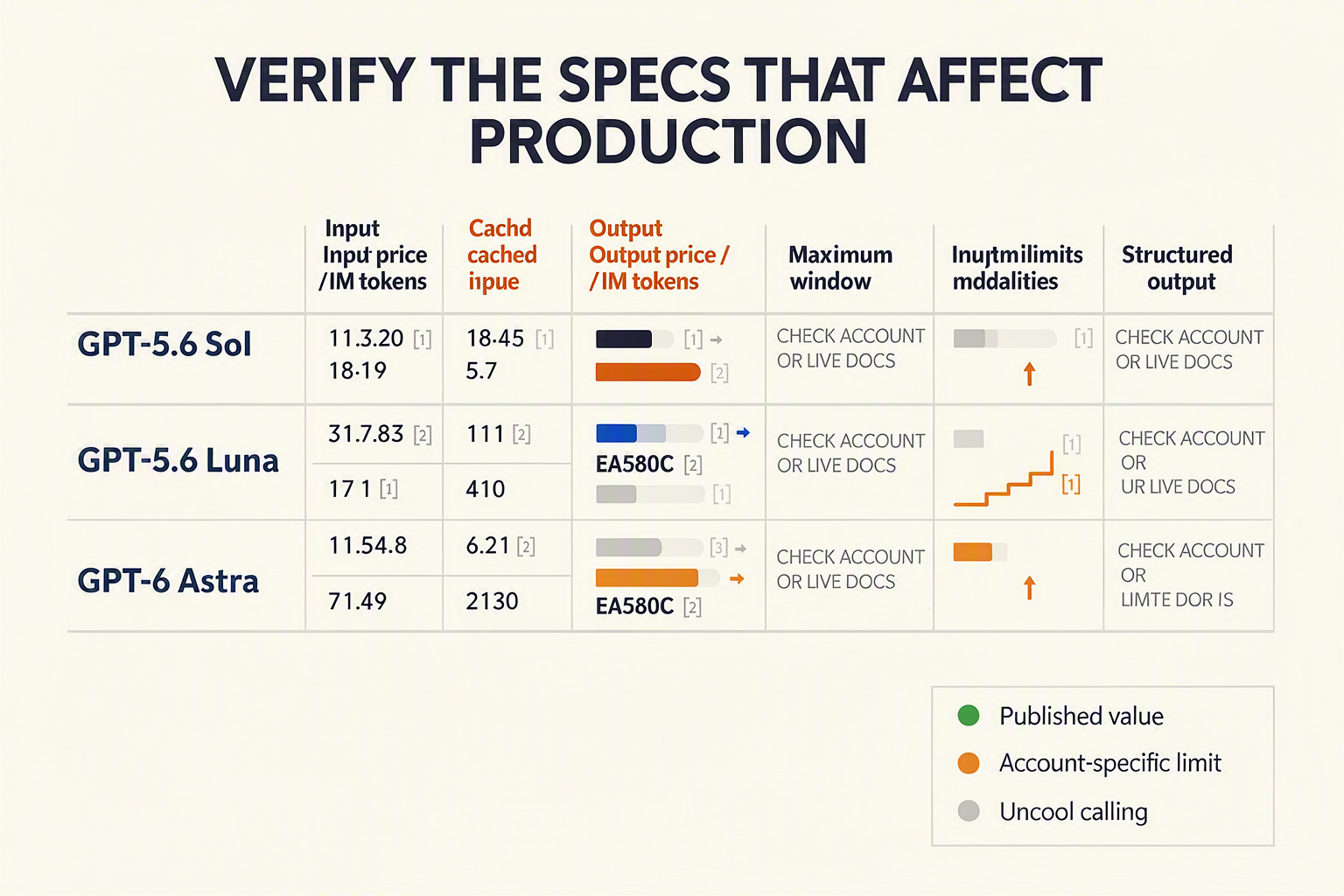
As of September 22, 2026, OpenAI publishes exact token prices for several models, but the available primary-source extracts do not establish universal numeric rate limits or complete capability matrices for every model. Developers should treat undocumented values as unverified, not estimate them from neighboring models.
What are the verified GPT-5.6 and GPT-6 API specifications?
| Model and API identifier | Verified API price per 1M tokens | Context and output limits | Verified capabilities | Published rate limits |
|---|---|---|---|---|
GPT-5.6 Sol — gpt-5.6-sol | $4 input; $0.40 cached input | Not verified in the cited extracts | Complete modality and tool matrix not verified | No universal RPM/TPM figure verified |
GPT-5.6 Terra — gpt-5.6-terra | $2 input; $0.20 cached input; $12 output | Not verified in the cited extracts | Complete modality and tool matrix not verified | No universal RPM/TPM figure verified |
GPT-5.6 Luna — gpt-5.6-luna | $0.20 input; $0.02 cached input | 1,050,000-token context; 128,000-token maximum output | Reasoning tokens verified; other features require live documentation checks | No universal RPM/TPM figure verified |
GPT-6 Astra — gpt-6-astra | $10 input; $50 output | Not verified in the cited extracts | Described as OpenAI’s model for the “hardest end-to-end work”; complete matrix not verified | No universal RPM/TPM figure verified |
All prices in the table are US dollars per million tokens as of September 22, 2026. OpenAI’s API pricing page lists the GPT-5.6 input and cached-input prices, while OpenAI’s model catalog lists GPT-6 Astra at $10 per million input tokens and $50 per million output tokens.
The available pricing extract does not expose every output-token price. An omitted value should therefore be checked on OpenAI’s live pricing page rather than inferred using a multiplier.
How large is the GPT-5.6 Luna context window?
OpenAI’s GPT-5.6 Luna model page listed a 1,050,000-token context window and a 128,000-token maximum output as of September 2026. The same OpenAI page listed a February 16, 2026 knowledge cutoff and support for reasoning tokens.
A large context window does not mean every request should approach the limit. Production systems still need to account for:
- Input, cached-input and output costs
- Latency from processing long prompts
- Tokens consumed by tool definitions and tool results
- Reserved space for the model’s response
- Application-level payload and timeout constraints
Are GPT-5.6 Sol prices permanent?
Not necessarily. OpenAI announced on August 21, 2026 that GPT-5.6 Sol API and credit pricing would be reduced by more than 20% for three months. Because this is a time-limited adjustment, developers should store prices in configuration rather than hard-code them into cost calculations.
For procurement or forecasting, record both the price-check date and the source page used. Recheck Sol pricing before the temporary period ends.
Do these models support tool calling and structured outputs?
The supplied primary-source extracts do not conclusively verify tool calling, structured outputs, vision, audio input or audio output for every listed model. Only GPT-5.6 Luna’s reasoning-token support is explicitly confirmed here.
Before deployment, verify each required feature on the individual OpenAI model page and run capability probes for:
- Function or tool calling
- JSON-schema structured outputs
- Image or audio inputs
- Streaming responses
- Maximum tool-result and output sizes
Likewise, numeric requests-per-minute and tokens-per-minute limits should be read from the developer account’s current limits view. Rate limits can depend on the model and account tier, so a single universal number would be misleading.
Which model should you choose for each workload?
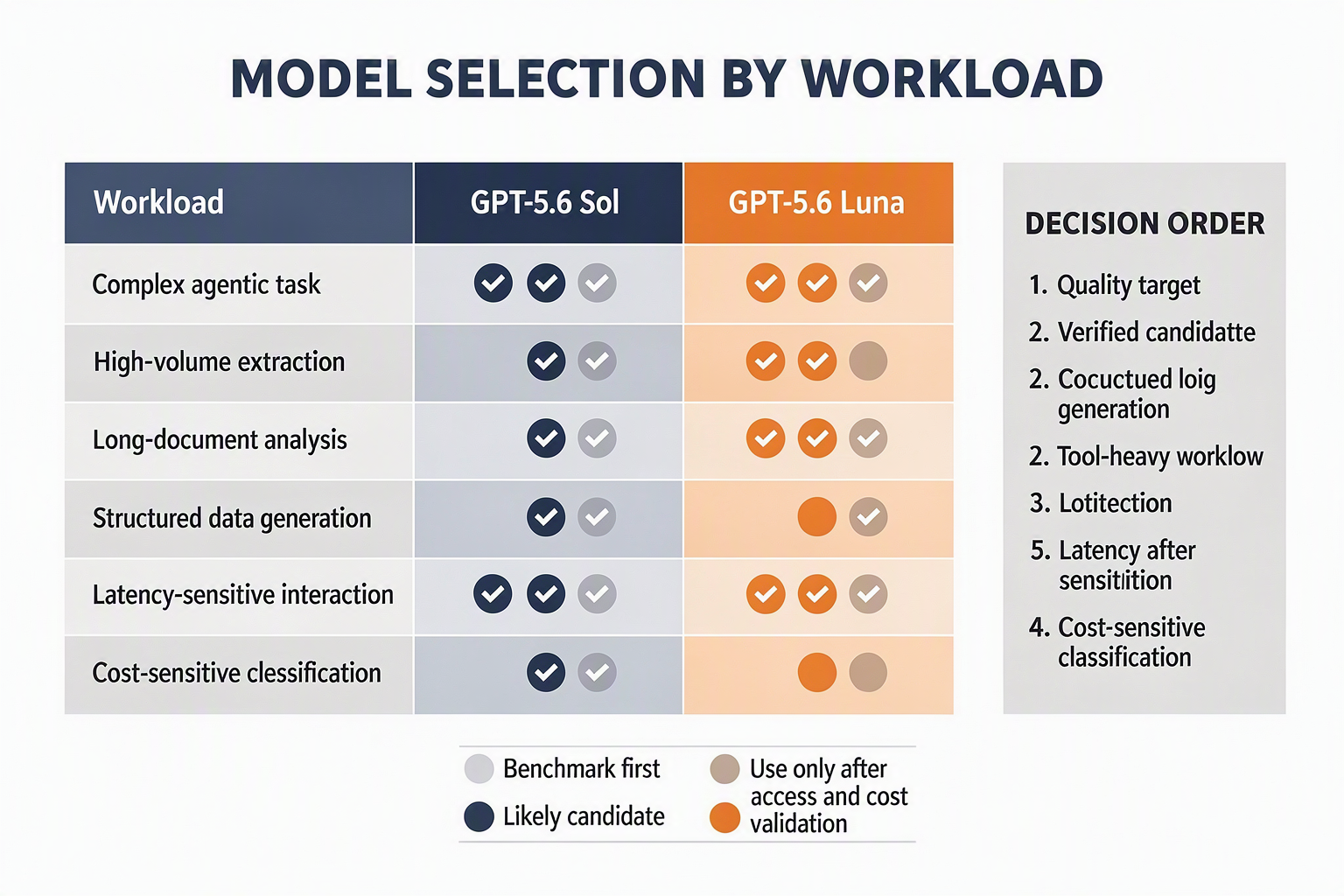
Choose GPT-5.6 Luna for cost-sensitive, high-volume work, GPT-5.6 Sol for quality-focused reasoning, and GPT-6 Astra for the hardest end-to-end tasks. GPT-5.6 Terra is the practical middle tier when Luna needs too much supervision but Astra or Sol would be unnecessarily expensive.
Which model fits each AI workload?
| Workload | Recommended model ID | Why it fits | Key trade-off |
|---|---|---|---|
| Classification, extraction and routing | gpt-5.6-luna | Lowest documented input price among these models | Test accuracy on ambiguous cases |
| Large-document analysis | gpt-5.6-luna | 1,050,000-token context window and 128,000-token maximum output | Large prompts still require retrieval and cost controls |
| General production assistants | gpt-5.6-terra | Mid-tier price-performance option | More expensive than Luna |
| Complex coding and reasoning | gpt-5.6-sol | Quality-oriented GPT-5.6 tier for demanding tasks | Promotional pricing may change after November 2026 |
| Long-running, multi-tool workflows | gpt-6-astra | OpenAI describes Astra as its model for the “hardest end-to-end work” | Highest documented token price in this comparison |
| Real-time voice agents | Benchmark Luna, Terra and Sol | Cost, response quality and tool reliability must be tested together | Model pricing excludes the rest of the voice pipeline |
When should you choose GPT-5.6 Luna?
Use gpt-5.6-luna when requests are numerous, prompts are large or mistakes can be caught through validation. Typical examples include ticket tagging, transcript summarization, entity extraction, retrieval-augmented generation and first-pass document review.
OpenAI listed GPT-5.6 Luna at $0.20 per million input tokens as of September 2026. By comparison, OpenAI’s model catalog listed GPT-6 Astra at $10 per million input tokens, making Astra’s documented input rate 50 times Luna’s.
OpenAI’s GPT-5.6 Luna documentation also listed a 1,050,000-token context window, 128,000-token maximum output and February 16, 2026 knowledge cutoff as of September 2026. That makes Luna attractive for long inputs, although developers should not automatically send entire repositories or archives when retrieval can supply a smaller, more relevant context.
When are Terra or Sol the better choice?
Choose gpt-5.6-terra when Luna’s output requires frequent retries or human correction. OpenAI announced GPT-5.6 Terra pricing of $2 per million input tokens and $12 per million output tokens on July 30, 2026, positioning Terra between Luna and Sol.
Choose gpt-5.6-sol for harder coding, planning and reasoning tasks where output quality has more economic value than minimum token cost. OpenAI’s API pricing page listed GPT-5.6 Sol at $4 per million input tokens as of September 2026. However, OpenAI said on August 21, 2026 that Sol API and credit pricing had been reduced by more than 20% for three months, so production budgets should not assume that temporary price will continue.
When is GPT-6 Astra worth the premium?
Reserve gpt-6-astra for tasks that fail measurable acceptance tests on the GPT-5.6 tiers: complex agent plans, difficult debugging, cross-domain synthesis or consequential multi-step workflows. OpenAI listed GPT-6 Astra at $10 per million input tokens and $50 per million output tokens as of September 2026.
A reliable routing strategy is:
- Start with Luna.
- Escalate failed or low-confidence requests to Terra or Sol.
- Use Astra only when evaluation results justify its premium.
- Verify tool calling, structured-output schemas, modalities and account-specific rate limits for the exact model ID before deployment.
How do you migrate safely from GPT-5.6 models to GPT-6 Astra?
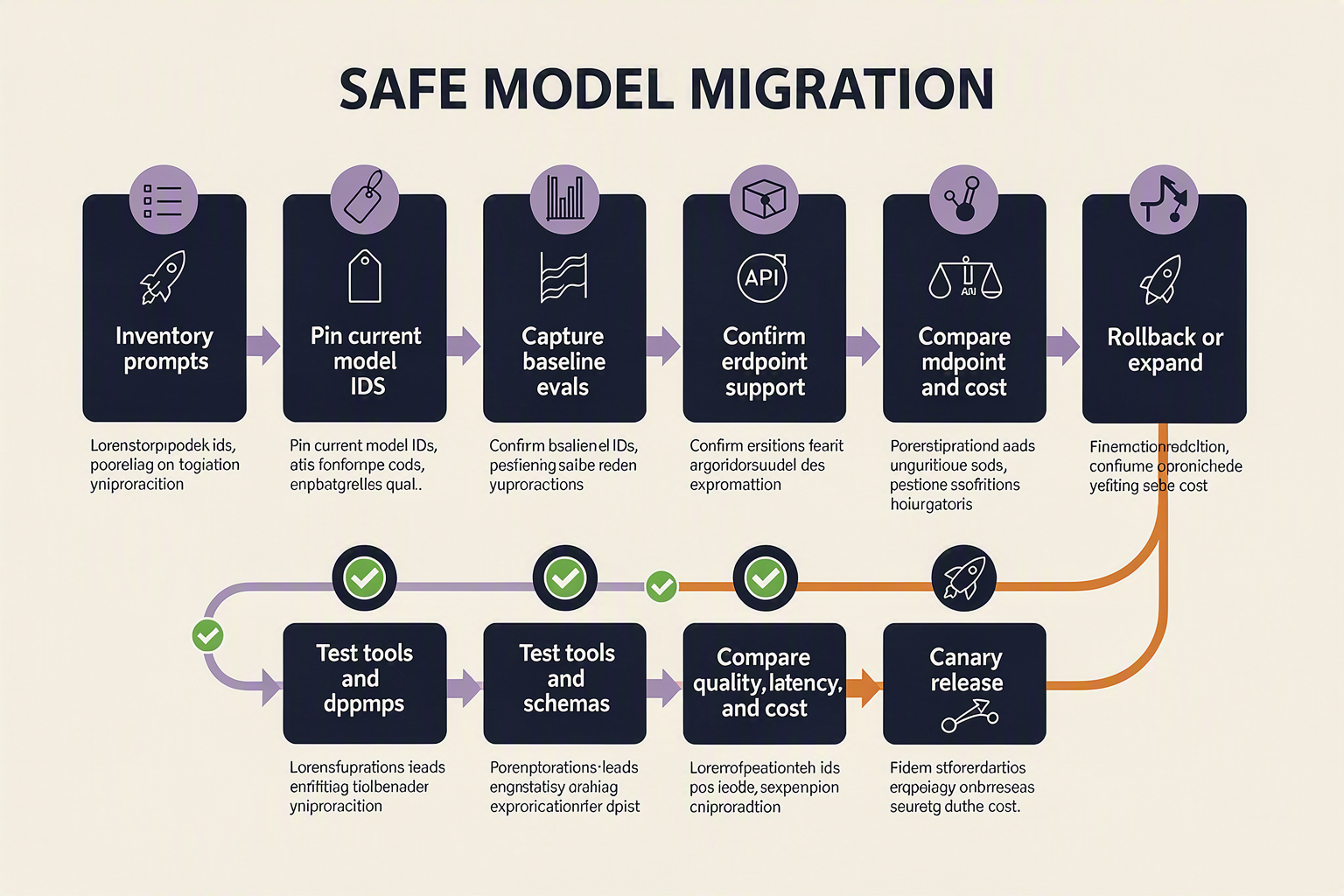
A safe migration from gpt-5.6-sol or gpt-5.6-luna to gpt-6-astra requires more than changing the model string. Run a capability audit, replay representative workloads, enforce cost limits and shift traffic gradually; do not assume GPT-5.6 context limits, rate limits, tool behavior or output formats carry over to GPT-6 Astra.
What should you verify before changing the model ID?
Start by recording the production behavior of the current GPT-5.6 model. Your baseline should include quality scores, token consumption, latency distributions, tool-call accuracy, schema-validation failures and cost per completed task.
Then verify these GPT-6 Astra properties against OpenAI’s current account documentation:
- API access for the relevant project and organization
- Supported endpoints, input modalities and streaming behavior
- Context window and maximum output size
- Tool calling, parallel tool calls and structured-output support
- Tokens-per-minute and requests-per-minute limits
- Reasoning controls and token accounting
- Cached-input pricing and batch-processing availability
The supplied OpenAI primary-source excerpts do not establish exact GPT-6 Astra context, output or rate limits as of September 22, 2026, so those values should not be inferred from GPT-5.6. By comparison, OpenAI’s model documentation listed gpt-5.6-luna with a 1,050,000-token context window and 128,000-token maximum output as of September 2026.
How should you test GPT-6 Astra compatibility?
Use an environment variable rather than hard-coding the identifier:
import os
from openai import OpenAI

client = OpenAI()

response = client.responses.create(
    model=os.environ.get("OPENAI_MODEL", "gpt-5.6-sol"),
    input="Analyse this support case and return the required result."
)
Set OPENAI_MODEL=gpt-6-astra only in a test environment first. Run a fixed evaluation set containing long prompts, multilingual inputs, adversarial instructions, empty fields, malformed tool results and requests near your expected output ceiling.
For applications using tools or structured data, validate:
- Tool selection: Did the model choose the correct function?
- Argument integrity: Do arguments pass JSON Schema and business validation?
- Execution safety: Are destructive actions protected by confirmation and idempotency keys?
- Recovery behavior: Can the application handle rejected schemas, timeouts and partial streams?
- Answer quality: Does the final response correctly incorporate tool results?
How can you control migration costs?
Apply a hard budget gate before increasing traffic. OpenAI’s model catalog priced GPT-6 Astra at $10 per million input tokens and $50 per million output tokens as of September 2026. OpenAI’s API pricing page listed GPT-5.6 Luna input at $0.20 per million tokens, making GPT-6 Astra input 50 times more expensive before accounting for differences in reasoning or output usage.
Track cost per successful task, not merely cost per token. A stronger model can still be economical if it reduces retries, tool loops or human review—but that benefit must be measured.
What rollout sequence minimizes production risk?
- Send shadow requests without exposing Astra’s answers to users.
- Canary 1%–5% of eligible traffic.
- Compare quality, errors, latency, tool calls and spend against the baseline.
- Increase traffic in controlled stages.
- Keep
gpt-5.6-solorgpt-5.6-lunaas an explicit rollback target. - Set automatic circuit breakers for budget overruns, schema failures and elevated API errors.
Finally, rerun evaluations whenever OpenAI changes model versions, pricing or limits. OpenAI announced on August 21, 2026 that GPT-5.6 Sol pricing would fall by more than 20% for three months, demonstrating why migration economics must be dated and rechecked rather than treated as permanent.
Which safeguards prevent rate-limit, access, and migration failures?

Prevent production failures by validating model access at deployment time, enforcing local token and concurrency budgets, and migrating behind a reversible model abstraction. As of September 2026, no universal OpenAI rate-limit figure for Sol, Luna or Astra could be verified from the supplied primary sources, so limits must be read from the API account and live responses rather than hard-coded from third-party tables.
How do you prevent model-access failures?
A model appearing in OpenAI documentation does not prove that every organization, project or region can call it. OpenAI’s Help Center states that GPT-6 Pro, powered by GPT-6 Astra, is available in ChatGPT on eligible Pro, Business and Enterprise plans as of September 2026, but ChatGPT access does not establish API entitlement.
Add a deployment-time access probe for each intended model:
- Authenticate using the production project’s API key.
- Check the provider’s current model catalog or model-listing endpoint.
- Send a minimal, low-token request to the exact identifier.
- Test required capabilities separately, including tool calling and structured output.
- Block deployment if the response indicates an unknown model, missing permission or unsupported parameter.
Treat HTTP errors differently:
- 400: correct the request or unsupported capability; do not retry unchanged.
- 401/403: stop and alert for credentials, project permissions or model access.
- 404: verify the model identifier instead of silently inventing an alias.
- 429: honor
Retry-Afterwhen supplied, then retry with exponential backoff and jitter. - 5xx/timeouts: retry only within a bounded attempt and latency budget.
How should applications handle unknown rate limits safely?
Use client-side admission control even when the provider publishes account-specific limits. Track requests, input tokens, output tokens and concurrent calls independently because any one of those dimensions can become the bottleneck.
A practical control loop should:
- Reserve estimated tokens before dispatching a request.
- Queue low-priority work rather than sending synchronized bursts.
- Reduce concurrency after repeated
429responses. - Apply randomized exponential backoff to prevent a retry storm.
- Cap retries by both attempt count and elapsed time.
- Record model, project, status code, latency and token usage for every request.
- Send failed work to a dead-letter queue where asynchronous processing is acceptable.
Do not retry tool actions blindly. Use an application-level idempotency key or execution ledger so a timeout cannot create a second order, payment or CRM update after the first tool call succeeded.
What is the safest way to migrate between Sol, Luna and Astra?
Place model selection behind configuration rather than embedding identifiers throughout the codebase. A safe migration changes one controlled mapping while preserving a known-good rollback target.
MODEL_FAST      = "gpt-5.6-luna"
MODEL_PRIMARY   = "gpt-5.6-sol"
MODEL_COMPLEX   = "gpt-6-astra"
Before shifting production traffic:
- Replay an evaluation set covering tool calls, JSON schemas, long prompts and refusal behavior.
- Canary a small traffic share and compare errors, cost, latency and task success.
- Validate output parsers, because valid prose can still violate an application schema.
- Set explicit input and output ceilings instead of relying on a model’s maximum window.
- Keep rollback immediate through versioned configuration or a feature flag.
- Recalculate spend at migration time. OpenAI announced on August 21, 2026 that GPT-5.6 Sol API pricing was reduced by more than 20% for three months, demonstrating why cached price assumptions can fail.
Finally, require human approval for identifier, price or routing changes. An automatic fallback should use only pre-approved models with tested capabilities, never a guessed “GPT-6 Sol API” or “GPT-6 Luna API” name.
How should you design voice agents and model fallbacks?
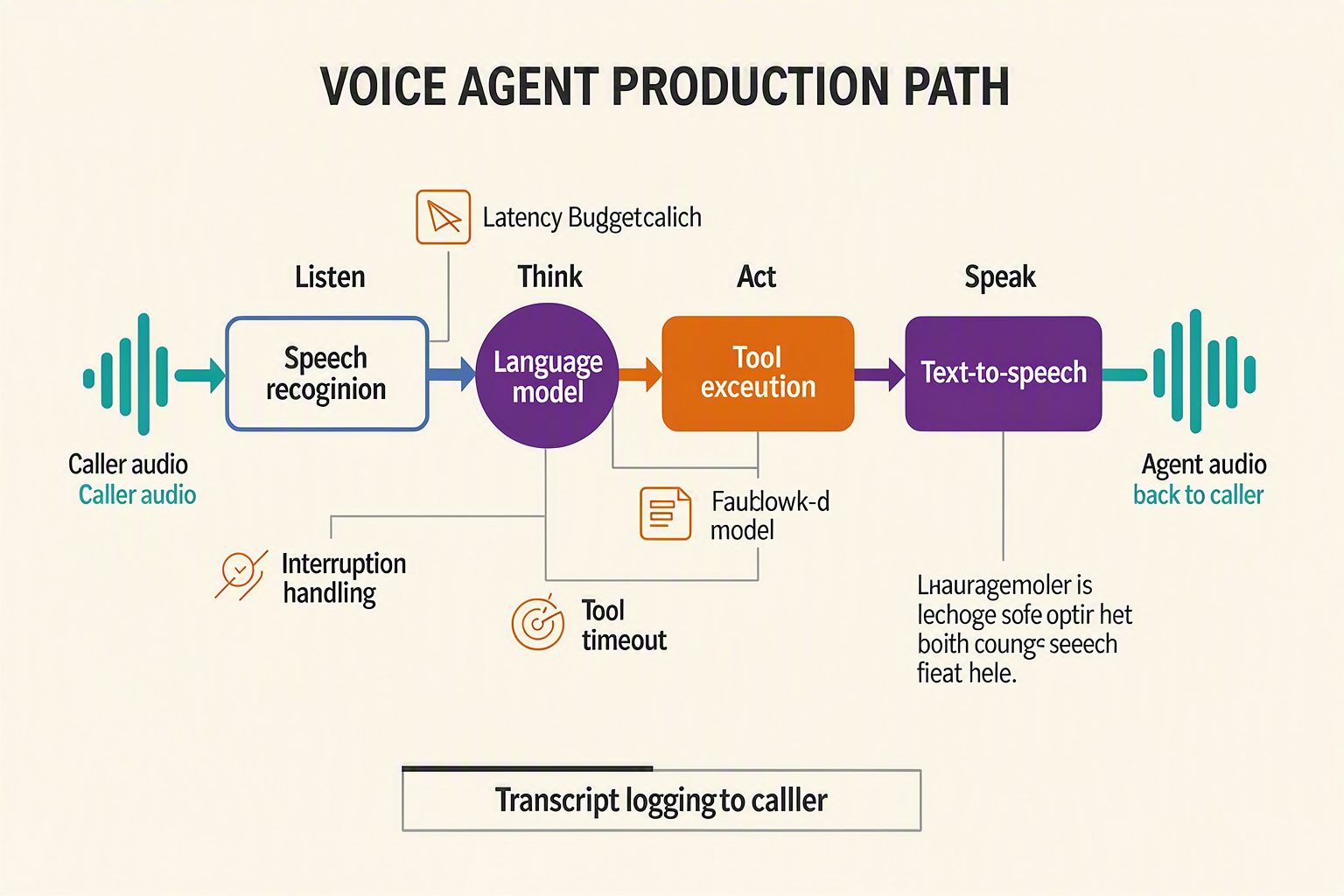
Design voice agents as a stateful orchestration layer, not as one long model call, and configure fallbacks by capability rather than by model name alone. For production, separate telephony, speech recognition, reasoning, tool execution and speech synthesis so that one failure does not terminate the conversation.
How should a GPT voice-agent pipeline be structured?
Use a modular pipeline unless OpenAI explicitly documents native real-time audio support for the selected model. As of September 22, 2026, the supplied OpenAI sources do not verify native speech input or speech output for gpt-5.6-sol, gpt-5.6-luna or gpt-6-astra; do not infer voice support from ChatGPT branding.
A practical pipeline has five stages:
- Audio transport: Receive telephone, browser or app audio over SIP, WebRTC or WebSocket.
- Speech-to-text: Stream partial transcripts while applying endpointing and interruption detection.
- Conversation model: Send compact dialogue state to
gpt-5.6-luna,gpt-5.6-solorgpt-6-astra. - Tool execution: Validate arguments, run permitted business actions and return structured results.
- Text-to-speech: Stream the response as audio and stop playback when the caller interrupts.
Keep call state outside the model. Store the active intent, verified identity, tool results and pending confirmation in your application so a retry or model switch does not lose critical context.
Which model should handle each voice-agent task?
Route by complexity and latency requirements rather than sending every turn to the most capable model. OpenAI describes GPT-6 Astra as its model for the “hardest end-to-end work,” while GPT-5.6 Luna is positioned as the lowest-cost GPT-5.6 option.
A sensible policy is:
- Use
gpt-5.6-lunafor greetings, routing, FAQ retrieval and simple structured extraction. - Escalate difficult reasoning or ambiguous tool decisions to
gpt-5.6-sol. - Reserve
gpt-6-astrafor workflows whose complexity justifies its documented $10 per million input tokens and $50 per million output tokens, according to OpenAI’s model catalog as of September 2026. - Send deterministic actions—such as checking an order ID—to application code rather than asking a larger model to improvise.
Although OpenAI documents a 1,050,000-token context window and 128,000-token maximum output for GPT-5.6 Luna, those limits should not become voice-session targets. Long prompts increase processing and cost; maintain a rolling transcript summary and retain exact tool outputs separately.
How should model fallbacks work during a live call?
Fallbacks should preserve the conversation while avoiding duplicate actions. Implement the following order:
- Retry once for a transient timeout, using an idempotency key for any tool operation.
- Switch to a capability-compatible model only if it supports the required modalities, tool calling and structured schema.
- Simplify the task—for example, collect contact details instead of completing a complex transaction.
- Transfer to a person or schedule follow-up when identity, payment or safety requirements cannot be satisfied.
- Never silently downgrade if the fallback cannot produce the required validated output.
Apply separate time budgets to transcription, model generation, tools and synthesis. Log the chosen model, fallback reason, response time, token usage, tool calls and final disposition for every turn.
For multi-provider resilience, CallMissed’s OpenAI-compatible API supports caller-chosen fallback models across a catalog that includes 25 real-time voice-agent models as of September 2026. Its managed voice-agent WebSocket can also reduce integration work, but developers should still test interruption handling, schema compatibility and failure recovery with real call conditions before deployment.
Frequently Asked Questions
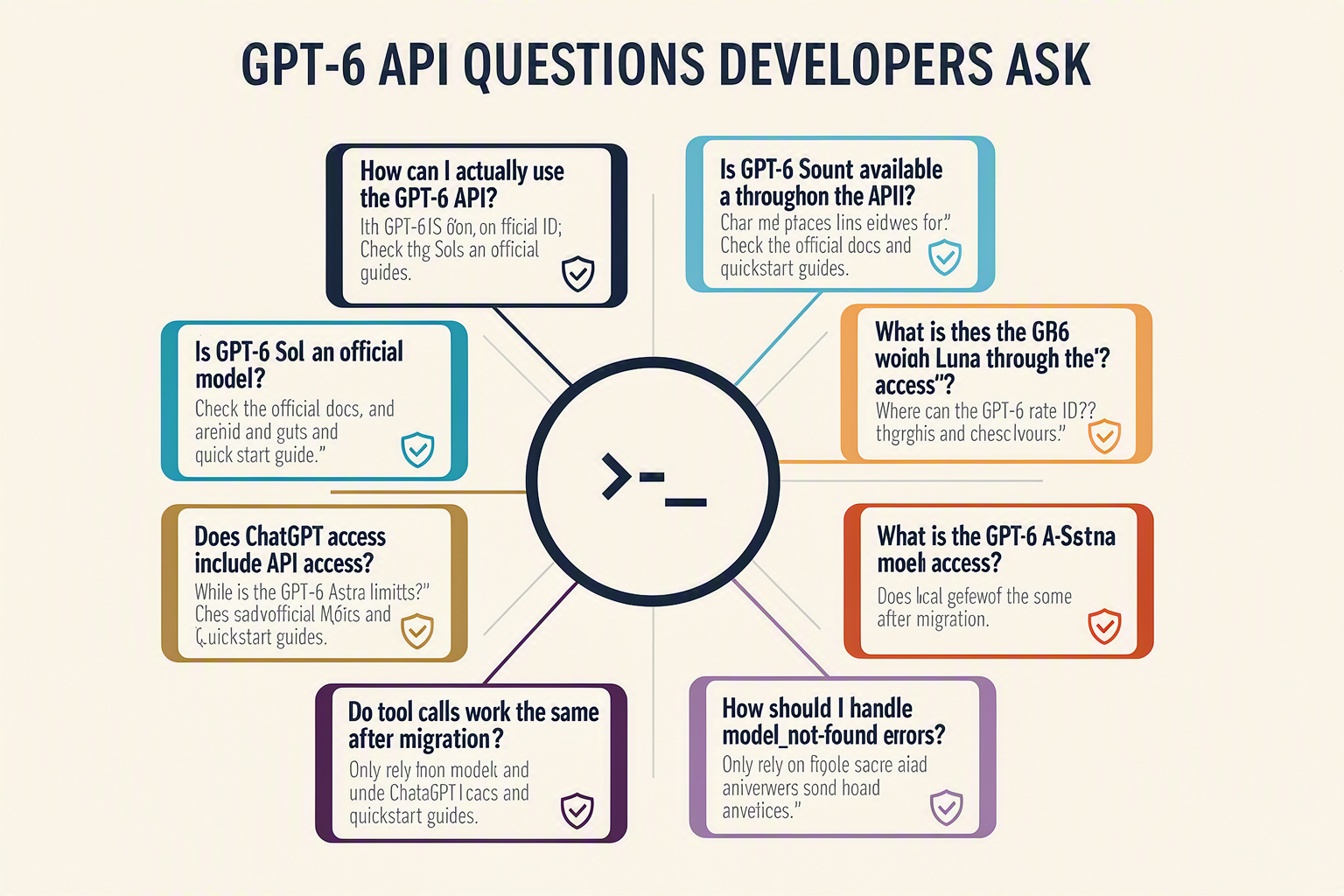
Does the GPT-6 Sol API or GPT-6 Luna API officially exist?
gpt-6-sol or gpt-6-luna were documented as of September 22, 2026. OpenAI identifies Sol and Luna as GPT-5.6 models, so integrations should use gpt-5.6-sol or gpt-5.6-luna; sending an invented GPT-6 identifier will normally produce a model-not-found or access error.How can I actually use the GPT-6 API in 2026?
gpt-6-astra. OpenAI’s model catalog described GPT-6 Astra as its most capable model for difficult end-to-end work as of September 2026, but ChatGPT access to GPT-6 Pro does not automatically establish API access or included API usage.How much do GPT-5.6 Sol, GPT-5.6 Luna, and GPT-6 Astra cost?
What is the context window for the GPT-6 Luna API and GPT-6 Astra API?
What are the GPT-6 Astra, Sol, and Luna API rate limits?
Do GPT-5.6 Sol, GPT-5.6 Luna, and GPT-6 Astra support tools, structured outputs, images, or voice?
Conclusion
The practical conclusion is simple: “GPT-6 Sol API” and “GPT-6 Luna API” are not official OpenAI API names as of September 22, 2026. Production code should use the documented identifiers gpt-5.6-sol, gpt-5.6-luna or gpt-6-astra, then validate each model’s current capabilities and account-specific limits before deployment.
- Treat model identifiers as versioned dependencies. OpenAI’s September 2026 catalog places Sol and Luna in the GPT-5.6 family and identifies Astra as GPT-6. Using an assumed identifier such as
gpt-6-solcan break an otherwise correct integration, so keep model names in configuration rather than hard-coding them throughout an application.
- Choose by workload, not generation number. OpenAI documented GPT-5.6 Luna with a 1,050,000-token context window, 128,000 maximum output tokens and a February 16, 2026 knowledge cutoff as of September 2026. GPT-6 Astra is positioned by OpenAI for the hardest end-to-end work, but that does not automatically make Astra the economical choice for every extraction, summarisation, agent or high-volume task.
- Recalculate costs using dated, primary-source prices. OpenAI’s API pricing page listed GPT-5.6 Luna at $0.20 per million input tokens and its model catalog listed GPT-6 Astra at $10 per million input tokens and $50 per million output tokens as of September 2026. OpenAI also announced on August 21, 2026 that GPT-5.6 Sol pricing would fall by more than 20% for three months, illustrating why copied price tables quickly become unreliable.
- Verify production behavior instead of inferring it from ChatGPT access. Confirm context and output limits, supported modalities, tool calling, structured outputs and rate limits for the exact API model and account tier. ChatGPT’s GPT-6 Pro access does not establish API availability, quotas or pricing.
Watch for renamed model aliases, expiration of Sol’s temporary discount, capability updates and changes to account-specific rate limits. Build fallbacks, budget alerts, evaluation suites and model-routing tests so those changes do not become outages.
Developers evaluating a multi-model approach can also explore CallMissed, an OpenAI-compatible AI gateway offering one API key and balance across 136 models as of September 2026, with caller-chosen fallbacks, structured outputs and usage logs. The question for your next deployment is not merely “Can I call GPT-6?” but which verified model delivers the required capability, reliability and cost profile for this workload?
Related Reading
- OpenAI Astra Launch Status: GPT-6 Release and API Facts for September 2026
- GPT-6 Sol vs GPT-6 Astra: Is Sol Actually Real in 2026?
- Claude Fable 5.1 vs GPT-6 Astra Pricing: Real API Costs in 2026
Sources
Discussion
Related Posts

Ready to automate customer conversations?
Launch AI voice agents and WhatsApp bots with CallMissed — one API, 22+ Indian languages.