Muse Wonder vs GPT-6 Astra vs Gemini 4 Argon for Voice


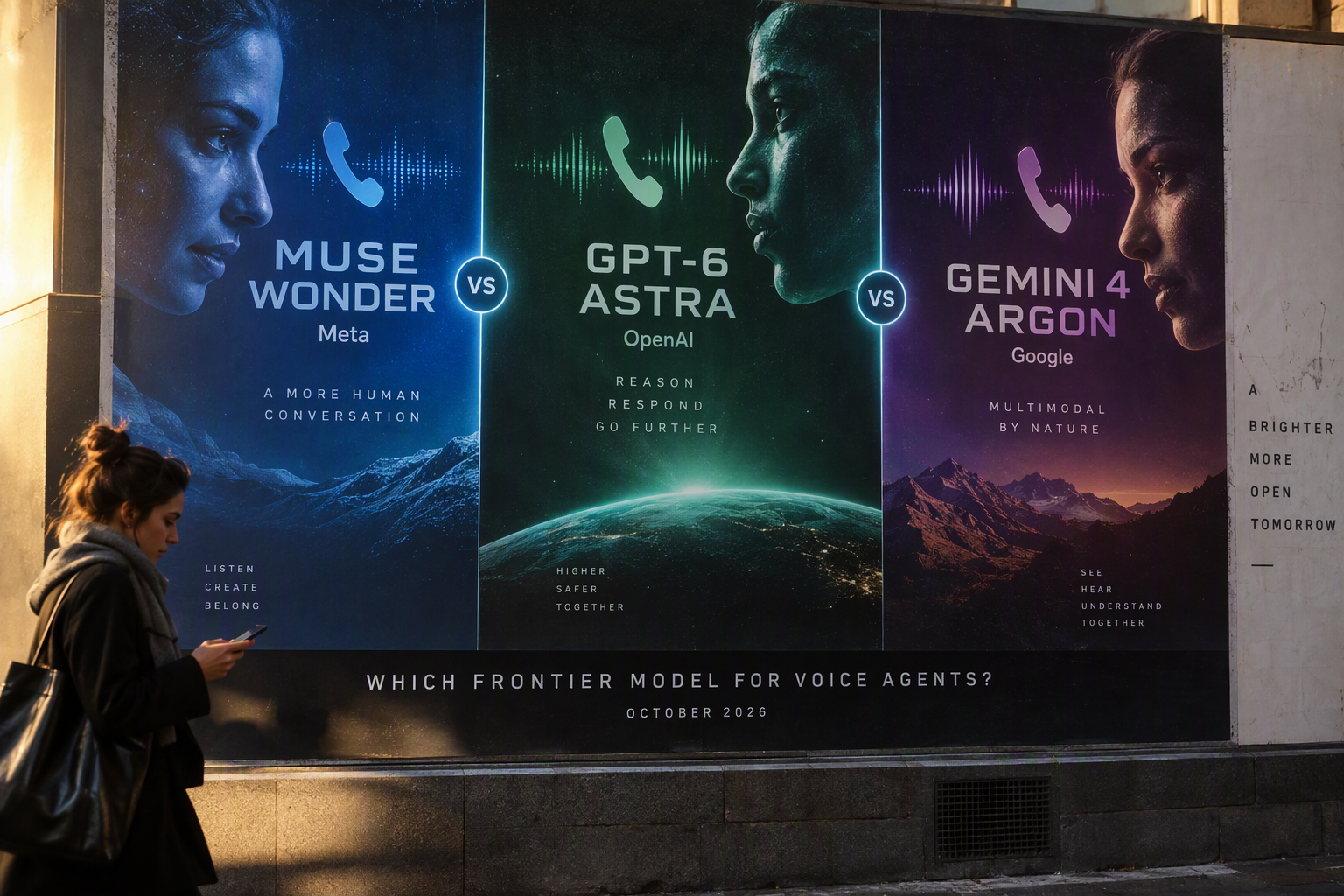
Muse Wonder vs GPT-6 Astra vs Gemini 4 Argon compared on price, context, audio support and latency, with a use-case table for voice and text-back.
Muse Wonder vs GPT-6 Astra vs Gemini 4 Argon for Voice
Meta's first frontier model costs exactly what Claude Opus 5.5 does, even though Alexandr Wang said it would be priced "meaningfully below" OpenAI and Anthropic. That detail frames the Muse Wonder vs GPT-6 Astra vs Gemini 4 Argon debate for anyone building voice agents or missed-call automation in October 2026. Meta released Muse Wonder on October 12, 2026, at $4 per million input tokens, $0.20 cached and $20 output, with a 1M-token context window, according to eesel AI and MACCUS. Datanorth reports it scores 52 on Artificial Analysis against 58 for Opus 5.5, so price and capability don't line up neatly.
This post compares the three models using only sourced facts, and flags where public data is still thin. You'll see what to weigh when picking a model for phone and WhatsApp calls. Platforms like CallMissed, with its OpenAI-compatible gateway, let teams test many LLMs through one API.
Which model is best for voice agents and missed-call automation?
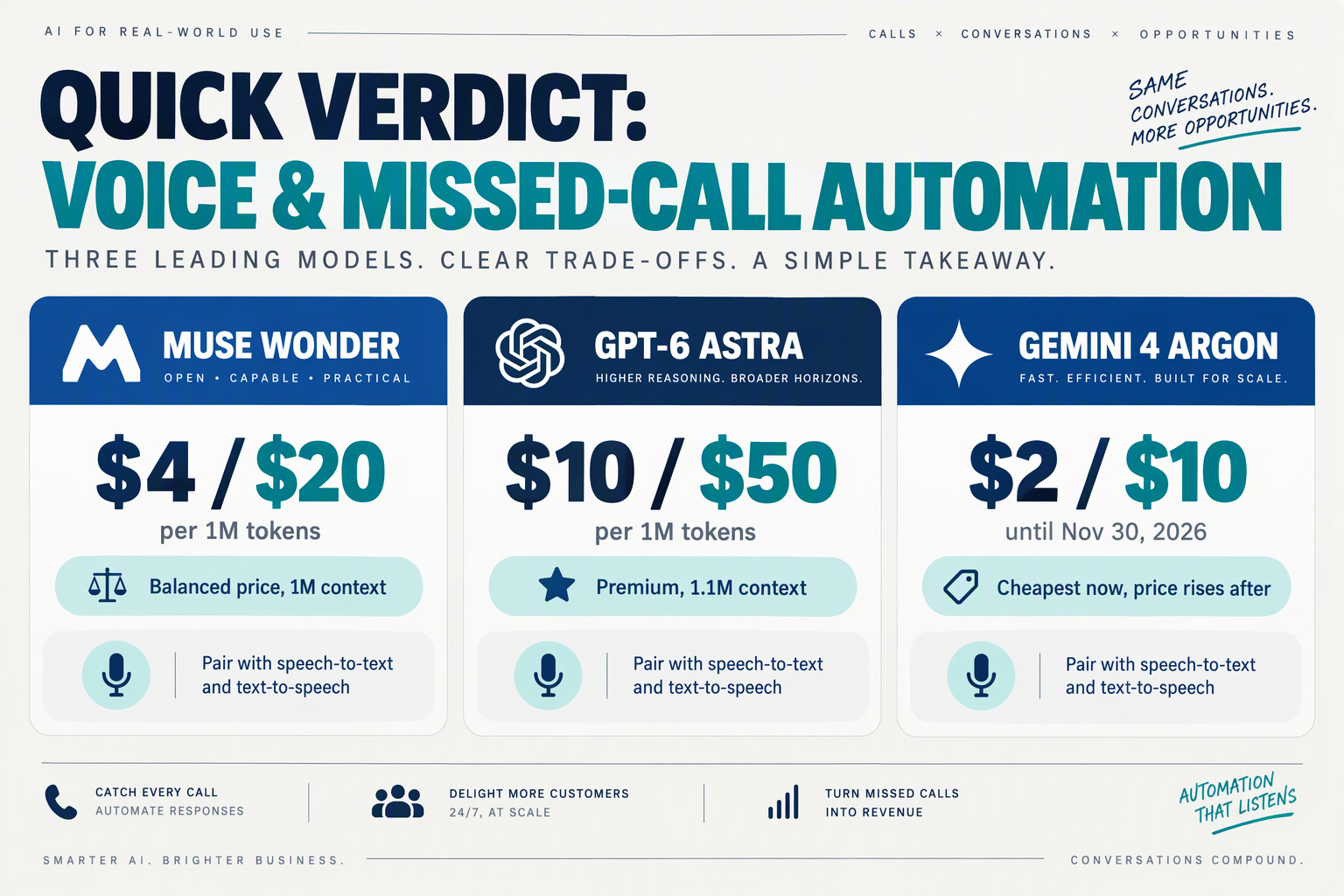
No model can be declared the winner for voice agents yet, because the public sources reviewed here include no voice-latency figures for any of the three, and no sourced pricing or benchmarks for GPT-6 Astra or Gemini 4 Argon.
What the sourced data supports (as of October 14, 2026)
- Muse Wonder: On Meta's own table it leads 7 of 14 rows and Claude Opus 5.5 leads 6, according to CellCog. Those rows are Meta's selection, not an independent test.
- Muse Wonder Full: It scores 56 on Artificial Analysis and is exclusive to paid Muse Code plans, per Datanorth. The model you can buy by the token is the lower-scoring one.
- Muse Wonder focus: Mint reports it targets coding, professional workflows and long-term personal support. Phone conversations are not named as a design goal.
- GPT-6 Astra: No sourced pricing, context window or benchmark scores are available here, so we won't guess.
- Gemini 4 Argon: Same gap. Any claim about its speed or price would be unsupported.
How to choose without a published winner
- Test time to first spoken word: In a live call, a 1M-token context window matters less than how quickly the first token arrives.
- Test Indian languages: Check code-mixed Hinglish and regional accents on real recordings.
- Cost a call, not a token: A short missed-call callback uses few tokens, so $20 per million output tokens is rarely the dominant cost.
- Keep a fallback: Route to a second model if the first stalls.
A gateway such as CallMissed, the OpenAI-compatible AI API covering 140 models, supports caller-chosen fallback models. That lets you run the same call script against several LLMs and compare the results yourself.
How do Muse Wonder, GPT-6 Astra and Gemini 4 Argon compare on features?
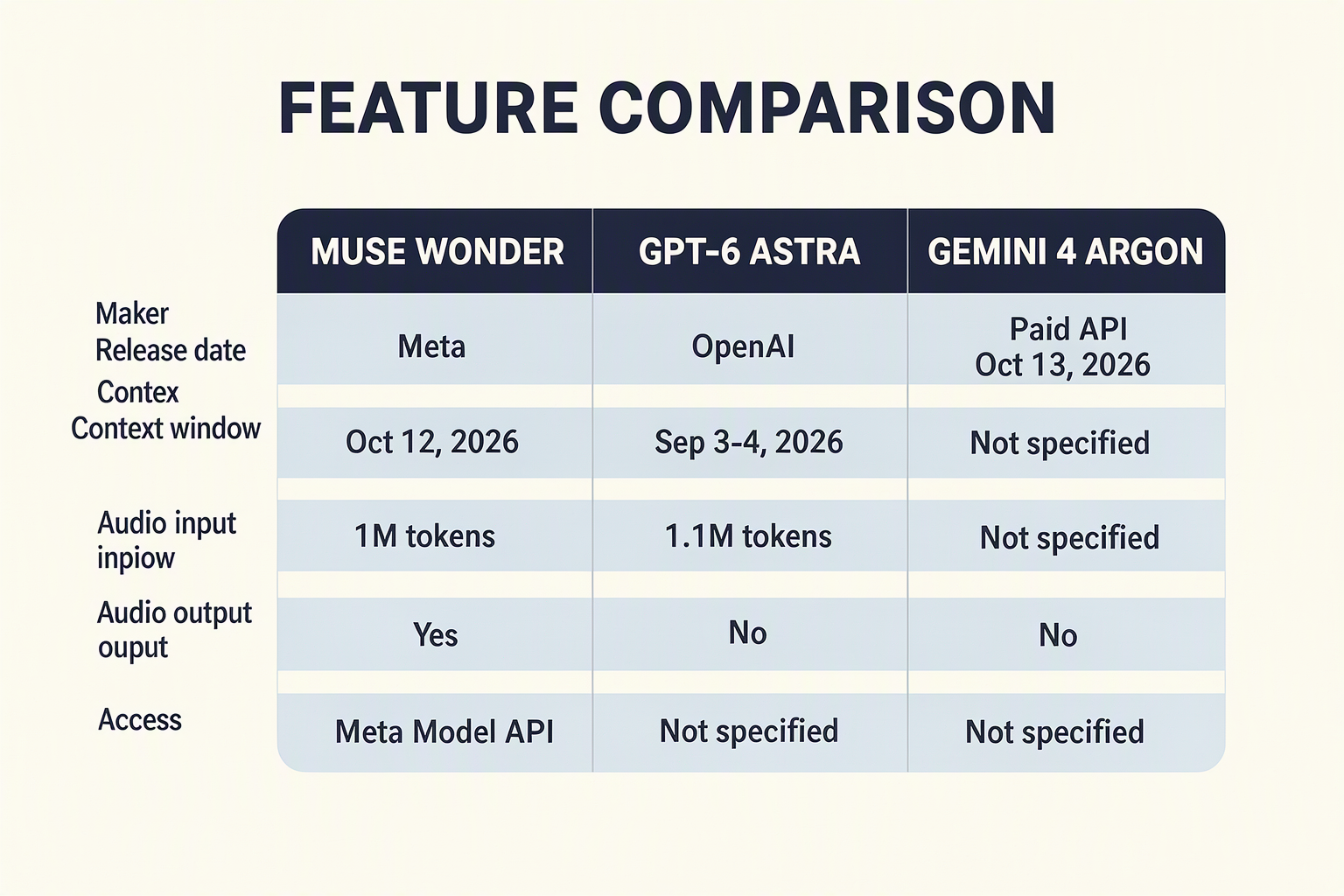
Only Muse Wonder has publicly sourced specs in the research reviewed here (as of October 14, 2026). The other two columns are marked as gaps rather than filled with guesses.
Feature comparison table
| Feature | Muse Wonder | GPT-6 Astra | Gemini 4 Argon |
|---|---|---|---|
| Release | October 12, 2026 (Meta) | Not sourced | Not sourced |
| Input price / 1M tokens | $4.00 | Not sourced | Not sourced |
| Cached input / 1M tokens | $0.20 | Not sourced | Not sourced |
| Output price / 1M tokens | $20.00 | Not sourced | Not sourced |
| Context window | 1M tokens, no long-context premium | Not sourced | Not sourced |
| Artificial Analysis score | 52 (Wonder Full: 56) | Not sourced | Not sourced |
| Voice latency | Not published | Not published | Not published |
What the table tells you
- Muse Wonder: Pricing and context come from the Meta Model API listing, as reported by eesel AI and MACCUS.
- Muse Wonder benchmarks: Datanorth reports 52 on Artificial Analysis versus 58 for Claude Opus 5.5.
- Muse Wonder Full: The 56-scoring sibling is limited to paid Muse Code plans, so it isn't available per token.
- GPT-6 Astra: Every cell is empty in the reviewed sources, so no ranking against Muse Wonder is possible.
- Gemini 4 Argon: The same gap applies, so treat any price or speed claim as unverified.
- Voice readiness: No source publishes first-token or speech-to-speech latency for any of the three, so run your own call tests.
How much does each model cost per task, and what happens when Argon's intro price ends?
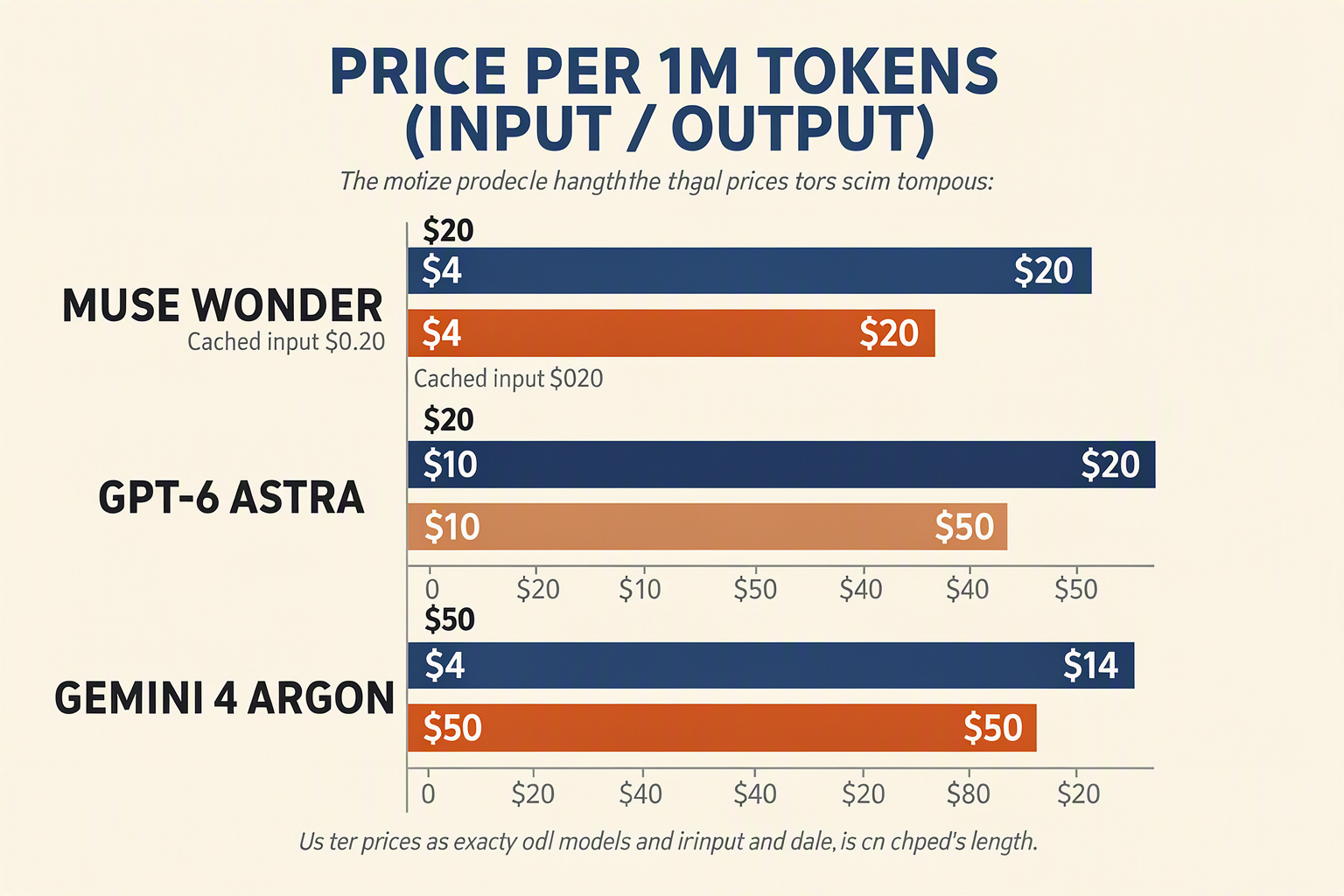
Only Muse Wonder has a sourced price, so only its column can be costed. No source reviewed here gives an Argon intro price or an end date, so what happens when it ends can't be answered yet (as of October 14, 2026).
Cost per task (illustrative token counts)
Token counts below are our assumptions. Prices are Muse Wonder's published API rates of $4 input, $0.20 cached input and $20 output per million tokens, per eesel AI and MACCUS.
| Task | Assumed tokens (in / out) | Muse Wonder, standard | Muse Wonder, cached input | GPT-6 Astra / Gemini 4 Argon |
|---|---|---|---|---|
| Missed-call callback | 3,000 / 300 | $0.018 | $0.0066 | No sourced price |
| 5-minute support call | 20,000 / 1,500 | $0.110 | $0.034 | No sourced price |
| 10-minute sales call | 60,000 / 3,000 | $0.300 | $0.072 | No sourced price |
| 1,000 callbacks | 3.0M / 0.3M | $18.00 | $6.60 | No sourced price |
| Filling the 1M window | 1M / 0 | $4.00 | $0.20 | No sourced price |
What this tells you
- Muse Wonder: A callback costs about 1.7 US cents at standard rates (roughly ₹1.73 at ₹96 per dollar), and caching cuts it by about 63%.
- Muse Wonder context: eesel AI reports no long-context premium on the 1M-token window, so long prompts are billed at the same rate.
- Argon's intro price: With no sourced figure, any "post-promo" cost would be invented. Ask Google for the end date and the standard rate in writing.
- Budget rule: Model the standard rate, not the intro rate, and treat any intro discount as a bonus.
For comparison, CallMissed voice agent plans bill a flat ₹4 to ₹6 per minute covering speech recognition, the language model and the voice. Phone carriage is billed separately.
Do benchmarks and latency translate to real-time voice and WhatsApp or SMS text-back?
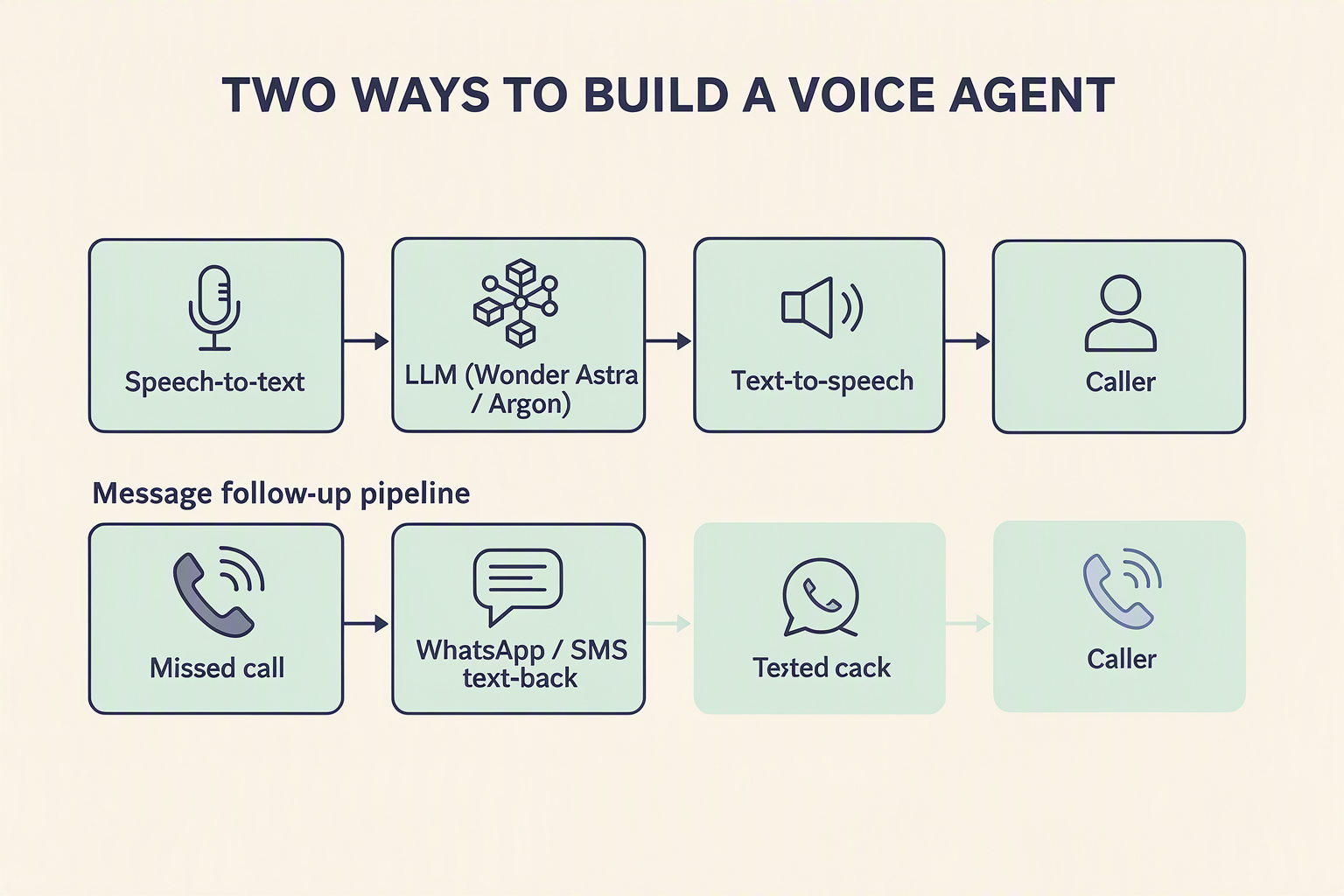
Not directly. Benchmark scores measure reasoning and coding, and none of the sources reviewed here publish voice latency for any of the three models (as of October 14, 2026).
- Benchmarks: Datanorth reports Muse Wonder scores 52 on Artificial Analysis, against 58 for Claude Opus 5.5. That gap says little about how a model handles a short, scripted callback.
- Meta's own table: CellCog notes Muse Wonder leads 7 of 14 rows. Meta chose those rows, and none of them is a voice test.
- Live voice: Callers notice time to first spoken word, which no source measures. The 1M-token context window, with no long-context premium per eesel AI, is rarely the constraint on a two-minute call.
- WhatsApp text-back: Replies are asynchronous, so latency matters less and answer quality and cost matter more. Cached input at $0.20 per million tokens, per MACCUS, helps when every message repeats the same system prompt.
- Illustrative cost: A reply using 2,000 input and 200 output tokens costs about $0.012 (roughly ₹1.15 at ₹96 per US$1) at Muse Wonder's list price. That is our arithmetic, not a sourced figure.
- GPT-6 Astra and Gemini 4 Argon: No sourced latency, price or benchmark data exists for either, so no comparison is possible.
Teams adding AI to WhatsApp can use platforms such as CallMissed, which bridges WhatsApp Business calls to an AI voice agent. Its gateway also lets you replay the same missed-call script across models and measure first-word delay yourself.
What are the pros and cons of each model for voice agents?
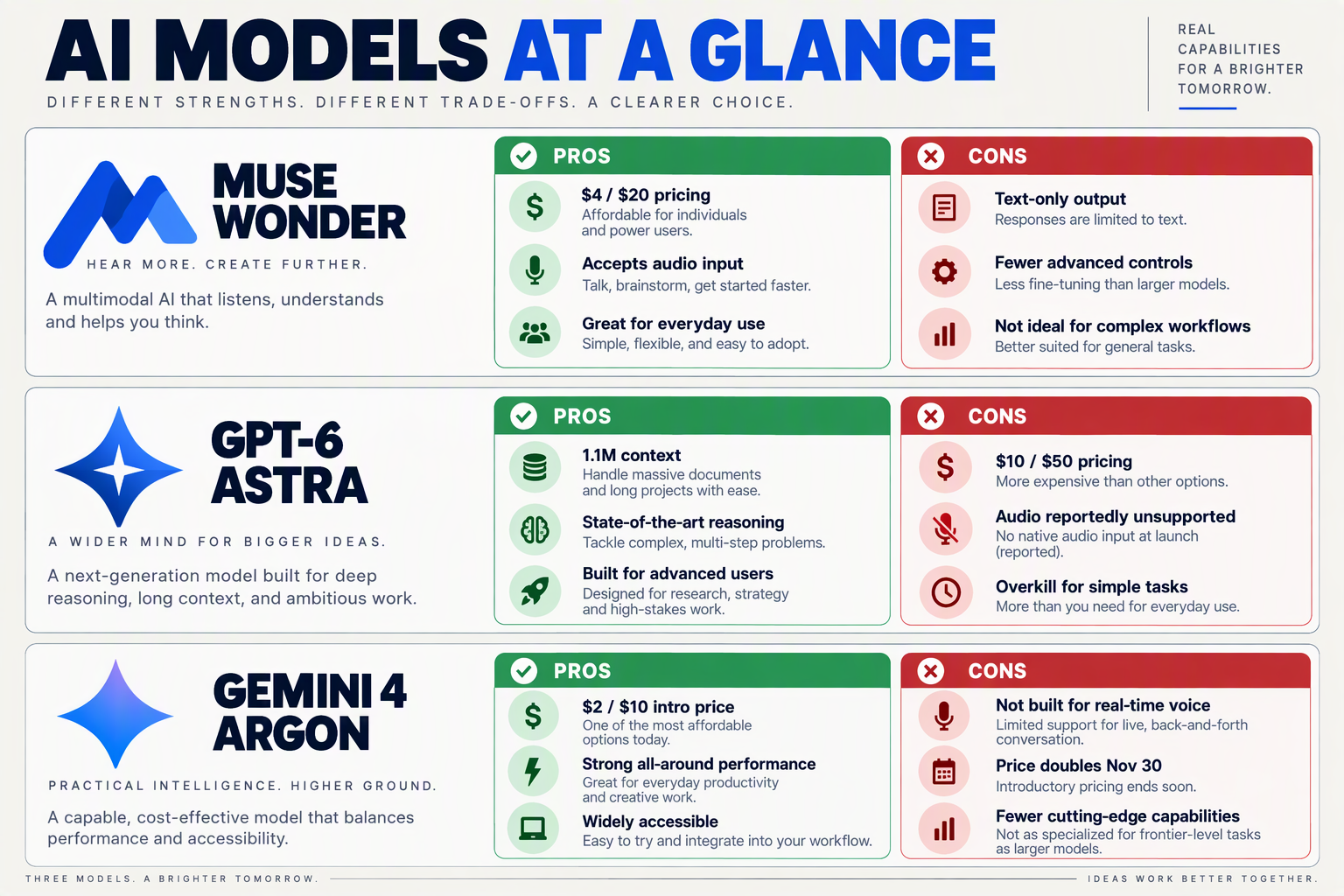
Only Muse Wonder has sourced pros and cons as of October 14, 2026. GPT-6 Astra and Gemini 4 Argon are marked "not sourced" rather than guessed.
Pros and cons at a glance
| Factor | Muse Wonder | GPT-6 Astra | Gemini 4 Argon |
|---|---|---|---|
| Pro: cost levers | $0.20 per million cached input tokens | Not sourced | Not sourced |
| Pro: context | 1M tokens, no long-context premium (eesel AI) | Not sourced | Not sourced |
| Con: price vs. score | $4 in / $20 out, same as Opus 5.5, but scores 52 vs 58 (Datanorth) | Not sourced | Not sourced |
| Con: access | Full version (56) is limited to paid Muse Code plans | Not sourced | Not sourced |
| Voice-latency data | None published | None published | None published |
What the table means for call automation
- Muse Wonder, cached input: A call script and knowledge base repeat on every turn, so the $0.20 cached rate could cut prompt costs. Verify this on your own traffic.
- Muse Wonder, long context: The 1M window can hold a full FAQ or a customer's history without a surcharge.
- Muse Wonder, focus: Mint reports it targets coding, professional workflows and long-term personal support, not live phone conversation.
- Muse Wonder, price: Alexandr Wang said it would be priced "meaningfully below" rivals, yet felloai notes it matches Opus 5.5.
- GPT-6 Astra and Gemini 4 Argon: Without sourced data, any pro or con claimed for them would be speculation.
Because none of the three has published voice benchmarks, run the same call script against each and compare first-word delay and Hinglish accuracy yourself.
Which model fits appointment booking, lead qualification, after-hours reception and cheap triage?
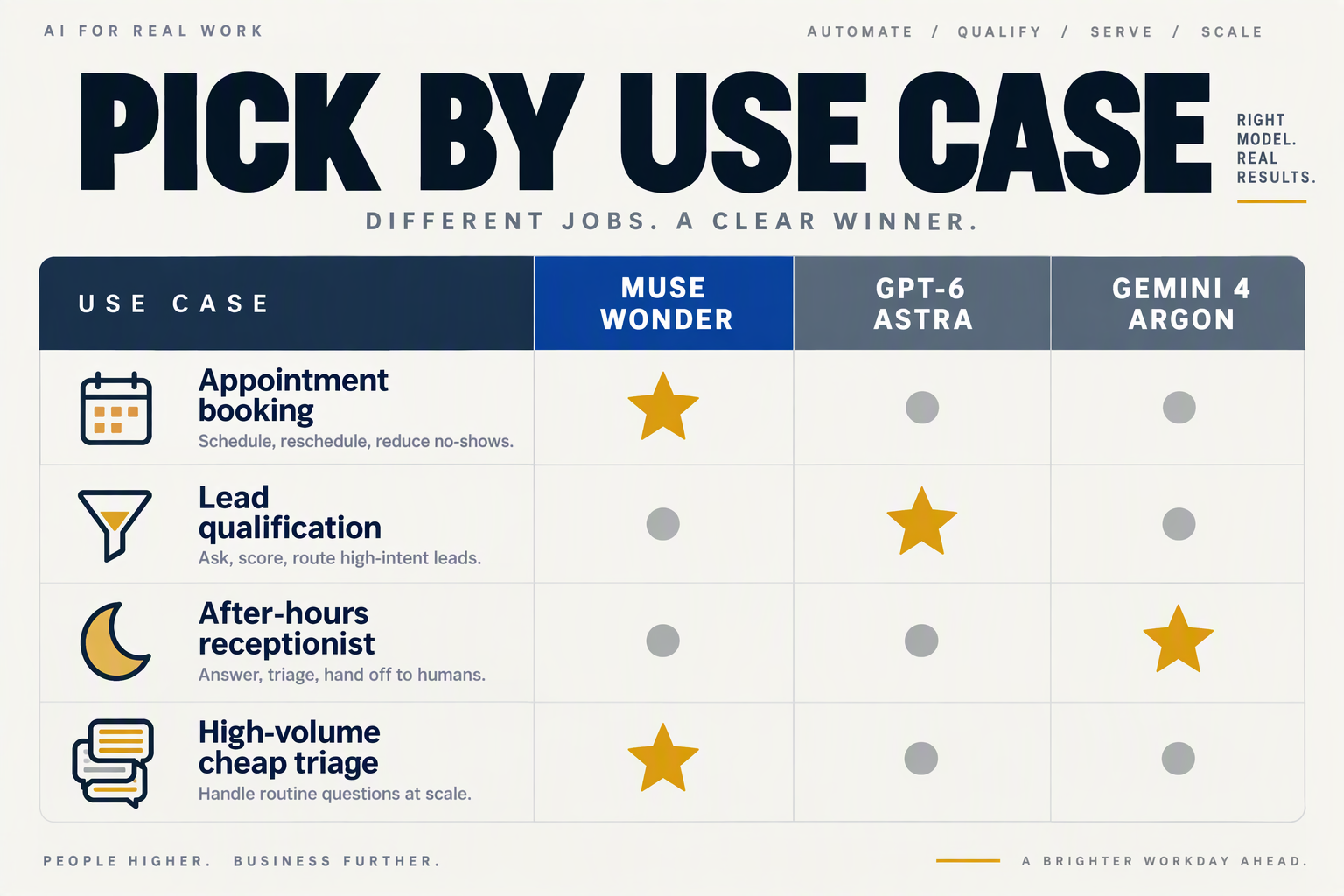
Based on the sourced data (as of October 14, 2026), only Muse Wonder can be assessed at all. Treat the table as a testing plan, not a verdict.
| Use case | What to test | Muse Wonder | GPT-6 Astra | Gemini 4 Argon |
|---|---|---|---|---|
| Appointment booking | Tool-calling accuracy, slot confirmation | Cached input at $0.20 per million helps with long, repeated prompts | No sourced data | No sourced data |
| Lead qualification | Following a question script, Hinglish handling | 1M-token context; no Indian-language figures published | No sourced data | No sourced data |
| After-hours reception | Knowledge-base answers, safe escalation | Pays off if the prompt carries long policy text | No sourced data | No sourced data |
| Cheap triage | Cost per call, speed | $4 in / $20 out, the same as Claude Opus 5.5 | No sourced data | No sourced data |
What the table does and doesn't tell you
- Muse Wonder: The 1M-token window carries no long-context premium, according to eesel AI.
- Cheap triage: At Opus 5.5 pricing, Muse Wonder is a premium-priced model. It scores 52 on Artificial Analysis, per Datanorth. A lighter model is likelier to suit simple routing, though that is our inference, not a sourced finding.
- Voice latency: None of the three has a published figure in the sources reviewed.
- GPT-6 Astra and Gemini 4 Argon: Every cell stays empty until pricing and benchmarks are published.
Teams can run the same booking script across several models through a gateway like CallMissed. Its voice agent plans also start at a flat ₹4 per minute, which gives you a cost baseline per call to compare against.
Which should you choose, and when is a ready-made voice stack enough?
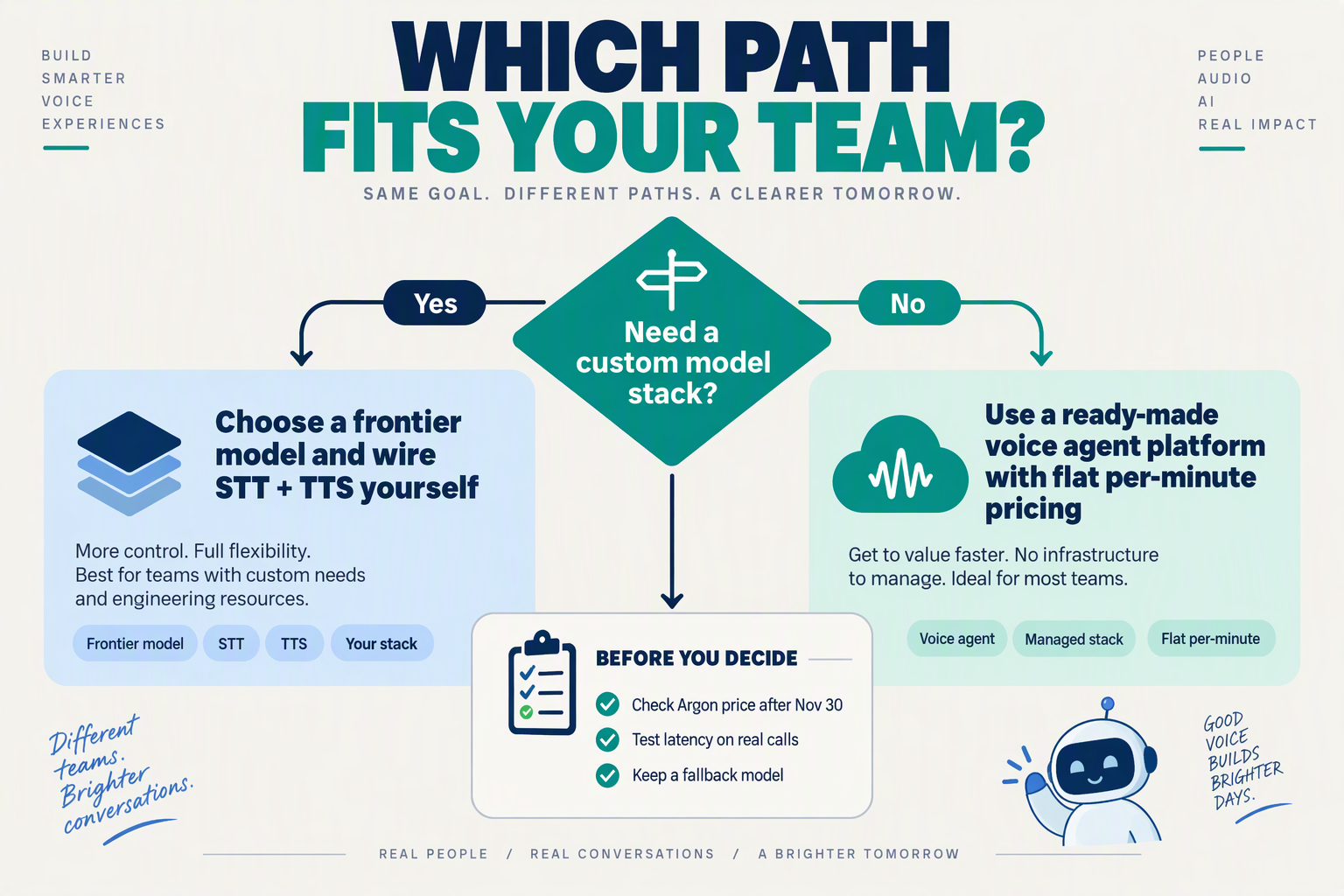
A ready-made voice stack is enough for most missed-call callbacks. Build a custom stack only when a specific model proves it earns the extra work (as of October 14, 2026).
- Ready-made stack: Fits callbacks, appointment booking and FAQ answers. CallMissed's voice agent plans bundle speech recognition, the language model and the voice at ₹4/min (Standard), ₹5/min (Expressive) or ₹6/min (Best latency). A call that never connects costs nothing.
- Muse Wonder: Consider it for long-context or agent-style work. According to eesel AI, it has a 1M-token window with no long-context premium, and cached input costs $0.20 per million tokens, which helps with large knowledge prompts reused across calls.
- Muse Wonder limit: Datanorth reports the stronger Muse Wonder Full is exclusive to paid Muse Code plans. You can't buy it by the token.
- GPT-6 Astra and Gemini 4 Argon: The sources reviewed here give no pricing or benchmarks, so treat both as unverified candidates. Shortlist them only after your own call tests.
- Custom stack: Worth it if you need to choose the model yourself. CallMissed lets you pay each component by the second with no minimum, and its gateway reaches 140 models through one API key.
- Language check: CallMissed's speech recognition covers 22 Indian languages plus English, including Hinglish. Its text-to-speech covers 10 Indian languages plus English, so verify your target language on the voice side too.
A practical rule
- Launch on a ready-made plan and measure answer quality on real calls.
- Move to a custom stack only if one model clearly beats it on your recordings.
- Keep a fallback model in place either way.
Frequently Asked Questions
Answers below use only the sourced facts available as of October 14, 2026.
What does Muse Wonder cost compared with Claude Opus 5.5?
Is Muse Wonder better than GPT-6 Astra and Gemini 4 Argon?
Which version of Muse Wonder can developers actually use?
Are there published voice-latency figures for these models?
Does Muse Wonder's 1M-token context window matter for missed-call automation?
How can I compare these models on my own call scripts?
Conclusion
- No sourced winner yet: As of October 14, 2026, no public data shows voice latency for any of the three models.
- Muse Wonder's price: It matches Claude Opus 5.5 at $4 input and $20 output per million tokens, yet scores 52 versus 58 on Artificial Analysis, per Datanorth.
- Test your own calls: Measure time to first spoken word and Hinglish accuracy, and keep a fallback model.
Watch for independent latency benchmarks and published GPT-6 Astra and Gemini 4 Argon specs. To compare models yourself, explore CallMissed, whose API reaches 140 models. Which metric will decide your pick?
Related Reading
- Gemini 4 Argon vs GPT-6 Astra: Evidence, Costs & Access
- Gemini 4 Argon vs GPT-6.1 Sol: API and Agent Integration
- Gemini 4 Argon vs GPT-6.1 Sol: Coding & Agents (2026)