
Gemini 4 Argon vs GPT-6 Astra: Evidence, Costs & Access



Compare Gemini 4 Argon vs GPT-6 Astra through source checks, access requirements, cost-per-task testing and enterprise evaluation criteria.
Gemini 4 Argon vs GPT-6 Astra: Evidence, Costs & Access
What good is a frontier-model breakthrough if your team cannot access it—or verify what it costs? Gemini 4 Argon vs GPT-6 Astra is an evidence-and-deployment question before it is a leaderboard contest, especially for businesses choosing AI for demanding reasoning, coding, and enterprise workflows.
On September 30, 2026, CNBC reported that Google unveiled Gemini 4 Argon, describing improvements in coding, cybersecurity, and complex professional work. But an announcement is not the same as general availability, and a reported capability is not an independently established result. OpenAI officially documents GPT-6 Astra’s specifications and pricing. Google’s Argon announcement confirms a restricted initial rollout and introductory rates. These sources establish product facts, not a universal head-to-head performance winner.
What evidence supports Gemini 4 Argon vs GPT-6 Astra?
The immediate distinction is what the available sources actually establish. According to VentureBeat’s September 30, 2026 coverage, Google said Argon’s rollout was beginning with trusted cyber defenders through its Fairwind Program. The Next Web’s September 30, 2026 report identified paid API customers and Google AI Ultra subscribers as intended subsequent audiences—not proof that every developer could access Argon that day.
Those reports make the comparison timely, but they do not replace Google and OpenAI’s own model documentation. The supplied Google DeepMind model-card result concerns Gemini 3.8 Flash, not Argon; the supplied context includes no corresponding OpenAI announcement for Astra. That evidence gap matters: model names, release stages, and advertised capabilities should not silently become verified product specifications.
What should developers and enterprise buyers compare?
For a production decision, the useful questions go beyond which model sounds more powerful:
- Reasoning: Do published evaluations disclose test conditions, tool access, and reasoning settings?
- Coding: Do results reflect realistic repository changes, successful tests, and maintainable fixes?
- Costs: Are input, output, caching, and tool charges documented for the exact model?
- Access: Is availability public, restricted, preview-only, or merely planned?
- Enterprise fit: What do official terms establish about data handling, deployment options, and operational limits?
A higher benchmark score can be less useful than predictable access and an affordable cost per completed task. Likewise, a lower token price does not automatically mean a cheaper workflow if retries, lengthy outputs, or additional tools increase consumption.
What will this comparison help you decide?
This comparison separates reported claims, first-party-confirmed facts, and unresolved questions, rather than assigning a winner from incomplete launch coverage. Readers will learn which evidence deserves weight, which cost assumptions require checking, and which access restrictions could block deployment.
As of September 2026, CallMissed’s OpenAI-compatible developer API offers 139 models through one API key and balance—illustrating the broader move toward multi-model infrastructure, without establishing that either headline model is available through CallMissed.
Gemini 4 Argon vs GPT-6 Astra: quick comparison
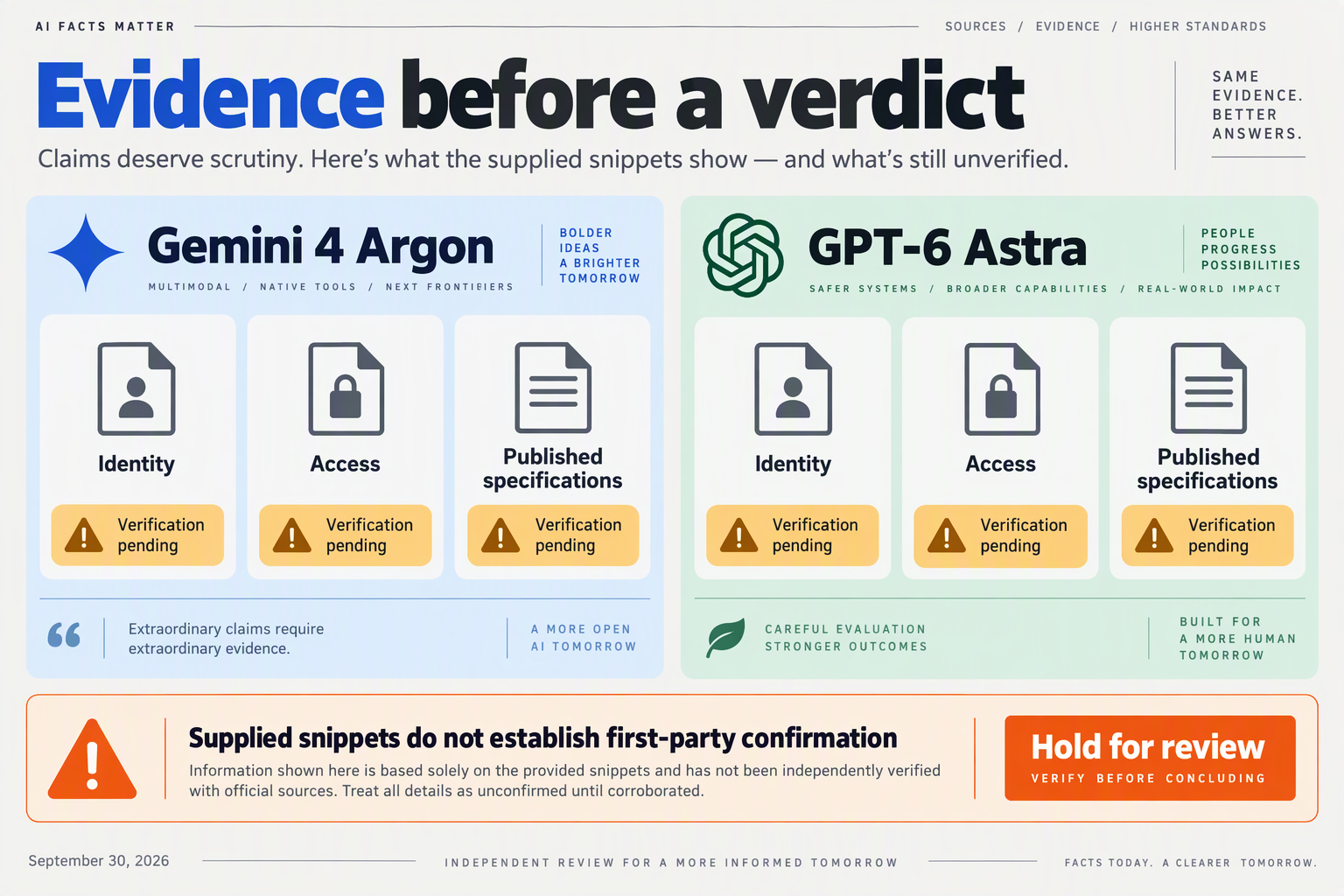
Access comes first in the Gemini 4 Argon vs GPT-6 Astra comparison. OpenAI documents gpt-6-astra for complex reasoning, coding, computer use, and research. Google announced Gemini 4 Argon on September 30, 2026, with restricted access through its Fairwind Program. Neither a lower token price nor a larger context window, by itself, establishes better task performance.
How do features and access compare?
- OpenAI GPT-6 Astra: OpenAI’s model documentation describes a 1,050,000-token context window, with a maximum of 922,000 input tokens and 128,000 output tokens. These are distinct limits—not a million-token output allowance. Tool calling requires the Responses API, so an integration needs to support that interface rather than assume Chat Completions compatibility is sufficient.
- Google Gemini 4 Argon: Google’s September 30 announcement describes an initial rollout through Fairwind for trusted cyber defenders, not unrestricted public API access. Check Google’s official announcements for eligibility and rollout details. A public API model identifier remains unverified; confirm the identifier, account permissions, region, and deployment status before planning an integration.
- Practical difference: Astra has a documented model identifier and operational limits; Argon’s restricted rollout makes eligibility the first procurement question. Documentation does not guarantee access for every account, and a restricted release does not establish weaker capabilities.
What do the announced prices mean for task cost?
- GPT-6 Astra: OpenAI’s official API pricing lists Standard pricing for inputs of 272,000 tokens or fewer at $10 per million input tokens and $50 per million output tokens, with $1 per million cached-input tokens and $12.50 per million cache-write tokens. Do not extrapolate this pricing tier across Astra’s full input capacity; check the applicable long-context rate before budgeting larger requests.
- Gemini 4 Argon: Google announced introductory pricing of $2 per million input tokens and $10 per million output tokens, followed by $4/$20 pricing. The introductory offer’s expiry is unspecified. A 95% discount on eligible cached input implies $0.10 per million tokens at the introductory input rate; that is a derived figure, not a universal cache rate. Confirm applicable terms against Google’s official pricing documentation.
- Compare accepted-task cost, not token rates alone: Include input, output, cache writes, cache reads, tool charges, and retries. Argon’s announced introductory token rates are lower, but they do not demonstrate better reasoning, coding accuracy, or lower total cost for a completed task.
Which should you evaluate first?
Evaluate the model you can access under acceptable deployment terms, then test it on your workload. Astra’s documented reasoning, coding, computer-use, and research scope makes it a candidate for those tasks—not an automatic performance winner. Argon is a candidate where Fairwind eligibility and deployment requirements align.
For a fair trial, use the same tasks, tool permissions, reasoning budgets, and acceptance criteria. See the sibling benchmark-methodology page for the evaluation approach.
CallMissed integration: CallMissed offers 139 models through one API key and one balance, including OpenAI-compatible Responses API and Anthropic-compatible endpoints. Its verified catalogue facts do not establish Astra or Argon availability. Confirm exact-model support separately; gateway compatibility alone is not proof of inclusion.
What is confirmed about names, model IDs and launch access? First-party source ledger
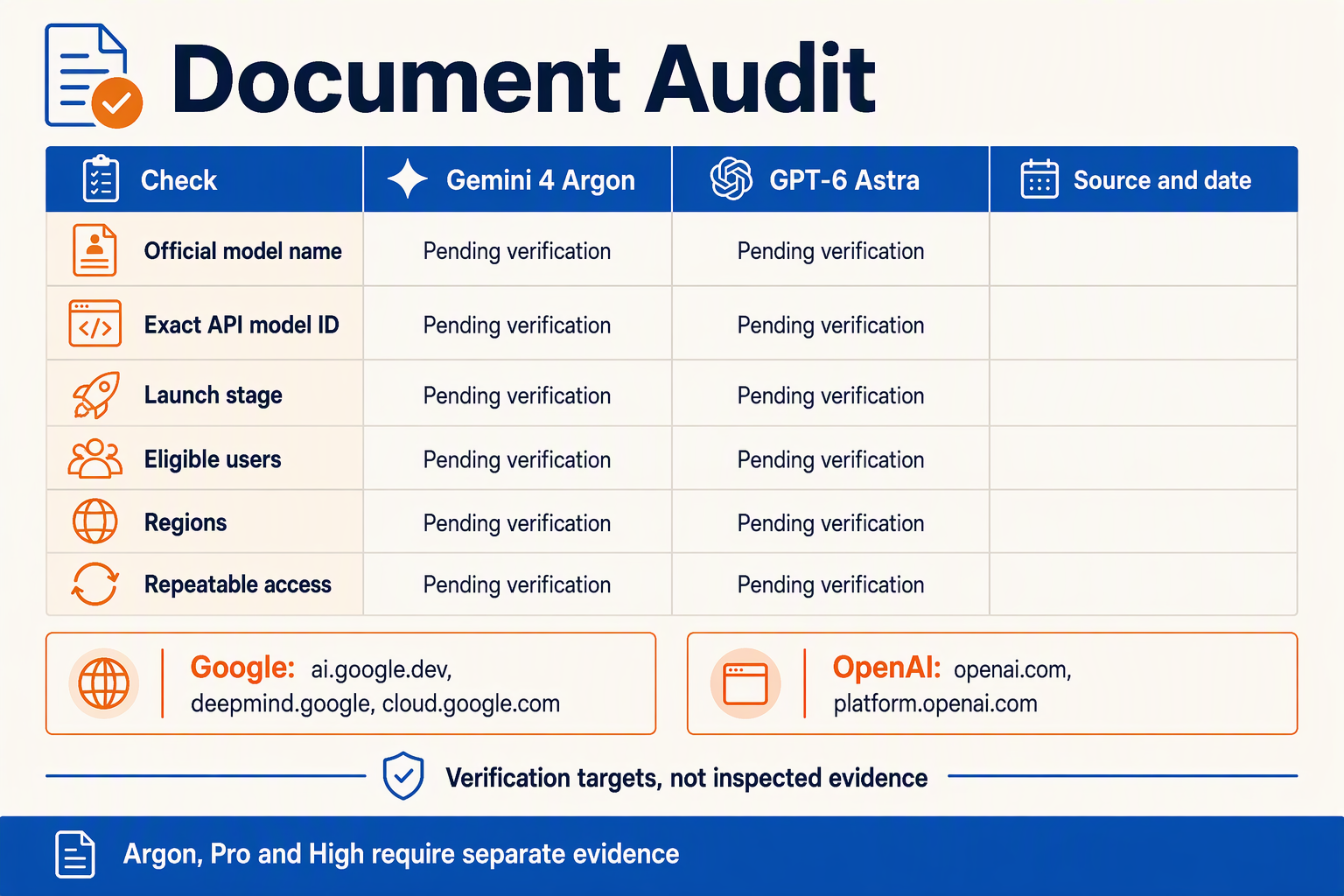
Neither name has a verified, deployable model ID in the supplied evidence as of September 30, 2026. This ledger distinguishes supplied first-party material from launch reporting; it is not a live verification of Google or OpenAI documentation.
Which sources confirm model names, IDs and access?
| Item | Source available | What the evidence establishes | Verification status |
|---|---|---|---|
| Gemini 4 Argon name | CNBC, September 30, 2026 | Reports Alphabet’s announcement under this name; does not supply an authenticated API identifier. | Reported, not first-party verified here |
| Argon initial access | VentureBeat, September 30, 2026 | Reports rollout to trusted cyber defenders through Google’s Fairwind Program. | Restricted rollout reported |
| Argon subsequent access | The Next Web, September 30, 2026 | Identifies paid API customers and Google AI Ultra subscribers as subsequent audiences; supplies no confirmed access date in the excerpt. | Planned access reported |
| Google model-card evidence | Google DeepMind, supplied result reviewed for this September 30, 2026 comparison | The available model-card result concerns Gemini 3.8 Flash, not Gemini 4 Argon. | First-party source; different model |
| GPT-6 Astra name and ID | No OpenAI first-party document supplied as of September 30, 2026 | The comparison title alone establishes neither an official product name nor a usable API model ID. | Unverified in supplied evidence |
| Pricing and production eligibility | No matching Google or OpenAI first-party documentation supplied as of September 30, 2026 | Exact-model prices, account eligibility, regional availability and production terms remain unresolved. | Not established |
What should buyers verify before treating either model as available?
- Google Gemini 4 Argon: Obtain an official Google announcement and matching API documentation before configuring an integration. A product label is not necessarily an endpoint identifier, and inventing a plausible ID such as a lowercase version of the launch name would introduce an unsupported deployment assumption.
- OpenAI GPT-6 Astra: Require an OpenAI announcement, model-catalogue entry and access documentation that explicitly identify Astra. The absence of those documents from the supplied research means “unverified here,” not “does not exist”—an important distinction for a September 30, 2026 comparison.
- Launch access: Check three separate conditions: whether the model is announced, whether your account is eligible, and whether a request succeeds using the documented identifier. VentureBeat’s September 30, 2026 Fairwind reporting supports a restricted-rollout description, not a claim of universal developer availability.
- Subscription access: Do not equate a consumer subscription with unrestricted API entitlement. The Next Web’s September 30, 2026 report names Google AI Ultra subscribers and paid API customers, but the supplied excerpt does not establish identical capabilities, quotas, release timing or billing arrangements for those audiences.
- Specification provenance: Keep the Gemini 3.8 Flash model card separate from Argon’s evidence record. Google DeepMind’s supplied card describes model-card purposes, including limitations and safety performance; it cannot substantiate Argon’s token limits, benchmark results, pricing or enterprise controls.
- Release sign-off: Record the exact model ID, document revision date, access stage, supported region and billing terms in the procurement ledger. Until matching first-party evidence is available, label both deployment assessments pending verification, rather than turning secondary launch coverage into production specifications.
How do context, output, modalities, reasoning, tools, residency and safety compare? Sourced features
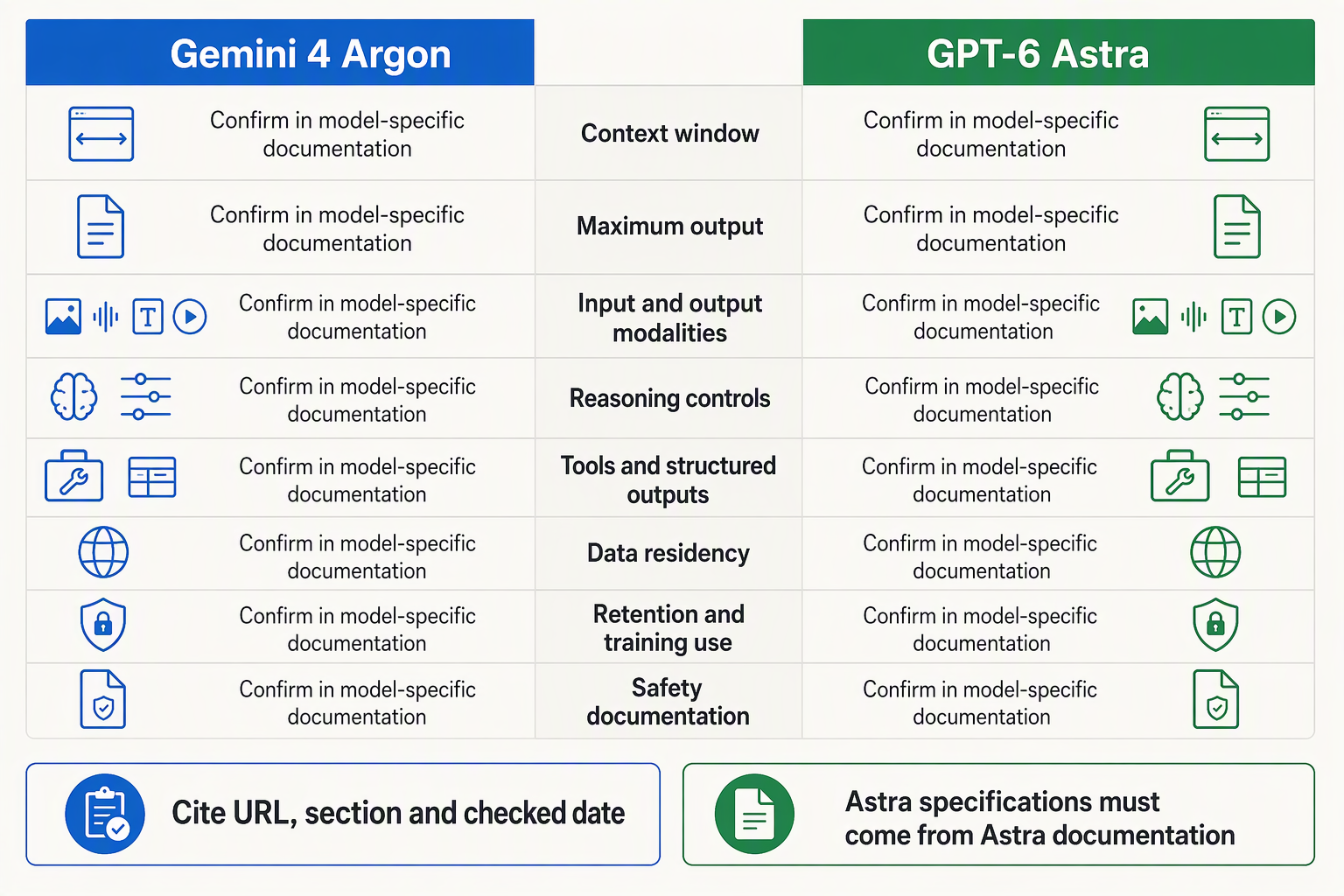
As of September 30, 2026, the supplied evidence does not establish a first-party-verified feature comparison between Gemini 4 Argon and GPT-6 Astra. The table separates reported specifications from missing documentation; “unverified” does not mean “unsupported.”
Which model specifications are actually verified?
| Feature | Gemini 4 Argon | GPT-6 Astra | Evidence needed |
|---|---|---|---|
| Input context | No verified token limit in supplied Google documentation | No supplied OpenAI specification | Exact model ID, context limit, and counting rules |
| Maximum output | AlphaSignal reports 1 million tokens, versus 64,000 previously, on September 30, 2026; not first-party verified here | No supplied OpenAI specification | Official output cap and endpoint restrictions |
| Modalities | No verified input/output modality matrix supplied | No verified input/output modality matrix supplied | Supported text, image, audio, and video formats |
| Reasoning controls | No verified reasoning-budget parameters supplied | No verified reasoning-budget parameters supplied | Parameter names, defaults, and billing treatment |
| Tools | No verified function-calling or hosted-tool specification supplied | No verified function-calling or hosted-tool specification supplied | Schemas, execution boundaries, and tool charges |
| Data residency | No Argon-specific regional processing or storage commitments supplied | No Astra-specific regional commitments supplied | Contractual locations for inference, logs, and backups |
| Safety | VentureBeat reports voluntary U.S. government pre-release access participation on September 30, 2026 | No Astra-specific safety documentation supplied | Model-specific evaluations, mitigations, and limitations |
- Google DeepMind: The supplied first-party model card covers Gemini 3.8 Flash, not Gemini 4 Argon, as of September 30, 2026; its safety findings cannot establish Argon’s behavior.
- OpenAI: No Astra-specific first-party documentation appears in the supplied research as of September 30, 2026; importing another GPT model’s limits would create a false specification.
- AlphaSignal: Its September 30, 2026 report describes one million output tokens, not a verified input-context window; these limits answer different engineering questions and must remain separate.
What should enterprise teams test before choosing?
- Context and output: For a repository-wide coding task, check whether source files, instructions, tool results, and reserved output fit the documented budget. A large advertised output ceiling does not establish reliable retrieval across a large input or successful completion of a long patch.
- Reasoning and tools: Require an executable request example for each exact model ID, including reasoning settings, structured-output constraints, and tool permissions. Evaluate a concrete workflow—such as producing a patch and running tests—rather than treating “complex professional work” as proof of supported API controls.
- Residency and safety: Request separate commitments for inference location, retained prompts, tool traffic, and deletion, plus model-specific safety evidence. As of September 2026, CallMissed’s verified fact sheet states that its platform is hosted in India and its developer API supports caller-chosen fallback models; neither fact establishes Argon or Astra availability, or where an upstream provider processes requests.
Procurement takeaway: Keep unknown fields explicit until Google and OpenAI publish applicable documentation. Reported scale, controlled rollout, and platform hosting are distinct facts—not substitutes for model-level deployment guarantees.
How much does each model cost by mode and eligibility? Pricing and cost per successful task
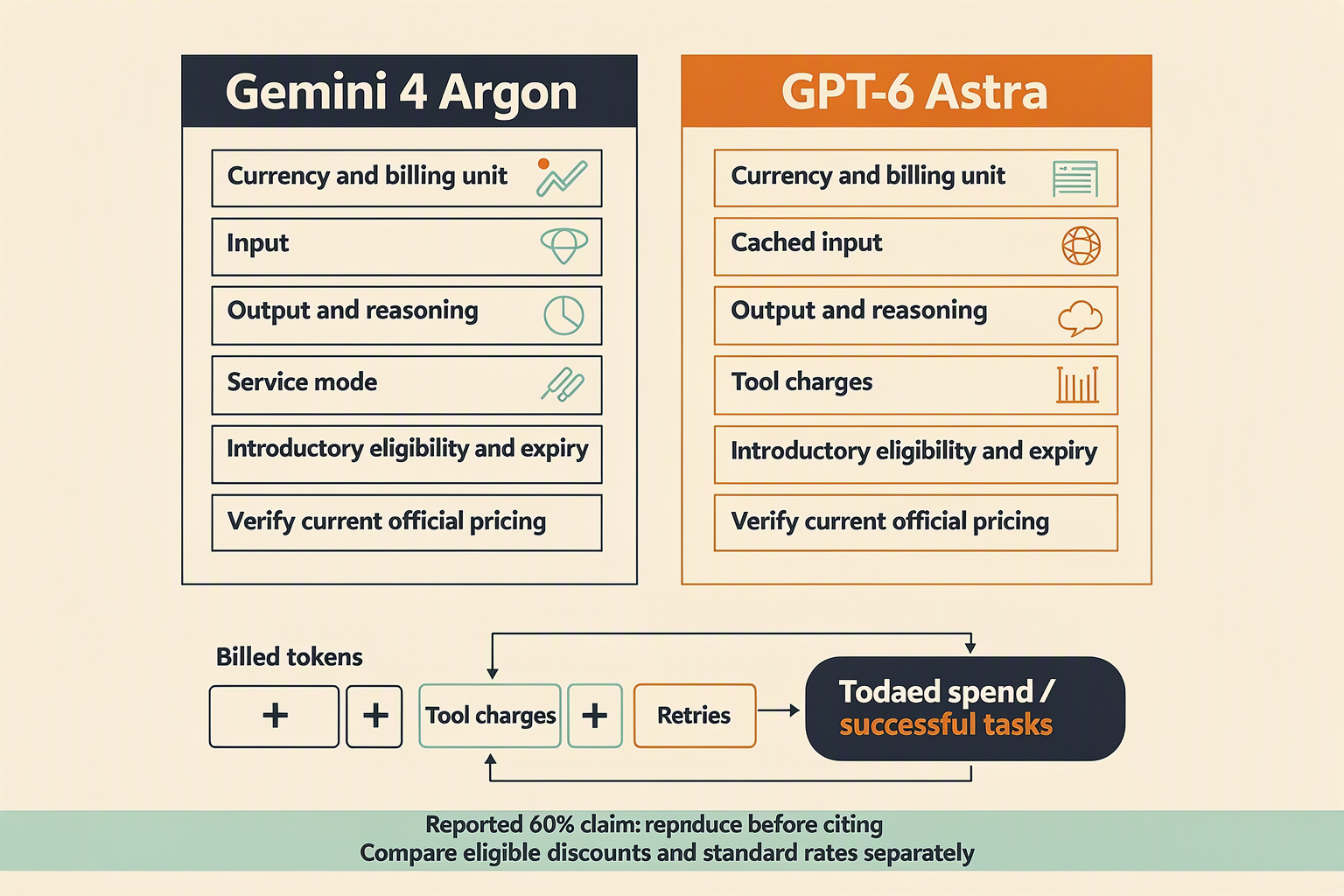
No verified price comparison is possible for Gemini 4 Argon and GPT-6 Astra as of September 30, 2026: the supplied evidence contains no first-party pricing documentation for either model. Treat missing prices as unknown—not free, and separate API charges from subscription eligibility.
- Gemini 4 Argon: The Next Web reported on September 30, 2026 that paid API customers and Google AI Ultra subscribers were intended subsequent audiences. That establishes a reported access pathway, not an Argon token rate, included subscription allowance, or confirmed date when either group can start using the model.
- GPT-6 Astra: The supplied context contains no OpenAI pricing page, model documentation, or announcement establishing Astra’s availability as of September 30, 2026. Procurement teams therefore cannot substantiate an API budget, subscription entitlement, or enterprise quote from this evidence.
| Cost or eligibility item | Gemini 4 Argon | GPT-6 Astra | Budget treatment |
|---|---|---|---|
| Standard API input/output | First-party rates absent | First-party rates absent | Leave token prices unfilled |
| Reasoning-mode charges | Not established | Not established | Confirm billable reasoning tokens |
| Cached-input pricing | Not established | Not established | Assume no discount until documented |
| Batch or priority modes | Not established | Not established | Verify support and separate rates |
| Subscription eligibility | Ultra access reported as planned | Not established | Do not assume API credits included |
| Restricted/enterprise access | Fairwind rollout reported | Not established | Confirm eligibility and contract terms |
- Source boundary: Every unresolved entry above reflects the supplied evidence as of September 30, 2026, not proof that a feature or price does not exist. VentureBeat’s September 30, 2026 report describes Argon’s initial Fairwind Program rollout; Google DeepMind’s supplied model card covers Gemini 3.8 Flash, so it cannot establish Argon’s commercial terms.
How should you calculate cost per successful task?
- Use completed outcomes: Calculate cost per successful task = total workflow spend ÷ accepted completions. Include failed attempts, retries, tool calls, and paid validation in the numerator. For coding, define success before testing—for example, a patch that passes the required tests and receives reviewer approval, rather than merely producing compilable code.
- Worked example—not a benchmark: Suppose a 100-task evaluation costs $60 and produces 75 accepted completions; its cost per success is $0.80. A second configuration costing $45 with 50 accepted completions costs $0.90 per success. The cheaper evaluation run is therefore more expensive per accepted outcome; neither example represents measured Argon or Astra performance.
- Compare modes separately: Keep task sets and acceptance criteria identical across standard, higher-reasoning, and tool-assisted runs. Record input tokens, output tokens, billable reasoning tokens where applicable, cache use, retries, and elapsed time. Only apply caching, batch, or priority discounts after the exact model’s first-party documentation confirms eligibility and rates.
- CallMissed: As of September 2026, CallMissed’s verified fact sheet lists an OpenAI-compatible developer API with usage and request logs, caller-chosen fallback models, and one balance across 139 models. Those capabilities support workflow-cost tracking, but the fact sheet does not establish Argon or Astra availability or pricing; verify the exact catalogue entry before budgeting.
What are the evidence-backed pros and cons for demanding work? Strengths, limitations and unknowns
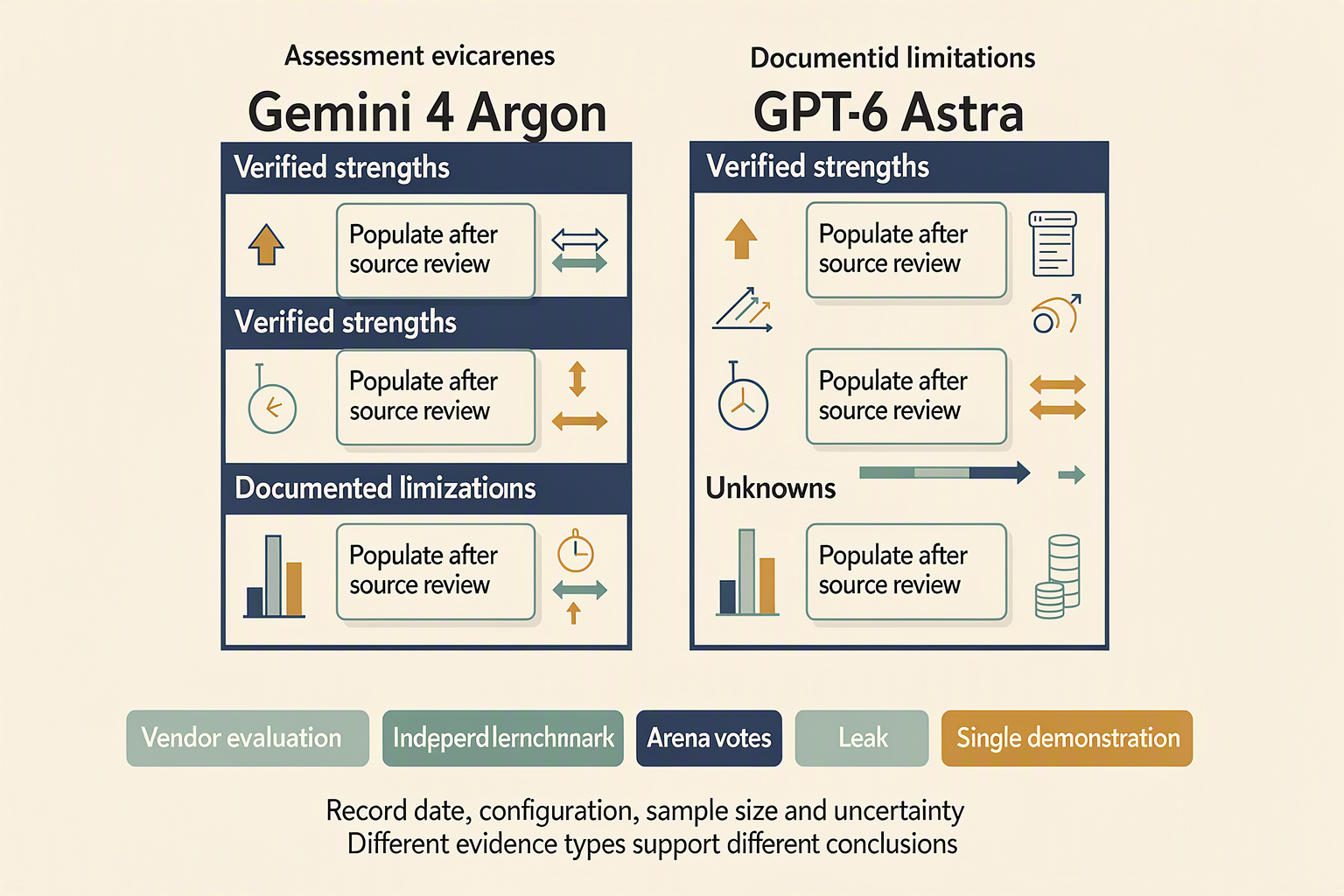
Neither model has enough verified first-party evidence in the supplied research to justify a production winner as of September 30, 2026. Argon has reported strengths worth testing; Astra’s capabilities remain unestablished here—not demonstrated weaknesses.
- Gemini 4 Argon: CNBC’s September 30, 2026 report identifies coding, cybersecurity, and complex professional work as improvement areas, but supplies no reproducible evaluation protocol.
- GPT-6 Astra: The supplied September 30, 2026 research contains no OpenAI model documentation establishing specifications, access, or enterprise conditions.
- Evidence standard: Treat missing documentation as an unknown, not a zero score; neither launch language nor an unrelated model card establishes production readiness.
Which strengths and limitations matter for demanding workloads?
The following matrix describes the evidence available as of September 30, 2026, rather than independently verified model performance.
| Workload | Argon: reported strength | Astra: evidence status | Limitation or buying implication |
|---|---|---|---|
| Extended reasoning | The Next Web reports a design focus on long, complex workflows. | No model-specific OpenAI evidence supplied. | Require task success rates, reasoning settings, and repeatability before assigning a reasoning advantage. |
| Repository coding | CNBC reports improved coding capabilities. | Coding performance unestablished here. | Test multi-file patches, regression failures, and reviewer acceptance; generated code volume is not successful delivery. |
| Cybersecurity | VentureBeat reports initial access through Google’s Fairwind Program for trusted cyber defenders. | Cybersecurity access and safeguards unestablished here. | Restricted rollout can prevent immediate evaluation; test only explicitly authorized security tasks. |
| Large outputs | AlphaSignal reports a maximum output of 1 million tokens, versus 64,000 previously. | Output limits unestablished here. | This is secondary reporting, not an official API specification; output capacity does not establish input context size. |
| Enterprise deployment | The Next Web reports paid API customers and Google AI Ultra subscribers as subsequent audiences. | Deployment options and availability unestablished here. | Intended access is not current entitlement; obtain exact model IDs and contractual conditions. |
| Cost-sensitive automation | No exact Argon pricing appears in the supplied evidence. | No exact Astra pricing appears in the supplied evidence. | Compare cost per accepted task, including retries, tools, and review—not an invented token-price comparison. |
What should buyers verify before committing?
- Google documentation: Obtain an Argon-specific model card and API reference; the supplied Google DeepMind result concerns Gemini 3.8 Flash, not Argon, as reviewed against the September 30, 2026 context.
- OpenAI documentation: Require an Astra-specific announcement, model identifier, pricing schedule, and data-handling terms before including Astra in procurement scoring; those records are absent from the supplied research.
- Evaluation infrastructure: Use the same repositories, prompts, tool permissions, and acceptance criteria for both candidates. As of September 2026, CallMissed’s verified developer API supports caller-chosen fallback models, request logs, and structured outputs—useful evaluation plumbing, but not evidence that either named model is available through CallMissed.
Practical verdict: Shortlist Argon for evidence-gathering if access permits; leave Astra unscored until model-specific documentation is available. Do not convert either uncertainty into a performance claim.
How can you reproduce reasoning and coding comparisons instead of relying on rankings?
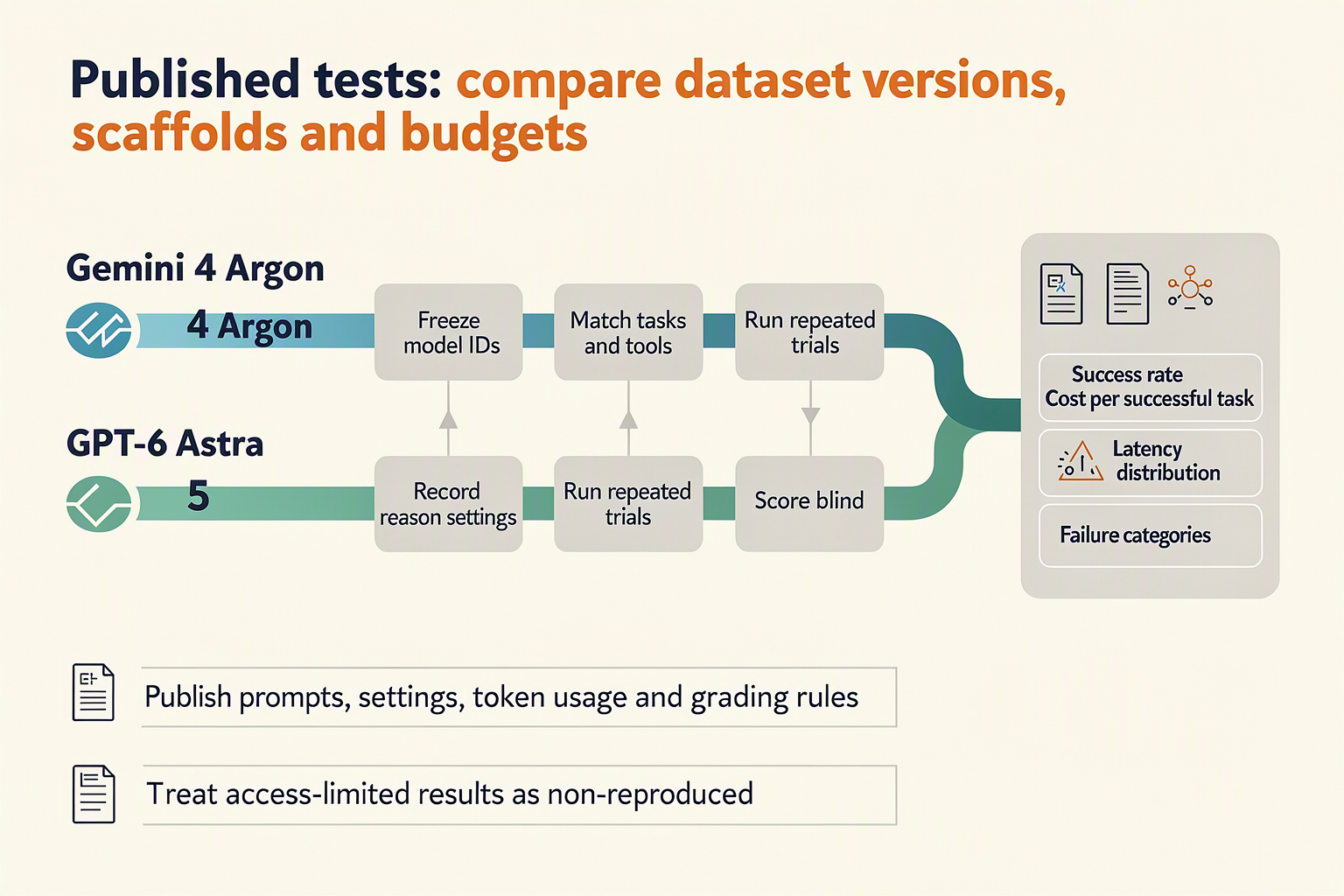
Reproduce reasoning and coding comparisons with a versioned test suite, matched resource budgets, and auditable results—not leaderboard positions. As of September 30, 2026, the supplied sources do not establish first-party specifications for both Gemini 4 Argon and GPT-6 Astra, so any head-to-head experiment must first confirm access and exact model identifiers.
- Documentation gate: Before testing, archive Google and OpenAI documentation covering model IDs, release status, reasoning controls, tool support, limits, and pricing, with retrieval dates. Google DeepMind’s supplied Gemini 3.8 Flash model card describes a different model; it cannot establish Argon’s specifications. Mark missing Astra documentation as unverified, rather than substituting another OpenAI model.
- Access gate: Record whether each endpoint actually accepts requests under your account, region, and billing configuration. VentureBeat reported on September 30, 2026, that Gemini 4 Argon’s rollout began with trusted cyber defenders through the Fairwind Program. That report supports checking restricted access—not assuming two publicly callable endpoints exist.
- Proposed reasoning suite: Use 30 held-out tasks spanning quantitative analysis, constraint satisfaction, and evidence-grounded enterprise decisions. Define expected answers and scoring rubrics before either model runs. Require checkable outputs such as calculations, cited evidence, and constraint checks; evaluate answer correctness rather than the length or apparent sophistication of an explanation.
- Proposed coding suite: Use 20 repository tasks across Python, TypeScript, and Java, including bug fixes, feature changes, and security-sensitive validation. Pin the repository commit, dependencies, container image, and test commands. Score patches against hidden tests and human review; a passing visible test alone does not establish a maintainable solution.
Which experimental controls make model comparisons reproducible?
- Matched budgets: Give both models identical prompts, repository snapshots, tool permissions, and execution environments. Predeclare a proposed 10-minute wall-clock cap and five tool calls per task, where supported. Record reasoning settings separately: similarly named controls are not necessarily equivalent, and unavailable settings should remain explicit differences rather than silently adjusted advantages.
- Repeated trials: Run each proposed task three times, producing 150 attempts per model across the 50-task suite. Report first-attempt success separately from success after retries, with uncertainty intervals and task-level outcomes. Randomize execution order and document failures, including timeouts and permission errors; do not quietly remove unsuccessful attempts.
- Cost and instrumentation: Calculate cost per accepted solution from documented input, output, cache, tool, and retry charges; keep unavailable prices marked unknown. As of September 2026, CallMissed’s developer AI API provides usage and request logs plus caller-chosen fallback models. For controlled testing, avoid fallbacks that would change which model actually answered; this does not establish Argon or Astra availability.
- Audit package: Publish prompts, scoring rubrics, dependency locks, model identifiers, configuration, timestamps, and redacted outputs. Separate accuracy, latency, cost, and security findings instead of collapsing everything into one winner. Preserve a private holdout set for subsequent checks, and remove credentials and customer data before sharing enterprise examples.
Which should you choose for reasoning, coding or enterprise deployment? Workload decision matrix
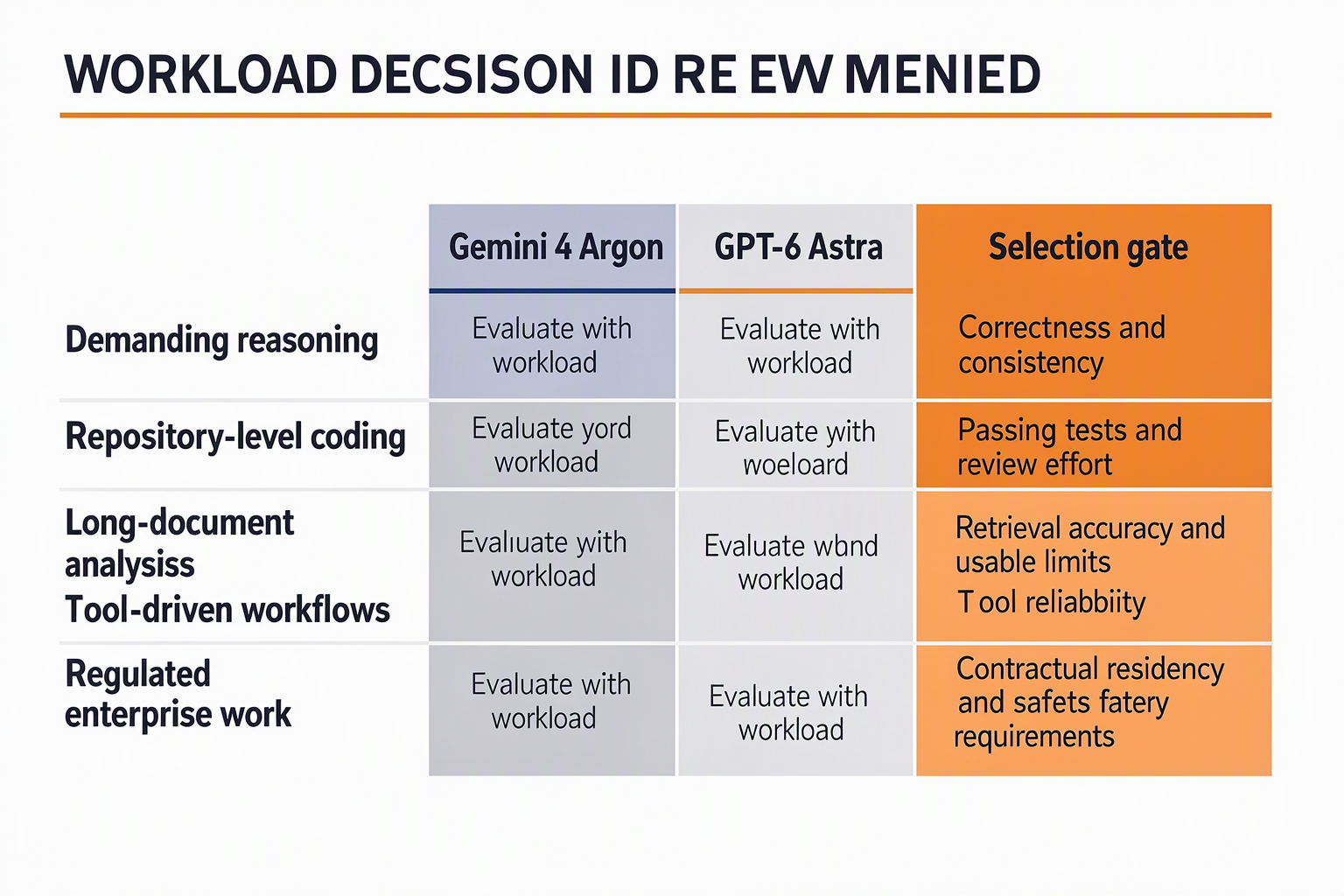
Choose by verified access and workload results, not model branding: the supplied evidence does not establish a defensible Gemini 4 Argon vs GPT-6 Astra winner. The matrix below gives provisional deployment recommendations as of September 30, 2026, rather than unsupported performance rankings.
- Gemini 4 Argon: VentureBeat reported on September 30, 2026 that rollout was beginning with trusted cyber defenders through Google’s Fairwind Program; treat access confirmation as a prerequisite for evaluation.
- GPT-6 Astra: The supplied research contains no OpenAI first-party documentation establishing specifications, pricing or availability; do not budget or schedule deployment around assumed capabilities.
- Evidence standard: The supplied Google DeepMind model card covers Gemini 3.8 Flash, not Argon; neither that document nor launch reporting verifies an Argon–Astra comparison.
Which model fits each workload?
| Workload | Argon decision | Astra decision | Required acceptance test |
|---|---|---|---|
| Complex reasoning | Evaluate if access is granted | Defer pending official documentation | Correct answers, valid assumptions and reproducible results |
| Repository-level coding | Pilot on representative repositories | Defer production selection | Passing tests, reviewable diffs and no new vulnerabilities |
| Defensive cybersecurity | Explore eligibility for the reported rollout | No supported selection basis | Authorized scope, containment and human approval |
| Long-document analysis | Verify exact input and output limits first | Limits unverified in supplied evidence | Accurate citations and retrieval across complete documents |
| Enterprise workflows | Require official service and data terms | Require official service and data terms | Retention, residency, permissions and escalation controls |
| Cost-sensitive automation | Obtain documented model and tool prices | Obtain documented model and tool prices | Total cost per accepted task, including retries |
How should teams run a defensible pilot?
- Reasoning and coding: Start with a suggested 30-task pilot—10 reasoning problems, 10 repository changes and 10 enterprise workflows. This is a practical starting design, not a published benchmark; keep prompts, tool permissions and acceptance criteria identical wherever supported.
- Enterprise procurement: Require five evidence categories before approval: exact model identifier, access conditions, pricing, operational limits and data-handling terms. The Next Web reported on September 30, 2026 that paid API customers and Google AI Ultra subscribers were intended subsequent Argon audiences; that is rollout reporting, not an access guarantee.
- CallMissed: As of September 2026, CallMissed’s verified fact sheet lists an OpenAI-compatible developer API with caller-chosen fallback models, usage logs and request logs. Those capabilities can support multi-model integration, but the fact sheet does not confirm Argon or Astra availability.
A useful pilot scorecard separates task quality, operational reliability and economics. For coding, count accepted changes rather than generated lines; for reasoning, assess justified conclusions rather than fluent explanations; for enterprise workflows, record when human intervention was necessary.
Calculate cost per accepted task as total model and tool spend divided by accepted completions. A cheaper request can produce a more expensive workflow when retries or manual corrections increase. Until the missing first-party evidence is available, retain a documented, accessible production model and treat either proposed upgrade as an evaluation candidate—not a committed replacement.
Frequently Asked Questions
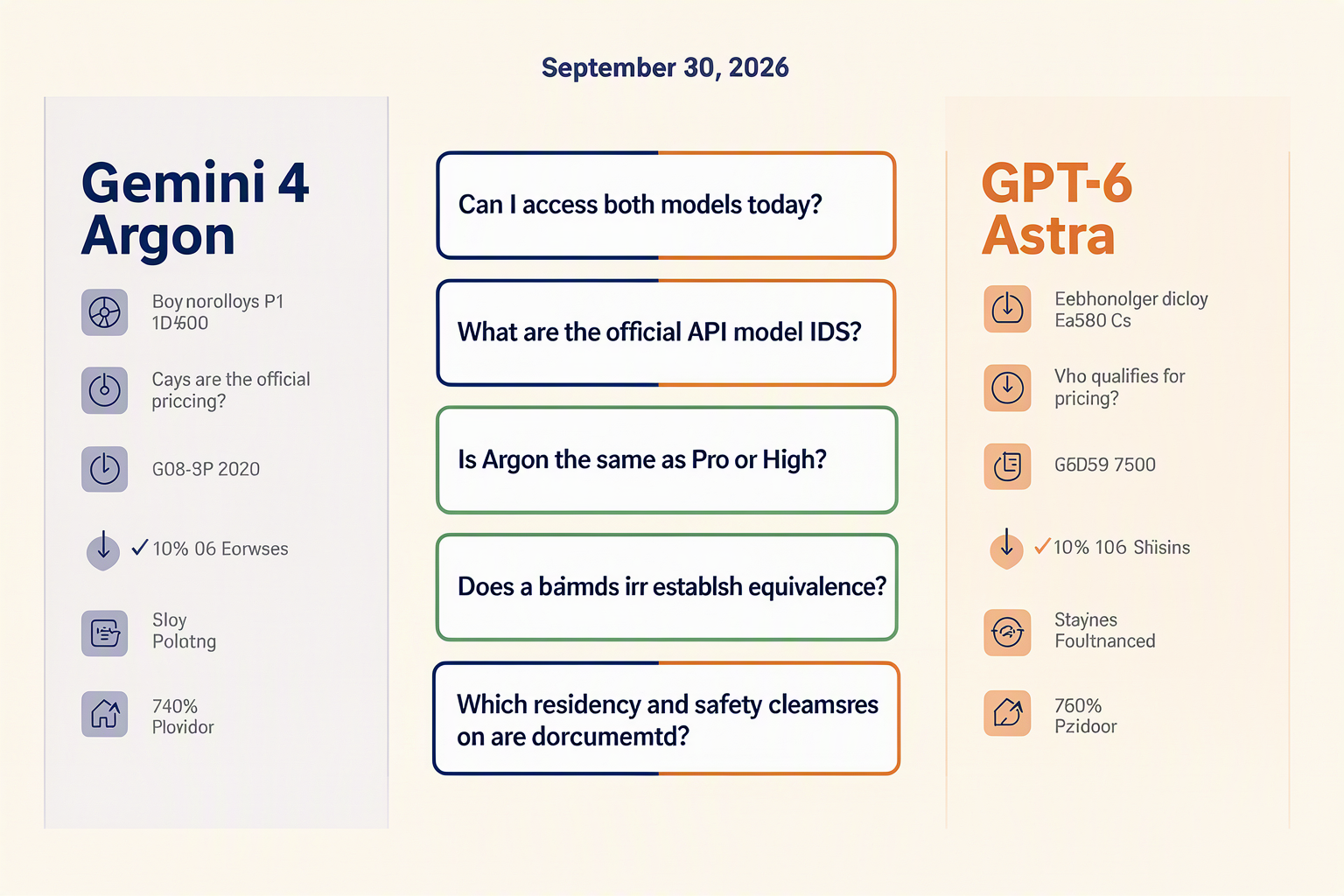
Both models’ public availability, Argon’s relationship to Pro or High, and claimed benchmark ties or discounts remain unverified in the supplied first-party documentation.
- Q: Are both models in Gemini 4 Argon vs GPT-6 Astra available today?
A: As of September 30, 2026, the supplied evidence does not establish public availability for both models: VentureBeat reported that Gemini 4 Argon’s rollout was beginning with trusted cyber defenders through Google’s Fairwind Program. The Next Web reported paid API customers and Google AI Ultra subscribers as subsequent audiences, not confirmed immediate access. No supplied OpenAI announcement establishes GPT-6 Astra’s availability.
- Q: Is Gemini 4 Argon the same model as Gemini Pro or High?
A: As of September 30, 2026, the supplied Google documentation does not establish that Argon, Pro, and High are interchangeable names. Google DeepMind’s supplied model card explicitly concerns Gemini 3.8 Flash, so its specifications cannot substantiate an Argon naming equivalence. Before integrating, check the exact API model identifier and whether “High” denotes a model, interface label, or reasoning setting rather than assuming equivalence.
- Q: Are benchmark ties verified for Gemini 4 Argon vs GPT-6 Astra?
A: No benchmark tie is verified by the supplied evidence as of September 30, 2026; VentureBeat’s coverage reports a benchmark-lead claim, but the provided context lacks comparable first-party evaluation tables for both named models. A defensible comparison requires matching benchmark versions, tool permissions, reasoning budgets, and scoring methods. Similar rounded scores alone would not demonstrate equivalent coding reliability or enterprise-task performance.
- Q: Are Gemini 4 Argon or GPT-6 Astra prices and discounts confirmed?
A: As of September 30, 2026, the supplied context contains no first-party pricing schedule or verified discount terms for either named model. The Next Web’s reference to paid API customers does not establish token rates, subscription entitlements, or promotional savings. Treat any claimed discount as unverified until Google or OpenAI documents the exact model, eligibility, expiration date, and applicable input, output, caching, or tool charges.
- Q: Does Gemini 4 Argon really support one million output tokens?
A: AlphaSignal reported a one-million-token maximum output, compared with 64,000 previously, in the supplied September 30, 2026 research, but no corresponding Argon first-party specification is provided. That remains a reported claim, not a verified production API limit. Maximum output length also differs from input context capacity and does not guarantee reliable reasoning, affordable generation, or availability under every access tier.
- Q: How should enterprises evaluate these models before deploying them?
A: As of September 30, 2026, enterprises should require official model identifiers, access terms, pricing, data-handling documentation, and repeatable tests on their own workflows before committing. CallMissed’s verified fact sheet lists an OpenAI-compatible developer API with caller-chosen fallback models, a practical capability when evaluating documented, accessible alternatives. That gateway capability does not establish that Gemini 4 Argon or GPT-6 Astra is available through CallMissed.
Conclusion
Gemini 4 Argon vs GPT-6 Astra has no defensible winner on the supplied evidence as of September 30, 2026. The practical decision is to distinguish reported capabilities from verified specifications, then judge reasoning, coding, costs, access, and enterprise fit against your team’s actual workload.
- Evidence comes before rankings. CNBC’s September 30, 2026 report describes Google Gemini 4 Argon’s announcement and improvements in coding, cybersecurity, and complex professional work. That reporting does not establish an independently verified head-to-head advantage over GPT-6 Astra. The supplied research contains no first-party documentation confirming Astra’s specifications, pricing, or access conditions. Google DeepMind’s supplied model card concerns Gemini 3.8 Flash, not Argon, so it cannot fill the documentation gap for this comparison.
- Access is part of performance in practice. According to VentureBeat’s September 30, 2026 coverage, Argon’s rollout begins with trusted cyber defenders through Google’s Fairwind Program. The Next Web’s reporting on the same date identifies paid API customers and Google AI Ultra subscribers as intended subsequent audiences. Neither report establishes unrestricted developer access that day. For a production team, a promising model that remains inaccessible cannot yet replace an available model in a deployed workflow.
- Compare completed-task costs, not token prices alone. Before committing a budget, verify the exact model’s official input, output, caching, and tool charges. Then measure how retries, lengthy responses, and additional tool use affect the cost of finishing representative work. A lower advertised token price does not necessarily produce a cheaper coding or reasoning workflow. Without documented pricing and comparable task conditions, a cost ranking would be an assumption rather than a procurement-ready conclusion.
- Enterprise suitability requires workload-specific evidence. Reasoning evaluations should disclose test conditions, tool access, and reasoning settings; coding evaluations should demonstrate realistic repository changes, successful tests, and maintainable fixes. Official terms must also establish data handling, deployment options, and operational limits. These checks connect headline capability claims to practical business requirements. A benchmark lead, even when properly documented, is not a substitute for confirming that a model can support your organization’s intended deployment.
What should teams watch for next?
Watch for Google and OpenAI’s model-specific documentation, explicit availability updates, published pricing, and reproducible evaluations. Those developments—not launch language alone—will make a stronger comparison possible.
For teams exploring how model choice connects to business communication, CallMissed offers an OpenAI-compatible developer AI API with caller-chosen fallback models, as of September 2026. Its capabilities are worth exploring without assuming either disputed model is available there.
Before choosing a frontier model, can your team verify its access, reproduce its results, and afford the completed task?
Related Reading
- Gemini 4 Argon vs GPT-6.1 Sol: Coding & Agent Work
- Gemini 4 Argon vs GPT-6.1 Sol: Coding & Agents (2026)
- Claude Fable 5.1 vs GPT-6 Astra Pricing: Real API Costs in 2026
Sources
Discussion
Related Posts


Ready to automate customer conversations?
Launch AI voice agents and WhatsApp bots with CallMissed — one API, 22+ Indian languages.