
Gemini 4 Argon vs Claude Opus 5.5: Coding Agent Guide


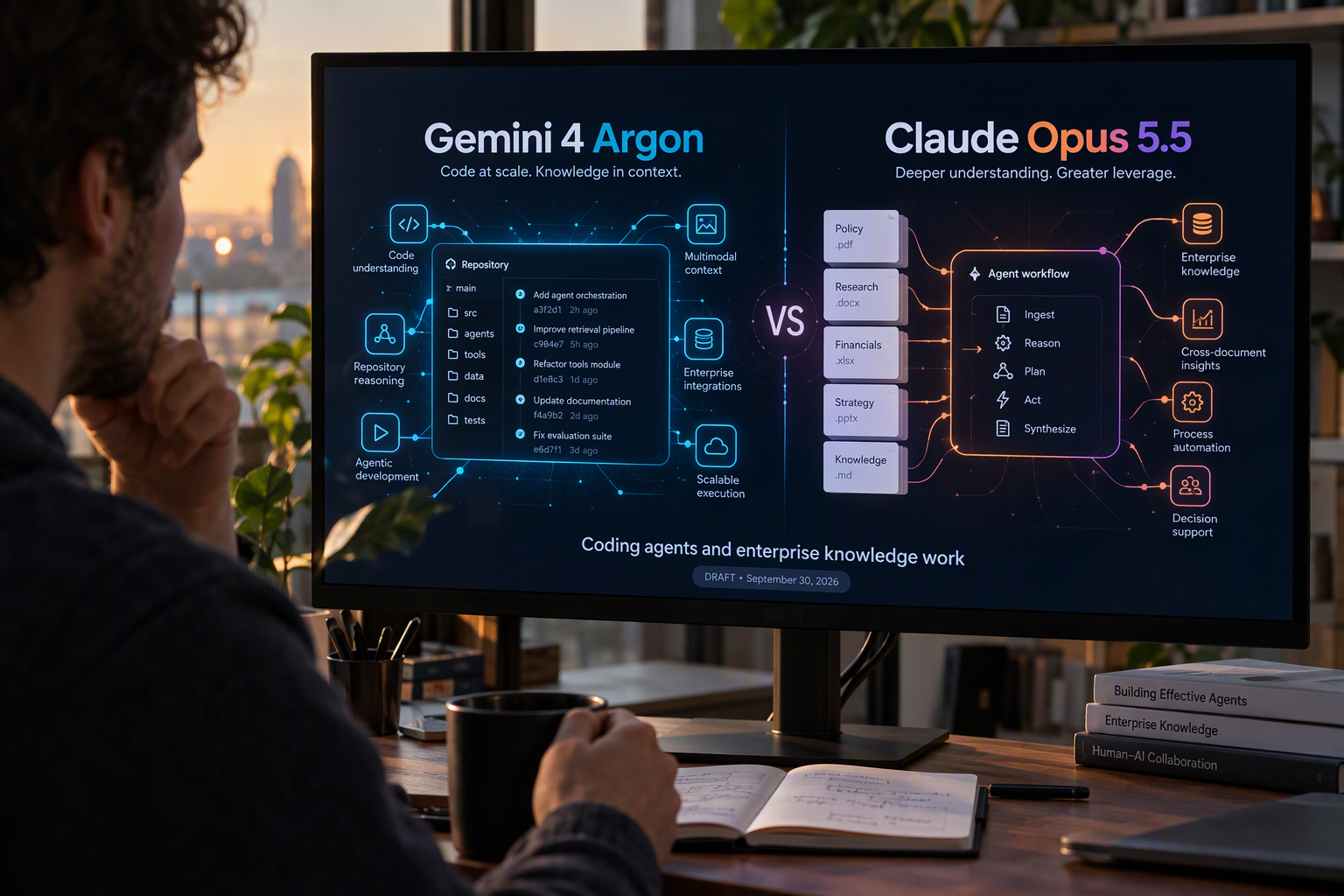
Compare verified model access, prices and repository-level evaluation criteria for Argon and Opus 5.5. Separate vendor claims from measured results.
Gemini 4 Argon vs Claude Opus 5.5: Coding Agent Guide
What if the deciding factor in Gemini 4 Argon vs Claude Opus 5.5 is not which model wins a benchmark, but which one reliably finishes your team’s work? For long-running coding agents and enterprise knowledge workflows, a strong first answer is only the beginning: the harder test is maintaining context, using tools correctly, recovering from failures, and producing changes someone can safely approve.
As of September 30, 2026, the supplied Google announcement excerpt positions Gemini 4 Argon for “real-world coding, enterprise knowledge work and cyber defense,” while describing a restricted rollout to trusted cyber defenders through the Fairwind Program. The supplied Anthropic excerpt claims Claude Opus 5.5 leads on its agentic coding, computer-use, and knowledge-work benchmarks—but also cautions that “benchmark margins have become a less reliable guide to real-world differences.” Those statements frame the comparison; they do not establish an independently verified winner.
What matters most when choosing a long-running coding agent?
The practical question is whether an agent can carry a task from investigation to a reviewable result without losing requirements or creating expensive cleanup. A repository-wide migration, for example, demands more than generating a patch: the agent must inspect dependencies, update related files, run tests, interpret failures, and distinguish a genuine fix from a workaround.
This guide will compare the evidence available for:
- Task continuity: preserving requirements and decisions across extended workflows.
- Tool execution: navigating repositories, running checks, and recovering from unsuccessful actions.
- Enterprise knowledge work: grounding answers in source documents and separating evidence from inference.
- Operational fit: availability, permissions, pricing, and the controls needed before production deployment.
The same discipline applies to document-heavy work. An agent drafting a policy briefing should trace its conclusions to the right sources, flag conflicting documents, and avoid treating an outdated instruction as current policy.
How should teams interpret this comparison?
Treat this article as a draft held for manual review, not a procurement verdict. The supplied excerpts do not establish comparable prices, context limits, benchmark scores, or unrestricted availability, so those details require confirmation against current official Google and Anthropic documentation before publication.
As of September 2026, CallMissed’s verified developer offering provides one API key and balance for 139 models, illustrating the broader move toward multi-model infrastructure without establishing support for either model discussed here.
You will learn how to separate vendor claims from usable evidence, design representative coding and knowledge-work evaluations, and identify the trade-offs that actually affect deployment. The goal is a defensible shortlist—not a winner selected from an announcement headline.
Gemini 4 Argon vs Claude Opus 5.5: coding-agent verdict
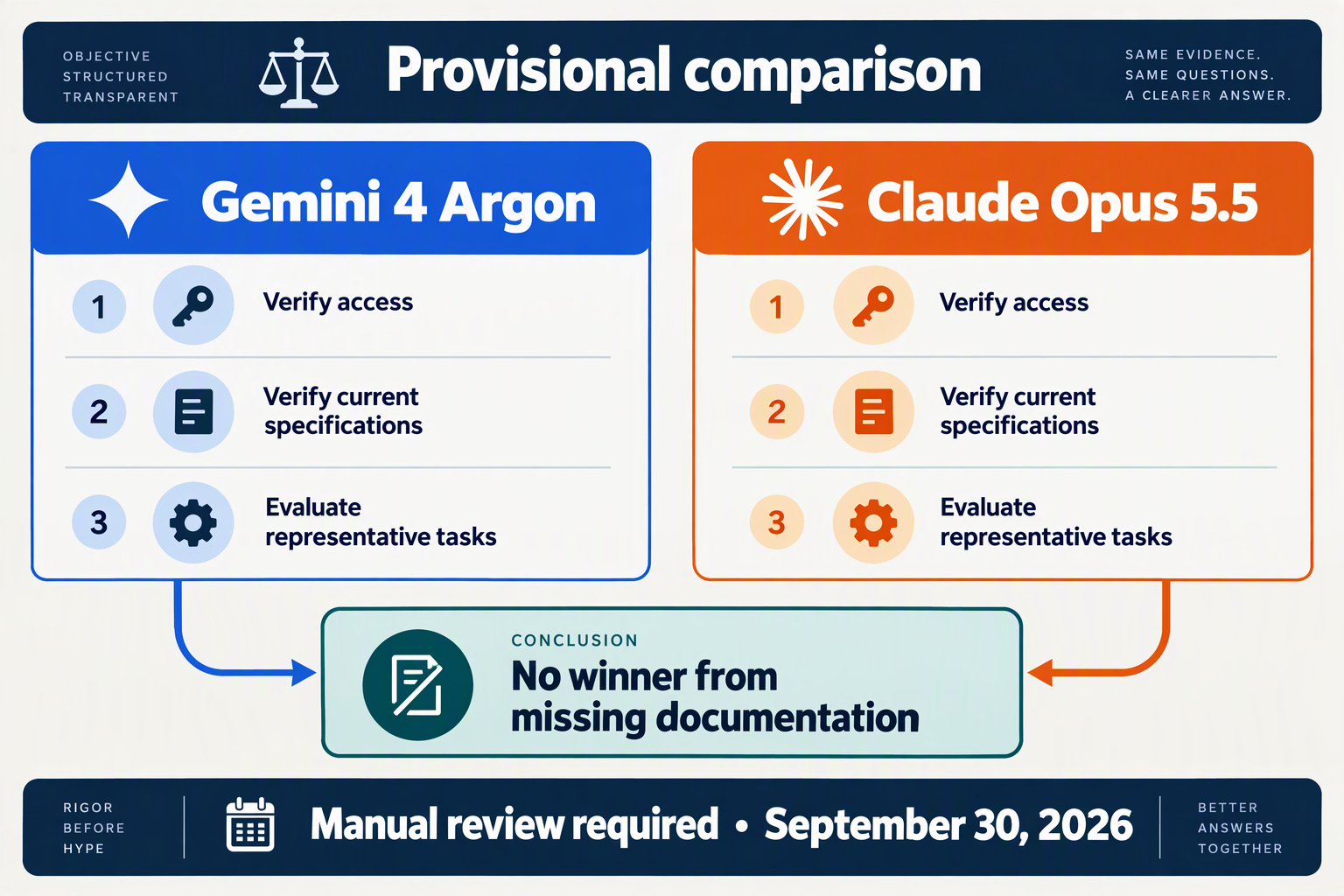
Evaluate Claude Opus 5.5 now if you have access; evaluate Gemini 4 Argon only after confirming permitted access. As of September 30, 2026, this is an access-based recommendation—not a universal ranking of coding performance.
Which model should you shortlist?
- Claude Opus 5.5: Anthropic’s official documentation identifies the model as
claude-opus-5-5, released September 22, with a 1M-token context window, 128K-token maximum output, and adaptive thinking always on. Pricing is $4 per million input tokens and $20 per million output tokens. These documented specifications make it an actionable evaluation candidate, not a guaranteed coding winner.
- Gemini 4 Argon: Google’s September 30 announcement limits access to trusted cyber defenders through the Fairwind Program. Public API general availability and a public model ID remain unverified. Announced introductory pricing is $2/$10 per million input/output tokens; eligible cached input works out to $0.10 per million tokens, derived from the stated 95% discount. Post-introductory pricing is $4/$20, but the introductory period’s expiry remains unresolved. Confirm eligibility, permitted repository workloads, and integration terms before planning a pilot.
Let your repository test harness decide
Run both accessible models against the same repository snapshots, tools, permissions, and task budget. Include multi-file fixes, migrations, dependency updates, and test repair; repeat tasks to measure consistency.
Judge accepted patches, regression-test results, unnecessary changes, reviewer corrections, and recovery from failed tool calls—not whether a patch looks plausible. Compare cost per accepted task, including retries, tool execution, and review time.
Bottom line: Start with accessible Opus 5.5. Add Argon when access and workload permissions are confirmed, then choose on measured coding reliability in your own repositories.
Sources: Google’s Gemini 4 Argon announcement (September 30, 2026); Anthropic’s official model documentation.
Who can access Gemini 4 Argon and Claude Opus 5.5? Verify Google's launch restrictions and Anthropic's current deployment docs
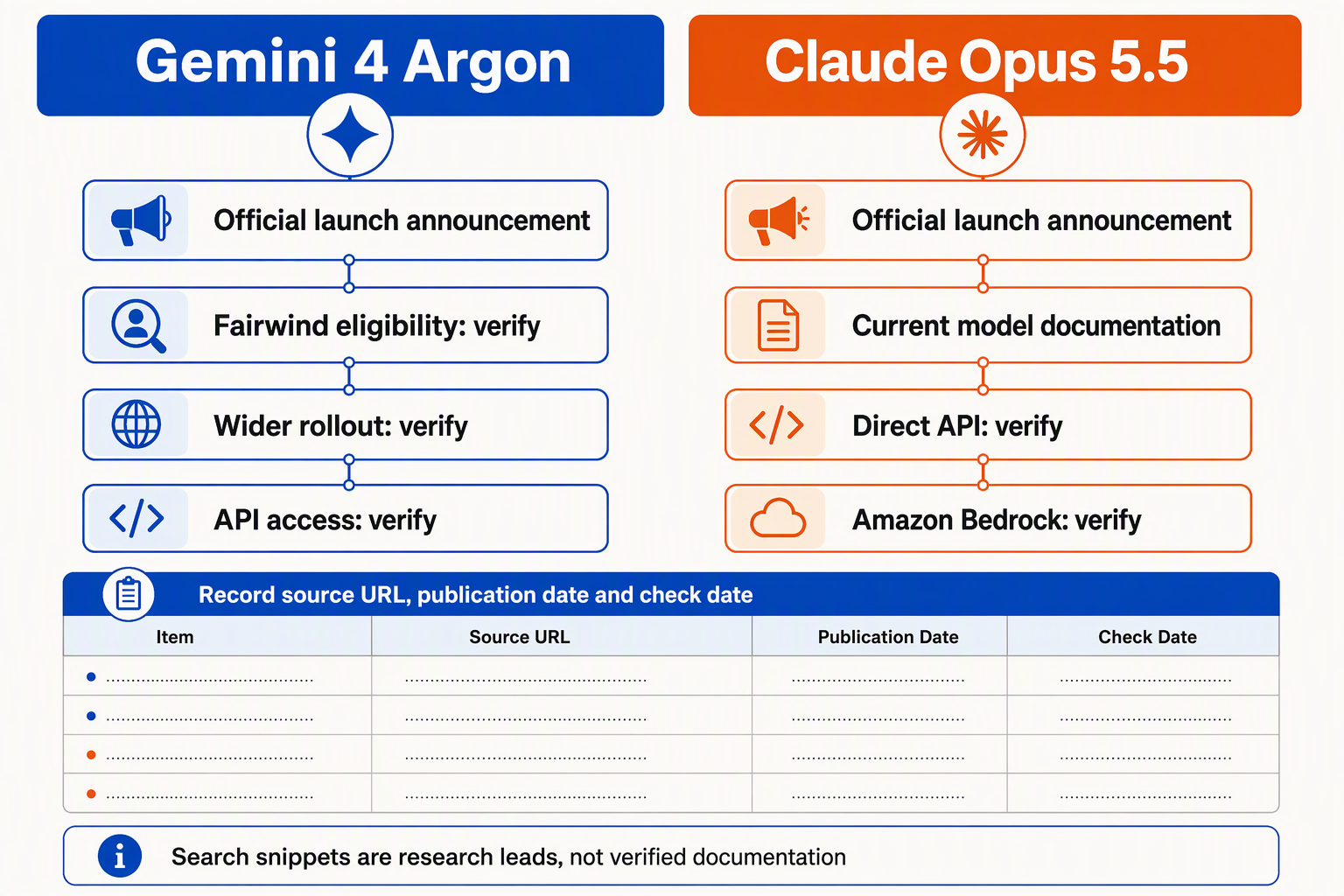
Google’s supplied announcement describes restricted Gemini 4 Argon access; the supplied Anthropic excerpt does not establish who can deploy Claude Opus 5.5. As of September 30, 2026, this access comparison remains a draft held for manual review, not a verified deployment guide.
Who can access Gemini 4 Argon?
- Gemini 4 Argon: Google’s supplied announcement says the model is “currently rolling out to trusted cyber defenders through the Fairwind Program.” As reviewed on September 30, 2026, that wording supports a restricted rollout—not general availability for developers, enterprise subscribers, or every organization conducting cybersecurity work. Eligibility still requires confirmation from Google’s official program documentation.
- Google launch restrictions: The supplied Google excerpt says Google is prioritizing “safety and rigorous testing before a wider release.” It provides no confirmed wider-release date, country list, application criteria, or approval timeline. Procurement teams should therefore treat access as an unresolved dependency rather than schedule a production migration around an assumed launch window.
- Gemini deployment channels: As of September 30, 2026, the supplied evidence does not confirm Gemini 4 Argon availability through Google AI Studio, the Gemini API, Vertex AI, or the Gemini app. Reviewers must check each channel separately: access to one Google product does not establish access to this particular model through another product.
- Gemini access evidence: Before approving a coding-agent pilot, request four items: written eligibility confirmation, the deployment endpoint, the exact model identifier, and permitted-use terms. For example, permission to evaluate cyber-defense workflows should not automatically be interpreted as permission to process internal finance documents or operate a general-purpose repository maintenance agent.
What do Anthropic’s deployment materials establish about Claude Opus 5.5?
- Claude Opus 5.5: Anthropic’s supplied excerpt discusses performance in “agentic coding, computer use, and knowledge work,” but contains no deployment instructions. As of September 30, 2026, that excerpt alone cannot confirm API availability, subscription eligibility, enterprise access, regional coverage, or distribution through a cloud marketplace. Performance positioning is not an access entitlement.
- Anthropic documentation: Manual review should verify five deployment details in current official documentation: the exact API model ID, supported endpoint, account eligibility, regional restrictions, and model lifecycle status. Record the documentation’s review date alongside each finding; do not substitute an announcement headline or search-result snippet for operational instructions that a developer can actually follow.
- Claude Opus 4.5 versus Claude Opus 5.5: The separate Anthropic search result states that Claude Opus 4.5 “is available today.” That statement applies to the named older model and its announcement—not to Opus 5.5 on September 30, 2026. Its availability, pricing, and deployment routes must not be carried forward without model-specific confirmation.
- Enterprise approval gate: For either model, require confirmed access plus documented data handling, retention, tool permissions, and usage limits before uploading private repositories or company documents. Keep model availability separate from workflow authorization: an accessible endpoint does not itself establish that an organization may run unattended coding agents or submit sensitive enterprise knowledge.
How do context, tools, reasoning controls and enterprise safety compare? (TABLE; linked, dated official citations beside each claim)
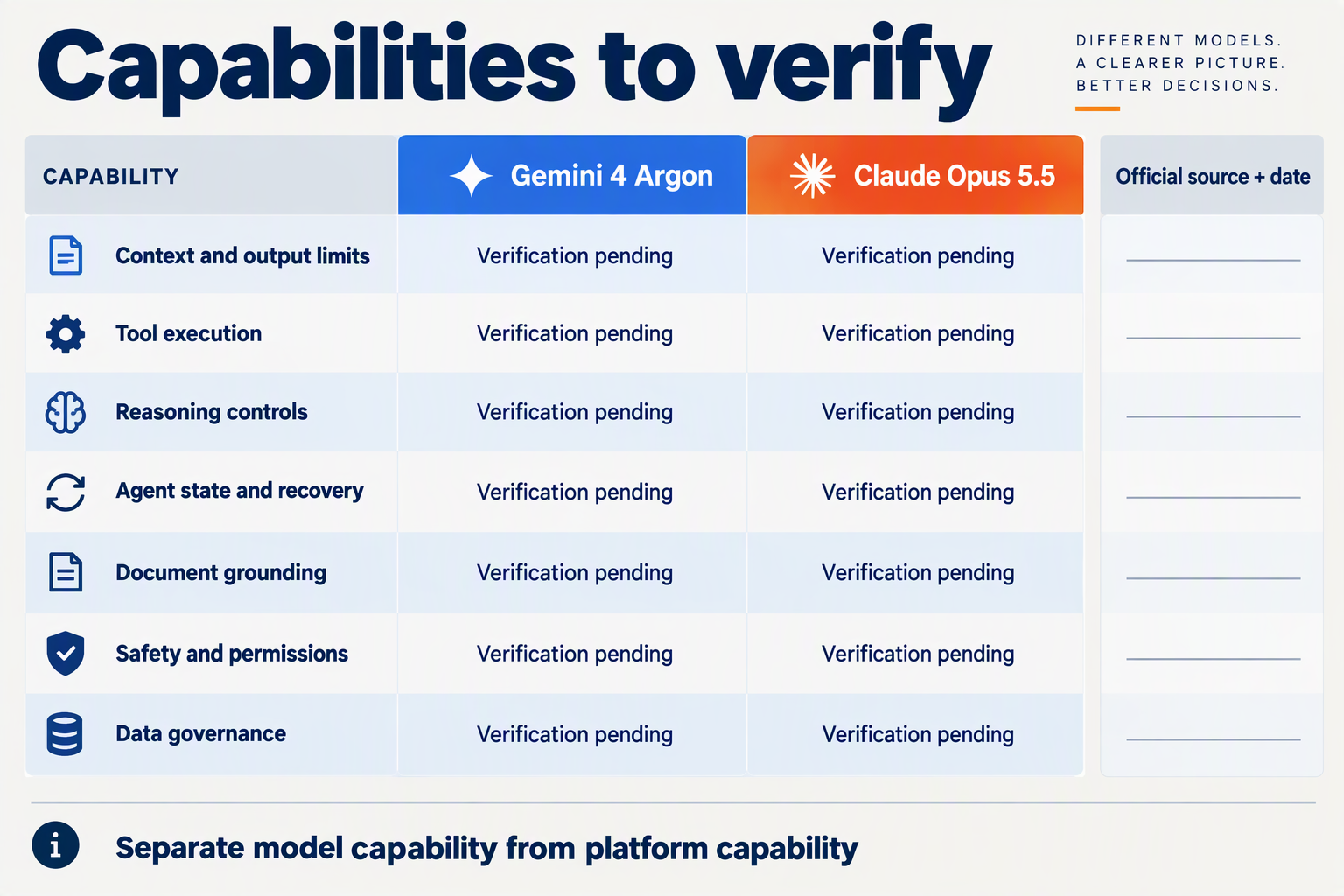
Context limits, tool interfaces, reasoning controls and enterprise safeguards cannot yet be compared reliably from the supplied excerpts. This section remains held for manual review as of September 30, 2026: missing specifications are evidence gaps, not evidence that either model lacks a capability.
- Gemini 4 Argon: Google’s supplied announcement excerpt does not specify context capacity, tool schemas, reasoning settings or enterprise data-handling terms; review status: September 30, 2026.
- Claude Opus 5.5: Anthropic’s supplied announcement excerpt does not specify those implementation details either; review status: September 30, 2026.
- Evidence standard: Confirm each specification against model-specific official documentation, recording the document’s publication or update date separately from this draft’s review date.
| Dimension | Gemini 4 Argon | Claude Opus 5.5 | Required verification |
|---|---|---|---|
| Context capacity | No token limit stated in supplied Google excerpt; reviewed September 30, 2026. | No token limit stated in supplied Anthropic excerpt; reviewed September 30, 2026. | Input limit, output limit and any long-context restrictions. |
| Tool interfaces | No function-calling schema or execution contract stated by Google in supplied excerpt; reviewed September 30, 2026. | Anthropic mentions “computer use,” but provides no interface specification in supplied excerpt; reviewed September 30, 2026. | Tool schemas, parallel calls, error handling and execution permissions. |
| Reasoning controls | No configurable reasoning budget stated in supplied Google excerpt; reviewed September 30, 2026. | No configurable reasoning budget stated in supplied Anthropic excerpt; reviewed September 30, 2026. | Supported settings, defaults and billing implications. |
| Long-running state | No checkpointing or context-compaction behavior stated in supplied Google excerpt; reviewed September 30, 2026. | No checkpointing or context-compaction behavior stated in supplied Anthropic excerpt; reviewed September 30, 2026. | State ownership, resumability and preservation of requirements. |
| Knowledge grounding | Google names enterprise knowledge work, without citation mechanics in supplied excerpt; reviewed September 30, 2026. | Anthropic names knowledge-work benchmarks, without citation mechanics in supplied excerpt; reviewed September 30, 2026. | Source attribution, document permissions and conflicting-source handling. |
| Enterprise safety | Google describes “safety and rigorous testing,” not tenant-level controls; supplied excerpt reviewed September 30, 2026. | No tenant-level security controls stated in supplied Anthropic excerpt; reviewed September 30, 2026. | Retention, training use, residency, audit logs and access controls. |
What should teams test before approving either model?
- Context continuity: Run one repository migration across three checkpoints—initial investigation, interrupted execution and resumed testing—and check whether every original requirement survives. A large advertised context window would not, by itself, establish reliable task memory.
- Tool safety: Use a sandbox with read-only access first, then explicitly approved writes; inject one failed command and one misleading instruction inside a retrieved document. Score unauthorized actions separately from task completion.
- Reasoning efficiency: If official documentation confirms adjustable reasoning, compare supported settings on the same tasks and record completion rate, elapsed time and total billed usage. Do not assume similarly named controls behave identically across vendors.
- Enterprise knowledge work: Test a current policy, a superseded policy and a restricted document together; require attributable answers, correct precedence and enforcement of document permissions. A plausible summary is not sufficient evidence of safe retrieval.
- Infrastructure fit: As of September 2026, CallMissed’s verified developer API offers structured outputs, function calling, reasoning-effort control and request logs. These capabilities illustrate useful integration requirements, but do not establish support for Gemini 4 Argon or Claude Opus 5.5—or identical behavior across models.
What do they cost per completed task? (TABLE; verify Argon introductory terms and recheck Opus $4/$20 per million tokens with dated pricing citations)
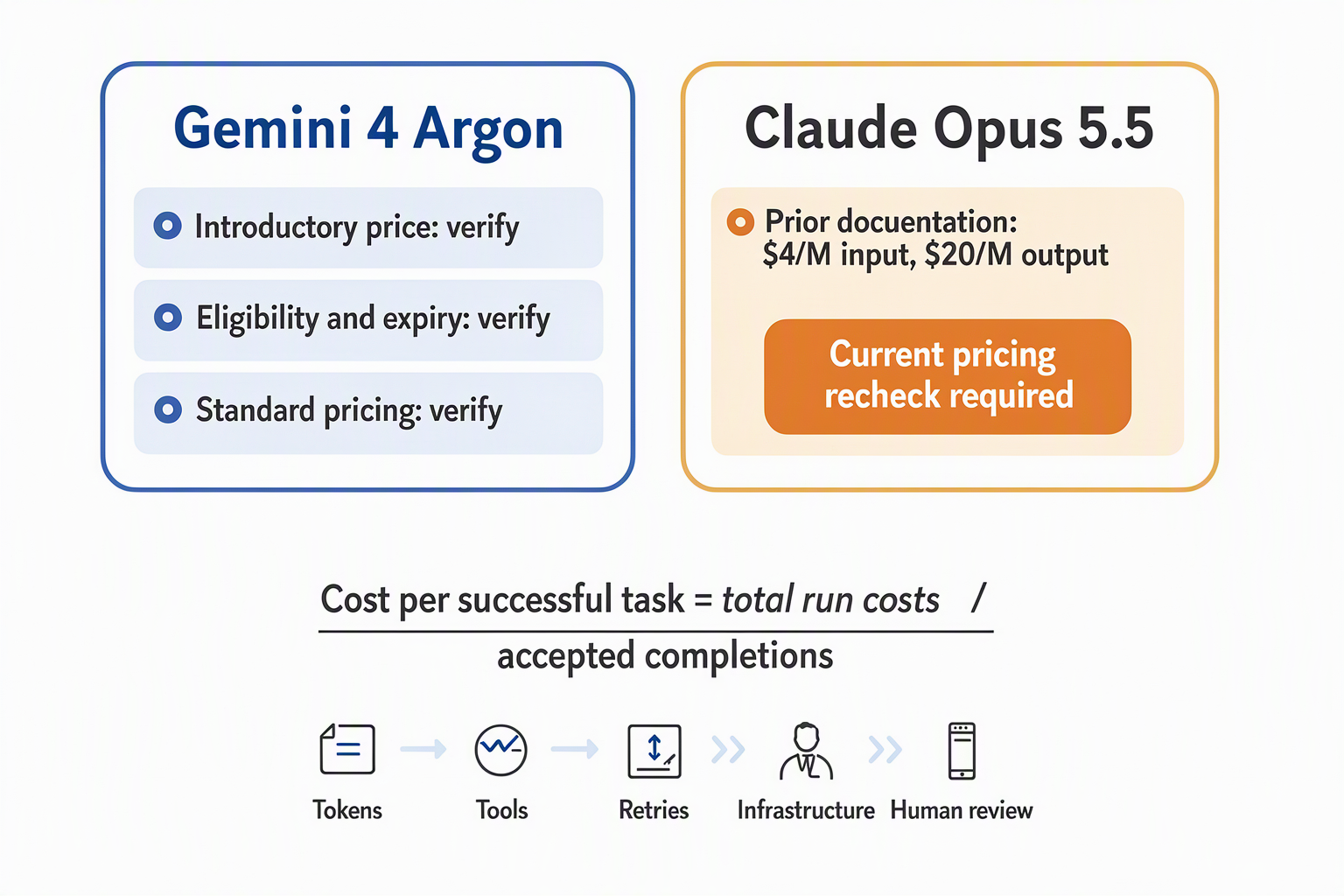
Cost per completed task cannot yet be verified for Gemini 4 Argon or Claude Opus 5.5 from the supplied excerpts as of September 30, 2026. Argon’s introductory terms and the proposed Opus $4 input/$20 output per million tokens remain publication blockers—not confirmed prices.
What pricing evidence is still missing?
| Cost component | Gemini 4 Argon | Claude Opus 5.5 | Manual-review requirement |
|---|---|---|---|
| Standard input tokens | Not supplied | $4/million claim unverified | Dated official pricing citation |
| Standard output tokens | Not supplied | $20/million claim unverified | Confirm exact model and endpoint |
| Introductory offer | Terms not supplied | No offer established | Verify eligibility, expiry and limits |
| Prompt caching | Rates not supplied | Rates not supplied | Check write, read and storage charges |
| Long-context usage | Charges not supplied | Charges not supplied | Check thresholds and applicable premiums |
| Tools and execution | Charges not supplied | Charges not supplied | Separate model, search and runtime costs |
- Gemini 4 Argon: Google’s supplied announcement excerpt describes a rollout to “trusted cyber defenders through the Fairwind Program”; the September 30, 2026 draft must not interpret restricted access as a free introductory offer.
- Claude Opus 5.5: Anthropic’s supplied excerpt discusses “performance and cost-effectiveness” but supplies no token rates; as of September 30, 2026, it cannot substantiate the proposed $4/$20 pricing.
- Introductory terms: Before publication, obtain Google’s official offer dates, eligible accounts, usage allowances, billing trigger and post-offer rates; an access announcement alone establishes none of those commercial conditions.
- Dated citations: Record each vendor’s pricing-page title, retrieval date, exact model identifier and billing channel; consumer subscriptions, direct API charges and cloud-provider prices should not be treated as interchangeable.
How should teams calculate cost per accepted task?
Cost per accepted task = total evaluation spend ÷ tasks meeting predefined acceptance criteria. Include unsuccessful runs in the numerator: excluding failures makes unreliable agents appear artificially inexpensive, especially when retries repeat large repository or document inputs.
- Define completion: For coding, require passing tests and reviewer approval; for knowledge work, require source-supported conclusions and approval against a written rubric.
- Measure full spend: Track billed input, output, cache operations, tool execution and sandbox runtime; report human-review time separately or include it using a disclosed hourly rate.
- Use the same workload: Compare identical tasks, permissions and acceptance rules, while recording retries and any introductory discounts separately from ongoing costs.
- Illustrative Opus arithmetic: Assuming—not verifying—$4/$20 rates, 200,000 input tokens plus 40,000 output tokens cost $1.60 per run: $0.80 input plus $0.80 output, excluding additional charges.
- Acceptance-adjusted arithmetic: At that hypothetical $1.60 per run, 100 runs costing $160 with 80 accepted results equal $2 per accepted task; this is a worked example, not an Anthropic benchmark.
Manual-review hold: Do not declare a price winner until dated Google and Anthropic pricing evidence establishes comparable access, billing terms and measured completion costs.
What are the documented advantages and trade-offs? (TABLE; separate vendor claims, verified facts and unknowns with dated citations)
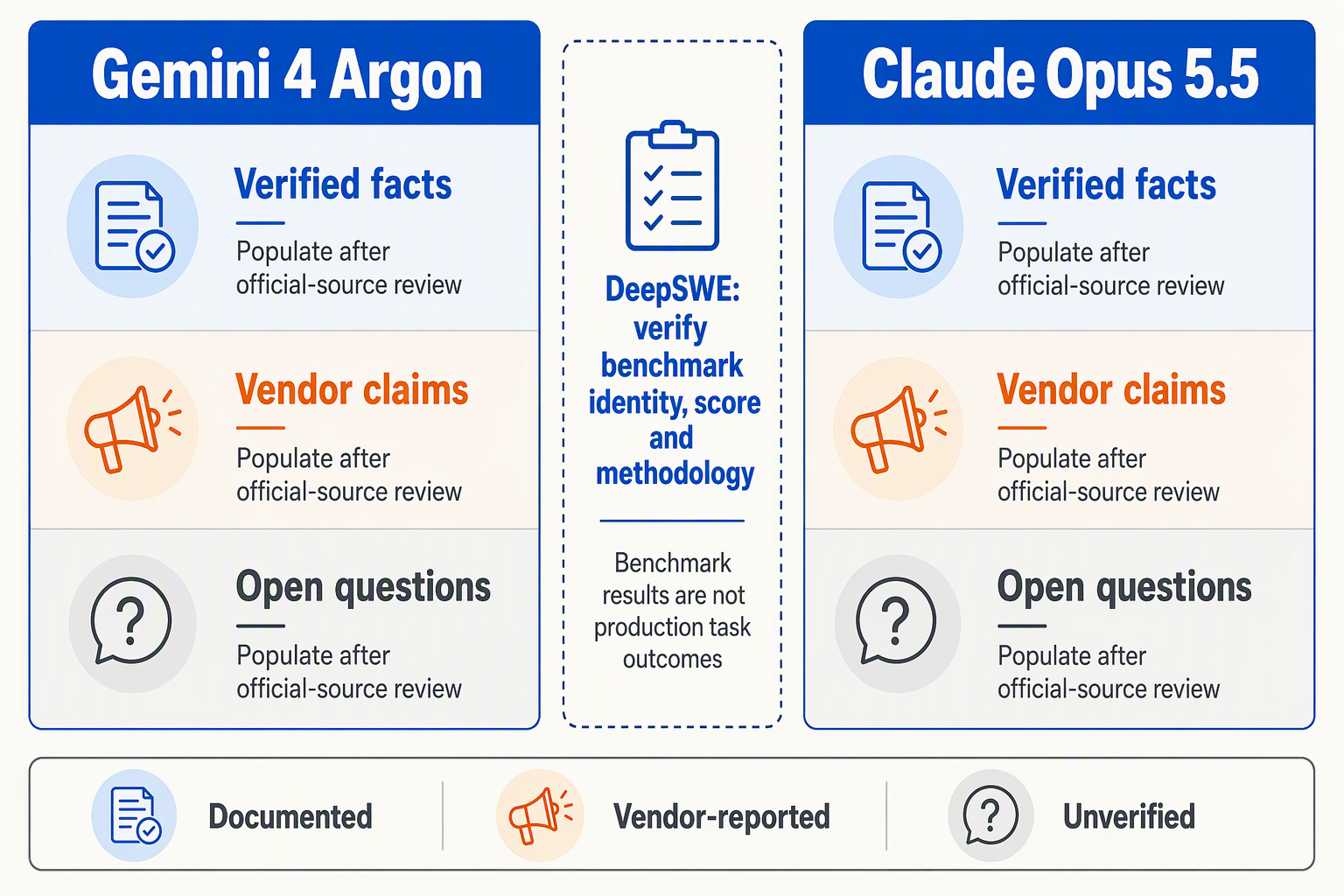
No independently verified advantage is established by the supplied excerpts for Gemini 4 Argon vs Claude Opus 5.5. As of September 30, 2026, the defensible comparison separates vendor positioning, excerpt-supported statements, and specifications still requiring manual verification.
Which advantages and trade-offs are actually documented?
The dates below identify this draft’s evidence cutoff, not confirmed announcement dates. “Excerpt-supported” means the supplied text contains the statement; it does not mean the underlying capability has been independently tested.
| Criterion | Gemini 4 Argon | Claude Opus 5.5 | Evidence status | Manual-review requirement |
|---|---|---|---|---|
| Coding positioning | Google describes a model for “real-world coding.” | Anthropic claims leadership in agentic coding on its own benchmarks. | Vendor claims: supplied Google and Anthropic excerpts, reviewed September 30, 2026. | Confirm official pages, model identifiers, benchmark names, scores, and evaluation settings before asserting an advantage. |
| Enterprise knowledge work | Google explicitly names enterprise knowledge work as a target use case. | Anthropic includes knowledge work in its claimed benchmark leadership. | Vendor claims: Google and Anthropic excerpts, September 30, 2026 cutoff. | Verify document-grounding results, citation accuracy, and handling of conflicting sources; neither excerpt supplies comparative measurements. |
| Computer use | The supplied Google excerpt provides no computer-use result. | Anthropic claims leadership in computer use on its benchmarks. | Claim versus unknown: Google and Anthropic excerpts, September 30, 2026 cutoff. | Obtain comparable tool environments and success criteria; missing Google evidence is not evidence of weaker performance. |
| Access and rollout | Google describes rollout to trusted cyber defenders through the Fairwind Program. | The supplied Anthropic excerpt does not establish availability or access conditions. | Excerpt-supported rollout statement; access unknown: September 30, 2026 cutoff. | Confirm eligibility, supported endpoints, regions, and whether access covers the intended enterprise workload. |
| Benchmark interpretation | No benchmark score appears in the supplied Google excerpt. | Anthropic says benchmark margins have become “a less reliable guide to real-world differences.” | Excerpt-supported caveat; comparative scores unknown: September 30, 2026 cutoff. | Inspect methodology and independent replication rather than treating a vendor leaderboard claim as a deployment verdict. |
| Operational specifications | Context limits, token pricing, and runtime guarantees are not supplied. | Context limits, token pricing, and runtime guarantees are not supplied. | Unknown for both: supplied evidence as of September 30, 2026. | Verify current specifications and terms; calculate complete workflow cost rather than assuming either model is cheaper. |
What should enterprise reviewers test before choosing?
- Gemini 4 Argon: Treat the Fairwind rollout as an access consideration, not proof of general availability or superior security.
- Claude Opus 5.5: Treat Anthropic’s three claimed benchmark categories—agentic coding, computer use, and knowledge work—as evaluation leads, not independently verified wins.
- Coding agents: Run the same repository migration with identical tools, permissions, and test suites; record completion, regressions, and human interventions.
- Knowledge agents: Use identical document sets containing outdated policies and conflicting instructions; count unsupported statements and incorrect citations.
- Operational trade-offs: Measure total tokens, tool retries, elapsed time, and reviewer effort; a cheaper response can still create a costlier workflow.
- Publication gate: Keep this comparison held for manual review until official availability, specifications, publication dates, and reproducible results are checked.
How should you reproduce a long-running coding and knowledge-work evaluation?
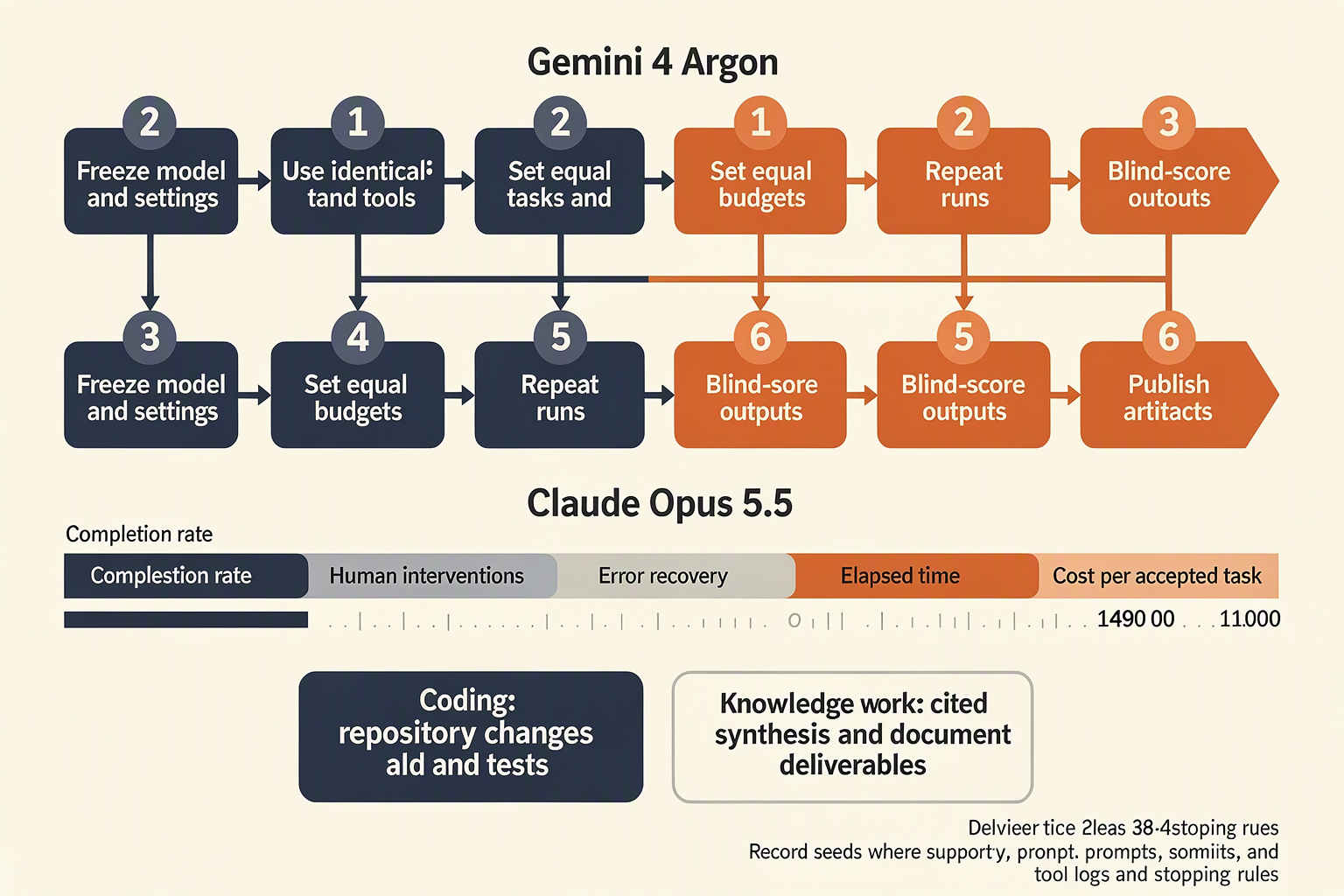
Reproduce the comparison with a versioned test harness, identical task inputs, and independently scored outcomes. For this draft held for manual review, the following numbers are proposed evaluation settings—not vendor benchmarks—as of September 30, 2026.
What should you freeze before testing either model?
- Model identity and access: Record the exact model ID, endpoint, access tier, execution date, and configuration for Gemini 4 Argon and Claude Opus 5.5. Google’s supplied announcement excerpt describes Argon as rolling out to trusted cyber defenders through the Fairwind Program; do not substitute another Gemini model if Argon access is unavailable.
- Representative task set: Prepare 20 coding tasks and 20 knowledge-work tasks, with 3 independent runs per task per model: 240 runs if both models are accessible. Include repository migrations, cross-file bug fixes, policy reconciliation, and evidence-backed briefings. Keep expected answers and hidden tests outside the agent’s accessible workspace.
- Identical execution environment: Freeze repository commit hashes, dependency lockfiles, document snapshots, system prompts, tool schemas, and permissions. Give both models the same 60-minute task deadline and 100-tool-call ceiling. Record model-specific reasoning settings separately; similarly named controls should not be assumed to represent equivalent computation or effort.
- Verified commercial configuration: Capture official input-token, output-token, caching, and tool charges on September 30, 2026, before testing. The supplied Google and Anthropic excerpts do not establish comparable prices or context limits. Leave those fields unverified until checked, and report actual token consumption rather than estimating cost from response length.
How should you score completion, recovery, and evidence quality?
- Coding completion: Require a reviewable patch, passing hidden tests, and no unauthorized changes. Report successful tasks ÷ attempted tasks, median completion time, reviewer correction time, and cost per accepted patch. Count timeouts and abandoned runs as failures; a plausible explanation without a working change is not a completed coding task.
- Knowledge-work grounding: Score factual accuracy, citation correctness, source coverage, and handling of conflicting documents separately. Include 1 superseded policy and 1 conflicting source in each reconciliation task, clearly dated. Reviewers should verify whether the final answer identifies the authoritative document and distinguishes supported conclusions from unresolved uncertainty.
- Long-running recovery: Inject 1 tool timeout and 1 checkpoint restart into designated tasks, using the same intervention points for both models. Measure repeated work, lost requirements, and recovery success. Preserve complete execution traces; CallMissed’s developer API offers usage and request logs as of September 2026, without establishing support for either model here.
- Independent interpretation: Blind reviewers to model identity, publish scoring rubrics, and report paired task outcomes with uncertainty intervals—not just an aggregate winner. Anthropic’s supplied excerpt, reviewed for this September 30, 2026 draft, warns that “benchmark margins have become a less reliable guide to real-world differences.” Separate model failures from harness failures, and retain every failed run.
Which should your enterprise choose, and what changes during migration? Use verified access, evaluation results and procurement requirements
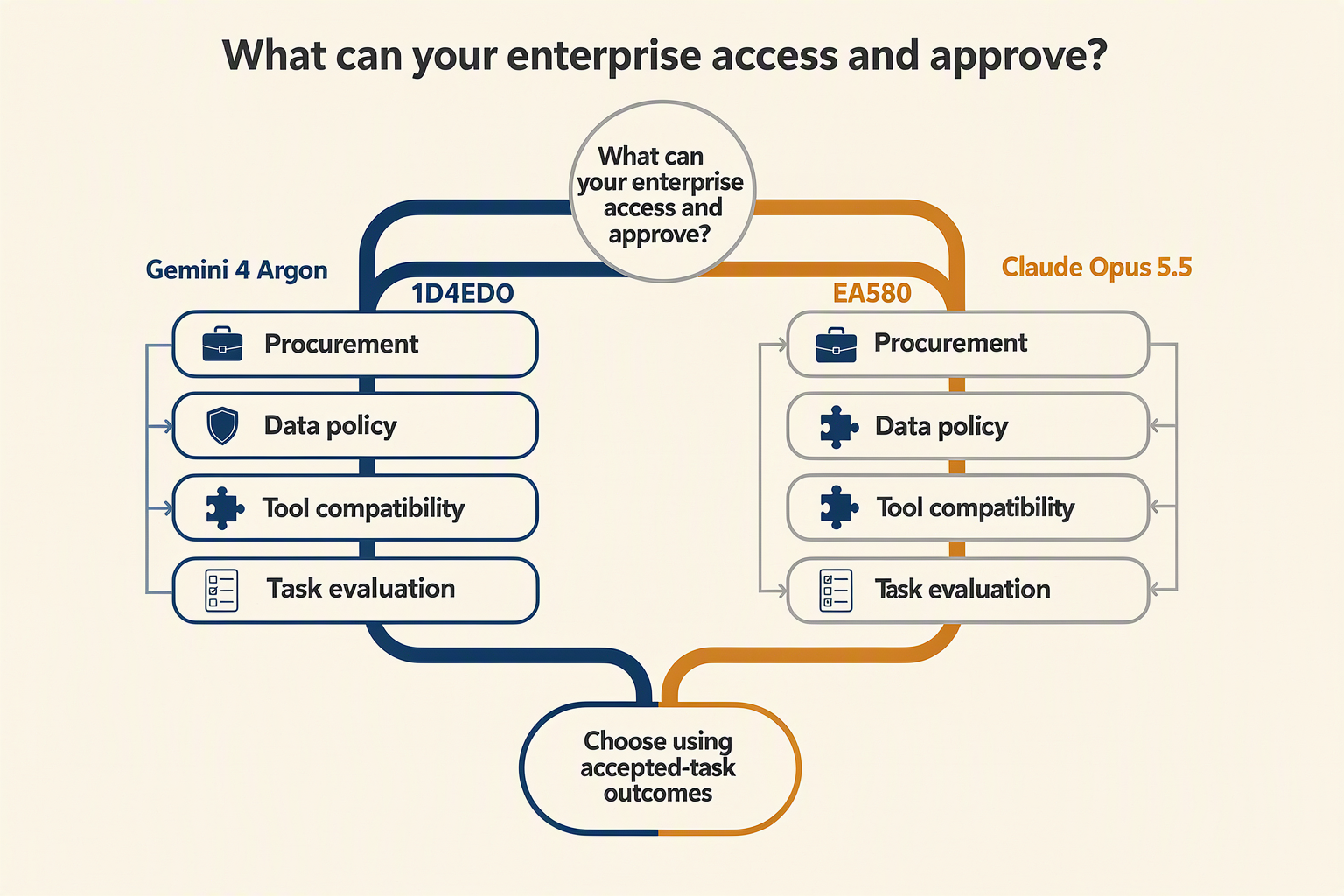
Choose the model your enterprise can actually access, validate on representative work, and approve for production—not the model with the strongest announcement. This September 30, 2026 draft remains held for manual review because the supplied sources do not establish comparable procurement terms or independently verified evaluation results.
Which evidence should determine the enterprise shortlist?
- Gemini 4 Argon: Require written confirmation of your organization’s eligibility, deployment route, and permitted workloads before scheduling a pilot. Google’s supplied announcement excerpt, reviewed as of September 30, 2026, describes access through the Fairwind Program for trusted cyber defenders; that does not establish general enterprise API availability or authorization for ordinary internal coding workflows.
- Claude Opus 5.5: Request the exact production model identifier, supported endpoint, regional availability, and applicable contract. Anthropic’s supplied excerpt, reviewed as of September 30, 2026, reports leadership on its own agentic coding, computer-use, and knowledge-work benchmarks, but supplies no numerical scores or procurement details sufficient to justify a purchase decision.
- Evaluation results: Use a proposed 30-task pilot: 15 repository tasks and 15 document-grounded tasks, running each task three times per accessible model. Keep permissions, source documents, test suites, and spending caps identical; record accepted completions, reviewer corrections, citation accuracy, elapsed time, and total cost. This is a recommended evaluation design, not a published benchmark.
- Procurement requirements: Make approval conditional on documented retention periods, training-use terms, processing locations, subprocessors, identity controls, audit access, incident notification, and service commitments. Obtain dated input/output pricing and any caching or tool charges; calculate cost per accepted task, including human review, rather than comparing token prices that the supplied context does not verify.
What changes when you migrate an existing agent workflow?
- Agent integration: Treat migration as a contract change, not merely a model-name replacement. Check tool schemas, structured-output validation, streaming events, error handling, retry behavior, and context-management rules against current provider documentation; replay saved workflows before allowing repository writes. Compatibility must be demonstrated for each feature your agent actually uses.
- Knowledge-work controls: Recheck document permissions, retrieval filters, citation formatting, and conflicting-source handling. Include a proposed test where an outdated policy contradicts its replacement and another where a user cannot access a referenced document; require the agent to respect both effective dates and access boundaries without leaking restricted content.
- CallMissed: As of September 2026, CallMissed’s verified developer API offers OpenAI-compatible and Anthropic-compatible endpoints, plus request logs and caller-chosen fallback models. Those capabilities can reduce integration work for supported models, but the fact sheet does not establish Gemini 4 Argon or Claude Opus 5.5 availability; verify catalogue support before planning either migration.
- Release decision: Start with read-only access and human-approved changes, then expand permissions only after evaluation and procurement sign-off. Preserve the previous model configuration, prompts, and tool contracts for rollback; if neither candidate clears the access, quality, and contractual gates, retain the existing deployment rather than forcing a winner.
Frequently Asked Questions
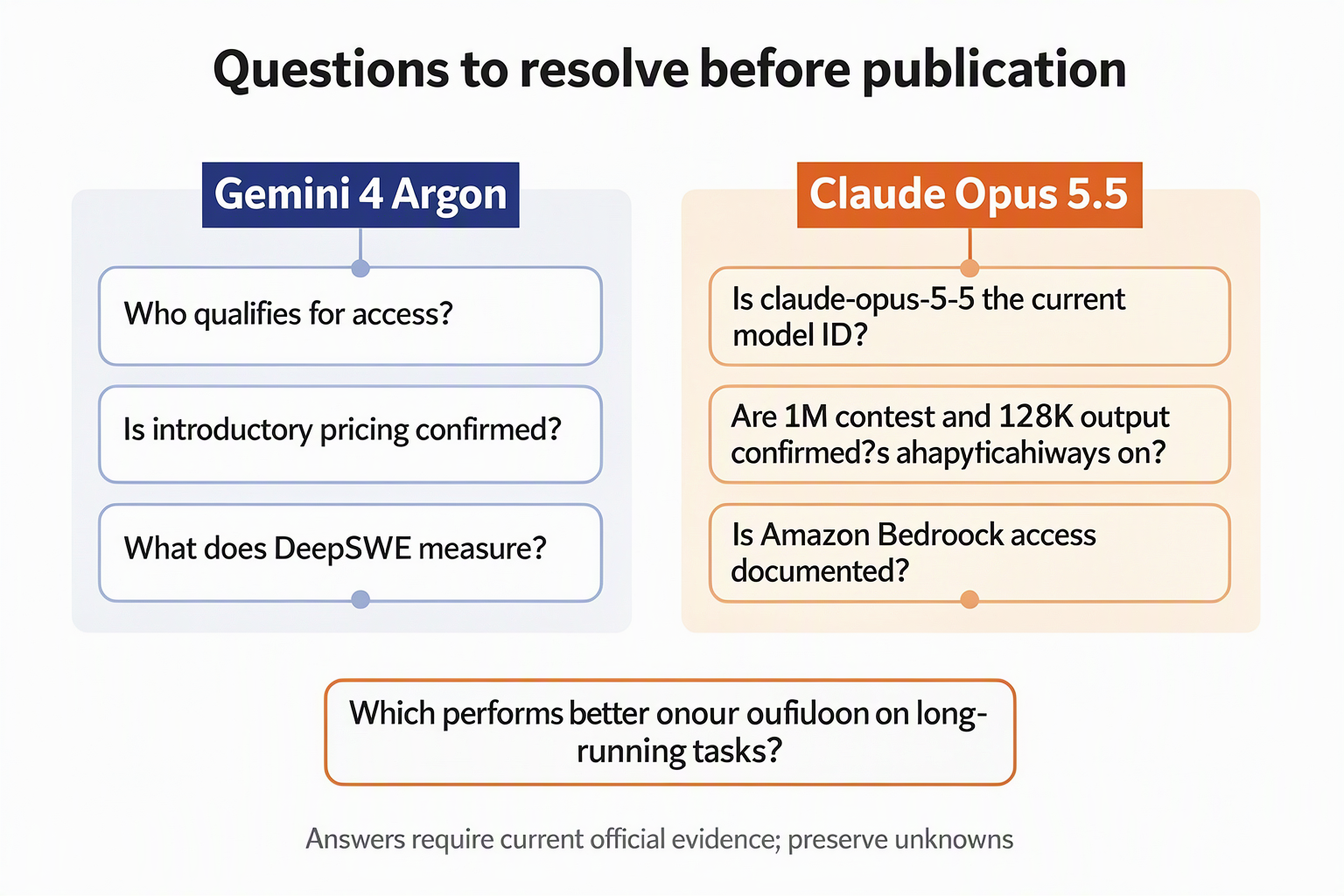
Draft held for manual review, as of September 30, 2026: The supplied excerpts support limited rollout and benchmark claims, but do not confirm pricing, DeepSWE results, technical limits, adaptive thinking, or Amazon Bedrock availability.
- Q: How do I get Gemini 4 Argon access for a Gemini 4 Argon vs Claude Opus 5.5 evaluation?
A: As of September 30, 2026, Google’s supplied announcement says Gemini 4 Argon is “currently rolling out to trusted cyber defenders through the Fairwind Program,” rather than establishing unrestricted developer access. The excerpt does not provide application instructions, eligibility criteria, API identifiers, or a general-release date. Before scheduling an evaluation, obtain official confirmation of access, permitted workloads, and whether your organization can test coding and enterprise knowledge tasks.
- Q: What is the price of Gemini 4 Argon vs Claude Opus 5.5?
A: As of September 30, 2026, neither Google’s supplied Gemini 4 Argon excerpt nor Anthropic’s supplied Claude Opus 5.5 excerpt establishes comparable prices, so a numerical cost comparison would be unsupported. Do not substitute another Gemini or Claude model’s rates, or treat consumer subscription prices as API pricing. For procurement, request model-specific input, output, caching, and tool charges, then measure cost per accepted result, including retries and human review.
- Q: What does DeepSWE establish about Gemini 4 Argon’s coding performance?
A: As of September 30, 2026, the supplied Google and Anthropic excerpts contain no DeepSWE definition, score, methodology, or model attribution, so this draft cannot use DeepSWE to establish a coding advantage. Any eventual result needs its benchmark version, task set, agent configuration, tool budget, and evaluation procedure before comparison. Even a verified score would support performance under those test conditions—not automatically prove reliable repository migrations, secure patches, or sustained autonomous execution.
- Q: Are Claude Opus 5.5 context limits and output limits confirmed?
A: As of September 30, 2026, Anthropic’s supplied Claude Opus 5.5 excerpt does not confirm context-window size, maximum output tokens, request limits, or long-running session behavior. These are separate constraints: fitting documents into context does not establish how much output a model can generate or how many requests an account permits. Validate each limit against current model-specific documentation and test your actual repository or document workload before committing to an architecture.
- Q: Does Claude Opus 5.5 support adaptive thinking?
A: As of September 30, 2026, adaptive thinking is not confirmed by the supplied Anthropic excerpt; its benchmark claims do not establish that capability or its configuration. Confirm the exact API parameters, supported settings, billing treatment, and interactions with tool use before describing adaptive thinking as available. For evaluation, record the reasoning configuration alongside completion quality and elapsed time so different settings do not quietly distort the comparison.
- Q: Is Claude Opus 5.5 available on Amazon Bedrock?
A: As of September 30, 2026, the supplied Anthropic excerpt does not confirm Claude Opus 5.5 availability on Amazon Bedrock, supported AWS Regions, or model identifiers. Require matching Anthropic and AWS documentation before promising a Bedrock deployment, and distinguish model listing from access granted to your account. Enterprise approval should also verify the relevant deployment’s data-handling terms, permissions, quotas, and operational controls rather than infer them from another Claude model’s availability.
Conclusion
Gemini 4 Argon vs Claude Opus 5.5 is a workflow decision, not an established benchmark victory. As of September 30, 2026, this comparison remains a draft held for manual review: the supplied Google and Anthropic excerpts describe promising capabilities, but do not establish an independently verified winner for long-running coding agents or enterprise knowledge work.
Four takeaways should guide the shortlist:
- Prioritize task continuity over a strong opening answer. A useful coding agent must preserve requirements through investigation, implementation, testing, and review. Evaluate whether the agent finishes a repository-wide change coherently, rather than whether its first patch looks convincing. The practical distinction is between generating plausible code and delivering changes your team can safely approve.
- Test tool execution and recovery on representative work. Repository navigation, dependency inspection, failed checks, and follow-up edits belong in the evaluation—not outside it. An agent that recognizes an unsuccessful approach and corrects course may be more useful than one that produces an impressive answer but leaves substantial cleanup. Measure the review burden alongside task completion.
- Require traceable evidence for enterprise knowledge work. Document-heavy evaluations should test whether conclusions connect to the right sources, conflicting documents are flagged, and outdated instructions are distinguished from current policy. Coding capability alone does not establish knowledge-work reliability. Both workflows require the agent to separate supported findings from assumptions before a person approves the result.
- Separate vendor claims from deployment evidence. In the supplied material reviewed for this September 30, 2026 draft, Google describes Gemini 4 Argon’s restricted rollout through the Fairwind Program. Anthropic claims benchmark leadership for Claude Opus 5.5 while cautioning that “benchmark margins have become a less reliable guide to real-world differences.” Neither excerpt supplies the comparable pricing, context limits, benchmark scores, or unrestricted availability needed for a procurement verdict.
Looking ahead, watch for confirmed access conditions, comparable evaluations, and clearer operational documentation from Google and Anthropic. Wider availability would make testing easier, but availability alone would not demonstrate that either model can sustain your organization’s workflows. The decisive evidence will come from repeatable tasks that expose lost requirements, incorrect tool use, unsupported conclusions, and avoidable review effort.
For readers exploring the broader infrastructure trend, CallMissed’s OpenAI-compatible developer API, as of September 2026, provides one API key and balance for 139 models. That makes CallMissed relevant to exploring multi-model integration, without implying that either model in this comparison is supported.
Before choosing a model, verify current official documentation and run a representative coding task alongside a source-grounded knowledge-work task. Which agent consistently delivers a reviewable result with the least correction from your team?
Related Reading
- Claude Opus 5.5 vs GPT-5.6 Sol: Coding & Cost Tests
- Claude Opus 5.5 vs Gemini 3.8 Flash: API Buyer Guide
- Claude Fable 5.1 vs Opus 5.5: Pricing & Coding
Sources
Discussion
Related Posts


Ready to automate customer conversations?
Launch AI voice agents and WhatsApp bots with CallMissed — one API, 22+ Indian languages.