
Gemini 4 Argon vs GPT-6.1 Sol: Coding & Agents (2026)



Compare Argon’s restricted access with GPT-6.1 Sol’s documented APIs, prices and coding evaluation criteria. Includes launch-pricing caveats.
Gemini 4 Argon vs GPT-6.1 Sol: Coding & Agents (2026)
Gemini 4 Argon vs GPT-6.1 Sol is an access-first coding comparison as of September 30, 2026. Google announced Argon with a limited Fairwind rollout; OpenAI officially documents GPT-6.1 Sol for coding and professional work. Neither product documentation nor a single benchmark proves an overall performance winner.
According to VentureBeat’s September 30, 2026 report, Google announced Gemini 4 Argon with claimed leadership on several enterprise-relevant benchmarks—but with a limited release. That distinction matters: a headline score does not establish whether developers can deploy a model, reproduce its results, or trust it to complete professional work.
Why does this AI model comparison matter now?
The immediate question is not simply which model scores higher. It is whether either model can reliably move from answering questions to editing repositories, operating software, and completing multi-step tasks under realistic constraints.
Unite.AI’s September 30, 2026 report describes Gemini 4 Argon as targeting real-world software engineering, legal and finance work, and cybersecurity defense. RuntimeWire’s September 30, 2026 report says Google is providing Argon to selected cyber defenders before broader access. Together, those reports make availability—not just capability—a central issue for this comparison.
Google’s official announcement confirms Argon’s limited rollout and announced introductory pricing; OpenAI’s official changelog and model page confirm GPT-6.1 Sol, its rates and API requirements. Neither source substitutes for a matched repository evaluation, so this guide does not declare a universal performance winner.
What will this coding and agents comparison examine?
This draft establishes the questions a useful, evidence-led comparison must answer:
- Coding: Can each model diagnose a failing test, implement a maintainable fix, and avoid introducing unrelated changes?
- Computer-use agents: Can each model navigate interfaces, recover from errors, and request approval before consequential actions?
- Professional work: Can each model produce traceable analysis, distinguish evidence from assumptions, and handle sensitive information appropriately?
- Deployment: What access restrictions, documented prices, tool permissions, and usage limits affect practical adoption?
A worked coding task should measure more than whether the final patch passes. Reviewers should also examine unnecessary edits, tool failures, human interventions, and the cost of reaching a usable result. For computer-use tasks, completing a workflow without exceeding authorized permissions matters as much as speed.
As of September 2026, CallMissed’s verified developer API supports caller-chosen fallback models and usage and request logs—capabilities relevant to teams evaluating models rather than committing on headline claims alone.
The comparison that follows should therefore separate reported claims, officially documented facts, and independently tested results. Readers will learn what evidence supports each conclusion, what remains unknown, and which deployment questions to resolve before choosing a coding or agent model.
At a glance: which model should you choose? Access and workload tests decide—not a verified overall winner
Start with GPT-6.1 Sol for a coding evaluation; shortlist Gemini 4 Argon only if you qualify for its limited access. As of September 30, 2026, both are officially documented, but neither is an independently verified overall quality winner. Availability, integration requirements, and results on your own workloads should drive the choice.
Which model belongs on your evaluation shortlist?
- GPT-6.1 Sol: OpenAI’s official changelog and model documentation establish
gpt-6.1-solas a released model for coding and professional work. Tool calls require the Responses API, and multi-agent functionality is in beta. It is the more practical starting point for this coding comparison if your account has access—not a proven benchmark winner.
- Gemini 4 Argon: Google’s launch announcement describes limited access through Fairwind for trusted cyber defenders, not public general availability. Evaluate it only after confirming eligibility and permitted workloads. Official documentation establishes the product and its positioning; it does not independently establish superiority over Sol.
- Coding quality: Choose based on reproducible results in your repositories. Compare patch correctness, passing tests, unrelated changes, reviewer effort, and total cost per accepted patch. Keep model versions, prompts, and tool permissions consistent, and distinguish vendor-reported results from your own measurements. No independent head-to-head quality winner is established here.
- Argon pricing: Google announced introductory rates of $2 input / $10 output per million tokens. A 95% discount on eligible cached input brings that input rate to $0.10 per million tokens. Announced later rates are $4 input / $20 output; the introductory offer’s expiry is not verified, so confirm the applicable rate before budgeting.
- Sol pricing: OpenAI lists Standard rates for requests with up to 272K input tokens at $2 input / $0.10 cache read / $2.50 cache write / $10 output per million tokens. Above 272K input tokens, input and cache rates double and output rates increase by 1.5× for the full request—to $4 / $0.20 / $5 / $15, respectively. Include retries, tool execution, and human review when comparing complete task costs.
- Bottom line: Sol is the starting candidate for an accessible coding evaluation; Argon is an access-dependent alternative. Neither documented availability nor announced pricing proves better coding performance. This page focuses on coding evaluation; the sibling coding-agent page covers API integration.
Sources: Google’s Argon launch announcement; OpenAI’s API changelog and model documentation.
Was Gemini 4 Argon launched, and who can access either model on September 30, 2026?
Gemini 4 Argon’s September 30, 2026 announcement is reported, not independently verified here against Google documentation. Access appears restricted; GPT-6.1 Sol’s identity and availability remain unverified in the supplied evidence.
Was Gemini 4 Argon officially launched?
- Gemini 4 Argon — announcement evidence: VentureBeat’s September 30, 2026 report describes Google’s announcement as a “limited release.” That supports describing a reported announcement, but not a generally available launch. Before publication, reviewers should obtain a dated Google announcement identifying the exact model name and distinguishing announcement, preview availability, and production availability.
- Gemini 4 Argon — official verification gap: As of September 30, 2026, the supplied material contains no official Google model page, API model identifier, pricing schedule, or access documentation. These are missing from this research packet—not proven absent everywhere. The draft should therefore label official launch verification pending, rather than imply that secondary coverage establishes deployment readiness.
- Gemini 4 Argon — earlier reporting: DEV Community’s September 22, 2026 post states, “Gemini 4 is not out,” and reports no model page, API identifier, pricing, or benchmark table at that time. That snapshot predates the reported announcement by eight days; it cannot establish availability on September 30 or invalidate subsequent reporting.
- GPT-6.1 Sol — identity check: As of September 30, 2026, none of the supplied sources documents an OpenAI model named GPT-6.1 Sol. Business Insider Africa’s September 30 report instead mentions OpenAI’s Astra in a cybersecurity comparison. That different name is not evidence of an alias, successor relationship, or equivalent product; reviewers must verify Sol independently.
Who can access Gemini 4 Argon or GPT-6.1 Sol?
- Gemini 4 Argon — initial users: RuntimeWire’s September 30, 2026 report says Google is giving Argon to selected cyber defenders before developers, enterprises, and consumers. Consequently, a software team should not assume ordinary account signup provides access. Named eligibility requirements, an application route, and permitted workloads still need confirmation from Google before an evaluation can be scheduled.
- Gemini 4 Argon — rollout detail: SaaSCity describes three distribution phases, with the first reportedly live on September 30, 2026 for vetted defense teams, intelligence agencies, critical-infrastructure operators, and security partners. Treat that list as secondary reporting, not verified enrollment criteria. The supplied excerpt does not establish dates or conditions for the remaining phases.
- Both models — deployment unknowns: As of September 30, 2026, the supplied evidence establishes no verified API prices, rate limits, regional eligibility, subscription requirements, or general-access dates for either comparison candidate. Record these fields as “unverified,” not “free,” “unlimited,” or “unavailable.” Without documented access terms, a procurement recommendation would rest on assumptions rather than reproducible deployment conditions.
- Both models — manual-review gate: Before releasing this September 30, 2026 comparison, require four checks: an official announcement, an exact model identifier, documented access eligibility, and published commercial terms. Until those checks pass, keep the availability verdict “Argon: restricted access reported; Sol: unverified.” Neither designation supports declaring a deployable winner for coding, computer-use agents, or professional work.
How do coding, computer-use and professional-work capabilities compare?
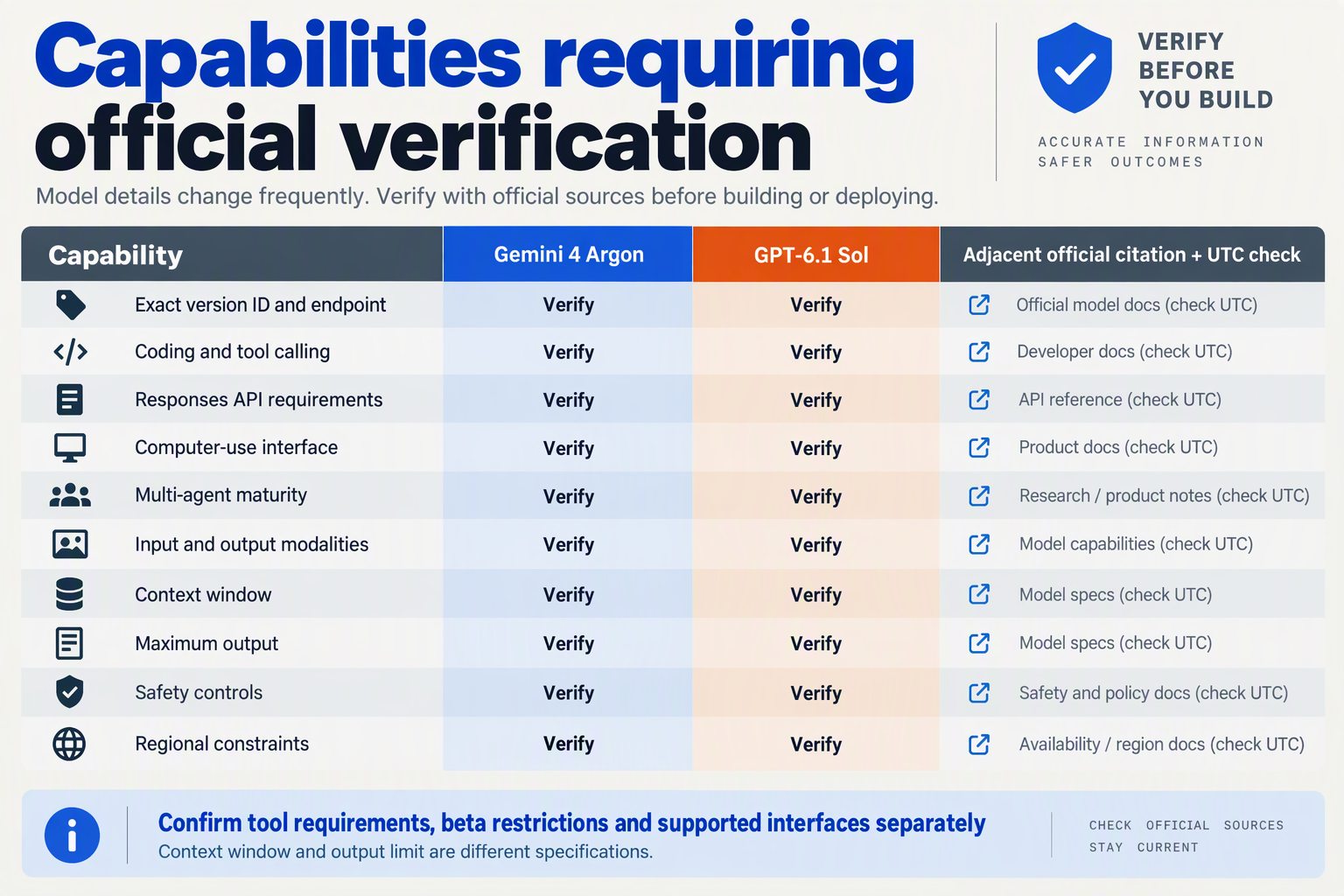
Gemini 4 Argon vs GPT-6.1 Sol has no verified capability winner as of September 30, 2026. The comparison below separates reported capabilities from the evidence reviewers need before approving this draft.
| Capability | Gemini 4 Argon | GPT-6.1 Sol | Evidence needed |
|---|---|---|---|
| Repository coding | RuntimeWire’s September 30 reporting mentions long-running coding claims. | No supporting documentation supplied. | Repository tasks, patches, test results. |
| Software engineering | Unite.AI’s September 30 report describes a real-world engineering focus. | Coding capabilities unverified. | Benchmark version, agent harness, task count. |
| Computer-use agents | No documented interface-control specification supplied. | Computer-use capabilities unverified. | Supported tools, permissions, recovery traces. |
| Legal work | Unite.AI’s September 30 report names legal knowledge work. | Legal-work capabilities unverified. | Source-grounded outputs, expert review. |
| Finance work | Unite.AI’s September 30 report names finance knowledge work. | Finance-work capabilities unverified. | Calculation checks, assumptions, source dates. |
| Cybersecurity defense | Business Insider Africa’s September 30 report describes claimed competitiveness with OpenAI’s Astra. | No Sol-specific cybersecurity evidence supplied. | Authorized tasks, scoring methodology, safety controls. |
How should reviewers compare coding capabilities?
- Gemini 4 Argon: Treat “long-running coding” as a reported claim, not a measured advantage; the supplied September 30, 2026 RuntimeWire excerpt provides no task duration, success percentage, or reproducible execution trace.
- GPT-6.1 Sol: Require an official OpenAI model identifier before testing; evidence about OpenAI’s Astra, mentioned by Business Insider Africa on September 30, 2026, cannot establish Sol’s identity or performance.
What would demonstrate reliable computer use?
- Both models: Run the same 3-stage workflow—locate a customer record, prepare an update, and request approval before saving—and record completion, unauthorized actions, recovery attempts, and human interventions; this is a proposed test, not a published benchmark result.
- Both models: Separate model reasoning from the agent harness: browser tools, screenshot handling, retry policies, and permissions can change outcomes, so a fair comparison must disclose those settings rather than attribute every success to the model.
How should professional-work quality be measured?
- Both models: Use 2 review tracks: a legal memo checked for accurate citations and jurisdictional assumptions, and a financial analysis checked for arithmetic, dated inputs, and explicit uncertainty; polished prose alone should not count as task completion.
- CallMissed: As of September 2026, CallMissed’s verified developer API supports structured outputs and OpenAI-compatible endpoints, which can help standardize evaluation formats; the supplied fact sheet does not establish availability of either named model.
What must be verified before publishing a verdict?
Manual review should retain separate labels for “reported,” “documented,” and “tested.” VentureBeat’s September 30, 2026 excerpt reports claimed benchmark leadership but supplies no scores, while the context contains no verified computer-use results for either model; publishing percentages or a capability ranking would therefore create unsupported precision.
What does each model cost per successful task? Conditional launch pricing and value
Cost per successful task cannot yet be calculated for Gemini 4 Argon or GPT-6.1 Sol from the supplied evidence as of September 30, 2026. Any launch-price comparison must remain conditional until official model identities, billing terms, and measured completion rates are verified.
- Gemini 4 Argon: VentureBeat’s September 30, 2026 report describes a limited release, but the supplied excerpt provides no official API price, billable model ID, or contracted access terms.
- GPT-6.1 Sol: The supplied September 30, 2026 research contains no supporting OpenAI documentation; input, output, caching, and tool-use prices must therefore remain unverified, not estimated from another model.
- Value metric: Compare total evaluation spend ÷ accepted completions, including unsuccessful attempts; a lower token price does not establish a lower cost per usable result.
Which pricing inputs need verification before comparing value?
The following table is an editorial verification checklist as of September 30, 2026, not a published tariff comparison. “Unverified” means the supplied evidence does not establish the figure—not that the service is free or unavailable.
| Cost input | Gemini 4 Argon | GPT-6.1 Sol | Required evidence |
|---|---|---|---|
| Input tokens, per 1M | Unverified | Unverified | Official API pricing |
| Output tokens, per 1M | Unverified | Unverified | Output and reasoning billing rules |
| Cached input, per 1M | Unverified | Unverified | Cache discounts and storage charges |
| Tools and execution | Unverified | Unverified | Search, browser, sandbox charges |
| Access and minimum spend | Limited release reported; terms unverified | Unverified | Eligibility and contract terms |
| Cost per accepted task | Not measurable yet | Not measurable yet | Spend logs and reviewed outcomes |
How should teams measure cost per successful task?
- Coding: Count a fix as accepted only after required tests and human review; record retries, execution charges, and reviewer time separately so a superficially cheap patch cannot hide expensive rework.
- Computer-use agents: Include failed navigation, repeated screenshots, browser sessions, and interventions; require completion within authorized permissions rather than rewarding an agent merely for reaching the final screen.
- Professional work: Require traceable evidence and an agreed review rubric; as of September 2026, CallMissed’s verified developer API offers usage and request logs that can support spend tracking, without establishing availability of either named model.
What would a conditional value calculation look like?
- Set the denominator: Evaluate the same task set, acceptance criteria, and retry budget for both models; report accepted completions alongside total attempted tasks.
- Use explicitly hypothetical arithmetic: A run costing $24 for 80 accepted tasks equals $0.30 per success; a run costing $18 for 40 accepted tasks equals $0.45 per success. These are illustrative figures, not Gemini or OpenAI prices.
- Apply the publication gate: Replace placeholders only after checking official Google and OpenAI documentation, then date the tariff and evaluation. Keep API-only and fully loaded costs separate, and do not declare a pricing winner before those checks.
What are the evidence-backed pros and cons—not just launch claims?
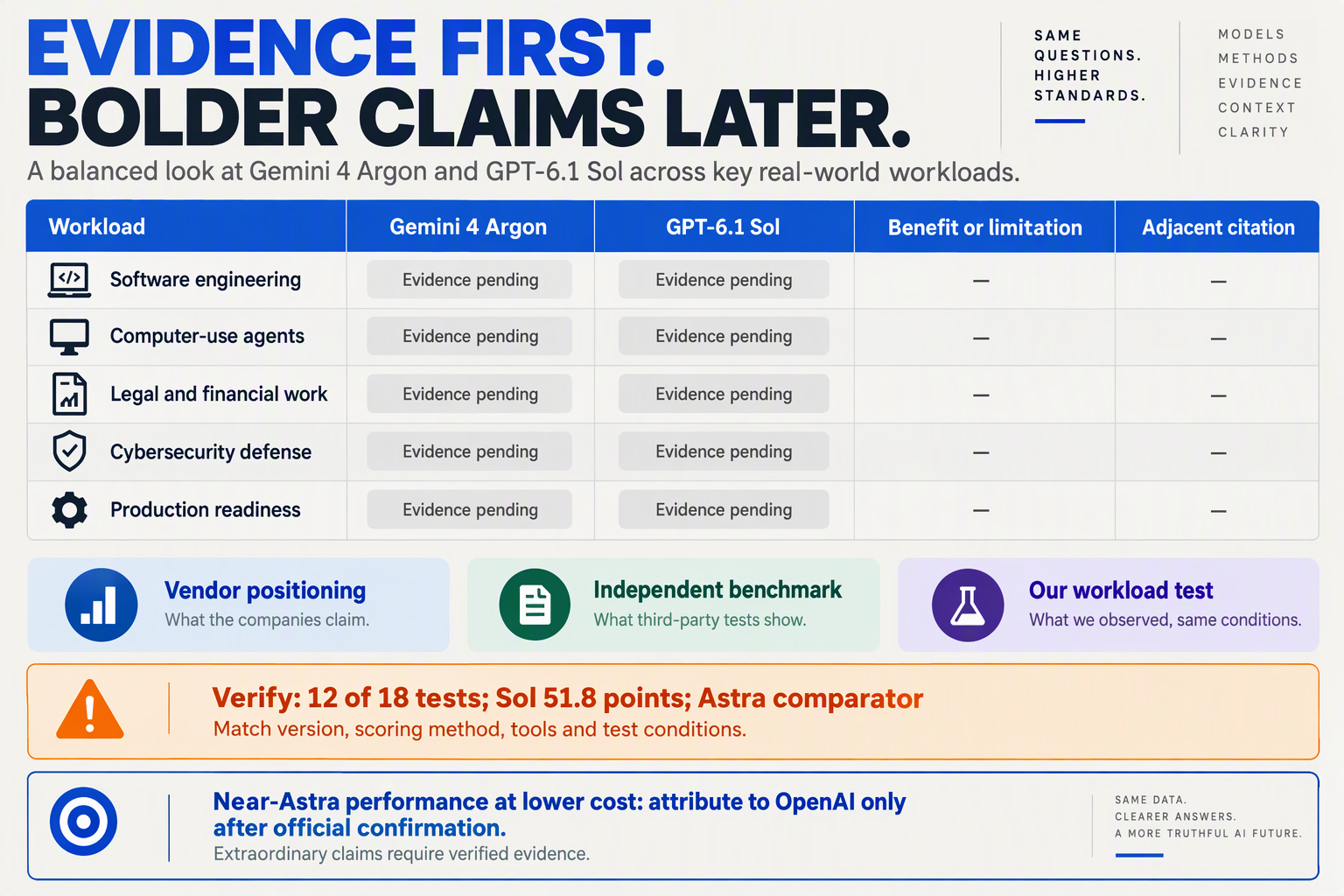
Gemini 4 Argon has reported strengths, not independently demonstrated advantages in the supplied evidence; GPT-6.1 Sol lacks supporting documentation here. As of September 30, 2026, this draft should distinguish promising positioning from verified performance and procurement-ready specifications.
- Gemini 4 Argon: VentureBeat’s September 30, 2026 report describes claimed benchmark leadership, but the supplied excerpt provides no scores, evaluation settings, or reproducible results.
- GPT-6.1 Sol: The supplied September 30, 2026 research contains no official model announcement, API identifier, benchmark results, or pricing for this name.
- Coding: Unite.AI’s September 30, 2026 report identifies real-world software engineering as an Argon focus; that supports relevance, not a measured advantage on repository tasks.
- Computer-use agents: Neither model has documented interface-navigation success rates, permission controls, or recovery results in the supplied September 30, 2026 context.
- Professional work: Unite.AI names legal and finance applications on September 30, 2026, but provides no task-level accuracy, citation-quality, or confidentiality evaluation in the excerpt.
- Counterevidence: The Next Web’s September 30, 2026 excerpt says some Google staff doubt Argon’s real-work performance, attributing that reporting to Bloomberg; the underlying evidence needs review.
Which reported strengths and limitations are supported?
| Dimension | Gemini 4 Argon: potential pro | Limitation or missing evidence | GPT-6.1 Sol |
|---|---|---|---|
| Coding | Software-engineering focus reported by Unite.AI, September 30, 2026 | No supplied patch-success scores, test conditions, or independent replication | No supporting coding results supplied |
| Benchmark performance | Leadership claims reported by VentureBeat, September 30, 2026 | No numerical table or identified comparison configuration in the excerpt | No verified benchmark entry supplied |
| Computer use | Long-running coding claims mentioned by RuntimeWire, September 30, 2026 | Coding endurance does not establish reliable graphical-interface operation | No computer-use evaluation supplied |
| Professional work | Legal and finance positioning reported by Unite.AI, September 30, 2026 | No supplied evidence for source fidelity, error severity, or expert acceptance | No professional-work evaluation supplied |
| Access | Selected cyber-defender access reported by RuntimeWire, September 30, 2026 | Restricted rollout prevents assuming general developer availability | Availability cannot be established here |
| Cost and deployment | No verified advantage established as of September 30, 2026 | Official prices, model IDs, quotas, and deployment terms remain unverified | The same procurement essentials are undocumented |
What would turn these claims into a defensible recommendation?
The practical distinction is unverified versus disproven: missing evidence does not establish that either model performs poorly. It means this comparison cannot yet support a purchasing decision or a declared winner.
For manual review, require an official model page and reproducible evaluation configuration, then test both models against the same repository, interface workflow, and source-grounded professional assignment. Record completed tasks, consequential errors, human interventions, elapsed time, and total billed cost.
A coding model that produces a passing patch but changes unrelated files presents a different trade-off from one that requests clarification. Likewise, an agent that completes a financial workflow without approval may be less suitable than a slower agent that respects authorization boundaries. These are proposed evaluation criteria—not results for either model.
How should engineers test both models before choosing a winner?
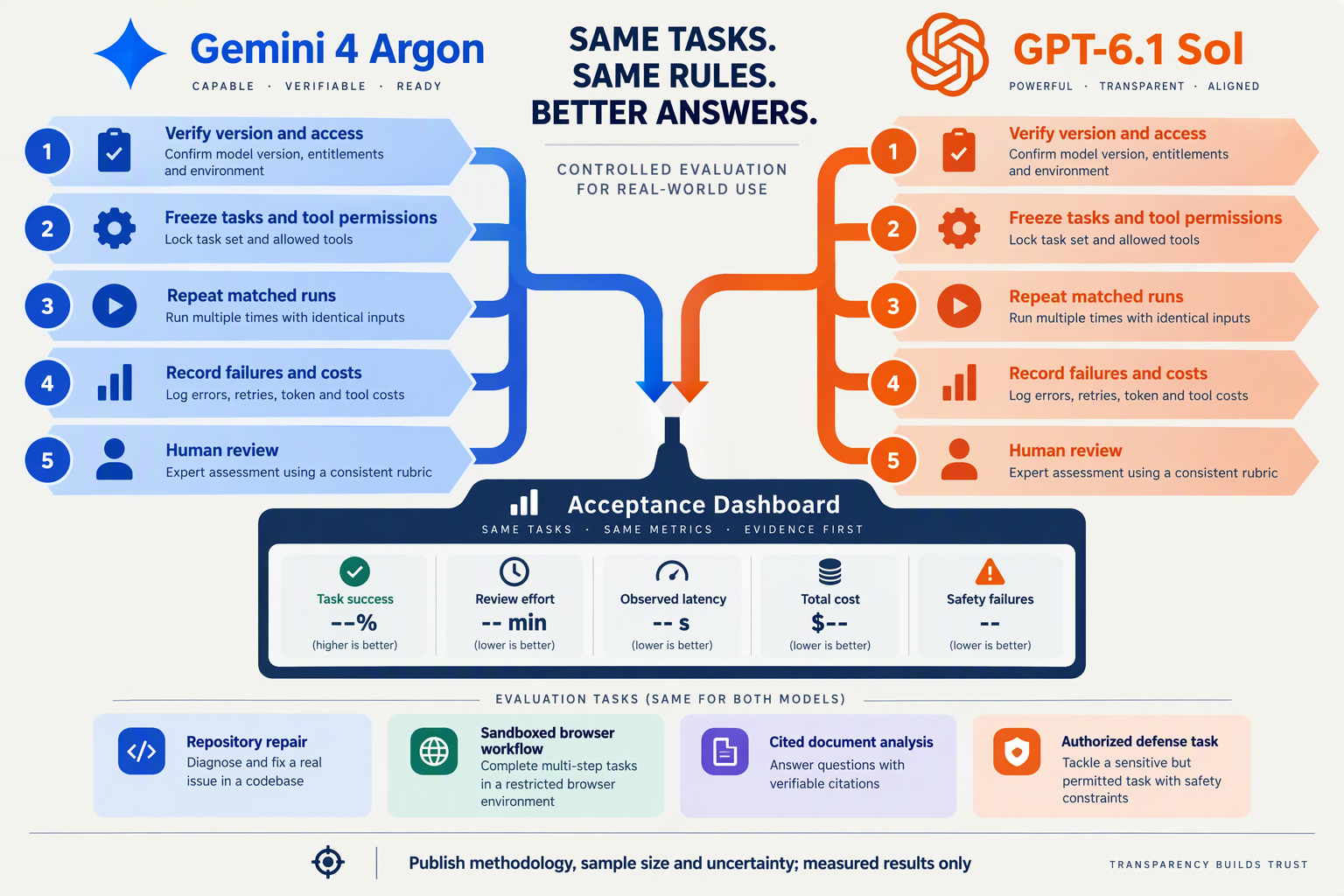
Engineers should run a matched, permission-controlled evaluation before choosing either model, and withhold a winner until both model identities and access are verified. The following numbers are proposed test settings, not published Gemini 4 Argon or GPT-6.1 Sol results.
What must engineers verify before testing?
- Model identity: Record the official model page, exact API identifier, version, access tier, and evaluation date for each candidate. VentureBeat’s September 30, 2026 report describes Gemini 4 Argon as a limited release; the supplied evidence does not establish GPT-6.1 Sol’s identity. Missing documentation means “not evaluable,” not “loser.”
- Access conditions: Confirm that the tested endpoint is actually available to your organization, with documented tool support and usage restrictions. RuntimeWire reported on September 30, 2026 that selected cyber defenders receive Argon before broader access. Do not substitute a different Gemini or OpenAI model and retain the original comparison label.
Which tasks should the comparison include?
- Coding: Select 30 private repository tasks across Python, TypeScript, and your main production language: 10 bug fixes, 10 feature changes, and 10 refactors. Give both candidates identical repository snapshots, instructions, and test commands. Score hidden-test passes, regression failures, unnecessary edits, and reviewer acceptance—not merely plausible-looking patches or successful compilation.
- Computer-use agents: Run 20 sandboxed workflows, including spreadsheet updates, browser research, and ticket handling. Keep accounts, screenshots, permissions, and tools identical. Add expired sessions, ambiguous buttons, and unavailable pages. Measure verified completion, recovery attempts, and human interventions; treat unauthorized sending, deletion, or purchasing as a separate safety failure.
- Professional work: Use 20 evidence-grounded assignments covering financial reconciliation, contract review, and research synthesis. Unite.AI’s September 30, 2026 report identifies legal and finance work among Argon’s intended applications, not independently proven strengths. Have domain reviewers check arithmetic, source traceability, omitted caveats, and whether the model distinguishes documented facts from assumptions.
How should engineers score a defensible winner?
- Repeatability: Run every task 3 times per model, producing 210 attempts per candidate across the proposed 70-task suite. Match tool-call ceilings, timeouts, and available context; record reasoning settings rather than assuming equivalence. Randomize execution order, blind reviewers to model names, and report task-level variation alongside aggregate success rates.
- Operational cost: Calculate total billed evaluation spend divided by accepted completions, including retries and any separately billed tools. Record median and 95th-percentile completion time, plus reviewer minutes. As of September 2026, CallMissed’s developer API provides usage and request logs; those capabilities support evaluation bookkeeping but do not establish availability of either candidate.
- Decision gates: Agree on acceptance thresholds before seeing results—for example, zero unauthorized consequential actions and a defined minimum reviewer-acceptance rate. Publish coding, computer-use, and professional-work scores separately. Keep this September 30, 2026 draft under manual review until official documentation, reproducible outputs, and dated pricing support any recommendation.
Which should you choose for coding, agents or professional work?
Choose neither model for production solely on the supplied evidence: Gemini 4 Argon merits conditional evaluation, while GPT-6.1 Sol remains unverified as of September 30, 2026. Match the evaluation to your workflow, and keep this comparison held for manual review.
Which model should you evaluate for coding and computer-use agents?
- Gemini 4 Argon: Consider a coding pilot only after confirming authorized access and official documentation. VentureBeat’s September 30, 2026 report describes a limited release and claimed benchmark leadership, but the supplied excerpt provides no numerical scores; neither a performance margin nor a coding victory can therefore be calculated from this evidence.
- GPT-6.1 Sol: Defer model-specific procurement until reviewers obtain an official OpenAI model page, API identifier, access terms, and pricing. None appears in the supplied September 30, 2026 context. Do not substitute results from another OpenAI model: similar branding would not establish identical coding performance, tool support, or deployment conditions.
- Coding teams: Use an illustrative 10-task repository pilot, not a leaderboard position, as your selection gate: four bug fixes, three feature changes, and three refactors. Keep repositories, tool permissions, and acceptance tests identical; record successful patches, regressions, reviewer corrections, and total spending. This is a proposed evaluation design, not a published benchmark.
- Computer-use teams: Require a separate sandbox trial covering navigation, form entry, error recovery, and an approval-gated action. RuntimeWire’s September 30, 2026 report concerns selected cyber-defender access to Gemini 4 Argon; that access arrangement does not establish general desktop automation availability. Reject any trial configuration that permits purchases or external messages without explicit authorization.
Which model should you choose for professional work?
- Legal and finance teams: Treat Gemini 4 Argon’s positioning as a reason to investigate, not evidence of professional accuracy. Unite.AI’s September 30, 2026 report names legal and finance work among its targets. Test document-grounded answers against known references, requiring citations, reproducible calculations, and clear separation between supplied evidence and the model’s assumptions.
- Security-sensitive organizations: Resolve data handling before capability scoring: retention, processing location, access controls, and contractual permissions must be documented for the actual deployment. The supplied September 30, 2026 excerpts do not establish these terms for either model. A promising evaluation should not override an unresolved requirement for handling confidential client or business information.
- Developer teams: Separate integration convenience from model eligibility. As of September 2026, CallMissed’s OpenAI-compatible developer API supports structured outputs and function calling, useful capabilities for standardized evaluation harnesses. However, the verified CallMissed fact sheet does not name Gemini 4 Argon or GPT-6.1 Sol; do not assume either is available through its catalogue.
- Procurement reviewers: Use three decision gates: verified identity, authorized access, and workload-specific acceptance. Advance Gemini 4 Argon only when those gates are satisfied; keep GPT-6.1 Sol pending identity verification. Until official prices and measured task outcomes are available, describe the recommendation as conditional—not a cost-performance ranking or a confirmed winner.
Frequently Asked Questions
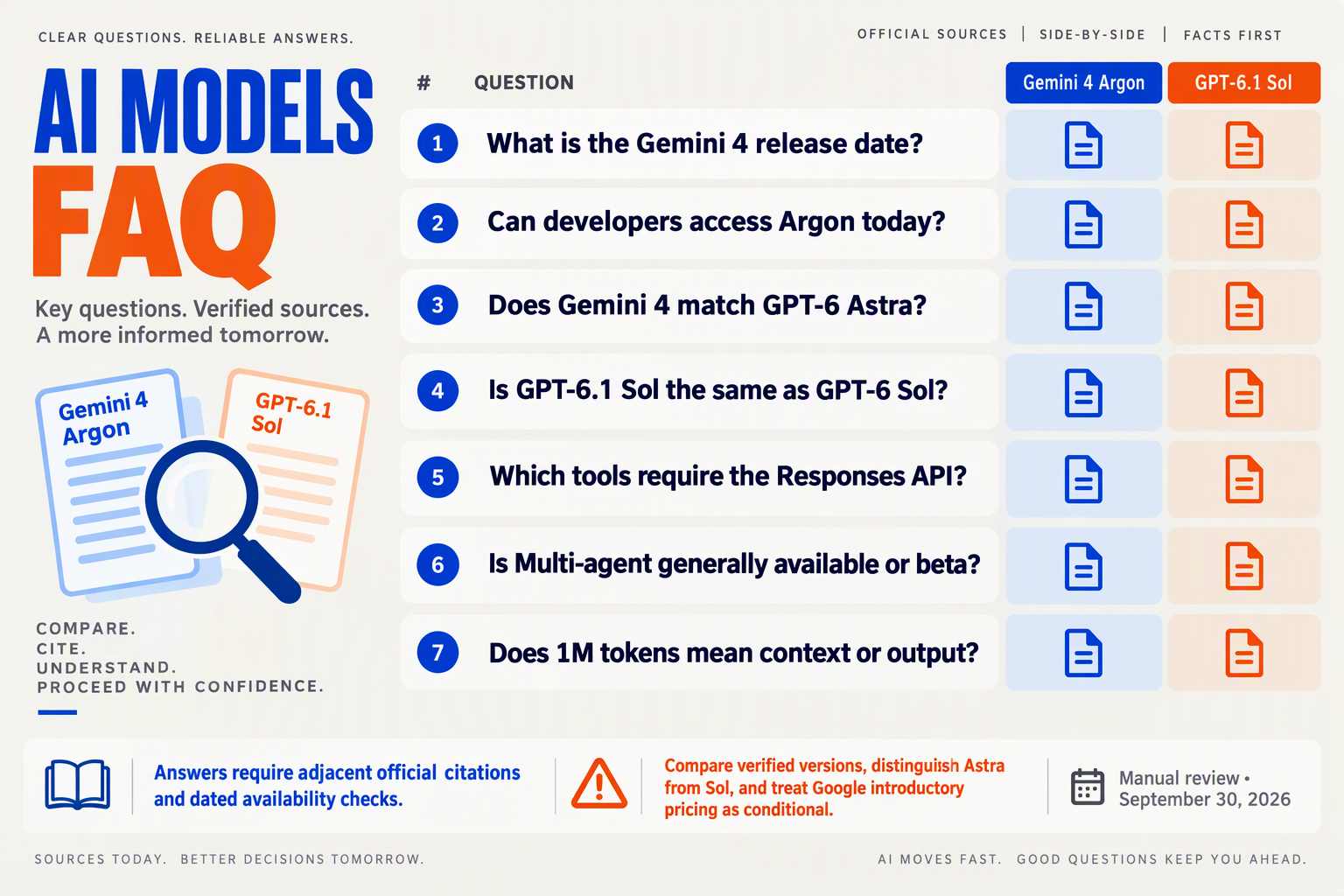
- Q: What are the release dates for Gemini 4 Argon vs GPT-6.1 Sol?
A: VentureBeat’s September 30, 2026 report dates Google’s Gemini 4 Argon announcement to that day and describes a “limited release,” not general availability. RuntimeWire’s September 30 reporting says selected cyber defenders receive access before developers, enterprises and consumers, but the supplied excerpts establish no public-release timetable. GPT-6.1 Sol’s announcement date and model identity remain unverified in the supplied material; this comparison therefore stays on hold for manual review.
- Q: Is Gemini 4 Argon competitive with OpenAI’s Astra?
A: Business Insider Africa’s September 30, 2026 report attributes to Google the claim that Gemini 4 Argon is competitive with OpenAI’s Astra in cybersecurity. That narrowly scoped statement does not establish equivalence across coding, computer-use agents or professional work, and the supplied context provides no official Astra documentation or reproducible comparison results. Reviewers should verify Astra’s exact identity and benchmark conditions rather than treating Astra as another name for GPT-6.1 Sol.
- Q: How can developers get API access to Gemini 4 Argon vs GPT-6.1 Sol?
A: As of September 30, 2026, the supplied context confirms neither a public Gemini 4 Argon API model ID nor a documented GPT-6.1 Sol endpoint. RuntimeWire reports restricted initial Argon access, so developers should await official eligibility requirements, authentication instructions and supported interfaces before planning production integrations. For broader model evaluation, CallMissed’s verified September 2026 developer offering provides 139 models through one API key and balance, but the fact sheet does not establish availability of either comparison model.
- Q: What do Gemini 4 Argon and GPT-6.1 Sol cost?
A: Neither model has verified API pricing in the supplied context as of September 30, 2026, so this draft cannot responsibly quote input-token, output-token or subscription prices. A usable cost comparison needs official billing terms covering cached inputs, generated outputs, tool charges and any separately billed execution environment—not a projected price borrowed from another model. For coding agents, reviewers should also record total expenditure per accepted patch, including failed attempts, rather than comparing advertised token rates alone.
- Q: What are the context windows and token limits for these models?
A: As of September 30, 2026, the supplied reporting establishes no verified context-window size, maximum output length or API rate limit for either model. These are separate constraints: a large input allowance does not guarantee equally long responses, unrestricted request throughput or reliable retrieval throughout a repository. Manual reviewers should obtain official specifications and test realistic codebase inputs before publishing token figures or claiming that either model can process an entire project.
- Q: Which wins Gemini 4 Argon vs GPT-6.1 Sol for coding and professional work?
A: No defensible winner can be named from the supplied evidence as of September 30, 2026 because GPT-6.1 Sol lacks supporting documentation and Argon’s reported benchmark leadership lacks reproducible tables here. Unite.AI’s September 30 report identifies software engineering, legal and finance work, and cybersecurity defense as Google’s intended Argon applications, not independently demonstrated superiority. A publishable verdict requires matched tasks, documented model versions, permission controls, human-review results and cost measurements under comparable operating conditions.
Conclusion
Gemini 4 Argon vs GPT-6.1 Sol has no defensible winner as of September 30, 2026. This draft should remain held for manual review until official documentation, model identities, access conditions, and reproducible results establish what teams can actually deploy.
Four takeaways should guide the eventual comparison:
- Reported benchmark leadership is not verified production readiness. VentureBeat’s September 30, 2026 report describes Google’s claimed benchmark leadership for Gemini 4 Argon alongside a limited release. Without official launch documentation and a reproducible benchmark table in the supplied evidence, those claims remain reporting to investigate—not grounds for recommending a migration. A strong headline cannot answer whether a model will handle your repository reliably.
- Availability belongs in the evaluation, not the footnotes. RuntimeWire’s September 30, 2026 report describes access for selected cyber defenders before broader availability. For developers and enterprises, practical adoption therefore depends on documented access restrictions, API availability, prices, and usage limits. A model that cannot yet enter your workflow cannot be evaluated on equal deployment terms with one that can.
- Coding and computer-use agents need outcome-based testing. Passing tests is only part of a successful coding task: reviewers should also count unnecessary changes, tool failures, human interventions, and the cost of reaching a usable patch. Computer-use evaluations should similarly examine error recovery and approval boundaries. Completing a workflow does not constitute success if the agent exceeds its authorized permissions.
- Professional work requires traceability, and the comparison requires confirmed identities. Unite.AI’s September 30, 2026 report describes Gemini 4 Argon’s focus on software engineering, legal and finance work, and cybersecurity defense. Those ambitions need testing against evidence handling and sensitive-information requirements. Meanwhile, the supplied material does not establish GPT-6.1 Sol’s identity or capabilities, making any direct performance ranking premature.
What should teams watch for next?
Watch for official Google launch materials, confirmed OpenAI documentation for the named model, reproducible evaluations, and documented pricing and access. These are the developments that could turn this editorial premise into a useful buying or engineering decision. The next revision should distinguish reported claims, officially documented capabilities, and independently observed outcomes, rather than treating them as interchangeable.
Once those foundations exist, run both models through the same repository fixes, interface workflows, and professional analysis tasks. Record failures and required supervision alongside successful completions; that evidence will be more actionable than a leaderboard position alone.
To explore infrastructure for this evaluation-led approach, consider CallMissed: as of September 2026, its developer API supports caller-chosen fallback models and usage and request logs. Those capabilities are relevant to testing alternatives without committing solely on headline claims.
Before choosing either model, what evidence would convince your team to trust it with real work?
Related Reading
- Claude Sonnet 5.5 vs GPT-6 Sol Coding Comparison 2026
- Claude Fable 5.1 vs GPT-5.6 Sol: Pricing, Coding & Voice Agents
- Best LLM for Voice Agents in 2026: GPT-6 vs Claude
Sources
Discussion
Related Posts


Ready to automate customer conversations?
Launch AI voice agents and WhatsApp bots with CallMissed — one API, 22+ Indian languages.