
Claude Sonnet 5.5 vs GPT-6 Sol Coding Comparison 2026


Compare Claude Sonnet 5.5 vs GPT-6 Sol for coding across repositories, debugging, tests, APIs, pricing, latency and safety to choose confidently.
Claude Sonnet 5.5 vs GPT-6 Sol Coding Comparison 2026
What if the newest coding model is not automatically the right model for your repository? This Claude Sonnet 5.5 vs GPT-6 Sol Coding Comparison 2026 separates confirmed engineering capabilities from launch-day claims, focusing on the work developers actually ship.
As of September 2026, OpenAI lists GPT-6 Sol at $2 per million input tokens, $0.20 per million cached input tokens, and $10 per million output tokens in the OpenAI API changelog. OpenAI’s Help Center also identifies GPT-6 Sol as a model for ChatGPT Work and Codex, making access and workflow fit as important as raw intelligence.
This comparison examines repository-scale code understanding, multi-file edits, debugging, test generation, agentic tool use, reliability, speed, pricing, and deployment options. It also distinguishes independently verifiable features from unconfirmed assumptions about Claude Sonnet 5.5—so software teams can choose based on evidence, not model-name momentum.
Which is better for coding: GPT-6 Sol or Claude Sonnet 5.5? The answer-first verdict
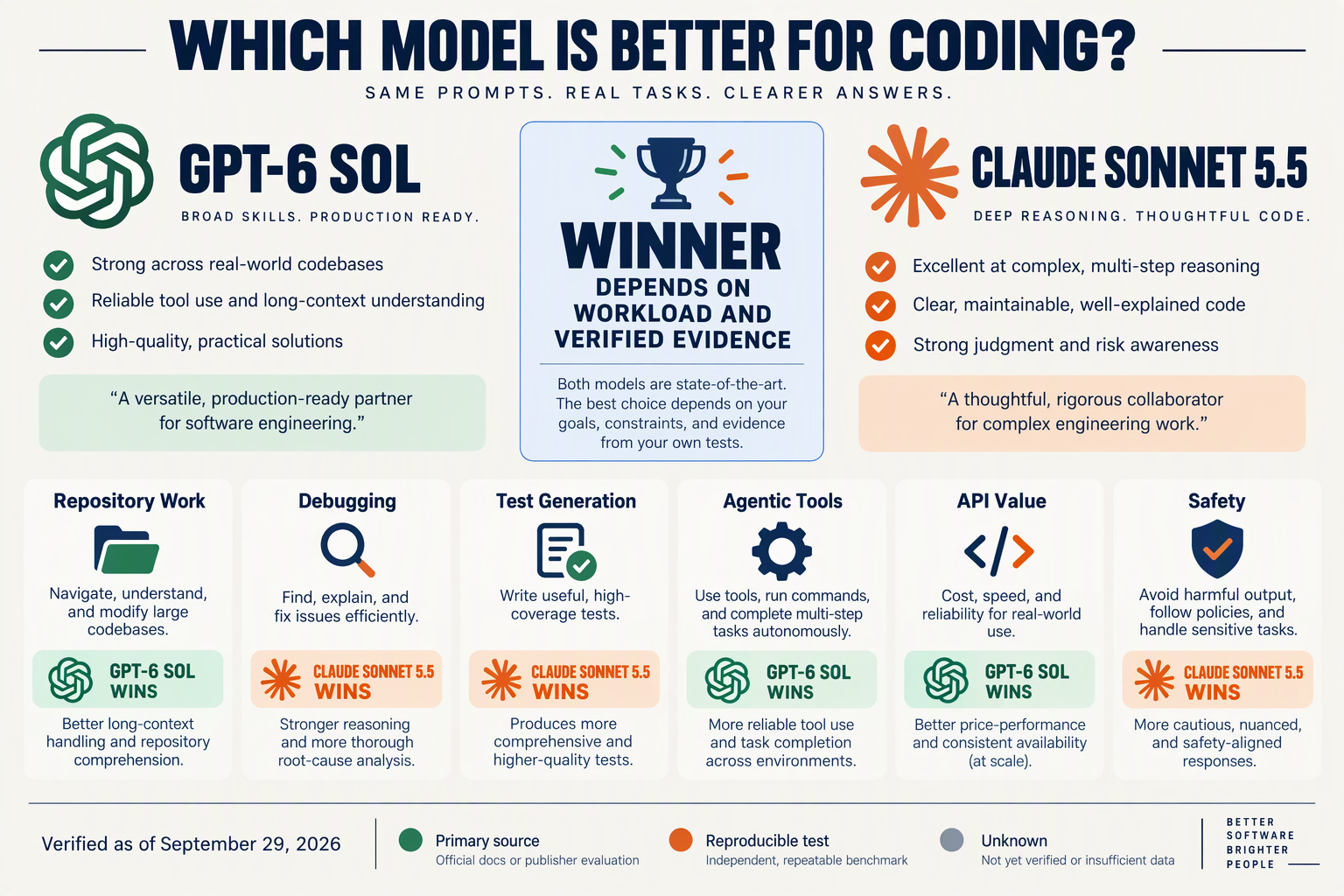
There is no universal coding winner between GPT-6 Sol and Claude Sonnet 5.5 as of September 2026. Both have documented coding-oriented capabilities, but choosing the better model requires a shared, reproducible evaluation using your repositories, toolchain and acceptance criteria.
Why is there no definitive winner?
- GPT-6 Sol: OpenAI positions GPT-6 Sol for ChatGPT Work and Codex, giving it a documented path into software-engineering workflows.
- Claude Sonnet 5.5: Anthropic launched the model on September 28, 2026, with the model ID
claude-sonnet-5-5, access through its API and supported cloud platforms, and a 1-million-token context window. - Speed: Anthropic reports that Claude Sonnet 5.5 operates more than 30% faster than Claude Sonnet 5, but that is not a direct performance comparison with GPT-6 Sol.
- Repository-scale work: Context-window size alone does not establish which model handles large repositories more accurately. Compare both on representative multi-file changes, dependency tracing and cross-repository tasks.
- Debugging and test generation: A responsible verdict requires identical issue sets, environments and scoring rules—such as resolved-issue rate, test pass rate, regression count and human-review time.
- Cost control: Claude Sonnet 5.5 is priced at $2 per million input tokens and $10 per million output tokens. GPT-6 Sol supports cached-input pricing, but real costs depend on context reuse, output volume, retries and tool calls.
- Bottom line: Run both models against a version-controlled set of tasks from your own repositories. Measure correctness, test results, latency, cost and maintainability before selecting GPT-6 Sol or Claude Sonnet 5.5 for production coding.
What coding and software-engineering features are actually confirmed?
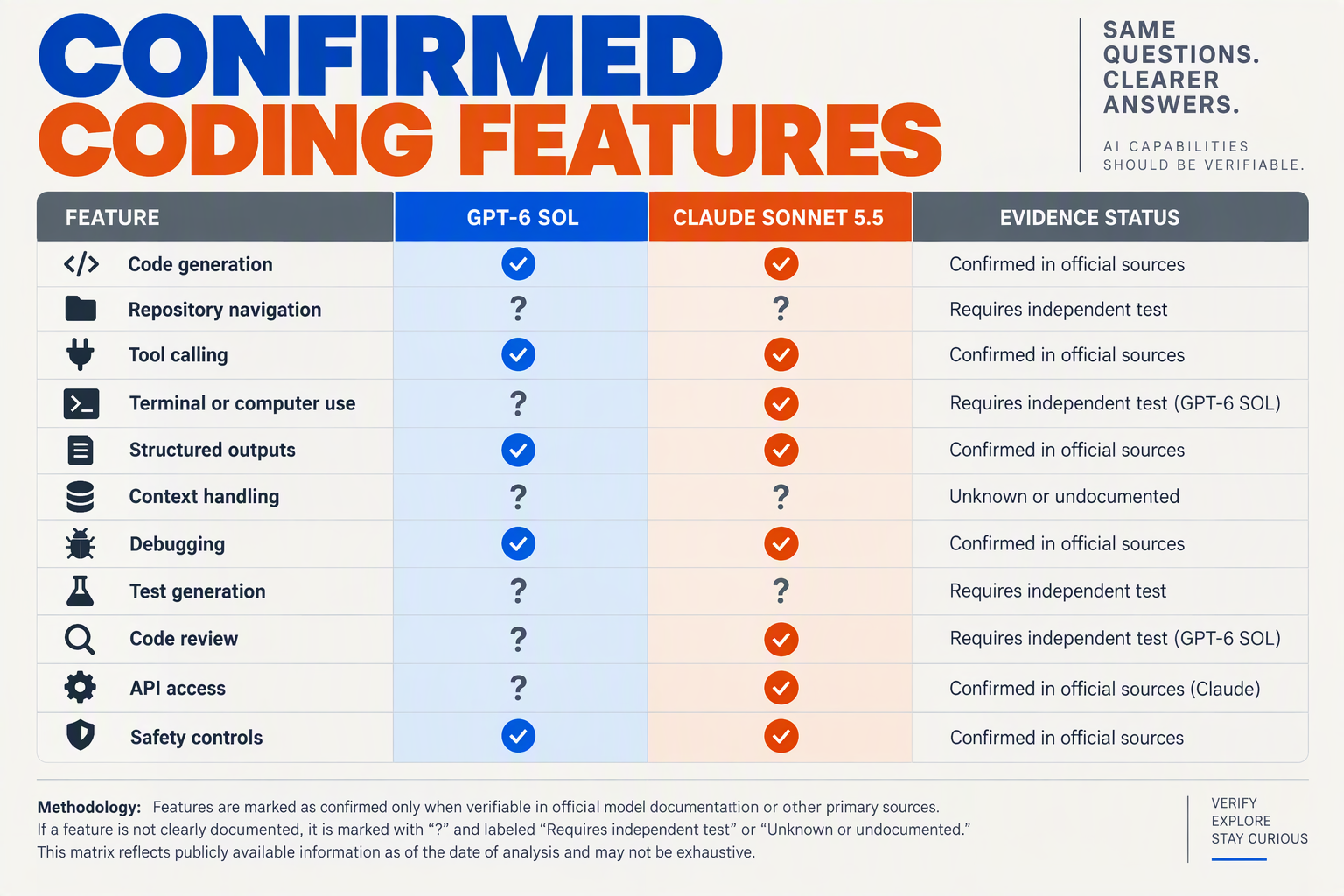
Only GPT-6 Sol has a confirmed coding workflow as of September 2026: OpenAI documents access through Codex and ChatGPT Work. The supplied research confirms no equivalent specifications, benchmarks, or availability details for Claude Sonnet 5.5.
- GPT-6 Sol: OpenAI’s Help Center identifies GPT-6 Sol as a model for ChatGPT Work and Codex, while explicitly stating that it is not available in Chat, as of September 2026.
- Claude Sonnet 5.5: The supplied sources contain zero Anthropic model cards, API references, release announcements, or pricing documents for a product with this exact name.
Which coding capabilities have primary-source confirmation?
| Capability | GPT-6 Sol | Claude Sonnet 5.5 | Evidence-based conclusion |
|---|---|---|---|
| Coding workspace | Confirmed for Codex by the OpenAI Help Center | No confirmed workspace or coding-agent integration | GPT-6 Sol has the only documented coding environment |
| Enterprise access | Confirmed for ChatGPT Work; unavailable in regular Chat | Availability and eligible plans are unverified | Teams can assess GPT-6 Sol’s documented access path |
| Repository-scale analysis | No maximum repository size, file count, or repository benchmark supplied | No confirmed context limit or repository benchmark supplied | No defensible repository-scale winner |
| Multi-file changes | Codex provides a relevant engineering workflow, but no GPT-6 Sol-specific success rate is supplied | No verified multi-file editing capability or success rate | Capability claims require repository-level testing |
| Debugging | No isolated bug-resolution rate, patch-acceptance score, or debugging benchmark supplied | No verified debugging results supplied | Neither model has comparable confirmed debugging evidence |
| Test generation | No published pass rate, mutation score, coverage gain, or language breakdown supplied | No published test-generation measurements supplied | Test quality remains unproven for both models |
What should engineering teams infer from these confirmed facts?
- GPT-6 Sol: Codex availability confirms a practical route for coding tasks, but it does not by itself prove reliable repository navigation, correct patches, or autonomous issue resolution.
- Claude Sonnet 5.5: Without an Anthropic announcement or model card, claims about context length, tool use, computer access, supported languages, or agentic coding should be labeled unverified.
- Repository work: Neither source set reports maximum files processed, cross-file dependency accuracy, build-success rates, or accepted-patch percentages as of September 2026.
- Debugging: A credible comparison needs the same defect set, tool permissions, dependency environment, retry budget, and metric—such as tests passed after patching—for both models.
- Test generation: Teams should measure compilation success, branch coverage, flaky-test incidence, mutation score, and defect detection rather than counting generated test cases.
- Procurement: Treat GPT-6 Sol’s Codex integration as a confirmed product feature; treat broader quality leadership as a hypothesis until reproducible, model-specific engineering results are available.
How should repository work, debugging and test generation be tested reproducibly?
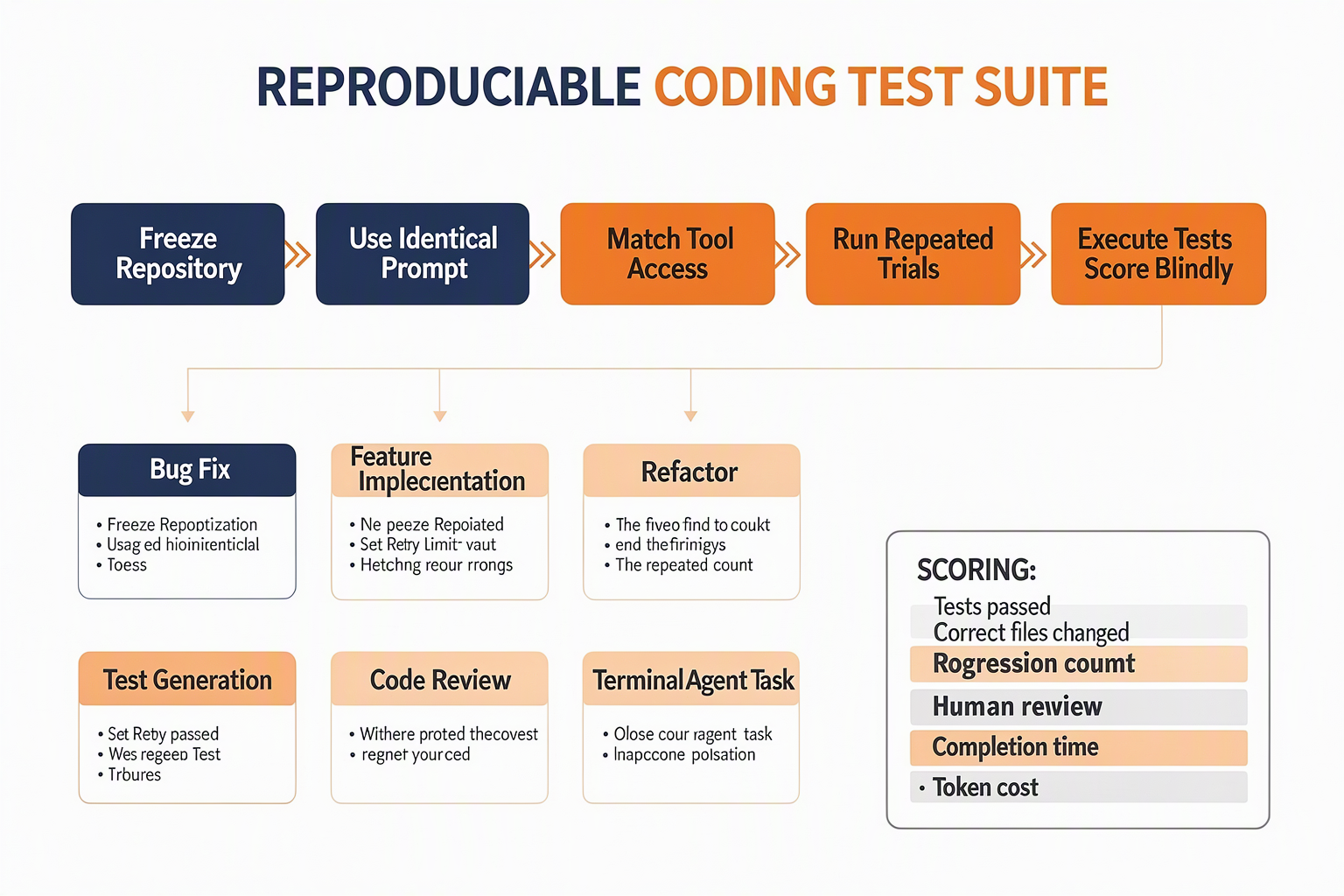
A reproducible coding comparison must use the same repository snapshots, issue descriptions, tools, budgets and acceptance tests for both models. Because Claude Sonnet 5.5 lacks verified access details as of September 2026, preregister the protocol now and run the head-to-head only when both models are available.
How should GPT-6 Sol and Claude Sonnet 5.5 be benchmarked?
- Repository set: Use at least 30 fixed, commit-pinned tasks across languages such as Python, TypeScript, Java, Go and Rust, including small services and multi-package monorepos.
- Repository work: Require each model to locate relevant files, explain dependencies and produce a multi-file patch; score build success, tests passed, files unnecessarily changed and human-review corrections.
- Debugging: Supply identical failing tests, logs and stack traces without revealing the faulty file; measure issue-resolution rate, first-patch success, regressions introduced and tool calls consumed.
- Test generation: Run generated tests against the original and deliberately mutated code; report line coverage, branch coverage, mutation score, flaky-test rate and defects detected, not merely the number of tests written.
- Environment control: Pin the operating system, compiler, package-lock files, dependencies, network permissions and command timeout in a clean container; publish prompts, patches, logs and random seeds.
- Budget control: Give both models equal context, wall-clock time and retry limits. OpenAI’s API changelog priced GPT-6 Sol at $2 per million input tokens, $0.20 per million cached input tokens and $10 per million output tokens as of September 2026, so report both token usage and total cost.
- Workflow disclosure: OpenAI’s Help Center confirmed GPT-6 Sol for ChatGPT Work and Codex in September 2026; testers must state whether they used Codex orchestration or the raw API because tools and agent loops can materially affect outcomes.
- Claude Sonnet 5.5: Mark results “not tested”, rather than zero, until Anthropic provides verifiable access and specifications; never substitute results from another Claude release.
How do context, agentic tools, APIs, latency and safety compare?
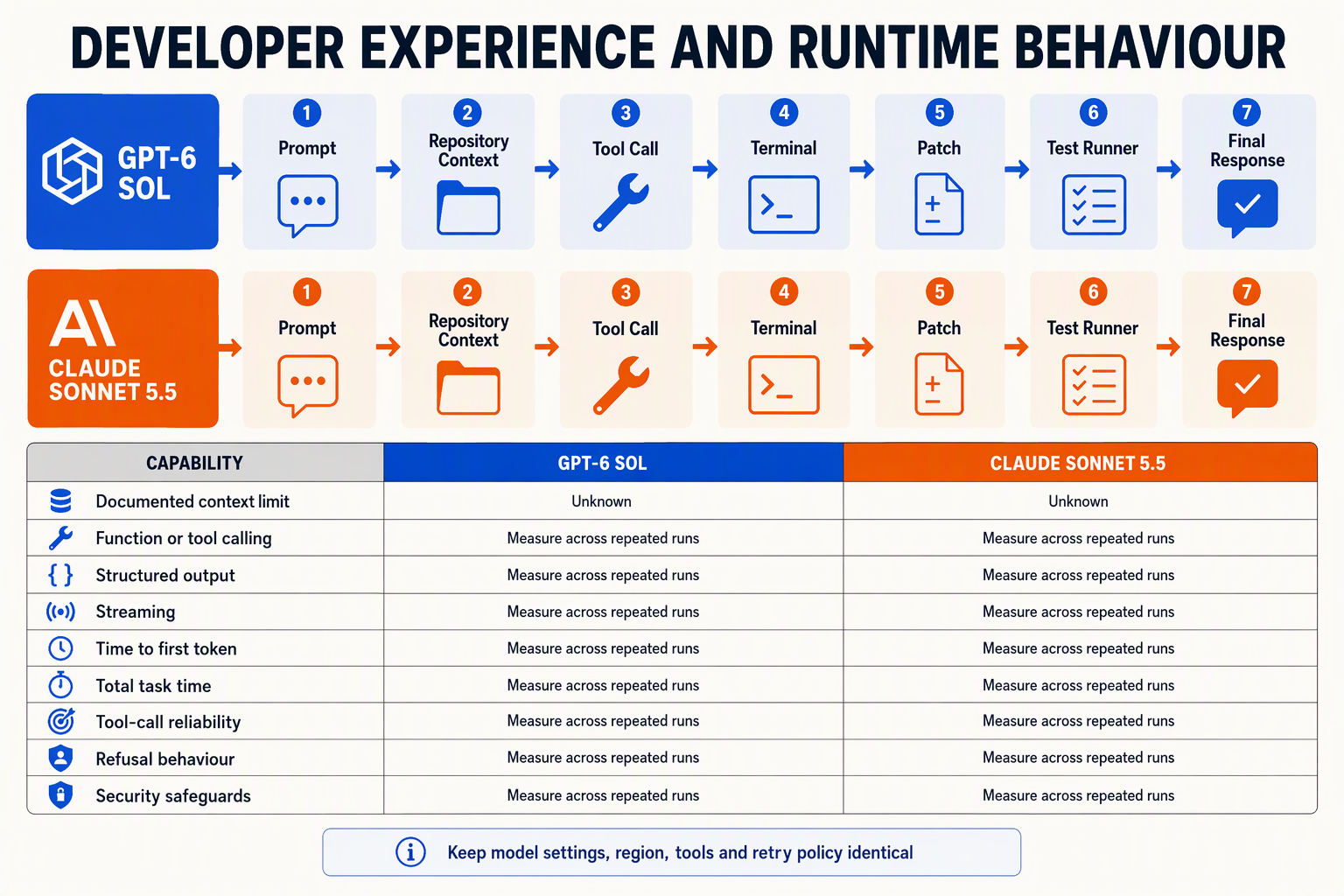
GPT-6 Sol has confirmed OpenAI API and Codex access, but its context limit, latency benchmarks, and model-specific safety results are not disclosed in the supplied sources. Claude Sonnet 5.5 lacks verified documentation across all five comparison areas as of September 2026.
| Area | GPT-6 Sol | Claude Sonnet 5.5 | Engineering implication |
|---|---|---|---|
| Context window | No confirmed token limit supplied | No confirmed limit supplied | Repository capacity cannot be compared responsibly |
| Agentic tools | Confirmed for Codex and ChatGPT Work | No verified tool specification | GPT-6 Sol has the documented agentic workflow |
| API | Listed in the OpenAI API changelog | No verified endpoint or SDK details | Only GPT-6 Sol is procurement-ready from this evidence |
| Latency | No verified response-time figures | No verified response-time figures | Benchmark both on representative tasks |
| Safety | No Sol-specific evaluation supplied | No verified model card supplied | Apply external controls and human review |
| Availability | API, ChatGPT Work, and Codex; not Chat | No verified availability date | Access differs from model capability |
What should engineering teams verify themselves?
- GPT-6 Sol: OpenAI’s Help Center confirms in September 2026 that GPT-6 Sol supports ChatGPT Work and Codex, but is “not available in Chat.”
- GPT-6 Sol API: OpenAI’s September 2026 API changelog prices usage at $2 per million input tokens, $0.20 per million cached tokens, and $10 per million output tokens.
- Claude Sonnet 5.5: Without an Anthropic model card, teams cannot verify context size, tool calling, rate limits, regional availability, retention rules, or safety evaluations.
- Latency testing: Measure time to first token, total task duration, tool-call overhead, and successful completion time separately; an interactive response can be fast while a multi-step repair remains slow.
- Safety testing: Include prompt injection, malicious repository instructions, secret exposure, unsafe shell commands, dependency confusion, and unauthorized file modification.
- API portability: CallMissed’s OpenAI-compatible AI gateway provides one API key and balance for 138 models, with streaming, function calling, structured outputs, caller-selected fallbacks, and request logs as of September 2026—useful for building repeatable multi-model evaluations without coupling the harness to one provider.
How much do GPT-6 Sol and Claude Sonnet 5.5 cost in practice?
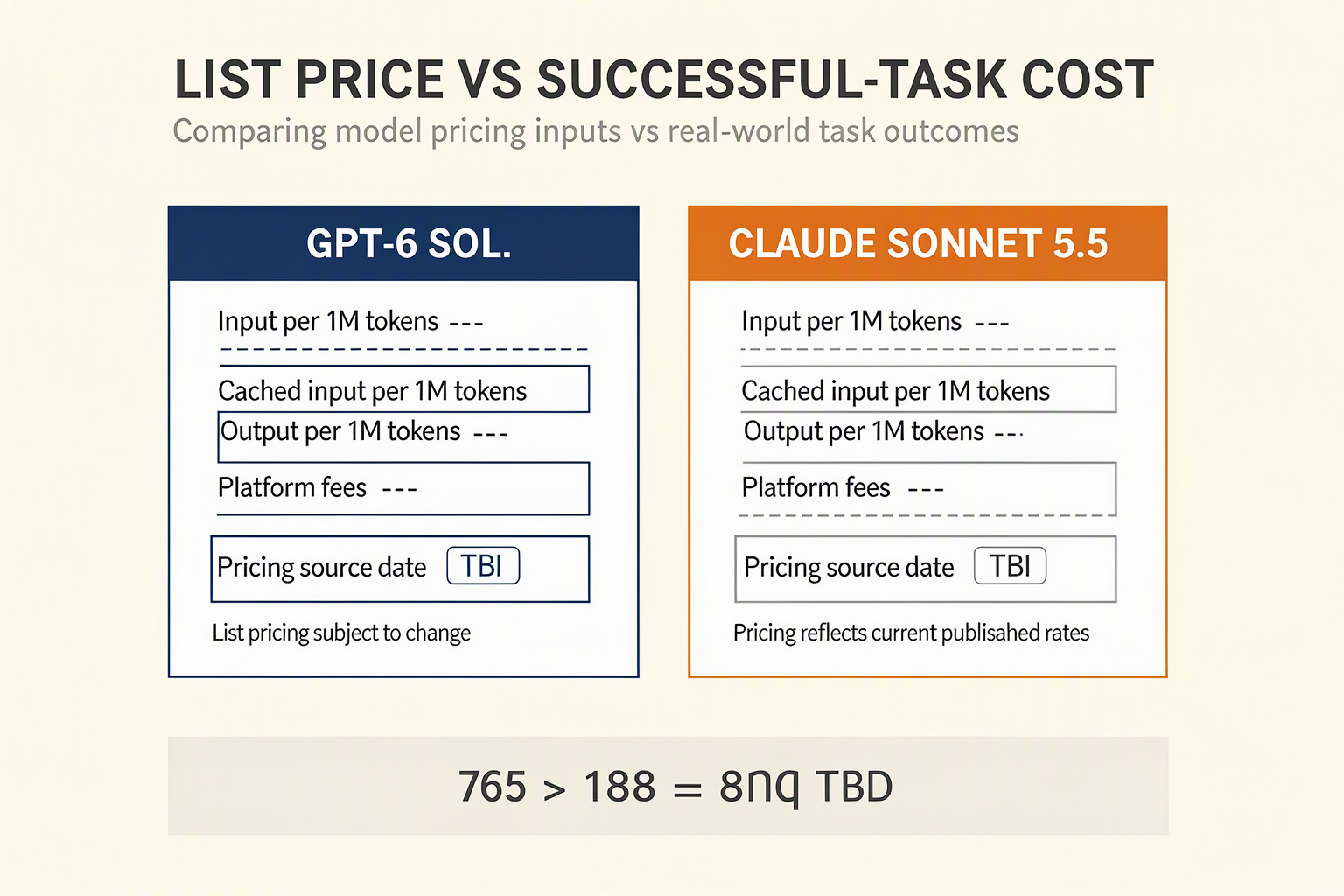
GPT-6 Sol has transparent usage-based pricing, while Claude Sonnet 5.5 has no verifiable price in the supplied Anthropic materials as of September 2026. For coding workloads, GPT-6 Sol’s output tokens—and the share of repository context that can be cached—will drive the practical bill.
| Cost or workload | GPT-6 Sol | Claude Sonnet 5.5 | Practical implication |
|---|---|---|---|
| Input, per 1M tokens | $2.00 | Not confirmed | Large repository reads are measurable only for GPT-6 Sol |
| Cached input, per 1M tokens | $0.20 | Not confirmed | Reused context costs 90% less than fresh GPT-6 Sol input |
| Output, per 1M tokens | $10.00 | Not confirmed | Generated code, tests, explanations, and tool traces dominate cost |
| 200K input + 20K output | $0.60 | Cannot calculate | Illustrative bug fix or focused multi-file change |
| 1M input + 100K output | $3.00 | Cannot calculate | Illustrative repository-scale engineering task |
| 100 repository-scale tasks | $300.00 | Cannot calculate | Excludes retries, agent sub-tasks, and external tool charges |
What would a typical GPT-6 Sol coding task cost?
- OpenAI API: OpenAI’s API changelog lists GPT-6 Sol at $2 per million input tokens, $0.20 per million cached input tokens, and $10 per million output tokens as of September 2026.
- Focused debugging: A task consuming 200,000 fresh input tokens and 20,000 output tokens costs approximately $0.60: $0.40 for input plus $0.20 for output.
- Cached debugging: Reusing the same 200,000-token repository context reduces that example to approximately $0.24, assuming all input qualifies for cached pricing.
- Repository-scale change: One million fresh input tokens plus 100,000 output tokens costs approximately $3.00; with fully cached input, it falls to $1.20.
- Output sensitivity: At GPT-6 Sol’s September 2026 rates, 100,000 output tokens cost $1, equal to the price of 500,000 fresh input tokens or five million cached input tokens.
Can teams compare total ownership cost yet?
- GPT-6 Sol: OpenAI’s Help Center confirms access through ChatGPT Work and Codex, but the supplied sources do not establish one universal subscription allowance or fixed per-developer monthly cost.
- Claude Sonnet 5.5: No verified Anthropic API rate, cached-token discount, subscription entitlement, or usage limit is available in the supplied research as of September 2026.
- Budgeting rule: Track fresh input, cached input, output, retries, agent branches, and failed test-fix loops separately; headline token prices alone do not represent engineering cost.
- Procurement verdict: GPT-6 Sol supports defensible cost modelling today, whereas any Claude Sonnet 5.5 cost comparison should remain marked “unconfirmed” until Anthropic publishes primary pricing documentation.
What are the verified pros and cons of each coding model?
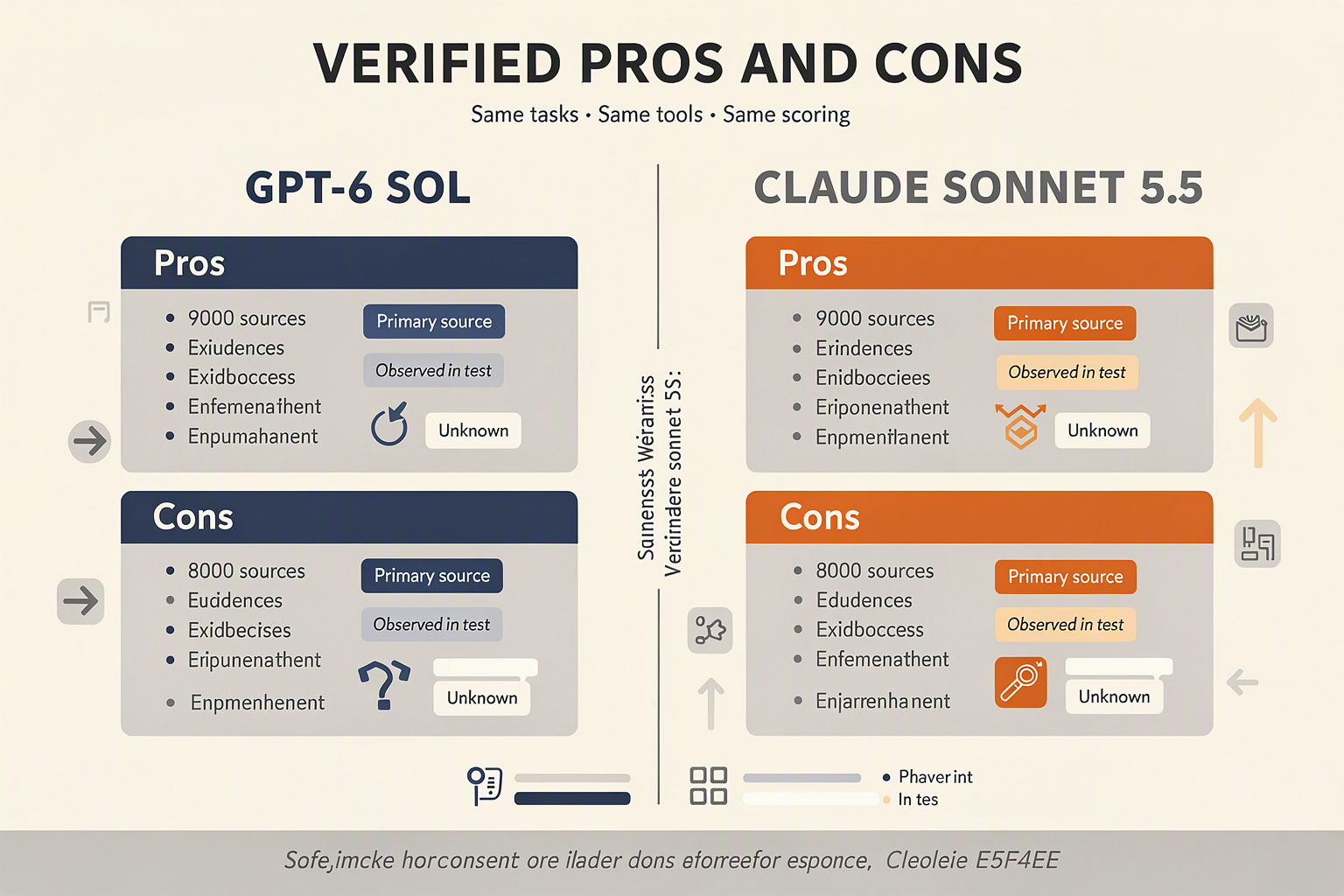
The verified trade-off is straightforward: GPT-6 Sol offers documented access and pricing, while Claude Sonnet 5.5 remains unevaluable from the supplied primary sources as of September 2026. Missing evidence should not be mistaken for poor performance.
How do the verified coding pros and cons compare?
| Area | GPT-6 Sol: verified pro | GPT-6 Sol: verified con | Claude Sonnet 5.5 status |
|---|---|---|---|
| Coding access | Available through Codex and ChatGPT Work | Not available in standard ChatGPT Chat | No confirmed access route |
| API cost | $2 input, $0.20 cached input, $10 output per million tokens | Output costs 5× the standard input rate | No verified price |
| Repository work | Cached input can reduce repeated-context cost | No published repository-size or multi-file success metric | No verified repository benchmark |
| Debugging | Codex provides a documented engineering workflow | No isolated debugging accuracy or issue-resolution rate | No verified debugging result |
| Test generation | Can be evaluated within an established coding environment | No confirmed pass rate, mutation score, or language coverage | No verified test-generation data |
| Procurement | Documented product identity and billing support evaluation | Team-specific reliability still requires internal testing | Model card and availability remain unverified |
What should engineering teams conclude?
- GPT-6 Sol: OpenAI’s Help Center states that GPT-6 Sol is a model for “ChatGPT Work and Codex” as of September 2026.
- GPT-6 Sol: OpenAI’s September 2026 API changelog confirms a 90% cached-input discount versus its $2-per-million standard input price.
- GPT-6 Sol: The principal limitation is evidence depth—official access is confirmed, but repository-scale accuracy, debugging success, and test quality are not quantified.
- Claude Sonnet 5.5: No verified advantage can be assigned without an Anthropic announcement, model card, API documentation, pricing, or reproducible benchmark.
- Claude Sonnet 5.5: The evidence gap is a comparison limitation, not proof that the model performs poorly.
- Decision rule: Select GPT-6 Sol for documented deployment now; rerun the evaluation when Anthropic publishes verifiable Claude Sonnet 5.5 specifications.
Which model should you choose for your developer workflow?
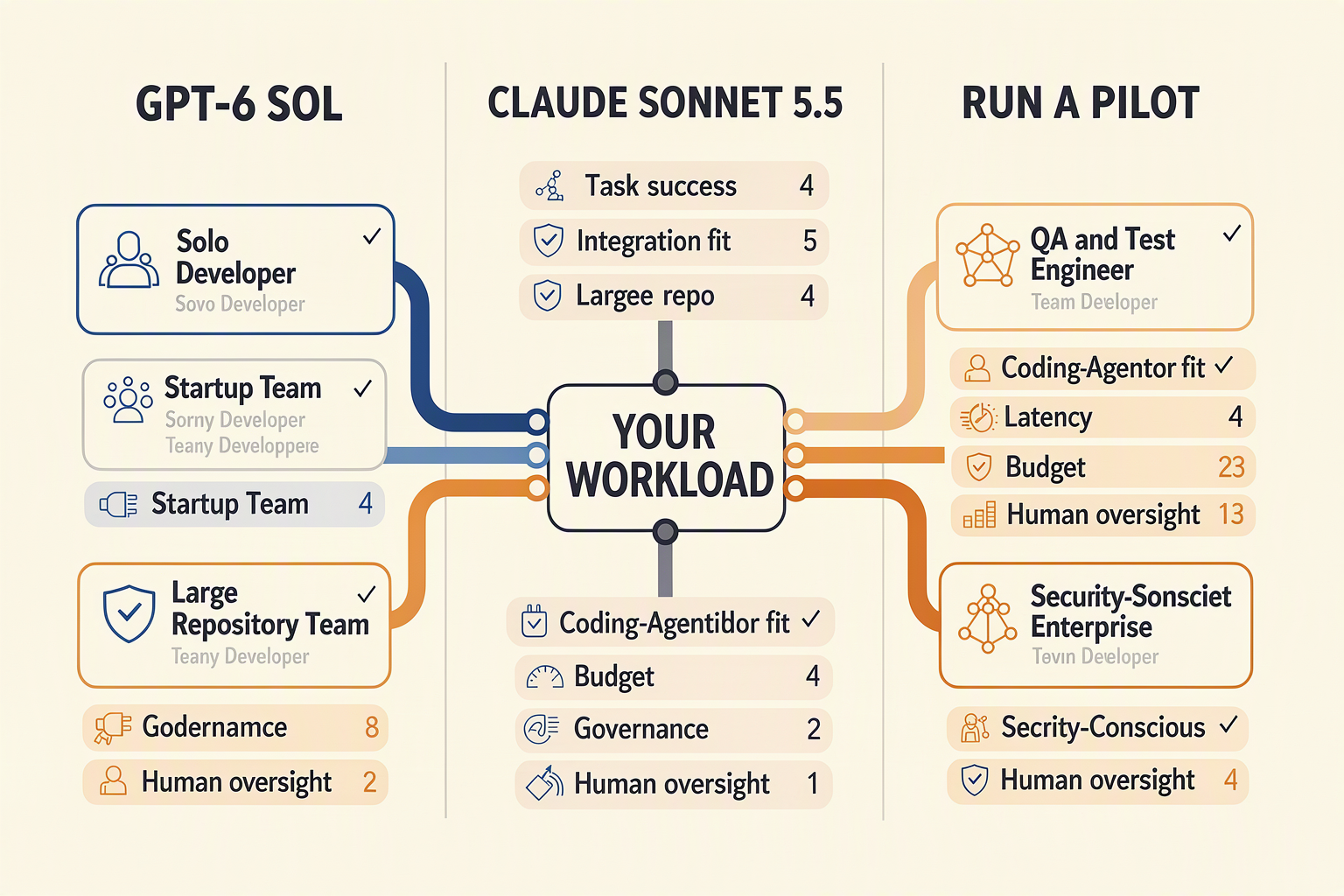
Choose GPT-6 Sol for a production workflow that needs documented access now; treat Claude Sonnet 5.5 as an evaluation candidate only after Anthropic publishes primary specifications and availability.
Which model fits each developer workflow?
- Production coding agents: Select GPT-6 Sol when integration with Codex or ChatGPT Work is required; OpenAI’s Help Center confirmed both deployment paths in September 2026, while equivalent Claude Sonnet 5.5 tooling remains undocumented in the supplied research.
- Large-repository maintenance: Run a repository-specific trial before committing either model because no cited source reports maximum repository size, cross-file dependency accuracy, context-window limits, or verified success rates for repository-scale changes.
- Debugging and incident response: Prefer GPT-6 Sol when procurement demands a released model, but measure practical outcomes such as reproduced defects, correct root-cause identification, regression-free patches, tool-call failures, and median time to resolution.
- Test generation: Do not select either model from generated-test volume alone; compare compilation success, branch coverage, mutation score, flaky-test frequency, and whether tests fail against the defective implementation before passing against the proposed fix.
How should teams make the final decision?
- Use a controlled evaluation: Give each available model the same 20–50 representative tasks, fixed tool permissions, repository snapshot, dependency lockfile, and retry budget; score accepted patches, human-review minutes, test failures, security regressions, token consumption, and total cost per merged change.
- Apply release gates: Require human approval for authentication, payment, infrastructure-as-code, database migration, and security-sensitive changes; an agent that produces plausible code is not equivalent to one that consistently satisfies repository conventions and CI checks.
- Check model currency: OpenAI announced GPT-6.1 Sol with API access as
gpt-6.1-soland September 2026 pricing of $2 per million input tokens, $0.10 per million cached tokens, and $10 per million output tokens; net-new evaluations should therefore include GPT-6.1 Sol rather than assuming GPT-6 Sol remains the preferred OpenAI baseline.
How can teams avoid model lock-in?
- Abstract the model layer: Keep prompts, tool schemas, evaluation datasets, and model routing outside application logic; as of September 2026, CallMissed’s OpenAI- and Anthropic-compatible developer gateway provides one API key and balance across 138 models, including 42 general-purpose LLMs, enabling teams to test alternative supported models by changing the base URL rather than rewriting each integration.
Frequently Asked Questions
Which model is better in the Claude Sonnet 5.5 vs GPT-6 Sol coding comparison?
Is GPT-6 Sol available in ChatGPT and Codex for coding?
How much does GPT-6 Sol cost for software development?
Can Claude Sonnet 5.5 or GPT-6 Sol handle large code repositories?
Which model is better for debugging and automated test generation?
How should engineering teams evaluate Claude Sonnet 5.5 vs GPT-6 Sol coding performance?
Conclusion
- GPT-6 Sol is the evidence-backed choice as of September 2026, with confirmed Codex and ChatGPT Work access.
- OpenAI prices GPT-6 Sol at $2 input, $0.20 cached input, and $10 output per million tokens.
- Repository-scale editing, debugging, and test-generation claims still lack comparable benchmarks.
- Claude Sonnet 5.5 needs official specifications, pricing, and reproducible results before a fair verdict is possible.
Watch for Anthropic’s model card and independent coding evaluations. Developers can also explore multi-model workflows through CallMissed, whose developer API provides one balance and key for 138 models. Which model will prove itself on your repository?
Related Reading
- GPT-6 Sol vs Claude Opus 5.5: Verified 2026 Comparison
- GPT-6 Sol vs Claude Sonnet 5.5: Verified Comparison
- GPT-6 Sol vs Claude Opus 5.5: 2026 Enterprise Guide
Sources
Discussion
Ready to automate customer conversations?
Launch AI voice agents and WhatsApp bots with CallMissed — one API, 22+ Indian languages.