
GPT-6 Sol vs Claude Opus 5.5: 2026 Enterprise Guide


Compare GPT-6 Sol vs Claude Opus 5.5 on reasoning, context, coding, agents, safety, latency, API pricing, and enterprise fit.
GPT-6 Sol vs Claude Opus 5.5: 2026 Enterprise Guide
A frontier model can become outdated before an enterprise finishes approving it. This GPT-6 Sol vs Claude Opus 5.5 comparison examines which model better fits complex reasoning, deep research, coding, and autonomous enterprise agents as of September 2026—without treating vendor claims as settled evidence. OpenAI describes GPT-6 Sol as built for “complex coding and agentic workflows,” but practical selection also depends on long-context accuracy, tool-call reliability, multimodal input, safety controls, latency, API access, and total cost.
This guide separates confirmed capabilities from unverified claims, highlights where comparable benchmarks are unavailable, and provides a feature table, workload decision matrix, deployment considerations, and FAQs. The stakes extend beyond one model choice: CallMissed, an OpenAI-compatible AI gateway, provides access to 138 models through one API key and balance as of September 2026, reflecting the enterprise shift toward flexible, multi-model architectures.
Which model wins? Neither universally—choose by verified workload results
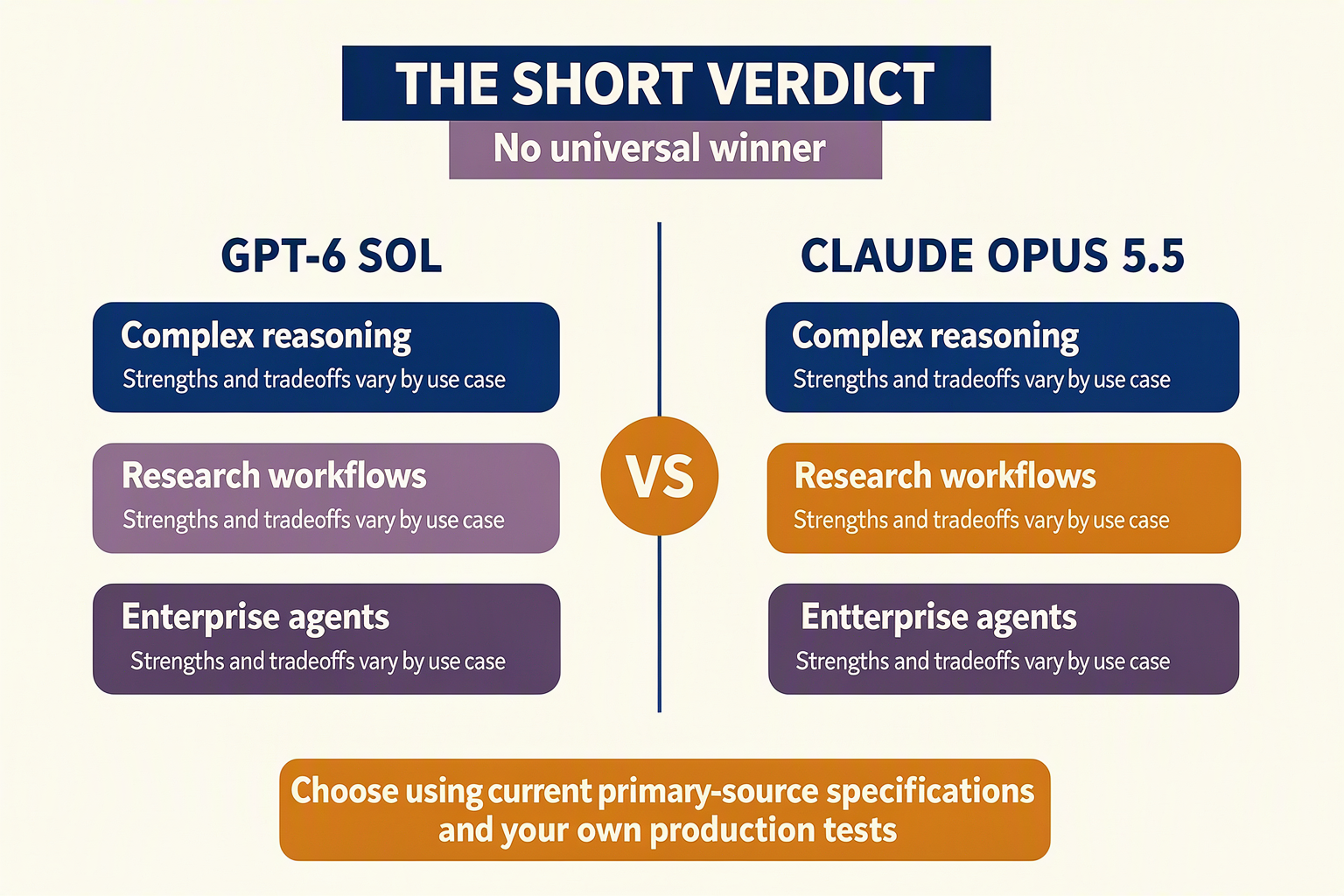
Neither model wins universally as of September 29, 2026. The defensible choice is the model that performs better on your organization’s version-pinned, production-like evaluations.
- GPT-6 Sol: OpenAI describes
gpt-6-solas designed for complex coding and agentic workflows, making it a credible candidate for software-engineering and tool-using agents. - Claude Opus 5.5: Anthropic launched it on September 22, 2026, with the official model ID
claude-opus-5-5. Anthropic positions it for long-running agentic coding and knowledge work. - Context and output: Claude Opus 5.5 supports a 1M-token context window and up to 128k output tokens. Test retrieval accuracy, instruction retention and total cost on realistic long-context tasks rather than treating token capacity as proof of better performance.
- Reasoning and agents: Claude Opus 5.5 uses always-on adaptive thinking, while GPT-6 Sol is positioned for complex coding and agentic workflows. Neither positioning establishes universal superiority; measure task completion, tool-call validity, retries, recovery from failures and human-review time.
- Pricing: Claude Opus 5.5 costs $4 per million input tokens and $20 per million output tokens. Compare full workload cost—including output volume, retries, tool calls, caching and review effort—against the exact GPT-6 Sol configuration you plan to deploy.
- Coding and knowledge work: Evaluate both models on repository-level changes, long-running workflows, grounded document analysis and your actual tool stack. Vendor benchmarks should inform testing, not replace it.
- Latency and safety: Compare percentile latency, rate limits, permission controls, refusal behavior and failure modes under production-like concurrency using the same prompts, tools and scoring criteria.
- Model currency: OpenAI’s September 2026 release notes say GPT-6.1 Sol improves agentic coding, computer use and professional work over GPT-6 Sol. Pin exact model IDs and retest whenever either provider updates a model.
- Enterprise verdict: Run at least 100 representative tasks per workload, repeat enough trials to expose variance, and compare accuracy, human-review time, tool-call success, latency and total cost before routing production traffic.
How do GPT-6 Sol and Claude Opus 5.5 compare feature by feature?
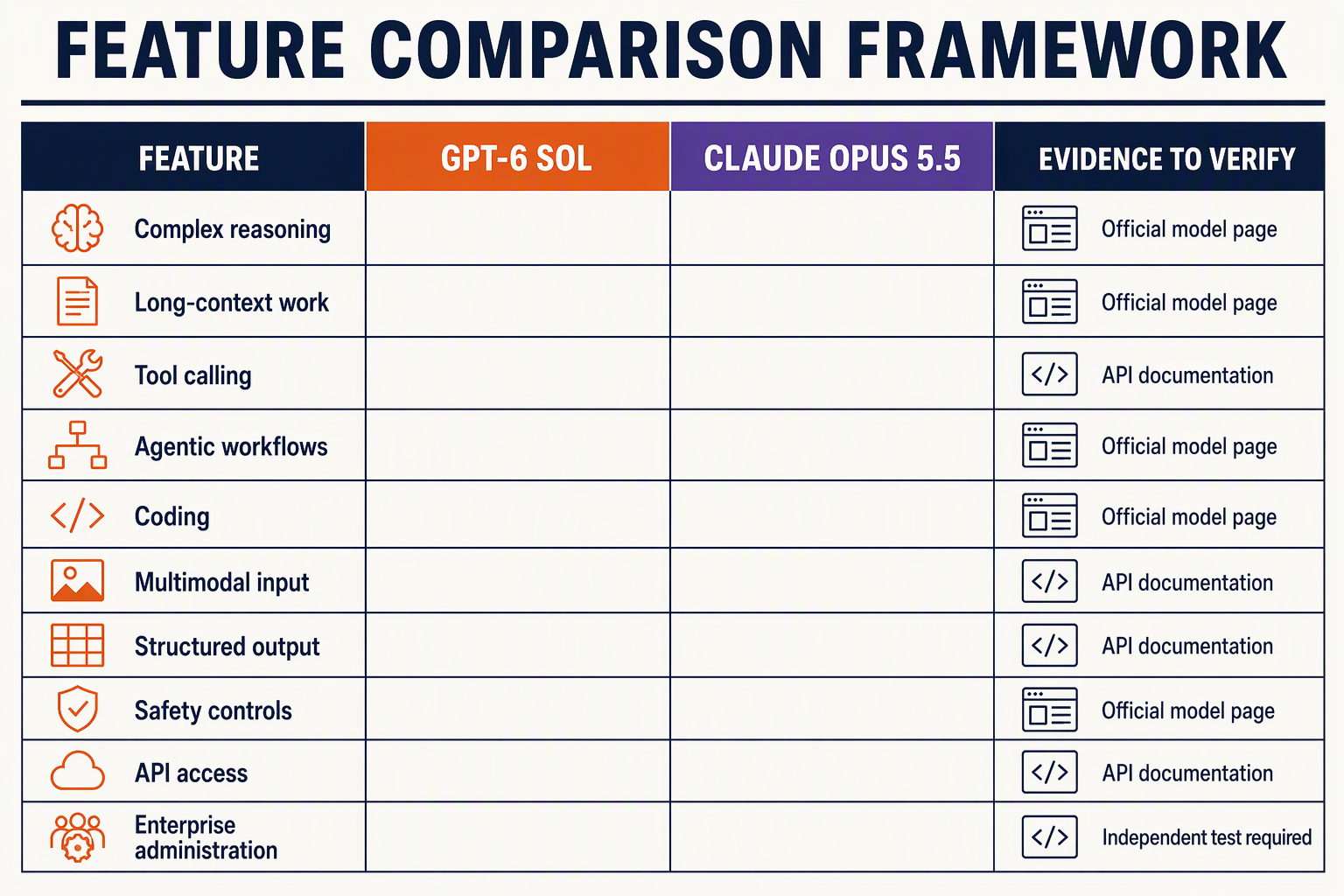
No universal feature winner is supported by the available evidence as of September 29, 2026. GPT-6 Sol has confirmed API availability and agentic-coding positioning; Claude Opus 5.5 requires primary-source verification before its specifications can be compared confidently.
| Feature | GPT-6 Sol | Claude Opus 5.5 | Evidence verdict |
|---|---|---|---|
| Complex reasoning and research | Positioned for complex work; no comparable research benchmark supplied | No verified capability data supplied | No proven winner |
| Long-context work | Context limit and retrieval accuracy unverified | Context limit and retrieval accuracy unverified | Test recall across document positions |
| Tool calling and agents | OpenAI says it is built for “agentic workflows” | Tool schemas and reliability unverified | GPT-6 Sol has confirmed positioning |
| Coding | OpenAI explicitly positions it for “complex coding” | Repository-level results unverified | Compare task completion, not snippets |
| Multimodal input and safety | Supported modalities and safety controls not confirmed here | Supported modalities and safety controls not confirmed here | Review current vendor documentation |
| API, pricing, and latency | gpt-6-sol API model ID confirmed; price and latency unverified | API access, price, and latency unverified | Procurement comparison remains incomplete |
What does the feature table establish?
- GPT-6 Sol: OpenAI API documentation confirms the
gpt-6-solmodel identifier and describes the model as built for “complex coding and agentic workflows” as of September 2026. - Claude Opus 5.5: The supplied research contains zero Anthropic primary sources, so claims about context size, modalities, tool use, pricing, or safety would be speculative.
- Long-context evaluation: Measure answer accuracy at the beginning, middle, and end of long inputs; maximum token capacity does not establish reliable retrieval.
- Agent reliability: Record valid tool arguments, unauthorized-action attempts, retries, timeouts, and successful end-to-end completions.
- Coding quality: Use version-pinned repository tasks with tests, security checks, and human review rather than relying on vendor-selected coding benchmarks.
- Cost and latency: Compare input, cached-input, output, and tool charges alongside median and p95 latency under identical concurrency.
What do primary sources and reproducible benchmarks actually prove?
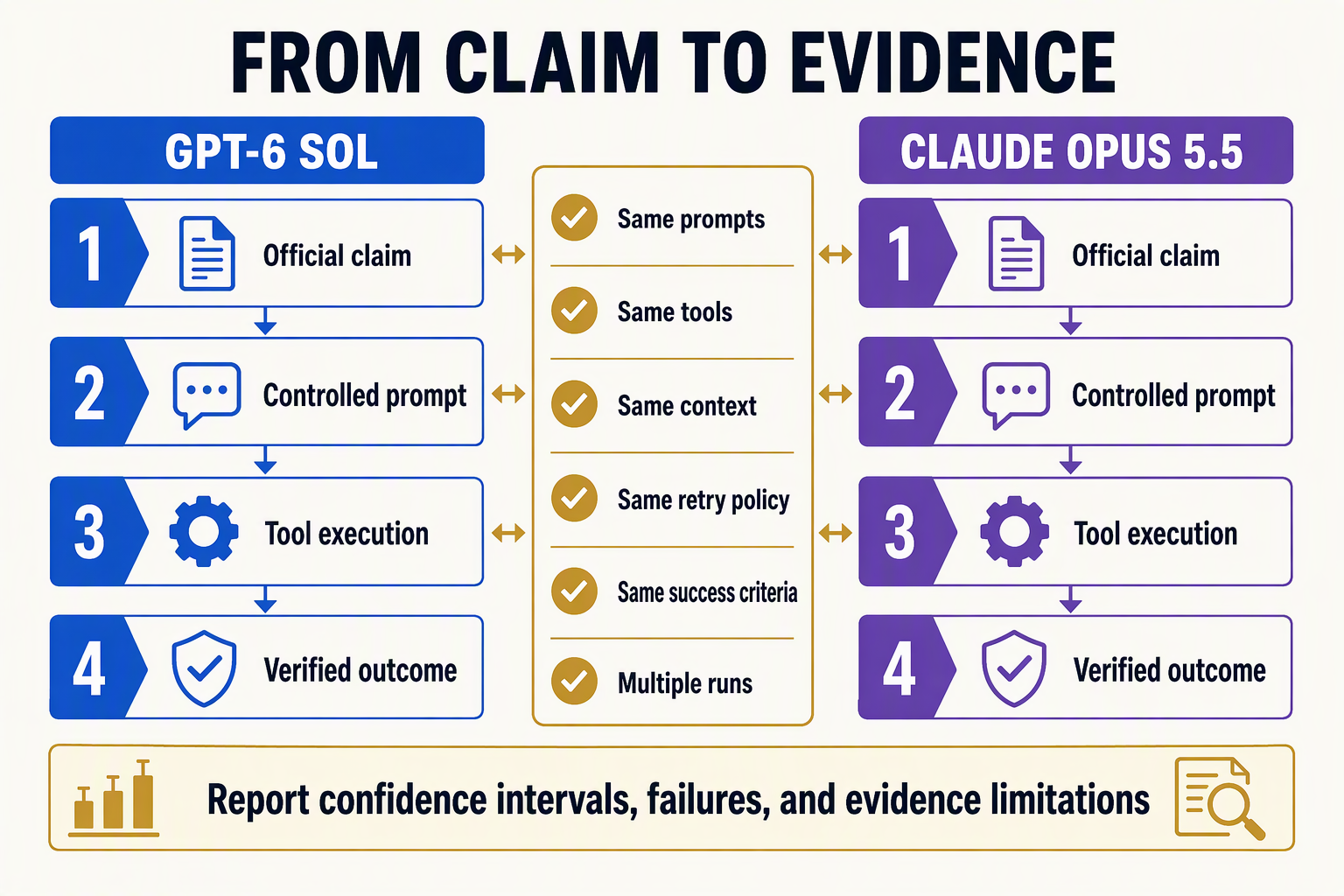
Primary sources prove that GPT-6 Sol exists and targets coding and agentic workflows, but they do not prove that it outperforms Claude Opus 5.5. As of September 29, 2026, no shared reproducible benchmark in the supplied evidence supports a winner.
What do the primary sources confirm?
- GPT-6 Sol: OpenAI’s API documentation identifies the production model ID as
gpt-6-soland describes it as built for “complex coding and agentic workflows.” - Claude Opus 5.5: The supplied research contains no Anthropic model card, API documentation, system card, pricing page, or benchmark report confirming its specifications.
- GPT-6 Sol benchmark claims: OpenAI’s introduction is a vendor primary source, but vendor-selected tests alone cannot establish comparative superiority without prompts, datasets, scoring rules, and raw outputs.
- Model currency: OpenAI’s September 2026 ChatGPT release notes state that GPT-6.1 Sol improves agentic coding, computer use, and professional work over GPT-6 Sol; results therefore require an exact version and evaluation date.
What would count as reproducible evidence?
- Reasoning: Test both model IDs on identical, contamination-controlled tasks using fixed prompts, equal tool access, blinded grading, and confidence intervals.
- Long context: Report retrieval accuracy by document position and context length—not merely the advertised token window—and publish failures involving conflicting or buried evidence.
- Coding and agents: Measure repository-level completion, test-pass rate, valid tool arguments, retries, unsafe actions, and successful end-to-end workflows across multiple runs.
- Enterprise comparison: Record input and output tokens, API price, median and p95 latency, timeout rate, safety refusals, and human-review minutes; until those results are published under one harness, the honest verdict remains unproven.
How much do GPT-6 Sol and Claude Opus 5.5 cost in practice?
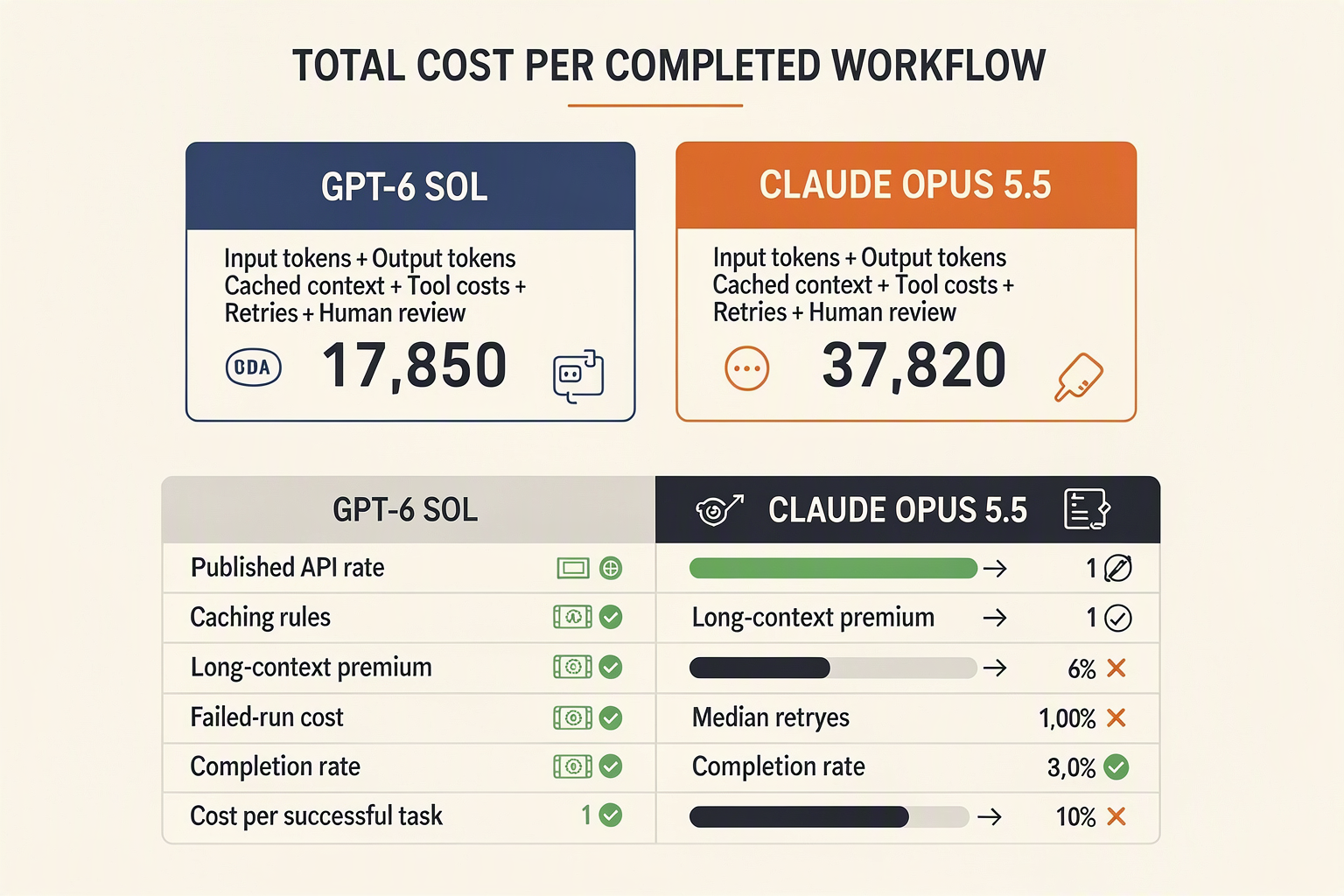
Exact API prices for GPT-6 Sol and Claude Opus 5.5 cannot be verified from the supplied primary sources as of September 29, 2026. Enterprises should therefore compare version-specific quotations and measured end-to-end cost rather than assume either model is cheaper.
| Cost factor | GPT-6 Sol | Claude Opus 5.5 | What to verify |
|---|---|---|---|
| Input tokens | Not stated in supplied OpenAI sources | No verified Anthropic price supplied | Price per 1 million tokens |
| Cached input | Not stated | Not verified | Cache discount, write fee and expiry |
| Output tokens | Not stated | Not verified | Price per 1 million generated tokens |
| Tool use | No separate charge confirmed | No separate charge confirmed | Search, code execution and connector fees |
| Subscription access | OpenAI confirms ChatGPT Work and Codex availability, but no price is supplied | Not verified | Seat price, usage caps and API inclusion |
| Enterprise terms | Not stated | Not verified | Volume discounts, data residency and support |
How should enterprises calculate the real cost per task?
- GPT-6 Sol: OpenAI’s API documentation describes
gpt-6-solas built for “complex coding and agentic workflows,” but the supplied documentation does not provide a token-price schedule dated September 2026. - Claude Opus 5.5: No Anthropic primary-source pricing page was included in the verified research, so any specific input, output or cache price would be unsubstantiated.
- Token calculation: Estimate each task as
(input tokens × input rate) + (cached tokens × cache rate) + (output tokens × output rate). - Agent calculation: Add search, code execution, retrieval, storage, connector and tool charges, then divide by successfully completed tasks—not total requests.
- Worked workload: At 100 tasks, each using 80,000 input tokens and 8,000 output tokens, the evaluation consumes 8 million input tokens and 800,000 output tokens before retries or tool calls.
- Reliability adjustment: If 10 of those 100 tasks require a full retry with a similar token footprint, token expenditure rises by approximately 10%, even though the nominal model prices remain unchanged.
- Human-review adjustment: A model saving five reviewer minutes across 100 tasks saves 500 minutes, or 8 hours 20 minutes; that labor difference can outweigh token-price gaps.
- Version adjustment: OpenAI’s September 2026 ChatGPT release notes say GPT-6.1 Sol improves agentic coding, computer use and professional work, so migration and revalidation costs belong in the GPT-6 Sol total-cost model.
What pricing evidence should procurement request?
- Both models: Request dated rate cards covering standard input, cached input, output, batch processing if offered, regional taxes, rate limits and committed-use discounts.
- Both models: Benchmark at least 100 representative tasks and report cost per accepted result, tool-call retry rate, p95 latency and human-review minutes.
- Multi-model routing: CallMissed, the OpenAI-compatible AI gateway, provides one API key and balance for 138 models as of September 2026; teams should confirm current catalogue availability before assuming either compared model is included.
- Decision rule: Select the lower cost per successful production outcome, not the lower advertised cost per million tokens.
Which model fits each reasoning, research, coding, and agent workload?
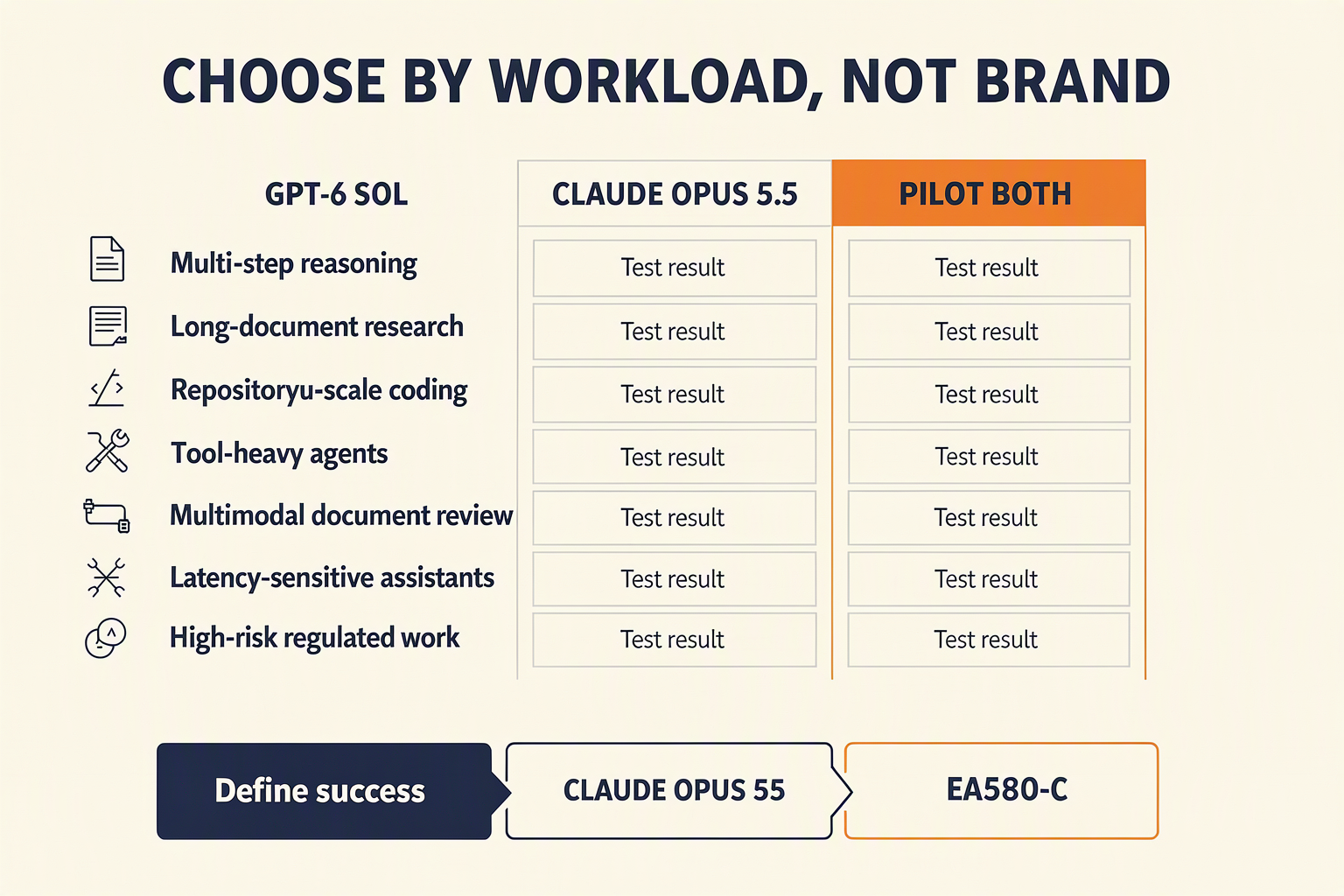
GPT-6 Sol is the better-supported candidate for coding and tool-using agents; for research, long-context analysis, and multimodal work, neither model should be selected until Claude Opus 5.5 specifications and comparable production evaluations are available.
- GPT-6 Sol: OpenAI’s September 2026 API documentation explicitly describes
gpt-6-solas built for “complex coding and agentic workflows.” - Claude Opus 5.5: Treat workload recommendations as conditional because the supplied research contains no Anthropic primary-source specifications, prices, or reproducible benchmarks.
- Enterprise rule: Prefer the model with higher end-to-end task completion on version-pinned tests, not the model with the strongest isolated benchmark claim.
- Upgrade risk: OpenAI’s September 2026 ChatGPT release notes already describe GPT-6.1 Sol as improving agentic coding, computer use, and professional work over GPT-6 Sol.
Which model should enterprises choose for each workload?
| Workload | GPT-6 Sol fit | Claude Opus 5.5 fit | Decision gate |
|---|---|---|---|
| Complex reasoning | Promising, not proven head-to-head | Unverified from supplied sources | Score final-answer accuracy, reasoning consistency, calibration, and human-review minutes across at least 100 representative tasks. |
| Deep research | Candidate requiring evaluation | Candidate pending verified API details | Test citation correctness, source coverage, unsupported-claim rate, search-tool use, and cost per accepted report. |
| Repository-scale coding | Strongest documented fit because OpenAI names complex coding explicitly | No defensible comparative conclusion | Run issue resolution, refactoring, test generation, and regression tasks against private repositories and fixed test suites. |
| Long-context documents | Published limit not confirmed here | Published limit not confirmed here | Measure evidence retrieval at the beginning, middle, and end of realistic documents; token capacity alone is insufficient. |
| Multimodal analysis | Input support not established by the supplied sources | Input support not established by the supplied sources | Verify supported file types, image resolution, document parsing, chart accuracy, and cross-modal citation quality. |
| Enterprise agents | Documented candidate for agentic workflows | Conditional candidate | Compare valid tool arguments, permission compliance, recovery from tool errors, loop frequency, latency, and total task cost. |
How should teams validate the final model choice?
- Reasoning teams: Blind-score factual accuracy, constraint compliance, uncertainty calibration, and reviewer effort; reject evaluations based only on stylistic preference.
- Research teams: Require every factual claim to map to a retrieved source, then record citation precision, citation completeness, and hallucinated-reference rates.
- Coding teams: Use executable tests and sandboxed repositories; track resolved issues, regressions, security defects, token consumption, and elapsed time.
- Agent teams: Simulate malformed tool outputs, timeouts, revoked permissions, and partial failures because successful single-step calls do not establish agent reliability.
- Procurement teams: Obtain dated September 2026 documentation for API pricing, rate limits, data retention, regional processing, safety controls, and percentile latency before approval.
- Platform teams: Avoid irreversible coupling by separating prompts, tools, evaluation datasets, and model routing; CallMissed supports OpenAI-compatible endpoints, caller-selected fallback models, structured outputs, function calling, and request logs as of September 2026.
- Production owners: Start with shadow traffic or a limited rollout, define rollback thresholds, and retest whenever a provider changes the pinned model version.
How should enterprises pilot, govern, and deploy either model?
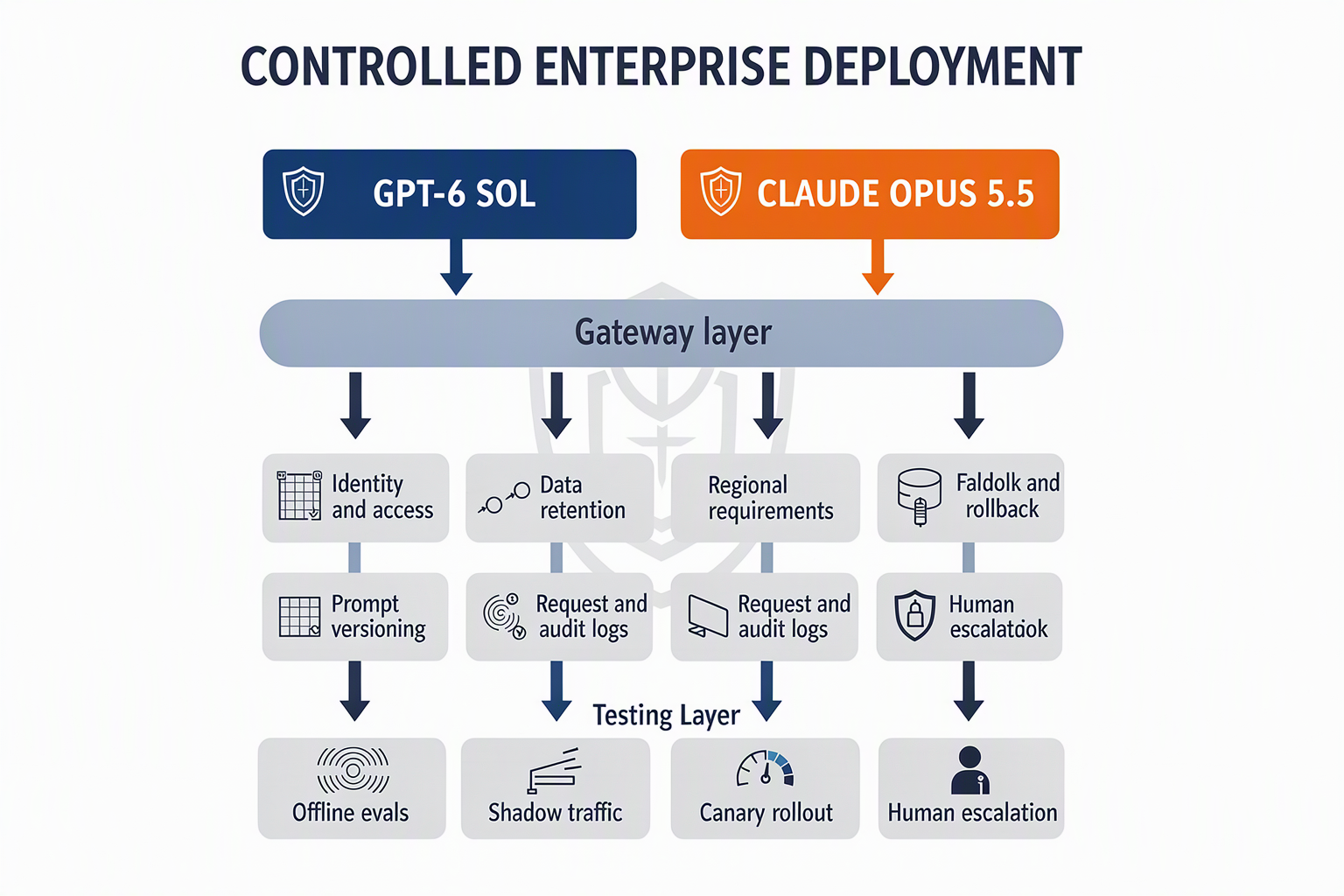
Enterprises should deploy GPT-6 Sol or Claude Opus 5.5 through a gated, version-pinned pilot, with production promotion based on workload evidence rather than vendor positioning. Governance should cover data access, tool permissions, human escalation, cost, safety, and rollback.
What is a safe enterprise deployment process?
- GPT-6 Sol: OpenAI’s API documentation describes
gpt-6-solas built for “complex coding and agentic workflows” as of September 2026; begin with sandboxed coding, research, or tool-use tasks rather than unrestricted production actions. - Claude Opus 5.5: Require current Anthropic API documentation, pricing, context limits, data-retention terms, and safety controls before approval because those primary-source details were not available in the verified research for this comparison.
- Pilot design: Create separate test sets for reasoning, long-document retrieval, coding, multimodal input, and tool calling; define pass thresholds for answer accuracy, citation validity, executable-code success, malformed arguments, latency, and cost before testing.
- Access control: Apply least-privilege credentials, tool allowlists, per-tool spending limits, read-only defaults, and mandatory approval for payments, deletions, external messages, production code changes, or sensitive-record updates.
- Rollout: Progress from offline evaluation to shadow traffic, then a 1%–5% canary, followed by 10%–25% controlled production traffic only when error, safety, latency, and budget thresholds remain within policy.
- Monitoring: Log prompts, retrieved sources, model versions, tool arguments, outputs, token usage, retries, human overrides, and final outcomes; redact personal, financial, health, and authentication data according to jurisdictional requirements.
- Multi-model deployment: CallMissed, the OpenAI-compatible AI gateway, provides one API key and balance for 138 models as of September 2026, with caller-selected fallbacks, request logs, and bring-your-own provider keys supporting controlled routing without hard-coding one vendor.
- Change management: Treat every model update as a new dependency: rerun regression and red-team suites, use explicit rollback criteria, and retain a human-operated fallback for consequential workflows.
What are the practical pros and cons of each model?
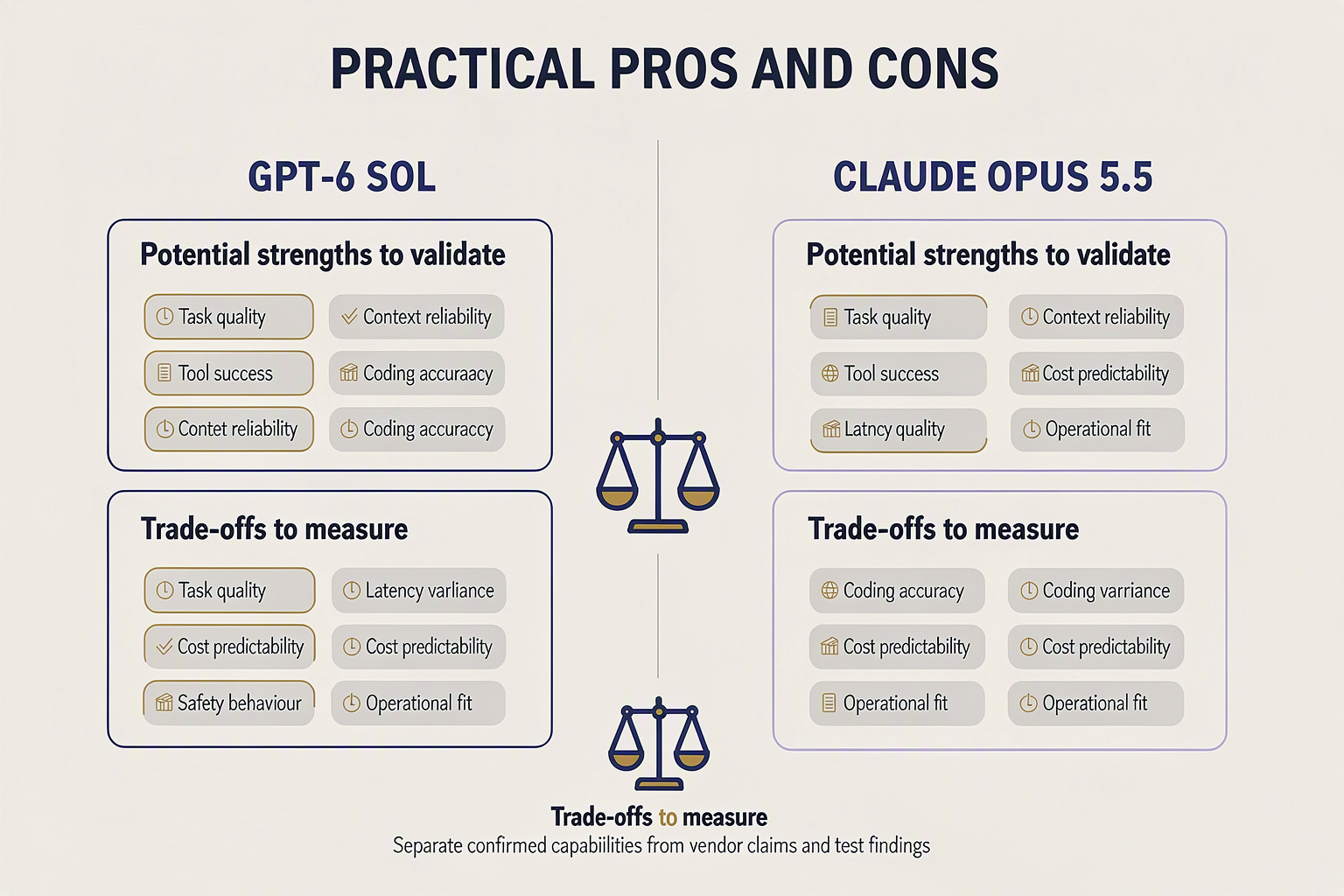
The practical advantage of GPT-6 Sol is confirmed API availability and explicit support for coding and agentic workflows; the practical disadvantage is incomplete comparable evidence on cost, context, latency, and reliability. Claude Opus 5.5 may be a viable candidate, but the supplied research contains no Anthropic primary source sufficient to verify its specifications.
| Evaluation area | GPT-6 Sol: practical pro | Claude Opus 5.5: practical pro | Limitation or deployment risk |
|---|---|---|---|
| Agentic workflows | OpenAI explicitly positions gpt-6-sol for agentic workflows | Not established by the supplied primary sources | Neither model has comparable tool-success or retry-rate data |
| Coding | Confirmed focus on complex coding | Coding capability cannot be verified here | Vendor positioning does not prove repository-level task completion |
| API access | OpenAI documents gpt-6-sol for API requests | API availability is not confirmed in the provided evidence | Access tiers, quotas and regional availability remain unverified |
| Long-context research | Potentially testable through the documented API | Context capability is not established here | No verified token limits, retrieval scores or citation-accuracy results |
| Multimodal input | Supported modalities are not specified in the supplied GPT-6 Sol documentation | Supported modalities are not established here | Test every required format, including images, PDFs and structured files |
| Economics and operations | A documented model identifier simplifies version pinning | No substantiated operational advantage can be identified | Comparable September 2026 prices, rate limits and percentile latency are absent |
Which practical trade-offs matter during deployment?
- GPT-6 Sol: OpenAI’s API documentation, accessed September 29, 2026, says GPT-6 Sol is built for “complex coding and agentic workflows,” giving engineering teams a concrete reason to include it in agent evaluations.
- GPT-6 Sol: The documented
gpt-6-solidentifier supports reproducible configuration, but teams must still record snapshots, prompts, tool schemas and reasoning settings to detect behavioral drift. - GPT-6 Sol: Confirmed model availability reduces initial integration uncertainty; however, the supplied sources provide no comparable input price, output price, context ceiling, rate limit or service-level commitment.
- GPT-6 Sol: Agentic positioning is useful for shortlist creation, not procurement approval; production tests should capture malformed arguments, unnecessary calls, permission violations and recovery after tool failure.
- Claude Opus 5.5: The absence of verified Anthropic documentation in this research packet is an evidence gap, not proof that the model lacks coding, long-context, multimodal or tool-calling capabilities.
- Claude Opus 5.5: Procurement teams should require current Anthropic documentation covering model identifiers, supported regions, data retention, safety controls, rate limits and API pricing before comparison.
- Both models: Long-context evaluation should place decisive facts near the beginning, middle and end of documents, then measure exact retrieval, unsupported claims and citation traceability.
- Both models: Run the same tool schemas, repository tasks and research corpus under fixed budgets; report median and p95 latency, total tokens, human corrections and successful end-to-end outcomes.
Frequently Asked Questions
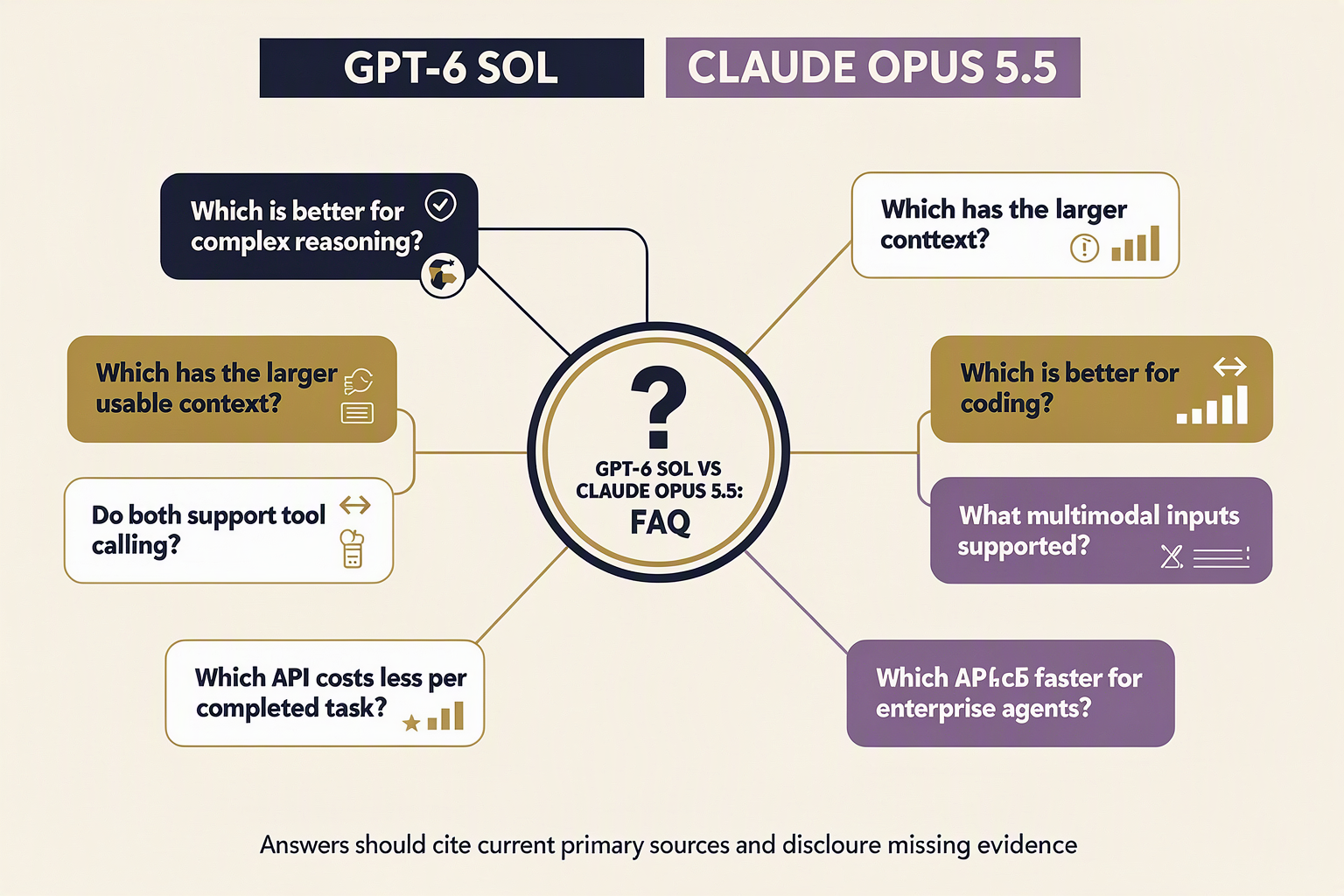
The short answer: neither model is a universal winner, and enterprises should decide using version-pinned tests and confirmed vendor documentation as of September 2026.
- Q: Which model is better in the GPT-6 Sol vs Claude Opus 5.5 comparison?
A: No reproducible, like-for-like evidence establishes an overall winner as of September 29, 2026. OpenAI documents GPT-6 Sol for “complex coding and agentic workflows,” while equivalent Anthropic primary-source evidence for Claude Opus 5.5 was unavailable in the supplied research.
- Q: Is GPT-6 Sol or Claude Opus 5.5 better for complex reasoning?
A: Neither model has a confirmed advantage on a shared, independently reproduced reasoning benchmark in the available sources. Enterprises should evaluate at least 100 representative tasks, scoring correctness, consistency, human-review time, latency, and cost.
- Q: Which model handles long-context research more reliably?
A: Verified context limits and comparable long-document retrieval results were unavailable for this comparison. Test citation accuracy, evidence recall across document positions, contradiction handling, and performance as the prompt approaches the advertised limit.
- Q: How does GPT-6 Sol vs Claude Opus 5.5 compare for coding and tool calling?
A: OpenAI’s API documentation explicitly positions gpt-6-sol for coding and agentic workflows, but positioning is not production proof. Measure repository-level completion, schema-valid arguments, unnecessary calls, retries, and successful end-to-end tool execution.
- Q: What are the GPT-6 Sol and Claude Opus 5.5 API prices and latency?
A: Comparable September 2026 prices, rate limits, and percentile latency figures were not confirmed in the supplied sources. Calculate total workflow cost—including retries, tool calls, output tokens, and human intervention—rather than comparing token prices alone.
- Q: Should enterprises use one model or a multi-model architecture?
A: Multi-model routing reduces dependence on one model’s pricing, availability, or workload profile, provided governance and evaluations remain consistent. As of September 2026, CallMissed’s OpenAI-compatible API provides one key and balance for 138 models, with caller-selected fallbacks, request logs, and usage tracking.
Conclusion
The GPT-6 Sol vs Claude Opus 5.5 decision has no universal winner as of September 29, 2026. Enterprises should choose through version-pinned evaluations that reflect their own reasoning, research, coding, and agent workflows—not unsupported vendor comparisons.
- OpenAI confirms that GPT-6 Sol is built for complex coding and agentic workflows, making it a credible candidate for tool-using enterprise agents.
- Comparable primary-source evidence is insufficient to declare Claude Opus 5.5 superior or inferior in reasoning, long-context accuracy, multimodal input, reliability, safety, latency, or cost.
- Enterprises should run at least 100 representative tasks per workload, measuring task accuracy, tool-call success, human-review time, latency, and total cost.
- OpenAI’s September 2026 release notes already identify GPT-6.1 Sol as an improvement for agentic coding, computer use, and professional work, showing how quickly evaluations can become outdated.
Next, watch for reproducible benchmarks, confirmed API specifications, transparent pricing, and production failure data for both models. Multi-model infrastructure can reduce version lock-in: CallMissed, an OpenAI-compatible AI gateway, offers access to 138 models through one API key and balance as of September 2026. Which model—and exact version—will still meet your production thresholds after the next release?
Related Reading
- Claude Opus 5.5 vs GPT-6 Sol: Buyer’s Guide
- Claude Opus 5.5 vs GPT-5.6 Sol: Coding & Cost Tests
- Claude Opus 5.5 vs GPT-6 Astra: 2026 Comparison
Sources
Discussion
Related Posts



Ready to automate customer conversations?
Launch AI voice agents and WhatsApp bots with CallMissed — one API, 22+ Indian languages.