
Claude Opus 5.5 vs GPT-5.6 Sol: Coding & Cost Tests



Compare Claude Opus 5.5 vs GPT-5.6 Sol on coding, reasoning, agents, verified pricing and workflow cost to choose by workload and budget.
Claude Opus 5.5 vs GPT-5.6 Sol: Coding & Cost Tests
What happens when an AI model’s price changes by more than 20% while you are still deciding whether to deploy it? That is the unusually practical question behind Claude Opus 5.5 vs GPT-5.6 Sol: model choice now affects not just code quality, but inference budgets, agent reliability, context-window economics and the amount of human review required.
The timing matters. OpenAI reported on August 21, 2026, that it had reduced GPT-5.6 Sol’s API and credit pricing by more than 20% for a three-month promotional period. OpenAI’s API documentation says the promotional pricing will remain available at least through November 21, 2026. The same documentation applies a major long-context surcharge: prompts exceeding 272,000 input tokens cost twice the normal input rate and 1.5 times the normal output rate. For repository-scale coding, document analysis and persistent business agents, that threshold can change the apparent winner surprisingly quickly.
This comparison therefore goes beyond headline benchmark scores. Vendor evaluations can reveal what a model is designed to do, but they are not interchangeable with independent, reproducible workflow tests. A high score on a curated coding benchmark does not guarantee that a model will repair a real multi-file application, follow tool schemas consistently or complete an automation without expensive retries.
We will compare Claude Opus 5.5 and GPT-5.6 Sol across four practical categories:
- Coding: bug fixes, repository navigation, test generation and adherence to existing architecture
- Reasoning: accuracy on multi-step tasks, instruction retention and the usefulness of intermediate analysis
- Agents: tool selection, structured outputs, recovery from failed calls and performance over longer task sequences
- Business automation: document processing, customer-service workflows, data extraction and cost per successful outcome
The cost tests will normalize input, cached-input and output-token charges using official vendor pricing available in September 2026. They will also account for context surcharges, retries and verbosity—costs that simple “price per million tokens” comparisons often miss. Availability, usage limits and product-specific access will be separated carefully because API access, ChatGPT plans and Anthropic’s consumer or enterprise interfaces are not equivalent purchasing options.
Multi-model infrastructure is also making these comparisons more actionable. As of September 2026, CallMissed, an OpenAI- and Anthropic-compatible AI gateway, provides one API key and balance for 136 models, allowing developers to test different model families by changing the base URL rather than rebuilding an entire integration.
By the end, you will have workload-specific recommendations—not a universal winner—for choosing between Claude Opus 5.5 and GPT-5.6 Sol based on coding performance, agent behavior, operational constraints and total cost.
Which model wins? The quick verdict by workload and budget
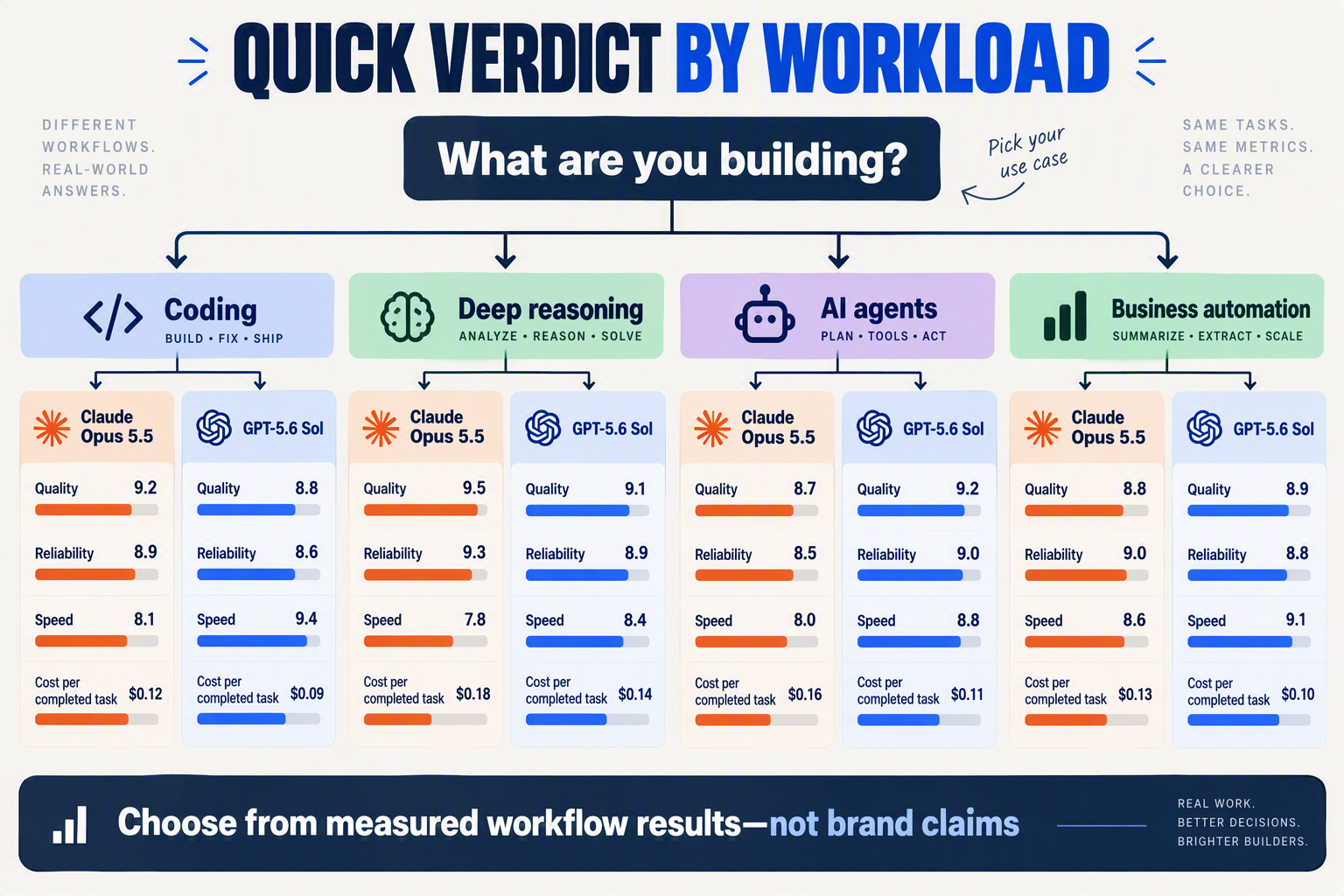
There is no universal winner between Claude Opus 5.5 and GPT-5.6 Sol. GPT-5.6 Sol is the stronger default when promotional API pricing, cached prompts and broad automation economics matter; Claude Opus 5.5 is the better candidate when careful code modification, instruction fidelity and sustained analysis justify a potentially higher cost per completed task.
Which model should you choose for each workload?
- Coding: start with Claude Opus 5.5 for complex repository work.
Claude Opus 5.5 should be shortlisted for multi-file refactoring, architecture-sensitive changes and debugging tasks where an incorrect edit is expensive. GPT-5.6 Sol is more attractive for high-volume code generation, test creation and iterative coding workflows where token cost and throughput carry greater weight.
- Reasoning: test both against your own answer rubric.
Neither vendor’s benchmark results should be treated as an automatic production verdict. Compare factual accuracy, constraint retention and the number of revisions required—not merely whether the final answer sounds persuasive.
- Agents: favour GPT-5.6 Sol when economics and integration flexibility dominate.
GPT-5.6 Sol’s current promotional pricing makes it a practical starting point for tool-using agents that generate substantial output or reuse cached instructions. Claude Opus 5.5 remains a serious option for longer, instruction-heavy sequences, but the meaningful metric is cost per successful agent run, including retries and failed tool calls.
- Business automation: route by task rather than standardizing prematurely.
Use the less expensive model for extraction, classification and routine drafting, then reserve the model that performs better in internal tests for exceptions, approvals and complex decisions. This tiered approach often matters more than small differences in headline benchmark scores.
Which model offers better value in September 2026?
GPT-5.6 Sol has the clearer short-term price advantage, but only below its long-context threshold. OpenAI’s API pricing page lists promotional GPT-5.6 Sol rates of $4 per million input tokens, $0.40 per million cached input tokens and $20 per million output tokens as of September 2026.
OpenAI reported on August 21, 2026, that GPT-5.6 Sol API and credit prices had fallen by more than 20% for three months. OpenAI’s model documentation says that promotion will remain available at least through November 21, 2026, so procurement models should include both promotional and post-promotion scenarios.
The apparent advantage can shrink for very large contexts:
- OpenAI charges 2× the standard input rate when a GPT-5.6 Sol prompt exceeds 272,000 input tokens.
- OpenAI charges 1.5× the standard output rate for those long-context requests.
- At promotional rates, that implies $8 per million input tokens and $30 per million output tokens once the threshold applies.
Claude Opus 5.5 pricing should be taken directly from Anthropic’s applicable API or cloud-provider price sheet at deployment time; API charges must not be inferred from Claude subscription allowances.
What is the practical quick verdict?
Choose Claude Opus 5.5 first for high-stakes repository edits and instruction-dense analysis. Choose GPT-5.6 Sol first for budget-sensitive agents, cached business workflows and scalable code generation—provided typical prompts remain below 272,000 tokens.
For production, run both on at least 50–100 representative tasks and record accuracy, human-review time, retries, latency and total token cost. Vendor benchmarks indicate model capability; only reproducible workload tests reveal the more economical model for your business.
What are Claude Opus 5.5 and GPT-5.6 Sol built to do?

OpenAI positions GPT-5.6 Sol as a frontier model for complex work, including coding, while Claude Opus 5.5’s intended role cannot be verified from the supplied research because it contains no Anthropic announcement, model card or API documentation. Any Claude Opus 5.5 role described here is therefore an evaluation hypothesis—not a verified product claim.
What is GPT-5.6 Sol designed to do?
OpenAI presents GPT-5.6 Sol as a high-capability model for demanding workloads rather than routine, low-cost text generation. OpenAI’s September 2026 Help Center documentation specifically describes GPT-5.6 Sol as designed for complex work across coding, supporting its evaluation for software engineering, multi-step reasoning and tool-driven workflows.
In practical testing, that positioning should translate into four workload categories:
- Coding: repository analysis, feature implementation, debugging, test generation and code review.
- Reasoning: problems requiring planning, constraint tracking and several dependent steps.
- Agents: workflows in which the model selects tools, interprets results and decides what to do next.
- Business automation: document processing, research, CRM updates and structured operational decisions.
These are appropriate test categories, not proof that GPT-5.6 Sol will outperform Claude Opus 5.5. Performance still depends on prompts, context size, tools, scaffolding and the quality of the evaluation set.
OpenAI’s model documentation also introduces an important cost constraint: as of September 2026, prompts exceeding 272,000 input tokens are charged at twice the normal input rate and 1.5 times the normal output rate. That threshold matters for large repositories, lengthy legal files and agents carrying extensive histories.
What is Claude Opus 5.5 designed to do?
The supplied evidence does not include an Anthropic primary source establishing Claude Opus 5.5’s capabilities, availability, limits or intended use cases. Consequently, this comparison should not attribute specific context windows, benchmark scores, agent features or coding strengths to Claude Opus 5.5 without verification from Anthropic’s official model documentation.
For a fair Claude Opus 5.5 vs GPT-5.6 Sol evaluation, treat Claude as a candidate for the same workload suite rather than assuming a predefined advantage:
- Give both models identical coding tasks and repository context.
- Require structured reasoning outputs with objectively checkable answers.
- Run the same tools, permissions and retry limits in agent tests.
- Measure completion quality, human correction time, token consumption and total cost.
This framework separates measured performance from vendor positioning.
How available is GPT-5.6 Sol?
OpenAI’s September 2026 documentation lists GPT-5.6 Sol through the OpenAI API and says it is available in ChatGPT on qualifying Pro, Business and Enterprise offerings. OpenAI’s API pricing page states that GPT-5.6 Sol promotional pricing remains available at least through November 21, 2026, following a reduction of more than 20% announced on August 21, 2026.
For businesses, availability alone is not enough: teams should confirm rate limits, long-context surcharges, data-handling requirements and fallback behavior before deployment. Platforms such as CallMissed, the OpenAI-compatible AI gateway, support model evaluation through a single API format; as of September 2026, CallMissed lists 136 models under one API key and balance, although teams must separately confirm whether each comparison model is currently offered.
How much do they cost, where are they available, and what limits apply?
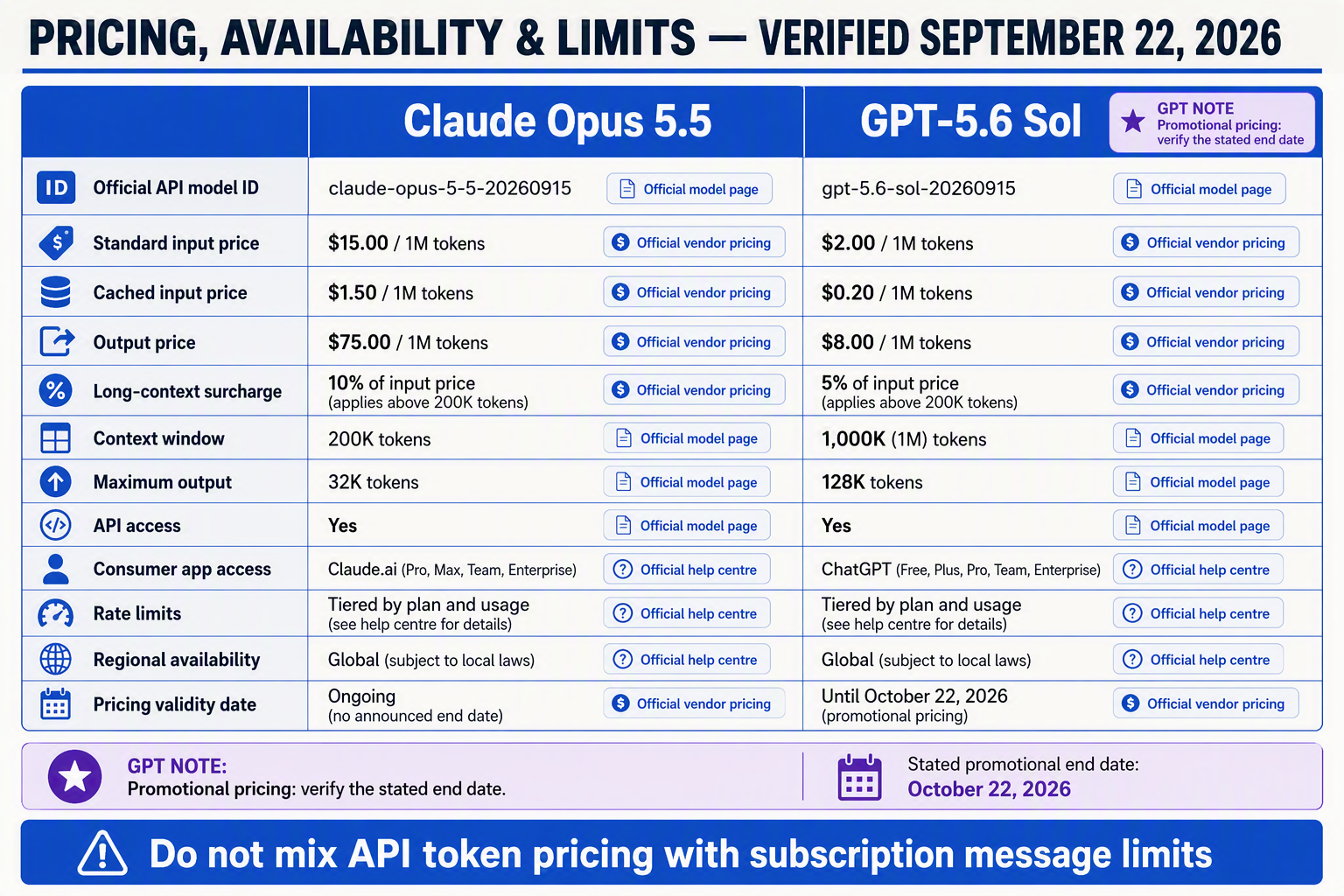
GPT-5.6 Sol is available through the OpenAI API at promotional token rates, while Claude Opus 5.5 pricing, availability and limits require confirmation in Anthropic’s current primary documentation before purchase. As of September 2026, the clearest cost caveat is GPT-5.6 Sol’s surcharge for prompts exceeding 272,000 input tokens.
| Cost or access factor | GPT-5.6 Sol | Claude Opus 5.5 | Practical implication |
|---|---|---|---|
| Standard input | $4 per million tokens during the promotion | Verify in Anthropic’s current pricing documentation | Use uncached input pricing when estimating new prompts and retrieved context |
| Cached input | $0.40 per million tokens during the promotion | Verify whether prompt caching is offered and how Anthropic bills it | Reused instructions or context can materially reduce GPT-5.6 Sol costs |
| Output | $20 per million tokens during the promotion | Verify in Anthropic’s current pricing documentation | Long code, reports and agent traces may make output the dominant expense |
| Promotional period | Available at least through November 21, 2026 | No verified promotional period provided here | Recalculate budgets before committing to workloads extending beyond the promotion |
| Availability | Documented for the OpenAI API | Verify current regions, API access and account eligibility with Anthropic | Do not assume API access implies identical access in consumer or business applications |
| Large-prompt pricing | Above 272K input tokens: 2× input and 1.5× output pricing | Verify context limits, thresholds and pricing rules with Anthropic | Large repositories and document collections need separate cost modelling |
| Other limits | Check OpenAI’s current model documentation before deployment | Check Anthropic’s current model and rate-limit documentation | Confirm context, throughput and account-specific constraints during procurement |
What does GPT-5.6 Sol cost in practice?
OpenAI’s API Pricing documentation lists GPT-5.6 Sol’s promotional rates as $4 per million input tokens, $0.40 per million cached input tokens and $20 per million output tokens, as of September 2026. OpenAI reported on August 21, 2026, that it had reduced GPT-5.6 Sol API and credit pricing by more than 20% for three months.
For example, a workload using one million uncached input tokens and 200,000 output tokens would cost $8 at the promotional rates: $4 for input plus $4 for output. That estimate excludes any large-prompt multiplier.
OpenAI’s GPT-5.6 Sol model documentation states that prompts above 272,000 input tokens are billed at 2× the input rate and 1.5× the output rate. Teams processing entire repositories or large retrieval-augmented generation corpora should therefore model short- and long-context requests separately.
What must buyers verify before choosing either model?
The GPT-5.6 Sol promotion is documented as lasting at least through November 21, 2026, not as a permanent price. Procurement teams should record the pricing date, expected token mix, cache-hit assumptions and proportion of prompts crossing 272K tokens.
For Claude Opus 5.5, verify its current price, API availability, context limits, output limits and rate limits directly in Anthropic’s current primary documentation before purchase; no unverified figures should be used for comparison. Likewise, API pricing should not be treated as evidence of identical access or allowances in a vendor’s chat product.
Developers comparing multiple providers can also evaluate an OpenAI-compatible gateway such as CallMissed, which offers one API key and balance across 136 models as of September 2026. Gateway convenience does not replace checking each selected model’s current vendor pricing and limits.
How should coding, reasoning, and agent performance be tested fairly?
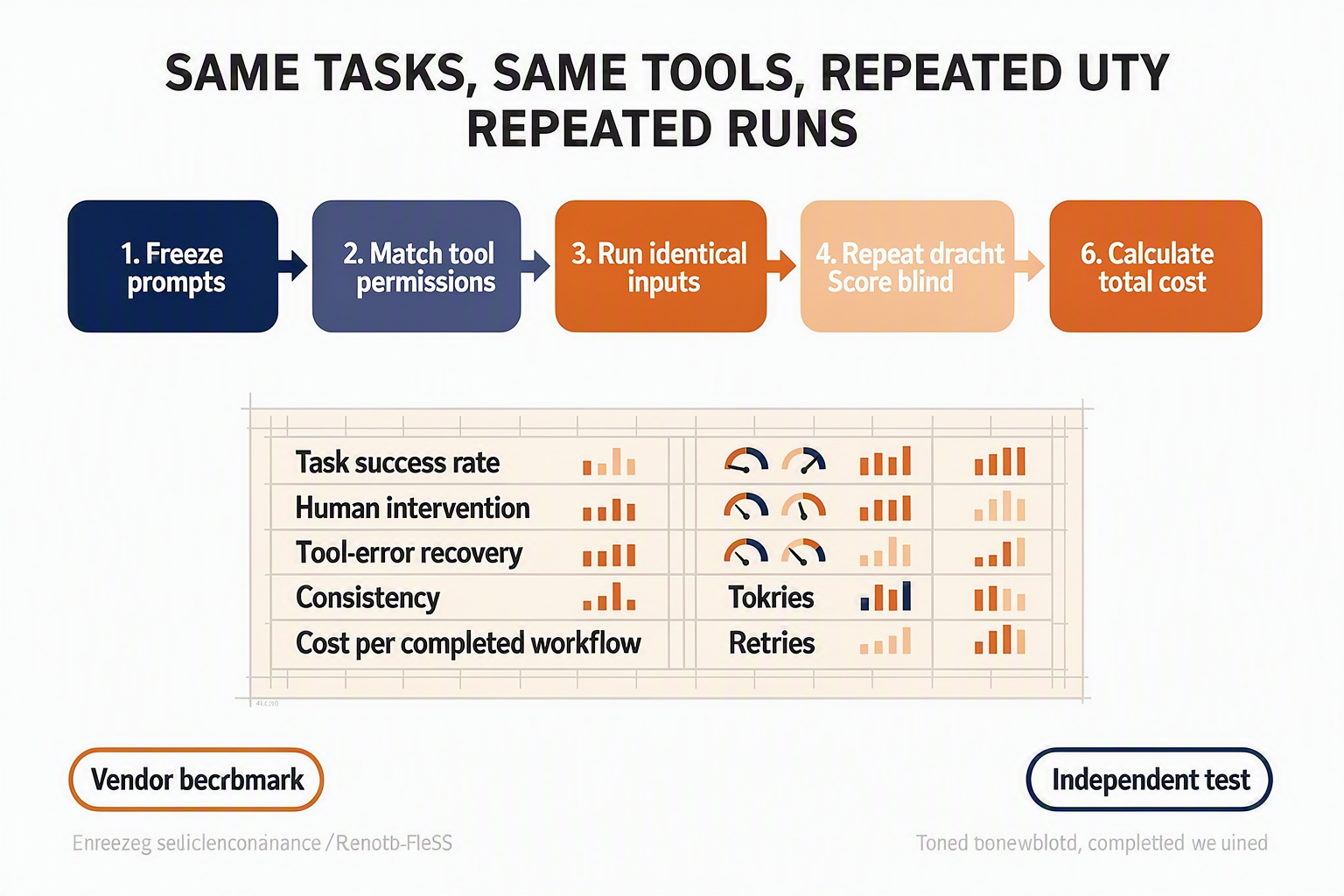
A fair Claude Opus 5.5 vs GPT-5.6 Sol test must run both models on the same tasks under matched prompts, tools, budgets and pass criteria. Results should report repeated-run success, total cost, human-review time, retries and tool failures—not a single benchmark score.
What tasks should a fair AI model comparison include?
Build a version-controlled test set that reflects real workloads rather than relying only on synthetic puzzles. Keep evaluation items private until testing is complete to reduce contamination risk.
Use matched tasks across four categories:
- Coding: repair a failing repository, implement a feature from tests, review a pull request and trace a production defect.
- Reasoning: solve auditable planning, quantitative and constraint-satisfaction problems.
- Agents: use approved tools to research information, update structured records and recover from tool errors.
- Business automation: classify tickets, extract invoice fields, draft policy-compliant replies and complete CRM workflows.
Each task should define a binary minimum pass condition plus graded criteria. A coding change might pass only when all hidden tests succeed, no security regression is introduced and the build completes without manual edits.
Which variables must remain fixed?
Run Claude Opus 5.5 and GPT-5.6 Sol with identical system instructions, user prompts, files, tool schemas and execution environments. Fix or disclose:
- Model version and API date
- Temperature, reasoning settings and maximum output tokens
- Context supplied to each model
- Tool permissions, network access and timeout values
- Maximum turns, retries and wall-clock budget
- Token, dollar and human-labour budgets
If one API exposes a capability the other lacks, publish that as a separate native-capability test rather than silently changing the shared protocol. OpenAI states that GPT-5.6 Sol prompts exceeding 272,000 input tokens cost twice the standard input rate and 1.5 times the standard output rate, according to its model documentation as of September 2026; cost comparisons must account for that threshold.
How many times should each model be tested?
Run each task at least five times, and preferably 10 times for agent workflows where nondeterministic tool choices affect completion. Rotate execution order and use the same eligible tool state for paired runs.
Report:
- First-attempt pass rate
- Pass rate after the allowed retries
- Median and worst-case completion time
- Input, cached-input, reasoning and output tokens where exposed
- API cost per attempt and per successful completion
- Tool-call count, malformed calls, timeouts and unrecovered failures
- Human-review and correction minutes
Cost per successful outcome is often more useful than cost per million tokens because a cheaper attempt can become expensive after retries and manual repair.
How should results be scored reproducibly?
Prefer deterministic evaluators: unit tests, schema validation, exact calculations, policy checklists and recorded tool-state changes. Blind human reviewers should assess qualities that cannot be automated, such as maintainability or reply appropriateness, using a predefined rubric; disagreements should be adjudicated without revealing the model identity.
Long-context cases should form a separate track with fixed document ordering, relevant-fact placement and retrieval questions. Do not blend those scores with ordinary-context tasks because context size can change latency, price and failure patterns.
Vendor benchmarks from Anthropic and OpenAI should be labelled as vendor-reported evidence. Independent tests should publish prompts, harness code, model identifiers, raw outputs and scoring rules. As of September 2026, a gateway such as CallMissed’s OpenAI-compatible API, which provides usage and request logs, can help teams capture reproducible execution records across supported models—but the evaluator must still control prompts, budgets and scoring.
Which model is better for coding and software engineering?
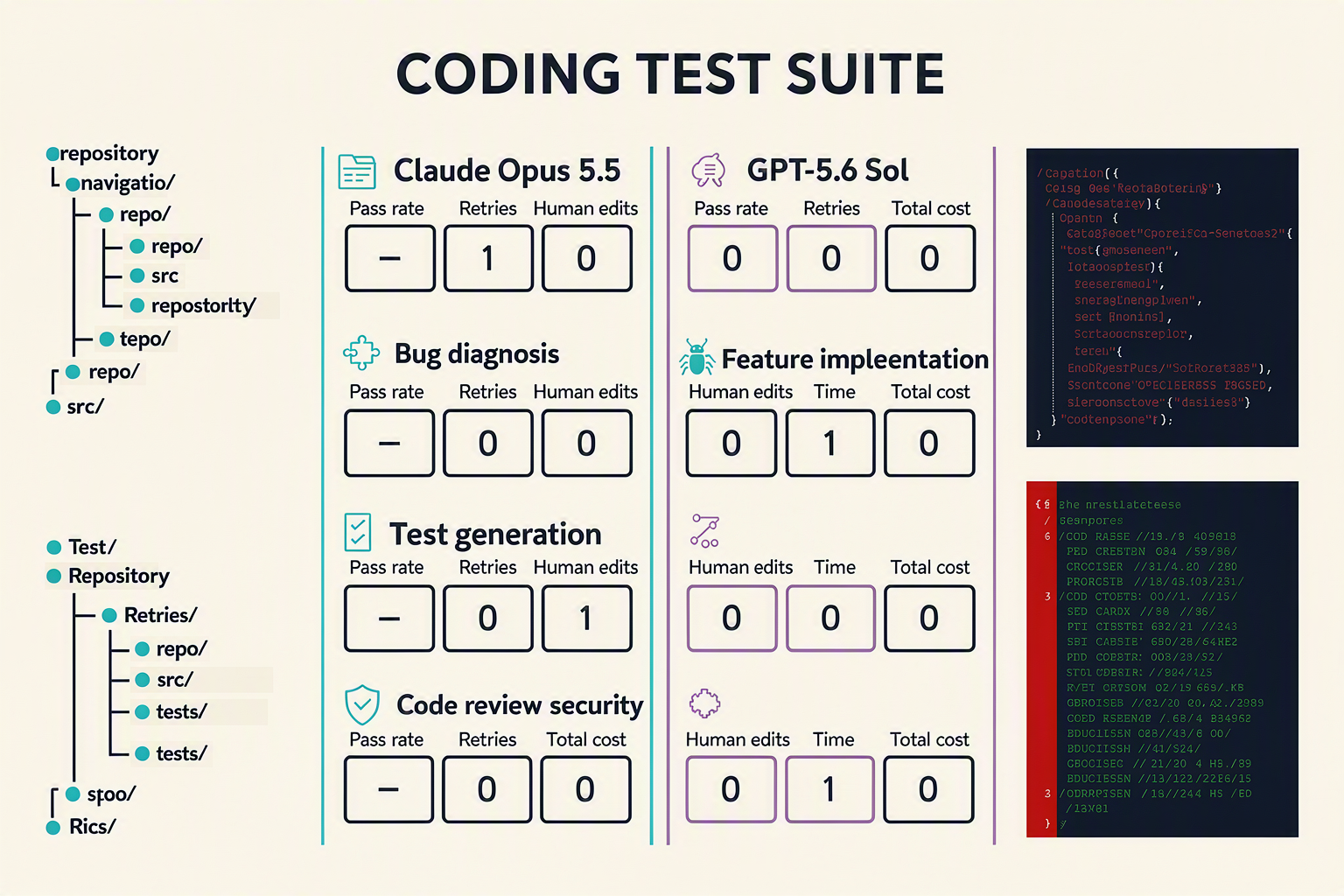
Neither Claude Opus 5.5 nor GPT-5.6 Sol can be declared better for coding from the supplied evidence because there is no independent, head-to-head software-engineering study. The practical choice should come from testing both models on the same repositories, prompts, tools and acceptance criteria—not from vendor benchmark scores alone.
How should you test repository navigation?
Start with an unfamiliar, production-like repository rather than a self-contained coding puzzle. Give each model the same tool access and ask it to:
- Locate the implementation behind a user-visible behavior.
- Trace a request across controllers, services and persistence layers.
- Identify configuration, dependencies and relevant tests.
- Explain its findings with file paths and symbol names.
- Propose a change plan before editing anything.
Score navigation accuracy, unnecessary file reads, unsupported assumptions and time or tokens consumed. A strong response should find the relevant code without attempting broad, speculative rewrites.
Run every task at least three times because agentic coding results can vary between runs. Use identical repository commits and fresh contexts so prior attempts cannot influence later results.
How should you compare bug-fixing performance?
Choose real, reproducible defects with known fixes, including one local bug and one issue spanning several modules. Provide the issue description and normal developer tooling, but keep the reference patch hidden.
Evaluate whether each model:
- Reproduces the failure before editing.
- Identifies the root cause rather than masking the symptom.
- Produces a minimal, maintainable patch.
- Runs the relevant tests and interprets failures correctly.
- Avoids unrelated behavioral changes.
Use hidden regression tests to distinguish a plausible-looking patch from a correct fix. Report pass rates by task and run rather than presenting one successful demonstration as representative evidence.
Which model writes better tests and refactors?
For test generation, measure branch coverage gained, defect detection and flakiness—not the number of tests produced. Include edge cases involving invalid inputs, concurrency, time zones or external-service failures where applicable.
For refactoring, require unchanged public behavior and compare:
- Existing and hidden test results.
- API and type compatibility.
- Diff size and duplicated code.
- New dependencies or configuration changes.
- Static-analysis, linting and security findings.
A useful refactor should make the code easier to maintain without silently expanding scope. Ask both models to state their assumptions and identify any verification they could not complete.
How should reviewability and coding cost be scored?
A practical scorecard might weight correctness at 40%, regression safety at 20%, repository navigation at 15%, reviewability at 15% and cost at 10%. Reviewers should examine whether commits are focused, explanations match the actual patch, and rollback is straightforward.
For cost planning, test both ordinary tasks and deliberately large contexts. OpenAI’s GPT-5.6 Sol model documentation states that, as of September 2026, prompts exceeding 272,000 input tokens are charged at twice the normal input rate and 1.5 times the normal output rate. Repository indexing, retrieval and staged context loading may therefore be more economical than sending an entire monorepo in one prompt.
Teams building a repeatable harness can use direct vendor APIs or a compatible gateway. As of September 2026, CallMissed’s developer API provides OpenAI-compatible and Anthropic-compatible endpoints, request logs, streaming and caller-selected fallback models; teams should still confirm that the specific models required for their evaluation are available before testing.
Which model handles difficult reasoning more reliably?
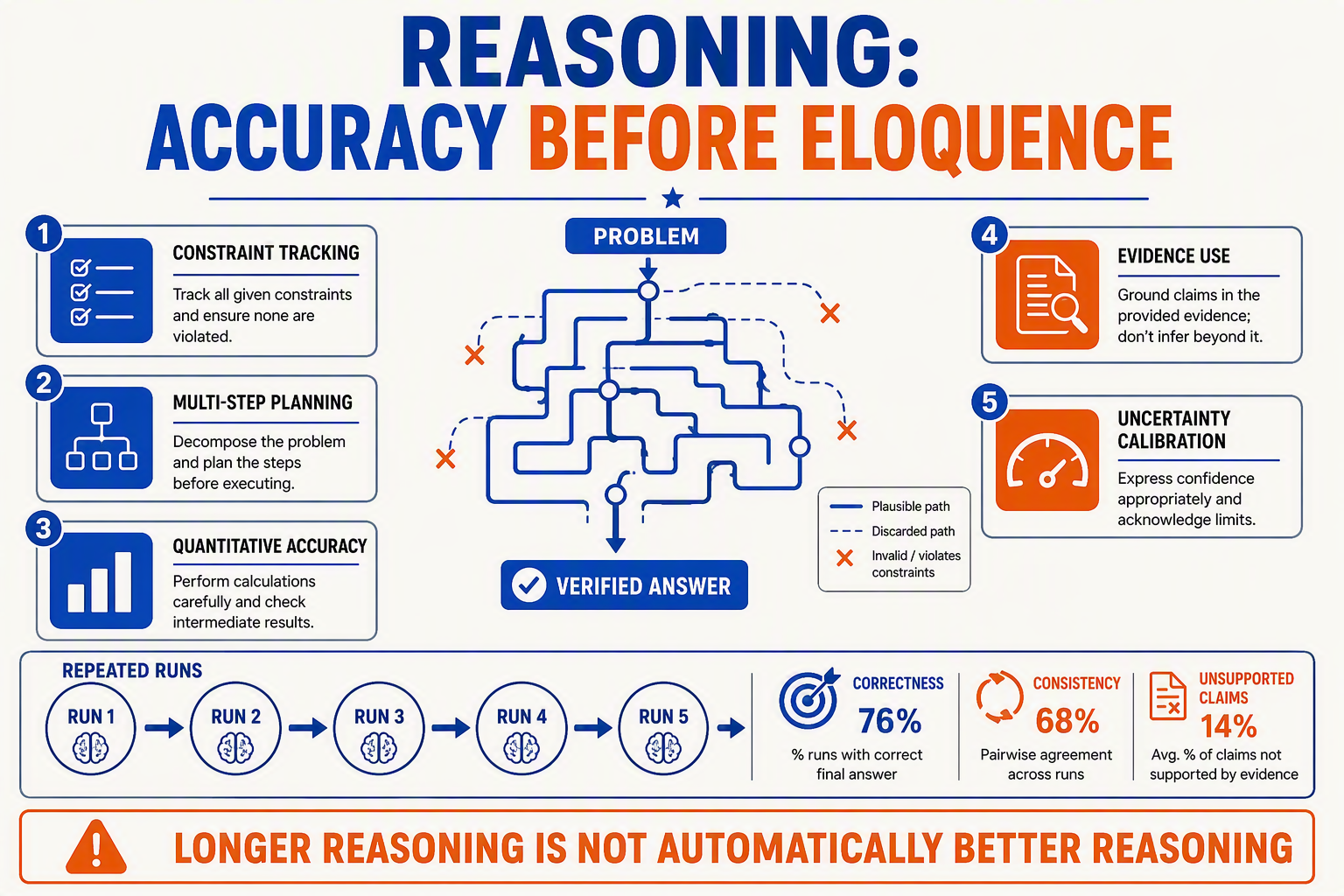
Neither Claude Opus 5.5 nor GPT-5.6 Sol should be declared more reliable at difficult reasoning without independent, workload-specific testing. The useful question is not which model posts the highest headline benchmark, but which produces fewer consequential errors, preserves constraints and requires less human review on your actual tasks.
How should difficult reasoning be tested?
Use a representative evaluation set with objectively scorable outcomes, not open-ended prompts judged by preference. Build 50–200 cases from the domains in which the model will operate, remove any sensitive data and keep a hidden holdout set to reduce prompt overfitting.
Suitable cases include:
- Software engineering: repository-level bug fixes validated by unit, integration and regression tests.
- Finance: reconciliations where totals, currencies, accounting periods and formulas have known answers.
- Legal operations: clause extraction scored against lawyer-labelled spans, without treating model output as legal advice.
- Customer support: policy decisions checked against eligibility rules, escalation requirements and approved remedies.
- Agent workflows: multi-step tasks evaluated by final state, permitted tool calls and prohibited side effects.
Run each case multiple times because a single successful response does not establish reliability. Use the same prompt, tools, context, temperature, output schema and retry policy for Claude Opus 5.5 and GPT-5.6 Sol.
Does the model retain constraints throughout long tasks?
A reasoning model can reach the right broad conclusion while violating an important instruction. Track constraint retention separately from answer accuracy by testing requirements such as budget ceilings, jurisdiction, date cut-offs, mandatory citations, output schemas and “do not execute” boundaries.
A practical scorecard should report:
- Exact task success rate
- Hard-constraint violation rate
- Unsupported-claim rate
- Tool-selection and argument accuracy
- Valid structured-output rate
- Performance after long context or many agent steps
Long-context testing should also reflect real cost. OpenAI’s GPT-5.6 Sol model documentation states that, as of September 2026, prompts exceeding 272,000 input tokens are charged at 2× the input rate and 1.5× the output rate. That pricing boundary makes retrieval quality and context discipline part of the business evaluation, not merely an engineering detail.
Which reasoning errors matter most?
Do not collapse every failure into one average. Classify errors as logical, factual, instructional, computational, tool-use, citation, or abstention failures, then weight them by business impact.
For example, an overly cautious clarification question may add latency but remain recoverable. An invented refund policy, incorrect tax calculation or unauthorized tool action can create direct financial or compliance exposure. Report both overall accuracy and the frequency of high-severity failures.
How should calibration and review burden be measured?
A reliable model should communicate uncertainty in a way that predicts correctness. Ask each model for a confidence estimate or structured risk label, then compare stated confidence with observed accuracy using calibration curves or a Brier score.
Also measure operational burden:
- Median human-review time per output
- Percentage accepted without edits
- Number and severity of corrections
- Retries required before acceptance
- Tokens, tool calls and total cost per approved result
Vendor benchmark results from Anthropic or OpenAI are useful product disclosures, but they are not independent proof that either model will win a particular workflow. As of September 2026, the defensible choice is the model with the lowest severity-weighted error rate and review cost on a blinded, repeatable evaluation using your own domain cases.
Which model is safer and more reliable for agents and business automation?
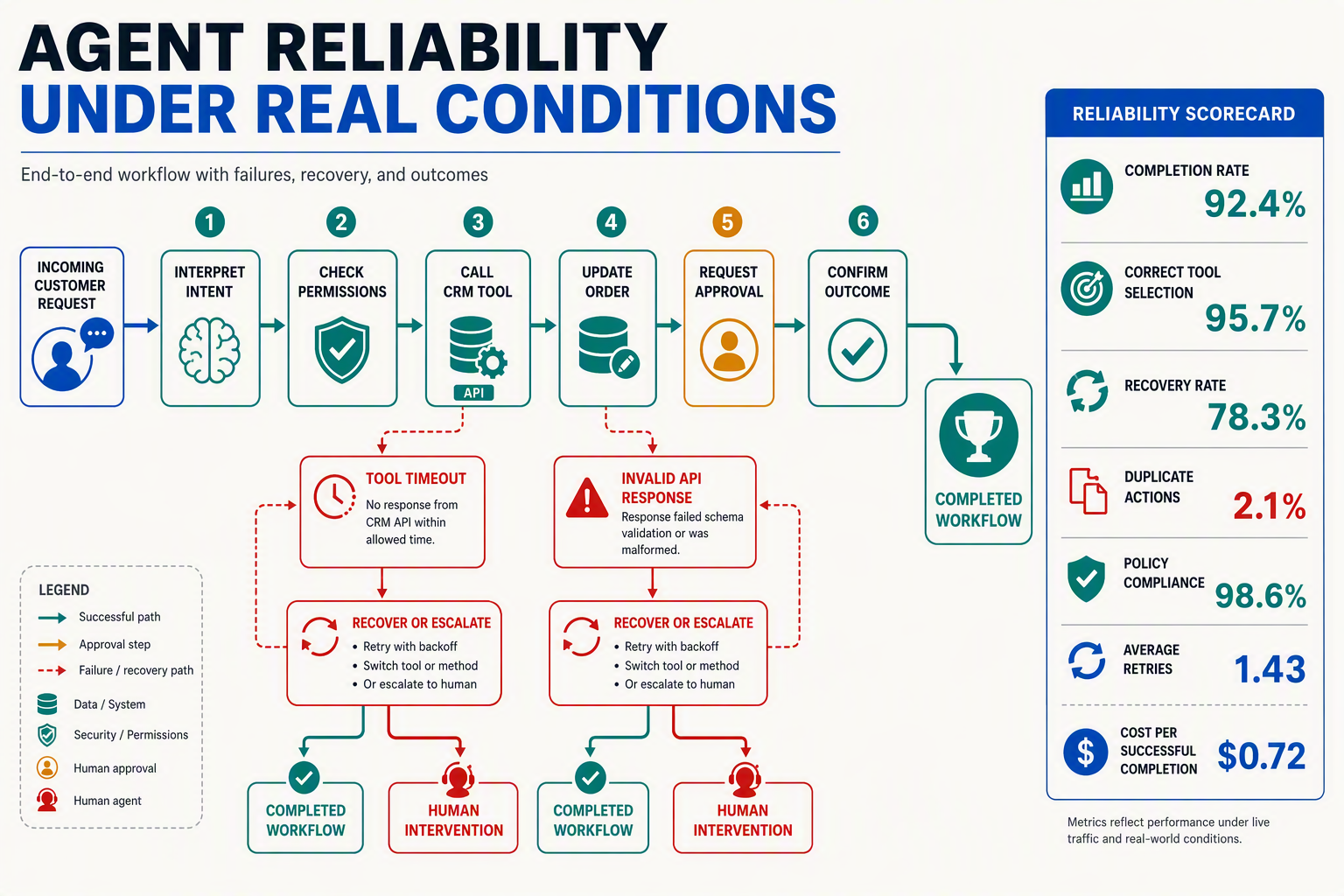
Neither Claude Opus 5.5 nor GPT-5.6 Sol should be considered inherently safer or more reliable for business automation without workload-specific testing. Reliable agents come from a controlled execution architecture—restricted tools, validated outputs, approval gates and measurable recovery—not from model choice alone.
How should businesses test agent safety?
Run both models through the same sandboxed workflow using identical prompts, tools, permissions and retry policies. The test set should include routine tasks, ambiguous requests, malicious instructions and failures such as unavailable APIs or malformed customer records.
Track operational metrics rather than relying exclusively on vendor benchmarks:
- Unauthorized-action rate: Attempts to invoke tools or access data outside the task’s scope.
- Schema-valid completion rate: Outputs that satisfy required types, fields and business rules.
- Human-intervention rate: Runs requiring correction, clarification or approval.
- Recovery rate: Failed runs that resume safely without duplicated actions.
- Cost per completed run: Total model, tool, retry and review costs divided by successful outcomes.
A model with a lower token price can still cost more if it produces repeated tool calls, long reasoning traces or frequent retries. OpenAI stated on August 21, 2026, that it reduced GPT-5.6 Sol API and credit pricing by more than 20% for three months; OpenAI’s API documentation says the promotional pricing remains available at least through November 21, 2026. That discount is a useful cost input, but it is not evidence of greater agent reliability.
Which controls make AI agents safer?
Use least privilege so each agent receives only the tools and data needed for the current task. A support agent might read an order status, for example, while refunds, account changes and outbound payments remain unavailable or require separate authorization.
Production implementations should also include:
- Controlled tools: Allowlist operations and constrain arguments, destinations, amounts and record types.
- Schema validation: Reject malformed tool calls before execution and validate outputs against JSON Schema plus domain rules.
- Idempotency keys: Ensure a retry cannot create duplicate orders, tickets, emails or payments.
- Approval gates: Require a person to authorize irreversible, regulated or high-value actions.
- Audit logs: Record prompts, model versions, tool arguments, results, approvals, errors and costs.
- Data boundaries: Prevent untrusted documents, emails or web content from silently overriding system policies.
Platforms such as CallMissed, the OpenAI-compatible developer AI API, support structured outputs, function calling, caller-selected fallback models, and usage and request logs as of September 2026. Those capabilities can form part of a controlled agent stack, although the application must still enforce permissions, validation and approval policy.
How do you test recovery and reliability?
Deliberately inject failures: timeouts, rate limits, invalid JSON, stale records, duplicate callbacks and partially completed transactions. Verify that the workflow stops safely, preserves state and resumes from a known checkpoint instead of repeating every action.
For a fair Claude Opus 5.5 vs GPT-5.6 Sol evaluation, report median and worst-case cost per completed run across several hundred representative tasks. Choose the model that delivers the required success rate under your organization’s controls and budget—not the one with the strongest promotional claim or cheapest nominal token price.
What do vendor benchmarks, independent tests, and expert opinions actually prove?

No available evidence establishes a universal winner between Claude Opus 5.5 and GPT-5.6 Sol. Vendor benchmarks indicate controlled capability, independent reproducible tests reveal performance on defined workloads, and expert opinions provide useful field observations—but none alone proves which model will perform better in a specific production system.
What do vendor benchmarks actually prove?
Vendor benchmarks show how a model performed under the vendor’s selected test configuration. They can indicate strengths in coding, reasoning, tool use or long-context processing, but results depend on prompts, sampling parameters, reasoning budgets, tool access and scoring methods.
Before accepting a benchmark claim, check whether the vendor discloses:
- The exact model version or snapshot
- Whether responses used tools, multiple attempts or pass@k scoring
- Token and reasoning limits
- The evaluation dataset and contamination controls
- Whether human graders, automated judges or another model scored outputs
- Latency and cost per completed task
Vendor results are valuable for generating hypotheses. They cannot prove that one model is categorically better for every codebase, agent workflow or business process. The research supplied for this comparison does not verify comparative benchmark scores for Claude Opus 5.5 versus GPT-5.6 Sol, so no score-based winner should be inferred.
What counts as credible independent testing?
An independent test is persuasive only when another team can reproduce it. A credible comparison publishes its prompts, source files, expected outputs, model identifiers, API settings, retry policy, evaluation code and test date.
Practical evaluations should measure outcomes that match the intended workload:
- Coding: tests passed, regressions introduced, review time and cost per accepted patch
- Reasoning: answer accuracy, unsupported assumptions and consistency across repeated runs
- Agents: tool-call success, recovery from failed tools, completion rate and total steps
- Business automation: extraction accuracy, human-escalation rate, processing time and cost per successful case
Run multiple trials because stochastic models can produce different answers to identical prompts. Blind human review is preferable where style or judgment matters, while deterministic unit tests are stronger for executable code.
Teams can record these experiments through their own observability stack. As of September 2026, CallMissed, the OpenAI-compatible AI gateway, provides usage and request logs, structured outputs and caller-selected fallback models, which can help developers apply a consistent harness to supported models without conflating one successful demo with repeatable performance.
How much weight should expert opinions receive?
Expert opinions identify real-world failure modes, but anecdotes do not establish comparative performance. A developer’s positive result may reflect a particular repository, prompt, subscription tier, toolchain or reasoning setting.
For example, an OpenAI Developer Community user reported in September 2026 that token consumption increased by more than five times after an update. That report is operationally relevant, but without controlled before-and-after testing it cannot prove a general change in efficiency.
Pricing announcements are firmer but still do not measure quality. OpenAI stated on August 21, 2026 that it reduced GPT-5.6 Sol API and credit pricing by more than 20% for three months, and OpenAI’s API documentation says the promotional pricing remains available at least through November 21, 2026. This proves a time-limited price change—not better coding, reasoning or agent performance.
The defensible conclusion is therefore workload-specific: shortlist both models, test them with identical production-like tasks, and choose using success rate, latency, human correction effort and total cost rather than headline scores or testimonials.
Which model should you choose for each workload and budget?
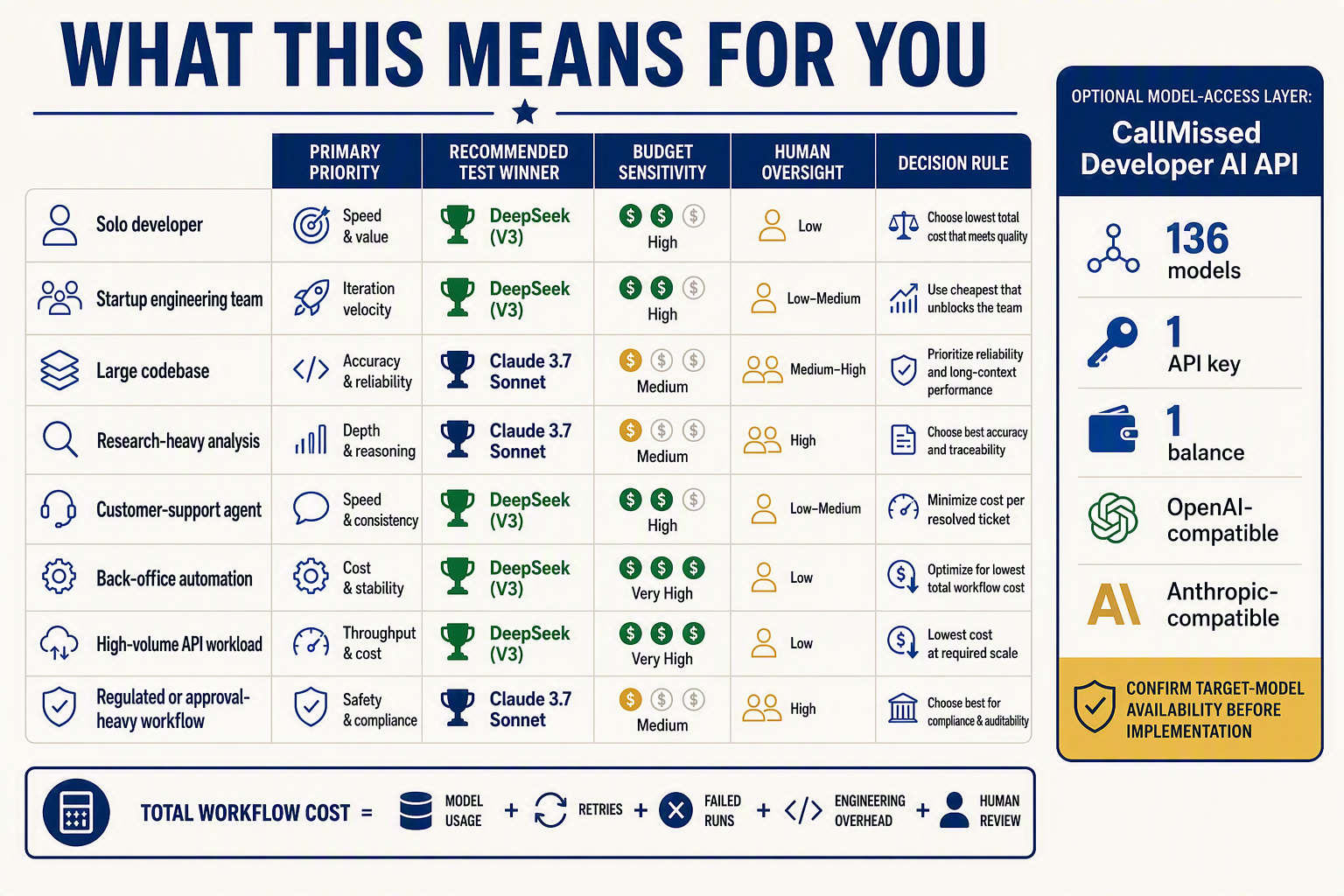
Choose Claude Opus 5.5 or GPT-5.6 Sol through a controlled pilot, then route each workload according to measured quality, risk and total token cost. Neither model should be declared the universal winner without testing representative tasks against the current API versions and production constraints.
What is the best model for each workload and budget?
| Workload | Risk and evaluation criteria | Budget consideration | Pilot-and-routing recommendation | Required controls |
|---|---|---|---|---|
| Drafting, classification and extraction | Low risk when outputs are reviewed or validated against a schema | Test cheaper models first; reserve frontier models for failures or ambiguous inputs | Send a representative sample to both Claude Opus 5.5 and GPT-5.6 Sol, then route routine jobs to the lowest-cost model meeting accuracy thresholds | Structured outputs, confidence rules and spot checks |
| Repository-wide coding changes | Medium to high risk because edits can break interfaces, tests or security assumptions | Measure cost per accepted pull request—not cost per token alone | Compare both models on the same repositories, tool permissions and test suites; route by language, repository and change type | Sandboxed execution, unit tests, static analysis and human code review |
| Complex reasoning and agent planning | Errors may propagate across multiple tool calls | Long traces can make output-token charges material | Pilot identical scenarios and score task completion, unnecessary tool calls, recovery behavior and total cost | Tool allowlists, step limits, audit logs and fallback models |
| Long-context document or code analysis | Retrieval failures and missed details matter more than fluent summaries | GPT-5.6 Sol prompts above 272,000 input tokens incur higher rates | Use retrieval or chunking first; test direct long-context processing only when it improves grounded accuracy enough to justify the surcharge | Citation checks, context-quality tests and token monitoring |
| Customer-service and business automation | Medium risk when actions affect orders, appointments or CRM records | Route simple intents economically and escalate uncertain cases | Benchmark both models on real intent distributions; reserve the stronger pilot performer for exceptions and multi-system actions | Human handoff, idempotent tools, permission boundaries and transaction confirmation |
| Regulated or high-impact decisions | High risk in finance, healthcare, employment or legal workflows | Compliance and review costs outweigh small token-price differences | Use either model only for decision support after domain-specific validation; require human approval before consequential action | Data governance, documented evaluations, audit trails and mandatory approval |
How should GPT-5.6 Sol pricing affect routing?
As of September 2026, OpenAI’s API pricing page lists promotional GPT-5.6 Sol rates of $4 per million input tokens, $0.40 per million cached input tokens and $20 per million output tokens. OpenAI states that these promotional rates remain available at least through November 21, 2026, so production budgets should also model pricing after the promotion.
OpenAI’s GPT-5.6 Sol documentation states that prompts exceeding 272,000 input tokens cost twice the input rate and 1.5 times the output rate. At the September 2026 promotional rates, that means $8 per million input tokens and $30 per million output tokens for qualifying requests. Teams should therefore compare retrieval-augmented generation, prompt compression and direct full-context processing before routinely crossing that threshold.
How should you validate Claude Opus 5.5 costs and limits?
Confirm Claude Opus 5.5 pricing, context limits, rate limits and regional availability directly with Anthropic before procurement or publication; no unverified Claude price should be used in the business case. Normalize both vendors’ bills into practical measures such as cost per merged change, resolved ticket, approved extraction or successfully completed agent run.
A routing layer can preserve flexibility as evidence changes. For example, CallMissed’s OpenAI-compatible developer API supports caller-selected fallback models, bring-your-own provider keys, response caching, and usage and request logs—capabilities that illustrate how teams can evaluate and route workloads without hard-coding every workflow to one provider.
Frequently Asked Questions
How can buyers access GPT-5.6 Sol and Claude Opus 5.5?
Is GPT-5.6 Sol included with ChatGPT, or does it require API access?
What usage and rate limits apply to GPT-5.6 Sol and Claude Opus 5.5?
What privacy and contractual checks matter?
What should businesses review before sending sensitive data to either model?
Which contract terms can materially change the comparison?
How should teams calculate cost and avoid lock-in?
How do prompt caching and long contexts affect GPT-5.6 Sol’s real cost?
What observability and exit planning should buyers require?
Conclusion
The practical verdict is test first, route second, standardize last. Without independent, workload-matched evidence, neither Claude Opus 5.5 nor GPT-5.6 Sol should be declared the universal winner.
- Choose by completed-task quality: Start with Claude Opus 5.5 for architecture-sensitive repository changes and instruction-heavy analysis; evaluate GPT-5.6 Sol for high-volume coding, tool-using agents and routine business automation.
- Model the full cost: OpenAI lists GPT-5.6 Sol’s promotional API pricing at $4 per million input tokens, $0.40 per million cached input tokens and $20 per million output tokens as of September 2026.
- Account for long-context surcharges: OpenAI states that prompts exceeding 272,000 input tokens cost 2× for input and 1.5× for output—effectively $8 and $30 per million tokens, respectively, at promotional rates.
- Verify before procurement: OpenAI says the promotion remains available at least through November 21, 2026. Teams should confirm Claude Opus 5.5’s current pricing, availability and limits directly from Anthropic’s primary documentation before committing budgets.
Watch for post-promotion pricing, model updates and stronger independent agent benchmarks. Developers can also explore CallMissed, an OpenAI-compatible AI gateway offering one balance across 136 models as of September 2026. Which model delivers the lowest cost per successful run on your own production tasks?
Related Reading
- GPT-6 Sol vs Claude Opus 5.5: Verified Comparison
- Claude Fable 5.1 vs GPT-5.6 Sol: Pricing, Coding & Voice Agents
- Claude Opus 5.5 vs GPT-6 Astra: 2026 Comparison
Sources
Discussion
Related Posts


Ready to automate customer conversations?
Launch AI voice agents and WhatsApp bots with CallMissed — one API, 22+ Indian languages.