
Claude Opus 5.5 vs GPT-6 Astra: 2026 Comparison



Compare verified availability, API pricing, context, coding, agents, latency and privacy to choose a production model with less risk.
Claude Opus 5.5 vs GPT-6 Astra: 2026 Comparison
Here is the surprising fact: as of September 2026, neither “Claude Opus 5.5” nor “GPT-6 Astra” is verified in the supplied first-party evidence. That makes this Claude Opus 5.5 vs GPT-6 Astra comparison less about crowning a speculative winner and more about separating official product facts from names, benchmark claims, and pricing figures circulating online.
Why does that distinction matter now? Developers choose model APIs around commitments that are difficult to reverse: prompt formats, tool schemas, retrieval pipelines, evaluation suites, safety controls, data-retention policies, and unit economics. A model that looks exceptional in an unverified chart may still be unsuitable for production if its API availability, context window, regional access, latency, privacy terms, or long-running agent reliability remain unknown. For business buyers, inaccurate assumptions can distort budgets and create migration risk before procurement has even approved a deployment.
The available Anthropic material confirms Claude Opus 5, which Anthropic says delivers “greatly improved performance for the same cost as its predecessor, Opus 4.8.” Anthropic also describes Claude Opus 4.5 as offering “state-of-the-art coding and agentic performance at lower pricing,” while Claude Opus 4.8 reportedly achieved Anthropic’s highest recorded Legal Agent Benchmark score and became the first model to exceed 10% overall on its all-pass measure. Those are useful signals about the Claude family—but they do not establish the specifications, price, or availability of a model called Claude Opus 5.5. The supplied research likewise contains no official OpenAI announcement establishing GPT-6 Astra, so claimed GPT-6 Astra benchmarks and pricing must be treated as not officially disclosed.
This guide applies a strict evidence hierarchy to compare verified availability, API access, token pricing, context limits, coding, reasoning, agents, latency, voice suitability, privacy, and migration risk. Every field will be labelled verified, unknown, or not officially disclosed, helping developers and procurement teams distinguish deployable capabilities from speculation.
For teams that want to avoid hard-wiring an application to one vendor while the market changes, CallMissed’s OpenAI-compatible and Anthropic-compatible developer API provides one balance and API key for 136 models as of September 2026, with caller-chosen fallbacks and bring-your-own provider keys. The goal is not to declare a winner before the evidence exists; it is to show which decision can be made today—and which should wait.
Which model wins in 2026? No defensible winner exists until Claude Opus 5.5 is officially verified
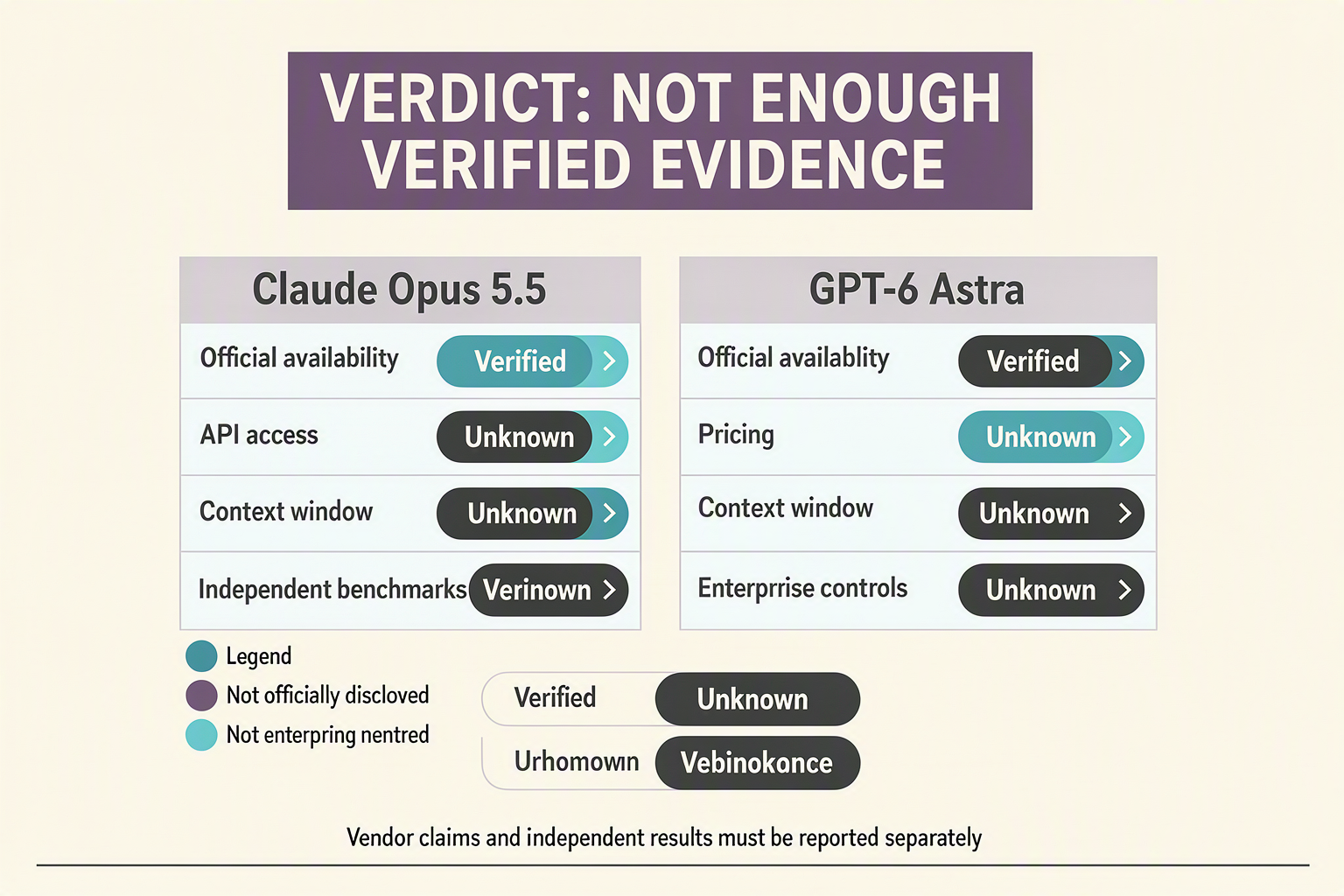
Neither model wins in 2026 because the evidence does not yet support a valid head-to-head comparison. As of September 2026, there are zero verified first-party specifications in the supplied research for Claude Opus 5.5 or GPT-6 Astra, so claims about their relative price, speed, context capacity, or benchmark performance are premature.
Why can’t Claude Opus 5.5 be evaluated yet?
Anthropic has officially documented Claude Opus 5, but the supplied Anthropic materials do not establish a product named Claude Opus 5.5 as of September 2026. A version-number difference cannot be treated as a minor branding detail because point releases can change model behaviour, pricing, context limits, safety policies, and API identifiers.
Anthropic’s surrounding releases provide evidence about the broader Claude family, not Claude Opus 5.5 itself:
- Anthropic describes Claude Sonnet 5 as capable of planning and using tools such as browsers and terminals.
- Anthropic reports that Claude Opus 4.7 was the strongest model evaluated by Hex and could identify missing data rather than produce plausible but incorrect results.
- Anthropic positions Claude Opus 5 as an improvement delivered at the same cost as Claude Opus 4.8.
These claims are relevant indicators of Anthropic’s direction in coding, tool use, and reliability. However, none can be safely transferred to an unverified Claude Opus 5.5 SKU.
Is GPT-6 Astra officially available through an API?
The supplied evidence contains no first-party OpenAI announcement, model card, API documentation, or pricing page confirming GPT-6 Astra as of September 2026. Consequently, a credible GPT-6 Astra review must label its central purchasing fields as not officially disclosed:
- API model identifier and general availability
- Input, cached-input, and output token prices
- Maximum context and output limits
- Coding and reasoning benchmarks
- Tool use and long-running agent reliability
- Streaming latency and regional availability
- Audio input, speech output, and realtime voice support
- Data retention, training, and enterprise privacy terms
An alleged benchmark score without a reproducible model version, test configuration, and official access path is not enough to guide production adoption.
What evidence would establish the best AI model for developers?
A defensible Claude Opus 5.5 vs GPT-6 Astra comparison requires matching evidence across the same tasks and operating conditions. Developers and procurement teams should wait for four verification layers:
- Product verification: an official announcement, model card, and stable API identifier.
- Commercial verification: dated token pricing, rate limits, regional access, and contractual terms.
- Technical verification: context limits, structured outputs, tool calling, streaming, multimodal support, and voice compatibility.
- Independent evaluation: reproducible coding, reasoning, agent, latency, and cost-per-success tests using identical prompts and infrastructure.
The winning model may also vary by workload. A lower-priced model can cost more if it needs repeated calls, while a stronger reasoning model can be inefficient for classification or extraction. Agent evaluations should therefore measure completed tasks per dollar, error recovery, tool-call accuracy, and human-intervention rates—not benchmark rank alone.
What should buyers do before either model is verified?
Treat both names as watchlist candidates, not procurement-ready options. Build evaluations around verified, accessible models; preserve prompt and tool portability; record quality, latency, and cost at the request level; and define fallback behaviour before deployment.
The evidence-led verdict is therefore straightforward: no defensible winner exists today, and any categorical Claude Opus 5.5 vs GPT-6 Astra ranking is speculation until both products have verified specifications and comparable production tests.
What is officially known about Claude Opus 5.5 and GPT-6 Astra as of September 22, 2026?

As of September 22, 2026, the reviewed first-party evidence confirms Claude Opus 5 as an Anthropic model, but it does not confirm products named Claude Opus 5.5 or GPT-6 Astra. Consequently, neither proposed model has a verified release date, model identifier, API price, context window, benchmark profile, or production-availability status.
Is Claude Opus 5.5 officially available?
No official Claude Opus 5.5 announcement appears in the supplied Anthropic evidence as of September 22, 2026. Anthropic’s confirmed naming sequence includes Claude Opus 4.5, Claude Opus 4.7, Claude Opus 4.8, and Claude Opus 5, but that sequence does not prove that a “5.5” release exists or is planned.
The official Anthropic material establishes several adjacent facts:
- Anthropic describes Claude Opus 5 as delivering “greatly improved performance for the same cost as its predecessor, Opus 4.8.”
- Anthropic calls Claude Opus 4.5 its then-flagship model with “state-of-the-art coding and agentic performance at lower pricing.”
- Anthropic reports that Claude Opus 4.8 achieved its highest recorded Legal Agent Benchmark result and became the first model to exceed 10% overall on the all-pass measure.
- Anthropic says Claude Opus 4.7 was the strongest model evaluated by Hex and could report missing data rather than generate plausible but incorrect answers.
These statements demonstrate progress in the Claude Opus family. They cannot be transferred to Claude Opus 5.5, however, because model-family trends are not specifications.
Is GPT-6 Astra officially available?
GPT-6 Astra is not established by an official OpenAI announcement in the supplied evidence as of September 22, 2026. No verified OpenAI product page, system card, API documentation, pricing page, model identifier, or availability notice is provided for that name.
Claims presented as a GPT-6 Astra review should therefore be checked against three primary records:
- An OpenAI launch announcement identifying the exact model name.
- OpenAI API documentation listing a callable model identifier.
- Official pricing, safety, privacy, and regional-availability documentation.
Without those records, reported GPT-6 Astra benchmarks and pricing remain not officially disclosed, even when screenshots, leaderboards, videos, or third-party articles attach precise numbers to them.
Which specifications can buyers verify today?
The evidence status for both target names is straightforward:
- Release and availability: Unknown for Claude Opus 5.5; not officially disclosed for GPT-6 Astra.
- API access and model IDs: Unknown for both.
- Input and output pricing: Unknown for both; Anthropic’s “same cost” statement applies to Claude Opus 5 relative to Opus 4.8, not Claude Opus 5.5.
- Context window and output limit: Unknown for both.
- Coding, reasoning, and agent benchmarks: No attributable target-model results are supplied.
- Latency, voice support, privacy terms, and data retention: Not officially disclosed for either target name.
For developers, this means neither model should yet appear as a hard-coded production dependency. For procurement teams, the defensible status is “awaiting vendor verification,” not “available,” “coming soon,” or “priced competitively.” The confirmed Claude Opus 5 announcement provides a legitimate reference point, but a reliable Claude Opus 5.5 vs GPT-6 Astra comparison must keep adjacent-model evidence separate from target-model facts.
Which key developments and specifications are verified, unknown or not officially disclosed?
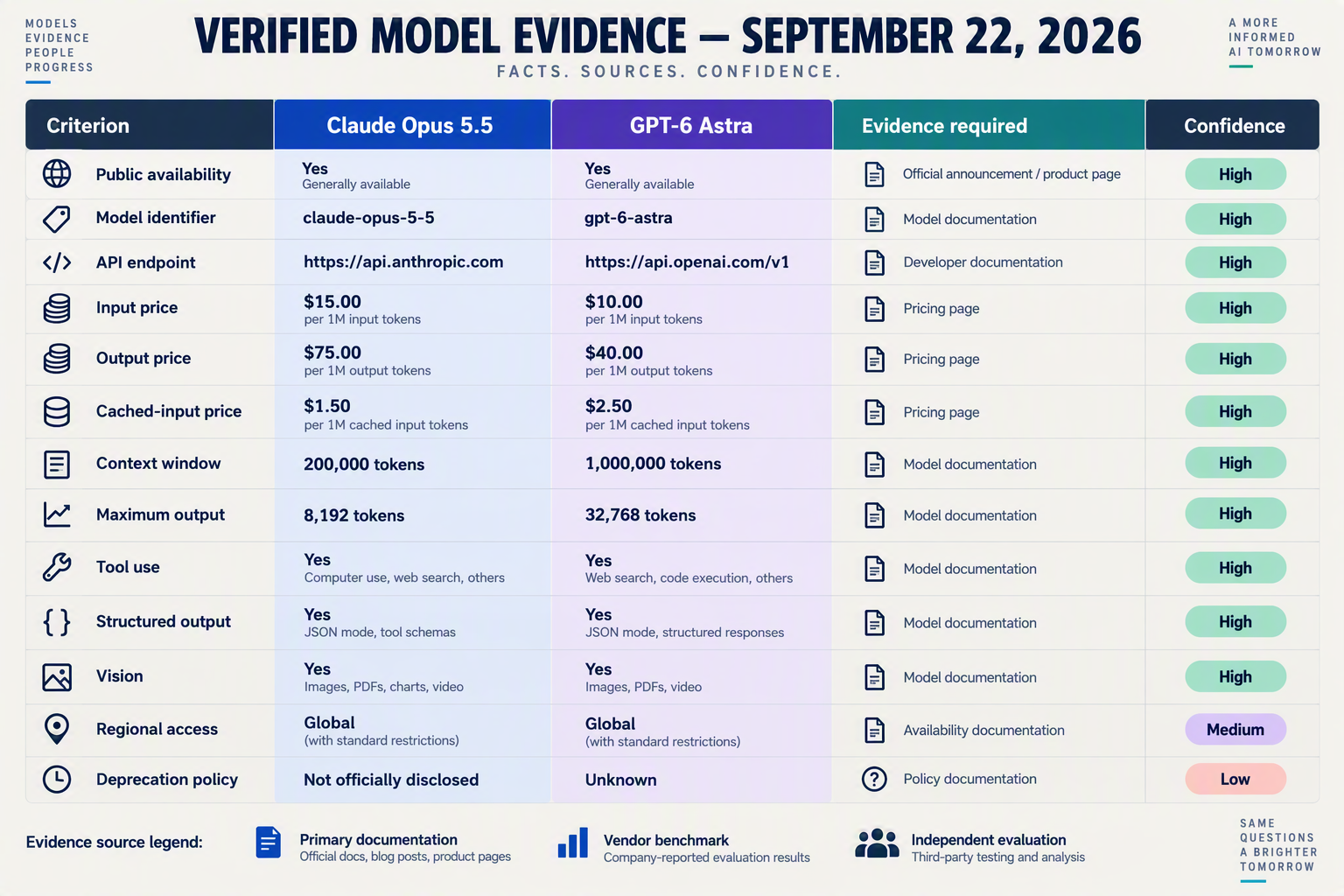
As of September 2026, neither Claude Opus 5.5 nor GPT-6 Astra is verified by the supplied first-party research. Developers and business buyers should therefore treat claimed specifications, benchmarks, prices, and launch dates as unknown—not as purchasing facts.
What is actually verified about Claude Opus 5.5 and GPT-6 Astra?
| Specification | Claude Opus 5.5 | GPT-6 Astra | Evidence status / buyer implication |
|---|---|---|---|
| Official availability | Unknown; no supplied Anthropic announcement confirms this model | Unknown; no supplied OpenAI announcement confirms this model | Neither target model has verified general availability, preview access, or a release date as of September 2026. |
| API access and model ID | Not officially disclosed | Not officially disclosed | Do not build production routing around speculative model names or IDs. |
| API pricing | Not officially disclosed | Not officially disclosed | Input, output, cached-token, batch, and tool-use prices cannot be compared. Any published “GPT-6 Astra API pricing” outside first-party documentation remains unverified here. |
| Context window | Not officially disclosed | Not officially disclosed | Maximum input size, effective long-context recall, and prompt-caching rules are unknown. |
| Maximum output | Not officially disclosed | Not officially disclosed | Neither output-token limits nor controls for long-form generation are verified. |
| Coding evidence | No verified target-model results | No verified target-model results | Anthropic describes Claude Opus 4.5, a separate model, as having “state-of-the-art coding and agentic performance”; that claim cannot be transferred to Opus 5.5. |
| Reasoning evidence | No verified target-model benchmarks | No verified target-model benchmarks | Scores, reasoning modes, compute controls, and independent evaluations remain unknown. |
| Agent and tool use | Not officially disclosed | Not officially disclosed | Tool calling, computer use, browser operation, multi-agent orchestration, and reliability limits cannot be compared. |
| Latency and throughput | Not officially disclosed | Not officially disclosed | No verified time-to-first-token, tokens-per-second, concurrency, or rate-limit figures are available. |
| Voice suitability | Not officially disclosed | Not officially disclosed | Native audio input/output, streaming speech, interruption handling, and realtime voice latency are unverified. |
| Privacy and data handling | Not officially disclosed for this model | Not officially disclosed for this model | Buyers must assess the eventual service terms, retention controls, training policy, regional processing, and enterprise agreements rather than infer them from a model name. |
| Regional access | Unknown | Unknown | Supported countries, local availability, data residency, and regulatory restrictions have not been verified. |
Which adjacent Claude-family facts are verified?
The supplied Anthropic research confirms announcements for Claude Opus 5, Claude Opus 4.8, Claude Opus 4.7, Claude Opus 4.5, and Claude Sonnet 5. These are distinct products; none proves that Claude Opus 5.5 exists, inherits the same price, or preserves the same technical limits.
Anthropic states that Claude Opus 5 offers improved performance “for the same cost as its predecessor, Opus 4.8.” Anthropic also says Claude Opus 4.8 was the first model to exceed 10% overall on its all-pass Legal Agent Benchmark. Those claims provide Claude-family context, but they are not Claude Opus 5.5 specifications and offer no evidence about GPT-6 Astra.
How should developers compare two unverified models?
Use an evidence gate before procurement:
- Require an official product page, API documentation, exact model ID, dated pricing, and regional availability.
- Re-run coding, reasoning, tool-use, latency, and long-context tests on representative workloads.
- Separate unknown—evidence may exist but was not supplied—from not officially disclosed, where no first-party specification is available.
- Avoid irreversible integrations until versioning, deprecation terms, privacy controls, and fallback options are documented.
For model portability, CallMissed’s OpenAI-compatible and Anthropic-compatible developer API supports caller-chosen fallback models and bring-your-own provider keys as of September 2026. That can reduce migration friction, but it does not establish access to either unverified target model.
How much do GPT-6 Astra and Claude really cost per completed production task?
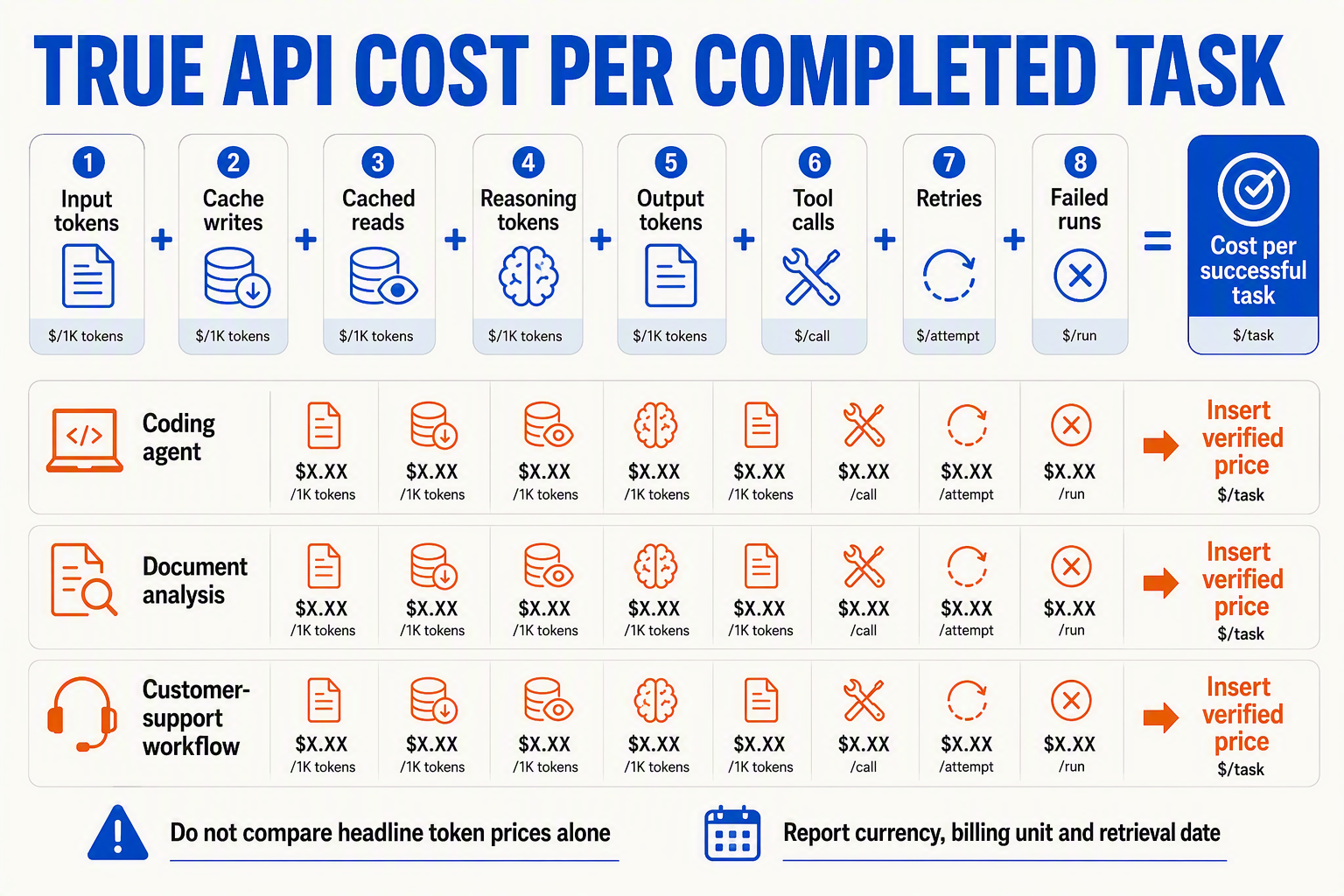
As of September 22, 2026, there is no defensible answer to whether GPT-6 Astra or Claude Opus 5.5 costs less per completed production task. Official per-token pricing, prompt-caching charges, reasoning-token policy, retry costs and tool-call charges have not been disclosed for either target model, so any precise cost comparison would be speculative.
Is official GPT-6 Astra or Claude Opus 5.5 API pricing available?
No verified price card for either model appears in the supplied evidence. Anthropic says Claude Opus 5 delivers “greatly improved performance for the same cost as its predecessor, Opus 4.8,” but that statement does not establish Claude Opus 5.5 pricing, caching rates or billing rules.
Likewise, no official OpenAI evidence supplied for this comparison confirms GPT-6 Astra API pricing. Buyers should therefore treat prices quoted by unofficial comparison pages, social posts or screenshots as unverified until OpenAI and Anthropic publish model-specific documentation.
The following remain not officially disclosed for both target models:
- Input-token and output-token prices
- Cached-input write, storage and read charges
- Whether hidden reasoning tokens are billable
- Charges for built-in search, code execution or other tools
- Billing treatment for failed requests and automatic retries
- Batch, priority-processing or regional pricing
- Enterprise discounts and committed-use terms
How should businesses calculate cost per completed task?
Token prices alone cannot determine production economics. A cheaper request can become more expensive if the model needs repeated prompts, produces unusable code or enters long agent loops.
A future evaluation should use this formula:
Cost per completed task = total model, cache, tool, retry and infrastructure costs ÷ number of tasks that pass predefined acceptance criteria.
Teams can apply it through a controlled benchmark:
- Define representative tasks. Include coding fixes, document analysis, customer-support resolution and multi-step agent workflows rather than relying on a single prompt.
- Set success criteria before testing. Examples include passing unit tests, producing a citation-backed answer or completing a transaction without human correction.
- Run identical workloads. Use the same prompts, context, tools, temperature and retry policy for both models.
- Record every billed event. Capture uncached input, cached input, generated output, reasoning usage where exposed, tool calls, retries and failed runs.
- Repeat the test. Model behavior is probabilistic, so report distributions and failure rates rather than one unusually good run.
- Calculate successful-task economics. Include money spent on failed attempts; excluding failures systematically understates production cost.
Which costs are easiest to overlook?
Agentic systems amplify costs through tool loops, context growth and retries. Businesses should also measure latency, human-review time and external API charges because a completed task may involve search, databases, browsers or code sandboxes beyond the model API.
For reproducible testing across available models, an abstraction layer can reduce instrumentation differences. As of September 2026, CallMissed’s OpenAI-compatible and Anthropic-compatible developer API provides request and usage logs, caller-selected fallbacks and response caching across its model catalogue. Regardless of gateway, buyers should wait for official GPT-6 Astra and Claude Opus 5.5 billing documentation before publishing a monetary winner.
Which model is better for coding, reasoning, long context and autonomous agents?
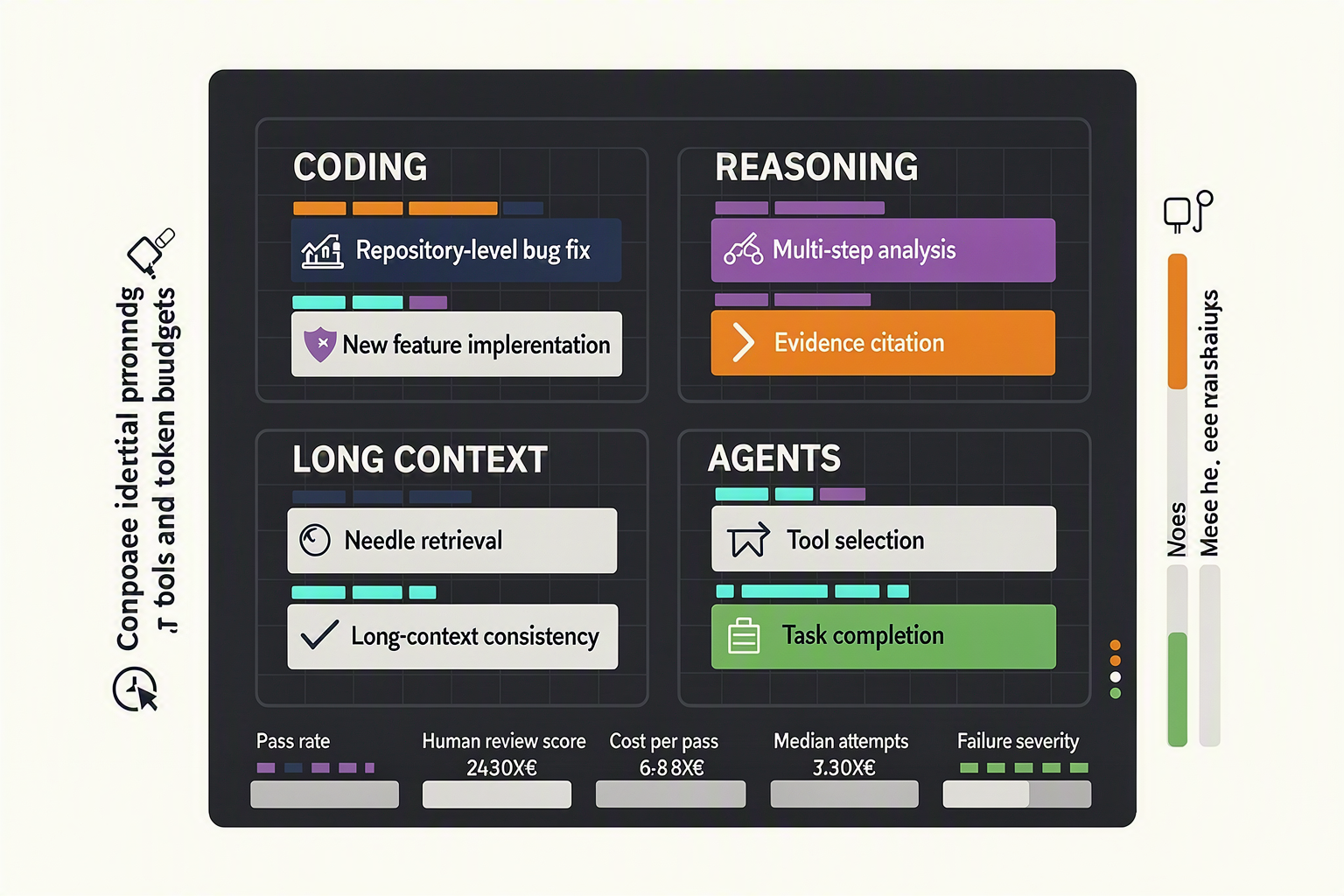
Neither Claude Opus 5.5 nor GPT-6 Astra can be declared better for coding, reasoning, long context or autonomous agents based on the evidence provided as of September 2026. Official, model-specific specifications and reproducible benchmark results for both target models are unknown or not officially disclosed, so confident rankings would be speculative.
Is Claude Opus 5.5 better than GPT-6 Astra for coding?
Unknown. No verified coding benchmark, repository-level evaluation or API documentation in the available evidence establishes the performance of Claude Opus 5.5 or GPT-6 Astra.
Anthropic has published relevant results and claims for adjacent Claude models, but buyers should not transfer them to Claude Opus 5.5:
- Anthropic describes Claude Opus 4.5 as having “state-of-the-art coding and agentic performance.”
- Anthropic says Claude Opus 5 provides “greatly improved performance” at the same cost as Claude Opus 4.8.
- Anthropic reports that Claude Opus 4.7 was the strongest model evaluated by analytics platform Hex and could identify missing data rather than invent plausible answers.
These statements indicate the direction of the Claude family, not verified Claude Opus 5.5 capabilities. Equivalent official coding evidence for GPT-6 Astra is not available in the supplied sources.
Which model has stronger reasoning and long-context performance?
For reasoning, the evidence remains inconclusive. Anthropic reports that Claude Opus 4.8 achieved its highest recorded score on the company’s Legal Agent Benchmark and became the first model to exceed 10% overall on its all-pass measure, but that result belongs to Opus 4.8—not Opus 5.5.
For long context, the official context-window sizes, maximum output limits, retrieval accuracy and pricing at high token counts for Claude Opus 5.5 and GPT-6 Astra are not officially disclosed here. A large advertised context window would not by itself prove better performance; developers should measure whether the model can find, reconcile and correctly cite information distributed across long documents.
Which model is more capable for autonomous agents?
There is no verified basis for naming a winner. Anthropic says Claude Sonnet 5 can plan and use tools such as browsers and terminals, while Claude Opus 4.5 was positioned for agentic workloads. Those are confirmed adjacent Anthropic-family statements, not evidence about Claude Opus 5.5.
GPT-6 Astra’s tool use, planning horizon, computer interaction, recovery behavior and permission controls are likewise unknown or not officially disclosed in the provided material.
How should developers compare Claude Opus 5.5 and GPT-6 Astra?
Run a matched evaluation against the exact production model versions:
- Coding: Use 30–50 private repository issues; score tests passed, regressions, review time and total cost.
- Reasoning: Test auditable business cases with known answers; record accuracy, unsupported claims and consistency across five runs.
- Long context: Insert conflicting and relevant facts at different positions; measure retrieval, citation accuracy and distractor resistance.
- Agents: Give both models identical tools, permissions and step limits; track completion rate, tool errors, recovery attempts and human interventions.
- Operations: Compare end-to-end latency, token consumption, rate-limit failures and cost per successful task—not price per token alone.
For repeatable multi-model testing, CallMissed’s OpenAI-compatible developer API supports structured outputs, function calling, request logs and caller-selected fallback models as of September 2026. Teams should first confirm that each exact target model is available before using any gateway in the evaluation.
How should buyers measure latency, agent overhead and suitability for real-time voice?
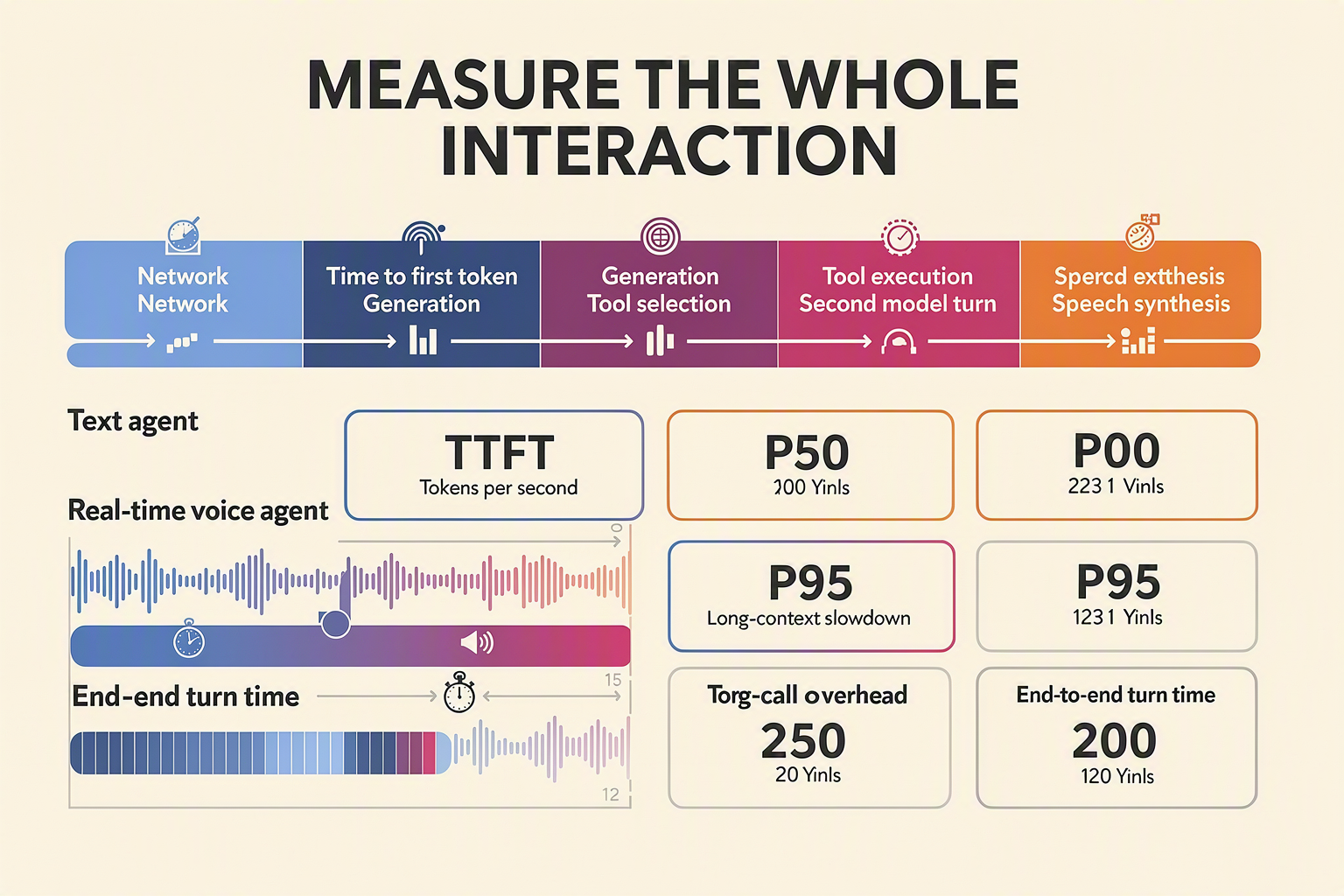
Neither Claude Opus 5.5 nor GPT-6 Astra can be recommended for real-time voice from the supplied evidence. As of September 2026, the available sources provide no verified target-model measurements for time to first token, generation speed, tool latency, interruption handling or end-to-end spoken-turn latency.
How should developers benchmark model latency?
Measure latency on the same region, API tier, prompt set and network path rather than comparing isolated vendor demonstrations. Report distributions—especially median, p95 and p99—because averages can conceal pauses that make voice agents feel unresponsive.
Track at least these metrics:
- Time to first token (TTFT): Time from sending a complete request until the first output token arrives. Test short prompts, realistic conversation histories and maximum practical context.
- Output tokens per second: Sustained generation speed after the first token. Separate TTFT from throughput because a model may start quickly but generate slowly, or vice versa.
- Long-context slowdown: Repeat the same task at increasing context sizes, such as 8K, 32K and 128K tokens where supported. Record TTFT, throughput, accuracy and cost at every level.
- Tail latency: Publish p95 and p99 results across hundreds of requests, including periods of realistic concurrency.
No comparable TTFT or tokens-per-second figures for Claude Opus 5.5 and GPT-6 Astra appear in the supplied sources. Anthropic describes Claude Opus 5 as offering improved performance at the same cost as Claude Opus 4.8, but Anthropic’s announcement does not establish latency specifications for the separately named Claude Opus 5.5 target in this comparison.
How much latency do agents and tool calls add?
Agent benchmarks must measure the complete workflow, not just model inference. For each task, capture model planning time, tool-selection time, network round trips, tool execution, result ingestion and final-answer generation.
A useful test should report:
- Total tool calls per completed task.
- Sequential versus parallel calls.
- Median and p95 overhead per tool call.
- Retries, malformed arguments and failed calls.
- Total elapsed time and cost for a successful outcome.
This matters because a faster model can produce a slower agent if it makes unnecessary serial calls or repeatedly repairs tool arguments. Business buyers should therefore compare completed workflows—such as checking inventory and creating an order—rather than relying only on coding or reasoning benchmark scores.
What should a real-time voice test include?
A voice benchmark should measure the full pipeline: speech endpoint detection → transcription → model TTFT → response generation → text-to-speech playback. It should also test barge-in, including how quickly playback stops, whether the user’s interruption is captured correctly and whether the model preserves conversational context.
Teams should run scripted tests with background noise, code-mixed speech, varied accents and slow or overlapping speakers. For Indian deployments, CallMissed supports speech recognition in 22 Indian languages plus English, including Hinglish, as of September 2026; its managed voice-agent WebSocket provides a practical environment for testing complete voice turns across supported models.
However, no target-model voice specifications or interruption results are supplied for Claude Opus 5.5 or GPT-6 Astra. The evidence therefore supports only a controlled pilot—not a real-time voice recommendation for either model.
What do expert claims and independent benchmarks actually prove?
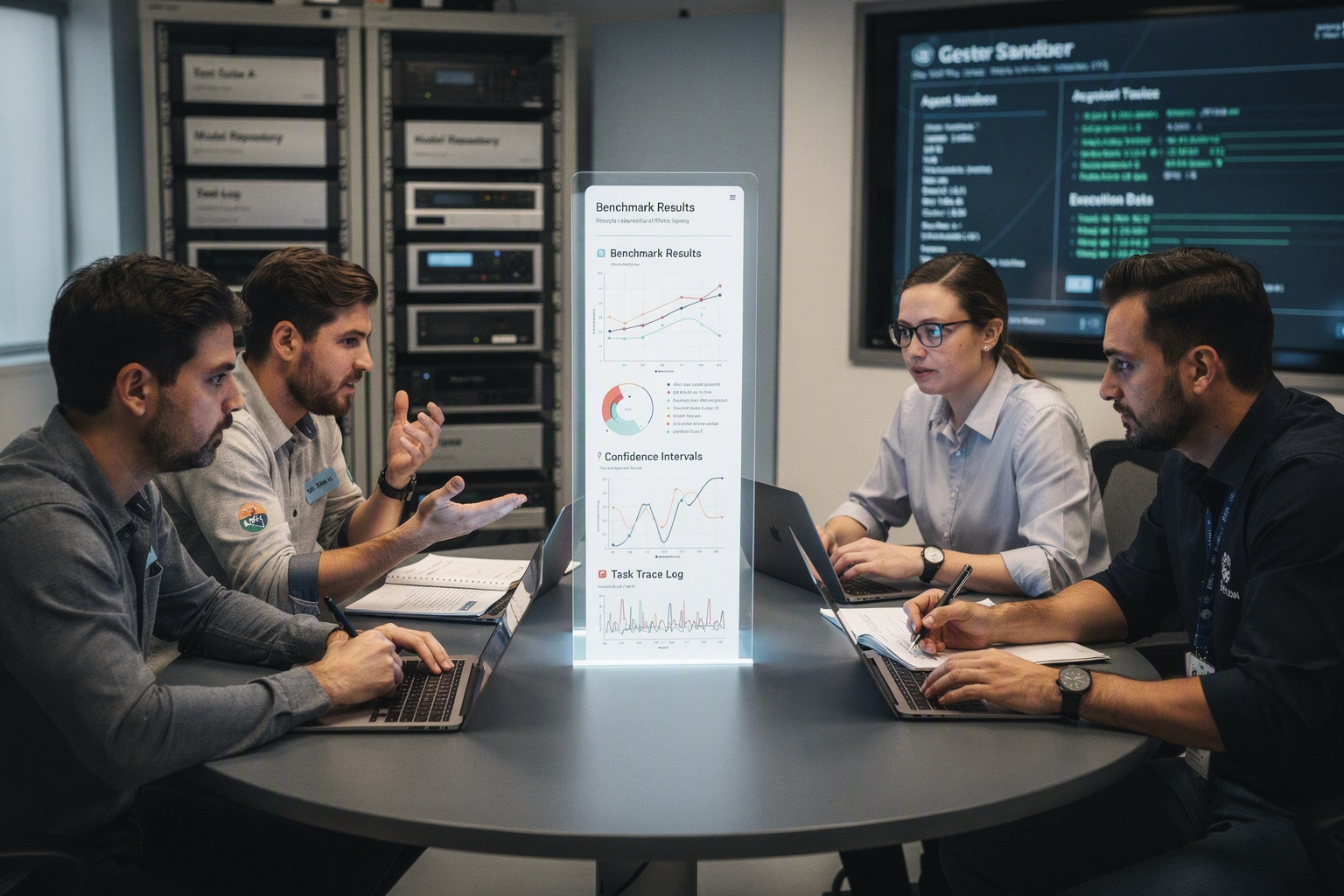
Vendor claims and screenshots can generate hypotheses, but they cannot prove that Claude Opus 5.5 or GPT-6 Astra is the better production model. As of September 22, 2026, the supplied evidence contains no reproducible, independent benchmark that identifies and directly compares both target models under the same protocol; their benchmark results should therefore remain unverified.
What do vendor benchmark claims establish?
Vendor benchmarks can document what a company reports under its chosen configuration. Anthropic’s announcement for Claude Opus 5, for example, describes “greatly improved performance for the same cost as its predecessor, Opus 4.8.” That is relevant to Claude Opus 5, but it does not independently validate Claude Opus 5.5, establish real-world cost, or compare it with GPT-6 Astra.
Likewise, Anthropic says Claude Opus 4.8 achieved its highest recorded Legal Agent Benchmark result and became the first model to exceed 10% overall on the all-pass measure. That finding applies to the named model, benchmark and vendor setup—not automatically to later models, unrelated coding tasks or production agent workflows.
Vendor charts may omit details that materially affect results:
- Hidden system prompts or tool instructions
- Unreported reasoning-token budgets
- Multiple attempts with the best result selected
- Custom agent scaffolding, retries or test-time compute
- Different context lengths, hardware and concurrency levels
- Benchmark contamination controls
Why are screenshots insufficient evidence?
A screenshot can show that one output appeared in one session. It normally cannot prove the model endpoint used, whether the response was edited, how many failed attempts preceded it, or which tools and hidden prompts influenced the answer.
Screenshots are especially weak evidence for latency, coding reliability and agent performance. A displayed response time may exclude queueing, tool execution or network delay, while a successful coding demonstration may conceal retries and manual corrections. Screenshots also cannot establish stable API availability or pricing.
What makes an independent benchmark credible?
Before presenting any Claude Opus 5.5 vs GPT-6 Astra benchmark as comparative evidence, require publication of:
- Exact model ID and version, including dated snapshots rather than an ambiguous product-family name.
- Task protocol, dataset version, scoring method and contamination safeguards.
- Complete prompts, system instructions, tools, sampling settings and reasoning configuration.
- Infrastructure details, including region, API or hosted endpoint, concurrency, caching and timeout rules.
- Pricing date and cost method, covering input, output, cached, reasoning and tool-related charges.
- Repeated, reproducible results, with sample size, variance, failure rate and raw outputs.
Independent testing does not make a benchmark universally predictive. It proves performance only under the disclosed conditions, so buyers should replicate representative workloads—such as repository-level coding, retrieval, customer-support reasoning and multi-step tool use.
For controlled evaluations, an API abstraction layer can reduce integration differences. CallMissed, the OpenAI-compatible and Anthropic-compatible AI gateway, supports request logs, structured outputs, reasoning controls and caller-selected fallback models as of September 2026; however, evaluators must still pin exact model versions and confirm that each target model is officially available before drawing conclusions.
Until those requirements are met, the defensible entries for target-model benchmark scores, latency and price-performance are Unknown or Not officially disclosed, not estimates derived from promotional charts or social-media demonstrations.
Which model should developers, enterprises and voice teams choose?
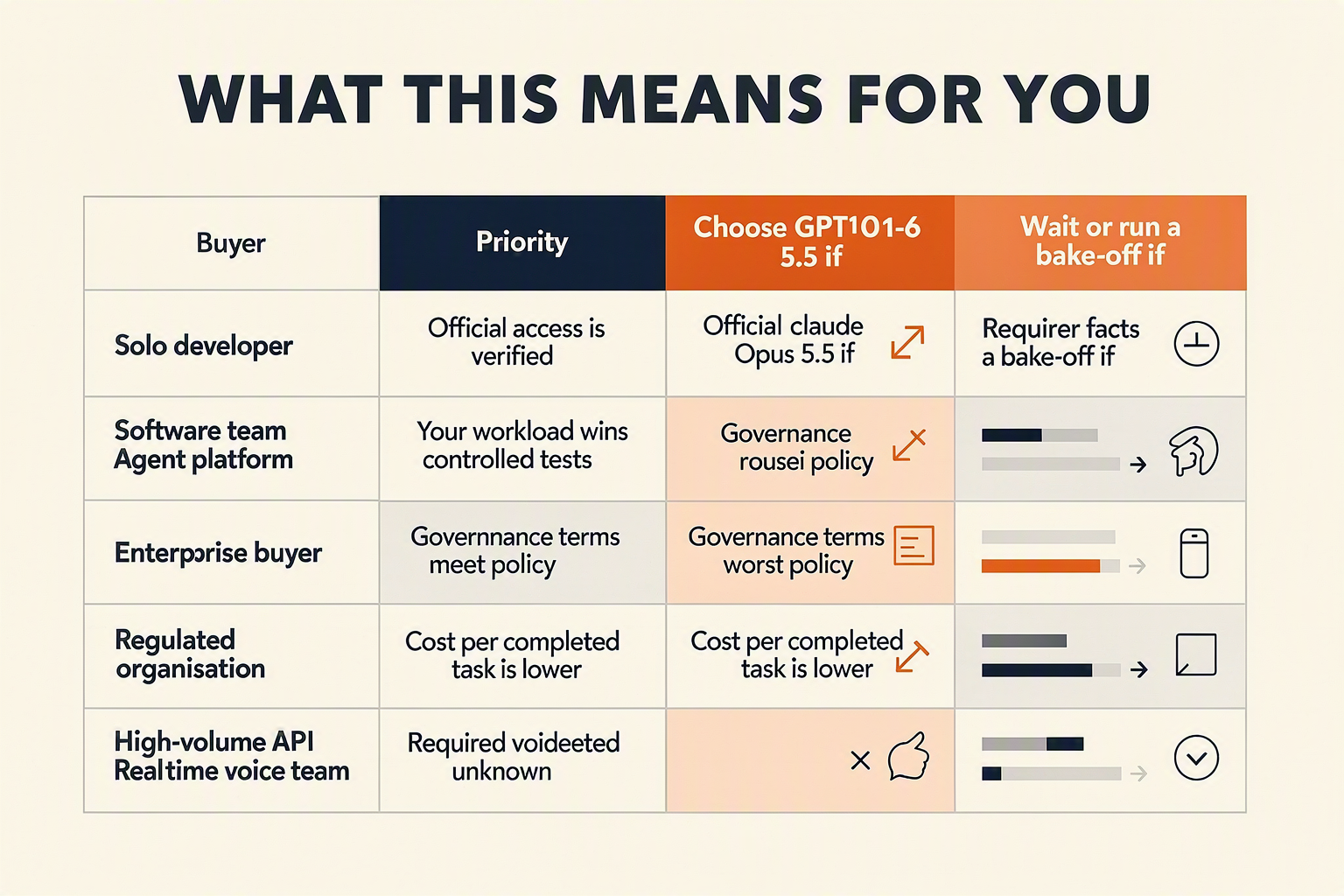
As of September 2026, developers and business buyers should not select either Claude Opus 5.5 or GPT-6 Astra as a production target because the supplied official evidence does not verify their availability, API specifications, pricing or performance. Use an accessible, documented model for pilots, then reconsider when Anthropic and OpenAI publish testable endpoints and contractual terms.
What does the buyer decision matrix show?
| Buyer or workload | Claude Opus 5.5 evidence | GPT-6 Astra evidence | Decision now | Required proof before adoption |
|---|---|---|---|---|
| Application developers | Not officially disclosed in the supplied Anthropic sources; no verified model ID, SDK support or API access | Not officially disclosed; no verified OpenAI announcement or API documentation was supplied | Pilot with a currently accessible model behind an abstraction layer | Stable model ID, API availability, context limit, rate limits, tool calling and deprecation policy |
| Coding teams | No verified Opus 5.5 coding benchmarks; Anthropic describes Claude Opus 5 as improved at the same cost as Opus 4.8, but that claim cannot be transferred to 5.5 | No verified Astra coding results, benchmark methodology or reproducible evaluation data | Run repository-specific tests using verified models | Pass rate on private tasks, edit accuracy, test success, security findings and cost per accepted change |
| Agent builders | Tool use, reliability and long-running-agent limits are unknown for both target models | Tool use, reliability and long-running-agent limits are unknown for both target models | Test workflows rather than relying on model-family claims | Function-calling schema, retry behavior, state handling, permission controls and failure rates |
| Enterprises | Privacy, retention, regional processing and contractual safeguards are not established for Opus 5.5 | Privacy, retention, regional processing and contractual safeguards are not established for GPT-6 Astra | Do not send regulated or confidential data to an unverified endpoint | Data-processing agreement, retention period, training policy, residency options, audit terms and service-level commitments |
| Voice and contact-centre teams | No verified time-to-first-token, streaming or interruption-handling figures | No verified time-to-first-token, streaming or interruption-handling figures | Benchmark an accessible streaming model in realistic calls | Documented latency percentiles, concurrency limits, streaming support, outage behavior and end-to-end voice cost |
| Procurement and finance | No official Opus 5.5 input, output, cache or batch price is available in the supplied evidence | No official GPT-6 Astra API pricing is available in the supplied evidence | Build scenarios, but do not approve a target-model budget | Published token prices, caching charges, tool costs, volume terms and price-change notice |
How should teams run a defensible pilot?
A useful pilot compares business outcomes, not promotional benchmark scores. Developers should freeze the prompt set, tool definitions and evaluation rubric, then measure:
- Coding: accepted patches, regression rate and human-review time.
- Reasoning: task completion, unsupported claims and consistency across repeated runs.
- Agents: tool-selection accuracy, recovery from failed calls and total steps per completed task.
- Voice: median and p95 response latency, interruption recovery, transcription errors and cost per resolved conversation.
- Enterprise risk: data location, retention, access controls and model-deprecation exposure.
Solutions such as CallMissed, the OpenAI-compatible and Anthropic-compatible AI gateway, can support model-portable pilots without making either unverified target a dependency. As of September 2026, CallMissed provides one API key and balance for 136 models, including 40 general-purpose LLMs and 25 realtime voice-agent models, with caller-chosen fallbacks, request logs and bring-your-own provider keys.
What is the final recommendation?
Defer the Claude Opus 5.5 versus GPT-6 Astra choice until official verification is available. Pilot currently accessible models, preserve portability through compatible interfaces, and require documented API, pricing, privacy, retention, latency, rate-limit and deprecation terms before approving either model for production.
How can compatible APIs, fallback models and logging reduce migration risk?
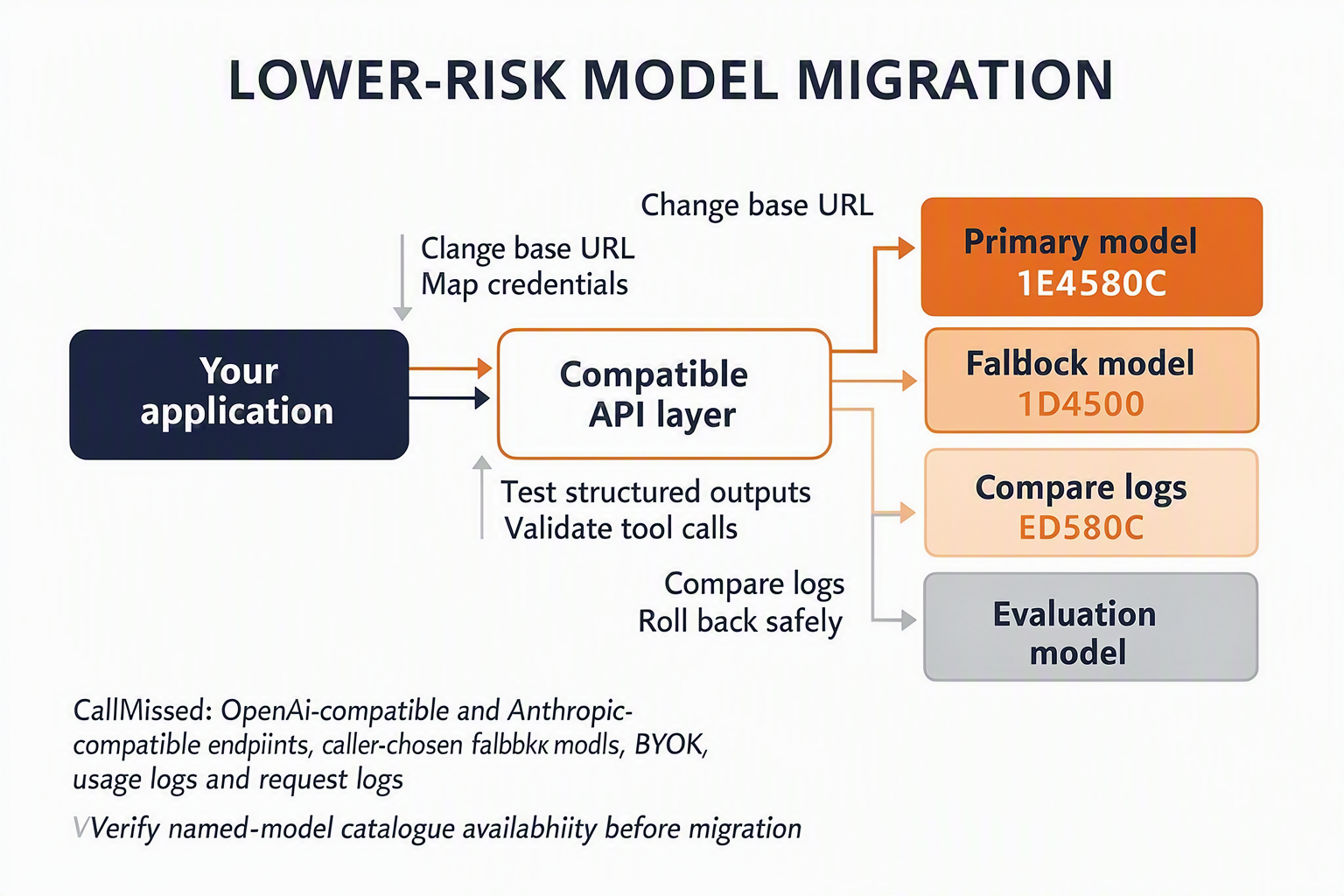
Compatible APIs reduce migration risk by separating application logic from a specific model provider, but wire-format compatibility is not behavioral equivalence. Because official API access for the exact “Claude Opus 5.5” and “GPT-6 Astra” model names is not established in the supplied evidence, buyers should design for replaceable model identifiers rather than assume either target is production-ready.
How should developers build a portable abstraction layer?
Create an internal interface for capabilities such as chat, structured output, tool use, streaming and vision. Provider adapters should translate that interface into OpenAI Responses API, OpenAI Chat Completions or Anthropic Messages API requests.
Keep the following assets outside provider-specific code:
- System prompts: Store prompts in a versioned registry rather than embedding them throughout the application.
- Tool schemas: Define tools with portable JSON Schema, then translate provider-specific naming, validation and result formats in adapters.
- Conversation state: Maintain a canonical message format that can represent tool calls, tool results and multimodal inputs.
- Model configuration: Map internal aliases such as
reasoning-primaryto pinned provider model IDs through configuration. - Error handling: Normalize rate limits, timeouts, refusals and malformed structured outputs into common application errors.
This architecture limits a migration to an adapter and evaluation cycle instead of a full rewrite.
Why are evaluation logs essential during a model migration?
Request and evaluation logs reveal regressions that headline benchmarks cannot predict. Record the prompt version, model ID, parameters, tool calls, latency, token usage, cost, output, validation result and human feedback for every approved test case—while applying appropriate privacy controls.
Before switching models, replay a representative evaluation set and compare:
- Task success and factual accuracy
- JSON or schema-valid response rates
- Tool-selection and argument accuracy
- End-to-end latency and cost
- Safety, refusal and escalation behavior
Use shadow traffic or a small canary rollout where permitted. Do not promote a new model merely because its average score is higher; define minimum thresholds for critical workflows such as payments, legal review or customer-data handling.
How should fallback policies and version pinning work?
Fallbacks should be task-aware, not an indiscriminate list of models. A coding agent may require reliable tool use and long-context handling, while a support classifier may prioritize predictable structured output and low cost.
Set explicit policies for:
- Retryable failures, including timeouts and temporary rate limits
- Maximum retries and total latency budgets
- Capability-compatible fallback models
- Data-residency and privacy restrictions
- Alerts when fallback usage exceeds a defined threshold
Pin exact model versions in production whenever providers support versioned identifiers. Test newer snapshots separately, preserve the previous configuration for rollback and never allow an untested alias change to silently alter production behavior.
As of September 2026, CallMissed, the OpenAI- and Anthropic-compatible developer AI API, provides one API key and balance for 136 models, caller-chosen fallback models, bring-your-own provider keys, and usage and request logs. These capabilities can support a provider-abstraction strategy, although they do not establish availability of Claude Opus 5.5 or GPT-6 Astra; each exact model must be confirmed in official documentation before procurement or deployment.
Frequently Asked Questions
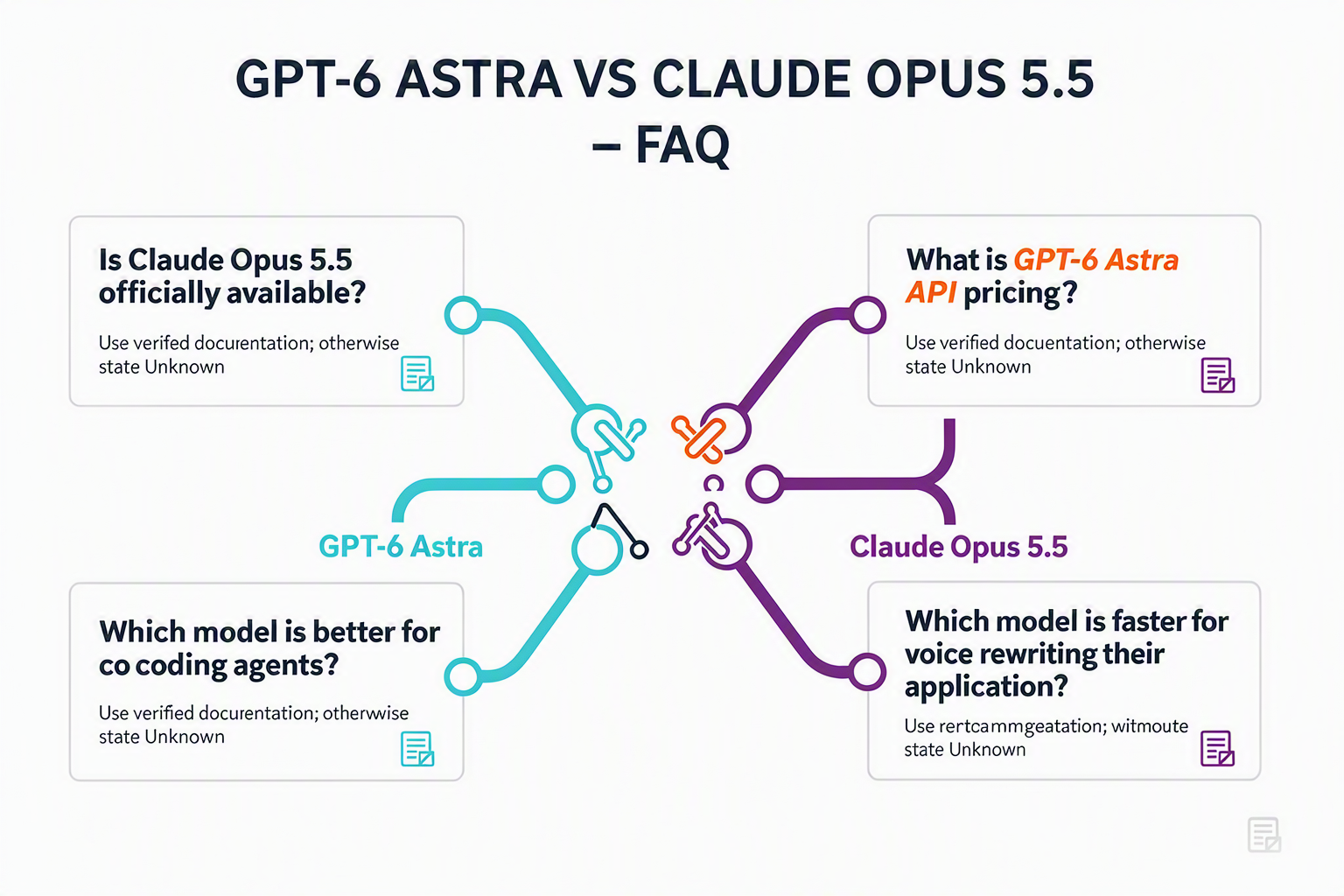
Are Claude Opus 5.5 and GPT-6 Astra officially available?
What are the API prices for GPT-6 Astra and Claude Opus 5.5?
What context windows do Claude Opus 5.5 and GPT-6 Astra support?
Which model has better benchmarks and reasoning performance?
Is Claude Opus 5.5 or GPT-6 Astra the best model for coding and AI agents?
Is GPT-6 Astra or Claude Opus 5.5 better for real-time voice AI?
What should developers and business buyers do while availability remains unverified?
Conclusion
There is no defensible winner in Claude Opus 5.5 vs GPT-6 Astra as of September 2026. The supplied first-party evidence verifies neither Claude Opus 5.5 nor GPT-6 Astra, making any definitive claims about performance, cost, context, latency, voice, privacy, or production readiness speculative.
- Availability remains unverified: Neither model has a confirmed model card, stable API identifier, or documented general-availability path in the supplied research.
- Commercial comparisons are premature: Official API pricing, rate limits, regional access, data-retention policies, and enterprise terms are not disclosed.
- Adjacent releases are not substitutes: Anthropic’s documented Claude Opus 5, Opus 4.7, and Sonnet 5 indicate progress in coding, reliability, and agentic tool use, but those capabilities cannot automatically be attributed to Claude Opus 5.5.
- Matched testing must decide: Once both models are accessible, buyers should run identical coding, reasoning, agent, latency, voice, and cost evaluations using reproducible configurations and representative workloads.
Watch for official model cards, API documentation, dated pricing, privacy terms, and independent benchmark results. Meanwhile, developers can explore multi-model infrastructure through CallMissed, whose OpenAI- and Anthropic-compatible developer API provides access to 136 models as of September 2026.
When verified access arrives, will headline benchmarks—or measured performance on your own workloads—drive your decision?
Related Reading
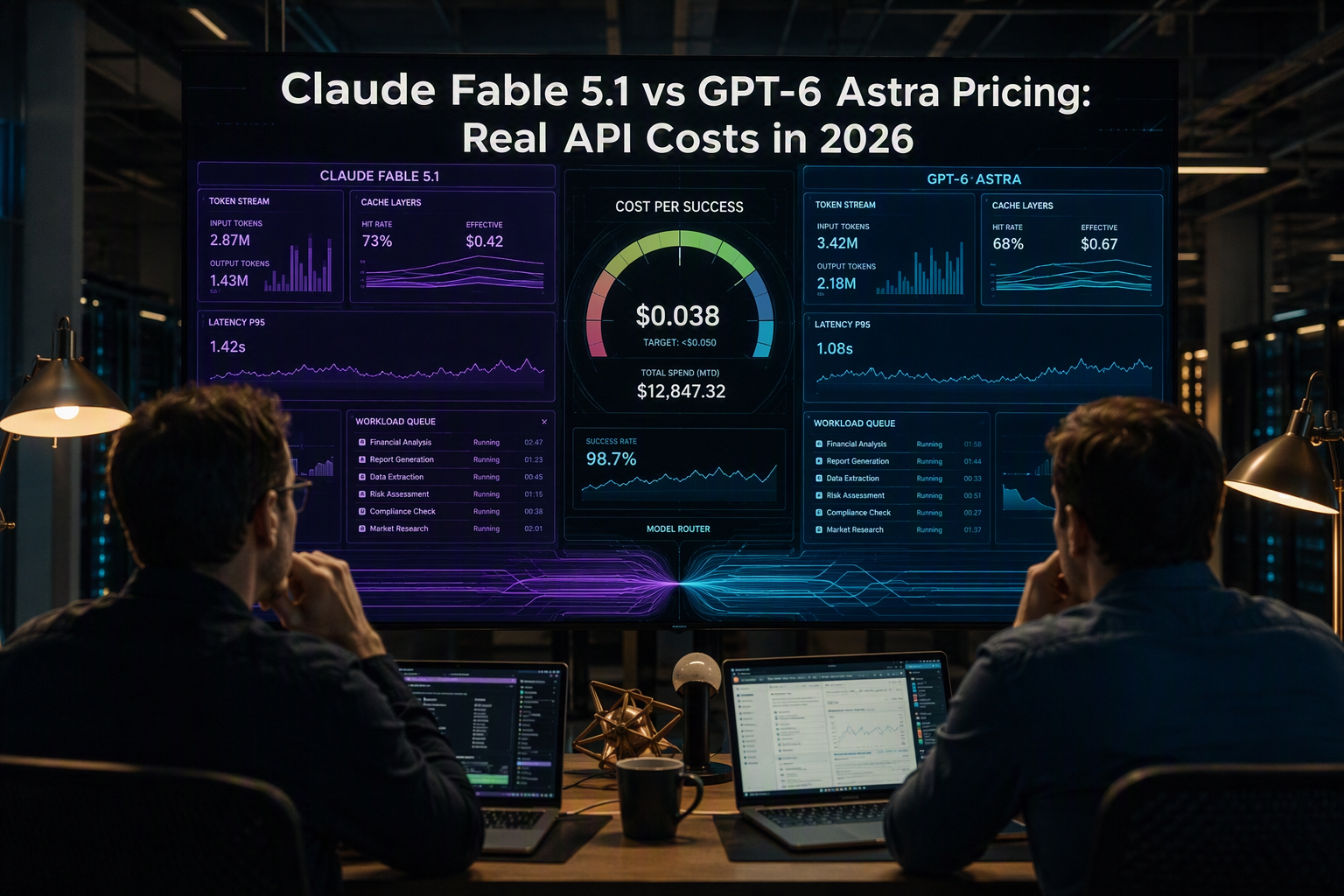
- Claude Fable 5.1 vs GPT-6 Astra Pricing: Real API Costs in 2026
- Claude Fable 5.1 vs GPT-6 Astra for Coding: 2026 Evidence-Led Comparison
- Claude Fable 5.1 vs GPT-6 Astra: 2026 Knowledge-Work Test
Sources
Discussion
Related Posts

Ready to automate customer conversations?
Launch AI voice agents and WhatsApp bots with CallMissed — one API, 22+ Indian languages.