Claude Fable 5.5 vs Opus 5.5: A Verified Comparison


Claude Fable 5.5 vs Opus 5.5 gets a source-verified status check, with Fable 5.1 benchmarks, pricing, context, and a practical choice guide.
Claude Fable 5.5 vs Opus 5.5: A Verified Comparison
What if the most important fact in a model showdown is that one contender does not officially exist yet? As of October 14, 2026, Claude Fable 5.5 vs Opus 5.5 is not a comparison between two released Anthropic models: Claude Opus 5.5 has launched, while Anthropic has not confirmed Claude Fable 5.5. That distinction matters because speculative names, leaked labels and search-driven assumptions can quickly harden into “facts.”
The verified baseline is unusually interesting. Anthropic describes Claude Opus 5.5 as the first model in the Claude 5.5 family and says it performs at the level of Claude Fable 5.1 on most work while costing 40% less to run than Claude Opus 5. Anthropic’s September 22, 2026, system card also reports that Opus 5.5 does not reach the company’s higher chemical and biological risk thresholds. Those are concrete claims; a Fable 5.5 release date, price and benchmark profile are not.
That makes the practical choice less about chasing a version number and more about matching a verified model to real work. Anthropic’s current platform guidance recommends starting with Claude Opus 5.5 for most workloads, then using Claude Fable 5.1 for demanding reasoning and long-horizon agentic tasks when Opus 5.5 at higher effort still falls short in a team’s own evaluations. Anthropic also cautions that small benchmark margins have become less reliable indicators of real-world differences at this capability level.
This article therefore compares what can actually be tested: Opus 5.5 against the currently available Fable 5.1. We will examine sourced benchmark evidence, software engineering, computer use, knowledge work, long-horizon agents, API pricing, context windows, response speed and operational fit. We will also separate vendor-reported results from conclusions that require workload-specific evaluation, because a leaderboard win does not automatically predict reliability, latency or total cost in production.
By the end, you will have a decision framework for choosing between Opus 5.5 and Fable 5.1, plus a clear checklist for reassessing the market if Anthropic later announces Fable 5.5. The central rule is simple: compare released specifications, dated documentation and your own task-level evaluations, not an unverified product name. For businesses, that means testing representative coding repositories, multi-step agent runs, tool-use failures, output quality and cost per completed task before standardizing on either tier. This evidence-first approach turns a confusing launch cycle into a defensible procurement decision—and avoids paying for theoretical capability that has not been announced, measured or shipped yet.
Is Claude Fable 5.5 out, and how does it compare with Opus 5.5 today?

Claude Opus 5.5 is available, but Claude Fable 5.5 is not an officially confirmed Anthropic model as of October 14, 2026. The valid comparison today is therefore Claude Opus 5.5 versus the released Claude Fable 5.1, not a speculative Fable 5.5 specification.
What has Anthropic officially released?
Anthropic’s release notes identify Claude Opus 5.5 as the first model in the Claude 5.5 family. Anthropic’s product announcement states that Opus 5.5 “performs at the level of Claude Fable 5.1 on most work” while costing 40% less to run than Claude Opus 5.
As of October 14, 2026, Anthropic’s cited announcements, model documentation and release notes do not provide an official Fable 5.5:
- No confirmed Claude Fable 5.5 release date
- No published Fable 5.5 API price
- No official Fable 5.5 model identifier
- No Fable 5.5 benchmark report or system card
- No documented context window, speed or availability details
Consequently, any website assigning benchmark scores, token prices or technical specifications to “Fable 5.5” should be treated as unverified unless it points to dated Anthropic documentation.
How does Opus 5.5 compare with the available Fable 5.1?
Anthropic positions the two released models around cost-effective general performance versus maximum capability on especially difficult tasks.
According to Anthropic’s October 2026 model overview:
- Start with Claude Opus 5.5 for most workloads.
- Try higher reasoning effort before moving to another model.
- Use Claude Fable 5.1 for demanding reasoning and long-horizon agentic work.
- Move to Fable 5.1 when representative evaluations show that Opus 5.5 still falls short.
Anthropic reports that Claude Opus 5.5 leads its benchmarks in agentic coding, computer use and knowledge work, as stated in the company’s 2026 launch announcement. However, Anthropic also warns that small benchmark margins at this capability level are becoming less reliable indicators of real-world differences.
That creates an important distinction: Opus 5.5 can lead selected benchmark categories while Fable 5.1 remains the escalation option for unusually difficult, extended reasoning tasks. “Performs at the level of Fable 5.1 on most work” does not mean the models behave identically on every repository, tool chain or multi-hour agent run.
Which model should businesses evaluate first?
A practical evaluation sequence is:
- Run Opus 5.5 first on representative production tasks.
- Test higher reasoning effort where quality is insufficient.
- Compare Fable 5.1 only on the failures or marginal cases.
- Measure cost per successful task, not merely cost per token.
- Record latency, tool-call errors, human corrections and completion rates.
For example, a software team should test both models on its own repositories, issue formats and CI tools rather than relying solely on a coding leaderboard. A research or operations team should similarly evaluate whether Fable 5.1’s stronger fit for long-horizon work offsets any difference in response time or API expenditure.
The defensible conclusion as of October 14, 2026 is straightforward: Opus 5.5 is the current default candidate, Fable 5.1 is the documented specialist alternative, and Fable 5.5 remains an unconfirmed future possibility—not a model that can yet be compared responsibly.
Why is Fable 5.1 the valid comparison point for Opus 5.5?
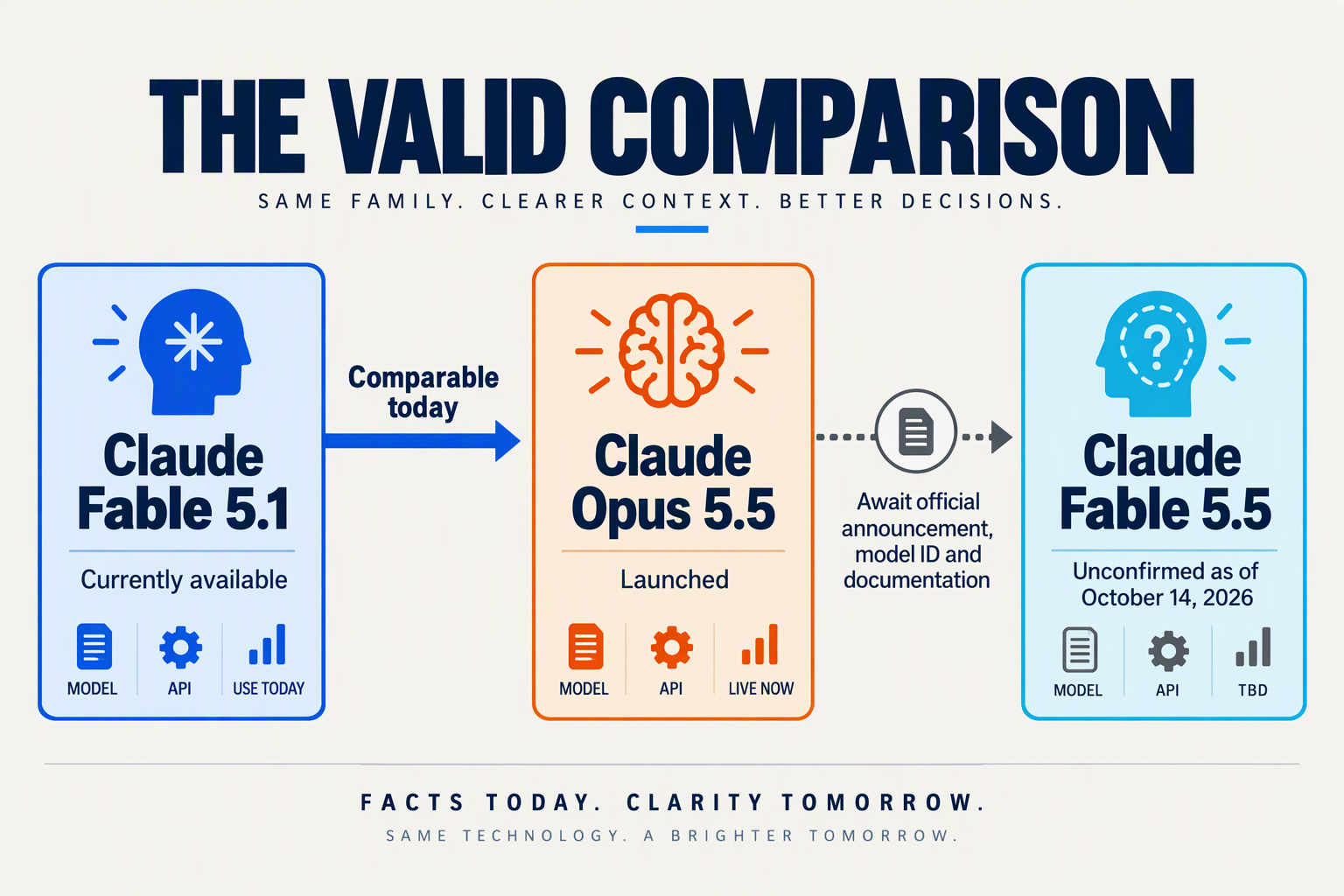
Claude Fable 5.1 is the valid comparison point because it is the currently documented Fable model that Anthropic itself compares with Claude Opus 5.5. As of the review date, October 14, 2026, Claude Opus 5.5 has launched, while Claude Fable 5.5 remains unconfirmed; assigning the hypothetical model specifications, pricing, or benchmark scores would be speculation.
Why does Anthropic compare Claude Opus 5.5 with Claude Fable 5.1?
In Anthropic’s Claude Opus 5.5 announcement, the company states that Claude Opus 5.5 “performs at the level of Claude Fable 5.1 on most work.” Anthropic’s release notes separately describe Opus 5.5 as the first model in the Claude 5.5 family, which does not establish that every Claude tier has moved to version 5.5.
Fable 5.1 is therefore the defensible baseline for three reasons:
- Both models are documented for current use. Developers can evaluate Opus 5.5 and Fable 5.1 with the same prompts, repositories, tool calls, and agent workflows.
- Anthropic selected the comparison. The pairing comes from Anthropic’s own positioning rather than naming patterns, rumors, or an assumed release sequence.
- Anthropic defines distinct operational roles. Its documentation explains when teams should begin with Opus 5.5 and when Fable 5.1 may be appropriate.
As of October 14, 2026, Anthropic has not confirmed a Fable 5.5 model card, API identifier, pricing schedule, context window, or benchmark report. A responsible Claude Fable 5.5 vs Claude Opus 5.5 comparison must identify those gaps rather than extrapolate from the shared version number.
When should developers use Fable 5.1 instead of Opus 5.5?
Anthropic’s Claude models overview recommends starting with Claude Opus 5.5 for most workloads. Anthropic recommends Claude Fable 5.1 for demanding reasoning and long-horizon agentic work, or when evaluations show that Opus 5.5 still falls short at higher reasoning effort.
That guidance supports a measurable escalation process:
- Test Opus 5.5 first on representative production tasks.
- Increase reasoning effort when the API configuration and workload support it.
- Measure task completion, tool-call errors, latency, and total API cost.
- Route difficult cases to Fable 5.1 only when evaluation results justify the change.
Anthropic says Claude Opus 5.5 costs 40% less to run than Claude Opus 5. That figure compares Opus 5.5 with Opus 5 only; it does not prove a 40% saving against Fable 5.1 or establish the cost of an unconfirmed Fable 5.5.
Why are version numbers insufficient for choosing a Claude model?
A “5.5” suffix would not guarantee identical architecture, context limits, speed, API pricing, or tool-use reliability across Claude tiers. Model families can advance asynchronously, so developers should verify the exact model identifier and current documentation before planning a migration.
Anthropic also says small benchmark margins are becoming less reliable guides to real-world differences at this capability level. The sound comparison is therefore Opus 5.5 versus the available Fable 5.1 using released evidence and workload-specific evaluations—not Opus 5.5 versus a hypothetical Fable model.
Which Claude 5.5 developments are verified as of October 14, 2026?
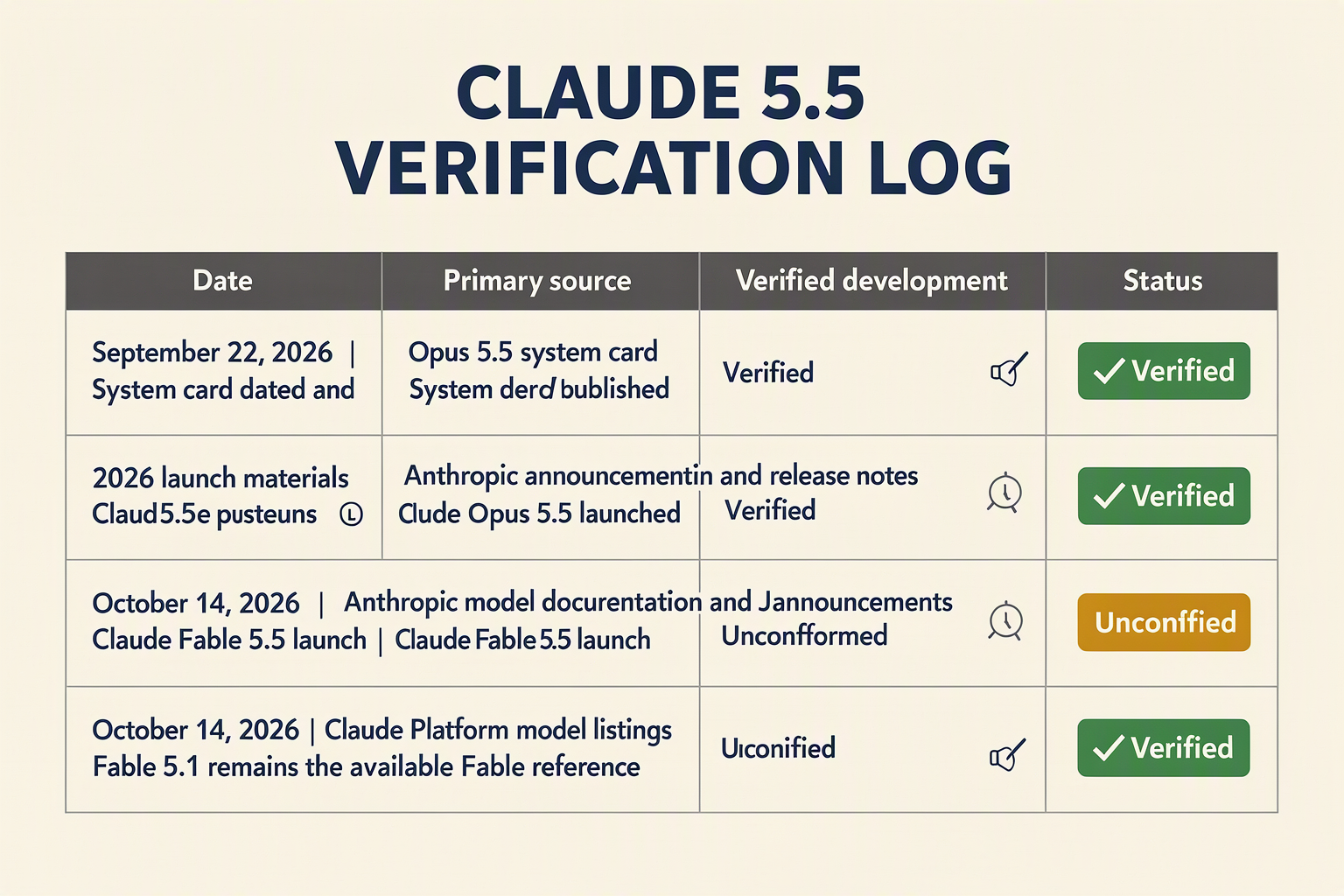
Claude Opus 5.5 is the only verified Claude 5.5 model as of October 14, 2026; Claude Fable 5.5 remains unconfirmed. Anthropic’s public materials identify Opus 5.5 as the first model in the Claude 5.5 family and direct users to the existing Claude Fable 5.1 when workloads require more demanding reasoning or long-horizon agency.
What has Anthropic officially confirmed about Claude 5.5?
| Development | Verification status | Named source | Practical meaning |
|---|---|---|---|
| Claude Opus 5.5 has launched | Verified | Anthropic release notes, reviewed October 14, 2026 | Teams can evaluate and deploy an officially released 5.5-family model. |
| Opus 5.5 is the first Claude 5.5-family model | Verified | Anthropic Help Center release notes | The “5.5” family designation does not establish that every Claude tier has a 5.5 version. |
| Claude Fable 5.5 exists publicly | Unconfirmed | No confirmation in the supplied Anthropic announcements or model documentation as of October 14, 2026 | Release dates, specifications, prices and benchmarks attributed to Fable 5.5 should be treated as speculation. |
| Opus 5.5 performs at Fable 5.1’s level on most work | Vendor-reported | Anthropic Opus announcement | Opus 5.5 may cover many workloads previously associated with the higher Fable tier, but “most work” is not universal parity. |
| Opus 5.5 costs 40% less to run than Opus 5 | Vendor-confirmed comparison | Anthropic announcement | The reduction is relative to Opus 5, not necessarily to Fable 5.1 or an unannounced Fable 5.5. |
| Fable 5.1 remains recommended for selected hard tasks | Verified guidance | Anthropic Claude Platform documentation | Anthropic recommends Fable 5.1 for demanding reasoning and long-horizon agents when Opus 5.5 at higher effort fails internal evaluations. |
Which claims require the most caution?
Anthropic says Opus 5.5 leads its benchmarks in agentic coding, computer use and knowledge work, but Anthropic also warns that small benchmark margins at this capability level are becoming less reliable indicators of real-world differences. Consequently, “leads on a benchmark” should not be rewritten as “wins every production workload.”
The clean evidence hierarchy is:
- Released documentation: Opus 5.5 is available and Fable 5.1 remains part of Anthropic’s current selection guidance.
- Vendor evaluation: Opus 5.5 performs at Fable 5.1’s level on most work.
- Workload-specific evidence: Each organization must test accuracy, tool failures, latency and cost per successful task.
- Unsupported inference: The existence of a 5.5 family does not confirm Claude Fable 5.5.
What does the Opus 5.5 system card verify?
Anthropic’s September 22, 2026 system card classifies Claude Opus 5.5 as having CB-1 capabilities, relating to the synthesis of non-novel weapons, but not CB-2 capabilities, relating to novel weapons. Anthropic’s Transparency Hub therefore states that Opus 5.5 does not reach the company’s higher chemical and biological risk thresholds.
This safety finding applies specifically to Claude Opus 5.5. It cannot be extrapolated to Claude Fable 5.5 because no confirmed Fable 5.5 system card, model specification or release announcement was identified as of October 14, 2026. Until that evidence appears, comparisons should label Fable 5.5 fields as “not announced”, not estimate them from Opus 5.5 or Fable 5.1.
What is known—and still unknown—about Claude Fable 5.5?
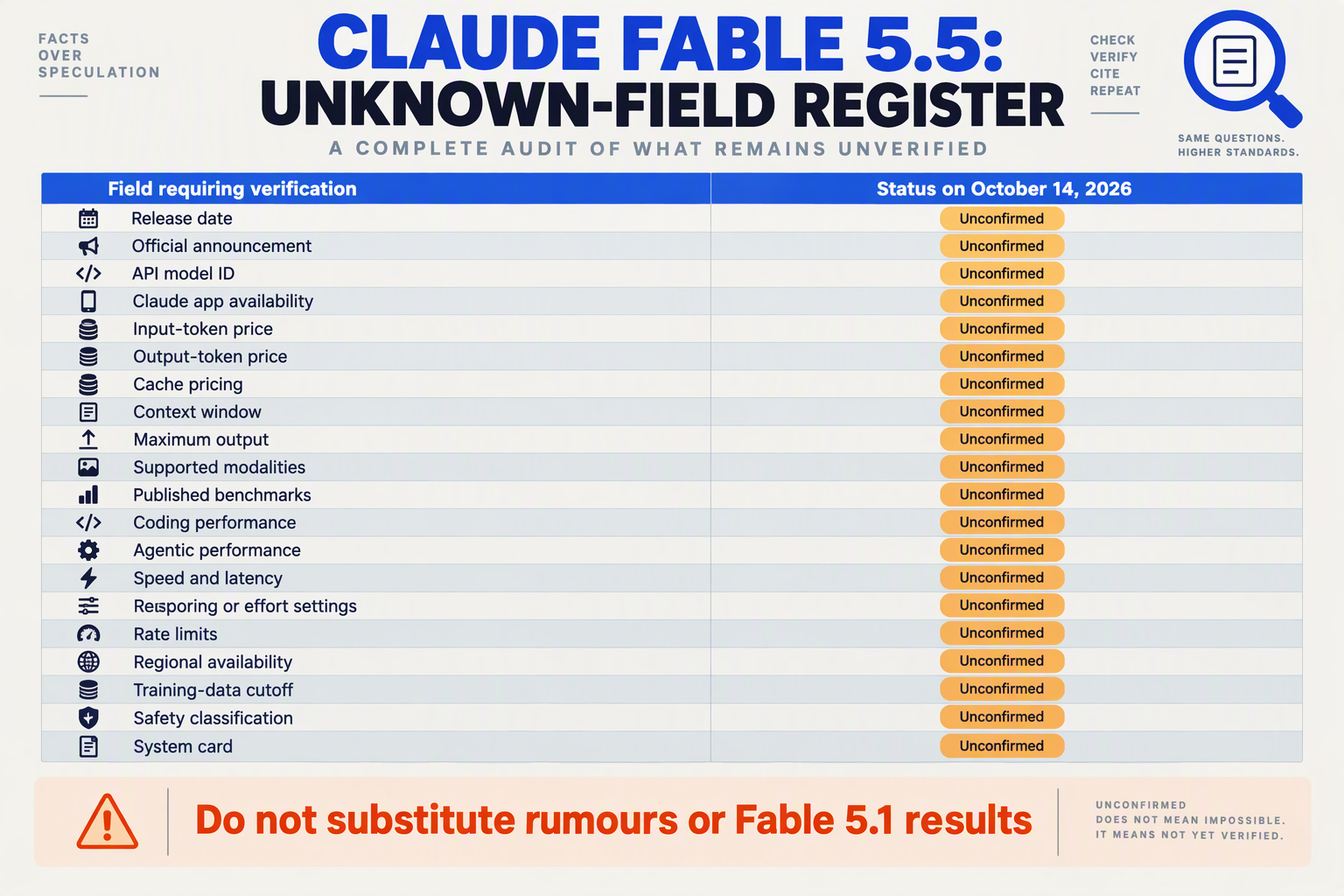
Claude Fable 5.5 remains unconfirmed as of October 14, 2026: Anthropic has not published a release date, model page, API specifications, pricing, benchmarks or system card for it. Claude Opus 5.5 has launched, but several numerical Opus API details are also absent from the supplied research and must be checked in Anthropic’s current documentation.
Which Claude Fable 5.5 specifications are confirmed?
None of the supplied Anthropic materials confirms Claude Fable 5.5 as a product. Anthropic’s Claude release notes call Claude Opus 5.5 “the first model in our new Claude 5.5 family,” but that wording does not announce another family member.
| Specification | Claude Opus 5.5 | Claude Fable 5.5 | Evidence-based conclusion |
|---|---|---|---|
| Release and release date | Launched; exact launch date not supplied here | Unconfirmed | No Fable 5.5 release date exists in the evidence |
| API model ID | Not supplied in this research | Unconfirmed | Verify against current API documentation |
| Input pricing | Exact price not supplied | Unconfirmed | No direct cost comparison is possible |
| Output pricing | Exact price not supplied | Unconfirmed | Anthropic only states a relative cost claim |
| Cache pricing | Not supplied | Unconfirmed | Do not estimate prompt-caching economics |
| Context window | Numerical limit not supplied | Unconfirmed | Consult the current model overview |
| Maximum output | Numerical limit not supplied | Unconfirmed | Integration limits cannot be assumed |
| Modalities | Anthropic’s overview says current models accept text and images and produce text | Unconfirmed | Fable modalities cannot be inferred |
| Speed and latency | No numerical measurements supplied | Unconfirmed | Benchmark in the intended region and workload |
| API rate limits | Increased Opus limits announced, but figures are not supplied here | Unconfirmed | Check account-tier documentation |
| Regional availability | Not supplied | Unconfirmed | Confirm availability before deployment |
| Lifecycle status | Current, launched model | No announced status | Fable 5.5 should not enter production plans |
| Coding, computer-use and knowledge-work benchmarks | Anthropic claims leadership, without figures in the supplied snippets | Unconfirmed | No reproducible head-to-head comparison exists |
| Reasoning and agentic results | Opus 5.5 is recommended for most workloads; Fable 5.1 remains recommended for harder reasoning and long-horizon agents | Unconfirmed | Fable 5.1 results cannot be transferred to Fable 5.5 |
| System card | Published September 22, 2026 | None identified | Safety reviews must remain model-specific |
Anthropic’s Claude Opus 5.5 announcement says the model performs at the level of Claude Fable 5.1 on most work and costs 40% less to run than Claude Opus 5. This is neither an exact API price nor evidence about a hypothetical Fable 5.5.
What can teams safely infer about Claude Fable 5.5?
Very little. A Claude 5.5 family exists, but family naming does not establish Fable 5.5’s launch, tier, capabilities or commercial terms.
Teams should avoid three unsupported assumptions:
- A plausible name is not a roadmap commitment.
- Newer numbering does not prove higher quality or lower latency.
- Fable 5.1’s positioning does not confirm Fable 5.5’s future specifications.
Anthropic’s models overview recommends starting with Claude Opus 5.5 for most workloads and using Claude Fable 5.1 for demanding reasoning or long-horizon agentic tasks when Opus evaluations fall short.
How should developers prepare for a possible release?
Require an official announcement, API model ID, pricing page, limits, regional availability and system card before testing Fable 5.5. Until then, compare Opus 5.5 with the available Fable 5.1 using completed-task cost, tool success, latency and human-reviewed quality.
CallMissed provides an Anthropic-compatible /v1/messages endpoint, request logs and caller-selected fallbacks. That API compatibility does not establish that Claude Opus 5.5 or Claude Fable 5.5 is available through CallMissed; developers must verify the platform’s current model catalogue separately.
How do Claude Opus 5.5 benchmarks compare with Fable 5.1?
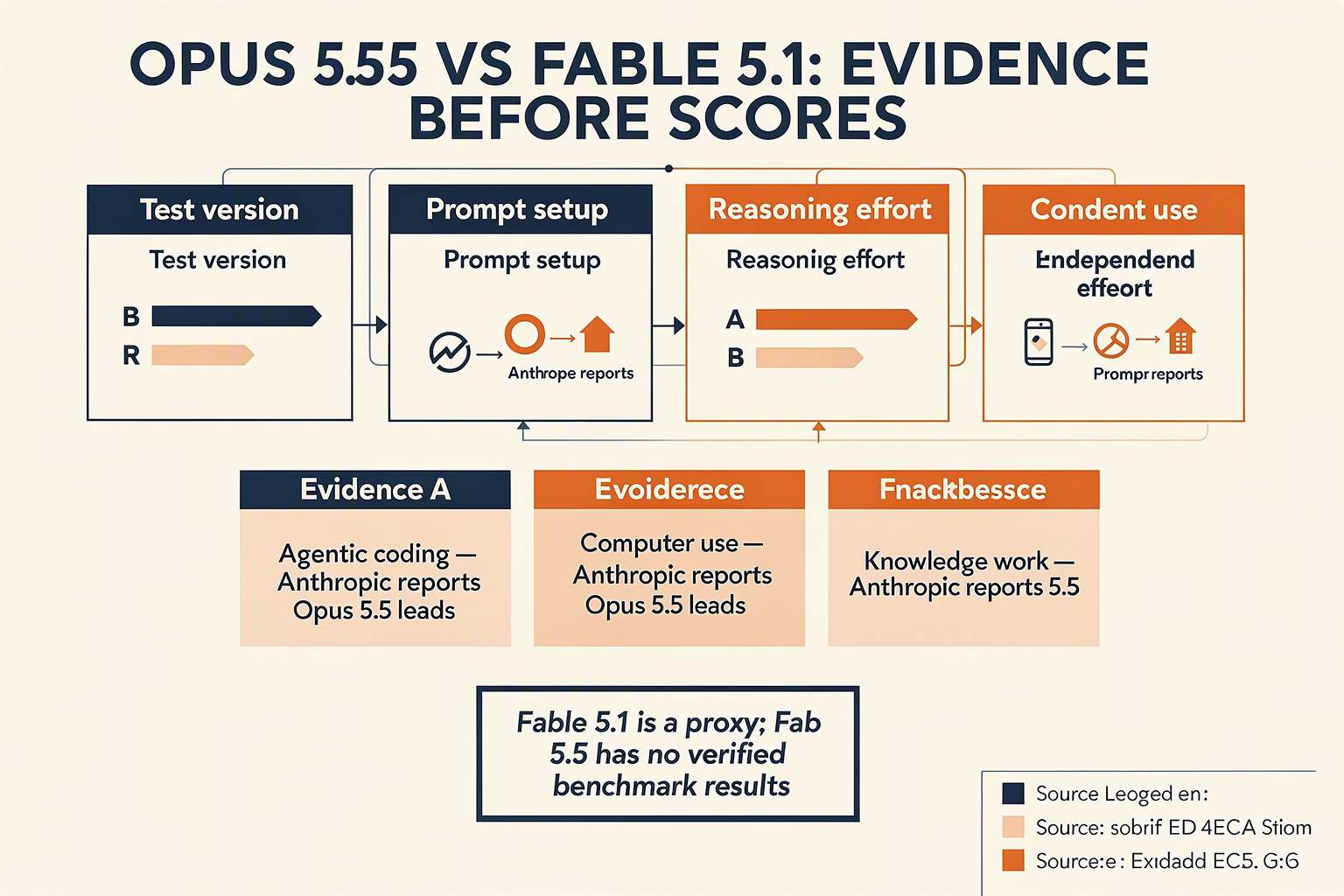
Anthropic reports that Claude Opus 5.5 performs at the level of Claude Fable 5.1 on most work and leads Anthropic’s internal benchmarks for agentic coding, computer use and knowledge work. However, as of the October 14, 2026 review date, the supplied sources contain no independent numerical results—and no scores, test versions or evaluation settings—from which to calculate a reliable Opus 5.5 versus Fable 5.1 benchmark margin.
What benchmark evidence has Anthropic published?
Anthropic’s Claude Opus 5.5 announcement makes category-level performance claims rather than supplying a reproducible scorecard in the provided evidence. Anthropic also cautions that benchmark margins become less reliable indicators of real-world differences at high capability levels.
| Workload | Anthropic’s reported conclusion | Comparison with Fable 5.1 | Evidence limitations |
|---|---|---|---|
| Agentic coding | Opus 5.5 leads “on our benchmarks” | No numerical head-to-head result supplied | Numerical scores, test versions and settings not supplied |
| Computer use | Opus 5.5 leads “on our benchmarks” | No task-level Fable 5.1 breakdown supplied | Numerical scores, test versions and settings not supplied |
| Knowledge work | Opus 5.5 leads “on our benchmarks” | Anthropic says Opus 5.5 reaches Fable 5.1’s level on most work | Numerical scores, test versions and settings not supplied |
| Demanding reasoning and long-horizon work | Anthropic recommends Fable 5.1 for these workloads | Fable 5.1 remains the documented escalation option | Numerical scores, test versions and settings not supplied |
These are vendor-attributed conclusions, not independent benchmark findings. The supplied research does not include third-party scores for SWE-bench, Terminal-Bench, OSWorld or another named evaluation that would support a numerical comparison.
Does Opus 5.5 replace Fable 5.1 for every workload?
No. Anthropic’s Claude Platform model overview recommends starting with Claude Opus 5.5 for most workloads, while recommending Claude Fable 5.1 for demanding reasoning and long-horizon agentic work. Anthropic also advises trying Fable 5.1 when Opus 5.5 at higher reasoning effort still falls short on an organization’s own evaluations.
That guidance supports three practical conclusions:
- Opus 5.5 is Anthropic’s broad default for mixed production workloads.
- Fable 5.1 remains relevant for difficult, sustained tasks involving extended planning or reasoning.
- Internal evaluations should determine deployment, because aggregate vendor claims do not capture private codebases, proprietary tools or organization-specific quality thresholds.
Anthropic’s system-card excerpt should not be used to claim that Opus 5.5 differs only modestly from Fable 5.1. The supplied sentence ends after “Claude” and therefore does not identify the comparator.
How should teams test Opus 5.5 against Fable 5.1?
Businesses should evaluate complete workflows using identical prompts, tools, effort settings and retry policies. Useful measures include:
- Repository-level coding success against automated tests.
- Long-horizon task completion and recovery from tool failures.
- Computer-use accuracy after interface or layout changes.
- Citation accuracy and unsupported-claim rates in research tasks.
- Cost per accepted result, review time and completion latency.
Anthropic says Opus 5.5 costs 40% less to run than Opus 5, as reported in its product materials available on October 14, 2026. That is not a Fable 5.1 price comparison, so it should not be treated as evidence that Opus 5.5 offers lower total cost than Fable 5.1 without workload-specific testing.
Which model is better for coding, agentic work, speed, and business use?

Claude Opus 5.5 is Anthropic’s recommended starting candidate for most workloads, not a universally superior model. As of October 14, 2026, Claude Fable 5.5 remains unconfirmed, so practical evaluations should compare the launched Opus 5.5 with the currently documented Claude Fable 5.1.
Which Claude model should developers test for coding?
Developers should test Claude Opus 5.5 first, then compare it with Fable 5.1 on representative repository-level tasks. In its Claude Opus 5.5 announcement, Anthropic said in 2026 that Opus 5.5 led its internal benchmarks for agentic coding, computer use and knowledge work—but also cautioned that small benchmark margins are becoming less reliable indicators of real-world differences.
Useful coding evaluation tasks include:
- Repository exploration and multi-file feature implementation
- Debugging failures with incomplete or misleading evidence
- Refactoring while preserving tests and interfaces
- Code review, test generation and tool-assisted pull requests
These are proposed evaluation uses, not proof that Opus 5.5 wins every named task. Teams should measure tests passed, regressions introduced, human corrections, completion time and cost per accepted pull request.
Which model should teams evaluate for agentic work?
Anthropic’s Claude Platform models overview, current as of October 2026, says to start with Claude Opus 5.5 for most workloads. The same documentation recommends considering Claude Fable 5.1 for demanding reasoning and long-horizon agentic work, or when evaluations of Opus 5.5 at higher reasoning effort still fall short.
A defensible evaluation sequence is:
- Run Opus 5.5 at a normal reasoning-effort setting.
- Increase effort and retest failed workflows.
- Compare Fable 5.1 on the same prompts, tools and recovery scenarios.
- Select Fable only when its measured benefit justifies its measured cost or latency.
Agent evaluations should include tool failures, incomplete data, permission errors and multi-step recovery—not just successful demonstrations.
Is Opus 5.5 faster or more cost-effective than Fable 5.1?
The supplied official sources do not establish a universal speed or token-price advantage for Opus 5.5 over Fable 5.1. Latency can vary with reasoning effort, output length, tool calls, traffic and application infrastructure, while comparative API token prices for these two models were not provided in the cited context.
Anthropic stated in 2026 that Claude Opus 5.5 performs at the level of Claude Fable 5.1 on most work and costs 40% less to run than Claude Opus 5, according to the official Claude Opus product page. The 40% figure compares Opus 5.5 with Opus 5, not Fable 5.1; it therefore cannot prove a better Opus-versus-Fable cost/capability balance.
Which Claude model should businesses choose?
Businesses should treat Opus 5.5 as the initial candidate, then route specific workloads to Fable 5.1 only when controlled evaluations demonstrate worthwhile gains. Track:
- Cost per successfully completed task
- P95 end-to-end latency
- Human correction rate
- Tool-use and workflow-completion rate
As of October 2026, CallMissed’s developer AI API supports Anthropic-compatible endpoints, request logs, caller-selected fallbacks and bring-your-own provider keys, which can support evaluation and routing architectures. However, protocol compatibility does not confirm that Opus 5.5 or Fable 5.1 is available in CallMissed’s model catalogue; teams must verify current catalogue access separately. Any Fable 5.5 decision should await an official Anthropic announcement, documented pricing and reproducible workload results.
How do API pricing, context, speed, and availability compare?
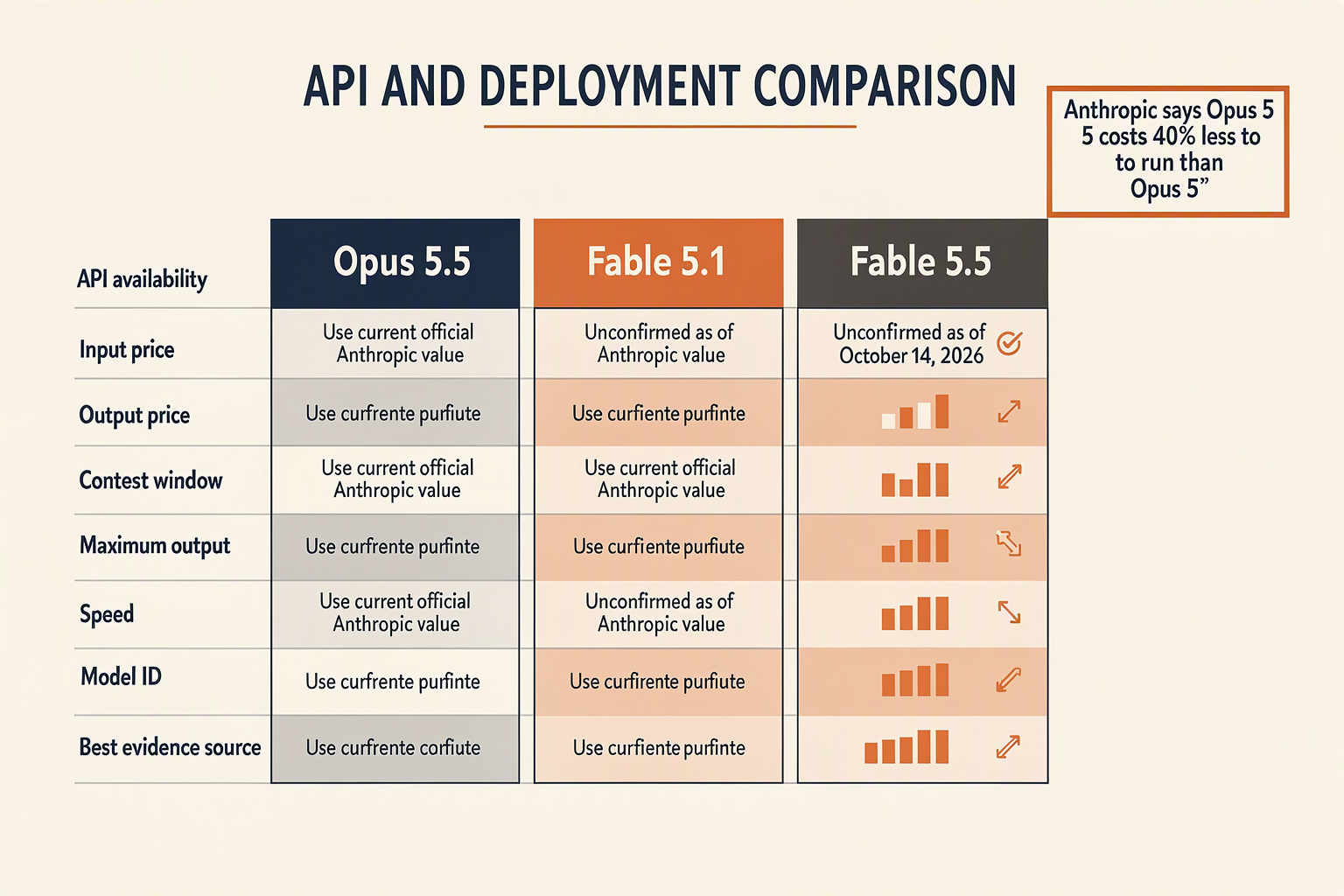
Claude Opus 5.5 is available, while Claude Fable 5.5 remains unconfirmed as of October 14, 2026. The practical comparison is therefore Claude Opus 5.5 versus the currently available Claude Fable 5.1, with exact prices and technical limits verified against Anthropic’s live documentation before deployment.
What API specifications are confirmed?
| Factor | Claude Opus 5.5 | Claude Fable 5.1 | Claude Fable 5.5 |
|---|---|---|---|
| Availability | Launched; Anthropic calls it the first Claude 5.5-family model | Currently available | Unconfirmed as of October 14, 2026 |
| Recommended use | Anthropic recommends starting here for most workloads | Demanding reasoning and long-horizon agentic work, particularly when Opus 5.5 evaluations fall short | No official positioning supplied |
| Numerical input/output prices | Not supplied in the provided research; verify in Anthropic’s current API pricing documentation | Not supplied in the provided research; verify in Anthropic’s current API pricing documentation | No confirmed pricing |
| Cache prices | Not supplied in the provided research; check current pricing documentation | Not supplied in the provided research; check current pricing documentation | No confirmed pricing |
| Context window | Numerical limit not supplied in the provided research; verify in Anthropic’s current Models overview | Numerical limit not supplied in the provided research; verify in Anthropic’s current Models overview | No confirmed specification |
| Maximum output | Numerical limit not supplied in the provided research; verify in the current Models overview | Numerical limit not supplied in the provided research; verify in the current Models overview | No confirmed specification |
| Modalities | Anthropic’s Models overview says current models support text and image input with text output | Anthropic’s Models overview says current models support text and image input with text output | No confirmed modalities |
| Speed and rate limits | No universal latency benchmark supplied; Anthropic has separately announced higher API limits for Claude Opus models | No comparative speed benchmark supplied | No published latency or rate limits |
Anthropic’s Claude release notes identify Claude Opus 5.5 as the first model in the Claude 5.5 family. “First” does not confirm that Claude Fable 5.5 exists, has entered testing or has a scheduled release date.
Is Claude Opus 5.5 cheaper or faster than Claude Fable 5.1?
The supplied evidence establishes no price or speed winner between Claude Opus 5.5 and Claude Fable 5.1. As of October 14, 2026, Anthropic says Claude Opus 5.5 costs 40% less to run than Claude Opus 5; that comparison does not show that Opus 5.5 costs less than Fable 5.1.
Teams should calculate cost per successful task, including:
- Input, output and cache charges from the live tariff
- Tokens consumed across retries and tool calls
- Failed runs and human-review time
- Total cost of completing a coding fix, research task or agent workflow
Speed also requires workload-specific testing. Measure time to first token, generation throughput, tool-call latency, end-to-end completion time and performance under expected concurrency. Anthropic’s announcement of higher Opus API rate limits has no supplied publication date here and should not be characterized as a change caused specifically by Opus 5.5.
How should developers validate these models?
Run identical prompts, tool definitions and quality rubrics against both available models, then record accuracy, latency and completed-task cost. Context capacity is only a ceiling; retrieval accuracy across realistic long prompts matters more than the advertised maximum alone.
As of October 2026, CallMissed’s Anthropic-compatible /v1/messages endpoint supports existing SDK patterns and provides usage and request logs. API compatibility, however, is not evidence that the unconfirmed Claude Fable 5.5 is available through Anthropic or any third-party provider.
What do Anthropic’s recommendations and independent evaluations actually establish?

Anthropic’s documentation establishes Claude Opus 5.5 as the default starting point, not as the universal winner over Claude Fable 5.1. Independent evaluations must still test representative workloads—and no independent result can validate Claude Fable 5.5 while that model remains unconfirmed as of October 14, 2026.
What does Anthropic recommend for Opus 5.5 and Fable 5.1?
Anthropic’s Claude Platform documentation recommends a clear escalation path as of October 14, 2026:
- Start with Claude Opus 5.5 for most workloads.
- Increase Opus 5.5’s reasoning effort where necessary.
- Use Claude Fable 5.1 for demanding reasoning or long-horizon agentic work when internal evaluations show that Opus 5.5 still falls short.
This recommendation establishes a sensible default, but it does not prove that Opus 5.5 will be more accurate, faster or cheaper on every application. Anthropic says Opus 5.5 performs at the level of Fable 5.1 “on most work,” leaving room for workload-specific differences.
Anthropic also reports that Claude Opus 5.5 costs 40% less to run than Claude Opus 5, as of its 2026 launch announcement. That comparison is against Opus 5—not Fable 5.1—and should not be misread as a 40% saving over every alternative.
What do Anthropic’s benchmark claims prove?
Anthropic reports that Opus 5.5 leads its benchmarks in agentic coding, computer use and knowledge work. These results establish that Opus 5.5 performed strongly under Anthropic’s selected tasks, scoring methods and test configurations.
However, Anthropic itself warns that “benchmark margins have become a less reliable guide to real-world differences” at this capability level. Consequently, the results do not independently establish:
- Reliability across a company’s private repositories and tools
- Lower latency under real production concurrency
- Better performance over hundreds of long-running agent steps
- Lower cost per successfully completed task
- Superior outcomes for every language, domain or prompting strategy
The distinction is methodological, not adversarial: vendor benchmarks are useful evidence, while reproducible third-party tests and customer-specific evaluations answer different questions.
What does the Opus 5.5 system card establish?
Anthropic’s September 22, 2026 system card classifies Claude Opus 5.5 as having CB-1 capabilities, related to synthesizing non-novel weapons, but not CB-2 capabilities, related to synthesizing novel weapons. Anthropic’s Transparency Hub therefore states that Opus 5.5 did not reach the company’s higher chemical and biological risk thresholds.
That finding is a dated safety assessment under Anthropic’s evaluation framework. It should not be generalized into a claim that the model has no misuse, hallucination, cybersecurity or operational risks.
How should businesses conduct an independent evaluation?
A defensible comparison should keep the model, prompt and tooling configuration fixed while measuring:
- Task success: completed outcomes, not subjective preference alone
- Reliability: tool errors, unsupported claims and recovery after failure
- Agent endurance: quality degradation across long, multi-step runs
- Economics: input, output, retry and human-review costs per completed task
- Performance: median and tail latency under realistic traffic
- Consistency: repeated runs across the same stratified test set
Teams should preserve prompts, model versions, outputs and reviewer rubrics so results can be audited. Infrastructure such as CallMissed’s Anthropic-compatible /v1/messages endpoint, request logs and caller-selected fallback models can support controlled application testing without making benchmark conclusions on a team’s behalf.
The evidence therefore supports Opus 5.5 as Anthropic’s recommended default and Fable 5.1 as an escalation option. It establishes nothing measurable about an unannounced Claude Fable 5.5.
When should you choose Opus 5.5 today instead of waiting?

Choose Claude Opus 5.5 today for most production workloads rather than waiting for an unconfirmed Claude Fable 5.5. As of October 14, 2026, Anthropic recommends starting with Opus 5.5 and moving to the available Claude Fable 5.1 only when demanding reasoning or long-horizon agent evaluations show a meaningful advantage.
Which model should you choose for each workload?
| Workload or constraint | Choose today | Why | What to validate |
|---|---|---|---|
| General production applications | Opus 5.5 | Anthropic recommends it as the starting model for most workloads | Accuracy, latency and cost per successful task |
| Agentic coding | Opus 5.5 first | Anthropic reports that Opus 5.5 leads its agentic-coding benchmarks | Repository-level completion and regression rates |
| Computer-use automation | Opus 5.5 first | Anthropic reports benchmark leadership in computer use | Recovery from UI changes, tool errors and interrupted sessions |
| Knowledge work | Opus 5.5 first | Anthropic reports leading results while warning that small benchmark margins may not predict practical differences | Citation quality, factuality and human-review time |
| Demanding reasoning | Test Fable 5.1 | Anthropic recommends Fable 5.1 when Opus 5.5 at higher effort still falls short | Correctness across repeated, difficult cases |
| Long-horizon agents | Test both | Fable 5.1 remains Anthropic’s recommended escalation path for extended agentic work | Goal completion, failure recovery and total run cost |
Why deploy Opus 5.5 instead of waiting?
The strongest reason is decision certainty. Claude Opus 5.5 is released, documented and available for evaluation; Claude Fable 5.5 has no confirmed release date, API price, context specification or benchmark profile as of October 14, 2026.
Anthropic states that Claude Opus 5.5 performs at the level of Claude Fable 5.1 on most work, making it unnecessary to wait merely because “5.5” sounds like a likely future Fable version. Anthropic also says Opus 5.5 costs 40% less to run than Claude Opus 5, although teams should still calculate cost per completed workflow rather than compare input or output token prices alone.
Production adoption is especially defensible when:
- A project has a fixed launch or migration deadline.
- Opus 5.5 already passes task-level quality thresholds.
- Lower latency or fewer retries outweigh a marginal benchmark difference.
- The organization needs a documented model for security, risk and procurement review.
- Waiting would delay revenue, customer support improvements or engineering automation.
Anthropic’s September 22, 2026 system card classifies Opus 5.5 as having CB-1 rather than CB-2 chemical and biological capabilities, meaning Anthropic found that the model did not reach its higher risk threshold. That dated documentation provides a concrete governance artifact that an unannounced model cannot supply.
When should you test Fable 5.1 instead?
Do not interpret “start with Opus 5.5” as “never evaluate Fable 5.1.” Use a controlled Fable 5.1 trial when Opus 5.5 at higher effort repeatedly fails on complex planning, difficult reasoning or long-running agents.
A practical evaluation should measure:
- Successful task completion, not benchmark score alone.
- Total token and tool cost, including retries.
- Time to acceptable output, including human correction.
- Failure recovery across multi-step runs.
- Consistency over repeated executions.
The defensible choice is therefore Opus 5.5 by default, Fable 5.1 by demonstrated need, and no production plan based on Fable 5.5 until Anthropic officially announces it.
Frequently Asked Questions
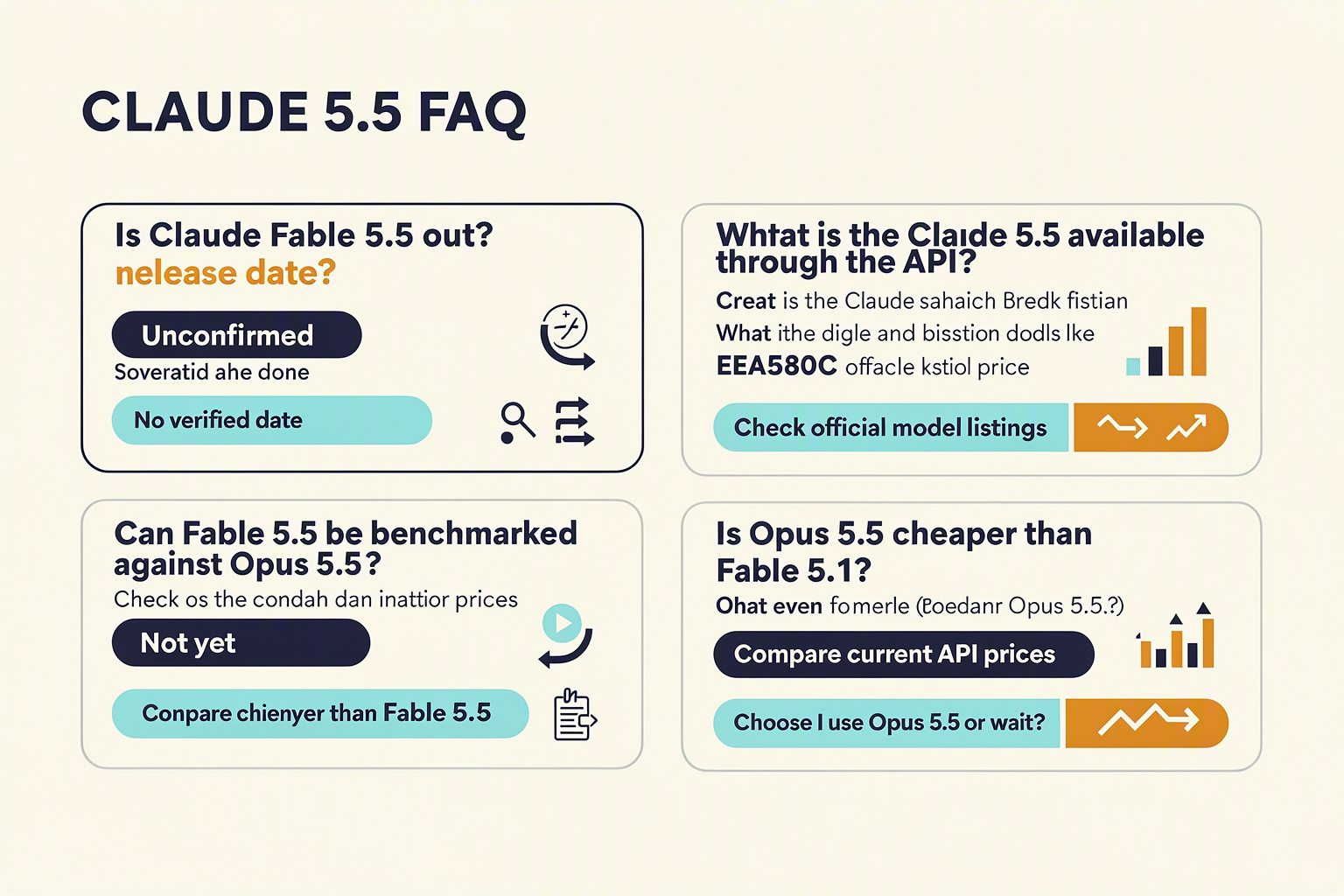
Is Claude Fable 5.5 available alongside Claude Opus 5.5?
Which model wins the Claude Fable 5.5 vs Opus 5.5 comparison?
Should developers use Claude Opus 5.5 or Claude Fable 5.1?
Is Claude Opus 5.5 cheaper than Claude Fable 5.5 or Fable 5.1?
How do context length and speed affect Claude Fable 5.5 vs Opus 5.5?
How can I verify whether Anthropic has officially launched Claude Fable 5.5?
Conclusion
The verified conclusion is clear: as of October 14, 2026, Claude Opus 5.5 is available, while Claude Fable 5.5 remains unconfirmed by Anthropic. Decisions should compare Opus 5.5 with the released Fable 5.1—not with speculative Fable 5.5 specifications.
- Opus 5.5 is the documented starting candidate. Anthropic’s model overview recommends it for most workloads, with Fable 5.1 reserved for demanding reasoning and long-horizon agentic work when higher-effort Opus evaluations fall short.
- Anthropic reports strong performance, not universal superiority. The official Opus 5.5 announcement says the model leads Anthropic’s benchmarks in agentic coding, computer use and knowledge work, while warning that small benchmark margins increasingly fail to predict real-world differences.
- Economics require workload-specific testing. Anthropic says Opus 5.5 performs at Fable 5.1’s level on most work and costs 40% less than Opus 5. Actual Opus 5.5 versus Fable 5.1 pricing, latency and cost per successful task still require verification and representative evaluations.
- Fable 5.5 claims remain speculation until Anthropic publishes a model identifier, pricing, context limits, benchmarks and a system card.
Watch next for an official Fable 5.5 release and reproducible production evidence. Teams can also explore CallMissed, an India-hosted AI communication platform offering no-code voice and chat agents plus OpenAI-compatible and Anthropic-compatible APIs. Which model produces the best verified outcome on your own workflows?
Related Reading
- Claude Fable 5.5 vs Sonnet 5.5: Verified Comparison
- Claude Fable 5.5 vs GPT-6 Astra: Verified Facts as of 2026
- Muse Wonder vs Claude Opus 5.5 vs Fable 5.1: What Holds Up