Muse Wonder vs Claude Opus 5.5 vs Fable 5.1: What Holds Up



Muse Wonder vs Claude Opus 5.5: see which scores are independent, what API access costs per task, and which model suits small business voice bots.
Muse Wonder vs Claude Opus 5.5 vs Fable 5.1: What Holds Up
Meta just shipped a model that sits one rung below Anthropic's flagship on a respected independent leaderboard, yet the better of its two versions can't be called through an API. That tension is why Muse Wonder vs Claude Opus 5.5 is the comparison developers are searching for this week. On October 12, 2026, Meta Superintelligence Lab announced Muse Wonder and Muse Wonder Full, and the benchmark numbers arrived within hours.
Why does this comparison matter right now?
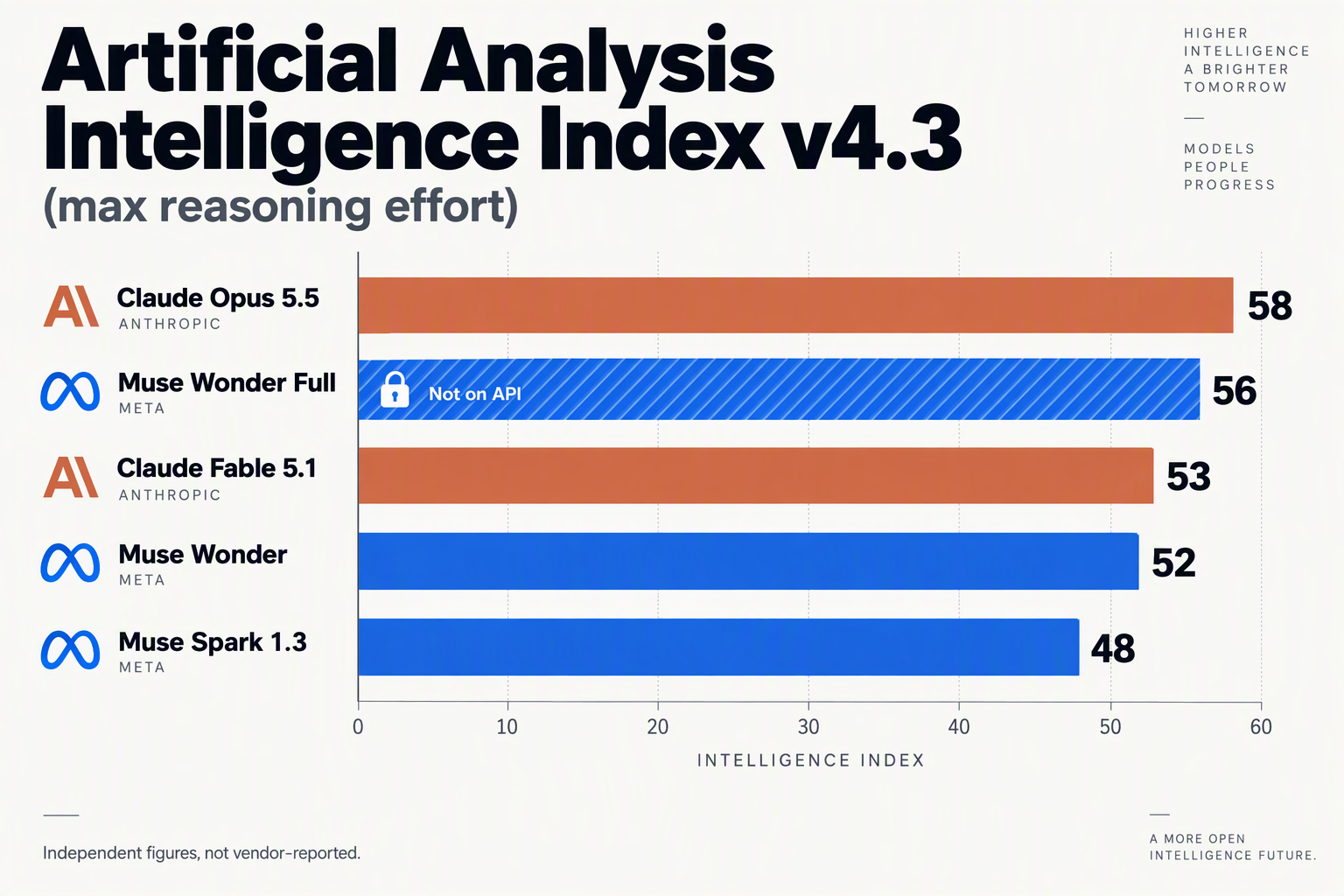
On the Artificial Analysis Intelligence Index v4.3, at maximum reasoning effort, Muse Wonder scored 52 and Muse Wonder Full scored 56, up from 48 for Muse Spark 1.3. OfficeChai reports that Full placed third overall, ahead of GPT-6 Astra and Gemini 4 Argon, which both tied at 53. Claude Sonnet 5.5 also scores 56 on the same index, so Full ties Sonnet 5.5 for second place behind Opus 5.5 at 58.
Headline scores are only half the story. Artificial Analysis measured roughly 54,000 output tokens per task for each Wonder variant, so heavy reasoning shows up on your bill as well as on the leaderboard. VentureBeat also notes that only the weaker Wonder model is available via API, and Artificial Analysis estimates the cost of running its average Intelligence Index task at $4.52 for Wonder. Meta's own model card recommends human confirmation before irreversible actions, which matters if you plan to build autonomous agents.
What will you learn in this post?
We separate what independent testers measured from what vendors claim. Specifically, we cover:
- Benchmarks: where Wonder, Wonder Full and Claude Opus 5.5 land on the Intelligence Index, and what a gap of a few points means in practice.
- API pricing and access: which models you can call today, and what token-hungry reasoning does to real per-task cost.
- Fable 5.1: the research behind this post contained no independent figures for it, so we flag that gap rather than guess.
- Which to use: a practical decision framework for coding, agents and cost-sensitive workloads.
One practical point before we dive in: model rankings can reshuffle within weeks. Gateways such as CallMissed, the OpenAI-compatible AI gateway, let teams reach many LLMs through one API key and switch models by changing a base URL instead of rewriting integrations.
Let's start with the numbers.
Which is better: Muse Wonder, Claude Opus 5.5 or Fable 5.1?
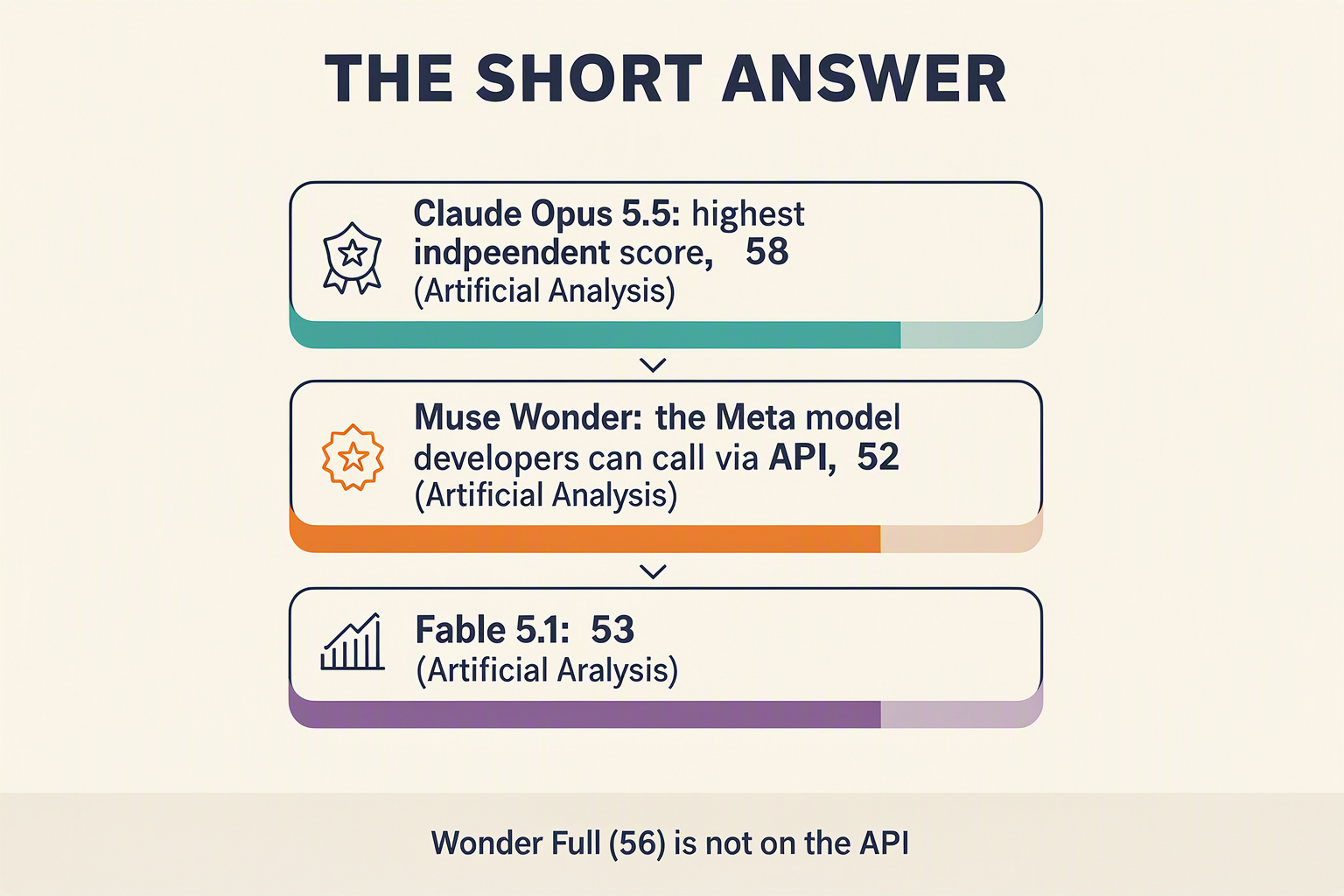
As of October 14, 2026, the independent evidence points to Claude Opus 5.5 as the strongest of the three, with Muse Wonder Full close behind but not callable through an API. Muse Wonder is the Meta model you can actually build on today. Fable 5.1 cannot be ranked, because the research for this post found no independent benchmark figures for it.
How do the three models compare on independent benchmarks?
All figures below are from the Artificial Analysis Intelligence Index v4.3 at maximum reasoning effort, as reported by the outlets named.
- Claude Opus 5.5 (Anthropic): Crypto Briefing says Muse Wonder Full is "second only to Claude Opus 5.5." We did not find Opus 5.5's exact score in the reporting, so we won't invent one.
- Muse Wonder Full (Meta): scores 56. OfficeChai reports it ahead of GPT-6 Astra and Gemini 4 Argon, which both scored 53.
- Muse Wonder (Meta): scores 52, which Shattered.io describes as a point behind GPT-6 Astra. VentureBeat reports it is the only Wonder variant available via API.
- Fable 5.1: no independent score, pricing or access details were found.
Do the sources agree on the ranking?
Not entirely. OfficeChai places Wonder Full third overall, Crypto Briefing calls it second to Opus 5.5, and Shattered.io says it ties Claude Sonnet 5.5 at 56. Those accounts may describe different Claude models and slightly different cuts of the leaderboard. Check Artificial Analysis's live page before you cite an exact rank, because leaderboards change.
What does a few-point gap actually mean for your workload?
The Intelligence Index is a composite, so a 4-point gap between Wonder (52) and Wonder Full (56) does not translate into 4% better answers on your task. In our judgment, gaps of one or two points, like Wonder versus GPT-6 Astra, are small enough that your own evaluation set will matter more than the leaderboard.
Cost matters too. Artificial Analysis measured roughly 54,000 output tokens per task for each Wonder variant, and it estimates $4.52 to run its average Index task on Wonder, according to VentureBeat. A model that scores higher but reasons longer can cost more per finished task than a lower-scoring rival.
So which should you choose?
- You need top accuracy and an API today: start with Claude Opus 5.5, since it leads on the evidence and is the only one of the three confirmed as ranked above Wonder Full.
- You want to test Meta's new models: use Muse Wonder through its API and measure cost per completed task, not just per token. Meta's model card recommends human confirmation before irreversible actions, so keep a person in the loop for agent workflows.
- You are considering Fable 5.1: wait for independent results before committing production traffic. A vendor claim alone is not a benchmark.
- You are unsure: run the same 50 to 100 real prompts through each candidate and compare accuracy, tokens used and latency.
That last step is easier when switching models does not mean rewriting code. Platforms like CallMissed, the OpenAI-compatible AI gateway, support caller-chosen fallback models and a single API key across many LLMs, so a head-to-head test comes down to changing a model name.
The next sections cover the pricing and access details behind these rankings.
What is Muse Wonder, and why do the benchmark numbers conflict?
Muse Wonder is Meta Superintelligence Lab's newest model family, announced October 12, 2026, and the benchmark numbers conflict because outlets are describing the same Artificial Analysis scores with different rankings and framing. The underlying scores agree: 52 for Wonder and 56 for Wonder Full. The disagreement is over where 56 places Meta.
What is Muse Wonder?
According to Arabian Post, Meta introduced Muse Wonder and Muse Wonder Full as its most capable models. Meta says they are built for complex professional assignments, software development and autonomous digital assistants. They succeed the Muse Spark family, and IJR News reports Mark Zuckerberg framed Wonder as a step up from Spark, Meta's first family of models.
Two facts matter most for builders:
- Only Wonder is available via API. VentureBeat reports that Muse Wonder Full, the stronger model, is not.
- Wonder is token-hungry. Winbuzzer reports Artificial Analysis measured roughly 54,000 output tokens per task for each variant at maximum reasoning effort.
Why do the reported rankings disagree?
Here is how the outlets describe the same result:
| Outlet | What it reports |
|---|---|
| OfficeChai | Wonder Full placed third on the Intelligence Index, ahead of GPT-6 Astra and Gemini 4 Argon (both 53) |
| Crypto Briefing | Wonder Full is second only to Claude Opus 5.5 |
| Shattered.io | Wonder Full tied Claude Sonnet 5.5 at 56; Wonder scored one point behind GPT-6 Astra |
| WorldAttention / Winbuzzer | Wonder scored 52 and Full scored 56, versus 48 for Spark 1.3 |
These accounts are compatible once you separate three issues.
- Labs versus models. OfficeChai also says Meta is now the second-highest-placed lab on the index. "Second" can mean second lab, while "third" counts individual models. Both can be true at once.
- Ties. A 56 that matches another model's score can be ranked above or below it depending on tie-breaking. Shattered.io's tie claim and OfficeChai's third place may describe the same leaderboard row.
- Model naming. Shattered.io names Claude Sonnet 5.5, while Crypto Briefing names Claude Opus 5.5. We could not verify Opus 5.5's exact score from the research, so treat its lead as reported rather than confirmed here.
How should you read these numbers?
Every figure above comes from one index (v4.3) at maximum reasoning effort. That setting is not what you will usually run in production, because it maximizes both score and output tokens.
A few practical rules follow:
- Anchor on the primary source. Check Artificial Analysis directly for current rows and ties instead of trusting a headline's rank.
- Separate vendor claims from measurements. Meta's model card and Zuckerberg's statements are vendor framing. The index scores and the $4.52 average-task cost estimate for Wonder come from Artificial Analysis, as VentureBeat reports.
- Test on your own workload. A point or two on a composite index rarely predicts how a model handles your prompts, tools and latency budget.
For that last step, a gateway such as CallMissed, the OpenAI-compatible AI gateway with 140 models behind one API key, lets you run the same prompts against several models by changing the model name rather than rewriting code. The next section turns to what each option costs.
Key Developments: Benchmarks, Pricing and Context Side by Side
As of October 14, 2026, the table below is everything independent testers have published that is solid enough to compare. Several cells are empty because the sources don't contain the numbers, and we would rather leave a gap than guess.
What do the benchmarks, pricing and access look like side by side?
| Model | Intelligence Index v4.3 (max effort) | API access | Cost per average task | Notes |
|---|---|---|---|---|
| Claude Opus 5.5 (Anthropic) | Ranked above Muse Wonder Full; exact score not in our sources | Not covered in sources | Not published in sources | Crypto Briefing says Wonder Full is "second only to" it |
| Muse Wonder Full (Meta) | 56 | No | Not published | Third overall, per OfficeChai |
| Muse Wonder (Meta) | 52 | Yes | $4.52 (Artificial Analysis estimate) | About 54,000 output tokens per task |
| Claude Sonnet 5.5 (Anthropic) | 56 (tie with Wonder Full) | Not covered in sources | Not published | Per Shattered.io |
| GPT-6 Astra / Gemini 4 Argon | 53 each | Not covered in sources | Not published | Both ranked behind Wonder Full |
| Fable 5.1 | No independent score found | Unknown | Unknown | Cannot be ranked |
How should you read this table?
- The scoring gap is small but real. Muse Wonder Full beat GPT-6 Astra and Gemini 4 Argon by three points, according to OfficeChai. Muse Wonder trailed GPT-6 Astra by one point, per Shattered.io.
- Meta's generational jump is large. The Artificial Analysis Intelligence Index put Muse Spark 1.3 at 48, so Wonder gained 4 points and Wonder Full gained 8.
- The best Meta model is not buildable today. VentureBeat reports that only the weaker Wonder model is available via API, so a production team's real choice from Meta is the 52-point model.
What does "cost per task" really mean here?
Cost per average task is more useful than headline price per million tokens, because reasoning models spend heavily on output. Artificial Analysis measured roughly 54,000 output tokens per task for each Wonder variant, and its estimate of $4.52 per average Intelligence Index task for Wonder reflects that. Winbuzzer reports the same token figure.
Two practical consequences follow:
- Budget per task, not per prompt. A single hard agent step can consume tens of thousands of output tokens at maximum reasoning effort.
- Lower the reasoning effort for routine work. The scores above are all at maximum effort. Your cost and quality on easier tasks will differ from these numbers, so test with your own prompts.
What about context windows?
None of the sources we reviewed gives a verified context window for Muse Wonder, Muse Wonder Full or Claude Opus 5.5, and we found nothing at all for Fable 5.1. Check each vendor's documentation before you design around long inputs.
How can you fill the gaps yourself?
Run the same 20-50 real tasks against each candidate and record pass rate, output tokens and total cost. A multi-model gateway helps here: CallMissed, the OpenAI-compatible AI gateway, exposes 140 models behind one API key, so comparing candidates means changing a model name rather than rewriting code.
Next, we look at what these numbers mean for specific workloads.
Which Muse Wonder can developers actually call through the API?
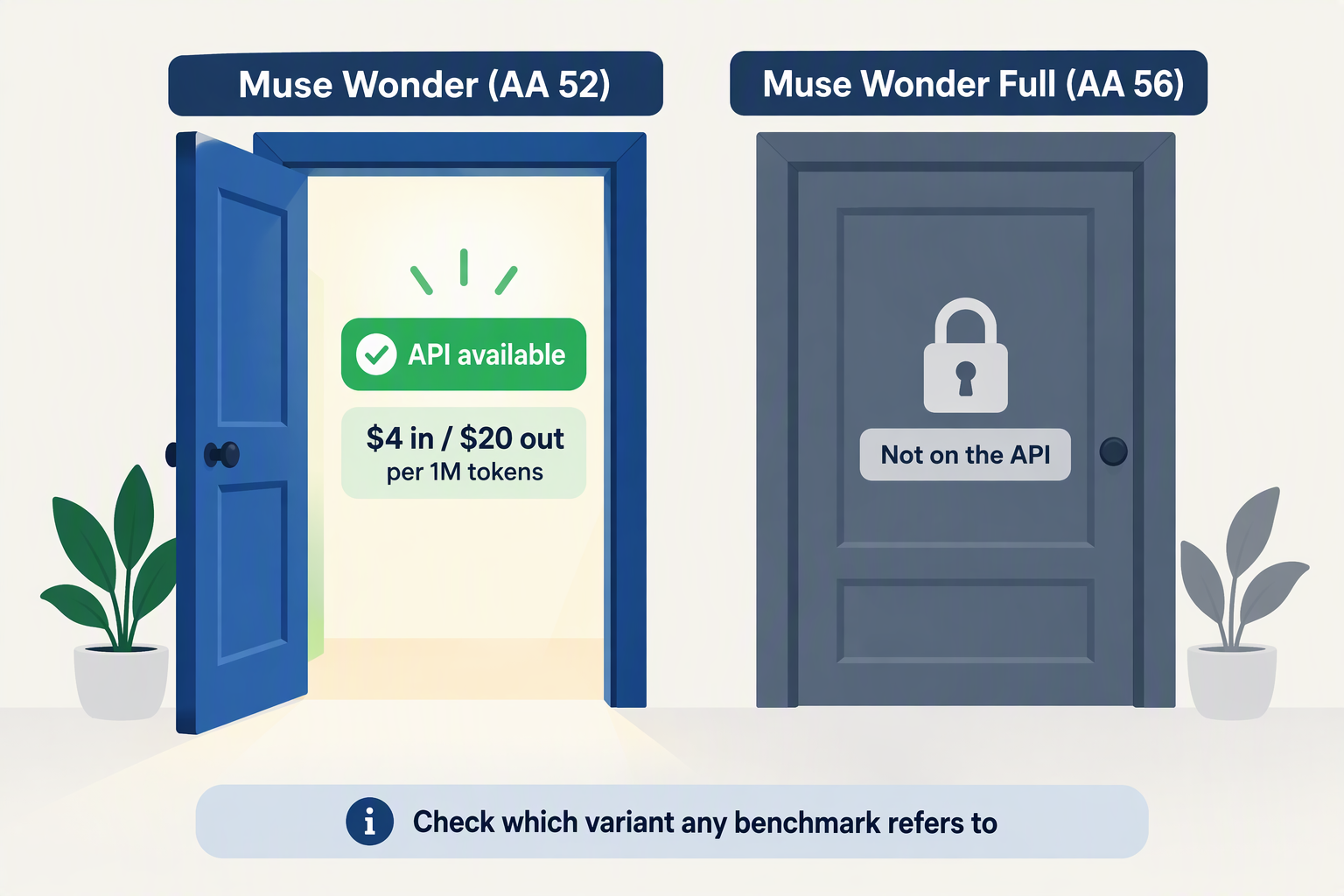
As of October 14, 2026, developers can call only Muse Wonder through an API. Muse Wonder Full, the higher-scoring variant, is not available that way. VentureBeat's headline on the launch says Meta's models "achieve frontier performance, but only the weaker one is available via API." That split matters more than the leaderboard gap.
Is Muse Wonder Full available through an API?
No. Meta Superintelligence Lab announced both models on October 12, 2026, but VentureBeat reports that API access covers only the smaller Muse Wonder. Muse Wonder Full scored 56 on the Artificial Analysis Intelligence Index v4.3 at maximum reasoning effort, against 52 for Muse Wonder. The four-point gap is the part you can't buy programmatically.
In practice, any benchmark claim you read about Full is a statement about a model you can't put in a production pipeline. The 56 is useful for judging Meta's trajectory. For an engineering decision, the 52 is the number that counts.
What does Muse Wonder cost to run?
Artificial Analysis estimates that its average Intelligence Index task costs $4.52 to run on Muse Wonder, as VentureBeat reports. At the ₹96 per US dollar rate, that is about ₹434 per task. The research for this post did not include a confirmed per-token price list, so we are not quoting one.
The cost driver is verbosity. Winbuzzer reports that Artificial Analysis measured roughly 54,000 output tokens per task for each Wonder variant at maximum reasoning effort. Output tokens are usually the expensive side of a bill, so a model that "thinks" this much can cost more than its list price suggests.
Here is a worked example. At the benchmark's average of $4.52 per task, 1,000 comparable tasks would cost about $4,520. That is an illustrative scaling, not a quote. Your real figure depends on prompt length, how much reasoning you allow, and whether you cache results.
What should you check before building on Muse Wonder?
Treat this as a short pre-flight list:
- Confirm the access route. The research does not say which platforms serve Muse Wonder, so verify the endpoint, region and terms yourself.
- Test at lower reasoning effort. The 52 score and the 54,000-token figure both come from maximum effort. Your cost-quality curve at lower settings may look very different.
- Budget per task, not per token. Measure real output tokens on your own prompts before committing.
- Add a human checkpoint. Meta's model card recommends human confirmation before irreversible actions, according to Winbuzzer. Build that into any agent that sends money, deletes data or messages customers.
- Plan for a fallback. A newly launched model can change pricing, limits or availability within weeks.
How do you avoid being locked into one launch?
The Wonder/Wonder Full split shows how a model's access can lag its benchmarks. A sensible defence is to keep your integration provider-agnostic. Gateways such as CallMissed, the OpenAI-compatible and Anthropic-compatible AI gateway, offer one API key and balance across 140 models. They also support caller-chosen fallback models, so a swap is a config change rather than a rewrite. CallMissed's catalogue includes makers such as OpenAI, Google, DeepSeek and Mistral. Check its live model list before assuming any specific new release is there.
Next, we put Muse Wonder's callable score of 52 against the models you can already rely on.
How much does each model really cost per task, not just per million tokens?
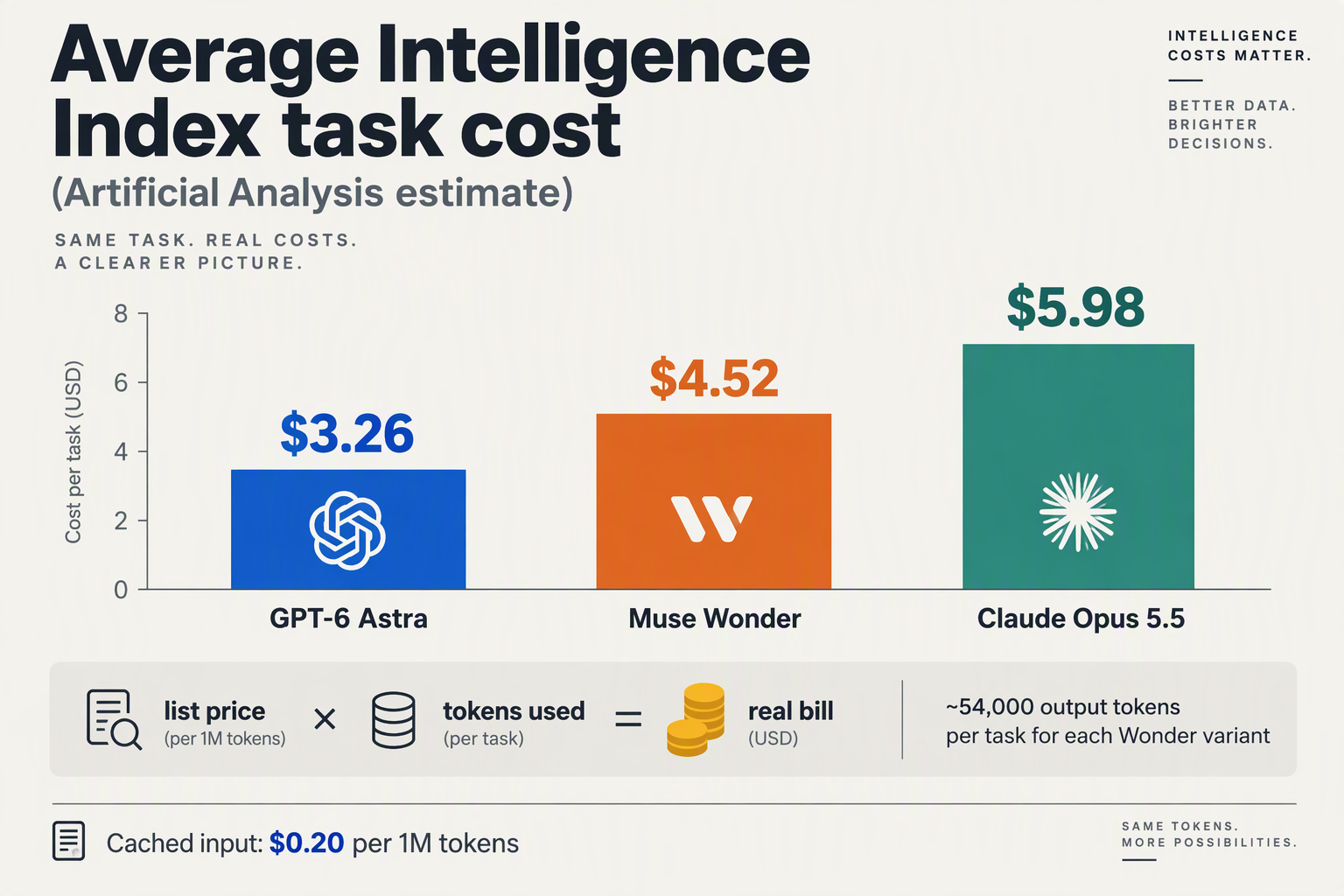
Per-task cost is token price multiplied by the tokens a model burns on each task, plus retries and review. As of October 14, 2026, the only independent per-task figure in our research is Artificial Analysis's estimate of $4.52 for Muse Wonder to run its average Intelligence Index task, as reported by VentureBeat. The comparison figures for Claude Opus 5.5 and Fable 5.1 were not available to us, so we show how to calculate them instead of guessing.
Why does price per million tokens mislead?
A per-million-token rate tells you nothing about volume. According to Winbuzzer, Artificial Analysis measured roughly 54,000 output tokens per task for each Wonder variant at maximum reasoning effort. Reasoning tokens are billed as output, so a model with a low list price can still cost more per task than a pricier model that answers in fewer tokens.
The Wonder numbers show the pattern. Muse Wonder (52) and Muse Wonder Full (56) use about the same number of output tokens. The extra four index points did not come from thinking longer. But Full is not available through an API, according to VentureBeat, so the cheaper, weaker model is the one you can budget for.
How do you calculate real cost per task?
Use this formula for any model:
- Input cost: prompt tokens × input price. Long contexts and repeated system prompts add up.
- Output cost: output tokens (including hidden reasoning) × output price.
- Retry multiplier: divide by your first-pass success rate. If a model succeeds 80% of the time, the effective cost is 1.25× the single-run cost.
- Review cost: Meta's model card recommends human confirmation before irreversible actions, so agent workflows carry a labour cost on top of API spend.
Here is an illustration with a made-up price. At a hypothetical $10 per million output tokens, a 54,000-token task costs about $0.54 in output alone. Halve the reasoning effort and the same task might cost roughly half as much, though quality may drop. This is not Meta's or Anthropic's actual rate, so substitute the published price when you run your own numbers.
What does $4.52 per task look like in rupees?
At the CallMissed rate of US$1 = ₹96, $4.52 is roughly ₹434, or about 434 credits at ₹1 per credit. That is the cost of one average benchmark task on a model that scores 52, not a typical chat reply. Benchmark tasks are deliberately hard and token-heavy, so your production average will probably be lower for simple workloads and higher for agentic ones.
Which model is likely cheapest per task?
We can only partly answer this from the evidence:
- Muse Wonder: $4.52 per average Intelligence Index task, with about 54,000 output tokens (Artificial Analysis, October 2026).
- Claude Opus 5.5: ranked highest of the three on quality, but our research did not include a per-task cost, so verify it against Anthropic's current price list.
- Muse Wonder Full: no API, so there is no billable per-task cost.
- Fable 5.1: no independent cost or benchmark figures were found.
The practical move is to measure on your own prompts. Gateways such as CallMissed, the OpenAI-compatible AI gateway, provide usage and request logs, response caching and caller-chosen fallback models across 140 models. That lets you record tokens per task and compare real spend before committing to one vendor.
Where does each model win or lose on coding and agent work?

On coding and agent work, the evidence as of October 14, 2026 is thinner than the headline scores suggest. Muse Wonder Full and Claude Opus 5.5 both look strong, but the research behind this post contains no per-task coding scores we can quote for Opus 5.5 or Fable 5.1. What follows separates what was reported from what you should verify yourself.
Where does Muse Wonder win on coding?
Meta Superintelligence Lab positioned both Muse Wonder and Muse Wonder Full for software development, complex professional assignments and autonomous digital assistants, according to Arabian Post. Crypto Briefing reports that Wonder Full posted "strong coding results" alongside its Intelligence Index score of 56. Winbuzzer likewise headlines the release as improving coding test scores.
Those reports describe direction rather than a head-to-head. They do not give a coding-specific number for Opus 5.5 to compare against, so a coding "win" over Anthropic's flagship is not established.
Wonder's practical advantage is access. VentureBeat notes that only the weaker Wonder model is available via API. It is the only Meta model in this comparison you can wire into a coding pipeline today.
Where does Muse Wonder lose?
- Token appetite: Artificial Analysis measured roughly 54,000 output tokens per task for each Wonder variant at maximum reasoning effort. Long agent loops multiply that cost with every step.
- Cost per task: Artificial Analysis estimates $4.52 to run its average Intelligence Index task on Wonder. An agent that attempts dozens of tasks an hour adds up quickly.
- Autonomy limits: Meta's model card recommends human confirmation before irreversible actions. For agents that deploy code, delete data or move money, plan for an approval step.
- No API for Full: the stronger variant cannot be called programmatically, so it is irrelevant to automated agent builds for now.
What about Claude Opus 5.5 and Fable 5.1?
Crypto Briefing places Wonder Full second only to Claude Opus 5.5 on the Intelligence Index, so Opus 5.5 is the safer default for hard, high-stakes agent work. One caveat: Shattered.io reports Wonder Full tying "Claude Sonnet 5.5" at 56, so outlets differ on which Claude model sits where. Check the live leaderboard before you commit.
Fable 5.1 cannot be assessed on coding or agents. We found no independent figures, so any claim about its strengths would be a guess.
How should you test them for your own workload?
Leaderboard gaps of a few points rarely predict how a model behaves on your repository. A short bake-off is more reliable:
- Pick 20-30 real tasks from your backlog, such as bug fixes, refactors or tool-calling flows.
- Run each model at the same reasoning effort and record success rate, output tokens and retries.
- Compute cost per solved task, not per token. A cheaper model that needs three attempts can cost more.
- Add a human approval gate for any irreversible step, in line with Meta's own guidance.
A gateway makes this much easier. CallMissed, the OpenAI-compatible AI gateway, gives developers one API key across 140 models, with caller-chosen fallback models and request logs. You can swap models by changing a base URL and compare results without rewriting integrations.
The next section turns these token and cost observations into a pricing comparison.
What do independent testers and Meta's own model card say?
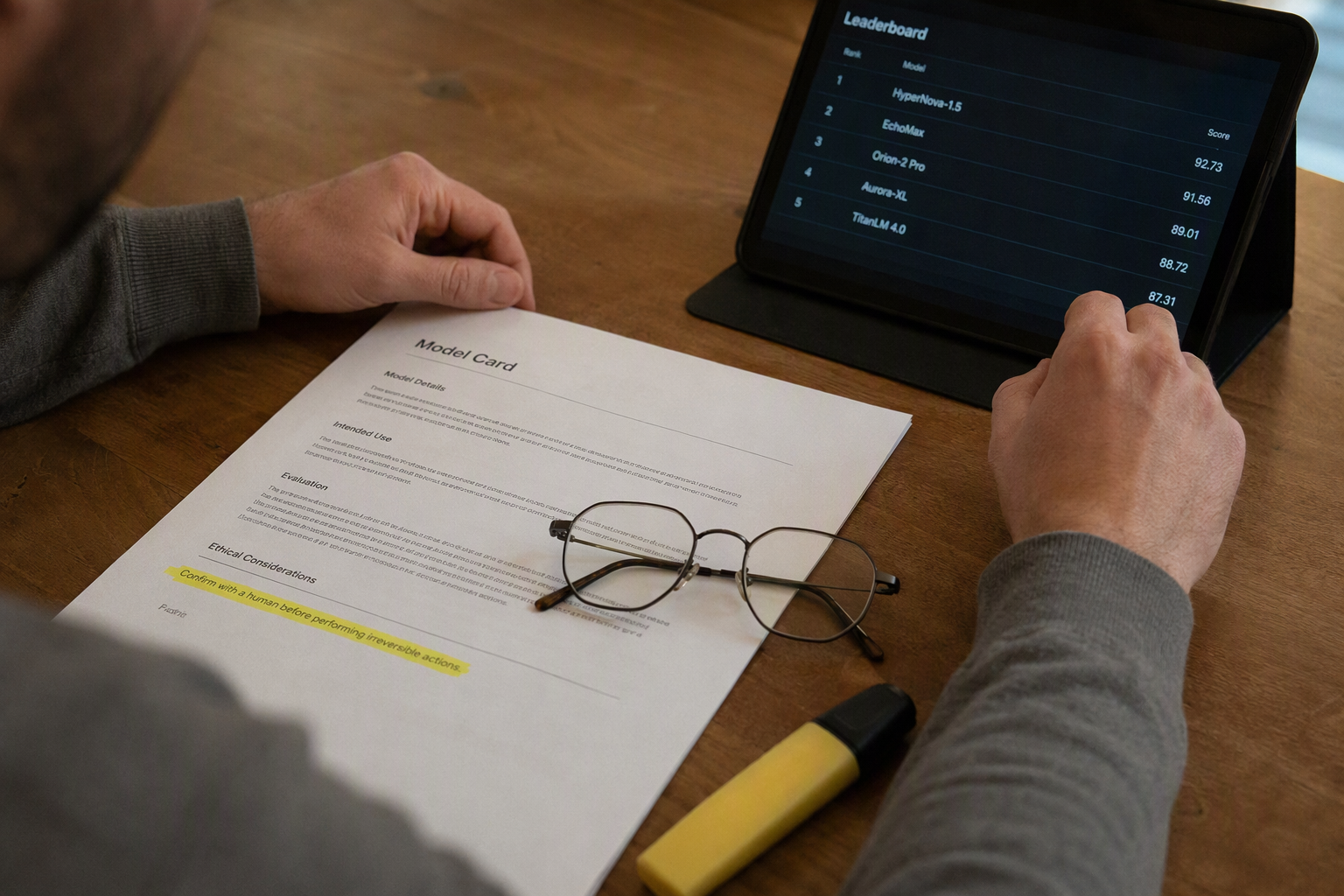
Independent testers confirm Meta's headline claim but add caveats, and Meta's own model card is more cautious than the launch marketing. The Artificial Analysis numbers largely match what Meta said. The fine print is about token use, API access and autonomy.
What did independent testers actually measure?
Artificial Analysis, the third-party benchmarking firm, scored the models on its Intelligence Index v4.3 at maximum reasoning effort. According to WorldAttention, Muse Wonder scored 52 and Muse Wonder Full scored 56, up from 48 for Muse Spark 1.3.
Coverage differs on how to read the ranking:
- OfficeChai reports Muse Wonder Full placed third overall, ahead of GPT-6 Astra and Gemini 4 Argon (both 53). It also says Meta is now the second-highest-placed lab on the index.
- Crypto Briefing describes Full as second only to Claude Opus 5.5, and says it posted strong coding results.
- Shattered.io says Full tied Claude Sonnet 5.5 at 56, and that the smaller Wonder sat a point behind GPT-6 Astra.
These accounts are compatible. Meta ranks second as a lab, Full ranks third as a model, and a different Claude model matches it on score. The coverage we reviewed gave no specific coding benchmark figures, so treat "strong coding results" as a pointer to test, not a number to rely on.
What does the data say about cost and access?
Winbuzzer reports that Artificial Analysis measured roughly 54,000 output tokens per task for each Wonder variant. That is a lot of reasoning, and you pay for it.
VentureBeat's headline says only the weaker Wonder model is available via API. It also reports Artificial Analysis estimates the cost of running its average Intelligence Index task at $4.52 for Wonder. The excerpt we had cut off before the comparison figures, so we can't say how that stacks up against Claude Opus 5.5.
In practice, the top-scoring Meta model can't be built into a production pipeline yet. The one you can call is the 52-scoring model, and its per-task cost depends heavily on how many tokens it spends thinking.
What does Meta's own model card say?
Winbuzzer reports that Meta's model card recommends human confirmation before irreversible actions. That is notable because the Arabian Post says Meta positions both models for complex professional assignments, software development and autonomous digital assistants.
The card's recommendation and the marketing pull in different directions. If you're building agents that send payments, delete records or email customers, Meta itself advises a human checkpoint. Design for that from day one.
How should you weigh vendor claims against independent scores?
IJR News frames the launch as Meta "claiming" benchmark gains, and Mark Zuckerberg's X post on October 12, 2026 presented Muse Wonder as a big step up from Muse Spark. Independent scores support that direction, but a few points on one index is not a verdict on your workload.
A simple checklist:
- Run your own evals on real prompts, since one index averages many task types.
- Track tokens per task, not just price per million tokens.
- Add confirmation gates for irreversible agent actions.
- Re-check scores in a few weeks, because leaderboards are moving quickly.
For step 2, tools help. A gateway like CallMissed, the OpenAI-compatible AI gateway, offers usage and request logs, so teams can compare real token consumption across models behind one API key.
What does Meta's rise mean for the AI model market?

Meta's rise means the top of the AI model market is now a tight, multi-lab race where access, token efficiency and switching cost matter as much as raw intelligence scores. Meta Superintelligence Lab went from a respectable mid-pack position to the top tier in one release cycle. That changes how teams should buy models.
How big is Meta's jump?
On the Artificial Analysis Intelligence Index v4.3, Muse Wonder scored 52 and Muse Wonder Full scored 56, up from 48 for Muse Spark 1.3, according to Winbuzzer and WorldAttention. That is a gain of 4 to 8 points in a single generation. OfficeChai reports that Meta is now the second-highest-placed lab on the index.
Headlines say Meta is "closing the gap," and that is fair. But the leaderboard is crowded rather than settled. Wonder Full sits three points above GPT-6 Astra and Gemini 4 Argon (both 53), while Shattered.io reports it tying Claude Sonnet 5.5 at 56.
What does a crowded frontier change for buyers?
When several labs sit within a few index points, the score stops being the deciding factor. Four other factors take over:
- Access: VentureBeat notes that only the weaker Wonder model is available via API. A 56 you cannot call in production is a press result, not a procurement option.
- Cost per task: Artificial Analysis measured roughly 54,000 output tokens per task for each Wonder variant. Two models with similar scores can have very different bills if one reasons far longer.
- Risk posture: Meta's model card recommends human confirmation before irreversible actions. Teams building autonomous agents should treat that as a design requirement, whichever vendor they pick.
- Pace of change: Spark 1.3 to Wonder took one release. Any ranking you commit to today may be stale within weeks.
Is Meta's open-versus-gated split a trend to watch?
Possibly, though the research for this post does not tell us Meta's intentions. What it does show is a pattern: the strongest variant is held back while a cheaper one is exposed. If other labs follow, the models you can benchmark in headlines and the models you can deploy will keep diverging. Plan for the deployable tier.
What should developers do about it?
The practical response is to avoid betting your architecture on any single vendor. Keep your integration layer thin and your evaluation set ready to re-run.
- Write a small internal eval from your own prompts, then re-test whenever a new model lands.
- Track tokens per task, not just price per million tokens.
- Use a standard API format so a model swap is a configuration change.
This is where gateways help. CallMissed, the OpenAI-compatible AI gateway, offers 140 models from makers including OpenAI, Google, DeepSeek, Mistral and xAI behind one API key and balance. It also exposes an Anthropic-compatible /v1/messages endpoint, so existing SDKs work by changing the base URL. As of October 14, 2026, check the live catalogue for which models are listed, since new releases like Wonder may not be available yet.
The takeaway: Meta's rise is good news for buyers because it adds competition at the top. The winners will be teams that can re-test and re-route quickly instead of rewriting code each time the leaderboard moves.
Which model should a small business use for missed-call text-back, an AI receptionist or voice agents?
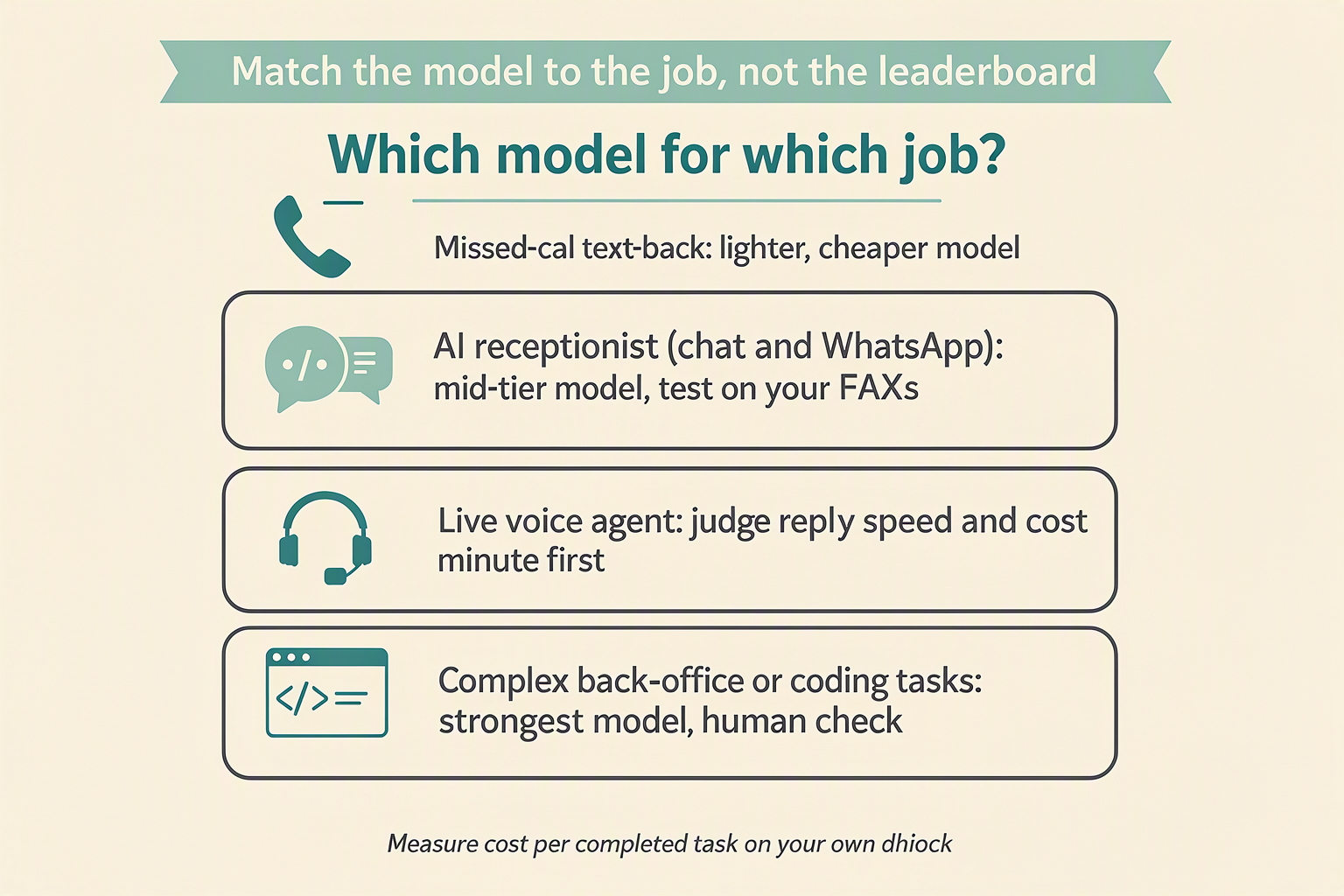
For most small businesses, the answer is a smaller, faster model rather than any of the three flagships. As of October 14, 2026, no independent benchmark covers missed-call text-back or reception work for Muse Wonder, Claude Opus 5.5 or Fable 5.1. The recommendations below are our own reasoning, based on the published Intelligence Index results and the trade-offs they imply.
Why are frontier models usually the wrong fit for these jobs?
Artificial Analysis measured roughly 54,000 output tokens per task for each Wonder variant. That budget suits long coding and research tasks. A customer waiting for a reply to "are you open Saturday?" needs an answer in seconds, not a long reasoning chain.
The Intelligence Index gap is also small relative to the task. Muse Wonder scored 52 and Muse Wonder Full scored 56, according to Artificial Analysis. Those points show up on hard multi-step problems. They are unlikely to matter for answering a FAQ or capturing a callback number.
Which model tier fits each small-business use case?
| Use case | What matters most | Suggested tier | Reasoning |
|---|---|---|---|
| Missed-call text-back | Speed, low cost per message | Small or fast model, low reasoning effort | Replies are short and scripted. Paying for deep reasoning adds cost with no visible benefit. |
| AI receptionist on chat or WhatsApp | Accuracy on your own FAQs and hours | Mid-tier model plus a knowledge base | Grounding in your documents matters more than raw intelligence. |
| Live voice agent | Low latency, natural speech | Realtime voice-agent model | Long reasoning delays break the conversation. |
| Booking, refunds, cancellations | Reliable tool use, fewer errors | Stronger model with human confirmation | Meta's model card recommends human confirmation before irreversible actions. |
| Post-call summaries and QA scoring | Quality, not speed | Strongest affordable model | Runs after the call, so latency is irrelevant. |
| Rare, complex escalations | Reasoning depth | Claude Opus 5.5 or Muse Wonder | Use a flagship only for the few cases that need it. |
What does this mean for the three models specifically?
- Muse Wonder: the only Meta model callable by API, per VentureBeat. Artificial Analysis estimates $4.52 for its average Intelligence Index task, so treat it as a back-office model rather than a per-message one.
- Muse Wonder Full: not available via API, so it cannot power a production receptionist today.
- Claude Opus 5.5: the strongest in the independent data we found, which suits escalation and review rather than every inbound message.
- Fable 5.1: we found no independent figures, so we cannot recommend it for any of these tasks yet. Test it on your own transcripts first.
How can a small business avoid betting on one model?
Route by task instead of choosing a single winner. Send routine messages to a cheap model, and send the rare hard case to a flagship.
CallMissed, the AI communication platform, takes some of this decision off your plate for voice. Its voice agent plans are flat per-minute rates (Standard ₹4, Expressive ₹5 and Best latency ₹6 per minute) that cover speech recognition, the language model and the voice. For WhatsApp, CallMissed offers AI chatbot agents on the official Meta Cloud API, with a knowledge base and a human-handoff queue. That queue suits the confirmation step recommended above. Developers can also reach 140 models through CallMissed's OpenAI-compatible API and switch between them by changing the base URL.
Pricing is as of October 2026 and may change; check the CallMissed pricing page before committing.
Frequently Asked Questions
Muse Wonder vs Claude Opus 5.5: which model scores higher?
Can I call Muse Wonder Full through an API?
How much does Muse Wonder cost to run per task?
Is Muse Wonder vs Claude Opus 5.5 really a three-point or ten-point difference?
How does Fable 5.1 compare with Muse Wonder and Claude Opus 5.5?
How can I switch between models like these without rewriting my code?
Conclusion
As of October 14, 2026, the evidence is clear enough to act on but not settled.
- Ranking: On the Artificial Analysis Intelligence Index v4.3, Muse Wonder Full (56) sits just behind Claude Opus 5.5 and ahead of GPT-6 Astra and Gemini 4 Argon (both 53).
- Access: Only Muse Wonder (52) is available via API, so Full's lead isn't yet something you can build on.
- Cost: At roughly 54,000 output tokens per task, reasoning-heavy runs cost more than a headline rate suggests. Artificial Analysis estimates $4.52 for Wonder's average Intelligence Index task.
- Fable 5.1: We found no independent figures, so don't base production decisions on it yet.
Watch for three things: whether Meta opens API access to Wonder Full, whether independent Fable 5.1 results appear, and how Meta's advice to confirm irreversible actions with a human shapes agent design.
Rankings can shift within weeks, so keep your integrations portable. To explore how AI infrastructure is evolving, check out CallMissed, an OpenAI-compatible gateway offering 140 models through one API key, with voice agents and multilingual chatbots built on top.
When the next leaderboard reshuffle lands, will your stack be ready to switch in an afternoon?
Related Reading
- Claude Fable 5.1 vs Opus 5.5: Pricing & Coding
- Muse Wonder vs GPT-6 Astra vs Gemini 4 Argon for Voice
- Claude Opus 5.5 Pricing: Assess Support-AI Performance