
Claude Opus 5.5 Pricing: Assess Support-AI Performance


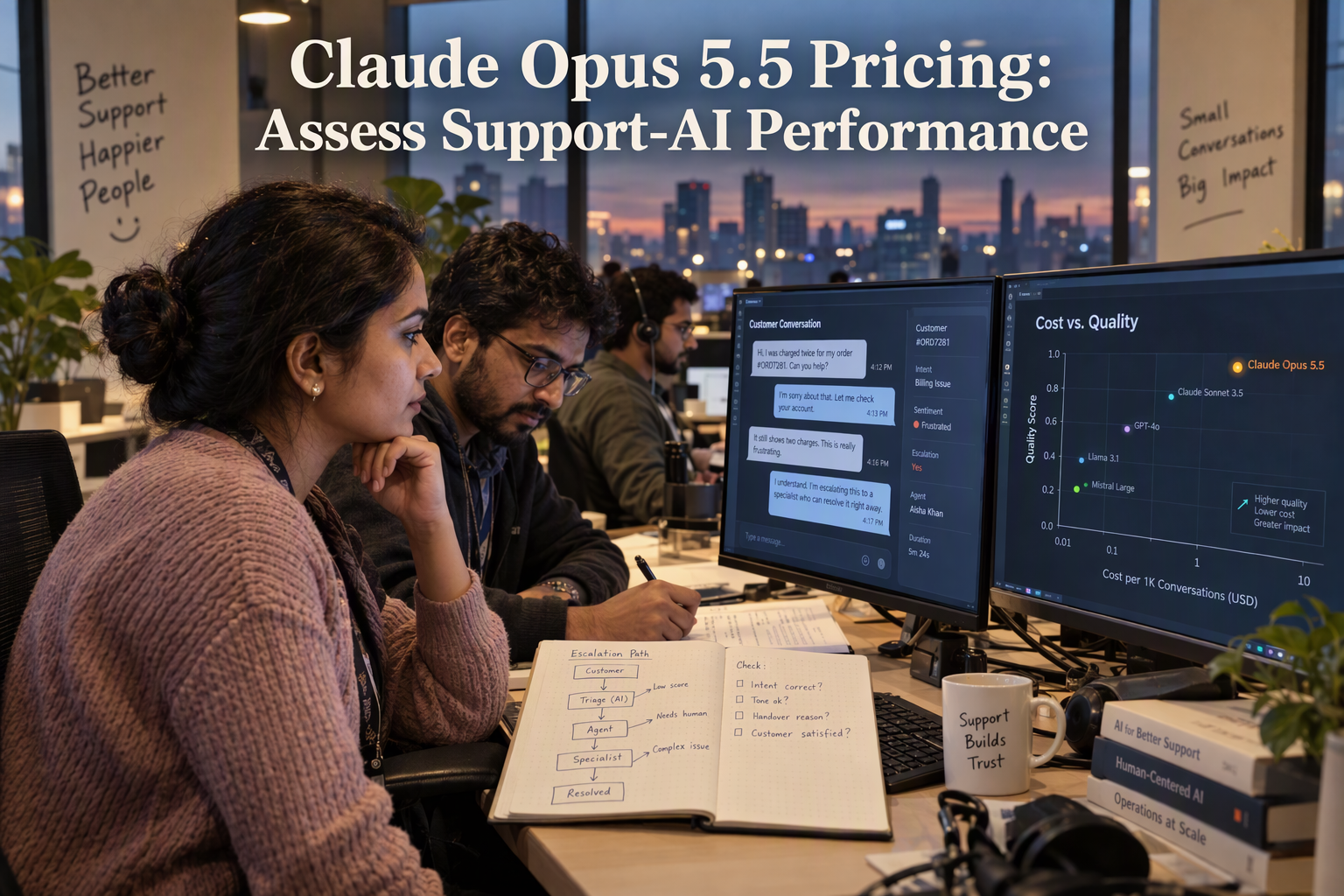
Assess Claude Opus 5.5 pricing with ticket-level cost calculations, reproducible support benchmarks, latency tests, and rollout criteria.
Claude Opus 5.5 Pricing: Assess Support-AI Performance
A cheaper AI model can still produce a more expensive support ticket if it needs extra turns, makes a policy mistake, or sends the customer back to a human. Claude Opus 5.5 pricing should therefore be assessed against cost per successfully resolved issue, not token rates alone.
As of October 2026, andrew.ooo reports that Anthropic released Claude Opus 5.5 on September 22, 2026, with pricing of $4 per million input tokens and $20 per million output tokens. Aismiley’s September 25, 2026 coverage reports a 40% reduction in processing costs compared with Claude Opus 5. Those reported figures make the model worth investigating—but they do not establish what your support operation will actually save.
The timing matters because the conversation around frontier AI is shifting from “How intelligent is this model?” toward “What does that intelligence cost to deploy?” The trending “Claude Opus 5.5 Intelligence, Performance and Price Analysis (Max)” discussion reflects that distinction. For support teams, impressive general-purpose results are only useful when they translate into accurate answers, reliable tool use, acceptable response times, and fewer avoidable escalations.
How should you assess Claude Opus 5.5 for support AI?
Start with a realistic workload rather than a leaderboard. A password-reset request, a disputed refund, and a multilingual troubleshooting conversation impose different demands; averaging them together can hide both expensive failures and valuable improvements.
Consider a simple budgeting example: at the October 2026 rates reported by andrew.ooo, a conversation consuming 10,000 input tokens and 2,000 output tokens would cost $0.08 in model tokens. That is an illustrative calculation—not a measured support benchmark—and excludes retrieval, external tools, retries, channel charges, and human follow-up. If the same issue requires three attempts, the apparent bargain changes quickly.
This guide will show you how to evaluate:
- Pricing: Estimate input and output consumption across complete conversations, including repeated context and retries.
- Resolution quality: Test factual accuracy, policy compliance, escalation decisions, and whether the customer’s problem actually gets solved.
- Performance: Measure response times under realistic loads instead of assuming headline speed improvements apply to your workflows.
- Deployment economics: Compare routine automation with selective use on complex cases, using a consistent test set.
As of October 2026, CallMissed supports this evaluation approach with call scoring against custom QA rubrics, eval suites, and A/B experiments.
The goal is not to crown a universal winner. It is to determine whether Claude Opus 5.5 delivers better support outcomes at a defensible total cost.
How should you assess Claude Opus 5.5 pricing and performance for support AI?
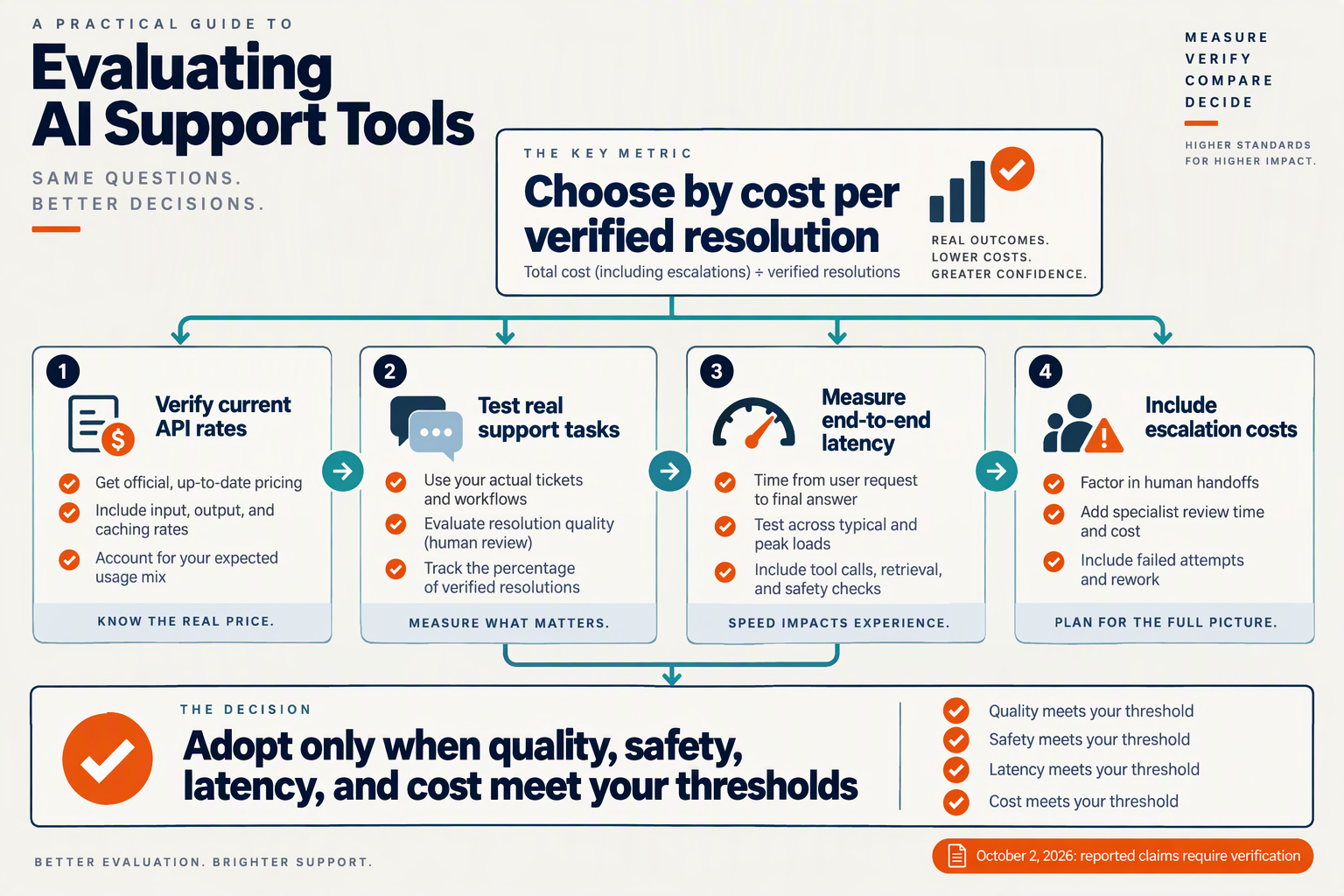
Assess Claude Opus 5.5 pricing and performance with a controlled comparison against your existing support workflow, using identical tickets, tools, and resolution criteria. Approve deployment only when the model meets your quality requirements and improves total operating cost—not merely its token bill.
What should a support-AI evaluation actually measure?
Define a successful resolution before running any tests. For a refund request, success might require checking eligibility, retrieving the correct order, executing an authorized action, and explaining the outcome accurately. A plausible answer without the required action is not a resolution.
Build a scorecard with four separate dimensions:
- Correctness: Did the response match the knowledge base and current customer records?
- Policy compliance: Did the agent respect refund limits, identity checks, and permissions?
- Task completion: Did the intended action succeed, with confirmation from the relevant system?
- Customer effort: Did the customer need to repeat information or contact support again?
Treat serious policy violations as deployment blockers, not small deductions that excellent writing can offset. Also distinguish necessary escalation from avoidable escalation: handing a sensitive dispute to a human can be the correct outcome.
How do you create a fair model comparison?
Use a repeatable evaluation process rather than selecting conversations that make one model look impressive:
- Sample representative tickets. Include routine requests, ambiguous policies, failed tool calls, and multilingual conversations.
- Separate development and test cases. Tune prompts on one set, then evaluate on an untouched holdout set.
- Control the environment. Keep knowledge-base versions, tool permissions, conversation history, and output limits consistent.
- Review outputs without model labels. Have support specialists judge correctness and completion before revealing which system produced each answer.
- Report results by ticket category. A strong overall average can conceal poor performance on billing or account-access cases.
For reproducibility, record the model identifier, evaluation date, configuration, and prompt version. October 2026 results should not silently become evidence for a later model revision.
How should you interpret reported performance improvements?
As of October 2026, The News reports a 30% speed improvement for Claude Opus 5.5, but the supplied coverage does not establish a support-specific latency benchmark or test methodology. Treat that figure as a reason to investigate, not a forecast for your deployment.
Measure time to first useful response, full task-completion time, and p95 latency—the response time within which 95% of requests finish. Tool lookups, retries, and long conversation histories can change the customer experience even when model generation becomes faster.
What financial result would justify deployment?
Calculate total evaluation cost divided by verified successful resolutions, then compare that figure with your baseline.
Consider an illustrative October 2026 scenario, not a measured benchmark:
- Baseline: $100 in total operating costs and 80 successful resolutions.
- Candidate: $120 in total operating costs and 96 successful resolutions.
- Both workflows cost $1.25 per successful resolution.
The candidate resolves more issues but has not improved unit economics. It may still offer value through capacity or shorter waits, provided those benefits are measured separately.
As of October 2026, CallMissed’s developer AI API provides usage and request logs, which can support the consumption side of this analysis. Pair those records with independently verified support outcomes: request counts alone cannot prove that customers received correct resolutions.
What prerequisites make a support-AI comparison reproducible?
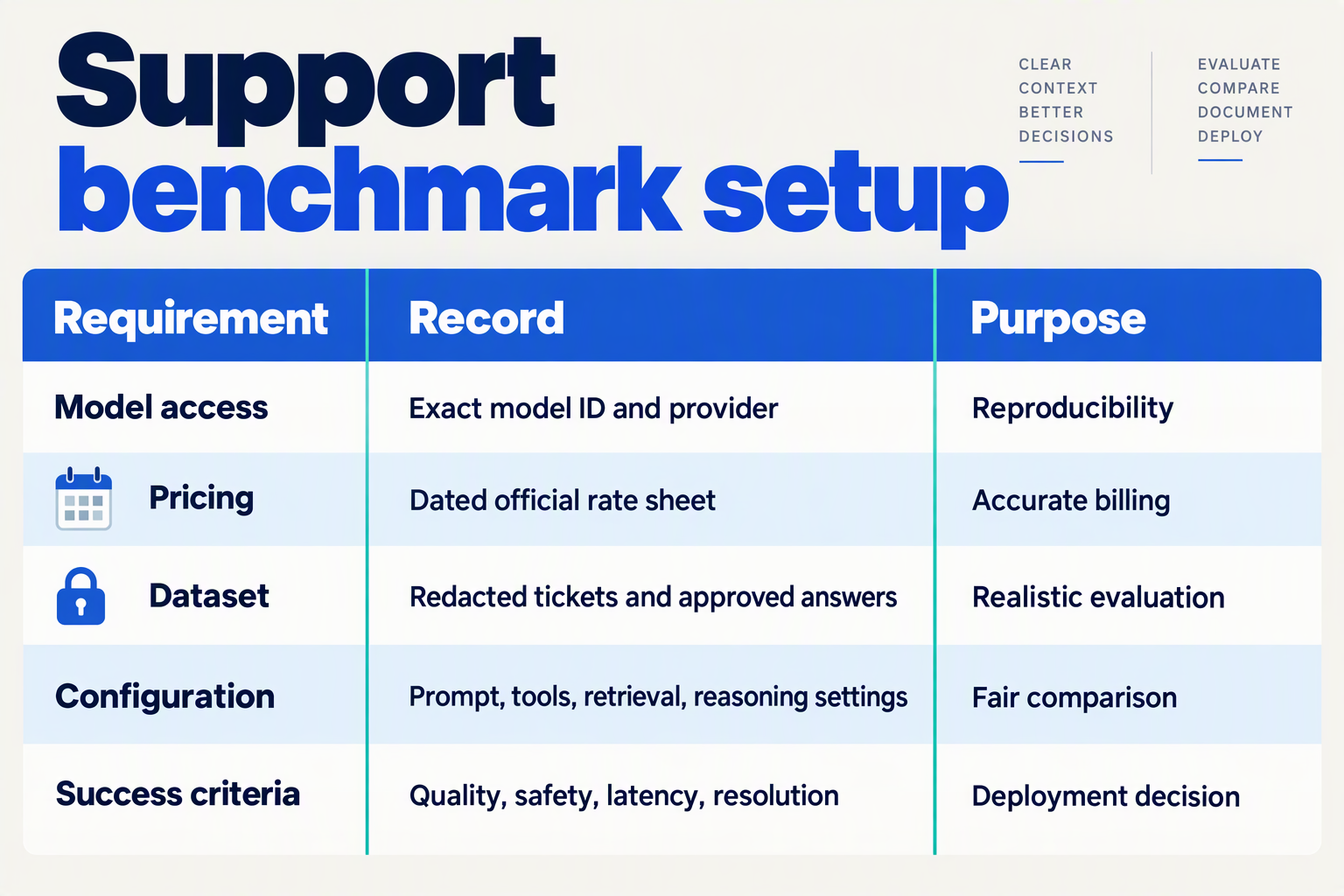
A reproducible support-AI comparison requires a frozen test set, versioned configuration, identical tool access, and consistent measurement rules. Before testing Claude Opus 5.5 against another model, create an evaluation manifest that lets a second engineer rerun the experiment without guessing which settings or support policies you used.
What should you freeze before comparing support-AI models?
Use the following checklist for an October 2026 evaluation. These are recommended experimental controls—not published Claude Opus 5.5 specifications or benchmark results.
| Prerequisite | What to record | Control to apply | Why it matters |
|---|---|---|---|
| Test conversations | Anonymized messages, issue category, language, expected outcome | Use the same held-out cases for every model | Prevents easier tickets from favoring one model |
| Model configuration | Exact model ID, endpoint, reasoning settings, output limit | Pin versions where available; record unsupported settings | Makes configuration differences visible |
| Prompts and knowledge | System prompt, policy documents, retrieval settings | Version prompts and freeze the knowledge snapshot | Separates model ability from changing instructions |
| Tools and permissions | Tool schemas, account state, allowed actions | Use identical sandbox responses and permissions | Prevents backend differences from distorting results |
| Execution conditions | Channel, concurrency, region, timeout and retry rules | Match conditions; separate cold and warm runs | Keeps latency and reliability measurements comparable |
| Scoring and billing | QA rubric, usage records, applicable rate card | Define success and cost boundaries before testing | Prevents selective scoring and incomplete accounting |
Identical conditions do not always mean identical parameter values. Different providers may expose different reasoning controls or sampling settings. Record those differences explicitly rather than assuming similarly named settings produce equivalent behavior.
How should you build a representative support test set?
Start with anonymized historical tickets, then add deliberately difficult cases that ordinary samples might miss. Keep evaluation tickets separate from examples used to tune prompts.
Include:
- Routine requests: order tracking, account access, and straightforward policy questions.
- Policy-sensitive requests: refunds outside the eligibility window, identity checks, and requests involving personal information.
- Tool-dependent requests: cancellations, booking changes, and actions requiring confirmation.
- Ambiguous conversations: missing details, contradictory customer statements, and multilingual exchanges relevant to your audience.
For example, an illustrative 120-case pilot could contain 30 cases in each category. Equal category sizes help diagnose weaknesses, but they do not necessarily reflect production traffic; report category results separately and calculate an additional traffic-weighted result using your actual ticket mix.
Which measurement rules prevent misleading results?
Define each timer before running requests. Time to first token, time to a usable answer, and time to confirmed resolution measure different things; a fast opening sentence does not prove a refund workflow finished faster.
As of October 2026, The News International reports a 30% speed boost for Claude Opus 5.5, but the supplied coverage does not establish that improvement for your support workflows. Treat that headline as a hypothesis to test, not an expected result.
Use three operational rules:
- Repeat cases: Run multiple trials to expose variable outputs, and alternate model order to reduce time-of-day effects.
- Retain failures: Count timeouts, retries, invalid tool calls, and escalations instead of removing unsuccessful runs.
- Score blind: Hide model names from reviewers and require policy-compliant completion—not merely fluent wording.
As of October 2026, CallMissed’s developer AI API provides usage and request logs, which can support this audit trail. Whichever infrastructure you use, preserve prompts, responses, tool events, timestamps, and billed usage alongside each evaluation result.
How do you verify API pricing and interpret the current benchmark headlines?
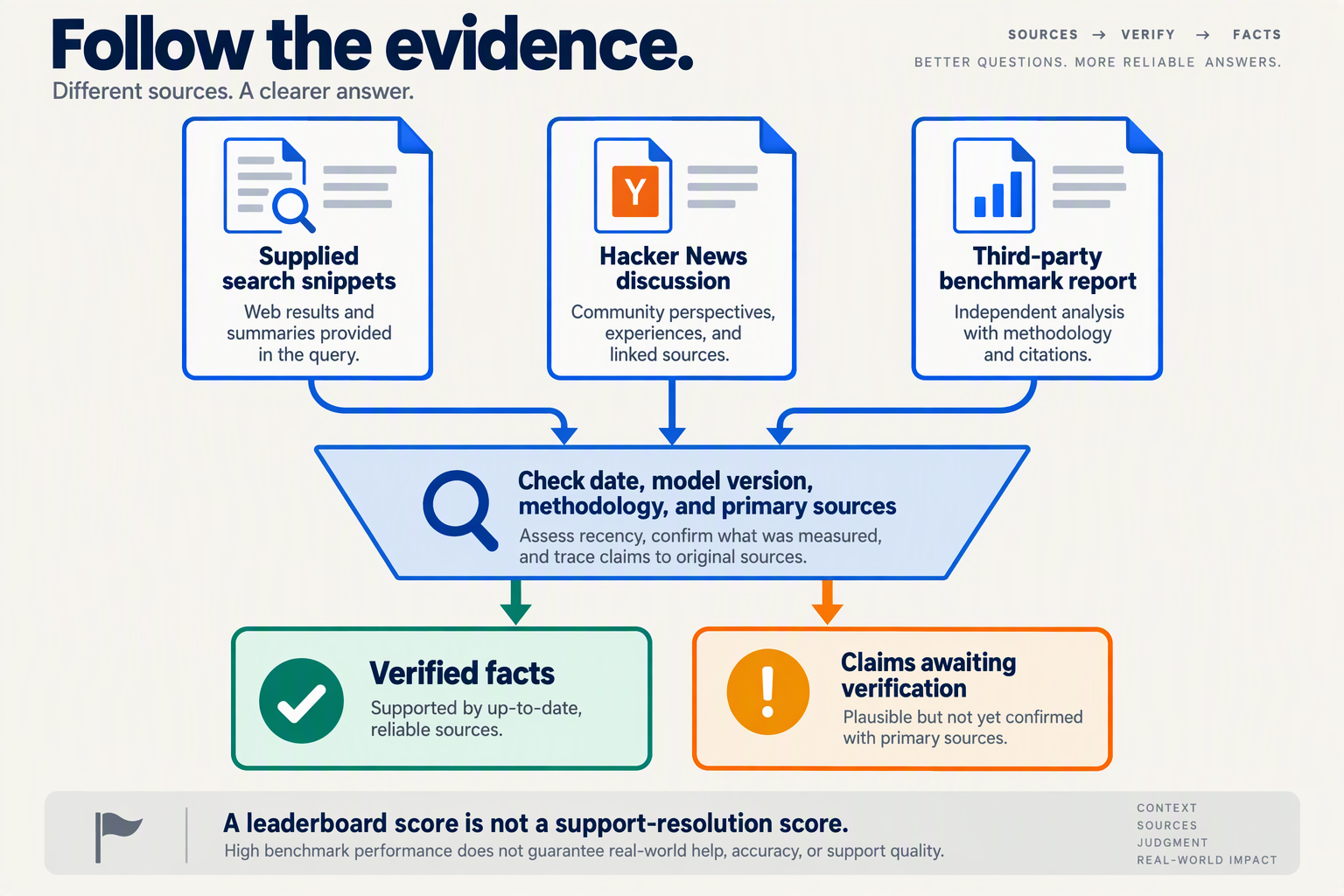
Verify Claude Opus 5.5 API pricing against Anthropic’s official documentation and your actual billing route, then interpret benchmark headlines through their test conditions. As of October 2026, the supplied coverage provides reported prices and performance claims, but not enough primary-source evidence to treat them as verified deployment guarantees.
How do you verify Claude Opus 5.5 API pricing?
Use the reported rate as a starting point, not a purchase specification. As of October 2026, andrew.ooo reports Claude Opus 5.5 pricing of $4 per million input tokens and $20 per million output tokens, following a reported September 22, 2026 release.
Before approving a support-AI budget, complete these checks:
- Confirm the model identifier. Match the requested API model to the pricing entry; a product-family name or chat subscription does not establish API charges.
- Check the billing route. Verify whether you are buying directly from Anthropic, through a cloud marketplace, or through an API gateway. Record the applicable currency and any additional charges.
- Separate token categories. Check how ordinary input, generated output, cache reads, cache writes, and any reasoning-related usage are billed, where applicable.
- Inspect conditional pricing. Look for documented differences involving context length, processing tiers, or other usage conditions rather than assuming one headline rate covers everything.
- Reconcile a small test. Compare API usage records with the billed amount before extrapolating to monthly volume.
Keep a dated pricing snapshot alongside the model identifier and test configuration. That makes later cost changes explainable rather than mysterious.
What does the reported 40% cost reduction actually mean?
Aismiley’s September 25, 2026 coverage reports a 40% reduction in processing costs for Claude Opus 5.5 compared with Claude Opus 5. That comparison does not, by itself, establish a 40% reduction in your support operation’s total spending.
Check what the percentage measures: published token rates, a fixed workload, or another definition of processing cost. The supplied excerpt does not provide that methodology.
For example, if a hypothetical $1,000 monthly model bill fell by 40%, the saving would be $400. If the same operation also spent $4,000 on unchanged staffing and infrastructure, total spending would fall from $5,000 to $4,600—an 8% reduction, not 40%. This is an illustrative calculation, not a measured Claude result.
How should you interpret benchmark and “Max” headlines?
Treat the trending title, “Claude Opus 5.5 Intelligence, Performance and Price Analysis (Max),” as a prompt to inspect the evaluation—not as evidence that its results match your deployment.
Ask:
- What does “Max” mean? Establish whether it describes a reasoning setting, evaluation configuration, or something else; the supplied context does not define it.
- What was held constant? Compare prompts, tools, token budgets, retries, and model versions.
- What does “speed” measure? Distinguish first-token latency, generation throughput, and complete task duration.
- Was cost measured under the same configuration? A capability score and a price headline may describe different operating conditions.
As of October 2026, The News reports a 30% speed boost for Claude Opus 5.5, but the supplied excerpt does not specify the measurement method. Do not translate that directly into 30% faster customer conversations.
For an auditable comparison, preserve request-level evidence. As of October 2026, CallMissed’s developer AI API provides usage and request logs, which can support that recordkeeping for models available through its gateway; this does not establish Claude Opus 5.5 availability.
How do you benchmark support quality and latency step by step?
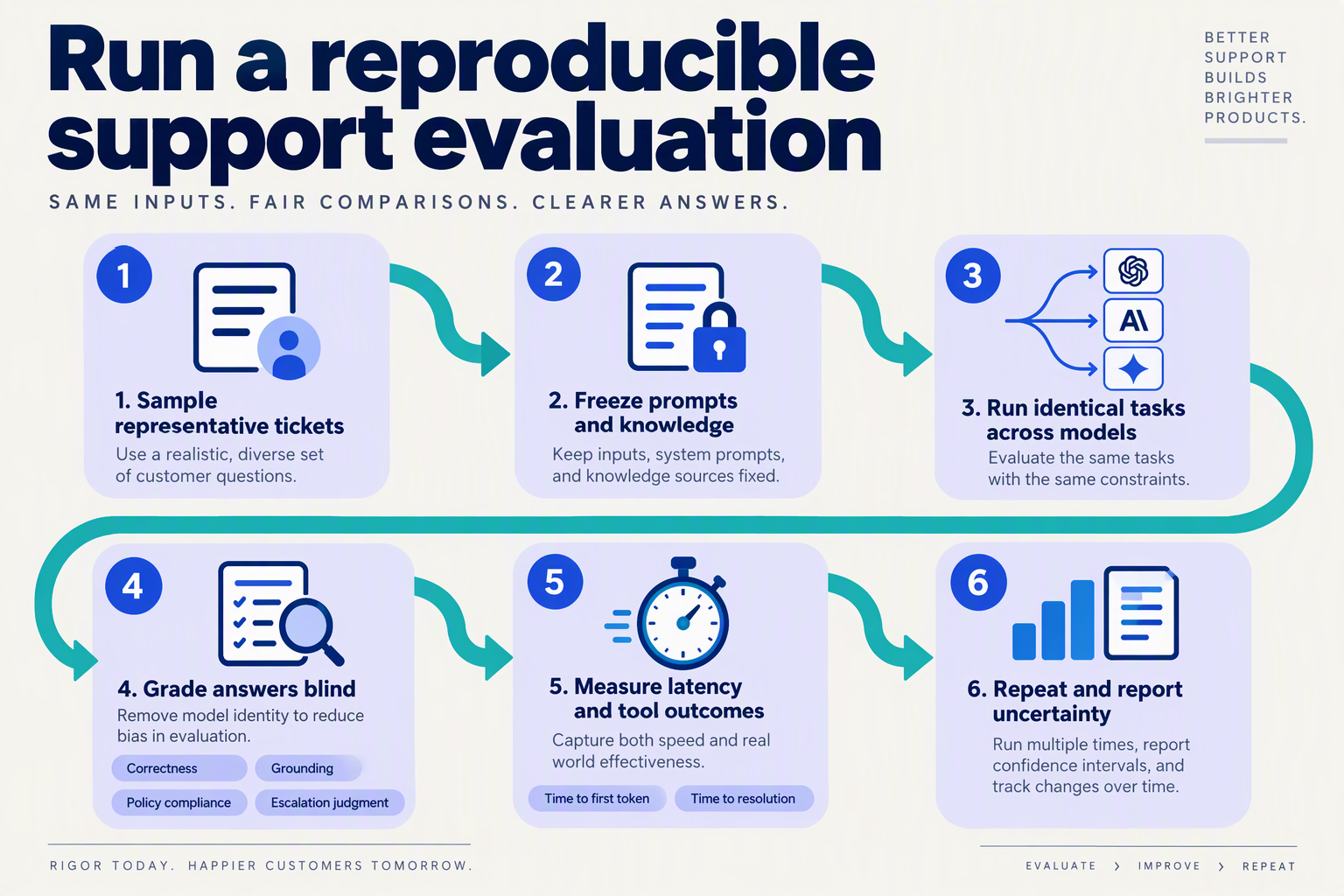
Benchmark Claude Opus 5.5 support quality and latency by replaying representative tickets under controlled conditions, scoring outcomes against a written rubric, and measuring the complete customer-visible response time. Compare models on the same cases, then validate the results in a limited live pilot before expanding deployment.
How do you build a representative support benchmark?
- Create a frozen, anonymized test set. Sample real conversations across your main support categories: account access, refunds, troubleshooting, order updates, and policy exceptions. Include incomplete requests, frustrated customers, multilingual exchanges, and cases that require human escalation.
An illustrative starting point is 200 tickets across five categories, not a statistically validated minimum. Preserve the actual production mix for aggregate reporting, but report difficult and safety-sensitive cases separately so routine successes cannot conceal serious failures.
- Define the expected outcome before testing. For each ticket, document the relevant knowledge-base evidence, permitted actions, required clarification, and correct escalation decision. Use sandbox tools for actions such as issuing refunds or updating customer records.
A refund test should distinguish “explained the policy correctly” from “checked eligibility and completed the authorized refund.” That difference separates plausible conversation from genuine resolution.
How do you score support quality consistently?
- Use a rubric with hard failure rules. Score each conversation against observable criteria:
- Accuracy: Are factual claims supported by approved sources?
- Policy compliance: Does the answer respect refund, privacy, and account-access rules?
- Tool execution: Are tool selection, arguments, and resulting actions correct?
- Resolution: Was the issue solved, or appropriately handed to a human?
- Communication: Is the response clear, relevant, and suitable for the customer’s language?
Treat unauthorized actions and sensitive-data disclosure as failures regardless of tone. Otherwise, a polished answer can inflate the average while creating operational risk.
- Blind-review outputs and repeat uncertain cases. Hide model names from reviewers, use two reviewers for ambiguous tickets, and resolve disagreements against the documented policy. Automated grading can accelerate screening, but human reviewers should verify consequential decisions.
As of October 2026, CallMissed’s voice-agent platform supports call scoring against custom QA rubrics, eval suites, and A/B experiments. Those capabilities can support a repeatable evaluation process; they do not establish Claude Opus 5.5’s quality or availability on the platform.
How do you measure latency without misleading averages?
- Instrument the entire response path. Record request submission, first visible token, completed answer, each tool call, retries, and final task completion. Report p50 and p95 latency—the median and the response time within which 95% of observations fall—alongside timeout and error rates.
As of October 2026, The News International reports a 30% speed boost for Claude Opus 5.5, but the supplied coverage does not specify a support-workload measurement method. Treat that figure as a hypothesis to test, not a forecast for your help desk.
- Control conditions, then test realistic load. Keep prompts, retrieval results, tool permissions, output limits, and supported inference settings consistent. Record caching status and run at representative concurrency levels; a fast isolated request may slow when tools or infrastructure queue.
How do you decide whether the results justify deployment?
Set acceptance gates before inspecting results: no critical policy failures, acceptable resolution quality, and channel-specific p95 latency targets. Pair those outcomes with cost per successful resolution, including retries and human follow-up.
Finish with a small, monitored pilot and explicit rollback criteria. Offline accuracy shows what the model can do under test conditions; live monitoring reveals whether customers actually receive reliable, timely support.
How much does Claude Opus 5.5 cost per resolved support ticket?
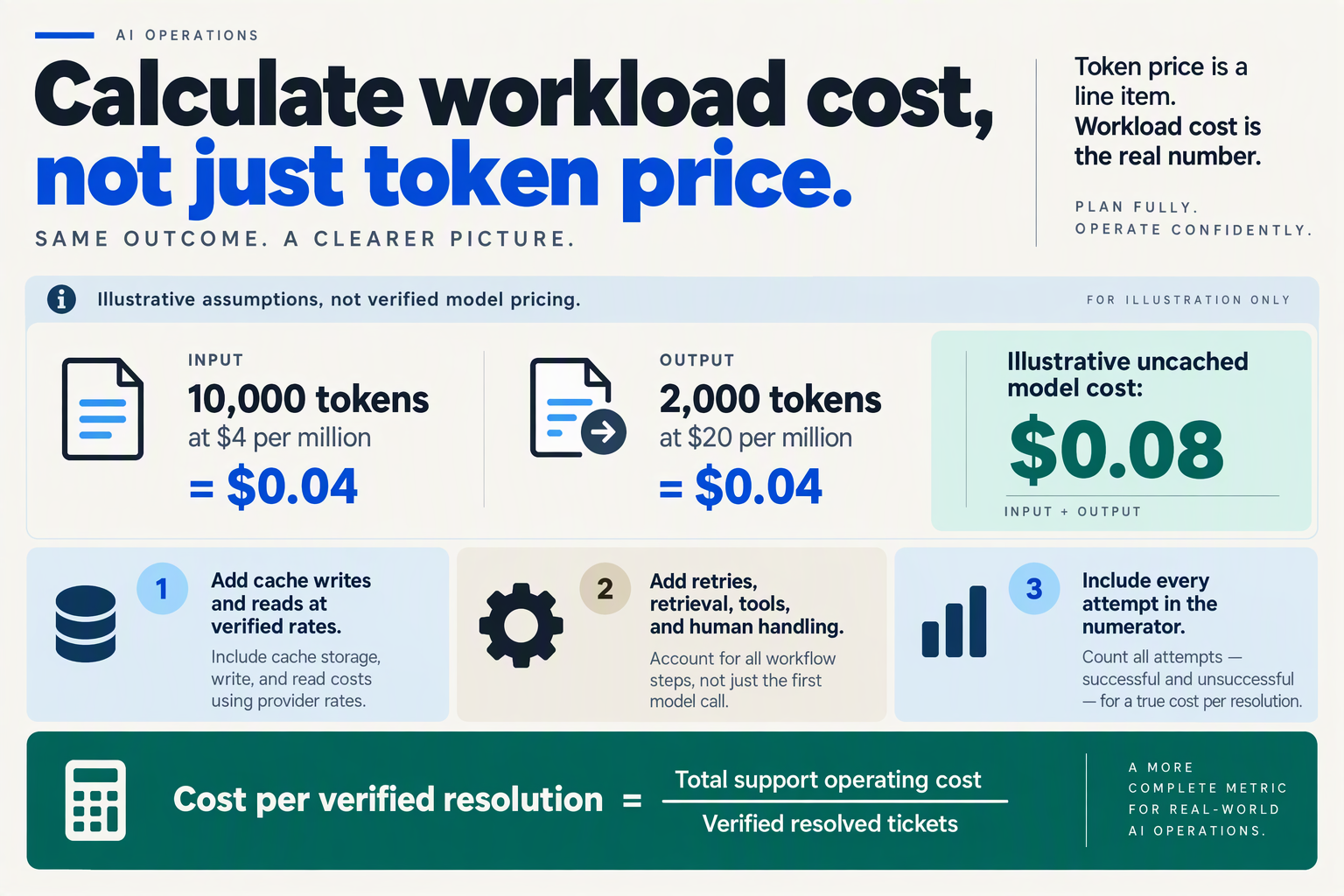
Claude Opus 5.5’s cost per resolved support ticket depends on total workflow spending divided by verified resolutions—not its token price alone. There is no measured support-ticket benchmark in the supplied reporting, so use the reported pricing as a budgeting input and calculate the outcome from your own ticket cohort.
How do you calculate cost per resolved support ticket?
Use this formula:
Cost per resolved ticket = total cost of handling a ticket cohort ÷ verified resolutions within that cohort
The numerator must include spending on unsuccessful attempts, not just conversations that ended successfully. Otherwise, a model that abandons difficult cases can appear artificially economical.
Track these cost categories:
- Model usage: Input and output tokens across every turn, retry, and tool-result processing step.
- Supporting infrastructure: Retrieval, external services, channel charges, and allocated platform costs.
- Human intervention: Review, escalation handling, and correcting inaccurate answers.
- Rework: Reopened cases and repeat contacts attributable to an incomplete resolution.
As of October 2026, andrew.ooo reports Claude Opus 5.5 pricing of $4 per million input tokens and $20 per million output tokens. Treat those as reported rates; confirm the applicable billing terms before committing a production budget.
What would a realistic support-ticket calculation look like?
Consider this illustrative October 2026 budget, not an observed Claude Opus 5.5 benchmark:
- Process 1,000 incoming tickets. Assume average aggregate usage per ticket—including retries—is 12,000 input tokens and 1,500 output tokens.
- Calculate model spending. At the rates reported by andrew.ooo, each ticket costs
(12,000 × $4 + 1,500 × $20) ÷ 1,000,000 = $0.078, making cohort model spending $78. - Add operational costs. Assume $120 for supporting infrastructure and 300 human escalations costing $4 each: $1,200 in human handling.
- Count verified outcomes. Suppose AI resolves 700 tickets, humans resolve another 250, and 50 remain unresolved at the measurement cutoff.
Total spending is $1,398, and the workflow resolves 950 tickets. Its cost per resolved ticket is therefore $1.47, rounded—not the $0.078 token cost per incoming ticket.
That difference shows where optimization matters. In this scenario, reducing avoidable escalations has substantially more financial leverage than trimming a few output tokens.
What counts as a verified support resolution?
Define resolution before running the evaluation. A conversation ending, a ticket closing automatically, or a customer saying “thanks” does not necessarily prove that the underlying issue was fixed.
For a defensible measurement:
- Require the requested outcome or a correct, policy-compliant explanation.
- Check for repeat contact or reopening within a predefined window.
- Separate AI-only resolutions from human-assisted resolutions.
- Keep unresolved tickets’ spending in the numerator.
As of October 2026, CallMissed’s developer AI API provides usage and request logs, which can support the model-spending side of this accounting. Pair those records with ticket outcomes and human-handling costs; request logs alone cannot establish resolution.
Does a reported 40% price reduction mean tickets cost 40% less?
No. Aismiley’s September 25, 2026 coverage reports 40% lower processing costs than Claude Opus 5, not a measured 40% reduction in support-ticket costs.
In the illustrative cohort above, even cutting the entire $78 model bill by 40% saves only $31.20, approximately 2.2% of total spending. Evaluate Claude Opus 5.5 on whether its answers reduce escalation and rework while maintaining resolution quality—not whether its token discount looks impressive in isolation.
How should you compare Opus 5.5 with Opus 5 and GPT-6 for support tasks?
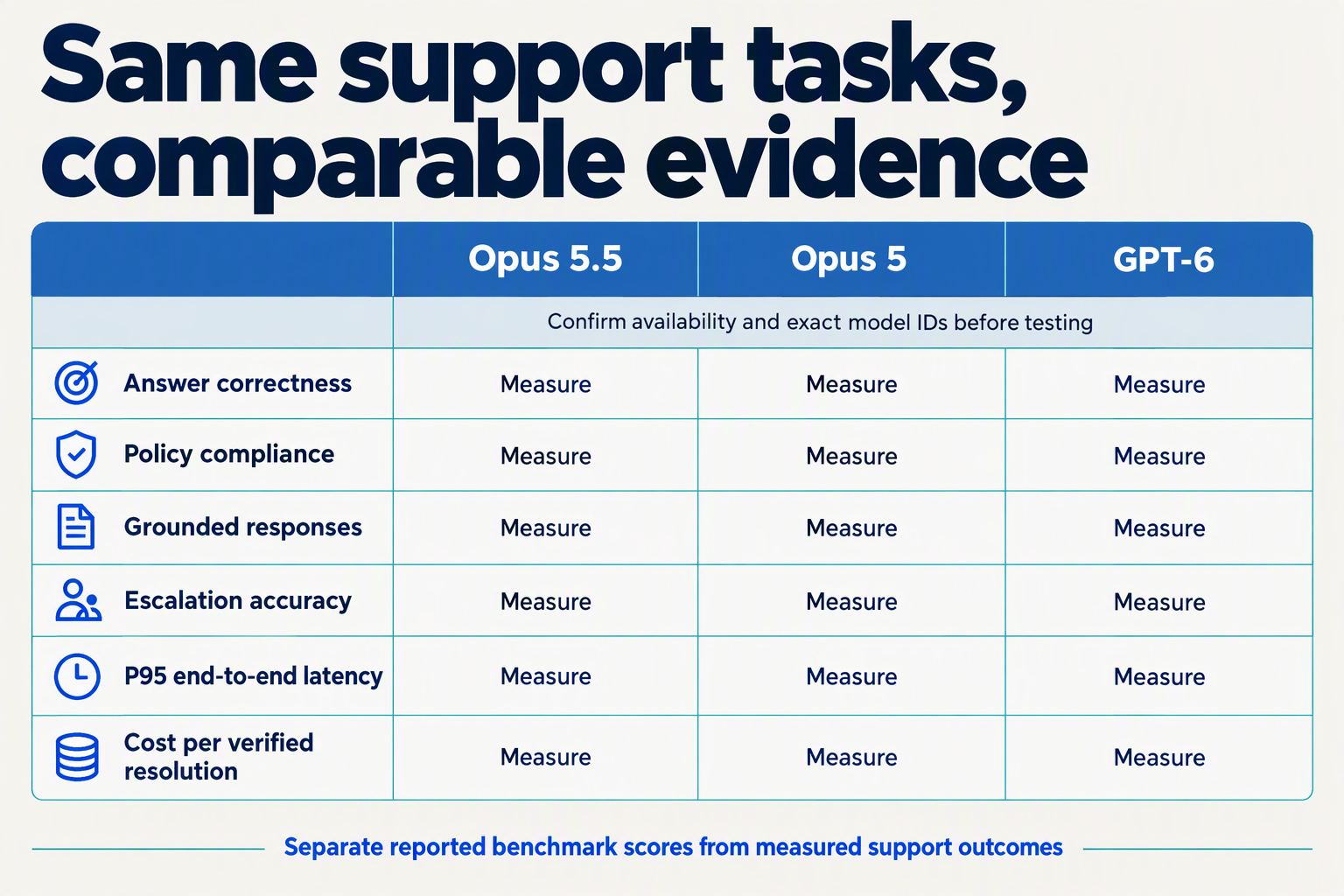
Compare Claude Opus 5.5, Claude Opus 5, and OpenAI GPT-6 on the same support cases, with identical policies, tools, and acceptance criteria. Select the model that clears your safety and quality thresholds at the lowest cost per verified resolution, rather than treating a general intelligence ranking as a support benchmark.
What does the available evidence establish about these models?
Aismiley’s September 25, 2026 report describes Claude Opus 5.5 as reducing processing costs by 40% compared with Claude Opus 5, alongside improvements in agentic coding and knowledge work. That is a reason to test an upgrade—not evidence of a 40% reduction in your support budget.
As of October 2026, The News reports a 30% speed boost for Claude Opus 5.5, but the supplied excerpt does not identify the measurement conditions. Do not translate that headline directly into faster refund processing or shorter customer wait times.
The supplied October 2026 research also mentions OpenAI’s GPT-6 Sol and Luna, according to AIstart, but provides no comparable prices or support-task results. Record the exact GPT-6 variant and obtain its current provider documentation before constructing a numerical comparison; do not treat “GPT-6” as one interchangeable configuration.
How do you build a fair support-task comparison?
Use two test tracks: a controlled comparison with shared settings, followed by a deployment comparison where each model receives a documented, production-appropriate configuration. This separates model differences from gains caused by better prompting or different reasoning budgets.
- Freeze the evidence. Give every model the same policy version, customer history, retrieved documents, and simulated tool responses.
- Specify the configuration. Record model identifiers, evaluation date, output limits, reasoning settings, caching, and retry rules.
- Blind the reviewers. Hide model names when human reviewers score answers, tool actions, and escalation decisions.
- Repeat ambiguous cases. Test whether a model consistently handles conflicting policies rather than succeeding once.
Include cases that distinguish support competence from fluent writing:
- Policy conflict: A customer requests a refund outside the standard window but qualifies for an exception.
- Tool failure: An order lookup times out; the agent must avoid inventing shipment details.
- Authorization boundary: A customer asks to change another account’s billing information.
- Multilingual ambiguity: A code-mixed message contains an unclear cancellation request.
As of October 2026, CallMissed, the AI customer-communication platform and developer AI API, offers eval suites, A/B experiments, and call scoring against custom QA rubrics—capabilities relevant to structuring this evaluation.
When is a more expensive model worth using?
A higher token bill can be justified when it prevents enough retries, incorrect actions, or human escalations. Calculate that trade-off within each ticket category rather than across one blended average.
For an illustrative October 2026 evaluation, suppose one candidate costs $0.05 more per ticket but reduces human escalation from 12% to 9%. Across 1,000 tickets, that adds $50 in model spending while avoiding 30 escalations; assuming $4 per escalation, the net saving is $70. These are hypothetical assumptions, not measured results for any named model.
Apply hard failure gates before comparing savings: unauthorized account changes and fabricated refund approvals should not be averaged away by excellent routine answers. The defensible outcome may be a routing policy—one model for straightforward requests and another for complex exceptions—not a universal winner.
Which advanced optimizations improve support-AI price-performance?
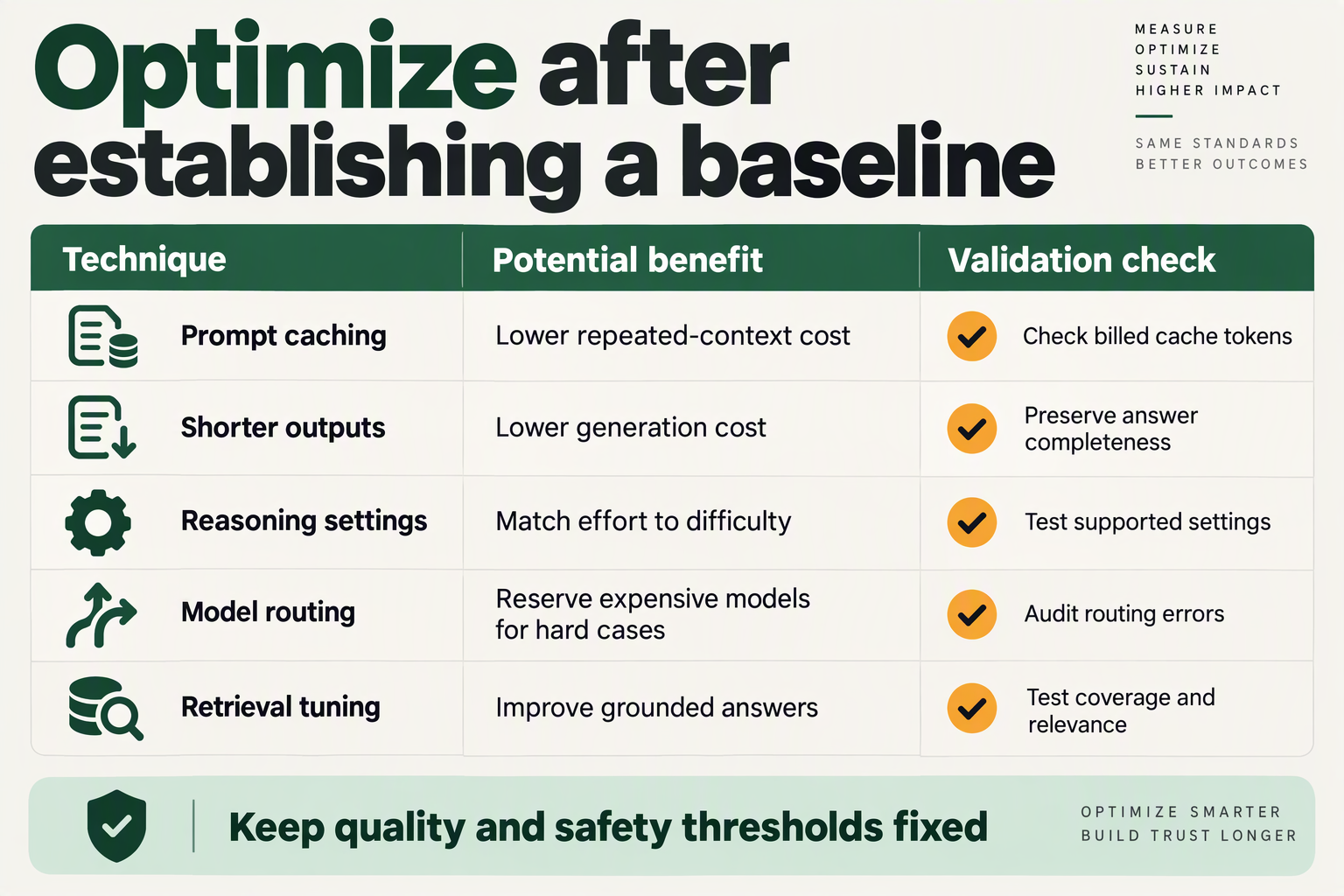
Selective model routing, tighter context, controlled outputs, safe caching, and disciplined tool execution can improve support-AI price-performance—but only when they preserve resolution quality. For Claude Opus 5.5, prioritize optimizations that remove unnecessary work before reducing the model’s involvement in difficult cases.
Which support-AI optimizations should you test first?
The following table is an October 2026 evaluation checklist, not a claim that Claude Opus 5.5 provides every mechanism natively. Implement these controls in your application or gateway, and verify model-specific support before deployment.
| Optimization | Practical implementation | Measure | Main safeguard |
|---|---|---|---|
| Selective routing | Use a lower-cost model for routine requests; escalate ambiguous policy cases to Opus 5.5. | Total cost per resolution, including routing | Audit misrouted high-risk tickets. |
| Context pruning | Retrieve relevant policy passages and summarize older turns instead of resending everything. | Input tokens and policy accuracy | Preserve dates, exceptions, and customer commitments. |
| Output budgets | Request concise customer replies and structured tool arguments. | Output tokens and repeat contacts | Never omit required explanations or next steps. |
| Safe response caching | Reuse approved answers to stable, non-personalized questions. | Cache hit rate and stale-answer rate | Invalidate when policies change; exclude account-specific answers. |
| Tool-call controls | Validate arguments, deduplicate requests, and cap retries. | Tool calls per resolution and failed actions | Require confirmation for consequential changes. |
| Selective verification | Check consequential answers against authoritative policies or account records. | Policy violations and verification cost | Do not trust model confidence alone. |
Routing is not automatically cheaper. If a routine model fails, its initial response, the escalation, and repeated context all contribute to the final bill. Evaluate the complete routed conversation against an Opus-only baseline, rather than comparing isolated requests.
How much can shorter outputs actually save?
As of October 2026, andrew.ooo reports Claude Opus 5.5 pricing of $4 per million input tokens and $20 per million output tokens. At those reported rates, removing 1,500 unnecessary output tokens saves $0.03 per conversation—an illustrative calculation, not a measured deployment result.
Across a hypothetical 10,000 conversations, that reduction would save $300 in output-token charges. However, shorter answers that trigger additional contacts can erase those savings.
Separate two different caching strategies:
- Response caching avoids generation by reusing an eligible answer.
- Provider prompt caching may change billing for repeated input; verify Claude Opus 5.5’s actual eligibility, pricing, and retention terms rather than assuming a discount.
How should you validate an optimization before rollout?
Use a staged experiment:
- Change one control at a time. Start with context pruning or output budgets so you can identify the cause of any quality change.
- Test difficult cases separately. Include conflicting policies, multilingual requests, outdated documents, and tools returning errors.
- Promote only with quality gates. Require acceptable policy accuracy, resolution rates, and end-to-end latency alongside lower cost.
As of October 2026, CallMissed’s developer AI API offers caller-chosen fallback models, response caching, structured outputs, and usage and request logs—useful building blocks for application-level optimization. Those capabilities do not, by themselves, establish Claude Opus 5.5 availability or model-specific caching discounts.
The strongest optimization removes redundant computation without removing the evidence, safeguards, or explanation needed to resolve the customer’s issue.
Which mistakes distort Claude Opus 5.5 pricing and benchmark results?
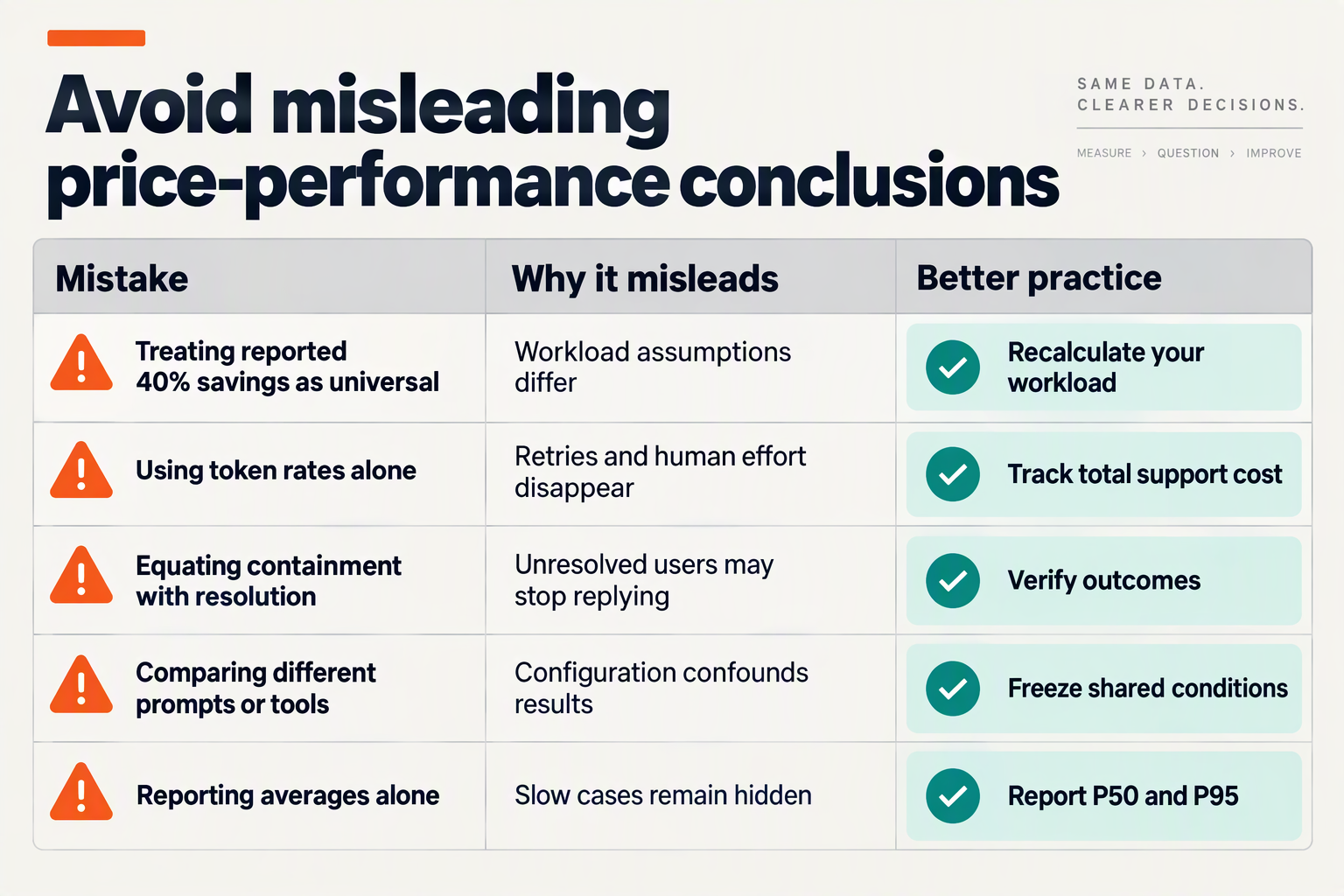
The biggest mistakes are treating headline token prices as total operating costs, comparing different inference settings, and using general intelligence benchmarks as evidence of support resolution quality. Claude Opus 5.5 pricing and benchmark results are meaningful only when the workload, configuration, billing assumptions, and success criteria are comparable.
Which pricing and benchmark mistakes should you check first?
Use this checklist before accepting a vendor comparison or internal evaluation. Each mistake can make a model appear cheaper or more capable without improving the customer’s outcome.
| Mistake | How it distorts results | What to check |
|---|---|---|
| Comparing “Max” with default settings | Extra inference effort may change quality, latency, and consumption. | Record the actual settings; do not infer them from a report title. |
| Pricing only the final answer | Earlier turns, repeated context, and retries disappear from the estimate. | Aggregate billed usage across the complete issue. |
| Mixing cached and uncached workloads | Different cache conditions create misleading cost comparisons. | Separate cold-start tests from cache-enabled production estimates. |
| Changing tools or retrieval | Better documents or tool access can look like better model intelligence. | Hold knowledge snapshots, tool permissions, and retrieval settings constant. |
| Scoring answers instead of outcomes | A fluent response can conceal an incorrect refund or unresolved issue. | Verify policy compliance, tool results, and resolution separately. |
| Reporting only averages | Easy tickets hide slow, costly, or unsafe edge cases. | Break results down by intent, language, complexity, and tail latency. |
The word “Max” in the trending analysis title is a reason to inspect methodology, not proof of a particular configuration. The supplied context does not establish that analysis’s inference settings, sample size, or support-specific test coverage.
Why can headline savings mislead support teams?
Aismiley reported on September 25, 2026, that Claude Opus 5.5 reduced processing costs by 40% compared with Claude Opus 5. That reported reduction should not be presented as a guaranteed 40% reduction in support expenditure.
For an illustrative October 2026 budget, suppose model inference represents 25% of a support workflow’s total cost. Even a 40% reduction in that component would reduce the total by only 10%, assuming everything else stays unchanged: 25% × 40% = 10%.
Similarly, The News reports a 30% speed boost in coverage supplied for this October 2026 assessment, but the excerpt provides no measurement methodology. Do not translate that claim directly into a 30% improvement in end-to-end ticket handling: retrieval, external APIs, and human approvals also take time.
How should you make an evaluation auditable?
Keep a compact evaluation manifest alongside every result:
- Identify the run: Record the date, model identifier, prompt version, inference settings, and knowledge-base snapshot.
- Reconcile consumption: Retain request-level usage and billing records, including retries and failed attempts where charges apply.
- Review failures: Label policy violations, unsuccessful tool actions, unnecessary escalations, and unresolved cases independently.
- State uncertainty: Report sample sizes and distinguish measured results from assumptions or projections.
As of October 2026, CallMissed, the developer AI API platform, provides usage and request logs plus caller-chosen fallback models. Those capabilities can support traceability, but evaluators should still record whether a fallback handled a request; otherwise, a mixed-model workflow may be mistakenly credited to a single model.
The practical rule: reject comparisons that cannot explain what was run, what was billed, and what counted as success.
Frequently Asked Questions
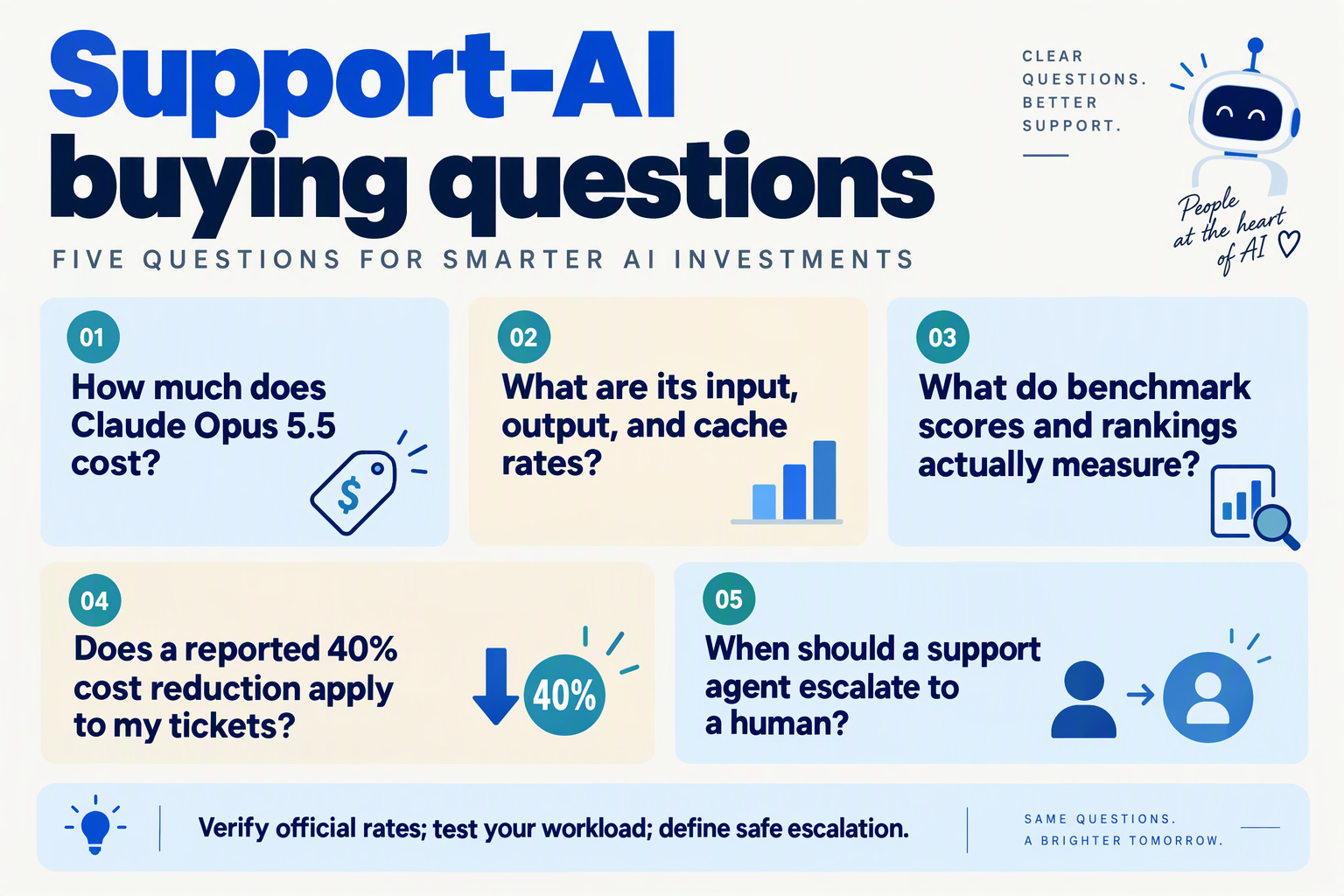
How much is Claude Opus 5.5 pricing per million tokens?
How do I calculate Claude Opus 5.5 pricing for monthly customer support?
Do Claude Opus 5.5 benchmark gains improve customer support resolution?
Is Claude Opus 5.5 faster for live support chats?
Does lower Claude Opus 5.5 pricing justify replacing every support model?
Can CallMissed help evaluate support-AI costs and quality?
Which resources and next steps help you run a controlled support-AI pilot?
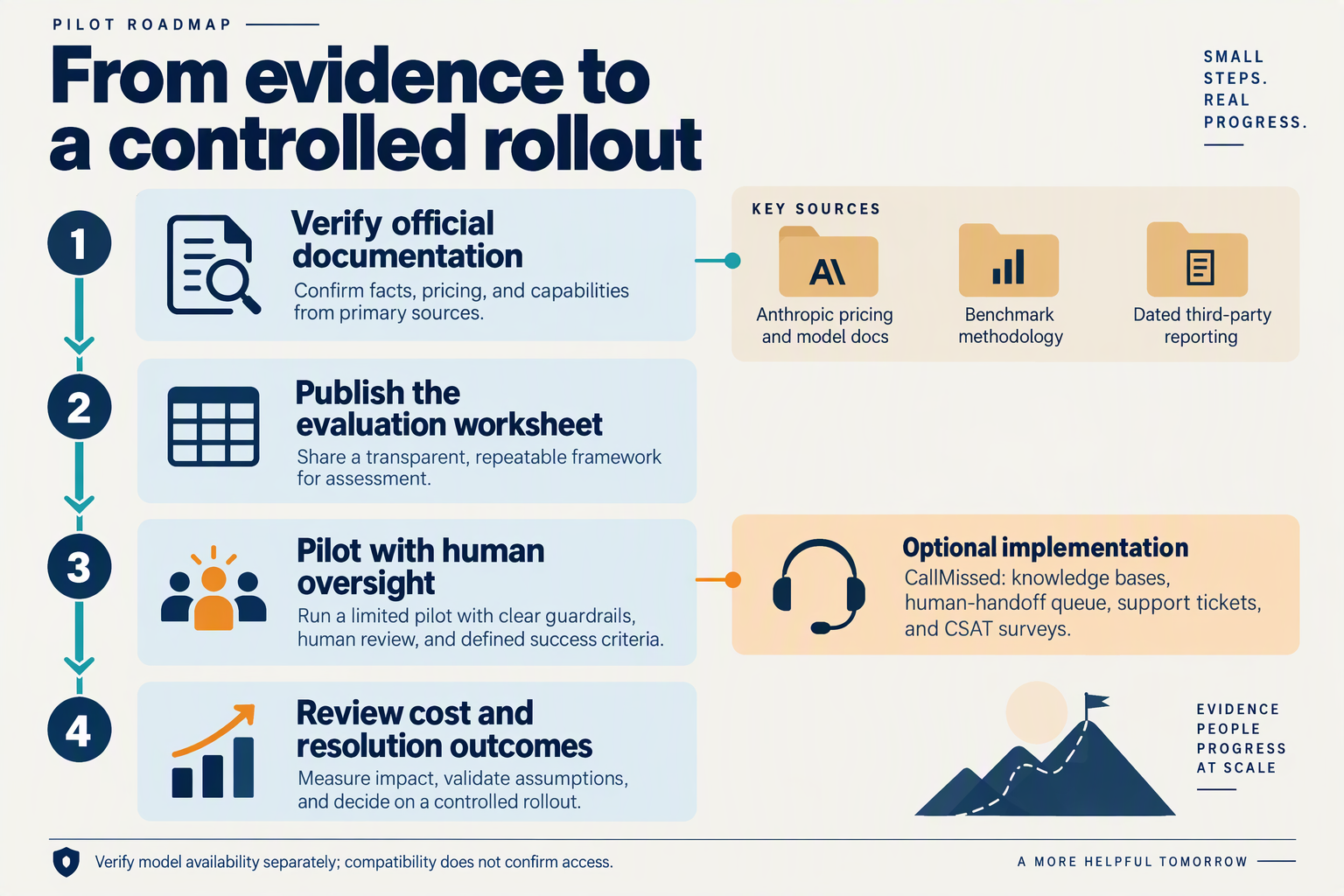
Run a controlled support-AI pilot with verified model documentation, a versioned evaluation pack, and explicit rollout gates. The next step is not a wider deployment: it is a small, reversible experiment that gives support, engineering, and finance teams the same evidence for a decision.
Which resources should you verify before testing Claude Opus 5.5?
Start with Anthropic’s official documentation and your provider’s current model catalogue. Confirm the exact model identifier, availability, billing rules, tool-use interface, and data-handling terms before committing engineering time; secondary coverage is useful context, not an integration contract.
Aismiley reported on September 25, 2026, that Claude Opus 5.5 reduced processing costs by 40% compared with Claude Opus 5. Treat that reported reduction as a hypothesis to investigate, not a forecast for your support budget.
Build a short resource register:
- Model and API documentation: Record the documentation version or access date, supported parameters, and error-handling requirements.
- Pricing documentation: Capture the applicable rates and any separate charges relevant to your configuration.
- Internal support policies: Identify the authoritative refund, identity-verification, cancellation, and escalation rules.
- Security and privacy guidance: Document which customer fields must be removed, masked, or withheld from model requests.
Date the register October 2026 and assign an owner to each resource. Recheck it before moving from offline testing to customer-facing traffic.
What should your pilot handoff pack contain?
Create a compact, reproducible package that another reviewer can run without reconstructing your decisions from chat messages.
- A frozen test set: Use de-identified support conversations, expected outcomes, and clearly marked high-risk cases. Keep a separate holdout set that prompt authors do not use for tuning.
- A configuration manifest: Record the model identifier, prompt version, knowledge-base snapshot, tool permissions, and generation settings.
- A scoring guide: Define acceptable answers, prohibited actions, appropriate escalations, and how reviewers resolve disagreements.
- An execution ledger: Preserve request identifiers, tool results, failures, timestamps, usage records, and reviewer decisions.
- A rollback runbook: Specify who can stop the pilot, how requests return to the existing workflow, and how affected customers receive follow-up.
As of October 2026, CallMissed’s developer AI API provides usage and request logs, structured outputs, and caller-chosen fallback models. Those capabilities can support an evaluation harness, but teams should separately verify Claude Opus 5.5 availability and endpoint compatibility rather than assume catalogue inclusion.
How do you move from testing to a rollout decision?
Use a staged sequence rather than a launch deadline. The following is an illustrative pilot plan, not a measured benchmark:
- Offline replay: Test historical cases without sending customer messages or executing live account changes.
- Shadow evaluation: Generate candidate responses alongside the existing workflow, with no customer-facing authority.
- Restricted live trial: Admit only approved, low-risk intents; retain human review for consequential actions.
- Decision review: Compare results against pre-agreed acceptance criteria and document unresolved failure patterns.
Assign stop conditions before the live trial. Unauthorized refunds, disclosure of protected information, or repeated tool failures should trigger investigation rather than disappear inside an average score.
Finish with a one-page decision: expand, revise, or stop. Include the evidence, remaining risks, accountable owner, and next review date. That turns interest in Claude Opus 5.5 pricing and performance into a defensible operational decision—not an open-ended experiment.
Conclusion
Assess Claude Opus 5.5 pricing by cost per successfully resolved issue—not by token prices alone. For support AI, a lower inference bill matters only when the model also delivers accurate answers, follows policy, uses tools reliably, and avoids unnecessary human escalation.
The practical conclusion is to evaluate Anthropic’s Claude Opus 5.5 against your own support workload before expanding deployment. Four takeaways should guide that decision:
- Treat reported pricing as a starting point, not a savings guarantee. As of October 2026, andrew.ooo reports Claude Opus 5.5 pricing of $4 per million input tokens and $20 per million output tokens. Aismiley’s September 25, 2026 coverage reports a 40% reduction in processing costs compared with Claude Opus 5. Neither figure establishes the reduction in your total support costs, which also depend on conversation length, retries, tools, and human follow-up.
- Measure complete conversations rather than isolated responses. At the October 2026 rates reported by andrew.ooo, an illustrative conversation using 10,000 input tokens and 2,000 output tokens costs $0.08 in model tokens. That calculation excludes retrieval, external tools, channel charges, and human intervention. A seemingly inexpensive answer can become costly when the customer must repeat the request or an agent must correct it.
- Keep resolution quality and response time in the same evaluation. Test factual accuracy, policy compliance, tool execution, and escalation decisions alongside response times under realistic loads. Separate routine requests from disputed refunds and multilingual troubleshooting: an average score can conceal the cases where better reasoning is valuable—or where a failure is especially expensive.
- Use controlled comparisons to decide where the model belongs. Run a consistent test set and compare routine automation with selective use on complex cases. The objective is not to identify a universal winner; it is to establish where Claude Opus 5.5 produces better support outcomes at a defensible total cost.
Looking ahead, watch whether reported price and capability improvements translate into fewer retries, reliable resolutions, and acceptable response times in production-like tests. The “Claude Opus 5.5 Intelligence, Performance and Price Analysis (Max)” discussion reflects the broader question buyers must answer: how much useful support work does each unit of spending deliver?
As of October 2026, CallMissed, an AI customer-communication platform and developer AI API, offers call scoring against custom QA rubrics, eval suites, and A/B experiments. Readers can explore those capabilities as part of a disciplined approach to evaluating evolving support AI.
Before expanding deployment, run a representative pilot: does Claude Opus 5.5 lower the cost of resolving the customer’s problem—or merely the cost of generating the next reply?
Related Reading
- Claude Opus 5.5 Evaluation Review: Support and Voice AI
- GPT-6 Luna vs Claude Opus 5.5: Pricing & Use Cases
- Claude Opus 5.5 API Pricing & Migration Guide
Sources
Discussion
Related Posts



Ready to automate customer conversations?
Launch AI voice agents and WhatsApp bots with CallMissed — one API, 22+ Indian languages.