
Claude Opus 5.5 vs GPT-6 Luna: 2026 Fact-Checked Comparison



A fact-checked GPT-6 Luna vs Claude Opus 5.5 comparison covering verified launch evidence, API status, pricing, capabilities and unknowns.
Claude Opus 5.5 vs GPT-6 Luna: 2026 Fact-Checked Comparison
The most important finding in the Claude Opus 5 vs GPT-5.6 Luna comparison is that the names in the debate may be more confident than the available evidence. As of September 2026, OpenAI’s primary documentation confirms GPT-5.6 Luna as a cost-efficient model for high-volume workloads, but the research supplied for this fact check does not establish an official model called “GPT-6 Luna.” Likewise, it does not provide an Anthropic primary source confirming the launch specifications of “Claude Opus 5” or “Claude Opus 5.5.”
That distinction matters because a one-digit naming error can invalidate an entire comparison. Model IDs determine whether an API request works; context limits shape retrieval and agent architectures; and token prices can change the economics of processing millions of support messages or code-generation requests. Comparing an officially documented model with an unverified or incorrectly named one risks turning speculation into purchasing advice.
OpenAI describes GPT-5.6 Luna as designed for “cost-sensitive, high-volume workloads” and says it roughly corresponds to the nano tier in earlier GPT-5 families, according to the OpenAI API documentation available in September 2026. OpenAI also announced expanded free-user access and “unlimited everyday chats” with GPT-5.6 Luna in ChatGPT, although consumer access terms should not be confused with API pricing or rate limits. An OpenAI preview for GPT-5.6 Sol displays Luna alongside Claude Opus 4.8, not Claude Opus 5.5, which further underscores why benchmark labels and model versions must be checked before drawing conclusions.
This article therefore separates three categories:
- Verified facts, including official launch status, published model identifiers and documented API access
- Claims requiring confirmation, such as Claude Opus 5.5 availability, context capacity and token pricing
- Non-comparable evidence, including vendor charts that use different evaluation settings, tool access or time limits
The analysis will examine API cost, context limits, coding and reasoning benchmarks, agent suitability, support automation, latency considerations and likely workload fit. Where primary sources do not disclose a specification, the answer will be unknown, not an invented estimate.
This verification discipline also matters for multi-model infrastructure: as of September 2026, CallMissed, the OpenAI-compatible AI gateway, provides one API key and balance for 136 models, with caller-selected fallbacks and request logs that can help developers manage changing model catalogues without treating similar names as interchangeable.
The practical verdict will not be “which model wins everything?” It will be whether GPT-5.6 Luna’s efficiency-oriented positioning or Anthropic’s verified flagship offering better matches a specific workload—and whether the supposed Claude Opus 5.5 versus GPT-6 Luna contest exists in deployable form at all.
Which model wins in 2026? First verify the names: current cited sources support GPT-5.6 Luna, not “GPT-6 Luna,” while “Claude Opus 5.5” requires primary-source confirmation
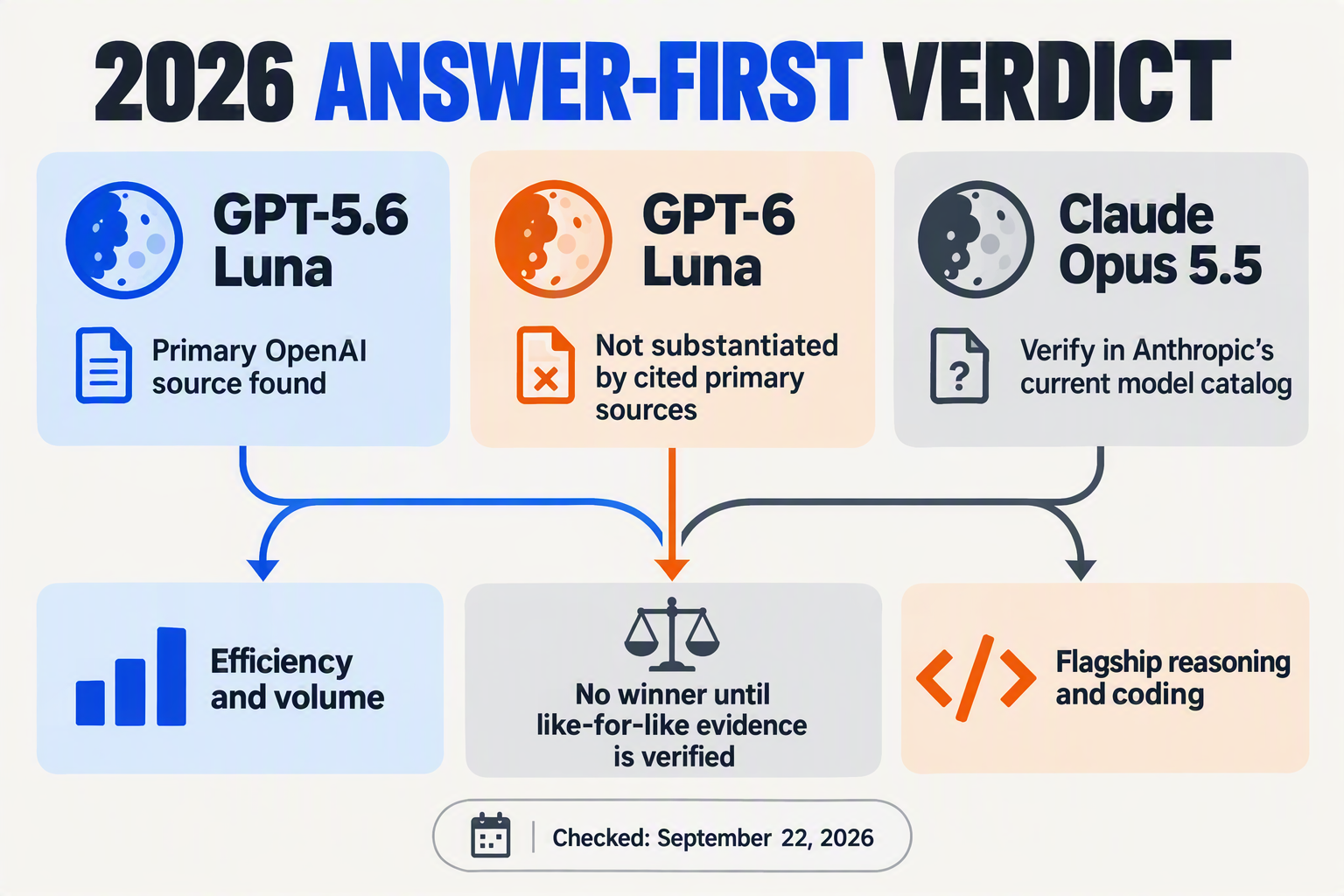
Claude Opus 5.5 wins on verifiable deployability, but no evidence-based performance winner can yet be declared against GPT-6 Luna. As of September 22, 2026, Anthropic’s primary sources confirm Claude Opus 5.5 and its API model ID. OpenAI-domain evidence also references “GPT-6 Sol and Luna,” so GPT-6 Luna should not be dismissed as a naming error. However, the retrieved evidence does not yet verify GPT-6 Luna’s API identifier, pricing, context window, benchmark results or availability.
| Evidence question | Claude Opus 5.5 | GPT-6 Luna |
|---|---|---|
| Official-name evidence | Confirmed across Anthropic launch, newsroom and documentation sources | An OpenAI-domain result titled “Introducing GPT-6 Sol and Luna” was surfaced |
| API model ID | claude-opus-5-5 | Not verified from a retrieved API reference |
| Product positioning | Agentic coding and knowledge work | Not verified from the available primary-source material |
| Pricing or workload cost | Anthropic says typical workloads cost 40% less than Opus 5 | Not verified |
| Context window | Requires confirmation from the applicable Anthropic model documentation before quoting a figure | Not verified |
| Reproducible comparative benchmarks | Insufficient for a direct verdict | Insufficient for a direct verdict |
| Deployment status for this comparison | Verifiable API target | Operational details remain unverified |
Has Anthropic officially launched Claude Opus 5.5?
Yes. Claude Opus 5.5 is officially confirmed. Anthropic’s launch page, newsroom coverage, API release notes, documentation and system-card listing support the model’s existence. The documented API model ID is claude-opus-5-5.
Anthropic positions Opus 5.5 for agentic coding and knowledge work. It also says typical workloads cost 40% less than Opus 5. That statement should be presented as Anthropic’s workload-level claim, not automatically converted into a 40% reduction in published per-token prices.
These sources correct the earlier conclusion that Opus 5.5 was unverified. They do not, by themselves, establish that it outperforms GPT-6 Luna under matched benchmark conditions.
Is GPT-6 Luna an official OpenAI model?
GPT-6 Luna now has meaningful OpenAI-domain evidence and should not be described as unreal or merely a typo. A search result from OpenAI’s domain surfaced the title “Introducing GPT-6 Sol and Luna,” dated September 22, 2026.
However, the exact launch page and corresponding API documentation were not available in the retrieved source set. The evidence therefore supports recognizing GPT-6 Luna as an OpenAI-referenced name, while leaving these deployment details unverified:
- Exact API model ID
- Input, cached-input and output pricing
- Context and maximum-output limits
- API access, rollout scope and regional availability
- Tool, modality and structured-output support
- Benchmark scores and evaluation settings
GPT-5.6 Luna and GPT-6 Luna must be treated as separate model names. Specifications documented for GPT-5.6 Luna cannot be carried over to GPT-6 Luna, and developers should not guess that the API identifier is gpt-6-luna without an OpenAI API reference confirming it.
Which model is the defensible 2026 pick?
For a production deployment requiring a confirmed API target, Claude Opus 5.5 is the defensible choice between these two labels because Anthropic documents claude-opus-5-5 and provides primary-source product information.
For model quality, the verdict remains not enough verified evidence. A fair comparison requires both models to be tested with the same prompts, tool access, reasoning budget, context, time limits and scoring methodology. Vendor benchmark percentages should not be compared when their evaluation conditions differ or when one model’s primary documentation is unavailable.
The rigorous answer as of September 22, 2026 is therefore conditional: choose Claude Opus 5.5 when you need a presently verifiable API deployment; treat GPT-6 Luna as an OpenAI-referenced model whose exact deployment specifications still require primary-source confirmation; and postpone any overall performance verdict until reproducible, matched testing is available.
Are GPT-6 Luna and Claude Opus 5.5 officially launched models?

GPT-5.6 Luna is officially documented and deployed, but the available primary sources do not confirm models named “GPT-6 Luna” or “Claude Opus 5.5.” As of September 22, 2026, the defensible comparison is therefore between a verified OpenAI model and an unverified Anthropic model name—not two equally documented releases.
Is GPT-6 Luna an official OpenAI model?
No official OpenAI source supplied for this review identifies a model called GPT-6 Luna. OpenAI’s API documentation instead lists GPT-5.6 Luna, describing it as designed for “cost-sensitive, high-volume workloads” and roughly equivalent to the nano tier in earlier GPT-5 model families.
Three pieces of first-party evidence establish GPT-5.6 Luna as a real product:
- OpenAI maintains a dedicated GPT-5.6 Luna API model page, whose documentation route uses the slug
gpt-5.6-luna. - OpenAI announced expanded free-user access and “unlimited everyday chats” with GPT-5.6 Luna in ChatGPT in 2026.
- OpenAI reported that Replit Free Mode is powered by GPT-5.6 Luna, demonstrating a named production deployment beyond OpenAI’s own interface.
These sources verify the GPT-5.6 Luna product name, but they do not support silently shortening or upgrading it to “GPT-6 Luna.” A version number is not a cosmetic label: sending an unsupported model ID can produce an API error, invoke a platform-defined fallback or target a different model than intended.
OpenAI Community discussions mentioning routing between GPT-6 Astra and GPT-5.6 Luna are user-generated reports, not launch announcements. They may identify issues worth investigating, but they cannot independently establish an official GPT-6 Luna release.
Is Claude Opus 5.5 officially available from Anthropic?
The research provided for this comparison contains no Anthropic announcement, model documentation, API reference or pricing page confirming Claude Opus 5.5 as of September 2026. Its official launch status, API model ID, token prices, context window and benchmark results must consequently remain unverified.
That conclusion has an important limitation: absence from the supplied primary evidence is not proof that a model can never exist or is unavailable in every account, region or preview programme. It means the name should not be presented as generally launched until an Anthropic source confirms it.
A credible launch record should include:
- An announcement on Anthropic’s official website or newsroom
- A model card or documentation entry naming Claude Opus 5.5
- An exact API identifier accepted by Anthropic’s
/v1/messagesendpoint - Published input, output and prompt-caching prices
- Defined context and maximum-output limits
- Availability details for the Anthropic API, Claude apps and cloud partners
What should buyers verify before testing either model?
Teams should validate models in this order:
- Canonical product name
- Exact API model ID
- General availability, preview or account-restricted status
- Current regional and platform availability
- Dated pricing and technical limits
The launch-status verdict is therefore asymmetric: GPT-5.6 Luna is verified through OpenAI’s first-party API and product materials, while “GPT-6 Luna” and “Claude Opus 5.5” remain unsupported by the primary sources available for this September 2026 review. Any benchmark or cost comparison that treats all three labels as confirmed products begins from an unreliable premise.
What launch status, API access, model IDs and context limits can primary sources verify?
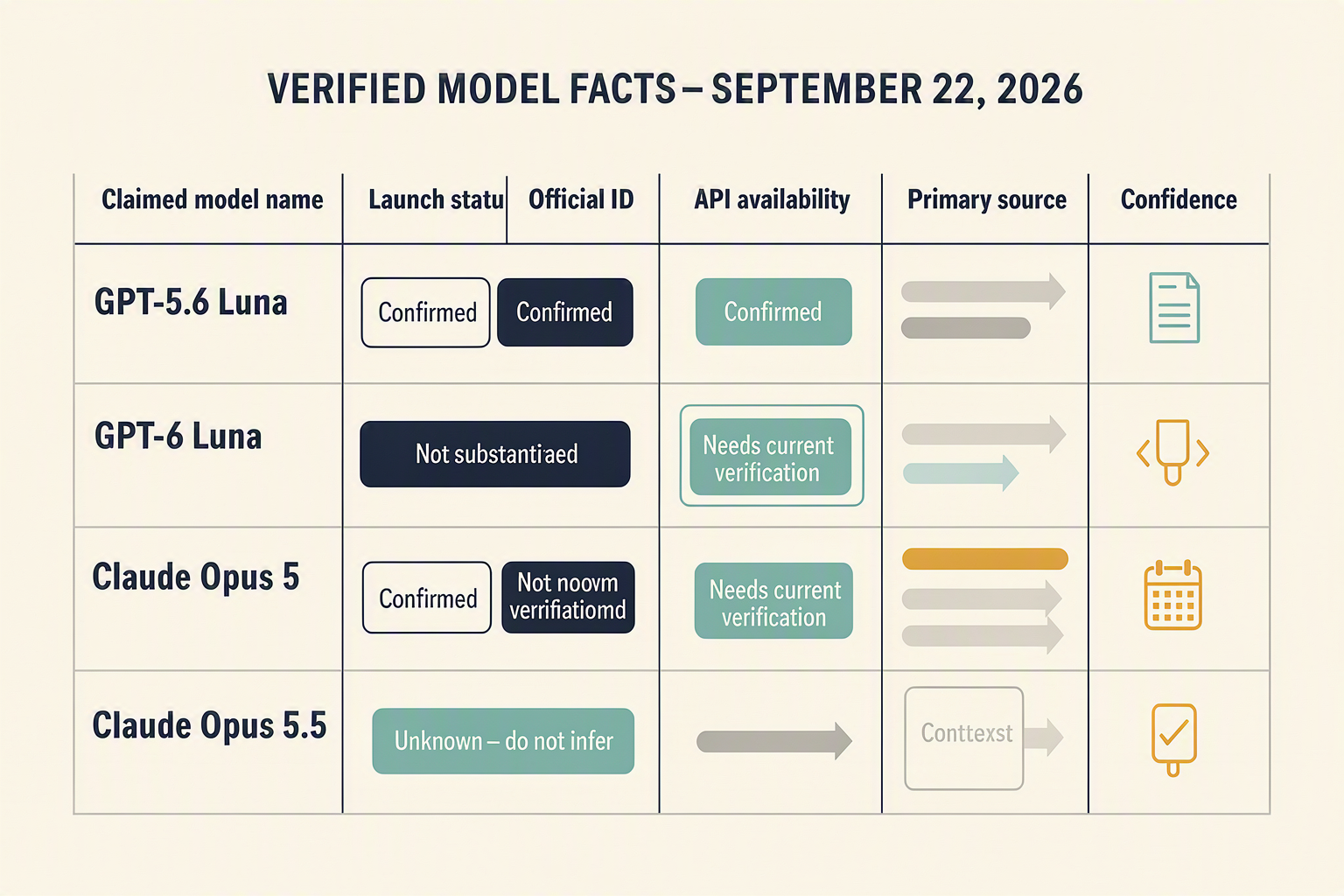
As of September 22, 2026, primary sources verify GPT-5.6 Luna as an OpenAI model with API documentation and ChatGPT availability, but they do not verify products named GPT-6 Luna or Claude Opus 5.5. The available evidence also does not establish official context-window limits for either supposed comparison model, so those fields must remain unknown.
What specifications are officially verifiable?
| Verification point | GPT-6 Luna | GPT-5.6 Luna | Claude Opus 5.5 | Primary-source finding |
|---|---|---|---|---|
| Public launch status | Not verified | Verified | Not verified | OpenAI publishes a GPT-5.6 Luna model page; no supplied OpenAI or Anthropic announcement confirms the other names |
| API documentation | Not found | Available | Not found | OpenAI lists GPT-5.6 Luna in its developer documentation |
| Documented model ID | Unknown | gpt-5.6-luna | Unknown | OpenAI’s official model-page identifier uses gpt-5.6-luna |
| ChatGPT availability | Not verified | Confirmed | Not applicable | OpenAI announced expanded free-user access and “unlimited everyday chats” with GPT-5.6 Luna |
| Published context limit | Unknown | Not stated in the supplied primary-source extract | Unknown | No defensible token limit can be extracted from the provided evidence |
| Named benchmark comparator | Not found | Compared with Claude Opus 4.8 | Not found | OpenAI’s GPT-5.6 Sol preview names Claude Opus 4.8 rather than Claude Opus 5.5 |
The table distinguishes absence of verification from proof that a model does not exist. A product might be privately tested, regionally released or available under a different identifier, but none of those possibilities supports presenting it as a generally available API.
Is GPT-5.6 Luna available through the OpenAI API?
Yes. OpenAI’s API documentation described GPT-5.6 Luna as designed for “cost-sensitive, high-volume workloads” as of September 2026. OpenAI also said the model “roughly corresponds to the nano model tier used in earlier GPT-5 families,” indicating an efficiency-oriented position rather than a direct claim of flagship capability.
The official model-page identifier is gpt-5.6-luna. Before production deployment, developers should still query the provider’s current model catalogue or run a minimal test request because documentation, account entitlements and regional availability can change independently.
OpenAI community discussions reporting that GPT-5.6 Luna was missing from a model catalogue—or directly callable despite not appearing there—are useful operational signals. However, community posts are not authoritative launch records or model specifications.
Is GPT-6 Luna an official model name?
No supplied OpenAI primary source confirms GPT-6 Luna as of September 22, 2026. The evidence consistently associates Luna with GPT-5.6, making “GPT-6 Luna” most plausibly an incorrect or unverified label in the context of this comparison.
This naming distinction affects implementation:
gpt-6-lunashould not be assumed to be a valid API identifier.- Requests should use only IDs documented for the developer’s account.
- Routing aliases should not be treated as proof of a separately launched model.
Is Claude Opus 5.5 officially documented?
No Anthropic primary source supplied for this analysis verifies Claude Opus 5.5, its API model ID, launch status or context capacity. OpenAI’s GPT-5.6 Sol preview instead displays Claude Opus 4.8 as a comparator, but an OpenAI benchmark chart cannot establish Anthropic’s API specifications.
Consequently, any Claude Opus 5.5 context figure, model string or availability claim should be marked unverified until it appears in Anthropic’s model documentation, API reference or official release notes.
How much do GPT-5.6 Luna and Claude Opus cost through their APIs?
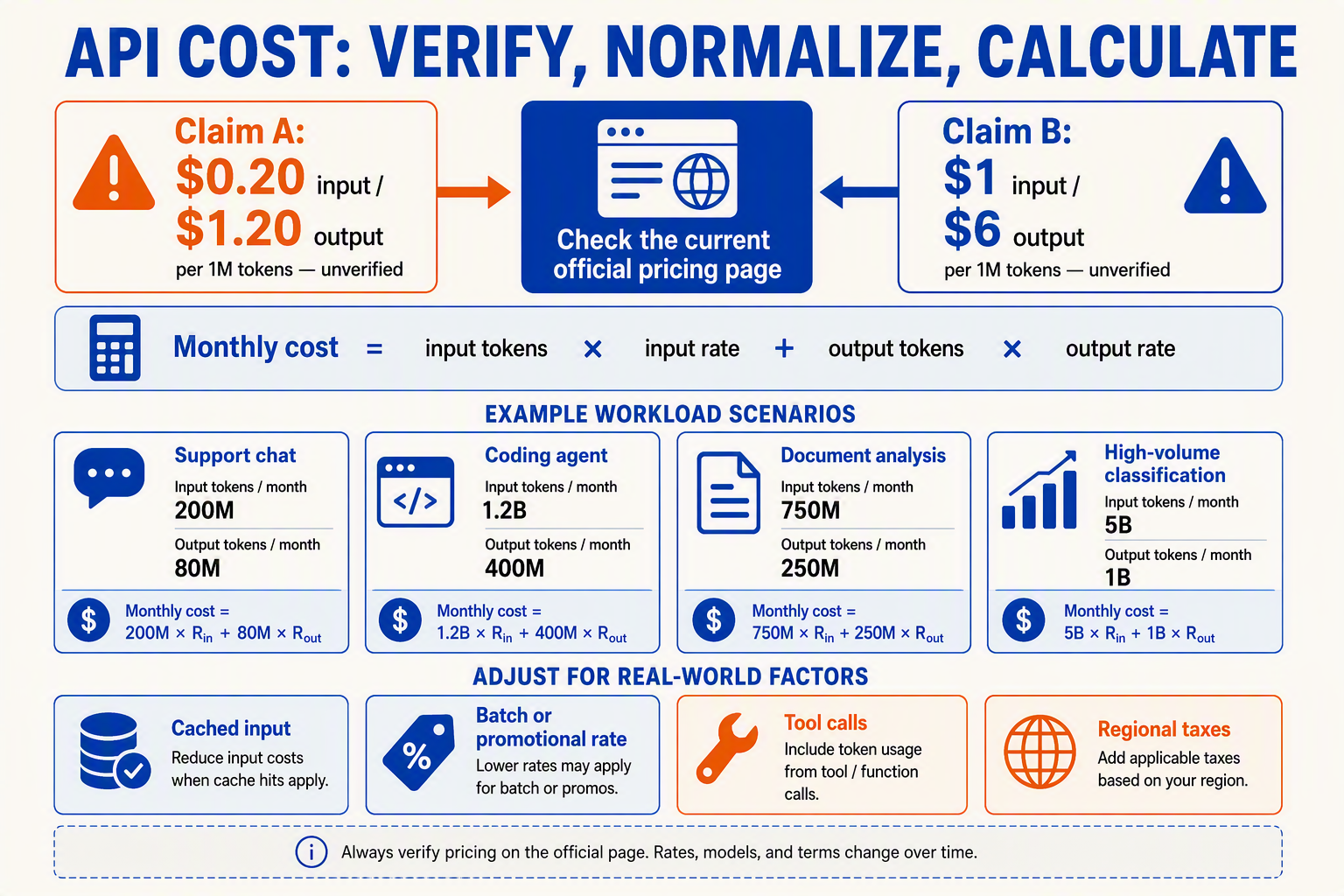
As of September 2026, a reliable dollar-per-million-token comparison is not possible from the supplied primary sources. OpenAI documents GPT-5.6 Luna and its API model ID, but the available OpenAI material does not state its token prices; no Anthropic primary source supplied here confirms Claude Opus 5 or Claude Opus 5.5, much less an API price.
What is the verified GPT-5.6 Luna API price?
The verified conclusion is price not established by the cited evidence. OpenAI’s September 2026 model documentation describes GPT-5.6 Luna as intended for “cost-sensitive, high-volume workloads” and says it roughly corresponds to the nano tier in earlier GPT-5 families. That positioning suggests an efficiency-focused product, but it is not a substitute for a published price.
OpenAI’s primary documentation identifies the API model as gpt-5.6-luna. However, the research provided for this comparison does not specify:
- Input-token cost per million tokens
- Output-token cost per million tokens
- Cached-input discounts
- Batch-processing discounts
- Separate reasoning-token charges
- Regional pricing or service-tier premiums
OpenAI also says GPT-5.6 Luna provides “unlimited everyday chats” in ChatGPT, as of September 2026. That consumer entitlement does not establish free or unlimited API use: ChatGPT subscriptions and metered API accounts are separate commercial products.
What is the verified Claude Opus 5.5 API price?
There is no verified Claude Opus 5.5 API price in the supplied evidence because no Anthropic model page, pricing page or API announcement confirming that product was provided. Any precise input or output rate attributed to “Claude Opus 5.5” would therefore be speculative.
Version discipline is especially important here. OpenAI’s GPT-5.6 Sol preview compares GPT-5.6 Luna with Claude Opus 4.8, not Claude Opus 5 or Claude Opus 5.5. Pricing from an earlier Claude generation cannot safely be assigned to an unconfirmed later model.
Before budgeting for Claude, procurement teams should verify three items directly in Anthropic’s current documentation:
- The exact deployable model ID
- Standard, cached-input and batch rates
- Whether tool use, extended reasoning or regional deployment changes billing
How should teams compare costs when token prices are unknown?
Use a workload model rather than ranking products from labels such as “nano” or “Opus.” The basic monthly calculation is:
Monthly API cost = input tokens × input rate + cached input tokens × cached rate + output tokens × output rate.
For example, a support workload handling 1 million conversations per month, with 1,500 uncached input tokens and 300 output tokens per conversation, would consume 1.5 billion input tokens and 300 million output tokens. Insert only the rates displayed on each vendor’s official pricing page at purchase time.
The comparison should also measure:
- Tokens per completed task, not merely cost per token
- Retry and failure rates
- Tool-call overhead
- Prompt-caching eligibility
- Output verbosity
- Human-review costs
The practical verdict is therefore provisional: GPT-5.6 Luna has verified efficiency-oriented positioning and a documented API identity, while Claude Opus 5.5 has no verifiable API price or launch status in the supplied sources. Until both vendors publish comparable rates and model IDs, no defensible claim can be made that either API is cheaper.
Which benchmarks provide a fair GPT-5.6 Luna vs Claude comparison?
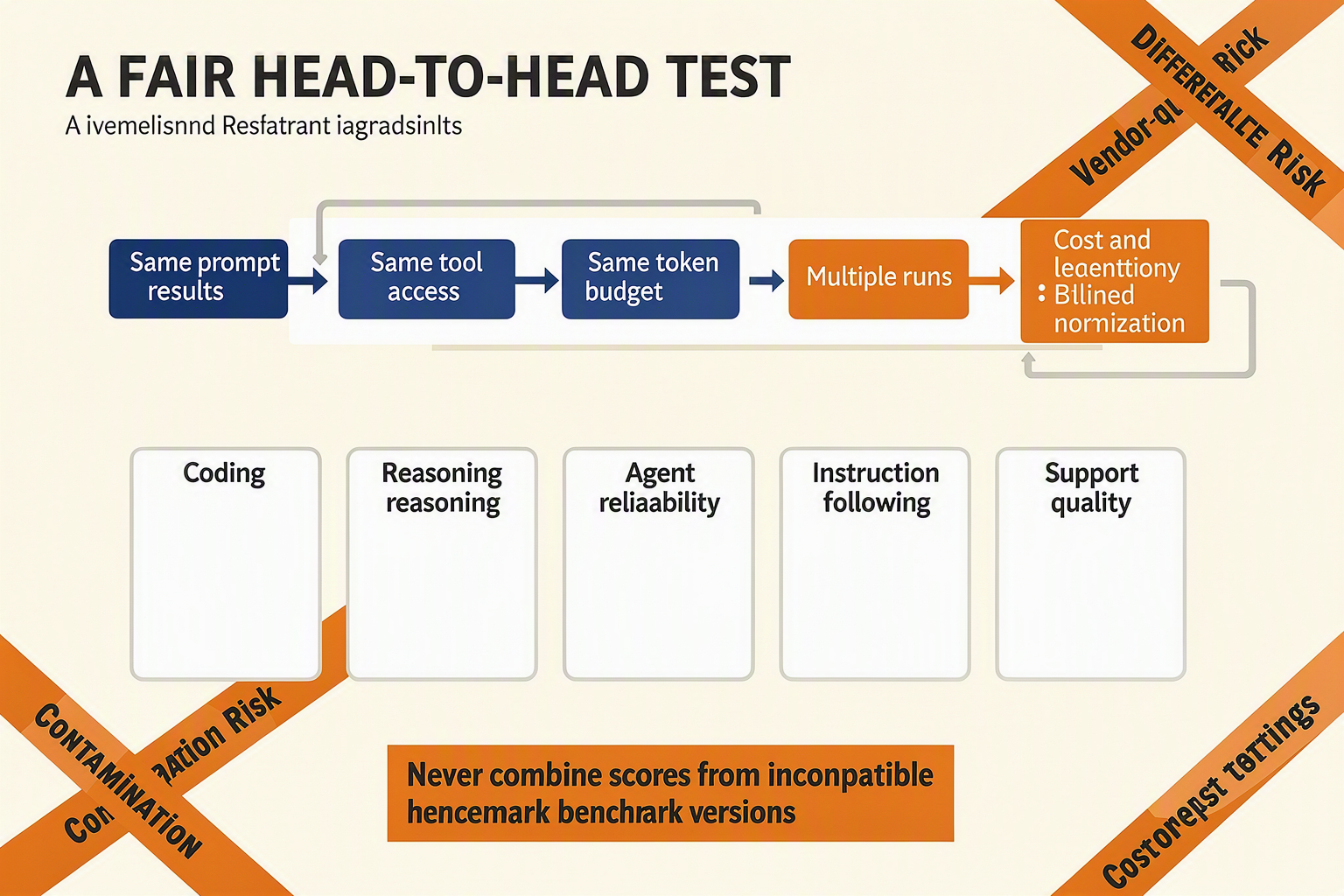
No benchmark currently supports a defensible GPT-5.6 Luna versus Claude Opus 5.5 winner because the supplied primary-source record does not verify Claude Opus 5.5 as a launched, testable model. A fair 2026 comparison must use callable model IDs, identical evaluation settings and workload-level cost and latency measurements—not similarly named models or isolated vendor scores.
Which benchmark results are directly comparable?
OpenAI’s GPT-5.6 Sol preview compares GPT-5.6 Luna with Claude Opus 4.8, not Claude Opus 5.5, according to OpenAI in September 2026. That chart may inform a Luna-versus-Opus-4.8 analysis, but relabelling its Anthropic result as “Claude Opus 5” or “Claude Opus 5.5” would be invalid.
Even correctly labelled scores are comparable only when both models receive:
- The same benchmark version and test set
- Identical prompts, system instructions and sampling parameters
- The same tools, including web search, terminals and code execution
- Equal token, time and retry budgets
- Equivalent reasoning settings and pass-count methodology
- Testing through documented, reproducible API model IDs
OpenAI’s GPT-5.6 Sol preview references a two-hour time limit for one displayed evaluation, according to OpenAI in September 2026. That constraint must accompany any quoted result because a model given more time, retries or tool calls may achieve a higher score at materially greater cost.
Which benchmarks should buyers run?
A useful Claude Opus 5 vs GPT-5.6 Luna benchmark comparison should cover six workload classes rather than compressing performance into one average:
- Software engineering: Use repository-level issue resolution with tests, dependency installation and patch validation. Report task success, total tokens, wall-clock time and cost per accepted patch.
- Reasoning: Test private, contamination-resistant questions and score exact answers separately from explanation quality. Repeated trials reveal whether a result is stable or dependent on one lucky generation.
- Agents: Measure multi-step task completion, invalid tool calls, retries and recovery after tool errors. Agent evaluations should impose the same action and time limits.
- Support automation: Use anonymized tickets to assess answer correctness, policy compliance, citation accuracy, escalation decisions and hallucination rates.
- Long context: Place relevant evidence at the beginning, middle and end of progressively larger inputs. A published context limit measures capacity; it does not prove reliable retrieval across that entire window.
- Efficiency: Record time to first token, output speed, end-to-end latency and total API cost. OpenAI describes GPT-5.6 Luna as intended for “cost-sensitive, high-volume workloads,” so throughput-adjusted quality is more relevant than flagship-only accuracy.
How should benchmark claims be normalized?
Publish both quality and resource consumption. A model that solves 80 tasks using twice the tokens and three times the wall-clock time is operationally different from one reaching the same score more efficiently.
Each benchmark report should therefore disclose:
- Exact model ID and test date
- Input, cached-input and output token counts
- Tool calls, retries and failures
- Median and 95th-percentile latency
- Cost per successful task
- Confidence intervals across multiple runs
Until Anthropic primary documentation confirms Claude Opus 5.5’s model ID, API availability and evaluation settings, the rigorous conclusion is “not yet benchmarkable,” not “Luna wins” or “Opus wins.” The currently evidenced head-to-head is GPT-5.6 Luna versus Claude Opus 4.8, and even that comparison requires matching harnesses before its scores become purchasing evidence.
What do vendor benchmark claims and independent expert evaluations actually prove?

Vendor benchmarks prove how a model performed under the vendor’s chosen test configuration—not that it will dominate every real workload. As of September 2026, the available evidence supports GPT-5.6 Luna’s efficiency-oriented positioning, but it does not establish a reproducible GPT-6 Luna versus Claude Opus 5.5 benchmark winner.
What do OpenAI’s benchmark charts actually demonstrate?
OpenAI’s September 2026 preview for GPT-5.6 Sol displays GPT-5.6 Luna, Claude Opus 4.8 and Gemini 3.1 Pro Preview in the same chart. That comparison is evidence that OpenAI evaluated those named model versions, but it is not evidence about the unverified Claude Opus 5.5.
OpenAI’s preview also shows a benchmark configuration with a two-hour time limit in September 2026. Time budgets matter because longer-running agents can attempt more solutions, execute more tools and recover from errors that would count as failures under stricter limits.
A vendor chart can legitimately prove:
- The tested model achieved the reported score under the disclosed setup.
- The vendor considered that benchmark relevant to the model’s intended use.
- The named competitors and model versions were available to the evaluator in some form.
It cannot independently prove lower production cost, faster responses or superior performance on a company’s private codebase. OpenAI’s API documentation describes GPT-5.6 Luna as intended for “cost-sensitive, high-volume workloads” and roughly equivalent to the earlier nano tier, but positioning language is not a latency or quality benchmark.
Why are apparent head-to-head scores often non-comparable?
A rigorous Claude Opus 5 versus GPT-5.6 Luna benchmarks comparison must normalize more than the percentage printed on a chart. At minimum, evaluators should disclose:
- Exact model IDs and snapshots: Aliases may silently point to newer versions.
- Prompt and reasoning settings: Reasoning effort and system instructions can materially affect results.
- Tool access: A coding agent with a terminal, web search and repeated test execution is not comparable with a single-pass model.
- Sampling policy: Temperature, retry counts and best-of-N selection can inflate success rates.
- Resource limits: Token, time and monetary budgets determine how many recovery attempts an agent receives.
- Scoring method: Human grading, unit tests and model-based judges introduce different error patterns.
A one-point lead is especially uninformative when confidence intervals, sample sizes or repeated-run variance are absent. Benchmark contamination is another risk: popular test questions may appear in training data, while recently created private tasks are less likely to reward memorization.
What do independent evaluations establish here?
The supplied September 2026 research includes no independent, reproducible evaluation of GPT-6 Luna against Claude Opus 5.5. Community reports about GPT-5.6 Luna routing or catalogue visibility document user experiences, but they are not controlled assessments of coding, reasoning or agent quality.
For a defensible evaluation, an independent expert should publish:
- Exact API model IDs, dates and parameters
- Identical prompts, tools and spending limits
- Multiple runs per task with variance
- End-to-end latency and token consumption
- Machine-checkable outputs or blinded human grading
Until such evidence exists, the responsible conclusion is narrow: OpenAI has published comparative material involving GPT-5.6 Luna and Claude Opus 4.8, while the claimed GPT-6 Luna–Claude Opus 5.5 contest remains unverified. Production teams should therefore run workload-specific trials rather than extrapolate from mismatched vendor charts.
Which model is better for coding, reasoning, agents, support automation and low-latency workloads?
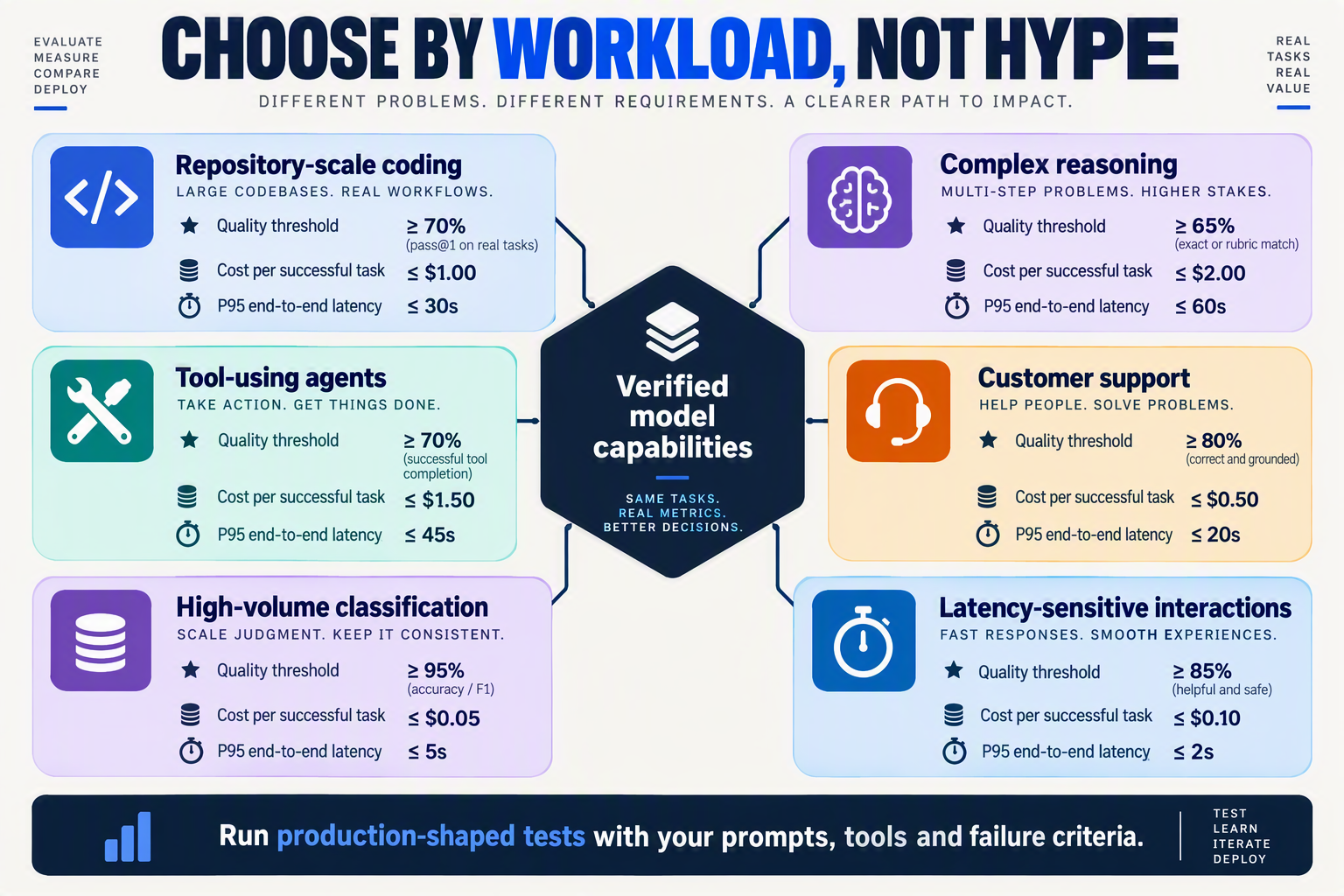
GPT-5.6 Luna is the safer deployable choice for high-volume automation because OpenAI officially documents it, while “GPT-6 Luna” and “Claude Opus 5.5” cannot be verified from the supplied primary sources as of September 2026. That does not prove Luna has better coding or reasoning quality; it means procurement decisions involving the unverified model names would be speculative.
Which model should developers choose for each workload?
| Workload | Practical pick | Evidence | Important caveat |
|---|---|---|---|
| High-volume coding assistance | GPT-5.6 Luna | OpenAI positions Luna for “cost-sensitive, high-volume workloads”; Replit uses it to power Free Mode | No normalized Luna-versus-Opus-5.5 coding benchmark is available |
| Complex coding and debugging | No verified winner | The supplied OpenAI comparison includes Claude Opus 4.8, not Claude Opus 5.5 | Test repository-level tasks with identical tools and time limits |
| Advanced reasoning | No verified winner | No primary-source, head-to-head Opus 5.5 benchmark is supplied | Vendor scores may use different reasoning budgets |
| Tool-using agents | GPT-5.6 Luna for verified deployment | OpenAI provides an official API model page for GPT-5.6 Luna | Agent reliability and tool-call accuracy still require evaluation |
| Support automation | GPT-5.6 Luna for high message volumes | Luna’s documented design target is cost-sensitive scale | Published token pricing and context limits must still be verified before budgeting |
| Low-latency interactions | No evidence-based winner | Neither vendor evidence supplied here establishes comparable latency figures | Measure time to first token and end-to-end completion in the target region |
Is GPT-5.6 Luna better for coding?
GPT-5.6 Luna is a credible choice for frequent, bounded coding tasks, including code completion, test generation, syntax repair and simple application scaffolding. OpenAI describes GPT-5.6 Luna as approximately equivalent to the nano tier in earlier GPT-5 families, which signals an efficiency-first model rather than an automatic replacement for a flagship reasoning system.
Replit’s 2026 deployment of GPT-5.6 Luna in Free Mode provides concrete evidence that the model can support software-creation workflows at scale. It does not, however, establish superiority on repository-wide refactoring, difficult debugging or autonomous software engineering.
Which model is stronger for reasoning and agents?
There is no defensible reasoning winner without a verified Claude Opus 5.5 release, model ID and normalized benchmark. OpenAI’s GPT-5.6 Sol preview compares Luna with Claude Opus 4.8, demonstrating why results from that chart cannot be relabelled as Claude Opus 5.5 performance.
Agent evaluations should measure more than answer quality:
- Tool-selection accuracy and argument validity
- Task completion rate across multiple tool calls
- Recovery from API or permission errors
- Tokens, latency and cost per successful task
- Prompt-injection resistance when using retrieved content
What is the better choice for support automation and low latency?
GPT-5.6 Luna’s documented high-volume positioning makes it the more evidence-backed candidate for ticket classification, reply drafting and knowledge-base question answering. For voice or live-chat support, however, “smaller” does not automatically mean faster: teams should benchmark p50 and p95 time to first token, total response time and escalation accuracy.
For example, CallMissed supports AI agents with knowledge bases, custom REST tools, human handoff and call scoring; a deployment could test Luna against any verified Anthropic model using the same support prompts and QA rubric. Until Claude Opus 5.5’s API identity and specifications are confirmed, the rigorous verdict is Luna for verified, efficiency-oriented deployment—and no declared winner for maximum capability.
How should you test advertised context limits against effective long-context performance?
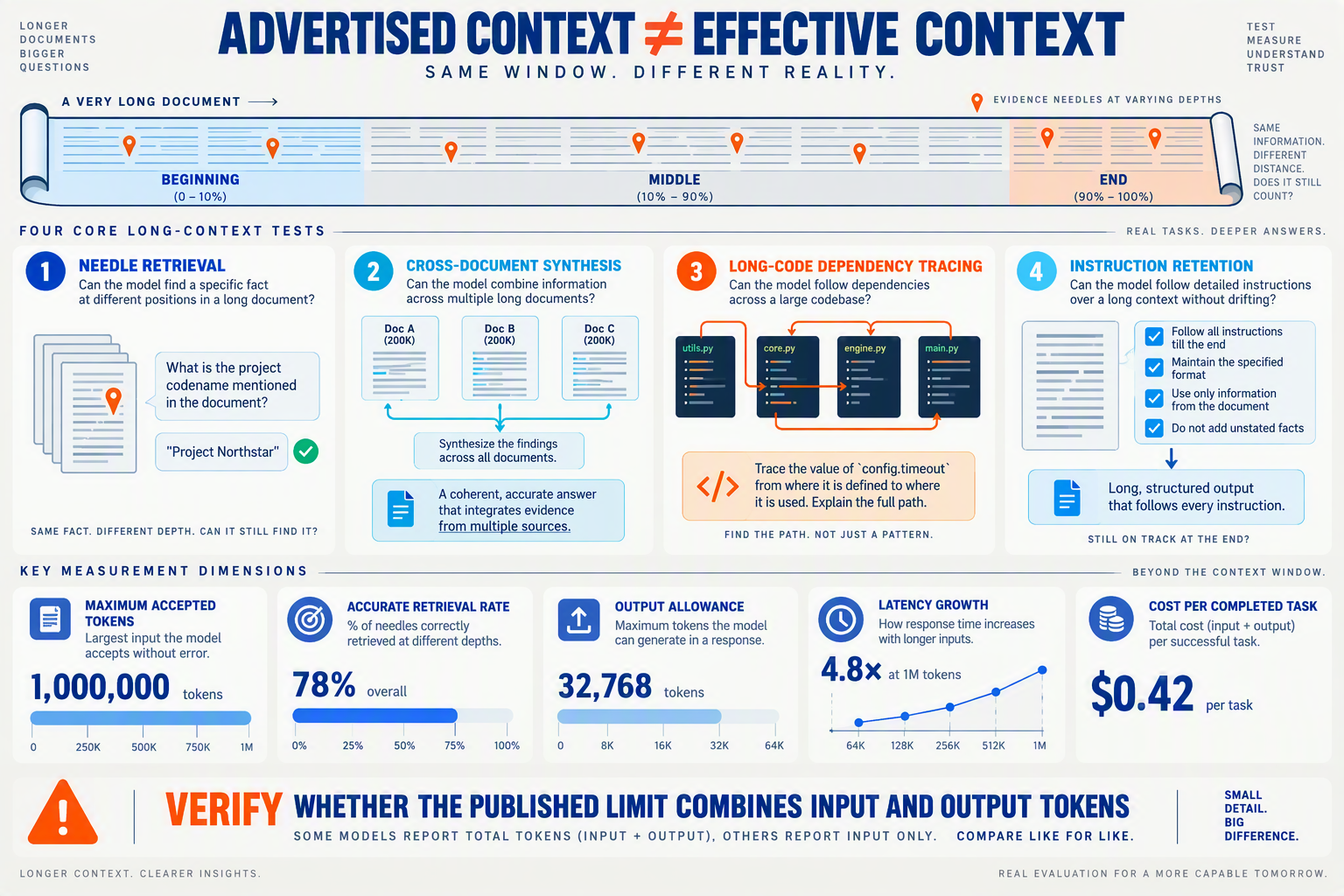
Do not treat a model’s advertised token window as its usable context window. Test whether the exact API model can retrieve, combine and apply information across increasing prompt lengths while maintaining accuracy, latency and cost; as of September 2026, the supplied primary sources do not establish official context limits for either “GPT-6 Luna” or “Claude Opus 5.5.”
What is the difference between advertised and effective context?
An advertised context limit is the maximum number of input and output tokens an API claims to accept. Effective context is the amount of material the model can use reliably for a real task.
A request succeeding at the maximum length proves only that the endpoint accepted it. Near that boundary, a model may overlook evidence, over-weight recent text, lose instructions or produce an answer before considering the entire prompt. Context capacity must therefore be evaluated separately from reasoning quality.
Before testing, record:
- The exact model ID, API version and test date
- Input-token, output-token and combined-token restrictions
- Tokenizer counts rather than character or word estimates
- Reasoning effort, temperature, tool access and maximum output settings
- Whether the provider silently truncates, caches or routes requests
This distinction is especially important here because OpenAI’s September 2026 documentation characterizes GPT-5.6 Luna as intended for “cost-sensitive, high-volume workloads,” not as a verified GPT-6 model with a documented long-context advantage.
How should you benchmark long-context retrieval?
Use a position-swept needle test, but make the target semantically meaningful rather than inserting an obvious random password.
- Create documents at several depths—for example, 8,000, 32,000, 64,000 tokens and progressively larger sizes up to the verified API limit.
- Insert evidence near the beginning, at 25%, in the middle, at 75% and near the end.
- Ask questions that require exact retrieval, paraphrase recognition and rejection of plausible distractors.
- Run each condition multiple times and report accuracy with confidence intervals.
- Record malformed responses, refusals, truncation and API errors as failures rather than excluding them.
A single successful retrieval is not enough. Report a matrix showing accuracy by prompt length and evidence position, because models can exhibit “lost in the middle” behavior even when the request remains within the advertised window.
How do you test reasoning across a long context?
Retrieval tests should be followed by tasks requiring information integration:
- Multi-hop reasoning: Combine facts located in three or more distant sections.
- Code analysis: Trace a bug across files, tests and dependency definitions.
- Support automation: Apply a policy, customer history and recent order event together.
- Contradiction detection: Identify which of two separated statements is newer or authoritative.
- Instruction persistence: Check whether an early system-like constraint survives late distractors.
Score both the final answer and its cited evidence. A correct conclusion based on the wrong passages is not dependable agent performance.
Which long-context metrics should you publish?
A reproducible Claude Opus 5 versus GPT-5.6 Luna context comparison should disclose:
- Task accuracy at every tested context depth
- Median and p95 latency
- Input, cached-input and output token usage
- Cost per completed task using prices valid on the test date
- Error and retry rates
- Percentage of answers supported by the correct source passages
The practical limit is the point where reliability falls below the workload’s acceptance threshold—not the largest payload returning HTTP 200. Until official model IDs and limits for “GPT-6 Luna” and “Claude Opus 5.5” are verified, any precise head-to-head context claim should remain labeled unconfirmed.
What does the comparison mean for your workload and deployment stack?
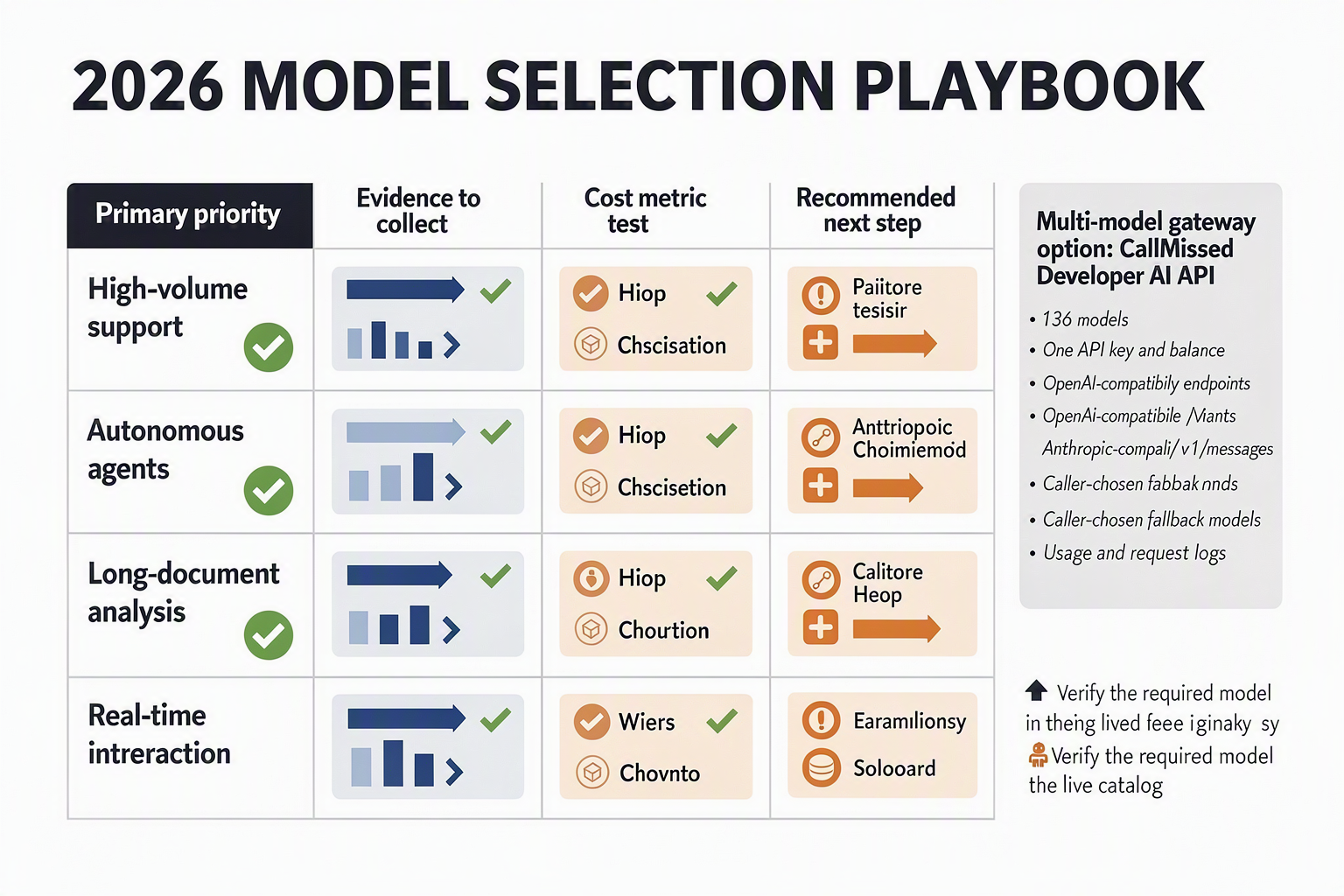
For production deployment, GPT-5.6 Luna is the defensible choice when efficiency and verified API availability matter; “GPT-6 Luna” and “Claude Opus 5.5” should remain blocked from procurement until their model IDs and specifications appear in official documentation. For complex coding or reasoning, evaluate Anthropic’s currently documented flagship rather than assuming an unverified Opus version exists.
Which model fits each production workload?
| Workload | Practical model choice | Why | Deployment requirement |
|---|---|---|---|
| High-volume classification and routing | GPT-5.6 Luna | OpenAI explicitly positions Luna for cost-sensitive, high-volume work | Benchmark accuracy, p95 latency and total token use on real traffic |
| Customer-support automation | GPT-5.6 Luna first; escalate hard cases | Routine intent detection, summarisation and drafting usually favour efficiency | Add retrieval, human handoff, policy checks and fallback routing |
| Repository-scale coding | Run a controlled bake-off | No verified evidence establishes Claude Opus 5.5 or comparable normalized scores | Use identical repositories, tools, prompts, time limits and test suites |
| Complex reasoning and agents | Verified flagship plus fallback | Multi-step tasks may justify a larger model, but model names alone prove nothing | Measure task completion, tool errors, retries and cost per successful outcome |
| Long-document analysis | No default pick yet | Verified context limits for the claimed pair are not supplied | Test usable context, retrieval quality and degradation near the limit |
| Interactive applications | Choose from measured latency | Neither vendor’s supplied evidence establishes comparable production latency | Record time to first token, p50/p95 completion time and timeout frequency |
OpenAI’s API documentation described GPT-5.6 Luna as roughly corresponding to the earlier nano tier as of September 2026. That positioning makes Luna a logical first candidate for repetitive workloads, but it does not prove that Luna will be cheaper per completed task: a low token price can be offset by longer outputs, retries or more frequent escalation.
How should you compare API cost without verified prices?
Do not build a budget from unofficial Claude Opus 5.5 versus GPT-5.6 Luna API cost tables. The supplied primary-source evidence does not provide a complete, normalized price sheet for the claimed pair as of September 2026, so unsupported input, output and cached-token prices should be treated as unknown.
Instead, replay a representative request set and calculate:
- Input and output tokens per successful task
- Retries, fallback calls and tool invocations
- Cache reads versus uncached requests
- Human-review or escalation rate
- Total cost per accepted answer, not merely cost per million tokens
For support automation, for example, test billing questions, multilingual messages, ambiguous refund requests and prompt-injection attempts separately. An average across easy requests can conceal costly failures in high-risk categories.
What should your deployment stack validate before launch?
Use exact model identifiers returned by official model catalogues, and reject configuration aliases that silently resolve to another model. OpenAI’s September 2026 preview compared GPT-5.6 Luna with Claude Opus 4.8, not Claude Opus 5.5; that chart therefore cannot validate the proposed head-to-head comparison.
A production readiness gate should require:
- A documented model ID, API endpoint and launch status
- Published prices and context limits captured with an as-of date
- Reproducible benchmark settings, including tools and time budgets
- Observed rate limits, latency distributions and error rates
- Explicit fallbacks with logs showing which model answered each request
As of September 2026, CallMissed’s OpenAI-compatible AI gateway supports 136 models through one API key and balance, with caller-selected fallback models and request logs. That type of abstraction can simplify bake-offs, but teams should still pin model IDs, inspect routing records and prevent an unavailable candidate from being mistaken for a deployable production model.
Frequently Asked Questions
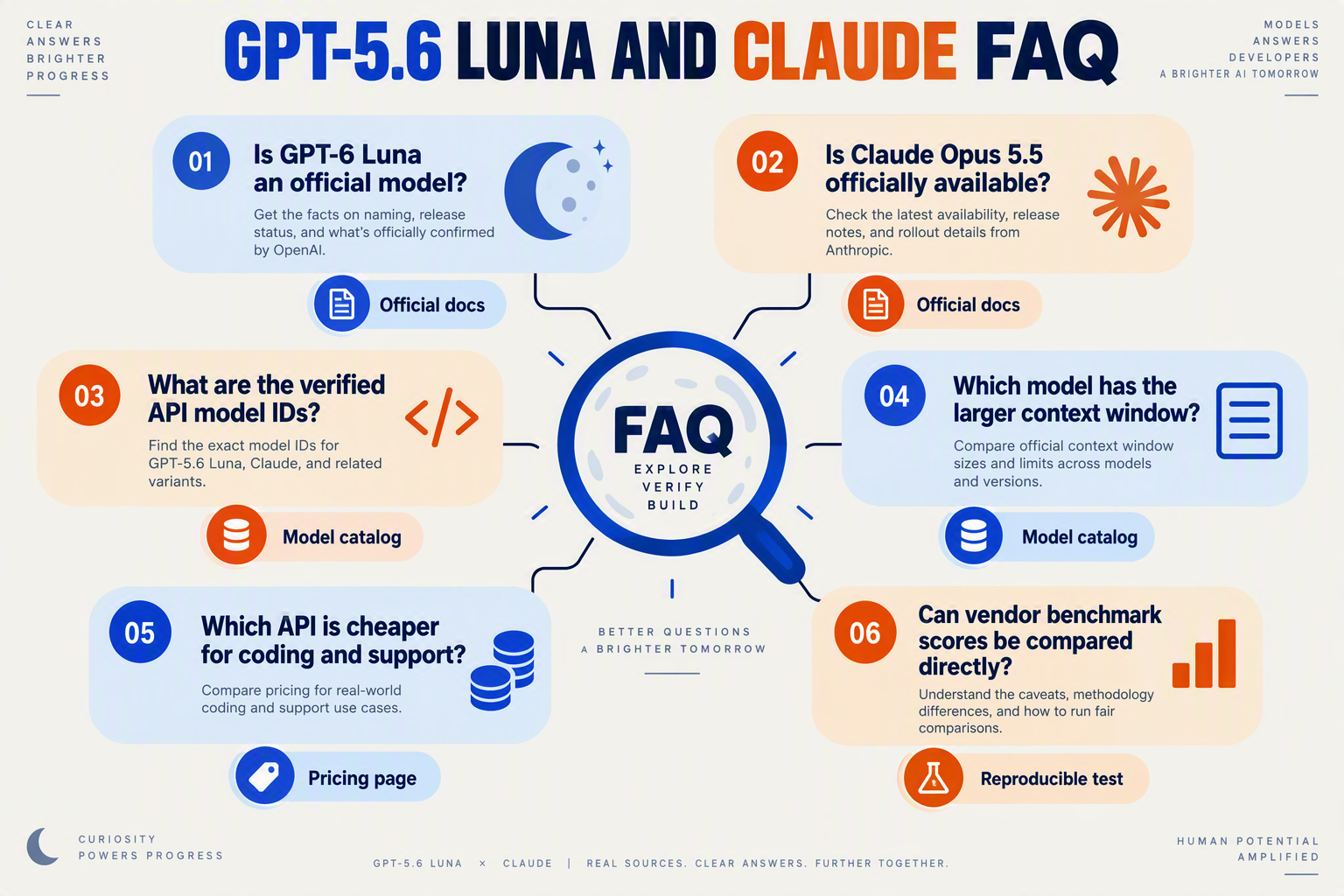
Launch status and model identifiers
Is GPT-6 Luna official as of September 2026?
Is Claude Opus 5.5 officially available through the Anthropic API?
What are the correct GPT-5.6 Luna and Claude Opus 5.5 API model IDs?
gpt-5.6-luna documentation path, but developers should confirm the exact callable identifier through OpenAI’s live Models API before deployment. No verified Anthropic primary source in the reviewed evidence establishes a Claude Opus 5.5 model ID, and guessing an identifier from Anthropic’s historical naming patterns could cause failed requests or accidental routing to another model.API pricing and context limits
Which API is cheaper in a GPT-6 Luna vs Claude Opus 5.5 comparison?
What are the Claude Opus 5 vs GPT-5.6 Luna context limits?
Benchmark interpretation and deployment
How should Claude Opus 5 vs GPT-5.6 Luna benchmarks be compared fairly?
Conclusion
The evidence-based verdict is that GPT-5.6 Luna is documented, while the proposed “GPT-6 Luna versus Claude Opus 5.5” contest is not yet verifiable from the supplied primary sources. OpenAI positions GPT-5.6 Luna for “cost-sensitive, high-volume workloads,” but comparable Anthropic documentation for Claude Opus 5 or Claude Opus 5.5 was not available as of September 2026.
- Verify names before comparing specifications. OpenAI documents GPT-5.6 Luna, not GPT-6 Luna, in the cited API materials. OpenAI’s GPT-5.6 Sol preview compares Luna with Claude Opus 4.8, further weakening claims that Claude Opus 5.5 is already the relevant head-to-head model.
- Unknown specifications should remain unknown. Without current primary-source confirmation of Claude Opus 5.5’s launch status, model ID, API pricing and context limit, any confident cost or architecture comparison would be speculative. Teams should verify the exact API identifier, token prices, rate limits and context window immediately before deployment.
- Benchmarks require normalized conditions. Scores are meaningful only when models use the same prompts, tools, reasoning budgets, time limits and scoring methodology. Vendor charts can inform testing, but they should not replace workload-specific evaluations for coding, reasoning, agents or support automation.
- Workload fit matters more than a universal winner. GPT-5.6 Luna’s documented efficiency positioning makes it a logical candidate for high-volume routing and routine tasks. A verified flagship model may justify higher costs where difficult reasoning or coding quality produces measurable business value.
What should teams watch next?
Watch for official Anthropic model cards and API documentation confirming Claude Opus 5 or 5.5, plus updated OpenAI pricing, context limits and stable model IDs. Independent evaluations should then test quality per rupee or dollar, effective long-context performance, latency distributions and agent reliability under identical conditions.
Multi-model infrastructure can reduce the operational risk of changing catalogues. As of September 2026, CallMissed, the OpenAI-compatible AI gateway, provides one API key and balance for 136 models, alongside caller-selected fallbacks and request logs. To explore how AI communication is evolving, check out CallMissed—and ask: Are you choosing a model based on a verified deployment target, or merely a persuasive name?
Related Reading
- GPT-6 Sol vs Claude Opus 5.5: 2026 API Reality Check
- Claude Opus 5 vs GPT-5.6 Sol: 2026 Buyer's Guide
- Claude Opus 5.5 vs GPT-6 Astra: 2026 Comparison
Sources
Discussion
Related Posts

Ready to automate customer conversations?
Launch AI voice agents and WhatsApp bots with CallMissed — one API, 22+ Indian languages.