
Claude Opus 5.5: Launch Details, Pricing and Use Cases



Learn what Claude Opus 5.5 adds, where it is available, official pricing, practical use cases, limits, and whether upgrading makes sense.
Claude Opus 5.5: Launch Details, Pricing and Use Cases
What if Anthropic’s newest flagship could cut typical workload costs by 40% while completing longer, more complex coding tasks? Launched on September 22, 2026, Claude Opus 5.5 is Anthropic’s latest model for long-running agentic coding and knowledge work—and a potentially significant upgrade for teams already using Claude Opus 5.
The timing matters because AI development is shifting from single-prompt assistance toward agents that plan, use tools and work across extended tasks. Anthropic says Claude Opus 5.5 leads its lineup in agentic coding and knowledge work, while costing 40% less to run than Opus 5 on typical workloads, according to the company’s September 2026 announcement. Anthropic also reports that Opus 5.5 used among the fewest tokens and steps measured in its testing with GitHub Copilot CLI and Visual Studio Code, although independent evaluations will be needed to establish how consistently those gains translate to production environments.
Several launch details are already confirmed:
- Claude Opus 5.5 is available through the Claude API under the model identifier
claude-opus-5-5, according to Anthropic’s September 22, 2026 platform release notes. - Anthropic’s pricing documentation lists Opus 5.5 rates below those of Opus 5, supporting the company’s focus on improved workload economics.
- Anthropic’s documentation says Opus 5.5 supports five effort levels and defaults to medium, whereas Opus 5 and earlier Opus models defaulted to high. That configuration difference could affect cost, latency and output quality when developers migrate without explicitly setting effort.
- The model is positioned for long-running software-engineering agents, repository-scale code changes and demanding knowledge-work workflows, rather than merely faster conversational responses.
That does not mean every Claude Opus 5 application should upgrade immediately. Migration decisions should account for prompt behavior, tool-use reliability, token consumption, effort settings and regression testing—not just headline claims. Teams comparing Claude Opus 5.5 vs GPT-5.5 will also need workload-specific evidence rather than assuming one model wins across coding, research and enterprise automation.
Multi-model infrastructure is becoming increasingly relevant as these releases accelerate; for example, CallMissed, an AI communication platform and developer API, provides OpenAI-compatible and Anthropic-compatible endpoints for a catalogue of 136 models as of September 2026, allowing developers to change models without rebuilding every integration.
This guide separates Anthropic’s confirmed launch facts from early analysis. It explains availability, documented pricing, capabilities, likely use cases, migration considerations and current limitations—helping developers and business teams decide who should adopt Claude Opus 5.5 now and who should wait for broader real-world testing.
What is Claude Opus 5.5, and what did Anthropic announce?
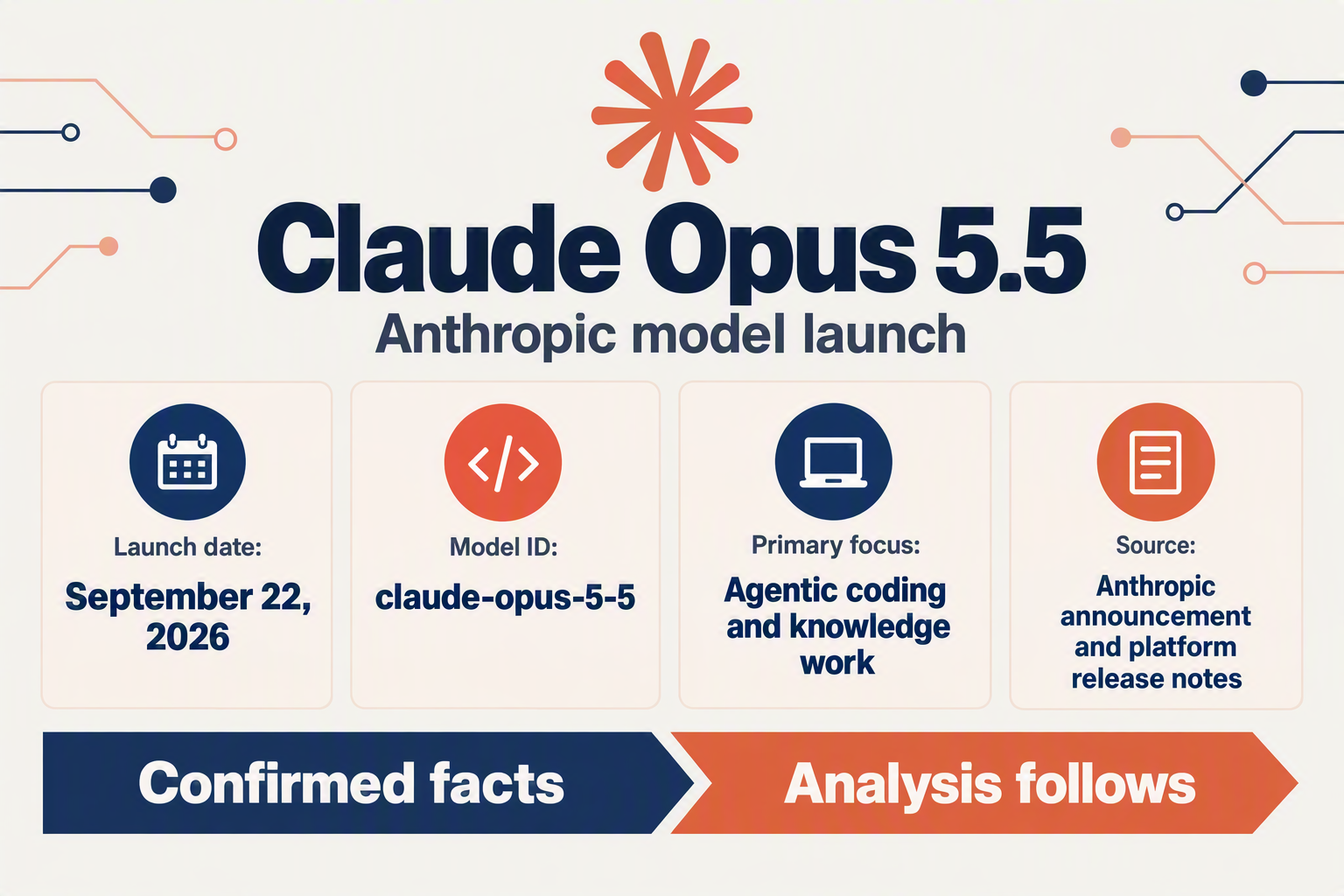
Claude Opus 5.5 is an Anthropic model released on September 22, 2026 for long-running agentic coding and complex knowledge work. Anthropic identifies the API model as claude-opus-5-5 and presents it as an Opus-family option for sustained, multi-step workloads.
What exactly did Anthropic announce?
Anthropic’s announcement and API release notes establish four key points:
- Launch date: Claude Opus 5.5 was released on September 22, 2026.
- API model ID: Developers can identify the model as
claude-opus-5-5. - Intended workloads: Anthropic describes it as a model for long-running agentic coding and knowledge work.
- Company-reported cost improvement: Anthropic says Claude Opus 5.5 costs 40% less to run than Claude Opus 5 on typical workloads.
The 40% figure is an Anthropic-reported workload estimate, not an independently verified result or a promise that every request will cost 40% less. Actual expenditure can vary with token usage, task length, tool calls, retries, caching and whether an agent completes the task successfully.
Compact verified-claims summary
| Claim | Primary-source type | Important caveat |
|---|---|---|
| Claude Opus 5.5 launched on September 22, 2026 | Anthropic announcement and API release notes | Confirms the release date, not third-party availability dates |
The API model ID is claude-opus-5-5 | Anthropic API release notes | Applications should use the exact documented identifier |
| The model targets long-running agentic coding and knowledge work | Anthropic release notes and product positioning | This describes intended use cases, not proven superiority for every workload |
| It costs 40% less to run than Opus 5 on typical workloads | Anthropic announcement | Vendor-reported estimate; actual production costs may differ |
Is Claude Opus 5.5 a replacement for Claude Opus 5?
Anthropic’s release of a newer Opus model does not establish that every Claude Opus 5 application should migrate automatically. Existing agents may respond differently because model behavior, tool use, token consumption and task-completion patterns can change between versions.
Teams considering a migration should test both models with matched prompts, tools, context, retry policies and success criteria. Comparing total cost per completed task is more informative than comparing a single response or assuming Anthropic’s 40% typical-workload estimate applies uniformly.
What capabilities has Anthropic officially highlighted?
Anthropic’s launch positioning focuses on:
- Agentic coding involving planning, tools and multiple steps
- Long-running software-development work extending beyond a single response
- Knowledge work involving analysis, synthesis and structured outputs
These are Anthropic’s stated workload categories. They should not be interpreted as independent proof that Claude Opus 5.5 leads every coding, reasoning or knowledge-work benchmark.
What has not yet been established?
The primary-source announcement alone does not establish:
- Reliability across unfamiliar repositories, tools and production environments
- Hallucination or error rates in high-stakes knowledge work
- Cost savings for every prompt, agent design or usage pattern
- Universal benchmark leadership over other Claude or competing models
- How Claude Opus 5.5 vs GPT-5.5 performs under matched prompts, tools and budgets
No token-price figures are included here because a reliable comparison requires an official pricing table that clearly separates applicable input, output, caching and long-context tiers.
The defensible launch takeaway is therefore limited but meaningful: Anthropic released claude-opus-5-5 on September 22, 2026 for long-running agentic coding and knowledge work, and Anthropic reports that it costs 40% less to run than Opus 5 on typical workloads. Independent and application-specific testing remains necessary.
How does Claude Opus 5.5 fit into Anthropic’s model lineup?
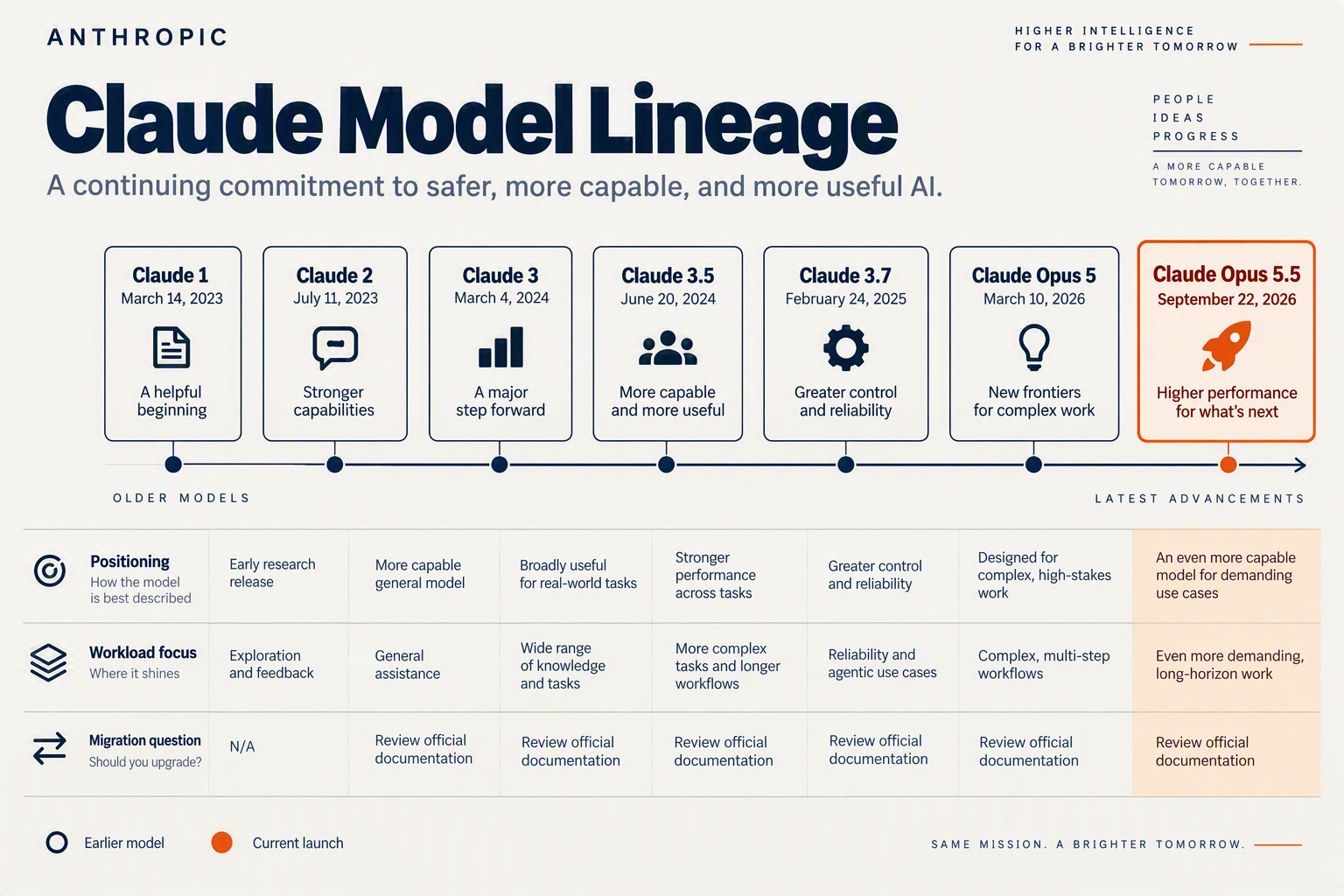
Claude Opus 5.5 sits at the top of Anthropic’s Opus line for agentic coding and knowledge work, while Anthropic’s model-selection guidance recommends it as the starting point for most workloads. However, the September 22, 2026 launch does not mean Claude Opus 5 or earlier Opus versions have been formally retired.
Is Claude Opus 5.5 the new flagship Claude model?
Yes—within the Opus family, Claude Opus 5.5 is Anthropic’s current flagship for long-running agents, software engineering and demanding knowledge work. Anthropic’s September 2026 introduction says the model “leads in agentic coding and knowledge work,” giving it a clearer production-agent focus than a generic chatbot upgrade.
Anthropic’s model-selection documentation goes further: as of September 2026, Anthropic recommends starting with Claude Opus 5.5 for most workloads when developers are unsure which model to choose. That recommendation indicates a broader default role, but teams should still route requests according to task complexity, cost sensitivity and latency requirements.
The practical hierarchy is:
- Choose Claude Opus 5.5 for multi-step coding, tool-using agents and substantial knowledge workflows.
- Keep an earlier Opus model temporarily when an application has tightly validated prompts or output formats.
- Evaluate another Claude family or model when specialized reasoning, lower-cost processing or different response characteristics matter more than Opus 5.5’s agentic strengths.
How does Claude Opus 5.5 compare with earlier Opus models?
Anthropic’s documentation distinguishes Opus 5.5 through its intended workload, lower documented pricing and revised operating controls—not simply a higher version number.
| Model | Position in the documented lineup | Key distinction | Practical implication |
|---|---|---|---|
| Claude Opus 5.5 | Current Opus flagship | Long-running agentic coding and knowledge work | Primary candidate for new, complex agent deployments |
| Claude Opus 5 | Previous-generation Opus | Earlier baseline for Opus applications | Migration requires behavioral and cost testing |
| Claude Opus 4.8 | Earlier Opus generation | Still listed in Anthropic’s pricing documentation | Useful only where compatibility or existing validation justifies it |
| Claude Opus 4.7 | Older Opus generation | Also present in Anthropic’s documented model table | Teams should verify continued availability before long-term reliance |
This table should not be read as a formal deprecation schedule. Anthropic had not announced the retirement of Opus 5, Opus 4.8 or Opus 4.7 in the supplied September 22, 2026 launch materials.
Does Opus 5.5 replace every other Claude model?
No. A flagship recommendation is not evidence that one model is optimal for every request. Anthropic separately points developers toward Claude Fable 5.1 for complex reasoning, suggesting that its lineup remains workload-oriented rather than a simple newest-to-oldest ranking.
A sensible production architecture could therefore use:
- Opus 5.5 for repository-scale implementation and persistent agents.
- A reasoning-focused model for particularly difficult analytical tasks.
- Less resource-intensive models for classification, extraction or high-volume routine requests.
- Earlier validated models during a controlled migration period.
This routing approach also reduces dependence on a single model identifier. Platforms such as CallMissed, the OpenAI-compatible and Anthropic-compatible developer AI API, provide one API key and balance across 136 models as of September 2026, supporting model comparison and caller-selected fallbacks without requiring a separate integration for every provider.
What are the key Claude Opus 5.5 launch developments?
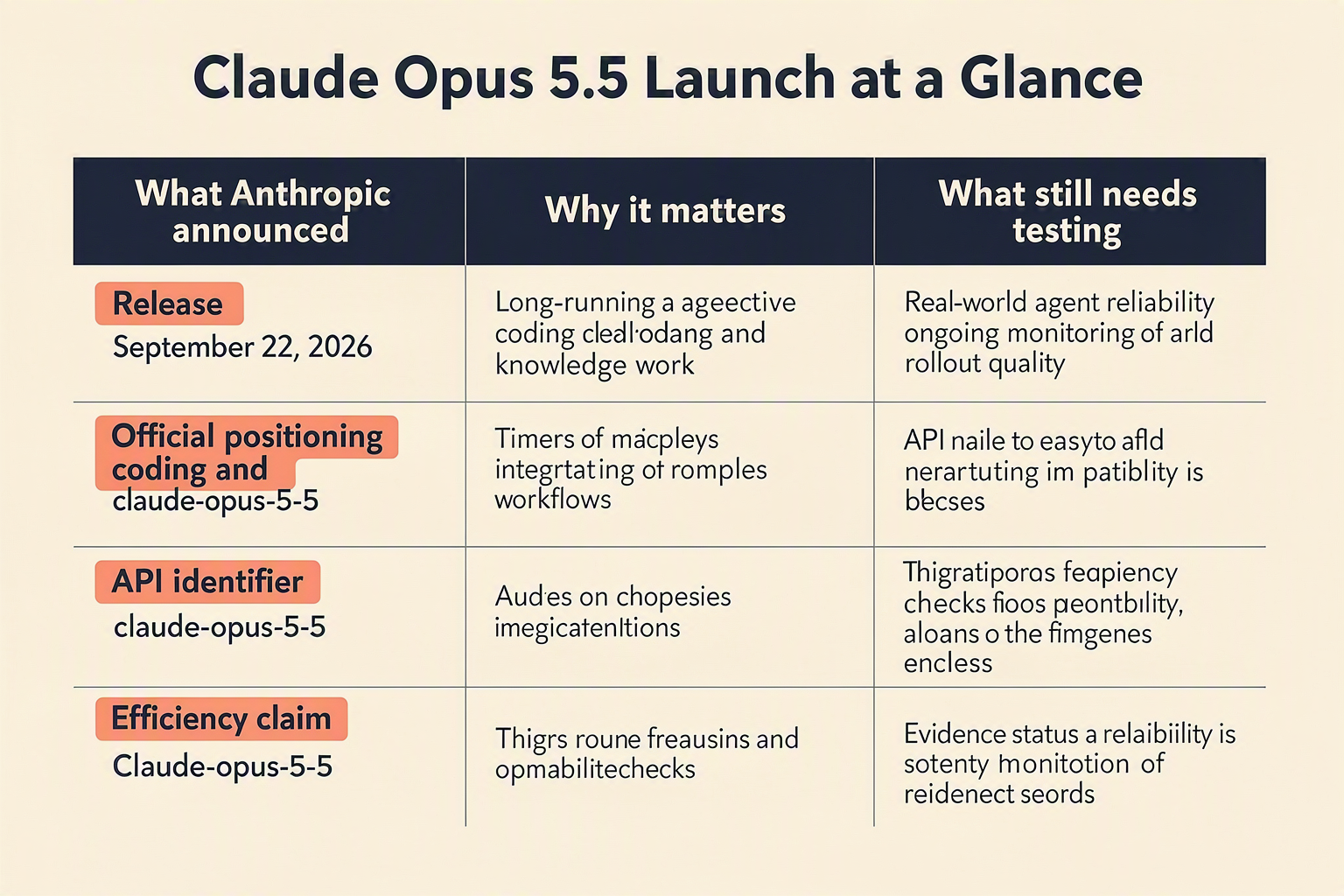
Claude Opus 5.5’s key launch developments are lower typical workload costs, configurable effort, stronger positioning for long-running agents and immediate Claude API access. Anthropic confirmed these changes on September 22, 2026, but independent production benchmarks remain limited at launch.
What did Anthropic officially announce for Claude Opus 5.5?
| Launch development | Official detail | Practical significance | Evidence status |
|---|---|---|---|
| Model release | Claude API model ID: claude-opus-5-5 | Developers can test it through an explicit, versioned model string | Confirmed by Anthropic release notes, September 22, 2026 |
| Workload economics | 40% lower cost than Opus 5 on typical workloads | Agent loops may consume fewer billable resources, depending on task and configuration | Anthropic claim, September 2026 |
| Effort controls | Supports five effort levels and defaults to medium | Teams can tune the balance among reasoning depth, token use, latency and cost | Confirmed by Anthropic documentation, September 2026 |
| Agentic focus | Designed for long-running agentic coding and knowledge work | Relevant to repository-scale changes, tool-using agents and multi-stage analysis | Confirmed product positioning |
| Coding efficiency | Used among the fewest tokens and steps measured in GitHub Copilot CLI and Visual Studio Code tests | Potentially improves agent efficiency, but results may vary by repository and tooling | Anthropic testing; not yet independently established |
| Published pricing change | Anthropic’s pricing page displays Opus 5.5 rates of $4 and $5 per million tokens, versus $5 and $6.25 for Opus 5 in the corresponding listed categories | The displayed rates are 20% lower, separate from the broader 40% typical-workload claim | Confirmed pricing-page comparison, September 2026 |
The distinction between the two cost figures matters. Anthropic’s published Opus 5.5 rates are 20% below the corresponding Opus 5 rates, while the company’s 40% typical-workload reduction may also reflect differences in token consumption, agent steps or effort configuration. Buyers should calculate costs using their actual input, output, caching and tool-use patterns rather than treating 40% as a universal API discount.
Why does the new default effort level matter?
Claude Opus 5.5 defaults to medium effort, whereas Claude Opus 5 and earlier Opus models defaulted to high, according to Anthropic’s September 2026 effort documentation. An application that changes only the model string could therefore receive different reasoning behavior even when its prompts and parameters remain unchanged.
Migration tests should compare:
- Task completion quality at medium and high effort
- Total tokens and agent steps, not only per-token rates
- Tool-call accuracy across long workflows
- Latency and failure recovery on repository-scale tasks
- Output consistency against existing regression suites
Which launch claims still need independent validation?
Anthropic’s GitHub Copilot CLI and Visual Studio Code results are useful first-party evidence, but “among the fewest” does not provide a complete public ranking, workload distribution or universal performance guarantee. The announcement also does not establish that Claude Opus 5.5 will outperform every alternative on short coding questions, creative work or all enterprise workflows.
The most defensible launch conclusion is narrower: Claude Opus 5.5 introduces documented price reductions and finer effort control while targeting sustained, tool-driven work. Its real advantage for any team will depend on production traces, prompt compatibility and end-to-end task success—not model branding alone.
Where is Claude Opus 5.5 available, and how much does it cost?
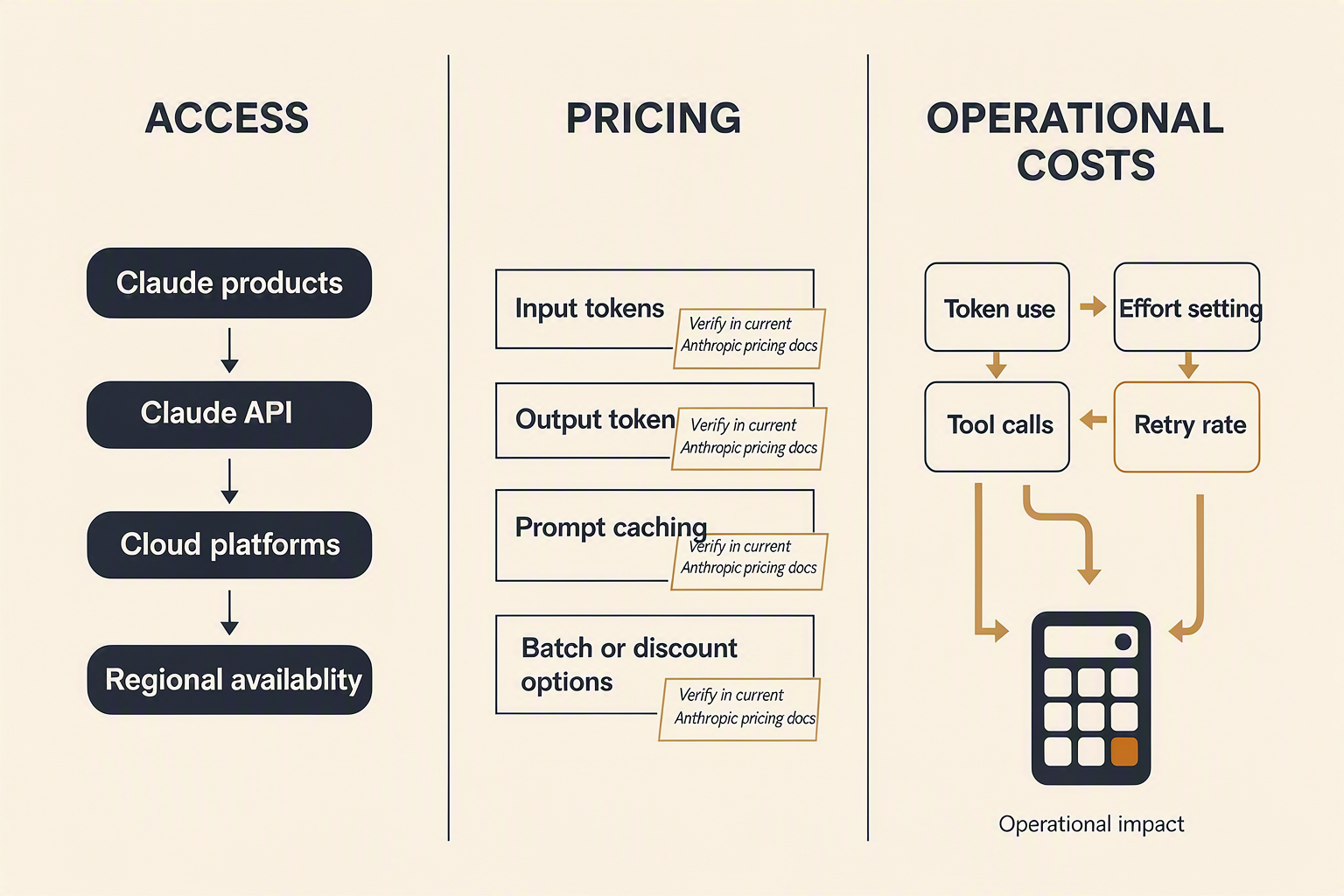
Claude Opus 5.5 is confirmed for the Claude API under the model ID claude-opus-5-5. Anthropic’s September 22, 2026 Claude Platform release notes describe it as a model for “long-running agentic coding and knowledge work,” while Anthropic’s pricing documentation lists two token rates: $4 per million tokens and $5 per million tokens in the corresponding pricing categories.
What is the confirmed Claude Opus 5.5 API availability?
Developers can reference Claude Opus 5.5 using this exact API model string:
claude-opus-5-5The Claude Platform release notes confirmed the model’s launch on September 22, 2026. That documentation establishes availability through Anthropic’s API platform, but the supplied launch materials do not provide enough information to confirm every possible access channel.
In particular, the available research does not establish:
- Availability in every Claude consumer subscription or interface
- Access through specific cloud marketplaces or third-party platforms
- Geographic or regional restrictions
- Account-tier requirements, quotas or default rate limits
- A staged rollout schedule
- Separate batch, caching or long-context pricing terms
Developers should therefore treat direct Claude API availability as confirmed and verify other channels in their respective product consoles or current provider documentation. References to earlier Claude models on Amazon Bedrock, for example, do not by themselves prove that Claude Opus 5.5 is generally available there.
How much does Claude Opus 5.5 cost?
Anthropic’s Claude Platform pricing page listed the following rates as of September 22, 2026:
| Model | First listed category | Second listed category |
|---|---|---|
| Claude Opus 5.5 | $4 per million tokens | $5 per million tokens |
| Claude Opus 5 | $5 per million tokens | $6.25 per million tokens |
The supplied pricing excerpt does not identify what each category represents, so those rates should not be relabelled as input, output, cached or another billing class without further official documentation.
Numerically, each listed Claude Opus 5.5 rate is 20% lower than the corresponding Claude Opus 5 rate:
- $4 is 20% below $5.
- $5 is 20% below $6.25.
Does Claude Opus 5.5 really cost 40% less?
Anthropic separately states that Claude Opus 5.5 “costs 40% less to run than Opus 5 on typical workloads.” That is a workload-level claim, not a statement that every published per-token rate fell by 40%.
The distinction matters. A typical-workload reduction can reflect several factors, including the number of tokens or agentic steps required to complete a task, whereas the pricing table shows only the listed token rates. Teams evaluating an upgrade should model both:
- Published rates: the two documented per-million-token prices.
- Observed task cost: total tokens and repeated agent steps required for representative coding or knowledge-work jobs.
Until Anthropic publishes more detailed billing examples, the safest interpretation is that list rates declined by 20% in both shown categories, while Anthropic reports a 40% reduction for typical end-to-end workloads.
What can Claude Opus 5.5 do better, according to Anthropic?
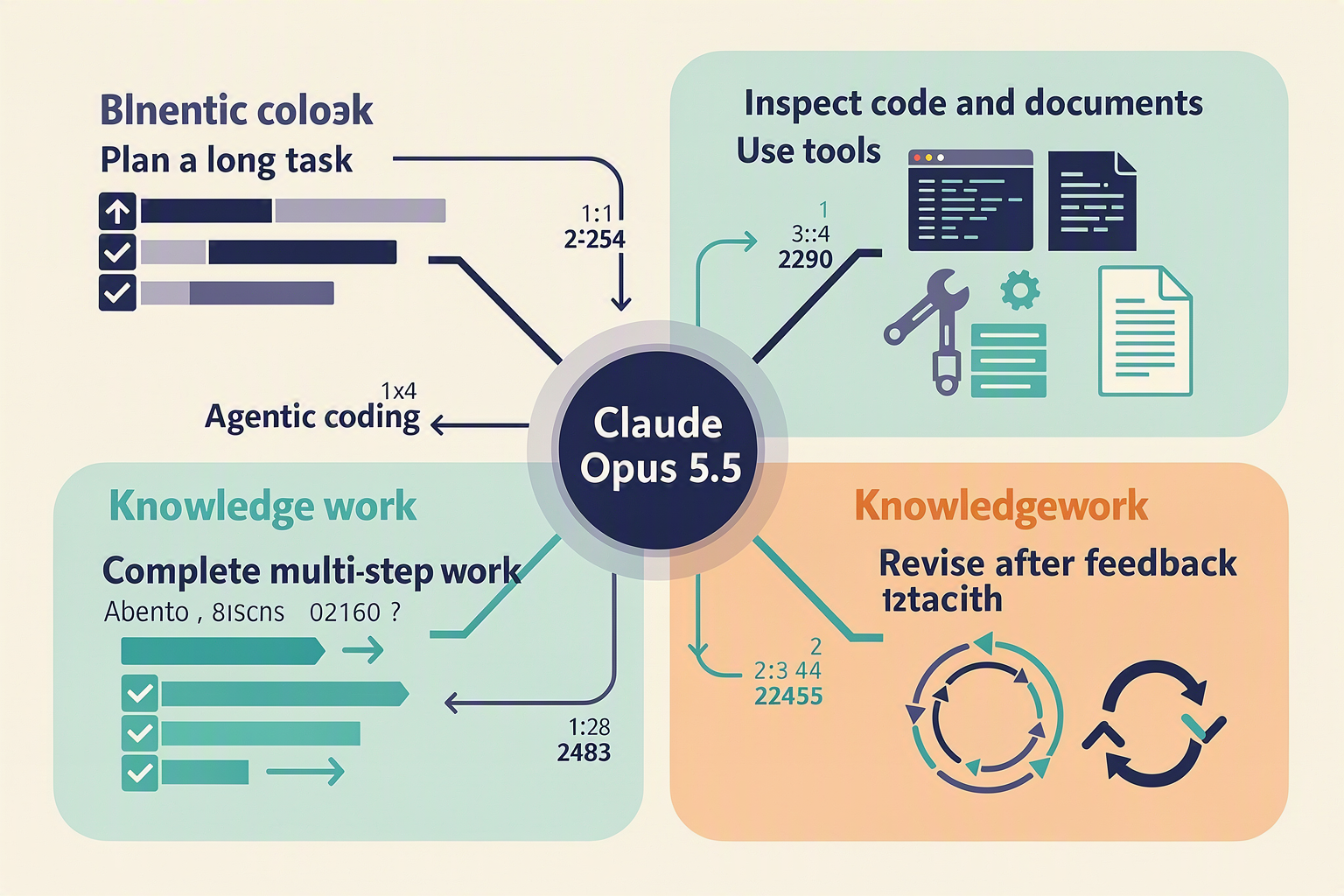
Anthropic positions Claude Opus 5.5 as an improvement for agentic coding and knowledge work, especially assignments that require an AI agent to operate over many steps rather than answer a single prompt. These are Anthropic’s claims as of the model’s September 22, 2026 launch—not evidence that Opus 5.5 is universally superior across every task or development environment.
What does “better at agentic coding” mean?
Anthropic says Claude Opus 5.5 “leads in agentic coding and knowledge work” and describes the model as designed for long-running agentic coding and knowledge work. In practice, agentic coding can involve exploring a repository, planning changes, editing several files, running tools or tests, diagnosing failures and iterating until a task is complete.
That positioning suggests Claude Opus 5.5 is intended for work such as:
- Implementing features that span multiple files or services
- Investigating bugs across an unfamiliar codebase
- Refactoring code while preserving existing behavior
- Running tests, interpreting failures and revising an implementation
- Maintaining context through extended command-line or IDE workflows
- Producing technical plans, documentation and code-review analysis
Anthropic has not established that every repository or programming language will see the same improvement. Results will still depend on the prompt, available tools, repository structure, context supplied and the safeguards governing what the agent may change.
Does Claude Opus 5.5 use fewer steps and tokens?
Anthropic reports that Claude Opus 5.5 used among the fewest tokens and steps it measured in GitHub Copilot CLI and Visual Studio Code testing as of September 22, 2026. Anthropic also says the model solved more tasks in VS Code, although the supplied announcement context does not provide a universally comparable score or prove that the result extends to every IDE workflow.
These efficiency claims matter because an agent that reaches a correct result with fewer interactions may offer several practical benefits:
- Lower execution overhead: Fewer generated tokens can reduce inference consumption.
- Shorter tool traces: Fewer steps may mean less time spent opening files, rerunning commands or reversing unsuccessful edits.
- Reduced failure exposure: Every additional autonomous action creates another opportunity for an incorrect assumption or unsafe change.
- Clearer review trails: Compact trajectories can be easier for developers to inspect before merging code.
Anthropic separately says Claude Opus 5.5 costs 40% less to run than Claude Opus 5 on typical workloads in its September 22, 2026 announcement. “Typical workloads” is vendor-defined, however, so teams should calculate costs using their own input volume, output volume, caching patterns and agent tool loops.
What knowledge-work improvements should teams expect?
“Knowledge work” is broad, but Anthropic’s long-running-agent framing points toward assignments that combine research, synthesis, planning and iterative document creation. Likely use cases include analyzing a large internal document set, drafting a structured report, comparing requirements, preparing implementation plans or coordinating multi-stage operational tasks.
The key distinction is persistence across a workflow: Claude Opus 5.5 is positioned to continue reasoning and acting through an extended assignment, not merely generate a polished first response. Organizations should still verify citations, calculations, code changes and consequential recommendations. Anthropic’s launch claims indicate stronger efficiency and task completion in its tests, but independent evaluation on representative workloads remains essential.
Which benchmarks and limitations should buyers scrutinize?
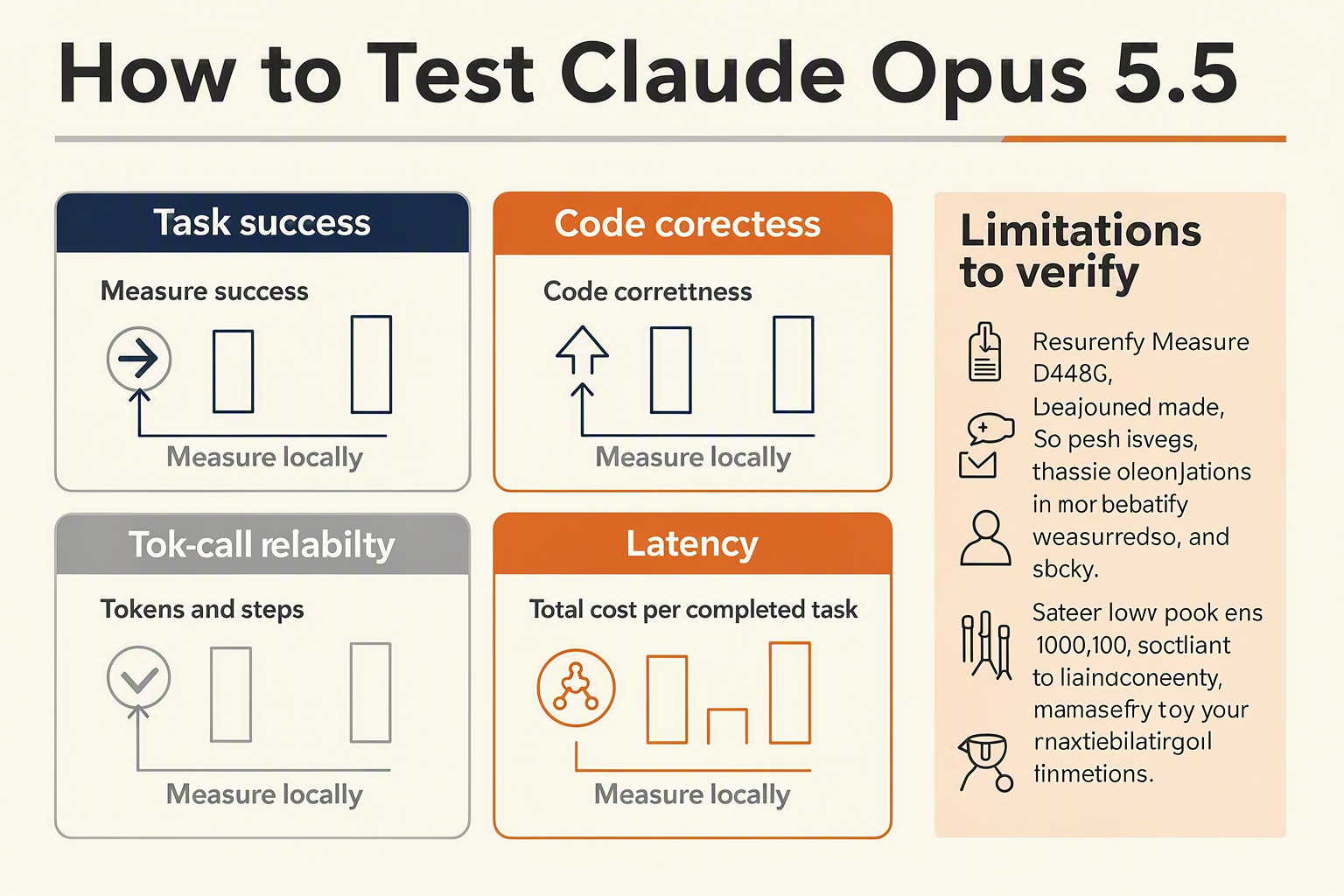
Buyers should treat Claude Opus 5.5’s launch claims as vendor-reported evidence, not a substitute for independent testing. As of September 22, 2026, the supplied research contains no third-party benchmark validation, reproducible evaluation package, or production latency data for Anthropic Claude Opus 5.5.
What do Anthropic’s Claude Opus 5.5 claims establish?
Anthropic describes Claude Opus 5.5 as leading in agentic coding and knowledge work. Anthropic also states on September 22, 2026, that Claude Opus 5.5 costs 40% less to run than Opus 5 on typical workloads.
Those claims are relevant, but buyers still need methodological details before generalizing them. “Typical workloads” may not reflect a particular repository, tool stack, retry policy, prompt length, or acceptance threshold. Anthropic’s testing across GitHub Copilot CLI and Visual Studio Code reportedly found that Claude Opus 5.5 used among the fewest tokens and steps measured, but the supplied evidence does not independently reproduce that finding.
A credible comparison should hold the following variables constant:
- Prompts and system instructions, including formatting and reasoning guidance
- Available tools, tool descriptions, permissions, and execution timeouts
- Token, step, and monetary budgets
- Effort settings and sampling parameters
- Repository state, dependencies, tests, and build environment
- Success criteria, such as tests passed, reviewer acceptance, or issue resolution
- Retries and human intervention, which can conceal first-attempt failures
Without those controls, a model may appear stronger simply because it received a larger budget or more capable tools.
Which repository-specific tests should coding teams run?
Generic coding benchmarks cannot show whether Claude Opus 5.5 understands a company’s architecture, conventions, and operational constraints. Teams should construct an internal evaluation set from real, access-controlled work rather than relying only on headline scores.
Useful tasks include:
- Fixing previously resolved bugs from issue descriptions alone.
- Implementing features that span several modules.
- Writing tests for undocumented edge cases.
- Refactoring code without changing observable behavior.
- Diagnosing failing builds or dependency conflicts.
- Reviewing pull requests for security and regression risks.
Measure task completion, test-pass rate, invalid tool calls, reviewer corrections, total tokens, elapsed workflow time, and cost per accepted change. Keep a human reviewer in the loop for security-sensitive or production-changing tasks.
How do Claude Opus 5.5 effort levels affect migration?
Anthropic’s platform documentation says Claude Opus 5.5 supports five effort levels and defaults to medium as of September 22, 2026. Anthropic’s documentation also says Claude Opus 5 and earlier Opus models default to high, meaning requests that omit the effort setting migrate to Opus 5.5 at a lower effort level by default.
That default change can confound upgrade testing. A quality difference may reflect the effort configuration rather than the underlying model, while token use and workflow cost may also change.
For a fair migration:
- First compare Opus 5 at high effort with Opus 5.5 explicitly set to high.
- Then test Opus 5.5 at medium, its new default, against the same acceptance criteria.
- Record the effort value in every request and evaluation result.
- Revalidate prompts, tool loops, escalation rules, and budget limits before production rollout.
The decisive benchmark is therefore not Anthropic’s launch headline, but Claude Opus 5.5’s performance on your own tasks under matched conditions.
Which use cases are the strongest fit for Claude Opus 5.5?
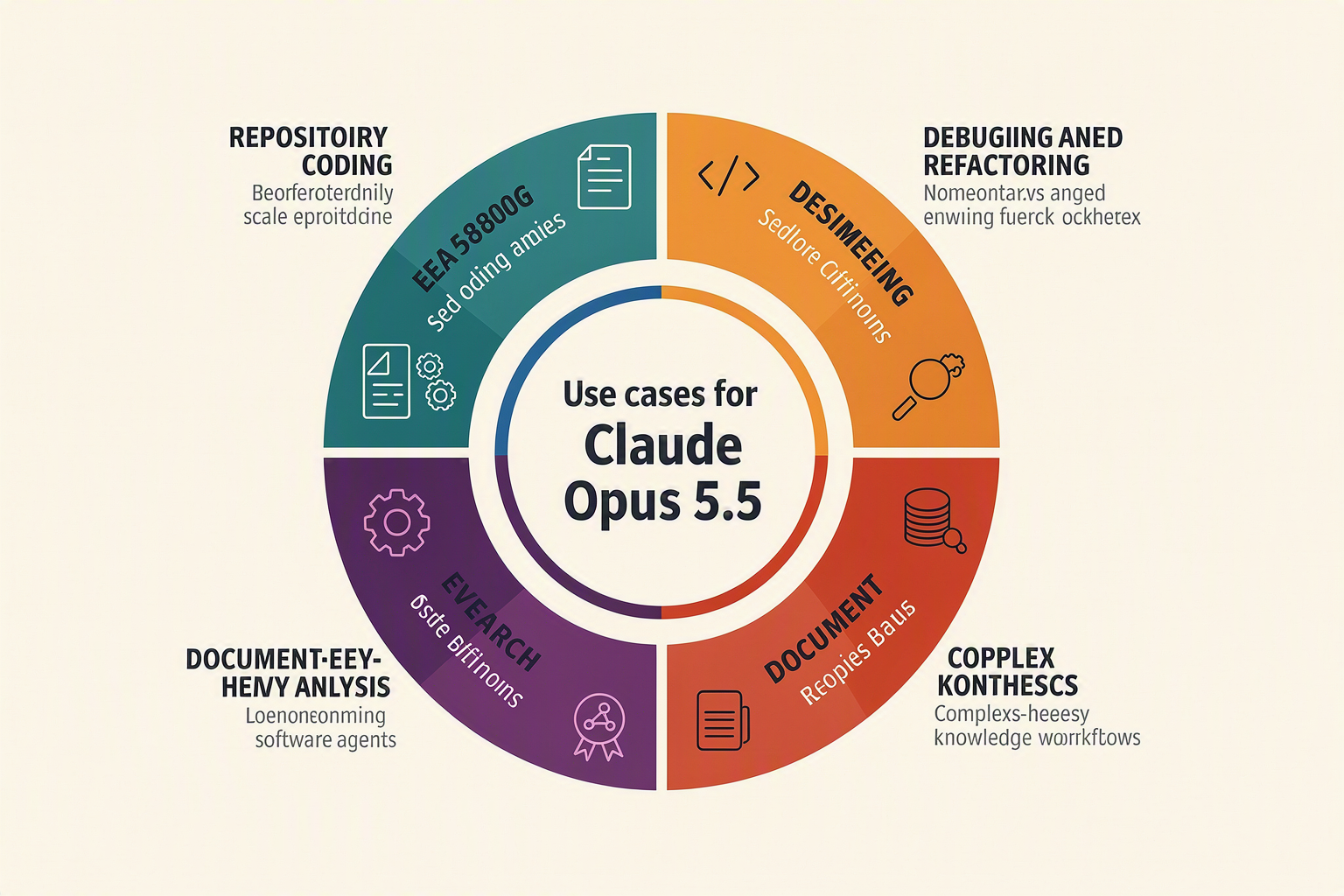
Claude Opus 5.5 is likely the strongest fit for long-running software-engineering agents, repository-scale coding, tool-using developer workflows, and demanding knowledge-work synthesis. Anthropic officially positions the September 22, 2026 release around agentic coding and knowledge work; the specific deployment recommendations below are practical analysis rather than confirmed performance guarantees.
What use cases does Anthropic officially recommend for Claude Opus 5.5?
Anthropic’s Claude Platform release notes describe Claude Opus 5.5 (claude-opus-5-5) as “a model for long-running agentic coding and knowledge work” as of September 22, 2026. Anthropic’s launch announcement also states that Claude Opus 5.5 leads in agentic coding and knowledge work while costing 40% less to run than Claude Opus 5 on typical workloads.
Anthropic’s positioning points to two broad categories:
- Agentic software development: Multi-stage tasks in which the model inspects code, develops a plan, edits files, invokes tools, runs tests, diagnoses failures, and iterates.
- Complex knowledge work: Assignments that require reasoning across substantial source material, reconciling evidence, and producing a structured analysis rather than a short answer.
Anthropic separately reports that, in its testing with GitHub Copilot CLI and Visual Studio Code, Claude Opus 5.5 used among the fewest tokens and steps measured. That is useful directional evidence, but it should not be treated as a universal result across every repository, agent harness, or prompt design.
Which practical workflows are likely to benefit most?
Based on that official positioning, the strongest practical candidates include:
- Long-running coding agents: Claude Opus 5.5 may suit tasks that continue across many tool calls, such as implementing a feature, running a test suite, reviewing failures, and revising the solution.
- Repository-scale changes: Framework migrations, cross-module refactoring, API-version upgrades, and security fixes often require tracing dependencies across many files rather than generating an isolated function.
- Tool-using developer agents: The model is a logical candidate for agents connected to terminals, code search, issue trackers, documentation systems, test runners, and pull-request workflows.
- Architecture and debugging analysis: Teams could use it to compare implementation strategies, investigate failures spanning multiple services, or turn logs, code, and technical documentation into a testable diagnosis.
- Demanding research and synthesis: High-value workflows may include reviewing lengthy reports, comparing competing proposals, preparing evidence-backed briefs, or synthesizing technical and commercial material for decision-makers.
These remain likely fits, not guaranteed outcomes. Teams should evaluate task completion, tool-call accuracy, review burden, latency, and total cost using their own repositories and documents.
For model-portable agent architectures, CallMissed offers OpenAI-compatible and Anthropic-compatible API endpoints, caller-selected fallback models, function calling, structured outputs, and request logs as of September 2026. Those capabilities can help developers test resilient multi-model workflows without tying application logic to a single interface, although availability of a particular model should always be verified separately.
When might Claude Opus 5.5 be a weaker fit?
Claude Opus 5.5 may be unnecessary where complexity is low or deterministic controls matter more than broad reasoning:
- Routine classification, tagging, or field extraction may be cheaper and faster with a smaller model.
- High-volume templated transformations rarely need an Opus-class model unless edge cases are unusually difficult.
- Tightly validated legacy workflows may not justify migration if the current model already meets quality, latency, and cost targets.
- Safety-critical automation without human review still requires external validation, permissions, audit logs, and rollback controls; a stronger model does not remove those engineering obligations.
Should you upgrade from Claude Opus 5, and how should teams test the switch?
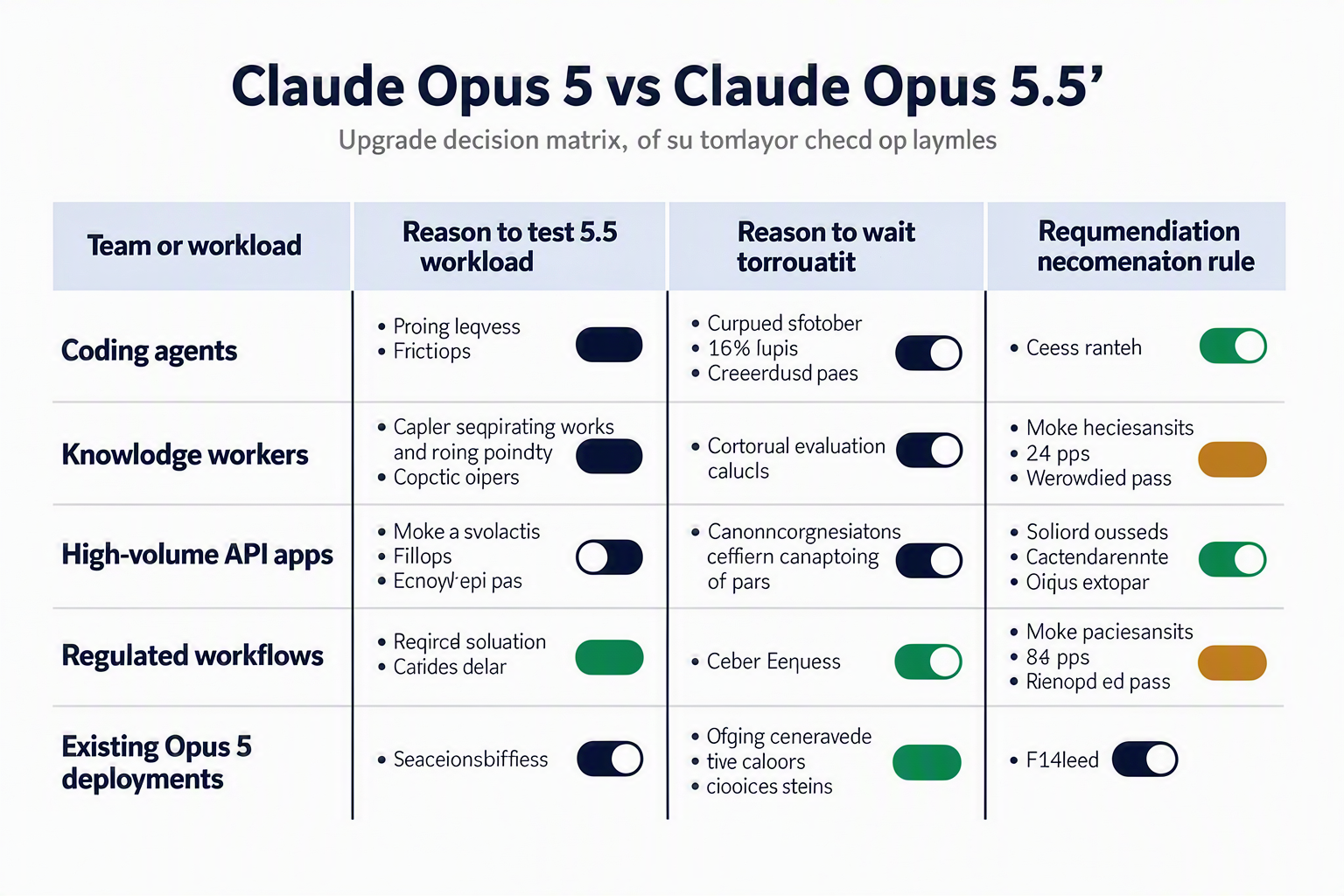
Do not upgrade from Claude Opus 5 to Claude Opus 5.5 automatically. Run a controlled evaluation on your production tasks, because model-level improvements do not guarantee better quality, lower cost or faster responses for every prompt, toolchain and workflow.
Anthropic said on September 22, 2026 that Claude Opus 5.5 costs 40% less to run than Opus 5 on typical workloads, but “typical workloads” may not reflect your token usage, retries or agent steps. Anthropic’s Claude Platform release notes identify the API model as claude-opus-5-5 and position it for long-running agentic coding and knowledge work.
What should teams compare before upgrading to Claude Opus 5.5?
| Test dimension | What to measure | How to test it | Upgrade signal |
|---|---|---|---|
| Exact production prompts | Accuracy, relevance and instruction adherence | Replay a representative, anonymized prompt set against both models | Higher task success without prompt-specific regressions |
| Tools and agents | Correct tool selection, arguments and execution order | Run complete workflows with the same tools, permissions and limits | More completed tasks with equal or fewer recovery interventions |
| Output compatibility | JSON validity, schemas, citations, tone and formatting | Apply existing validators and downstream parsers unchanged | No increase in parsing errors or contract violations |
| Tokens and steps | Input tokens, output tokens, tool calls and agent turns | Log the full trajectory rather than only the final answer | Lower or acceptable total resource use at comparable quality |
| Cost and latency | End-to-end spend and completion time | Include retries, cache behavior, tool charges and failed runs | Better economics or responsiveness for the required quality |
| Failure recovery | Retry success, fallback behavior and partial-task preservation | Inject tool errors, timeouts, missing data and ambiguous instructions | Predictable recovery without unsafe or duplicated actions |
Why must effort be controlled during the comparison?
Claude Opus 5.5 defaults to medium effort, while Claude Opus 5 and earlier Opus models default to high effort, according to Anthropic’s effort documentation available on September 22, 2026. An evaluation that omits the effort parameter therefore changes both the model and its reasoning setting.
Run at least two comparisons:
- Controlled comparison: Set both Claude Opus 5 and Claude Opus 5.5 to the same supported effort level, such as high.
- Deployment comparison: Test Claude Opus 5.5 at the effort level you would actually use in production, including its medium default if appropriate.
This distinction prevents teams from incorrectly attributing changes in quality, token consumption or response time solely to the new model.
How should teams decide whether to switch?
Build an evaluation set from real tasks rather than relying only on public benchmarks. Score task-completion rate as the primary metric, then apply hard gates for security, factuality, schema compliance and tool authorization.
A practical rollout should include:
- A fixed test set plus newly sampled production cases.
- Human review for high-impact or subjective outputs.
- Shadow traffic or a small canary deployment before full migration.
- Logged failures grouped by prompt, tool, format and recovery type.
- A rollback path to Claude Opus 5 if critical regressions appear.
Upgrade when Claude Opus 5.5 produces a meaningful improvement for your defined objectives and passes every compatibility gate—not merely because it is newer or because Anthropic reports lower costs on typical workloads.
What are experts saying, and what evidence is still missing?

The supplied evidence does not yet include independent expert commentary on Claude Opus 5.5. It consists of Anthropic’s September 22, 2026 announcement, Claude Platform release notes, pricing documentation, and Anthropic-run testing; therefore, early performance claims should be treated as vendor-reported until third parties reproduce them.
What has Anthropic officially confirmed about Claude Opus 5.5?
Several launch facts are supported by Anthropic’s primary sources as of September 22, 2026:
- Anthropic describes Claude Opus 5.5 as a model designed for “long-running agentic coding and knowledge work.”
- Anthropic’s Claude Platform release notes identify the API model string as
claude-opus-5-5and record its launch on September 22, 2026. - Anthropic says Claude Opus 5.5 costs 40% less to run than Claude Opus 5 on typical workloads, but that percentage is based on Anthropic’s workload assumptions rather than an independently audited production study.
- Anthropic’s pricing documentation lists Claude Opus 5.5 rates beginning at $4 per million tokens, while the displayed pricing table includes different rates for distinct token and caching categories.
- Anthropic reports that Claude Opus 5.5 used “among the fewest tokens and steps” in its testing across GitHub Copilot CLI and Visual Studio Code.
These claims establish the model’s intended role and official commercial positioning. They do not, by themselves, establish how Claude Opus 5.5 performs across different repositories, programming languages, agent frameworks or enterprise environments.
What evidence is still missing for Claude Opus 5.5?
The most important gap is independent production evidence. Buyers still need evaluations covering:
- Reliability: task-completion rates, tool-call failures, hallucinations, instruction adherence and performance degradation during long-running sessions.
- Total cost: input, output, cache and retry costs measured on real workflows—not only nominal per-token prices or Anthropic’s “typical workloads.”
- Coding quality: repository-level tests involving unfamiliar codebases, regression rates, security defects and human review time.
- Latency and throughput: time to first token, end-to-end task duration and behavior under concurrent workloads.
- Knowledge-work accuracy: citation quality, factual consistency and performance on organization-specific documents.
- Operational safety: resistance to prompt injection, inappropriate tool use and unintended changes during autonomous execution.
Anthropic’s lower-cost claim could prove meaningful if Claude Opus 5.5 completes tasks with fewer tokens and agent steps. However, a cheaper token rate does not guarantee a lower final bill if a deployment requires more retries, longer outputs or heavier validation.
Can Claude Opus 5.5 be compared fairly with GPT-5.5 yet?
A defensible Claude Opus 5.5 vs GPT-5.5 verdict cannot be drawn from the supplied research. No matched, independent evaluation of the two models is included, so claims that either model is categorically faster, cheaper or more capable would be unsupported.
A useful comparison should hold the prompt, tools, context, effort settings, retry policy and success criteria constant. Teams considering an upgrade should run a representative test set, then compare successful-task cost, completion time, failure rate and human correction effort. Until those results emerge, Anthropic’s launch materials are strong evidence of product intent—but not a substitute for neutral expert testing.
Frequently Asked Questions
When did Anthropic launch Claude Opus 5.5?
What is the Claude Opus 5.5 API model ID?
claude-opus-5-5, as documented by Anthropic on September 22, 2026. Developers should use that exact string when configuring API requests and should not assume that an application’s marketing label and API identifier are interchangeable.What is Claude Opus 5.5 designed to do?
What are the published Claude Opus 5.5 token rates?
Does Claude Opus 5.5 really cost 40% less than Claude Opus 5?
What is the default effort setting in Claude Opus 5.5?
effort setting can behave differently after migration; developers should set effort explicitly when reproducibility matters.Should existing Claude Opus 5 users upgrade immediately?
Conclusion
Claude Opus 5.5 marks a targeted upgrade for developers building long-running coding agents and complex knowledge-work systems, rather than a universal replacement for every Claude deployment.
- Anthropic launched Claude Opus 5.5 on September 22, 2026, with the confirmed API model ID
claude-opus-5-5. - Anthropic’s pricing documentation lists Opus 5.5 rates of $4/MTok and $5/MTok, compared with $5/MTok and $6.25/MTok for Claude Opus 5 in the corresponding pricing categories.
- Anthropic says Opus 5.5 costs 40% less to run than Opus 5 on typical workloads, but this is a company-reported estimate—not independent proof that every request will be 40% cheaper.
- Opus 5.5 supports five effort levels and defaults to medium, whereas Opus 5 defaults to high. Controlled evaluations should therefore hold effort, prompts, tools and success criteria constant.
What matters next is independent evidence: completion rates, total tokens, tool-call reliability, latency and end-to-end cost across real repositories and knowledge workflows. Teams should test representative tasks before upgrading or comparing Claude Opus 5.5 with alternatives.
Developers can also explore this broader shift through CallMissed, an AI communication infrastructure platform offering one API key and balance for 136 models as of September 2026. Will Opus 5.5’s efficiency claims hold up in your production workload?
Related Reading
- Claude Opus 5 Migration Guide: API Pricing for 2026
- Sarvam AI vs Deepgram for Indian Languages: Accuracy, Pricing, and Best Use Cases
- Best Voice AI API for Indian Languages in 2026: Pricing, Coverage, and Use Cases
Sources
Discussion
Related Posts



Ready to automate customer conversations?
Launch AI voice agents and WhatsApp bots with CallMissed — one API, 22+ Indian languages.