
Claude Opus 5 Migration Guide: API Pricing for 2026


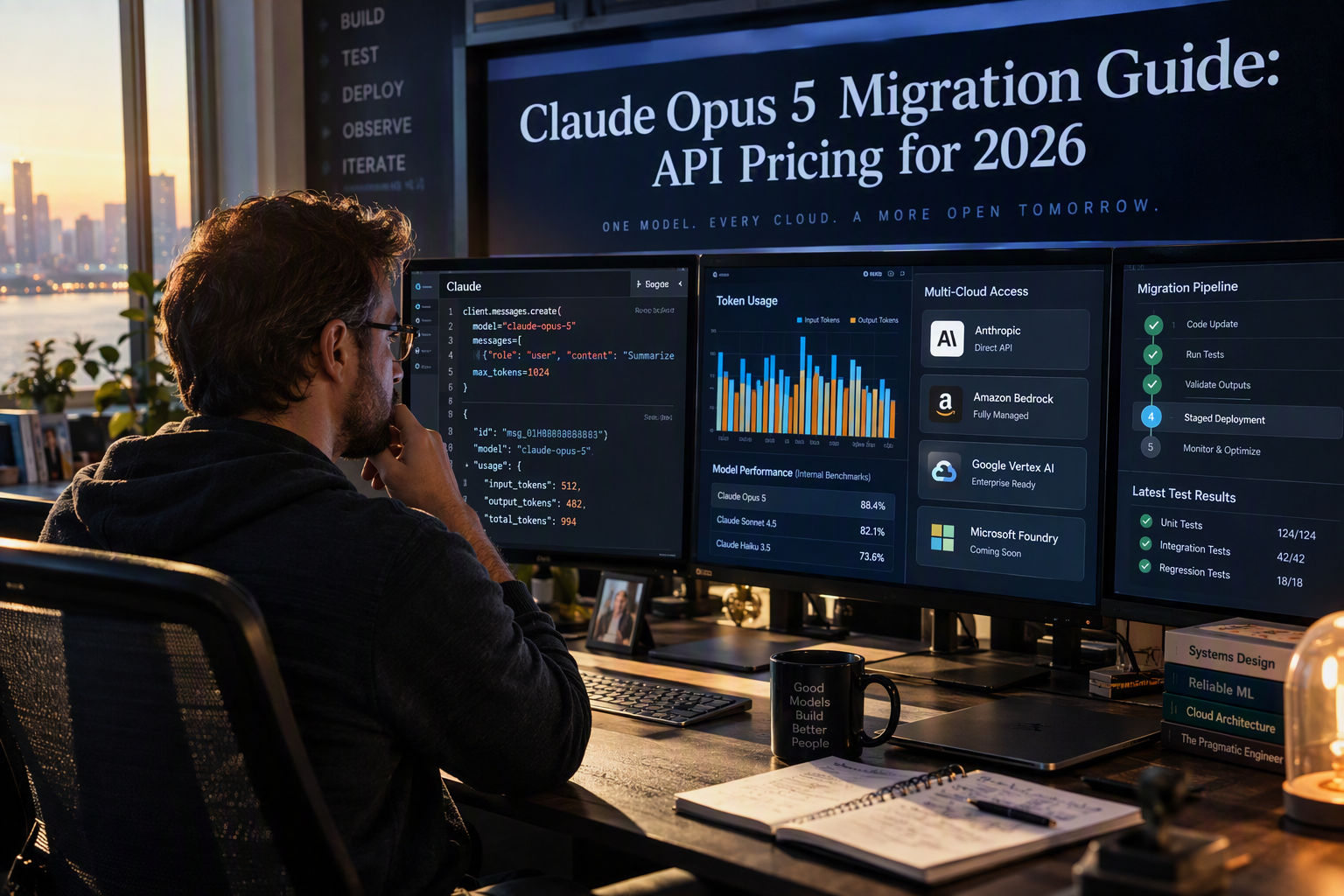
Use this Claude Opus 5 migration guide to verify API access, pricing, model IDs, tools, tests, limits, and safe rollout steps.
Claude Opus 5 Migration Guide: API Pricing for 2026
What if one caching decision could cut Claude Opus 5.5 input costs by 95%? Anthropic’s Claude Platform documentation states that an Opus 5.5 cache hit is billed at $0.20 per million tokens, or “5% of the standard input price,” as of September 2026. That makes a careful Claude Opus 5 migration guide essential: changing the model name may take seconds, but overlooking caching, context growth, tool behavior, or cloud-specific pricing can materially change both application performance and cost.
Why does migrating to Claude Opus 5.5 matter now?
Claude Opus 5.5 arrives as developers are moving beyond simple chat interfaces toward coding agents, research pipelines, tool-using assistants, and long-running workflows. These systems can repeatedly process large repositories, conversation histories, tool results, and retrieved documents—so Claude Opus 5 API pricing must be evaluated at the workload level rather than by comparing headline token rates alone.
The available operating modes add another cost-performance decision. Anthropic’s documentation prices Claude Opus 5 Fast mode at $10 per million input tokens and $50 per million output tokens as of September 2026. Developers therefore need to determine when faster responses justify the premium, which prompts benefit from caching, and whether output-token limits—not input volume—will dominate the production bill.
Access paths matter too. Teams may call Claude through the Anthropic API or an officially supported cloud platform such as Amazon Bedrock, where model availability, identifiers, endpoints, context limits, and pricing can differ. Anthropic’s Amazon Bedrock documentation lists a 1-million-token context window for Claude Opus 5.5 and notes a 10% pricing premium for specified endpoints as of September 2026. Those differences should be verified before deployment rather than assumed to match Anthropic’s first-party API.
What will this Claude Opus 5.5 developer guide cover?
This implementation-focused guide will show you how to:
- Confirm the current model identifier for each supported provider instead of guessing an alias.
- Compare standard pricing, prompt caching, Fast mode, and cloud-platform premiums.
- Validate the context window, maximum output, tool use, and structured-output behavior.
- Update SDK configuration, prompts, token budgets, retries, and fallback logic.
- Build regression tests for accuracy, latency, tool calls, schemas, and cost.
- Check disclosed rate limits and design safe backoff and concurrency controls.
- Roll out gradually with observability, budget alerts, canaries, and rollback plans.
For developers who want provider flexibility, CallMissed’s Anthropic-compatible /v1/messages endpoint provides access to a broader 136-model catalogue through one API key and balance as of September 2026, illustrating the growing role of compatibility layers in model migrations.
The goal is not merely to make the first Opus 5.5 request succeed. It is to produce a migration that remains predictable under real traffic, measurable in cost, and reversible when production behavior differs from staging.
What should developers know before using the Claude Opus 5.5 API?
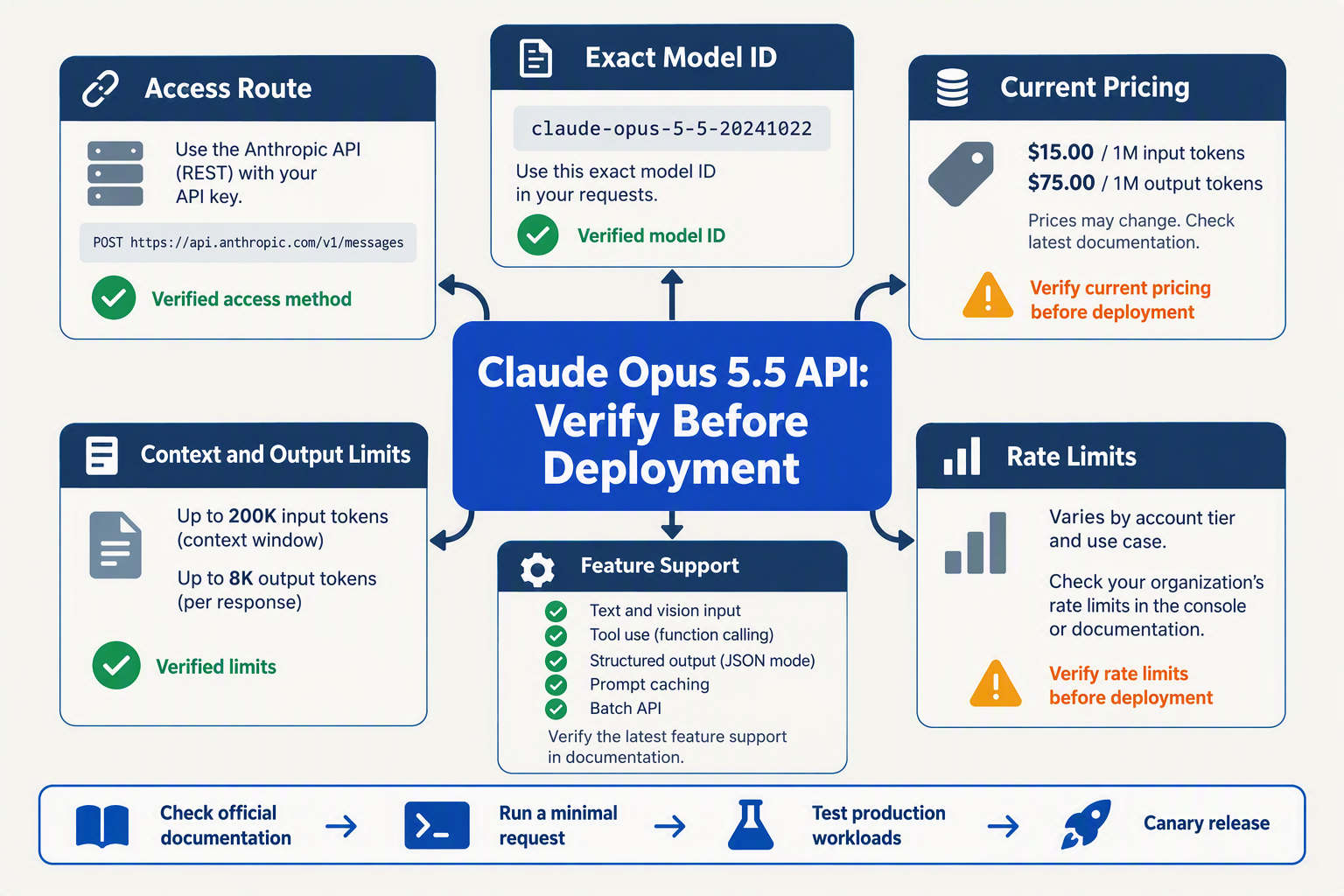
Developers should treat Claude Opus 5.5 API adoption as a deployment change, not a model-name substitution. Before writing production code, verify the access provider, exact model identifier, endpoint contract, regional availability, context limits, and billing rules in the provider’s current documentation.
Where can developers access the Claude Opus 5.5 API?
The two verified access paths in the available official documentation are the first-party Anthropic API and Claude on Amazon Bedrock. These routes can expose the same model family through different authentication, endpoint, billing, and model-discovery mechanisms.
- Anthropic API: Uses Anthropic credentials and the Claude Messages API contract.
- Amazon Bedrock: Uses AWS authentication, regional endpoints, Bedrock permissions, and provider-specific model resources.
- Compatibility gateways: Can simplify multi-model applications, but developers must check whether every Anthropic-specific feature and request field is passed through unchanged.
Do not assume that a model available through Anthropic is immediately enabled in every AWS Region or account. For Amazon Bedrock, confirm model access, identity and access management permissions, endpoint type, quotas, and data-residency requirements before implementation.
What is the Claude Opus 5.5 model identifier?
Use only the model ID returned by the provider’s current model catalogue or documentation. The supplied official-source context does not provide a complete, verified Claude Opus 5.5 identifier, so copying an identifier from an older model, preview announcement, SDK example, or another cloud is unsafe.
Add the identifier through configuration rather than hard-coding it:
CLAUDE_PROVIDER=anthropic
CLAUDE_MODEL=<verified-provider-model-id>
This makes provider-specific identifiers replaceable without changing application logic. It also supports controlled rollbacks when a dated model snapshot, alias, or cloud deployment behaves differently.
Which technical limits must be verified before integration?
Create a provider-specific capability record covering:
- Context window: Anthropic’s Amazon Bedrock documentation lists a 1-million-token context window for Claude Opus 5.5 as of September 2026.
- Maximum output: Verify the output-token ceiling separately; a large context window does not imply an equally large response allowance.
- Tool use: Test tool definitions, tool-choice controls, parallel calls, error recovery, and repeated tool loops.
- Structured outputs: Validate the exact schema features supported, including required fields, enums, nested objects, and refusal handling.
- Streaming: Confirm event types, partial tool-call behavior, cancellation semantics, and timeout handling.
- Multimodal input: Check supported media types, file-size restrictions, and token accounting before sending images or documents.
Anthropic’s Claude Platform documentation states that a Claude Opus 5.5 prompt-cache hit costs $0.20 per million tokens, or 5% of standard input pricing, as of September 2026. However, cache writes, cache hits, uncached input, and generated output should be tracked as separate billing categories.
What should the preflight checklist include?
Before the first production request, developers should:
- Enable provider access and test authentication with least-privilege credentials.
- Record the verified model ID, region, endpoint, API version, and pricing date.
- Send a minimal non-streaming request, followed by streaming and tool-use tests.
- Measure input, cached-input, and output tokens independently.
- Define request timeouts, exponential backoff, idempotency behavior, and spending limits.
- Capture model, provider, request ID, token usage, latency, tool calls, and termination reason in logs.
- Keep the previous model configuration available for rollback.
This preflight discipline prevents silent incompatibilities from becoming production incidents or unexpected Claude API pricing 2026 overruns.
How did Claude Opus 5.5 change the API and migration landscape?
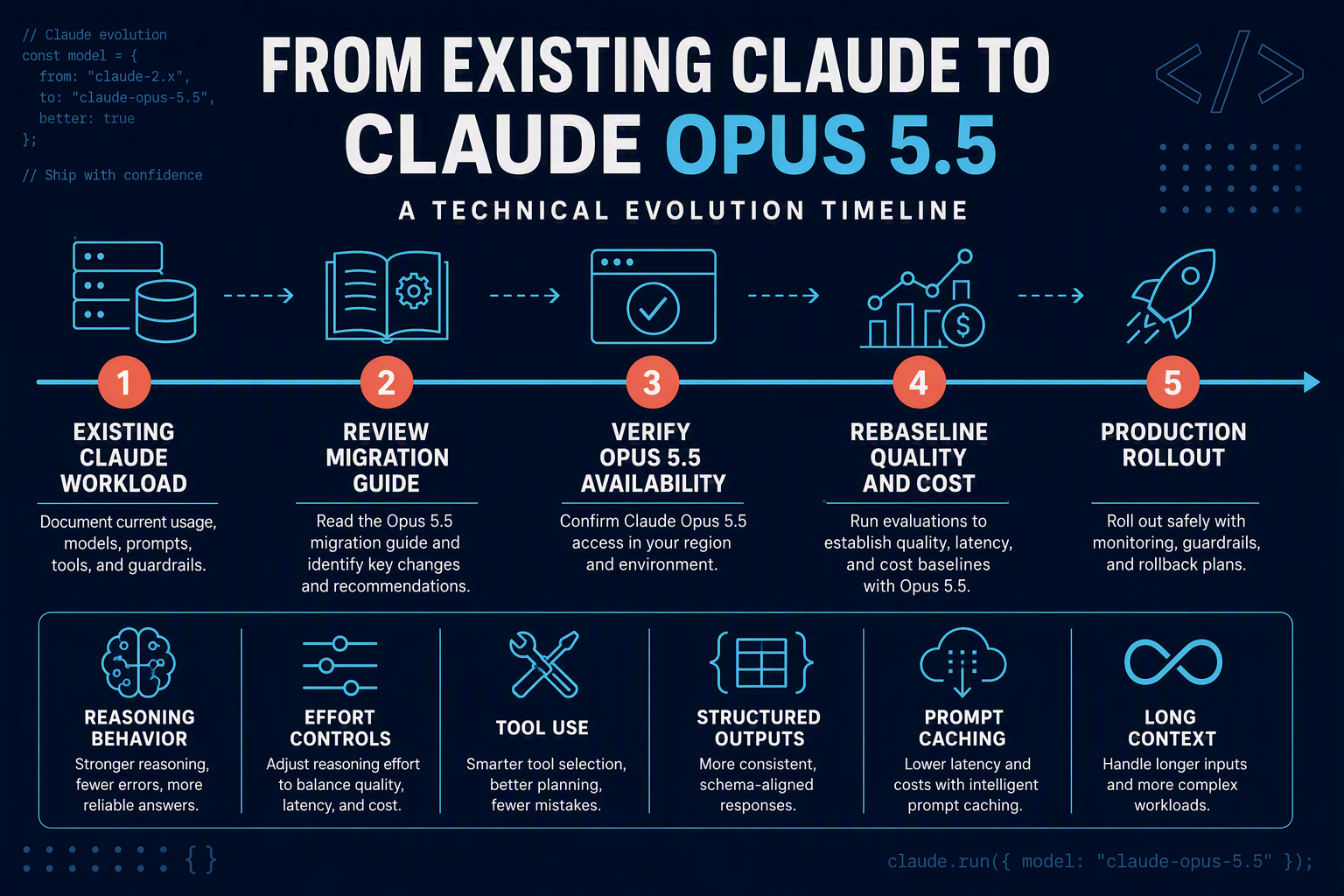
Claude Opus 5.5 turns migration from a simple model-string update into a provider-specific systems change. Developers must now validate caching economics, million-token context behavior, endpoint pricing, tool-call regressions, and model availability separately for the Anthropic API and each supported cloud platform.
What changed beyond the model name?
The largest shift is that long-context and agentic workloads can no longer be evaluated using headline token prices alone. Anthropic’s Claude Platform documentation states that an Opus 5.5 prompt-cache hit costs $0.20 per million tokens, equal to 5% of the standard input price, as of September 2026.
That discount can materially change architecture. A coding agent might repeatedly send a 500,000-token repository snapshot alongside a much smaller user request. Caching the stable repository prefix can be more consequential than reducing a few hundred tokens from each instruction.
Developers should therefore review:
- Prompt boundaries: Separate stable system instructions, repositories, and reference documents from frequently changing content.
- Cache eligibility: Confirm which request blocks can be cached and how cache writes, hits, and expiration affect cost.
- Token accounting: Track uncached input, cache creation, cache reads, and output independently.
- Output budgets: Long reasoning traces or generated code can make output spending the dominant cost.
- Context quality: A 1-million-token allowance does not mean every workflow should send 1 million tokens; retrieval and summarisation can still improve relevance.
How does Fast mode affect migration decisions?
Anthropic prices Claude Opus 5 Fast mode at $10 per million input tokens and $50 per million output tokens as of September 2026. Fast mode should consequently be treated as a separate deployment profile, not enabled globally without measurement.
A useful migration experiment compares standard and Fast mode against the same production-like dataset:
- Measure time to first token and total response time.
- Compare task completion, code correctness, and tool-call success.
- Record input, cached-input, and output-token costs.
- Calculate cost per successful task rather than cost per request.
- Route only latency-sensitive workloads to the faster configuration.
For example, an interactive coding assistant may value responsiveness, while an asynchronous repository audit may favour lower total cost over faster delivery.
Why is provider selection now part of the migration?
Claude Opus 5.5 deployments can differ by access path. Anthropic’s Amazon Bedrock documentation lists a 1-million-token context window for Claude Opus 5.5 and reports a 10% pricing premium for specified endpoints as of September 2026. That means an application tested against Anthropic’s first-party API should not assume identical pricing, identifiers, regions, quotas, or endpoint semantics on Amazon Bedrock.
Before changing production configuration, verify the provider’s current documentation for:
- The exact model ID or inference-profile identifier
- Regional and account-level availability
- Context and maximum-output limits
- Streaming, tool use, and structured-output support
- Rate limits, quotas, retries, and timeout behaviour
- Prompt-caching support and billing treatment
Do not derive an identifier from a marketing name such as “Claude Opus 5.5.” Provider IDs may include versioned suffixes or platform-specific routing constructs, and an unverified alias can fail deployment or silently target an unintended version.
What should a safe migration change?
Anthropic maintains dedicated model migration guides, underscoring that model upgrades may change prompting and application behaviour. A safe Claude Opus 5 migration guide should therefore require regression tests for answer quality, JSON-schema validity, tool selection, argument construction, refusal behaviour, token usage, latency, and total cost.
Roll out through a canary, preserve the previous model configuration for rollback, and log the provider, exact model identifier, operating mode, cache status, token counts, tool calls, and error codes for every request. This turns Claude Opus 5.5 migration into an observable engineering change rather than an unmeasured model swap.
Which Claude Opus 5.5 capabilities and access routes are officially documented?
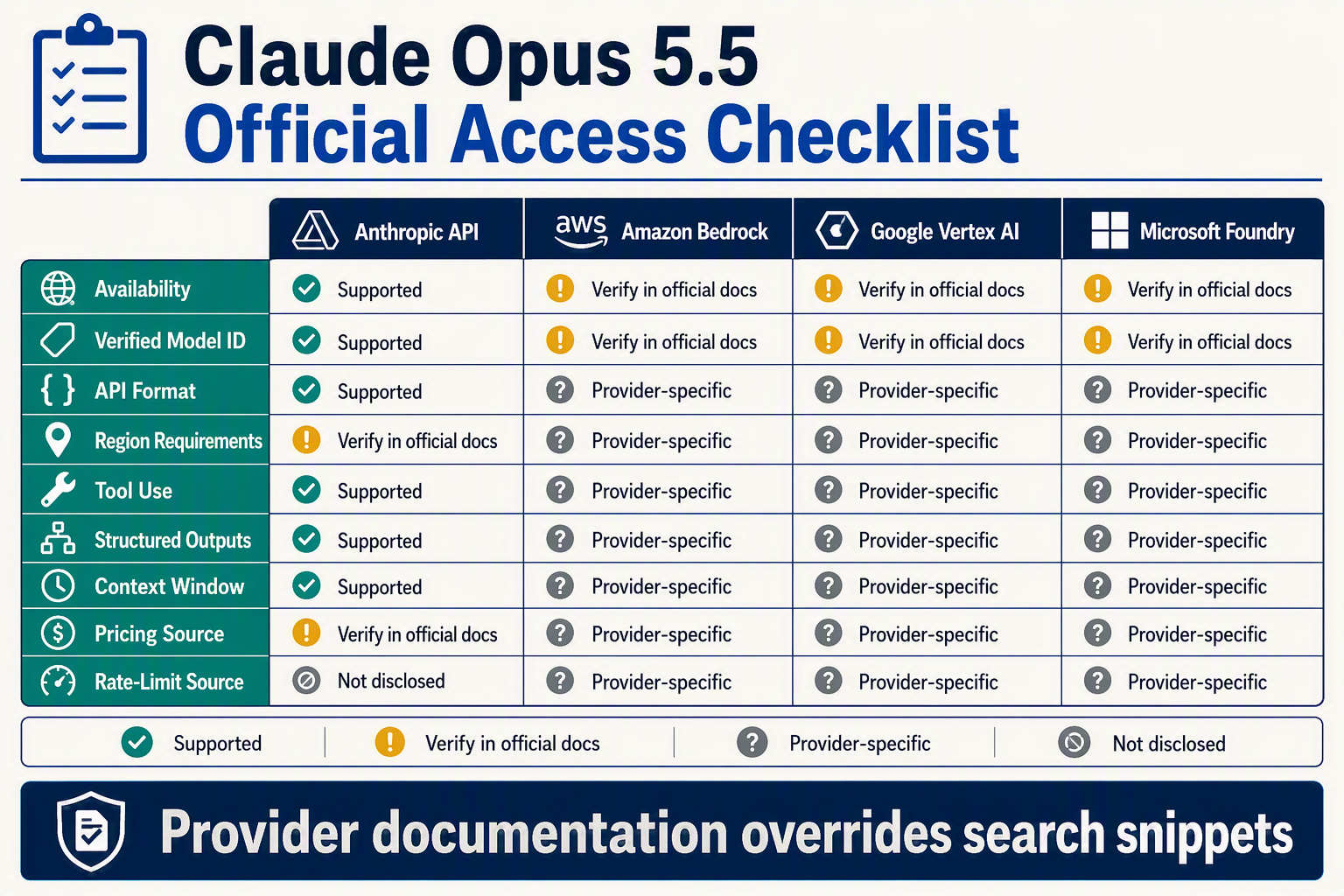
Claude Opus 5.5 is officially documented for direct access through the Anthropic Claude API and through Amazon Bedrock, but provider-specific model identifiers, endpoints, limits, and pricing should be verified independently. The available Anthropic documentation also confirms a 1-million-token context window, prompt caching, and a higher-priced Fast mode as of September 2026.
What does the official documentation confirm?
| Capability or route | Officially documented detail | Developer implication | Verification source |
|---|---|---|---|
| Anthropic Claude API | First-party access through the Claude Platform | Use Anthropic’s current SDK and model registry; do not infer the model ID from a display name | Anthropic Claude Platform documentation, September 2026 |
| Amazon Bedrock | Claude Opus 5.5 is listed with a 1M-token context window | Bedrock identifiers and invocation formats may differ from Anthropic’s API | Anthropic’s Amazon Bedrock documentation, September 2026 |
| Extended context | The documented context window is 1 million tokens | Budget for the complete prompt, tool results, conversation history, and requested output | Anthropic model and Bedrock documentation, September 2026 |
| Prompt caching | A cache hit costs $0.20 per million tokens, described as “5% of the standard input price” | Cache stable system prompts, repository context, policies, and reference documents | Anthropic Pricing documentation, September 2026 |
| Fast mode | Fast mode costs $10 per million input tokens and $50 per million output tokens | Benchmark latency gains against the price premium before enabling it broadly | Anthropic “What’s new in Claude Opus 5,” September 2026 |
| Tools and structured outputs | These must be checked against the current model and provider documentation | Test schemas, tool-choice behavior, parallel calls, and validation failures before migration | Provider-specific API documentation, September 2026 |
Which Claude Opus 5.5 model identifier should developers use?
Use only the exact identifier returned by the provider’s current model catalogue or documentation. The cited documentation excerpts do not expose a verified Anthropic or Amazon Bedrock model ID, so publishing a guessed alias would create a fragile integration.
Before deployment:
- Retrieve the identifier from the Anthropic model overview or API console.
- For Amazon Bedrock, confirm the regional model or inference-profile identifier in the AWS console.
- Store provider identifiers in configuration rather than application code.
- Log the resolved provider, model ID, region, and operating mode with every request.
- Reject startup when an identifier is missing instead of silently falling back to another model.
This matters because a marketing name such as Claude Opus 5.5 is not necessarily the string accepted by every API. Bedrock can also introduce region, endpoint, and inference-profile distinctions that do not exist in Anthropic’s first-party interface.
Are capabilities identical across access routes?
No—developers should treat model capability and platform exposure as separate questions. A model may support a feature while a particular cloud endpoint, SDK version, region, or account configuration exposes it differently.
Run provider-specific checks for:
- Tool use: tool definitions, forced tool selection, parallel calls, and tool-result formatting.
- Structured outputs: supported schema subset, refusal handling, and malformed-output behavior.
- Streaming: event types, usage reporting, disconnect recovery, and partial tool calls.
- Context limits: whether the documented 1M-token window is enabled for the chosen endpoint.
- Commercial terms: Anthropic’s documentation notes a 10% premium for specified Amazon Bedrock endpoints as of September 2026.
Official support should therefore mean more than seeing the model name in a catalogue: the exact model identifier, region, endpoint, capability flags, and price schedule must all be confirmed together.
How do you configure context, effort, tools, structured outputs, and Fast mode?
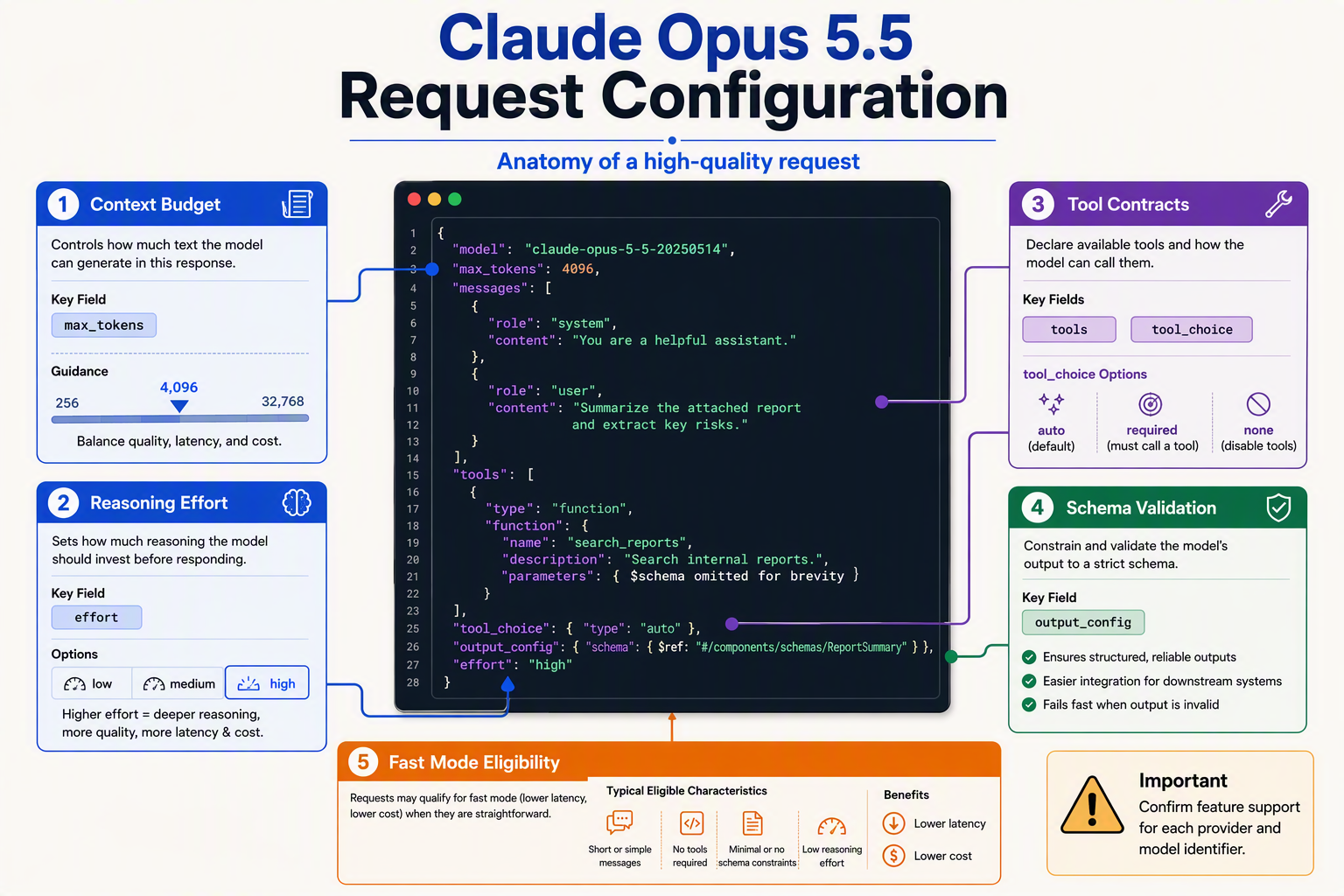
Configure Claude Opus 5.5 by treating context size, effort, tools, structured outputs, and Fast mode as separate, provider-validated capabilities. The supplied research confirms a 1-million-token context window and Fast mode pricing, but it does not verify exact request fields, output-token limits, model identifiers, or feature parity across Anthropic and cloud platforms.
How should you configure the 1M-token context window?
Claude Opus 5.5 has a 1-million-token context window, according to Anthropic’s Claude Platform documentation as of September 2026. Anthropic’s Amazon Bedrock documentation also lists a 1-million-token context window for Claude Opus 5.5, but developers should verify the current Bedrock model entry before deployment.
A large window is a capacity ceiling, not an instruction to send every available document. For more reliable and economical requests:
- Retrieve only passages relevant to the current task.
- Put durable instructions and reusable reference material in cacheable prompt sections where supported.
- Reserve enough capacity for the response, tool results, and follow-up turns.
- Test long-context accuracy at several prompt sizes rather than testing only the maximum.
- Record input and output token usage separately in production telemetry.
Anthropic’s pricing documentation states that an Opus 5.5 prompt-cache hit costs $0.20 per million tokens as of September 2026, equal to 5% of the documented standard input price cited by the source.
How should effort controls be configured?
Use the provider’s documented effort control only after confirming that the selected Opus 5.5 endpoint supports it. The supplied research does not establish the parameter name, allowed values, default behavior, or interaction with output limits, so copying settings from another Claude generation could produce validation errors or silent behavioral changes.
Benchmark each supported effort level against:
- Task success and factual accuracy
- Tool-call correctness
- Output-token consumption
- End-to-end latency
- Cost per successful task
Higher effort should be selected by evaluation results, not applied globally. Routing routine extraction and classification differently from complex coding or agentic tasks can control costs without weakening demanding workflows.
How should tools and structured outputs be enabled?
Verify tool use and structured output support in the current documentation for the exact provider, region, API version, and model identifier. Do not assume that an Anthropic API request can be copied unchanged into Amazon Bedrock or another hosted endpoint.
Before production rollout:
- Validate tool names, descriptions, and input schemas.
- Reject unknown arguments before executing a tool.
- Set timeouts, authentication scopes, and idempotency protections.
- Test malformed tool results and repeated calls.
- Validate structured responses against the application’s schema.
- Define retry or repair behavior for invalid output.
Structured output tests should include missing required fields, unexpected properties, incorrect types, null values, and truncated responses.
How do you enable and budget for Fast mode?
Anthropic prices Claude Opus Fast mode at $10 per million input tokens and $50 per million output tokens as of September 2026. Before enabling it, consult Anthropic’s current Fast mode documentation for access requirements, supported models, request fields, and provider availability; those implementation details are not verified in the supplied research.
Treat Fast mode as a distinct deployment profile. Run the same prompts through standard and Fast configurations, then compare latency percentiles, answer quality, tool reliability, and total cost before shifting production traffic.
How much does Claude Opus 5 cost for real API workloads?
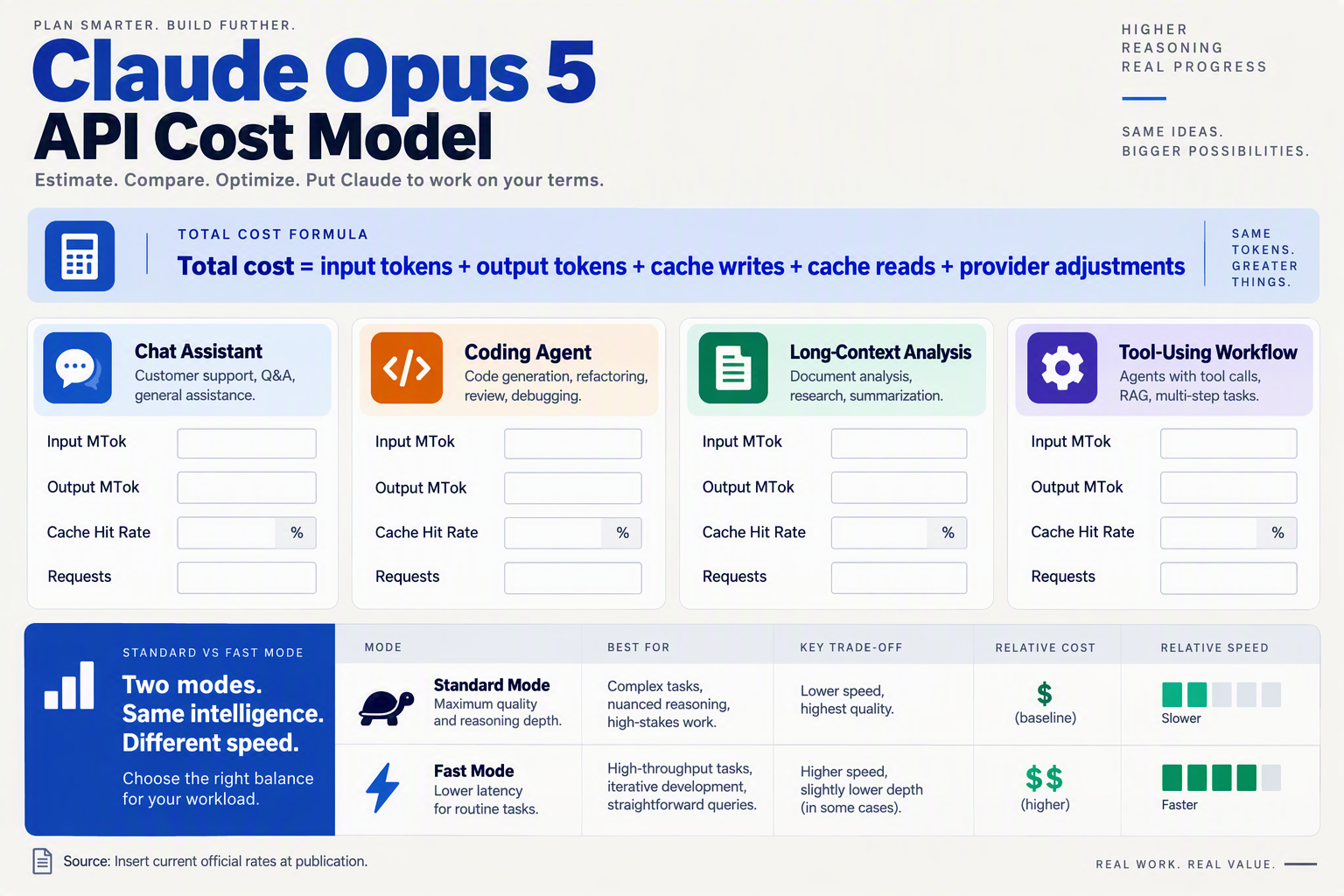
Claude Opus 5 API costs depend on uncached input, prompt-cache reads, cache writes, output tokens, and execution mode. As of September 2026, Anthropic’s model overview lists standard Claude Opus 5 pricing at $5 per million input tokens (MTok) and $25 per MTok of output, while Fast mode costs twice those rates.
What are the verified Claude Opus 5 API prices?
Anthropic’s official model overview lists standard Claude Opus 5 pricing at $5/MTok for input and $25/MTok for output as of September 2026. Anthropic’s “What’s new in Claude Opus 5” documentation lists Fast mode at $10/MTok for input and $50/MTok for output as of September 2026.
For Claude Opus 5.5, prompt caching can materially change the calculation. Anthropic’s pricing documentation states that a Claude Opus 5.5 cache hit costs $0.20 per MTok, equal to 5% of that model’s standard input price, as of September 2026.
Do not combine these figures as though they describe one interchangeable SKU. The cited $5/$25 rates apply to standard Claude Opus 5, the $10/$50 rates apply to Claude Opus 5 Fast mode, and the $0.20 cache-hit rate is explicitly documented for Claude Opus 5.5. Confirm the selected model identifier, mode, region, and provider before forecasting production spend.
How should developers calculate a real Claude API workload?
Use metered token categories rather than multiplying every token by one headline rate:
total_cost =
  (uncached_input_tokens / 1,000,000 × standard_input_rate)
+ cache_write_cost
+ (cache_hit_tokens / 1,000,000 × cache_read_rate)
+ (output_tokens / 1,000,000 × output_rate)
+ provider_or_tool_charges
Track these components separately:
- Uncached input: New system prompts, user messages, tool results, and context billed at the applicable input rate.
- Cache hits: Reused eligible prompt content; Claude Opus 5.5 cache reads cost $0.20/MTok according to Anthropic.
- Cache writes: Content newly written to the prompt cache. Treat this as a separate billing category and retrieve its current rate from Anthropic or the chosen cloud provider; the supplied official context does not verify a cache-write price.
- Output: Assistant text, reasoning-related billed output where applicable, and tool-call content charged at the selected model’s output rate.
- Mode and platform adjustments: Fast mode changes token rates, while cloud-platform pricing can differ from direct Anthropic API pricing.
Which workload metrics matter most?
Production cost forecasts should use token telemetry from representative traffic, not request counts alone. Record uncached input tokens, cache-read tokens, cache-write tokens, output tokens, model identifiers, Fast-mode usage, and provider for each request.
Caching delivers the greatest benefit when substantial prompt prefixes recur exactly, such as stable instructions, schemas, or documentation. Long conversations with frequently changing prefixes may achieve lower hit rates, while verbose outputs can dominate spend because the documented standard Opus 5 output rate is five times its input rate.
For multi-model applications, an OpenAI- and Anthropic-compatible gateway such as CallMissed can centralize request and usage logs across supported endpoints. Regardless of infrastructure, validate invoices against per-request token records and place budget alerts around both daily spend and output-token growth.
What do official sources and independent experts say developers should verify?
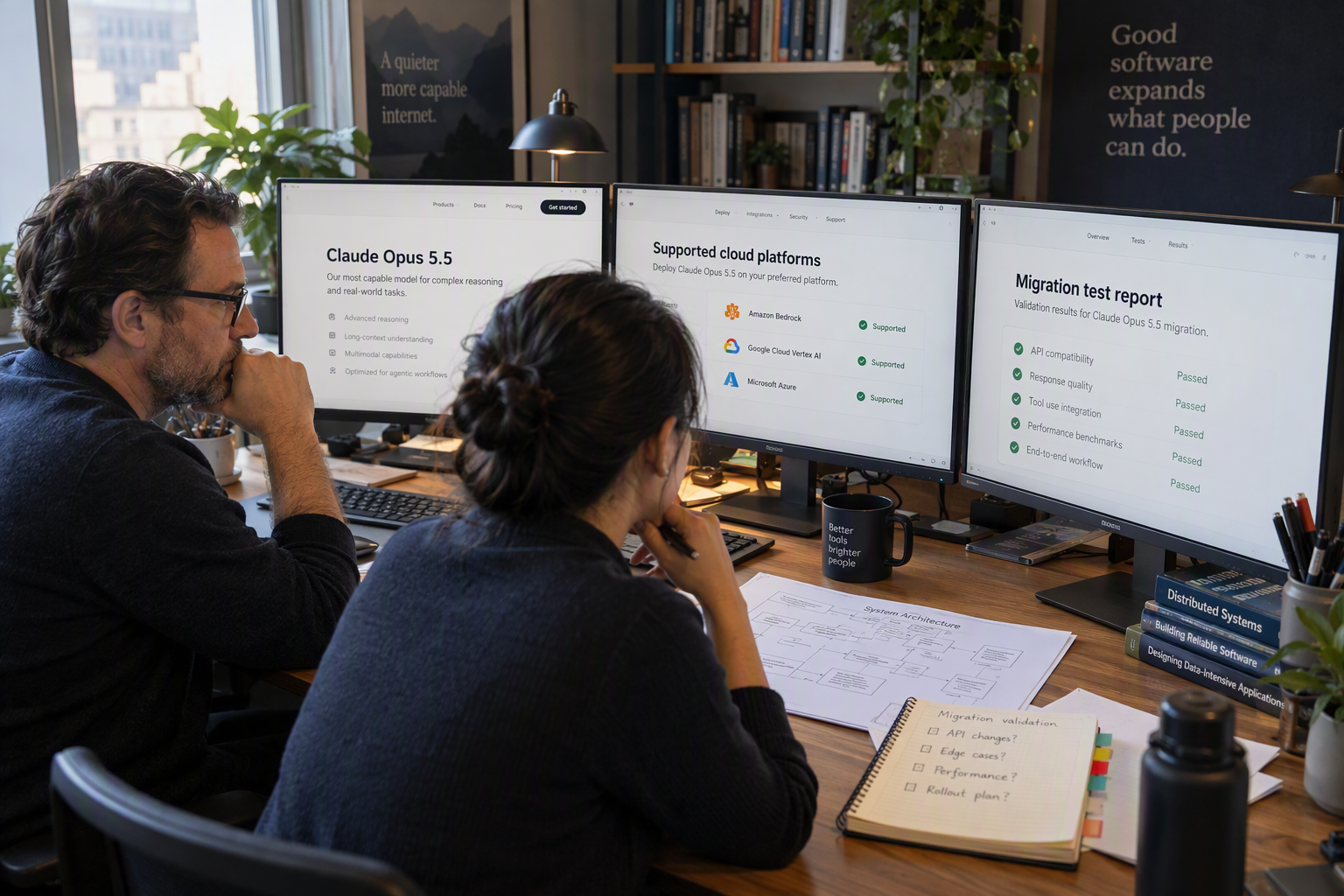
Developers should treat every Claude Opus 5.5 integration detail as provider-specific and version-sensitive. Before deployment, verify model identifiers, regional access, prices, token limits, tool behavior, quotas, and migration requirements against the official Anthropic or Amazon Bedrock documentation as of September 2026.
How do you verify the Claude Opus 5.5 model ID and availability?
Copy the exact model identifier from the provider’s current model catalogue or API documentation; do not construct it from a product name or reuse an identifier from another provider. Anthropic API and Amazon Bedrock identifiers may differ even when both expose Claude Opus 5.5.
Confirm all of the following:
- The identifier is available to your account.
- The model is enabled in the intended cloud region.
- The endpoint supports the required API operation.
- Preview, beta, or access-request conditions have been satisfied.
- Production and test environments resolve to the same intended model version.
Amazon Bedrock availability can vary by region and endpoint type, so successful access in one region does not establish global availability.
Which Claude Opus 5.5 prices should developers verify?
Calculate costs from the pricing page for the provider and mode actually used. According to Anthropic’s Claude Platform pricing documentation, a Claude Opus 5.5 prompt-cache hit costs $0.20 per million tokens and equals 5% of the standard input price as of September 2026.
Anthropic separately states that Claude Opus 5 Fast mode costs $10 per million input tokens and $50 per million output tokens as of September 2026. Do not automatically apply Fast mode pricing to standard Claude Opus 5.5 requests without confirming the supported model and access conditions.
For Amazon Bedrock, Anthropic’s Bedrock documentation says designated endpoints can carry a 10% pricing premium as of September 2026. Cost tests should therefore record:
- Input and output tokens
- Cache writes and cache hits
- Standard versus Fast mode
- Endpoint type and regional pricing
- Any Bedrock endpoint premium
What context and output limits must be checked?
Verify context window and maximum output separately. Anthropic’s Amazon Bedrock documentation lists a 1-million-token context window for Claude Opus 5.5 as of September 2026, while the same documentation references 200,000-token limits for earlier configurations.
A large context window does not guarantee that an equally large response can be generated. Your preflight validation should calculate the combined system prompt, conversation history, tool definitions, documents, and requested output budget against the provider’s documented limits.
How should tools and structured outputs be tested?
Do not assume identical behavior across models or providers. Test tool-choice controls, parallel tool calls, JSON Schema constraints, streaming events, refusal handling, and malformed tool arguments using the exact SDK and endpoint planned for production.
Structured output tests should include required fields, enums, nested objects, maximum lengths, and schema violations. Applications must still validate returned arguments server-side before executing tools.
What should a Claude Opus migration checklist include?
Anthropic publishes dedicated migration guides for moving from previous Claude versions. A production migration should include:
- Replace the model ID only after confirming provider availability.
- Re-run prompt, tool-use, structured-output, and safety tests.
- Compare token consumption, latency, and total cost on representative traffic.
- Verify context and output truncation behavior.
- Review provider-specific migration notes and deprecated parameters.
- Roll out gradually with monitoring and a tested rollback path.
Finally, use only rate limits explicitly shown in your provider documentation or account console. The supplied official context does not establish one universal Claude Opus 5.5 requests-per-minute limit, so a generic quota should not be presented as authoritative.
What should your migration, testing, and rollout plan include?
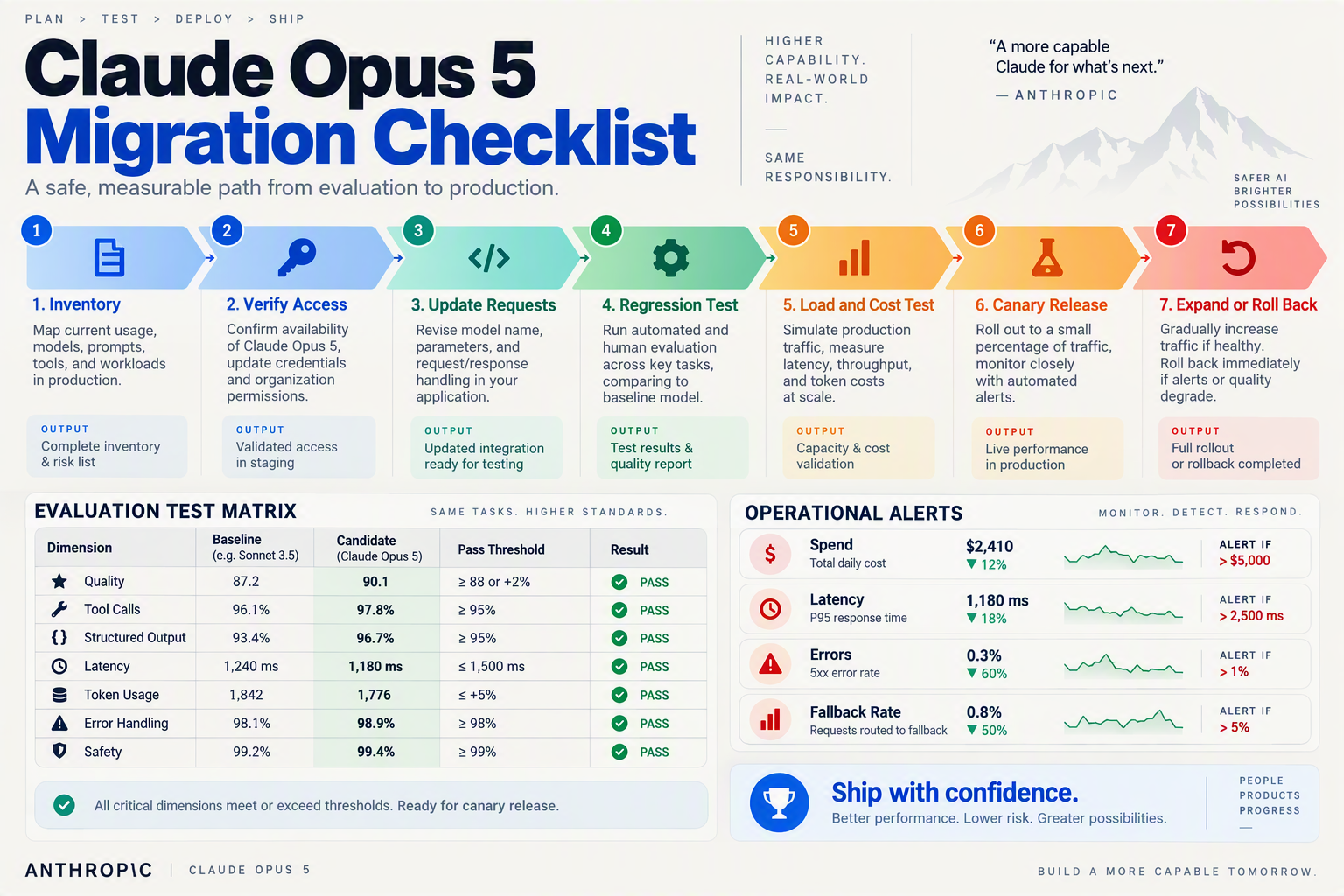
A safe Claude Opus 5.5 API migration should use configuration-based model selection, reproducible regression tests, a small canary, and explicit rollback criteria. Treat every provider’s documented quotas and pricing as deployment inputs—not assumptions—and verify them in the target account and region immediately before launch.
What should you test before migrating to Claude Opus 5.5?
| Phase | Engineering actions | Evidence and gates | Rollback trigger |
|---|---|---|---|
| Inventory and configuration | Find every hard-coded model reference; place the verified provider-specific model identifier behind an environment variable or feature flag. Pin SDK versions, record API parameters, and keep the previous model selectable without a code release. | Configuration review confirms that development, staging, and production resolve to intended models. Verify availability, permissions, disclosed quotas, regions, and pricing in official Anthropic or cloud-provider documentation as of September 2026. | Identifier, entitlement, region, quota, or billing configuration cannot be verified. |
| Golden-set regression | Replay representative prompts and adversarial cases with deterministic settings where supported. Test factual quality, instruction following, refusals, multilingual inputs, long conversations, and domain-specific edge cases. | Human-reviewed scorecards compare the candidate and current model against task-specific acceptance thresholds. Store prompts, outputs, parameters, provider, model identifier, and evaluation version. | Material quality regression, unacceptable safety behavior, or failure on a critical workflow. |
| Schemas and tool calls | Validate structured outputs against JSON Schema; test missing fields, invalid enums, escaping, truncation, parallel calls, malformed tool results, timeouts, and idempotency. Never execute generated arguments before validation and authorization. | Automated tests report schema-valid response rate, tool-selection accuracy, argument validity, and successful end-to-end completion. | Schema failures or unsafe/incorrect tool invocations exceed the team’s predefined error budget. |
| Tokens and cost | Measure input, output, cache-read, retry, and tool-loop usage on production-like traces. Recalculate per-request and per-workflow cost using the selected provider’s current price sheet. | Cost dashboards show p50, p95, and maximum tokens and cost by route, tenant, and feature. Anthropic’s pricing documentation lists a Claude Opus 5.5 cache hit at $0.20 per million input tokens, or 5% of standard input pricing, as of September 2026. | Spend per successful task, output growth, or retry amplification exceeds the approved budget. |
| Load and resilience | Test concurrency below disclosed quotas, then validate throttling behavior. Implement bounded retries with exponential backoff and jitter for retryable failures; cap attempts and avoid retrying invalid requests. | Observability covers latency percentiles, throughput, timeout rate, provider error codes, retry count, token consumption, and saturation. Confirm quotas directly in the provider console because account and regional limits may differ. | Persistent throttling, timeout growth, duplicate side effects, or exhausted retry budgets. |
| Canary and rollout | Route a small, representative traffic percentage through the new model using a feature flag. Expand in stages only after a defined observation window; exclude irreversible or high-risk actions initially. | Compare candidate and control cohorts for task success, schema validity, tool completion, latency, tokens, cost, safety escalations, and user feedback. | Any breached service-level objective, budget alert, security incident, or statistically meaningful quality decline. |
| Production operation | Add spend caps, budget alerts, audit logs, redaction, on-call ownership, and a tested rollback runbook. Preserve the old configuration until the new deployment has remained stable through peak traffic. | A rollback drill proves traffic can return to the prior model without losing request state or duplicating tool actions. | Incident commander invokes the runbook; model selection returns to the prior verified configuration. |
How should teams execute the final rollout?
Use shadow evaluation first when privacy and provider terms permit, then canary live traffic and increase exposure gradually. Do not infer exact rate limits, model identifiers, regional availability, or latency from another provider: verify each item in Anthropic, Amazon Bedrock, or the applicable officially supported platform documentation and console.
For multi-model deployments, CallMissed’s OpenAI-compatible developer AI API supports caller-chosen fallback models, request logs, usage logs, and response caching as of September 2026. Those controls can support configuration-led rollback and observability, but teams should still test provider-specific behavior and confirm current quotas before production.
Frequently Asked Questions
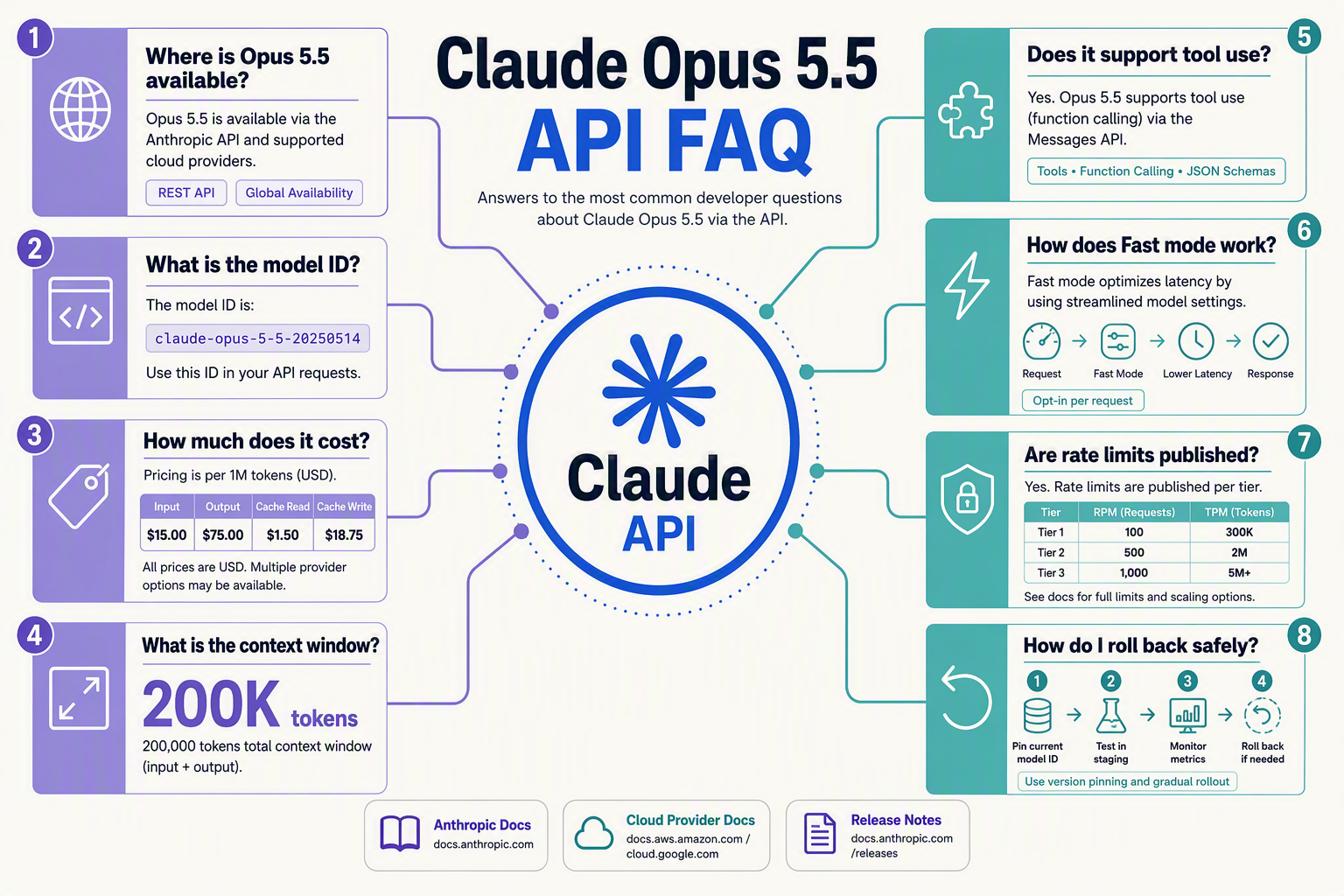
How can developers access the Claude Opus 5.5 API?
What is the correct Claude Opus 5.5 model ID?
How much does the Claude Opus 5.5 API cost, including prompt caching and Fast mode?
Does Claude Opus 5.5 support a one-million-token context window?
How do effort settings, Fast mode, and rate limits work for Claude Opus 5.5?
What should a Claude Opus 5 migration checklist include?
/v1/messages endpoint, which provides one balance for 136 models and supports caller-selected fallback models.Conclusion
A safe Claude Opus 5.5 API migration is a controlled deployment change—not a simple model-name swap. Provider contracts, availability, token accounting, and runtime behavior should all be validated before production traffic moves.
- Verify provider details: Confirm the current model identifier, account access, regional availability, endpoint contract, quotas, and permissions separately for the Anthropic API and Amazon Bedrock.
- Model costs by category: Calculate uncached input, cache writes, cache hits, and output tokens independently. Anthropic Platform documentation lists Claude Opus 5.5 cache hits at $0.20 per million tokens as of September 2026, or 5% of the standard input price.
- Retest application behavior: Validate tool use, structured-output schemas, streaming events, multimodal inputs, refusal handling, output limits, and timeout recovery against realistic workloads.
- Roll out defensively: Use canary traffic, request and usage logs, quality evaluations, cost alerts, and a configuration-based rollback path to the previous verified model.
Amazon Bedrock documentation lists a 1-million-token context window for Claude Opus 5.5 as of September 2026, but teams should still control prompt growth and output budgets. Watch official documentation for model-ID changes, regional expansion, pricing revisions, and updated feature support.
Developers evaluating broader AI infrastructure can also explore CallMissed, whose OpenAI- and Anthropic-compatible API provides one balance across 136 models. Is your migration plan designed to reverse safely when production evidence differs from staging results?
Related Reading
- Claude Fable 5.1 vs GPT-6 Astra Pricing: Real API Costs in 2026
- Claude Fable 5.1 vs GPT-6 Astra: 2026 API Migration and Routing Guide
- Claude Opus 5.5 vs GPT-6 Astra: 2026 Comparison
Sources
Discussion
Related Posts


Ready to automate customer conversations?
Launch AI voice agents and WhatsApp bots with CallMissed — one API, 22+ Indian languages.