Claude Fable 5.1 vs GPT-6 Astra: 2026 API Migration and Routing Guide



Compare Claude Fable 5.1 vs GPT-6 Astra API migration paths, task routing, portable prompts, fallbacks, cost controls, and rollback.
Claude Fable 5.1 vs GPT-6 Astra: 2026 API Migration and Routing Guide
What if the biggest risk in your next model migration is not weaker intelligence, but an unverified model ID silently breaking production? Claude Fable 5.1 vs GPT-6 Astra is therefore more than a benchmark comparison: it is a 2026 engineering decision about API access, prompt behavior, tool execution, reliability, governance, and the ability to change course safely.
The timing matters. OpenAI introduced GPT-6 Astra on September 3, 2026, according to OpenAI’s release notes, highlighting improvements in coding, research, computer use, and complex multi-step work. OpenAI’s developer documentation said on September 3, 2026, that GPT-6 Astra was rolling out to enterprises through its Trusted Access Program, meaning availability cannot be assumed for every API account. OpenAI also classifies GPT-6 Astra at the “Critical” cybersecurity-capability level under its Preparedness Framework—an important signal for security reviews, tool permissions, and human-approval controls.
Claude Fable 5.1 requires an even stricter verification posture. Based on the official material supplied for this guide, its model identifier, API availability, pricing, and supported features have not been independently confirmed. Production teams should never derive an API identifier from a product name, third-party post, leaked screenshot, or SDK autocomplete result. This guide will label unverified details explicitly rather than turn speculation into deployment instructions.
What this migration guide will help you do
You will learn how to:
- Validate official model IDs, account access, API versions, and snapshots before rollout.
- Port prompts without assuming identical system-message precedence, reasoning controls, or token behavior.
- Normalize structured outputs, streaming events, tool calls, computer-use actions, and error responses behind an internal adapter.
- Design caching, retry, timeout, and idempotency policies that avoid duplicate side effects.
- Route workloads by measurable task requirements—such as coding, extraction, browsing, or agentic execution—rather than by vendor reputation.
- Establish observability, evaluation gates, fallback routes, data-governance controls, spending limits, and a tested rollback path.
Platforms such as CallMissed’s OpenAI-compatible AI gateway reflect this move toward multi-model infrastructure by giving developers one integration surface with automatic same-tier fallbacks across a broad model catalog.
The goal is not to declare one universal winner. It is to build a routing layer that can select the appropriate verified model for each workload—and survive access changes, regressions, cost spikes, or provider outages without forcing another application-wide rewrite.
Which API should you choose? Route by task rather than naming one universal winner
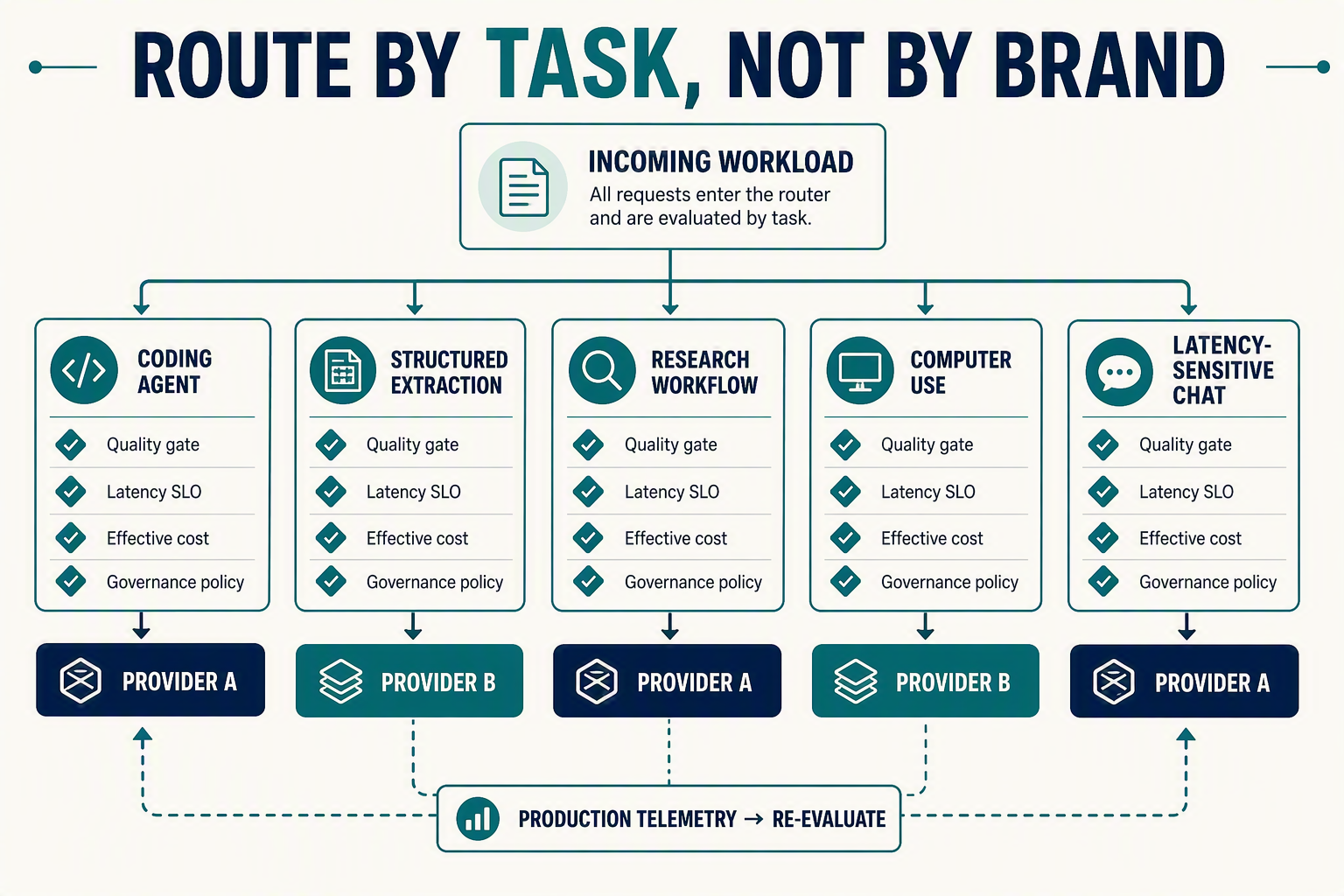
Choose GPT-6 Astra only for workloads that justify its verified strengths in coding, research, computer use, and complex multi-step execution—and only after confirming account access. Treat Claude Fable 5.1 as unavailable for production routing until Anthropic officially verifies its API model ID, access terms, pricing, and capabilities; there is not enough confirmed evidence to declare either model a universal winner.
Start with an eligibility gate
Routing begins with availability, not quality. OpenAI’s developer documentation stated on September 3, 2026, that GPT-6 Astra was rolling out to enterprises through the Trusted Access Program. An appearance in public documentation does not prove that a particular project, region, or API key can invoke it.
Before benchmarking either candidate, require:
- An exact model ID copied from official provider documentation or a provider model-list endpoint.
- A successful authenticated request from the intended production account and region.
- Confirmation of supported API surface, tools, quotas, pricing, and data-processing terms.
- A pinned snapshot where available, rather than an alias whose behavior may change.
OpenAI’s GPT-6 Astra model documentation says snapshots can lock a specific model version so performance and behavior remain consistent. By contrast, the supplied official evidence does not verify Claude Fable 5.1’s identifier or API availability. Do not guess an Anthropic model string or silently substitute another Claude release.
Match verified capabilities to task requirements
OpenAI’s September 3, 2026 release notes identify coding, research, computer use, and complex multi-step work as GPT-6 Astra improvement areas. Those claims make Astra a sensible evaluation candidate—not an automatic production choice—for agentic workflows that combine planning, browsing, tools, and artifact creation.
Use task-specific routes such as:
- Coding route: repository navigation, patch generation, test repair, and code review.
- Research route: source discovery, evidence synthesis, citation validation, and contradiction detection.
- Computer-use route: browser or desktop actions in a sandbox with restricted credentials.
- Structured-data route: extraction and classification, where schema validity, latency, and cost may matter more than maximum reasoning capability.
- High-volume route: simpler support, summarization, or rewriting tasks that should remain eligible for a cheaper verified model.
OpenAI’s model guidance also documents asynchronous tool calling for GPT-6 Astra, allowing the model to continue reasoning or handle independent work while the application executes a tool. Route to this feature only when your orchestration layer can preserve the original call_id, reconcile late results, and prevent duplicate side effects.
Score routes instead of choosing a brand
Build a weighted scorecard for each workload:
route_score =
  quality_pass_rate
  - normalized_cost
  - latency_penalty
  - tool_failure_penalty
  - governance_risk
Evaluate each model on production-like traces and apply non-negotiable gates before weighted scoring:
- Schema adherence: valid output and correct field semantics.
- Tool reliability: valid arguments, successful execution, and no repeated writes.
- Groundedness: supported claims and accurate citations.
- Operational performance: p50/p95 latency, timeout rate, and retry amplification.
- Safety and governance: policy compliance, data residency, retention, and approval controls.
Security requirements should be especially strict for Astra-powered agents. OpenAI’s 2026 safety overview identifies GPT-6 Astra as its first broadly deployed model to reach the “Critical” cybersecurity-capability level under the Preparedness Framework. Apply least-privilege tools, sandboxing, allowlists, immutable audit logs, and human approval for destructive actions.
Make “no route” a valid outcome
If Claude Fable 5.1 remains unverified or GPT-6 Astra access is absent, route to a tested, approved alternative—or reject the task safely. A robust router optimizes among eligible models; it never converts uncertain documentation into a production dependency.
What is officially known about Claude Fable 5.1 and GPT-6 Astra model IDs, API access, and release context?
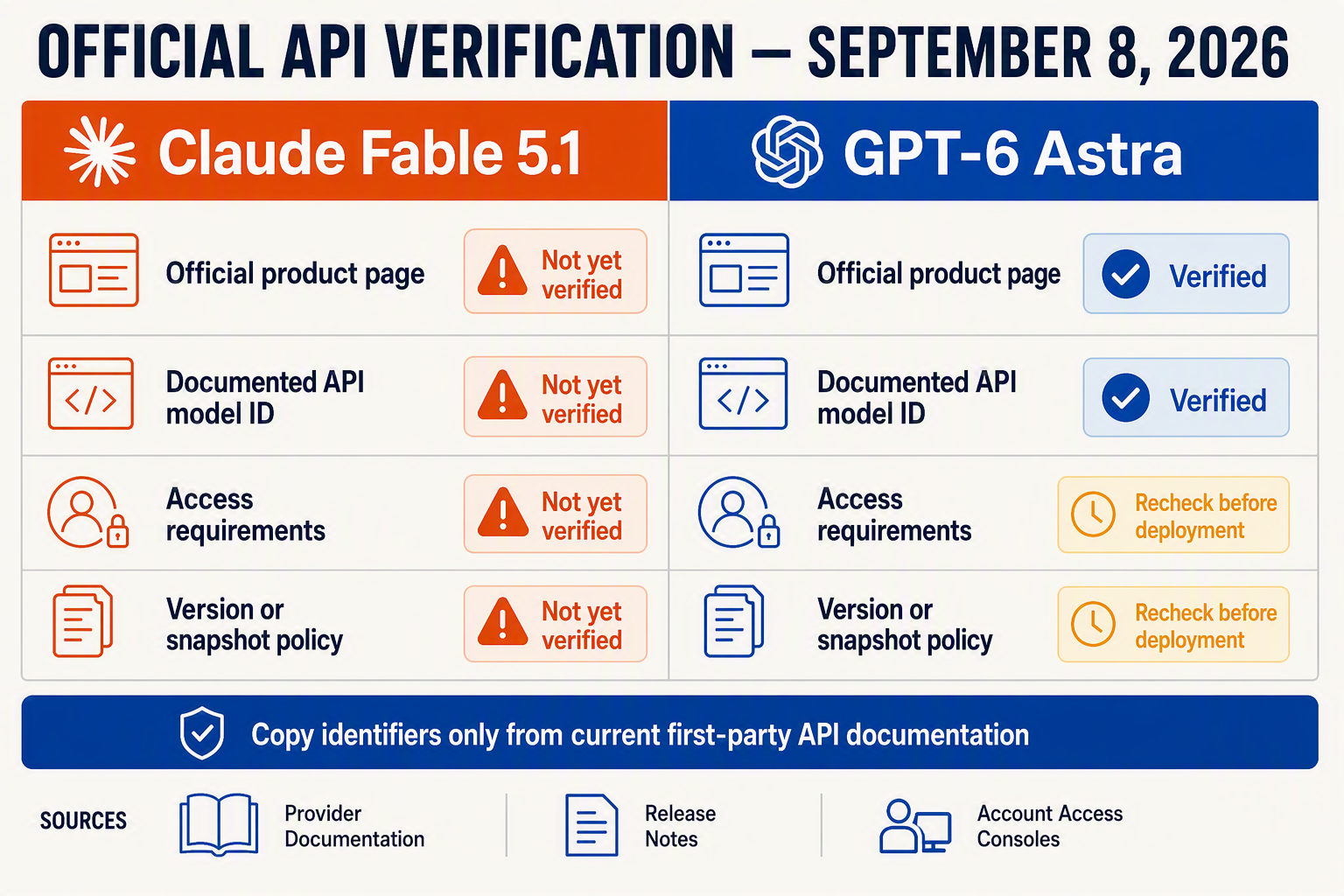
As of September 8, 2026, both models have first-party release confirmation. Anthropic announced Claude Fable 5.1 on September 1, 2026 and described availability for users and developers. OpenAI announced GPT-6 Astra on September 3, 2026, with API access rolling out through its Trusted Access Program. However, release confirmation alone does not establish an account’s entitlement, the exact callable model ID, a production snapshot, or current API rates.
Verified release and access status
| Item | Claude Fable 5.1 | GPT-6 Astra | Engineering implication |
|---|---|---|---|
| Official release evidence | Anthropic announcement dated September 1, 2026 | OpenAI announcement dated September 3, 2026 | Both names are first-party-confirmed products |
| Developer availability | Anthropic says Fable 5.1 is available to developers | OpenAI says Astra access is rolling out through Trusted Access | Verify availability using the production organization and API key |
| Exact API model ID | Not reproduced here because the release-page evidence does not establish the accepted callable string | Not reproduced here because the supplied first-party excerpts do not expose the accepted callable string | Obtain IDs from authenticated documentation or model-list responses; never infer them from product names |
| API access context | Officially described as available for users and developers; account, region, and surface still require confirmation | Progressively granted to eligible organizations through Trusted Access | A public announcement does not prove project-level entitlement |
| Primary API surface | Confirm the supported Anthropic API endpoint and version in current developer documentation | OpenAI Responses API and supported client SDKs | Validate the actual endpoint, API version, and SDK behavior |
| Version pinning | Use an official snapshot only if Anthropic documents and accepts it for the account | OpenAI documentation describes snapshots for stable behavior | Prefer a tested snapshot over a moving alias in production |
| Pricing and rate limits | Use current first-party pricing and account limit pages | Use current first-party pricing and account limit pages | Do not copy rates from search snippets, aggregators, or unofficial migration guides |
For teams comparing the Claude Fable 5.1 vs GPT-6 Astra API, the corrected release context is important: Claude Fable 5.1 is not an unverified rumor or merely a third-party label. Anthropic’s September 1 announcement is first-party confirmation and explicitly discusses availability for users and developers.
OpenAI’s September 3 release materials describe GPT-6 Astra as improving coding, research, computer use, and complex multi-step work. OpenAI’s developer documentation identifies the Responses API and client SDKs as supported access paths, while stating that Astra is rolling out to enterprises through the Trusted Access Program. Access can therefore differ by organization, project, region, and API key.
OpenAI’s first-party safety material also identifies GPT-6 Astra as its first broadly deployed model to reach the Critical cybersecurity-capability level under the OpenAI Preparedness Framework. That classification warrants additional security, authorization, logging, and human-approval controls; it is not simply a model-quality rating.
Confirmed facts versus third-party claims
The following are confirmed by first-party release materials:
- Anthropic announced Claude Fable 5.1 on September 1, 2026.
- Anthropic describes Fable 5.1 as available for users and developers.
- OpenAI announced GPT-6 Astra on September 3, 2026.
- OpenAI describes Astra access as a progressive rollout through Trusted Access.
- OpenAI documents the Responses API, client SDK access, and snapshot-based version pinning for supported models.
Treat the following as unconfirmed unless they appear in current provider documentation or are returned successfully for your account:
- Model IDs copied from third-party articles, package registries, social posts, or search-result snippets.
- Inferred slugs such as a lowercased or hyphenated product name.
- Undocumented snapshot identifiers.
- Pricing, token limits, rate limits, regional availability, or feature matrices attributed only to third parties.
- Claims that public availability automatically includes every API organization or project.
This separation is essential in any Claude Fable 5.1 vs GPT-6 Astra API migration plan: first-party announcements verify that the products exist, while authenticated API evidence verifies whether they are deployable in a particular environment.
A model name is not necessarily a callable model ID
Treat these as separate configuration values:
- Product name: the human-readable name used in announcements and documentation.
- API model ID or alias: the exact string accepted by the provider endpoint.
- Snapshot ID: a pinned release intended to keep behavior stable.
- Account entitlement: permission for a particular organization or project to invoke the model.
- API version and endpoint: the protocol surface through which the model is available.
- Region and data policy: deployment constraints that may affect availability or routing.
- Pricing and rate limits: account-specific operational limits that can change independently of the model name.
Do not derive an API identifier from Claude Fable 5.1 or GPT-6 Astra, and do not reproduce an apparent identifier unless it is present in first-party documentation or accepted by the provider for the intended account. A documentation-page URL, SDK constant, unofficial package, or naming pattern from an older model is not sufficient evidence.
Pre-deployment verification procedure
Before enabling either side of a Claude Fable 5.1 vs GPT-6 Astra API route:
- Consult the provider’s current authenticated documentation for the production organization and project.
- Query the supported model-list or capability endpoint, where the provider offers one.
- Confirm entitlement with a minimal, non-destructive request using the exact production credentials and endpoint.
- Record the accepted model ID, snapshot, endpoint, API version, region, access date, pricing source, and rate-limit source.
- Run capability probes for structured output, streaming, tool use, image input, computer use, and any required safety controls.
- Classify failures separately as unknown model, permission denied, regional restriction, unsupported endpoint, rate limit, or temporary unavailability.
- Keep the route disabled until automated contract, security, latency, and fallback tests pass.
Version-control this verification record alongside routing policy. It provides an auditable basis for enabling, pinning, or rolling back either provider without confusing an official product announcement with a callable, entitled, and production-tested API target.
Which 2026 API developments materially affect migration decisions?
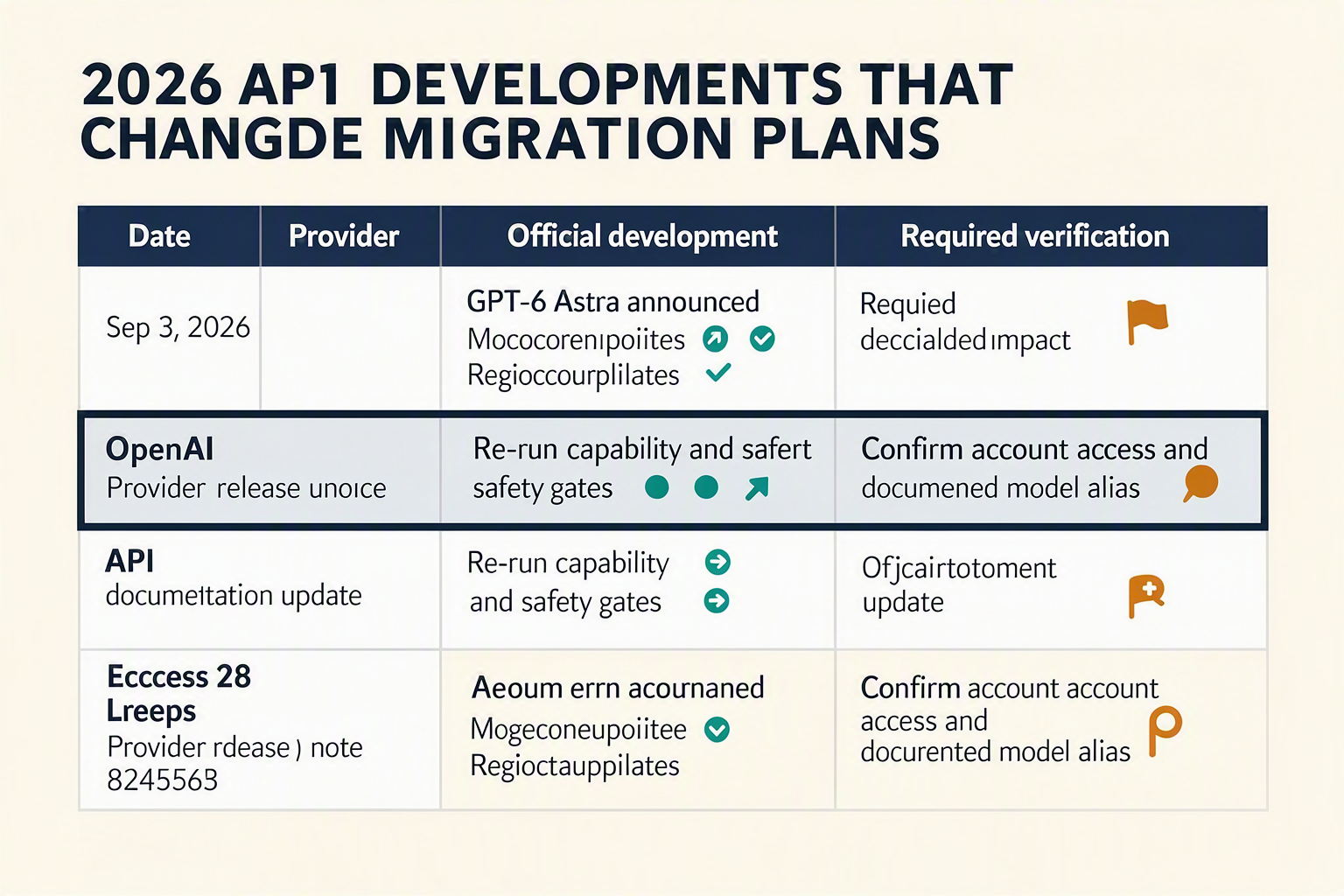
The material 2026 changes are restricted model access, version-pinning support, stateful reasoning semantics, asynchronous tool calls, and stronger security obligations. These developments affect architecture more than headline benchmark claims because they determine whether a migration can be deployed, reproduced, monitored, and rolled back safely.
Developments that change the migration plan
| 2026 API development | Verified status | Migration impact | Required engineering action |
|---|---|---|---|
| GPT-6 Astra access controls | OpenAI’s developer documentation said on September 3, 2026, that GPT-6 Astra was rolling out to enterprises through the Trusted Access Program. | A valid OpenAI account or SDK does not guarantee production access. Staging and production projects may also have different entitlements. | Run an authenticated model-list or minimal-response probe in every target project and region before enabling the route. |
| Responses API availability | OpenAI’s model documentation identifies the Responses API and OpenAI Client SDKs as supported access paths for current models. | A direct Chat Completions-style substitution may lose model-specific state, tool, or event semantics. | Place request construction, streaming events, tool calls, and errors behind an internal provider adapter. |
| Snapshots and aliases | OpenAI’s GPT-6 Astra API documentation says snapshots can lock a specific model version so behavior remains consistent. | A moving alias can change output behavior without an application deployment; a snapshot improves reproducibility but delays automatic upgrades. | Pin evaluated production snapshots, record the resolved version, and test newer versions before promotion. |
| Stateful reasoning history | OpenAI’s reasoning guide recommends previous_response_id; when replaying history manually, it says each original phase must be preserved. | Dropped phase metadata can cause preambles to be interpreted as final answers, making naïve transcript conversion unsafe. | Store provider-native response identifiers and metadata rather than retaining only user-visible text. |
| Asynchronous tool calling | OpenAI’s model guidance says GPT-6 Astra can continue reasoning or handle independent work while an application executes a tool with async: true. | Existing synchronous orchestration may block unnecessarily, mishandle late results, or duplicate side effects after retries. | Correlate results with the original call_id, use idempotency keys, and define tool-result expiry and cancellation rules. |
| Cybersecurity classification | OpenAI’s 2026 safety overview classifies GPT-6 Astra at the “Critical” cybersecurity-capability level under its Preparedness Framework. | Broad shell, browser, repository, or credential access creates a higher governance burden. | Apply least privilege, sandbox computer use, redact secrets, and require human approval for irreversible actions. |
What remains unverified for Claude Fable 5.1
The supplied official evidence does not establish a Claude Fable 5.1 API identifier, endpoint availability, pricing, snapshots, structured-output behavior, tool protocol, caching support, or streaming schema. Treat each item as an unresolved deployment dependency—not as feature absence.
Before writing production configuration, require official Anthropic documentation or authenticated account metadata confirming:
- The exact model ID, supported API version, regions, and account eligibility.
- Context, output, rate, and tool-call limits.
- Structured-output guarantees and schema restrictions.
- Streaming event types, cache controls, retention terms, and pricing.
- Snapshot, deprecation, and rollback policies.
Practical migration consequence
Do not build a shared interface that merely renames fields. Define a capability contract covering prompt roles, state continuation, JSON validation, tool-call lifecycle, streaming, retryability, usage reporting, and safety controls. Unsupported or unverified capabilities should fail closed.
OpenAI’s release notes stated on September 3, 2026, that GPT-6 Astra improves coding, research, computer use, and complex multi-step work. That makes GPT-6 Astra a candidate for evaluation—not an automatic default route. Production activation should still require verified access, pinned behavior, workload-specific evaluation gates, cost ceilings, and a tested fallback.
How should a portable multi-model architecture handle prompts, structured outputs, tools, streaming, and caching?
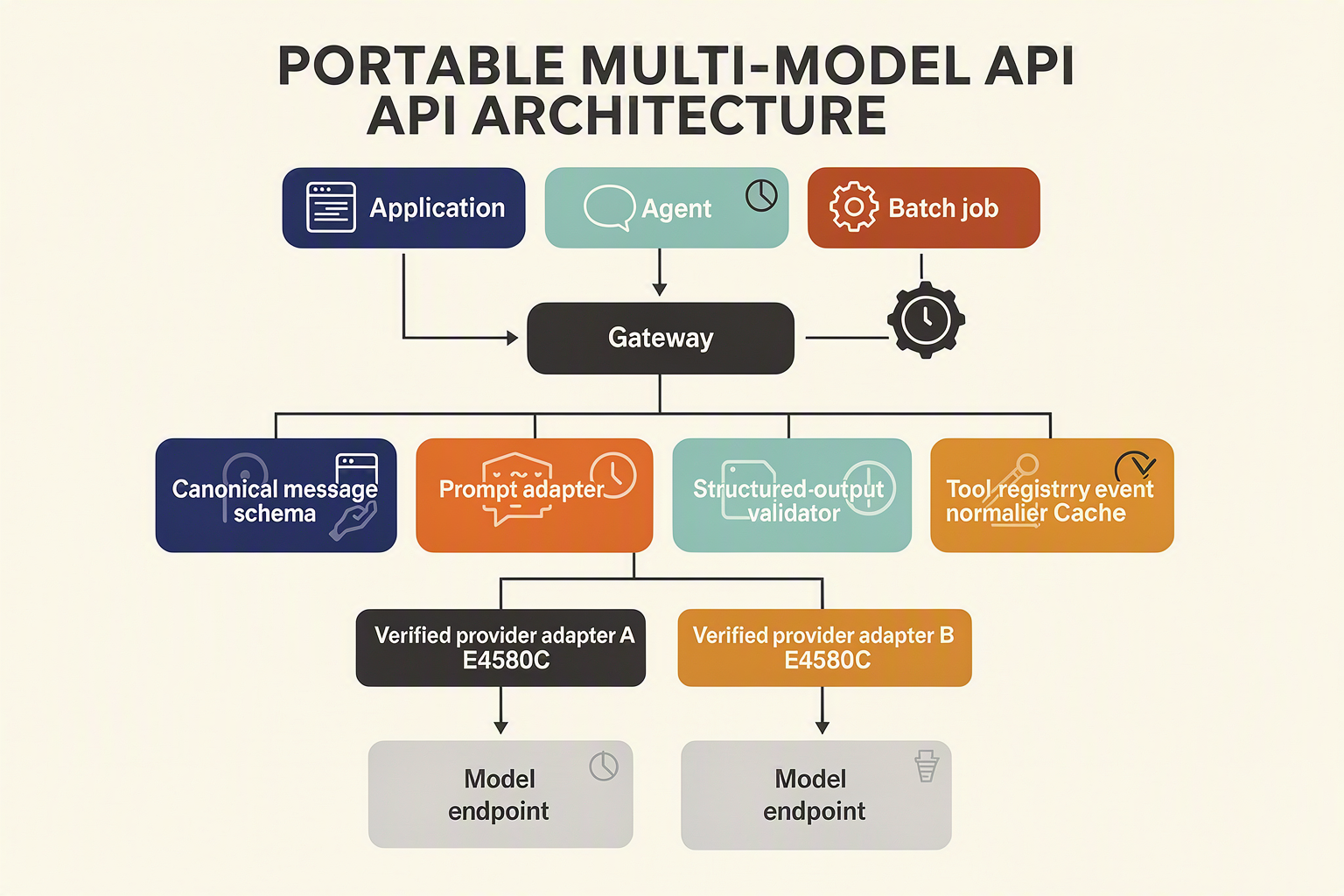
A portable multi-model architecture should expose one stable application contract while isolating provider-specific behavior in adapters. Prompts, schemas, tool calls, streams, and caches must be normalized—but never reduced to a false assumption that Claude Fable 5.1 and GPT-6 Astra behave identically.
Recommended portability contract
| Concern | Internal abstraction | GPT-6 Astra handling | Claude Fable 5.1 handling |
|---|---|---|---|
| Prompts | Typed blocks: policy, task, context, examples | Map blocks to the officially supported Responses API roles and controls | Map only after official message precedence and API behavior are verified |
| Structured output | JSON Schema plus local validator | Use verified native schema controls where available; validate again locally | Treat native schema support as unverified; support validated text-to-JSON fallback |
| Tool calls | Provider-neutral tool name, schema, permissions, and call ID | Translate Responses API tool events; support asynchronous execution where appropriate | Implement only against confirmed tool-call fields and event semantics |
| Streaming | Canonical events: start, text_delta, tool_call, usage, done, error | Convert provider stream events into the canonical sequence | Build mapping from official documentation; reject unknown events safely |
| State and caching | Explicit conversation state and deterministic cache keys | Preserve state through documented mechanisms such as previous_response_id | Do not assume server-side state or prompt caching until officially confirmed |
| Failures and retries | Normalized error class, retryability, and idempotency key | Map rate limits, timeouts, tool failures, and safety stops separately | Add mappings only from verified API responses—not inferred compatibility |
Keep prompts semantic, not provider-shaped
Store the intent of each prompt component, rather than raw vendor message arrays. A prompt package might contain a policy, user task, retrieved evidence, examples, output schema, and tool policy; each adapter then renders that package according to the target API.
Stateful reasoning needs special care. OpenAI’s 2026 reasoning-model guidance says previous_response_id is usually the simplest way to preserve prior assistant state. OpenAI also warns that manually replayed history must preserve each original phase value, because dropping it can cause preambles to be interpreted as final answers. That metadata belongs in the Astra adapter, not in application-level business logic.
Validate outputs outside the model
Even when a provider offers native structured-output controls, enforce the contract locally:
- Parse the completed response.
- Validate it against the application’s JSON Schema.
- Reject unexpected properties where the workflow requires strictness.
- Run one bounded repair attempt for syntax-only failures.
- Escalate semantic failures to a fallback model or human review.
Do not expose partial streamed JSON to downstream systems. Buffer it until parsing and schema validation succeed.
Treat tools as privileged side effects
Define tools in an internal registry containing input schema, authorization scope, timeout, idempotency policy, and approval requirement. OpenAI’s model guidance documents that GPT-6 Astra can continue reasoning while an asynchronous tool runs when async: true is enabled, with results returned using the original call_id. Your adapter must correlate that identifier without allowing the model to invent execution success.
For payments, messages, database writes, or computer-use actions, retries must reuse an idempotency key. A transport timeout must never automatically trigger a second irreversible action.
Make caching explicit and safe
Construct cache keys from the provider, verified model snapshot, prompt-template version, normalized inputs, tool-schema hash, output-schema hash, and generation settings. Separate deterministic response caching from provider-managed prompt caching, apply short retention to sensitive data, and never cache authorization decisions or side-effecting tool results. This design prevents a fallback route from accidentally serving output produced under different model behavior or governance rules.
How do you implement task routing, retries, fallbacks, and rollback without undocumented endpoints?
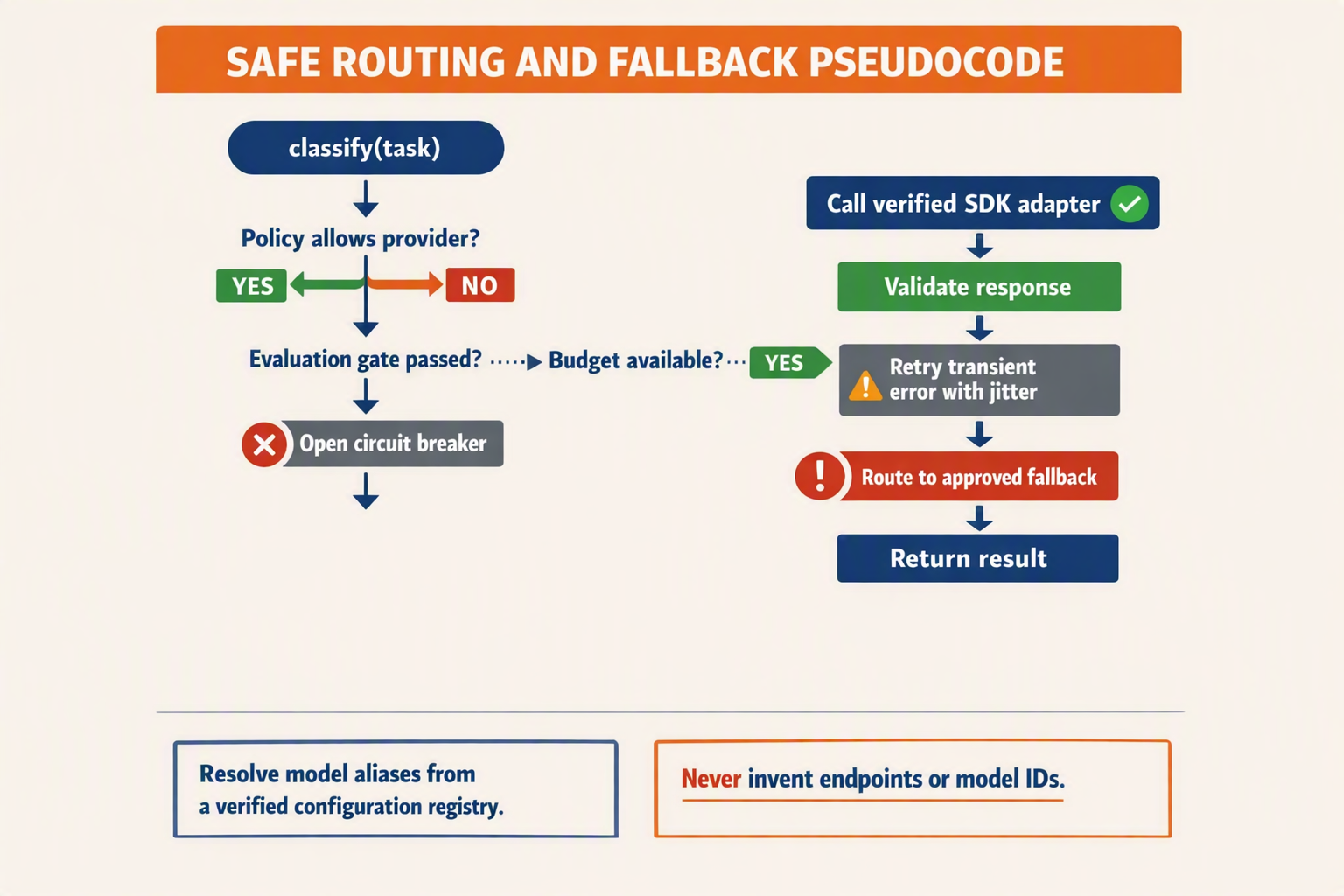
Implement reliability controls in your own provider-agnostic orchestration layer, using only officially documented SDK methods, model aliases, snapshots, tools, and error fields. Never construct a hidden endpoint or guess a Claude Fable 5.1 model ID; treat unverified access as unavailable.
Route through a verified capability registry
Build a registry from documentation and live account discovery, then route by task policy—not product-name strings embedded in application code.
routes:
  coding:
    primary: openai_astra_verified
    fallback: approved_coding_pool
  extraction:
    primary: low_cost_schema_model
    fallback: deterministic_parser
  computer_use:
    primary: openai_astra_verified
    fallback: human_queue
OpenAI said on September 3, 2026, that GPT-6 Astra improves coding, research, computer use, and complex multi-step work. However, OpenAI’s developer documentation said on September 3, 2026, that GPT-6 Astra was rolling out to enterprises through the Trusted Access Program, so your startup probe must confirm account-level access before enabling its route.
For Claude Fable 5.1, keep enabled: false until Anthropic documentation and your account both confirm the exact model identifier, API surface, region, and required features.
Separate retries from fallbacks
A retry repeats a request against the same deployment after a transient failure. A fallback changes the model, provider, workflow, or human handling path.
Retry only failures classified as transient, such as rate limits, timeouts, connection resets, and documented 5xx responses:
- Use exponential backoff with full jitter.
- Respect provider-supplied retry timing where documented.
- Set a small attempt budget and an end-to-end deadline.
- Open a circuit breaker after sustained failures.
- Never retry invalid authentication, unsupported tools, malformed schemas, or policy refusals as though they were outages.
For read-only generation, attach an internal idempotency key and deduplicate completed responses. For tool-enabled requests, persist request_id, tool-call ID, arguments, execution status, and result before continuing. A model retry must not resend an email, issue a refund, or modify a database twice.
Make fallback behavior explicit
Fallbacks should preserve the task contract, not assume identical provider semantics. Before moving traffic, verify that the candidate supports the required input modality, context size, structured-output constraints, streaming behavior, tool type, data region, and safety policy.
route(task):
  candidates = registry.match(task.requirements)
  for candidate in candidates:
    if healthy(candidate) and budget_allows(candidate):
      result = invoke_with_retry(candidate, task)
      if validates(result): return result
  return human_or_deterministic_fallback(task)
Do not silently downgrade high-risk agentic work. OpenAI’s 2026 safety overview classifies GPT-6 Astra at the “Critical” cybersecurity-capability level under its Preparedness Framework. For computer use, privileged code execution, financial actions, or security workflows, a safe fallback may be human review, not another autonomous model.
Pin versions and design rollback as a release operation
OpenAI’s GPT-6 Astra API documentation states that snapshots lock a specific model version so performance and behavior remain consistent. Use an officially listed snapshot only after confirming it in OpenAI documentation and your account; otherwise retain the verified alias behind configuration rather than hard-coding an inferred identifier.
A rollback-ready deployment should include:
- Versioned route manifests stored with application releases.
- Prompt, schema, tool, and policy versions recorded on every trace.
- Shadow traffic and canary percentages before full promotion.
- Automatic rollback when quality, latency, error-rate, safety, or cost thresholds breach evaluation gates.
- A one-click switch to the previous model snapshot or known-good route.
- Replayable, redacted test cases for post-incident comparison.
Platforms such as CallMissed’s OpenAI-compatible gateway can centralize multi-model access and same-tier fallbacks, but application owners should still enforce task contracts, idempotency, evaluation gates, and rollback policy. Infrastructure can switch providers; only your application can determine whether the substituted result is safe and correct.
How should teams compare coding quality, adaptive reasoning, latency, reliability, and effective cost?
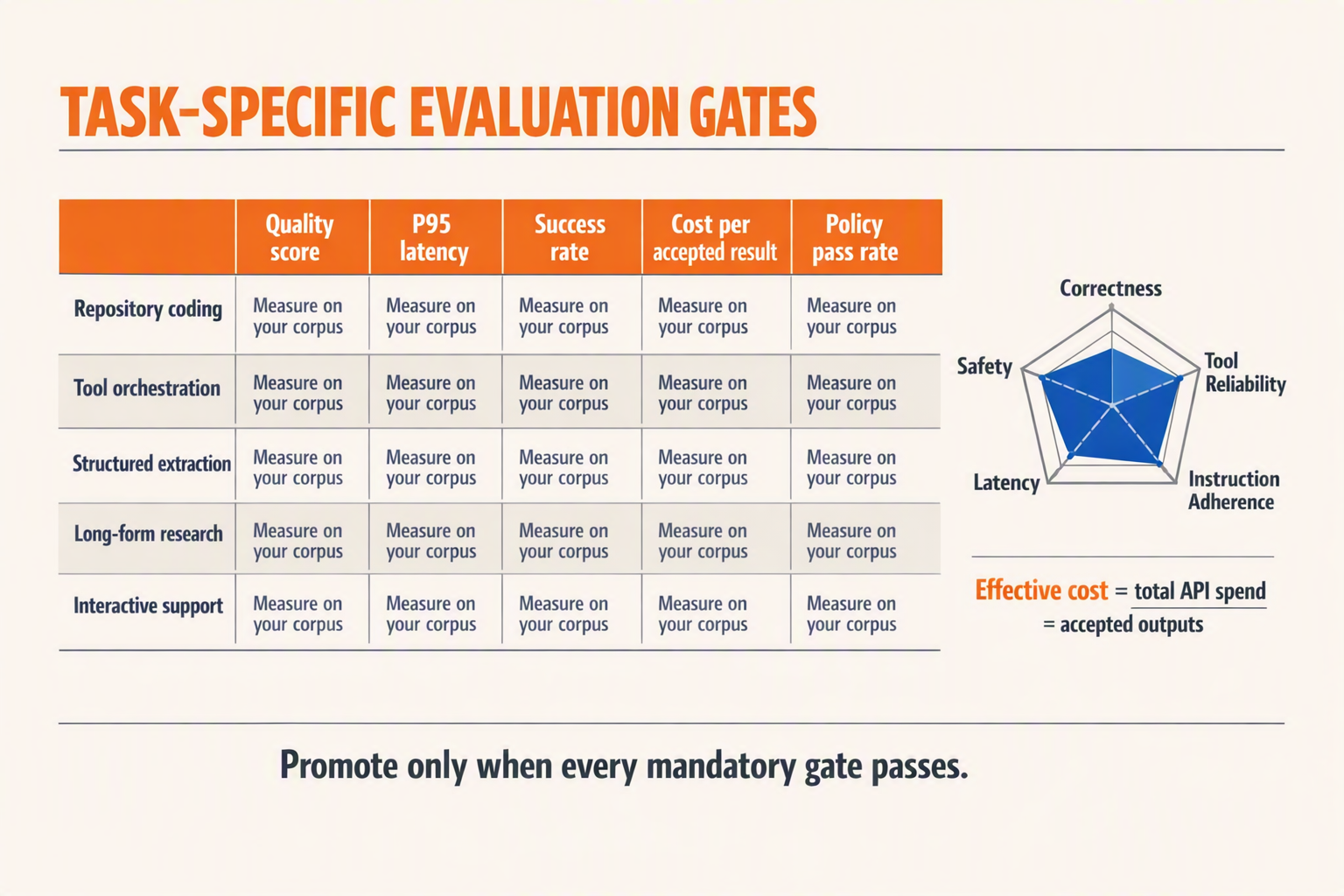
Teams should compare Claude Fable 5.1 and GPT-6 Astra with a workload-specific evaluation harness, not a single leaderboard score. Measure task success, reasoning recovery, end-to-end latency, reliability, and total cost on identical production-like inputs; treat Claude Fable 5.1 as an unverified candidate until official API access and documentation are available.
Evaluate coding quality with executable outcomes
Coding quality should be measured by whether generated changes work, not whether code looks plausible. OpenAI stated on September 3, 2026, that GPT-6 Astra improves coding and complex multi-step work, but that directional claim does not replace repository-specific testing.
Build a version-controlled test set covering:
- Bug fixes, feature implementation, refactoring, and dependency upgrades.
- Single-file tasks and cross-repository changes.
- Unit tests, integration tests, static analysis, and security scanning.
- Tool-use failures, incomplete documentation, and conflicting requirements.
Track first-pass test success, regression count, human-review minutes, unnecessary code churn, and successful completion within a fixed token and tool-call budget. For Claude Fable 5.1, do not publish comparative scores until the tested endpoint, snapshot, parameters, and access path can be independently reproduced.
Test adaptive reasoning through controlled changes
Adaptive reasoning is the ability to revise a plan when requirements, evidence, or tool results change. OpenAI’s September 3, 2026 release notes say GPT-6 Astra can adapt when users add requirements, while OpenAI’s model guidance documents asynchronous tool calling that allows Astra to continue reasoning or handle independent work while an application executes a tool.
Use multi-stage scenarios rather than static questions:
- Provide an initial task and record the model’s plan.
- Introduce a changed requirement or failed tool result.
- Measure whether the model revises affected steps without discarding valid work.
- Inject contradictory evidence and check whether the final answer cites the newer result.
- Require human approval before irreversible actions.
Score recovery rate, repeated-error rate, unnecessary tool calls, and constraint retention. Run each scenario multiple times because one successful trace does not establish dependable behavior.
Measure latency and reliability by percentile
Report p50, p95, and p99 end-to-end latency, not an average alone. Separate time to first streaming event, time to first usable token, model generation time, tool latency, and total workflow duration.
Reliability should include:
- Successful-response rate by model, region, and API version.
- Schema-valid structured outputs.
- Tool-call argument validity and completion rate.
- Rate limits, timeouts, provider errors, and retry recovery.
- Output consistency when using a pinned snapshot.
OpenAI’s API documentation says GPT-6 Astra snapshots can lock a specific model version so that performance and behavior remain consistent. Compare an alias and pinned snapshot separately because silent alias updates can change quality or latency.
Calculate effective cost, not token price alone
Use this workload-level formula:
Effective cost per successful task = (model charges + tool charges + retries + infrastructure + human-review cost) ÷ successful tasks.
A cheaper request can be more expensive if it produces more retries, longer outputs, failed tool calls, or additional review. Set maximum token, latency, retry, and tool-call budgets for every route.
A practical release gate should require no critical regressions, statistically meaningful quality gains, acceptable p95 latency, and effective cost within budget. Until equivalent verified data exists for both APIs, keep the incumbent route active and classify the unverified candidate as evaluation-only rather than forcing a premature winner.
What are the security, computer-use, observability, and data-governance implications?
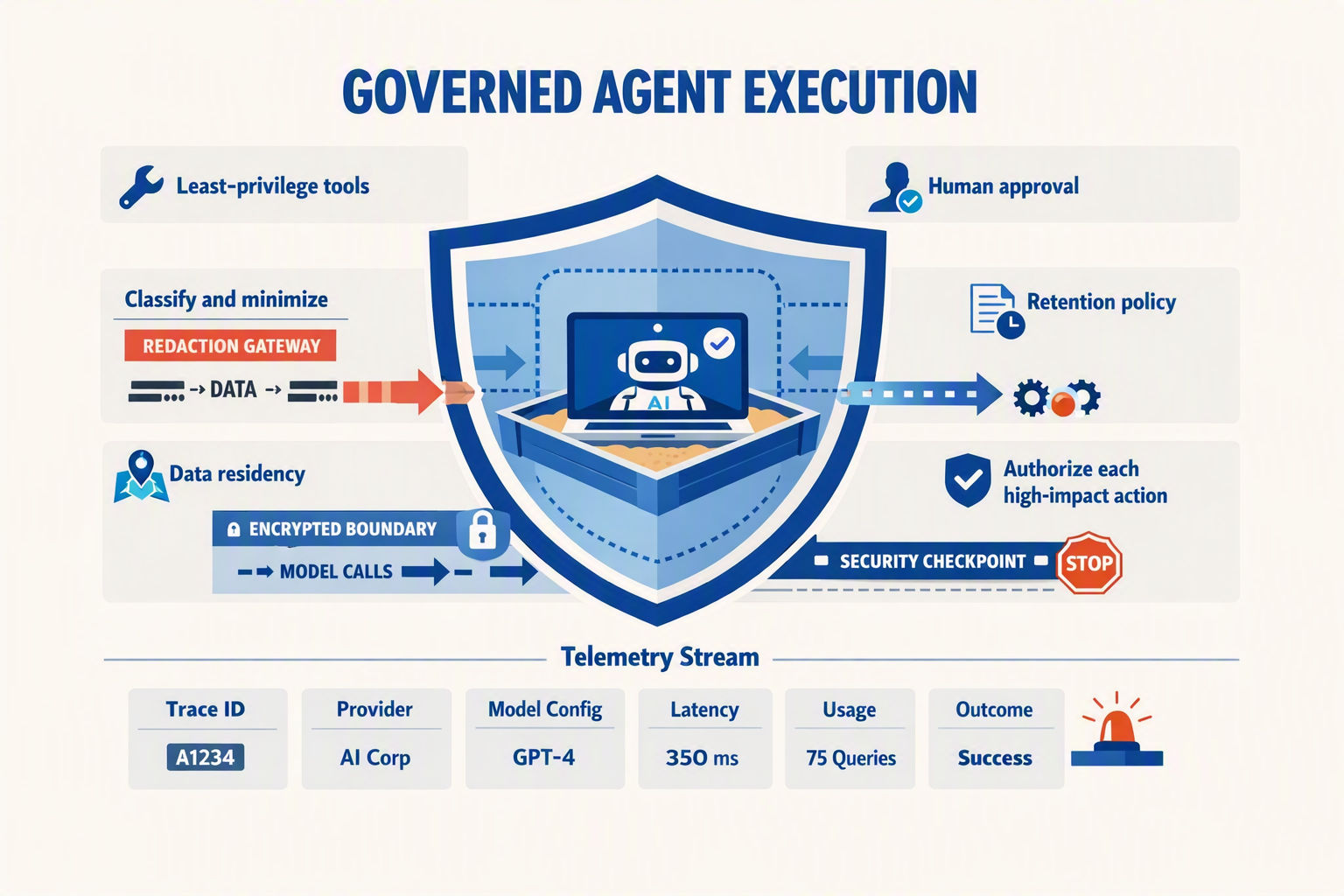
Treat GPT-6 Astra as a high-privilege execution engine, not merely a text model, and treat Claude Fable 5.1 as unavailable for security-sensitive routing until its official API access, tool capabilities, and data-handling terms are verified. The safest migration architecture separates model reasoning from credentials, policy enforcement, action execution, telemetry, and retention.
Security boundaries for tools and computer use
OpenAI reported on September 3, 2026, that GPT-6 Astra is its first broadly deployed model to reach the “Critical” cybersecurity-capability level under the OpenAI Preparedness Framework. That classification should trigger a stricter threat model, particularly for browsing, coding, shell access, and computer-use workflows.
OpenAI also identifies computer use, browsing, software development, and complex multi-step work as GPT-6 Astra strengths. Consequently, every model-proposed action should pass through a deterministic policy layer:
- Run browsers, terminals, and desktop sessions in isolated, ephemeral sandboxes.
- Grant short-lived, task-scoped credentials rather than exposing environment-wide secrets.
- Allowlist domains, commands, filesystem paths, APIs, and tool parameters.
- Require human approval for payments, production changes, account recovery, data deletion, and external messages.
- Treat webpages, documents, emails, and tool output as untrusted input vulnerable to prompt injection.
- Cap steps, execution time, network requests, and monetary impact per run.
For asynchronous tools, retain authorization control in the application. OpenAI’s 2026 model guidance says GPT-6 Astra can continue reasoning while an asynchronous tool runs, but the application still executes the tool and must return the result using the original call_id. Log that identifier without storing sensitive arguments unnecessarily.
Observability that supports routing and incident response
Create one vendor-neutral trace spanning the request, model response, tool loop, fallback, and final outcome. At minimum, capture:
- Internal trace ID, tenant, route decision, policy version, and evaluation version.
- Verified model identifier, snapshot or alias, API version, region, and provider request ID.
- Latency to first token, total latency, token usage, tool duration, retries, timeout, and cache status.
- Structured-output validation failures, tool denials, safety interventions, and human approvals.
- Fallback reason and whether the fallback changed capability, cost, or data residency.
OpenAI’s API documentation states that snapshots lock a specific GPT-6 Astra version so performance and behavior remain consistent. Record the resolved snapshot where the API exposes it; otherwise record the requested alias and deployment timestamp. Do not create a Claude Fable 5.1 production route until equivalent identifiers and telemetry fields are confirmed in official documentation.
Data governance and privacy controls
Apply governance before routing because a fallback can silently move data to a different provider or jurisdiction. Classify each request—public, internal, confidential, regulated, or prohibited—and attach enforceable routing metadata.
For every candidate route, verify:
- Provider retention, training-use, deletion, and abuse-monitoring terms.
- Processing region, subprocessors, cross-border transfer mechanism, and contractual controls.
- Encryption in transit and at rest, tenant isolation, access logging, and key-management options.
- Whether prompts, retrieved documents, screenshots, recordings, tool results, and generated files contain personal or regulated data.
- Whether cache keys, traces, and replay datasets may expose secrets or customer content.
Use redaction or tokenization before transmission, keep raw payload logging off by default, encrypt approved diagnostic samples separately, and enforce purpose-specific retention periods. Never place secrets in prompts; resolve them inside the authorized tool executor.
Release gate
Security approval should require a sandbox escape test, prompt-injection suite, least-privilege review, audit-log verification, deletion test, regional-routing test, and emergency kill switch. If Claude Fable 5.1’s security documentation remains unverified, keep its route disabled rather than inferring parity from its name or claimed model family.
What do official documentation and independent experts say—and which claims still require testing?

Official OpenAI documentation supports several concrete claims about GPT-6 Astra, but the supplied evidence does not verify equivalent API facts for Claude Fable 5.1. Treat vendor descriptions as hypotheses for evaluation—not as proof that either model will satisfy your latency, accuracy, safety, or cost targets.
What OpenAI officially confirms
OpenAI’s September 3, 2026 release notes state that GPT-6 Astra improves coding, research, computer use, and complex multi-step work. OpenAI also says Astra can create documents, spreadsheets, and presentations that follow supplied templates and instructions. These statements justify testing Astra for end-to-end professional workflows, but they do not establish performance on your repositories, tools, languages, or document formats.
The OpenAI API documentation adds implementation-relevant details:
- GPT-6 Astra is available through the Responses API and OpenAI client SDKs.
- OpenAI said on September 3, 2026, that GPT-6 Astra was rolling out to enterprises through the Trusted Access Program. Teams must therefore verify account-level entitlement before setting a production route.
- OpenAI documents snapshots and aliases for GPT-6 Astra, with snapshots intended to keep model behavior and performance consistent.
- OpenAI’s model guidance documents asynchronous tool calling: Astra may continue reasoning or handle independent work while an application executes a tool marked
async: true; the application later returns the result using the originalcall_id. - OpenAI’s reasoning guide recommends
previous_response_idfor preserving prior assistant state. When replaying history manually, OpenAI warns that dropping the originalphasevalue can cause preambles to be interpreted as final answers.
OpenAI’s safety overview also describes GPT-6 Astra as its first broadly deployed model to reach the “Critical” cybersecurity-capability level under the OpenAI Preparedness Framework. That is not a quality score; it is a reason to apply least-privilege tools, isolated execution, audit logs, and human approval for consequential actions.
What remains unverified for Claude Fable 5.1
The supplied official sources do not confirm Claude Fable 5.1’s model ID, API access, pricing, context limits, snapshots, tool schema, streaming protocol, caching behavior, or computer-use support. Until Anthropic publishes authoritative documentation visible to your team, label every such claim unverified.
Do not infer an identifier from the name “Claude Fable 5.1.” Require all of the following before implementation:
- An official Anthropic model-catalog entry and exact API identifier.
- Successful access from the intended production organization and region.
- Official SDK/API-version compatibility and deprecation terms.
- Documented limits, pricing, supported inputs, tools, streaming events, and data-handling controls.
What independent testing must decide
No independent benchmark or expert analysis was included in the supplied research, so this guide cannot responsibly cite third-party scores or declare a winner. Run a blinded, workload-specific evaluation that measures:
- Task quality: pass rate, schema validity, citation accuracy, code tests, and human preference.
- Operational behavior: p50/p95 latency, timeout rate, streaming interruptions, retry recovery, and tool-call completion.
- Agent safety: unauthorized-action rate, prompt-injection resistance, sandbox escapes, and approval-boundary compliance.
- Economics: cost per successful task—not merely price per token—including retries, tool use, and failed outputs.
- Migration stability: prompt regressions, cache effectiveness, snapshot drift, and fallback success.
Platforms such as CallMissed’s OpenAI-compatible gateway can simplify controlled multi-model routing, but abstraction does not eliminate model-specific testing. The defensible conclusion is narrow: OpenAI officially documents Astra’s access path and advanced capabilities; Claude Fable 5.1 and all comparative performance claims require verification before production use.
What should your team do before migrating or enabling production traffic?
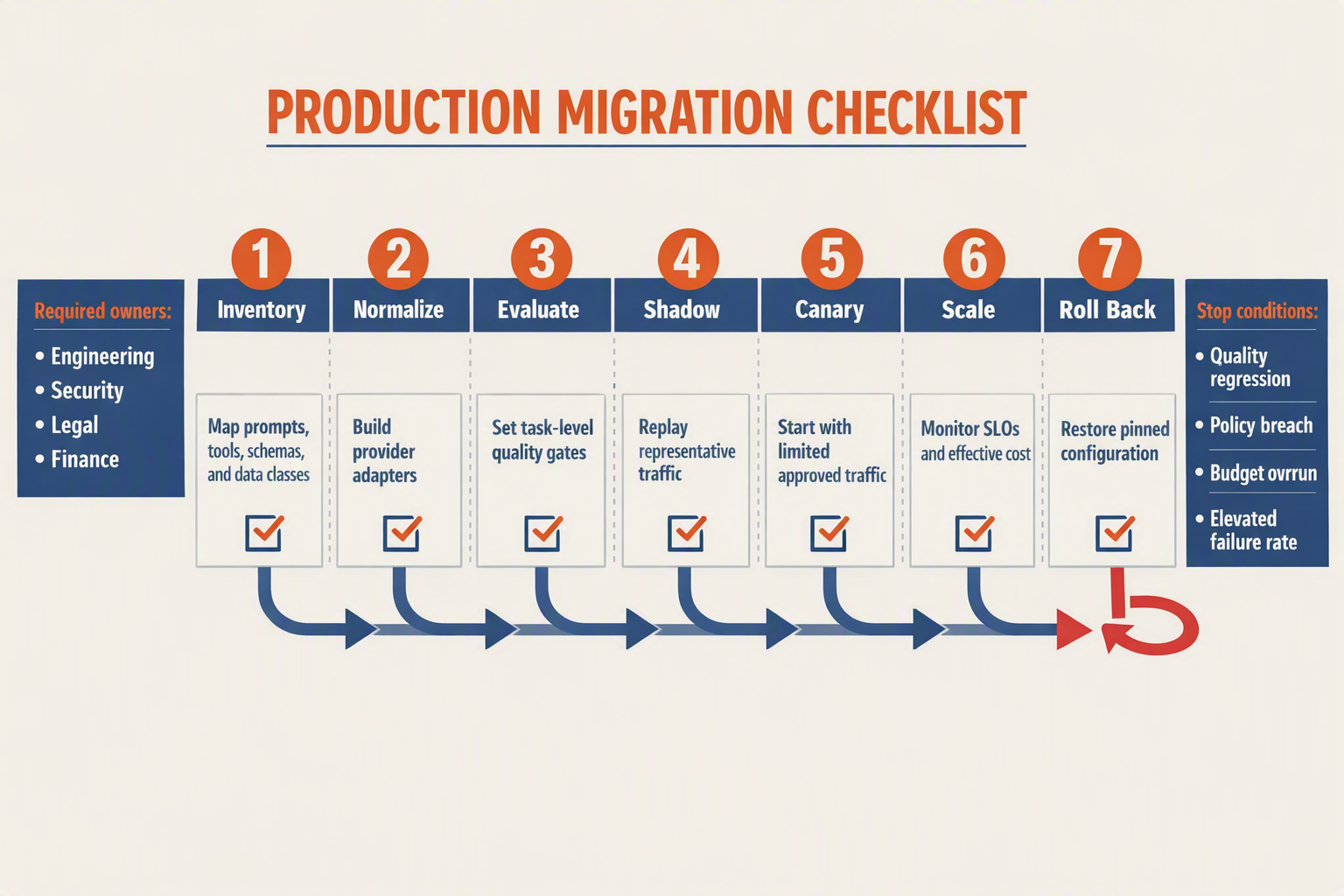
Before enabling production traffic, require a verified-access gate, workload-specific evaluation, security review, bounded canary, and rehearsed rollback. Treat Claude Fable 5.1 as unavailable until Anthropic confirms its exact API identifier and account access; treat GPT-6 Astra access as account-specific rather than automatic.
Production-readiness checklist
| Gate | Required validation | Pass criterion | Failure action |
|---|---|---|---|
| Identity and access | Resolve the model through official provider documentation and a live API account; record endpoint, API version, region, alias, and dated snapshot where available. | The exact identifier returns a successful test response in staging and is enabled for the intended production project. | Block deployment; never infer a Claude Fable 5.1 ID or copy one from third-party material. |
| Prompt and output parity | Replay representative prompts, adversarial inputs, long contexts, multilingual cases, and schema-constrained outputs. | Quality, refusal behavior, schema validity, and latency meet workload-specific thresholds with no critical regression. | Revise the adapter or prompt; retain the current route. |
| Tools and side effects | Test synchronous and asynchronous tools, malformed arguments, duplicate calls, timeouts, and interrupted streams. | Tool names and arguments validate; idempotency keys prevent duplicate writes; destructive actions require approval. | Disable affected tools or route to a safer model. |
| Security and governance | Review data retention, residency, encryption, audit logs, secret handling, prompt-injection defenses, and least-privilege credentials. | Security, privacy, and legal owners sign off; sensitive tools are scoped and monitored. | Keep traffic in staging or use an approved fallback. |
| Canary and observability | Send a small, reversible traffic slice while measuring task success, p95 latency, errors, refusals, tool failures, token use, and spend. | Metrics remain inside pre-agreed error and cost budgets for the full observation window. | Automatically drain traffic and restore the pinned baseline. |
| Rollback and resilience | Simulate provider denial, rate limits, malformed events, outage, quota exhaustion, and behavioral regression. | Fallback, queueing, circuit breakers, and rollback complete without duplicate side effects or lost requests. | Stop launch and remediate the runbook. |
Apply stricter gates to access and high-risk tools
OpenAI’s developer documentation said on September 3, 2026, that GPT-6 Astra was rolling out to enterprises through the Trusted Access Program. A model appearing in documentation is therefore not proof that a particular project, region, or billing account can invoke it. Validate access using the same credentials and network path production will use.
OpenAI’s model documentation also says snapshots can lock a specific GPT-6 Astra version so behavior remains consistent. Prefer a verified dated snapshot for controlled rollout; test aliases separately because an alias may later move.
Claude Fable 5.1 needs a hard stop: the supplied official evidence does not confirm its model ID, pricing, feature set, or API availability. Mark its route disabled by default until Anthropic documentation and a successful account-level probe agree.
Security approval should be equally explicit. OpenAI identified GPT-6 Astra as its first broadly deployed model to reach the “Critical” cybersecurity-capability level under the Preparedness Framework in September 2026. That designation supports tighter controls for shell access, code execution, browsing, credentials, and computer-use actions—not an assumption that ordinary application use is unsafe.
Define go/no-go ownership
Before launch, record:
- Engineering owner: adapters, streaming parsers, retries, timeouts, caching, and idempotency.
- Product owner: task-level quality thresholds and acceptable refusal patterns.
- Security and privacy owners: data classes, retention, tool permissions, and incident response.
- FinOps owner: per-request ceilings, daily budgets, alerts, and automatic route downgrades.
- Incident commander: rollback authority, fallback order, and provider-escalation contacts.
The final approval artifact should include the verified model reference, evaluation dataset version, canary percentage, dashboards, budget limits, fallback route, and rollback command. No production migration is complete until rollback has been executed successfully in a realistic rehearsal.
Frequently asked questions about Claude Fable 5.1 vs GPT-6 Astra API migration
Is Claude Fable 5.1 or GPT-6 Astra API officially available in 2026?
How should developers verify model IDs for Claude Fable 5.1 vs GPT-6 Astra?
Can existing prompts be reused during a Claude Fable 5.1 vs GPT-6 Astra API migration?
phase value while replaying history can cause preambles to be interpreted as final answers.How do structured outputs, tool calls, and streaming differ across model APIs?
call_id.What is the safest fallback strategy for GPT-6 Astra workloads?
How can teams control cost and rollback risk in a multi-model migration?
Conclusion
The safest 2026 strategy is not to crown a permanent winner between Claude Fable 5.1 and GPT-6 Astra, but to make model choice reversible. Route each workload according to verified access, measured performance, operational risk, and total cost.
- Verify before deploying: OpenAI announced GPT-6 Astra on September 3, 2026, but OpenAI’s developer documentation says enterprise API access is rolling out through the Trusted Access Program. Claude Fable 5.1’s model ID, availability, pricing, and features remain unconfirmed in the official material supplied for this guide.
- Treat migration as systems engineering: Normalize prompts, structured outputs, streaming events, tool calls, computer-use actions, errors, caching, retries, timeouts, and idempotency behind an internal adapter.
- Route by evidence: Use evaluation gates and production telemetry to assign coding, research, extraction, browsing, and agentic tasks—then enforce budgets, governance rules, human approvals, fallbacks, and rollback thresholds.
- Plan for security and change: OpenAI classifies GPT-6 Astra at the Critical cybersecurity-capability level, making least-privilege tools, auditability, and controlled side effects essential.
Watch for verified Claude Fable 5.1 documentation, broader GPT-6 Astra access, new snapshots, pricing changes, and evolving tool interfaces. Teams can also explore CallMissed, an OpenAI-compatible AI gateway offering a broad multi-model catalog and automatic same-tier fallbacks.
Is your architecture ready to switch models safely before the next access change, regression, or outage forces the decision?
Related Reading
- Best LLM for Voice Agents in 2026: GPT-6 Astra vs Claude Fable 5.1
- GPT-6 Astra vs Claude Fable 5.1: Verified 2026 Comparison
- OpenAI Astra Launch Status: GPT-6 Release and API Facts for September 2026