WhatsApp COD Confirmation for Shopify: Voice Workflow & ROI



WhatsApp COD Confirmation for Shopify: map message-to-call escalation, handle dispatch exceptions, and calculate costs, profit and break-even ROI.

WhatsApp COD Confirmation for Shopify: Voice Workflow & ROI
Nearly one in four cash-on-delivery orders can become a shipment that comes straight back: Shipway’s FY25 ShipNotes report recorded nearly 26% RTO for non-prepaid orders, versus under 2% for prepaid orders, according to MediaBrief’s July 29, 2025 coverage. WhatsApp COD Confirmation for Shopify addresses that costly gap by checking buyer intent and delivery details before dispatch, with voice conversations available when a message alone cannot resolve uncertainty.
For Shopify merchants planning operations in November 2026, that historical benchmark is a reason to investigate their own COD performance—not assume every store has the same return rate. A checkout records an order, but it does not necessarily establish that the customer understands the amount payable, entered a usable address, or will accept the parcel.
That distinction matters because return to origin (RTO) creates costs beyond a missed sale: outbound freight, return freight, handling, and inventory tied up in transit. Confirmation can help identify avoidable problems earlier, although it cannot eliminate courier failures or guarantee delivery.
The practical opportunity is a message-first, voice-assisted workflow. Give customers a clear way to confirm, correct, or cancel their order on WhatsApp; use a permitted call or human follow-up for cases that need clarification. A buyer who needs to explain a landmark or correct an apartment number may benefit more from a conversation than another reminder.
As of November 2026, CallMissed combines Shopify integration, WhatsApp Business messaging through Meta’s official Cloud API, and WhatsApp Business Calling with AI voice agents, including business-initiated calls to customers who have given permission.
This guide will show you how to:
- Design the confirmation journey: identify eligible COD orders, present the order details, and separate confirmed, cancelled, and unresolved cases.
- Add voice responsibly: distinguish customer-initiated calls from permission-based business calls, and decide when a human should take over.
- Measure business outcomes: track delivered orders, RTO, confirmation costs, and legitimate orders lost through unnecessary friction.
- Calculate ROI: compare avoided fulfilment losses against messaging, voice, integration, and operating costs.
For an illustrative November 2026 calculation—not a reported benchmark—preventing 20 failed shipments at ₹200 in avoidable cost each creates ₹4,000 in gross savings. If the workflow costs ₹1,500, the net saving is ₹2,500 before accounting for other effects.
The key question is not simply, “Did more customers confirm?” It is: Did confirmation improve profitable deliveries without driving genuine buyers away? That is the standard this guide uses to evaluate both the workflow and its return on investment.
How does WhatsApp-first COD confirmation work, and when does voice improve ROI?
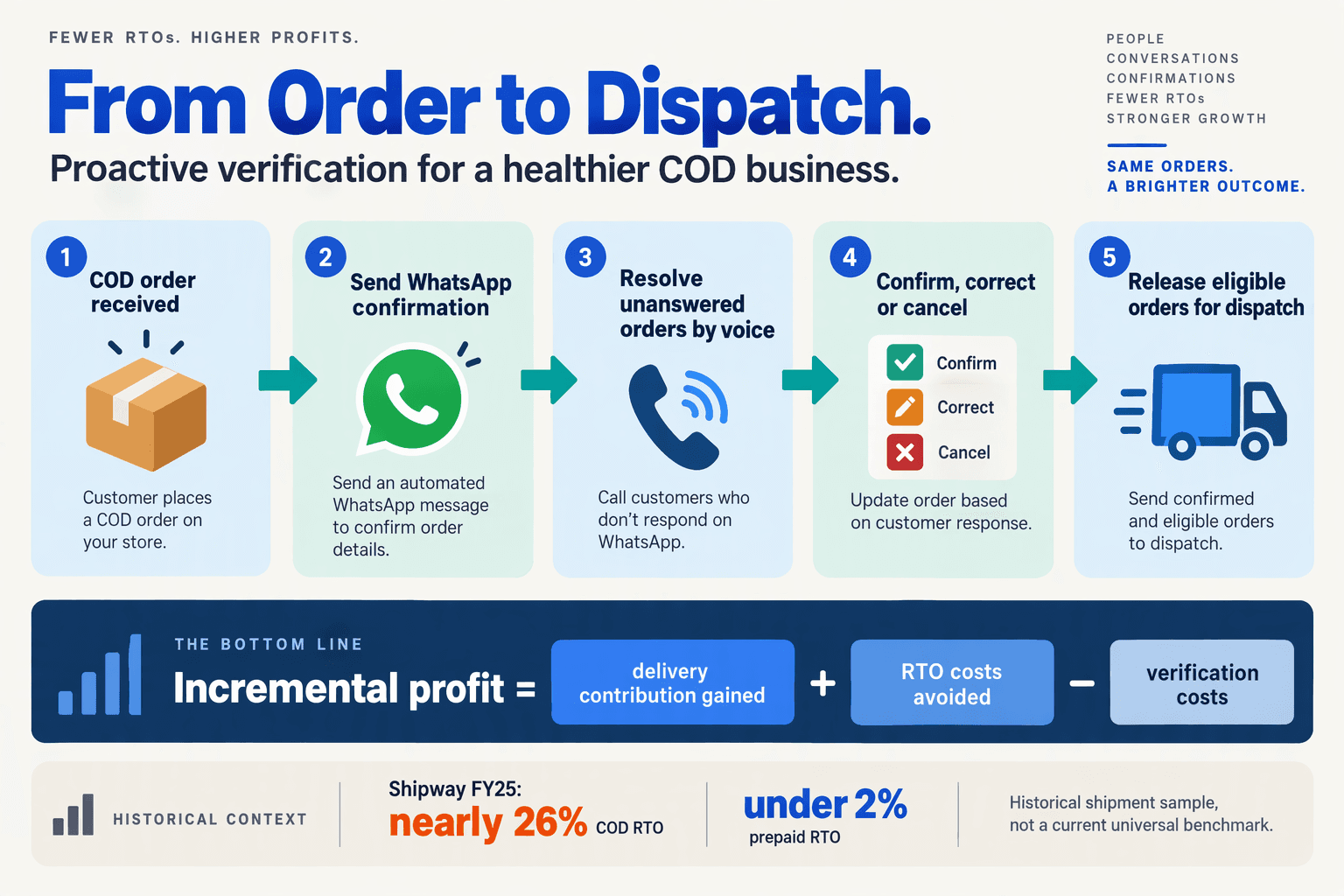
WhatsApp-first COD confirmation uses a message to establish buyer intent before dispatch, then reserves voice for unresolved cases where clarification could change the fulfilment decision. Voice improves ROI when the expected benefit of resolving an order exceeds the additional calling and handling costs—not simply when more calls are completed.
What should happen between checkout and dispatch?
For a November 2026 implementation, treat confirmation as an order-state workflow, not a message-delivery campaign. A delivered or read WhatsApp message does not establish that the buyer accepts the order.
A practical WhatsApp COD confirmation for Shopify workflow has five steps:
- Identify eligible orders. Select unfulfilled COD orders and exclude duplicates, cancellations, and orders already reviewed by staff.
- Present the essentials. Show the order reference, items, total payable on delivery, and delivery address. Offer clear choices: confirm, correct details, or cancel.
- Resolve corrections. Ask for the missing apartment number, landmark, or other relevant detail. Route changes affecting price or fulfilment to staff rather than silently accepting them.
- Record the outcome. Maintain distinct states such as confirmed, correction pending, cancelled, and unresolved, with a timestamp and the customer’s response.
- Apply a dispatch rule. Release eligible confirmed orders; review unresolved orders against a defined deadline and risk policy. Do not automatically interpret silence as cancellation.
An illustrative message might read: “Your order #1048 totals ₹1,299, payable on delivery. Is the delivery address correct, and would you like us to dispatch it?” This is sample copy, not a verified Meta-approved template.
As of November 2026, CallMissed supports Shopify orders, products, and customers alongside WhatsApp message templates and a shared inbox through Meta’s official Cloud API. These capabilities provide building blocks; merchants still need to configure confirmation states and fulfilment rules.
Which unresolved orders justify a voice conversation?
Use voice when there is a specific question to resolve. A buyer explaining an address correction may need a conversation; a buyer who clearly cancelled does not need another persuasion attempt.
Useful escalation reasons include:
- Ambiguous intent: the customer asks about delivery timing but never confirms acceptance.
- Address uncertainty: a correction cannot be understood reliably in chat.
- Customer preference: the buyer requests a call or starts one.
- Commercial exposure: the potential avoidable loss justifies additional review.
As of November 2026, CallMissed’s WhatsApp Business Calling supports AI answers to customer-initiated calls and business-initiated calls to customers who have given permission. According to CallMissed’s verified product facts, Meta does not charge for customer-initiated WhatsApp calls; that does not make the AI conversation cost-free.
How do you decide whether voice improves ROI?
Compare incremental outcomes, not confirmation rates alone. MediaBrief’s July 29, 2025 coverage of Shipway’s FY25 ShipNotes report concerns shipment returns; it does not establish a measured uplift from WhatsApp confirmation or voice escalation.
Use comparable message-only and message-plus-voice groups, then track:
- Avoided failed-shipment costs.
- Contribution margin from additional delivered orders.
- Messaging, calling, integration, and staff costs.
- Genuine orders lost through delays or unnecessary friction.
For an illustrative November 2026 calculation, suppose 100 escalations cost ₹600 in total and prevent six failed shipments costing ₹180 each. Gross avoided costs are ₹1,080, leaving ₹480 net savings before other effects. Break-even requires four prevented failures, rounded up from ₹600 ÷ ₹180.
That threshold—not call volume—is the operational reason to add voice.
What must you prepare before connecting Shopify, WhatsApp and voice?
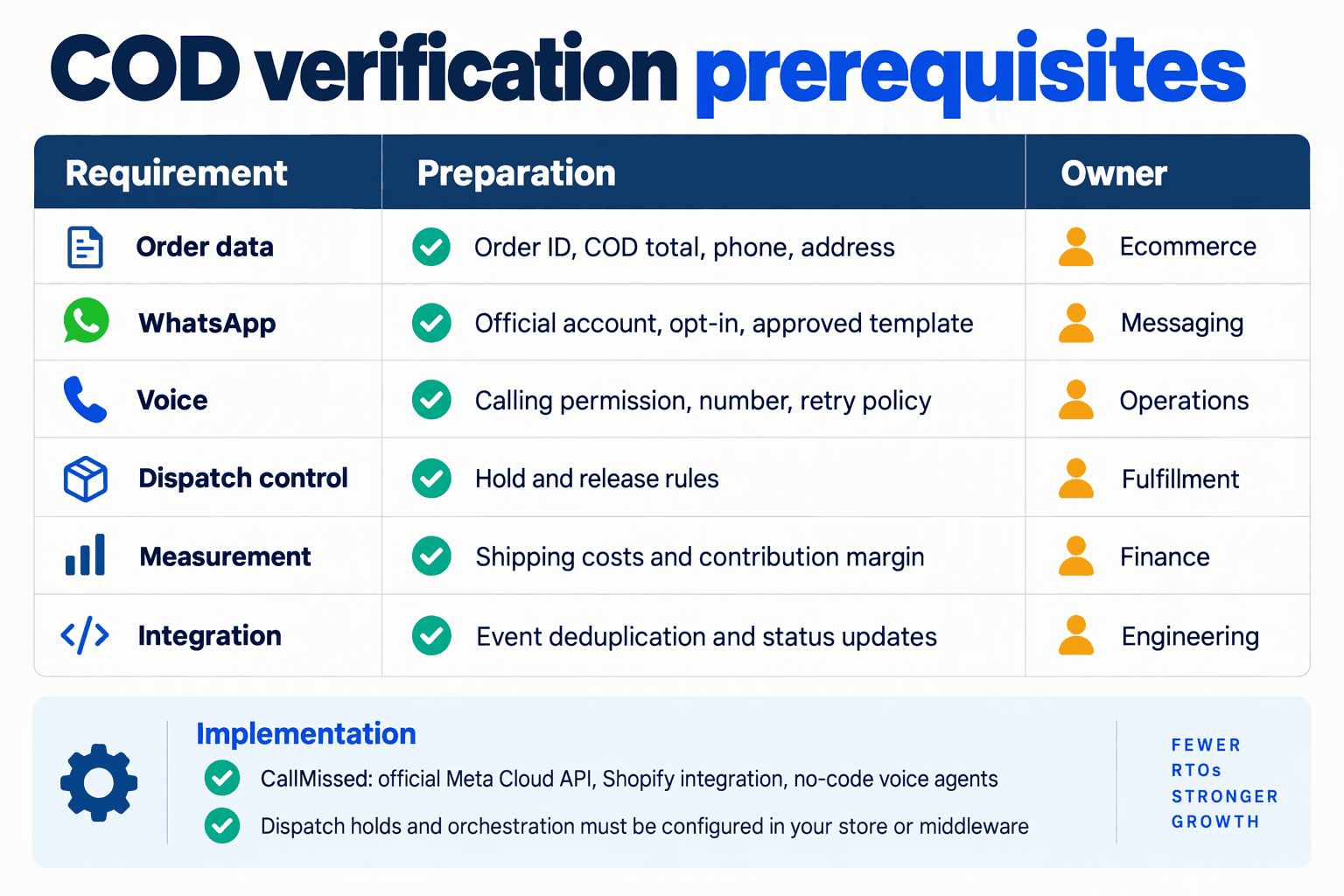
Before connecting Shopify, WhatsApp and voice, prepare order-data access, messaging permissions, approved message content, a voice escalation policy, fulfilment rules, and a cost baseline. Treat these as launch gates: a successful API connection does not prove that the workflow can safely release, hold, or cancel a COD order.
What belongs on your COD confirmation setup checklist?
Use this November 2026 preparation checklist to assign ownership before building the integration. Each row should have a named owner and a completed test—not just a configuration screenshot.
| Preparation area | What to prepare | Launch acceptance check |
|---|---|---|
| Shopify order data | Order ID, COD status, amount payable, items, phone number, delivery address and fulfilment status | A test order displays the correct details; prepaid and already-dispatched orders are excluded |
| WhatsApp account | WhatsApp Business account, Meta connection, customer messaging permissions and approved confirmation templates | A test message reaches the intended customer with accurate order details |
| Voice route | Customer-initiated WhatsApp calling or permission-based business calling; phone-carrier setup if using telephone calls | The selected route works, and business-initiated WhatsApp calls require recorded permission |
| Decision rules | Confirmed, correction requested, cancelled and unresolved outcomes; dispatch cutoff and human review owner | Silence remains unresolved rather than being treated as confirmation or cancellation |
| Data safeguards | Access roles, retention policy, recording disclosures where applicable and limits on information collected | Staff can access only necessary customer data; sensitive payment credentials are never requested |
| ROI baseline | Delivered COD orders, RTO, cancellation reasons, freight losses and communication costs | Every confirmation outcome can be matched to its eventual shipment outcome |
Which Shopify fields and operational rules should you define?
Create a data contract: a written agreement describing which fields the workflow reads, which records it may update, and who owns exceptions. Map the customer-facing order reference separately from internal identifiers so buyers can recognise the purchase.
Define these rules before writing agent prompts:
- Eligibility: which COD orders enter confirmation, and which are excluded.
- Authority: whether an agent may record intent only or also request an order change.
- Fulfilment cutoff: when warehouse staff must receive the confirmation result.
- Duplicate protection: how repeated events or replies avoid triggering repeated actions.
Test an address correction carefully. A buyer’s new landmark should not silently overwrite the shipping address or release an order without the validation your operations team requires.
What must be ready for WhatsApp and voice?
As of November 2026, CallMissed supports Shopify orders, products and customers, alongside WhatsApp Business account connection through Meta embedded signup, message templates synced with Meta, and a live shared inbox, according to the CallMissed fact sheet. These capabilities provide connection points; merchants still need to define their own confirmation and fulfilment policy.
Prepare separate wording for messaging permission and business-initiated WhatsApp calling permission. Do not treat the presence of a checkout phone number as proof of permission for every contact route. Check Meta’s current requirements before launch, and specify when unresolved conversations go to a person.
Budget voice separately from messaging. According to the CallMissed fact sheet, CallMissed’s Standard voice-agent plan costs ₹4 per minute with a 30-second minimum per call as of November 2026; phone carriage is billed separately. Include applicable messaging charges and staff handling costs rather than treating the voice rate as the entire workflow cost.
What should you measure before launch?
Establish your store’s baseline before changing dispatch decisions. MediaBrief reported on July 29, 2025, that Shipway’s FY25 ShipNotes analysis recorded nearly 26% RTO for non-prepaid orders, compared with under 2% for prepaid orders; that historical finding is context, not your store’s starting value.
For the pilot, record:
- Order outcomes: delivered, RTO, cancelled before dispatch and unresolved.
- Avoidable costs: outbound freight, return freight and handling.
- Workflow costs: messages, voice, integration and human review.
This preparation makes later ROI analysis traceable to actual deliveries—not merely confirmation clicks.
How do you get started with verification rules and a controlled pilot?
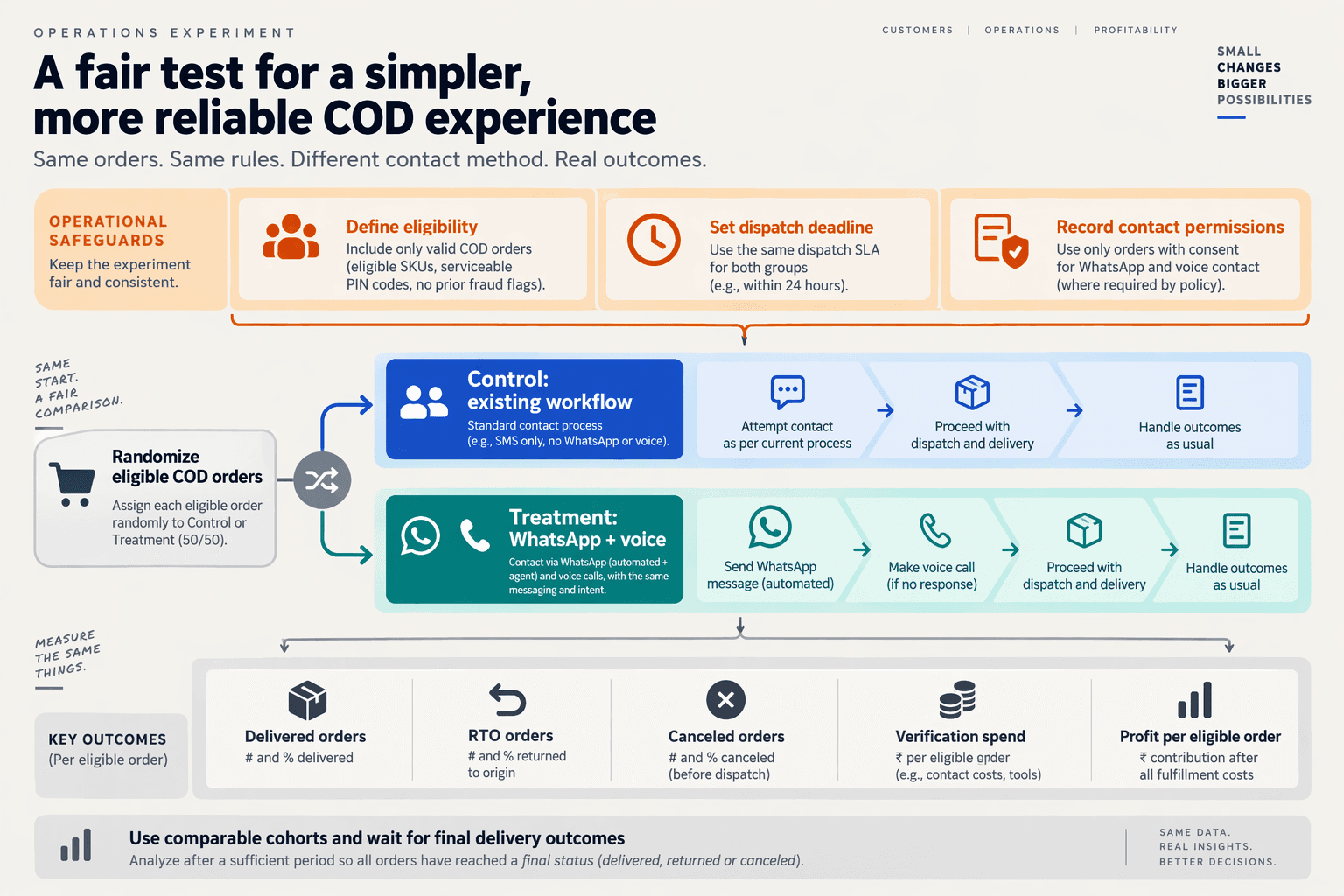
Start with explicit verification rules, then test them on a small, randomly assigned group of eligible COD orders against your existing process. A controlled pilot should establish whether confirmation improves delivery economics—not merely whether customers reply.
What should your COD verification rules check?
For a pilot designed in November 2026, create a written decision checklist before configuring messages or agents. Keep checks focused on information that can change the fulfilment decision:
- Buyer intent: Does the customer explicitly want the order and understand the total payable on delivery?
- Address completeness: Are the building or house number, locality, postcode, and any necessary landmark usable?
- Order accuracy: Are the product, variant, quantity, and COD amount correct?
- Delivery expectations: Has the customer understood the estimated delivery window, without treating an estimate as a guarantee?
- Escalation eligibility: Does the case need a permitted voice call or human review rather than another message?
Define what counts as evidence. “Yes, deliver this order” is confirmation; a delivered message, read receipt, or unanswered call is not.
Separate customer cancellation, address correction, and no response. An address edit should trigger validation, while silence should enter an unresolved queue—not automatically become a cancellation. Set a maximum hold period aligned with your dispatch cutoff, and document who can release or cancel held orders.
How do you structure a controlled COD confirmation pilot?
Use your own shipment history to choose the test population. Shipway’s FY25 ShipNotes report, covered by MediaBrief on July 29, 2025, provides historical evidence of the COD–prepaid RTO gap; it does not establish your store’s baseline or expected improvement.
An illustrative November 2026 pilot design, not a recommended statistical sample size, could allocate 400 eligible COD orders equally:
- Control: 200 orders follow the existing fulfilment process.
- Treatment: 200 orders follow the new verification rules.
- Randomize before contacting buyers, rather than assigning apparently risky orders only to treatment.
- Keep other conditions consistent, including courier selection, offers, dispatch standards, and delivery regions.
- Follow both groups through final delivery or RTO, even after enrolment closes.
Exclude cases where experimentation would override an existing safety or serviceability restriction. Avoid overlapping workflows that send duplicate requests.
As of November 2026, CallMissed supports Shopify integration, WhatsApp message templates synced with Meta, and a live shared inbox. These capabilities can support the pilot’s messaging and review process, but the merchant must define assignment, release rules, and outcome reconciliation.
What should you measure before expanding the pilot?
Choose net contribution per eligible order as the primary business measure. Track delivered-order contribution alongside outbound and return freight, communication costs, handling time, and losses from genuine buyers abandoning the process.
Use operational measures to explain the result:
- Confirmation, correction, cancellation, and unresolved rates.
- Time from order placement to dispatch.
- Human-review workload and customer complaints.
- RTO among dispatched orders and delivered orders per eligible order.
That last distinction matters: cancelling more orders can lower shipment-level RTO while reducing profitable deliveries.
Predefine pause conditions, such as duplicate contacts, incorrect amounts, unauthorized calls, or excessive dispatch delays. Expand only after outcomes mature and the economics improve without unacceptable customer friction; a small pilot provides directional evidence, not proof of a universal ROI.
How do you implement WhatsApp-to-voice escalation step by step?
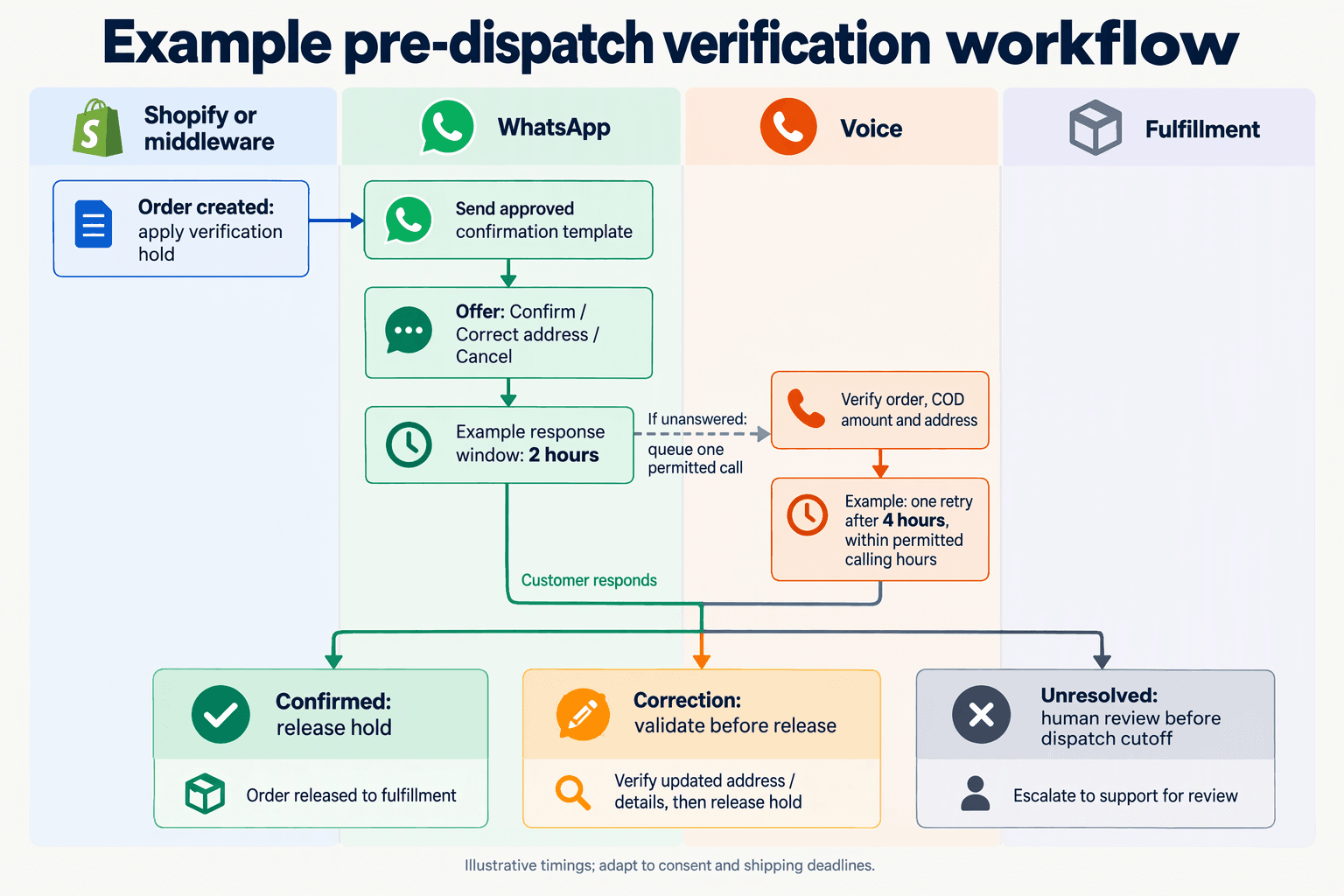
Implement WhatsApp-to-voice escalation as an order-level workflow: send a confirmation message, classify the response, offer a permitted voice conversation when needed, and record the outcome before fulfilment. Keep customer intent, calling permission, and dispatch eligibility as separate fields so silence never becomes consent or an automatic cancellation.
How do you prepare Shopify orders for WhatsApp confirmation?
- Create a reliable order record.
For each eligible Shopify COD order, capture the order ID, amount payable, items, delivery address, contact number, and fulfilment cutoff. Use the order ID as an idempotency key—a unique identifier that prevents repeated order events from triggering duplicate confirmation journeys.
Keep separate fields for:
- Confirmation: pending, confirmed, correction requested, cancelled, unresolved.
- Contact: message sent, reply received, call requested, call attempted.
- Fulfilment: held, ready for release, manual review.
- Connect messaging and define the integration boundary.
As of November 2026, CallMissed supports Shopify integration, WhatsApp Business messaging through Meta’s official Cloud API, and WhatsApp Business Calling with AI voice agents, according to CallMissed’s verified product facts. Configure the order-event handling and status updates in your merchant workflow; do not assume connecting these capabilities creates a complete COD escalation sequence automatically.
Prepare the appropriate Meta-approved message template and verify applicable messaging permissions before launch.
What should trigger escalation from WhatsApp to voice?
- Send one clear decision request.
Include the merchant name, order reference, COD total, and a concise address summary. Offer distinct choices: confirm, correct details, cancel, or request a call.
An illustrative November 2026 message could read: “Please confirm order #1042: ₹1,499 payable on delivery. Deliver to the address ending ‘Apartment 12, Indiranagar’? Reply CONFIRM, CHANGE, CANCEL, or CALL.” Avoid exposing unnecessary personal information.
- Escalate uncertainty—not every unanswered message.
Prioritise address corrections, contradictory replies, accessibility needs, or explicit call requests. For non-response, choose a waiting period based on your dispatch schedule; an illustrative November 2026 pilot might flag unresolved orders after two hours, but that is a test setting, not an industry benchmark.
Offer a customer-initiated WhatsApp call or obtain the required permission before a business-initiated WhatsApp call. Permission to message is not automatically permission to call. Verify the current Meta calling requirements before deployment, and use individual calls or a review queue rather than assuming an automated outbound calling campaign is available.
How do you close the call and safely release the order?
- Give the voice agent a narrow task and clear limits.
Ask the agent to identify the merchant, confirm the order reference and amount payable, clarify delivery details, and read back any correction. Require an explicit answer before marking the order confirmed.
Route disputes, unclear answers, unavailable products, or unsupported changes to a person. Do not let the agent promise delivery dates, discounts, or refunds that your business has not authorised.
- Save the outcome, then apply fulfilment rules.
Record the decision, corrected details, timestamp, permission evidence, and escalation reason. Validate changes before updating Shopify; a call summary alone should not release a shipment.
Before launch, test duplicate events, late replies, cancellation during a call, failed calls, and orders already dispatched. Track delivered orders and unresolved cases, not just confirmations: MediaBrief’s July 29, 2025 coverage of Shipway’s FY25 ShipNotes report establishes the historical RTO problem, but your pilot must establish whether this workflow improves your store’s outcomes.
What should happen when messages fail, calls go unanswered or customers change an order?
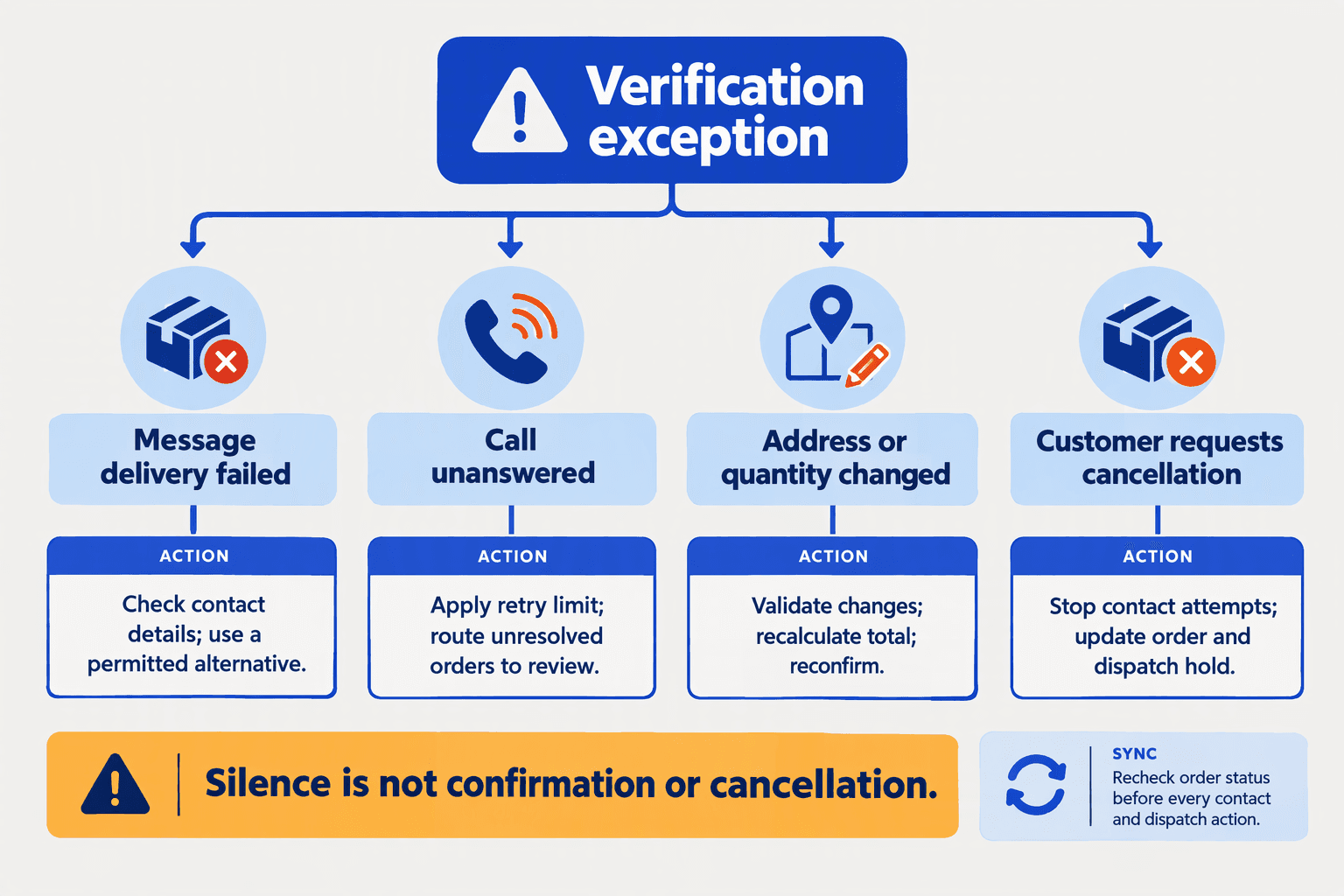
Failed messages and unanswered calls should leave a COD order unresolved—not automatically confirmed or cancelled. Order changes should pause fulfilment until the revised details are validated and the customer confirms the updated order.
What should happen when a WhatsApp confirmation message fails?
Separate delivery failure from customer silence. A rejected message, an invalid number, and a delivered message without a reply require different actions.
For a November 2026 operating playbook, define these exception states in your order system:
- Message failed: Record the error, check the contact details, and resolve any messaging configuration issue before retrying.
- Delivered, awaiting reply: Keep the order pending until the stated confirmation deadline; do not interpret delivery or a read receipt as purchase intent.
- Customer unreachable: Route the order to a permitted alternative contact method or manual review.
- Customer opted out: Stop further confirmation outreach through that channel and apply your documented order-review policy.
Chatmitra’s RTO in Ecommerce guide identifies incomplete addresses and unreachable buyers as pre-dispatch risk factors. The practical response is to resolve the underlying exception, rather than repeatedly send the same reminder.
How many times should you retry an unanswered call?
Use a bounded retry policy, not an indefinite calling loop. Set contact hours, spacing between attempts, a maximum attempt count, and a clear stop condition.
An illustrative November 2026 policy—not an industry benchmark—might allow one WhatsApp reminder and one permission-based call before human review. Adjust that limit using your own recovered-order margin, customer complaints, and fulfilment deadlines.
An unanswered call is not a refusal. Record whether the attempt was unanswered, busy, disconnected, or connected but inconclusive; a callback request should create a scheduled task rather than another immediate attempt.
As of November 2026, CallMissed provides a human-handoff queue and support tickets. These capabilities can support exception review, but merchants still need to define the retry rules and fulfilment decisions.
What happens when a customer changes their COD order?
Treat an edit as a new confirmation checkpoint. An earlier “yes” does not necessarily cover a different item, quantity, address, or amount payable.
- Pause dispatch: Prevent fulfilment while the requested change is being reviewed.
- Validate the change: Check stock, serviceability, discounts, and the revised COD total.
- Read back the revised details: State the item, quantity, delivery address, and amount due.
- Capture explicit confirmation: Save the response against the revised order version.
- Release or escalate: Resume fulfilment only after successful validation; send ambiguous requests to a person.
For example, changing “one shirt” to “two shirts” requires reconfirming the total—not merely updating quantity. If the parcel has already shipped, explain the available options instead of promising an edit the warehouse cannot make.
How do you prevent exceptions from damaging ROI?
Give every unresolved order an owner, deadline, and final disposition. Your dispatch cutoff should trigger a documented decision—manual review, continued hold, or cancellation under your stated policy—not silent expiry.
Also check the latest order status before acting on delayed replies. A late confirmation must not reopen a cancelled order or create duplicate fulfilment.
Measure incremental deliveries recovered, contact cost, handling time, and genuine orders lost through unnecessary holds. A workflow that lowers RTO by cancelling reachable buyers can still reduce profit; exception handling should protect both delivery success and legitimate demand.
How do you calculate verification costs, incremental profit and break-even RTO reduction?
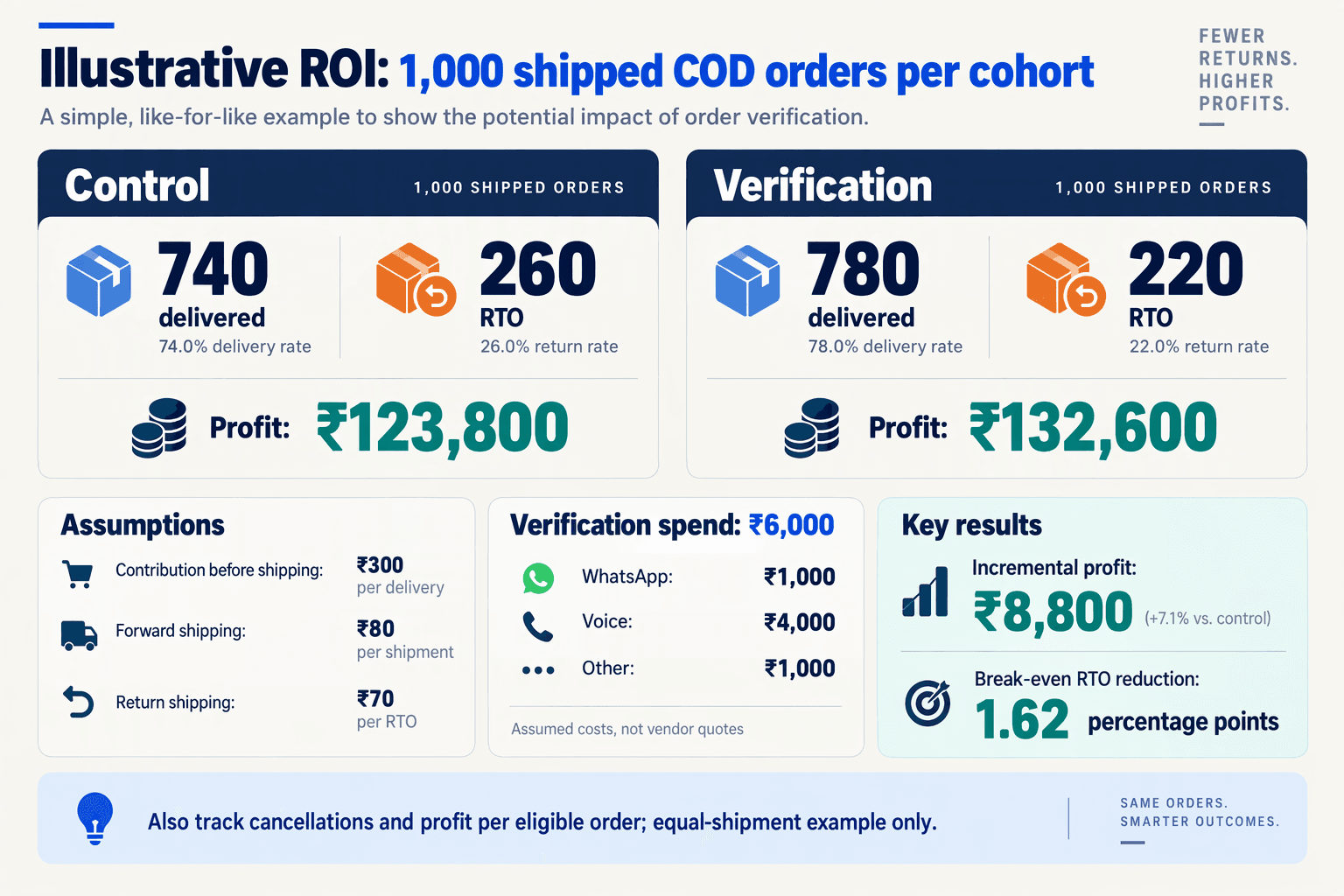
Calculate incremental profit as avoided RTO losses plus contribution from additional deliveries, minus verification costs and contribution lost through unnecessary cancellations. Break-even is the improvement needed to cover those costs—not simply a higher confirmation rate.
What belongs in COD verification costs?
Measure costs across all eligible COD orders, including customers who never respond. For a November 2026 pilot, use:
Total verification cost = WhatsApp charges + AI voice charges + applicable carriage + human follow-up + allocated integration and operating costs.
Include retries, supervisor time and ongoing maintenance. Spread one-off setup costs over a stated evaluation period rather than excluding them from ROI.
As of November 2026, CallMissed’s Standard AI voice plan costs ₹4 per minute, covering speech recognition, the language model and voice, with a 30-second minimum per connected call; unconnected calls cost nothing, and phone carriage is separate, according to CallMissed’s verified pricing.
An illustrative November 2026 budget, not a provider quote, could be:
- ₹800: WhatsApp messaging charges.
- ₹400: 100 connected, one-minute Standard AI voice calls.
- ₹800: applicable carriage, human follow-up and allocated integration costs.
That totals ₹2,000, or ₹2 per eligible order across 1,000 orders. Replace every assumption with invoice data before making rollout decisions.
How do you calculate incremental profit without double-counting?
Use matched treatment and control cohorts, allowing enough time for deliveries and returns to settle. Shipway’s FY25 ShipNotes report recorded nearly 26% RTO for non-prepaid orders, according to MediaBrief’s July 29, 2025 coverage; that historical figure is context, not your store’s expected improvement.
Define:
- A: failed shipments avoided, including orders cancelled before dispatch and orders converted into successful deliveries.
- L: avoidable loss per failed shipment—outbound freight, return freight, handling and expected damage or write-down.
- D: additional successful deliveries attributable to verification.
- G: otherwise-successful orders lost because verification introduced friction.
- M: contribution per successful delivery, after product cost, discounts, fulfilment and payment charges.
- C: total verification cost.
Incremental profit = (A × L) + (D × M) − (G × M) − C.
An RTO converted into a delivery can generate both avoided failure costs and delivery contribution. This is not double-counting if L represents the failed-shipment loss and M already deducts the successful shipment’s costs.
Do not count the full order value as profit or treat recoverable inventory as completely lost.
What does a worked ROI calculation look like?
For an illustrative November 2026 pilot covering 1,000 eligible orders:
- Avoid 30 failed shipments at ₹200 loss each: ₹6,000 saved.
- Generate 10 additional deliveries at ₹300 contribution each: ₹3,000 gained.
- Lose two genuine purchases through friction: ₹600 lost.
- Deduct ₹2,000 verification costs: ₹6,400 incremental profit.
Verification ROI = incremental profit ÷ verification cost × 100 = 320%.
This is a worked assumption, not a reported benchmark or promised outcome.
What RTO reduction reaches break-even?
Ignoring delivery gains and friction losses, break-even avoided failures = C ÷ L. With ₹2,000 verification costs and ₹200 avoidable loss per failure, you need 10 fewer failed shipments per 1,000 eligible orders—a one-percentage-point reduction in failed shipments per eligible order.
Keep that denominator explicit. Conventional RTO rate uses dispatched shipments, so pre-dispatch cancellations change its denominator. Track eligible orders, dispatches, deliveries, RTO events and contribution together; a lower RTO percentage alone does not establish profitability.
Which advanced tactics improve confirmation without adding unnecessary calls?
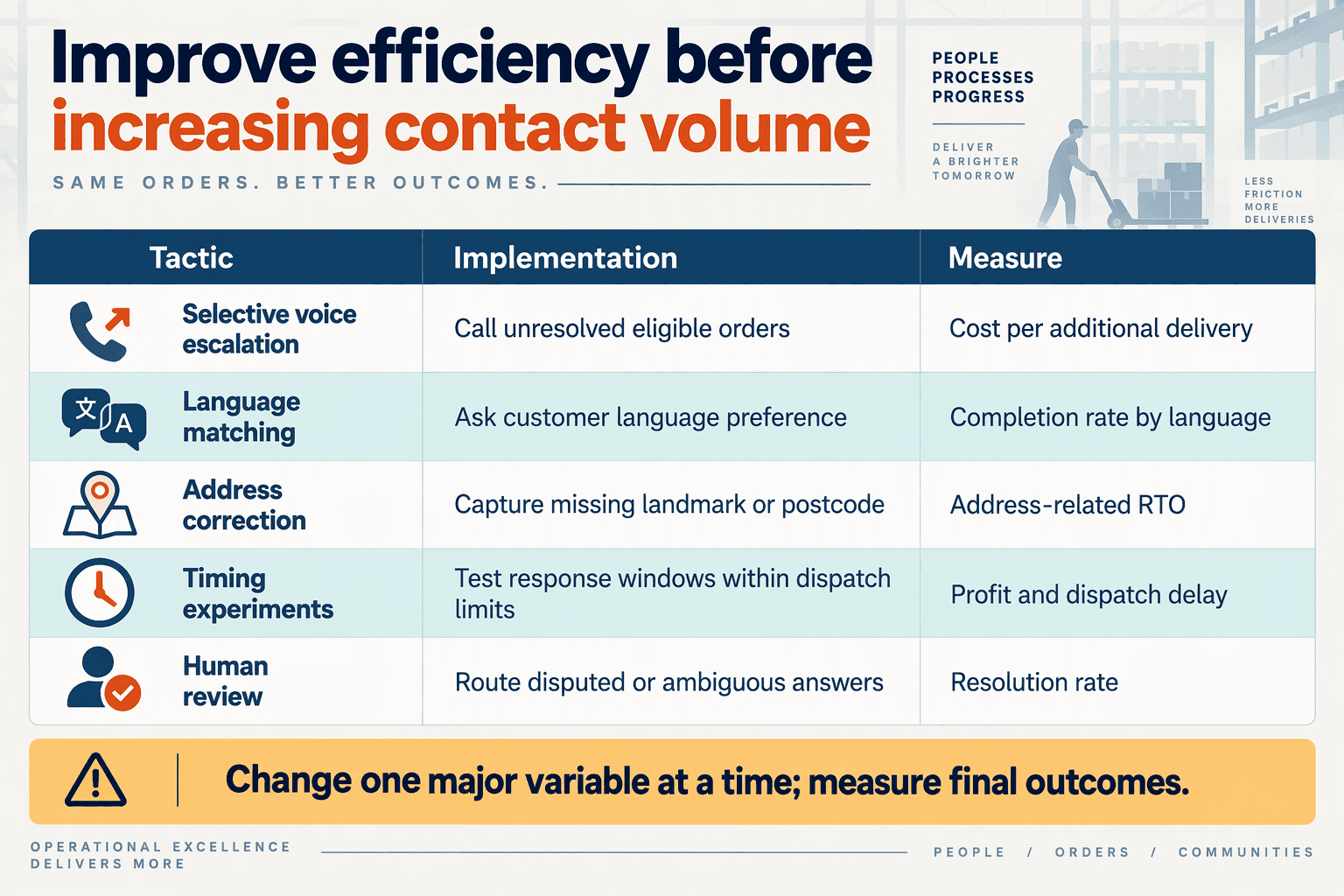
The strongest advanced tactics make calls conditional, not automatic: resolve structured questions in WhatsApp, suppress follow-ups when an order changes state, and reserve voice for uncertainty that could affect delivery. Optimise for profitable delivered orders, rather than confirmation rate alone.
Which tactics reduce avoidable COD confirmation calls?
The following November 2026 implementation recommendations extend a WhatsApp-first workflow. They are operating rules to test against your store’s data—not published performance benchmarks.
| Tactic | WhatsApp-first action | When voice adds value | Guardrail |
|---|---|---|---|
| State-based suppression | Stop reminders after confirmation, cancellation, or resolution | A new issue remains unresolved | Recheck order status immediately before calling |
| Structured address repair | Request only the missing flat number, landmark, or postcode | The buyer cannot explain the correction in text | Validate corrections before fulfilment |
| Customer-selected timing | Offer a preferred callback slot and record permission | The buyer requests help at that time | Respect the slot and applicable calling requirements |
| Issue-based prioritisation | Separate address problems, price questions, and delivery requests | A conversation can resolve a specific blocker | Do not treat silence alone as cancellation |
| Language preference capture | Ask which language the buyer prefers | Spoken clarification is easier for the buyer | Preserve the preference for human handoff |
| Controlled holdout testing | Compare equivalent eligible groups with different escalation rules | Calls demonstrate incremental delivery benefit | Track legitimate orders lost, not just RTO |
How should risk signals influence escalation?
Use explainable operational signals, such as an incomplete address or an explicit question about the payable amount. A location or previous failed delivery should prompt investigation, not automatic rejection: courier serviceability and delivery execution can also affect outcomes.
Shipway’s FY25 ShipNotes report recorded nearly 26% RTO for non-prepaid orders, according to MediaBrief’s July 29, 2025 coverage; that historical aggregate is not an individual customer risk score.
For example, a buyer who replies “confirm” but omits an apartment number needs address repair—not another intent-confirmation call. Conversely, “Why is the amount higher?” identifies a specific issue worth resolving before dispatch.
As of November 2026, CallMissed supports WhatsApp Flows for multi-screen in-chat forms and a human-handoff queue, according to its verified product fact sheet. Those capabilities can support structured information collection and exception handling; merchants should design and validate the order-state rules around them.
How do you decide whether another call is worth making?
Calculate the incremental value of escalation, not the value of every order touched by a call.
For an illustrative November 2026 test, suppose 100 eligible orders receive permission-based calls and 100 comparable orders remain message-only. If the called group produces five additional profitable deliveries:
- Contribution per additional delivery: ₹250, after fulfilment costs.
- Incremental contribution: 5 × ₹250 = ₹1,250.
- Additional escalation cost: ₹800.
- Illustrative net benefit: ₹450.
These are hypothetical inputs, not CallMissed pricing or measured results. Use comparable groups and allow deliveries and returns to complete before judging the experiment.
- Set a stop rule: no further outreach after a clear cancellation or resolved issue.
- Set an escalation reason: every call should answer a named unresolved question.
- Review downstream outcomes: compare delivery, RTO, complaints, and contribution after communication costs.
A tactic succeeds when it resolves uncertainty economically—not when it generates more conversations.
Which common mistakes undermine COD verification and ROI?
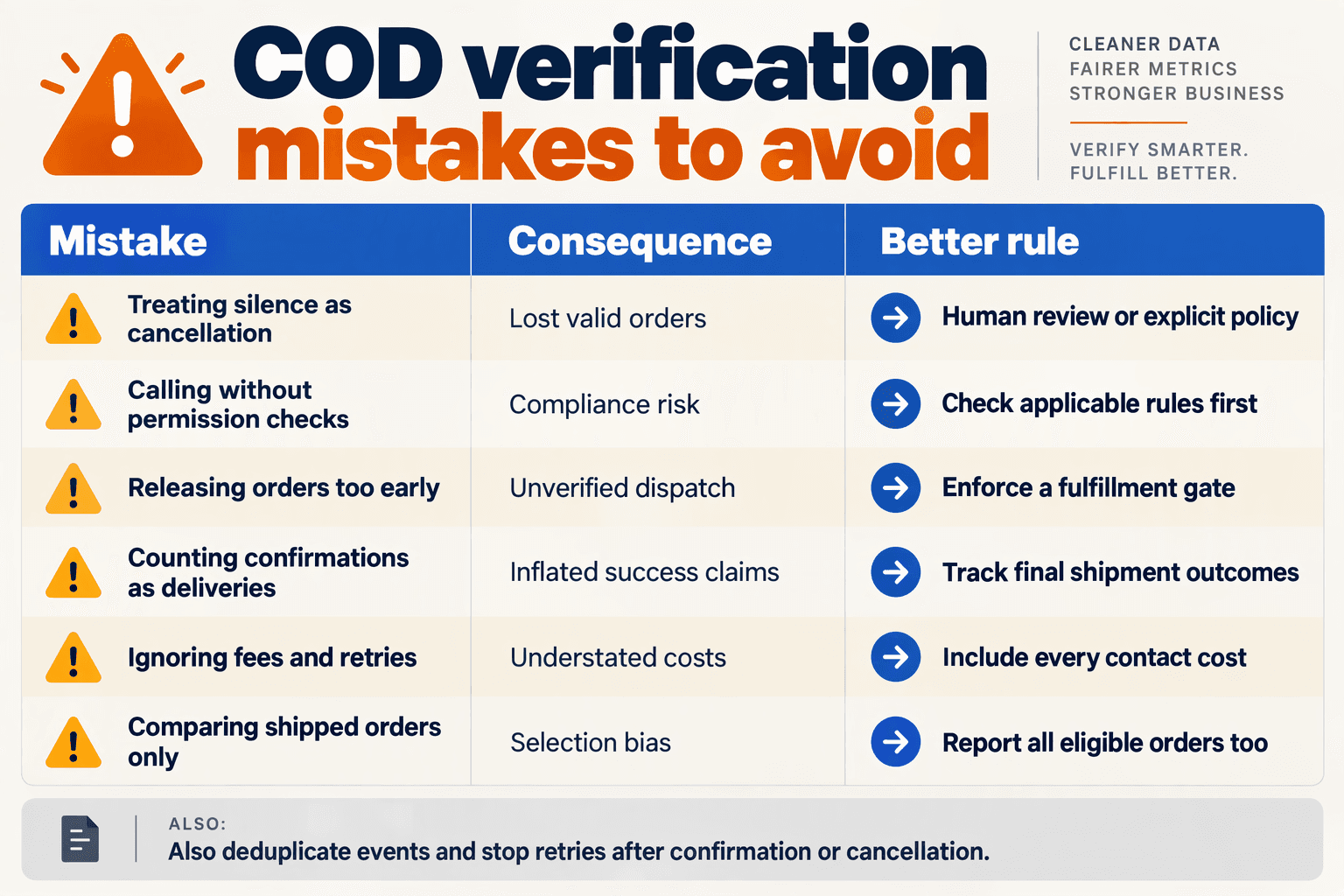
COD verification loses ROI when merchants confuse a reply with delivery intent, cancel genuine orders too aggressively, or measure success using a shrinking shipment denominator. The safest workflow preserves unresolved cases, prevents conflicting actions, and evaluates net contribution—not just confirmation rates or lower RTO percentages.
Which COD verification mistakes should merchants fix first?
Use this November 2026 operational checklist to audit the WhatsApp-and-voice workflow before increasing verification volume.
| Common mistake | Why it undermines ROI | Practical correction | What to monitor |
|---|---|---|---|
| Treating any reply as confirmation | “OK” may acknowledge the message without accepting the order or COD amount. | Ask for explicit acceptance of the displayed order and payable amount; route ambiguous replies for clarification. | Delivered orders by confirmation type |
| Cancelling every non-responder | Silence can reflect timing, connectivity, or language—not lack of buying intent. | Keep an unresolved status and define a review deadline before cancellation. | Non-response cancellations and recovered orders |
| Calling without WhatsApp permission | A checkout phone number is not sufficient evidence of permission for a business-initiated WhatsApp call. | Record permission before initiating a WhatsApp Business call; offer a customer-initiated alternative. | Calls with recorded permission |
| Allowing conflicting order updates | A late confirmation can arrive after cancellation, or an address edit after warehouse release. | Recheck order status before each action; deduplicate events and define a dispatch cutoff. | Duplicate contacts and post-release changes |
| Optimizing RTO percentage alone | Shipping fewer legitimate orders can reduce reported RTO while reducing profit. | Compare delivered orders and net contribution per eligible COD order, including cancellations. | Delivered contribution per eligible order |
| Ignoring full verification costs | Human reviews, integration work, discounts, and voice usage can outweigh avoided freight losses. | Include incremental operating costs and lost contribution in the ROI calculation. | Net savings after all incremental costs |
Why can a lower RTO rate still hide a worse outcome?
A lower RTO percentage does not prove that COD verification increased profitability. Shipway’s FY25 ShipNotes report recorded nearly 26% RTO for non-prepaid orders, according to MediaBrief’s July 29, 2025 coverage; that historical benchmark is not a November 2026 target or a substitute for your store’s baseline.
Consider this illustrative November 2026 scenario, not a reported benchmark:
- Without stricter verification, 100 eligible COD orders produce 80 deliveries and 20 RTOs.
- With stricter verification, 70 orders ship, producing 63 deliveries and seven RTOs.
- Shipment RTO falls from 20% to 10%, but deliveries fall from 80 to 63.
The second workflow might still save money, but the RTO reduction alone cannot establish that. Calculate the margin lost on fewer deliveries alongside avoided fulfilment costs, and compare cohorts only after their delivery outcomes have matured.
How do you prevent automation from amplifying these mistakes?
Build an exception path, rather than forcing every response into “confirmed” or “cancelled.” Test difficult cases before launch:
- Ambiguous language: “Tomorrow” should trigger clarification, not automatic acceptance.
- Multiple orders: Confirmation should identify the specific order, not update every open purchase.
- Late corrections: Address changes after dispatch should enter an operational review, not silently overwrite shipment details.
As of November 2026, CallMissed provides a live shared inbox and a human-handoff queue, where switching off the AI hands the thread to a person. These capabilities support exception handling; merchants still need to define order-state rules, dispatch cutoffs, and cancellation authority.
The governing principle is simple: reduce avoidable failed shipments without making genuine purchases harder to complete.
Frequently Asked Questions
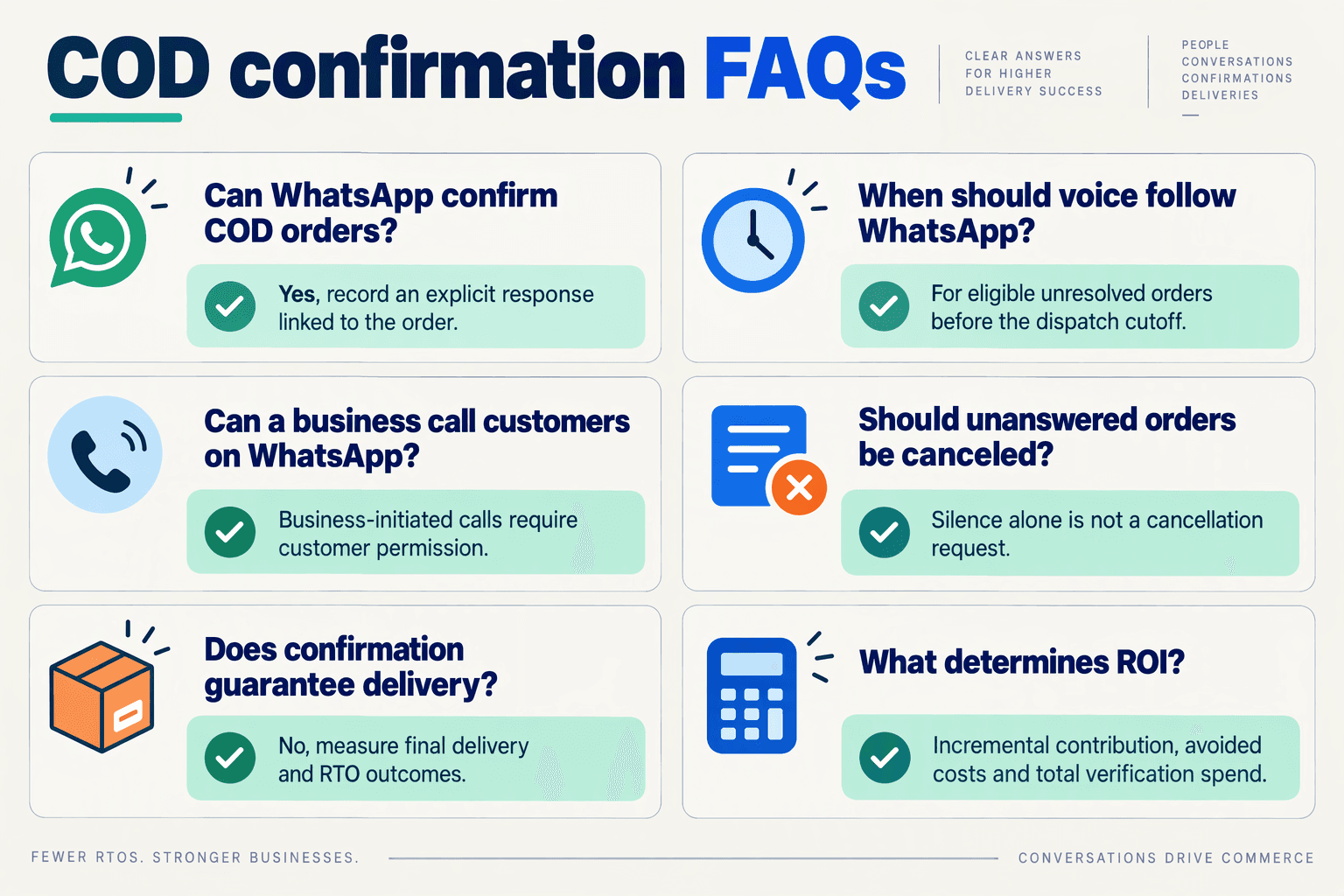
Can WhatsApp COD Confirmation for Shopify confirm an order before dispatch?
What information should a WhatsApp COD confirmation message include?
Keep promotional content separate so that customers can resolve the order quickly, and verify applicable Meta template requirements before sending business-initiated messages.
When should a business call a COD customer?
When should WhatsApp COD Confirmation for Shopify escalate to a voice call?
Do customers need to give permission for WhatsApp Business calls?
How should merchants measure results and handle unanswered orders?
How do you calculate ROI for WhatsApp and voice COD confirmation?
(incremental financial benefit − workflow cost) ÷ workflow cost × 100, using comparable order cohorts rather than counting confirmations as revenue. For a November 2026 evaluation, assemble the calculation in this order: 1. Avoided outbound, return, and handling costs 2. Contribution margin gained or lost through changed delivery outcomes 3. Messaging, voice, integration, and staff costsCompare cohorts with similar products, locations, and acquisition channels, and wait for delivery and return outcomes to mature before declaring savings.
Should unconfirmed COD orders be cancelled automatically?
Which resources and next steps help you launch a measurable pilot?
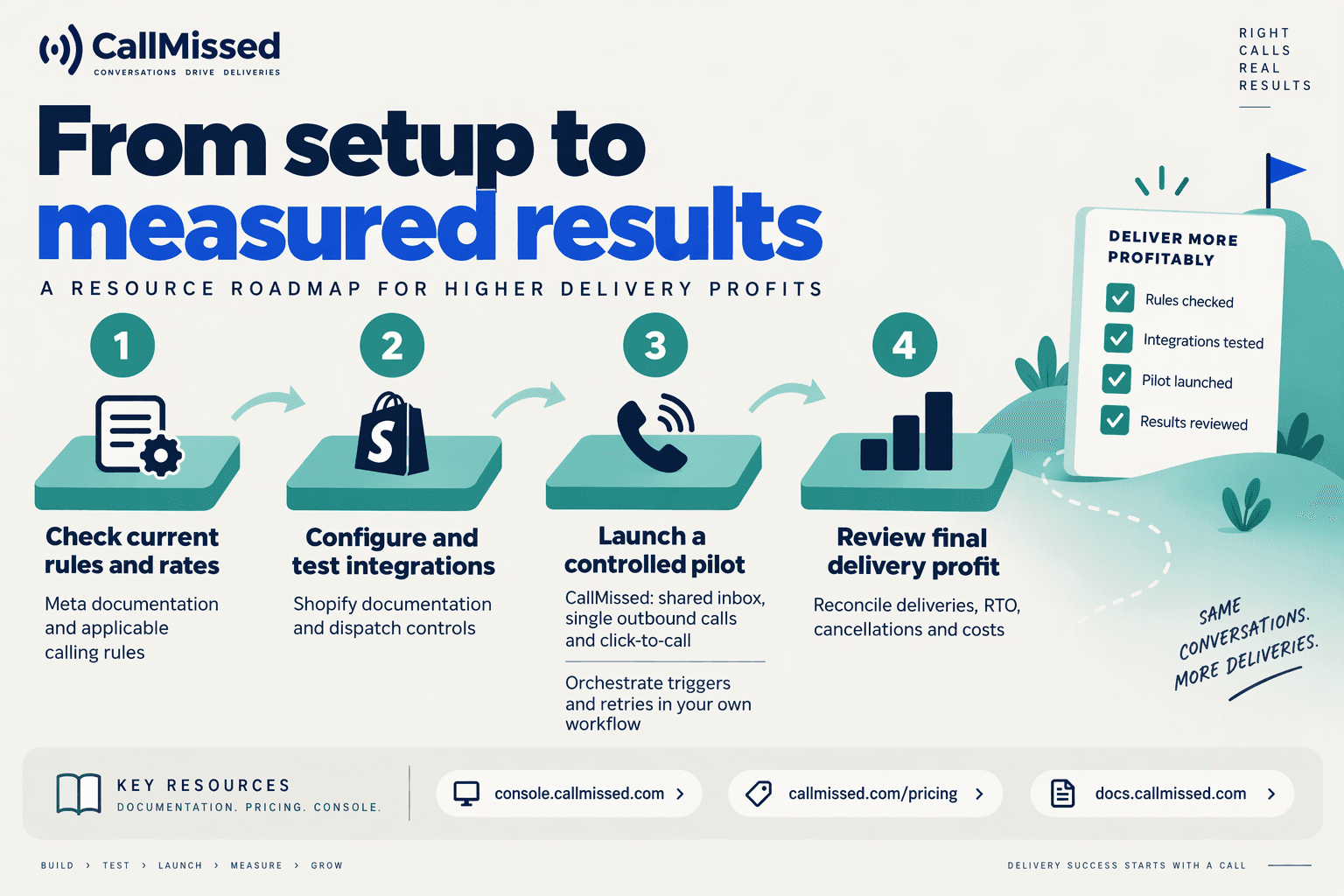
Launch a measurable pilot with a written test plan, official implementation documentation, and an order-level results ledger. Start with a limited COD cohort, retain a comparable control group, and wait for delivery outcomes—not just WhatsApp replies—before deciding whether to expand.
Which resources should your pilot team use?
For a November 2026 launch, assemble a small reference pack that separates implementation requirements from business assumptions:
- Meta’s WhatsApp Business Platform documentation: verify current message-template requirements, messaging charges, and permission requirements for business-initiated WhatsApp calls before activating the workflow.
- Shopify’s developer documentation: review order events, API permissions, and how your integration will record confirmation outcomes without overwriting fulfilment information.
- Your courier invoices and shipment exports: use actual outbound freight, return charges, delivery outcomes, and settlement data to establish store-specific economics.
- Shipway’s ShipNotes report: use the FY25 research, reported by MediaBrief on July 29, 2025, as historical industry context—not as your store’s baseline or a promised improvement.
As of November 2026, CallMissed’s Shopify integration, Meta Cloud API messaging, shared inbox, and permission-based WhatsApp Business Calling provide relevant building blocks for this pilot. Consult CallMissed’s documentation and current pricing to establish integration steps and cost assumptions; these capabilities do not replace the need to define your own experiment.
What should you prepare before contacting customers?
Create a one-page pilot charter that operations, support, and finance can approve. Turn the workflow described earlier into explicit responsibilities:
- Define eligibility: specify the products, delivery regions, order values, and exclusions covered by the test.
- Assign comparable groups: randomly allocate eligible orders where practical; otherwise document differences that could bias results.
- Set handling rules: define response deadlines, permitted voice escalation, human ownership, and dispatch decisions for unresolved orders.
- Specify safeguards: establish limits for complaints, dispatch delays, and cancellations that trigger a pause.
- Name the decision owner: identify who can stop the pilot and who approves expansion.
Complete a dry run with internal test orders first. Check duplicate events, incorrect phone numbers, address corrections, cancellation requests, and human handoff—not merely the successful confirmation path.
How should you schedule and measure the pilot?
An illustrative schedule proposed in November 2026 could allocate three working days to setup, two to internal testing, and fourteen to enrolling eligible orders. Those durations are planning examples, not evidence that two weeks produces statistically reliable results.
Keep outcome tracking open until enrolled shipments have reached a final status. Record:
- Order identity and assignment: order ID, cohort, eligibility date, and treatment or control.
- Workflow exposure: messages, permitted calls, replies, staff time, and communication costs.
- Commercial outcomes: dispatch, delivery, cancellation, RTO, contribution margin, and fulfilment costs.
Measure net contribution per eligible order, alongside shipment-level RTO. Otherwise, cancelling more orders before dispatch can make RTO appear better while reducing profitable deliveries.
What evidence should justify expansion?
Expand only when the pilot improves economics without unacceptable customer friction or operational delays. Report unresolved shipments separately, show group sizes, and distinguish observed results from forecasts.
The final deliverable should be a short decision memo: what changed, what it cost, what remains uncertain, and what to test next. A positive result supports a larger controlled rollout; an inconclusive result supports better measurement—not an unsupported ROI claim.
Conclusion
WhatsApp COD Confirmation for Shopify works best as a message-first, voice-assisted process—not a blanket calling strategy. Its value lies in improving profitable deliveries by checking buyer intent and delivery details before dispatch, without creating unnecessary friction for genuine customers.
The historical case for action is clear: Shipway’s FY25 ShipNotes report recorded nearly 26% RTO for non-prepaid orders, versus under 2% for prepaid orders, according to MediaBrief’s July 29, 2025 coverage. For merchants reviewing operations in November 2026, those figures are a starting point for investigation, not a prediction of their own store’s results. Confirmation cannot eliminate courier failures, but it can help surface address problems, uncertainty about payment, and cancellation requests before fulfilment costs accumulate.
Four practical takeaways should guide implementation:
- Make confirmation simple and actionable. Present the order details and amount payable, then let customers confirm, correct, or cancel. Keep confirmed, cancelled, and unresolved orders distinct so an unanswered message is not mistaken for either acceptance or rejection. The workflow should clarify intent rather than merely collect responses.
- Use voice where conversation adds value. An unclear landmark or apartment number may be easier to resolve through a conversation than repeated messages. Offer customer-initiated calling, use business-initiated calls only with permission, and retain human follow-up for cases that need judgment. Voice should resolve uncertainty, not become an automatic extra step for every buyer.
- Measure delivery outcomes, not just confirmation rates. Track delivered orders, RTO, confirmation costs, and legitimate orders lost through unnecessary friction. A higher response rate is useful only if it contributes to better commercial outcomes. Avoid treating every cancelled shipment as a saving without considering whether the customer could have completed a profitable purchase.
- Calculate net savings using your own costs. In the guide’s illustrative November 2026 example, preventing 20 failed shipments at ₹200 each creates ₹4,000 in gross savings; subtracting ₹1,500 in workflow costs leaves ₹2,500 before other effects. Include messaging, voice, integration, and operating costs rather than comparing avoided freight with messaging charges alone.
What should Shopify merchants watch next?
Looking ahead, watch whether selective voice assistance improves outcomes beyond WhatsApp messaging alone—and whether those gains justify the additional cost and customer effort. The strongest reason to expand a workflow is measured improvement, not simply greater automation.
As of November 2026, CallMissed combines Shopify integration, official Meta Cloud API WhatsApp messaging, and WhatsApp Business Calling with AI voice agents, including permission-based business calls. Readers can explore these capabilities as they evaluate how message-first, voice-assisted confirmation fits their operations.
Start with a measurable pilot: does your confirmation journey produce more profitable deliveries without pushing genuine buyers away?
Related Reading
- COD confirmation voice bot script: WhatsApp and ROI
- WhatsApp voice AI integration: Developer Setup Guide
- Best Omnichannel AI Agent Platform for Voice, WhatsApp, SMS, and Email in 2026