COD confirmation voice bot script: WhatsApp and ROI


Use a COD confirmation voice bot script with WhatsApp handoffs, safe retry rules and an India-specific ROI model to measure delivery gains.
COD confirmation voice bot script: WhatsApp and ROI
What if confirming an order matters more than winning it? A COD confirmation voice bot script, paired with WhatsApp, helps check purchase intent, delivery details, and payment expectations before dispatch—giving sellers a chance to catch avoidable failures while respecting customers who genuinely want cash on delivery.
The stakes are substantial. According to MediaBrief’s coverage of Shipway’s ShipNotes FY25 report, cash-on-delivery orders recorded a 26% return-to-origin (RTO) rate within Shipway’s analysed seller base. That is a useful benchmark, not a universal rate for every Indian merchant.
The newer evidence makes confirmation especially relevant in October 2026. Unicommerce’s India D2C Report, published in April 2026, reports that 58% of COD orders returned during the festive quarter, compared with under 15% of prepaid orders, within its platform dataset. Those return figures should not be treated as interchangeable with Shipway’s RTO measure: different datasets and definitions can tell different stories.
How do WhatsApp and voice work together for COD confirmation?
The practical approach is to make confirmation easy, then use voice where a conversation can resolve uncertainty. A WhatsApp message can present the order summary; a voice interaction can clarify an incomplete address, explain the payable amount, or distinguish “cancel” from “deliver next week.”
This guide walks through:
- The WhatsApp workflow: order details, confirmation choices, unresolved responses, and human escalation.
- The voice script: identify the business, explain the purpose, verify intent, and record the customer’s decision without pressure.
- The compliance boundaries: approved message templates and permission requirements for business-initiated WhatsApp calls.
- The ROI calculation: avoided logistics losses minus messaging, calling, and operational costs.
As of October 2026, Meta’s WhatsApp Business Policy states: “You may only initiate conversations using an approved Message Template.” Confirmation design therefore starts with compliant outreach, not simply a persuasive script.
As of October 2026, CallMissed supports WhatsApp Business messaging through the official Meta Cloud API and WhatsApp Business Calling, including AI voice-agent answers and business calls to customers who have given permission.
For an illustrative—not benchmark—ROI scenario, suppose 1,000 COD orders see RTO fall from 26% to 23%: that means 30 fewer failed shipments. At an assumed ₹150 avoidable cost per failure, savings equal ₹4,500; subtract ₹2,000 in confirmation costs and net savings are ₹2,500, or 125% ROI.
The goal is not more calls. It is better dispatch decisions—and a measured workflow that proves whether confirmation saves more than it costs for your own orders, customers, and delivery conditions.
How does COD confirmation work? Start on WhatsApp, use voice fallback and measure incremental margin
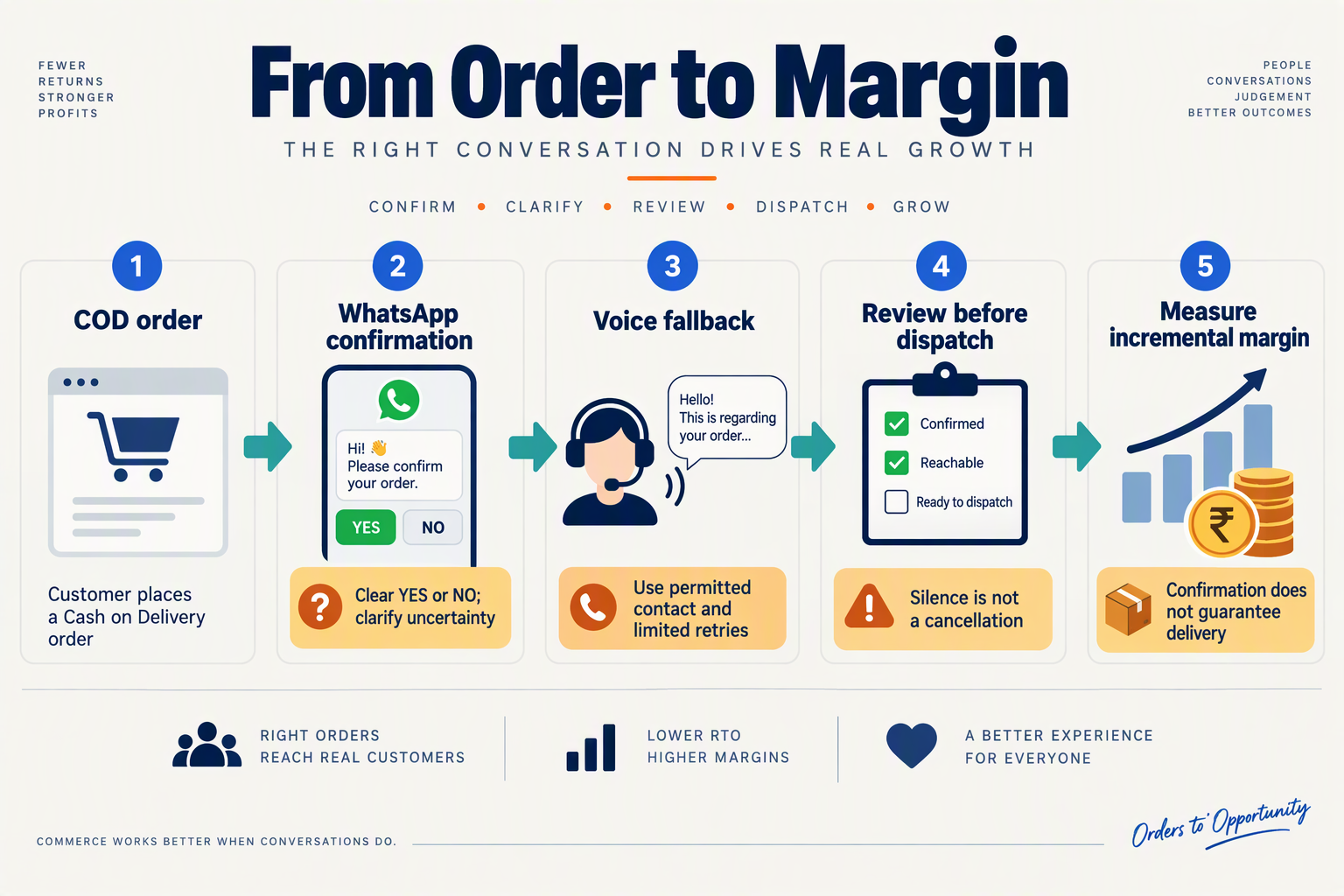
COD confirmation works by collecting an explicit delivery decision on WhatsApp, using voice to resolve unanswered or ambiguous cases, and recording the outcome before dispatch. Judge the workflow by incremental contribution margin per eligible order, not simply by how many customers confirm or how far the reported RTO rate falls.
What should happen between checkout and dispatch?
Treat confirmation as an order-state workflow, with a clear dispatch deadline and an owner for unresolved cases:
- Create a pending-confirmation record. Capture the order ID, items, payable amount, delivery details, and dispatch cutoff. Keep payment status separate: “confirmed” does not mean “paid.”
- Send the WhatsApp confirmation request. Present the order summary and straightforward choices: confirm, request a correction, or cancel. Keep promotional offers out of the operational request.
- Validate the response. An address correction needs checking before release to fulfilment. A question about delivery timing should remain unresolved until answered—not count as confirmation.
- Use voice selectively. Route unclear replies and selected nonresponses to a conversation where contact is permitted. Stop follow-ups once the customer makes a clear decision.
- Write back the final disposition. Use distinct states such as confirmed, correction required, cancellation requested, unreachable, and human review.
No response is not the same as cancellation. Decide in advance whether unreachable orders receive manual review, a temporary hold, or dispatch under your existing policy; otherwise, confirmation can quietly become a source of lost sales.
When should voice replace another WhatsApp reminder?
Voice is most useful when clarification could change the fulfilment decision: an incomplete landmark, confusion about the total, or a request to receive the parcel later. Start a COD confirmation voice bot script with the business name and purpose, then verify intent without pressuring the buyer.
For example: “You requested delivery on Friday. Should we hold the order until then, or would you prefer to cancel?” That produces a more actionable outcome than repeatedly asking, “Please confirm.”
As of October 2026, Meta’s WhatsApp Business Policy allows businesses to respond without a message template within 24 hours of the user’s last message. Design reminders around that boundary rather than assuming an earlier reply permits unrestricted future outreach.
As of October 2026, CallMissed supports WhatsApp message templates synced with Meta, a live shared inbox, and WhatsApp Business calls to customers who have given permission. These capabilities support messaging, clarification, and escalation; they do not imply an automated outbound calling campaign.
How do you measure whether confirmation actually increases margin?
Compare similar orders assigned to confirmation and business-as-usual groups. Where feasible, randomise assignment and retain every assigned order in the analysis—including cancellations and unreachable customers.
Segment results by location and order characteristics. According to MediaBrief’s coverage of Shipway’s ShipNotes FY25 report, Vadodara recorded 18% RTO, while Patna recorded 35% RTO in the analysed dataset. That variation makes an unadjusted before-and-after comparison potentially misleading.
Calculate:
Incremental margin = treatment contribution margin − comparable control contribution margin − incremental confirmation costs.
Include:
- Delivered-order contribution: after product costs and fulfilment charges.
- Failed-delivery costs: forward freight, reverse freight, and handling where applicable.
- Confirmation costs: messaging, voice, staff review, and implementation.
- Lost contribution: genuine orders cancelled or delayed by the workflow.
For an illustrative October 2026 planning example, ₹8,000 in avoided logistics losses minus ₹3,000 in confirmation costs and ₹2,000 in lost contribution produces ₹3,000 incremental margin. Counting only avoided RTO costs would overstate the benefit.
What prerequisites and CallMissed setup does COD verification need?
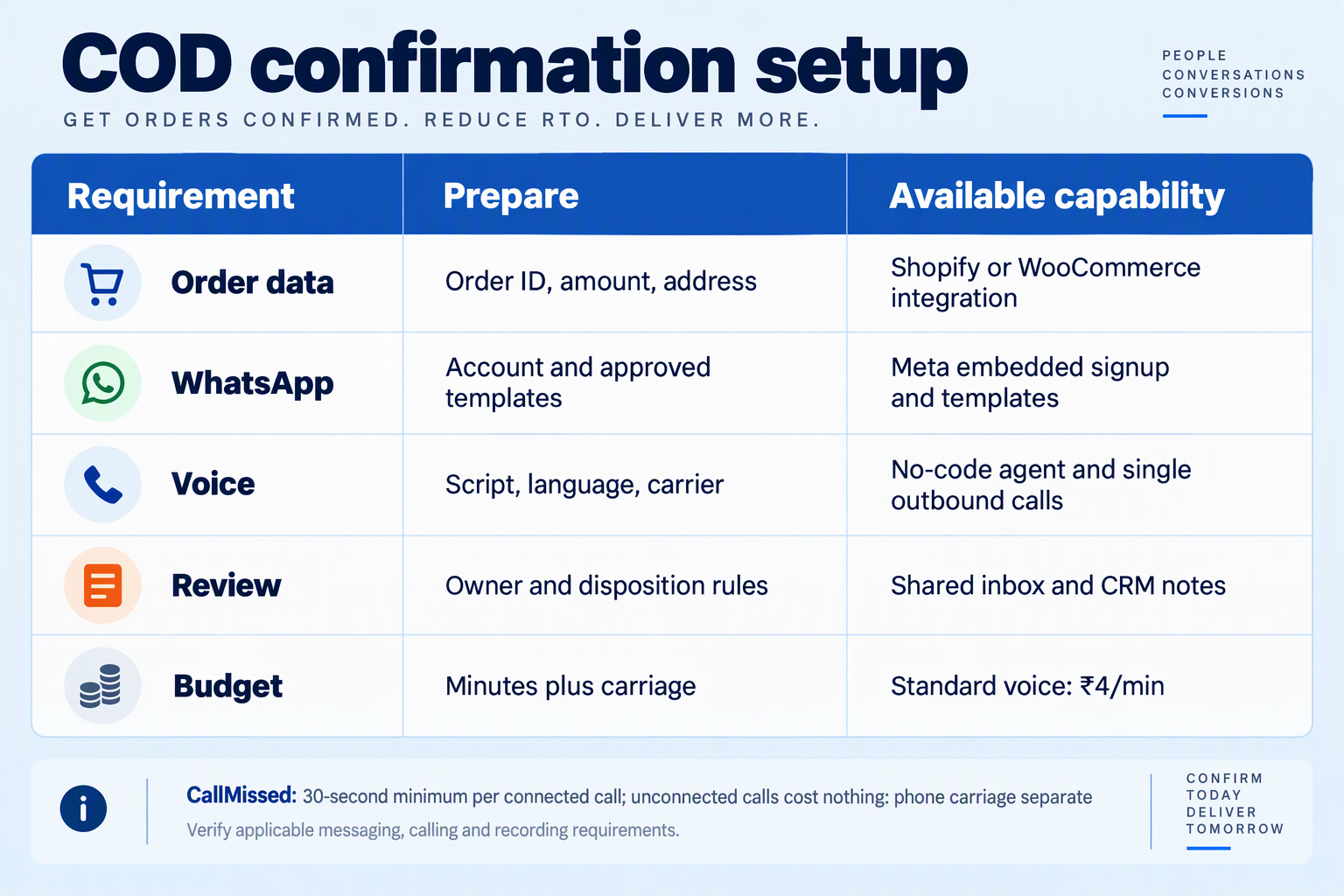
COD verification needs accurate order data, permission-aware outreach, approved WhatsApp templates, a configured voice agent, and a reliable way to record decisions before dispatch. As of October 2026, CallMissed provides Meta embedded signup, a no-code agent builder, Shopify and WooCommerce integrations, and a shared inbox—the building blocks for this workflow, rather than a substitute for your dispatch rules.
What must be ready before COD verification goes live?
The checklist below separates platform configuration from merchant responsibilities. Product capabilities reflect CallMissed’s verified fact sheet as of October 2026; workflow controls are recommended implementation steps.
| Prerequisite | What to prepare | Setup or capability | Go-live check |
|---|---|---|---|
| Order data | Order ID, items, COD amount, phone number and delivery address | Shopify or WooCommerce integration; custom REST tools where needed | Agent retrieves the correct order and payable amount |
| WhatsApp connection | Business account and access for the setup owner | Connect through Meta embedded signup using the official Meta Cloud API | Test messages reach the intended recipient |
| Message template | Clear order summary and confirmation request | Template drafting and syncing with Meta | Template is approved for its intended purpose |
| Calling permission | Evidence of permission for business-initiated WhatsApp calls | WhatsApp Business Calling supports calls to customers who have given permission | Calling eligibility is checked before outreach |
| Voice agent | COD confirmation voice bot script, language, knowledge base and tools | No-code builder with prompts, variables and versioning | Agent handles confirmation, cancellation and uncertainty correctly |
| Outcome handling | Decision fields, review owner and dispatch policy | CRM custom fields, shared inbox and human-handoff queue | An unresolved response cannot silently become “confirmed” |
Connecting an order source is not the same as configuring a dispatch gate. Your commerce or fulfilment workflow must decide how a recorded confirmation, cancellation or unresolved response affects shipment release.
What permissions and messaging rules should the workflow check?
As of October 2026, Meta’s WhatsApp Business Policy permits replies without a message template within 24 hours of the customer’s last message, according to the policy preview supplied in the research context. Treat that window as a messaging rule—not as permission to initiate a WhatsApp call.
Keep separate records for:
- Messaging eligibility: whether outreach complies with the applicable WhatsApp policy.
- Calling permission: whether the customer has authorised a business-initiated WhatsApp call.
- Order outcome: whether the customer confirmed, cancelled, requested a correction or needs assistance.
Do not infer calling permission from a phone number entered at checkout. Also, design outbound voice fallback around supported single calls or click-to-call; automated outbound calling campaigns are not offered.
How should teams test readiness and estimate setup costs?
Run a small test set before enabling dispatch decisions:
- Verify amounts: check that the agent reads the final COD payable amount, not an incomplete subtotal.
- Test ambiguous replies: “next week,” “wrong address” and “I did not order this” should trigger clarification or review.
- Check write-back: ensure the decision reaches the intended record without overwriting unrelated orders.
- Exercise human handoff: confirm that a person can take ownership of unresolved conversations.
According to CallMissed’s verified fact sheet, as of October 2026, flat-rate voice-agent plans cost ₹4, ₹5 or ₹6 per minute, depending on the selected tier, with a 30-second minimum per call; phone carriage is billed separately. Budget messaging and operational costs separately, and establish your own baseline for confirmation rate, handling cost and subsequent RTO before judging ROI.
What is the step-by-step WhatsApp-to-voice escalation workflow?
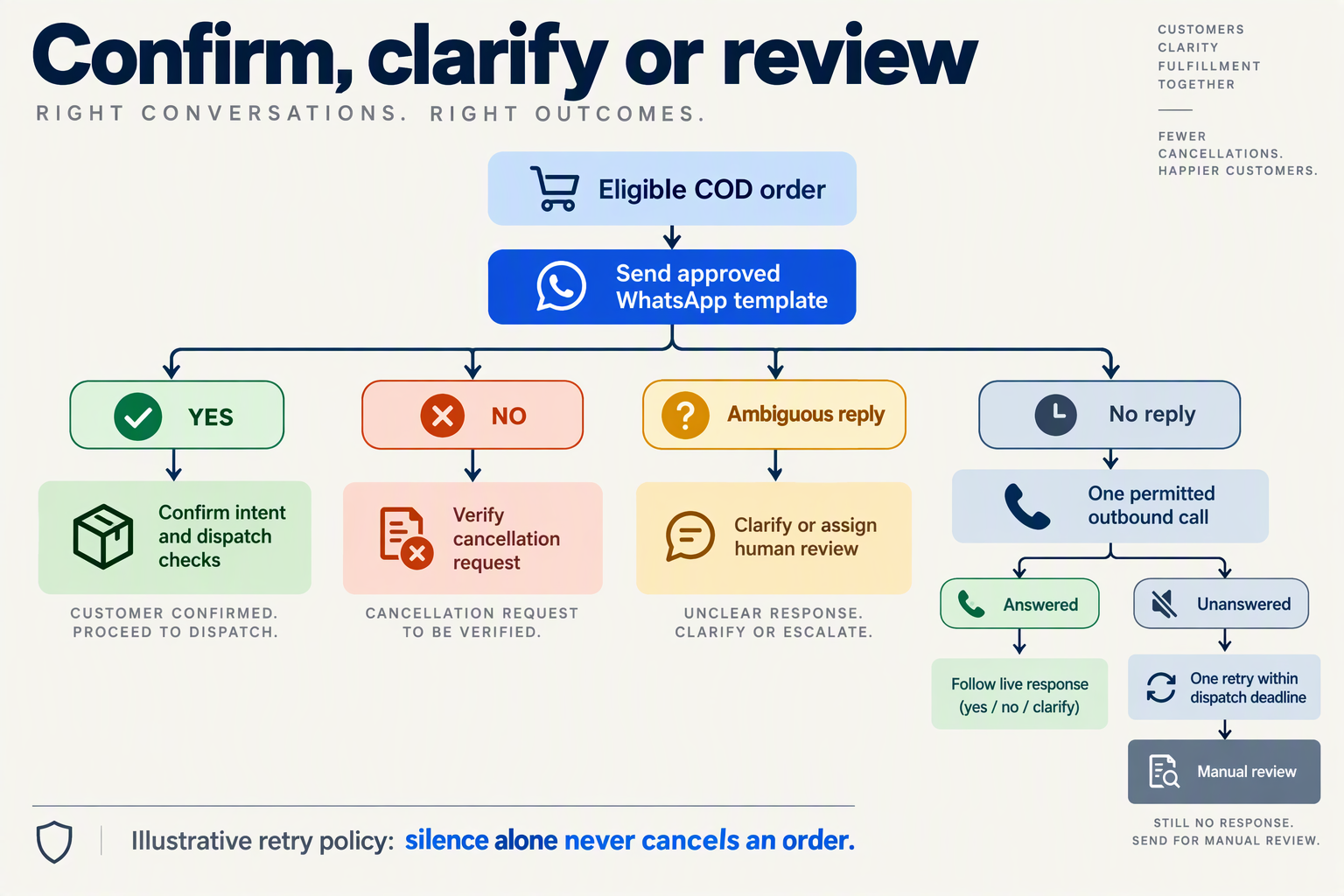
Start with an order-specific WhatsApp message, record the customer’s response, and escalate only unresolved cases to voice. The workflow should end with a clear dispatch decision—not merely a “message delivered” or “call completed” event.
How do you prepare and send the COD confirmation message?
- Create a confirmation record before outreach.
Link the order ID, customer contact, items, COD amount, delivery address, dispatch deadline, and current confirmation status. Check whether the order has already been cancelled, confirmed, or dispatched so duplicate events do not trigger unnecessary contact.
- Send a compliant, actionable WhatsApp message.
Present the essential details and offer three choices: Confirm order, Change details, and Cancel order. Keep promotional content out of the confirmation request.
An illustrative October 2026 message, not a pre-approved template, could read: “Your order #4821 from [Store] totals ₹1,299, payable on delivery. Please confirm, request a correction, or cancel before we dispatch.”
As of October 2026, Meta’s WhatsApp Business Policy permits replies without a message template within 24 hours of the customer’s last message; outreach outside that customer-service window requires an approved template. Build that window check into the messaging logic rather than leaving operators to remember it.
Which responses should trigger voice escalation?
- Route the response by intent, not just keywords.
A confirmation can move to dispatch review; a cancellation should stop fulfilment under the merchant’s cancellation policy. Address corrections and ambiguous replies need resolution before confirmation.
Use explicit operational states:
- Confirmed: purchase intent and essential delivery details are clear.
- Correction needed: an address, amount, item, or timing issue remains.
- Cancelled: the customer explicitly declines the order.
- Awaiting response: no customer decision has been received.
- Human review: a complaint, conflicting instruction, or unsupported request needs staff attention.
“Okay, but send it next Friday” is a scheduling request—not unconditional confirmation.
- Escalate only when a conversation can resolve the issue.
Choose an escalation point relative to the dispatch cutoff and your observed response times. Non-response, repeated confusion, or an unresolved correction can justify offering a call; silence alone should not become consent or cancellation.
For business-initiated WhatsApp calls, obtain the required customer permission first. Alternatively, invite the customer to call the business. As of October 2026, CallMissed supports AI voice-agent answers to customer-initiated WhatsApp Business calls and business calls to customers who have given permission; treat these as individual escalation actions, not an assumed automated outbound campaign.
What should happen during and after the confirmation call?
- Use a short, decision-focused voice script.
The COD confirmation voice bot script should identify the store, explain the confirmation purpose, verify purchase intent, and clarify only the unresolved details. Confirm the payable amount without requesting payment credentials.
If the customer changes an address or delivery preference, repeat the correction and check whether fulfilment can support it. Escalate uncertainty rather than promise an unavailable delivery date.
- Write back the outcome and enforce the dispatch rule.
Record the decision, correction, timestamp, channel, and unresolved issue against the order. Recheck the latest order status before releasing fulfilment, because a cancellation may arrive while a call is underway.
Track confirmation rate, escalation rate, human-review rate, contact cost per order, and time to decision. These measures reveal whether voice resolves genuine uncertainty—or simply adds expense and delays to orders WhatsApp already confirmed.
What should a COD confirmation voice bot script say, and when should it hand off?
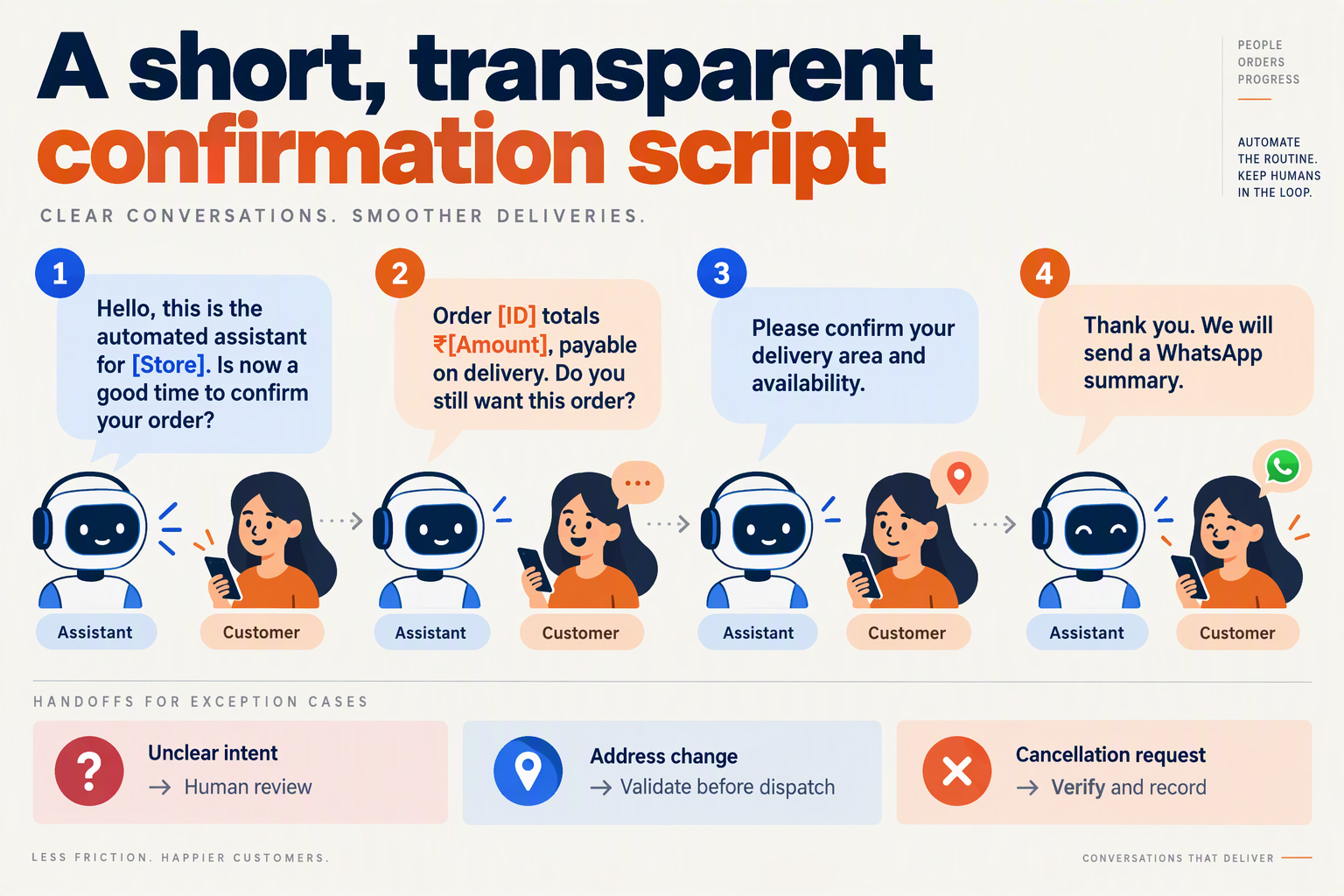
A COD confirmation voice bot script should identify the seller and AI assistant, verify that the customer can speak, confirm the order and payable amount, and capture a clear decision. Hand off when the customer requests a person, disputes the order, needs an exception, or remains unclear after a brief clarification—not whenever the conversation becomes inconvenient.
What should the bot say when confirming a COD order?
Use this illustrative script, replacing every placeholder with verified order data. The ₹1,299 amount is an example, not a pricing benchmark.
- Introduce the business and disclose automation.
“Hello, I’m [Store]’s automated assistant calling about your recent order. Am I speaking with [first name], and is now a convenient time for a quick confirmation?”
If someone else answers, do not disclose the purchase details. Ask for the customer or end the call.
- Confirm intent and the total.
“Your order is for [item and quantity], with ₹1,299 payable on delivery, including [applicable charges]. Would you like us to proceed?”
Accept confirmation, cancellation, or a request for help without trying to pressure the customer into accepting delivery.
- Check only the delivery details that need attention.
“The delivery postcode is [postcode]. Is that correct? Is there a missing landmark or address detail we should review?”
Avoid reading the entire address aloud unnecessarily. Treat substantive changes as pending validation, not automatically approved.
- Clarify payment expectations.
“Payment is due when the order arrives. The available payment methods are [verified methods]. Does that work for you?”
Never promise doorstep UPI, parcel opening, refunds, or a delivery date unless the merchant’s actual policies support them.
- Read back the outcome.
“You’ve confirmed that you want the order delivered for ₹1,299. I’ll record your confirmation.”
For cancellation or rescheduling, distinguish a request received from a change successfully completed.
When should a COD confirmation bot hand off to a human?
Use explicit escalation rules rather than letting the model improvise commercial decisions:
- Customer requests a person: honour the request without another confirmation loop.
- Order or amount dispute: pause confirmation if the customer denies ordering, reports duplicate orders, or challenges charges.
- Policy exception: escalate discounts, urgent delivery, refunds, or changes outside approved rules.
- Unresolved understanding: after one short clarification attempt, route uncertain speech or conflicting answers for review.
- Sensitive or distressed interaction: stop persuasion and offer human support.
“One clarification attempt” is a suggested operating rule, not an industry benchmark. As of October 2026, CallMissed supports live-call transfers between agents and supervisor monitoring with listen, whisper, and barge-in capabilities; teams should separately define how their human escalation process operates.
What should the bot record before dispatch?
Record confirmed, cancellation requested, change requested, callback requested, or unresolved, together with the reason and any validated corrections. Silence, a disconnected call, and “maybe” must never become confirmation.
MediaBrief’s coverage of Shipway’s FY25 ShipNotes reports city-level RTO rates of 18% in Vadodara and 35% in Patna within its analysed seller base. Those historical differences support measuring outcomes by delivery context—not treating a customer’s city as proof of purchase intent.
The practical safeguard is simple: dispatch decisions should follow the customer’s explicit response and verified order data, while exceptions remain visible to an accountable human.
How do you calculate COD confirmation ROI and break-even in rupees?
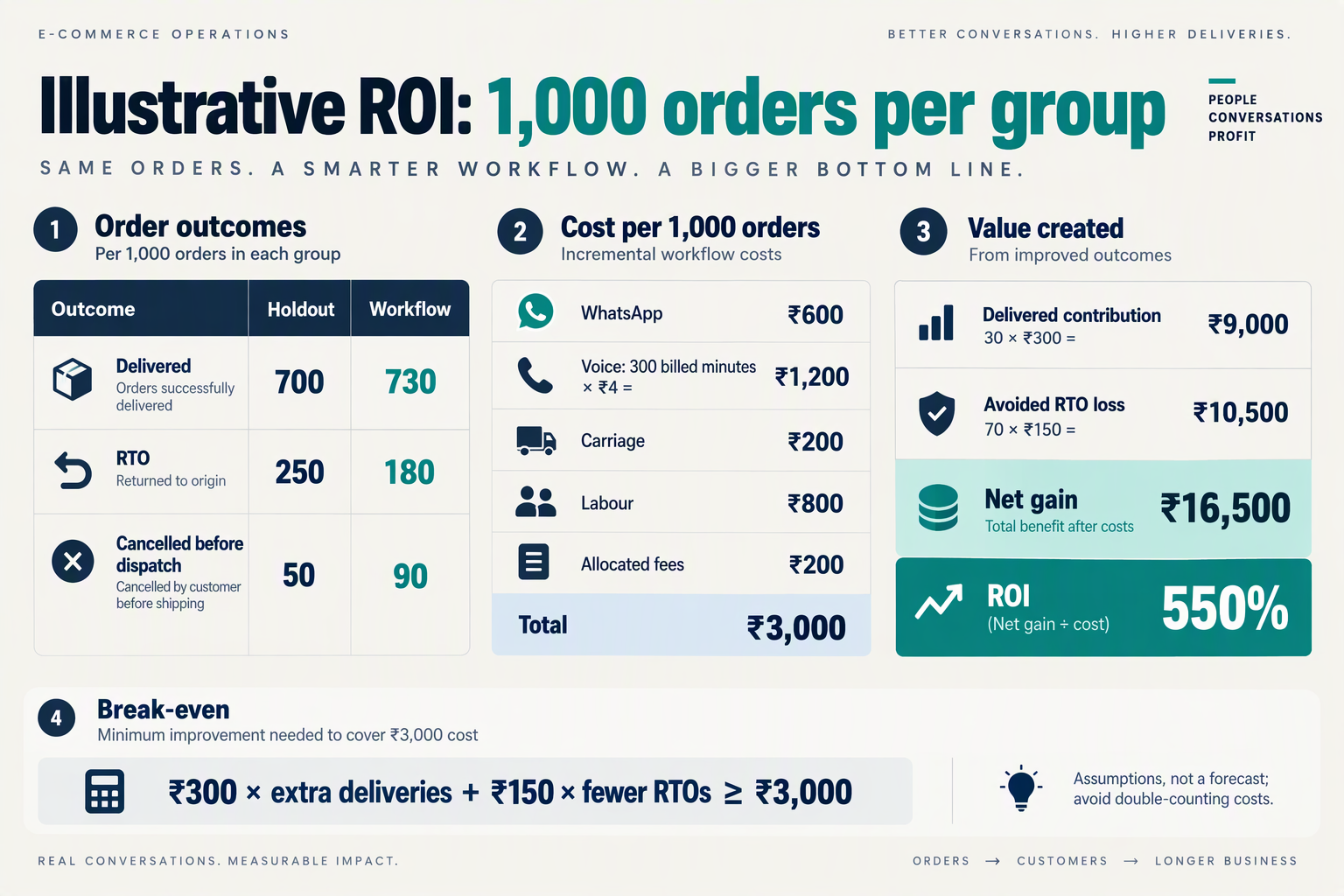
Calculate COD confirmation ROI as incremental profit attributable to confirmation, minus the full workflow cost, divided by that cost. Break-even occurs when avoided losses and additional contribution margin cover WhatsApp, voice, human handling, and implementation expenses.
Which costs belong in your COD confirmation ROI calculation?
Use avoidable costs, not the order’s selling price. A ₹1,500 cancelled order does not automatically represent ₹1,500 saved—or lost.
Build the calculation from your courier invoices and order-level accounts:
- Avoided failure cost: forward freight, reverse freight, packaging or handling genuinely avoided, and any applicable non-refundable charges.
- Additional contribution margin: revenue from genuinely recovered deliveries minus product cost, fulfilment, payment charges, and other variable expenses.
- Confirmation cost: WhatsApp messaging, AI voice usage, telephone carriage, human escalations, integration, and ongoing maintenance.
- Adverse effects: contribution lost when confirmation incorrectly blocks a customer who would otherwise have accepted delivery.
Do not count the same shipping saving twice within avoided losses and contribution margin. Allocate one-time setup costs across a stated period, such as three months, rather than silently excluding them.
What does a worked rupee calculation look like?
Consider this illustrative October 2026 monthly scenario—not an industry benchmark:
- Eligible COD orders: 10,000.
- Failed shipments avoided versus a comparable control: 300.
- Avoidable cost per failed shipment: ₹180.
- Gross logistics savings: 300 × ₹180 = ₹54,000.
- Total incremental confirmation cost: ₹18,000.
An illustrative ₹18,000 cost budget could contain:
- ₹6,000 for AI voice usage.
- ₹5,000 for WhatsApp messaging and telephone carriage.
- ₹4,000 for additional human handling.
- ₹3,000 for allocated setup and maintenance.
As of October 2026, CallMissed’s verified pricing lists its Standard voice-agent plan at ₹4 per minute, covering speech recognition, the language model, and voice, with a 30-second minimum per connected call and telephone carriage billed separately. For illustration, 2,000 connected calls lasting exactly 45 seconds each would therefore cost ₹6,000 in voice-agent usage; actual budgeting should use each call’s billable duration.
With no additional margin gains or cancellation losses:
Net benefit = ₹54,000 − ₹18,000 = ₹36,000.
ROI = ₹36,000 ÷ ₹18,000 × 100 = 200%.
If incorrect cancellations instead destroy ₹3,000 of contribution, net benefit falls to ₹33,000 and ROI to approximately 183%.
How many avoided RTOs do you need to break even?
For a logistics-only calculation:
Break-even avoided failures = total confirmation cost ÷ avoidable cost per failure.
Here, ₹18,000 ÷ ₹180 = 100 avoided failures, equivalent to 1 percentage point across 10,000 eligible orders. Round fractional results up to the next whole shipment.
This threshold changes with your shipping economics. MediaBrief’s coverage of Shipway’s ShipNotes FY25 report gives RTO rates of 18% in Vadodara and 35% in Patna within the analysed seller base, reinforcing why one national assumption should not determine every merchant’s budget.
How do you prove the savings are incremental?
Randomly split comparable eligible orders into confirmation and control groups, then wait for delivery and RTO outcomes to mature. Keep courier, geography, basket value, and dispatch timing comparable.
Measure profit per original eligible order, not just RTO among dispatched orders: aggressive cancellation can improve the headline RTO rate while reducing profit. Scale the COD confirmation voice bot script only when the experiment shows positive incremental contribution after every workflow cost.
How should you compare WhatsApp-only, voice-only and hybrid confirmation against a holdout?
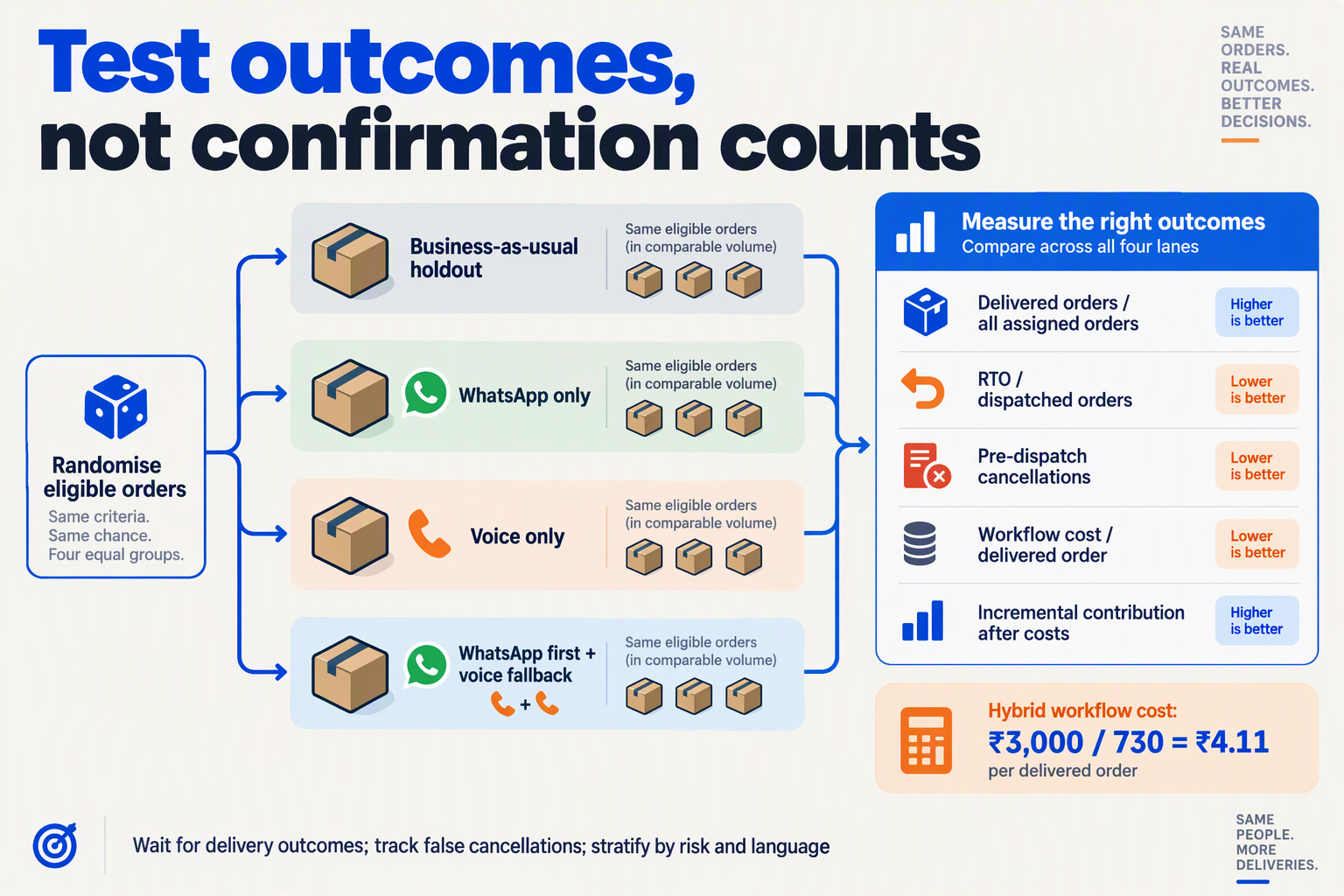
Compare WhatsApp-only, voice-only and hybrid COD confirmation with a randomly assigned holdout using net contribution per eligible order, not confirmation rate alone. The winning workflow should improve profit after outreach costs without increasing delivery delays, complaints or unnecessary cancellations.
How should you assign orders to the four test groups?
Run all four groups concurrently so festive demand, courier performance and stock availability affect each arm similarly. Define eligibility before assignment, including the permissions required for each channel; otherwise, differences in contactability can masquerade as treatment effects.
- Holdout: Continue your existing order-processing workflow without the additional confirmation intervention. Do not remove normal customer support or essential order updates.
- WhatsApp-only: Send the approved confirmation message and handle replies without voice fallback.
- Voice-only: Use the COD confirmation voice bot script without WhatsApp confirmation outreach.
- Hybrid: Start with WhatsApp, then use voice only when a predefined trigger occurs, such as an unresolved response before the dispatch deadline.
Specify whether “voice” means telephone calls or WhatsApp Business Calling. As of October 2026, CallMissed supports both phone calls and permission-based business-initiated WhatsApp calls; these are distinct routes and should not be mixed silently within one experimental arm.
Randomise at the customer level where repeat buyers are common, keeping each customer in the same group. Balance groups across order value, new versus repeat buyers, geography and courier.
Geographic balancing matters: MediaBrief’s coverage of Shipway’s ShipNotes FY25 reports RTO rates of 18% in Vadodara and 35% in Patna within Shipway’s analysed seller base. Those historical differences are a reason to control the experiment’s mix—not predictions for October 2026 orders.
Which metrics show whether confirmation actually helps?
Use intention-to-treat analysis: count every eligible order in its assigned group, including customers who never answer. Comparing only confirmed orders would favour workflows that filter out difficult customers.
Track these outcomes:
- Primary: Net contribution per assigned order—realised revenue minus relevant product, fulfilment, return, outreach and operational costs.
- Delivery: Delivered orders per assigned order and RTO per dispatched order, with both denominators stated.
- Cancellation: Pre-dispatch cancellations, including confirmed customer requests and merchant-initiated cancellations.
- Guardrails: Dispatch delay, complaints, opt-outs and human-handling time.
A lower RTO percentage is not automatically a win. Cancelling genuine orders can reduce failed shipments while destroying profitable deliveries, which is why delivered-order contribution must remain in the calculation.
How do you calculate incremental value against the holdout?
Consider this illustrative October 2026 test, not a benchmark: each arm receives 1,000 eligible orders, and contribution totals already include all confirmation costs.
- Holdout: ₹80,000, or ₹80 per order.
- WhatsApp-only: ₹86,000, or ₹86 per order.
- Voice-only: ₹83,000, or ₹83 per order.
- Hybrid: ₹90,000, or ₹90 per order.
Hybrid delivers ₹10 incremental contribution per order against holdout, but only ₹4 against WhatsApp-only. That second comparison answers whether voice fallback earns its additional complexity.
When is the result strong enough to roll out?
Before launch, choose the smallest worthwhile contribution uplift and calculate sample size from your baseline variability. Do not assume 1,000 orders per arm is sufficient.
Wait until delivery, RTO and billing outcomes mature, then report confidence intervals alongside average uplift. Roll out the simplest workflow that produces a credible contribution gain while keeping customer-experience guardrails intact.
Which advanced tactics improve confirmation without increasing customer friction?
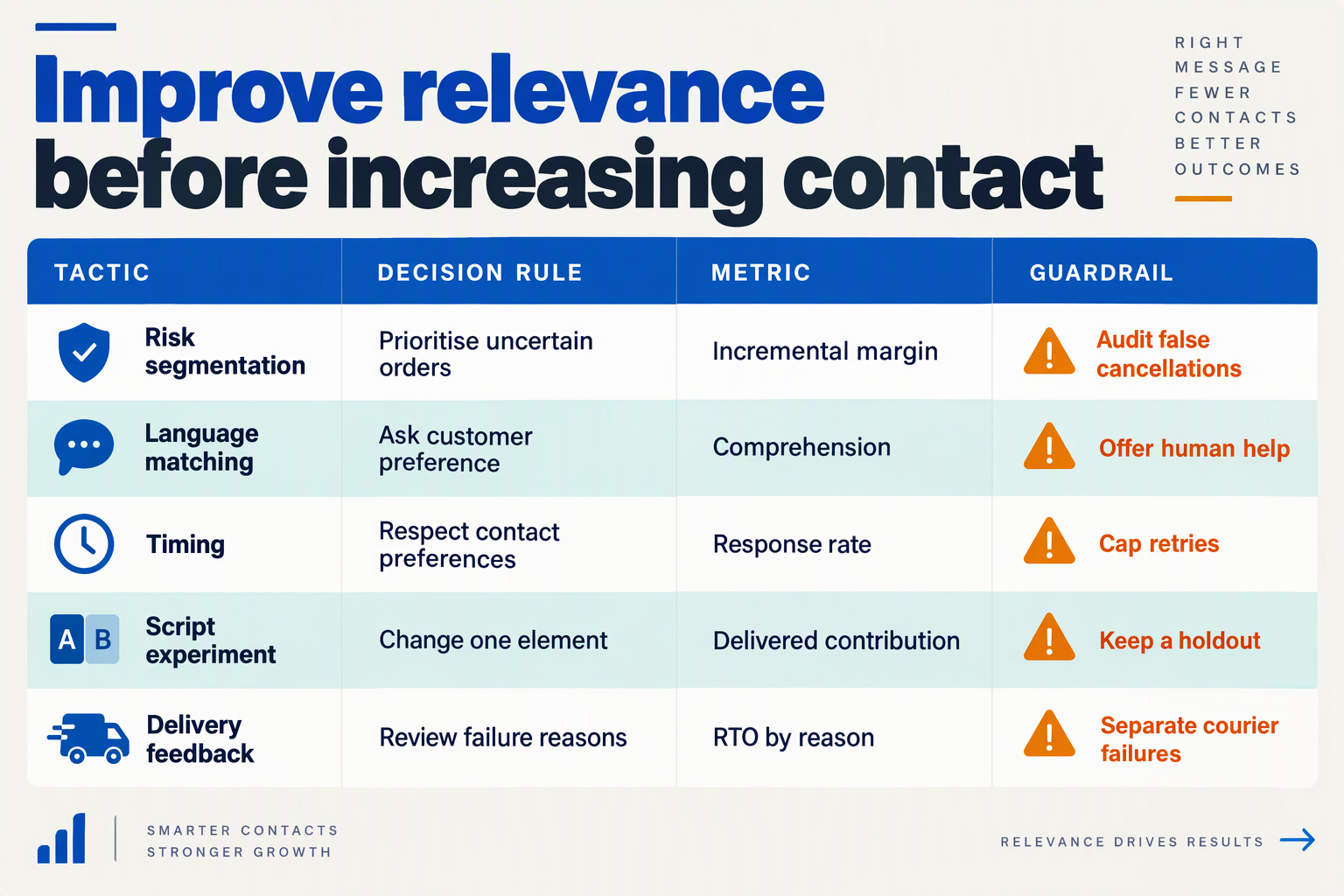
Selective escalation, minimal data entry, and immediate stop rules can improve COD confirmation without adding unnecessary customer effort. Treat each tactic as a testable workflow choice—not a proven RTO reduction—and optimise for incremental margin per order, rather than confirmation rate alone.
Which advanced COD confirmation tactics are worth testing?
The following recommendations are for an October 2026 workflow design. Start with one or two changes so that any improvement can be attributed to a specific intervention.
| Tactic | Workflow change | Friction safeguard | Measure |
|---|---|---|---|
| Risk-based escalation | Prioritise unresolved orders with missing address details or previous delivery failures. | Do not require extra verification solely because of a postcode. | Margin per eligible order |
| Correct only the mismatch | Show existing delivery details and ask which field needs changing. | Avoid making customers re-enter the entire address. | Correction completion rate |
| Customer-chosen timing | Offer “Confirm now” or a preferred callback window. | Honour the selected window; suppress overlapping outreach. | Contacts per resolved order |
| Language continuity | Carry the customer’s language preference from WhatsApp into voice. | Offer a language switch or human help when understanding fails. | Misunderstanding rate |
| Explicit ambiguity handling | Route “maybe,” “later,” or conflicting answers to clarification. | Never translate silence or uncertainty into confirmation. | Disputed confirmations |
| Immediate outcome suppression | Stop confirmation outreach after a recorded confirmation, cancellation, or agreed follow-up. | Check the latest order state before each new contact. | Duplicate-contact rate |
Risk segmentation needs local validation. MediaBrief’s coverage of Shipway’s ShipNotes FY25 report, referenced as of October 2026, reports city-level RTO rates of 18% in Vadodara and 35% in Patna within Shipway’s analysed seller base. That variation supports investigating operational differences; it does not justify assuming an individual customer is unreliable because of their city.
Use signals that suggest a resolvable problem. An incomplete house number points toward address clarification, while a previous failed delivery may warrant asking about availability—not demanding prepayment.
How can WhatsApp and voice share context without asking customers twice?
Carry the order state, last customer answer, and unresolved issue into the next interaction. The voice agent should address the remaining question instead of restarting the full COD confirmation voice bot script.
For example: “You asked to update the landmark for order 4821. What landmark should the courier use?” That is more useful than repeating product details, payment expectations, and questions the customer has already answered.
As of October 2026, CallMissed supports WhatsApp Flows for multi-screen in-chat forms, speech recognition in 22 Indian languages plus English, including Hinglish, and per-contact agent memory. These capabilities can support focused corrections and contextual conversations, but the merchant still needs to define order-state checks and escalation rules.
How do you test improvements without mistaking fewer shipments for better ROI?
Compare each tactic against the existing workflow using similar eligible orders and the same observation period. Include delivery outcomes: a higher confirmation rate is not valuable if it produces more failed shipments.
Track three guardrails alongside financial results:
- Customer effort: attempts per order, repeated questions, and correction abandonment.
- Decision quality: disputed confirmations, accidental cancellations, and unresolved answers.
- Commercial impact: delivered-order margin minus confirmation and failed-delivery costs.
An illustrative October 2026 test—not an industry benchmark might cap outreach at two attempts, with the second reserved for unresolved orders. Compare that design with your current approach; adopt it only if net margin improves without unacceptable losses in genuine orders or customer experience.
Which mistakes distort COD ROI or put WhatsApp and voice outreach at risk?
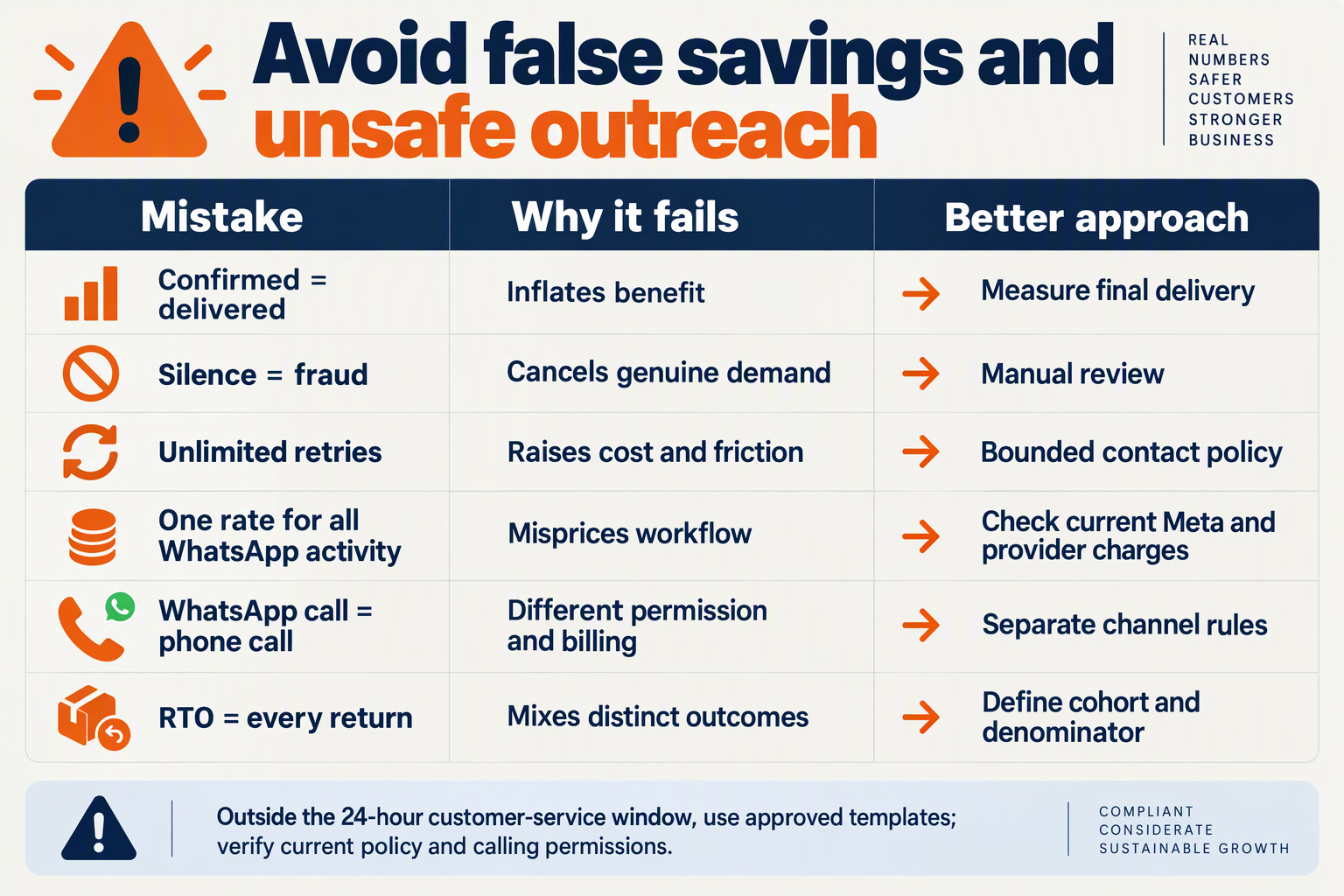
The biggest COD ROI mistakes are counting cancelled orders as savings, comparing mismatched cohorts, and omitting outreach costs. WhatsApp and voice outreach also become risky when teams confuse message-template approval with calling permission or treat an unanswered confirmation as consent to dispatch—or cancel.
Which measurement and outreach mistakes should you audit?
Use this checklist before scaling a COD order confirmation via WhatsApp and voice workflow. The safeguards below are operational recommendations as of October 2026, not guaranteed performance improvements.
| Mistake | Why it distorts ROI or creates risk | Practical safeguard |
|---|---|---|
| Counting every cancellation as avoided RTO | Some cancelled customers would have accepted delivery; lost contribution can outweigh saved freight. | Measure delivered-order contribution alongside avoided logistics costs. |
| Comparing different customer cohorts | Geography, acquisition source, product mix and seasonality can explain the apparent improvement. | Use concurrent comparison groups with similar order characteristics. |
| Mixing returns with RTO | Post-delivery returns and failed deliveries represent different outcomes and costs. | Define each metric separately and keep denominators consistent. |
| Excluding confirmation expenses | Voice, messaging, phone carriage and staff handling can consume the savings. | Reconcile invoices and human-handling costs against the experiment ledger. |
| Treating an approved template as call permission | Message approval does not establish permission for a business-initiated WhatsApp call. | Track messaging eligibility and WhatsApp calling permission separately. |
| Repeatedly contacting silent customers | Nonresponse may reflect timing, language or accessibility—not purchase refusal. | Set attempt limits, honour stop requests and route ambiguity to a person. |
Why can a lower RTO rate still hide worse economics?
A lower RTO percentage is not automatically evidence of higher profit. If confirmation blocks genuine buyers from dispatch, failed shipments may fall while profitable deliveries fall too.
MediaBrief’s coverage of Shipway’s ShipNotes FY25 report records RTO rates of 18% in Vadodara and 35% in Patna within the analysed seller base. That geographic spread illustrates why a treatment group concentrated in one city should not be compared with a control group concentrated in another.
For an illustrative October 2026 calculation, suppose outreach prevents ten failed shipments at ₹150 avoidable cost each, but also cancels five orders that would have generated ₹250 contribution each. The ₹1,500 logistics saving becomes just ₹250 before confirmation expenses—not ₹1,500 of incremental profit.
Audit three things:
- Original-order denominator: retain every eligible order, including pre-dispatch cancellations.
- Outcome maturity: wait until delivery, RTO and relevant return outcomes are sufficiently settled.
- Cost boundaries: avoid counting the same shipping charge both as an avoided expense and inside contribution margin.
Which permission and billing assumptions need extra care?
As of October 2026, Meta’s WhatsApp Business Policy states that approved message templates must “only be used for [their] designated purpose.” Adding unrelated promotional content to an order-confirmation message therefore creates a different compliance question from simply confirming purchase intent.
Keep a permission record that distinguishes the channel, purpose and customer decision. An ordinary telephone fallback also needs its own applicable consent and outreach review; WhatsApp calling permission should not be treated as blanket permission for every channel.
As of October 2026, CallMissed’s Standard voice-agent plan costs ₹4/minute, with a 30-second minimum per connected call and phone carriage billed separately, according to CallMissed’s verified product facts. A ten-second connected call therefore has a ₹2 minimum voice-agent charge on that plan, before carriage.
The final safeguard is simple: approve expansion only when incremental contribution remains positive after all confirmation costs, rather than when the dashboard merely shows fewer RTOs.
Frequently Asked Questions
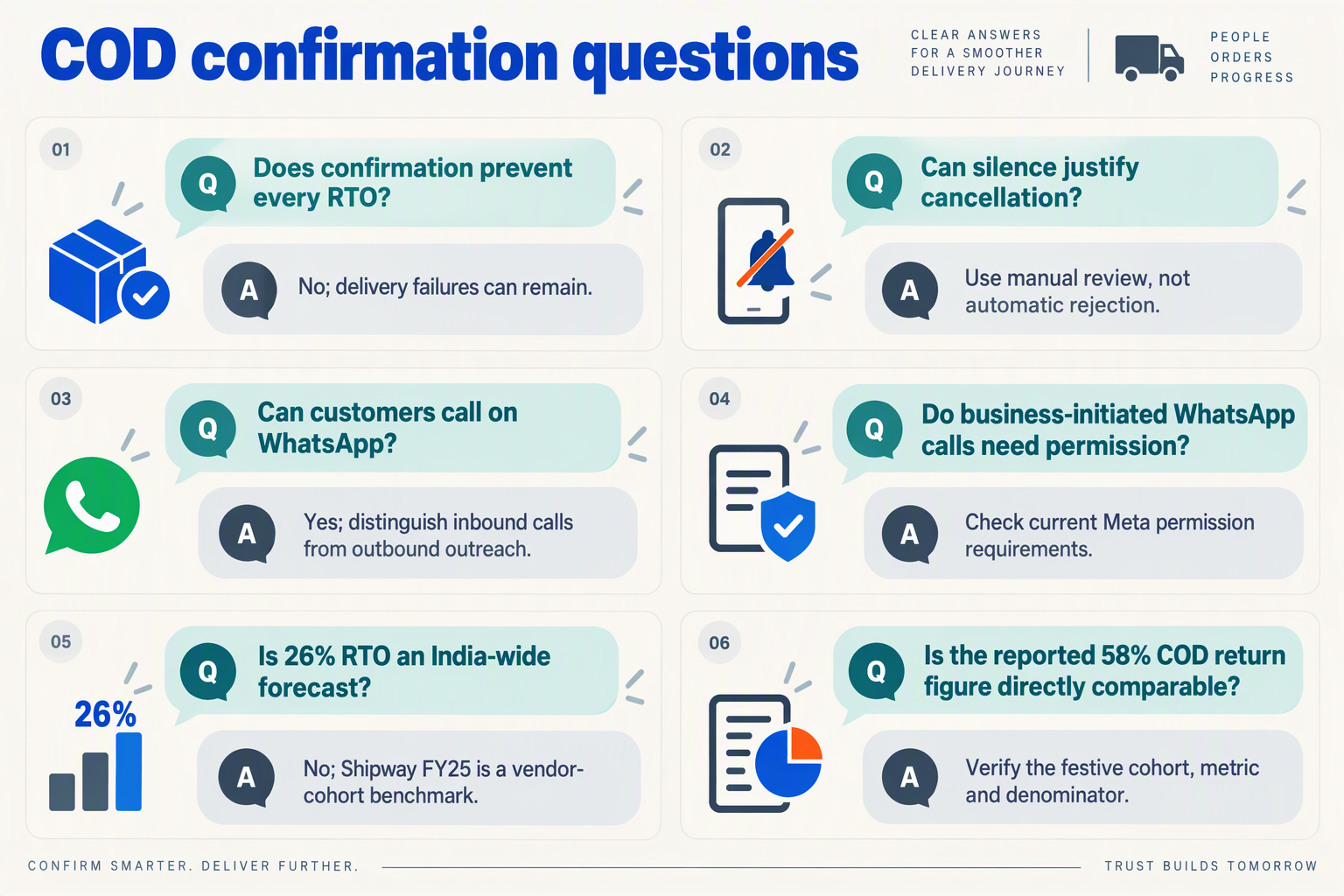
What should a COD confirmation voice bot script ask before dispatch?
Can a business make WhatsApp calls to confirm COD orders without permission?
What should a COD confirmation voice bot script do when the customer does not respond?
What is a realistic RTO benchmark for COD orders in India?
Are customer-initiated WhatsApp confirmation calls free for the business?
How do you measure whether WhatsApp and voice COD confirmation delivers positive ROI?
Which resources and next steps help you launch a measured COD confirmation pilot?
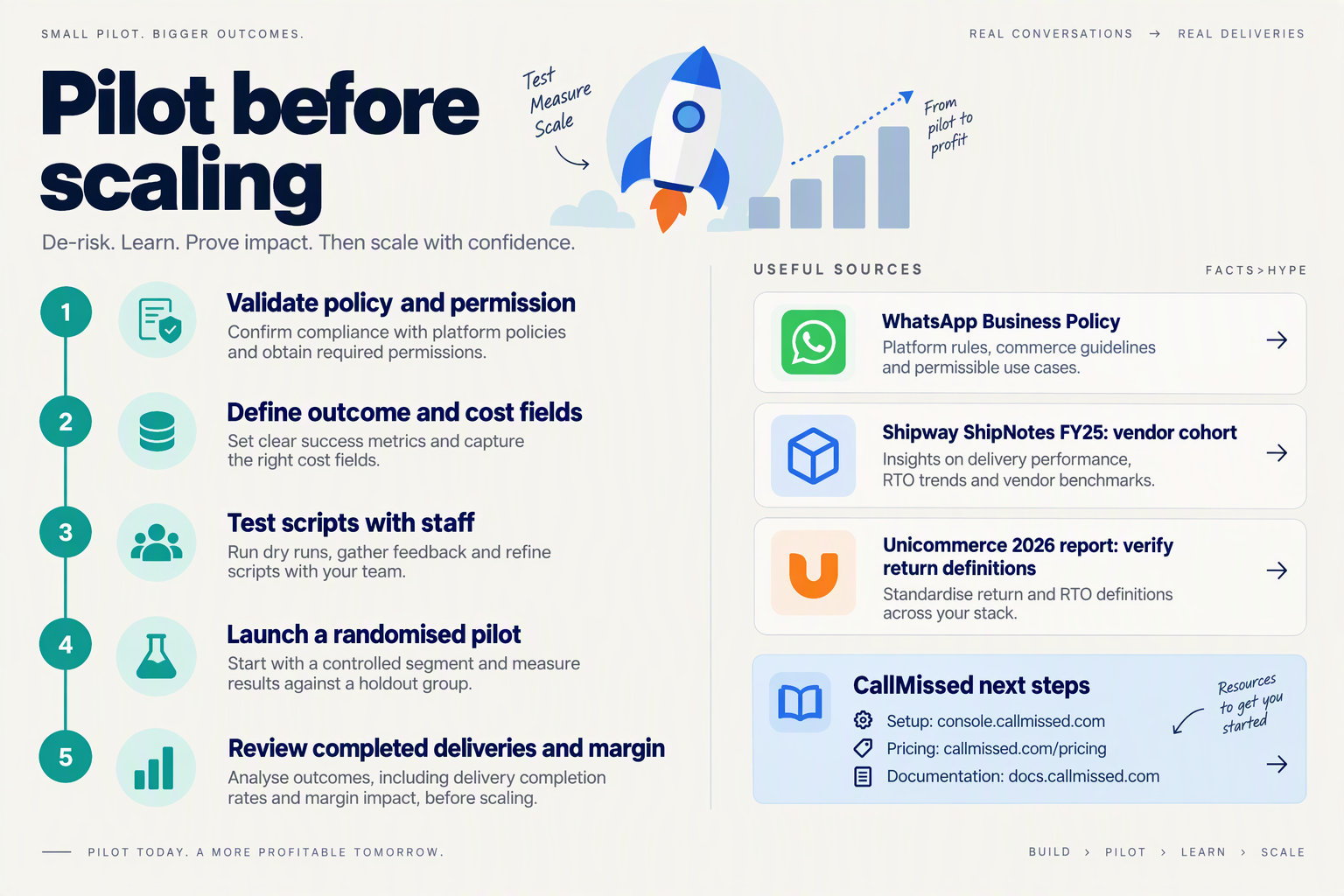
Launch a measured COD confirmation pilot with a policy checklist, a versioned script, an order-level measurement sheet, and a predefined scale-or-stop decision. Test WhatsApp confirmation plus selective voice follow-up against your existing process, then judge the result on incremental contribution—not confirmation rates alone.
Which resources should your team review before launch?
Build a small reference pack that answers operational questions rather than collecting generic RTO advice:
- Meta’s WhatsApp Business Policy: As of October 2026, Meta states that message templates must “only be used for [their] designated purpose.” Check that your order-confirmation template, permission process, and escalation path match the intended interaction.
- Unicommerce’s India D2C Report, April 2026: Use the report to understand seasonal risk, while keeping its return definitions separate from your courier’s RTO classifications.
- Your courier invoices and settlement records: Extract actual forward-shipping, reverse-shipping, COD collection, and handling charges. These records—not industry averages—should determine the pilot’s savings assumptions.
- Your operational records: Bring together dispatch timestamps, cancellation reasons, customer complaints, and final delivery outcomes using a consistent order identifier.
Segmentation matters. According to MediaBrief’s coverage of Shipway’s ShipNotes FY25 report, reported RTO rates ranged from 18% in Vadodara to 35% in Patna within Shipway’s analysed dataset. That historical variation supports comparing similar delivery geographies rather than assuming every order has the same risk.
What should a launch-ready pilot pack contain?
Prepare five documents before contacting customers:
- A one-page experiment brief: Define eligible orders, exclusions, allocation method, dispatch deadlines, and the business question.
- A versioned COD confirmation voice bot script: Include the order summary, permitted clarification questions, cancellation handling, and human escalation instructions.
- A messaging and permissions checklist: Record template approval status and the evidence required before a business-initiated WhatsApp call.
- An event dictionary: Define “confirmed,” “unreachable,” “cancelled before dispatch,” “delivered,” and “RTO” so operations and finance count the same outcomes.
- A cost-and-outcome ledger: Capture outreach costs, staff time, shipment costs, refunds, and retained contribution for both pilot and control orders.
As of October 2026, CallMissed supports a no-code agent builder with versioning, publish and rollback, alongside call transcripts and AI call notes. These capabilities can support script iteration and review; teams should still define their own experiment allocation and financial reconciliation process.
How should you run the first measured test?
Start with a restricted cohort and a concurrent control group. Randomly allocate eligible orders where practical, or document the limitations of any matched comparison.
Use a staged launch:
- Before launch: Test realistic cases, including an incorrect address, a changed delivery date, a language mismatch, and a customer who declines further contact.
- During the pilot: Review conversation quality, handoff failures, dispatch delays, and complaints daily. Avoid changing scripts mid-test without recording the version and affected orders.
- After shipment resolution: Reconcile deliveries, RTOs, cancellations, and costs. Do not declare success while a substantial share of orders remains in transit.
Set the sample size from your baseline rate and the improvement you need to detect; an arbitrary order count cannot guarantee reliable evidence.
When should you scale, revise, or stop?
Scale when incremental contribution improves without unacceptable customer friction or fulfilment delays. Revise when conversations work but targeting, costs, or handoffs weaken the economics. Stop when permission gaps, harmful errors, or persistent negative contribution appear.
Your next step is concrete: assign an owner, approve the pilot pack, and agree on decision thresholds before launch. The pilot should prove better dispatch decisions—not simply produce more confirmations.
Conclusion
A COD confirmation voice bot script works best when it improves dispatch decisions—not when it simply generates more calls. Pair WhatsApp with targeted voice follow-up, respect customer choices, and judge the workflow by incremental savings after costs, rather than confirmation volume alone.
The guide’s four practical takeaways are:
- Start with WhatsApp; use voice to resolve uncertainty. Present the order summary and clear confirmation choices first. When a response leaves purchase intent, the address, or delivery timing unclear, a voice conversation can clarify the issue before dispatch. The objective is to distinguish a genuine cancellation from a correctable detail or a request to deliver later—not to pressure every customer into saying yes.
- Keep the script specific and respectful. Identify the business, explain why you are contacting the customer, verify the order and payable amount, and record the decision. Give unresolved cases a route to human support. A useful confirmation captures what the customer actually wants; a superficially positive response is not valuable if the shipment still goes to the wrong address or arrives at the wrong time.
- Build compliance into the workflow. As of October 2026, Meta’s WhatsApp Business Policy states: “You may only initiate conversations using an approved Message Template.” Business-initiated WhatsApp calls also require customer permission. These boundaries belong in the workflow design from the beginning, rather than being treated as a final check after messages and scripts have already been written.
- Measure ROI against your own operating costs. In the guide’s illustrative October 2026 scenario, reducing RTO from 26% to 23% across 1,000 COD orders avoids 30 failed shipments. Assuming ₹150 saved per failure and ₹2,000 in confirmation costs, the result is ₹2,500 net savings and 125% ROI. Those assumptions demonstrate the arithmetic; they do not establish an expected result for another merchant.
What should sellers watch next?
Watch whether WhatsApp and voice confirmation produce better dispatch decisions consistently—not just during one campaign or delivery period. MediaBrief’s coverage of Shipway’s ShipNotes FY25 report places COD RTO at 26% within its analysed seller base; Unicommerce’s April 2026 India D2C Report reports 58% festive-quarter COD returns within its platform dataset. Different definitions and datasets mean these figures should inform questions, not become interchangeable targets.
As of October 2026, CallMissed is a platform readers can explore for official Meta Cloud API messaging and WhatsApp Business Calling, including AI voice-agent answers and calls to customers who have given permission.
Start with a measured pilot: does your confirmation workflow save more in avoidable logistics losses than it costs to run?
Related Reading
- Best Omnichannel AI Agent Platform for Voice, WhatsApp, SMS, and Email in 2026
- Best AI voice agents in India: 2026 Comparison Guide
- Claude Haiku 5.5 Voice Agents vs Fable 5.5 Compared