Best Omnichannel AI Agent Platform for Voice, WhatsApp, SMS, and Email in 2026


Compare the best omnichannel AI agent platforms for voice, WhatsApp, SMS, and email, with verified channels, pricing, trade-offs, and buyer guidance.
Best Omnichannel AI Agent Platform for Voice, WhatsApp, SMS, and Email in 2026
The best omnichannel AI agent platform for voice, WhatsApp, SMS, and email in 2026 is one that supports all four channels, preserves conversation context, and provides human handoffs at a transparent total cost. There is no universal winner: shortlist platforms by verified channel coverage, CRM integration, workflow controls, and whether each channel supports autonomous AI resolution or only messaging.
Lorikeet cites a 2026 Salesforce State of Service report finding that 64% of customer support leaders say their AI deployments fail when conversations move between channels—making continuity a key evaluation criterion. CallMissed offers AI voice agents, WhatsApp messaging and calling, a shared inbox, human handoffs, built-in CRM, and Gmail integration; SMS and autonomous email-agent coverage require separate verification. This comparison examines channel coverage, capabilities, pricing, and trade-offs to help you choose.
Which is the best omnichannel AI agent platform for voice, WhatsApp, SMS, and email in 2026?
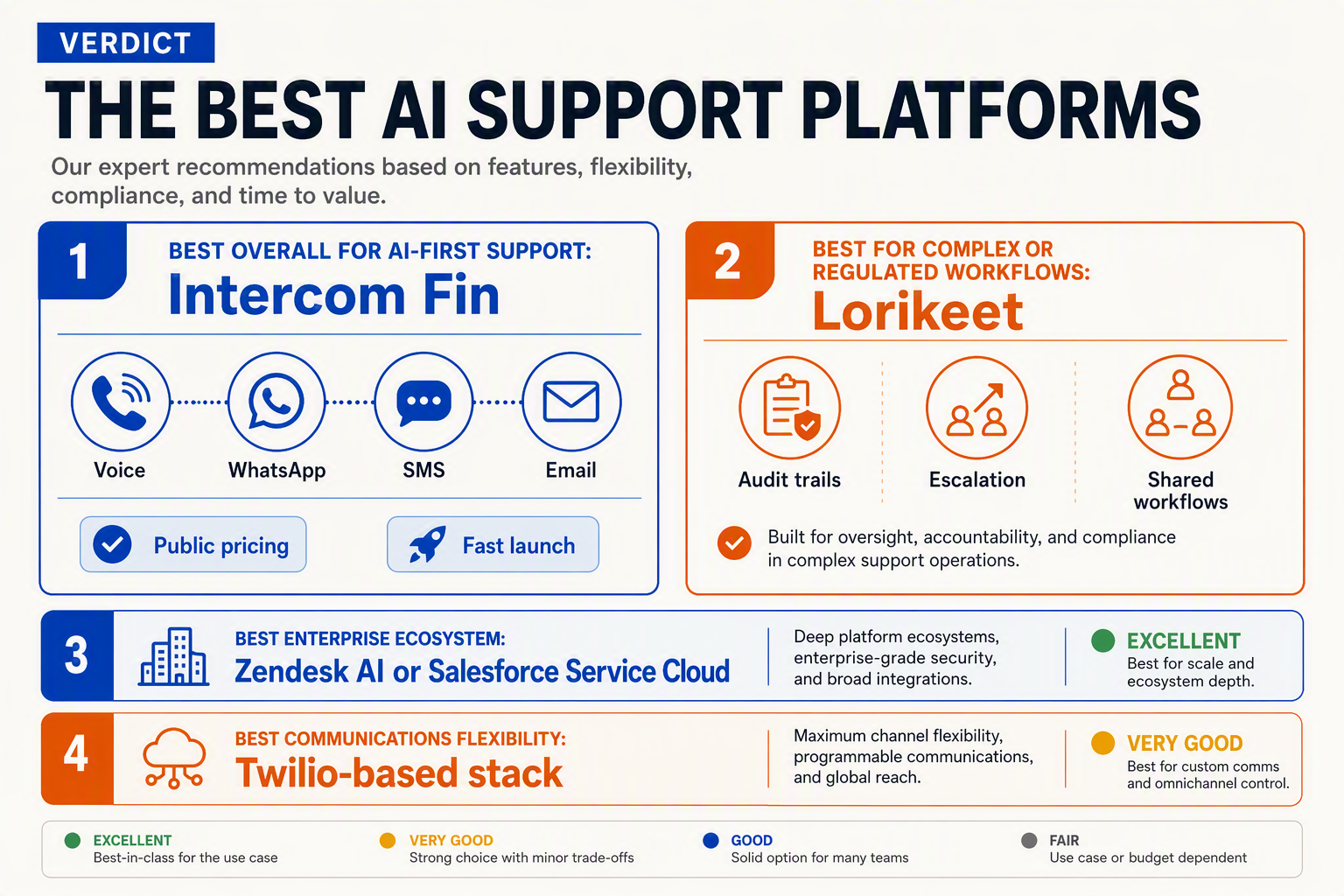
For buyers that need one workflow engine across voice, WhatsApp, SMS, and email, Lorikeet is a conditional recommendation based on the scope described in Lorikeet’s 2026 platform overview. Intercom Fin, Zendesk AI, Ada, Salesforce Service Cloud, and Twilio-based stacks remain relevant alternatives depending on whether the priority is packaged support automation, enterprise service operations, configurable AI, or developer control.
The practical shortlist for 2026
The right choice depends less on the number of channels shown on a pricing page and more on whether the platform maintains a shared agent, context, knowledge base, and workflow across those channels.
- Lorikeet: Lorikeet’s 2026 platform overview positions the platform for regulated B2C and B2SMB scale-ups that need a single workflow engine across voice, SMS, chat, email, and WhatsApp, operated by their own team. That makes Lorikeet the clearest fit in this shortlist for teams specifically seeking cross-channel workflow continuity.
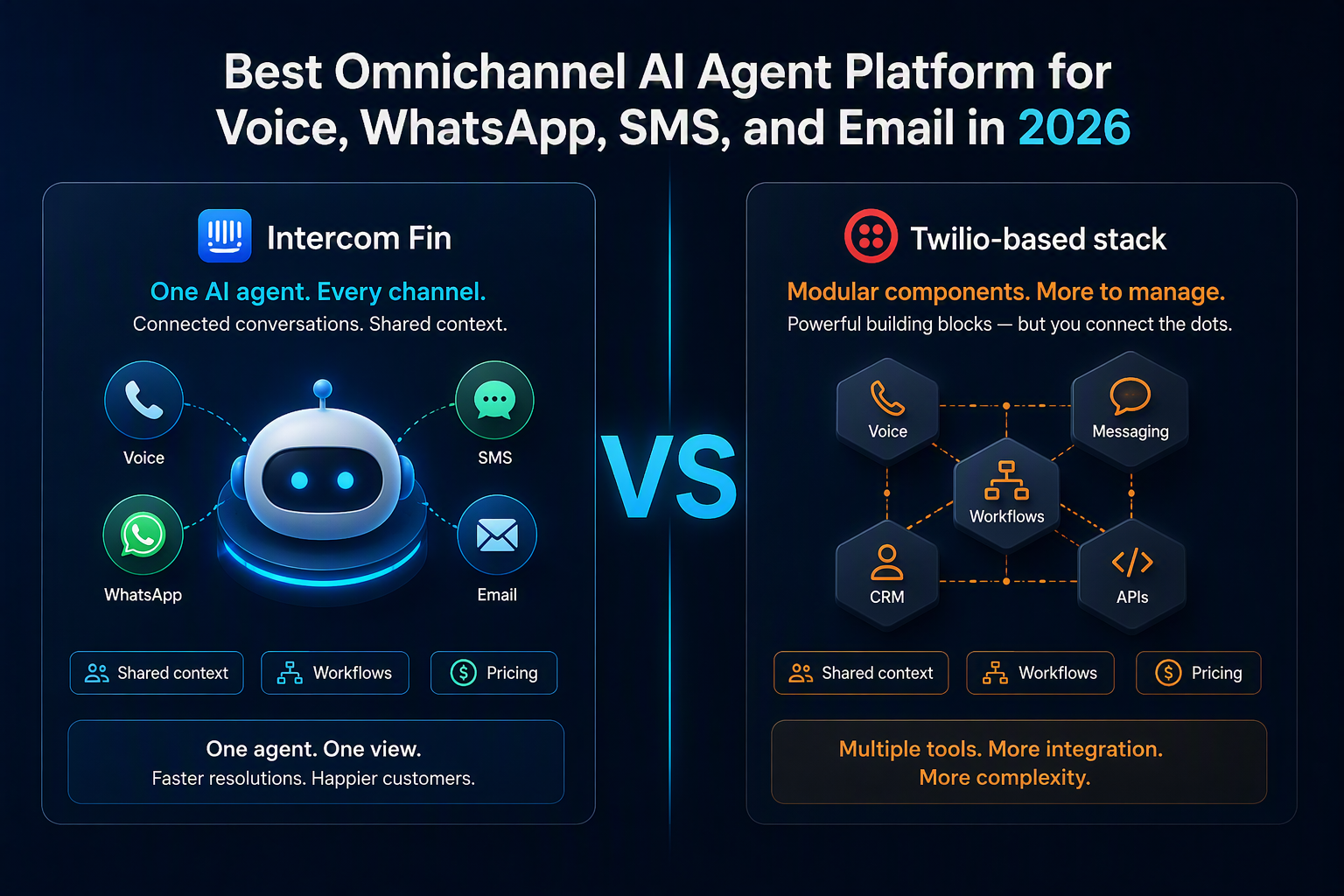
- Intercom Fin: Consider Intercom Fin when the main requirement is AI-assisted customer support within an established support and conversation-management environment. Buyers should verify the required depth of voice, WhatsApp, and SMS handling rather than assume every channel is covered equally.
- Zendesk AI: Zendesk AI is a natural option for organizations already standardizing on Zendesk or prioritizing service-desk processes, agent workflows, and governance. Confirm whether the selected configuration supports the desired WhatsApp, SMS, email, and voice journeys as one connected experience.
- Ada: Ada belongs on the shortlist for teams evaluating a dedicated AI customer-service automation platform. Its suitability depends on the buyer’s requirements for voice support, channel-specific handoffs, and the amount of workflow configuration available.
- Salesforce Service Cloud: Salesforce Service Cloud is most relevant when customer service must connect closely with broader enterprise CRM and operational processes. It may suit organizations that value ecosystem integration and governance, but channel continuity should be tested in a live workflow.
- Twilio-based stacks: Twilio-based architectures are worth considering when developers need to assemble a custom communications and AI stack. They can offer implementation flexibility, but the buyer—not a single packaged agent platform—typically owns more of the orchestration, context-sharing, and operational design.
- MessageMind: MessageMind’s 2026 AI-agent comparison presents it as an option for combining messaging and voice in one stack. It is worth evaluating where those two capabilities are central, while checking its coverage of email, SMS, WhatsApp, and shared workflows.
What “omnichannel” should mean
Listing voice, WhatsApp, SMS, and email as separate integrations is not proof of one continuous AI agent. A genuine omnichannel evaluation should test whether a customer can begin in WhatsApp, continue by voice, receive an SMS update, and get an email without losing identity, conversation history, intent, or workflow state.
Use these checks during evaluation:
- Can one knowledge base and policy layer govern every channel?
- Does context persist across channel changes?
- Are escalations, approvals, and human handoffs consistent?
- Can teams audit conversations and outcomes centrally?
- Are all four channels available in the exact regions and configuration required?
Bottom line: shortlist Lorikeet first for a unified cross-channel workflow requirement, then compare Intercom Fin, Zendesk AI, Ada, Salesforce Service Cloud, MessageMind, and Twilio-based stacks against the specific balance of packaged support, enterprise controls, messaging coverage, voice depth, and developer flexibility.
What is the verdict at a glance, and which platform fits each buyer?
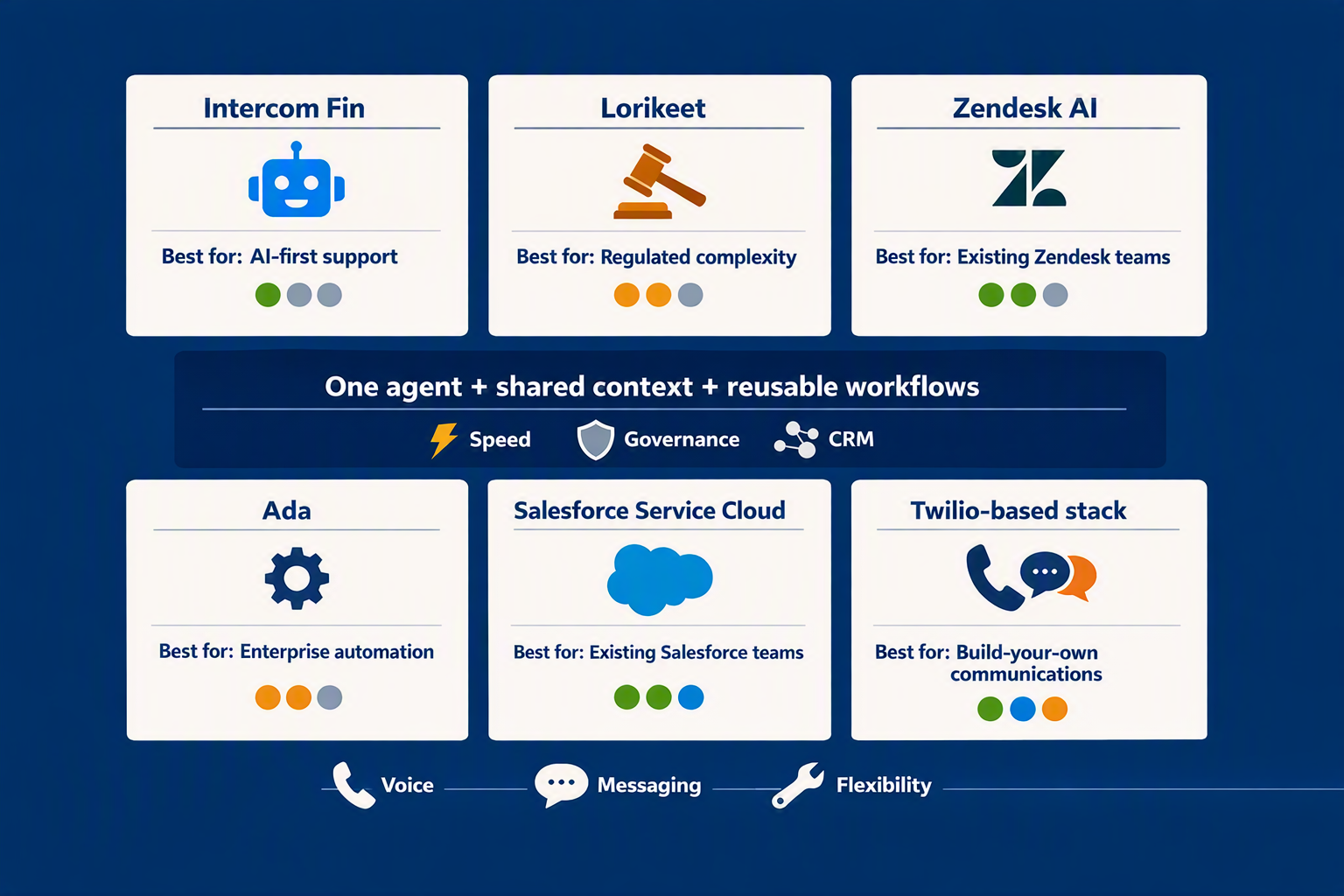
The verdict is conditional: choose the platform that preserves the same customer, context, policy, workflow, and measurement model across the channels you actually operate. No single option is automatically the best fit for every combination of voice, WhatsApp, SMS, email, chat, automation depth, governance, and implementation capacity.
Buyer fit at a glance
- Lorikeet: Best fit for regulated B2C and B2SMB scale-ups that want a configurable workflow engine operated by their own team. Lorikeet’s 2026 platform overview describes coverage across voice, SMS, chat, email, and WhatsApp; buyers should still validate regional availability, telephony configuration, and channel-specific limits.
- Intercom Fin: Best fit for teams already centred on Intercom’s customer-service workspace and looking to deploy AI assistance within that operating model. Confirm whether the required voice, WhatsApp, SMS, and email workflows are native, partner-supported, or dependent on additional integrations.
- Zendesk AI: Best fit for support organisations that prioritise structured ticketing, agent tooling, service governance, and reporting. Zendesk’s suitability for a particular omnichannel programme depends on the channels, messaging integrations, voice configuration, and automation requirements included in the deployment.
- Ada: Best fit for organisations seeking a specialised AI automation layer for customer-service conversations. Validate escalation, identity resolution, knowledge governance, and the exact channel mix before treating Ada as the system of record for every interaction.
- Salesforce Service Cloud: Best fit for enterprises already invested in Salesforce data, case management, permissions, and workflow orchestration. Its appeal is strongest when customer service must connect to broader CRM processes, but implementation scope and integration ownership can be substantial.
- Twilio-based stacks: Best fit for developer-led teams that need control over telephony, messaging, routing, and custom AI orchestration. Twilio provides building blocks rather than a single preconfigured service operation, so teams must design the agent layer, knowledge controls, handoffs, analytics, and ongoing reliability processes.
The six continuity tests
A platform qualifies as genuinely omnichannel only when it passes these tests:
- Shared identity and context: Can the system recognise the same customer across a phone call, WhatsApp thread, SMS, email, and agent session?
- Shared knowledge: Do all channels retrieve from the same approved knowledge base, with versioning and permissions?
- Reusable workflows: Can teams define an escalation, refund, booking, or verification workflow once and reuse it across channels?
- History-preserving handoff: Can an AI agent transfer a conversation to a human with the transcript, customer identity, intent, actions, and promised next steps intact?
- Consistent policies: Are authentication, consent, disclosure, retention, and escalation rules applied consistently across voice and digital channels?
- Unified analytics: Can leaders compare containment, resolution, transfer, latency, sentiment, cost, and customer outcomes across channels without stitching together incompatible reports?
Practical recommendation
Start with the operating model, not the channel checklist. Choose Lorikeet when cross-channel workflow control is central; Intercom Fin, Zendesk AI, or Ada when the organisation’s service workspace and AI-support model are the priority; Salesforce Service Cloud when CRM governance and enterprise process integration dominate; and a Twilio-based stack when engineering control outweighs implementation simplicity. Before signing, run a production-like test covering all six continuity criteria across the highest-volume customer journeys.
How do the leading platforms compare across voice, WhatsApp, SMS, and email?
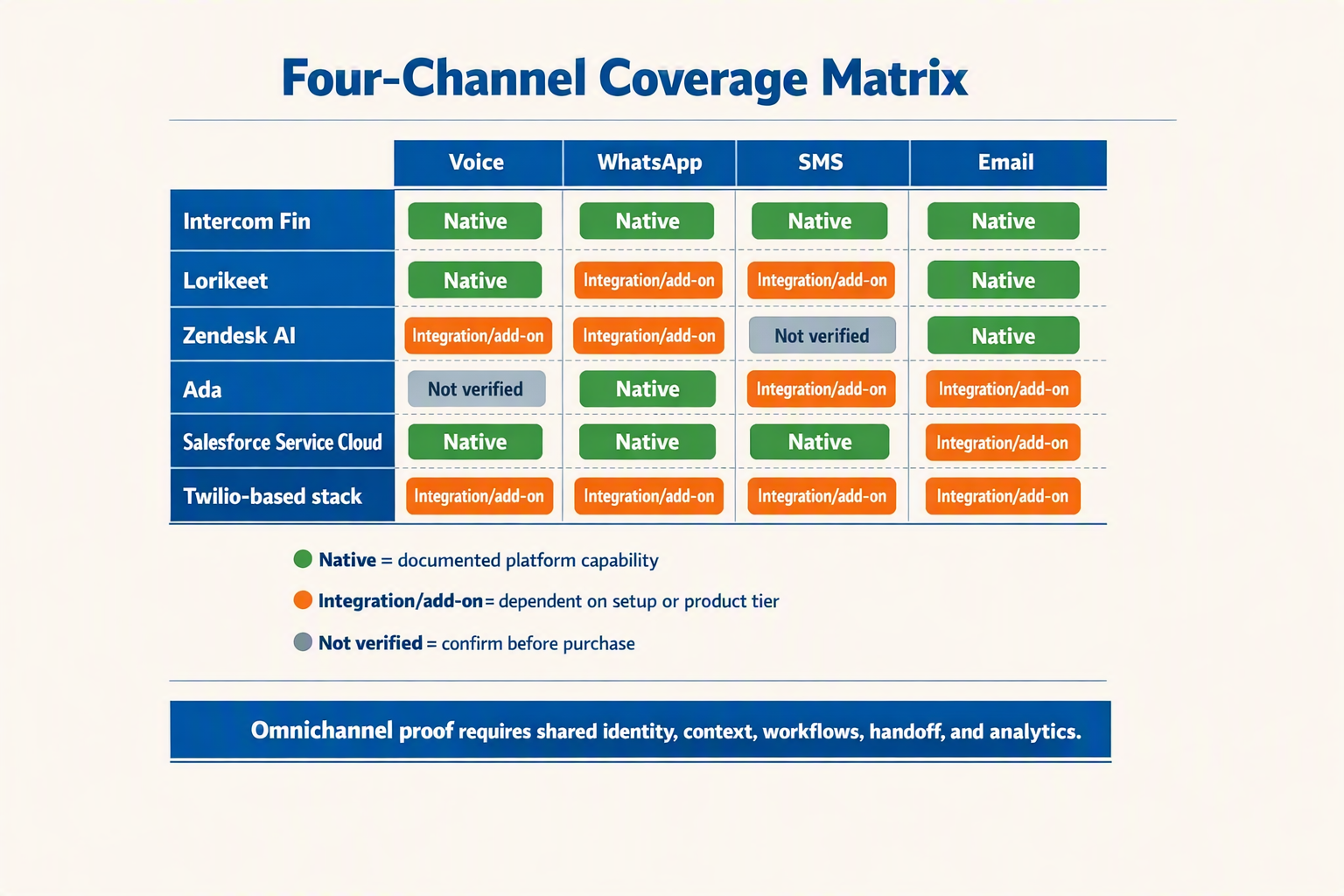
The most defensible comparison is channel-by-channel: Lorikeet’s 2026 overview explicitly describes voice, SMS, chat, email, and WhatsApp under one workflow engine, while the other platforms require closer validation of channel ownership, automation depth, and shared context.
Transparent channel matrix
| Platform | Voice | SMS | ||
|---|---|---|---|---|
| Lorikeet | Native | Native | Native | Native |
| Intercom Fin | Not publicly verified | Integration/add-on | Not publicly verified | Native |
| Zendesk AI | Integration/add-on | Integration/add-on | Integration/add-on | Native |
| Ada | Integration/add-on | Integration/add-on | Integration/add-on | Integration/add-on |
| Salesforce Service Cloud | Integration/add-on | Integration/add-on | Integration/add-on | Native |
| Twilio-based stacks | Native | Native | Native | Integration/add-on |
These labels describe the channel capability represented by the platform or stack—not whether a single AI agent automatically preserves context across every channel.
- Lorikeet: Lorikeet’s 2026 omnichannel support overview names voice, SMS, chat, email, and WhatsApp as channels handled through one workflow engine. Its separate 2026 AI concierge overview identifies Lorikeet as a fit for regulated B2C and B2SMB scale-ups requiring that cross-channel operating model.
- Intercom Fin: Intercom has established email and conversational-support capabilities, but the public material available for this comparison does not verify equivalent native voice and SMS depth. WhatsApp should be assessed as an integration or add-on, including agent handoff and customer-history behavior.
- Zendesk AI: Zendesk is strongly associated with enterprise service-desk and ticketing workflows. Voice, WhatsApp, and SMS availability may depend on products, plans, or connected services; buyers should verify whether each channel is AI-automated or merely routed into the support workspace.
- Ada: Ada is positioned around AI customer-service automation, but channel implementation can vary by deployment and integration. A demo should confirm whether voice, WhatsApp, SMS, and email share one knowledge base, workflow state, and escalation path.
- Salesforce Service Cloud: Salesforce Service Cloud provides a broad enterprise service platform with native email-oriented case workflows, while voice, WhatsApp, and SMS commonly require additional products, configurations, or providers. “Integration/add-on” does not by itself indicate limited functionality; it indicates that buyers must validate packaging and implementation.
- Twilio-based stacks: Twilio provides programmable Voice, SMS, and WhatsApp communication products, while email commonly uses a connected email service such as SendGrid. The resulting AI-agent experience depends on the orchestration layer, model provider, CRM, identity resolution, and handoff logic selected by the implementation team.
What to validate before choosing
A channel logo is not proof of omnichannel continuity. In a live demo, ask vendors to show:
- A customer moving from WhatsApp to voice to email without repeating context.
- Whether the same knowledge base and business rules govern every channel.
- Native support for inbound and outbound interactions, including consent and opt-out handling.
- Human handoff, transcripts, recordings, ticket creation, and conversation history.
- Pricing, regional availability, phone-number requirements, and third-party dependencies.
This validation is especially important for platforms marked Integration/add-on or Not publicly verified, because channel presence alone does not establish equivalent automation depth.
Which feature differences matter beyond a four-channel checklist?
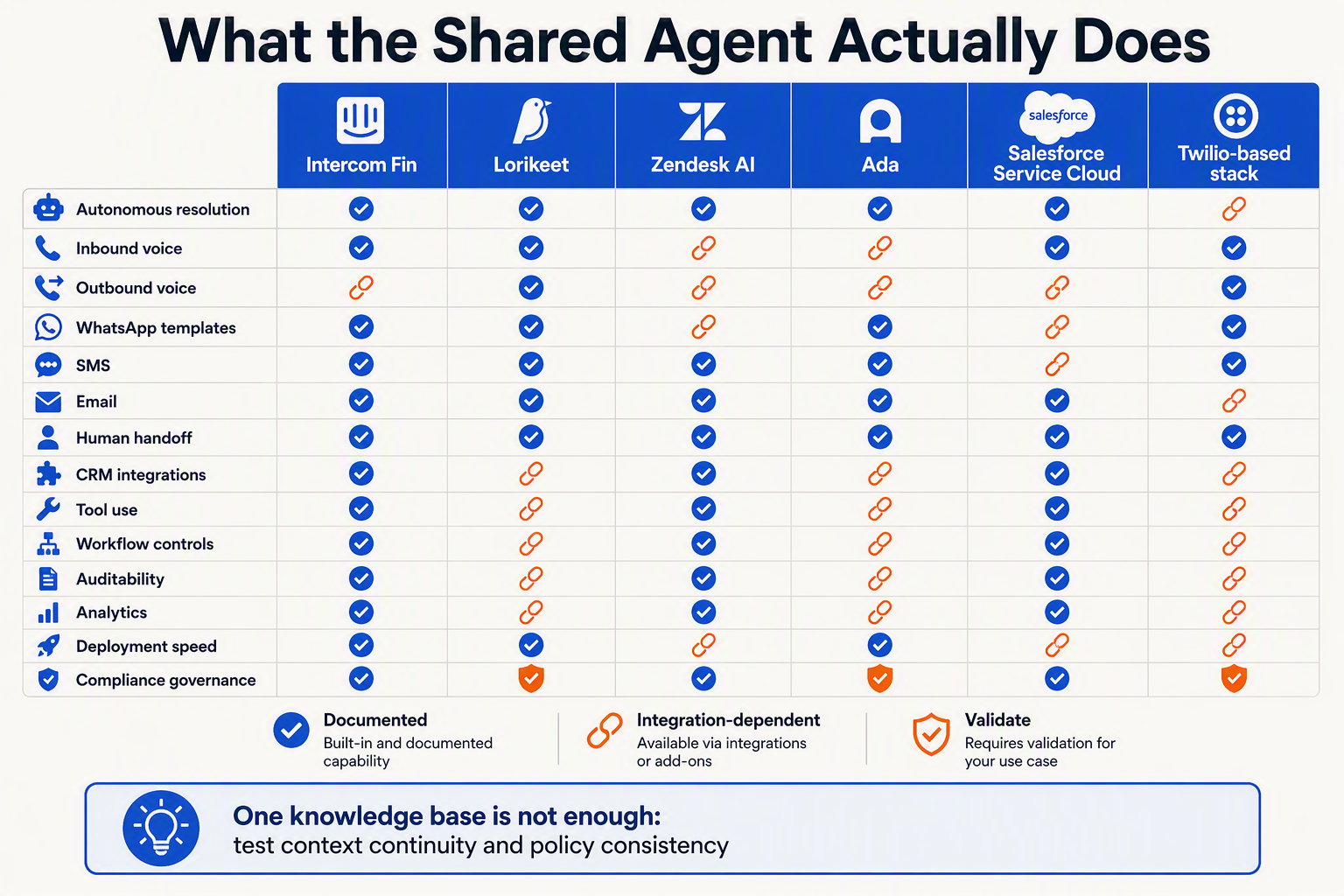
A four-channel checklist shows coverage, but not channel depth, continuity, or operational control. The meaningful differences appear when you test how each platform handles handoffs, regional languages, workflows, and pricing.
Feature differences that change the buying decision
| Evaluation area | CallMissed | Lorikeet | Kayako | Why it matters |
|---|---|---|---|---|
| Voice capability | AI voice agents plus WhatsApp Business calling | Cross-channel voice workflows | Primarily email, chat, social, and in-app support | Confirm whether voice is native or requires a separate system |
| WhatsApp depth | Messaging and business-initiated or inbound WhatsApp calls | Listed as part of its omnichannel workflow engine | Not presented as native WhatsApp voice in Kayako’s comparison | WhatsApp calling can eliminate channel-switching for customers |
| Regional language support | Speech-to-Text and Text-to-Speech across 22 Indian languages | Global omnichannel support positioning | No 22-language voice specification in the cited comparison | Indic-first voice matters for Indian and Bharat-focused audiences |
| Workflow and knowledge control | Shared inbox/CRM, knowledge-base RAG, campaigns, and email tooling | Configurable workflows for regulated B2C and B2SMB operations | Unified shared inbox with AI support | Evaluate escalation rules, permissions, auditability, and knowledge updates |
| Pricing model | Transparent credits: 1 credit = ₹1, with free and pay-as-you-go tiers | Typically assessed around enterprise workflow and scale requirements | Starts at $1 per resolved ticket, according to Kayako | Compare total cost by resolved conversation, minute, message, and handoff |
- CallMissed: Best aligned with India-first teams needing WhatsApp-native voice, regional-language automation, and one platform for engagement workflows.
- Lorikeet: Stronger fit when a regulated scale-up needs one workflow engine across voice, SMS, chat, email, and WhatsApp, according to Lorikeet’s 2026 platform overview.
- Kayako: Its cited comparison reports a 4.3/5 G2 rating, but positions the product around shared-inbox support rather than native voice automation.
- MessageMind: Worth shortlisting when combining messaging and voice is the primary requirement, based on MessageMind’s 2026 AI-agent comparison.
- Decision rule: Test a real journey—WhatsApp message to AI call to human escalation to email—rather than validating channel logos separately.
How much does an omnichannel AI agent platform cost, and what is the total cost of ownership?
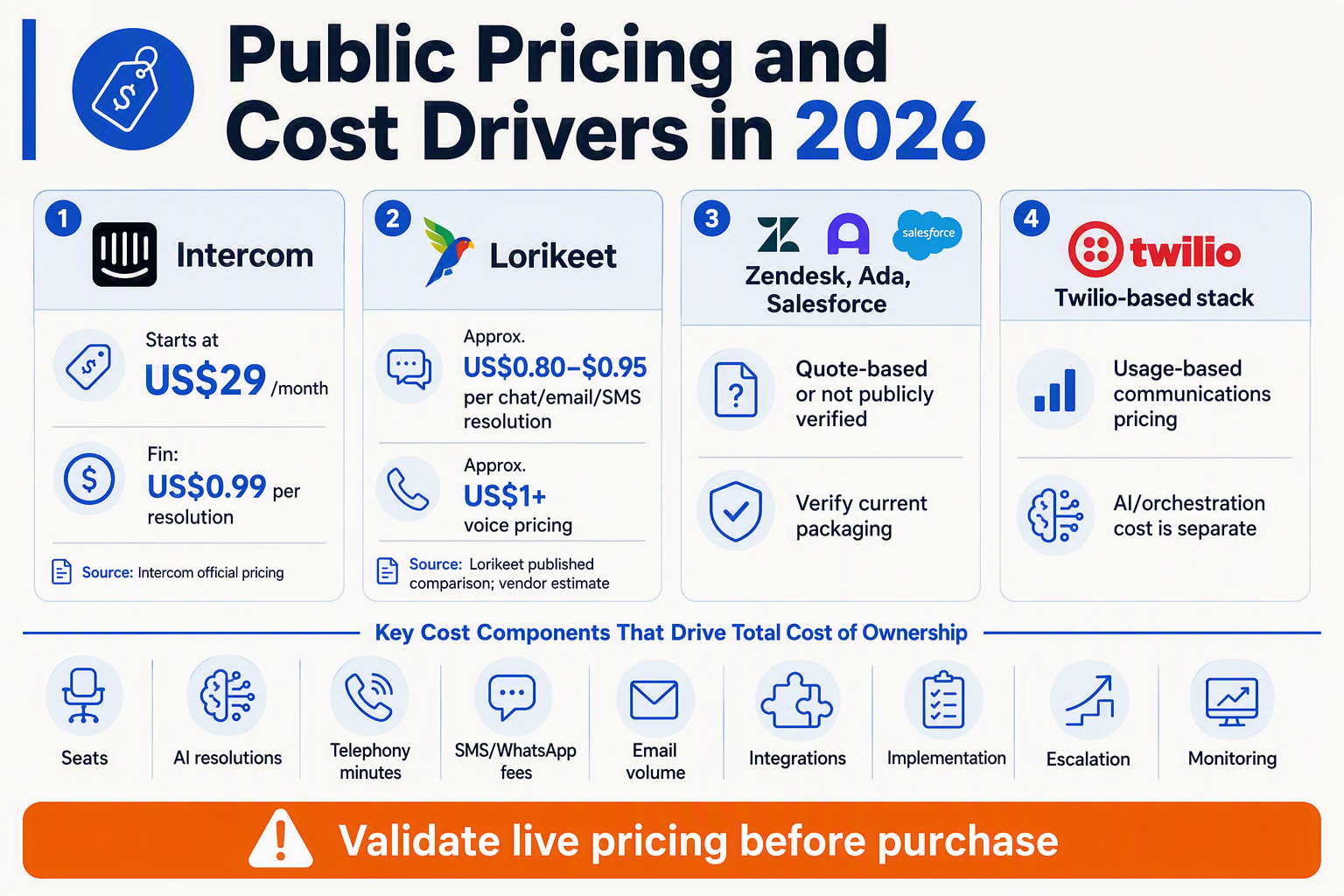
The total cost of ownership (TCO) for an omnichannel AI agent includes platform fees, usage charges, carrier costs, integrations, and human escalation—not just the advertised monthly subscription. CallMissed uses transparent credits at 1 credit = ₹1, while other platforms may require quote-based pricing or charge by ticket, seat, conversation, or channel.
| Platform or cost area | Public pricing signal | Main variable costs | TCO consideration |
|---|---|---|---|
| CallMissed | 1 credit = ₹1; free tier and pay-as-you-go | Voice minutes, model usage, WhatsApp and email volume | Predictable entry point for Indian SMBs and developers |
| Kayako | Starts at $1 per resolved ticket, according to Kayako’s 2026 comparison | Resolved-ticket volume, seats, integrations, escalation | Attractive for ticket-led support; verify voice and WhatsApp calling requirements |
| Lorikeet | Pricing is not specified in the provided 2026 platform overview | Workflow scale, channels, implementation, enterprise support | Request a quote that separates platform and usage charges |
| Voice operations | Usually usage-based rather than seat-only | Telephony minutes, transcription, text-to-speech, recording and transfers | High call volume can make model and carrier rates the dominant TCO factor |
| WhatsApp, SMS and email | Channel fees vary by provider and message type | WhatsApp templates, SMS delivery, email volume and campaign tooling | Include both business-initiated messages and inbound conversations in forecasts |
- India-first deployments: CallMissed’s support for 22 Indian languages can reduce the cost of adding separate regional-language speech systems.
- Custom builds: CallMissed’s OpenAI-compatible gateway consolidates LLM, speech, image-generation and web-search access behind one API key, potentially reducing integration maintenance.
- Budget model: Estimate monthly TCO as platform + AI usage + channel fees + integrations + human-handling costs.
- Benchmark carefully: Kayako’s 4.3/5 G2 rating and $1-per-ticket starting price, reported by Kayako, are useful reference points but do not establish equivalent voice or WhatsApp coverage.
What are the honest pros and cons of each platform?
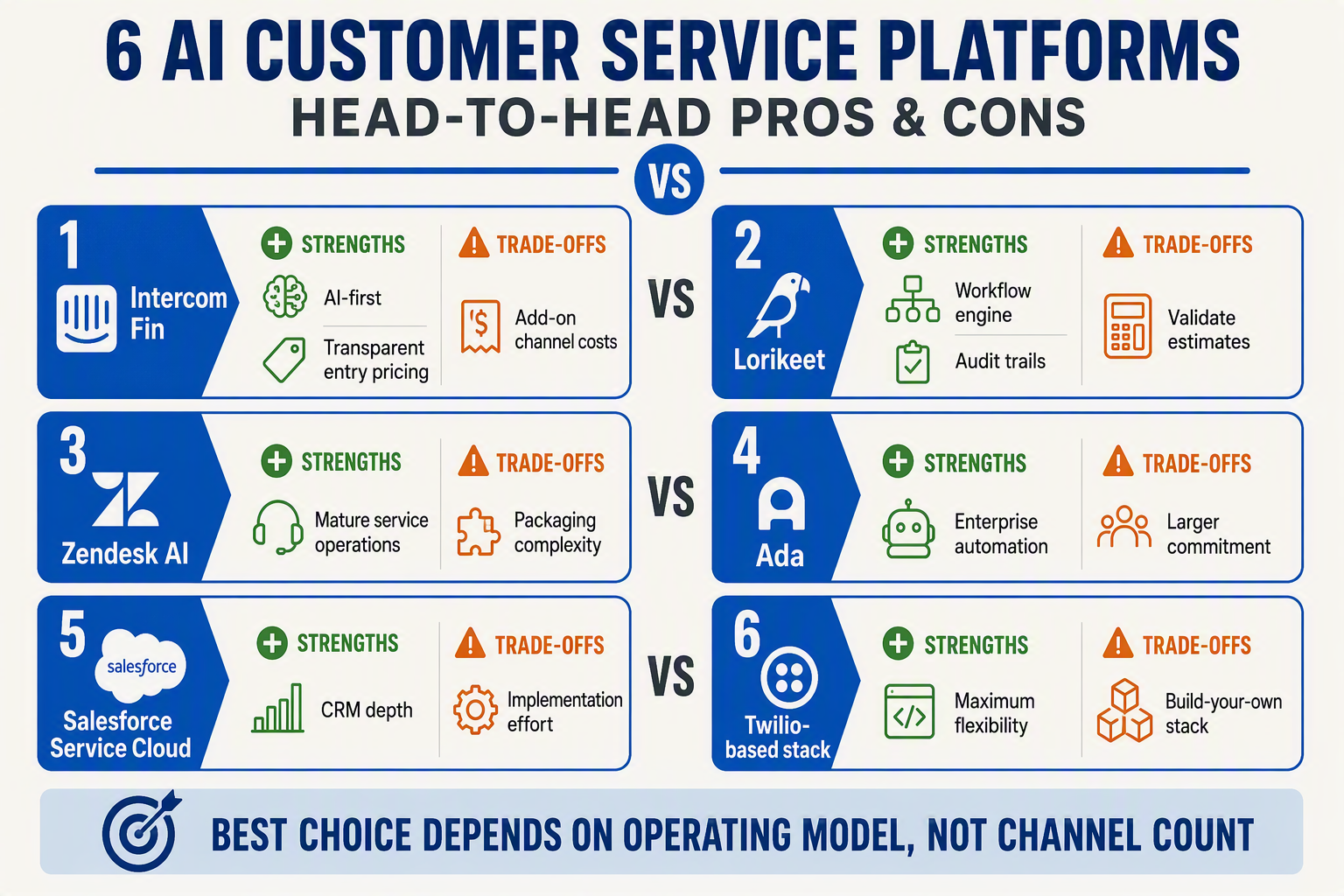
The honest trade-off is channel depth versus support-suite maturity: no platform should be judged by channel count alone. The right choice depends on whether native WhatsApp calling, regional-language voice, workflow control, or enterprise service management matters most.
| Platform | Key strengths | Honest limitations | Best fit |
|---|---|---|---|
| CallMissed | AI voice agents, WhatsApp messaging and Business calling, CRM, email tooling; 22 Indian languages; OpenAI-compatible multi-model gateway | India-first positioning may require validation for global telecom and compliance needs; packaged workflows may not cover every enterprise process | Indian businesses needing WhatsApp-native voice and regional-language automation |
| Lorikeet | One workflow engine across voice, SMS, chat, email, and WhatsApp; designed for regulated B2C and B2SMB scale-ups | Public comparison context does not provide a starting price or language count; implementation depth should be tested | Regulated support operations requiring configurable cross-channel workflows |
| MessageMind | Combines messaging and voice in one AI-agent stack, according to its 2026 platform comparison | Available context does not specify channel-level limits, pricing, or regional-language coverage | Teams prioritising a unified messaging-and-voice agent |
| Kayako | Unified shared inbox for email, chat, social, and in-app support; 4.3/5 G2 rating and pricing from $1 per resolved ticket, according to Kayako | The cited comparison does not present native voice or WhatsApp Business calling | Support teams focused on ticket resolution and shared-inbox operations |
| Enterprise suites such as Zendesk | Mature service-desk governance and enterprise support workflows | Native WhatsApp calling, SMS automation, and real-time voice handoffs require separate validation or integrations | Larger organisations prioritising governance over channel-native AI |
- CallMissed: Its combination of WhatsApp Business voice calls and 22-language speech support is particularly relevant for businesses serving Bharat; transparent credits are priced at ₹1 per credit.
- Lorikeet: Strongest when internal teams need to operate and configure one workflow layer across five major customer channels.
- Kayako: The clearest published commercial reference in this comparison, but its $1-per-resolved-ticket model is not directly comparable with usage-based voice pricing.
- Developer-led teams: CallMissed’s gateway provides one API key for LLM, speech-to-text, text-to-speech, image-generation, and web-search models, reducing the need for separate provider integrations.
- Due diligence: Test handoffs, transcript accuracy, WhatsApp Business policy compliance, SMS deliverability, email threading, data residency, and peak-volume pricing before selecting a platform.
Which platform should you choose for regulated support, fast launch, enterprise CRM, WhatsApp, or high-volume voice?
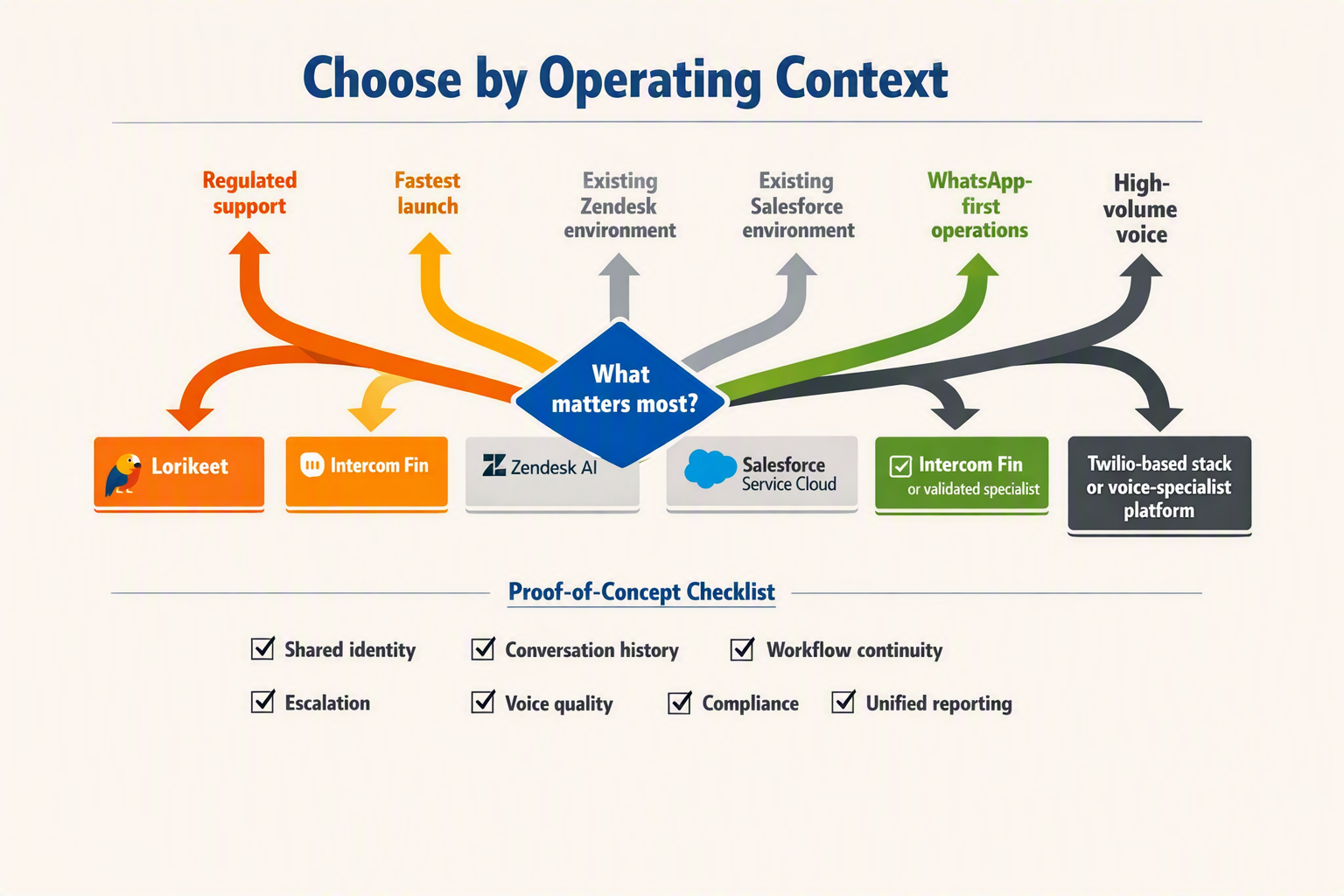
Choose by operating constraint, not by the longest feature list: regulated workflows favour configurability, while WhatsApp-native engagement and Indian-language voice favour India-focused platforms.
Best fit by business priority
- Regulated support: Lorikeet is the clearest shortlist for regulated B2C and B2SMB scale-ups; Lorikeet describes one workflow engine spanning voice, SMS, chat, email, and WhatsApp.
- Fast launch in India: CallMissed combines AI voice agents, WhatsApp messaging, WhatsApp Business calling, CRM workflows, and email tooling in one business platform, reducing the need to assemble separate channel products.
- Enterprise CRM and service-desk depth: Zendesk and comparable enterprise suites deserve evaluation when governance, ticketing, reporting, and established CRM integrations matter more than native WhatsApp voice; verify channel-specific coverage before buying.
- Unified inbox support: Kayako focuses on email, chat, social, and in-app support, with a 4.3/5 G2 rating and pricing starting at $1 per resolved ticket, according to Kayako’s 2026 comparison.
- WhatsApp-first customer engagement: CallMissed supports both WhatsApp Business messaging and business-initiated or inbound WhatsApp voice calls bridged to AI agents—an important distinction from platforms limited to text chat.
- High-volume voice operations: Lorikeet and CallMissed should be tested using your projected concurrent calls, escalation rate, telephony coverage, and language mix; CallMissed adds speech recognition and voice generation across 22 Indian languages, while Lorikeet targets scale-up support operations.
Practical shortlist
- Choose CallMissed for India-first WhatsApp, voice, and regional-language deployment.
- Choose Lorikeet for configurable, regulated omnichannel workflows.
- Compare Zendesk or Kayako when enterprise support governance and CRM depth are the primary buying criteria.
What do buyers ask about omnichannel AI agents for voice, WhatsApp, SMS, and email?
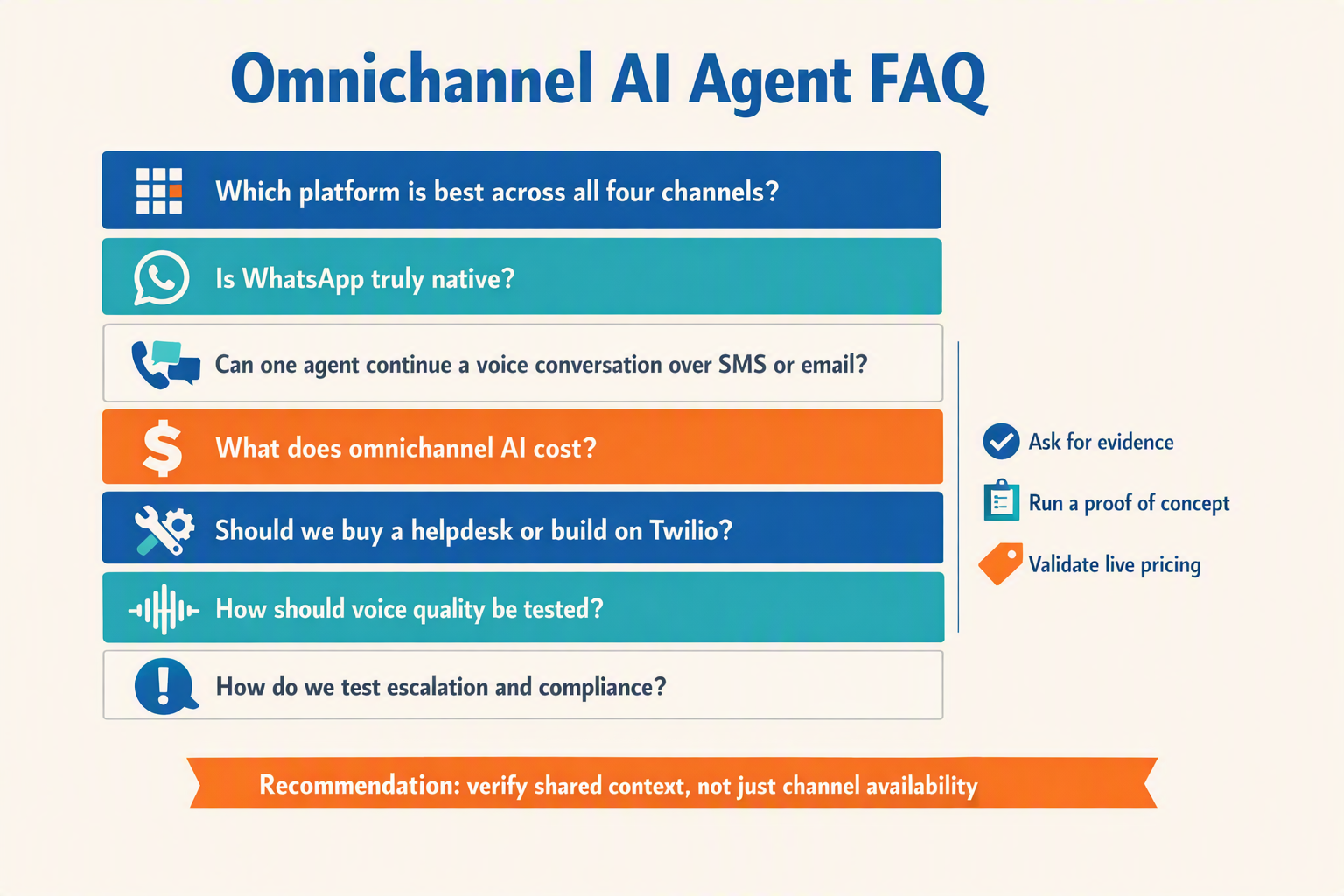
- Q: What is the best omnichannel AI agent platform for voice WhatsApp SMS and email in 2026?
A: The best choice depends on channel depth, shared customer context, workflow controls, integrations, compliance, and total cost—not merely the number of channels listed. India-focused teams may consider CallMissed for AI voice, WhatsApp messaging and Business calling, email workflows, CRM, and support for 22 Indian languages; buyers needing SMS should verify that requirement separately.
- Q: How should buyers compare the best omnichannel AI agent platform for voice WhatsApp SMS and email?
A: Test each channel natively and confirm that conversation history, customer data, knowledge-base access, analytics, and automation rules carry across channels. Lorikeet targets regulated B2C and B2SMB scale-ups across voice, SMS, chat, email, and WhatsApp, while Kayako focuses on email, chat, social, and in-app support.
- Q: What selection checklist should buyers use?
A: Check five areas: shared context across channels; reliable human handoff; required channel coverage, including voice and WhatsApp Business calling; relevant compliance and data controls; and total cost, including seats, AI usage, telephony, WhatsApp fees, SMS volume, and email delivery.
- Q: Can an AI agent handle WhatsApp Business voice calls as well as messages?
A: Only some platforms support both. Verify whether WhatsApp Business calling is genuinely available rather than assuming WhatsApp support includes voice. CallMissed can bridge inbound and business-initiated WhatsApp Business calls to an AI voice agent.
- Q: Do omnichannel AI agents support regional languages in India?
A: Coverage varies by provider and may differ between speech recognition and text-to-speech. CallMissed offers Indic-first voice capabilities across 22 Indian languages, making it relevant for teams serving multilingual audiences beyond English and Hindi.
- Q: Is the best omnichannel AI agent platform for voice WhatsApp SMS and email suitable for custom workflows?
A: It should be if it provides APIs, webhooks, model flexibility, and dependable fallback behaviour—not just a packaged inbox. CallMissed’s OpenAI-compatible gateway uses one API key for LLM, speech, image-generation, and web-search models, with same-tier fallbacks.
- Q: How much does an omnichannel AI agent platform cost?
A: Compare total cost rather than headline pricing. Costs can include software seats, AI usage, telephony, WhatsApp fees, SMS volume, and email delivery. Kayako lists pricing from $1 per resolved ticket, while CallMissed uses transparent credits at 1 credit = ₹1, with free-tier and pay-as-you-go access.
Conclusion
The best omnichannel AI agent platform in 2026 depends on channel depth and business priorities—not logo counts.
- CallMissed fits India-focused teams needing WhatsApp messaging and Business calling, AI voice agents, email workflows, CRM, and support across 22 Indian languages.
- Lorikeet suits configurable, regulated workflows spanning voice, SMS, chat, email, and WhatsApp.
- Kayako remains relevant for shared-inbox support, while developer-led teams may value CallMissed’s multi-model API gateway.
Watch for deeper voice handoffs, shared context, and transparent pricing. Explore CallMissed—which platform best matches your next customer journey?
Related Reading
- Omnichannel AI Customer Service in 2026: CallMissed Guide to Voice, WhatsApp, and Email
- Best WhatsApp AI Agent Platform in 2026: A Decision-Ready Comparison
- Best WhatsApp AI Agent Platform in 2026: Pricing, Features, and Fit Compared