Qwen3.5 vs GLM-5.2: Chinese-English Translation Guide



Compare Qwen3.5 vs GLM-5.2 for Chinese-English translation with sourced specs, reported prices, evidence gaps, and a reproducible testing plan.
Qwen3.5 vs GLM-5.2: Chinese-English Translation Guide
A newer model is not automatically a better translator: as of October 2026, the supplied sources do not establish that GLM-5.2 outperforms Qwen3.5 for Chinese-English translation. The Qwen3.5 vs GLM-5.2 comparison therefore needs translation-specific evidence—not a winner inferred from coding benchmarks, parameter counts, or release dates.
The timing makes this comparison relevant. AI Release Tracker dates Alibaba’s Qwen3.5 release to February 16, 2026, while LLM Stats dates Z.ai’s GLM-5.2 release to June 16, 2026. Both entered the market this year, but the supplied research emphasizes model specifications and coding performance rather than a controlled Chinese-English translation comparison. For businesses translating contracts, customer messages, or product documentation, that distinction matters: fluent English can still conceal an incorrect obligation, omitted qualifier, or mistranslated technical term.
Is GLM-5.2 better than Qwen3.5 for Chinese-English translation?
There is no demonstrated translation winner in the supplied evidence as of October 2026. Featherless reports GLM-5.2’s strong results on FrontierSWE, PostTrainBench, and SWE-Marathon following its June 16, 2026 release; those are coding benchmarks, not direct measurements of Chinese-English translation quality.
Qwen’s official announcement identifies its initial Qwen3.5 release as Qwen3.5-397B-A17B. That product identity helps readers specify which model they are comparing, but it does not establish translation accuracy. A useful comparison must identify the exact versions, prompts, and evaluation conditions before drawing conclusions.
What should a Chinese-English translation comparison measure?
The practical question is which model preserves meaning most reliably for your text type and translation direction. Chinese-to-English marketing copy, English-to-Chinese technical instructions, and bilingual legal documents require different judgments.
This guide will explain how to examine:
- Meaning preservation: Does the translation retain conditions, negation, quantities, and who must do what?
- Terminology consistency: Are product names and specialist terms translated consistently across a document?
- Idioms and register: Does the output preserve the intended tone without becoming unnaturally literal?
- Unsupported additions: Does the model introduce explanations or claims absent from the original?
- Operational trade-offs: What are the cost and response-time implications under the same workload?
For example, translating “原则上不予退款” requires preserving the qualification “in principle,” rather than silently turning the sentence into an absolute no-refund policy. A polished sentence is not enough if the policy’s meaning changes.
How can teams make the comparison useful?
The guide will outline a repeatable, blinded evaluation using identical source passages, shared terminology instructions, and bilingual review. It will also separate published specifications from translation results that still need testing.
As of October 2026, CallMissed’s OpenAI-compatible developer API supports existing SDK integrations through a base-URL change—an example of the broader move toward reusable AI infrastructure, without implying that either specific model is available in its catalogue.
The goal is a defensible choice, not a headline-driven verdict.
Is GLM-5.2 better than Qwen3.5 for Chinese-English translation? The supplied sources do not establish a winner. Choosing between them requires testing exact variants on the same bilingual texts; coding benchmarks do not establish translation quality.
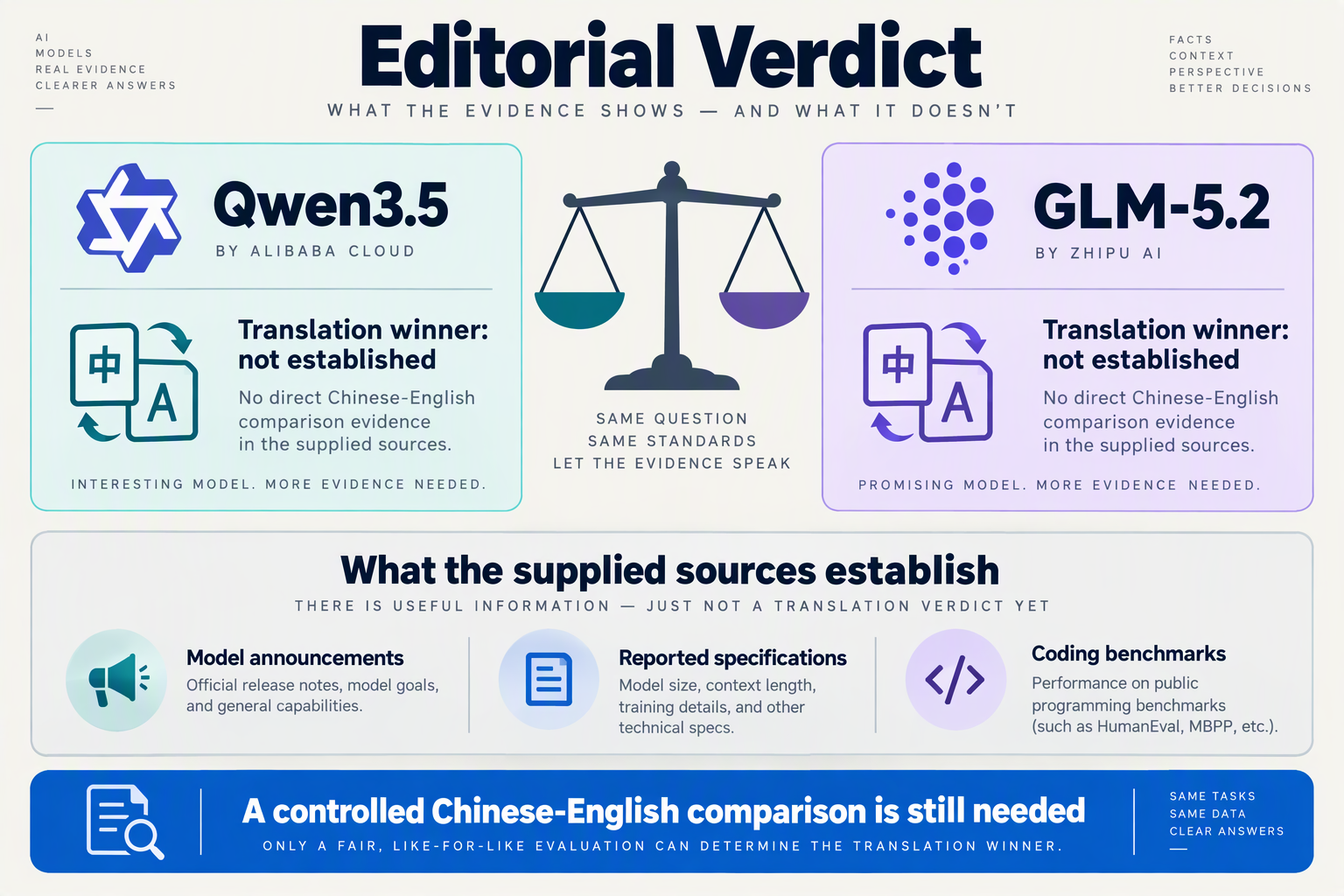
The supplied sources do not establish whether GLM-5.2 is better than Qwen3.5 for Chinese-English translation as of October 2026. Treat translation superiority as an untested claim, not a consequence of coding scores or model size.
What does the available evidence actually establish?
- GLM-5.2: LLM Stats lists Z.ai’s June 16, 2026 release with 753 billion parameters and a 1 million-token context window, as reported in the supplied October 2026 research. These specifications describe capacity, not demonstrated bilingual accuracy: neither measures whether a translation preserves a contractual exception or correctly resolves an ambiguous Chinese subject.
- Qwen3.5: Qwen’s official announcement names the initial open-weight model Qwen3.5-397B-A17B, while AI Release Tracker dates its release to February 16, 2026. For an October 2026 comparison, record that complete identifier rather than simply “Qwen3.5”; a family name alone does not adequately identify the system producing the translations.
- Source consistency: The supplied October 2026 research contains conflicting Qwen3.5 descriptions: AI Release Tracker identifies a 397B model, whereas RunThisModel describes six sizes spanning 0.5B–72B. Do not combine those descriptions into one definitive specification. Use Qwen’s official announcement to identify the initial release, and verify any additional variant separately.
- Benchmark relevance: Featherless’s report on the June 16, 2026 GLM-5.2 release names FrontierSWE, PostTrainBench, and SWE-Marathon as coding benchmarks. The supplied sources provide no matched Chinese-English translation scores, bilingual reviewer results, or translation error rates for these two models. That absence supports “no established winner,” not “equal translation quality.”
What evidence would justify choosing one translator?
- Exact configurations: Save the model identifier, hosting provider, test date, system prompt, terminology glossary, and generation settings for both candidates. Use identical translation instructions and disallow explanatory additions. Otherwise, an apparent model advantage may reflect a better prompt, a different variant, or different inference settings rather than stronger Chinese-English translation.
- Matched bilingual tests: As a practical starting protocol—not a published benchmark—evaluate 100 passages: 50 Chinese-to-English and 50 English-to-Chinese. Divide them across customer support, technical documentation, commerce, legal language, and idiomatic prose. Report results by direction and domain; one aggregate score can hide failures in the category your business actually needs.
- Blinded error counts: Have two bilingual reviewers assess anonymized outputs for omissions, additions, terminology errors, incorrect numbers, and register mismatches. Track serious meaning errors separately from stylistic preferences. A model that wins more fluency judgments but changes payment conditions should not automatically win a business translation evaluation.
- Deployment relevance: As of October 2026, CallMissed’s verified developer offering includes an OpenAI-compatible API, usage and request logs, and caller-chosen fallback models. These capabilities can support instrumented model comparisons, but the fact sheet does not confirm either exact candidate’s availability. Verify access first; gateway convenience is not evidence of translation superiority.
What launched, and how do the exact models compare on context, size, and modalities?
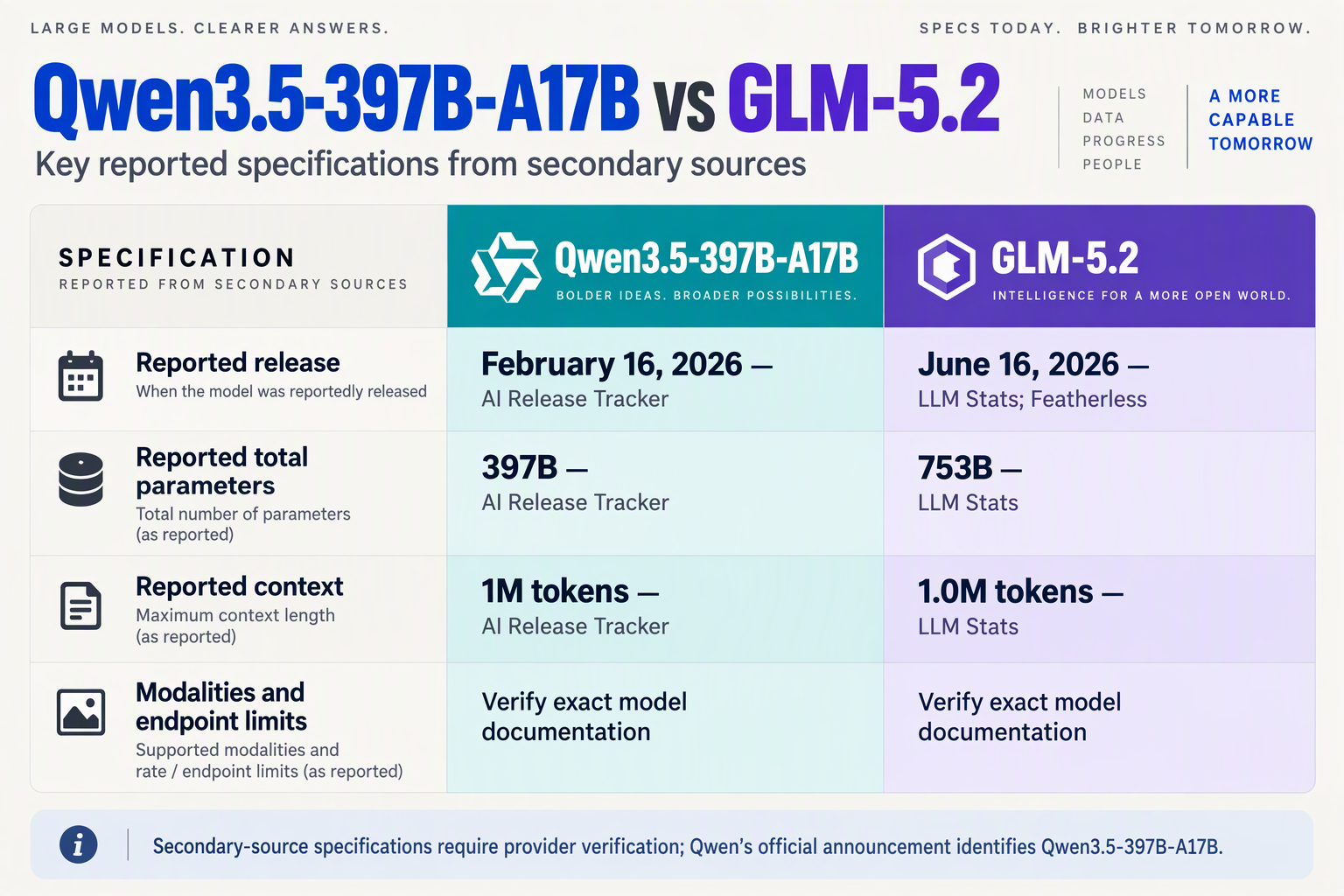
Qwen3.5-397B-A17B and GLM-5.2 have reported million-token context windows, but their size and modality evidence differ. As of October 2026, the supplied sources identify Qwen’s launch model precisely; they do not provide equally complete, model-specific modality documentation for either side.
What are the exact Qwen3.5 and GLM-5.2 specifications?
| Specification | Qwen3.5 | GLM-5.2 | Source and qualification |
|---|---|---|---|
| Launch identity | Qwen3.5-397B-A17B | GLM-5.2 | Qwen’s official announcement; LLM Stats, checked against supplied context as of October 2026 |
| Release date | February 16, 2026 | June 16, 2026 | AI Release Tracker; LLM Stats |
| Reported parameter count | 397 billion | 753 billion | AI Release Tracker; LLM Stats, as of October 2026 |
| Reported context window | 1 million tokens | 1 million tokens | AI Release Tracker; LLM Stats, as of October 2026 |
| Weight availability / license | Officially announced as open-weight; license unspecified in supplied excerpt | Open weights reported; MIT license listed | Qwen; Semgrep; LLM Stats, as of October 2026 |
| Model-specific modalities | Not established by supplied announcement excerpt | Described as a language model; image/audio support not established | Qwen; LLM Stats, as of October 2026 |
- Qwen3.5: Qwen’s February 2026 announcement calls Qwen3.5-397B-A17B “the first model in the Qwen3.5 series.” Use that exact identifier in evaluation records: a family name alone does not establish which weights or hosted variant produced a translation.
- GLM-5.2: Semgrep distinguishes Coding Plan access on June 13, 2026 from open weights and release notes on June 16, 2026. This explains apparently conflicting launch dates without treating early access and public weight release as identical events.
- Parameter counts: As of October 2026, AI Release Tracker lists Qwen3.5 at 397B parameters, while LLM Stats lists GLM-5.2 at 753B parameters. These reported totals do not establish active inference parameters, deployment memory requirements, or translation accuracy.
Does a million-token context window improve bilingual translation?
- Context capacity: As of October 2026, AI Release Tracker and LLM Stats each report 1M-token context for the respective models. That is a capacity specification—not evidence that either reliably preserves terminology, exceptions, or cross-references throughout a million-token document.
- Practical test: Compare a Chinese contract clause first in isolation, then with its definitions and referenced schedules. Record whether added context corrects terminology or introduces omissions; identical advertised context limits do not guarantee identical document-level translation behavior.
Which modality and deployment claims need verification?
- Modalities: Qwen’s supplied page mentions image and video understanding, image generation, and document processing at the broader product level. As of October 2026, that excerpt does not establish which capabilities belong specifically to Qwen3.5-397B-A17B; verify the endpoint before testing scanned documents.
- Pricing: As of October 2026, LLM Stats lists GLM-5.2 at $0.750 per million input tokens, $0.140 per million cached-input tokens, and $2.40 per million output tokens. The supplied context provides no matched Qwen3.5 price, so a defensible cost comparison remains incomplete.
- Integration: As of October 2026, CallMissed offers an OpenAI-compatible developer API and caller-chosen fallback models. For a controlled comparison, record the exact model and any fallback used; the supplied CallMissed facts do not confirm availability of these two specific versions.
What would a fair Chinese-to-English and English-to-Chinese benchmark measure?
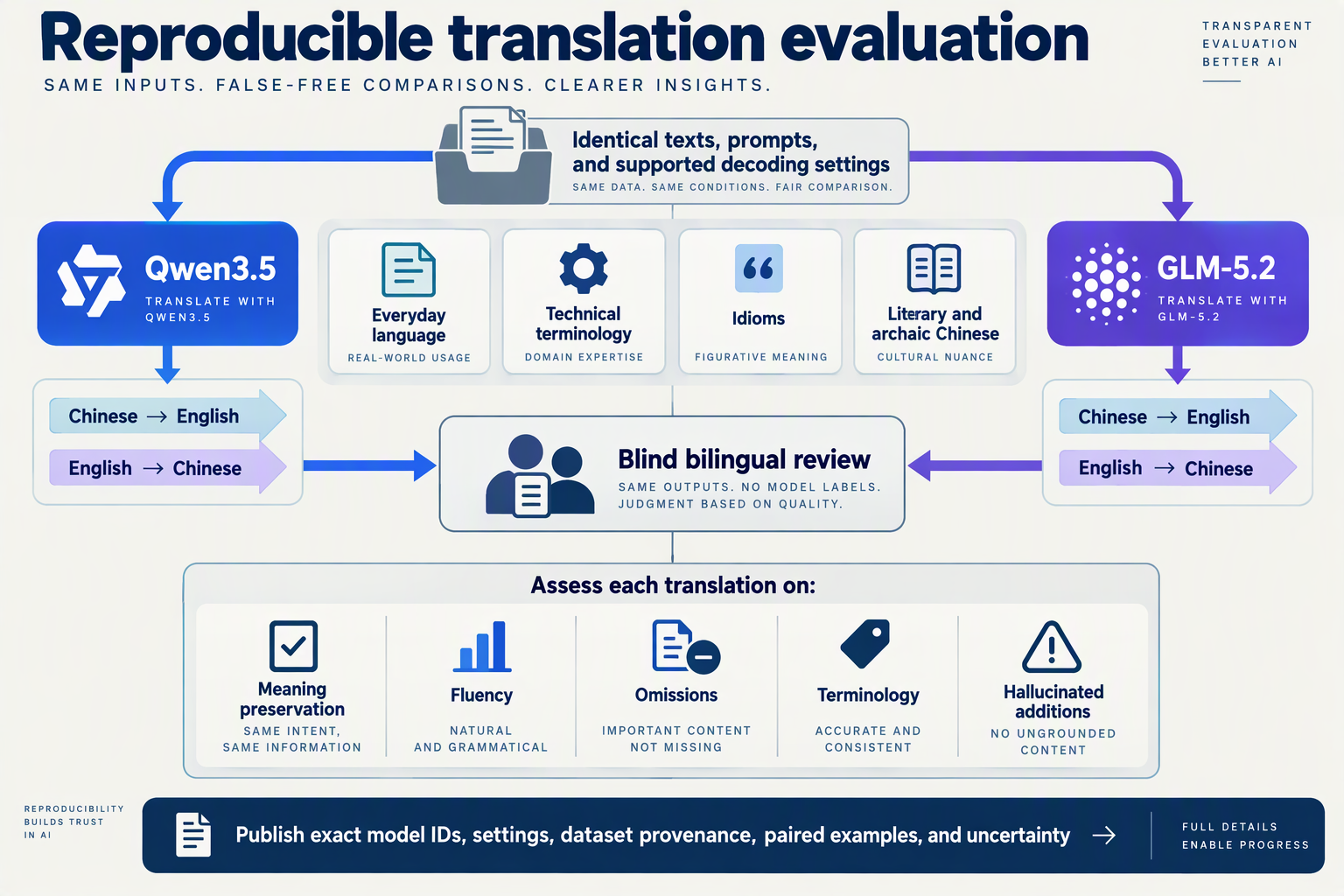
A fair benchmark would measure translation accuracy in both directions, using blinded bilingual review and identical test conditions. The following is a proposed evaluation protocol for October 2026, not a claim about either model’s measured performance.
How should teams benchmark GLM-5.2 against Qwen3.5 for translation?
- Directional coverage: Build 400 held-out passages, split equally between Chinese-to-English and English-to-Chinese. Within each direction, allocate 50 passages each to customer support, technical documentation, commercial/legal text, and marketing. Report all eight direction-domain results separately: an aggregate score can conceal a model that handles English output well but produces weaker Chinese.
- Exact model identity: Record the model identifier, provider, test date, and inference settings for every request. Qwen’s official announcement identifies the initial Qwen3.5 model as Qwen3.5-397B-A17B, according to the supplied context available in October 2026. Do not combine results from different Qwen3.5 variants or silently substitute a provider alias during testing.
- Meaning-preservation errors: Count omissions, additions, mistranslations, and incorrect numbers or units per 1,000 source characters, separately by direction. Classify errors as minor, major, or critical using a written rubric. For example, translating “不得超过人民币五万元” as “at least RMB 50,000” should trigger a critical error because the upper limit becomes a lower limit.
- Terminology and writing conventions: Give both models the same 30-entry bilingual glossary and measure compliance across repeated occurrences. Include simplified Chinese, traditional Chinese, abbreviations, product names, and locale-specific dates. Score naturalness separately from correctness: a fluent translation should not earn back points lost for changing an obligation, technical instruction, or named entity.
- Document-level consistency: Test 20 multi-paragraph documents within the 400-passage set, preserving headings and surrounding context. Check whether pronouns, defined terms, speaker relationships, and repeated terminology stay consistent across paragraphs. Keep short-passage and document results separate; neither a large advertised context window nor excellent sentence-level output establishes reliable document translation.
- Blinded human assessment: Assign two bilingual reviewers to every paired output, randomize presentation order, and hide model names. Have a third reviewer adjudicate disagreements involving major or critical errors. Publish win, tie, and loss rates with confidence intervals, alongside severity counts; automatic similarity scores can supplement this review but should not determine the winner alone.
- Reproducibility controls: Freeze prompts, glossary instructions, output limits, and retry policies, then repeat a 40-passage subset three times to assess variation. As of October 2026, CallMissed’s verified fact sheet lists OpenAI-compatible endpoints and usage/request logs—capabilities relevant to reproducible evaluation workflows, without establishing that either specific model is available through CallMissed.
- Operational efficiency: Report billed cost per 1,000 source characters, median latency, and 95th-percentile latency alongside quality. In the supplied October 2026 context, LLM Stats lists GLM-5.2 at $0.750 per million input tokens and $2.40 per million output tokens. Treat these as listed rates, not measured translation costs; obtain comparable Qwen3.5 pricing and measure actual token usage before claiming better value.
How much does each model cost, and what is the cost of an acceptable translation?
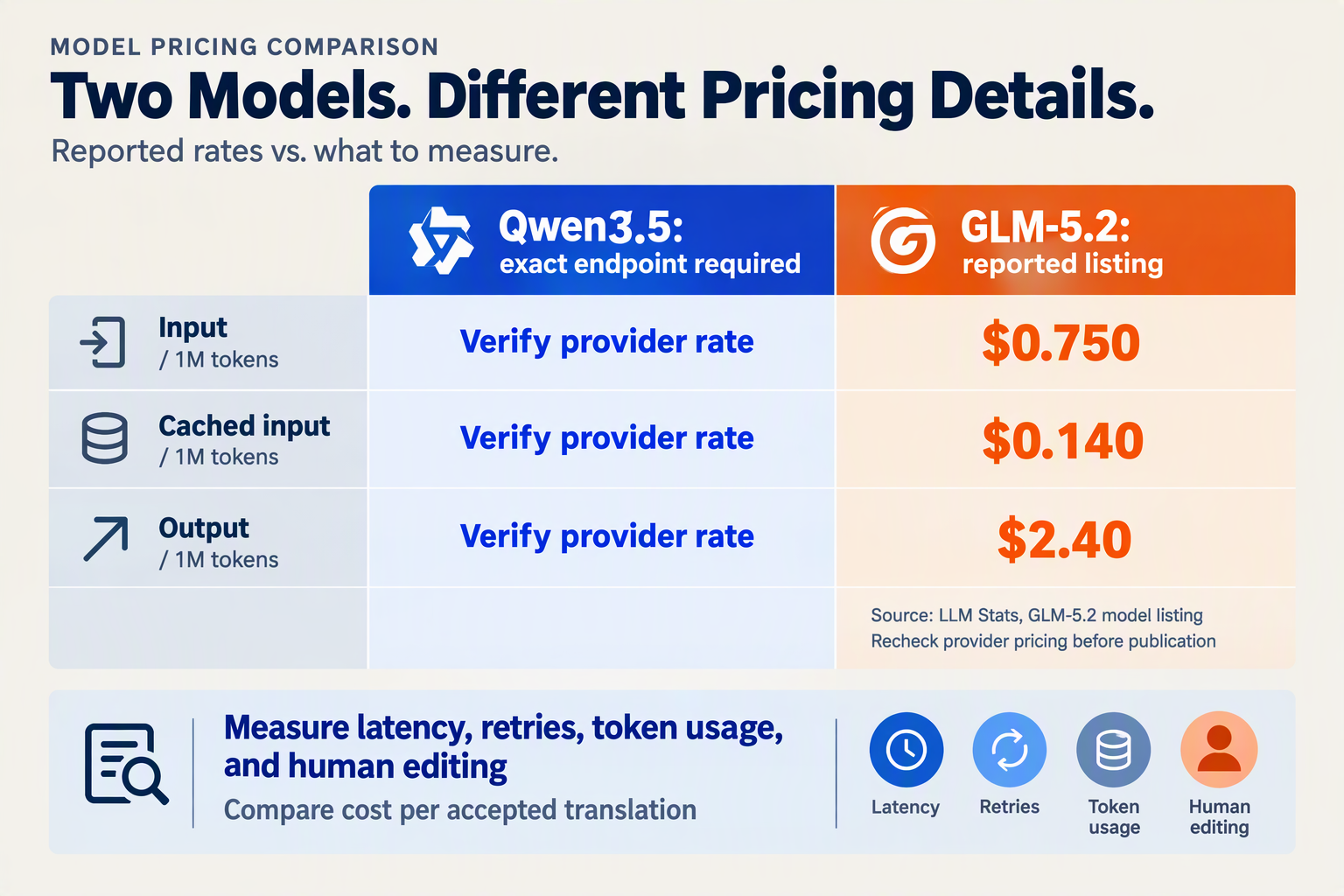
GLM-5.2 has a published starting API price; the supplied sources do not provide a comparable Qwen3.5 API price. As of October 2026, neither model has enough translation-specific evidence here to establish the lower cost per acceptable Chinese-English translation.
How do GLM-5.2 and Qwen3.5 API costs compare?
| Cost item | GLM-5.2 | Qwen3.5 | Evidence or implication |
|---|---|---|---|
| Input tokens | From $0.750/million | Not supplied | LLM Stats; October 2026 comparison |
| Cached input tokens | From $0.140/million | Not supplied | LLM Stats; cache eligibility matters |
| Output tokens | From $2.40/million | Not supplied | LLM Stats; October 2026 comparison |
| 2,000 input + 1,000 output tokens | $0.00390 | Cannot calculate | Illustrative uncached request |
| Same request, fully cached input | $0.00268 | Cannot calculate | Illustrative; assumes eligible input |
| Self-hosting expenditure | Not supplied | Not supplied | Requires infrastructure estimates |
- GLM-5.2: LLM Stats lists starting prices of $0.750 per million input tokens, $0.140 per million cached input tokens, and $2.40 per million output tokens in the supplied evidence used for this October 2026 comparison; these are starting rates, not a universal provider quote.
- Qwen3.5: Qwen’s official announcement identifies Qwen3.5-397B-A17B, but supplies no API tariff in this research; obtain a dated quote for the exact endpoint rather than substituting another Qwen model’s price.
- Open weights: AI Release Tracker describes Qwen3.5 as open-weight, while LLM Stats reports GLM-5.2 under the MIT license; neither statement establishes zero operating cost, because hosting still requires compute, deployment, and maintenance.
What is the cost of an acceptable translation?
Cost per acceptable translation = total translation-workflow spending ÷ translations that pass your acceptance criteria. Include failed attempts, retries, bilingual review, and editing—not just the successful request’s token bill.
- Worked example: At the listed GLM-5.2 starting rates, 2,000 uncached input tokens plus 1,000 output tokens cost $0.00390:
(2,000 × $0.750 + 1,000 × $2.40) ÷ 1,000,000; this October 2026 illustration excludes hosting overhead and human review. - Acceptance sensitivity: For 1,000 such requests, API spending totals $3.90; hypothetical acceptance rates of 90% and 80% produce costs of $0.00433 and $0.00488 per accepted translation, respectively—not measured results for either model.
- Review sensitivity: Assuming 30 seconds of review per attempt at $24/hour, review adds $0.20 per attempt; at hypothetical 90% acceptance, API-plus-review cost becomes approximately $0.2266 per accepted translation, making reviewer effort the dominant expense.
How should teams compare translation spending fairly?
- Fix the workload: Use identical Chinese-English passages and terminology instructions, but record each endpoint’s actual billed tokens; equal text does not guarantee equal token counts.
- Record the configuration: Log provider, model version, output limits, cache usage, reasoning settings, retries, and reviewer minutes alongside the October 2026 price quote.
- Compare accepted outputs: As of October 2026, CallMissed’s verified developer offering includes an OpenAI-compatible API, usage logs, and request logs—useful infrastructure for cost tracking, without implying that either specific model is available through CallMissed.
What are the evidence-backed pros and cons of each model?
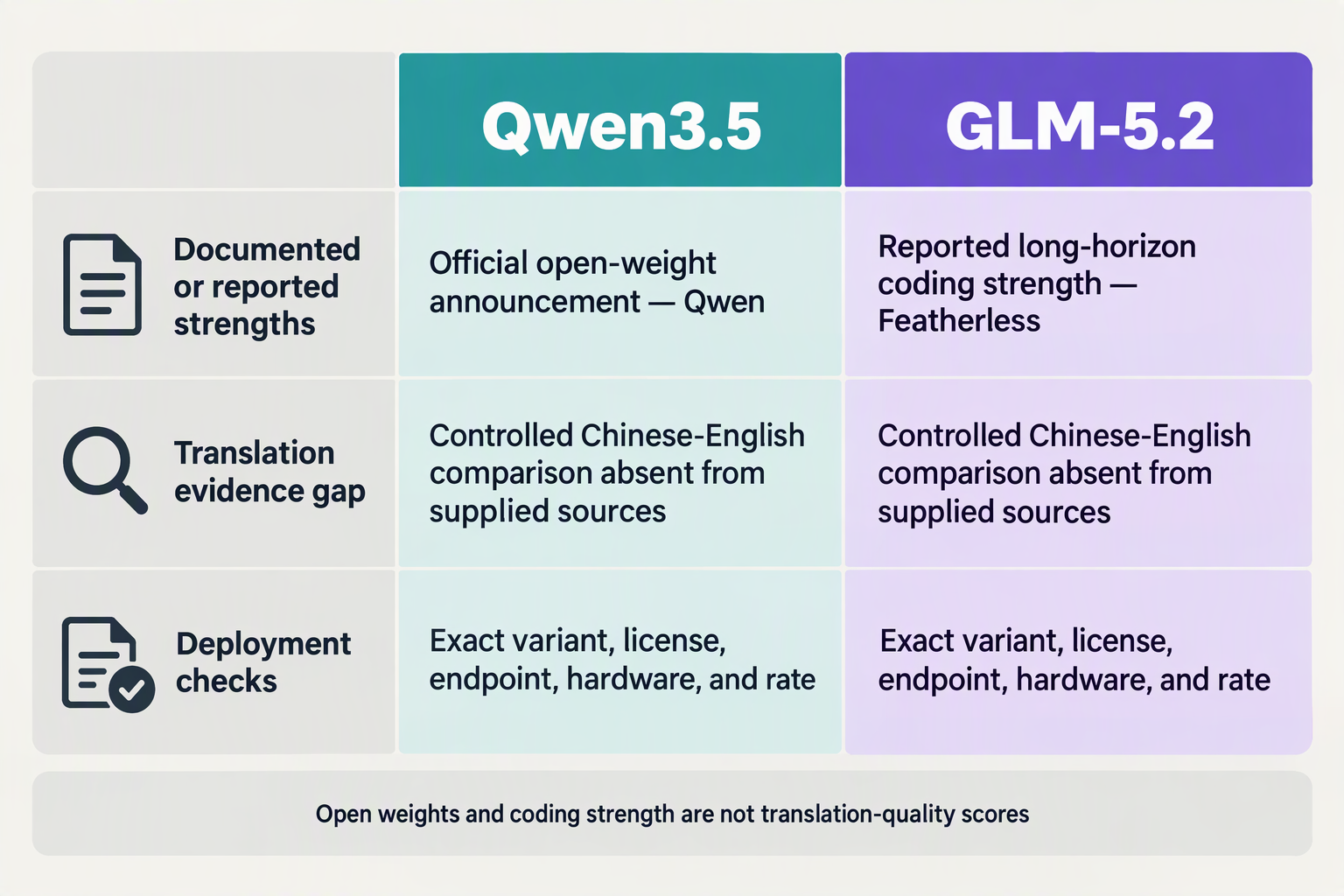
GLM-5.2 offers documented pricing and licensing advantages; Qwen3.5 offers officially confirmed open weights. Neither has a demonstrated Chinese-English translation advantage in the supplied evidence as of October 2026.
| Evidence area | GLM-5.2: advantage or limitation | Qwen3.5: advantage or limitation | Translation implication |
|---|---|---|---|
| Translation accuracy | No direct Chinese-English score supplied | No direct Chinese-English score supplied | Neither deserves a quality-win claim |
| Model identity | LLM Stats lists 753B parameters, as of October 2026 | Qwen officially identifies Qwen3.5-397B-A17B; AI Release Tracker lists 397B parameters, as of October 2026 | Parameter counts are not translation scores |
| Long-document capacity | LLM Stats lists a 1.0M-token window, as of October 2026 | AI Release Tracker lists a 1M-token window, as of October 2026 | Both warrant long-document testing; capacity does not prove consistency |
| API budgeting | LLM Stats lists $0.750/M input and $2.40/M output tokens, as of October 2026 | No comparable API price supplied, as of October 2026 | GLM-5.2 is easier to budget from this evidence, not demonstrably cheaper |
| Deployment control | LLM Stats reports an MIT license permitting commercial use, as of October 2026 | Qwen’s official announcement confirms downloadable open weights, as of October 2026 | Deployment flexibility differs from translation reliability |
| Benchmark relevance | Featherless reports strong coding results following the June 16, 2026 release | No translation-specific benchmark supplied, as of October 2026 | Coding evidence cannot settle this comparison |
What are GLM-5.2’s practical pros and cons?
- GLM-5.2: Its published token rates enable a worked budget: 100,000 input tokens plus 100,000 output tokens cost $0.315, using LLM Stats’ October 2026 rates, before other charges.
- GLM-5.2: LLM Stats lists $0.140/M cached input tokens as of October 2026, but savings depend on provider caching rules; do not assume every repeated glossary qualifies.
- GLM-5.2: Digital Applied reports Z.ai’s claim of “usable 1M-token context” in the supplied 2026 coverage; this supports testing whole-document workflows, not assuming accurate terminology throughout.
What are Qwen3.5’s practical pros and cons?
- Qwen3.5: Qwen’s official announcement confirms Qwen3.5-397B-A17B open weights, as of October 2026; local deployment offers control but requires separately budgeting infrastructure and operations.
- Qwen3.5: The supplied sources disagree on family specifications: AI Release Tracker lists 397B, while RunThisModel describes 0.5B–72B sizes; verify the exact checkpoint rather than combining those claims.
- Qwen3.5: Missing comparable API prices and translation scores prevent a defensible cost-quality ranking; obtain a dated provider quote and test the same Chinese-English passages.
Which advantages should determine your choice?
Treat deployment control, documented cost, and translation accuracy as separate purchasing criteria. For example, legal translation should prioritize preserved obligations and qualifiers over context-window size; catalog translation should also measure glossary consistency and human correction time.
As of October 2026, CallMissed, the OpenAI-compatible developer AI API, supports caller-chosen fallback models and usage and request logs. Those capabilities can support evaluation workflows, but the verified fact sheet does not establish availability of either exact model version or a translation-quality advantage.
Which should you choose for everyday, technical, literary, or under-70B translation?
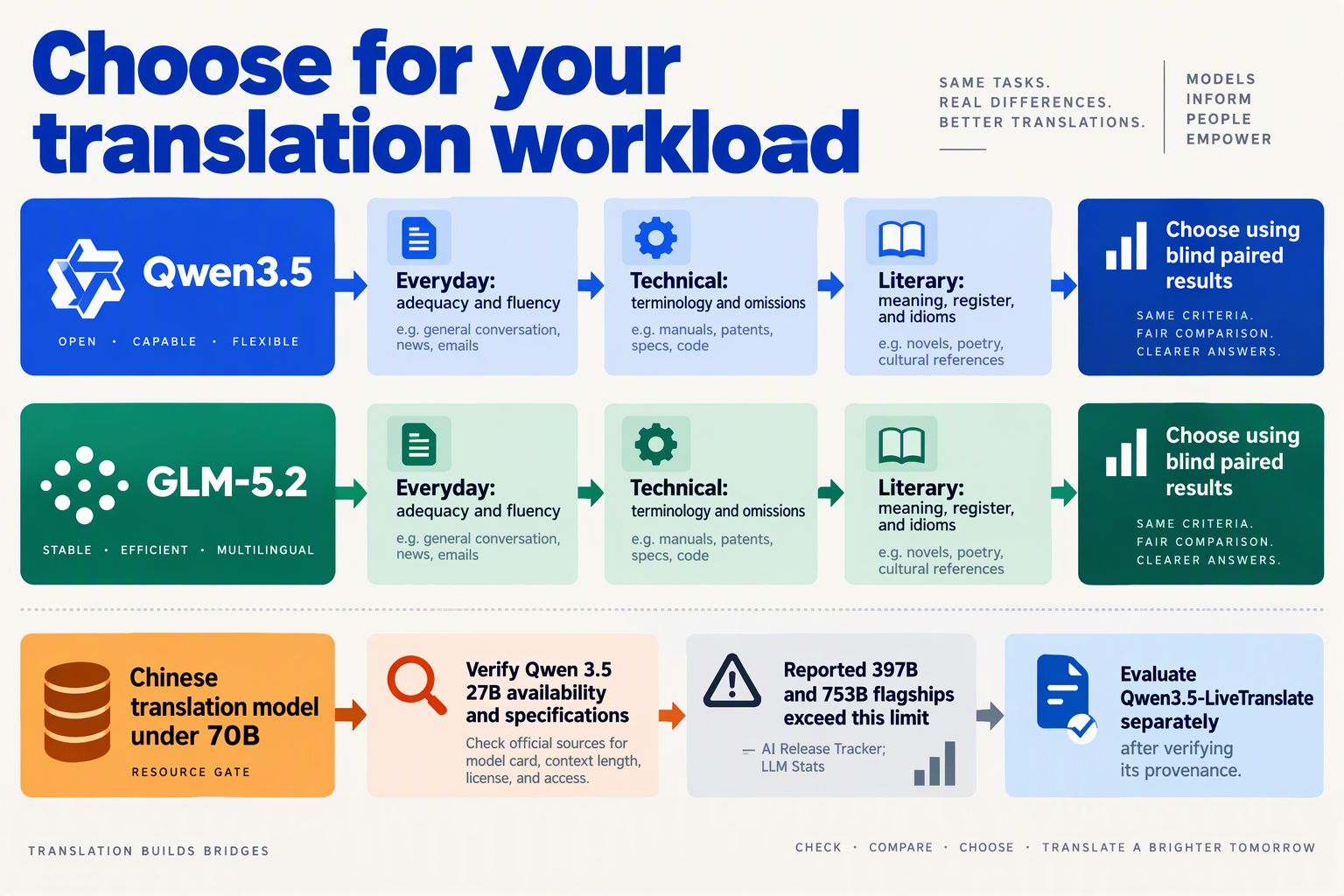
Choose GLM-5.2 or Qwen3.5 by translation workload, not a presumed overall ranking. As of October 2026, the supplied evidence supports deployment and cost comparisons, but not a Chinese-English translation-quality winner.
Which model should you choose for everyday, technical, or literary translation?
- Everyday translation: For Chinese-English emails, chat messages, and product descriptions, choose whichever exact model meets your quality threshold at the lower measured cost. Test short, context-poor messages such as “方便的话今天处理一下”: the translation should preserve the polite qualification rather than turn the request into an unconditional deadline. Neither supplied source establishes superiority for this workload.
- Technical translation: Make glossary compliance and preservation of requirements your deciding factors. For example, “不得超过5毫米” must retain both the prohibition and the 5 mm limit; “should not exceed” can weaken a mandatory instruction. Require consistent translations of component names, units, warnings, and version identifiers before accepting either model for production documentation.
- Literary translation: Choose through bilingual editorial review, with separate judgments for imagery, narrative voice, and meaning. Ask each candidate for two versions—one close to the source and one publication-oriented—then inspect whether creative phrasing introduces information. This is a recommended workflow, not evidence that GLM-5.2 or Qwen3.5 has a demonstrated literary advantage.
Which model should you choose with an under-70B parameter limit?
- Qwen3.5 flagship: Qwen’s official announcement identifies Qwen3.5-397B-A17B, while AI Release Tracker lists 397 billion parameters, as cited in the supplied research available in October 2026. That flagship does not satisfy a strict under-70B total-parameter requirement. Do not confuse a smaller active-parameter designation with the total weights required for deployment.
- GLM-5.2: LLM Stats lists 753 billion parameters for GLM-5.2 in the supplied October 2026 research, placing it outside an under-70B total-parameter limit too. If the restriction concerns infrastructure you operate, hosted access changes who manages the hardware; it does not make the underlying model smaller or satisfy a model-size policy.
- Smaller Qwen candidates: RunThisModel reports a Qwen3.5 lineup spanning 0.5B–72B parameters in the supplied October 2026 context, but that excerpt does not identify every checkpoint. Verify the exact model card before selecting an under-70B variant; 72B is over the limit. Treat smaller variants as separate translation candidates, not equivalent substitutes for the flagship.
How should cost and API access affect your choice?
- GLM-5.2 cost: As of October 2026, LLM Stats lists GLM-5.2 pricing from $0.750 per million input tokens and $2.40 per million output tokens. At those rates, 100,000 uncached input tokens plus 20,000 output tokens cost approximately $0.123, excluding other charges. No comparable Qwen3.5 price appears in the supplied context, so a cost winner remains unverified.
- CallMissed integration: As of October 2026, CallMissed’s verified fact sheet lists an OpenAI-compatible developer API, caller-chosen fallback models, and usage and request logs. Those capabilities can support routing and cost tracking across supported models, but the sheet does not confirm these exact two checkpoints. Verify availability before designing a comparison around a shared gateway.
How can you verify API availability and run the same translation test today?
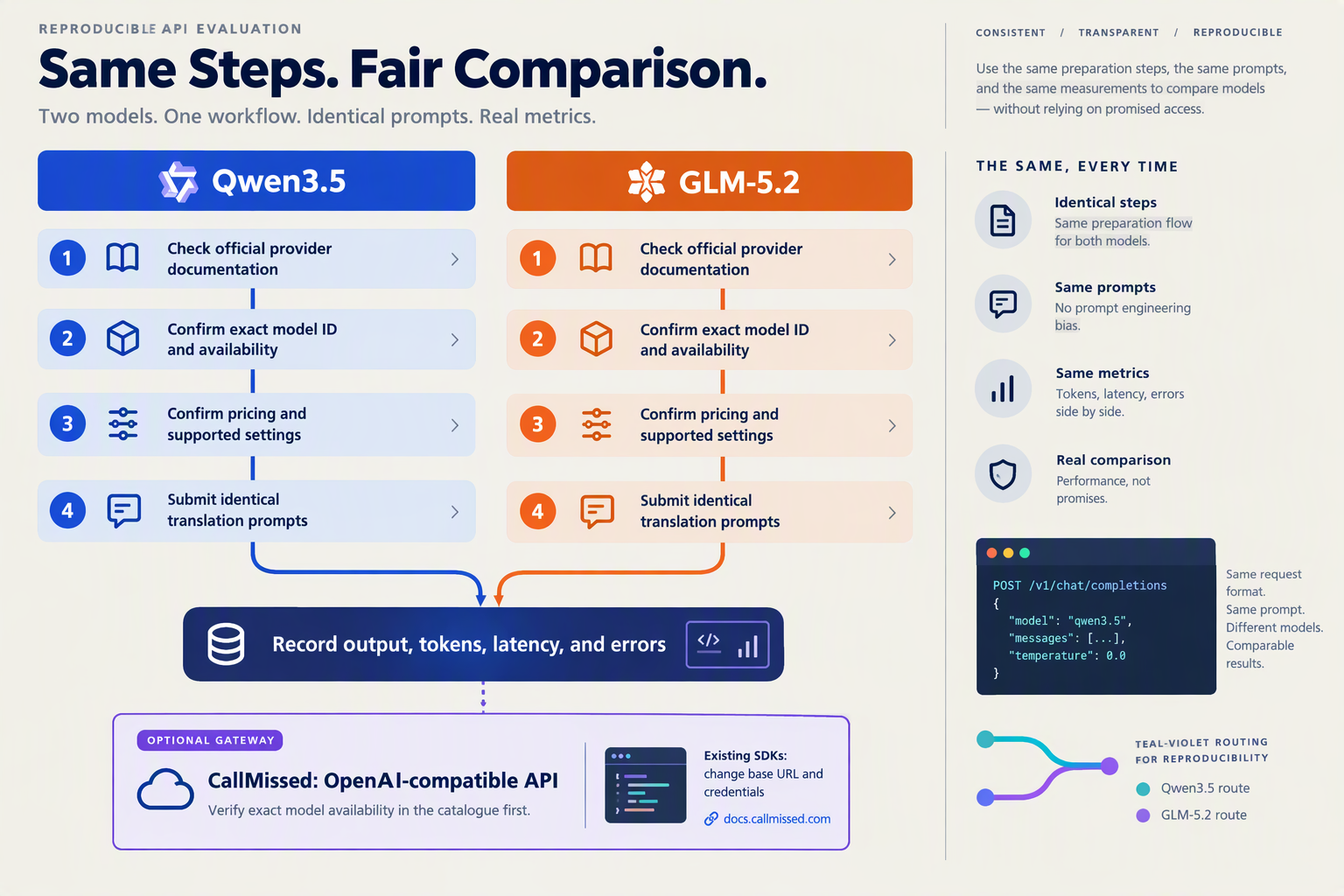
Verify exact model IDs and working API access, then test both models with identical Chinese-English inputs and settings. As of October 19, 2026, the supplied sources document release and hosting claims—not a live API check or a translation winner.
How do you confirm GLM-5.2 and Qwen3.5 API access?
- GLM-5.2: Featherless reports hosting GLM-5.2 from its June 16, 2026 launch. For an October 2026 test, check the provider’s current model catalogue, account permissions, and inference documentation, then submit one short Chinese-to-English request. Record the requested model ID, returned model identifier if available, HTTP status, and timestamp; a launch announcement alone does not establish that your account can access the endpoint today.
- Qwen3.5: Qwen’s official announcement identifies the initial open-weight release as Qwen3.5-397B-A17B, while AI Release Tracker dates Qwen3.5 to February 16, 2026. For October 2026 testing, confirm that your host serves that exact variant rather than a different Qwen checkpoint or moving alias. Downloadable weights establish a deployment option, not a particular provider’s API availability.
- Pricing: As of October 2026, the supplied LLM Stats listing quotes GLM-5.2 prices starting at $0.750 per million input tokens, $0.140 per million cached input tokens, and $2.40 per million output tokens. Verify your chosen provider’s actual rates before testing; the supplied context contains no equivalent Qwen3.5 API price. Keep cached and uncached runs separate rather than comparing unlike billing conditions.
- Gateway compatibility: As of October 2026, CallMissed’s verified fact sheet lists 124 models, OpenAI-compatible endpoints, usage logs, and caller-chosen fallback models. Its catalogue includes Zhipu models, but the sheet does not confirm GLM-5.2 or Qwen3.5 specifically. Check exact availability before choosing a gateway, and disable automatic substitution during a head-to-head test.
How do you run a reproducible Chinese-English translation test?
- Test set: Use a proposed 40-passage pilot: 20 Chinese-to-English and 20 English-to-Chinese, divided across customer support, technical instructions, commercial terms, and marketing. Freeze the source file and glossary before either run. Include names, dates, quantities, negation, and ambiguous clauses; this sample is a practical starting point, not a published benchmark.
- Shared prompt: Send both models: “Translate the following text into [target language]. Preserve meaning, numbers, names, qualifications, and formatting. Apply the supplied glossary. Return only the translation.” Keep prompts and passages identical, and use matching supported generation settings. Record unsupported settings rather than assuming two APIs interpret every parameter identically.
- Blind review: Have two bilingual reviewers independently score anonymized outputs from 0–5 for meaning preservation, terminology, fluency, and omissions or additions. Log critical errors separately, reconcile disagreements, and report results by translation direction and domain. A fluent sentence with an incorrect obligation should not disappear inside an overall average.
- Decision record: Save prompts, outputs, model IDs, settings, token usage, elapsed time, provider charges, and the October 19, 2026 test date. Report quality alongside cost per completed passage and median response time. Conclude “better for this tested workload” only when the results support it—not “universally better at Chinese-English translation.”
Frequently Asked Questions
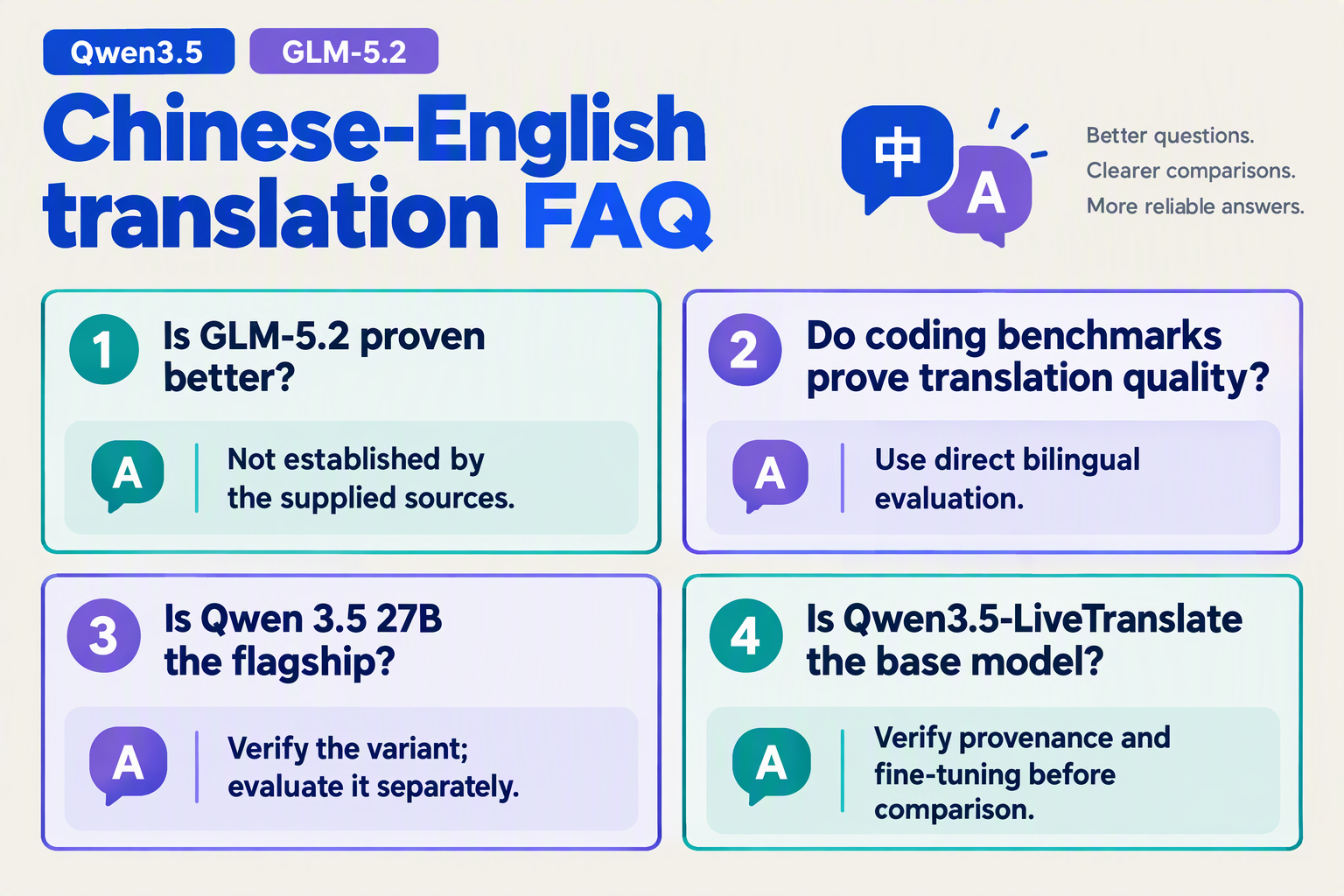
Is GLM-5.2 better than Qwen 3.5 for Chinese-English translation?
Is GLM-5.2 better than Qwen 3.5 for Chinese-English translation of legal documents?
Do GLM-5.2 coding benchmark scores predict Chinese-English translation quality?
Are Qwen 3.5 27B and Qwen3.5-LiveTranslate directly comparable?
How should I test GLM-5.2 against Qwen3.5 for Chinese-English translation?
Can an OpenAI-compatible API simplify a translation-model comparison?
Conclusion
As of October 2026, the supplied evidence does not establish that GLM-5.2 is better than Qwen3.5 for Chinese-English translation. The defensible conclusion is not a universal winner, but a practical recommendation: compare exact model versions on representative bilingual texts before choosing a translator for your workflow.
Four takeaways should guide that decision:
- Release dates and coding results do not prove translation superiority. AI Release Tracker dates Qwen3.5’s release to February 16, 2026, while LLM Stats dates GLM-5.2’s release to June 16, 2026. Featherless highlights GLM-5.2’s performance on FrontierSWE, PostTrainBench, and SWE-Marathon, but those coding benchmarks do not directly measure Chinese-English translation quality. A newer release can justify another evaluation; it cannot substitute for translation-specific evidence.
- Meaning preservation matters more than fluent wording. Evaluate whether each translation retains negation, quantities, conditions, responsibilities, and qualifications. The example “原则上不予退款” illustrates the risk: dropping “in principle” changes a qualified refund policy into an absolute prohibition. Terminology consistency, idiomatic expression, and appropriate register also matter, but polished language should never conceal an altered obligation or an unsupported addition. Reviewers should judge what the translation says, not simply how naturally it reads.
- Use a repeatable, blinded comparison rather than an impressionistic test. Specify the exact model versions, use identical source passages and shared terminology instructions, and ask bilingual reviewers to assess outputs without knowing which model produced them. Test Chinese-to-English and English-to-Chinese separately, because a result in one direction does not establish performance in the other. Include the text types you actually handle—such as contracts, customer messages, or technical documentation—rather than assuming one successful example settles the comparison.
- Choose for the workload, not just the model name. Assess cost and response time under the same conditions alongside translation quality. A model that works well for marketing copy may not be the preferred choice for technical instructions or legal language. Keep operational trade-offs visible, but do not let a faster response or a lower bill outweigh errors that change the source meaning. The useful outcome is a documented choice for a defined task, not an unsupported claim of overall superiority.
Looking ahead, watch for controlled Chinese-English translation evaluations that disclose model versions, prompts, translation direction, and bilingual review criteria. Those results—not another coding leaderboard—could materially change this conclusion.
As of October 2026, CallMissed’s OpenAI-compatible developer AI gateway is one platform readers can explore as multi-model AI workflows evolve. Its single-API approach offers a relevant way to consider model choice without treating any model as universally superior.
Before choosing Qwen3.5 or GLM-5.2, which one preserves the meaning of your own bilingual documents more reliably?